



Abstract
Migration and ethnic minority integration remain heavily contested issues in numerous European countries. Over the past decade, researchers and political commentators have observed an apparent retreat from multiculturalist policies related to a belief that multiculturalism has lost support among the majority public. Recently, however, based on analyses of the evolution of migrant integration policies, it has been demonstrated that multiculturalist policies were largely left in place. To investigate the effect of multiculturalist policies on public opinion, we use a multilevel analysis of three policy indicators (Multiculturalism Policy Index, Index of Citizenship Rights for Immigrants–Cultural diversity, and Migrant Integration Policy Index) and European Social Survey data in 20 European countries. Results show that multiculturalist policies, as measured by Multiculturalism Policy Index and Index of Citizenship Rights for Immigrants–Cultural diversity, and migrant integration policies more generally, as measured by Migrant Integration Policy Index, to some extent are associated with lower levels of anti-immigrant sentiments, while they do not affect public attitudes toward political institutions. Regarding political attitudes, especially respondents with higher education levels tend to respond in a more positive manner to multiculturalist policies than respondents with lower education levels.
Introduction
Although the conceptualization of multiculturalism is highly contested, at least three different meanings of the term can be distinguished (Berry & Sam, 2013). Multiculturalism can be interpreted as a demographic fact, as an ideology on how to deal with cultural diversity, and as a public policy that is based on this ideology. Regarding multiculturalism as a demographic fact, it can be observed that most countries in Western Europe are confronted with an ageing population, and the most likely scenario is that immigration will be needed to sustain the labor forces of European countries in the coming decades (Coleman, 2006; DeWaard, Kim, & Raymer, 2012). The implication of this scenario is that cultural diversity in Europe will continue to increase as it has done in the previous decades. Therefore, the discussion on migrant integration policies, and the future of multiculturalism as an ideology and public policy, is now as relevant as ever. At this point in time, however, the future of multiculturalism as an ideological or a policy concept is uncertain. On the one hand, prominent commentators have argued that multiculturalism is on the way out (Joppke, 2004). On the other hand, it has just as vehemently been argued that multiculturalism is still reflected in current migrant integration policies in many countries and thus appears here to stay (Banting & Kymlicka, 2013).
Following political theorists such as Kymlicka (1995), the political ideology and policy of multiculturalism can be defined as one that advocates equal recognition of the rights and the heritage of diverse cultural groups in society. In this contribution, we will investigate whether multiculturalist policies have an effect on public opinion with regard to immigration and ethnic diversity, as is often argued. To investigate this relation, we test how policies that should stimulate equality in the multiculturalist sense are related to public attitudes toward immigration and minorities and to attitudes toward the political system. If the claim that the public in Europe has developed a negative attitude toward multiculturalism is valid, as current day political actors seem to believe, then policies that are regarded to promote multiculturalism can be expected to have a negative effect on public attitudes toward immigration and minorities and a negative effect on trust in and satisfaction with political institutions.
Our analysis builds on two lines of research. Sociological research, on the one hand, has previously focused on the effect of multiculturalist policies on integration outcomes such as labor market participation (Koopmans, 2010). Research in the field of social psychology, on the other hand, has focused on the micro-level relation between support for assimilationist or multiculturalist ideologies and anti-immigrant attitudes (Verkuyten, 2011). We use an interdisciplinary perspective, investigating the effect of actual policies on anti-immigrant and anti-political establishment attitudes among the general public.
We use data from the European Social Survey (ESS; 5th wave, 2010) to analyze attitudes toward minorities, immigration, and the political elite. Based on the Multiculturalism Policy Index (MCP), the Index of Citizenship Rights for Immigrants (ICRI), and the Migrant Integration Policy Index (MIPEX), we investigate the influence of migrant integration policies on these attitudes in 20 European countries using multilevel models. It has to be clear that the MIPEX index focuses on individual rights for migrants, and therefore should not be seen an operationalization of multiculturalist policies. The MIPEX index, however, can be considered as a proxy for the extent to which migrant integration policies encourage cultural diversity and take a more liberal (rather than restrictive) approach toward migrants. In this manner, it provides a useful counterpoint to the ICRI and MCP indices, which more closely operationalize the extent to which migrant integration policies can be seen as multiculturalist.
Multiculturalist Policies and Public Reactions in Europe
Around the turn of the millennium, European societies have witnessed a strong backlash against the multiculturalist ideology and politics of the preceding decades (Taras, 2013). In an influential article, Joppke (2004) has argued that the retreat from multiculturalism was not limited to political rhetoric, but encompassed theoretical critique by political philosophers as well as a clear turn in the policies of Western countries that had previously pursued a decidedly multiculturalist integration agenda. Interestingly, the theoretical discussion was and is one within the liberal family of political theorists. Reacting on scholars such as Will Kymlicka and Bhikhu Parekh, Brian Barry (2001) argued that the liberal state should focus its efforts to promote recognition and equality on the individual and not on group rights. According to Barry, liberal policies should protect the individual against conflicting group interests and pressures. Moreover, Barry (2001) argued that policies in the liberal state should apply to citizens universally, precluding the need for group rights and recognition.
In the first decade of the new millennium, an alleged withdrawal from multiculturalist policies received much attention in the literature. As Joppke (2004) has described, several countries such as Australia, the United Kingdom, and the Netherlands apparently reformed their multiculturalist policies into more assimilationist ones. Especially the case of the Netherlands received much attention, a country which at one point followed a strongly multicultural approach, later followed by a turn toward conspicuously assimilationist policies (Vasta, 2007).
However, the picture of a general retreat from multiculturalism across Europe has been qualified in recent analyses. The German chancellor Angela Merkel is often quoted as an example of the sentiment among European politicians that “multiculturalism has utterly failed.” However, a different picture emerges when we focus on actual policies rather than rhetoric of politicians. Analyzing policy indices such as the “MCP,” Banting and Kymlicka (2013) argue that there is actually little evidence for a retreat from multiculturalism at the level of specific policies.
As a consequence, there is still a large variety in migrant integration policies in Europe, ranging from more assimilationist to more multiculturalist policies, with Sweden being a notable example of the latter. Considering this variety and the fact that multiculturalist policies are considered preferential and important by members of minority groups themselves (Arends-Tóth & Van de Vijver, 2003; Modood & Ahmad, 2007), it is crucial to ask how the general—native majority—public reacts to actual policies beyond the prevailing antimulticulturalist rhetoric.
Multiculturalist Policies and Attitudes Toward Minorities
Relations between multiculturalism, threat, and prejudice have previously been investigated from a psychological perspective. There is a long research tradition in psychology that focuses on prejudice and anti-immigrant sentiments, which has subsequently been linked to popular support for multiculturalism. A key determinant of prejudice has been identified as perceived intergroup threat (Bizman & Yinon, 2001). From the perspective of realistic group conflict and ethnic competition theory, threat results from intergroup competition over scarce resources (Quillian, 1995; Riek, Mania, & Gaertner, 2006). From the perspective of social identity theory, however, it has also been argued that threat and prejudice arise from social categorization itself, and the related need for positive group distinctiveness (Tajfel & Turner, 1986). Building on these studies, researchers have investigated the effect of perceived threat on support for multiculturalism, finding evidence for a negative relation (Verkuyten, 2009).
There is less research, however, on this relation in the reversed causal direction, that is, the effect of multiculturalism on perceived threat and prejudice. Nonetheless, some recent studies suggest that multiculturalism may very well affect intergroup attitudes. Schlueter, Meuleman, and Davidov (2013), have observed a negative effect of more permissive or liberal migrant integration policies on the perceived threat posed by immigrants such that living in a context with more liberal policies seems to be associated with reduced perceptions of threat. They argue that migrant integration policies can convey dominant group norms to which citizens conform, suggesting that such policies can function as a political socialization mechanism (Schlueter et al., 2013). This reasoning is also supported by evidence from Kauff, Asbrock, Thörner, and Wagner (2013) who have found that more liberal migrant integration policies can increase prodiversity beliefs among the population.
Contrastingly, however, in experimental studies among White Americans, Morrison, Plaut, and Ybarra (2010) have demonstrated that respondents primed with multiculturalist messages can show higher levels of threat to group values and higher levels of prejudice. Furthermore, Plaut, Garnett, Buffardi, and Sanchez-Burks (2011) demonstrated with experimental studies among White Americans that majority group members tend to associate multiculturalism with exclusion rather than inclusion in their words the “What about me?”-effect. The reasoning is that multiculturalism can lead to feelings of threat, because majority members can have the impression that minorities’ interests and values are prioritized over their own, when multiculturalism is framed as a concept that focuses (exclusively) on the emancipation of ethnic minority groups. In other words, policies that promote cultural diversity and group equality can lead to a threat to positive group distinctiveness among the majority.
Following this reasoning and the experimental evidence, we suspect that multicultural policies may also have negative effects on majority members’ attitudes toward minorities and toward immigration. This leads to the following hypotheses:
Multiculturalist Policies and Political Attitudes
Policies that seek to promote equality and extend rights to minority groups may not only have an effect on majority attitudes toward minority groups and immigration but they may also have an effect on attitudes toward the political establishment. Following the theory on social dominance orientation, it has been argued that majority members can have a preference to maintain their privileged positions over minority groups in society (Hooghe, 2007; Pratto & Lemieux, 2001). This preference, together with perceived economic competition, can inhibit majority members’ willingness to help empower immigrants to attain positions of equality in society (Jackson & Esses, 2000). If the political establishment is perceived to implement policies that contradict this preference, then this may have a negative effect on attitudes such as political trust. In fact, research has demonstrated that there is a strong connection between anti-immigration attitudes and political distrust, which can be magnified by the adoption of multiculturalist policies (Citrin, Levy, & Wright, 2014; McLaren, 2012). As argued by Kriesi et al. (2012), concern about migration flows is one of the main challenges for the legitimacy of democratic political systems in Western Europe. If there is a “What about me?”-effect, apparently this also erodes the legitimacy of the political system as a whole. Therefore, we test the following hypotheses:
The Educational Divide
The contrast between the predictions based on theories of social identity theory and social dominance orientation on the one hand, suggesting a negative effect of multiculturalism, and predictions based on theories on group norms and political socialization on the other, suggesting a beneficial effect of multiculturalism, provide an interesting puzzle (Morrison et al., 2010; Schlueter et al., 2013). One answer to this puzzle may be that different mechanisms operate among different sections of the population.
Previous studies investigating the interaction between migrant integration policies and individual characteristics have focused on right-wing authoritarianism and national identification. Research by Ariely (2012) shows that there is a negative interaction between liberal migrant integration policies—in terms of access to citizenship—and national identification, suggesting that the link between national identification and xenophobic attitudes is weaker in countries that have more liberal policies on citizenship acquisition. Kauff et al. (2013) found that in countries with more liberal migrant integration policies, in general terms, as operationalized by the MIPEX index, there is a stronger negative correlation between authoritarianism and prodiversity beliefs. Interpreted conversely, this suggests that authoritarians respond especially negatively to liberal policies on migrant integration.
An important trend that is receiving much attention in the current literature is the growing educational divide in European countries. A key group when it comes to possibly negative reactions to multiculturalism are what Kriesi et al. (2012) have termed the “losers in the process of globalization.” Kriesi et al. (2012) argue that increasing cultural diversity and shifting class divisions, both related to the process of globalization, have created a section of the public that has a more insecure and threatened outlook on society and is therefore vulnerable to prejudice and populist discourse. The literature suggests that education levels are the main divisive factor in this regard as education is a major determinant of attitudes on immigration (Kriesi et al., 2012). Education levels are strongly related to economic (im)mobility, perceived competition from migrants, and relatedly, ideological attitudes such as opposition to immigration, antiestablishment sentiments, and support for right-wing populist parties (Werts, Scheepers, & Lubbers, 2013). Parallel to these observations, it can be expected that the educational divide in attitudes will also apply to reactions toward multiculturalist policies, as the lower educated are more likely to perceive these policies as prioritizing migrants’ interests over natives’ interests, or in other words are more likely to react to multiculturalism in line with the mechanism of social dominance orientation. Therefore, our final hypothesis is the following:
Indices of migrant integration and multiculturalist policies
While within the theoretical literature there is no real consensus on the meaning of the concept of multiculturalism, almost inevitably this also spills over into a discussion about what kind of indicators can be used to operationalize multiculturalist policies. Clearly, there is no overall consensus on what might be considered as the best operationalization as all indicators that have been established have obvious merits and disadvantages.
The MCP was designed by Banting and Kymlicka (2013). This measure is based on eight policy indicators (the legislative affirmation of multiculturalism, adoption of multiculturalism in school curricula, ethnic representation and sensitivity in public media, cultural exemptions, dual citizenship rights, funding for cultural ethnic organizations, funding of bilingual and immigrant language instruction, and affirmative action policies) that capture the core of multiculturalism in public policies, namely the strengthening of cultural diversity. For this study, we use the version of the index that applies to immigrant minorities. In addition, Koopmans has developed the ICRI, which uses 41 indicators across eight policy domains (nationality acquisition, expulsion protections, marriage migration, access to public sector employment, antidiscrimination policies, political rights, educational rights, and other cultural and religious rights). In this index, country scores on two major dimensions are calculated, namely support for individual equality and support for cultural difference. It is the latter dimension, support for cultural difference, that actually captures the multiculturalist character of integration policies, and therefore we use this subdimension (ICRI-CD [Index of Citizenship Rights for Immigrants–Cultural diversity]) in our analysis.
Previous analyses on the relation between migrant integration policies and public opinion have most often relied on the MIPEX instead of the MCP or ICRI indices. The MIPEX index closely corresponds to the notion of liberal integration policies, in that it evaluates whether countries have policies in place that help immigrants attain equal status in society. The index is based on the evaluation of policies by independent experts on seven different domains. These domains include policies that focus on labor market mobility, family reunion, education, political participation, long-term residence, access to nationality, and antidiscrimination policies, each with four subdomains (Niessen & Huddleston, 2009). Though the advantage of this measure is that it includes a large number of societies, thus allowing for a valid multilevel analysis, the disadvantage is that it is more a tool for benchmarking and policy evaluation than for capturing any ideological dimension of migrant integration policies. The defining feature of multiculturalist policies, that it allows and stimulates migrants to preserve their cultural distinctiveness, is not represented in the MIPEX index (Kauff et al., 2013).
The relative disadvantage of the MCP and ICRI-CD indices is that they include fewer countries in the study, 14 and 9, respectively that match the ESS data we use here. The considerable advantage, however, is that they allow us to evaluate how public attitudes relate to multiculturalist policies specifically, rather than “liberal” migrant integration policies more generally as is the case with MIPEX. Because these three indices can be seen as the most important comparative data available on migrant integration policies, it is interesting to evaluate to what extent they lead to consistent results in terms of relations with public attitudes toward migrants and political institutions. While the MCP and the ICRI-CD offer the advantage that they can be considered as a theoretically informed operationalization of multiculturalist policies, it has been reported that there is quite some overlap in the sense that often the same countries adopting more liberal migrant integration policies in terms of individual rights also tend to adopt more multiculturalist policies (Helbling, 2013). This notion is also supported by the empirical data we use here, as the correlations between the “individual rights-focused” MIPEX on the one hand and the “multicultural” MCP and ICRI-CD on the other are .73 and .79, respectively, thus quite high, for the countries where we have data on all three indices. Therefore, using all three indices allows us to combine their respective strengths, and gives an indication of the extent to which multiculturalist policies have similar effects as policies that focus much more generally on immigrant inclusion and individual rights for immigrants. The ambition of the current article remains limited to testing the effect of these indicators that were developed to operationalize multiculturalist policies. Whether or not these indices are actually successful in covering the theoretical notion of multiculturalism is a question that falls outside the scope of this article.
A Multilevel Analysis of European Countries
Our analysis is based on a combination of data sources, which is necessary for our multilevel approach. The data applied here are based on the ESS Multilevel Data Repository. The individual-level data are taken from the fifth edition of the ESS administered over the course of 2010 and 2011 in 27 European countries. The country-level data are provided by Eurostat and the Organisation for Economic Co-operation and Development, and prepared and made publicly available by the Norwegian Social Science Data Services. Additionally, the authors have supplemented these data with information from the MCP for 2010, and the ICRI-CD for 2008 and MIPEX for 2010. While the MCP and ICRI indices are regarded the two most important indices specifically measuring multiculturalist policies (Koopmans, Michalowski, & Waibel, 2012), the MIPEX can be considered as the most widely used comparative index on general migration policies.
Only the 20 countries which were represented in both the ESS and MIPEX data sources and for which the additional macro-data were available from Eurostat and the Organisation for Economic Co-operation and Development were included in the analysis. These countries are Belgium, Switzerland, the Czech Republic, Germany, Denmark, Estonia, Spain, Finland, France, the United Kingdom, Greece, Hungary, Ireland, the Netherlands, Norway, Poland, Portugal, Sweden, Slovenia, and Slovakia. However, we have subsamples limited to 14 and 9 countries, respectively, for which data are available on the MCP and ICRI indices. Furthermore, considering the nature of our hypotheses, only respondents who are native born and whose parents are native born were included in the analyses, as including respondents who are first- or second-generation immigrants themselves would have required a different question wording. All in all, our analyses are therefore based on a sample that includes 32,806 respondents. To deal with the problem of missing information on the different dependent and independent variables, we have used multiple imputation with five replication data sets in Stata.
Dependent Variables
We analyze four dependent variables in this study: anti-immigrant sentiments, opinions on immigration, political trust, and government satisfaction. First, the variable for anti-immigrant sentiments was measured with three items that were answered on an 11-point scale (0-10): “Would you say it is generally good or bad for the economy that people come to live here from other countries?” “Would you say that cultural life is generally enriched or undermined by people coming to live here from other countries?” and “Is the country made a better or worse place to live by people coming to live here from other countries?” The items proved to be a reliable scale with a Cronbach’s α of .86. The variable score for respondents who had a missing value on only one of these three questions is based on the remaining two questions.
Second, the variable opinions on immigration was measured with the following item: “Would you want to allow many or few immigrants from poorer countries to come to live here?” This item was answered on a 4-point scale, with answering categories ranging from “Allow many to come and live here,” through “allow some” and “allow few,” to “allow none.”
Third, our variable for political trust was measured with three items, which allowed respondents to indicate their level of trust in national politicians, national parties, and the national parliament, each on an 11-point scale (0-10). These items proved to be a reliable scale with a Cronbach’s α of .92. The variable score for respondents who had a missing value on only one of these three items is based on the remaining two items. Last, for the variable on satisfaction with government, respondents were asked the question “How satisfied are you with the national government,” to which they could reply on a scale ranging from 0 (extremely dissatisfied) to 10 (extremely satisfied).
Independent Variables
The most important independent variables in our analysis are the three policy indices: MCP, ICRI-CD, and MIPEX. With respect to each dependent variable, we compare the relations with these indices in separate models. Furthermore, to test our fifth hypothesis, we include a variable for level of education. This variable is a measure of the highest level of education attained in International Standard Classification of Education categories ranging from 0 (less than lower secondary education) to 6 (higher tertiary education).
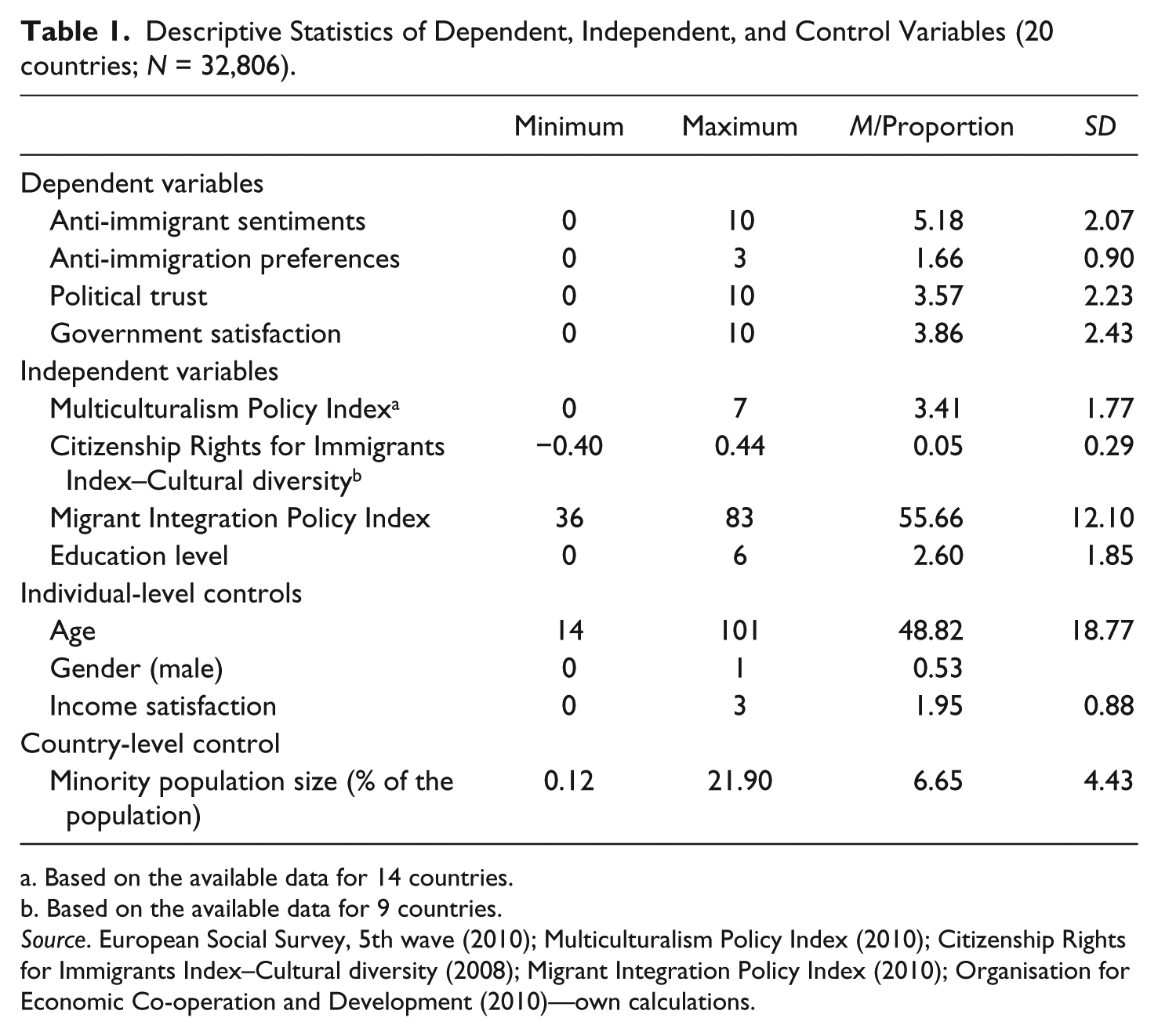
We have also included micro- and macro-level control variables that have been found to be influential in previous research on prejudice and political attitudes (Green, 2009; Werts et al., 2013). On the macro-level, we include the minority population size. On the micro-level, the control variables include age, gender, and satisfaction with family income. The latter variable was measured on a 4-point scale ranging from “Very difficult to cope on the current income,” through “difficult” and “coping,” to “able to live comfortably on the current income.” Table 1 shows the descriptive statistics for the variables included in our analysis.
Descriptive Statistics of Dependent, Independent, and Control Variables (20 countries; N = 32,806).
Based on the available data for 14 countries.
Based on the available data for 9 countries.
Source. European Social Survey, 5th wave (2010); Multiculturalism Policy Index (2010); Citizenship Rights for Immigrants Index–Cultural diversity (2008); Migrant Integration Policy Index (2010); Organisation for Economic Co-operation and Development (2010)—own calculations.
Method
We have estimated multilevel regression models with the “xtmixed” procedure in Stata 12. This method allows simultaneous modeling of the effects of the country-level and individual-level independent variables (Hox, 2002; Snijders & Bosker, 1999). With multilevel modeling, variance explained by factors at the country level and variance explained by factors at the individual level can be distinguished. We have centered the independent variables on the overall mean because we also include interactions in our models. Furthermore, we have applied the design weights provided in the ESS data in our analysis, which correct for country differences in sampling. It should be noted that 20 countries provide a relatively small number of Level-2 units in terms of multilevel analysis, and the countries can, moreover, not be seen as a random sample. This means that the results need to be interpreted with caution, as the limited (Level 2) sample size increases the odds of finding statistical null results where relations are in fact substantively relevant (i.e., limited statistical power), and the nonrandom inclusion of countries limits the external validity of the analysis. We do have a rather representative sample of European countries, also in terms of diversity in migrant integration policies. However, because the number of Level-2 units is even smaller with regard to the MCP and ICRI indices, we have taken care not to overspecify our models in terms of Level-2 predictors.
Models and Results
From the descriptive statistics, in Table 1, it can be seen that anti-immigrant sentiments are clearly present across Europe. The overall average is above the neutral midpoint of the scale, indicating that the public is slightly leaning toward a negative attitude toward immigrants. The same is true when we consider opinions on immigration. On average, there seems to be a negative rather than positive attitude. Political trust is on average actually well below the neutral midpoint of the scale, indicating a rather suspicious attitude toward national politicians, parties, and the parliament. Regarding the last dependent variable, we can see that there is, on average, also a rather negative attitude in terms of satisfaction with the government in these 20 European countries.
The scores on the policy indices suggest a wide variety in the extent to which countries have policies in place that support the integration and recognition of cultural minorities. At the high end of the scale, with a score of 7 on the MCP index and 0.44 on the ICRI-CD index, is Sweden. At the lower end of the scale, with a score of 1 on the MCP index and −0.40 on the ICRI-CD index, is Switzerland. Interestingly, the scores on the MIPEX index show a similar distribution between countries. In the nine countries for which there are data on all three indicators, the correlation between MIPEX and MCP is .73, and the correlation between MIPEX and ICRI-CD is .79. So while from a theoretical point of view, it is very important to distinguish the concepts measured by the various instruments, empirically it can be observed that all three indices correlate very strongly.
Multilevel Analysis of Integration Policies and Attitudes Toward Minorities
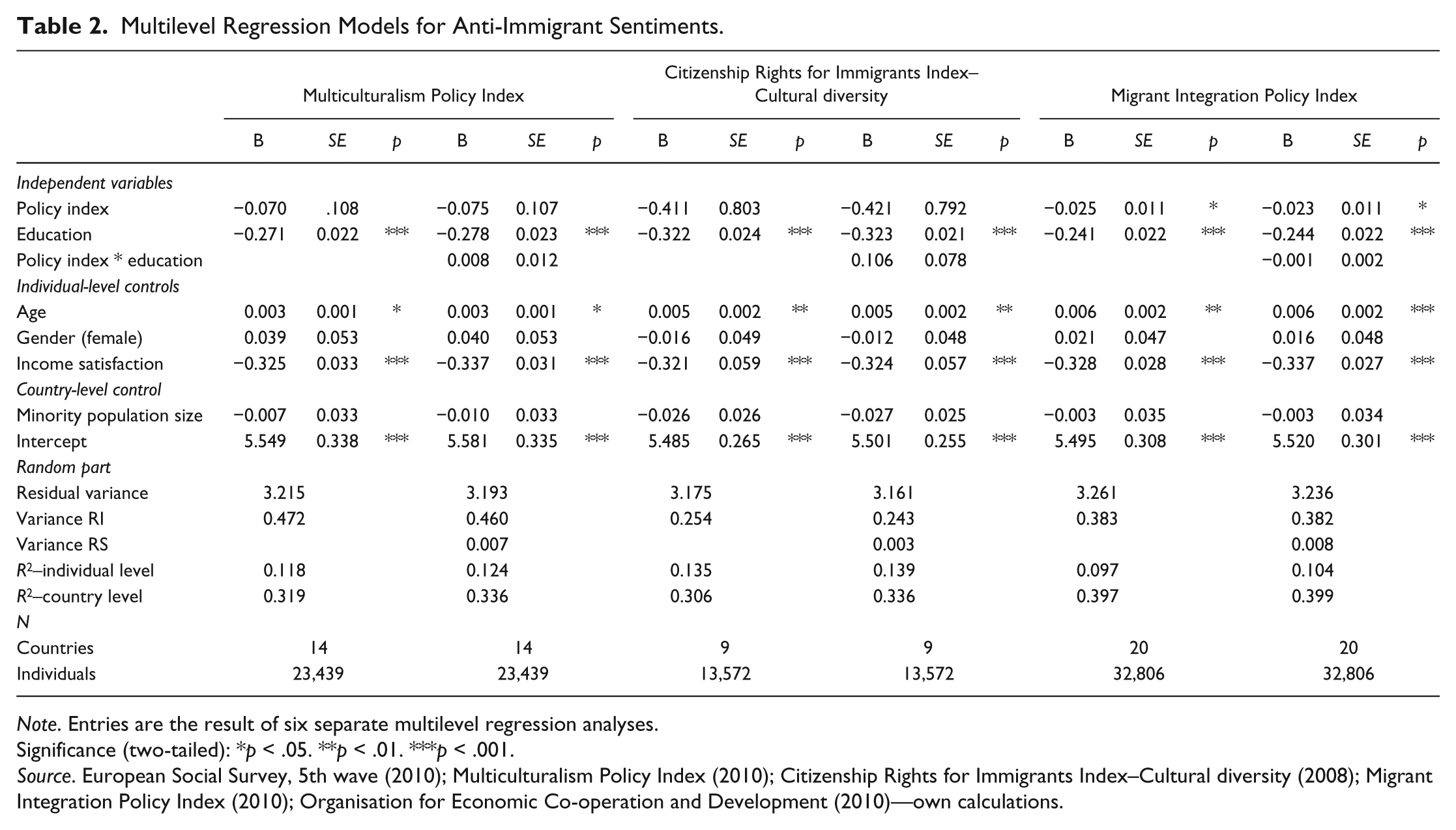
When we estimate an “empty model” for anti-immigrant sentiments on all 20 countries, without including explanatory variables, it shows that the individual-level variance is much larger (3.613) than the variance at the country level (0.636). This is already important, as it indicates that there is much more variation in anti-immigrant sentiments within countries than between countries. Relatedly, what stands out in the first model in Table 2 is that the individual-level independent variables strongly affect anti-immigrant sentiments. However, Table 2 shows that for the indices of multiculturalist policies, MCP and ICRI-CD (in the first and the third column of Table 2, respectively), the relations are negative, but not significant. The MIPEX index, on the other hand, is significantly, negatively related to anti-immigrant sentiments, meaning that the more a country offers inclusive integration policies, the lower the levels of anti-immigrant sentiments are. This suggests that neither multicultural policies nor broader integration policies as measured by MIPEX exacerbate ethnocentric attitudes among the public; instead, the evidence suggests a tentative negative relationship, with such policies dampening anti-immigrant sentiments. To determine whether both observations are causally related, and if so, in what direction, falls outside the scope of the current article. We further find that anti-immigrant sentiments are negatively related to higher education and satisfaction with income and positively related to age, and this is in line with earlier research.
Multilevel Regression Models for Anti-Immigrant Sentiments.
Note. Entries are the result of six separate multilevel regression analyses.
Significance (two-tailed): *p < .05. **p < .01. ***p < .001.
Source. European Social Survey, 5th wave (2010); Multiculturalism Policy Index (2010); Citizenship Rights for Immigrants Index–Cultural diversity (2008); Migrant Integration Policy Index (2010); Organisation for Economic Co-operation and Development (2010)—own calculations.
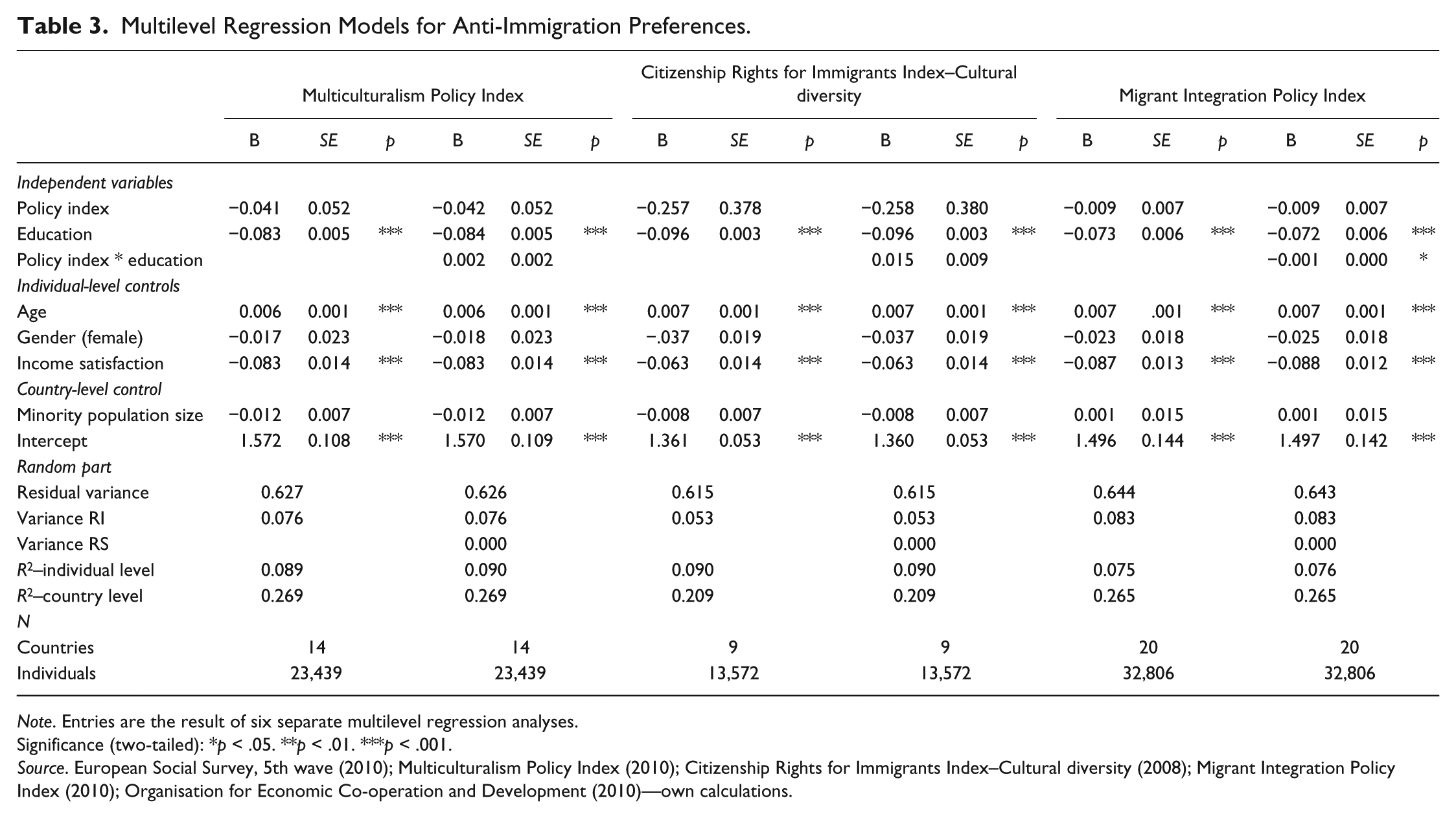
A similar picture arises when we analyze preferences with regard to immigration in Table 3. We find in an empty model that the individual-level variation (0.696) is greater than the country-level variation (0.113), suggesting that attitudes toward immigration vary much more within national populations than between countries. However, the models for each policy indicator show that there is no significant relation between scores on the MCP, ICRI-CD, and MIPEX indices on the one hand and anti-immigration attitudes on the other. However, it is noteworthy that the relations between the policy indicators and anti-immigration attitudes are consistently negative, suggesting that more multicultural policies and more liberal migrant integration policies are associated with a reduced resistance to immigration. Still, only individual-level variables are significantly related to anti-immigration attitudes. A higher education level and more income satisfaction are associated with less anti-immigrant attitudes, whereas higher age is associated with higher levels of anti-immigrant attitudes.
Multilevel Regression Models for Anti-Immigration Preferences.
Note. Entries are the result of six separate multilevel regression analyses.
Significance (two-tailed): *p < .05. **p < .01. ***p < .001.
Source. European Social Survey, 5th wave (2010); Multiculturalism Policy Index (2010); Citizenship Rights for Immigrants Index–Cultural diversity (2008); Migrant Integration Policy Index (2010); Organisation for Economic Co-operation and Development (2010)—own calculations.
Multilevel Analysis of Integration Policies and Political Attitudes
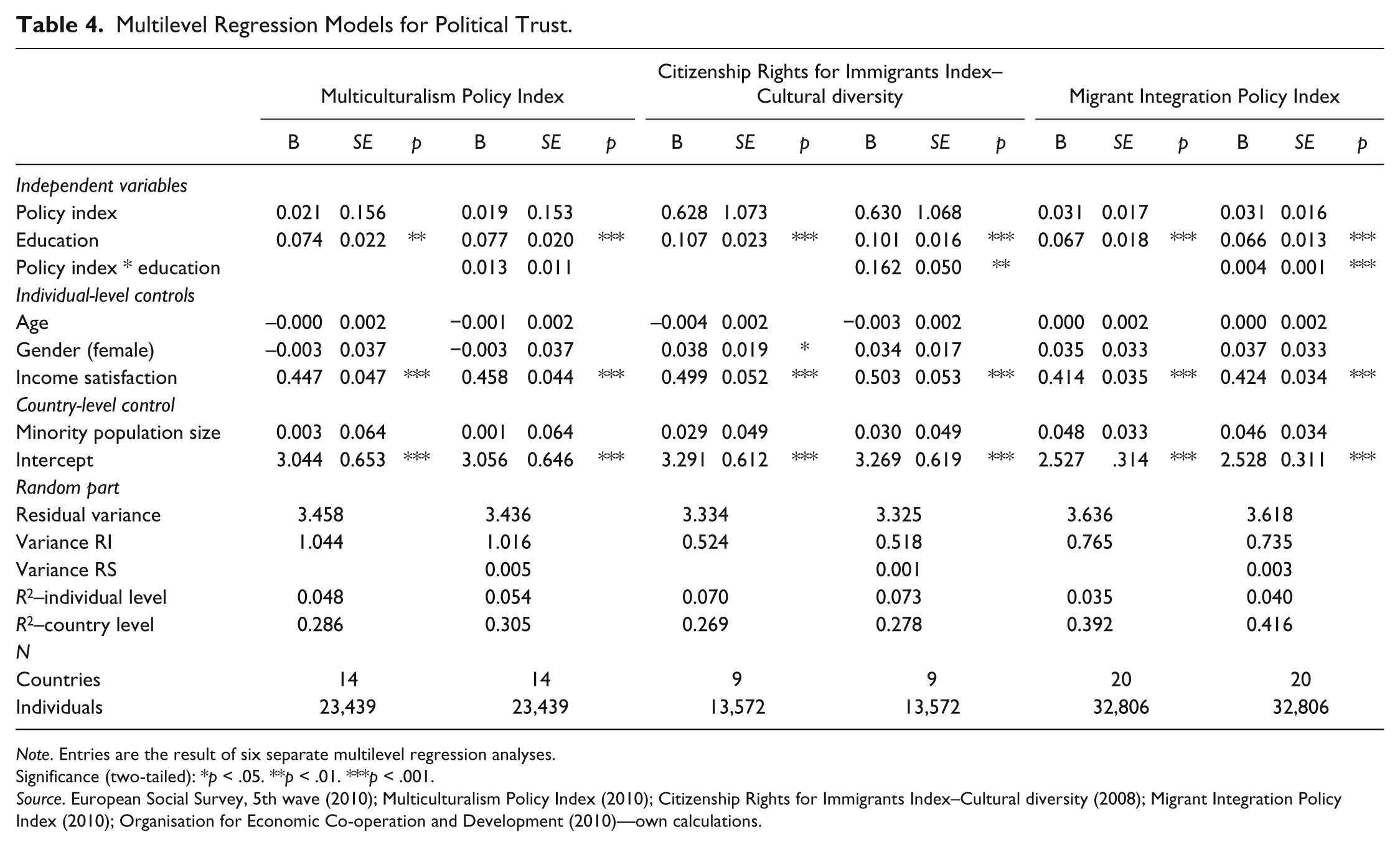
As we have already noted, it could be expected that multiculturalist policies affect public attitudes toward national political institutions. For the results on the related hypotheses Hypothesis 3 and Hypothesis 4, we turn to Tables 4 and 5. First, as with the previously investigated attitudes, we observe that there is more variation between citizens within countries than there is between countries. An empty model indicates that the individual-level variance (3.767) is about 3 times larger than the country-level variance (1.258). Regarding our main independent variables of interest, we see that scores on the MCP, ICRI-CD, and MIPEX index are not significantly related to political trust levels. Again, however, it does stand out that the policy indices are consistently positively related to political trust, in that more liberal integration policies and more multiculturalist policies at the country level are associated with more political trust. However, only a higher education level and satisfaction with income prove to be significantly related to political trust.
Multilevel Regression Models for Political Trust.
Note. Entries are the result of six separate multilevel regression analyses.
Significance (two-tailed): *p < .05. **p < .01. ***p < .001.
Source. European Social Survey, 5th wave (2010); Multiculturalism Policy Index (2010); Citizenship Rights for Immigrants Index–Cultural diversity (2008); Migrant Integration Policy Index (2010); Organisation for Economic Co-operation and Development (2010)—own calculations.
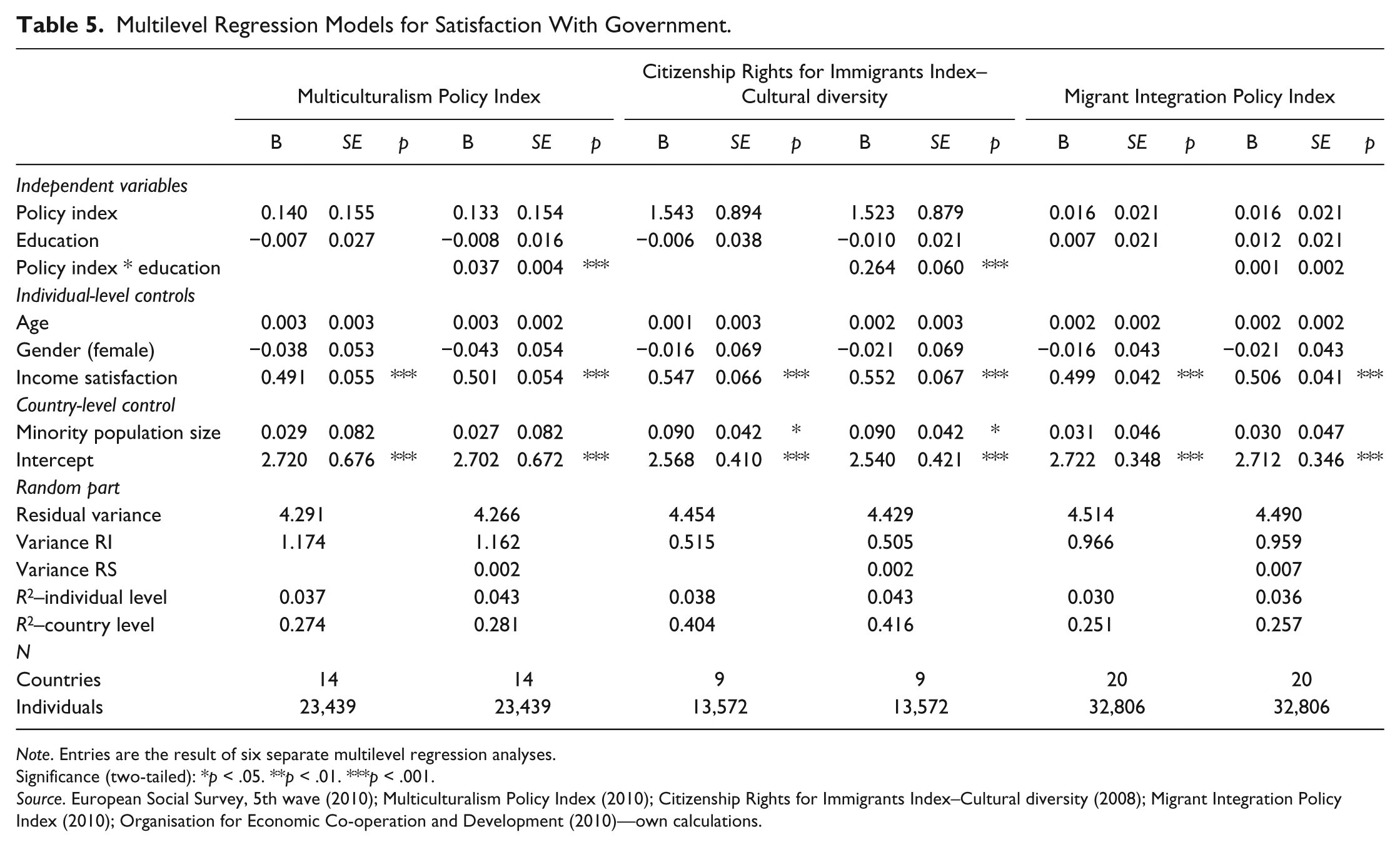
Multilevel Regression Models for Satisfaction With Government.
Note. Entries are the result of six separate multilevel regression analyses.
Significance (two-tailed): *p < .05. **p < .01. ***p < .001.
Source. European Social Survey, 5th wave (2010); Multiculturalism Policy Index (2010); Citizenship Rights for Immigrants Index–Cultural diversity (2008); Migrant Integration Policy Index (2010); Organisation for Economic Co-operation and Development (2010)—own calculations.
Regarding our fourth dependent variable, satisfaction with government, we again find similar results. The empty model shows that the variation between countries is small (0.138), while there is a huge variation within countries (4.362). Also regarding government satisfaction, we see that the MCP, ICRI-CD, and MIPEX indices do not have a significant effect, though the relations are all positive. We find that a higher level of income satisfaction is associated with a higher level of government satisfaction.
The Educational Divide
For the results on our fifth hypothesis, we look at the second model for each dependent variable and each policy indicator in Tables 2 through 5, where we have included the cross-level interaction effects between the policy indicators and level of education. As stated in our fifth hypothesis, it could be expected that mainly among the lower educated, multiculturalist policies would be associated with more negative attitudes toward immigration and cultural minorities, and with lower political trust and government satisfaction. We do observe significant interaction effects, which suggest that higher educated and lower educated sections of the population respond differently to multiculturalist policies and broader migrant integration policies. Looking at the second, fourth, and sixth models of Table 2, however, this does not apply to anti-immigrant sentiments, as the interaction effects in Table 2 are not significant.
Regarding the other dependent variables, however, we do find significant interaction effects. For anti-immigration preferences, there is a small but negative and significant interaction between MIPEX and education level, as can be seen in the second model of Table 3. This suggests that someone with a higher level of education, who lives in a country with more liberal migrant integration policies, will be even less likely to hold negative attitudes toward immigration, when compared with individuals with more modest education in the same country. Furthermore, when it comes to political trust, we observe positive interaction effects between education level and both the ICRI-CD and MIPEX indices (Table 4). This means that someone with a higher level of education, who lives in a country with more multiculturalist policies and/or more liberal migrant integration policies, will have an even higher level of political trust, compared with individuals with more modest education in the same country. Last, regarding satisfaction with the government, we find positive interaction effects with respect to both the MCP and ICRI-CD indices. These positive interactions (Table 5) suggest that that individuals with a higher level of education, who live in a country with more multiculturalist policies, will have an even higher level of satisfaction with government, compared with individuals with more modest education in the same country.
Discussion
As Banting and Kymlicka (2013) have recently argued, there are still policies in place in many European countries that decidedly lean toward multiculturalism in contrast to the popular contention that there is a general retreat from multiculturalist policies. Relatedly, we ask in this contribution how the majority native public reacts to these policies, to investigate further whether they are indeed as unpopular as is sometimes assumed. Basically our question was whether among the majority group, one can observe a backlash against multiculturalist policies.
Considering the belief that multiculturalist policies are in disrepute among the native majority groups of European societies, it could have been expected that policies that go against this sentiment would produce a backlash against political elites and have negative consequences for intergroup relations. However, we find that the public in 20 different European countries actually does not seem to react much to the policies in place, in terms of their attitudes toward immigration, their political trust, and satisfaction with government. The only exception is that we find a negative relation between more liberal migrant integration policies (i.e., a higher MIPEX score) and anti-immigrant prejudice, in line with previous studies on prejudice and immigrant threat (Ariely, 2012; Kauff et al., 2013; Schlueter et al., 2013). While we have to acknowledge that none of the three policy indicators we use offers a perfect operationalization of the theoretical concept of multiculturalism (MIPEX is not even designed to measure multiculturalism), the fact that the results for the three indicators are largely similar does strengthen our claim that multiculturalist policies apparently do not lead to a backlash among the majority population. Our data do not offer any indication whatsoever for the occurrence of the “What about me?”-effect in Western Europe.
So, how do the findings in this analysis contribute to the debate on the future of multiculturalism? Generally, our results suggest that the public concerns about multiculturalist policies are overestimated. We think that this points to a contrast between reactions to the multiculturalist ideology and antimulticulturalist rhetoric, on the one hand, and actual policies on the other. Obviously, the notion that immigrants are less than fully committed to integration in host societies is not especially welcomed by some members of majority groups as social psychological studies have often shown. Furthermore, the issue of migrant and minority integration, or assimilation, remains a popular theme in political debates. Especially among political actors situated at the right of the political spectrum, critique on multiculturalism and the intention to pressure immigrants and minorities to assimilate is often seen as a key ingredient of a potentially successful electoral campaign.
In light of these debates, our results provide a more optimistic picture than studies such as presented by McLaren (2012) who found that concerns about immigration can lead to a reduction in political trust. On the other hand, research by Kesler and Bloemraad (2010) has already indicated that trust, civic engagement, and political participation are not influenced negatively by cultural diversity and policies that promote individual equality and cultural recognition. Moreover, Ariely (2012), Kauff et al. (2013), and Schlueter et al. (2013) presented an even more optimistic picture by finding that more permissive migrant integration policies are associated with a reduction in perceived threat and prejudice and more prodiversity beliefs. Even when we use three different indicators for multiculturalist or liberal integration policies, our findings tend to support this more optimistic line of research. Our findings further stress that it is important to look at multiple indicators when assessing the impact of policies on public attitudes.
Moreover, our findings support the notion that different mechanisms could be at work among different sections of the population. Especially levels of education can function here as a major dividing mechanism in Western societies as the highly educated apparently react much more positively to multiculturalist policies than the lowly educated members of the majority group. In this sense, our results parallel recent studies which suggest that the key issue is how multiculturalist policies and diversity itself are framed and interpreted. Plaut et al. (2011) have argued that multiculturalism can be framed more as an exclusive or as an inclusive concept, from the perspective of White majority members, and that multiculturalism framed as an inclusive concept is associated with more positive majority attitudes. Relatedly, Guimond et al. (2013) argue that how attitudes such as prejudice are related to support for multiculturalism depend much on the national context and local norms associated with policies that support diversity, also suggesting that the key factor is how these policies are framed and conveyed to the general public.
A possible conclusion based on our findings is that higher educated voters can interpret policies that support diversity more strongly in terms of inclusion. The lower educated sections of the population, on the other hand, may interpret policies that support diversity more in terms of exclusion, benefitting only minority groups and threatening the position of majority members, related to the antimulticulturalist rhetoric of the populist right. This also relates to the argument made by Crisp and Meleady (2012) who argue that diversity or the “multicultural environment” can activate two possible cognitive processes. One is the process of “coalition detection” related to perceived threat from those regarded as outsiders. The other is the more complicated cognitive mechanism of “coalition building,” related to the notion that in an increasingly diverse environment where ethnic boundaries become less relevant, the more adaptive strategy is not to associate exclusively with coethnics but to build associations across ethnic boundaries, creating new opportunities. It is quite feasible that the latter more complex mechanism, akin to “deprovincialization” (Pettigrew, 2011), is more easily picked up by higher educated sections of the population. This would imply, however, that with regard to attitudes toward diversity and immigration, the differences between highly and lowly educated groups within the population can continue to grow wider. In sum, the implication is that there is no “singular” general public when it comes to the issue of multiculturalism, but that it is seems easier for those who have higher human capital, experience more economic mobility, are “winners” in the process of globalization in the terms of Kriesi et al. (2012), to take on an optimistic and positive attitude toward cultural diversity. Conversely, building support for multiculturalism among those with more modest education and less secure economic positions does seem a formidable task for political elites, especially as there appears to be a strong link between anti-immigrant sentiments and political distrust, which can be enhanced by the adoption of multiculturalist policies, as shown by Citrin et al. (2014).
A limitation to our present analysis, based on the MCP, ICRI-CD, and MIPEX indices, is that the MCP and ICRI-CD indices have a limited number of cases in terms of multilevel analysis, although the MIPEX index was not designed to capture multiculturalism. As we have shown, however, the results of our analysis regarding public attitudes toward migrants and the political establishment are remarkably consistent across the three indicators. Therefore, we believe that it is relevant to show how actual policies could be associated with negative attitudes toward minorities or to a possible backlash against political elites and institutions. Based on the currently available indicators, we can arrive at the conclusion that there is no evidence at all for a popular backlash against multiculturalist or liberal integration policies although there is a danger for a deepening divide between the highly and the lowly educated members of society. If, however, indicators of multiculturalist policies will become available for more countries in the years ahead, it is all the more crucial to conduct a similar analysis based on these more elaborated indicators.
Footnotes
Declaration of Conflicting Interests
The author(s) declared no potential conflicts of interest with respect to the research, authorship, and/or publication of this article.
Funding
The author (s) disclosed receipt of the following financial support for the research, authorship, and/or publication of this article: ERC Advanced Grant “Linkage”