



Abstract
In this study, we analyze the personal networks of 379 college students in Singapore to explore the social affordances of traditional and new channels in communicating with different types of social relationships and their associations with personal well-being. Results suggest communication channels play a complex role in how strong and weak ties are related to personal well-being. On one hand, face-to-face communication, landlines, mobile phones, text messaging, and social network sites are associated with the strong ties that boost personal well-being. On the other hand, mobile phones, text messaging, social network sites, and video chat (but not face-to-face or landline communication) are associated with weak ties and personal well-being. This study contributes to the literature in two ways. First, we show that strong and weak ties are both important to the personal well-being of college students in Singapore; second, we show how different communication channels are associated with different kinds of social ties. Mobile and social media play a critical role in these social ties.
Introduction
Two puzzles underpin this study. The first is the underexplored role of the weak tie subset of social networks in explaining personal well-being. We know that the utility of our weak ties lies in their diversity and their ability to connect us to disparate social circles and unique resources. They are often associated with learning about employment opportunities and other instrumental gains (Erickson, 2001; Granovetter, 1974/1995). While it is well known that strong ties buffer against stress and benefit personal well-being (Cohen & Wills, 1985; Ensel & Lin, 1991), it remains unclear whether weak ties perform a similar function (Lin, 2001). The second puzzle pertains to the various channels in a personal communication system. We routinely use multiple platforms to keep in touch with family, friends, and acquaintances, living life in the digital age as networked individuals (Rainie & Wellman, 2012). Given the salience of mobile and social media among younger cohorts such as college students (Smith, Rainie, & Zickuhr, 2011), these emerging channels of communication must be considered along with traditional ones in the analysis of communication within personal networks and correlates of well-being.
The results of this study are derived from a sample of 379 undergraduates from two universities in Singapore who participated in an online survey measuring aspects of their personal networks, communication with different types of network ties, and perceived personal well-being. We find both strong and weak ties play a significant role in bolstering personal well-being. We also find different communication channels are suited for sustaining different types of network ties. Face-to-face communication, landlines, mobile phones, text messaging, and social network sites are associated with the maintenance of strong tie relationships that traditionally correlate with personal well-being. Weak tie relationships are supported by mobile phones, text messaging, social network sites, and video chat but not face-to-face or landline communication. However, weak ties also correlate with personal well-being. This study contributes to the literature in two ways. First, we show strong and weak ties are important to the personal well-being of college students in Singapore. Second, we show how different communication channels are suited for sustaining the strong and weak tie relationships that matter for personal well-being; not surprisingly, mobile and social media play a critical role in these relationships.
Different Types of Social Ties and Well-Being
Social network structures are rarely random, more often dependent on an individual’s position and relational choices within the web of connections (Valente, 2010). Those directly related to us can have a significant impact on our emotions, perceptions, behaviors, and health (Christakis & Fowler, 2009; Wellman, 2007). Yet not all of these direct social ties are the same in terms of their characteristics, functionalities, or relational benefits. Some are stronger, more readily available, less stigmatizing, and less costly (Heller & Rook, 2001; Kaniasty & Norris, 2001). Strong ties typically consist of significant others, family, and close friends, with limited network size but high density and homophily (Wellman & Wortley, 1990). Other relationships may be weaker but are often thought to branch out to wider, more diverse, and useful pools of resources (Granovetter, 1973).
Although there is general agreement that social relationships are the conduit for access to a range of instrumental (e.g., employment opportunities) and expressive (e.g., emotional support) resources and are critical to personal well-being (Song, Son, & Lin, 2010), different types of social relationships may function differently to meet these needs. Scholars suggest the importance of strong ties in catering to expressive needs such as offering a listening ear when a loved one is going through an emotional turmoil. Lin (2001) is emphatic: “The stronger the tie, the more likely that the social capital accessed will positively affect the success of expressive action” (p. 65). While equally emphatic, Putnam (2000) takes a more macro perspective and likens strong ties—also known as bonding social capital—to “a kind of sociological superglue . . . good for mobilizing solidarity and providing crucial social and psychological support” (pp. 22-23).
By contrast, weak ties are often associated with instrumental goals and typically thought to be useful for strategic behaviors like “seeking jobs and political allies” or accumulating bridging social capital (Putnam, 2000, p. 22). Some argue these instrumental benefits can bolster outcomes integral to personal well-being, such as socioeconomic status (Mirowsky & Ross, 2003). But by definition, weak tie networks are composed of people outside an individual’s small world who can provide information and resources differing from those proffered by the familiar and close social circle (Williams, 2006). As weak tie connections are expected to be inherently diverse and to serve more practical purposes, they are not usually included in discussions of social support, expressive needs, or individual health and well-being.
The division of resource provision into strong and weak tie relationship categories as outlined above dominates the literature. We caution against a one-sided focus on strong ties in the discussion of social relationships and personal well-being, however. For one thing, the densely knit network structures associated with strong ties can sometimes exert too much social control on members (Portes & Landolt, 2000), causing a negative boomerang effect on well-being. For another, weak ties may be just as important as strong ties for personal well-being. That said, little research has explored the possibilities of such a connection, with the exception of a few studies finding a correlation between weak ties and mental health. Although not directly tested with overall assessments of personal well-being, some researchers have found that the more diverse a person’s social network, the lower the incidence of psychological distress and depression (Erickson, 2003; Song, 2011). Weak ties can increase individual well-being in several ways. For example, little pieces of information and advice from different people may “nudge” a person toward better health practices (Erickson, 2003). In addition, having a network rich in ties to people from different occupational positions can enrich cultural knowledge (Erickson, 1996), increase intellectual flexibility, hone mental agility, and boost intellectual capacity for dealing with the challenges inherent in different social settings. Taken together with other well-established benefits, it is plausible that weak ties can contribute to an individual’s sense of well-being in substantial and meaningful ways. Thus, we state our first hypothesis as follows:
Weaving Communication Channels into the Social Web
As Parks (2007) says, “Relationships live in communication. They are made, unmade, and remade in the communicative practices of their participants” (p. 24). Thus, those who comprise our personal networks and how we communicate with them are fundamental to our sense of meaning in the world, physical and mental health, and overall personal well-being (Christakis & Fowler, 2009; Valente, 2010). A distinct characteristic of contemporary society is the intertwining of multiple media and social networks, forming a personal communication system (Boase, 2008). Particularly, our daily routines involve what we do with multiple technologies that faciliate direct person-to-person communication, creating the networked individualism phenomenon mentioned above (Rainie & Wellman, 2012; Wellman, 2001a, 2001b). Networked individualism has been studied extensively in Western countries, much less in the Asian context. This study takes a first step by examining networked individualism among college students in Singapore, the first generation to have all sorts of communication technologies designed to center on them, including iPods, iPhones, iPads, and just about “iEverything.” In effect, they embody networked individualism. Singapore is a good choice for this because it is one of the most technologically developed countries in South East Asia, with its Internet and mobile penetration rates similar to those of the United States (International Telecommunication Union, 2013). Given the prevalence and popularity of mobile and social media in Singapore (and worldwide), we added these to more traditional communication channels to represent the personal communication system of the study participants.
A perennial concern with technologies such as the Internet, mobile, and social media is the fear that they reduce the quantity and quality of communication, particularly face-to-face communication, leading to social isolation and negative effects on individual well-being (Kraut et al., 1998; McPherson, Smith-Lovin, & Brashears, 2006; Putnam, 2000; Turkle, 2011). This concern has lasted for decades, and tension reemerges with each technological advance (Marvin, 1988; Wang & Wellman, 2010). Even in a digital network society, however, an individual’s social network dynamics are manifested in the form of person-to-person connectivity (Rainie & Wellman, 2012). But empirical research suggests different communication platforms can provide different social affordances, with frequency positively related to social cohesion, relationship satisfaction, and personal well-being (Baym, Zhang, & Lin, 2004; Boase, 2008; Boase, Horrigan, Wellman, & Rainie, 2006; Boase & Wellman, 2006; Wellman et al., 2003).
Tseng and Hsieh (2015) find systematic differences in the specific tools we use to communicate with our strong and weak ties. Similarly, we acknowledge the different social affordances of different communication channels and explore the possibility that multiple communication channels produce multiple forms of social capital associated with personal well-being. Therefore, we state our second hypothesis as follows:
Method
Participants
We recruited participants from two undergraduate classes in two major universities in Singapore, one public and the other private. Results of independent-sample t tests indicated similar demographic characteristics based on age, gender, race, and ethnicity, except for household income. Therefore, we combined the samples in the final analysis. The survey completion rate was 70.6%, with 379 students completing all key questions.
Our combined sample consisted of 75.7% female participants, with a mean age of 20.98 years (SD = 1.66). There were 57.2% freshmen, 25.5% sophomores, 6.1% juniors, and 10.1% seniors; their studies focused primarily on communication, psychology, and sociology. In terms of race and ethnicity, 79.7% were Chinese, 6.3% were Malay, 5.8% were Indian, and about 8% identified with a range of other ethnicities.
Procedure
We made a research announcement in both classes and on the course website, including a survey link directing interested students to the study description and informed consent form; extra course credit was given as an incentive. The data were collected between October 2012 and May 2013.
Measurement
Network structures
Questions about participants’ personal networks closely follow the definitions set out in the Pew Social Tie Survey (Boase et al., 2006) and was divided into two groups. Strong ties are “the people who you have felt VERY CLOSE to over the past 12 months. These might include those you discussed important matters with, kept in regular contact, and/or people who were there for you when you needed help.” Weak ties are “the people you felt SOMEWHAT CLOSE to over the past 12 months. These are the people who are more than just casual acquaintances, but not as close as family and good friends.”
We examine four network attributes. First, network size is measured by the number of strong ties and weak ties in a personal network. Second, network density is measured by asking about the extent to which a participant’s network members know each other (1 = none of them, 5 = all of them). Third, network diversity is determined by asking questions about whether the ties are of same sex, age, ethnicity, and education. Fourth, network composition is measured by asking about the nature of different relationships such as kin, friends, coworkers, neighbors, and so on. A name generator measures the attributes of the strong tie network. The survey asks participants to nominate up to five people they feel closest to. The questions about strong tie diversity specifically target each nominated alter; answers are averaged across all nominated strong ties.
Communication channels
We include questions about the communication channels used to sustain the participants’ personal networks. These take nine possible forms: face-to-face communication, mail, landline, mobile phones, email, text messaging, instant messaging, social network sites, and video chat. Participants are asked to indicate the degree of their usage of each type of communication channel on a 6-point scale (1 = never, 2 = at least once a year but less than once a month, 3 = at least once a month but less than once a week, 4 = at least once a week but less than once a day, 5 = just about every day, and 6 = multiple times a day).
Personal well-being
Personal well-being is measured as a composite of subjective, psychological, and social well-being. Based on Diener et al. (2010), subjective well-being is measured using a 5-item scale on life satisfaction (Cronbach’s α = .89) and a 12-item scale to assess positive feelings (Cronbach’s α = .90) and negative experience (Cronbach’s α = .79). This represents the hedonic view of well-being in the literature, whereby personal well-being is dependent on individuals’ subjective evaluation of life satisfaction and affect balance (Diener, 1984). Also based on Diener et al. (2010), psychological well-being is measured using an 8-item scale (Cronbach’s α = .88). This represents the eudaimonic view of well-being in the literature, whereby personal well-being is dependent on whether individuals can realize their true potential and find meaning in their lives (Ryff, 1995). In addition, social well-being is measured using a 10-item scale from Pea et al. (2012) that includes social success and feelings of normalcy (Cronbach’s α = .90). This represents the communicative aspect of social interactions and complements the psychological emphases of the other two dimensions. We compute a composite variable representing all three dimensions of personal well-being. Units of measurement are the percentile of the mean values; these become the final measure of personal well-being.
Controls
We include three control variables: gender, ethnicity, and housing status, all of which affect personal well-being (Mirowsky & Ross, 2003). Gender is coded as female = 1, male = 0. Ethnicity is coded as Chinese = 1, non-Chinese (i.e., the minority) = 0. Housing is used as a proxy for socioeconomic status and is coded as private housing = 1, public housing = 0.
Data Analysis
We use SPSS 20.0 for descriptive and inferential statistical analysis and estimate the multiple regressions using ordinary least squares. We follow the standard formula where X1 is the independent variable of interest; we add the key demographic variables (i.e., gender, ethnicity, and housing type) to the equation as control variables. Ultimately, well-being = a + b1X1 + b2 (female) + b3 (Chinese) + b4 (private housing).
Findings
Network Characteristics and Communication Frequencies
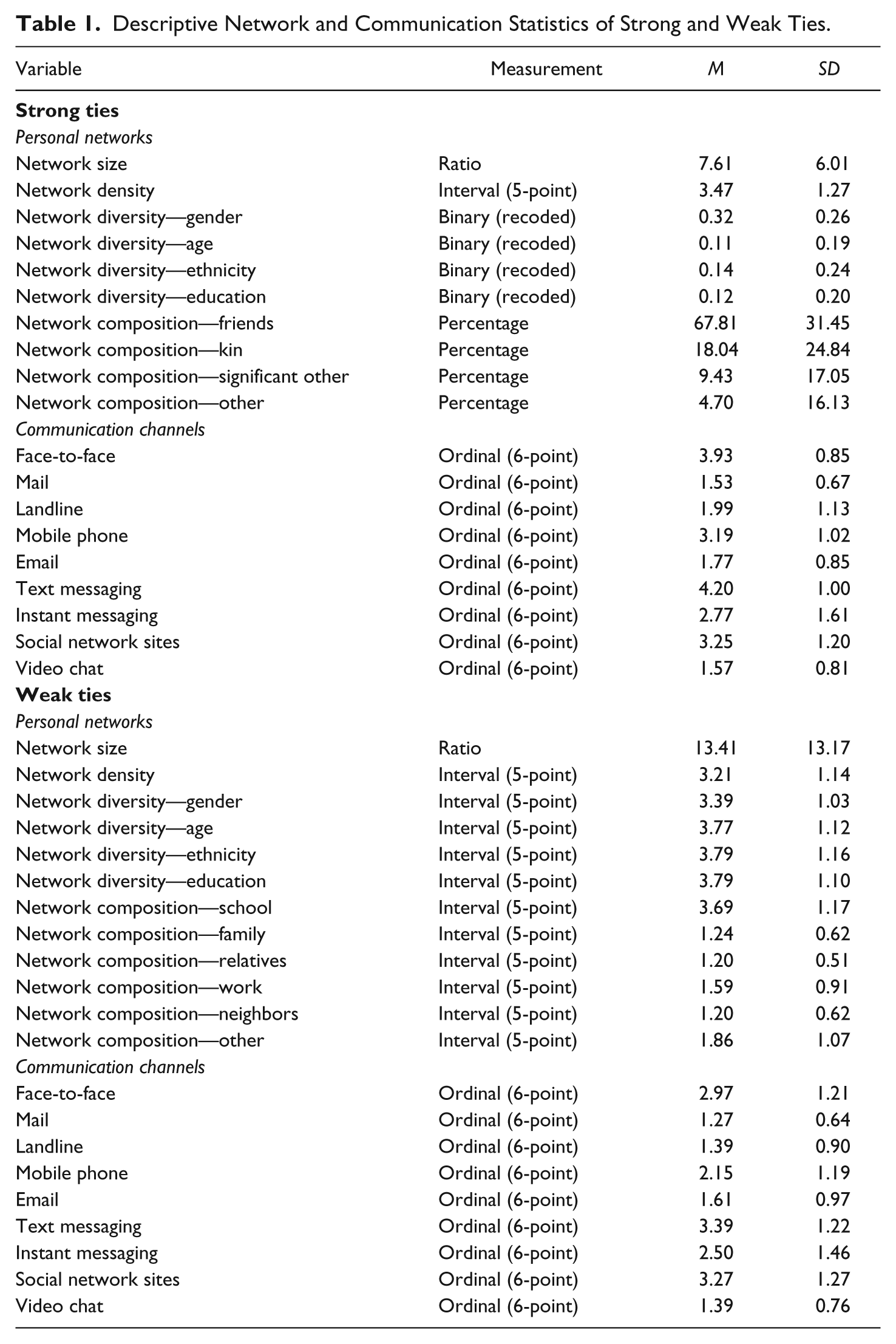
Respondents report an average of 7.61 strong ties. Over two thirds of the strong ties are with friends (67.81%), close to a fifth are with kin (18.04%), and significant others, by definition, form a small group (9.43%). Friendships dominate these networks, underlining the importance of peer groups for college students. The network density is 3.47 (out of a maximum 5). Hence, on average, more than half of the participants’ network members know one another. Network gender (.32), age (.11), ethnic (.14), and educational diversity (.12) are all on the lower end of the scale (ranging from 0 to 1), suggesting overall high levels of homogeneity along those dimensions, although gender diversity is slightly higher than the others. These patterns reflect networks composed of close-knit friends, mixed across gender, but similar in age, ethnicity, and education.
Respondents report an average of 13.41 weak ties. The diversity scores for age, ethnicity, and education are closer to that of gender, suggesting weak ties are more heterogeneous and inclusive than strong ties, as expected. Many of the weak tie relationships originated in participants’ schools, although many also come from family, work, neighborhoods, and other places outside the normal social circles.
On a 6-point scale, on average, the frequency of communicating with strong ties is the highest using text messaging (4.20), face-to-face communication (3.93), social network sites (3.25), and mobile phones (3.19), while the frequency of communicating with weak ties was the highest with text messaging (3.39), social network sites (3.27), or face-to-face (2.97). These descriptive statistics are summarized in Table 1.
Descriptive Network and Communication Statistics of Strong and Weak Ties.
Social Ties, Communication Channels, and Well-Being
Table 2 summarizes the significant results of regression models. After controlling for sociodemographic variables, the number of strong ties (β = 1.00, p < .001) and low strong tie diversity in terms of gender (β = −11.28, p < .05), ethnicity (β = −18.71, p < .01), and education (β = −12.86, p < .05) are significant; this means having more homogenous strong ties is positively associated with personal well-being. The number of weak ties (β = 1.27, p < .01) and having more weak ties coming from “other” sources of connection outside normal social circles (β = 2.89, p < .05) are also significant; this suggests having a large and diverse weak tie network is critical to personal well-being. Thus, Hypothesis 1 is supported.
Significant Results of Multiple Regressions on Personal Well-Being.

p < .05. **p < .01. ***p < .001.
After controlling for sociodemographic variables, frequent communication with strong ties using face-to-face (β = 3.76, p < .01), landline (β = 2.21, p < .05), mobile phones (β = 2.83, p < .05), text messaging (β = 4.57, p < .001), or social network sites (β = 2.07, p < .05) is significantly associated with personal well-being. Interestingly, frequent use of mobile phones (β = 3.01, p < .01), text messaging (β = 2.53, p < .01), social network sites (β = 2.17, p < .05), and video chat (β = 5.72, p < .001) to communicate with weak ties (but not face-to-face or landline) is also significantly associated with personal well-being. This allows us to make two observations. First, mobile and social media add meaningful channels for communication and relationship maintenance with different personal relationships, corroborating established findings that online and offline relations are more integrated than segregated. Second, we note a rich interplay between communication channels, tie strength, and well-being. The data suggest different communication channels are suited for different social ties and their frequent use is significantly associated with personal well-being. Thus, Hypothesis 2 is supported.
Discussion
The social worlds of the college students in Singapore who participated in this study consist of strong-tie clusters of friends and kin, characterized by a high degree of homophily in terms of sociodemographic characteristics, along with a great number of weak ties that are more heterogeneous in nature. The students adopt a variety of communication channels to keep in touch with people in their social circles. Their personal well-being is linked to both strong and weak tie connections and to frequent use of multiple communication channels, especially mobile and social media platforms.
This work probes several questions, the most general of which is the inquiry into the role of weak ties in personal well-being. Complementing research on acquaintances and mental health, our results demonstrate a significant link between weak tie networks and an individual’s overall assessment of personal well-being, quite apart from (or in addition to) the strong tie relationships that are traditionally considered to correlate with well-being. While we are unable to specify the exact mechanisms, possible explanations include the following: (1) weak ties increase access to diverse information, thus increasing awareness of other milieus and enriching understanding and adaptability; (2) weak ties function as ladders to social resources, such as facilitating relationships with influential mentors (e.g., professors) who guide students, vouch for them, and highlight opportunities; (3) weak ties such as those developed during an internship set the stage for future employment by building students’ organizational ties—today, weak tie networks are a prerequisite for employment in many industries.
We also consider the use of specific communication channels and how they support specific relationships and personal well-being. Both traditional (e.g., face-to-face, landline) and newer channels (e.g., text messaging, social network sites) are integral to the sustenance of strong and weak tie networks associated with personal well-being. In particular, students are using mobile and social media—mobile phones, text messaging, and social network sites—to maintain both strong and weak ties. Based on our findings, the view that new media restrict interpersonal communication or the development of community is unfounded.
Personal well-being is not simply a function of either social ties or communication channels. The evidence presented herein suggests it is a function of the interaction between these variables. The effects appear to be reciprocal—communication facilitates the development and maintenance of social ties, and social ties facilitate the continued frequent use of various communication channels. College students are using multiple media to connect—as we see it—to different parts of their social network; some types cater to strong ties only (face-to-face and landline), some to weak ties only (video chat), and some, in fact most, to both strong and weak ties (mobile phones, text messaging, and social network sites). In short, different kinds of communication channels are suited for maintaining different kinds of social ties, and it is the interplay of these channels and ties that is integral for well-being.
Conclusion
This study has several limitations. First, the sample comprises only those enrolled in specific departments in social sciences, and a large proportion have a Chinese ethnic background. This limits the generalizability of the findings to a wider student population in Singapore. Second, the data are cross-sectional in nature, and this precludes solving causality issues. For example, do weak ties promote well-being, or does well-being promote openness to forging weak ties? Do mobile and social media equally promote strong and weak ties, or are social individuals keener to engage with newer communication platforms? A longitudinal design would be ideal for a future study.
These limitations notwithstanding, the study makes several important contributions to our understanding of the different types of social ties and communication channels associated with personal well-being. Future research may explore the specific mechanisms used by strong and weak tie networks in terms of resource provision or the use of particular communication channels to tease out their direct and indirect contributions to personal well-being.
Footnotes
Acknowledgements
The authors wish to thank Amanda Lohiser, Carolyn Hurley, Mary Eberhadinger, and Stephanie Pollack for their administrative support, and Elizabeth Thompson for her editorial assistance.
Declaration of Conflicting Interests
The author(s) declared no potential conflicts of interest with respect to the research, authorship, and/or publication of this article.
Funding
The author(s) received no financial support for the research, authorship, and/or publication of this article.