




Abstract
There are numerous media offerings targeted to young audiences that claim to have educational benefits. It is hard to overemphasize the need for evidence about which of these offerings are effective, for which populations, and for which outcomes. The current article begins by discussing the value and limitations of meta-analysis (as opposed to narrative literature reviews) as a tool for marshaling such evidence. We illustrate these points with a recent meta-analysis of the educational impact of Sesame Street international coproductions. We then present two further studies that emerged from one aspect of the findings, examining effects of educational TV narratives on children’s racial/ethnic attitudes.
Need for Evidence About Educational Media
Parents’ need for information about the outcomes of exposure to purportedly educational media offerings is made clear both by the popularity of media-guidance websites such as Commonsense Media and the Center for Media and Child Health, but also, conversely, by the long-standing popularity of products such as baby DVDs despite growing evidence of minimal educational benefits (e.g., Robb, Richert, & Wartella, 2009). Parents are not alone in needing evidence-based guidance. In the United States, the Federal Communications Commission offers expedited license renewal for stations offering 3 hours a week of educational/informative programming. The Commission currently has few tools, beyond intuition, to evaluate the networks’ claims about the benefits of their educational offerings. Outside the United States, funding agencies and policy makers need data to inform decisions about whether to allocate finite resources to educational media to help combat the crisis of inadequate early education in many regions of the globe (UNICEF Innocenti, 2011; Walker et al., 2011).
Meta-Analysis as a Potential Tool for Informed Decisions
Research on educational television in the United States has flourished since the 1980s, with the work of academics such as Anderson, Huston and Wright, the Singers, and their colleagues (see Fisch & Truglio, 2001; Mares, 2009, for reviews). More recent work has extended beyond the traditional preschool age range of 3 to 5 year olds, to consider effects of infant and toddler exposure to educational television, DVDs, and interactive platforms such as iPads (see Anderson & Kirkorian, 2015, for a review). Despite all this work, and in contrast to the work on violent media, there have been virtually no meta-analyses of educational effects of educational media content, except with regard to the subset of studies of prosocial outcomes (Hearold, 1986; Mares & Woodard, 2005) or use of digital technologies in the classroom (Vogel et al., 2006). Why does this absence, and the reliance on narrative literature reviews, matter?
Although narrative reviews sometimes do aim for comprehensive coverage of all relevant research, the more common procedure is to highlight the subset that strike the author as important and illustrative. Synthesis of the findings typically involves brief, sequential descriptions (this study did this and found this, that study did that and found that), followed by interpretive summary statements. In the absence of clearly defined procedures for making such statements, much depends on the authors’ insight. There is no clear metric for comparisons (between demographic groups, with other outcomes, with other types of interventions, etc.).
The strength of meta-analyses lies in the systematic, prescribed approach to identifying relevant studies and weighing and combining results. At their best, they cut through the clutter of disparate methods and findings to offer numeric information about the significance and average strength of effects. Moreover, analysis of variability in the effect size estimates can indicate whether there is a single effect (the estimates are homogeneous), or whether moderator variables are needed to help explain differences. These moderators (e.g., features of the audience, of the content, of the viewing context, or of study methodologies) can be systematically tested to examine whether they help produce more homogenous subsets (i.e., under these conditions, the effect sizes are around this magnitude; under those conditions, they are around that magnitude). Significant heterogeneity despite these endeavors potentially indicates that the research question and set of studies are not focused enough and that additional, unidentified moderators remain.
The flip side of these potential strengths is that there frequently is no sufficiently large and coherent research base that would generate homogeneous estimates, and the authors are left lamenting the need for more research and more comprehensive statistical reporting within studies. Furthermore, quantitative effect size estimates, though useful for significance tests and for comparisons, are not particularly intuitive for many readers. An additional obligation remains to provide sufficient context and interpretation to allow key audiences to take away meaningful information.
To illustrate these issues, we discuss a recent meta-analysis of educational television effects. The goal is to not only exemplify the use of meta-analysis as a tool for assembling evidence and to describe our strategies for explicating the findings but also to highlight the issues that made the process less straightforward. Furthermore, we touch on the various questions that remained and the need to return to more micro-level examination of educational media effects for particular outcomes.
Effects of Sesame Street as a recent example
We (the first author and a colleague, Zhongdang Pan) were asked by Sesame Workshop to conduct a meta-analysis of research evaluating the effects of Sesame Street international coproductions. These international versions of Sesame Street are mostly funded by grant-giving organizations that require summative evaluation research (consistent with the Sesame Workshop model of research informing production practices; Fisch & Truglio, 2001). Sesame Workshop hoped that a meta-analysis of these studies could provide a systematic, quantitative assessment of the program’s effectiveness in teaching a variety of outcomes as well as providing guidance about the conditions under which the program was most effective.
Ultimately, we had a sample of 21 reports, yielding 134 whole-sample effect size estimates that were calculated from a total of 10,596 children from 15 countries. Given the breadth of the Sesame Street curriculum, most studies assessed multiple learning outcomes on a given group of children. These ranged from traditional educational content (e.g., knowledge of letters, numbers, shapes, which we labeled cognitive outcomes) to local environmental and health issues (e.g., recycling, use of mosquito netting, importance of bike helmets, which we labeled learning about the world) to intergroup attitudes and prosocial reasoning (which we labeled social reasoning/attitudes). To deal with the nonindependence of these conceptually distinct outcomes gathered on the same samples of children, and to avoid disproportionate influence of studies that generated many effect size estimates, we used multilevel modeling in which estimates were nested within studies.
Ultimately, the data indicated that there were significant, positive effects of exposure to Sesame Street on children’s learning, assessed across the range of outcomes (d = .292). When these estimates were divided into the three broad content categories (cognitive, learning about the world, social reasoning/attitudes), there were significant positive effects for all three. Thus, Sesame Workshop, and funders, and government agencies had aggregate data indicating that children who watched more knew more about the topics covered than children who watched less. The argument that these were causal outcomes of viewing was strengthened by the fact that over 84% of the estimates were from pre–post or longitudinal designs (thus controlling for the child’s initial knowledge or ability).
We reported the estimates as d, and not surprisingly, Sesame Workshop requested that we help explain what the effect size numbers meant. Based on U.S. Department of Education guidelines for reporting on the outcomes of interventions (What Works Clearinghouse, 2011), we converted d into a percentile “improvement index” based on Cohen’s (1988) U 3 index. This involved looking up the z score associated with the effect size and observing the area under the normal curve, to indicate the percentile associated with the hypothetical average child who watched Sesame Street, relative to the hypothetical average child who did not (by definition, at the 50th percentile). In our meta-analysis, the effect size of .29 corresponded to a z score of .29, representing a percentile gain of 11.6.
In addition, we could compare the magnitude of the effect of watching Sesame Street with that of other interventions. As we described in the original article (Mares & Pan, 2013), the effect size for cognitive outcomes of viewing was roughly comparable to the effect size observed in another meta-analysis for cognitive outcomes of nonmedia interventions, such as preschool enrollment or caregiver training (Nores & Barnett, 2010). To provide further context that spoke to the social value of these effects, we presented data (where available) about the percentage of children viewing Sesame Street in various countries, relative to the percentage enrolled in preschools.
In addition to describing and interpreting the magnitude of the effect, we could examine whether the effects of exposure were significant both in high-income and low- and middle-income countries (as indicated by World Bank ratings) and within low-income-only samples as well as mixed-income samples. The value of doing so came from being able to revisit the early concern (e.g., Cook et al., 1975) that effects might be observed only or primarily among higher income populations, and relatedly, being able to speak to the possibility that educational programming could help address the crisis of inadequate early education in low-income regions of the world. As we reported, there were significant, positive effects of exposure both in lower and higher income regions, and in low socioeconomic status–only samples as well as mixed-income samples. Moreover, the effects in low-income countries were significant even for surveys (i.e., where viewing was more likely to be initiated by the child rather than required as part of an experiment).
These were answers that would almost certainly have been more tentative in a narrative review. Nonetheless, there were numerous, nontrivial challenges and limitations to our findings.
In principle, the task of converting various pieces of statistical information in the reports to standardized effect size estimates is relatively straightforward and simply involves following various formulae. The reality was frequently more complex, as we struggled with instances in which key bits of data (particularly measures of variance) were missing. Not only is it crucial (from a meta-analytic perspective) for authors to report variance with means, but it is crucial to give the variance of the predictor when reporting unstandardized regression coefficients with multiple covariates. In effect, we often had some clues about the outcomes, but not enough to translate that information into the metric we needed. Six relevant, quantitative studies could not be included at all, given these types of issues, and we could only provide a narrative summary of their results. Within the studies that were included, missing statistical information meant that we were substantially limited in our ability to calculate separate effect estimates for subsamples, such as different age-groups, genders, or children from rural versus urban locations. We wound up making very tentative conclusions about differences between ages and locations.
Given the limited number of studies, we lacked sufficient data to examine whether effect sizes were moderated by viewing context (e.g., viewing alone or with others, at home or in class, with supplemental Sesame-related materials or not). Ultimately, there remained considerable unexplained variance in estimates, indicating the need for further conceptual and empirical work.
The need for further research highlights a larger issue. Although meta-analytic techniques helped us provide a systematic answer to the question of Sesame Street effects, the question itself is limited. Because we only examined one program as aired, we could not speak to the effects of other programs or even the key characteristics that make programs more or less likely to succeed. A bigger, much more ambitious, question still waiting to be answered is how different features of educational programming affect various learning outcomes.
The rest of this article is not a meta-analytic answer to that question—quite the opposite. The process of doing the meta-analysis suggested that there are some educational outcomes for which we still need micro-level studies, rather than leaping ahead to aggregation.
An Outgrowth of the Meta-Analysis
One unanticipated effect of coding studies and converting statistical results to effect size estimates is that one acquires considerable intimacy with the study findings. Although we (Mares & Pan, 2013) found significant positive effects of exposure on children’s social attitudes and moral reasoning (d = .189), examination of the tiny subset of effect size estimates specifically dealing with racial or ethnic group attitudes (n = 8) suggested a puzzle. The effects were sometimes positive (e.g., effects of Rechov Sumsum on Israeli children’s perceptions of “What is an Arab?”) and sometimes negative (e.g., effects of Galli Galli Sim Sim on Indian children’s acceptance of “sociocultural diversity”), resulting in a trivially tiny average effect size of d = .04. The small number of estimates precluded examining moderators that would explain these differences, and examination of the papers left it unclear whether the differences resided in the disparate measures used, the sociopolitical context in which the program operated, specific characteristics of the particular version of Sesame Street, and/or variations in the age and cognitive development of the samples of children. Overall, the set of studies left it unclear what it takes for programs to reduce bias toward racial/ethnic or national out-groups.
This lack of clarity was echoed in a recent systematic narrative literature review conducted by Aboud et al. (2012). They also found mixed and limited effects of video and story-book interventions on prejudice among children aged 8 or younger. Importantly, most of the positive effects that were observed occurred in studies of experimenter-generated content, rather than in studies of “real-world” commercially produced material. As Aboud et al. noted, content created with the best of intentions often failed to produce positive outcomes, indicating the need for “fine-tuning and a focus on theory” (p. 331).
The current studies were an attempt to begin that process, by returning to more micro-level examination of how, and under what circumstances, positive attitudinal outcomes of exposure to television depictions might occur.
The Current Project
In two studies presented here, we examined the impact of educational TV depictions on young children’s racial/ethnic attitudes. We sought to extend the typical Black–White binary by also considering depictions of Asians and Hispanics—one considered a multiethnic racial group, and one considered a multiracial ethnic group. Both have a substantial numerical presence in the United States, are the target of adult stereotyping and prejudice, and are understudied with regard to children’s attitudes. We focused on responses among 3 to 5 year olds for several reasons: evidence (reviewed below) that attitudes change over the course of the preschool years, the prevalence of TV programs featuring multicultural themes targeted to this age group, and the strong possibility that such themes are misunderstood, given cognitive constraints of this age group.
Early development of children’s racial/ethnic attitudes
A recent meta-analysis (Raabe & Beelmann, 2011) suggests that prejudice toward racial, ethnic, and national out-groups increases significantly from early childhood (ages 2-4) to middle childhood (ages 5-7), d = .29, followed by significant but smaller declines (ages 8-10, d = −.17), and nonsignficant trends toward further decline through early adolescence. In reviewing the literature, Hailey and Olson (2013) noted that the focus of children’s racial/ethnic preferences appears to vary by the child’s own ethnicity or race. In studies of 4 to 5 year olds, children from high-status or “majority” groups showed in-group favoritism when asked to assign positive or negative adjectives to groups or choose hypothetical playmates. Children from lower status groups sometimes expressed in-group preference, but sometimes showed a preference for the high-status group.
Explanations for the developmental trajectory of racial/ethnic prejudice not only acknowledge the child’s social context (e.g., adults’ nonverbal cues in interracial interactions, the media landscape) but also emphasize the role of cognitive development. Some accounts emphasize domain-specific development (e.g., acquisition of group identity, reasoning about morality and group norms; Rutland, Killen, & Abrams, 2010). Others emphasize general cognitive development, including younger, preoperational children’s egocentrism and tendency to concentrate on one salient feature versus older children’s greater ability to reconcile different points of view and to classify individuals in multiple ways (Aboud, 2008; Bigler & Liben, 2006). In reviewing the literature on prejudice reduction interventions, Aboud et al. (2012) noted that most attempts at bias reduction ignore these cognitive constraints that may contribute to prejudice and focus primarily on trying to change the child’s context—either by altering the amount of contact with the out-group or by explicit instruction about multiculturalism and inclusiveness.
Parasocial contact as a potential source of bias reduction
Consistent with this observation, most media interventions to reduce prejudice rest on Allport’s (1954) contact theory. Allport proposed that sustained contact that fosters the pursuit of common goals, is supported by authorities, and occurs under conditions of equal status should lead to increased knowledge and improved attitudes. Indeed, a meta-analysis of more than 500 studies found that intergroup contact was associated with reduced prejudice (r = −.21), primarily via reduction in anxiety and enhancement of empathy with regard to the out-group (Pettigrew, Tropp, Wagner, & Christ, 2011).
Although researchers have long assumed that media depictions of out-groups might serve similar functions (e.g., Lovelace, Scheiner, Dolberg, Segui, & Black, 1994), explicit theorizing about the processes involved is relatively new. One approach, titled the “extended contact hypothesis” (e.g., L. Cameron & Rutland, 2006), grew out of social psychological research suggesting that bias toward an out-group may be reduced by awareness of friendships between members of one’s in-group and members of the out-group (S. C. Wright, Aron, McLaughlin-Volpe, & Ropp, 1997). Mediated depictions of such friendships are argued to have the advantages that they can reach children with few opportunities for intergroup mingling, can be depicted by the authors as positive and tension-free (thus reducing anxiety), and can shape attitudes toward out-groups prior to actual interactions, thus setting up more favorable trajectories (L. Cameron & Rutland, 2006; L. Cameron, Rutland, Brown & Douch, 2006).
Consistent with this hypothesis, several studies found that children’s responses to stigmatized out-groups, (e.g., immigrants, peers with disabilities) became more positive after hearing or reading researcher-created stories about friendships between the in-group and the out-group (L. Cameron, et al., 2006; L. Cameron & Rutland, 2006; L. Cameron, Rutland, Hossain, & Petley, 2011). Effects were stronger if the stories emphasized the target characters’ group membership and the degree to which they resembled others in that group (i.e., typicality), rather than emphasizing the unique qualities of the depicted individual (i.e., decategorization; L. Cameron et al., 2006; L. Cameron & Rutland, 2006). Effects occurred primarily among those who had only superficial acquaintance with out-group members rather than among those with preexisting “high-quality” cross-ethnic friendships (L. Cameron et al., 2011).
A related line of theorizing and research comes from the work of Schiappa, Gregg, and Hewes (2005). In outlining the steps in their “parasocial contact hypothesis,” they suggested that individuals may encounter stigmatized out-groups in media content and, if the experience is enjoyable, seek out more of that content, resulting in sustained exposure over time. As affective ties develop with the out-group characters, such relationships “could encourage a change in prejudicial attitudes” (p. 97), particularly if the exposure is to multiple, diverse representatives rather a sole exemplar, and if those representatives are clearly identified as members of their group. Consistent with this theorizing, the authors found that adults repeatedly exposed to media depictions of gay men (e.g., Will and Grace, Queer Eye for the Straight Guy) expressed less negative views about homosexuality, with stronger effects among those with low levels of interpersonal contact (Schiappa et al., 2005, Schiappa, Gregg, & Hewes, 2006).
Taken together, these literatures suggest the importance of considering the process by which young viewers may be affected by television depictions of minority characters, and the types of factors that would moderate such effects. In the current studies, we focused on a simple mediator suggested by parasocial contact theory—affective dispositions toward the depicted character. As outlined above, extended exposure is expected to lead to liking of the character (as well as the reverse). Such engagement with the character is, in turn, hypothesized to lead to more favorable attitudes toward the character’s group. However, based on the work discussed above, such effects are expected to be moderated. That is, they are hypothesized to occur primarily if there is relatively little interpersonal contact, and if the character is perceived as typical of the group.
The nature of educational TV depictions
This last requirement raises interesting developmental questions. Preschool-targeted TV programs that depict humans are almost exclusively animated, meaning that the physical cues of race and ethnicity are subject to the judgments of the illustrators. It is unclear whether young viewers understand that these images are meant to depict real-world social groupings. In a study by Guerrero, Enesco, Lago, and Rodríguez (2010), 3 to 6 year olds were asked to describe and sort line drawings or photographs of Black and White children. The authors found that 3 and 4 year olds (relative to 5 and 6 year olds) were significantly less likely to mention race or color when describing line drawings than photos and were less able to sort either type of representation by label (Black ones and White ones). Thus, young viewers may fail to understand the connection between media depictions of racial ethnic groups and real-world interactions.
In addition, the tendency for educational programs to feature fantasy themes and interactions with anthropomorphic characters (Mares & Acosta, 2008; Smith et al., 2006) may undercut the likelihood of characters being seen as typical of real group members. Non-White characters interact with talking animals (Ni, Hao, Kai Lan; Go, Diego, Go!), a talking map and backpack (Dora the Explorer), talking tools (Handy Manny), a magic rocket ship (Little Einsteins), or a Hispanic muppet (Sesame Street). Prior evidence suggests that 5 year olds tend to be overly simplistic in their reliance on genre cues to diagnose the reality and purpose of content (J. C. Wright, Huston, Reitz, & Piemyat, 1994). Perhaps positive attitudinal outcomes of exposure to animated and fantasy-blended content depend on children’s ability to recognize the realism and educational intent of the content, despite these cues that signal unreality.
Conceptualizing and operationalizing children’s racial/ethnic attitudes
A key issue in both Study 1 and Study 2 was how to conceptualize and operationalize children’s racial/ethnic attitudes. In a compelling critique, J. A. Cameron, Alvarez, Ruble, and Fuligni, (2001) noted that the majority of attitudinal measures conflate in-group favoritism with out-group derogation (see also Brewer, 1999), by requiring children to express a preference for one group over another, or to attribute attributes (e.g., naughty, nice, kind) to one group or the other. J. A. Cameron et al. (2001) noted that in the relatively few studies where young children are not required to assign negative traits or ratings to any group, they tended not to do so, expressing relatively neutral rather than hostile or derogatory attitudes about the others (Davey, 1983; Rutland, 1999).
Based on these critiques, we avoided requiring children to express a preference for one group over the other. Given the age-group and our interest in measuring attitudes toward multiple groups, the attitudinal items had to be short, simple, and not require much by way of verbal response. Ultimately, as in many studies, we presented children with photos of unknown children of different groups (White, African American, Hispanic, Chinese). We asked them to indicate how happy they would be if each child were in their class at preschool, and in our analyses, we examined ratings of “happiness” about each group as well as relative preference.
Study 1
We began testing the parasocial contact hypothesis by examining whether habitual exposure to Dora the Explorer, Ni Hao, Kai Lan, and Little Bill (programs featuring, respectively, a Hispanic, Chinese American, and African American primary character) were significant predictors of children’s racial/ethnic attitudes toward the group depicted. In accordance with the extended intergroup contact hypothesis (L. Cameron et al., 2011), we also assessed whether children’s attitudes were predicted by exposure to Sesame Street, which models interracial and interethnic friendships. Finally, we examined whether these relationships were moderated by interpersonal contact with the depicted group and by children’s perceptions of similarity between the animated representations of the target group and photographs of real children from that group.
Method: Study 1
Participants
A total of 111 three to five year olds participated: 34 aged 3 (30.6%), 43 aged 4 (38.7%), and 34 aged 5 (30.6%). Parent reports identified 90 children (81.1%) as White only, 8 as Chinese, 3 as Hispanic, 5 as African American or African American/White, and 5 as other Asian nationalities (Korean, Indian, Taiwanese). Slightly more than half (n = 63, 56.8%) were male.
Procedure
As part of a larger project, children were randomly assigned to see either clips from Dora the Explorer focusing on Three Kings Day, or from Ni Hao, Kai Lan focusing on Chinese New Year. Afterward, children answered a series of questions about the content and their attitudes toward hypothetical White, Hispanic, African American, and Chinese classmates.
Measures. Descriptive statistics for most of the measures are given in Table 1
Descriptive Statistics for Attitudes, Contact, and Media Variables in Studies 1 and 2.

Racial/ethnic/racial attitudes
Children saw four photographs showing a White, Hispanic, African American, and Chinese girl (in random order) and were told, Let’s play a pretend game. Let’s pretend that some girls could come be in your class at preschool. They can’t really but it’s fun to pretend. What if this girl was in your class at school? How would you feel about that?
Children rated their responses, using a smiley-face scale from 1 (very unhappy) to 5 (very happy). Children were randomly assigned to see one of three possible photos for each racial/ethnic group. Undergraduates had previously rated the photos as physically representative of each racial/ethnic group and similar in age and attractiveness.
Given that both White and minority children often show pro-White preferences during the preschool years (Hailey & Olson, 2013), we created relative preference scores, by subtracting the rating for each non-White classmate from the White child rating. Scores could range from 4 indicating strong pro-White preference (i.e., rating of 5 for the White child and 1 to the non-White child) to −4 (the reverse pattern). Scores close to zero reflected little relative preference.
Perceived character-photo similarity
After rating their happiness about the girls in the four photos, the child was asked to indicate which one looked most like Dora or Kai Lan, though they were not explicitly instructed to do so by race or ethnicity. Their choice was scored as a dichotomous variable (selected same race/ethnicity as Dora or Kai Lan or not).
Exposure to TV depictions of race/ethnicity
Parents rated the frequency with which their child watched a series of programs, from 1 (never) to 5 (very often). Our conception of these programs was that some focused on a non-White primary character, while others featured multiethnic casts with intergroup friendships. This distinction was supported by principal components analysis (varimax rotation) of viewing scores, which yielded two factors explaining 63% of the variance. One factor (“minority hero shows”) contained Go, Diego, Go!, Dora the Explorer, Ni Hao, Kai Lan, and Little Bill. The second factor (“friendship shows”) consisted solely of Sesame Street. Handy Manny, an animated program depicting a Hispanic man who interacts with his magical tools, but also with human friends, cross-loaded and was dropped.
Overall television exposure
Average daily viewing was calculated from parental reports of time their child spent watching TV (regardless of platform) on weekdays and weekend days.
Interethnic contact
Parents reported how often their child interacted with (1) children and (2) adults who were Latino/Latina, Hispanic or Chicano; Chinese or Chinese American; and Whites (non-Hispanic) on a scale from “hardly ever” (1) to “very often” (5). Scores for interactions with adults and children were averaged to create a single measure for each group.
Reality judgments
As part of the larger study, children answered three questions about the reality of cultural traditions depicted in the clips (e.g., “On Kai Lan, they got a red envelope with coins. Outside of TV, do some real kids get envelopes with coins or is that just made up for the program?”). Scores for the three items (0 = just made up; 1 = real) were averaged.
Cognitive flexibility
Given prior evidence that cognitive flexibility is positively related to children’s tendency to remember counter-stereotypical content (Bigler & Liben, 1993), we used a card-sorting task (Lam, Guerrero, Damree, & Enesco, 2011). Scores could range from 0 (no appropriate sortings) to 2 (two different, appropriate sortings).
Results: Study 1
Predicting exposure to TV depictions of race/ethnicity
We conducted two regression analyses to predict exposure to minority hero shows and Sesame Street (our exemplar of friendship shows). Minority status (White only vs. not), age in months, gender, interpersonal contact, and overall TV exposure were entered together on a single step. As shown in Table 2, the model predicting exposure to minority hero shows was significant. White children were significantly less likely than others to watch such programs, and overall TV viewing was positively associated with viewing those programs. In contrast, the model predicting exposure to Sesame Street was not significant. Consistent with findings of Vandewater and Bickham (2004), there were no demographic differences in exposure.
Predicting Exposure to TV Depictions of Race/Ethnicity.
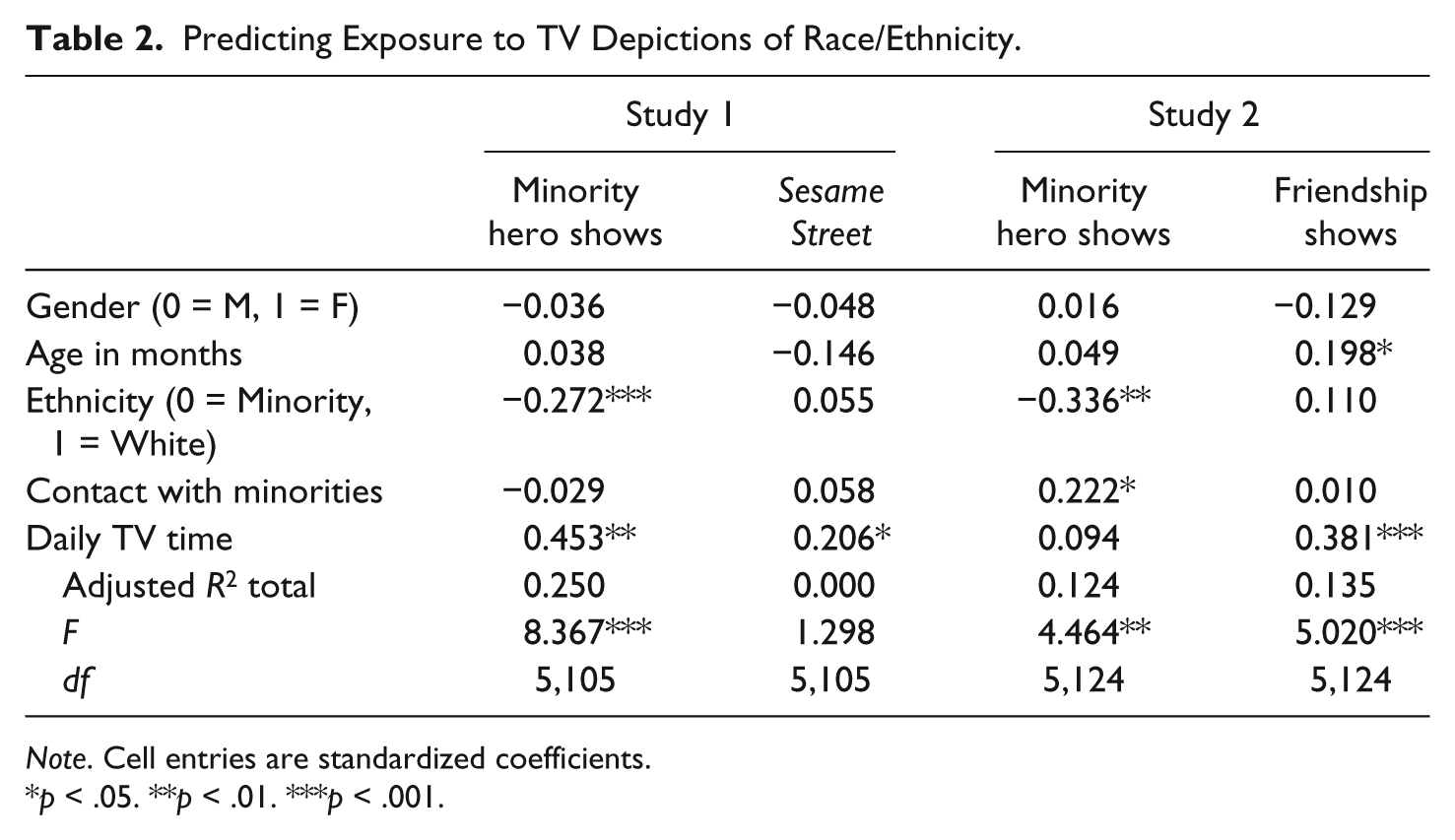
Note. Cell entries are standardized coefficients.
p < .05. **p < .01. ***p < .001.
Describing children’s ethnic/racial attitudes
As shown in Table 1, children used the full range of the “happiness” scale for all four groups, though there was substantial negative skew for ratings of the White girl (−1.11, SE = 0.23), and Chinese girl (−.74, SE = 0.23), indicating that scores clustered toward the high end of the scale. Repeated measures analysis of variance indicated significant differences in ratings of the groups, such that happiness was significantly higher for the White girl than for the Hispanic or African American girl Wilks’s Λ = .790, F(3, 107) = 9.455, p < .001,
We could also consider these scores in terms of bias—the percentage of children expressing negative affect (very unhappy or unhappy) about each exemplar. Bias was expressed by 13.5% of children for the White girl, 18.2% for the Chinese girl, 26% for the Hispanic girl, and 30.6% for the African American girl.
Predicting children’s attitudes: Looking for parasocial/extended contact effects
Analytic strategy
In initial analyses, we entered a set of background demographic and developmental variables on the first step: cognitive flexibility, age in months, gender, and dummy codes for the child’s own race/ethnicity. Three were then dropped because they were consistently nonsignificant: gender, age (redundant with cognitive scores), and the child’s race/ethnicity (redundant with interpersonal contact with the target group).
Thus, on the first step of regression analyses predicting ratings, we entered the child’s cognitive score, level of interpersonal contact with the target group, and overall TV viewing. On the second step, we entered habitual exposure to the show depicting the target group, and habitual exposure to Sesame Street (as an example of an interracial friendship show). For White/Chinese and White/Hispanic preferences we also entered experimental condition.
Media exposure and ethnic/racial attitudes
Overall, there was virtually no evidence of relationships between habitual or experimental media exposure and children’s attitudes. None of the four happiness ratings were significantly predicted by any of the media exposure variables. Given the skew in some of these scores, we then used logistic regressions predicting bias toward each of the groups. These also failed to indicate any significant effects of media variables. Finally, we used the three relative preference measures as the outcomes, and there were still virtually no relationships. As can be seen in the top half of Table 3, there was only one significant media effect: White/Chinese relative preference was significantly negatively predicted by overall TV time, F(3, 103) = 4.832, p < .01. Effect sizes for all other media relationships were trivially tiny and nonsignificant.
Media Exposure and Racial/Ethnic Preferences in Studies 1 and 2.
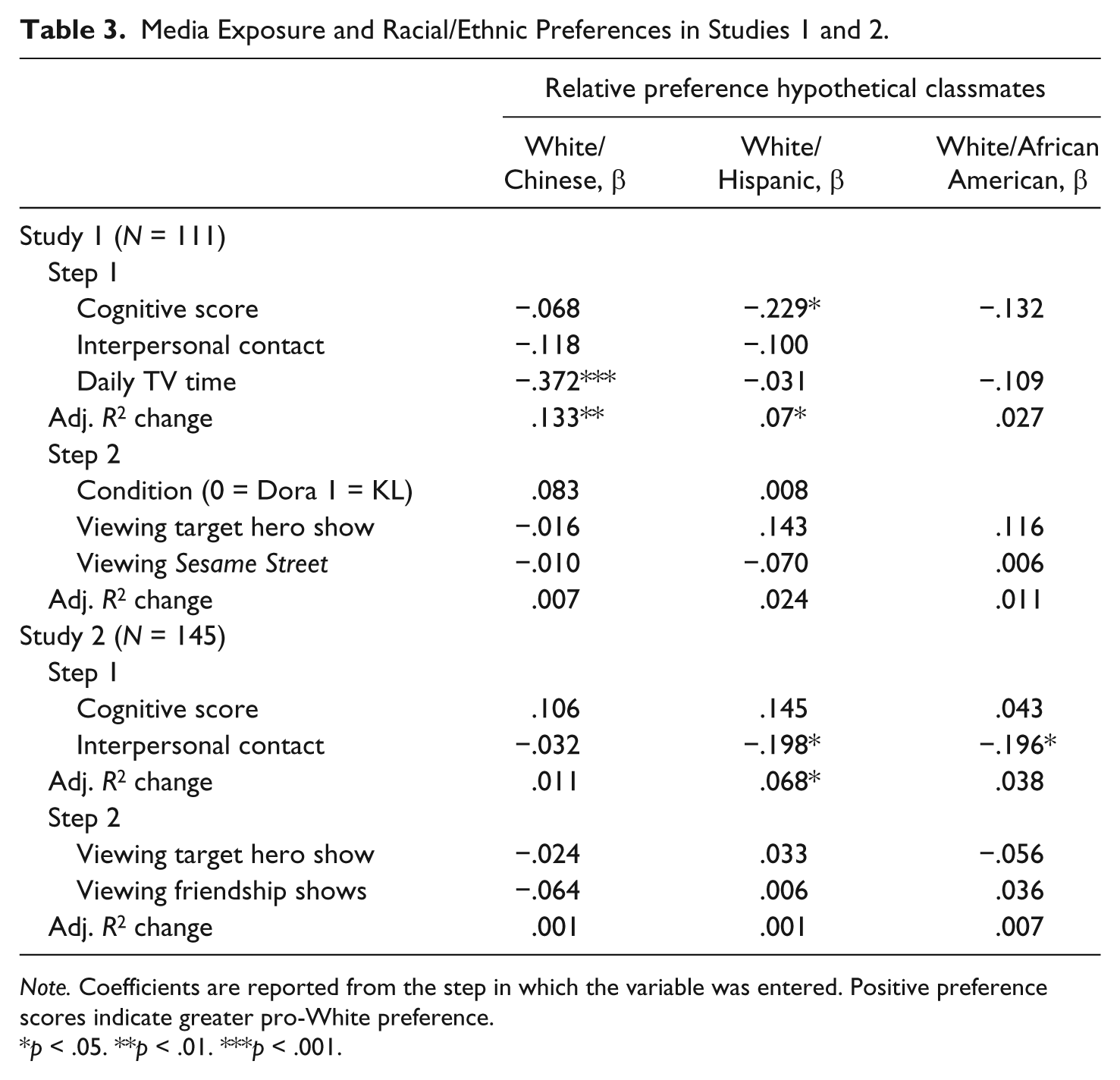
Note. Coefficients are reported from the step in which the variable was entered. Positive preference scores indicate greater pro-White preference.
p < .05. **p < .01. ***p < .001.
Moderation of media exposure by interpersonal contact
We ran four regressions to see if habitual or experimental media exposure interacted with amount of interpersonal contact to predict White/Chinese or White/Hispanic preferences (unfortunately, we did not gather data about contact with African Americans). The first two steps were identical to those shown in Table 3. Step 3 contained the interaction term. There were no significant interactions.
Moderation by character-photo similarity choices
Examination of children’s photo choices indicated that 54.7% chose a Chinese child as most similar to Kai Lan; 32.8% chose a Hispanic child as most similar to Dora. Although these were both above chance (25%), substantial numbers of children were not matching by ethnicity. Age in months was significantly correlated with choice of a Hispanic child as similar to Dora (r = .307, p < .05), but did not predict choice of a Chinese child as similar to Kai Lan (r = .078).
We ran two regression analyses to examine whether habitual exposure to the target hero show interacted with children’s perception of character-target similarity in predicting White/Chinese or White/Hispanic preferences. In both analyses, neither the main effect of similarity nor the interaction term approached significance.
Moderation of media exposure by reality judgments
Finally, we ran two regressions evaluating whether habitual exposure to Dora the Explorer and Ni Hao, Kai Lan interacted with perceived reality judgments (assessed in response to the experimental clips) to predict relative preference. Perhaps effects of viewing would depend on children perceiving that such programs convey information about the real world rather than dismissing the cultural content as fantasy.
The first step was the same as in Table 3, the second step contained exposure to the specific show and the child’s perceived reality score, and the third step contained the interaction term.
The interaction term was not significant for habitual exposure to Dora the Explorer, but was significant for habitual exposure to Ni Hao, Kai Lan, F(1, 102) = 9.411, p < .01, R2 change = .07; adjusted R2 total = .163. Examination of the interaction indicated that among children who grasped that the experimental clip depicted real cultural content (+1 SD), habitual exposure to Ni Hao Kai Lan, was associated with significantly less pro-White preference, B = −.351, SE = .171, p < .05. Indeed, as illustrated in Figure 1, high habitual exposure and high perception of cultural reality was associated with greater happiness about the Chinese classmate than about the White classmate. Among those who rated the content as not real (−1 SD for reality judgments), habitual viewing was associated with more pro-White preference, B = .375, SE = .171, p < .05.
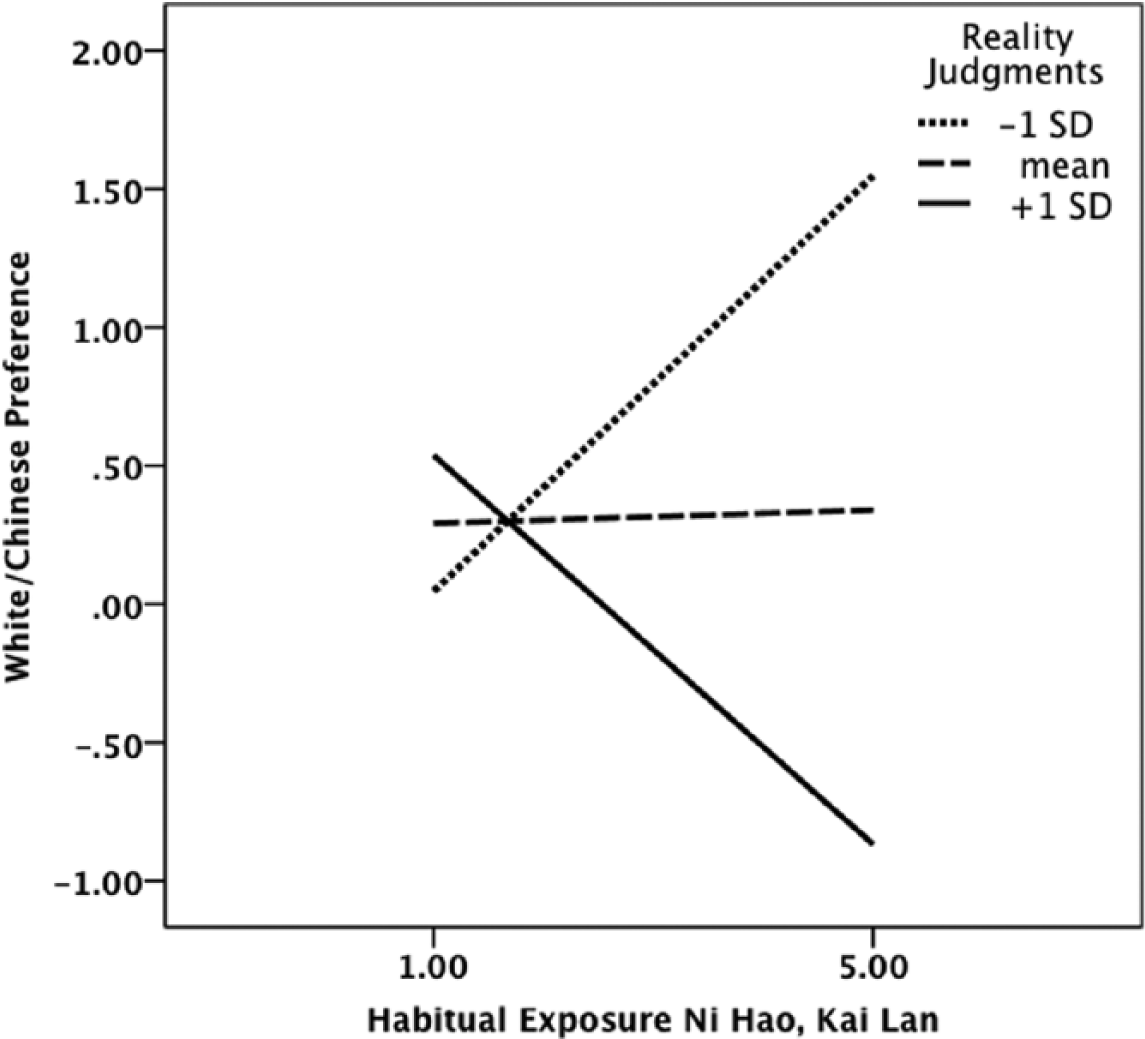
Study 1: Habitual exposure and perceived reality predicting White/Chinese preference.
Discussion: Study 1
Overall, the results of this study suggested minimal direct effects (either positive or negative) of exposure to non-White characters or intergroup friendships on children’s racial/ethnic attitudes. Although there was an interaction between habitual exposure and reality judgments, it occurred only for one of the two programs examined.
There were various limitations that may have hampered our ability to detect effects. We had only one exemplar of friendship shows and one exemplar each of shows with primary Asian or African American characters. Thus, in Study 2, we assessed exposure to a wider array of characters. We also lacked a measure of liking of the characters. The parasocial interaction hypothesis is that positive feelings toward media characters who typify stigmatized groups may lead to reduced bias. Thus, in Study 2, we asked about liking of a primary character for each group, so that we could examine whether there was an indirect effect of exposure, via liking.
Our measure of perceived character-photo similarity did not assess whether children were able to match on race/ethnicity if asked to do so. Given the importance of clarity of group membership (L. Cameron & Rutland, 2006), we changed the measure to ask explicitly for racial/ethnic matching. Moreover, given that Schiappa et al. (2005) theorized the importance of perceiving that there are multiple media characters belonging to the stigmatized group, we examined whether children could sort multiple animated characters on the basis of race/ethnicity.
Given the lack of age differences in attitudes in Study 1 (though we found relationships with cognitive flexibility), we extended the age range to 3 to 7 years.
Study 2
The primary goal of Study 2 was to examine whether there might be indirect effects of exposure to non-White characters via liking and knowledge of multiple media representatives, and whether such effects would be moderated by (1) interpersonal contact and (2) recognition of racial/ethnic similarity between media characters and real children depicted in photographs.
Method: Study 2
Participants
A total of 145 three to seven year olds participated (52% female). Parental reports identified 83 as White/non-Hispanic (57%), 20 as Asian (Indian, Chinese, Japanese, Korean, Pakistani, and Vietnamese), 7 as African American, 6 as Hispanic, and 29 multiracial/multiethnic.
Procedure
The 20-minute session consisted of four blocks of questions. The first asked about happiness with hypothetical classmates shown in photos (as in Study 1). The second asked about knowledge and liking of media characters from each group. The third asked children to match characters and photos on the basis of race/ethnicity. The fourth asked them to match characters with each other on the basis of race/ethnicity. Within each block, order of the ethnic groups was randomized (e.g., didn’t always ask about Whites first). Cognitive flexibility was measured last.
Measures
Ethnic/racial attitudes
These were assessed using the same measures as in Study 1.
Character knowledge
Children were shown images of eight different characters (two from each racial/ethnic group) and were asked if they could name each one. The Hispanic characters were Maya from Maya and Miguel and Dora, Asian characters were Kiku from Little Bill and Kai Lan, African American characters were Princess Pea from SuperWhy and Fuschia from Little Bill, White characters were Annie from Little Einsteins and Emily Elizabeth from Clifford the Big Red Dog. Character knowledge scores for each group could range from 0 to 2.
Character-photo matching
Children saw an image of an animated character from each group (Dora, Kai Lan, Princess Pea, Annie). For each one, the researcher named the character and program, labeled the character’s race/ethnicity, and asked the child to indicate if there were any girls of that race/ethnicity in the photos (e.g., “This is Dora, from the television show Dora, the Explorer. Dora often speaks in Spanish and is called Latina or Hispanic, can you point to other Hispanic girls in the pictures? Who else looks Hispanic like Dora?”). This task was repeated twice for each character, using randomly selected photos each time, from an array of three possibilities per group. The order of photos within the array of options was randomized, as was the order of the matching tasks. Scores for each character could range from 0 to 2.
Animated character matching
Children saw the primary exemplar and two successive arrays of four other animated characters (one from each group). The same instructions were used as in the photo matching task. The Hispanic matches were Diego from Go, Diego, Go! and Maya from Maya & Miguel; Asian matches were Kiku from Little Bill and June from Little Einsteins; African American matches were Fuchsia from Little Bill and Quincy from Little Einsteins; White matches were Caillou from Caillou and Emily Elizabeth from Clifford the Big Red Dog.
Character liking
Children rated Dora, Kai Lan, Princess Pea, and Annie, using a smiley scale from 1 (don’t like her at all) to 5 (like her a lot). Averages were all above the midpoint and within half a point of each other. Minority characters scored the highest: Dora M = 3.93, SD = 1.43; Princess Pea M = 3.82, SD = 1.43; Kai Lan M = 3.79, SD = 1.33; and Annie M = 3.77, SD = 1.30.
Exposure to TV depictions of race/ethnicity
Parents rated their child’s viewing of shows from 1 (never) to 5 (very often). Principal components analysis (varimax rotation) yielded three factors which explained 63% of the variance. One featured multiethnic casts (Sesame Street, Little Einsteins, Maya and Miguel, SuperWhy), which were averaged to form a measure of exposure to friendship shows (Cronbach’s α = .62). The second consisted of Dora the Explorer and Go, Diego, Go! both featuring primary Hispanic characters, the third consisted of Little Bill and Ni Hao, Kai Lan. The four programs in the second and third factor were averaged to create a measure of exposure to minority hero shows (Cronbach’s α = .72).
Overall television exposure
This was the same measure as used in Study 1.
Interethnic contact
As in Study 1, parents rated how much interaction the child had with White, Hispanic, African American, and Chinese/Chinese American adults and children.
Cognitive flexibility
We used the same card sorting task as in Study 1.
Results: Study 2
Predicting exposure to TV depictions of race/ethnicity
To examine predictors of exposure to minority hero and friendship shows, we conducted two regression analyses, entering ethnicity (White only vs. not), age in months, gender, level of interpersonal contact with minorities, and overall TV exposure together on a single step.
As shown in Table 2, both models were significant. As in Study 1, White children were significantly less likely than non-White children to watch minority hero programs. In addition, those with more interpersonal contact with minorities were more likely to watch. Exposure to friendship shows did not differ by the child’s ethnicity or interpersonal contact. Rather, such exposure was higher among older children and those who watched more television overall.
Describing children’s ethnic/racial evaluations
As shown in Table 1, children again used the full range of the 5-point scale for all four racial/ethnic groups. Repeated measures analysis of variance indicated only marginally significant differences in the average happiness ratings of the four groups, albeit with the same hierarchy of highest to lowest ratings as in Study 1, Wilks’s Λ = .951, F(3, 141) = 2.433, p = .068,
Predicting children’s ethnic/racial preferences
As shown in Table 3 (and consistent with Study 1), there were no significant relationships between relative preferences and exposure to minority hero shows or to friendship shows. The same lack of relationships were also observed for the four happiness ratings and for the dichotomous variables of bias toward each group. There were also no relationships with a measure of White/minority preference (i.e., aggregated across the three minority groups) nor were there interactions between level of interpersonal contact and media exposure.
Indirect effects of exposure via liking of characters
In the absence of significant direct effects of exposure to hero shows or friendship shows on racial/ethnic attitudes, we examined whether there were significant indirect effects via liking of and knowledge of minority characters. As can be seen in Figure 2, there was a small but significant indirect effect of exposure to minority hero shows on White/minority preference, via liking of minority characters, B = −.07, p < .05, Model F(4, 137) = 2.61, p < .05, adjusted R2 = .06. Exposure positively predicted liking minority characters. In turn, liking minority characters predicted less pro-White preference. Exposure to hero shows was also associated with knowing more minority characters, but such knowledge was not a significant predictor of children’s White/minority preferences.
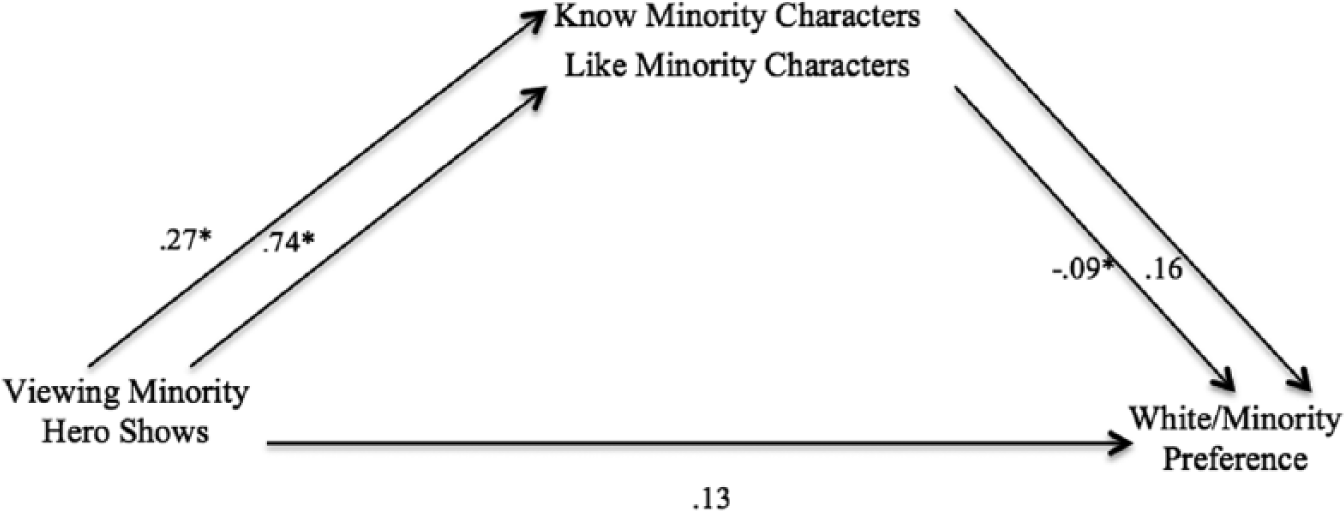
Study 2: Indirect effect of minority hero shows on racial attitudes via minority character liking.
There was no indirect effect of exposure to friendship shows on attitudes: Exposure to such shows was not significantly associated with liking minority characters.
Moderation of the indirect effect by interpersonal contact
To assess whether there was evidence of moderated mediation, we used the Hayes PROCESS macro (Model 14). We entered White/minority preferences as the outcome variable, exposure to hero shows as the focal predictor, liking of minority characters as the mediator, and interpersonal contact with minorities as a moderator of the effect of character liking on preferences. Children’s cognitive flexibility scores were entered as a covariate. The results indicated that the indirect effect of exposure to minority hero shows was not moderated by levels of interpersonal contact.
Moderation of the indirect effect by character-photo matching
As can be seen in Table 1, children were, on average, able to match each character to a photo for one of two trials. However, 42% of children matched neither Hispanic photo with Dora, 36% matched neither Chinese photo with Kai Lan, 48% matched neither African American photo with Princess Pea. Somewhat fewer children (29%) failed to match either White photo with Annie.
To test the moderated mediation hypothesis, we entered White/minority preferences as the outcome, exposure to hero shows as the focal predictor, liking of minority characters as the mediator, and racial matching scores as a moderator of the effect of character liking on attitudes. Cognitive scores and knowledge of minority characters were entered as covariates.
The results indicated that there was a significant moderated indirect effect, Index of Moderated Mediation = .082, SE = 0.045, p < .05. Viewing minority hero shows positively predicted liking minority characters; liking minority characters interacted with racial matching scores to predict White/minority preference. The indirect effect of viewing on relative preference was significant among those with high ability (+1 SD) to match characters with photos, B = −.086, SE = 0.047, p < .05, and those at the mean on matching, B = −.040, SE = 0.019, p < .05. The indirect relationship was nonsignificant for those who scored low on character-photo matching (−1 SD).
Discussion: Study 2
The results of Study 2 indicated a small indirect effect of exposure to minority hero shows (but not friendship shows) on children’s racial/ethnic attitudes. Children with more exposure to hero shows liked minority characters more, and such liking predicted less pro-White preference when evaluating hypothetical classmates. This indirect effect was not moderated by contact. Mere knowledge of minority characters did not predict children’s attitudes.
Consistent with the argument that bias reduction depends on the viewer perceiving media exemplars as typical of real-world group members, the indirect effect of exposure to minority hero shows was significantly moderated by children’s ability to match the animated characters to same-race photos of real children.
General Discussion
In the beginning of this article, we argued for meta-analysis as a tool for aggregating findings to draw conclusions and provided the example of the Sesame Street meta-analysis. The results of that meta-analysis indicated that there were significant effects of exposure to Sesame Street on children’s learning, including on social attitudes and reasoning. Nonetheless, one conclusion that emerged from the process was that for racial/ethnic attitudes, the field needed more research rather than aggregation. Even the fairly consistent format of Sesame Street, with its emphasis on modeling friendly intergroup interactions, produced highly variable outcomes, raising the question of what it takes to produce positive outcomes.
This question led to the two studies reported here. Based on theorizing and research on parasocial contact theory (Schiappa et al., 2005) and extended contact (L. Cameron & Rutland, 2006), we examined the relationships between children’s racial/ethnic attitudes and their exposure to intergroup friendship shows (such as Sesame Street), and minority hero shows such as Dora the Explorer.
In Study 1, despite our vigorous attempts to unearth associations between children’s racial attitudes and their exposure to these types of programs, there were no significant direct effects of exposure to either type. We then examined whether exposure would interact with interpersonal contact and with fantasy-reality judgments to predict children’s attitudes. Contrary to prior research findings, there were no significant interactions between mediated exposure and interpersonal contact. The one significant outcome occurred for Ni Hao, Kai Lan and pro-Chinese attitudes. Children who understood that the episode’s cultural content depicted real things that real people did in the real world (rather than being just made up for the show) showed a positive association between habitual exposure and attitudes. The same interaction did not emerge for habitual exposure to Dora the Explorer.
Operating within the differential susceptibility to media effects model (Valkenburg & Peter, 2013), we then focused on the possibility of indirect effects that occur only under particular conditions. Parasocial contact theory suggested that sustained exposure to media exemplars of stigmatized groups would reduce bias toward those groups as a result of viewers coming to know and like those exemplars. Both parasocial and extended contact approaches suggested that for bias reduction to occur, the characters would need to be seen as typical of the real-world group.
The results of Study 2 indicated a small but significant indirect effect of exposure to depictions of minorities despite the absence of a significant direct effect. That is, viewing programs with primary minority characters led to less pro-White preference, to the extent that viewers liked the minority characters depicted. (Exposure to the programs was also associated with getting to know more characters’ names, but that in itself was not associated with viewers’ attitudes.) Importantly, this indirect effect was moderated by children’s ability to match each character with a photo of a real child of the same race/ethnicity. The indirect effect of liking the character on racial/ethnic attitudes was only significant for children who could make this connection at least some of the time.
Thus, the results of both Study 1 and Study 2 suggest that one way to strengthen the effects of exposure would be to improve children’s understanding of the connection between stylized, animated depictions of ethnicity and the real world. Unfortunately, children seem unlikely to be helped in this matter by adult coviewers. In a recent study, Vittrup and Holden (2010) randomly assigned White 5 to 7 year olds and their parents to watch videos featuring positive depictions of African Americans, or to discuss race without watching the videos, or to watch the videos and discuss. Despite agreeing to be part of the study, and despite explicit instructions from the researchers, only 10% of parents reported having more than a superficial discussion about race. When they did discuss it, they most often focused on messages that everyone is equal and God loves everyone. Thus, children are probably left to their own devices to sort out the connection between depictions and possible real-world interactions. A primary question that remains is what it takes to help children understand these connections.
Indeed, there is much work to be done, and a substantial number of methodological advances still required. Starting, in effect, on the left hand side of the differential susceptibility to media effects model, we need a better understanding of the conditions that lead minority and nonminority children to seek out or avoid depictions of minority characters or interracial friendships, including examination of the ways in which initial racial/ethnic attitudes predict exposure. As Aboud et al. (2012) noted, initial preferences may become self-perpetuating and strengthened as children selectively avoid disconfirming content. In both studies, minority hero shows, which we conceived of as those featuring one primary non-White character, were more likely to be watched by non-White children, even after controlling for overall television viewing. This fits with the argument that such programs have particular meaning for minority children seeking representations beyond the White norm that still prevails in media content (Children Now, 1998). Nonetheless, it remains unclear what features of the content are attractive and why audiences are watching.
In addition, given the apparent importance of character liking rather than mere exposure or knowledge, we need to reconceptualize our measure of exposure. Thus far, we have focused on children’s viewing of television programs, but obviously this is not the only way in which children encounter minority TV characters. Even some of the children in our sample who had never watched Dora the Explorer knew a great deal about her and were passionately fond of a book about her, a pair of Dora pajamas, or their own Dora backpack. The power of these paratexts (as they have been described by Gray, 2010) has seldom been considered in children’s media effects research though it has been explored in research on children and popular culture (Fleming, 1996). Perhaps we are finding weak effects of television viewing because that is not the only way or even the most important way in which children come to admire certain characters.
We would also need to improve our understanding of the mediators of effects, both in terms of finding stronger measures of parasocial engagement that can be used with such young children, but also in terms of considering other ways in which depictions may produce positive outcomes. L. Cameron et al. (2011) found that stories about immigrants in the United Kingdom had positive effects in part because they altered children’s perceptions of immigrant peers’ interest in being friends—but the effects of such reappraisal occurred primarily among the older children in their 6- to 11-year-old sample. It is unclear whether positive outcomes with young viewers rely primarily on simple affective responses.
In the current studies, we focused on two moderators—interpersonal contact and ability to match characters with photos of children of the same race or ethnicity. Both of these merit further examination. We did not measure the nature of the interpersonal contact and the degree to which it involved more than superficial acquaintance nor did we measure children’s perceptions of parents’ attitudes. Thus, we had little indication of the degree to which media messages of interethnic friendship were operating in resonance with the child’s social environment or battling against it. Likewise, we have just begun to scratch the surface with our measure of typicality. This a relatively complex concept for young children and understanding how they think of the relationship between an exemplar and a group should help us design more effective messages.
Finally, we are still struggling with the dilemma of how to measure young children’s attitudes in this domain, given that some were barely cognizant of ethnicity or race and others were very much aware of them. Asking children to speculate about their feelings about hypothetical classmates that differ only in racial/ethnic cues seems hardly ideal. Indeed, such tasks seem likely to elicit race-based processing, potentially obscuring important variability in children’s natural responses to peers of different races and ethnicity.
We have aired our considerable dirty laundry here, in the hope that these reflections spur further work in this area. Our goal would be to be able to report some advances beyond the current state of mixed and limited effects, by the time of the next special issue. Ultimately, we (as a field) should be able to reach the point of meaningful aggregation, to generate substantive answers about the types of programming that foster positive racial/ethnic attitudes among young viewers.
Footnotes
Declaration of Conflicting Interests
The author(s) declared no potential conflicts of interest with respect to the research, authorship, and/or publication of this article.
Funding
The author(s) declared receipt of the following financial support for the research, authorship, and/or publication of this article. Preparation of this article was supported in part by a fellowship to the first author from the Netherlands Institute for Advanced Study (NIAS).