




Abstract
Building on substantive yet neglected foundations provided by classical sociological theorists—theorists who emphasized the experiential conditions of work in structuring ideology—we examine in this article the impact of job authority tasks on levels of support for policy to redistribute income. Such a focus contributes to a broader sociological understanding of the links between status, ideology, and political action. With data drawn from the 2010 and 2012 National Election Studies, we find that workplace experiences and tasks involving sanctioning/organizational responsibility as well as the hierarchical patterning of interactions on one’s job help structure generalized views regarding inequality and policy orientations ultimately enacted outside of the workplace. In this regard, the number of authority tasks is inversely related to support for redistributive policy. Subsequent analyses, however, reveal this general pattern does not hold on the basis of race: less variation in policy support as well as greater levels of policy support is expressed by African Americans than Whites across all authority task levels. We conclude by discussing how our findings inform broader conceptions regarding the link between work, ideology, and politics, as well a deeper sociological sense of the attitudinal consequences of work and the underpinnings of tenets of American stratification ideology.
Keywords
Over recent decades, sociologists have documented that job authority constitutes one of the foremost components of class position in advanced postindustrial societies (Halaby & Weakliem, 1993; Wilson, 1997). In this vein, the impact of job authority exceeds that of traditional indicators of inequality such as socioeconomic status and sector of employment in structuring life chance trajectories on both an intra- and intergenerational basis: Authority attainment is related to income acquisition (Smith, 2002) and wealth possession (Conley, 1999; Smith, 2002) that benefits workers and additionally provides resources to help ensure the favorable transmission of economic status for their children (Wilson, 1997). The influence of job authority also extends to, for example, charting personnel policies and recruitment strategies of firms, thereby, fundamentally influencing career prospects for others along stratification-relevant criteria such as ethnicity, gender, and class background (Smith, 2002).
Despite these crucial insights, however, the full-range of consequences of authority attainment has yet to be enunciated. Most notably, absent have been examinations of its impact on perceptual/ideological outcomes, including stratification beliefs, such as support for redistributive policies. In this vein, redistributive polices are tenets of stratification ideology that has risen in importance as social issues among the American public in recent years pursuant to the widely publicized growing polarization of income attainment and wealth possession across recent decades in the United States (Dallinger, 2010; McCall, 2013). Tapping “the most fundamental sentiments about normative and idealized notions of distributive justice” (Hochschild, 1995, p. 36), in the new millennium, the issue of income and wealth distribution has risen higher up the priority list than any other social or economic issue among Americans (McCall, 2013).
To date, examinations of the determinants of support for redistributive policy have focused on a variety of determinants, both global, outside-of-work factors such as political ideology (e.g., Castillo & Marques-Perales, 2014; Hauesemann, Kurer, & Schwander, 2015; Rudolph, 2005), other tenets of stratification ideology, including, most often, causal attributions for socioeconomic inequality (e.g., Bobo & Kluegel, 1993; Gildens, 1999; Hunt, 2007) and racial affect (e.g., Bobo & Kluegel, 1993) as well material and reward-based factors in the workplace such as income and socioeconomic status that signal forms of “self-interest” (e.g., Bobo & Kluegel 1993; Steele, 2015). However, these studies, in toto, have recently been characterized as “instructive and important, but not comprehensive” (Shelton & Wilson, 2012): Building on this characterization have been two least recent calls to pursue additional investigation, specifically, exploring the underpinnings of policy support within the daily experiences of institutional domains—such as work (Dallinger, 2010; McCall, 2013). Along these lines, this additional investigation
may well reveal that socio-political attitudes can be grounded in, and be generated from, stratification experiences encountered daily in terms of the kind of labor performed and the kinds of interactions with others that persist with others over prolonged periods of time. (McCall, 2013, p. 74)
In this article, these recent calls for additional investigation are heeded: We explore the link between job authority—as a stratification-based aspect of daily life and experiences within the institutional domain of work—and support for income redistributive policy. Such attention and foci, we believe, traverses several subspecialties of our field (e.g., work, culture, inequality, and politics) and adds a deeper layer of meaning specifically regarding the broader social relevance of work and workplace experiences (see also Hodson, 2001). In this regard, we draw data from the National Election Studies (NES) to link along both general and racial lines an important aspect of work, namely, its experiential meaning in daily life, based on cultural and social structural considerations, with the rise and perpetuation of stratification ideology. Accordingly, work and politics are linked in a manner that, we believe, is unique and important as we achieve two primary aims, enhancing our understanding of both the roots of redistributive policy and the full range of consequences of job authority attainment.
Workplace Experiences and Redistributive Policy
Background Theory
Theorizing by classical sociologists provide an initial and crucial basis for maintaining that privileged position in the workplace, that encompasses having opportunities to exert authority and control over other workers, is associated with the formation of ideological beliefs, such as support for redistributive income policy. For example, Marx’s (1965) classic statement, “At any time the dominant ideas are the ideas of the ruling class,” embodies his perspective. In this vein and more generally, central to his historical materialist perspective is that ideological formation is an outgrowth of social relations in the productive sphere; the experiential aspects of class relations that are embodied in interactions of domination and subordination in production are the basis of, particularly among those in superordinate positions, the development of orientations toward the world—including political/ideological beliefs—that legitimate their privilege and favorable position. Durkheim (1984), similarly, argues there is a fundamental link between occupational experiences and ideology formation, specifically, drawing on the notion of “occupational groupings” as entities that are characterized by distinct mechanisms of socialization and certification that “provide orientations toward the political world (p. 106). Nevertheless, Durkheim’s analysis may be less decisive for discussions of the consequences of authority attainment: He has no explicit and extended discussion of the relationship between the hierarchical ordering of these occupational groups and variation in policy preference formation (Durkheim, 1984; Lukes, 1973).
The line of contemporary research in political science and sociology noted in the introduction that examines redistributive income policy along lines do not follow-up on the logic of the classical sociological theorists, that is, analyze the role of experiential aspects of work on policy support. Locating policy underpinnings in aspects of the workplace other than job experiences such as income and socioeconomic status that are associated with, forms of “self-interest” as well global factors outside of workplace factors such as adherence to generalized political orientations, other tenets of stratification ideology including, most often, causal attributions for socioeconomic inequality and racial affect constitute meaningful substantive contributions. For purposes of this study, particularly meaningful are studies that focus on nonexperiential aspects of the workplace: They empirically bear out the basic relationship enunciated by the classic sociologists, including, most conspicuously Marx, that privileged position in the workplace is associated with reduced support for income redistributive policy and that material rewards associated with privilege constitutes important determinants of policy support. Nevertheless, the contribution that may be played by daily experiences, for example, in performing job tasks in a hierarchical workplace structure remain unexamined as a possible contributing source of income policy preferences.
Supervisory Tasks
That experiences of work have attitudes fundamental attitudinal consequences has been empirically documented, for example, in the classic work of Kohn (1969, 1983); he highlights the socialization and nurturing role of class-based job conditions on the formation of “personality,” that is, basic orientations to the world in terms of phenomenon such as self-direction versus conformity and appreciation versus nonappreciation of intellective functioning. In this regard, he characterized the inculcation of values and subsequent generalization of these values learned on the job in the following manner:
The most reasonable hypothesis is that in industrialized society, where work is central to people’s lives, what people do in their work directly affects their values, their conceptions of self, and their orientation to the world around them—“I do therefore I am.” Hence, work leaves a fundamental imprint on value orientations. (Kohn, 1969, p. 31)
In fact, a distillation of recent research subsuming political science inquiries into the formation of political attitudes (e.g., Corbeta & Pasquele, 2013; Lee, 2007) as well as workplace case studies, treatises, sand ethnographies by sociologists (e.g., Kalleberg, 2009; Leicht & Fennell, 2001; Perrucci & Wysong, 2007; Vallas & Hill, 2012) provides a strong basis for maintaining that experiences in the hierarchical workplace nurture and reinforce political attitudes such as those about redistributive policy. Furthermore, in these studies this connection emerges most poignantly among those working in privileged positions that subsumes those who are employed in privileged positions including those who exercise supervisory responsibility (Perrucci & Wysong, 2007; Vallas & Hill, 2012). In this vein, at the heart of these supervisory experiences that emerge as causally relevant are job tasks that consist of two components: (1) a behavioral component that subsumes control/sanctioning aspects as well as supervised/organizational functions for which supervisors are responsible (Lee, 2007) and (2) an interactive component that subsumes interpersonal the interpersonal relations supervisors have with subordinate coworkers (Kalleberg, 2009; Perrucci & Wysong, 2007).
Regarding (1): The major study that documents the importance of the behavioral component of job tasks is that by Kitschelt and Rehm (2014). In their study, the authors postulate the following:
There is a connection between occupational experiences and attitudes that appear to be one of generalization and transposition from one important sphere of life—work—to others and especially from private experiences to policy preferences. People apply the kinds of reasoning, heuristics, and problem-solving techniques that they learn and use at work in all realms of life.
In the context of supervisors, the authors identify the following as causally relevant: tasks involving the supervision, sanctioning, and directing of those at a lower level in the stratification hierarchy in whom they must instill compliance and incentives to pursue organizational goals while simultaneously constrained by the imperative to use scarce resources efficiently inculcates generalized beliefs about preserving material incentive systems in and out of the workplace. To be perhaps more specific, crucial is that those who structure task assignments of subordinates, in both formal and in dispositional capacity perform functions related to the execution of allocating scarce resources to uses that are efficient for the maximization of goals the organization’s care about owners that appears to make them eager to preserve material incentive systems that make subordinates comply with organizational objectives. In this vein, Kitschelt and Rehm (2014) use data from the European Social Survey to establish correlations between job tasks, operationalized along two dimensions, the “logic of authority” (professional, associate professional, unskilled routine) and “logic of task structure” (organizational, technical, nontechnical) and three sociopolitical domains including “greed,” that is, prof versus contra support for income redistribution policy. The authors find that along each dimension those whose tasks are associated with incumbency in privileged occupations and entail professional and organizational tasks are highly associated with low levels of support for income redistribution policy. In addition, also noteworthy is the piece by Vallas and Hill (2012) who maintains that organizational forces including “inertia and cultural conservatism” inherent in the running of organizations militate toward the development of “deeply-rooted and firmly entrenched” antilabor sentiments that are generalized to the broader American labor market.
Regarding (2): Several studies are invoked to establish the importance of the interactive component of job tasks. Along these lines, supervisors are guardians of organizational budget and organizational goal attainment who are involved in the “manipulation of objects or playing with strategic players” (Leicht & Fennell, 2001); they deal with strategic counterparts and others in a hierarchical fashion, that is, as professionals they work on objects with clients and others as strategic counterparts, leading them to be oriented toward personal and organizational income maximization and dismiss claims to redistribution. In this vein, Leicht and Fennell (2001) found in their interviews with professionals in mid-west cities that those most entrusted to enforce organizational goals express the strongest maintenance of the economic status quo in the distribution of socioeconomic resources in American society. Similarly, Perrucci and Wysong (2007) in their analysis of supervisor–worker relations found that those who express the highest levels of job satisfaction also expressed the greatest opposition to policies that would redistribute economic resources both within and outside of the firms in which they work.
All told, this discussion establishes a firm basis for expecting that the behavioral and interactive components of job tasks associated with authority attainment to limit support—net of, most important, both economistic workplace factors associated with the attainment of job authority as well as generalized political orientations examined in previous work—for income redistributive policy.
The Impact of Race
We believe the breakdown of the relationship between authority tasks and support for income redistributive policy along racial lines may produce results that constitute an important qualification to our general expectations. In fact, sociological research documents that across all structural positions in the hierarchical workplace African American experience less variation in levels of support for income redistribution than do Whites (Shelton & Wilson, 2012; Wilson, 2001). In this vein, the higher levels of support among African Americans relative to, Whites performing the same authority-based job tasks may signal greater prework socialization effects as determinants of support for aspects of stratification ideology that constitute a kind of “caste effect” and render relatively minimal the role of learning that is generalized from the workplace environment into the nonwork sphere.
Data and Method
We use data drawn from the 2010 and 2012 NES to examine the relationship between the attainment of job authority and support for income redistributive policy. The NES is a full probability sample of English-speaking adults living in households in the United States (for a full description of the NES, see Miller, Kinder, & Rosenstone, 1993).
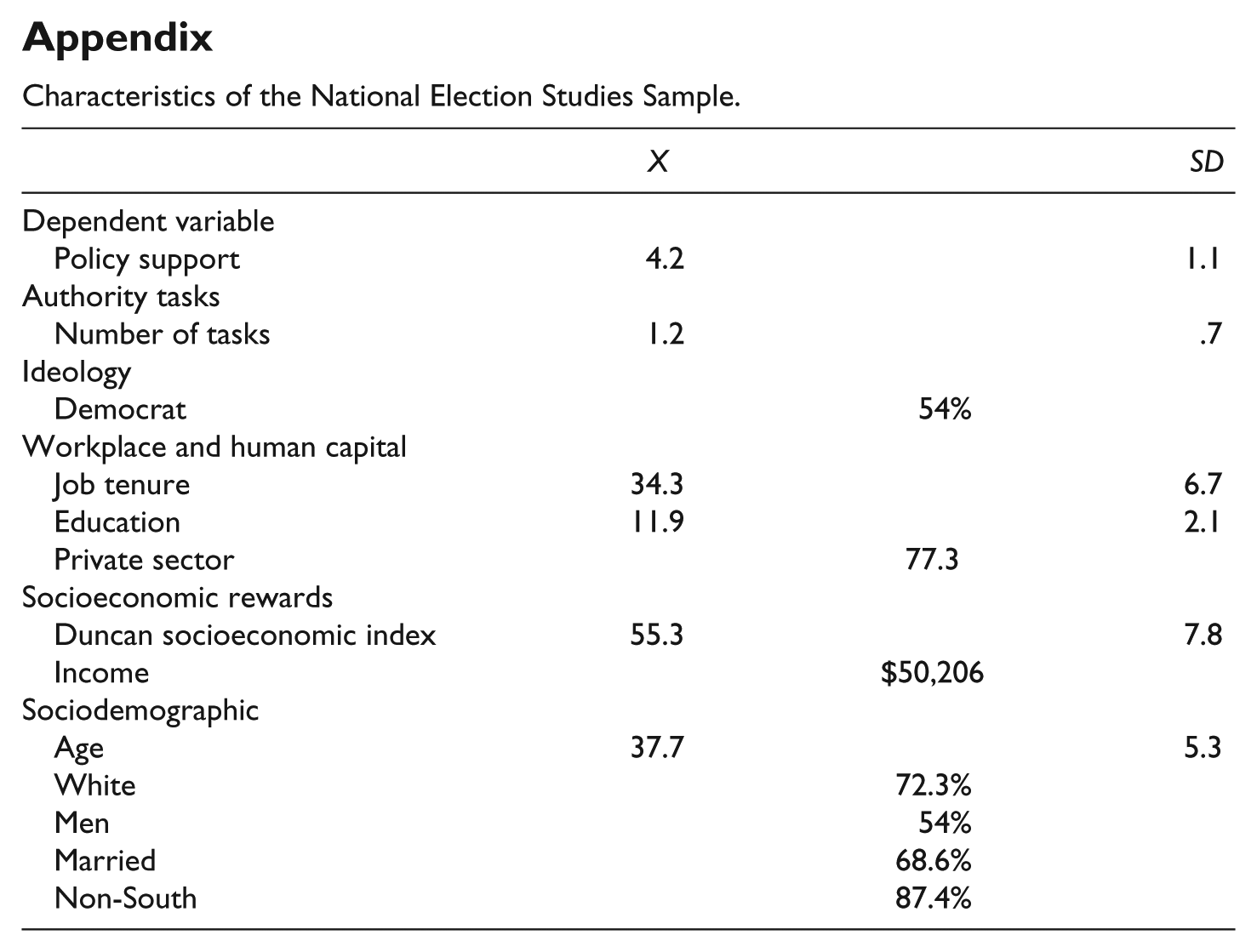
Individuals between the ages of 20 and 62 who worked full-time when interviewed were included in the sample. This produced a sample of 2,834 individuals, approximately 56% men and 44% women (the appendix contains descriptive information on the NES sample). To address missing data, we use multiple imputation, which replaces missing values with predictions based on associations observed in the sample and generate imputed data sets (Rubin, 1987). We, ultimately, combine the empirical results across the imputed data samples, accounting for variation within and between imputed data sets to arrive at unbiased standard errors of the coefficient estimates (Rubin, 1987). In supplementary analyses, usage of a listwise deletion procedure produced results that are largely similar to those presented in this study. Overall, the statistical model used in this study is as follows. 1
Dependent Variable
Support for redistributive policy
The “income-targeted” version of redistributive policy is measured with one item and is worded as follows:
In general, some people feel that the government in Washington should see to it that every person has a good job and a good standard of living. Others think the government should just let each person get ahead on his own. Where would you place yourself on this scale?
Respondents placed themselves on a 7-point scale with “Government See to Job and Good Standard of Living,” coded 7, defining one end of the scale, and “Government Let Each Person Get Ahead,” coded 1, defining the opposite end.
Independent Variables
Authority tasks
The NES asks respondents about the “critical” (Bridges & Villemez, 1994) “span of responsibility” dimension of job authority, that is, the degree to which a supervisor has the power and responsibility to make decisions that directly affect subordinates. NES respondents were asked if they supervised any workers in their jobs. If they answered “yes,” they were asked if they have “say over the pay or promotion of others.” Several dummy-coded authority variables were derived for the two questions: respondents who have only supervisory authority and respondents who have supervisory authority and say over pay or promotion and respondents who have no job authority. The unemployed were used as the reference category. In the tables presenting results of analyses, NES respondents who have both supervisory authority and say over pay or promotion are categorized as having a “higher” span of responsibility (coded 2), those sample members who have supervisory authority but have no say over pay or promotion are categorized as having a “lower” span of responsibility (coded 1), and sample members who have no responsibility are categorized as having “none” (coded 0).
Ideology
Sample respondents’ political ideology was tapped by asking their political party affiliation (2 = Democrat, 1 = Independent, 0+ = Republican).
Workplace and human capital
Several workplace and human capital variables are included in the statistical model. First, tenure with present employer is coded in months. Second, education is coded in years. Third, sector of employment is coded as 1 = private and 0 = public. Fourth, occupation is measured by the 2000 census-based scheme.
Socioeconomic rewards
Income is measured as annual personal income and is subject to a natural logarithmic transformation, and the socioeconomic status of respondents is coded as a Duncan SEI (socioeconomic index) scores.
Sociodemographic
The effects of age (years), race (1 = White, 0 = African American), gender (1 = women, 0 = men), region of work (1 = South, 0 = others), and marital status (1 = married, 0 = not married) are included in the statistical model.
Finally, ordinary least squares regression is the main multivariate technique used in our analyses. In this vein, we are interested in isolating the effect of authority tasks net of all other predictors in our statistical model. Accordingly, we opt for a hierarchical method of analysis, first entering in stage one the authority tasks to derive a “zero-order” estimation. We, then, in subsequent stages enter variables that measure socioeconomic rewards, ideology, workplace and human capital characteristics, and, finally, sociodemographic factors, to assess the extent to which the job authority variables work through each of the set of predictors in the statistical model.
Results
Levels of Support for Income Redistributive Policy
Table 1 presents results from an analysis of variance procedure that yields the mean levels of support across levels of authority tasks performed on the job.
Analysis of Variance for Levels of Support for Income Redistributive Policy.
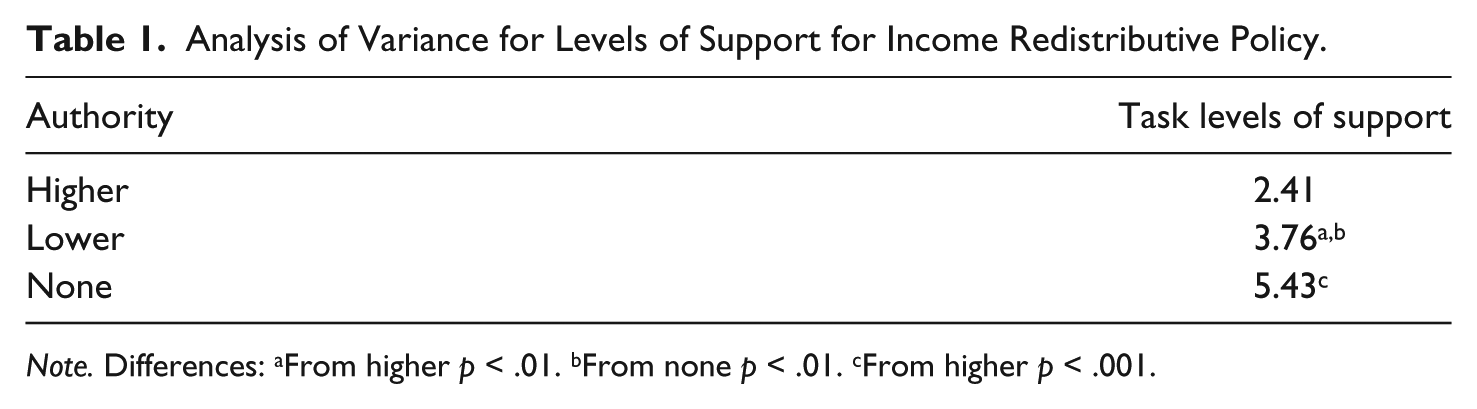
Note. Differences: aFrom higher p < .01. bFrom none p < .01. cFrom higher p < .001.
Results indicate, as expected, that there is an inverse relationship between amount of authority tasks performed and levels of mean support for income redistributive policy. Specifically, at the “Higher” level, mean support (2.41) is more than 3 points lower on the support scale than among those who do not perform any job tasks (5.43), and those at the “Lower” task level maintain an intermediate level of mean support (3.76); differences in mean support between those at all three task levels is statistically significant.
Determinants of Support for Income Redistributive Policy
Multivariate analyses regarding the determinants of support for income redistributive policy among the general sample are presented in Table 2.
Determinants of Support for Income Redistribution Policy.
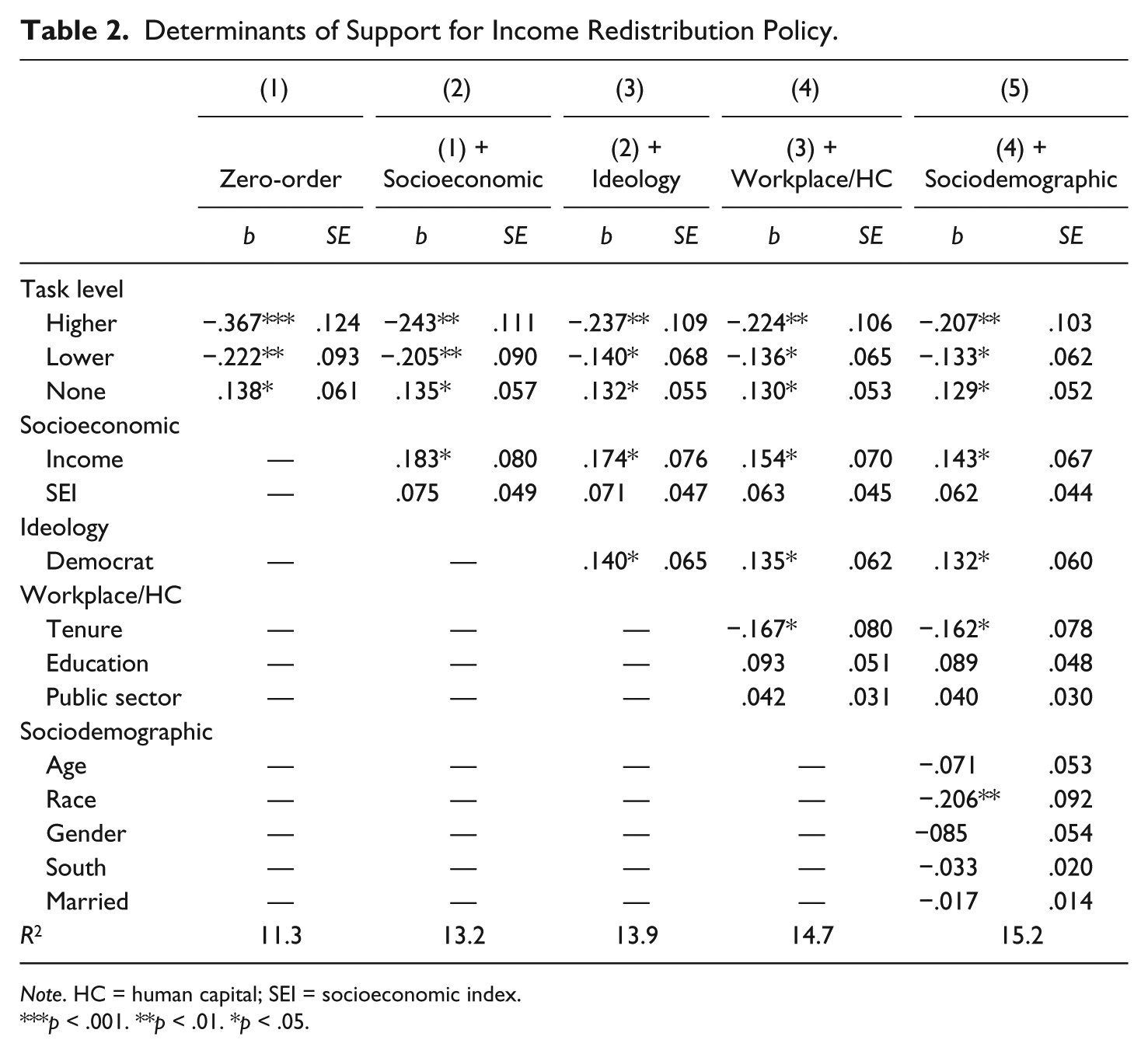
Note. HC = human capital; SEI = socioeconomic index.
p < .001. **p < .01. *p < .05.
Findings indicate the experiences at work among those associated with the attainment of job authority—as indexed by number of job tasks—are important determinants of support for redistributive policy, net of all other factors in the statistical model. In fact, the number of job tasks performed, that is, the “higher” and “lower” levels remain statistically significant throughout the hierarchical regression analysis, serving, overall, to reduce support for income redistributive policy. Furthermore, not having any authority tasks, that is, the “none” level, operates in a statistical fashion throughout the analysis to increase support for income redistributive policy.
At the first stage, which taps zero-order effects, there is, as expected, a clear inverse relationship between the amount of supervisory tasks and support for redistributive policy. In particular, performing multiple authority tasks, that is, those at the “higher” task level, has a robust (b = −.367; p < .001) negative effect on redistributive policy. Furthermore, performing only one authority task, that is, those at the “lower” task level, has a moderate (b = −.222; p < .01) negative effect on policy support. Furthermore, performing no authority tasks, has a modest positive effect on support for income redistribution (b = .138; p < .05) and this effect remains constant throughout all stages of the hierarchical regression analysis.
Significantly, when variables measuring socioeconomic rewards are introduced at Stage 2, the influence of performing a “higher” number of job tasks is reduced slightly (b = −.243; p < .01) though the influence of performing a “lower” number of job tasks is unaffected (b = −.205; p < .01); clearly, at the higher task level, policy support—to a modest degree—operates through socioeconomic rewards attained as a supervisor. In addition, noteworthy, is that after the variable measuring political ideology is introduced in Stage 3, the influence of performing higher number of job tasks is unaffected, maintaining its significance level from Stage 2 (b = −.237; p < .01) while the statistical influence of performing the “lower” number of tasks is reduced slightly (b = −.140; p < .05); clearly, level of support at the lower task levels operate modestly through generalized political orientations. Finally, after variables measuring human capital and sociodemographic characteristics are introduced, respectively, at Stages 4 and 5, the influence of performing both higher and lower numbers of job tasks on support for income redistribution policy is unaffected so that after all variables in the statistical model are accounted for, performing multiple job tasks exerts a moderate (b = −.207; p < .01) negative effect on policy support while performing only one job task exerts a statistically modest (b = −.133; p < .05) negative effect on support for redistributive policy.
Findings from a similar hierarchical regression analysis by race among African American and Whites are presented in attenuated form in Table 3.
Determinants of Support for Income Redistribution Policy by Race.
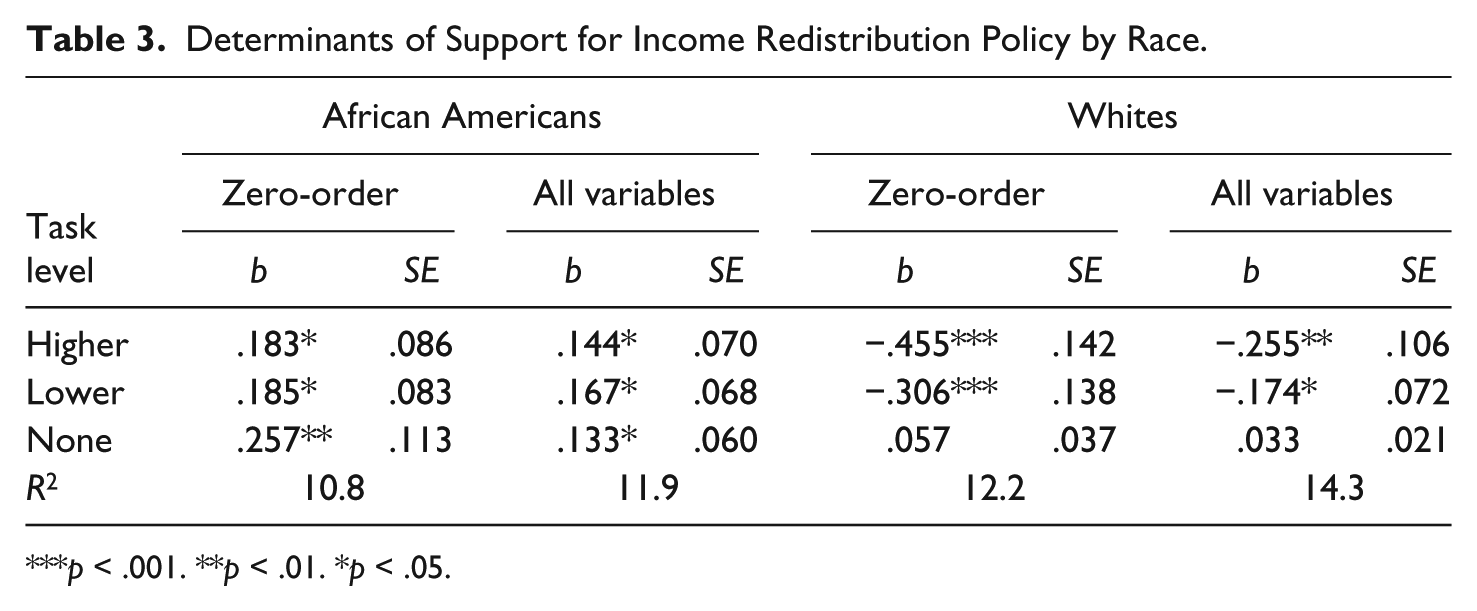
p < .001. **p < .01. *p < .05.
As expected, statistically significant differences emerge among African American and Whites throughout the regression analysis: African Americans exhibit greater levels of support across task levels with relatively small changes occurring across stages of the analysis. In particular, in terms of zero-order effects, African Americans at the higher and lower task levels express modest (p < .05) and positive levels of policy support while expressing a moderate (p < .01) levels of policy support at the none task level. In contrast, Whites—in terms of zero-order effects—at both higher and lower task levels express robust (p < .001) and negative levels of policy support while the “none” task level is not statistically significant. Furthermore, as stages of the analysis unfold, African Americans retain a level of positive support for income targeted policy, culminating—after all variables in the statistical model are introduced—in a modest positive and positive statistical effect across all three task levels. Whites, in contrast, express by-and-large negative levels of support throughout all stages of the analysis culminating in a moderately negative effect at the higher task level and a modestly negative effect at the lower task level while the none task level continues to exert a nonsignificant statistical effect.
Discussion and Conclusion
There is a lineage of sociological work dating back to the class sociological theorists that make examining the connection between workplace experiences and support for stratification beliefs, such as levels of support for redistributive policy, a research priority. Yet little empirical work has followed through on this idea. We do so, here, and, in the process of focusing on the experiences of one group of workers, namely, those with job authority, uncover a neglected aspect of authority attainment, that is, supervisory job tasks embodied in the performance of sanctioning/control functions as well as patterns of interaction with coworkers in the hierarchical workplaces—net of, most significantly, material rewards attendant to occupying this privileged position and generalized political orientations—help to structure stratification ideology, in this case, levels of support for income redistributive policy. However, one qualification to this finding also emerges in subsequent analyses: the generalized pattern does not capture the dynamics of both African Americans and Whites, so a racial effect is present in the relationship between job tasks and the formation of support about redistributive policy.
Significantly, these findings build on findings from important stratification literatures, particularly, in sociology. In this regard, we underscore that these contributions are premised on a unique linkage between cultural and social structural factors operating in the workplace with the formation of stratification ideology. First, in the context of research on attitudinal consequences of work associated, most conspicuously, with the research tradition that addresses “work and personality” (Kohn 1969, 1983), our findings extend both the range of workplace experiences that help trigger attitudes and the attitudinal consequences that are impacted. In this vein, aspects of laboring in the hierarchical workplace extend outside of the extent to which work, for example, is substantively complex, invokes intellective functioning and is routinized in structuring attitudes, in this case, socializing and subsequently generalizing aspects of stratification ideology. Second, the tasks associated with job authority emerge as a neglected causal agent in the sociological literature that addresses the underpinnings of support for income redistribution policy. Accordingly, we extend the underpinnings here to a broader range of causes than the nonexperiential aspects of work and global factors outside of the workplace such as political orientations and other tenets of stratification ideology that have been the focus of previous inquiry.
The findings from the racial breakdown, however, yield unique, race-specific, dynamics characterized by a “caste-like” effect that is manifest for African Americans, unlike Whites, that is, among African Americans, there is relatively little variation in policy support across levels of job supervisory tasks performed. We suspect that African Americans exhibit high levels of support with little variation in policy support may signal, relative to Whites, greater prework socialization effects as determinants of support for aspects of stratification ideology that simultaneously render minimal the role of learning that is generalized from the workplace environment into the nonwork sphere. In fact, this race-specific causal dynamic has long been suspected in the sociological literature that addresses the race-based underpinnings across a variety of tenets of American stratification ideology (see Shelton & Wilson, 2012).
We, finally, note that additional research is needed to further establish the connection between authority tasks and support for income redistributive policy. Undertaking this task, we believe, should involve efforts that extend the scope of traditional lines of workplace inquiry—for example, analyses of the labor process—with literatures that address the social psychological underpinnings of attitude formation that tend to be global in nature and neglect institution-specific factors such as workplace experiences. With this in mind, we believe a foundation can be established that, first, better gets at the possible causal mechanisms involved in leading to the formation and generalization of workplace experiences. In particular, first-hand extended examinations of workplaces with an elaborate and skillful research agenda will allow researchers to better understand how job tasks—which invoke cultural and social structural phenomena—operate as agents of both socialization and generalization regarding the formation and perpetuation of attitudes toward income redistributive policy. Second, we recognize that across the entirety of the sample, there may be a selection factor operating that reduces the role of socialization based on workplace experiences. We believe that combining survey-based analyses such as ours with sophisticated instruments in first-hand observations in the workplace should provide a basis for addressing this critical issue. Third, speaking to broader concerns for a moment, we also recommend examination across an additional broader range of other stratification-based ideological outcomes—such as beliefs about distributive justice and beliefs’ and perceptions of the extent to which the opportunity structure is viewed as open—that will lead to a more generalized and comprehensive rendering of the role of task experiences in structuring tenets of stratification ideology. We, overall, look forward to all of this work, as it will enhance our understanding of crucial stratification workplace issues at both the structural and ideological levels.
Footnotes
Appendix
Characteristics of the National Election Studies Sample.
| X | SD | ||
|---|---|---|---|
| Dependent variable | |||
| Policy support | 4.2 | 1.1 | |
| Authority tasks | |||
| Number of tasks | 1.2 | .7 | |
| Ideology | |||
| Democrat | 54% | ||
| Workplace and human capital | |||
| Job tenure | 34.3 | 6.7 | |
| Education | 11.9 | 2.1 | |
| Private sector | 77.3 | ||
| Socioeconomic rewards | |||
| Duncan socioeconomic index | 55.3 | 7.8 | |
| Income | $50,206 | ||
| Sociodemographic | |||
| Age | 37.7 | 5.3 | |
| White | 72.3% | ||
| Men | 54% | ||
| Married | 68.6% | ||
| Non-South | 87.4% | ||
Declaration of Conflicting Interests
The author(s) declared no potential conflicts of interest with respect to the research, authorship, and/or publication of this article.
Funding
The author(s) received no financial support for the research, authorship, and/or publication of this article.