



Abstract
The intraparty mechanisms for Members of Parliament (MPs) selection has been only partially analyzed by the literature. Most works focus on parties’ written rules regarding the selection of candidates for the national chamber(s). However, party statutes hide other informal procedures. In this article, we analyze how candidate selection is implemented in parties using survey data for a representative sample of 580 MPs, completed with 58 in-depth interviews of MPs and gatekeepers. With these data, we analyze how the selection of candidates is implemented in a multilevel democracy such as Spain.
The way candidates are selected for electoral lists have an impact on different aspects of the political process: representation and representativeness (Dalton, 1985; Norris & Lovenduski, 1995; Spies & Kaiser, 2014), party cohesion (Bowler, Farrell, & Katz, 1999; Carey, 2007; Cordero & Coller, 2015; Gallagher & Marsh, 1988), electoral behavior (Cross & Blais, 2012a; Kenig, 2008), and the stability of governments and institutions (Gallagher, Laver, & Mari, 2001; Morlino, 1995; Rahat & Hazan, 2010). Rahat and Hazan (2001) introduce a distinction between the degree of centralization and inclusiveness in candidate selection depending on the number of people participating in decisions (party affiliates in one extreme and a qualified group of them in the other) and the territorial/organic level where decisions are taken. The extent to which this model holds needs to be empirically tested in different settings.
The combination of a widespread trend toward open ways of selecting party candidates since the beginning of the century (Hopkin, 2001) 1 and the continuous territorial devolution provide an adequate setting to test the model put forward by Rahat and Hazan (2001). The problem is that while the literature dealing with candidate selection usually focuses on party and electoral rules, few researchers attempt at finding out the informal mechanisms driving the selection process (Bermúdez & Cordero, 2014; Cordero & Coller, 2015; Fujimura, 2012). As Gallagher (1988, p. 5) put it, “formal de jure rules may not reflect the de facto and informal process; there are likely to be multiple processes and therefore no individual or body may actually control the process.” Being one of the most important elements for democracy, the way candidates are internally selected is still “the secret garden of politics” (Cross & Blais, 2012b; Gallagher & Marsh, 1988).
Following Ranney (1981, p. 75), candidate selection is “the predominantly extra-legal process by which a political party decides which of the persons legally eligible to hold an elective public office will be designated on the ballot.” With the information provided by a representative sample of 580 personal interviews carried out between 2009 and 2011 2 among Spanish national and regional Members of Parliament (MPs), we describe how informal (and formal) selection processes take place in the Spanish parties, focusing on the relationship between decentralization and exclusiveness. Decentralization crystallizes in transferring power from the national party headquarters to the local affiliates and sympathizers (Detterbeck, 2013; Shomer, 2014). However, as argued by some previous works, decentralization in candidate selection in federal and quasifederal countries may transfer the power from the national leaders to the regional or local leaders rather than to rank and file affiliates. Although this pattern has not been empirically demonstrated from a comparative perspective, some case studies point to a positive relationship between decentralization and exclusiveness in candidate selection (Cox, 1999; Hazan & Rahat, 2006; Hopkin, 2003). With this empirical study, we take Spain as a case of a constellation of similar decentralized countries with a number of entry points in institutional politics. Findings in this case may be applicable to other similar cases and contrasted to different, centralized democracies.
The article is organized as follows. In the next section, we describe the case of Spain, focusing on its structural and contextual specificities affecting candidate selection. The arguments and hypotheses are shown in the third section. The fourth section describes the data used in this article. The results are discussed in the fifth section, and in the last section, the main findings and contributions are discussed.
The Case of Spain
Spain is a country that successfully completed the transition to democracy from an authoritarian regime (1939-1977) and, at the same time, created a new territorial structure based on the decentralization of the State. The 1978 Constitution created a political arrangement called by experts a “quasifederal State,” “asymmetrical federalism,” or “imperfect federalism” based on the unequal transferring of powers to regional governments and the creation of regional structures of legislative, executive, and judiciary power together with their respective bureaucracies (Lijphart, 1999; Linz, 1989; Moreno, 1997). As an institutional innovation of asymmetric federalism, the Estado de las Autonomías (the State of the autonomous communities) has had three major political effects with relevant consequences for candidate selection.
First, a new layer of legislative power has been created over the years. There are 17 regional chambers (one per each autonomous community) ranging in size from 33 seats (La Rioja) to 135 seats (Catalonia). Since the first regional elections in 1980 to the ones in 2015, there have been 10,160 seats open for electoral competition in the autonomies. 3 This new level of power has become an incentive for statewide parties to regionalize over the years their internal structure and for the emergence of new regional parties seeing a window of opportunity for political action in regional chambers, although they may also be present in the national ones.
Second, and as a consequence, there is no single party system in Spain, but a national one and some regional party systems with their own peculiarities (Gunther, Montero, & Botella, 2004; Lago & Montero, 2007). The combination of democratization and decentralization, and the constitutional provision (art. 6) indicating that parties are key elements for political participation, have fostered the emergence of strong national parties 4 with a key role in regional chambers, and strong regional parties playing a relevant role both in regional and national politics. For instance, several national minority governments of PSOE and PP have relied repeatedly on regional parties (CiU, PNV, and CC, mainly) to pass relevant legislation, while it is not unusual that regional branches of statewide parties support or participate in regional governments with regional parties (PNV, ERC, BNG, CC, UV, PAR). 5 Regions with a special constitutional status like Galicia, Basque Country, Catalonia, and others like Navarre, have developed a fragmented multiparty party system with a higher Effective Number of Parties than others. 6
Third, the provision of candidates to compete for European, national, regional, and local elections has made the selection of candidates a major function of the political process. The combination of the electoral system and the institutional incentives for the regionalization of politics have given regional “selectorates” (in both regional and national parties) a leverage for the selection of candidates and the elaboration of electoral lists. The electoral system combines a threshold (between 3% and 5% in most of the chambers), electoral districts based on the 52 provinces for national and regional elections (with few exceptions), closed and blocked electoral lists (except for the Senate), and the D’Hondt formula to convert votes into seats. The main effect of this electoral system is a low level of fragmentation producing stable governments most of the times (Montero, Lago, & Torcal, 2007). Two elements should be highlighted in this regard. First, closed and blocked electoral lists confer enormous power to the parties to select candidates and consequently decide who will have a seat in a representative chamber. Therefore, those having power and influence in the parties become gatekeepers for representative institutions. Second, since the province is the electoral district for national and regional elections, provincial and regional leaders are granted with some leverage for candidate selection. These are political actors that emerge as crucial elements for the functioning of the electoral machinery and the selection of candidates, promoting the emergence of local or regional oligarchies that may have incentives to avoid control by the center.
Thus, Spain can be considered a case of a constellation of similar multilevel democracies where institutional incentives for decentralization combined with the electoral system has promoted the emergence of new actors playing a key role in the selection of politicians. Given the territorial cleavage, it is expected then that the selection of candidates will be decentralized but not necessarily inclusive. Becoming a centerpiece of the political system and having effects on the quality of democracy is striking that we know so little about the selection of candidates and the lack of empirical research on this topic. To shed some light on the nature of the selection of candidates in Spain, we pay attention to how formal and informal mechanisms interact to produce electoral lists.
Inclusiveness and Decentralization
Our starting point is the distinction made in Rahat and Hazan (2001) and Hazan and Rahat (2006) between exclusiveness and centralization in candidate selection. While exclusiveness refers to the smaller (exclusive) or greater (inclusive) number of people involved in candidate selection in a given party, 7 centrality refers to the territorial level where this decision is taken, commonly ranging from the local level (very decentralized) to the national level (very centralized). 8 The main goal of this article is to analyze the extent to which territorial decentralization has generated more or less decentralized practices and, in parallel, more or less exclusive ways of candidate selection in Spain.
Different works have pointed out the relationships between territorial decentralization, party decentralization, and decentralization in candidate selection (Gallagher & Marsh, 1988; Hermens, 1972; Rahat & Hazan, 2001). In federal and quasifederal countries, the role of the national party organization is usually insignificant (Lundell, 2004). Following this argument, we expect candidate selection in Spain to be decentralized, without a significant role for the national elites, especially in regional chambers (Hypothesis 1).
Although decentralization narrows the distance between the elite and the electorate, it does not necessarily generate more participative practices in candidate selection. In fact, as previous works have argued—although, to our knowledge, not yet empirically tested—centralization and exclusiveness in candidate selection do not go necessarily hand in hand (Bowler et al., 1999; Gallagher & Marsh, 1988; van Houten, 2009). In the words of Rahat and Hazan (2010), “decentralization could mean only that control of candidate selection has passed from the national to a local oligarchy” (p. 54). Therefore, we expect that in multilevel States, regional leaders will play a decisive role in selecting candidates at the expense of both national leaders and party affiliates. For these reasons, we expect more exclusive ways of candidate selection precisely in regional chambers and also in regionalist and nationalist parties (Hypothesis 2). Alternatively, it could be argued, following Katz and Mair (1995), that the empowerment of the heterogeneous regional party branches in candidate selection has, in return, given more power to the centralized and better organized national party elites (Hypothesis 2a).
Ideology might be a key variable when explaining the internal practices of parties and yet, the effects of the ideology on candidate selection have been only partially studied (Lundell, 2004). If a party relies on close connections with social organizations, trade unions, and social movements, a greater openness of candidate selection could be expected since some of these organizations can become avenues for participation in institutional politics (Rahat & Hazan, 2001). This is what usually happens in Spain with leftist parties (IU and PSOE), while center-right parties are less connected to social movements or organizations and closer to professional and business associations (Coller, 2008), incorporating a more hierarchical organizational structure. Therefore, we expect ideology to have an impact on candidate selection in both the centralization and inclusiveness dimensions (Hypothesis 3).
Inclusive and decentralized mechanisms in candidate selection are formally articulated in parties’ statutes, which are the documents that have usually been the main resource in the analysis of the field. 9 Parties regulate their selection mechanisms in a great detail, given its importance for the partly life—for some authors, candidate selection is one of the major function of parties as institutions (Norris & Lovenduski, 1995; Spies & Kaiser, 2014). There is a widespread trend to open the candidate selection processes that has an effect on the increasing social heterogeneity of parliaments (Bille, 2001; Best & Cotta, 2000; Coller, 2008; Norris, 2006; Zweigenhaft & Domhoff, 2006). In Spain, these trends are listed in every party’s statute for both the regional and national chambers (Coller, Cordero, & Echavarren, 2016). Despite the process of internal democratization and inclusiveness, the most participative mechanisms of candidate selection are usually circumscribed to the head of the list, but do not apply to the remaining candidates (Hopkin, 2001; Méndez-Lago, 2000). Furthermore, although the largest parties in Spain select their representatives in a more or less inclusive way, the final word is in the hands of the central and exclusive parties’ leaderships.
The most exclusive and centralized party in selecting candidates is the center-right People’s Party PP, which does not provide local mechanisms of participation. Its National Electoral Committee has the final say in the approval of the lists for the national and also the regional chambers. The United Left (IU, articulated around the Communist Party) neither has mechanisms of participation at the local level and, as the case of the PP, the final say is on the national level, at the Political Federal Council. These central agencies in each party have veto power in the design of the lists to the regional and national chambers. On the contrary, the affiliates of the Spanish Socialist Workers’ Party (PSOE) are active members in the process of candidate selection, proposing candidates. Then, the Provincial Executive Commission (also at the local level) designs the lists. Despite the centralization of these mechanisms, the National Executive Commission and the Federal Committee (both at the national level) have also veto power in the approval of the lists. Last, nationalist parties also regulate their formal mechanisms of candidate selection with decentralized procedures, although these are always centrally controlled from specific party agencies. 10
Generally speaking, party rules place a high leverage in the hands of central bodies in most major parties in Spain, generating thus oligarchies with strong power over the selection process and, thus, having an impact on the quality of democracy. However, party rules do not necessarily reflect the informal practices behind candidate selection as different authors have pointed out. 11 Beneath formal structures, the informal and latent mechanisms and practices developed in these parties are realities that we try to—at least partially—unveil in this article. For this, we will focus on data provided by a survey to a representative sample of MPs.
Data and Method
In this work, we use data from the Spanish Centro de Investigaciones Sociológicas (CIS, Study 2827). The study was carried out between 2009 and 2011, with survey data for 580 regional and national Spanish MPs (Coller et al., 2016). Additionally, we use a set of 58 qualitative interviews conducted between 2014 and 2015 in which privileged observers—MPs and gatekeepers—were asked about the internal and subjective mechanisms of candidate selection.
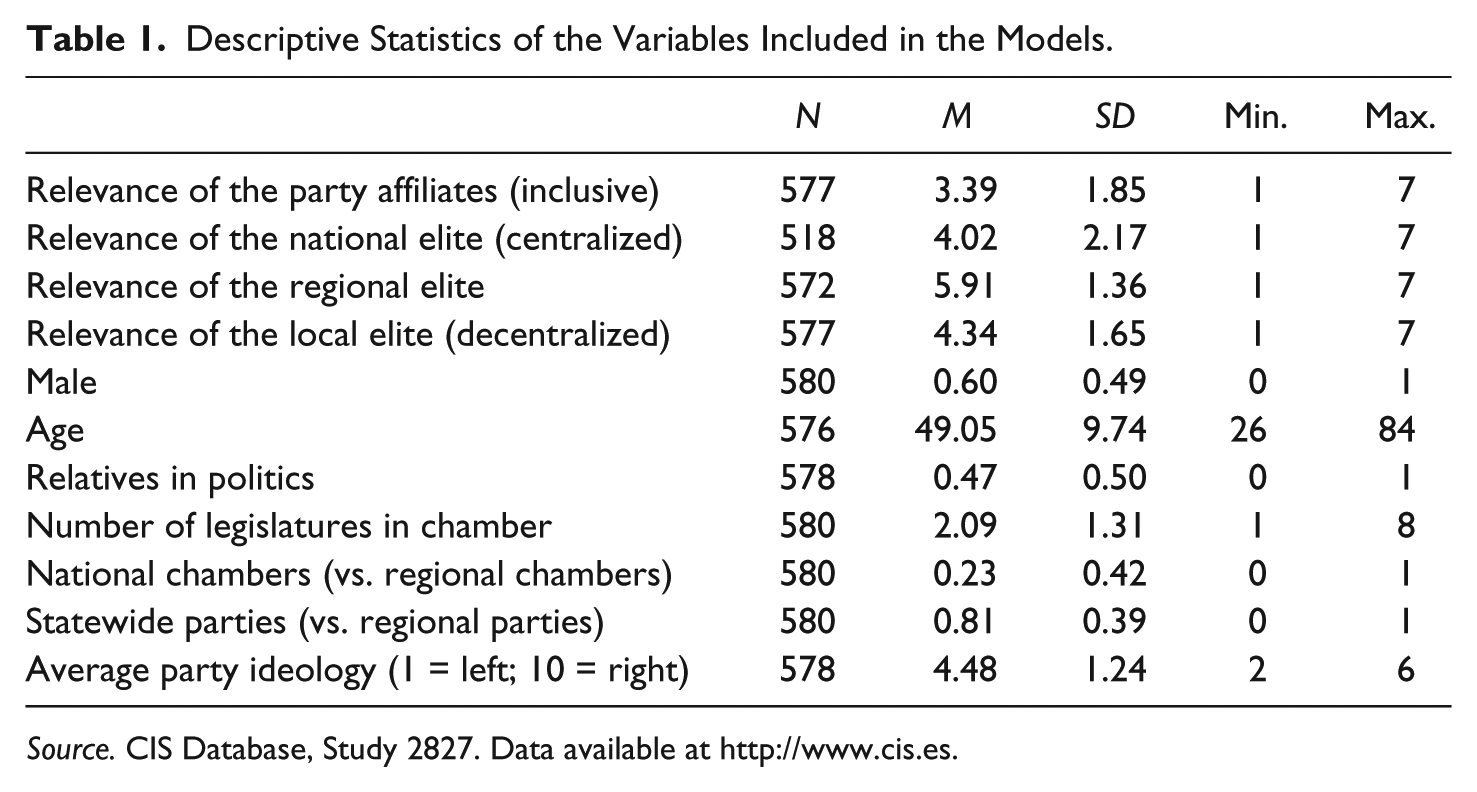
Two sets of dependent variables have been selected to analyze to what extent MPs candidate selection mechanisms are decentralized and inclusive. First, inclusiveness is measured as the extent to which MPs indicate a low (1) or a high (7) relevance of the party affiliates in the elaboration of the electoral lists for their chamber. The second set of dependent variables refers to the degree of centralization in candidate selection. The interviewees were asked about the relevance of the national, regional, and local party leaders on the elaboration of the electoral lists for their chamber, ranging from 1 not relevant to 7 very relevant. With this information, we are able to describe from first-hand informers how candidate selection is managed in the Spanish parties, from the most decentralized pole (local) to the most centralized one (national; see Table 1).
Descriptive Statistics of the Variables Included in the Models.
Source. CIS Database, Study 2827. Data available at http://www.cis.es.
To test our hypotheses, two institutional independent variables have been selected. First, the type of chamber, distinguishing between national (Congress and Senate) and regional (the chambers of the Autonomous Communities). According to our hypotheses, more exclusive and decentralized—specifically, at the regional level, given the process of devolution—candidate selection procedures should be found in the regional parliaments. Second, we will analyze to what extent statewide parties and regional parties have developed different strategies on candidate selection. We expect that regional parties have followed their own process of decentralization giving relevance to the local level (Coller et al., 2016).
Party ideology is included as an additional explanatory variable in our models. It is measured as the average of the ideological position of their deputies. As discussed in the previous section, we expect more centralized and exclusive procedures of candidate selection in right-wing parties than in left-wing parties. Additionally, we control for basic sociodemographic characteristics of MPs: gender, age, experience (measured through the number of legislatures in the chamber), and having relatives in politics. Given the legal existence of gender quotas, we expect central selectorates to play a role in selecting women to create electoral lists. Also, since experience may be an issue to the elaboration of lists, experienced MPs will not be selected by central selectorates vis-a-vis regional or local ones. Since experience and age usually go together, we expect a similar behavior in this variable.
We use ordinary least squares in our four models. The standard errors are clustered at party level due to the hierarchical structure of our data (with information at individual and party levels). We do not use a random effects specification for two different reasons. First, we have a very small number of parties, which leaves no room for using random intercept or random slopes models. Moreover, we have the whole population of Spanish political parties instead of a sample of them.
Findings and Discussion
In Figure 1, we report the distribution of answers to the questions about the relative relevance of party affiliates (inclusiveness), as well as the relevance of national, regional, and local party leaders (centralization). In general, MPs understand that the affiliates are not decisive in the selection of the parliamentary elite. The average importance given to the affiliates (3.39, with a standard deviation of 1.85) is lower than the remaining variables (national, regional, and local leaders). This result points to the exclusive nature of these processes, in which the influence of the rank-and-file members of the Spanish parties is rather weak. However, the emergence of social demands for greater participation in politics—endorsed by movements such as the 15-M, has also opened a debate about how parties select their candidates. These changes are very present in our additional 58 in-depth interviews to MPs and gatekeepers, conducted between 2014 and 2015. According to an MP of a left-wing party linked to social movements, “[The social changes since 15M] will change the functioning of parties. To what extent and at what pace? That is the enigma. But obviously it will change things. At this point, it is a matter of changing or dying.” Parties such as Podemos and Ciudadanos have implemented extremely participative and innovative methods for candidate selection. However, as the literature demonstrates, horizontal mechanisms of selection reinforce the power of the party elite. Rank-and-file members have less capacity to coordinate an alternative, especially in parties with a strong and charismatic leadership. An MP of one of these new parties highlights the importance of visibility to gain support within the primary processes: “My inclusion in the list was possible [ . . . ] because I had been to several TV debates and different events.” These deputies argue that their newly established dynamics have not generated mechanisms of power sharing between party families, sectorial interests, or regional elites.
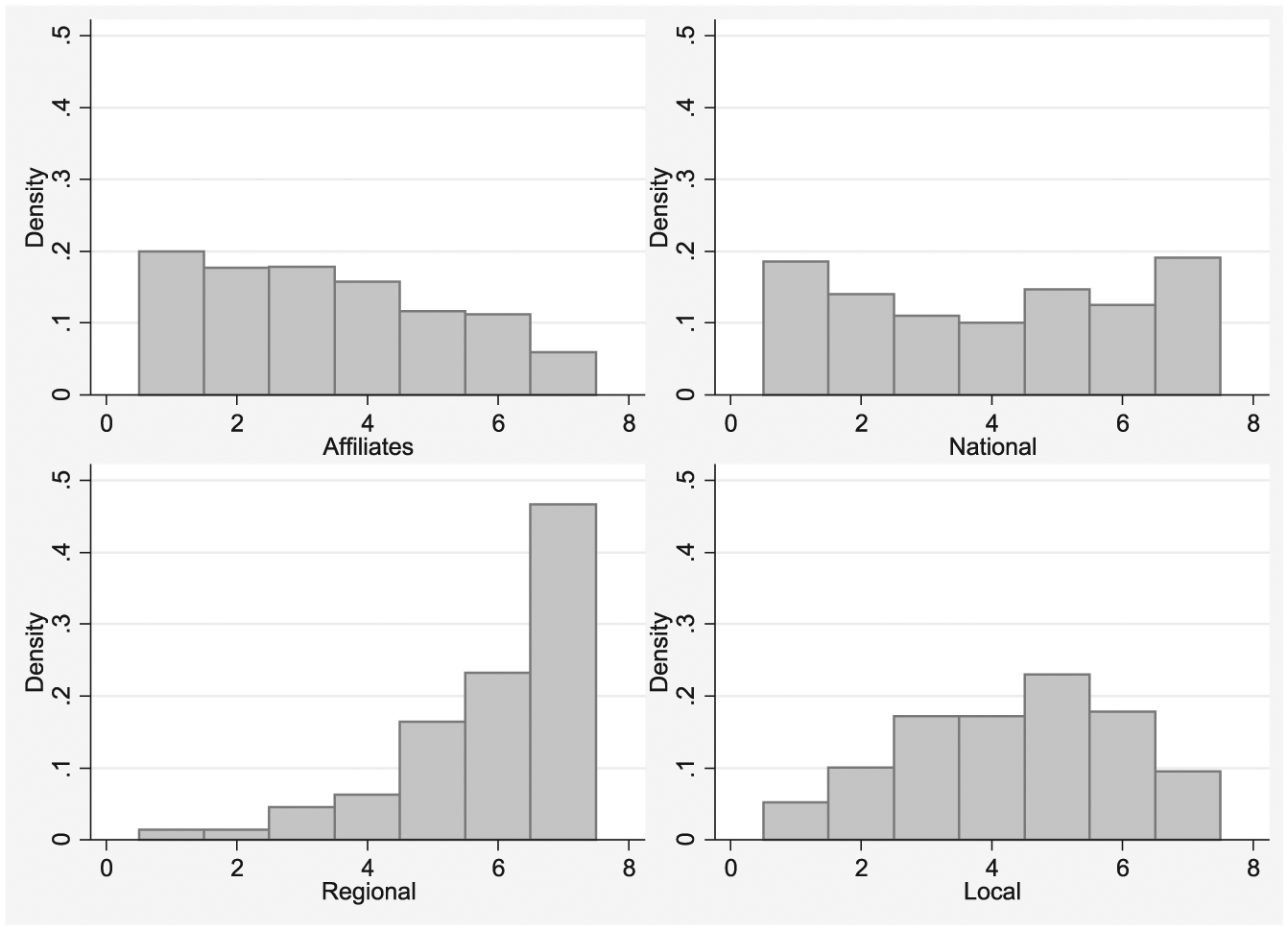
Importance of the national, regional, local elites, and the affiliates in candidate selection.
Regarding decentralization, regional party leaders are the most influential group in the selection process, which is in line with our expectations, because of the prevalence of the regional level in Spanish politics. The average relevance of regional party leaders on candidate selection is 5.91 with standard deviation 1.36; almost 70% of MPs give a relevance of 6 or 7 to regional leaders. Even more important, the local level of party governance is quite relevant in the selection of candidates with average 4.34 and standard deviation 1.65. In contrast, national party leaders are shown as the less relevant level in the selection process, which is in line with Lundell’s (2004) findings, who argues that national party leaders are expected to play a minor role in territorially decentralized countries. The average relevance of national leaders is 4.02 with standard deviation 2.17. Interestingly, the distribution of responses in this item is not single-picked, as it has two peaks at both ends of the scale. It means that opinions of MPs are polarized about the relevance of national leaders in the selection process, as 32.6% believe that national leaders are hardly relevant (1-2), while 31.7% believe that national party leaders are very relevant (6-7) and the other third lies somewhere in between.
Beyond the overall picture, there are significant differences in the relevance of different actors, especially in the case of the national and regional levels. To further explore these differences, in Table 2 we report the average relevance of the party affiliates and the national, regional, and local party leaders, by chamber and territorial presence of the party. The average relevance of affiliates is 3.16 in statewide parties, while it is 4.40 on average for regional-wide parties. Regarding centralization, although the regional level is the most relevant in every chamber and party, the relevance of regional party leaders from statewide parties is 6.01 on average, while the average for regional parties is 5.47. Similarly, MPs serving at regional chambers rank the influence of regional party leaders on average at 5.99, while the average for MPs at national chambers is 5.65. In a similar way, the latter rank the relevance of national party leaders on average at 4.93, while the average for the former is 3.73, although no significant differences have been found between MPs belonging to national and regional parties regarding the influence of national party leaders. Differences in the influence of local party leaders are very small. All in all, results indicate that the selection process in regional chambers is more decentralized, while the selection process is more inclusive.
Average Importance of the Affiliates and the National, Regional, and Local Elites in Candidate Selection, by Chamber (National vs. Regional) and Party (State vs. Regional).

Source. CIS Database, Study 2827. Data available at http://www.cis.es.
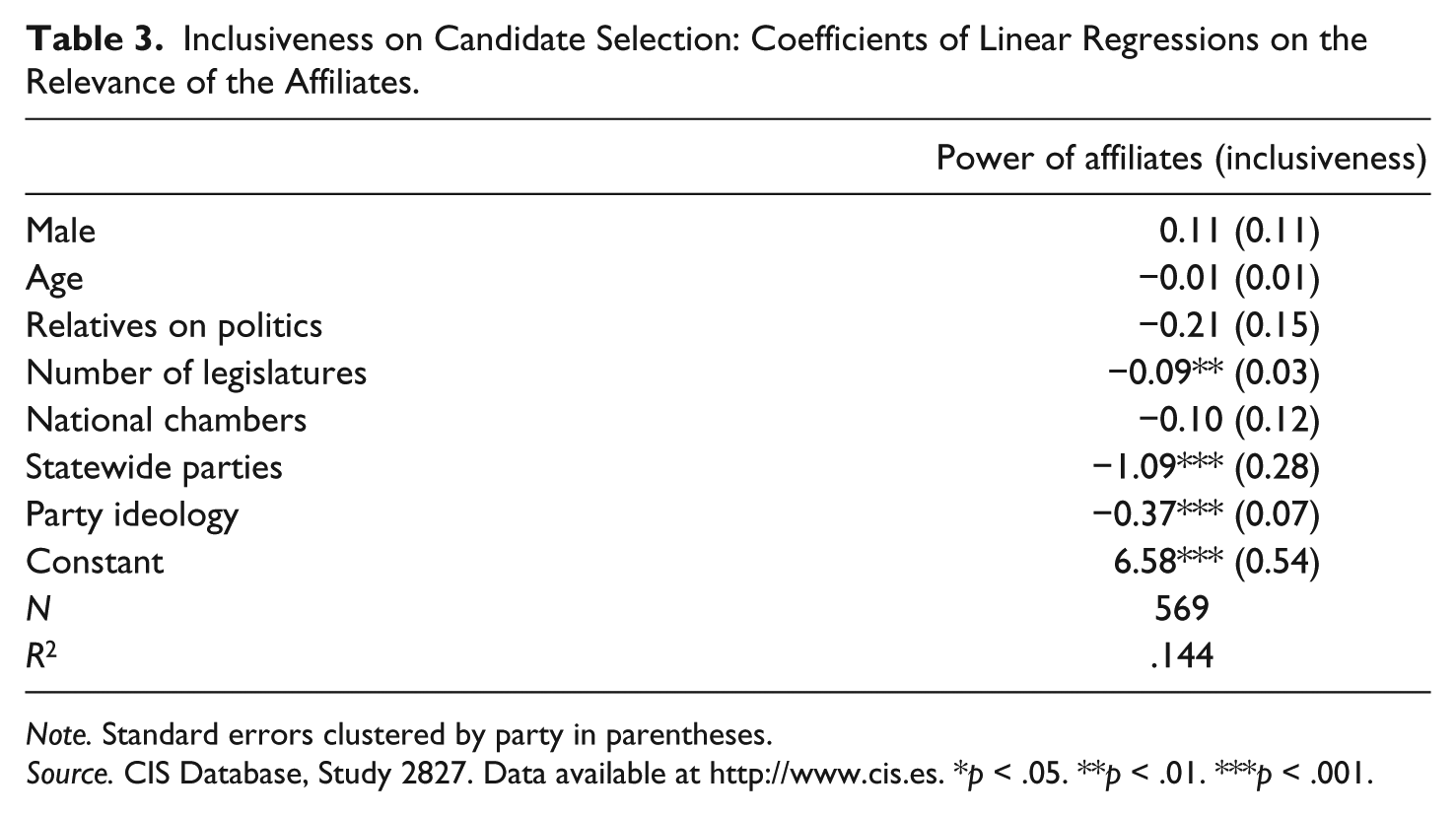
The relevant question, however, is whether inclusiveness and centralization in the selection process can be accounted for by our key explanatory variables. Therefore, we analyze the determinants of inclusiveness and centralization in candidate selection. In Table 3, we report estimates from a regression in which the dependent variable is inclusiveness in candidate selection, measured by the power of affiliates. Our key explanatory variables include chamber (national vs. regional), territorial dimension of the party (statewide parties vs. regional-wide parties) and party ideology. In addition, we control for gender, age, family participation in politics (having relatives in politics), and political experience (number of legislatures in parliament). Overall, findings are in line with our hypotheses. Party ideology has a highly significant and negative effect on inclusiveness in candidate selection. That means that the process of candidate selection is less inclusive in right-wing parties than in left-wing parties. Moreover, the process is less inclusive in national parties than in regional parties. This finding indicates that affiliates play a more limited role in national parties than in regional parties, which suggests that in the case of Spain, there is a connection between inclusiveness and decentralization.
Inclusiveness on Candidate Selection: Coefficients of Linear Regressions on the Relevance of the Affiliates.
Note. Standard errors clustered by party in parentheses.
Source. CIS Database, Study 2827. Data available at http://www.cis.es. *p < .05. **p < .01. ***p < .001.
Control variables have no significant effect on inclusiveness except in the case of political experience. Contrary to our expectations, gender has no significant effect on inclusiveness, as the selection process for women is not more exclusive. In a similar way, the selection process is not more inclusive for older MPs. Interestingly, however, affiliates have less power in the process of candidate selection for those who have been in Parliament for a longer period. This finding is consistent with our expectations in the sense that the more experienced MPs are expected to be selected by higher levels in party hierarchy, while less experienced candidates are expected to be selected by lower levels.
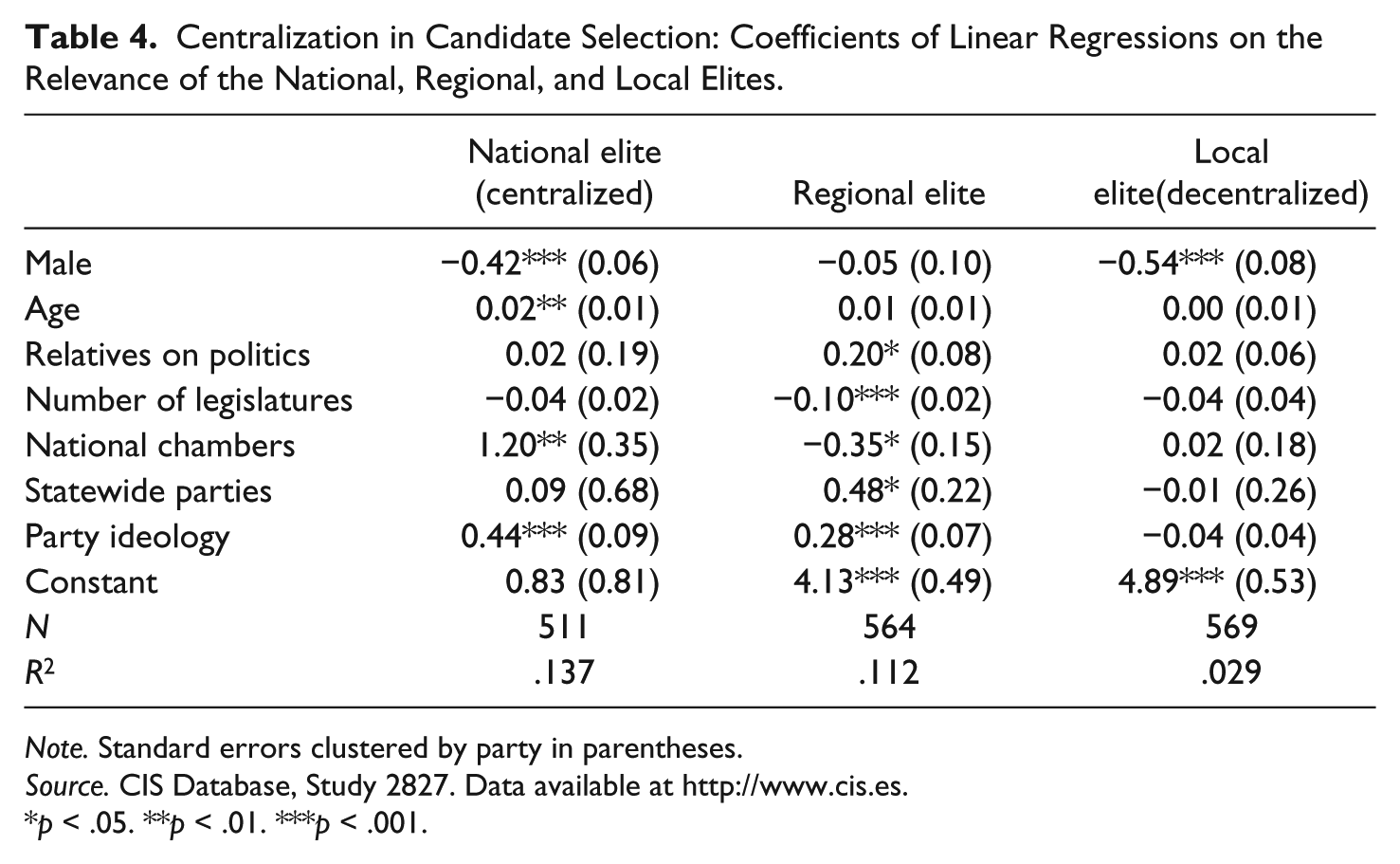
We now turn to the determinants of centralization in candidate selection. In Table 4, we report estimates from three models in which the dependent variables are the power of the three levels (national, regional, and local) of party governance. Overall, the selection process is more centralized for men than for women. However, at the same time, both national and local party leaders are less relevant in the selection process for men. Age has a positive effect on the relevance of national elites, which indicates that national party leaders could be more influential in selecting well-established candidates. This is in line with the fact that regional party leaders are less relevant for more experienced MPs (as measured by number of legislatures), as argued by Field (2006) and her analyses of candidate selection in the 1980s and 1990s in Spain. Finally, regional party leaders are more relevant for those who have relatives in politics than for those who do not. This is in line with Rahat and Hazan (2010), who argue that decentralization might open some room for regional oligarchies to rule the parties.
Centralization in Candidate Selection: Coefficients of Linear Regressions on the Relevance of the National, Regional, and Local Elites.
Note. Standard errors clustered by party in parentheses.
Source. CIS Database, Study 2827. Data available at http://www.cis.es.
p < .05. **p < .01. ***p < .001.
Control variables have a limited impact on centralization in the selection process. First, chamber has a significant effect on the relevance of national and regional elites. National party elite is more relevant when selecting candidates for Congress and Senate than for regional chambers, while regional party elite is more relevant to select candidates for regional chambers. Interestingly, however, regional elites are more important in the selection process in national parties than in regional parties. As shown in the bivariate analyses in Table 2, the role of the local leaders is more relevant for national candidates, despite the fact that multivariate analyses in Table 4 do not show significant differences.
The previous findings are consistent with a large strand of literature arguing that decentralization in party structures is connected with decentralization in candidate selection (Gallagher & Marsh, 1988; Hermens, 1972; Rahat & Hazan, 2001). At the same time, party ideology has a strong and significant effect on centralization. National and regional party leaders are more relevant in the selection process for MPs from right-wing parties. These findings are consistent with the higher inclusiveness found in left-wing parties (see Table 3).
Conclusion
There is an overall trend around the world toward higher levels of democratization in candidate selection. In addition, political decentralization in Spain has opened new avenues for political positions and has helped configure some subnational party systems (Cordero & Coller, 2015; Field, 2006). The conjunction of these two trends explains some of the findings of this article in which we make a methodological contribution: Rather than studying the written party rules regulating candidate selection, as it is the common practice in the field, we analyze the selection of candidates in Spain using data from a survey of 580 national and regional MPs as well as 58 in-depth interviews to a sample of key political actors.
According to our hypothesis, we expect more decentralized practices in the regional chambers than in the national chambers. Our findings support this expectation, being the regional MPs those who think that regional leaders are the most relevant actors when selecting leaders. We also hypothesized that decentralization in candidate selection would be more intensive in regional parties. Overall, findings are also in line with this expectation. The Spanish process of devolution might be in the origin of the decentralization in candidate selection shown in the empirical results. Furthermore, left-wing parties and regional parties seem to implement more inclusive mechanisms of candidate selection than right-wing parties and statewide parties. Generally speaking, it seems that rank-and-file members are more relevant for candidate selection in regional and left-wing parties. This conclusion does not apply when we deal with experimented MPs (a group that usually concentrates the leadership of parties), for whom their selection lies in the higher levels of the hierarchy.
Our findings open new avenues for further research. The crisis of political trust in Southern Europe (Zamora & Coller, 2015; Cordero & Simón, 2016) and the emergence of new political parties (such as Podemos and Ciudadanos) posit the question of how these findings apply to the new political actors. This is especially more relevant with Podemos, a party that originally based its functioning in a highly decentralized structure that is becoming more classical in Michelians terms (Michels, 1915). Moreover, the established political parties (mainly PP and PSOE) are expected to react to the innovations of these new political actors to meet the increasing demands for more participation in the political process, by adapting their selection mechanisms. Will classical parties emulate new actors and incorporate organizational innovations to select candidates in a more open and decentralized way? Thus, more longitudinal research is needed to understand how these changes might affect our findings and how selection mechanisms evolve over time.
Footnotes
Declaration of Conflicting Interests
The author(s) declared no potential conflicts of interest with respect to the research, authorship, and/or publication of this article.
Funding
The author(s) disclosed receipt of the following financial support for the research, authorship, and/or publication of this article: This research has been partially made possible thanks to the funds provided by the Ministry of Economy and Competiveness to the project “Parliamentarians and Society” (CSO2012-32564).