



Abstract
Evidence suggests that incidental national flag exposure activates nationalistic feelings and that incidental exposure to the EU flag can affect citizen attachments to Europe. However, we know little about what inferences citizens make based on the EU flag when they see it displayed by parties in an electoral context. To test the expectation that this display affects citizens’ evaluations of party elites’ EU attachment, we conducted a large-scale experiment embedded in a Swedish survey in which respondents were exposed to communications from one of the two main Swedish parties, containing or not containing the image of the flag. We find that simple visual display does little to move perceptions. However, if citizens perceive that a particular party displayed the flag, then they are more likely to evaluate its party elites as more attached to Europe.
Imagined communities, such as states, need their members to develop a sense of common identity to firmly establish their legitimacy (Anderson, 1991). Group identity increases the subjective value of oneself, group members, and the group itself (e.g., Hogg, 2006). Thus, national identities help forge positive bonds among citizens and to the political system, which in turn foster long-term political stability (e.g., Norris, 1999). National identity is often linked to visual symbols such as the national flag. Exposure to this symbol activates patriotic and other positive, group-centric feelings (Butz, Plant, & Doerr, 2007; Kemmelmeier & Winter, 2008; Schatz & Lavine, 2007) and can influence electoral support (Kalmoe & Gross, 2015).
As dramatically illustrated by the recent “Brexit” vote in the United Kingdom, the development of a common identity among European Union (EU) 1 citizens has been difficult, given the EU’s temporal recentness and cultural, historical, and linguistic diversity. Such an identity may, however, be a prerequisite for citizens’ acceptance of the EU’s political power (Carey, 2002). EU elites have therefore attempted to cultivate an European identity, in part by promoting a set of nonverbal symbols for the community.
Over the past few decades, symbols like the European flag, European map, and European anthem have become obvious signs of the EU’s physical presence (Manners, 2011). Among them, the EU flag has been the most successful in gaining popular recognition and support. Ninety-five percent of EU citizens recognize the flag, more than 70% believe it stands for something good, and more than 80% believe it to be a good symbol of Europe (Standard Eurobarometer 77, 2012). Research has shown that “adherence to EU symbols such as the flag” forms an integral part of the positive affective component of European identity (Boomgaarden, Schuck, Elenbaas, & de Vreese, 2011, p. 247). Europeans are likely to find themselves exposed to the EU flag (or an image of the flag) in their daily life, as it features on most if not all European and national official buildings, European-level media communications, car plates across Europe, and Euro coins and notes.
Previous research has provided diverging evidence as to how citizens react to the EU flag when observed in public. On the one hand, incidental exposure to the flag in media coverage enhances feelings of European identity (Bruter, 2009). This result mirrors the effects observed for national flags in general (Butz et al., 2007; Kemmelmeier & Winter, 2008; Schatz & Lavine, 2007). Other studies have found, more specifically, that the EU flag affects community identity only when associated with some EU-related benefits, and this effect is relatively small (Cram, Patrikios, & Mitchell, 2011).
For most EU citizens, considerable exposure to the EU flag takes place during European election campaigns. In these campaigns, many parties from across Europe choose to display the image of the flag in their informational materials, despite not being legally bound to do so. Previous research has shown parties that lean pro-European are more likely to display the EU flag than those who do not, and these parties are more likely to do so if a substantial percentage of the population is favorable toward the EU (Popa & Dumitrescu, 2015). In election campaigns, the flag is overwhelmingly used in a positive manner: only 4 out of 921 parties since 1979 have used it in a negative way (Popa & Dumitrescu, 2015). However, there has been limited research on the public opinion effects of the EU flag display.
Since the flag is widely recognized as a positive symbol of the European community (Manners, 2011), understanding how EU citizens interpret its display by national parties is important for several reasons. On the one hand, it is clear that political parties play a central role in shaping public opinion in general (Zaller, 1992) as well as on European matters (Gabel & Scheve, 2007; Ray, 2003). If national parties display this community symbol, the association to the EU may help reinforce the legitimacy of the EU community among voters. At the same time, if parties want to use the flag to cater to pro-European voters, then it is important to determine the extent to which this symbol can act as a pro-European signal in a partisan context.
This study therefore explores how citizens interpret the meaning of the EU flag in an election campaign context. More specifically, we investigate whether displaying the flag in election materials makes citizens attribute stronger EU attachments to party elites. To test this proposition, we use a large-scale survey experiment in which Swedish citizens are exposed to campaign communications featuring the EU flag from one of the two main Swedish parties, the Social Democratic Party (SDP) and the Moderate Party (MP).
Theoretical Background
The EU Flag and Positive Attachment to the European Community
European citizens have different reasons to feel attached to Europe. Bruter (2003, 2009) distinguishes between attachment derived from shared culture and experience with other Europeans (the “cultural” side of European identity) and attachment based on shared political values (the “civic” component of identity). European visual symbols, including the EU flag, are closely linked to the “cultural” side of European identity. Boomgaarden et al. (2011) identify two distinct clusters of affective reactions directed at the European community—a positive dimension (e.g., pride of being European) and a negative dimension (e.g., fear of the European Union). The European flag is, according to their evidence, closely connected to a diffuse, positive affect felt with regard to the European Union. These results are in line with other research on national flags. Schatz and Lavine (2007), for instance, also find that the national flag is strongly related to an affective, symbolic attachment to the nation. Thus, although people may identify with a community for different reasons, flags, as visual emblems of national identity, are typically associated with positive emotional attachment to a community.
Empirical evidence consistently suggests that exposure to national symbols activates positive, nation-centric feelings (Bruter, 2009; Butz et al., 2007; Kalmoe & Gross, 2015; Kemmelmeier & Winter, 2008; Schatz & Lavine, 2007). Group identities, in turn, influence perceptions of oneself and members of the group (cf. Hogg, 2006; Stets & Burke, 2000). While previous studies have largely focused on the impact of exposure to national symbols on personal identity and attitudes, in this article we are concerned with how exposure to these symbols affects the image of those who display them. To clarify this point by analogy, imagine that a New Yorker walking down the street were to display a pink ribbon in 1991. For that individual, the ribbon would be a symbol of group identity as part of those who fight breast cancer. However, apart from the select group of New York City runners who used this symbol in 1991, few people would take it as an identity cue back then. Twenty-five years later, this symbol has become so ubiquitous that the display of pink ribbons (or wrist bands, or shoes on athletes) is now a widely recognized indication of support for cancer activism, in particular breast cancer.
Since the EU flag has been forged as a symbol of the European community (Manners, 2011) and has been strongly linked to positive affect about the European Union (Boomgaarden et al., 2011), we examine whether party elites can use its display to signal their EU attachment to voters (Hypothesis 1: “The direct flag effect”). We focus on party elites rather than other political actors based on evidence of their influence on individual political attitudes, including European integration (Ray, 2003; Steenbergen, Edwards, & de Vries, 2007; Zaller, 1992). At the same time, some empirical research has found that the EU flag’s symbolic power may not yet be potent enough to always activate feelings of positive identity through simple exposure (see Cram et al., 2011). One way to increase the flag’s signal strength may be to increase awareness of its appearance by asking individuals to formulate an opinion about whether the flag was displayed in campaign communications or not. Thus, we also investigate whether display of the EU flag sends a credible signal of party elites’ EU attachment if individuals perceive that the flag was displayed (Hypothesis 2: “The perception-mediated flag effect”).
The Context of Communication
A memorable image from the 2014 European Election campaign was a UKIP (United Kingdom Independence Party) poster depicting an EU flag emerging from the still-burning ashes of a Union Jack (U.K.) flag. This negatively charged display, though consistent with UKIP’s strong anti-EU position, is also highly unusual (Popa & Dumitrescu, 2015). In fact, the flag is almost always positively portrayed in parties’ manifestos, and it is positively associated with pro-EU party positions (Popa & Dumitrescu, 2015). This pattern suggests that such a display is therefore consistent with a party’s EU attachment.
Moreover, the more ambivalent on EU matters a party is, the more room there should be for the display of the European flag to affect voter perceptions. Previous research finds that intraparty dissent generates voter uncertainty about a party’s stance on European integration (Gabel & Scheve, 2007). Sweden offers a good opportunity to test the moderating role of party position, as the two main parties have different levels of intraparty dissent on EU matters. The MP is historically known for favoring European integration (Sitter, 2001), with a low level of intraparty dissent according to the latest Chapel Hill Expert Survey (Bakker et al., 2015). Thus, in the case of the MP, displaying the EU flag should only marginally increase perceptions of MP elite attachment to the European Union, which is already perceived as strong.
The SDP, on the other hand, is generally viewed as having an ambivalent position toward the European Union due to the fact that the party has been “seriously divided over Europe even since Sweden decided to apply for EC [European Community] membership” in the early 1990s (Raunio, 2007, p. 198). This ambivalence is confirmed by the latest Chapel Hill Expert Survey study, which placed the SDP close to the middle on the pro/anti-EU position scale and noted the high level of intraparty dissent—the highest among the eight Swedish parties represented in parliament (Bakker et al., 2015). Thus, in the case of the SDP, the positive display of visual symbols of EU identity should act as a cue that moves the balance toward more EU-favorable perceptions. In short, the display of the EU flag on party campaign materials should have a stronger effect on the perception of SDP party elites’ affective attachment to the EU than for MP elites (Hypothesis 3: “The party effect”).
The Availability of Additional Information
Communication research shows across a variety of contexts that individuals infer significant amounts of information from visuals: flag cues can activate political attitudes and feelings of national identity (e.g., Butz et al., 2007; Kemmelmeier & Winter, 2008); in the realm of facial displays, viewers are able to pick winning candidates based on facial appearances alone (Hall, Goren, Chaiken, & Todorov, 2009) and, in the absence of nonverbal facial cues, on their general visual demeanor (Spezio, Loesch, Gosselin, Mattes, & Alvarez, 2012). When citizens have access to both verbal and nonverbal political information, a few studies have found that certain voters rely more on the verbal channel to make decisions (Krauss, Apple, Morency, Wenzel, & Winton, 1981; Nagel, Maurer, & Reinemann, 2012), while others find increased reliance on the visual channel (Shah et al., 2016; Shah, Hanna, Bucy, Wells, & Quevedo, 2015).
Thus, we also test whether the presence of additional information about the parties’ EU positions moderates the impact of displaying the flag on perceptions of elites’ attachment to the European Union (Hypothesis 4: “The information availability effect”). Given previous divergent results, we are open about the direction of the effect here. The null hypothesis is that exposure to policy positions does not affect the signal strength of displaying the EU flag. But it is also possible that the effect of the flag gets weaker with the presence of additional information, or that it is enhanced by pro-EU policy positions and diminished by anti-EU policy positions.
Experimental Design and Measures
The data for this study come from an internet survey experiment conducted by the Laboratory of Opinion Research at the University of Gothenburg on a panel of Swedish citizens (N = 1,824). The average age of respondents in the study was about 53 years. Sixty percent were men, and 77% had completed post–high school education. Technical details about the panel from which this sample was drawn are available in Martinsson, Andreasson, Markstedt, and Riedel (2013). The study was dispatched to respondents several months prior to the campaign for the 2014 European elections, in November and December 2013.
Design
To test the capacity of the European flag to signal party elites’ European attachments, we adapted the visual cover of the Swedish MP and SDP’s 2009 European Election manifestos (Euro-Manifestos) and based all the information provided to respondents on the parties’ 2009 and 2004 European programs. We pooled policy information from both years because we could not identify enough quotations in 2009 alone to express both positive and critical positions about the European Union for both parties.
The experiment took the form of a fully factorial 2 (flag: present vs. absent) × 2 (party: MP vs. SDP) × 4 (added information: none, EU-positive, EU-critical, EU-balanced) design. The first factor was whether or not the campaign materials featured a picture of the EU flag. Specifically, in the flag-present conditions, we added an image of the EU flag to the top left of each party-specific Euro-Manifesto cover. When present, the flag took only 4% of the cover so as to not overlap with any of the other originally present elements. This visual manipulation is illustrated in Figure 1. The second factor was the party sponsor: respondents saw campaign materials either from the MP or SDP. The third factor was the additional information accompanying the manifesto covers, consisting of a short text displayed on the screen. The text factor had four levels: some saw an EU-positive text (highlighting the European Union’s contribution to solving collective problems); some saw an EU-critical text (about the European Union’s “democratic deficit”); some saw a balanced text about the European Union; and, finally, some groups only saw the visual version of the cover with no text. Participants were randomly assigned to one of the study’s 16 conditions.
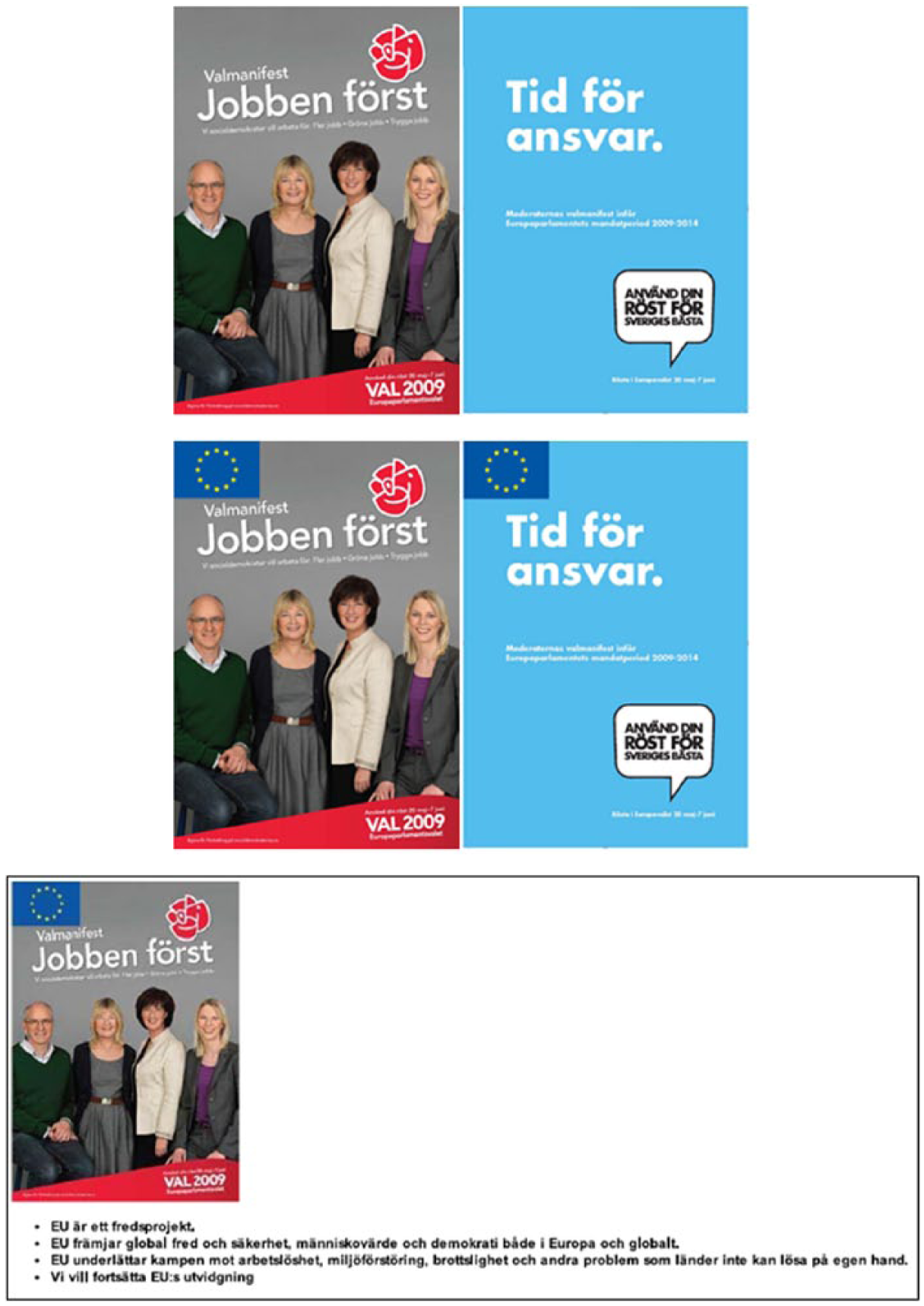
Visual manipulation.
Screenshots of the full visual manipulation are presented in Figure 1. The full text manipulations are in Appendix A.
Perception of the Flag Display
After exposure to the experimental treatment and before the outcomes of interest were measured, all respondents were asked whether any symbols had been present on the campaign materials they had just seen. They were provided with a list including the EU flag. The placement of the EU flag on this list was randomized. To avoid repeated (and uncontrolled) exposure to the image of the flag, we restricted respondents’ ability to go back and see the materials again; thus, they had to answer this question based on what they remembered. A total of 88% of the sample answered the question (N = 1,616); of these, 70% (N = 1,126) answered it correctly. More specifically, of the 848 respondents who were exposed to the flag, 646 (76.1%) reported seeing it. And of the 768 who did not receive the flag treatment, 481 (62.6%) correctly reported not seeing the flag. As visuals are processed largely automatically, the question was intended to make individuals think deeper about the visuals and have them actively express their perceptions about EU flag display.
Dependent Variables
All respondents next evaluated the party’s “top officials” whose campaign materials they had just seen, as opposed to perceptions of the party overall. Top officials were simply described as “the party’s leaders and Members of Parliament.” We felt that asking respondents to estimate their feelings toward an entity as abstract and complex as a party would be cognitively burdensome, and invite measurement error. Moreover, party elites are in charge of the parties’ policies; thus, their opinions are likely to influence the party direction. In a very real way, party leaders do personify the parties they represent. To measure perceptions of party leaders’ European attachment, we adapted a question format from the ANES 2010-2012 Evaluations of Government and Society Study (Segura, Jackman, Hutchings, & American National Election Studies, 2012), which was used to measure group perceptions. Respondents rated how well the expressions “Feel attached to Europe” and “Feel proud of being part of the EU” described the [SD/Moderate] Party’s top officials. These two items were chosen among others used by Boomgaarden et al. (2011) and by Bruter (2009) and included two affective terms (“feel attached” and “feel proud”) so as to elicit an evaluation of elites’ affective identification with the European Union. Our main dependent variable is an affective orientation scale constructed from the ”feel attached” and “feel proud” evaluations given to top officials (α = .90).
Controls
In the early stages of the survey, respondents indicated their level of European identity (with a measure used by Bruter, 2009), their support for the European Union and attitudes toward EU integration (with items from the European Elections Survey 2004, and Schmitt et al., 2009), and their party vote intention the 2014 general elections. Demographic information including age and gender were also asked. These variables are described in Appendix B.
To facilitate interpretation of the results, all variables in our models were rescaled to run from 0 to 1.
Results
To test the effect of the flag on perceptions of party elites’ EU attachment, we ran a series of mediation models (Imai, Keele, Tingley, & Yamamoto, 2011), as depicted in Figure 2. These models allow us to test both for a direct effect of the flag visual display (Hypothesis 1) and for an indirect effect through individuals’ perception of the display (Hypothesis 2). Furthermore, as we expect differences by party (in line with Hypothesis 3), we run these models separately for the SDP and MP. We also expect these effects to vary with the presence of additional information (in line with Hypothesis 4); therefore, we run them separately for each condition.
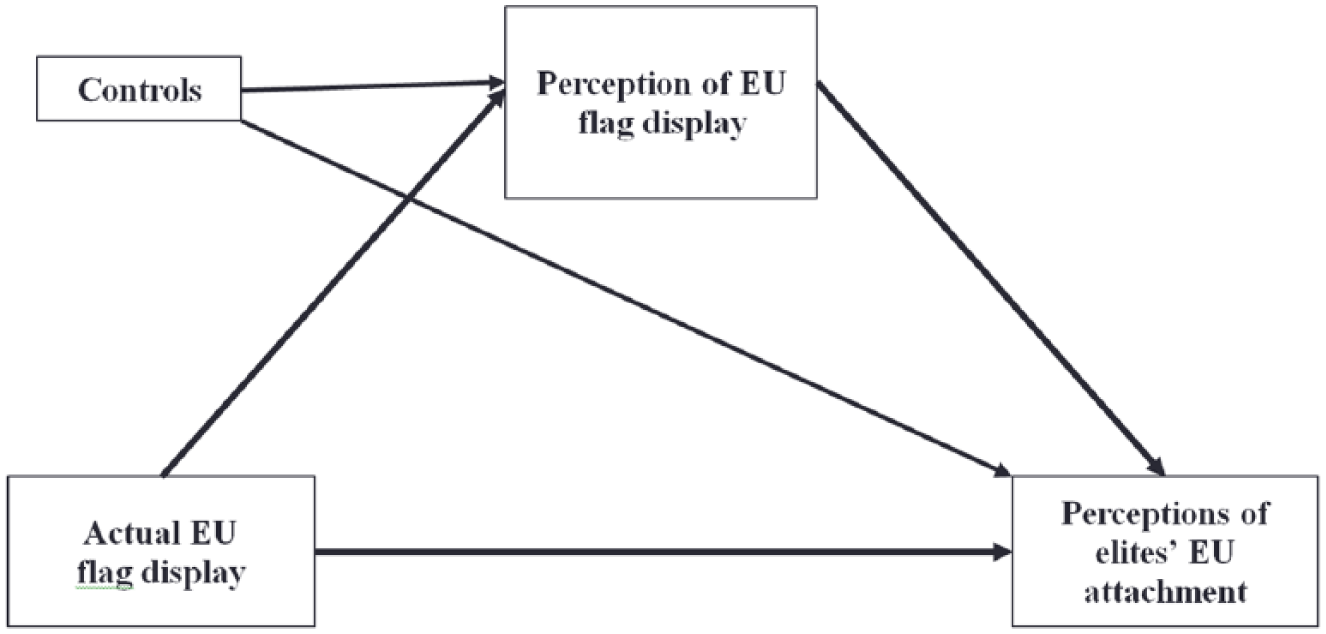
The Path Analysis Model.
We start with a simple descriptive table of mean perceptions of elites’ European attachments in each experimental condition, as a function of participants’ perceptions of whether the EU flag was displayed in the materials they viewed. These simple means, presented in Table 1, offer an initial indication of the magnitude of effects. Larger values indicate that elites are perceived to be more strongly attached to the EU. The table suggests at least two patterns of results: compared with the actual display of the EU flag, the perception that the flag was displayed is associated with larger variations in the evaluations of elites’ EU attachment; and these variations are larger for the SDP than for the MP.
Average Effects of EU Flag Display on Evaluations of Party Elites’ EU Attachment.
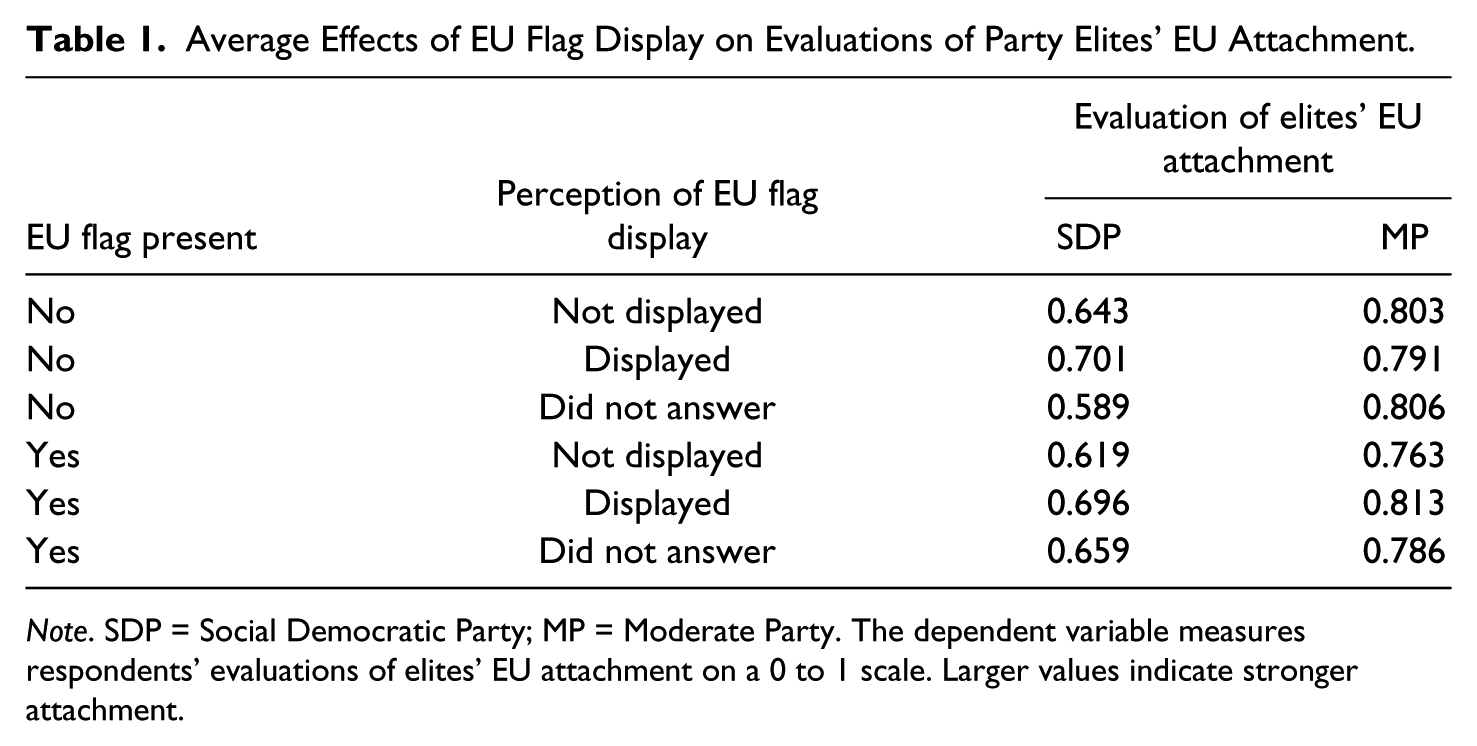
Note. SDP = Social Democratic Party; MP = Moderate Party. The dependent variable measures respondents’ evaluations of elites’ EU attachment on a 0 to 1 scale. Larger values indicate stronger attachment.
To test our four hypotheses, analysis was carried out in MPlus 6.11 (Muthén & Muthén, 2011) using a series of path models that control for several pretreatment covariates, such as voting for the SDP, voting for MP, European identity, EU support, gender, and age (the full results are presented in Appendix C). 2 We present the results separately for the SDP (Table 2) and MP models (Table 3).
Path Analysis Results, SDP Group.
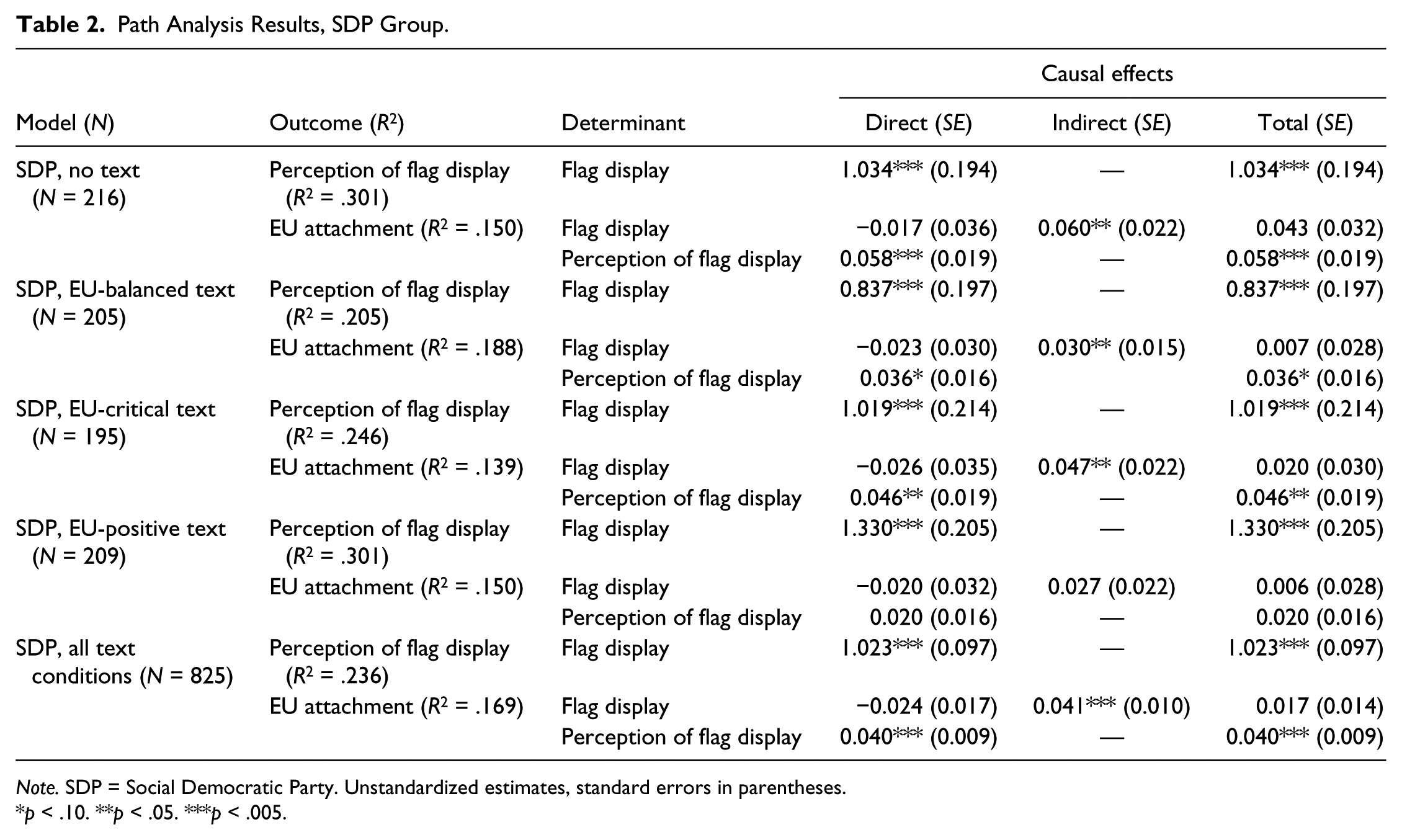
Note. SDP = Social Democratic Party. Unstandardized estimates, standard errors in parentheses.
p < .10. **p < .05. ***p < .005.
Path Analysis Results, MP Group.
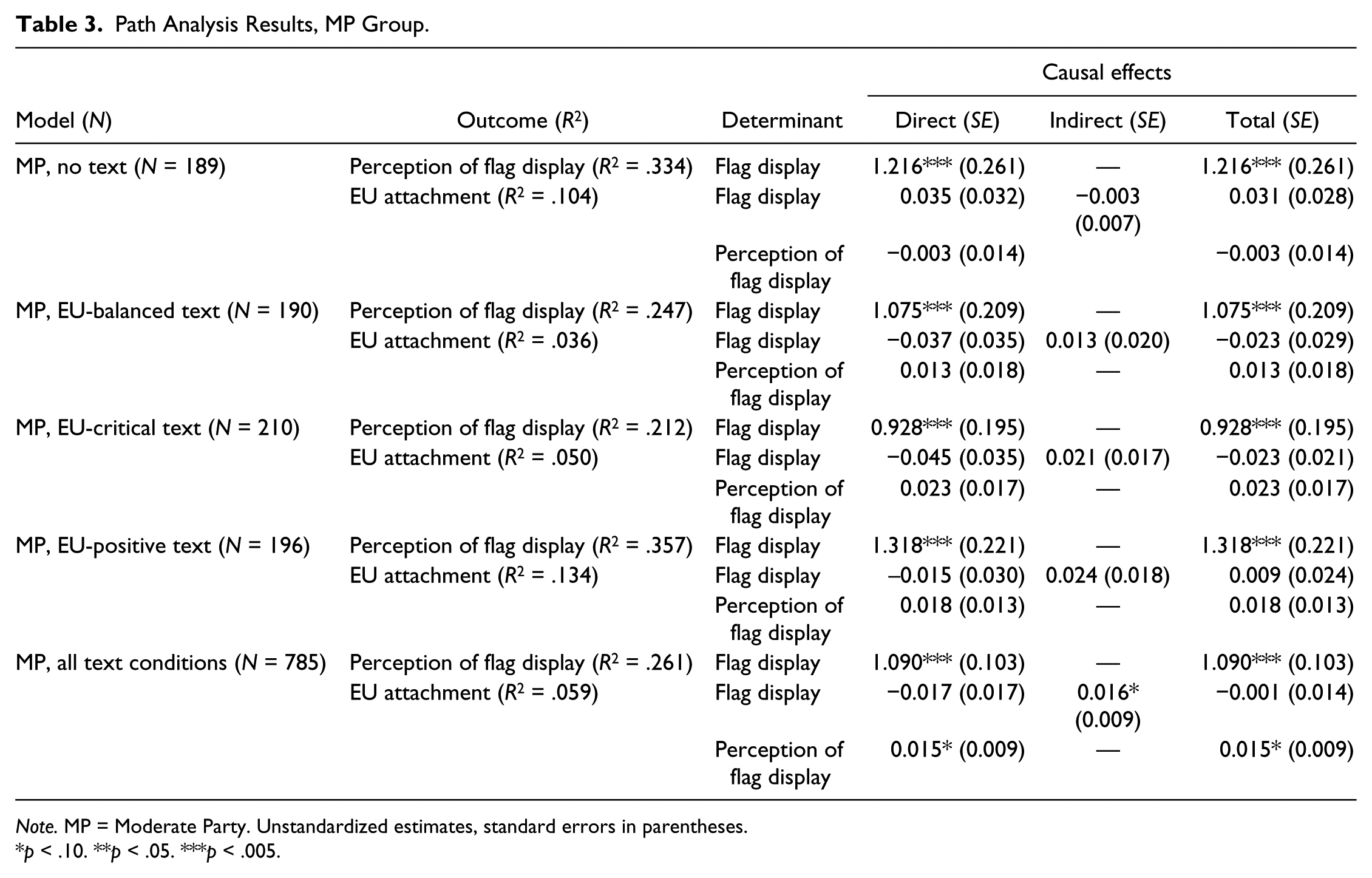
Note. MP = Moderate Party. Unstandardized estimates, standard errors in parentheses.
p < .10. **p < .05. ***p < .005.
The results show no statistically significant direct effects of flag display on evaluations of elites’ EU attachment for either party, irrespective of whether each information valence condition is considered separately, or together. Thus, we did not find any evidence that would corroborate Hypothesis 1, the expectation that simple exposure to the flag would sends a credible sign of party elites’ EU attachment.
We do however find a statistically significant indirect effect, offering support for Hypothesis 2, which assumed that the presence of the flag would have to reach awareness to serve as a relevant signal. However, the effects are almost exclusively confined to the SDP conditions. In the case of SDP we find an indirect effect of exposure to the flag visual across almost all information valence groups. The exception is when respondents were shown an EU-positive text. The indirect effect of the flag on evaluations of SDP elites’ attachment holds even if we analyze all the information valence groups together.
These results suggest that, for those participants who believed the flag had been displayed, exposure to this visual symbol of the European Union had a positive effect on perceptions of SDP elites’ European attachments. At the same time, no such effect is observed for perceptions of MP elites. There is an indication of a statistically significant indirect effect of the flag treatment when we aggregate all groups. But given that for a relatively large N we only detect significance at p < .10, and the fact that this effect is much smaller than in the case of SDP, we can safely say that the indirect impact of the flag on the perceived EU identity of MP elites is at best minimal. Thus, consistent with Hypothesis 3, we do find some indication that the signal may be more consequential when the party is ambivalent on EU matters, as is the case with the SDP but not the MP, which is strongly pro–European Union.
Furthermore, we expected flag effects to vary with the valence of the information provided, whether the text was critical or supportive (Hypothesis 4). Our analysis found that the indirect effect of the flag on perceptions of SDP elites is strongest in the absence of information about the party’s EU positions. This result may also have to do with the text’s valence. None of the positions in the stimulus materials were overly critical of the European Union (including the EU critical condition, which was only mildly negative), and the information valence factor has an independent positive effect on perceptions of SDP elites (see Appendix C).
Finally, including the flag visual on the party manifesto covers did not significantly move the viewers’ overall perceptions of party elites’ European attachments (the total effect of the visual display of the flag does not reach statistical significance). This could be due to the relatively limited exposure that each participant received to the stimulus materials, or to the fact that while an indirect effect can be observed, the perception about whether the parties used the EU flag on the cover of their manifestos does not provide a strong enough rationale on its own for individuals to update their overall impressions of party elites.
Discussion
The EU flag is a visual embodiment of the European community and exposure to it has been shown to increase citizens’ affective attachment to Europe (Bruter, 2009). But there has been limited research on how citizens interpret the meaning of this symbol when they see it strategically displayed by parties. Previous research shows that parties influence public opinion in general (Zaller, 1992)—and attitudes toward the EU in particular (Ray, 2003; Steenbergen et al., 2007). Given the prominent role that national political elites play in the construction of a common European identity, it is important to understand the extent to which voters infer European attachments from the display by parties of the EU flag on their campaign communications. The aim of this article was to provide a first test of this effect.
Using data from a large N survey experiment in Sweden, we found that displaying the EU flag can influence voter perceptions of party elites’ EU attachment for parties with an ambivalent position toward the European Union, such as the Swedish SDP. However, the display itself does little to move these perceptions; rather, it needs to be accompanied by the perception that the party actually displayed the EU flag. We also find that this indirect effect is strongest in the absence of other information, but further research is needed to establish more precisely how the valence of information affects evaluations of elites’ EU attachment.
While we find only indirect effects for flag display, these results may be due to the limited exposure to the flag that respondents received in the study. Due to practical constraints, we could not make the flag larger than about 4% of the cover image overall and we were not able to present repeated exposures to enhance recall accuracy. Admittedly, these conditions are quite artificial with respect to real campaigns, where symbols are featured more prominently and repeatedly. Thus, our study ends up being a conservative test of the hypothesis. In a real campaign, the effects of EU flag display on perceptions of party elites should be stronger.
Moreover, the national context in which we tested for flag effects adds to the conservative nature of the test. While the level of EU contestation in Sweden has never reached the highs of other countries that have produced anti-EU parties (such as UKIP in the United Kingdom), Sweden’s main parties have also been split on the benefits of this membership since joining the European Union in 1995 (Raunio, 2007). Moreover, in addition to its national identity, Sweden also has a strong regional identity as part of the Scandinavian Peninsula. Thus, Sweden may be a tougher than usual case to test for the signaling power of the EU flag on perceptions of party elites’ European attachment. Results may be stronger in the case of founding members of the European Union (Belgium, France, Germany, Italy, Luxembourg, and the Netherlands), for example.
The results also provide some guidelines for practitioners involved in the design of European campaign promotional materials. They suggest that playing on EU symbols to signal party leader attachment to the European Union may work but only for parties that do not have a clear pro- or anti-EU position to begin with. Moreover, what matters most is whether voters believe the symbol was displayed; thus, to send an effective signal, campaign managers must ensure that voters pay close attention to the visual aspect of their electoral message.
Far from settling what inferences citizens make when exposed to the EU flag in a campaign context, these results point instead to the need for further research. So far, studies of the impact of European symbols have mainly focused on how exposure to these symbols in the media influence the public’s sense of European attachment, and what the flag means to individual citizens as part of a larger political community. This article suggests that the EU flag display in a political electoral context can signal EU attachment on behalf of those who display it. Thus, the EU flag display by groups recognized as opinion leaders, and that individuals identify with, such as national parties, could potentially play an important role in forging a stronger EU attachment. Future studies should further specify the optimal context for this signal.
Footnotes
Appendix A
Appendix B
Appendix C
Acknowledgements
The authors would like to thank Erik Bucy, Shanto Iyengar, Daniel Rubenson, two anonymous referees, and the participants of the 2014 Gothenburg University conference on “Nonverbal Communication in Politics: Implications for Democratic Judgements and Discourse” for their comments on earlier versions of this article. We are also extremely grateful to Johan Martinsson, Karolina Riedel, Elias Markstedt, and Maria Andreasson at the Laboratory of Public Opinion Research (LORE) at the University of Gothenburg for their assistance with data collection.
Declaration of Conflicting Interests
The author(s) declared no potential conflicts of interest with respect to the research, authorship, and/or publication of this article.
Funding
The author(s) received no financial support for the research, authorship, and/or publication of this article.