




Abstract
Russia is the only country in the G20 group of nations where Donald Trump is the preferred choice for the next President of the United States. This article examines a hypothesis that Trump owes his popularity in Russia to the way Russian media frames his image. The media content was analyzed by quantitative parameters and then, these parameters were further complimented with a discourse analysis which, in addition to examining the texts themselves, also appeals to the reality beyond the texts, including social and political circumstances that surround the issue. The results demonstrate that the discourse about Trump in the Russian media possesses all the necessary typological characteristics of propaganda. Russian official media actively supports Donald Trump and deliberately creates favorable opinion of him.
Introduction
On April 17, 2016, YouGov research across the G20 group of nations published an article revealing that Donald Trump was the preferred choice for U.S. President in only one country: Russia.
New YouGov research of over 20,000 adults in every G20 country for Handelsblatt Global Edition reveals Russia is the only country of the G20 major economies where people would rather Donald Trump was the next President of the US than Hillary Clinton. And by a long way—Trump leads Clinton by 21 points in Russia, while Hillary has a lead of more than 21 points over Trump in 15 other countries. (Dahlgreen, 2016)
Popularity of Donald Trump in Russia is an exception—in other countries, he is less than popular to say the least. The article develops a hypothesis that positive attitudes toward Trump in Russia do not come out of nowhere, but rather are a direct result of the Russian media discourse about the U.S. election.
Although official Russian media (and there is very little left besides the official media outlets) does not give much time and space to American elections—it is on the periphery of the news agenda—some news about Trump’s achievements regularly get mentioned, and as this article will further demonstrate, the tone of most the references tends to be positive, although not overenthusiastic. After he was officially nominated as the Republican party candidate, the media support for Trump in Russia became even more obvious. What exactly are the facets of Trump’s media image in Russia that made him so exceptionally popular? This article attempts to find the answer by analyzing now Russian media portrays Trump and thus how Russian audiences may perceive him.
The conclusion that we reach seems to be in line with the existing body of knowledge on agenda setting and framing. Media indeed manages to dictate what people think of and how they think of it, creating opinions among a largely ignorant public.
Theoretical Background
The acceptance or rejection of a politician is an emotional decision that is driven primarily by the image of a politician (Nimmo, 1970). Technically speaking, the image of any public figure is made up of the subjective understanding an individual has of that figure (Newman, 1999). This subjective understanding is to a great extent influenced by mass media. Past research and evidence state that the media is a powerful tool in influencing public opinion and shaping its political perceptions.
Journalists and editors draw the map or the internal story pattern for readers, and the map, which is also known as framing, functions cognitively in structuring political opinions, influencing the information levelling on the readers, and attributing to the policy responsibility (Gamson, 1992; Iyengar, 1991; Kinder & Kiewit, 1979).
The way the media portrays politicians directly affects the way they are perceived by the public. The media will seize on key aspects of a politician’s rhetoric and will use this to create the frame to present to their audiences. Tiung and Hasim (2009) suggest, that in extreme cases, media can drop all message inputs given by other parties and can create a debate fully molded by them. The media has full control over any matter used and the way they report the news. The realities that we access through the media might be the realities that are created by the media and do not really represent the actual situation. Media outlets are able to downplay or play up a certain issue while portraying the image of a political personality.
The nature of this framing process is driven by the environment and media market circumstances. In an environment driven by ratings, news is packaged and delivered by journalists who often exploit personality, use sensation, drama and story conflict, do not downplay the social picture, economy, and politics (Bennett, 2002; Hart & Sparrow, 2001). In an environment based on market political power drivers where media operations put them with the framework of strategic political actors, their effort to redefine and to change political rhetoric will be influenced more by political rather than economic priorities. (Cook, 1998, Chaps. 5 and 6; Hallin, 1992). Hence, the role played by the media is more complex compared with other actors. The media simultaneously may act as a unique frame builder to be expressed to public.
The reasons and causes for that may sometimes lie in the nature of the relationship between the media and the political elite, which is of a symbiotic nature (based on giving and receiving information). But in countries with totalitarian or authoritarian regimes, this symbiosis is based on something more than just the need of political actors to relay their message to the public and the needs of the media to provide news. Their dependence on each other is of another nature, where control and dominance play a much greater role.
Whether it is from the journalism norm, the dependency of media on the authorities, the desire to comply with the regime, the desire to acquire profit, media frames influence how certain issues are being portrayed, either directly or through chosen messages to who they want. They shift attention to “the set of perspectives or frames that journalists and the public employ to think about each object” (Ghanem, 1997, p. 5). McCombs and Estrada (1997) explain that “these perspectives and frames—called semantic devices—draw attention to certain attributes and away from others” (p. 246). By accentuating certain elements over others, the media is assumed to influence the salience of attributes as well as the salience of issues. As a result, McCombs and Shaw (1993) propose that “media may not only tell us what to think about, but also how to think about it, and consequently, what to think” (p. 65).
Methodology
We utilized a formal approach to examining texts (content analysis), converting the content into quantitative parameters and then interpreting these parameters in a linguistic and value aspect. Content analysis results are complemented with a discourse analysis which, in addition to examining the texts themselves, also appeals to the reality beyond the texts, including social and political circumstances that surround the issue.
The units of analysis in the texts were related to the main actor—Donald Trump. Other actors that constitute the context environment of the main actor are Hillary Clinton and Russian authorities (Kremlin, Vladimir Putin). The analyzed texts were published from March 1 till July 31, 2016.
The sample consisted of 91 texts that appeared in either official or loyal to Kremlin media, including television (NTV, 1TV Channel, Rossiya TV), print (Rossiyskaya Gazeta, Vzglyad, Komsomolskaya Pravda, Moskovskij Komsomolets, Sobesednik, Izvestia), and online (lenta.ru, dni.ru, fb.ru, gazeta.ru). The selection criteria for inclusion in the sample was the presence of the keyword Trump in the heading or subheading. The focus of the research was on communication features and the interpretation of these features to determine the authors’ intentions.
Findings
Characteristics of Trump
Russian media described Donald Trump as a politician with the following properties: billionaire, entrepreneur, a popular TV host. He is called a real phenomenon, if not a sensation for American politics. Never before has there been such a scandalous and blatantly rude candidate. He is a hooligan in an expensive suit.
Adjectives used to describe Trump are mostly judgmental: scandalous, shocking, provocative, odious, eccentric. These nominations dominate the discourse. It is worth noting here that although in the English language these adjectives have mostly negative connotations, they do not sound purely negative in Russian. Not only are some of them neutral descriptors but they may also resonate with certain segments of the audiences: Trump is not an ordinary person, and not a stupid one. He is capable of thinking in broader scopes than his opponents. What he says is usually music to Russian ears.
It is also worth noting, that to differentiate from his main opponent in the presidential race, Hillary Clinton, Trump is not labelled as “a much more likeable character”: Unlike Hillary, he does not demonize everything that he hates. He is charismatic and charming that contrasts sharply with Clinton.
In some cases, the function of description is combined with evaluation and characterization—a serious businessman, a talented politician. This is a technique of political marketing, which is used to create symbols where nominations and characteristics are combined in one. This may be explained by the authors’ intention to support Trump: The phenomenon of Trump shows that despite a strict establishment’s control over the democratic process marginals like Trump are still able to deliver their unexpected and yet sometimes sensible ideas.
Among Trump’s personal characteristics, the most common ones found in the text are the following: honest, sincere, speaks from the heart. These nominations belong to the semantic field of “brave” and “direct”: The growing popularity of Trump is based on the fact that there are people in America who are not paranoid and who want to hear the truth. Trump says exactly what the majority of the electorate thinks.
Verb semantics play an important role in creating effective texts. Copywriters are well aware of the predicative effect—using verbs in the active voice add impact and dynamism to the text. In the examined sample, the verbs that were used to describe Trump’s life and actions are used in the active voice and stress the actor’s strength, determination, and decisiveness: Trump is always the actor, and rarely an object of an action. He criticizes more often than he is criticized, he says, not is said, and so on. The choice of words seems to indicate that Trump is being positioned as active, entrepreneurial, capable, charismatic, and original. To sum up, it is possible to conclude that the verbal tools used to describe Trump form an image of a dynamic, likeable, and interesting person.
Trump and Russia
This section will focus on verbal tools the authors of the texts use to describe the attitude of Trump toward Russia and why his perceived attitudes to Russia make him popular there.
Overall, Trump is usually named the only current politician in the United States who is positive toward Russia:
Only the American billionaire can establish peace between US and Russia. This is the mission which Trump can accomplish; His remarks about Russia clearly show, that in case if he is elected, there will be some definite warming in the Russian–American relationships; Trump said that he loved Russia; Trump says that they have never understood this mysterious country (Russia) with all its enormous wealth; Russia is the power.
According to Russian media, while fighting for votes, Trump has several times mentioned that Russia should become a friend of America, not its enemy. And in order to achieve this goal, the country has to start negotiations with Vladimir Putin. The notion is the sample were presented in the following forms:
Trump finds it necessary to repeat that he wants to strengthen ties with Russia, Trump thinks it would be great to join efforts with Russian in fighting ISIS, Trump wants to defeat ISIS together with Putin, Trump says that it would be great to have business with Russia; Trump mentioned several times how important it is to build good relationships with Russia; Trump thinks it is important to work together with Russia.
Overall, the impression that one gets is that Trump is the only politician in America who does not disapprove of Russia’s foreign policy, but actually supports it (both in the Middle East, and to a certain extent—even in Ukraine, where he is in favor of American noninterference):
Trump said that USA should not conflict with Russia and it is time America withdrew from the Ukraine; In the event of his election, Trump will consider recognising Crimea as a part of Russia, lifting all the sanctions; Trump believes that the people of Crimea want to be with Russia, and not Ukraine.
The media in Russia also quotes some of the most memorable remarks that Trump made actually in favor of Russia. The most notable was him questioning one of the fundamental principles of NATO, according to which attacking one of the alliance countries equals attacking the whole alliance. Another was his firm determination to remove from the Republican program, the point about supporting Ukraine against Russian intervention. The media also quotes some other remarks that resonate with Russian peoples’ understanding of their country’s interests:
Trump also sharply criticises the so called new European countries—Estonia, Latvia and Lithuania for their obedience in sending their soldiers to support US further military interventions; Trump doubts that it makes sense to station US troops abroad instead of sending them wherever necessary in case they are needed.
According to Russian media, Trump made it a key point of his campaign that he would fix the relationship with Russia. Thus, this notion is frequently mentioned by the media:
Donald Trump has always been specific in his remarks about Russia, hoping that the two superpowers will soon ally in their foreign policies; Trump believes that restoring relationships with Russia would benefit the whole world; Trump promised to review relationships with Russia in fighting with ISIS; Trump wants to restore Russian–American relations; Trump wants to drastically change the relationship with Russia; According to Trump American and Russian peoples have to find a common language.
This seems to reflect the public notion of what people in Russia consider to be a case of unfair treatment of their country. They think that the current U.S. administration is being unjust to Russia, and Trump seems to promise a change.
These notions in the official discourse constitute a stereotypical image of a friend that is directly associated with a potential to reverse the situation: Trump never tires to repeat that Russia is an important partner and a strategic ally for the USA, Trump has nothing against Russia.
Putin and Trump
Another important topic was the relationship between Putin and Trump and their potential political alliance. The character and tone of the text is always positive and optimistic:
Trump is ready to invite Putin to Washington; Trump believes that no other candidate can carry negotiations with Putin as well as he can; Trump says Putin is a strong leader, unlike American politicians; Trump gives credit to Vladimir Putin for revealing the truth about Western leaders who have been too long promoting their pseudo-leadership.
It is also interesting how the figure of Donald Trump is used to give more legitimacy to Putin’s decisions, particularly in foreign policy. In the situation when most world leaders see Putin as a threat to global stability, Trump is a welcomed deviation, who can prove the point that not everyone in the West is against Putin:
From the very beginning Trump was the only candidate who was positive about Putin; Trump is the only candidate who was brave enough to openly support Vladimir Putin in his international policy decisions; Trump admires Putin’s reforms of the Russian military forces: Putin works on improving Russian army, it is getting stronger and stronger; Trump says that fighting ISIS is the right thing for Russia to do.
Russian media also gives a hint to certain reciprocity, suggesting that multiple evidence supports the notion that Trump can count on certain support from Moscow:
Trump has a strong ally in Vladimir Putin, who delicately supports the billionaire; Putin admitted that Trump is a serious leader on the US political Olympus, and Trump responded by saying that he values the opinion of the Russian president a lot.
Russian government–affiliated media is generally supportive of Trump, admitting (or suggesting) that he also counts on Russian money in financing his real estate deals. What is interesting, is that Russian media seems to suggest that Putin’s support actually helps Trump score extra electoral points with American voters:
Putin supports Trump by “lending” him his high ratings; Putin very accurately, but strategically supports Trump; Putin called Trump an absolute leader of the presidential race, a bright and talented man; For Russia the results of the convention give a hope for improvement of Russian–American relations during Trump’s presidency.
Another key message that is often repeated by the media in various forms is the importance that “the Russian question” plays in the U.S. presidential election, as if Russia is the very center of the American political agenda and the most discussed topic, the opinion on which can decide the outcome:
Trump found an unexpected ally in Putin; Trump continues to praise Putin, hoping to score additional scores by doing this; The brand of Putin becomes an important factor in the presidential race, and Trump plays this very well; Trump reflects the preferences of a certain parts of the electorate who want “their own Putin” and demand a strong ruling hand. Although his opponents believe that these intentions to get close with Russia have a negative impact on Trump’s ratings, they are wrong. These passionate speeches about ending the political conflict with the Kremlin won Trump many new supporters. And those candidates who openly criticised Vladimir Putin, lost huge portions of their electorate.
Donald Trump is portrayed in Russia as a politician who can be a reliable partner in case of his election, and who can solve the problem of lifting the sanctions against Russia, which can in turn influence the EU positions on the sanctions as well. There seems to be a consensus among Russian journalists that Trump as the president will be rather convenient for Putin—and definitely more convenient, than Hillary Clinton:
America financial oligarchy chose to fight with Russia, thus Trump, who wants to end this fight, will be the target of their attacks; Unlike Hillary Clinton, Trump says that during his presidency he will try to rebuild relationships with Russia, that Ukraine is far from the US and it is a purely European problem that the USA have nothing to do with.
Journalists in Russia seem to think that Anti-Russian rhetoric became a trend in American politics, but both business and the general population are tired of this; thus, it has had a negative impact on Democrats’ ratings. According to them, Clinton also picked this side, demonstrating her pro-Ukrainian position and this is precisely why she is unlikely to win. Again, this notion proves the sense of Russian importance in U.S. presidential elections.
Trump and U.S. Elites
Another obvious trend is the anti-U.S.-establishment tone, which is typical for many publications, which accents the juxtaposition of Trump to Washington elites. Of course, this reflects another important element of Russian media agenda—blaming the American establishment for all of Russia’s misfortunes. And on this notion, Russian media finds an unexpected supporter in Donald Trump, who also accuses current administration and the establishment in multiple failures:
Trump feels the attitudes of the voters who are tired of Clintons and Bushes; Trump made brave comments about the White House, whose actions in his opinion do not stand any critique; Trump’s criticism of the present administration and the president is logical and understandable; Trump publicly accused Obama and Clinton of the failure of US international policy.
As these examples suggest (the verbs and a nouns, used in describing Trump), the common meaning of opposition to the establishment and include connotations of confrontation with the status quo:
Trump believes it is very stupid to be politically correct these days; Trump made all his opponents shut up; Washington should review its international policy and definitely stop teaching other countries what to do; Trump does not like the US-role as a policeman; Trump says USA is really bad at negotiations.
The media has also developed and elaborated on the presumed confrontation between Russia (and Putin) with the current U.S. administration: Trump stressed that the Russian president does not consider Obama a politician with a strategic vision, and thus it would be difficult for them to find a common language. Besides, Putin is not favored by the dark-skinned Kenyan either.
At the same time, the view that media suggests is that Trump gets criticized primarily for being supportive of Putin:
Democrats do not like Trump’s positive attitude towards Russia and his reluctance to help the Ukraine; When Trump says that Russia is a great country, his opponents book him by saying “How dare you!”; Trump’s enemies call him a fascist and a friend of Putin, but this does not weaken Trump’s positions, this does not discredit such a strong personality and his opinion of Russia remains unchanged.
Analysis and Discussion
Based on the quantitative analysis of the units in the texts and on the linguistic analysis, it is possible to draw same conclusions related to key messages, ideologies, and frames communicated to the audiences by the media in Russia regarding Donald Trump.
The fragments demonstrate that Trump is portrayed as a friendly figure, as someone who is capable of bringing positive changes to Russian–American relations. Everything about him is communicated in a form of active potential—he can, he is capable of. The conditional verb forms of “can” in the Russian language also describe possibilities, not actual actions. However, it is still possible to explain the positive effects on audience of using these verb forms. Their function in the ideological texts has an additional manipulative effect—it is impossible neither to prove nor refute the statements. Each of these examples has a positive connotation and is related to the semantic fields of “friendship,” forming in the readers’ mind the image of a partner—an unofficial ally of the authorities.
Another important element of most of the texts from the sample is an inflated sense of importance of Russia in the American political agenda in general, and in Trump’s popularity in particular:
It is worth mentioning that never before in history has the name of the Russian president been mentioned so often in the presidential debates; Americans started to trust Trump more after he publicly supported Russian intervention in Syria, saying that Putin selected a good tactic to fight ISIS; Trump believes that the White House needs to partner with the Kremlin, because without Russia it is impossible to defeat international terrorism. This position is supported by a great majority of American voters; Trump’s position on Russia helped him get a lot of support, and he clearly understands that.
The words that are used to describe Trump are mostly given in subjective mood and in forms that suggest a positive interpretation (see Table 1).
Negative and positive semantic fields in descending order.
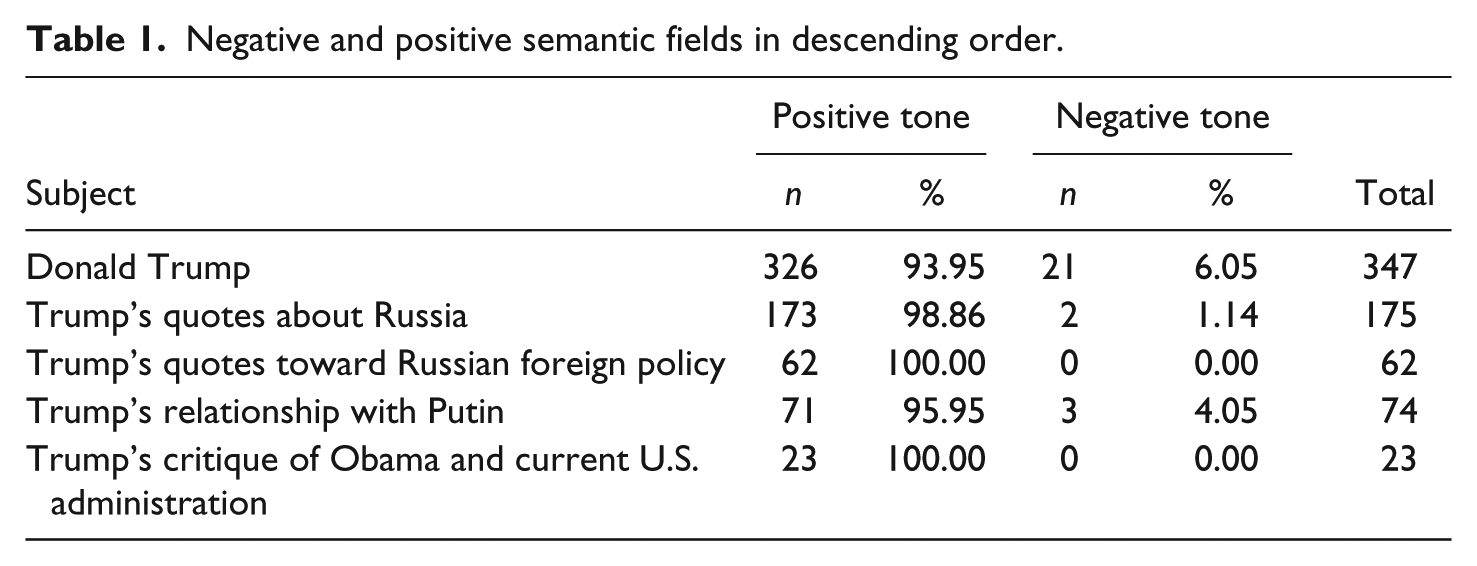
It seems like the media actualizes the linguistic experience of their audience which is capable of recognizing ideological markers in texts and relates them to their social status and world views. At the same time, the official position of the media is in most cases not judgmental: positive interpretation of Trump is more often given by quoting him, rather than by descriptive statements or evaluative assessments. Sometimes, it leads to almost anecdotal situations, like one of the articles about a Russian pensioner who wrote a letter to Donald Trump. Trump, as the pensioner believed, could restore the balance, since Trump several times had mentioned his intentions to cut military spending.
It is relatively easy intuitively to explain why Russians like the extravagant populism of Trump. The public image of Trump is of a politician that is dear to many Russians—he is direct, almost to the point of rudeness, which somehow resembles the always so popular Putin. Trump is definitely charismatic and Russian people do like charismatic politicians. Trump also regularly repeats an idea successfully cultivated in Russia, that the Western political elite is utterly rotten, making universal claims that the dominance of the U.S. establishment should be put to an end. The conservative rhetoric of Trump also resonates with the Russian worldview—Russian people also favor fences over refugees and do not like any progressive discourse that defends minorities and questions traditional values. He is not afraid to call things what they are, curses the establishment, and has no respect for political correctness.
Another explanation of Trump’s popularity could be that Russians do not want anything good for America—a poll in April 2016 showed that 64% of Russians have negative attitudes toward the United States (which is a significant improvement from 81% negative in the previous year).
The third (and, probably, the most realistic) explanation of Russians’ love of Trump is that he, unlike Hillary Clinton, does not hide his neutral attitude toward Russia and a positive one—toward Putin. This is what most Russians know about Trump—he promised to be friends with Putin. Russians were made to believe that if a man like this becomes the U.S. president, perhaps he and Putin can quickly find a way to understand each other and put an end to endless humiliation of Russia by Western elites, stop sanctions, and bring Russia back to its respected position in global politics. Besides, both Putin and Trump have already spoken quite highly of each other.
Conclusion
It is possible to conclude that the discourse about Trump in the Russian media possesses all the necessary typological characteristics of propaganda. Russian official media actively supports Donald Trump and deliberately creates a favorable opinion of him. Communication strategies used by the media are aimed at increasing the number of those audience members who are positive toward Trump. The discourse is propagandistic in nature due to its ideological bias, tendentious positioning of actors, formation of stable images of friends and enemies, positive projections of the future together with the negative projections of the present and the past.
Among the friends of Russia, there are all people who express favorable opinions of Putin, those who criticize him are treated as enemies. Any events or actors that are being covered by official media are used to promote views and ideologies and lead to the forming of similar views among the followers. This official discourse is not controversial or thought provoking, neither is it dynamic in evaluating similar situations nor other political figures; it demonstrates a stable focus on working within its information sphere.
Footnotes
Declaration of Conflicting Interests
The author(s) declared no potential conflicts of interest with respect to the research, authorship, and/or publication of this article.
Funding
The author(s) received no financial support for the research, authorship, and/or publication of this article.