




Abstract
This study examines the 2016 presidential campaign by comparing the voice of the people with that of the press and the political establishment. By systematically collecting some 5,000 texts (political speeches, ads, and debates alongside print and broadcast coverage) during the campaign and comparing them with 1,200 letters to the editor written in 12 small American cities, an overview of the nation’s quadrennial dialogue was made possible. By also comparing this sample with similar texts gathered for the 1948 through 2012 presidential campaigns, the 2016 campaign could be seen in sharper relief. These comparisons were facilitated by DICTION, a lexically based, content analytic program capable of producing rhetorical profiles of the discourse sampled. Overall, I found (a) that each voice produces distinct verbal patterns, thereby revealing its unique role in the polity; (b) that all three voices—politicians, the press, and the people—were more strident and more philosophical in 2016 than in prior years; (c) that Donald Trump and his letter writing supporters were especially dismayed by the status quo; and (d) that many of the stereotypes about letter writers turn out not to be true, with only a small percentage being blind ideologues. The rest were either issue specialists, analytical problem solvers, champions of a particular worldview, or voters interested in dissecting the psychological makeup of the candidates.
A proper academic article would commence with a sophisticated research question based on an extensive review of the literature followed by a series of intricate hypotheses ripe for testing. Donald John Trump changed all of that with his ascension to the presidency. Thousands of pages have been written post hoc to explain how he won but the bottom line is this: Everyone, cab driver and Princeton scholar alike, was shocked by what happened on November 8, 2016, in the United States of America.
As they do quadrennially, editors of the journal PS: Political Science & Politics (“Elections in Focus,” 2016) asked eight teams of scholars to deploy different statistical models to predict the campaign’s outcome. Some models featured demographic variables, some stressed geography, others factored in media coverage and lay attitudes, and all used one or more economic predictors. With one exception the models collapsed, although they did a better job of predicting the popular vote than that of the Electoral College. Only Helmut Norpoth of Stony Brook University gave Trump (262 days prior to the election) a 97% chance of winning based on (a) voter sentiment and party unity during the primaries and (b) certain large-scale historical patterns.
Professor Norpoth’s predictions notwithstanding, discovering why the 2016 presidential election turned out as it did is still a job undone. Historians, political scientists, and journalists are now asking questions never asked before: How could a TV pitchman-turned-politician be taken seriously by voters? What happened to the Hillary Express, a candidacy advantaged by money, organization, gravitas, and pedigree? And why could not experienced professionals like Jeb Bush, John Kasich, and Marco Rubio sideline the largely self-funded Trump campaign?
This study focuses on a different set of questions, asking what the 2016 campaign sounded like. In doing so, it builds on previous work describing the three voices of American democracy—politicians, the press, and the people. It is the latest emanation of the Campaign Mapping Project (https://moody.utexas.edu/strauss/campaign-mapping-project), a research endeavor first funded by the Ford Foundation and the Carnegie Corporation and designed to capture the distinctive language of American elections. To date, some 10 books, over 100 chapters and articles, and a bevy of theses and dissertations have emerged from the Project. A database of some 60,000 texts now exists—including campaign speeches, debates, advertisements, print coverage, and broadcast news—and has been subjected to both human and automated content coding. To capture the often-ignored voice of the people, 11,500 letters to the editor from 12 midsized U.S. cities written during presidential elections from 1948 through 2016 have also been collected. 1
The questions asked in the present study are basic: Did the 2016 campaign have a distinctive tone and tenor? Were politicians more idiosyncratic than in prior years? Was the press more combative? Did the discourse of the primaries differ from that of the general election? But my main focus is on what the people said. Were voters in a resolutely bad mood throughout the campaign? Did letter writers “take up” the language of Trump or were they repelled by it? Did they reflect the argot of their age, blending cynicism with brittleness, or did they exhibit hard-headed pragmatism and a passion for change? These are broad questions but they help reveal a campaign still wrapped in a mantle of imponderables.
Background
Understanding the people’s voice is a fledgling business. With the emergence of Twitter feeds and Facebook postings, scholars now have greater access to what voters are saying, but getting a “random draw” of social media sentiments is virtually impossible although it is being attempted (e.g., Davis, 2005; Reagle, 2015). But even if such a sample could be found, to what could it be compared historically? The Web is wonderful but it is also new.
In the offline world, there have been a number of fine, time-bound studies of the people’s voice dating back to the pathbreaking work of Robert Lane (1962), who painstakingly interviewed working men in New Haven, Connecticut in the late 1950s. More recent researchers have followed Lane’s lead, some using formal interviews (Gamson, 1992; Perrin, 2006) or focus groups (Hibbing & Theiss-Morse, 2002; Klofstad, 2011), while other scholars have used participant observation methods (Lindquist, 2002; Wahl-Jorgensen, 2007) or conducted detailed analyses of formal deliberations (Hart & Jarvis, 1999; Karpowitz & Mendelberg, 2014) and town hall meetings (Bryan, 2003).
Qualitative studies have problems of representativeness and this study suffers from them as well. But other indictments of projects like mine go deeper, with some scholars arguing that media gatekeepers inevitably skew the selection of letters to the editor (a claim that is often wrong), that only disaffected people write letters (a claim that is surely wrong), that such letters are rarely read (a claim that is massively wrong), and that letters have little impact (a claim that is probably wrong).
As I have detailed elsewhere (Hart, Childers, & Lind, 2013), the 12 newspapers comprising my sample accept 89% of all letters submitted, thus mitigating the gatekeeping charge. In addition, three separate surveys run in these cities over the past 20 years find that (a) the letters columns are avidly read by subscribers, (b) that writers are as likely to be Democrats as Republicans, and (c) that the writers are similar to readers with three exceptions: they are a bit older, they have lived in the community somewhat longer, and they care more about politics than the average citizen (Hart, in press). In short, to get an extant and reasonably representative sample of what Americans have said about politics during the past 70 years, one must use letters to the editor.
For the current study, I collected 1,201 letters from the aforementioned cities published between November 1, 2015, and November 15, 2016. A total of 26.7% of the letters either explicitly or implicitly endorsed Hillary Clinton and 24.7% sided with Donald Trump. A fraction of the letters endorsed Bernie Sanders (1.6%), a non-Trump Republican (2.1%), or a Third-Party candidate (2.0%), while a considerable number (23.3%) focused on local or State politics. Among the most interesting letters (19.6%) were those ruminating on the 2016 election but ignoring the candidates themselves. These letters either critiqued campaign processes (“bad press coverage, worse party ads”) or castigated voters for being too glum, too unhinged, or too inert.
Studying letter writers by themselves, however, only tells us so much, so I compared them to the nation’s leaders and members of the press. The political sample included 784 passages from speeches delivered by Donald Trump, Hillary Clinton, and their rivals; 632 passages from the primary and general election debates; and 81 ads put out by the Trump and Clinton teams. For the media sample, I collected, 1,730 news reports from the Chicago Tribune, The Washington Post, Los Angeles Times, The New York Times, The Christian Science Monitor, Atlanta Constitution, and the AP-UPI bureau. In addition, I gathered 933 broadcast segments from the nightly news shows of NBC, ABC, CBS, and PBS. In short, by assembling a reasonably large contingent of messages, one can get a sense of a campaign’s discursive architecture—its issues, arguments, sentiments, and tonalities. 2
Discovering what messages to study is often easier than determining how to study them. Over the years, researchers have generated thousands of content analytic templates for particular research enterprises. To handle large data sets, computer-based tools have been used and that is the approach taken here. I used DICTION, a program that has been deployed in some 500 studies (see http://www.dictionsoftware.com/published-studies/) published in a wide variety of social science disciplines.
DICTION is written in Eclipse/Java for PCs and Macs and examines texts with 10,000 search terms located in a variety of dictionaries. None of the search terms is duplicated in these lists, giving the user an unusually rich understanding of a text. By combining counts of these variables in creative ways, DICTION’s “lexical layering” sheds light on a passage’s tone, a phenomenon that becomes more prominent when word families are comingled. By standing back from a text, DICTION notices things that ordinary observers cannot notice, an especially useful approach for examining a large number of texts. When using DICTION, researchers can key on its various dictionaries and calculated variables or create new dictionaries suited to their specific research questions.
The current study is an outgrowth of a previous one (Hart & Curry, 2016) which found letter writers situated midway between politicians and the press on rhetorical optimism. That is, while citizens complain about politics, they are more generous than the press but not as hopeful as politicians. We also found that the press and the nation’s leaders differed along three binaries: (a) the press was interrogative while politicians were protective, (b) the press was clinical and politicians promotional, and (c) the press remained grounded while politicians strove for transcendence. Letter writers avoided all six extremes and did so steadily, confidently. In essence, each voice reflected a different worldview and deployed a different rhetorical style. So the question becomes: What did they say in 2016?
Based on prior research but based, too, on three unique aspects of the 2016 campaign—a woman was running for president on a major party ticket for the first time, a full-time business leader had been selected as a major party candidate (also for the first time), and the American electorate was in a manifestly agitated state—three main content analytic variables were used:
The Hortatory Style: Consists of language tapping the core beliefs of nationhood, religion, and community and that does so in assured, dramatic ways. To create this variable, two of DICTION’s built-in scores and three customized dictionaries were standardized and then combined: Hortatory Style = Patriotic Language (freedom, justice, republic, etc.) + Religious Language (worship, disciple, prophecy, etc.) + Voter References (citizenry, people, nation, etc.) + Certainty (all-encompassing language) + Embellishment (heavy use of adjectival constructions).
The Pragmatic Style: Distinguishes between words grounded in the real world and those reinforcing abstract goals and standards. This score was built by first combining (after standardization) Temporal terms (hours, month, immediate, etc.), Quantitative language (amount, billion, lots, etc.), and Financial words (deal, funds, taxes, etc.) and subtracting from this total Inspirational terms (faith, honesty, virtue, etc.), Praiseworthy terms (noble, mighty, proud, etc.), and 173 words selected from Graham, Haidt, and Nosek’s (2009) Moral Dictionary (fair, decent, righteous, etc.).
The Dissatisfied Style: Focuses on language alleging that politicians undermine the national project or restrict its possibilities. The Dissatisfied Style was built by standardizing Leader References (i.e., the last names of 270 current or former U.S. leaders) and Blame terms (naive, malicious, stupid, etc.) and then combining them.
As it turns out, there is virtually no statistical relationship among these three variables, so knowing a given text’s Hortatory score gives one no ability to predict its Pragmatism or Dissatisfaction scores. As a result, each of the three probes sheds unique light on a passage, thus adding to the “theoretical density” of one’s analysis. This is a special asset when processing a large data set with a decontextualizing methodology.
The 2016 campaign is an interesting site for a study like the present one. Hillary Clinton and Donald Trump did a number of unorthodox things during the campaign, combining social media and traditional campaigning with considerable amounts of serendipity. The press, too, established new routines, blanketing the campaign with Web-based coverage 24/7, running an unprecedented number of public opinion polls, and providing Donald Trump alone with an estimated $2 billion worth of free media coverage (Confessore & Yourish, 2016). And what of the people? How did they react during the campaign? Were they as glum as some have reported and, if so, were they deeply dispirited or just plain cranky? What did the people say in 2016 and what did it mean?
An Unyielding Campaign
Here is just one of the things Donald Trump said during the 2016 campaign: I have to be honest with you, this has been going on for a long time. We’ve become a debtor nation. Our roads are falling down, our highways, our bridges. They’re like . . . a high percent are considered unsafe. We have to rebuild the United States; we have to rebuild the United States. We’re gonna get together an advisory soon. I was very proud to say . . . I know an old truck business tough-guy. He says I’m slower on the trigger today but I’m a tough guy. I’m for the strongest militarily you can ever have. I always said I’m a militaristic person. We’ll have such a strong military. But you know what it’s time for folks? We have to get rid of Isis. We’re gonna get rid of them surgically and fast because you can’t allow them to cut Christians’ heads off and everyone else’s. That’s from medieval times . . . I used to read about that. I just said, you know, this is no different—we’re living in medieval times, we’re living in medieval times! It’s just as bad as they ever were in the history of the world—they’re cutting people’s heads off! I used to read that when I was in history class . . . it’s a medieval time bomb! They’re doing the same thing right now. Probably more viciously! We’re living probably in the most vicious time we’ve had. These people—they’re disgusting, disgusting animals. . . . But you know what? We’ve gotta get back to the country we’ve been. Gotta bring our people back. And we’ve gotta let people know that if they mess around with us, they’re gonna be, we’re gonna wipe them off the face of the earth. (Trump, 2016, January 16).
From the standpoint of American oratorical history, there is nothing new here. Trump combines Jonathan Edwards’s fire and brimstone with Huey Long’s populism and Henry LaFollette’s colorful insularity. Images of disintegration vie with images of expansion. Medicinal metaphors (“surgical strikes”) become entwined with zombie metaphors (“heads severed”). “Trigger fingers” mix with “time bombs,” causing utter annihilation for some (“wiped off the face of the earth”) and redemption for others (a “rebuilt” United States). Trump’s world is dialectical—past meets present, animal life meets human life, medieval times give way to a Second Exodus. Heady stuff, this.
As we see in Figure 1, the Hortatory Style has proved popular to those running for office in the United States, combining as it does a sense of certitude and the nation’s verities—God, country, and the people—a brew that proves too servile for the working press and too heady for letter writers in small towns. 3 But Donald Trump warmed to that style. His exotic spontaneity combined with a herky-jerky blend of overstatement and self-interruption caught voters’ ears, especially when dished out to them in soundbites on the evening news or via Twitter.
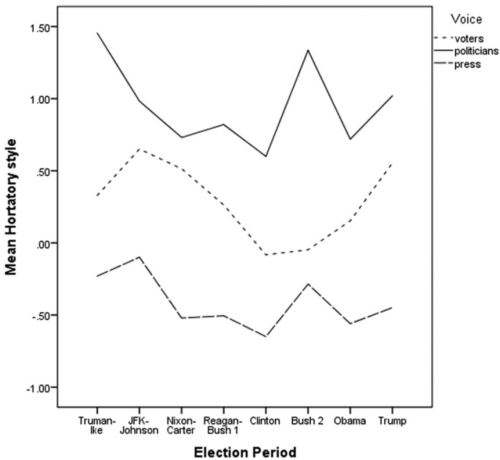
Hortatory Style by voice across election periods.
Figure 1 shows that the Hortatory Style was popular in the Cold War era and declined steadily until revived by George W. Bush in 2000 and 2004, after which it plummeted during the Obama era. It now seems to be making a comeback, perhaps because of Donald Trump and, to some extent, because of Hillary Clinton (although Trump edged her out on that score). 4
The letter writers have now joined in, increasing their use of the Hortatory Style in recent years. Those writing in support of Mr. Trump were especially strident (as we see in Figure 2), often imitating his no-holds-barred style of campaigning and reflecting the elite and party polarization that has sharply increased lately.
5
Donald Trump clearly had a ear for the people and they for him: The very definition of deplorable is a good start in describing the endless sea of disgusting, perverted, corrupt and seditious acts of the Democrats’ presidential nominee, her minions and her followers perpetrate against our once-great nation on a seemingly daily basis. (Matt Feiock, September 14, 2016, Duluth News Tribune) What has happened to . . . America? What has caused the people of this nation to become wimps and followers, in lieu of real leaders and builders? If you read the beginning sentence of the preamble to our nation’s Constitution, the “supreme law of the land,” you will have your answer. As it begins with “We the people,” not “We the government!” (George Sexton, August 16, 2016, Billings Gazette)

Hortatory Style for letters by writer positioning.
Letters written 8 years earlier had a different, conventionally political, sound, focusing more on candidates’ personal qualities or on campaign strategies and issues. The letters still had pungency and vivacity but they lacked the ideological force of the 2016 missives: Sarah Palin, the Republican VP candidate, has gone to the UN to meet with foreign dignitaries and for photo ops. With this visit she hopes to embellish her foreign policy expertise. Just the other day I walked into Albertson’s produce department. I squeezed the tomatoes and melons, sniffed the peaches and plums, then someone took my picture standing alongside this huge stack of green cabbage. I left the store content with the knowledge that I am now a farmer. (Dick Kulka, October 4, 2008, Wichita Falls Times Record News) Recently Matt Damon (a great actor but I suspect a poor statistician) came out with the claim that there is better than a one in three chance Republican presidential candidate John McCain would not survive his first term. I posed this assertion to a friend on mine who deals in actuarial statistics. His conclusion: A healthy 72-year-old man’s normal life expectancy is about 14 years, and the chances of McCain living out his first term is about 95 percent. Matt, stick to making action movies. (Larry Lasher, September 25, 2008, The Salinas Californian)
We do not yet know if the letter writers’ increased use of the Hortatory Style resulted from changing political tastes or from the peculiar candidates running for office in 2016. It is also hard to know who became ideological first: the candidates or the citizens. The trends noted here are glacial ones, representing only a moderate increase in the Hortatory Style. The story becomes clearer when we look at the writers’ relative pragmatism.
A Moralistic Campaign
Figure 3 plots campaign Pragmatism between 1948 and the present, showing how it increased over time until the Bush 43 years unfolded. 6 The events of 9/11, the quagmires of Afghanistan and Iraq, the contretemps of No Child Left Behind, and a variety of faith-based initiatives were practical matters but they were also profoundly philosophical: What had the United States been in the past and what should it become? Who were the nation’s friends and who were its enemies? Which tasks were federal tasks, which belonged to the states, and which should the people undertake? The Bush years gave way to long and complicated conversations.

Pragmatic Style by voice across election periods.
The Obama elections of 2008 and 2012 struck a different tone. Debates about Afghanistan and Iraq became more strategic and, on the domestic front, health care, Wall Street reform, climate change, same-sex marriage, and homeland security dominated the headlines. With some exceptions, the trend lines for the three voices moved together over the years even as they maintained a steady vertical separation from one another. 7 Some of this makes sense: We expect the press to report the stock ticker and the ball scores and letter writers to write more speculatively. Politicians operate somewhere in between, dreaming dreams but acknowledging concrete realities. Three voices, three different discourses.
Letters to the editor sounded different yet again in 2016—more ideological, as we saw earlier, but also more conceptual; 2016 became a “principles-based” election. While some people voted for Trump because they wanted more manufacturing jobs, many asked more fundamental questions: Why should traditional Americans cede their cities to illegal immigrants? What is the difference between a healthy patriotism and a dangerous nationalism? Why cannot the United States compete anymore? What sort of future could their kids expect? What happened to the hope and change Barack Obama promised? Supporters of Hillary Clinton also posed axiological questions: Why should not gay people have the same rights as others? Is not it time for a woman to break through the ultimate glass ceiling? Can the nation afford to turn its back on the world community in an age of globalization? How can Bernie Sanders’s brand of socialism be squared with the needs of corporate America?
In 2016, domestic issues, not international ones, made the writers especially philosophical. That held true for all 12 cities as well as for the primaries and general election.
8
It was as if the nation were suddenly engaged in a grand introspection, no longer willing to let conventional politics stay conventional. All matters—taxes, ethics, immigration, gender identity, science, medicine, and even politicians’ family members—were interrogated at the level of principle. The old sops—self-interest and lower taxes—were no longer enough: What has left Washington lawmakers are respect and responsibility. . . . They toss aside their responsibilities which are many and in dire need of addressing while they shuttle to their home states and vacation homes through most of the summer, and then of course, come the holidays. They see no responsibility to move this greatest nation on earth into stronger and safer waters by doing the business of this country. (Shirley Stoican, June 11, 2016, Billings Gazette) A better world rejects the moral equivalency of Donald Trump’s inappropriate sexual verbiage and actions with Hillary Clinton’s morally bereft decades of lies and corruption. Help save our republic. Do your part to create a better world. Vote on Nov. 8. (Christine Masters, October 18, 2016, Provo Daily Herald)
Not surprisingly, writers supporting particular candidates—versus those stressing campaign issues—were somewhat more likely to abandon the Pragmatic Style for principle-based arguments. 9 While statistically modest, this finding captures so much of the unpleasantness witnessed during the 2016 campaign because values were suddenly being heralded. Moral responsibility and intellectual integrity have never been strangers to American political discourse but in 2016, the letters displayed them more prominently.
A Discordant Campaign
Figure 4 shows that the press has been far more Dissatisfied over the years than either letter writers or politicians. 10 Donald Trump’s claim in February of 2017 that “the media are the enemy of the American people” rang true for many of his supporters but, as we see in Figure 4, it would have rung true for most of his predecessors as well. Thomas Jefferson may be the only White House occupant who believed that “were it left to me to decide whether we should have a government without newspapers, or newspapers without a government, I should not hesitate a moment to prefer the latter.” 11
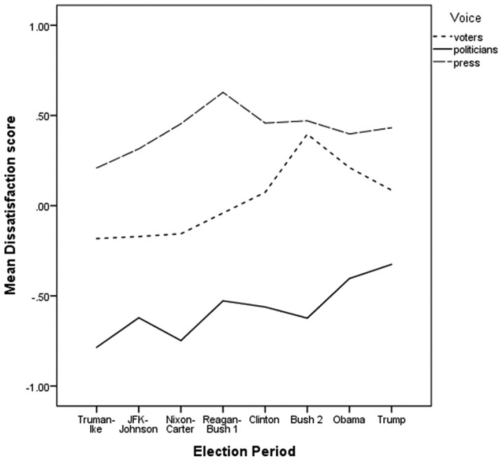
Dissatisfaction scores by voice across election periods.
Donald Trump is clearly not a fan of reporters nor they of him. But Figure 4 shows that Trump also piled on during the campaign, outdistancing most of his predecessors on Dissatisfaction and eclipsing Hillary Clinton as well. 12 Lyin’ Ted, Little Marco, Crooked Hillary, Crazy Bernie, and Senator Pocahontas (Elizabeth Warren) became familiar characters because of Trump. While candidates with high Dissatisfaction scores are more likely to lose presidential elections, Mr. Trump’s supporters could not get enough of it. They cheered him throughout the raucous primaries and again in the general election. 13 Trump was significantly more accusatory than Clinton in all three of their debates and surpassed her in his speeches and political ads as well. 14
And what of the letter writers? Figure 4 shows they were actually a little cheerier than they were during the George W. Bush years but Figure 5 shows this was not true of the partisans among them.
15
The 2016 race proved to be a dyspeptic one, with families torn apart via Twitter loathings and Facebook unfriendings. The language of the 1950s—“I’m for Dawkins,” “let’s put Simpson over the top”—seemed quaint if not addle-brained 60 years later. The viscera, not the prefrontal cortex, commanded the body politic. As a result, the letters of 2016 had a saturnine kind of eloquence: Any Christian should have seen who Trump is from the beginning. He is proud, boastful, greedy, a pathological liar and an angry man who stirs up others to be angry. His vocabulary is awful. We as Christians should know how important words are because they are an indication of what is in our heart. And now with this tape from Access Hollywood we see that he is a sexual predator. (John Murray, October 25, 2016, Wichita Falls Times Record News) If Democrats think lying and corruption is a resume enhancement they got exactly what they deserve—the most untrustworthy, self-serving public figure in America! It’s agonizing watching her blind surrogates crown this pariah. This image of evil occupying the people’s house should sicken you! (Tom Williams, July 23, 2016, Utica Observer-Dispatch) [Clinton is] a thoroughly corrupt and lawless political opportunist who has clearly demonstrated herself to be a serial liar, a race-baiter, a class-warfare aficionado infinitely crooked immoral, loathsome, repulsive, and a hypocritical Marxist-Alinskyite. She is worth hundreds of millions of dollars [and] should spend the rest of her natural life wearing an orange jumpsuit in federal prison for violating the federal espionage act and because of her vast corruption while in public office. (Tom Taylor, November 5, 2016, Fall River Herald News) Trump is scapegoating two groups to incite fear and hatred to gain power for himself just as Hitler did. Hitler started with Jews and Marxists while Trump is targeting another religious minority and immigrants. When violence against minorities increases because of his hateful words Trump just shrugs it off. I hope most people in this area remembering their own immigrant roots and mindful of the contributions recent immigrants have made to our area will not fall for his dirty propaganda. (Margaret Orman, March 9, 2016, Utica Observer-Dispatch)

Dissatisfaction scores for letters by writer positioning.
This is an athletic assemblage. Sexual predators mix with filthy propagandists. Nazis are disinterred and pariahs denounced. Religion meets up with Marxism while espionage and race-baiting vie with a poor vocabulary for censure. While colorful, Trait writers like these—those calling attention to a candidate’s personal shortcomings—are but one of several types of writers. Figure 6 shows what happens when Hortatory and Dissatisfaction scores are contrasted (using ±½ standard deviation for the cutoffs). The results are telling. Contrary to conventional wisdom, very few writers are Ideological hacks. Ten times as many are Analytical, arguing on empirical grounds (e.g., “we need increased funding for the schools,” “let’s end the welfare state as we know it”) rather than characterological grounds. Different still are Sermonic writers who rally the community around long-standing myths (e.g., the importance of voting), often blending elements of Church and State (e.g., “abortion is the law but it’s also a sin”).

Types of letter writers.
Many writers (31.2%) do not fall neatly into these four categories. Those addressing local or state politics were often Topical writers, while those living in conservative communities (e.g., Wichita Falls and Lake Charles) were often more Sermonic. Issue advocates had an Analytical cast of mind and lived in more progressive communities (e.g., Fall River and Salinas), while candidate devotees were often Trait-oriented. Generally speaking, though, these five writer types are spread evenly across my national sample and appear in roughly the same proportions throughout the 18 presidential elections sampled in this study.
Like the American people themselves, those who write letters to the editor are a complex lot and they write letters for different reasons. They are not a perfect stand-in for the nation because they care more about politics than do their fellow citizens. Normatively, though, it is heartening that writers care enough about the polity to venture forth, to take a risk, to have their say. When writing, they make tacit assumptions about their readers, exposing the cultural presuppositions to which they are heirs. It is within these assumptions, within these presuppositions, that new truths can be found.
Conclusion
Donald Trump is a phony and troubled man and, no, I do not support Hillary Clinton. Apparently Trump thinks money can undo all of his hateful outbursts, lies and impulsiveness. Can anyone see this man in the White House as President of our great country? We unfortunately as citizens are left empty in this election. Instead of demanding that he release his tax returns, maybe he should be required to get a psychiatric evaluation. (Helen Mitchell, June 12, 2016, The Roanoke Times)
As Helen Mitchell amply understands, the patience of the American people was sorely tested in 2016. The primary season seemed endless and the general election was often a soap opera. The personalities involved—oh, the personalities!—were unprecedented, including an avowed socialist, a former first lady, a retired neurosurgeon, and a corporate mogul cum TV star. They were joined by a gaggle of senators and governors but these, too, were an odd bunch. Some were despised but weirdly effective (Ted Cruz), while others were well-liked but lackluster (John Kasich). The press covered the campaign as it always had but, this time, its reportorial habits became their own (controversial) news stories. Everyone tweeted during the race but the most important Tweets were still filtered through legacy media. The year 2016 saw a new campaign doing old things (e.g., untold sums were spent on TV advertising) but doing them in new ways (e.g., by recirculating the ads via social media).
The research described here is also old, also new. I have reported that politicians continued to be more Hortatory than the press, pulling the nation’s heartstrings at every turn. The press kept to its script, maintaining high Dissatisfaction scores by detailing the candidates’ weakness. The voters’ stands-ins—the letter writers—kept their distance from both the press and the politicians. In 2016, they focused heavily on principles and found both Republicans and Democrats lacking. The writers were preachier than the press but not as preachy as those running for office. Many writers expressed dismay during the election but they never became as forlorn as those in the media. Unsurprisingly, letter writers with a special stake in the campaign—those supporting specific candidates—were often vituperative (especially those supporting Donald Trump) but roughly half of the writers stuck to the issues of the day, largely ignoring the candidates themselves.
This study has asked what a campaign looks like from the people’s perspective. In contrast, most prior research has focused on the strategies of those running for office and the attendant press coverage. But a political campaign is really a three-part affair because the people, too, have conversations. In 2016, they talked less about specific policy proposals and more about values: Who has a right to be rich? How rich? Who has a right to work? What kind of work? Whose version of American history should guide the nation in the years ahead? What is justice and who should administer it? Why do Beyonce and Putin seem more popular than God these days? Do Black lives really matter and, if so, to whom?
The trends noted in this study are occasionally modest, occasionally more dramatic, but collectively they invite new considerations. For example, why did all three of the voices studied here—the people, the press, and the candidates—become less Pragmatic and more Hortatory in 2016 than 4 years earlier? What sorts of economic, cultural, or political variables inspired this seeming collaboration? Was this a “philosophical” turn on their parts that had been building over the years or was it simply a tired-of-Obama effect? Alternatively, were the American people rejecting racehorse coverage and looking for more substantive dialogue?
And what of Hillary Clinton? Was she wise to tone-down her rhetoric (via lower Dissatisfaction scores) or should she have gone after Donald Trump personally, abandoning her often airy rhetoric? Along these lines, one subsidiary finding was that the writers supporting Clinton exhibited far more Dissatisfaction than she did and they were more Pragmatic as well. 16 Did Clinton fail to “connect” with her own people? Was she too cautious when she should have been bold, too upbeat when she should have been outraged? Donald Trump, in contrast, matched his supporters quite well. Clearly, we need to know more about the rhetorical alignments between candidates and their supporters.
Scholars using survey methods have taught us a great deal, but “public opinion”—a congealed construct—is quite different from “public opinions”—an individuated construct. How, and when, do these two concepts intersect? What do surveys tell us that letters to the editor cannot? Which features of the American polity can only be found by reading what voters have said—in depth, at length, via repeated measures? What image of the people do we get from street corner interviews on the nightly news and what sorts of selectivity and bias do those interviews present? Which citizens are eager to theorize about politics, which are mute, and which are actively hostile to civic engagement?
All too often in the past, scholars have ignored the people’s voice or, worse, failed to acknowledge that they have a voice. Happily, qualitative field studies like those of Cramer (2016), Coleman (2013), and Tracy (2011) have reasoned differently, exposing new fault lines in contemporary politics. Careful textual analyses of lay discourse like those of Childers (2012), Hauser (2014), and Lovell (2012) have also made important contributions. By presenting findings based on automated language analysis, I have tried to add range, power, and nuance to the mix. But whatever tools are used and whatever questions are asked, one thing remains true: We need to know more about the people’s voice in American politics.
Footnotes
Declaration of Conflicting Interests
The author(s) declared no potential conflicts of interest with respect to the research, authorship, and/or publication of this article.
Funding
The author(s) received no financial support for the research, authorship, and/or publication of this article.