




Abstract
What explains high party polarization in younger developing democracies? This article examines and explains variation during South America’s recent left turn period, making two key claims. Extremely polarized politics in countries such as Bolivia, Ecuador, and Venezuela emerged through a mechanism termed polarizing populism, in which political outsiders leveraged popular anti-systemic appeals to underwrite otherwise risky and highly controversial policy programs. The occurrence (or not) of polarizing populism in South America, in turn, can be explained by the conjunction of state crises before the left turn period (which provided fuel for outsider politics) and the strength of the extant infrastructure of left-wing political mobilization each country possessed as the post–Cold War era began, which shaped incentives for outsiders to build ideologically narrow or broad elite coalitions. These propositions are tested through a broad analysis of eight South American countries and a more detailed case study of Venezuela.
What explains high levels of party polarization in younger developing democracies in the post–Cold War era? In the past decades, countries in many developing regions have seen the emergence of high levels of polarization, often arriving after years of relatively centripetal competition. Theories developed to explain party polarization in the older democracies of Western Europe and North America—such as those centered on the number of parties or social cleavages and inequalities—seem to offer limited leverage on many of these episodes (Lipset & Rokkan, 1967; Sartori, 1976). 1 The implications of polarization, for good or for ill, underline the importance of better understanding its causes and dynamics. On the positive side, polarization may clarify choices for voters, enhance programmatic linkages, and help strengthen partisan identities (Lupu, 2015; Zechmeister & Corral, 2013; Le bas, 2006, 2011). On the negative side, polarization has been linked to both poor policymaking and the erosion or breakdown of democracy (Collier & Collier, 1991; Frye, 2002, 2010; Handlin, 2017; Mainwaring & Pérez-Liñan, 2012).
This article offers a novel theoretical explanation for variation in party polarization in 21st-century South America, a particularly suitable context for exploring the topic. The new century saw the political fortunes of the left rise across the entire continent, a phenomenon attracting substantial scholarly interest. 2 This regional resurgence of the left yielded great variation in levels of party system polarization where the left managed to win power. Party systems of Bolivia, Ecuador, and Venezuela came to possess notoriously high levels of polarization, while those in the five other countries where the left took power did not. The article makes two major assertions, one descriptive and the other explanatory. The descriptive claim is that high levels of polarization emerged through a mechanism termed polarizing populism, in which the ascendance of an outsider politician or movement capitalizing on anti-systemic sentiment also triggered an uptick in party polarization on the left-right programmatic dimension. I argue that these two phenomena were intrinsically related. By winning decisively on a pro-systemic/anti-systemic dimension of politics, polarizing populists carved out latitude to adopt riskier, controversial, and even spatially suboptimal programmatic positions while still winning elections.
The central theoretical claim is that the emergence (or not) of polarizing populism in South American countries during this period was driven by the conjunction of two variables during the prior decade. First was the occurrence of state crises, not only situations in which states were weak—plagued by inefficiency and corruption—but also situations in which mass publics came to hold very little confidence in the functioning of basic state institutions and government in general. State crises facilitated the emergence and ascendance of outsiders on the left politicizing anti-systemic sentiment. But state crises were not sufficient for truly high levels of party system polarization. Whether outsiders on the left took the form of polarizing populists or much more pragmatic orientations hinged on whether or not they built their movements on top of a strong extant infrastructure of left-wing political mobilization—recruiting allies, advisors, and coalitions partners on the left—or on whether they built movements in contexts largely bereft of such infrastructure, which induced them to seek centrist allies, advisors, and coalition partners, necessitating programmatic compromise. Polarizing populism required not just state crisis but also contextual conditions that induced outsiders to build elite coalitions on the left.
This article proceeds as follows. I first discuss and demonstrate variation in party polarization in 21st-century South America. The article then presents its central conceptual and theoretical claims. Finally, I assess these propositions through a brief comparative analysis of eight South American countries and a more in depth case study of Venezuela.
Variation in Party Polarization During South America’s Left Turn
South America experienced a consequential turn to the left during the first decade of the 21st century, with candidates of the left winning the presidency in 8 of the region’s 10 largest countries. 3 The left turn unfolded quite differently across countries, however, leaving party systems marked by highly variant levels of polarization. Particularly, radical leftist parties and movements emerged in Bolivia, Ecuador, and Venezuela, greatly raising the intensity of politics and presenting steep challenges to the market-oriented economic model favored by their competitors. Elsewhere on the continent, the rise of the left tended to be far less contentious. Party systems therefore came to be marked by great variation in polarization, conceptualized as the left-right differentiation between component parties in a party system, viewed in terms of both distance (the spread of the distribution) and intensity (the willingness of opposing parties to compromise). 4
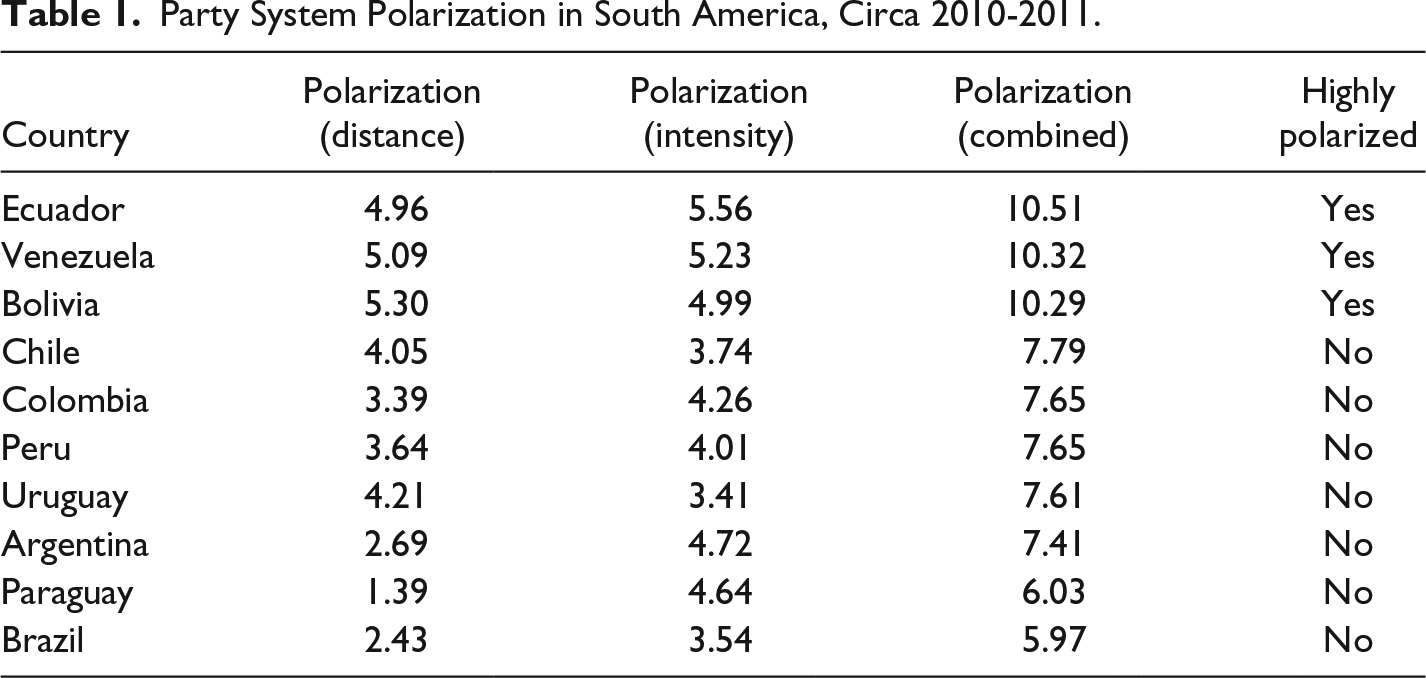
As Table 1 suggests, party systems in Bolivia, Ecuador, and Venezuela came to far outpace others in the region in terms of polarization by the end of the new century’s first decade. 5 This trio scored highest on both component measures of distance and intensity. On the aggregate measure, the gap between Bolivia, the third highest scoring country, and Chile, the fourth highest scoring country, was greater than the gap between Chile and Brazil, the lowest scoring country. The emergence of such stark variation makes South America a fertile ground for building and testing theories regarding the dynamics and causes of polarization.
Party System Polarization in South America, Circa 2010-2011.
The Logic of Polarizing Populism
The argument presented here begins with a descriptive assertion: Highly polarizing party systems in South America emerged through a mechanism of “polarizing populism,” distinguished by two characteristics. First, populist figures and movements emerged to challenge for, and often win, executive power. By populists, the article means outsider or maverick politicians who mobilize mass constituencies while making antiestablishment or anti-systemic appeals for office. 6 Second, these populist figures not only politicized a pro-systemic/anti-systemic dimension of politics, but they also advanced radical programmatic agendas greatly at odds with those of status quo opponents. In the time and region under investigation, outsiders on the left forged a combination of anti-systemic attacks on the status quo and radical economic policies that challenged the neoliberal order. But, in theory, outsiders on the right such as Peru’s Alberto Fujimori—or actors politicizing programmatic dimensions of politics other than the left-right divide—could also adopt strategies of polarizing populism.
If polarizing populism served as the proximate mechanism introducing polarization into party systems, then what explains its origins and occurrence? A central claim of the article is that polarizing populism is enabled by state crises, a term coined in O’Donnell’s (1993a) seminal analysis of the phenomenon. 7 State crises refer to situations characterized by two necessary elements. First, states perform poorly: Basic institutions such as the public administration, the judiciary, and the police prove inefficient and highly corrupt in their conduct and provision of goods and services. Second, citizens come to possess very little confidence in these basic state institutions and government in general. Because both elements are necessary for a state crisis, the concept is not equivalent to that of a weak state and is prone to change over time. Indeed, a state could be marked by weakness for a lengthy period of time without a state crisis—as citizens tolerate state pathologies—only for a state crisis to flare up at a later point.
State crises are conducive to antiestablishment politics and the rise of political outsiders, who can appeal to populations upset by the ineffectiveness and inequities of states in their treatment of citizens. A lengthy set of scholarship theorizes and demonstrates associations between phenomena similar to state crisis or incorporated into its definition—such as mass disenchantment with democratic institutions or corruption levels—and the decline of established political parties, crises of representation, and the emergence of populists (Coppedge, 2005; De La Torre, 2000; Doyle, 2011; Hawkins, 2010; Mainwaring, 2006; Seawright, 2012). These outcomes certainly may have other contributing causes, such as poor economic performance, certain patterns of market reform politics, “brand dilution” among leading political parties, and the erosion of established forms of linkage. 8 But there is great reason to believe that state crisis represents an important proximate driver of outsider politics and the rise of populists.
Why would state crises trigger party system polarization? If we think only of the intensity of political contestation, state crises may heighten polarization simply by enabling the rise of populist outsiders, since antiestablishment attacks on the existing political elite tend to foster heated, uncompromising politics. Yet state crises can also enable programmatic polarization. In fostering clashes along a pro-systemic/anti-systemic dimension of politics, state crisis facilitates the adoption of polarizing positions along other programmatic dimensions. The logic of this claim can be heuristically illustrated in Figure 1, with each panel displaying a two-dimensional space in which a left party is competing against a right-of-center competitor on both the horizontal left-right dimension and a vertical pro-systemic/anti-systemic dimension. In the absence of state crisis (left panel), the median voter is effectively pro-systemic. There is no incentive for vertical deviation by the left party and, as such, a strong centripetal pull toward the middle of the horizontal dimension.
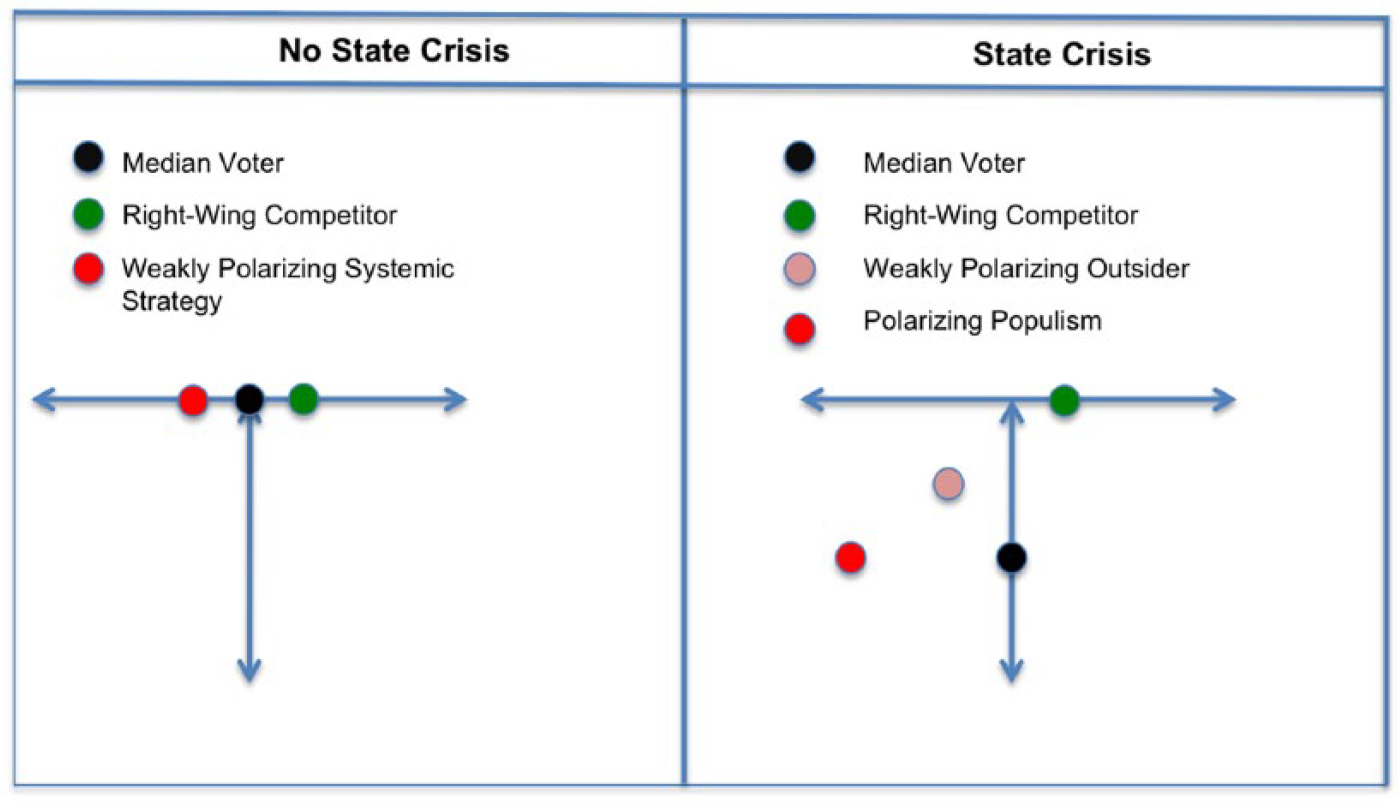
State crisis and the logic of polarizing populism.
State crisis (right panel), in contrast, opens up a range of strategic possibilities for the left actor, assuming it is one—like a populist outsider—with the non–status quo credentials to move freely on the vertical dimension. With the median voter now strongly anti-systemic, this actor could expect to win an election at a variety of locations in the lower left quadrant of the policy space. The outsider could take a relatively cautious approach that maximized the chances of winning office (as in the pink circle in the right-hand-side panel of Figure 1), politicizing the anti-systemic dimension somewhat to gain advantage over opponents but not deviating much horizontally. But the outsider could also adopt a riskier position (as in the red circle in the right hand panel), one in which vertical congruence with the median voter on the anti-systemic dimension would effectively underwrite a horizontal positioning that was radical and (on its own) spatially suboptimal. Strategic choice by populist outsiders can be decisive.
The processes by which populist outsiders build movements, especially the coalitions and alliances they forge, therefore become critical in determining whether populists will adopt pragmatic or polarizing positions, and therefore whether or not they will transform party systems in highly polarizing directions. These processes, and the underlying variables shaping them, are likely to be contextually sensitive, hinging on the nature of political and social cleavages. Yet we may still be able to identify patterns of more systematic regularity, especially among sets of cases within single regions and/or time periods.
During the late 1990s and 2000s in South America, when forces of the left were on the march across the region, a key contextual variable involved the prior existence of a robust infrastructure of left-wing politics. The existence of a strong infrastructure of left-wing political mobilization offered incentives for outsiders on the left, if they emerged, to build ideologically narrow coalitions on the left—to forge alliances with extant left parties, recruit advisors seasoned in left-wing politics, and find allies in anti-neoliberal social movements. This coalitional dynamic incentivized populist outsiders to embrace more radical economic positions and to take particularly harsh and confrontational anti-systemic stances, as in the red circle on the right-hand-side panel of Figure 1. Contexts barren of left-wing infrastructure, in contrast, induced outsiders to build ideologically broad coalitions. Lacking relevant left allies, outsiders faced great pressures to court centrist actors in the search for allies and were consequently incentivized to attenuate their anti-systemic rhetoric and adopt more moderate economic policies, akin to the pink circle.
In sum, I argue three points. First, high levels of party system polarization often emerge through a mechanism of polarizing populism in which outsiders productively combine anti-systemic and programmatically radical positions. Second, state crises enable polarizing populism by facilitating outsider politics and allowing outsiders to politicize an anti-systemic/pro-systemic dimension of contestation. Finally, whether or not outsiders adopt highly polarizing agendas is likely to depend on the ways in which contextual variables shape options for coalition building. In the specific context of South America’s left turn period, the existence or not of a strong extant infrastructure of left-wing political mobilization very strongly conditioned how left outsiders built their movements and therefore whether or not their entrance into politics reoriented party systems in highly polarizing ways. In other contexts, different variables might be critical in shaping the logic of outsider coalition building.
State Crises, Left Infrastructure, and the Dynamics of South America’s Left Turn
This section presents broad evidence for the plausibility of the theory across eight South American countries. 9 The section scores all countries in the region on the explanatory variables and briefly illustrates the mechanisms of the theory across the eight cases. Before undertaking this task, however, a note must be made about the timing of these processes. The goal is to explain the emergence of highly polarizing party systems during the 21st century, when the region as a whole took a turn to the left. The explanatory variables are therefore assessed with regard to their relevance in the prior period, between the end of the Cold War and the beginning of each country’s turn to the left.
State crisis occurred across much of South America during the 1990s and early 2000s. Our ability to specifically date the onset of some of these crises is limited by the existence of cross-national comparative data suitable for measuring the two dimensions, which tend to be available only from the mid-1990s onward. This does not pose a substantial problem, however, since the key question at hand is whether or not prolonged state crises occurred during the 1990s and early 2000s, not the exact length of these crises. Table 2 displays measures of the occurrence of the state crises. The indicator of state performance averages three of the Worldwide Governance Indicators (Rule-of-Law, Control of Corruption, and Government Effectiveness), while the measure of institutional confidence is an index of several measures (in the judiciary, the police, and congress) taken from the Latinobarómetro. This table shows each country’s average score on these indices in the period between 1995 or 1996 (when data are first available) and the year in which they elected a leftist executive. 10 Five countries experienced prolonged state crises during the 1990s and early 2000s. Three others avoided prolonged state crises. Chile and Uruguay possessed highly functioning states throughout the period and maintained great public confidence in institutions by regional standards. Brazil likely fell into state crisis during the early 1990s but then experienced significant improvements in both state performance and public confidence over time, such that its aggregate measures on each indicator for the pre–left turn period well surpassed those of other countries in the region. 11
State Crisis in South America Before the Left Turn.

The occurrence (or not) of the deep state crisis in the 1990s and early 2000s unfolded in countries that differed greatly in the robustness of their infrastructure of left-wing political mobilization as the 1990s began. This term primarily refers to political parties of the left, defined as parties and movements with Socialist or Marxist roots (or new parties founded by leaders and activists with those roots) also possessing a substantial programmatic commitment to the reduction of social and economic inequality. It also can be understood to encapsulate strong left-wing social movements that might have been important political actors if not (yet) participants in the electoral arena.
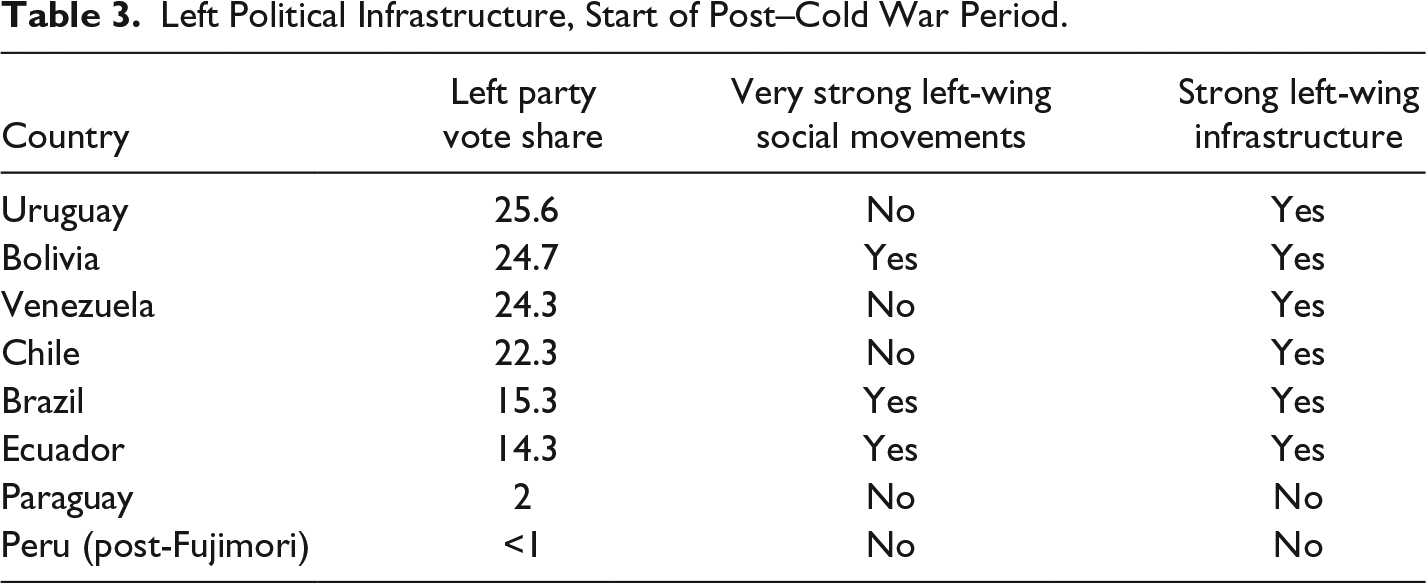
Table 3 shows the infrastructure of left-wing politics across the eight countries as the post–Cold War era began or, in the partially deviant case of Peru, once a sustained period of post–Cold War democracy occurred after the ouster of autocrat Alberto Fujimori. Left party vote share reflects the average of the total gained by the left in the closest lower house elections before and after January 1, 1990. The presence of particularly strong left-wing social movements in the early 1990s is a more qualitative measure drawn from examination of the secondary literature. As we can see, there were six countries that began the 1990s marked by relatively substantial infrastructures of left-wing political mobilization (Bolivia, Brazil, Chile, Ecuador, Uruguay, and Venezuela), one country (Paraguay) in which the left had made almost no inroads, and a final case (Peru) in which the left was relatively strong as the 1990s began but was completely destroyed by a regional anomalous period of authoritarian rule, such that it was virtually nonexistent once democracy returned in the new century.
Left Political Infrastructure, Start of Post–Cold War Period.
Cases and Outcomes
The eight South American countries therefore fell into three categories in terms of the combination of these two variables. This section first traces how, within each category, variables combined to drive alternative outcomes, with high polarization resulting only from the combination of prolonged state crisis and a strong infrastructure of left-wing politics. Due to space constraints, these discussions are necessarily very cursory. A case study of Venezuela then allows for more refined examination of the core claims and mechanisms of the theory.
Bolivia, Ecuador, and Venezuela possessed the combustible combination of a prolonged state crisis occurring in contexts of strong left-wing political infrastructure. In all three countries, a prolonged state crisis drove the rise of political outsiders of various stripes during the 1990s, with strong left-wing outsiders (Hugo Chávez in Venezuela, Evo Morales in Bolivia, Rafael Correa in Ecuador) eventually emerging to contest and win presidential elections. Although processes varied somewhat by case, in each country, these left outsiders built new left movements on top of an extant infrastructure of left-wing politics: They forged coalitions with smaller extant left-wing parties; they recruited seasoned left-wing politicians and strategists to join their movements, run their campaigns, and develop their programs; and they forged relationships with anti-neoliberal social movements or, in the Bolivian case, emerged more organically from such movements. In all three countries, outsiders therefore came to power at the head of ideologically narrow left-wing coalitions, running on programs that had been substantially influenced by their left-wing advisors and allies and which combined radical denouncements of market reforms with harsh anti-systemic critiques.
Paraguay and Peru were characterized by state crises of great severity, but these crises occurred in contexts bereft (in the Peruvian case, post-Fujimori) of a meaningfully strong infrastructure of left-wing politics. In both countries, state crisis provided fuel for outsider politics, including the emergence of left-wing outsiders in the first decade of the new century. In Peru, this occurred quite early, with the rise of Fujimori himself, and then continued in the post-Fujimori years, leading to the ill-fated candidacy of Ollanta Humala for the presidency in 2006, and his successful second attempt in 2011. In Paraguay, outsiders began to penetrate the long-standing party system centered on the PC (Partido Colorado) and PLRA (Partido Liberal Radical Auténtico) in 2003, with a left-wing outsider in Fernando Lugo then challenging for and winning power in 2008. In both cases, left outsiders, faced with contexts in which allies on the left were few and far between, built pragmatic coalitions by courting centrist parties as coalition partners, enlisting key advisors from outside the political left, and relying only marginally on relationships with relatively weak left-wing social movements. 12 The price of these coalitional strategies involved the embrace of platforms that were economically moderate and which, while critiquing deficiencies of the state, did not advocate massive reforms or present existential challenges to the political status quo. Despite their status as outsiders, the rise of Humala and Lugo to power therefore did not reorient party systems in a strongly polarizing direction.
Finally, Brazil, Chile, and Uruguay avoided prolonged state crisis while possessing strong infrastructures of left-wing politics. No political outsider ever seriously challenged for presidential power in either Chile or Uruguay during the 1990s or 2000s, while electorally relevant outsiders effectively disappeared from presidential politics in Brazil after 1994. With outsiders absent, extant left-wing parties grew in strength over time, as moderate and pragmatic factions were able to consolidate their hold over parties. The left turn in this trio of countries therefore yielded party systems marked by relatively weak levels of polarization. The existence of strongly institutionalized parties of the center-left ensured a minimum degree of predictable programmatic competition, but such competition occurred within bounds—with the left not seeking to thoroughly undermine the market-oriented economic model they inherited—and among insiders accustomed to the necessity of pragmatic compromise and deal making with opponents.
Polarizing Populism in Venezuela
A closer case study of the emergence of polarizing populism in Venezuela can help further test the central claims of the theory. While extensive in size, the Venezuelan state had long been famously weak. As the economy floundered in the 1980s, public discontent with the functioning of state institutions and government in general rose to previously unknown levels, such that the country likely entered state crisis sometime in the late 1980s. 13 The inefficiency of Venezuelan public administration became an object of considerable scrutiny while crime levels escalated (Briceño-León, 2006; Cupolo, 1998). Perhaps most important, high levels of corruption came to the fore of public consciousness. By the middle of 1994, public disgust with corruption had reached such a level that, according to one poll from Consultores 21, 81% agreed with the characterization of the Congress as a “den of thieves” and 62% supported a suspension of constitutional rights if it helped bring the corrupt to justice (Romero, 1997, p. 23).
The outbreak of state crisis was soon followed by the rise of political outsiders. The 1993 presidential election was won by Rafael Caldera, a former president who rebranded himself as an anti-systemic maverick, with Andres Velásquez, the populist leader of insurgent leftist party La Causa R (LCR), nearly winning himself. The three most prominent candidates in the subsequent 1998 election were all outsiders: Chávez, former beauty queen Irene Sáez, and businessman Henrique Salas Römer. Multiple factors likely contributed to the rise of outsider politics (Lupu, 2014; Morgan, 2011; Roberts, 2014). But widespread public dissatisfaction with the functioning of state institutions and with corruption in particular was clearly a major contributing factor (Coppedge, 2005; Hawkins, 2010; Seawright, 2012). State crisis played a particularly central role in driving the emergence and ascendance of Chávez and his Movimiento Bolivariano Revolucionario-200 (MBR-200). Chávez himself ascribed the corruption of the Punto Fijo system as the primary motivation for the MBR-200’s initial formation in the early 1980s (Chávez Frías, 2014). When the MBR-200 first came to prominence through a 1992 coup attempt, the group proposed that the Venezuelan state was “exhausted” and “corrupt” and laid out a detailed set of plans for completely remaking institutions (Movimiento Bolivariano Revolucionario, 2002a, 2002b). During his time behind bars, Chávez penned a series of formal statements in which he called for a thorough refounding of the state through the convocation of a national forum that would write a new constitution (Chávez Frías, 2002). The ongoing state crisis, much more so than economic policy, was the central object of critique for Chávez and the MBR-200 in their period as insurrectionary actors.
After Chávez was released from prison and decided to contest the 1998 elections, he made the convocation of a constituent assembly to rewrite the constitution and refound the state as the centerpiece of his campaign. Chávez and his supporters in the Polo Patriotico alliance did their best to frame the presidential contest itself as a referendum on this idea. As one leader put it when asked about the PP’s campaign strategy, “The program of . . . the Polo Patriótico is to ask this question: Do you want to invoke a constituent process, yes or no?” (Rondón, 1998, p. 247). On the campaign trail, Chávez consistently returned to the need for a constituent assembly and emphasized that state reform, even more than economic issues, would be the biggest priority of his administration. Although most Venezuelans seemed to only poorly understand what the constituent assembly would entail, the idea enjoyed great popularity in survey after survey, a point not lost on Chávez’s campaign team (El Universal 1998a, 1998b). Although the 1998 election was contested among outsiders, Chávez’s call to refound the state distinguished him from other candidates such as Salas Römer and Sáez who promised much less substantial departures from the status quo. At the polls, Venezuelans responded. Studies show that the vote for Chávez was driven strongly by high corruption perceptions and low confidence in institutions, even more than by pocketbook evaluations or left-right ideology (Handlin, 2017; Hawkins, 2010). State crisis fueled anti-systemic outsider politics in the electoral arena.
Venezuela’s robust infrastructure of left-wing politics, in turn, favored the emergence of a left-wing outsider that would build an ideologically narrow coalition and stick to a radical and polarizing program. From the earliest days of the MBR-200, Chávez found allies among radical sectors of the Venezuelan left, with some of whom he had deep connections running back to his childhood. The 1992 coup was planned in coordination with leaders of the radical wing of LCR and other famed Venezuelan leftists such as Kléber Ramírez, who also played major roles in influencing the programmatic manifestos that the group would offer to the public. After the failure of the coup, as Chávez plotted a new strategy to win power through elections, he made concerted efforts to seek a wider group of left-wing allies, activists, and coalition partners while openly advertising his goal of forming a “National Bolivarian Front, a grand alliance,” which would unite different elements of the Venezuelan left (El Universal, 1995). The robust infrastructure of left-wing politics in Venezuela offered him many options for recruitment: Chavez joined forces with seasoned leftist politicians such as Alberto Müller Rojas, José Rafael Núñez Tenorio, Jorge Giordani, and José Vincent Rangel to serve as key advisors and run his campaign. He also convinced both MAS (Movimiento Al Socialismo) and the majority faction of LCR to join the Polo Patriótico coalition, along with several minor leftist parties. The availability of these allies on the left therefore made it unnecessary to seek coalitions with centrist parties or to lean heavily on key advisors and strategists from outside the left, relationships that might have required programmatic moderation and compromise.
Instead, leftist advisors and coalition partners were integral in designing the program of the Chávez campaign and keeping the Polo Patriótico tethered to uncompromising left-wing positions. The idea of a program that combined anti-systemic appeals for state transformation with radical economic policies had originated in substantial part with left-wing advisors to Chávez before the coup. These and other leftist advisors assumed important roles within the Bolivarian Movement above ground and helped guide its strategic direction. Giordani and a circle of other radical leftist economists known as the “Garibaldi Group” were particularly influential in developing the economic policy of the Chávez campaign and MVR (Movimiento V República; Kelly & Palma, 2004, p. 217). Müller Rojas, Carlos Escarrá, and others were integral in pushing and designing the proposal to hold a constituent assembly, which had been a longtime emphasis. In an interview during the election, Juan Barreto, a key figure within the MVR at this point, explained how the official program of the campaign was developed: “Hugo is the inspiration of this program . . . but there is a technical team in different areas, in the macro social area, in the area of political economy, in the political area itself . . . Hugo, of course, is the candidate, he is the one responsible for presenting this program to the public (Iglesias, 1998, p. 146).
The 1998 elections therefore saw the emergence of a new pattern of high polarization that would continue to characterize Venezuelan politics into the 21st century. The opposition to Chávez coalesced around Salas Römer, a Yale-educated businessman who, while an outsider himself, represented a pro-systemic and programmatically right-wing option. Chávez and the Polo Patriotico, in contrast, proposed a thorough refounding of state institutions and melded this anti-systemic platform to a highly radicalized economic program that rejected neoliberalism and envisioned the state playing a strong role in the economy not just to promote industrialization but also to shift the nature of production itself, by promoting cooperatives, worker-managed enterprises, and other forms of production outside the realm of standard firms (Movimiento Quinta República, 1998). Despite many tumultuous events, this basic dynamic would continue to characterize Venezuelan politics throughout the subsequent Fifth Republic: an uncompromising and high-intensity competition between a largely center-right opposition bloc (which eventually coalesced into the Mesa de la Unidad Democrática) and a Bolivarian bloc (first in the form of the Polo Patriótico, eventually in the form of the Partido Socialista Unido de Venezuela) advancing their program Socialism in the 21st century. 14
Conclusion
The spread of democracy across much of the world during the post–Cold War era has yielded substantial variation in party polarization. This article offered a novel explanation for variation in contemporary South America, making several conceptual and theoretical contributions. On a descriptive level, the article suggests that high levels of polarization have been spawned by a mechanism of polarizing populism, in which outsider politicians and movements utilize popular anti-systemic critiques to underwrite otherwise risky and controversial policy programs that depart markedly from those of status quo competitors. On a theoretical level, the article argues that polarizing populism is enabled by state crises, situations that open up possibilities for outsiders to politicize anti-systemic sentiment. But polarizing populism, rather than more pragmatic and milquetoast versions of outsider politics, also hinges on whether outsiders build ideologically narrow or broad coalitions, more contingent processes likely to be shaped by contextual variables. In the case of South America’s left turn period, a strong preexisting infrastructure of left-wing political mobilization proved decisive in this respect. Other contextual variables might be more important elsewhere.
Understanding the roots of high party polarization in younger democracies, and the logic of polarizing populism, is particularly vital given that the ascendance to power of polarizing populists has so often led to the erosion or breakdown of democracy. Democratic erosion occurred to varying degrees in Bolivia, Ecuador, and Venezuela, with the new governments undermining free and fair elections and/or protections for civil liberties (Handlin, 2016; Levitsky & Loxton, 2013; Mainwaring & Pérez-Liñan, 2015). Similar processes of democratic erosion have unfolded in cases of polarizing populism in other world regions such as Hungary, Turkey, Thailand, and the Philippines. Scholars of populism have long theorized tensions between populism and liberal-procedural democracy. 15 Researchers have also often emphasized the power of polarization to undermine democracy by increasing the stakes of politics and the commitment of key actors to the democratic game (Alexander, 2002; Collier & Collier, 1991; Mainwaring & Pérez-Liñan, 2012; Slater, 2012). It should be no surprise that the combination of the two phenomena might be particularly poisonous.
Unfortunately, state crises seem likely to remain common in the 21st century. Despite massive attention among academics and policy practitioners to issues of state weakness in recent decades, reliable policy solutions for improving state performance and for curing institutional dysfunction remain largely elusive. The long-term persistence of state pathologies under democratic rule is likely to have corrosive effect on public confidence in basic state institutions in many countries. As such, the world is likely to present us with many more instances of state crisis—and therefore potential outbreaks of polarizing populism—for further study.
Footnotes
Declaration of Conflicting Interests
The author declared no potential conflicts of interest with respect to the research, authorship, and/or publication of this article.
Funding
The author received no financial support for the research, authorship, and/or publication of this article.