



Abstract
Against the backdrop of Europe’s migrant crisis, this study investigates attitudes toward immigrants and immigration policy. Specifically, how do Europeans’ attitudes stem from: (a) the symbolic boundaries they draw regarding immigrants (i.e., their perceptions of what constitutes an immigrant); (b) their contact with racially and ethnically different others; and (c) their own experiences with discrimination? Data from the 2014-2015 European Social Survey (N = 37,623) show Europeans’ symbolic boundaries regarding immigrants varied by respondents’ sociodemographics, consumption of political news, and social trust. Most, but not all, forms of intergroup contact enhanced support for specific groups and broader immigration policy. Contrary to expectations, experience with discrimination did not shape attitudes toward specific immigrant groups. Our discussion focuses on theoretical implications, future research, and how findings can inform contemporary public discourse about the migrant crisis.
The global migrant crisis has propelled immigration to the fore in many regions of the world, particularly Europe. The politically and socially motivated migration to Europe derives from conflicts in the Middle East (e.g., Syria, Iraq, Afghanistan) and infrastructural concerns (e.g., access to education and health services) in those conflict-ridden countries. Additionally, people emigrate from their countries of origin because they seek political stability, a safer atmosphere, and a better quality of life for their families (Banulescu-Bogdan & Fratzke, 2015; BBC, 2014). With an unsurpassed 244 million migrants worldwide (International Organization for Migration, 2016), Europeans see immigration as the most important issue facing the European Union (European Commission, 2015). Not surprisingly then, immigration has dominated European political debates, media coverage, and public opinion.
Given the omnipresence and impact of immigration issues in public life, we examine how individuals’ attitudes toward immigrants and immigration policies can be explained by: (a) symbolic boundaries individuals draw in defining others as viable immigrants, (b) their contact with racially and ethnically different others, and (c) their experience with discrimination. Drawing on key concepts from sociology—symbolic boundaries, intergroup contact, cultural affinity, and empathy—we analyze 2014-2015 European Social Survey (ESS) data from 20 countries to address three fundamental questions: How do people draw boundaries and decide which immigrants are viable for their societies? Do citizens with greater contact to dissimilar others have more inclusive attitudes about immigrants and immigration policies? And how do discriminatory experiences affect those attitudes? Our analyses are designed to inform contemporary public discourse about the migrant crisis. Knowledge about the psychological determinants of immigration attitudes, including previously unexplored interactions, is of merit to policy makers, educators, and those framing the discourse in politics and mass media.
Literature Review
Drawing Symbolic Boundaries: A First Step Toward Defining “Us” Versus “Them”
The sociocultural, ethnic, racial, and religious heterogeneity borne of international migration challenges both members in the immigrant-receiving host societies and the immigrants themselves. From the perspective of the former group, attitudes and behaviors toward immigrants can be deeply rooted in social closure and boundary work.
Social closure occurs when individuals draw boundaries, construct identities, and build communities so as to control resources and exclude others from accessing them (Mackert, 2012). Out-group members’ access to resources and therefore their (real or perceived) class membership and social status might be based on certain criteria comprising innate (e.g., age, sex) or achieved characteristics (e.g., intelligence, merits; Lamont & Fournier, 1992; Sauder, 2011). When people draw symbolic boundaries, they conceptually categorize individuals or communities (Lamont & Molnar, 2002), creating in-groups and out-groups to draw lines between those who are welcome and those who are not welcome to be part of a community or, more broadly, society. Symbolic boundaries are identity-shaping and used by individuals to separate “us” from “them,” the in-group from the out-group (Zolberg & Woon, 1999). Symbolic boundaries, however, can morph into social boundaries when a broad consensus exists about how the in-group differs from the out-group. Social boundaries are often institutionalized in the form of social policies that create social distance and ensure that the resources and opportunities are accessed more by those in the majority (Alba, 2005). While they stem from intersubjective and hypothetical symbolic boundaries, social boundaries are visible, real, and policy-oriented.
In the context of immigration, individuals in countries that receive immigrants primarily evaluate these newcomers based on their economic rather than their cultural contributions (Iyengar et al., 2013). For instance, educational attainment may determine whether and how one draws symbolic boundaries for immigrants, reflecting a strong preference for migration of skilled individuals (Facchini & Mayda, 2012). Immigrants in Europe are more strongly judged based on their language skills and overall cultural fit than their race or religious affiliations (Bail, 2008). In addition, cultural concerns, rather than economic concerns about immigration, are driving factors behind drawing boundaries on the basis of immigrant skills, race, and religion (Heizmann, 2016). Guided by the existing scholarship on symbolic boundaries and desired qualities of immigrants, we ask the following research question:
Intergroup Contact
Defining the qualities of a hypothetical immigrant has implications for people’s attitudes toward immigrants and immigration policies. However, such symbolic boundaries are contingent on experiences of diversity, which often come in the form of interpersonal contact with immigrants. For example, cultural boundaries are reinforced by both structural conditions (e.g., a nation’s limited experience with immigration and cultural diversity) and individual conditions (e.g., lack of individual contact with immigrants; Heizmann, 2016). Frequent contact between in-group and out-group members can reduce prejudice and ethnocentric attitudes, and boost out-group solidarity and trust (Allport, 1954; for a meta-analytic review, see Pettigrew & Tropp, 2006). In the long term, the shift toward culturally diverse immigrant societies is likely to entail an increase in social capital, solidarity, and new, encompassing identities (Putnam, 2007).
Regardless of a country’s level of immigration, close contact with minority group members, as one type of contact, is associated with positive attitudes toward immigrants (McLaren, 2003). Close contact in the form of friendship is considered a fundamental condition for positive intergroup contact. Likewise, the higher the number of minority friends an individual has, the more favorable her attitudes toward immigrants (Kehrberg, 2007). In other potential sites of interethnic/interracial exposure (e.g., at the workplace), people with immigrant colleagues are less xenophobic than those without the opportunity to work across racial or ethnic boundaries (Hjerm, 2007).
Similar to type, frequency of contact can enhance proimmigrant attitudes (Ward & Masgoret, 2006). In the United States, the frequency with which Whites communicate with Hispanics is generally positively related to affinity toward Hispanics, and more pronounced in areas with high concentration of Hispanics (Stein, Post, & Rinden, 2000). The same interaction effect was observed regarding immigration policy. Frequent and repeated intergroup contact (e.g., in the form of discussions), typically takes place at the workplace—often a source of many social relationships—rather than the neighborhood or places of worship, which help maintain these relationships (Huckfeldt & Sprague, 1995).
Last, valence of contact makes a difference. Whether an interaction is positive or negative affects the extent to which that particular category is salient: Usually a negative interethnic experience causes the ethnicity of the contact partner to become more salient (Paolini, Harwood, & Rubin, 2010). In addition, if an out-group member is perceived to be typical of the entire out-group, the impact of intergroup contact on out-group attitudes is likely to be more positive compared with those who consider the out-group member rather atypical (Brown, Eller, Leeds, & Stace, 2007). Inclusive attitudes about (a) immigrants and (b) immigration policy are associated positively with …
At the same time, it is reasonable to assume that frequency and valence of contact will jointly exert influence on immigration attitudes. After all, an individual who only occasionally experiences negative interactions with racially or ethnically different others likely will feel differently about immigrants and immigration policy than someone who regularly experiences negative interactions.
Experience With Discrimination
Thus far we have argued that symbolic boundaries drawn around hypothetical immigrants and interpersonal experiences with actual immigrants (through intergroup contact) may explain attitudes toward immigrants and immigration policies. However, another set of real-life experiences can shape how individuals think about immigrants and immigration policy: their own experiences with discrimination. Specifically, those who have experienced some form of discrimination may feel more empathetic toward immigrants because they are perceived to also be victims of discrimination. Two related theories guide this line of reasoning.
First, according to cultural affinity theory, people’s perceptions of out-group members hinge on their individual similarities with those out-group members and the extent to which the out-group as a whole is included in the dominant in-group (Zamora-Kapoor, Kovincic, & Causey, 2013). Put another way, cultural affinity develops from shared cultural characteristics and social ties (Espenshade & Hempstead, 1996). For example, members of religious minorities have more favorable attitudes toward immigrants than members of the dominant religion (Hayes & Dowds, 2006). At the macro-level, certain groups of citizens empathize with immigrants because of structural (i.e., group-based) similarities in their position relative to the dominant group (Pehrson, Vignoles, & Brown, 2009). From an intergroup-contact perspective, equal status—based on similar qualities, backgrounds, characteristics, and shared histories—can facilitate intergroup communication (Allport, 1954) and connect those individuals with discrimination experience with out-group members such as immigrants.
Second, cultural empathy, the ability to adopt another’s ethnocultural perspective (Albiero & Matricardi, 2013), can improve intergroup relations (Dovidio et al., 2010). This generally plays a mediational role in the positive relationship between the act of perspective-taking (i.e., being encouraged to adopt a perspective of an out-group member) and intergroup attitudes (Vescio, Sechrist, & Paolucci, 2003), even when in-group members maintain stereotypes about out-group members (Pettigrew, Tropp, Wagner, & Christ, 2011). When exposed to content about discrimination against minority group members and when empathy is induced (e.g., taking an empathic perspective toward out-group members who are victims of discrimination), in-group members experience reduced bias and improved intergroup relations (Finlay & Stephan, 2000). 1
Against this backdrop, we contend that the concepts of cultural affinity (Zamora-Kapoor et al., 2013) and cultural empathy (Albiero & Matricardi, 2013) apply to policy making that is based on cultural, racial, or ethnic boundaries. The more one empathizes with a specific culture, the more one is likely to have positive feelings toward its members (such as refugees from a foreign country) and policies that aim to help those members (such as humanitarian policy measures). We therefore posit our final hypothesis, linking discrimination experiences with attitudes toward immigrants and immigration policy:
Method
Data from Round 7 of the ESS were analyzed to address the research questions and test the hypotheses posed. Between August 22, 2014, and December 5, 2015, interviews were conducted with 37,623 respondents aged 15 years and older residing within private households. The ESS covered 20 countries (Austria, Belgium, Czech Republic, Denmark, Estonia, Finland, France, Germany, Hungary, Ireland, Lithuania, Netherlands, Norway, Poland, Portugal, Slovenia, Sweden, Spain, Switzerland, and the United Kingdom). 2 Details regarding specific fieldwork dates, data collection modes, and response rates can be found at http://www.europeansocialsurvey.org/methodology/ess_methodology/data_collection.html. In analyzing ESS data, we maximize the variance among our focal variables, looking at Europe in its entirety instead of single nations; this approach has been proven suitable for hypothesis-testing and theory-building (Livingstone, 2003). Furthermore, pooling data from a variety of countries allows us to present how the concepts of symbolic boundaries, intergroup contact, and cultural affinity/empathy apply across many national contexts; this will allow us to draw conclusions about the scope and generality regarding immigration attitudes in the context of Europe’s migrant crisis.
Measures
Dependent Variables
Acceptance of immigrants
Respondents were asked the extent to which their country should allow specific groups of people from other countries to come and live there: (a) individuals who were of the same race or ethnic group as most others in the respondent’s own country (M = 2.89, SD = 0.83); (b) those of a different race or ethnic group from most in the respondent’s country (M = 2.65, SD = 0.87); (c) Muslims (M = 2.47, SD = 0.95); (d) individuals from poorer countries in Europe (M = 2.63, SD = 0.89); and (e) those from poorer countries outside Europe (M = 2.48, SD = 0.92). Responses ranged from 1 (allow many to come and live here) to 4 (allow none), and were reverse-coded such that higher scores reflect greater acceptance.
Support for inclusive immigration policy
Respondents were provided a 5-point Likert-type item stating that “the government should be generous in judging people’s applications for refugee status” (M = 3.27, SD = 1.10). The item was reverse-coded so that higher scores reflect greater policy support. A prefatory statement noted that “some people come to this country and apply for refugee status on the grounds that they fear persecution in their own country.”
Independent Variables
Symbolic boundaries drawn around immigrants
Using a scale ranging from 0 (extremely unimportant) to 10 (extremely important), respondents were asked how important various considerations “should be in deciding whether someone born, brought up and living outside (country) should be able to come and live here”: good educational qualifications (M = 6.41, SD = 2.60); the ability to speak (country’s official language[s]) (M = 7.03, SD = 2.68); a Christian background (M = 2.95, SD = 3.03); being White (M = 1.82, SD = 2.65); having work skills that (country) needs (M = 6.50, SD = 2.73); and commitment to the way of life in (country) (M = 7.39, SD = 2.47).
Contact with different races/ethnicities
Contact with individuals of different races and/or ethnicities was measured with several items. Respondents were asked about the perceived heterogeneity of the area in which they currently live; they could identify this area as one where almost nobody (1), some people (2), or many people (3) are of a different race or ethnic group (M = 1.74, SD = 0.72). They also were asked about their frequency of contact with these individuals in everyday settings (e.g., on public transportation). Responses ranged from never (1) to every day (7) (M = 4.57, SD = 2.19). Respondents then were asked to assess the valence of this contact, from extremely bad (0) to extremely good (10), (M = 6.83, SD = 1.94). Finally, respondents were asked whether they had close friends of a different race or ethnic group from most people in their country: none (0), a few (1), and several (2) close friends (M = 1.68, SD = 0.73).
Experience with discrimination
Our analyses also included discrimination-related experiences as independent variables. Respondents were asked if they would describe themselves as a member of a group that is discriminated against in their country (8.4% indicated this). Since the reasons for discrimination can be manifold, we included in our analyses discrimination on grounds of religion (1.8%), race (1.8%), nationality (1.5%), ethnicity (0.9%), and language (0.5%).
Political news use and social trust
The inclusion of political news use as a variable acknowledges how attitudes about complex sociopolitical issues (such as the migrant crisis) are shaped by the information individuals have about these issues, most likely obtained through the media coverage (McCombs & Shaw, 1972; Tewksbury, 2015). This item measured exposure to news, politics, and current affairs on television on an average weekday, from no time at all (0) to more than 3 hours (7) (M = 1.93, SD = 1.41).
Also, because attitudes about immigrants and immigration-related policy presumably reflect views individuals hold about their community and how common goals may be attained (or not) (Putnam, 2007), we included a measure of social trust. This item was an aggregate variable averaged from three 11-point items asking respondents whether they thought most people can be trusted, try to be fair, and try to be helpful (M = 5.17, SD = 1.79, Cronbach’s α = 0.72).
Demographics
Finally, because attitudes toward immigrants and immigration policy are often a function of individuals’ social and political positions, our analyses included a number of demographic variables: sex (51.8% female); age in years (M = 46.09, SD = 19.08); education in years 3 (M = 12.52, SD = 3.82); total household income in deciles (value labels 1-10; median = 5); perceptions of one’s household income [living comfortably (1); coping (2); finding it difficult (3); finding it very difficult (4)], reverse-coded such that higher scores reflect greater financial comfort (M = 3.07, SD = 0.80); employment during the past 7 days (51.6%); religiosity [not at all religious (0) to very religious (10), M = 4.36, SD = 3.13]; and political conservativism [left (0) to right (10), M = 4.95, SD = 2.14].
To account for differences in inclusion probabilities and examine data for several countries combined, both poststratification weights and population size weights were applied. In so doing, we followed the recommendations of the ESS survey developers regarding the pooling of data from different countries to describe an entire region.
Results
Symbolic Boundaries
Our first research question asked about the symbolic boundaries drawn around immigrants. Respondents attached varying levels of importance to the six immigrant criteria and their adherence to these boundaries hinged on several factors (see Table 1). Generally, these criteria for immigrants tended to be valued by older and conservative respondents, and those with lower levels of education, financial security, and social trust. Value on an immigrant’s commitment to the nation’s way of life tended to be higher among the employed and less religious, but speaking the host country’s official language was more important among those with less income. Work skills also matter, according to males and the less religious. Placing importance on immigrants being educationally qualified was emphasized by male, less affluent, and unemployed respondents. Those who consumed political news more often were more likely to place emphasis on language and work skills and educational qualifications.
Predicting Perceived Importance of Immigration Qualifications (Symbolic Boundaries).

Note. Entries are standardized upon-entry coefficients from ordinary least squares regressions. As per European Social Survey guidelines, unweighted Ns are reported.
p < .05. **p < .01.
The factors that predicted the two lowest ranked criteria for immigration—being Christian and being White—were identical. Males, those in lower socioeconomic strata (as reflected in their education, income, employment status, and perceptions of financial security), and those with higher levels of religiosity and conservativism were more likely to see these criteria as important for immigration. Social trust undermined importance of those criteria.
Inclusive Attitudes About Immigrants
As shown in Table 2 (block 3), these same factors predict acceptance of specific immigrant groups and attitudes toward immigration policy. Generally, if respondents emphasized symbolic boundaries, they were less likely to support immigration from all groups asked about in the survey: people of the same or different race/ethnicity (as the majority of the host county), Muslims, and individuals from poorer countries both within and outside of Europe. The only symbolic boundary positively linked to greater acceptance of immigrants was having a good education (ranked fourth most important). If individuals prioritized education, they were more likely to be welcoming of all races/ethnicities and Muslims.
Predicting Acceptance of Immigrants and Support for Inclusive Immigration Policy.

Note. Entries are standardized upon-entry coefficients from ordinary least squares regressions. As per European Social Survey guidelines, unweighted Ns are reported.
p < .05. **p < .01.
To the extent that contact with different races and ethnicities makes a difference, the data provide robust support for Hypotheses 1 to 3. Namely, the more frequently people are in casual contact with different others, the more positive their contact with these individuals, and the more close friends they have of a different race/ethnicity, the more likely they are to support all or most immigrant groups. Contact with others included a measure of the perceived heterogeneity of respondents’ area of residence, which negatively predicted inclusive attitudes: Those living in more diverse areas were less willing to support immigration of people of the same race or ethnicity and up people from poorer European countries. This was not the case for support for Muslims, which was positively associated with neighborhood heterogeneity.
Support for Hypothesis 4, that frequency and valence of contact would exert a joint influence, emerged only with respect to one group. Figure 1 illustrates how inclusive attitudes toward those of a race or ethnicity different from the host country’s majority were positively predicted by frequency of contact, and this effect is stronger among those who reported positive interactions.
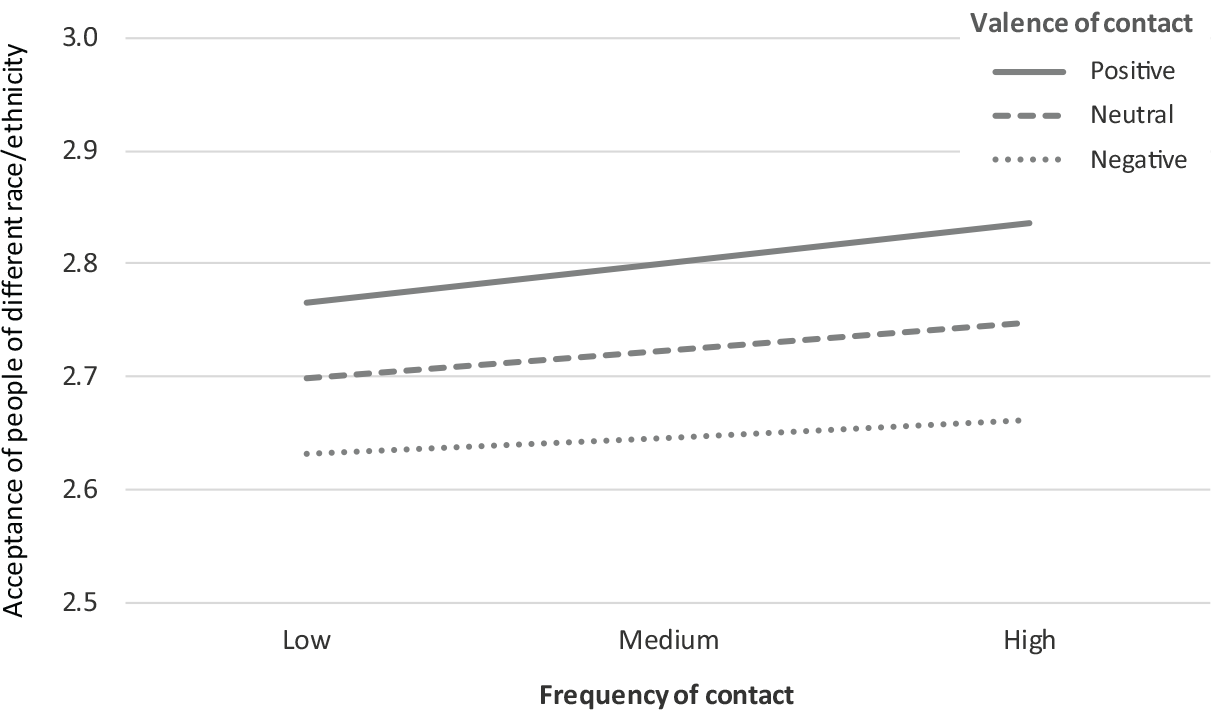
Acceptance of racially/ethnically dissimilar immigrants by frequency and valence of contact.
Finally, where attitudes about immigrants were concerned, the results revealed trends generally antithetical to Hypothesis 5. If respondents were of a group that had experienced race- or ethnicity-based discrimination, they tended to oppose immigration. Respondents who had experienced language-based discrimination were generally more welcoming of immigrants of the same race or ethnicity and immigrants from poorer countries within and outside Europe, but those discriminated on religious grounds were less welcoming of those groups. Language-based discrimination otherwise tended to support Hypothesis 5.
Support for Inclusive Immigration Policy
Support for inclusive immigration policy was predicted by a set of factors markedly different from that of support for specific groups of immigrants. Perceptions of financial comfort, being well-educated, greater religiosity, and political liberalism were linked to this view, as was political news use and social trust. If respondents placed importance on specific criteria for immigration, except for being Christian, these views trickled over into support for more stringent policy.
Partial support emerged for the contact hypotheses posited. Having close friends of a different race/ethnicity and experiencing positive interactions led to support for more inclusive policy, as predicted by Hypotheses 2 and 3, respectively. However, Hypothesis 1 was not supported in that the more frequent casual contact people had with racial or ethnic others, the less they supported inclusive immigration policy. Figure 2 shows support for the interaction hypothesis put forward in Hypothesis 4.

Support for inclusive immigration policy by frequency and valence of contact.
Given that intergroup contact can be experienced interpersonally and in a mediated fashion, we conducted additional analyses using interaction terms comprising political news consumption and each of the different contact measures, with perceived neighborhood diversity and news consumption reflecting the strongest interaction effect. Note that the independent main effects for both news consumption and perceived neighborhood diversity on attitudes toward immigrants were mostly negative (see Table 2). While this negative pattern largely persists for people residing in relatively homogeneous neighborhoods (see dotted line in Figures 3 and 4), this effect does not emerge for people residing in ethnically diverse areas. Consuming news had either a weakened negative effect among those living in moderately heterogeneous areas (see dashed line in Figure 3) or a positive effect among those living in highly heterogeneous areas (see solid line in Figure 4).

Acceptance of racially/ethnically similar immigrants by levels of news consumption and neighborhood diversity.
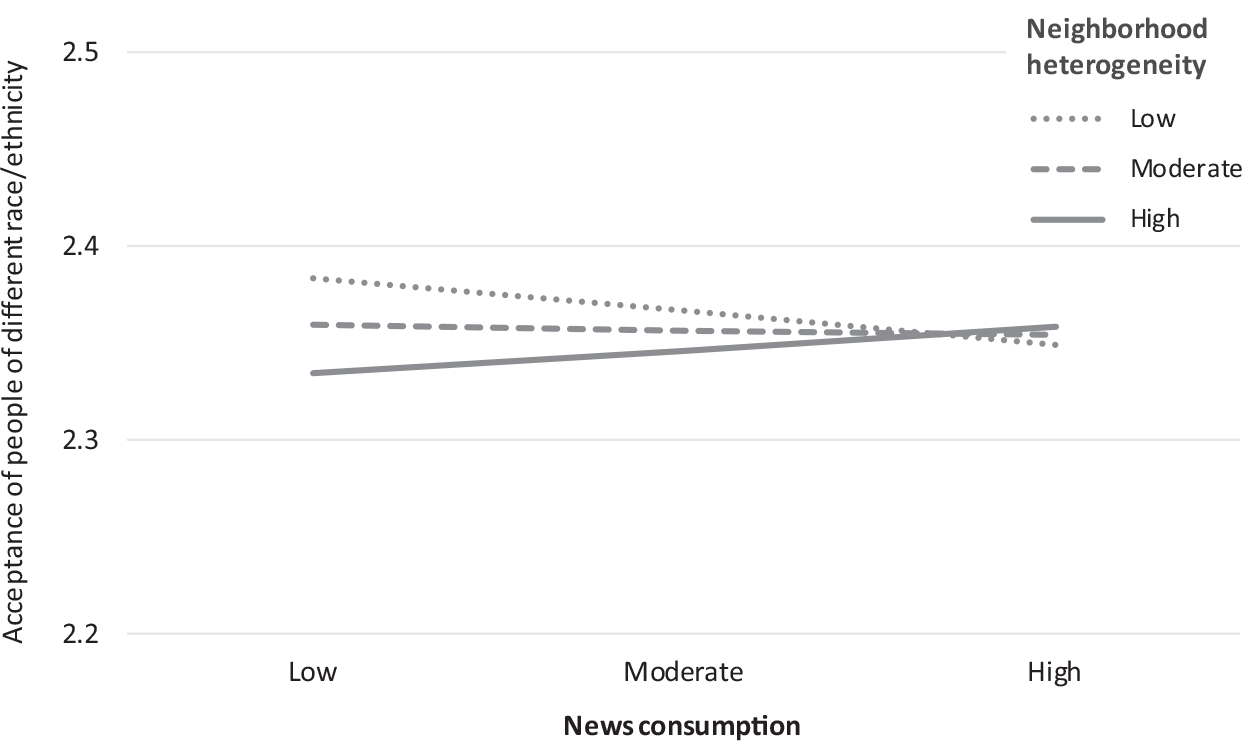
Acceptance of racially/ethnically dissimilar immigrants by levels of news consumption and neighborhood diversity.
Finally, experience with discrimination based on ethnicity and nationality was linked negatively to support for broader immigration policy, but discrimination based on religion generally bolstered support for inclusive policies.
Conclusion
Motivated by the need to better understand public sentiment about one of Europe’s most pressing political concerns, this study analyzed data from the 2014-2015 ESS to identify and clarify the influences on citizens’ acceptance of immigrants and support for immigration policy. Additionally, building on Bail’s (2008) work on symbolic boundaries, we examine the impact of these boundaries on Europeans’ willingness to admit certain groups into their country, the attributes they consider important in letting immigrants into their country (i.e., the symbolic boundaries they draw around immigrants), and how such attitudes are shaped by contact with racially/ethnically different others and experience with discrimination.
Our findings must be interpreted in light of study-specific considerations. First, although this study examined immigrants in Europe, one must be mindful that treating a European nation, or a particular region within a European nation, as the unit of analysis will afford further insight into similarities and differences. 4 Second, future studies should incorporate more nuanced measures related to immigration policies. Our current single item focused on refugees when in fact immigration is a very complex issue involving multiple groups at various levels, not just those seeking asylum. Similarly, asylum policies and support for national or supranational (i.e., European Union) legislation may differ substantially. Third, immigration is a politically and socially charged concept and label. Methodologically oriented studies should attempt to better understand how people view “immigrants” and whether the term elicits reactions different from related concepts such as “refugees” or “migrants.” Social desirability bias is often inherent in responses related to sensitive items such as ethnicity, race, and religion, which were ranked lowest among the symbolic boundaries respondents drew. While control measures (e.g., Marlowe–Crowne scale) exist in survey research, it is nearly impossible to ensure their inclusion in secondary data analyses. Only with additional original research that focuses on primary data collection via content analysis and/or experimental designs can we better understand boundary work, the social construction of identity in the news media, the potential underlying causes of intergroup conflict, and attitudes toward immigrants and immigration policy.
Several findings are worth highlighting. First, Europeans use symbolic boundaries to construct notions of “us” versus “them” and define what constitutes an immigrant. Largely confirming extant research (Bail, 2008), it is possible that the high value placed on an immigrant’s language skills or his or her willingness for cultural assimilation might serve as proxy attitudes for more deep-seated, sensitive aspects such as race or religion, which are more likely to evoke socially desirable answers. Previous research has, in fact, pointed to this meshing of boundaries, for example, that “linguistic and cultural symbolic boundaries are used publicly to mask private racism or Islamophobia” (Bail, 2008, p. 56). While this explanation seems plausible, our data demonstrate the contrary for all immigrant groups under consideration, including Muslims. Specifically, those who attach less importance to an immigrant’s language skills and cultural commitment to the nation’s way of life were consistently more likely to hold more favorable attitudes toward immigrants and showed stronger support for refugee policy. Furthermore, symbolic boundaries generally explained a good amount of variance in immigration attitudes—for all but one immigrant group even more than did sociodemographic factors.
This study also sheds light on how symbolic boundaries shape attitudes toward immigrant groups and immigration policy. Drawing and adhering to symbolic boundaries consistently decreases acceptance of immigrant groups that are constructed along sociodemographic fault lines such as race, ethnicity, religion, or geographical region. However, educational attainment appears to be an equalizer. Those who place importance on immigrants’ education are more likely to accept immigrant groups of the same or different race/ethnicity, and Muslims, but are less supportive of immigration policy. Instead, placing importance on a Christian background increases support for immigration policy. One plausible explanation for this is that Europeans are more supportive of immigration policy that is aimed at Christian refugees and thus aligns with the symbolic boundary they draw as well as the Christian majority in Europe.
Besides symbolic boundaries, greater acceptance of immigrants from most groups was fueled by frequent, positive, and close contact with racially or ethnically different others. Interestingly, a positive interaction exists between frequency and valence of contact for people of a different race or ethnicity: Valence of contact moderated the relationship between contact frequency and attitudes in that the effect was stronger among those with frequent and positive interactions. Indeed, this finding resonates with research that shows that quantity and quality of contact increases attitudes toward out-group members (e.g., Voci & Hewstone, 2003).
Contrary to expectations based on cultural affinity and empathy, experience with discrimination generally did not lead to more inclusive attitudes. This ostensible opposition to specific groups entering the country may reflect a measure of paternalism; that is, those who have experienced discrimination may wish to protect others from experiencing similar acts of discrimination by refusing them entry into their country. Unfortunately, the measures available for analysis preclude empirically confirming this reasoning. Also noteworthy is how differing levels of item specificity (i.e., being a member of a group with discrimination experience versus experiencing discrimination based on specific grounds) can shape support for immigrants and immigration policy. The former, broader item can include identification with groups not considered in the analyses and tied to economic class, gender, or sexual orientation. Identification with these groups may drive support for more generous immigration policy. One form of discrimination, however, was in line with our expectations regarding cultural empathy: If discrimination is based on language, then attitudes toward immigrant groups also tend to be generally more inclusive. Overall, these tentative findings deserve more examination, ideally with larger subgroups, as less than half of the relationships between specific discrimination experiences and particular immigrant groups were statistically significant. The results for support for immigration policy were more mixed: Those who had experienced discrimination in general and based on religion tended to be more supportive of immigration policy. While these discrepancies may be interpreted as attitudinally dissonant, they also resonate with research reflecting differences in attitudes toward abstract policies versus attitudes toward specific immigrants. As Iyengar et al. (2013) illustrate, citizens can express opposition to broadening immigration policies, all while supporting the admission of individual immigrants.
Also of note are findings related to two other variables in our analyses: consumption of news and social trust. When it made an impact, news consumption was associated with symbolic-boundary drawing. The impact of news consumption on immigration-related attitudes, however, was more mixed. If media effects stem from media coverage, it is possible that news coverage of immigrants or the migrant crisis emphasized challenges raised by immigrants’ language skills, work skills, and/or educational qualifications, thereby leading to the creation of symbolic boundaries. This issue can only be addressed with additional information about the specific media respondents used and a content analysis of those media, for instance, how policy or specific immigrant groups were portrayed.
Related to social trust, a strong and consistent trend emerged in that trust was negatively associated with all symbolic boundaries drawn. One plausible interpretation is that greater trust in others leads to greater inclusivity in how citizens define immigrants. However, because the ESS data sets are cross-sectional, one cannot rule out reverse causality or the possibility that trust in others derives from the symbolic boundaries individuals have already drawn.
With regard to theory-building, our empirical findings strongly support the ubiquity of symbolic boundaries. While intergroup contact helps shape favorable attitudes toward immigrant groups, discrimination experience does just the opposite. Exploring the underlying mechanisms of these relationships therefore appears to be a fruitful area for future research and calls for additional methods to probe these mechanisms.
Implications for Best Practices in Immigrant Communications
Our findings inform some useful practices that can improve communications between immigrants and nonimmigrants, thereby helping both populations overcome obstacles resulting from the sudden demographic changes witnessed in recent years.
First, a general trend involved education as a positive predictor, and news exposure as a negative predictor, of acceptance of all immigrants, except Muslims. Exposure to news about immigrants has become an essential means by which nonimmigrants learn about aspects such as the roots, the extent and the demographics of global migration flows. Hence, media literacy plays a crucial role in moderating these mediated experiences about immigrants. This means school curricula and continued education for adults should emphasize the importance of developing strong media literacy skills; these skills will help counter false stereotypes of immigrants based on prejudice and misinformation, especially in the current media environment besieged by falsehoods and antirefugee “fake news.”
Second, our findings underline the importance of intergroup contact—specifically, more frequent, more positive, and closer contact between immigrants and nonimmigrants. These findings point to the potential of political and media messages emphasizing religious and cultural pluralism, and tolerance. Such messages can shape and amplify feelings among immigrants, particularly refugees, that they are welcome. Likewise, political elites’ communication about immigration policies should strive for a healthy balance between immigrants’ rights and responsibilities (Guibernau, 2010). The discourse should focus not only on what these individuals have a right to but also how they can contribute meaningfully to their host society.
Discourse, however, is only part of the solution. Because interpersonal contact can outweigh mediated experiences with regard to higher acceptance of immigrants, conditions need to be created under which positive intergroup contact can be facilitated. It is important for community leaders and policy makers at various levels to create opportunities that encourage intergroup contact and inclusionary, proimmigrant activities (Okamoto & Ebert, 2016). Also, those at the community level who are willing and have access to sufficient resources can create spaces for fostering intercultural exchanges, including immigrant newcomers in the larger community, and ultimately diminishing group boundaries. Likewise, those at higher levels of political power and decision making can provide resources to those communities with insufficient resources; such a move will deter the emergence of parallel societies where nonimmigrants only know about newcomers via online or mass media.
To conclude, the formation of immigration attitudes is a complex process that involves many individual- and societal-level considerations. As the migrant situation continues to grow in magnitude and geographical scope, scholars need to examine different contexts and communities and employ different methodologies to answer their research questions. While this study focuses on European public opinion, larger questions remain to be addressed. The questions revolve around how individuals define community and how these interpretations can translate into identity-shaping and community-building processes in increasingly heterogeneous environments.
Footnotes
Declaration of Conflicting Interests
The author(s) declared no potential conflicts of interest with respect to the research, authorship, and/or publication of this article.
Funding
The author(s) received no financial support for the research, authorship, and/or publication of this article.