




Abstract
This article aims at giving a portrait of Italian philanthropic organizations, highlighting strengths, weaknesses, and challenges that philanthropy is facing in Italy compared with Germany and the United States. The article underlines the extreme variety of the philanthropic sector and suggests that Italian foundations still do not exist as a homogeneous group. Rather, as subgroups, some of them have a sort of strong institutional identity (i.e., foundations of banking origin), while others seem to behave very independently and are less open not only to public oversight but also to communication and peer collaboration (i.e., family foundations, private independent foundations). Moreover, the article suggests that the Italian foundation landscape is experiencing a transition toward new institutional regimes, which will be speeded by the capacity of gaining legitimacy and acting as a more unitary group. Opportunities for growth and access to new resources will be possible only if Italian foundations will proactively contribute to the reconfiguration of welfare systems.
Introduction
If we look at foundations as a group or a sector, Italian foundations are relatively young and have seen an unprecedented boom in the past two decades. In 2011, 1 6,220 nonprofit organizations were registered as “foundations” in Italy, more than double compared with the 3,008 active foundations registered in 1999 (Italian National Institute of Statistics [ISTAT], 2009). 2 This trend confirms an increase previously registered in 2005, when 54.6% of the registered foundations were set up between 1996 and 2005, compared with 20% between 1986 and 1995 and only 25.4% before 1985 (ISTAT, 2009). Not only have foundations increased in absolute numbers but they also are the third sector institutions that increased the most, compared with other nonprofit organizations, in terms of volunteer engagement, employees, and temporary or external workers (ISTAT, 2013, 2014).
This article aims at giving a portrait of Italian philanthropic foundations, highlighting strengths, weaknesses, and challenges that these types of organizations are facing. The article relies on existing data in the attempt to sort out what are the peculiarities of philanthropic foundations in Italy comparing them to German and American ones. As a matter of fact, while many similarities might be found (especially with the German case), Italy presents at least two distinctive peculiarities.
First, heterogeneity and fragmentation might stem as overarching labels for the Italian foundations landscape. Italy sees the presence of independent (private or family) foundations, corporate foundations, community foundations, and public-law or government-created foundations, as will be described in a later section. Italy is also the only country in Europe that sees the presence of the so-called foundations of banking origin (often called “banking foundations”), a very peculiar type of foundations that derive their origin from law, making them unique compared with any other type of foundation (Barbetta, 1999, Leardini, Rossi, & Moggi, 2014b). In fact, foundations of banking origin were formalized in 1990 after a long process of legislative reform of the Italian bank system that led to the privatization of saving banks and the separation between the credit function and the philanthropic function. Despite their small number (88 foundations scattered throughout the country), they are, as a group, far bigger than any other counterparts in the foundation sector, with endowments that collectively amount to 41.2 billion euros in 2014 (ACRI, 2015).
Second, the country is witnessing a peculiar momentum for innovation in the philanthropic scene. After 2 years of extensive legislative debate, the Reform of the Law of Third Sector, approved in July 2016 and now seeing concrete developments through the approval of implementing decrees, gives unprecedented space and prominence to the need to classify third sector organizations in Italy, including foundations, and clarify some crucial aspects such as fiscal regulation. Nonetheless, major focus of implementing decrees at the moment has been on social enterprises and voluntary organizations.
The article is structured as follows. The next section will expand on the regulatory framework of philanthropy in Italy and the boundaries of the concept definition. This institutional perimeter will be enriched with recent data on foundations, which enables a full depiction of the Italian philanthropic landscape. Finally, in the third section we discuss the general portrait of philanthropic foundations in Italy: we highlight which comparative advantages or strengths and which disadvantages or weaknesses are associated with foundations in Italy.
Italian Foundations: A Summary Portrait
If the history of Italian foundations turns back to ecclesiastic origins (piae causae) and a controversial relationship with the State, it is on the grounds of the Italian Constitution (1948) and the Civil Code that the discipline of foundations assumes a specific relevance. According to the Civil Code, a foundation is a stable, private, nonprofit organization with an endowment bound to pursuit the organization’s objectives (Guzzi, 2014). This legal definition is rather “minimalist”: it does not help in understanding the concept of philanthropic foundations as different from many other foundations and nonprofit organizations, which hold private funds bound to their mission. This is the case of foundations of political parties, for example, which do not relate their activity to any charitable, social, or cultural mission but to the support of certain political positions. The absence of a unique registry of foundations (but rather a group of regional registries) is not helping neither in accessing data nor in the comprehension of the diversity of the sector.
In this situation, one of the most common ways used by researchers to overcome this impasse is to adopt a working definition of foundation, adopting some criteria to get to conceptual boundaries, such as the so-called structural-operational definition (Anheier, 2014; Salamon & Anheier, 1992). According to this definition, foundations are (a) private, (b) asset-based, (c) self-governing, (d) nonprofit distributing, and (e) serving a public or charitable purpose (Anheier, 2014). To allow a discussion on foundations in an international comparative perspective, this article adopts this working definition of foundation.
In these regards, we cannot leave the relationship between the third and the public sector out of consideration. Several scholars have attempted to set up frameworks to explain the positioning of the nonprofit sector in different welfare regimes. According to the varieties of capitalism classification (Hall & Soskice, 2001), Italy is in an ambiguous position between two ends of the spectrum: the liberal market economies (such as the United States) and coordinated market economies (such as France or Germany). It is also considered a conservative welfare state (Anheier, 2014; Esping-Andersen, 1990) with a lively third sector, which has seen a considerable increase in the past 15 years not only in the number of nonprofit organizations but also of people committed to working in this sector as volunteers or workers of different types (Table 1).
The Third Sector Growth in Italy: 2001 to 2011.
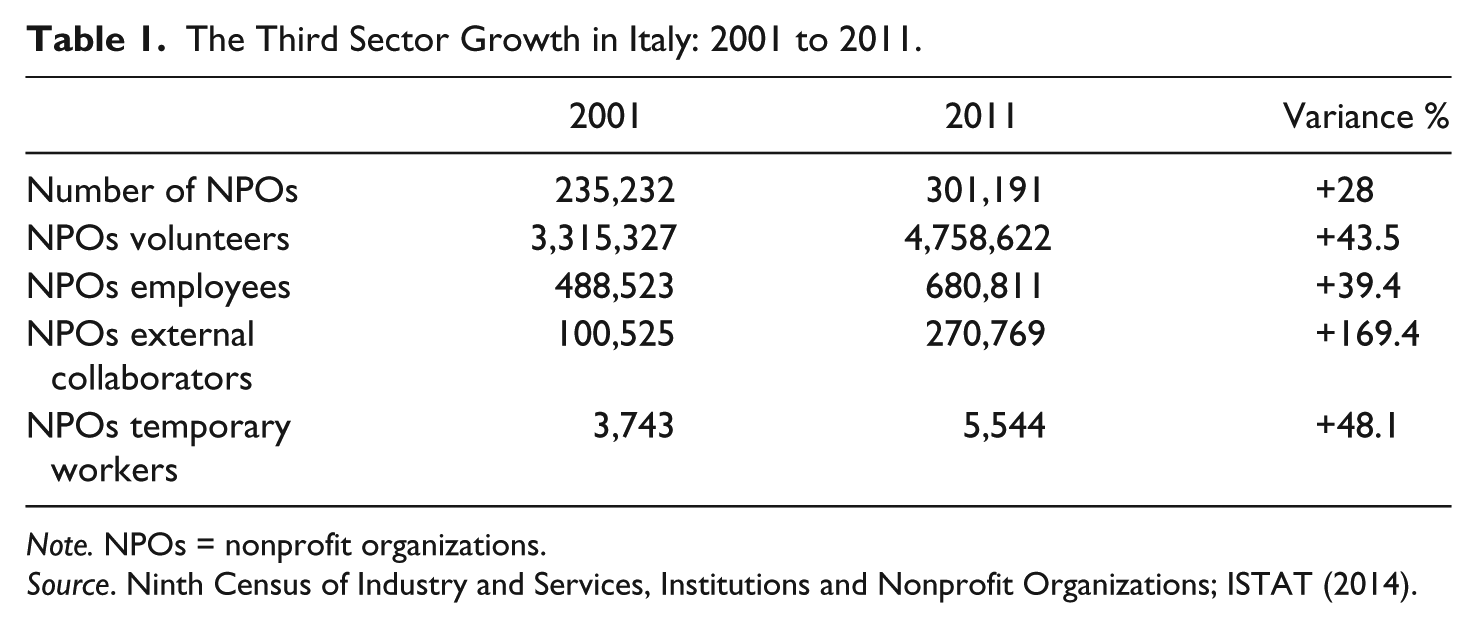
Note. NPOs = nonprofit organizations.
Source. Ninth Census of Industry and Services, Institutions and Nonprofit Organizations; ISTAT (2014).
Among different type of third sector organizations foundations, there are only 2% of the entire nonprofit organizations universe in Italy. Of the 6,220 foundations registered in Italy in 2011, 5,095 are private foundations (private asset and private governance), representing 81.9% of the total, compared with 78% of 2005 (ISTAT, 2009). Moreover, foundations are mainly operating (49.5%), followed by grant-making (20%) and mixed (30%), according to 2005 data from the National Census (ISTAT, 2009). The fact that operating foundations represent the majority reflects a typically European model, rather unlike the Anglophone emphasis on the grant-making role of foundations.
The North of the country represents the territory with the highest presence of foundations, although they have increased throughout the country (Table 2). The Lombardy Region—in the Northwest of the country—plays the lion’s part in foundations’ growth, with an increase of 154.7% from 2001 to 2011, representing the 3.8% of the total number of nonprofit institutions, compared with the 2.1% at the national level (ISTAT, 2013).
Foundations’ Growth by Geographical Area.
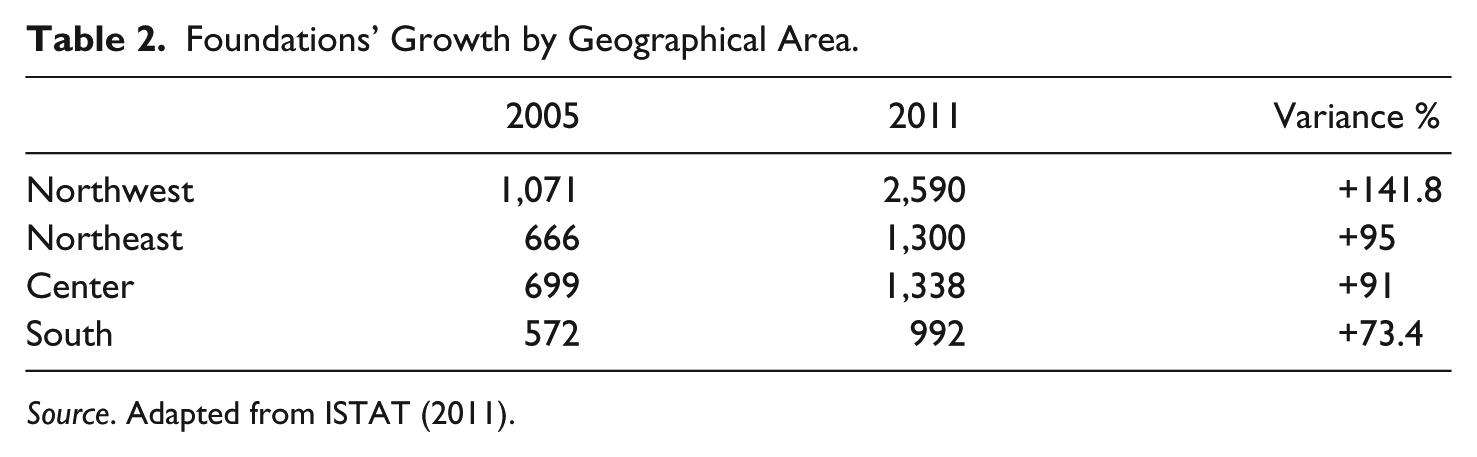
Source. Adapted from ISTAT (2011).
The most recent data on foundations’ endowments are referred to 2005, when foundations’ collective endowments were more than 85 billion euros (Barbetta, 2013), of which more than 45 billion euros were from foundations of banking origin (Smith, 2015). Moreover, the portrait of 12 years ago was of an ensemble of foundations relatively small: of the 4,720 foundations registered in 2005, Table 3 reports the amount of endowments subdivided by geographical area (ISTAT, 2009).
Geographical Distribution (%) and Foundations’ Endowments (in Thousands Euros).

Source. Adapted from ISTAT (2009).
In terms of income and expenditures, the collective income of foundations in 2011 was slightly more than 11 billion euros, with a total amount of expenditures of almost 10 billion euros (Fondazione Golinelli, 2015), representing 17.3% of the total third sector expenditures. 3 Education and research is the first field of activity for Italian foundations (27.4%), followed by culture, sports, and recreation (24.5%; ISTAT, 2014).
From these data, it seems evident that Italian foundations are far from being homogeneous, neither in size nor in organizational form. One might complement this portrait by referring to foundations’ primary source of assets in order to foster the heterogeneity argument. Italian foundations differ in mission and size if they receive their assets from corporations (corporate foundations); from individuals, families, or trusts (independent/private/family foundations); from the community (community foundations); from government-related entities (public-law foundations); or from saving banks (foundations of banking origin).
This latter type of foundation has to be profiled as it represents a hybrid type of organization that is peculiar of the Italian landscape. Actually, foundations of banking origin are the result of a long process of reform of the Italian bank system that began with the so-called Amato Laws (Law 218/90 and Decree 356/90; Gazzetta Ufficiale, 1990a, 1990b). The reform separated the credit function, left to new, “spin-off” banks, from saving banks’ philanthropic function, left to new, separate entities—foundations of banking origin—created with the sole purpose of pursuing philanthropic activity in a very specific territory. The separation between these two entities was stated as almost complete: foundations should have separate functions, activities, and governance structures, while they should be only the owner of the shares in “spin-off” banks pursuing the banking commercial activity. Other laws have followed in the 1990s, which have partially changed the rules of ownership between banks and foundations. Today, foundations of banking origin are 88, of which the majority (53) controlling less than 50% of banks’ shares, 22 with no shares at all, and only 13 with a control higher than 50% (Leardini, Rossi, & Moggi, 2014a). They represent a total of about €70 billion, with no foundations of other types reaching their size (Hopt et al., 2009). As mentioned before, other private foundations depend on different assets.
Family or corporate foundations benefit from the private wealth of an individual, a family, or they are set up by companies: in all these cases the foundation focus on a socially oriented mission is quite detached from the economic interests of families or firms. Community foundations (a model imported by the United States) pool assets from a wide variety of sources (i.e., public, corporate, private) for a specific communal purpose. These foundations have seen a development in the Italian context due to the virtuous circle they trigger: organizations or individuals donate their resources (money, time, skills) to the community foundation, which returns these resources for the benefit of the local community and for purposes that have been shared with the community itself. Finally, public-law or government-created foundations have been created from the privatization of public assets. An example of this group in Italy is represented by the formerly called IPAB organizations. 4 These specific types of public sector organizations have been privatized in 1990. They mainly operate in the fields of relief and primary assistance, in the health sector (hospitals), education (orphanages, crèches), and social assistance (shelters). A second example of this group are the Fondazioni Enti Lirici (opera house foundations), which benefit from considerable fiscal incentives and are heavily controlled (governance) and supported (resources) by the public sector.
Italian Foundations: Reflections Over a Sketched Portrait
Italian foundations operating nowadays in the country have emerged from different and disconnected pathways. What seems now a roughly homogeneous forest of foundations hides different roots and different stages of growth. Actually, any attempt to portray an overall picture of Italian foundations fails immediately due to the lack of evidence. This lack of data has a double effect on philanthropy. First, it means no (or very limited) accessible knowledge, which severely undermines the research potential in the field of philanthropy. On a more important stance, this lack of data leads to a lack of transparency and public oversight, undermining accountability, the Achilles’ heel of Italian private foundations.
Furthermore, similarly to what occurs in other European countries, the Italian Civil Code defines foundations as private nonprofit organizations with an endowment bound to pursuit its mission. Because of this rather minimalist definition, several nonprofit organizations are registered under this label, with missions and activities extremely varied and not necessarily related to what is commonly intended with the term (e.g., private child care centers and political think-tanks are registered as foundations).
Foundations in Italy are also registered on a regional, not a national, basis. The country is scattered with regional registries of foundations that are not unified nor standardized, neither in the way information is collected nor in the way to access information.
Finally, foundations in Italy have very loose accountability requirements. They must produce a financial report at the end of every year, although this is not required to be made publicly available. Any other form of reporting (social reporting duties or impact evaluation reports) is only voluntary. In fact, reporting is still an almost totally voluntary effort. In these regards, according to a research dated 2014 on 196 foundations (including the whole group of foundations of banking origin), 15% of these did not publish any document on their websites and 70% of these foundations are family or private foundations. Of the 196 foundations mapped, 113 published an annual report and/or a social reporting document on their websites, while 42% did not provide any social reporting document downloadable from their website (Ricciuti & Calò, 2016).
The lack of accountability and transparency foundations are used to is not a peculiarity of these type of philanthropic organizations and it represents one of the gray traits of Italian third sector, which parallels the pervasive role of the informal sector in Italian economy and society (Gërxhani, 2004). Things may change after the Reform of the Third Sector, which officially recognizes foundations among the ensemble of third sector organizations (Decree 117/2017, Art. 4; Gazzetta Ufficiale, 2017) and for this reason they will be subjected to transparency duties. With the new reform, foundations will be also able to register to the National Registry of Third Sector Organizations: registration is voluntary, but it will represent the only way to access the favorable fiscal regulation foreseen for the whole third sector. Transparency and accountability will therefore increase.
In this roughly obscure landscape, it seems however clear that Italian foundations are facing fundamental challenges.
The traditional landscape of several rather small, mid-size operating foundations playing the role of substitutes of the state and civil society (or, more typically, families) is co-existing with a more vivid territory where grant-making foundations, with bigger than the average endowments, are experimenting innovative practices and new welfare models of interventions.
Thank to their large assets some foundations (primarily of banking origin) are exploiting their risk-taking capacity to invest in social innovation experimentations. The total amount disbursed by these foundations to fund social innovation initiatives in Italy in 2016 reached some €21.4 million, which represents 22% of the total social innovation funding (Maiolini, 2017). This effort is much concentrated in two regions, Lombardy and Piedmont, due to the presence of the major foundations of banking origin in the country. As an example, Fondazione Cariplo, in the past 3 years, has invested 130 million each year for welfare initiatives in the region, through innovative modalities of intervention, which are working as pilot projects. These new modalities imply a strong collaborative governance between the subjects involved, embedded in the requirement for a participatory approach in the coplanning of the solutions proposed and the projects’ implementation. In this way, foundations may explicit their role not only in helping to reconfigure local welfare systems but also in strengthening democracy and fostering social cohesion in communities, as a precondition for social justice (Guzzetti, 2017). Social innovation may also lead to a higher attention to innovative financial mechanisms, though this is not a compulsory requirement to produce innovation. Italian foundations are demonstrating to be changing their ways of intervening in the local and national community.
Distributing grants represents only one of the many mechanisms at hand: social finance mechanisms are emerging as a more effective tool. The first experimentation with social impact bonds is currently undergoing in a foundation of banking origin in the Northwest of Italy (Salamon, 2014). Moreo, grant-making foundations are using their know-how to become strategic investors in their communities. In particular, these foundations are performing as social entrepreneurs investing in their communities, rather than only funders. They have even started providing services, and training and tutoring to their grantees driving them toward effective results.
These are examples of how the case of Italian foundations might stand as case of a country in transition for what regards philanthropy. On one side traditional operative, small or midsize foundations still serve as niche providers or residual service providers in a CM-like country where the State (together with families, civil society, and the informal sector) cover the general welfare of society. On the other side, a small set of innovative, grant-making (or mixed) foundations (mainly of banking origin) play the role of professional philanthropists, social entrepreneurs, and even institution builders, seeking social and political legitimacy.
Despite regional differences, which are still persistent in Italy, the change in approach introduced by these foundations might translate the overall system from a traditional social democratic model (according to which foundations either complement or supplement state activities) to a more liberal model (according to which foundations form a largely parallel system, frequently seeing themselves as alternatives to the mainstream; Anheier, this issue).
This shift will definitively depend on the degree of legitimacy foundations in general will accrue in the country (Toepler, Prewit, Mattei, & Heydemann, 2006).
For sure, Italian foundations are increasing their legitimacy and advocacy strength overcoming their traditional isolation and fragmentation. Philanthropic organizations still do not identify themselves as a united league or as an identity group, but some scattered evidence of the search for more autonomy and legitimacy can be surely evidenced. Corporate foundations, for example, are struggling each year to justify and advocate their request for funds with the parent company in order to ensure the continuity of the strategies announced for the near future. Private/family foundations seem torn between accepting a higher degree of disclosure and being unwilling to expose themselves to public oversight. Community foundations, which are a well-established model in other countries, seek legitimacy to grow and strengthen in Italian local communities too. Foundations of banking origin, coordinated by a national “umbrella” organization (ACRI), advocate to communities and policy-makers that they can play a major role in social innovation.
Italian foundations are therefore increasing their power of advocacy, influencing the political agenda in their communities and triggering the tendency of local governments to create multistakeholder decision-making processes (Fondazione Golinelli, 2015).
The concrete and definitive shift to a liberal model is, however, constrained by different factors. It is worth recognizing that philanthropy is still a sector where a specific professional education is lacking in Italy. Foundations staff is frequently not trained for the job of program officer and education programs specifically addressing this professional category are lacking. This is even more relevant especially considering the strategic management approach, which is now unavoidable in foundations to face the new challenges of fast-changing societies. In this respect, strategic management approaches can help foundations and their communities to focus the attention on impact and outcome measurement. Limited impact evaluation analyses have been run so far in Italian foundations (Ricciuti & Calò, 2016). Nonetheless, the value of these and other currently undergoing evaluations rest in the learning potential of these attempts, which can result in cross-fertilization across the country, in a situation where the lack of a foundations “sector” undermines collaboration and dialogue among peers.
Footnotes
Declaration of Conflicting Interests
The authors declared no potential conflicts of interest with respect to the research, authorship, and/or publication of this article.
Funding
The authors received no financial support for the research, authorship, and/or publication of this article.