



Abstract
Keywords
Introduction
To what extent are digital activities, engagements, and practices integral to social class status? Is use of digital technology as much a function of social status and context—“habitus” (Bourdieu, 1990)—as other social, economic, and cultural activity? This article seeks to explore these questions through the examination of social media use. Social media was selected as it was noted in prior work (Yates, Kirby, & Lockley, 2015a) that the narrow use of social media alone notably varied by class, as compared with using a mix of digital technologies. This result implied the possibility of differences in citizens’ digital “habitus.”
Discussions of class and digital media have predominantly focused on issues of digital inequality as measured by access and skills (Van Dijk, 2005; Van Dijk & Hacker, 2003). This touches on a range of policy issues (see Yates, Kirby, & Lockley, 2014, 2015b) and is key to many governmental digital strategies in the United Kingdom, the United States, and Europe (Mawson, 2001). The goals of such policy work remain improving access and skills. These have been called the first (access) and second (skills) levels of the digital divide. The goal of this article is to reorientate the question of digital inequalities away from access and skills toward understanding the inequalities in the uses of digital literacy (cf. Hoggart, 1957). Drawing on Helsper’s (2012) argument that digital inequalities have to be understood as being in correspondence with other “fields” of social, cultural, and economic inequality, this article seeks to explore the use of social media among those who are considered to be “digitally included.” As social media users, they have both access to technology and the skills to use it (to a greater or lesser extent). Understanding inequality in relation to digital production and participation, as opposed to just consumption (Hargittai & Walejko, 2008; Witte & Mannon, 2010), is also critical to assessing media use in our increasingly networked society (Castells, 2011). As has become apparent in recent years, digital media use is becoming intrinsic to political and civic life (Vargo & Hopp, 2017). Representations within the digital public sphere matter and lead to questions of equality, especially if elite voices dominate in the digital public sphere (Schradie, 2012).
Starting Point
The starting point for this analysis were findings from prior work on data from the OfCom (Office of Communications) Media Literacy Survey of 2012–2013, replicated here for 2014–2015 (Yates et al., 2015a). These analyses found that NRS (National Readership Survey) social class groups D and E (see Table 1) had proportionally more users focused on social media than the other class groups (see Figure 1). This result implied that social media use was the primary focus of social class D and E users within a context of lower overall Internet use. This implies that individual forms of Internet use cannot be understood in isolation from one another—much like other forms of cultural consumption. This leads to questions of how and to what extent social media use and inequality intersect within corresponding fields (Helsper, 2012) and with social class.
NRS Social Grades and NS-SEC.
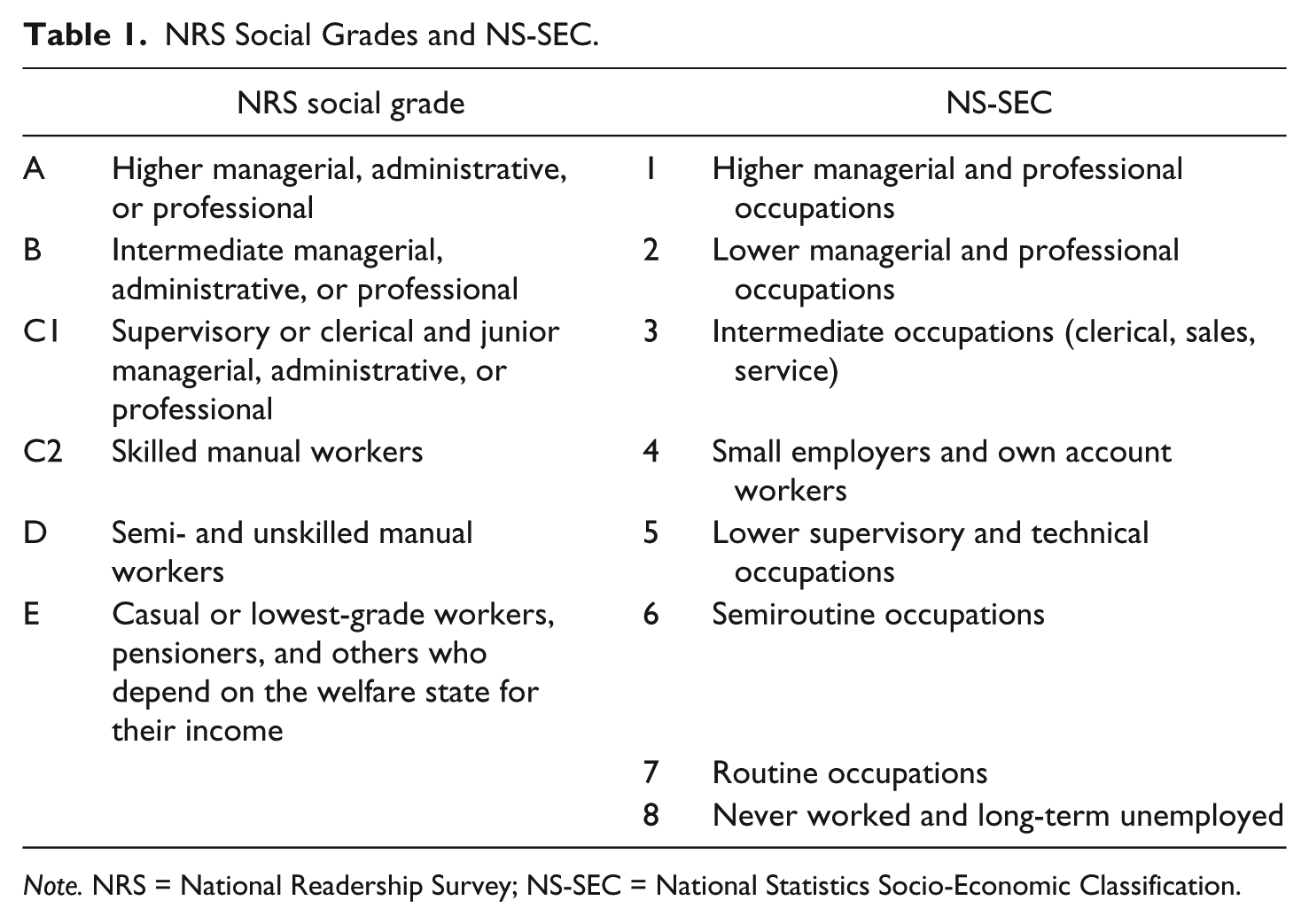
Note. NRS = National Readership Survey; NS-SEC = National Statistics Socio-Economic Classification.
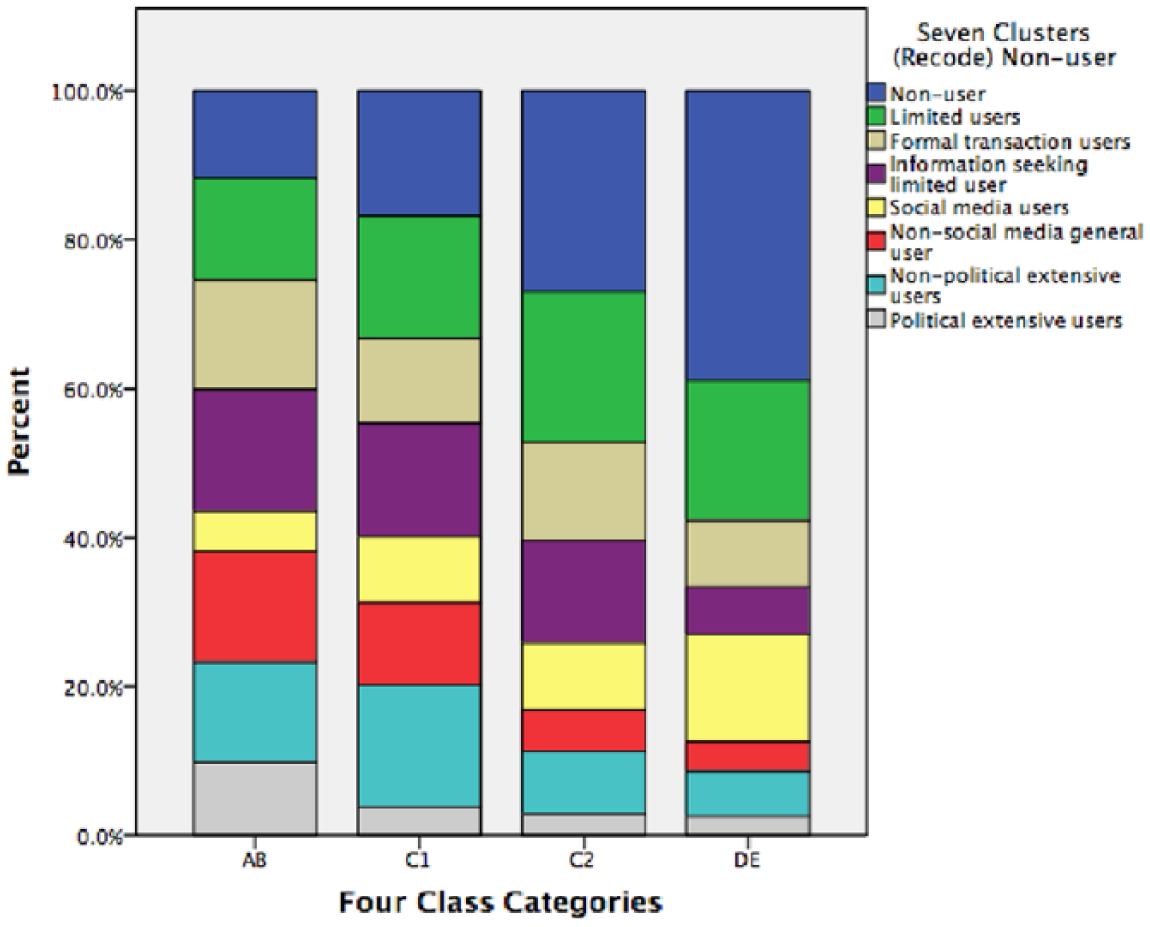
Types of Internet user and NRS social class (OfCom Media Literacy Survey 2012–2013).
Bourdieu, Social Class, and the Digital
Defining and measuring social class is a complex task. Importantly, the impact that a growing digital economy may have on contemporary social class has recently become the focus of academic debate. This includes approaches based on Bourdieu (1984, 1991, 1997), such as Bradley (2014), Rollock (2014), Savage (2015), and Savage et al. (2013, 2015). There is no space in this article to review the full details of this broad debate on class, but this work aligns with Savage and colleagues’ argument that any contemporary view of class must consider Bourdieu’s (1984, 1997) contention that social status is driven by three forms of exchangeable capital:
Economic capital: As generally understood in material terms of money, assets, and property
Social capital: “The sum of the resources, actual or virtual, that accrue to an individual or a group by virtue of possessing a durable network of more or less institutionalized relationships of mutual acquaintance and recognition” (Bourdieu & Wacquant, 1992, p. 119)
Cultural capital: Predominantly an aspect of education and socialization that allows individuals to demonstrate aspects of cultural consumption, knowledge, and practice that differentiate them from other social groups—importantly, different forms of cultural capital engender greater possibilities of exchange for other forms of capital
Recent studies on access to and uses of the Internet have made similar arguments. Grant (2007) clearly argues that economic capital alone is not a sufficient explanation of why people do or do not meaningfully engage with technology. Clayton and Macdonald (2013), drawing on Graham (2002) and Selwyn (2003), summarize this position as follows: The various forms of economic, social and cultural capital (Bourdieu, 1997) individuals bring to technology in terms of their own socio-economic positions and internalized dispositions or habitus, is key in influencing the way in which technology might (or might not) be used as well as perceptions of benefits gained. (Clayton & Macdonald, 2013, p. 948)
Social Class and Social Media
There are a limited number of empirical studies taking a fully Bourdieu-based perspective on digital media use. But there is work that has separately explored the economic, social, and cultural differences in the types and levels of digital media use. Recent reports by the Good Things Foundation 1 based on work by Yates et al. (2015a) identified more than 13 million U.K. citizens who were limited users or nonusers of the Internet, with the majority being from lower-income households. Socioeconomic position therefore influences access to what Selwyn (2003) calls the “opportunity structure” of digital technologies. This reaches beyond just access to broader digital literacy, highlighting that there are a range of experiences for those categorized as “digitally included” (Clayton & MacDonald, 2013). We therefore seek to explore this through examining the use of social media in the context of Bourdieu’s three types of capital.
Economic Capital
Quantitative data from the British Social Attitudes Survey 2015 were used by Sloan (2017) to explore the use of Twitter. Sloan compared class variations using the NS-SEC (National Statistics Socio-Economic Classification) system (see Table 1) and found a higher proportion of Twitter users in the higher NS-SEC classes, 1 and 2. Sloan also notes comparable results from prior analyses (Sloan, Morgan, Burnap, & Williams, 2015) where NS-SEC categories were algorithmically derived from Twitter profile data. Problematically, none of these data were subjected to statistical testing of interaction effects, nor were relative effect sizes recorded. Unlike in Yates et al. (2015a), there is no comparison of Twitter use as a proportion of overall digital media use. Similar arguments are made by Blank (2016) and Blank and Lutz (2017) based on OxIS (Oxford Internet Surveys). Their results highlight the lack of social representativeness in data scraped from social media platforms. They demonstrate that all social media platforms are skewed toward content produced by younger, wealthier, and better-educated citizens. The results reinforce the point that socioeconomic context is a major factor determining on which platform and to what extent citizens engage with social media.
Social Capital
Social capital can be defined in terms of the value derived from a citizen’s network of social ties (Son & Lin, 2008). The concept has two lineages, one that begins with Durkheim and is embodied in the work of Putnam (2000). In this characterization, social capital is understood as both a personal and a community commodity that is linked to civic engagement, political engagement, and the formation of the public sphere (Brehm & Rahn, 1997; Fischer 1982a, 1982b; Rainie & Wellman, 2012; Son & Lin, 2008).
Bourdieu’s (1985) model of social capital is notably different from that of Putnam (2000). For Bourdieu, social capital is focused on the opportunities for social enhancement and distinction that can be leveraged from the structure of interpersonal networks and ties—that is, the extent to which social capital can be translated into or exchanged for other forms of capital (economic or cultural). These two definitions, of “community”- and “distinction”-based social capital, clearly overlap and may not be mutually exclusive, being based on how networks and ties add to citizens’ lives (Burt, 2005; Gil de Zúñiga, Jung, & Valenzuela, 2012).
The majority of work focusing on digital media has taken the community view of social capital. For example, Phua, Jin, and Kim (2017) comparatively analyze social capital within four social networking sites: Facebook, Twitter, Instagram, and Snapchat. They apply uses and gratifications theory, along with an approach drawing on Putnam’s (2000) distinction between bridging (weak ties) and bonding (strong kinship ties). Their study of 297 social media users indicates that Twitter users had the highest bridging social capital, followed by Instagram, Facebook, and Snapchat, whereas Snapchat users had the highest bonding capital, followed by Facebook, Instagram, and Twitter. This result would indicate that different social media platforms offer, or are used to maintain, different forms of social ties.
Valenzuela, Park, and Kee (2009), again following Putnam (2000), focused on U.S. students’ civic and political engagement via Facebook. They found a positive and significant association between intensity of Facebook use and group membership, and social capital as measured in terms of personal contentment, greater trust, and participation in civic and political activities. However, they could not determine if Facebook use and group membership drove this or if civically engaged students used Facebook more extensively. Facebook use could mark an intensification in a digital medium of respondents’ existing social capital. Similarly, Ellison, Steinfield, and Lampe’s (2007) study of a small sample of undergraduate students in the United States found that use of Facebook had a strong association with maintaining existing off-line relationships.
Taking Bourdieu’s (1985) approach to social capital, Clayton and MacDonald (2013) highlighted the importance of the accumulation of relevant (digital) social and cultural capital in understanding how citizens make everyday use of technology. They examined the extent to which technology has been adopted by socially excluded neighborhoods within the U.K. city of Sunderland. In terms of social capital, their survey and interview work found far less evidence of the development of bridging ties than of the reinforcement of existing bonding ties. They note, The character of the use of social networking in our qualitative sample also demonstrates a different set of practices to those of political participation and community development. Participants do not necessarily use technology to contact new people . . . or to engage in formal democratic processes, rather its use enables the maintenance of social relationships already established on a new and engaging platform. (Clayton and MacDonald, 2013, p. 954)
None of these studies can clearly fully evidence whether social media use drives the creation of new social capital or, rather, provides an additional, digital layer to existing social capital. Yet they all highlight the possibility that different social media might function to support and potentially intensify network ties and therefore existing social capital.
Cultural Capital
Bourdieu identified three main types of cultural capital (Bourdieu, 1997; Bourdieu & Passeron, 1990):
Embodied cultural capital, in the form of knowledge acquired over time through socialization and expressed through one’s habitus
Objectified cultural capital, in the form of both owned and experienced cultural consumption that can be translated into other forms of capital and that may require appropriate embodied cultural capital to support their consumption
Institutionalized cultural capital, the formal social and institutional recognition of a person’s cultural capital
Straubhaar, Spence, Tufekci, and Lentz (2012) note that social class affects citizens’ exposure to and willingness to invest in skills and knowledge and shapes their disposition toward and familiarity with technology. Clayton and MacDonald (2013) argue from their data that the accumulation of legitimized forms of cultural capital, including knowledge, skills and customs which are invested in, inherited and embodied differentially by social groups, is crucial in determining the ability to appropriate technology for socially valued purposes. . . . Without legitimate knowledge, connections or reasons to meaningfully engage, individuals may struggle to make what is seen to be appropriate use of technology within a society in which they do not dictate what is “useful.” (p. 949)
In the discussions around technology use, the term information or digital capital is invoked (Robinson, 2009). Although the authors were initially sympathetic to this idea, as discussed later, it may conflate categories and overemphasize the digital. There are a number of empirical studies that have used Bourdieu’s (1997) categorization and the idea of information capital to explore ethnographic and contextualized cases. Robinson (2009, 2011, 2014) uses the idea of information capital to explore approaches to school and personal uses of information and communications technology by U.S. high school students. Robinson (2014) notes that their practices are “deeply rooted in the accumulation and internalization of information capital” (p. 533). Robinson points out how this mirrors issues raised in Bourdieu’s early work, especially “how school and home socialization relate to class reproduction” (p. 522). Robinson’s work highlights how even among groups with access in the context of a digital media–rich nation, key differences in information capital can accumulate. These differences lead to different educational and life experiences that have the potential to underpin long-term variations in embodied, objectified, and institutionalized cultural capital.
Similarly, North, Snyder, and Bulfin (2008) report a 3-year study focused on Australian 15- and 16-year-olds, linking cultural capital, habitus, and cultural forms to digital inequality. They use case studies to illustrate the links between taste and information and communications technology (ICT) use and conclude that technology is a performative function that is embedded in power relations and serves the cultural and economic interests of individuals or institutions. They note individual variations in practices using new technologies, but the case studies in their work show a consistency in digital tastes in those from similar social backgrounds (North et al., 2008, p. 907).
Research Question
Taking the work of Bourdieu and the findings discussed above, the following argument can be made: Measures of the three forms of capital would appear to be in correspondence with digital media use and particular forms of social media use. Given the lack of existing large-scale data sets with well-established measures covering all three forms of capital and digital media use, the analyses below utilize data sets with a range of specific and proxy measures. This is therefore an inductive examination of how these three forms of capital associate with specific types of digital media.
Methods
The analysis is based on two data sets collected by U.K. statutory bodies: OfCom and the Department of Digital, Culture, Media and Sport (DCMS). Both data sets are used to support policy and regulation, and “top-level” results and cross-tabulations are presented by the relevant agencies each year. Detailed statistical models are not generally provided by either agency.
Data Sets
The OfCom Adults Media Literacy Survey is an annual, nationally representative sample (n ≈ 1,800) of adults aged 16 years and older. The 2012–2013 and 2014–2015 surveys used here were conducted by Saville Rossiter-Base in-home, using a computer-aided personal interview methodology, between September and October 2015. 2 The OfCom data provide one of the most extensive surveys of U.K. Internet behavior across both levels and types of digital media use. The DCMS Taking Part Survey is a longitudinal study designed to yield a representative sample each year of 10,000 adults aged 16+ years who are normally resident in England. The 2016 sample (n = 10,171) is a mixed sample, evenly divided between fresh sample cases and re-interview cases. 3 Both surveys provide a set of direct and proxy measures of the three forms of capital.
Measures of Economic Capital
In the United Kingdom, there are two relevant measures of socioeconomic status predominantly defined by position within the workforce. These are the NS-SEC, used by the government, and the NRS social grade, often used in academic, policy, and media research. The outlines of both are presented in Table 1. NS-SEC is used in the U.K. census and is based on extensive academic work (see Erikson & Goldthorpe, 1992; Rose & Pevalin, 2003). NS-SEC is used in the DCMS Taking Part Survey, and NRS is used in the OfCom survey. Other measures of economic status in both data sets include household income, the index of multiple deprivation, and home ownership.
Measures of Social Capital
Social capital in Bourdieu’s terms is best measured through the analysis of the number, types, and social status of members of a citizen’s social network. Unfortunately, such measures are not available in the two data sets used here, though it is possible to identify relevant proxies. As noted in the subsection Social Capital, prior work on social capital and social media identified two key features: (1) that the level of social media use may be a proxy for an active social network off-line and (2) that different social media may be used for different types of social ties and interaction. Data from the OfCom Media Literacy Survey can provide insight on the level and type of social media use. The DCMS Taking Part Survey has data on the use of social media to support nondigital social and cultural activities—linking social and cultural capital.
Measures of Cultural Capital
Measuring cultural capital requires the identification of potential proxies for embodied, objectified, and institutional cultural capital. Measuring embodied cultural capital via a questionnaire survey is challenging, and the surveys do not contain simple direct proxies. Following Bourdieu’s (1997) own approach, the data include different forms of cultural activity as a proxy for objectified cultural capital and, to an extent, by implication, embodied cultural capital. The DCMS Taking Part Survey contains data on levels of attendance at a range of cultural activities, such as opera, music, or film. Institutionalized cultural capital may be best addressed through educational credentials or professional qualifications. This is therefore captured via level or extent of education and also in part by our two mainly socioeconomic measures, NS-SEC and NRS.
Measures of Internet and Social Media Use
Both data sets contain comparable U.K. standard measures of Internet access at home. Both contain measures of levels of general social media use, with greater fidelity in the DCMS measures. The OfCom data provide an extensive set of measures of levels and types of Internet use. These data have been used to construct eight different user types following the methods outlined in Yates et al. (2015a). The overall measures available are listed in Table 2.
Measures in the OfCom and DCMS Data Sets.
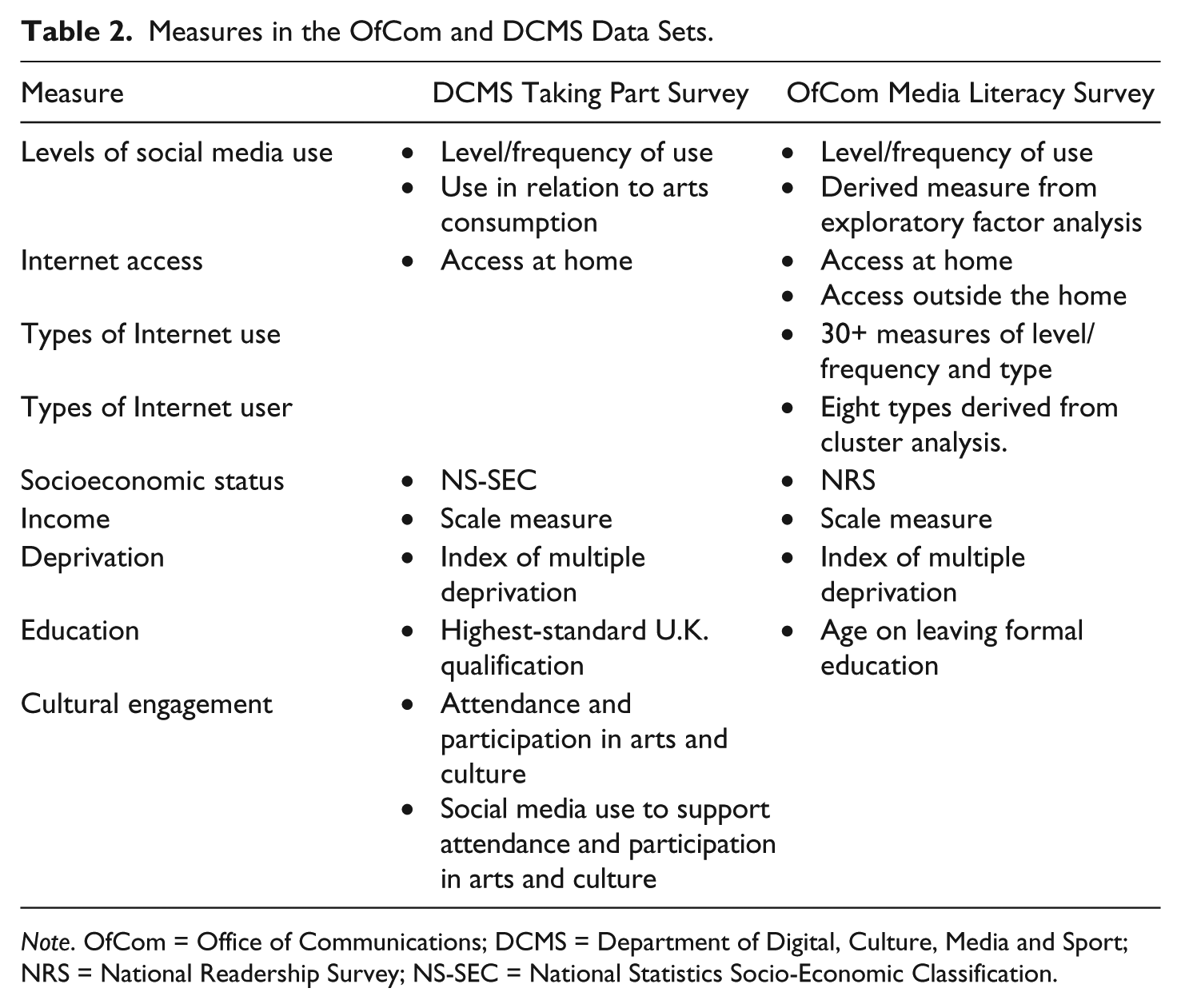
Note. OfCom = Office of Communications; DCMS = Department of Digital, Culture, Media and Sport; NRS = National Readership Survey; NS-SEC = National Statistics Socio-Economic Classification.
Analytic Approaches
The analysis of the OfCom 2014–2015 data follows that of Yates et al. (2015a) and sought to reconfirm the findings in the subsection Starting Point. This began with an exploratory factor analysis using principal components analysis across the 23 types of Internet behavior measured by both the 2012-2013 and the 2014-2015 surveys. All the items were suitable, having correlation coefficients greater than .3 in the matrix and communalities greater than .3. The Kaiser–Meyer–Olkin value was 0.919, above the recommended value of 0.6 (Kaiser, 1970, 1974), and Bartlett’s test of sphericity (Bartlett, 1954) was significant, χ2(496) = 12957.811, p < .000. The diagonals of the anti-image correlation matrix were all >.5, supporting the inclusion of each item in the factor analysis.
The principal components analysis revealed the presence of five factors with eigenvalues greater than 1.0, explaining 32.0%, 9.0%, 5.6%, 4.9%, and 4.4% of the variance, respectively, and 51.6% in total. An inspection of the scree plot did not indicate a clear break in the reduction of eigenvalues. The rotated solution indicated a relatively simple structure showing strong loadings and all of the variables loading substantially on only one component (>0.4). The five factors were meaningful and consistent in relation to known forms of digital media use. These five factors with eigenvalues >1.0 were therefore retained, and factor scores were calculated using the Anderson–Rubin method to produce measures that are orthogonal, with a mean of 0 and standard deviation of 1. Table 3 provides the pattern and structure matrix results for the analysis. This analysis identified the same five factors as those found by Yates et al. (2015a):
Pattern and Structure Matrix for Factor Analysis.
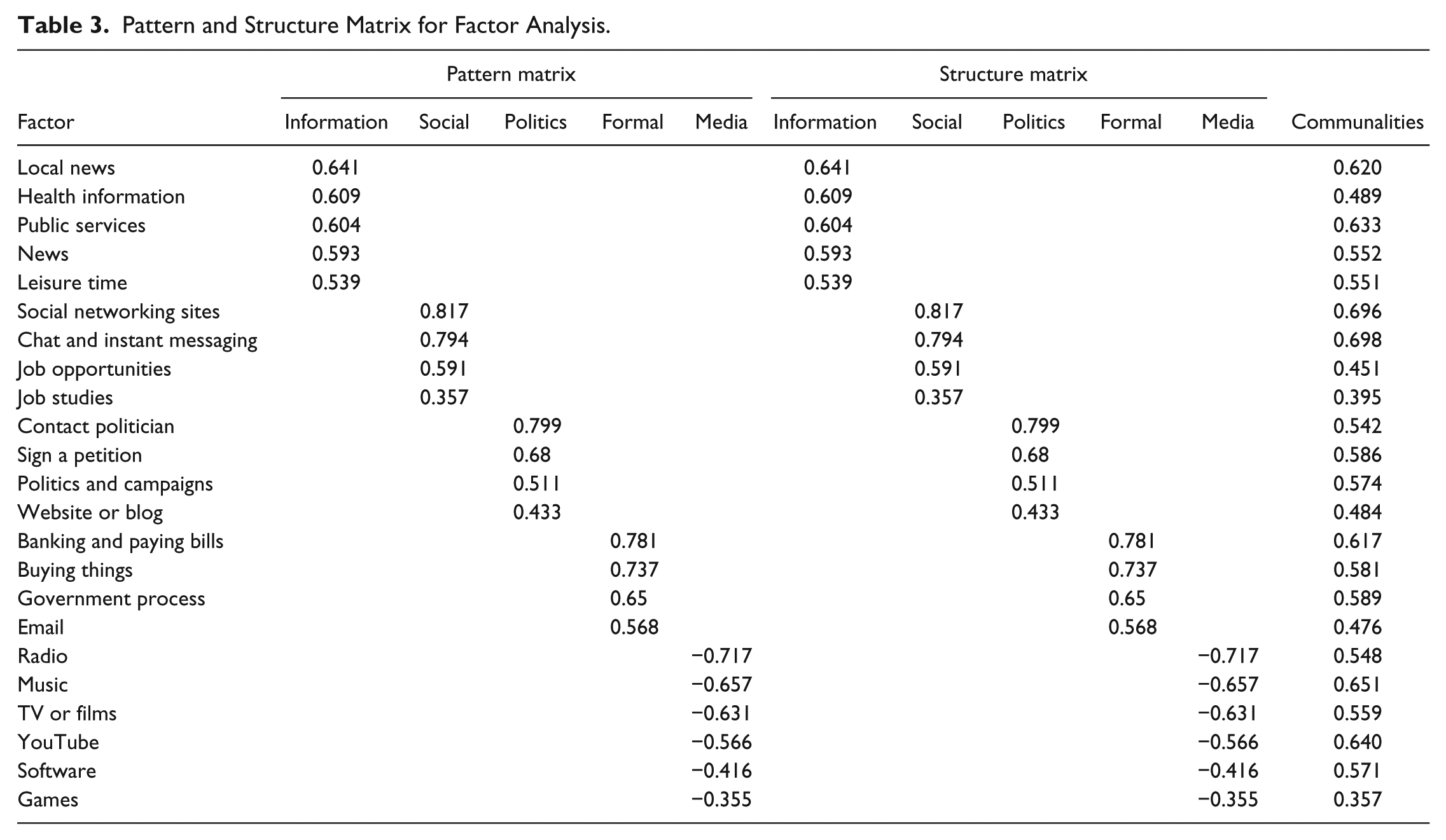
Media consumption: music, TV, YouTube, games
Information seeking: health, public services, leisure
Political action: petitions, political communication
Formal transactions: banking, government services
Social use: social media
Using the saved factor scores, respondents were hierarchically clustered using a squared Euclidean distance measure under the Wards method via SPSS. Clear breaks in the rate of change of the cluster coefficients were noted at two, four, and seven clusters. The two-cluster solution separated limited users from the rest of the sample. As in Yates et al. (2015a), seven clusters provided the most informative set of user types. The cluster analysis was rerun with the k-means cluster technique applied to the data, with a target of seven clusters and iterations repeated until the results converged. Table 4 presents the mean z scores for our five factors at the centroids of the clusters and potential descriptors for these groups (note that high media factor scores are negative in this case).
Mean z Scores for Five Factors at Cluster Centroids.
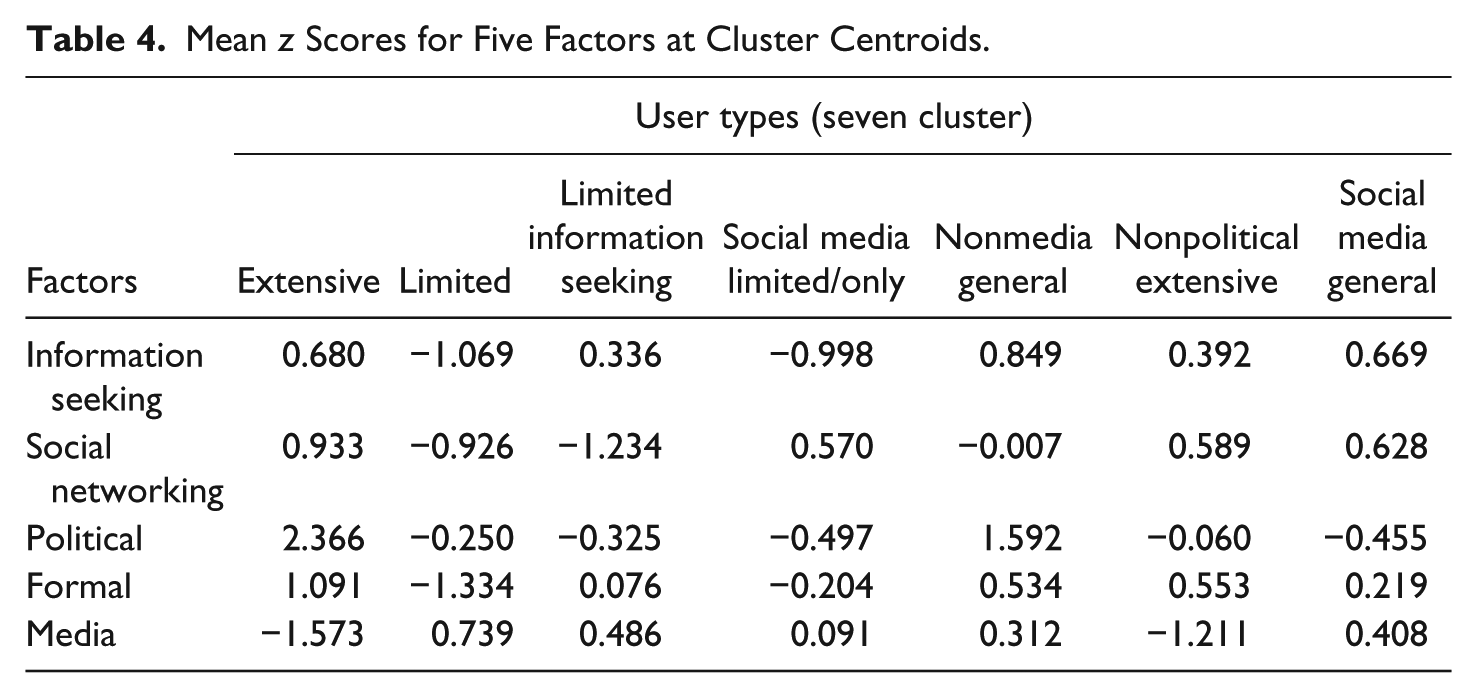
“Extensive users” have high scores on all factors, and in comparison, “nonpolitical extensive” users have high scores on all but the political factor. There are three types of limited user who score below average on the majority of factors: (1) “limited” (below average on all), (2) “limited information seeking” (all but information use), and (3) “limited social media users” (all but social media use). There are two types of general user who score above average on most factors, except media, with one group having above- and the other below-average levels of social media use.
Cultural participation data are more challenging. Attendance at the majority of cultural activities is effectively binary. Individuals either attend or participate, or they do not do so in any one year. Levels of participation in multiple types of cultural activity are limited, as is extensive repeated attendance. For example, though film attendance is one of the most common cultural activities, most respondents attend a film show less than once a year (52.4%). The next largest groups attend three or four times a year (32.7%), once a month (13.5%), and weekly (1.5%). In the case of opera, 98.9% attend less than once per year, with the remainder attending between one and four times a year. As a result, because of distributions, levels of attendance figures cannot be used in exploratory factor analyses.
This analysis therefore uses, akin to Bourdieu (1997), multiple correspondence analysis (MCA) to explore the relationship between social media use, and economic and cultural capital. MCA techniques allow for nominal categorical data to be examined in a manner akin to a principal components exploratory factor analysis. The results are graphical and can be used to inductively detect and represent the underlying structures in a data set (see Blasius & Greenacre, 2006; Greenacre and Pardo, 2006; Le Roux & Rouanet, 2004). SPSS was used for the analysis of variance (ANOVA) and the chi-square and factor analyses. For the MCA, the “mjca” function within the “ca” package of R was used in RStudio.
Summary of the Findings
Economic Capital
Undertaking a one-way ANOVA on the DCMS Taking Part social media variable, using the nine levels of the NS-SEC scale, reveals that class is a statistically significant independent variable: F(8, 78,728.7), p < .000. Average levels of social media use drop from more than twice a week to less than once a week between the top and the bottom of the NS-SEC scales (see Figure 2). Though the overall effect size was small (η2 = 0.015), a Tukey HSD (honestly significant difference) comparison found all levels of the NS-SEC variable to be statistically significantly different at p < .01. A far stronger effect was found for the independent variable of age: F(2, 10,089,536.4), p < .000, with a very large effect size (η2 = 0.314). This would indicate that socioeconomic class plays a part in levels of social media use but is not a sufficiently explanatory variable.
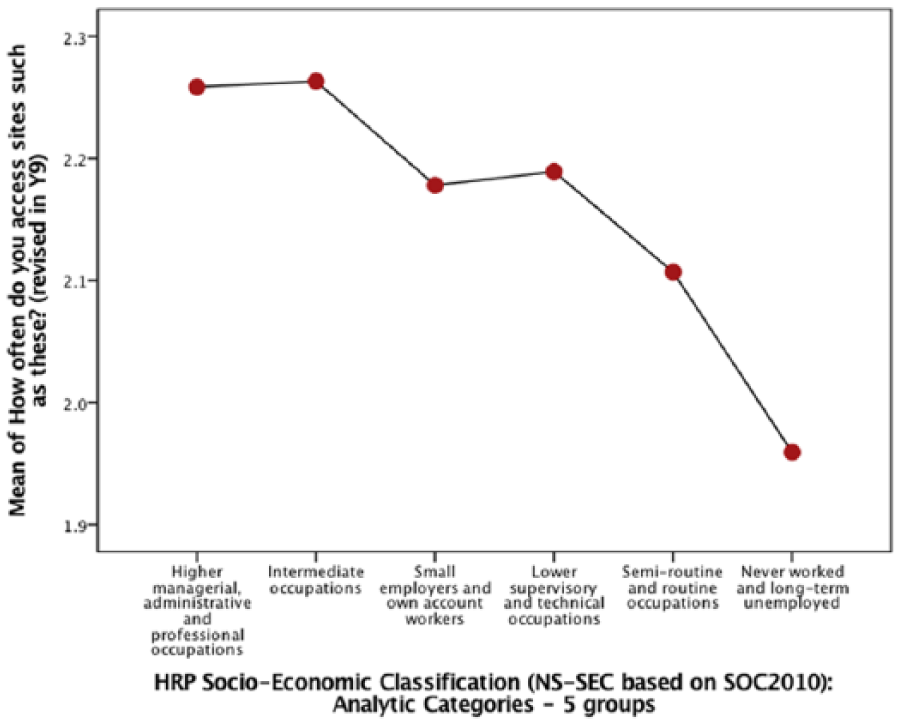
Mean of frequency of social media use by social class (NS-SEC).
But the key question has to be how social media use fits within the broader use of digital media—citizens’ digital habitus. In identifying seven Internet user types and an eighth category of nonusers from the OfCom data, it can be argued that there are eight broad forms of digital habitus, from the extensive user to the nonuser—in the same sense that one might have a proxy measure for different forms of cultural consumption, for example, people or groups with greater levels of “high” or “popular” arts consumption (Figure 3).
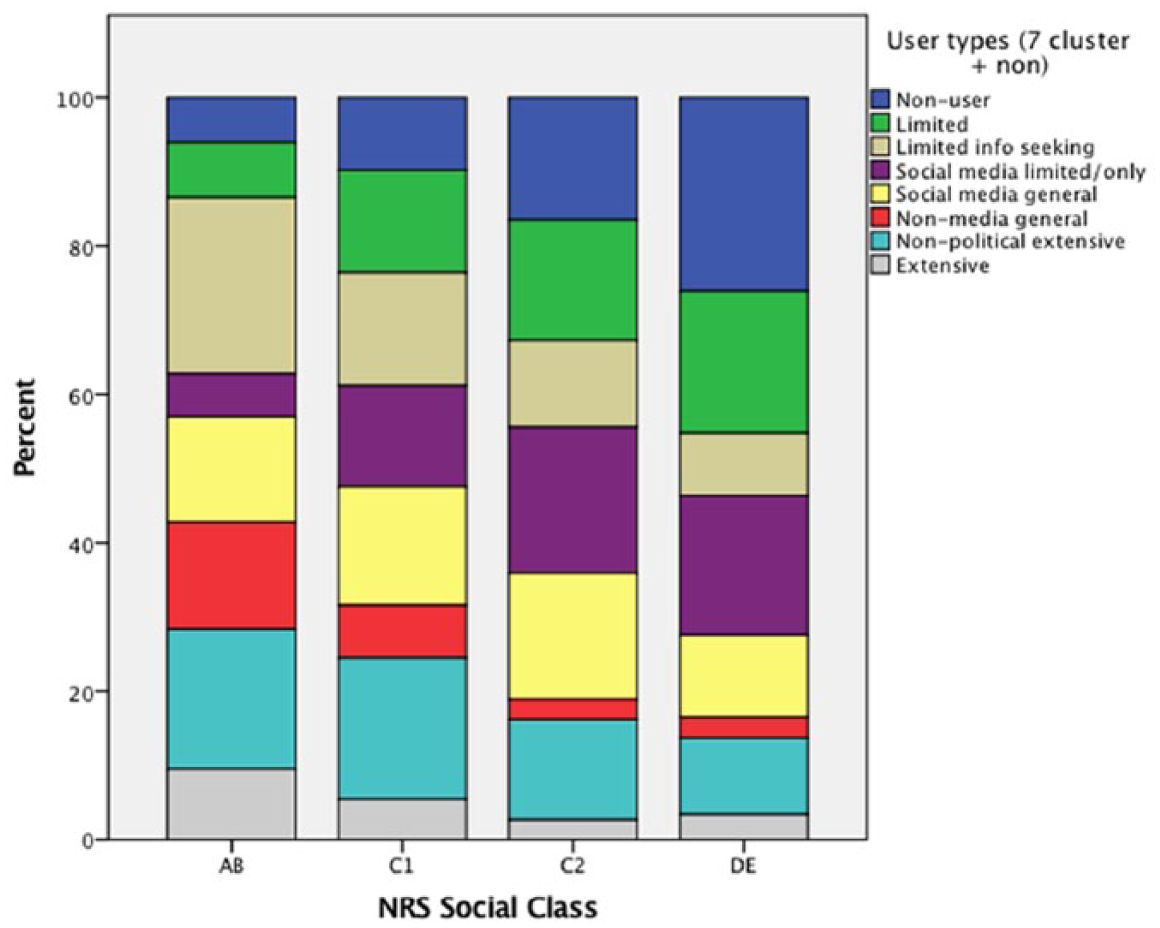
Type of Internet user by social class (NRS).
As was noted in the subsection Starting Point, the result from the 2014-2015 data is almost identical to that from the 2012-2013 data. Those in NRS social classes C2 and DE are most likely to be off-line, or one of the limited user types. In the case of social class group DE, this is close to 70% of citizens. Looking at the same clusters by household income, the data indicate that limited and limited social media only users are unlikely to be from higher-income backgrounds (Figure 4). Considering this in purely economic terms, the results show that social media limited users are from poorer households, with the majority from households with income below the national average. Looking at the same categories by age, nonusers and limited users tend to be older than 55 years, but limited social media users are predominantly younger than 55 years (Figure 5). This indicates that limited social media users are predominant among the younger poor. These results mirror those from the Blank (2016), Blank and Lutz (2017), and the case studies in Robinson (2009).
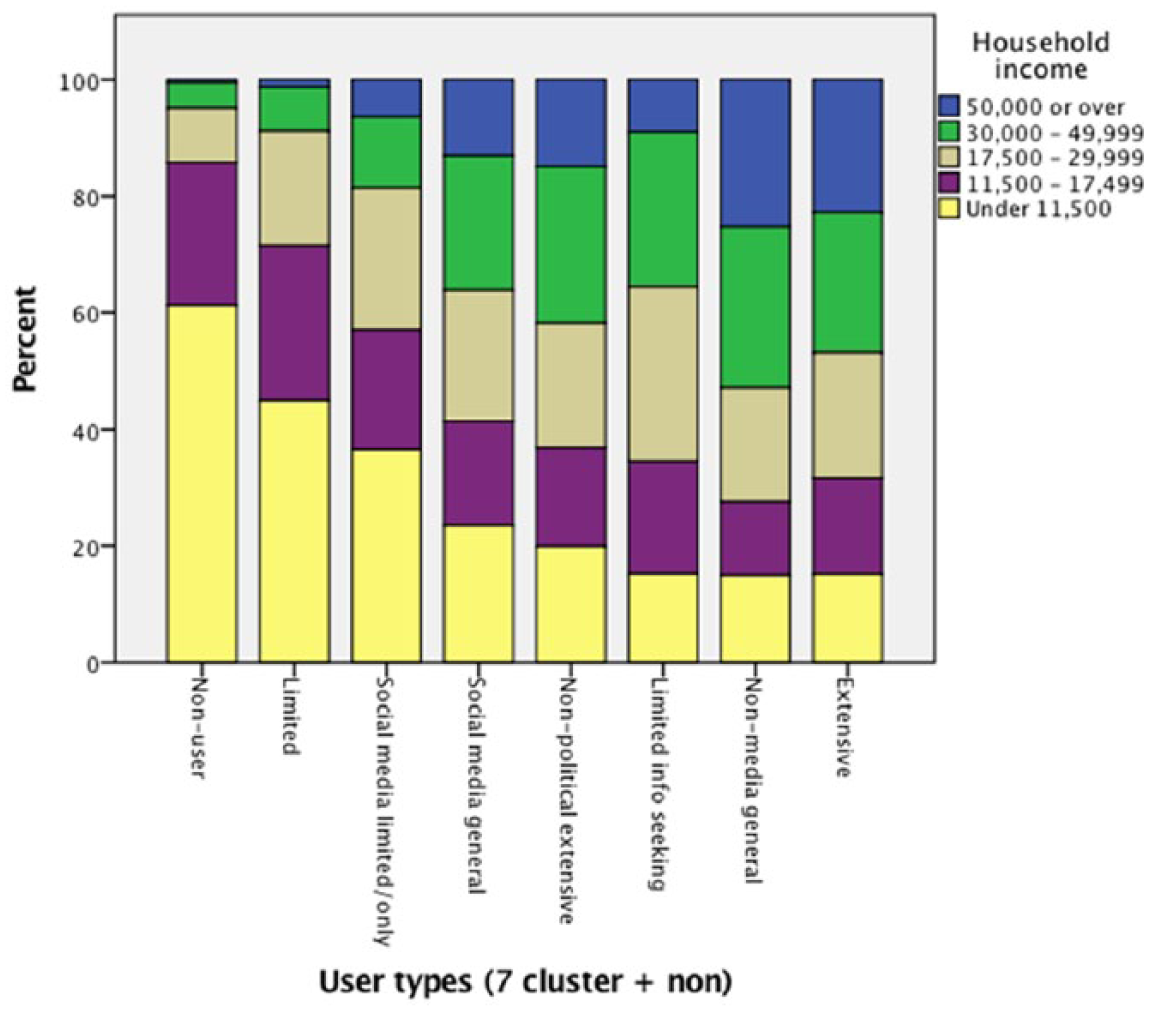
Household income by type of social media user.
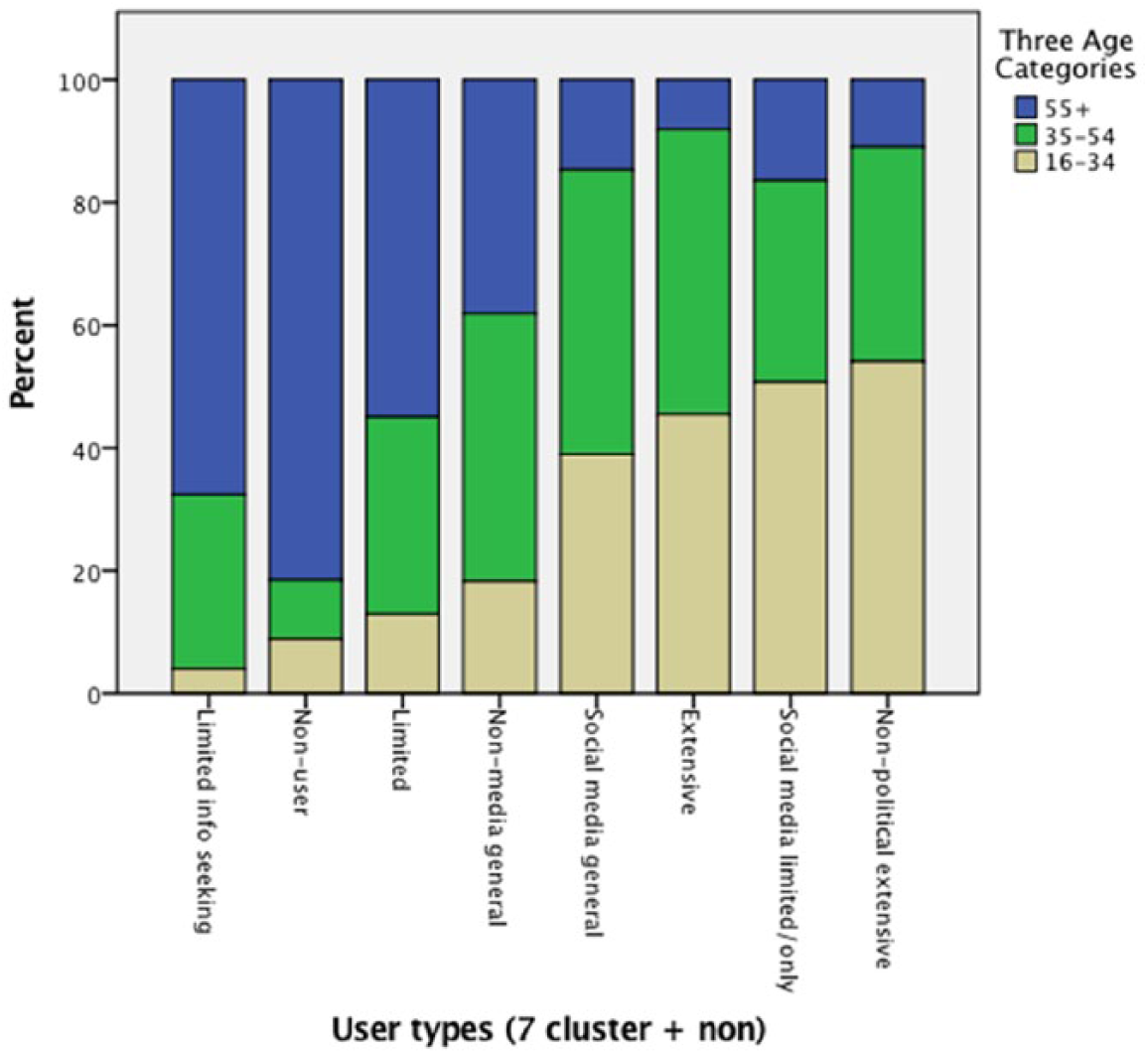
Types of Internet user by age.
Social Capital
There are also two other notable differences in social media use in the data sets. First, there is a statistically significant difference in the range of social media platforms used by the different class groups. Using the DCMS Taking Part data, a one-way ANOVA on the number of different types of social media platform used indicates that class is a statistically significant independent variable, F(5, 483,749.875), p < .000. The number of different social media platforms used drops from more than three to just one between the top and the bottom of the NS-SEC scales (see Figure 6). Though the overall effect size was small to medium (η2 = 0.05), a Tukey HSD comparison found all levels of the NS-SEC variable to be statistically significantly different at p < .000.
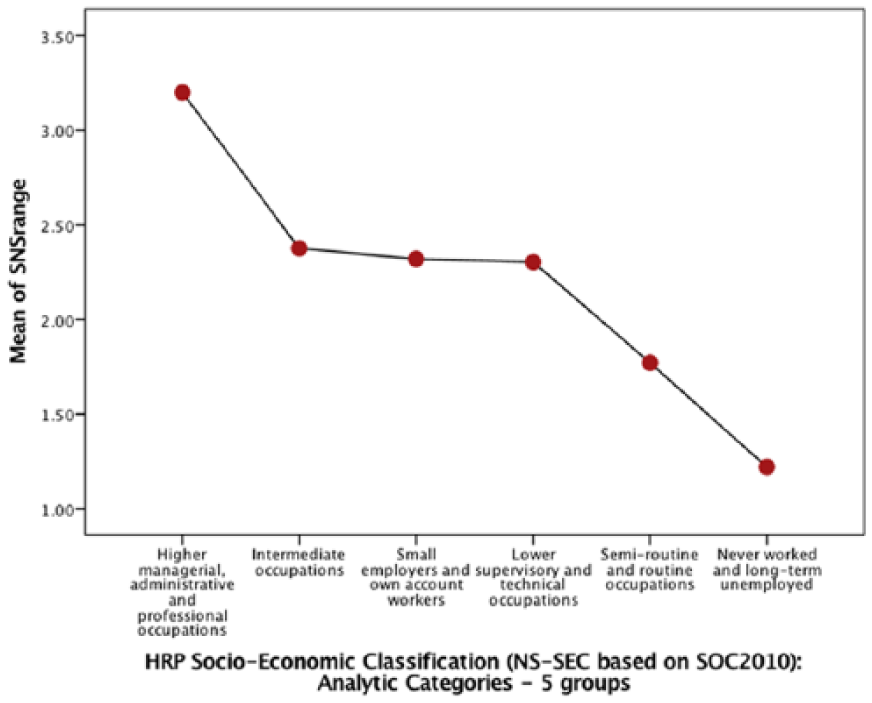
Mean number of social media platforms used by class.
Second, the data indicate that types of social media used also vary by class. As may be expected, social media platforms aimed at professionals (e.g., LinkedIn, Vimeo) are predominantly used by NS-SEC professional groups. Notably, Twitter is more likely to be used by professionals, in comparison with other groups. Facebook and Myspace have a more even spread in use across the class groups, but still with an overrepresentation of higher professional class groups (Figure 7). In the specific case of Facebook, the top four NS-SEC groups remain overrepresented, with a mixed picture for the lower four groups and very low levels of use for those who are unemployed, χ2(8, n [weighted] = 40,318,650) = 452071.153, p < .000, small effect size φ = 0.106.
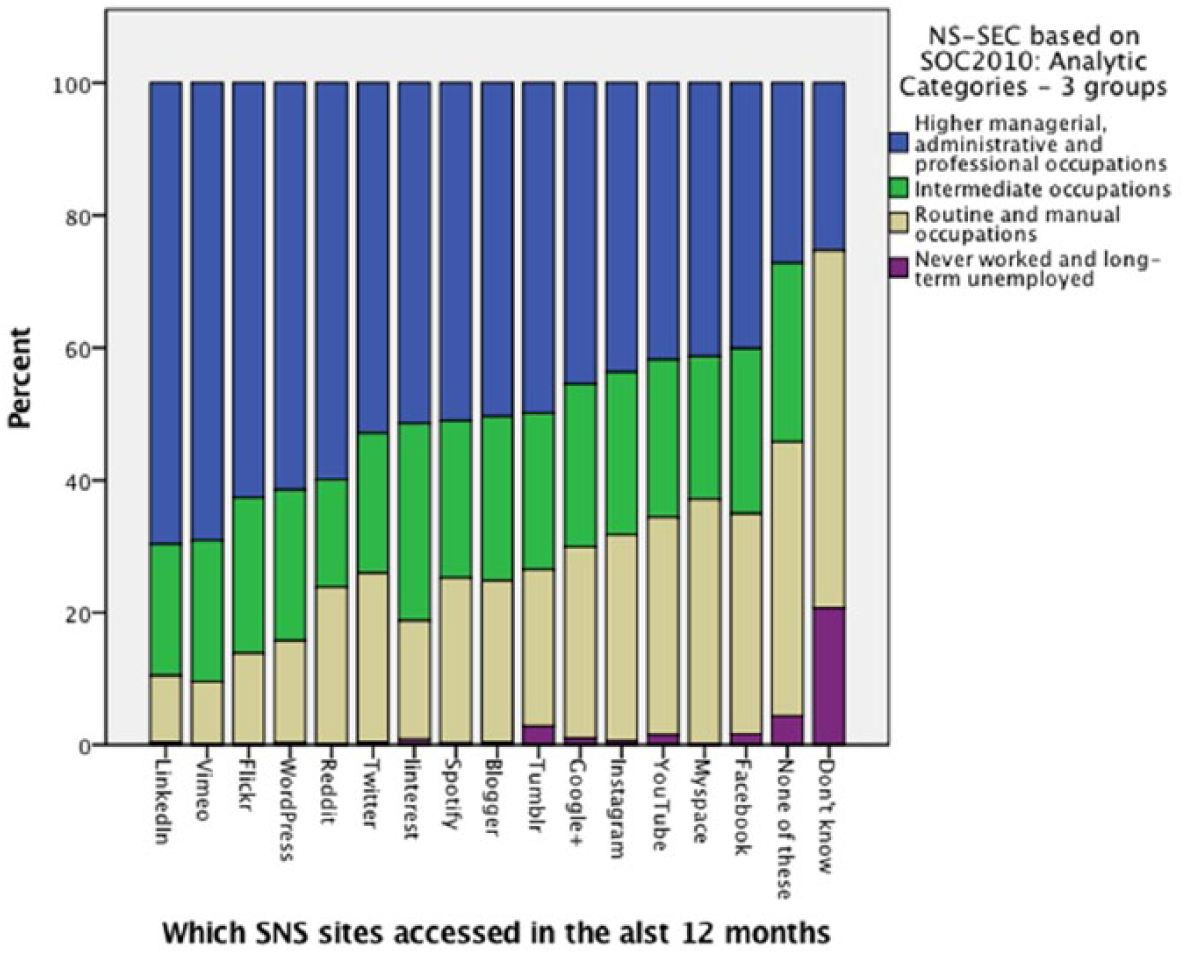
Social media platforms used by social class (NS-SEC).
Institutionalized Cultural Capital
Examining the eight OfCom user types by level of education gives a very clear result, with both breadth and depth of Internet use increasing with time in education and more than half of extensive users being higher-education graduates (Figure 8).
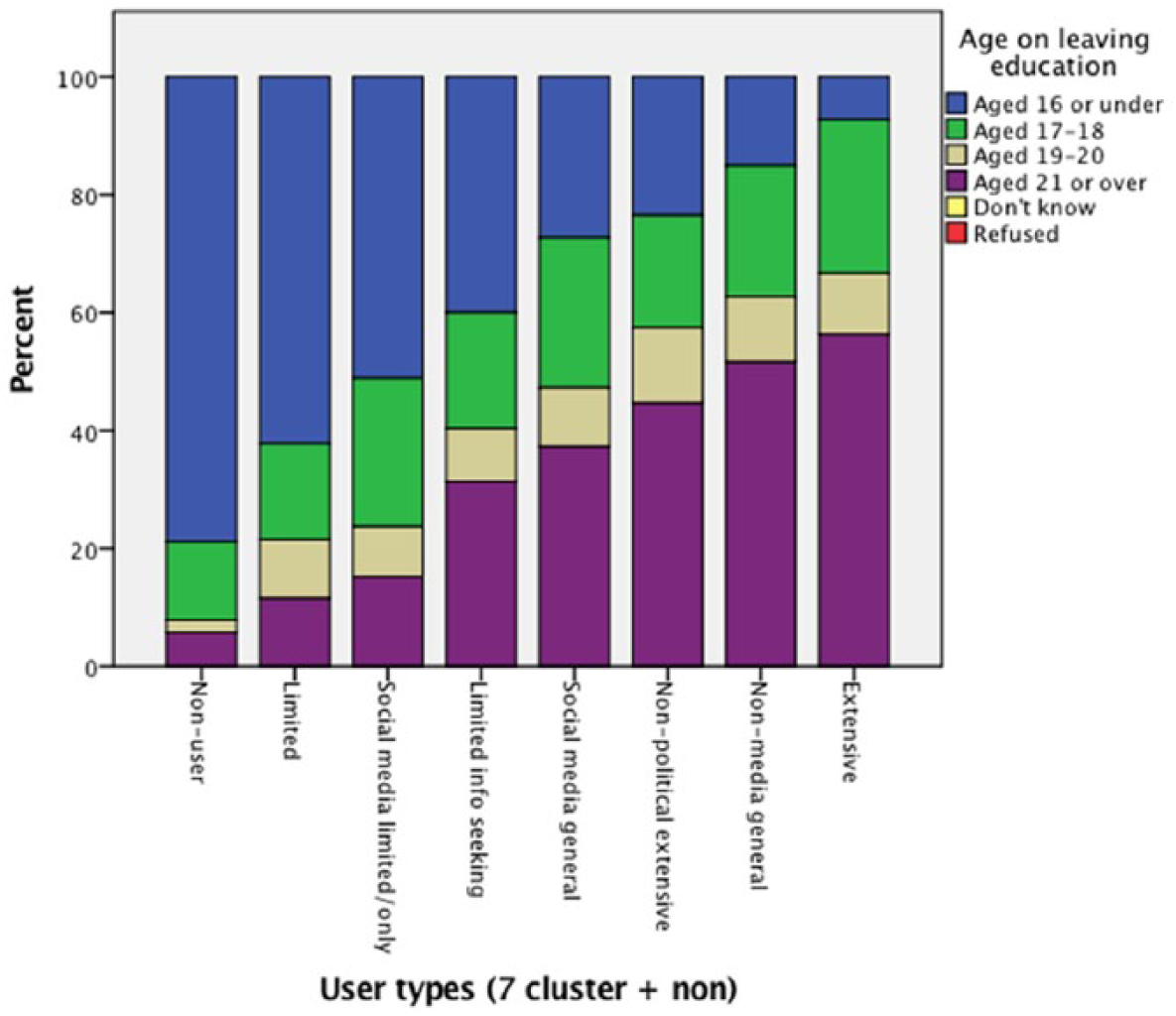
Types of Internet user and age on leaving education.
Objectified and Embodied Cultural Capital
The final analysis presents an inductive MCA analysis of the relationship between social media use, other forms of cultural consumption, and economic capital. The MCA analysis was conducted on three sets of variables: (1) attendance at a range of cultural activities; (2) NS-SEC, deprivation, and Internet access; and (3) social media use.
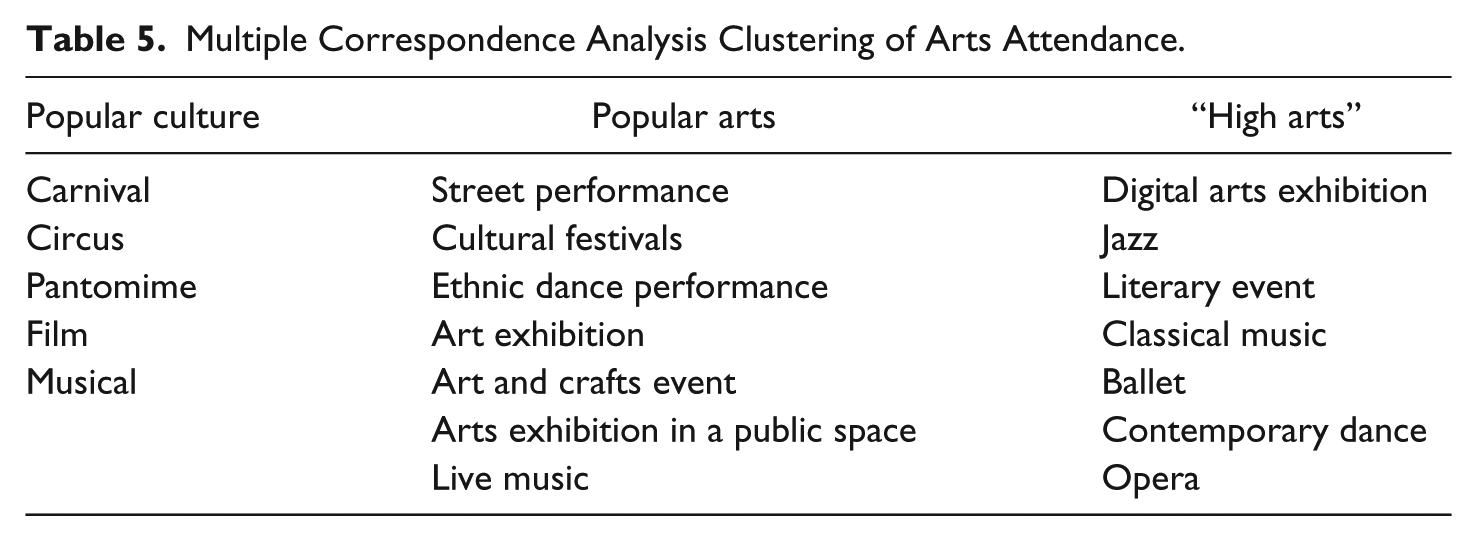
The results from the analysis are presented in Figures 9 to 11. Figure 9 presents the overall result, with the first two dimensions explaining 82.6% and 5.1% of the variance. Dimension 1 explains the majority of the data along an axis that matches class, deprivation, cultural distinctions, and Internet access (Figure 10). Dimension 2 appears to differentiate between popular culture and what might be described as “high culture.” An examination of the plots points to four potential clusters. Three of these appear to mark out cultural distinction, with one covering “high culture,” the second popular arts, and the third popular culture. The fourth identifies those who are socioeconomically, culturally, and digitally excluded (see Figure 11 and Table 5). All forms of cultural attendance appear toward the higher-class end of Dimension 1. High levels of social media use are situated closest to popular arts (Figure 11). It is interesting to note that levels of social media use follow a similar vector across the graph as that for popular to “high” culture attendance. This would indicate an association between high levels of social media use and higher levels of objectified, and potentially embodied, cultural capital.
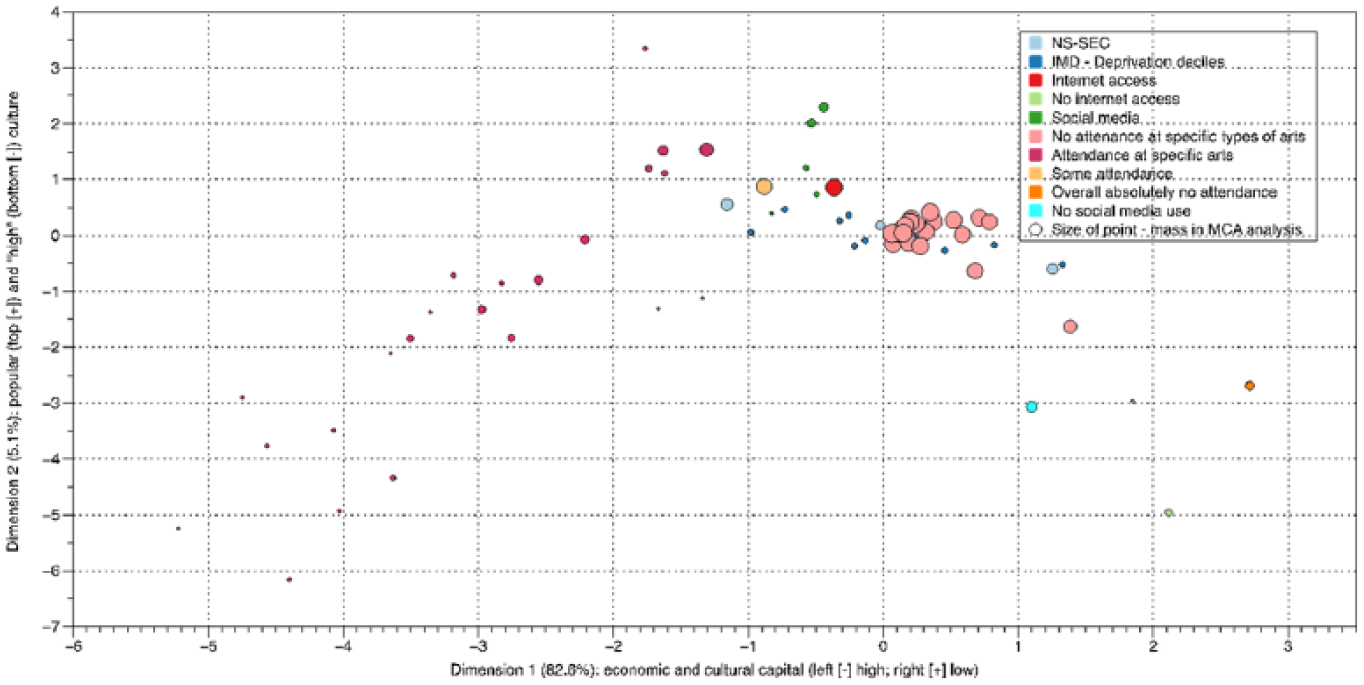
MCA analysis of cultural attendance, social class, deprivation, and social media use.
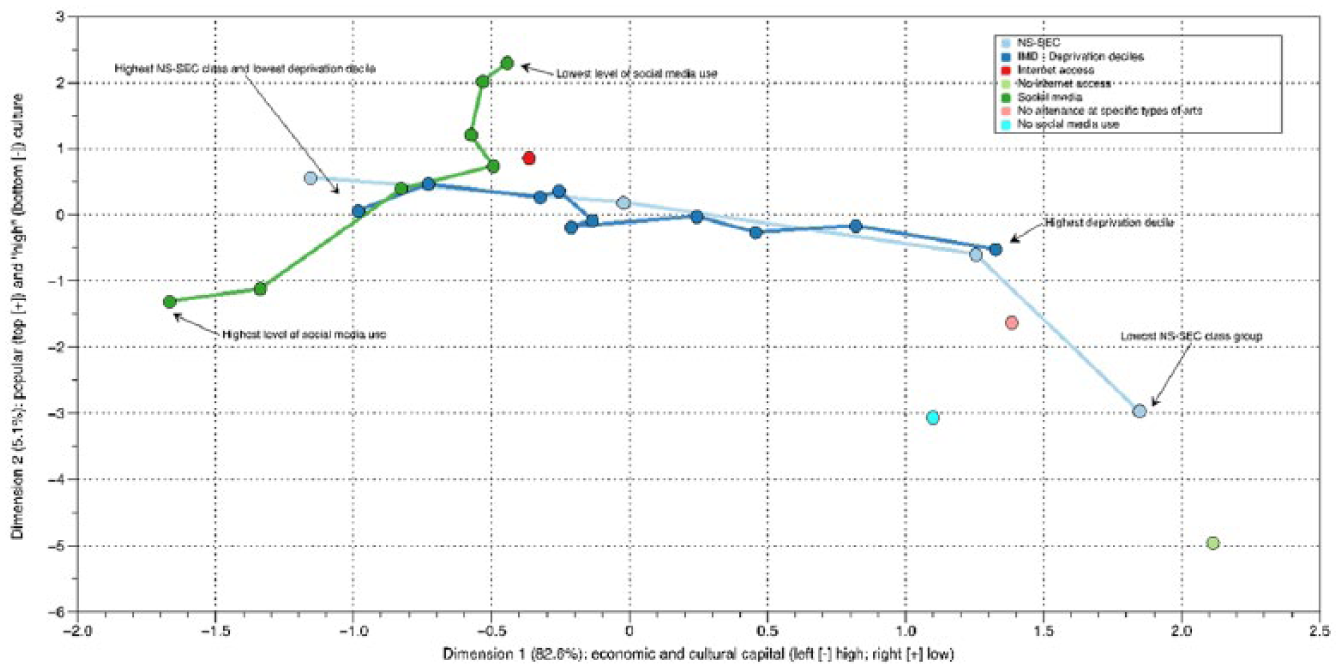
MCA analysis: Details of class, deprivation, and social media vectors.
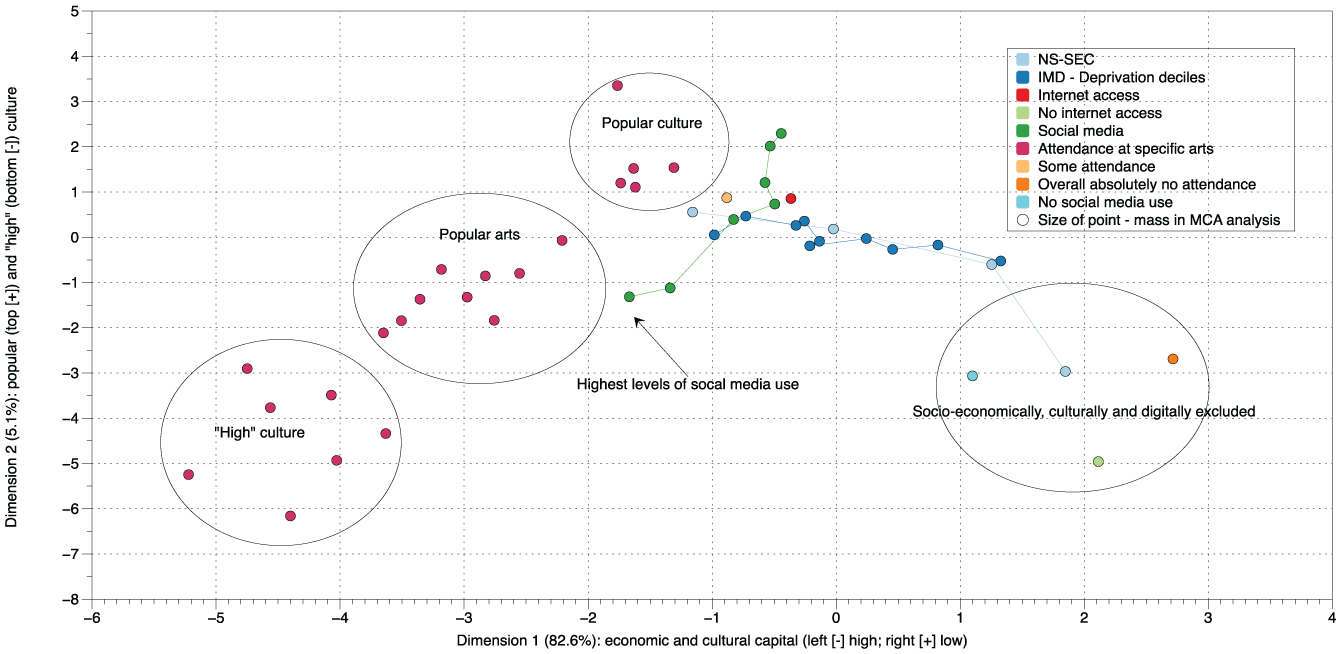
MCA analysis: Overall results.
Multiple Correspondence Analysis Clustering of Arts Attendance.
Finally, examining the question of the use of social media to support cultural and personal activities indicates that social class plays a role in two ways. First, many of these activities are predominantly undertaken by citizens from professional class groups. Second, they are also statistically more likely to utilize social media to support these activities. Figure 12 details the use of social media to engage in activities that might be seen as supporting the development and maintenance of both social and cultural capital. Once again, the higher social class groupings predominate in all activities.
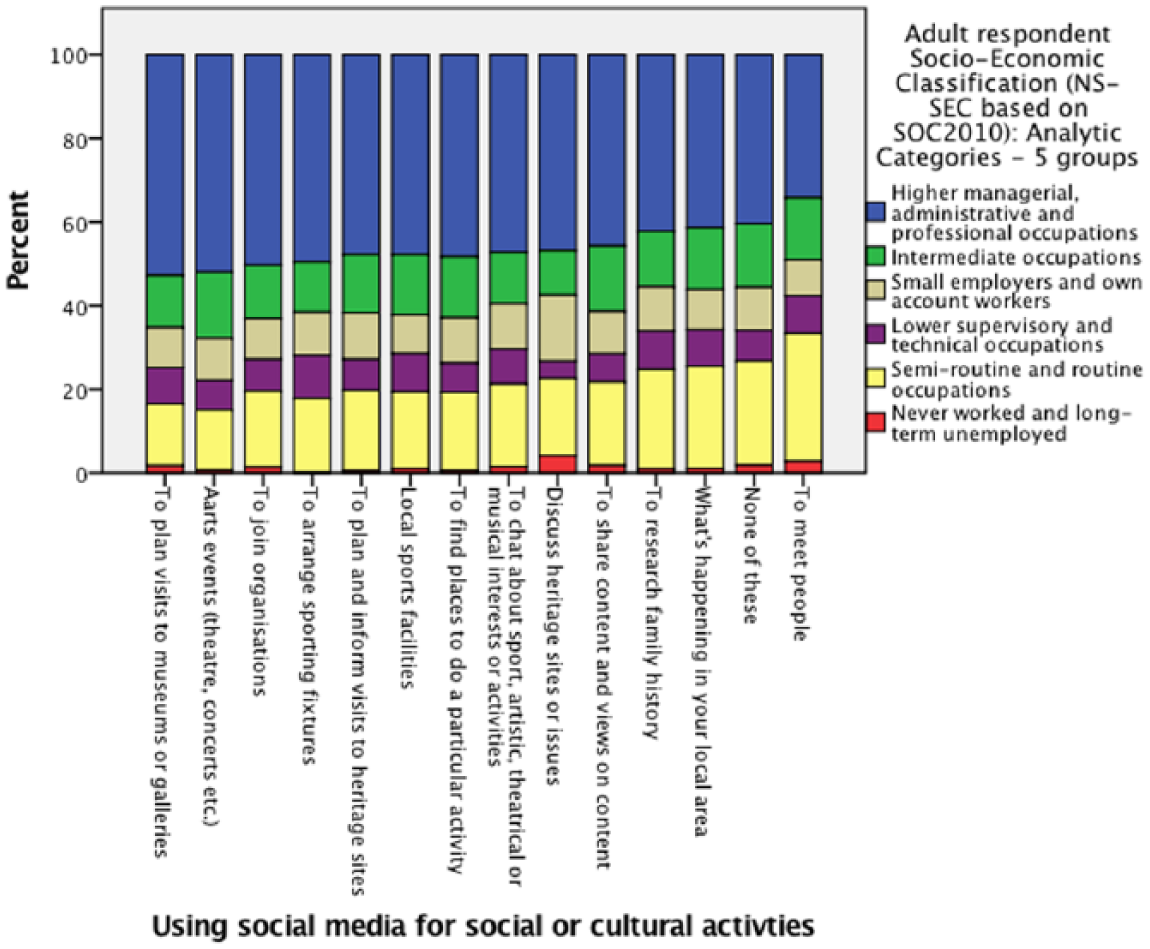
Social and cultural uses of social media by social class (NS-SEC)
Conclusions
The data indicate that social media use cannot be examined in isolation. It is part of a wider set of activities within people’s digital and nondigital lives. Examining this across Bourdieu’s (1997) three forms of capital makes this very clear. Economic capital has an influence on levels of social media use (see the subsection Economic Capital). What is clearly influenced by economic capital, and potentially class in a wider definition, is the extent to which social media is one of the primary routes to engage with the digital. Importantly, limited Internet users who are predominantly focused on social media are far more likely to have lower incomes and be members of lower socioeconomic class groups (measured by either NRS or NS-SEC). In terms of social capital, the data show that those in lower socioeconomic groups have lower levels of social media use, even where it is the main form of digital media use. People in this group also make use of a smaller set of social media platforms and are unlikely to use those platforms most associated with professional contexts. They are also unlikely to use social media in relation to other forms of nondigital cultural consumption. Facebook appeared to have a broader user base, but it was still statistically significantly skewed toward the higher NS-SEC categories.
In terms of cultural capital, this analysis points to three findings. First, social media–focused, limited Internet users may also have lower levels of access to institutional cultural capital, having left formal education earlier and predominantly lacking a professional occupation. Second, as indicated by the MCA analysis, higher levels of social media use are associated with greater engagement with markers of embodied and objectified cultural capital. Third, the use of social media in the context of social and cultural activities that are likely to reinforce social and cultural capital is predominantly undertaken by those in the higher NS-SEC groups.
The analyses presented here are, of course, limited by the two data sets used, neither of which was designed specifically for this analysis. Future research based on questionnaire tools tailored to an approach such as this, and potentially supported by additional social network analysis, would provide a more robust result. But the results of this analysis should not be surprising, and they fit well with the literature discussed in the introduction. Digital technology use can be considered a social “field” (Bourdieu 1993); therefore, it is no surprise to see that this field is marked by systems of distinction between different social groups and that some behaviors or access to certain technologies will carry greater cultural capital in that domain. This fits well with Helsper’s (2012) idea of corresponding fields. Having access to such systems and knowing how best to use them appropriately within any field may be key markers of relevant economic, social, and cultural capital.
Ideas of a “digital” or “information” habitus and of “digital capital” have been proposed by a variety of authors as a way of understanding the role of digital technologies in systems of class and distinction. Such ideas are helpful in focusing attention on the digital aspects of citizen’s lives, but such concepts presuppose a potentially artificial distinction between people’s digital and nondigital activities. They also conflate economic, social, and cultural capital, often “mirroring” these within the definition of information/digital capital. But as digital technologies become ever more embedded and ubiquitous, digital activities will become as much a part of users’ habitus as books or fashion. As such, the issue becomes how different uses of digital technologies are both markers of and constitutive of social distinction and it’s lived manifestation in the habitus of individuals.
In focusing on the use of social media in the context of other digital activities and other markers of social, cultural, and economic capital, this work also demonstrates how the uses of digital media (cf. Hoggart, 1957) function in the context of class distinctions. Such variations add another level of inequity and difference to the more basic ones of access and skills. There rightly remains a focus in policy research on access and skills, as addressing basic access and use is still important. But as digital media become integrated into the full range of social, economic, and cultural fields in which citizens operate, there are likely to be differences and divides in the breadth and depth of digital media use. These digital distinctions will not simply be about access (economic capital), but they will also include skills to use (institutional and embodied cultural capital), the associated cultural uses of digital media (objectified cultural capital), and the likely routes to access social networks (social capital). The data presented here point to digital technologies being embedded in the contemporary habitus of citizens and, as with previous material and cultural features, providing markers of class distinction. Therefore, how digital technologies embed into, transform, and possibly challenge existing socioeconomic and cultural systems of inequality needs further empirical examination.
Footnotes
Declaration of Conflicting Interests
The authors declared no potential conflicts of interest with respect to the research, authorship, and/or publication of this article.
Funding
The authors received no financial support for the research, authorship, and/or publication of this article.
