



Abstract
This article investigates how global forces influence immigrant entrepreneurship. Research in the United States generally assumes that immigrant enterprises, especially those in the service sector of the urban economy, are largely low-end and highly localized. Our case study of Chinese-owned nail salons in New York City suggests that immigrant enterprises are predominantly transnational, shaped not only by local market conditions in the host country but also by multiple layers of socioeconomic and politico-institutional circumstances in the home country. We build on the ideas of mixed embeddedness and transnationalism to develop an analytic framework of simultaneous embeddedness that underscores the linkage between the local and the global. Using data collected from face-to-face interviews and on-site observations in New York City, as well as archival records of government policies and media reports in both the United States and China, we find that individual characteristics and home country interpersonal networks shape processes of adaptation and business formation in the host country. Moreover, the supply of business labor is influenced by three factors in China: (a) educational attainment among the younger generation, (b) job mismatch in the local labor market, and (c) economic opportunities. Finally, the Chinese government’s entrepreneurship promoting policy and relaxed control over studying abroad and tourism overseas, intertwined with U.S. immigration policy, exacerbate the problem of labor shortage for Chinese-owned nail salons in New York City.
Keywords
Since the worldwide economic restructuring of the 1970s, immigrant entrepreneurship has witnessed rapid growth in migrant-receiving countries (Edwards, Ram, Jones, & Doldor, 2016). Studies of this phenomenon have mushroomed in multidisciplinary fields, despite the domination of the U.S.-inspired scholarship of “ethnic entrepreneurship” (Engelen, 2001). Recent research has shifted from the centrality of ethnicity to a focus on broader structural contexts within which immigrant enterprise is embedded. Originally formulated by Kloosterman et al. (Kloosterman, 2010; Kloosterman, van der Leun, & Rath, 1999; Rath, 2002), the influential concept of “mixed embeddedness” has been applauded as “perhaps the greatest single theoretical leap forward in this field” (Ram, Jones, & Villares-Varela, 2017, p. 5).
This framework locates immigrant entrepreneurs centrally within a three-rung sphere of influence, namely, individual agency and ethnic networks at the micro-level, the opportunity structure offered by the local economy at the meso-level, and the politico-institutional environment at the macro-level. Kloosterman et al. argue that immigrant enterprise is dependent on these factors and their interactions in the host country (Kloosterman, 2010; Kloosterman et al., 1999; Rath, 2000; Valdez, 2011). Despite considerable theoretical advancement, however, this framework overlooks the forces of transnationalism and gives minimal attention to home country circumstances that may enable or constrain potential entrepreneurs to mobilize resources effectively for entrepreneurial endeavors. The literature on transnational entrepreneurship has its own shortcomings as well. An obvious gap is the disproportionate attention to international or cross-border enterprises, such as import–export, foreign trade, and outsourced manufacturing, while neglecting the role of transnationalism in the local economy of the host country. Yet numerous immigrant businesses in the personal service sector, such as nail salons, are rooted in the local economy and oriented toward a local clientele.
Building on mixed embeddedness and transnationalism approaches, this study develops an analytic framework to understand immigrant entrepreneurship in the local economy. Using data collected from face-to-face interviews, on-site observations, archival records of government regulations, and media reports in both the United States and China, we examine immigrant entrepreneurship within the context of Chinese-owned nail salons in New York City (NYC), a highly localized in-person service sector that is simultaneously embedded in a transnational field. We argue that, though anchored in one place, the competitive advantage of immigrant entrepreneurs rests with the skills, strengths, and social ties nurtured in the home country and developed further through host and home country interactions.
Theorizing Immigrant Entrepreneurship
Ethnic Entrepreneurship
In many respects, the notion of the ethnic entrepreneur overlaps that of the immigrant entrepreneur. The concept of “ethnic entrepreneurs” stresses entrepreneurs’ ties to a common cultural heritage and social embeddedness within ethnic communities (Light & Gold, 2000; Waldinger, Aldrich, & Ward, 1990; Zhou, 2004). Conventional wisdom considers both structural and cultural factors in influencing the formation and performance of entrepreneurial ventures. Early literature underscored the status gap in ethnically stratified societies. Labor-market disadvantages and pervasive racial exclusion steered immigrant and ethnic group members toward self-employment in underrewarded sectors unwanted by nonethnic firms (Light & Bonacich, 1988; Min, 1990; Waldinger et al., 1990).
Falling short of explaining ethnic group differences in enterprise, cultural approaches focus on group-specific traits, including “cultural values, behavioral patterns, distinct group traits, social structures, collective resources, and coping strategies” (Zhou, 2004, p. 1048). Light’s comparative study of Chinese-, Japanese-, and Black-owned businesses observed an “elective affinity,” born out of interpersonal relations through ethnic institutions in the ethnic community, such as family mutual aid societies and rotating credit associations, functions to collectively reinforce values and norms, mobilize resources, set prices, and regulate intraethnic competition for small business operation (Light, 1972). Such ethnic solidarism in turn ensures success in business. Zhou’s (1992) study of New York’s Chinatown illustrates how reciprocal bonds are established between entrepreneurs and workers and how they function to nurture the entrepreneurial spirit and enforceable trust for ethnic firm success.
Waldinger et al. (1990) propose an interactive model that stresses three dimensions—group resources, opportunity structure, and ethnic strategies. The success of an ethnic business largely depends on whether the ethnic entrepreneur can implement strategies to fully mobilize the opportunities produced through the complex interaction of these dimensions (Waldinger et al., 1990). However, this model is criticized as reducing economic and politico-institutional factors too narrowly as immigrant- or ethnic-specific laws and regulations only (Bonacich, 1993; Rath, 2000, 2002).
The social capital approach considers not only cultural factors unique to the ethnic group but also patterns of social relations that have emerged from the process of adaptation. This perspective contends that ethnic enterprise in advanced economies can be traced to ethnic group cultural heritage and the group’s ability to mobilize a variety of resources through ethnic networks (Chand & Ghorbani, 2011; Ley, 2006; Portes & Sensenbrenner, 1993; Rath, 2000).
Mixed Embeddedness
Kloosterman (2010) articulate a more comprehensive analytic model, termed “mixed embeddedness.” This model situates individual entrepreneurs within a three-rung sphere of influence, namely the micro-level of the individual entrepreneur and their ethnic networks, the meso-level of the opportunity structure offered by the local economy, and the macro-level of the larger politico-institutional environment (Kloosterman, 2010). At the micro-level, this model considers the opportunity structure along two dimensions—the access to and growth potential of markets. At the meso-level, this approach investigates the interaction between the opportunity structure, access to ethnic-based resources, and available entrepreneurial strategies. The macro-level identifies four dimensions of the politico-institutional framework that may affect the size and shape of an opportunity structure, including institutional-structured market demands, labor, business operations, and business systems (Kloosterman, 2010). Besides an intrinsically hostile market environment, the mixed embeddedness model also considers the state regulatory regime (Jones et al., 2014; Kloosterman, 2010; Ram et al., 2017). Due to market exclusion and state regulation, immigrant entrepreneurs are confined to a restricted range of market niches and openings abandoned by nonethnic business persons, and major deficiencies associated with immigrant businesses cannot be fully mitigated by ethnic social capital (Kloosterman, 2010).
Despite considerable theoretical advancement, the mixed embeddedness model overlooks the forces of transnationalism, a key feature of recent global migration, and gives minimal attention to the influence of structural conditions in the home country that shape immigrant enterprise.
Transnational Entrepreneurship
In today’s increasingly globalized and deterritorialized world, many immigrants have become transnational (Portes, Guarnizo, & Landolt, 1999; Vertovec, 1999). Characterized as a continuous and regular tie with the sending country after migration, transnationalism has gathered momentum since the 1990s and intersected with many areas of inquiry including entrepreneurship (Brzozowski, Cucculelli, & Surdej, 2014; Drori, Honig, & Wright, 2009; Portes et al., 1999; Schiller, Basch, & Blanc-Szanton, 1992; Zhou, 2004).
The transnational entrepreneurship literature limits its scope to transnational ties, which is considered a spatially enlarged source of social capital and comparative advantage unavailable to native-born competitors (Jones, Ram, & Theodorakopoulos, 2010; Patel & Terjesen, 2011; Sequeira, Carr, & Rasheed, 2009). However, even transnationalism skeptics like Waldinger and Fitzgerald (2004) suggest “the specific socioeconomic politico-institutional context” of home countries should be analyzed because “networks are created, sustained and used” within such contexts (Brzozowski et al., 2014; Sequeira et al., 2009).
Another obvious gap in the existing literature is that disproportionate attention has been paid to immigrant enterprises that are international or cross-border, such as import–export and outsourced manufacturing, to the neglect of those lodged in the local economy of the host country. Industries that are characterized as highly localized and generally immune from the transformative power of globalization are often transnational in scope—shaped not only by local market conditions in the host society but also by multiple layers of socioeconomic and politico-institutional circumstances in the country of origin, as well as interactions between host and home countries (Waldinger & Fitzgerald, 2004).
Simultaneous Embeddedness
According to Drori et al. (2009, p. 1001), transnational entrepreneurs are immigrants who maintain “business-related linkages with their countries of origin and with their adopted countries and communities [allowing] them to maintain critical global relations that enhance their ability to creatively and efficiently maximize their resources base.” This conception makes a significant theoretical advance by identifying immigrant entrepreneurs’ potential connections to two or more social environments across national borders. This conception focuses on entrepreneurs who actively seek opportunities in transnational space, neglecting to consider those who passively adapt to changes brought about by global forces in the local economy. In our view, not all immigrant entrepreneurs are transnational entrepreneurs, but many immigrant enterprises are influenced by global forces. Thus, we argue that the economic prospects of immigrant entrepreneurs, whether they physically move across national borders, are shaped by interpersonal relations, social networks, and the politico-institutional circumstances of the home and host country.
Figure 1 outlines an analytic framework of simultaneous embeddedness. If we ignore the linkages between the home country on the left side and the host country on the right side, we can see two parallel mixed embeddedness models. On the right side is the original model, developed by Kloosterman et al. (1999), which concerns the host country at length. In the host country, the immigrant entrepreneur is embedded within an interpersonal network, which is often broken in the process of migration but gets rebuilt in the process of adaptation. At the meso-level, the entrepreneur’s interpersonal network is embedded within the ethnic group or community. At the macro-level, the ethnic community with its economy and institution is embedded within the larger economy and politico-institutional environment (e.g., occupational niching, market opportunities, and policy). On the left side, the same logic can be applied to explain mixed embeddedness in the home country.
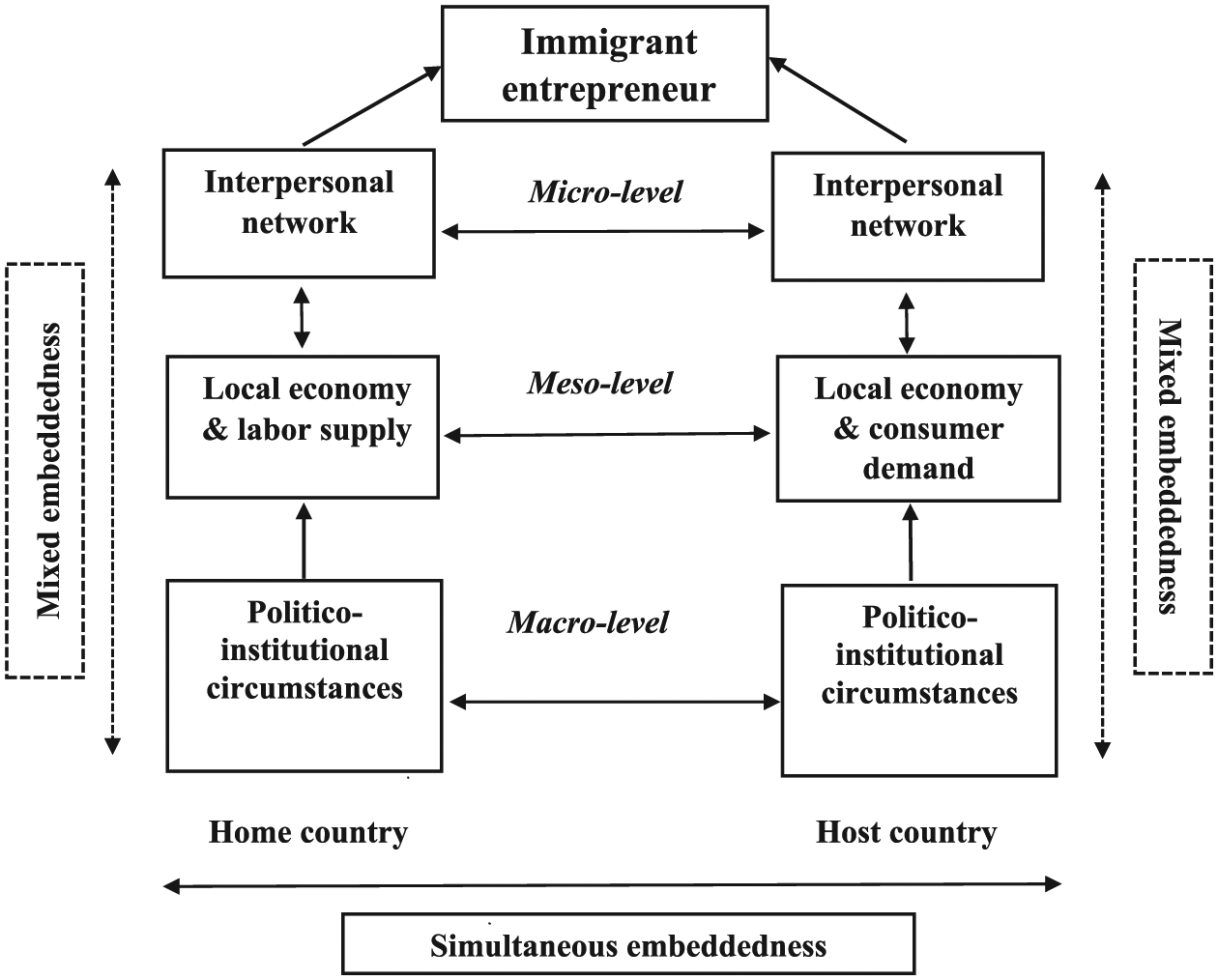
Simultaneous embeddedness: An analytic framework.
Our analytic framework of simultaneous embeddedness is built on the idea of mixed embeddedness but focuses on the linkages between home and host countries. We place the immigrant entrepreneur centrally within the three-rung sphere of influence of both home and host countries and consider the continuous interaction of key determinants in transnational space. At the micro-level, our focus is on transnational interpersonal networks. We argue that immigrant entrepreneurs’ premigration statuses and their effectiveness of exploiting transnational networks in the home country affect their business performance in the host country. These transnational networks can derive social capital, in myriad forms of labor, capital, information, and other informal business resources, to support entrepreneurial endeavors. At the meso-level, our focus is on local labor market conditions in the home country. We argue that, given a certain level of local consumer demand in the host country, the local labor market in the home country from which immigrants originally hailed is affected by social and economic changes, such as the elevation of educational attainment in the younger generation, the skilled mismatch and labor shortages in the local labor market, and entrepreneurial innovation promoted by favorable government policies. These changes in the local labor market in the home country can influence entrepreneurial performance and access to labor among immigrant entrepreneurs in the host country. At the macro-level, our focus is on the policy arena. We argue that broad politico-institutional factors can enable or constrain immigrants to pursue entrepreneurship.
We apply this analytical framework to the case study of Chinese-owned nail salon industry in NYC. Our analysis shows that interpersonal networks that are built in the home country and strengthened through the process of adaptation in the host country vary by immigrants’ socioeconomic characteristics in affecting this industry. Moreover, the labor supply for this business is influenced by three main factors in China: (a) the elevation of educational attainment in the younger generation, (b) the skilled mismatch in the local labor market, and (c) rising economic opportunities. Furthermore, Chinese government’s entrepreneurship promoting policy and relaxed control over studying abroad and tourism overseas, intertwined with changes in U.S. immigration policy, exacerbate the problem of labor shortage for Chinese-owned nail salons in NYC.
Research Design
Research Question
We use the analytic framework of simultaneous embeddedness to address three questions: (a) How do interpersonal networks of immigrant Chinese entrepreneurs, maintained or rebuilt in China and the United States, affect their entrepreneurial performance? (b) In what specific ways do China’s socioeconomic changes and labor market conditions affect Chinese-owned nail salons in NYC? and (c) Do macro-level policy changes in both China and the United States affect this industry, and if so, how?
Site Selection
Dubbed as “the manicure capital,” NYC had nearly 2,000 nail salons in 2012, three times the number 15 years ago and growing faster than that of the rest of the country (Nir, 2015). Relatively low entry barriers cause intense competition. As nail salons become ubiquitous, prices are heavily pressured, while steadily rising operational costs are cutting deeply into profit margins. Heavily regulated by more than eight local and state agencies, nail salons are increasingly unable to keep up with strict and costly compliance.
The dominance over this this business in the New York metropolitan area 1 is shifting from Koreans to Chinese (Bates, 2012; Kang, 2010). In 2013, Koreans had 60% of market shares and operated 70% of nail salons citywide (Choi, 2014), but in 2015, Chinese owned about half of the salons in Manhattan, and at least 80% in neighboring counties (Kim, 2015). Nail salons are largely part of the informal economy because undocumented workers are pervasively employed to the extent that an interviewed worker “does not know any salon does not hire undocumented workers.”
Partly due to the weaker labor-market position and partly due to employment of undocumented workers, owners usually pay workers cash and leave no record for such payments. Most owners and workers are low-skilled and poorly educated female immigrants from geographically diverse backgrounds. Social media apps like WeChat reshape the recruitment process. Hundreds of owners and workers exchange unlimited free recruiting messages or share know-how in dozens of online chat groups. Assisted by search engines, potential workers may have some knowledge about the industry before they leave China.
Technological advances do not mitigate labor shortage, a longstanding concern. High demand for nail services in NYC leads to a higher number of nail salons and higher demand for salon workers, which outruns the available labor supply and gives workers greater leverage in the local labor market than workers in other industries. Employers have to offer higher wages, flexible schedules, better working conditions, and other benefits to workers. Workers’ entrepreneurial ambition further shrinks the size of labor supply and pushes up the labor cost. The labor shortage is not caused exclusively by local factors. Just as it is dominated by immigrants, the industry is transnational in nature. In the case of Chinese-owned nail salons, problems of labor shortage and rising operating costs are partially offset through transnational interpersonal networks. However, local market conditions in the home country and policies in both host and home countries can create challenges to salon owners in NYC.
Data
The data for this mixed methods study include (a) in-depth, face-to-face, semistructured interviews with 21 immigrant business owners and workers based on an enhanced snowball sampling method. This method is cost-efficient, effective in accessing “hidden” populations, suitable for small sample size, and capable of maximizing variation in the determinants critical to the phenomenon discussed (Black & Champion, 1976; Hendricks & Blanken, 1992; Penrod, Preston, Cain, & Starks, 2003); (b) on-site observations of five nail salons in Manhattan for more than 20 hours to “generate new knowledge of theoretical importance through describing the basic processes at work in members’ daily situations” by using a “sociological sampling” guide (Gold, 1997, p. 391); (c) compilation and analysis of government policies and legislative histories, case law, statutory law, and law enforcement records, using legal research methods; and (d) collection of related media reports by The New York Times, The New York Review of Books, Voices of New York, The World Journal, and other local media outlets. Safeguards are undertaken to minimize the refusal rates (Penrod et al., 2003), increase variation in the sample, and prevent a generalization to a population (Gold, 1997). One author’s insider knowledge is of help.
Although we did not conduct fieldwork in China, we relied on archival records of government regulations and policies to analyze local labor market dynamics and government policies in China. We also posed questions to our interviewees in NYC about their ties, views, and experiences with social and economic changes in China.
Findings
Interpersonal Networks at Micro-Level
Our analytic framework of simultaneous embeddedness highlights the importance of immigrant entrepreneurs’ interpersonal networks in facilitating their access to financial, human capital, and social capital resources in both host and home countries for their entrepreneurial endeavors at the micro-level. We found that the premigration socioeconomic status of individual entrepreneurs affects the maintenance of interpersonal networks in the home country, such that these networks enable entrepreneurial activities in the host country.
Nemo, an owner of a boutique salon in Chelsea, ran a retail shop selling clothing in a provincial capital of an inner province in China. When her business failed, she and her husband each borrowed RMB300,000, or roughly $40,000 at that time, to obtain U.S. visas in the late 1990s. Her relatively low premigration socioeconomic status and small interpersonal networks in China and United States largely determined her path to entrepreneurship, including her entrepreneurial practices and performance. Because she and her husband must pay off their huge debts and provide for their two young sons left behind in China, Nemo worked in various nail salons and other personal service businesses for coethnics in NYC for 4 years. She then opened her first salon in the basement of a five-story apartment in vibrant central Chelsea. Due to a lack of English proficiency, Nemo and her husband did not understand the local zoning law, which prohibited basement-based businesses. They were heavily fined by the fire department and forced to close their salon in early 2011. Fortunately, Nemo was offered a spacious storefront on the same street by a neighbor, and after considering risk and limited financial resources, took half of the available space for a new salon. Nemo’s immigration status and financial situation have prevented her from returning to China. In the meantime, she maintains her interpersonal networks in China, calling family members and close friends, and regularly sends remittances to family members, most of whom are poor, unemployed, or retired. She mostly relies on her social networks in NYC, such as hometown associations and other coethnic salon owners and workers, to recruit workers and seek assistance, but she also takes advantage of her networks in China. She recruited her younger brother, sister-in-law, and niece, all of whom are poorly educated in China, to work in her salon, partly because of labor shortage in NYC and partly out of family obligation.
Nemo is conservative in financing and reluctant to borrow money from other people nor from banks even with preapproved loans, due to good credit and business longevity. Although she owned an apartment in China, she did not want to sell it to fund her business in NYC as some other owners would do, nor did she try to use it as collateral to borrow money from a Chinese bank. Eventually, she came to count on her own family and friends and struggles to keep her business afloat.
In contrast, Cassey had a successful dancer career in China and belonged to the local elite prior to immigration. She used to be a referee for top-level dancing contests in China, a job that enabled her to get to know individuals who belonged to an even more privileged and elite class than her own in China. This allowed her to build a wider range of high-class, interpersonal connections than she would otherwise have had as an average professional, including her husband, a famous report for The New York Times. She has used these connections effectively to build sizable wealth. Her marriage and her MFA degree from New York University enabled her to join the elite class of NYC where she has derived considerable social capital. She subsequently opened two full-service spas in upscale neighborhoods in Midtown East and the Upper West Side with her own and her husband’s financial resources and crucial business information from her local connections. With financial resources and social capital, she spent $250,000 on interior decoration alone, by her designer friend at a discounted price, for one store in late 1990s. Her store in the Upper West Side is profitable even though the rent is $40,000 a month. Besides generating an income, these upscale salons bestow her with the highly valued status of being a woman entrepreneur, which represents independence and wealth in both countries. Because of the high volume of wealthy customers, her workers, most of them Chinese immigrant women, are willing to accept lower base salaries and some of them have worked for her for decades. Unlike other regular owners who personally manage their salons and oftentimes work for customers themselves, Cassey leaves the day-to-day management to her younger sister, who is also from China. This way, she can spend more time with her high school children, much like an ordinary upper middle-class American mom, a luxury not enjoyed by other owners interviewed. The profitability of her businesses places her in an advantageous position in the labor market—she was the only owner in our study who did not hire any undocumented immigrant workers. Cassey’s fluency in English also helps her businesses, especially during interactions with enhanced law enforcement. She told us that her stores were inspected only once, largely because of good locations and inspectors’ presumptions. She was ticketed once, but she immediately sought legal help from a lawyer friend, prepared favorable evidence, went to the administrative court of the NYC with her husband to defend herself, and successfully persuaded the judge to rescind that ticket. She was also able to use her personal connections to voice concern about and take action against the biased reporting on the Chinese-owned nail salon business, which earned her respect in the industry and in the Chinese immigrant community.
Another example of how simultaneous embeddedness functions is the case of Linda, whose socioeconomic status was between Nemo and Cassey. Linda was a manicurist. She came to United States through debt-free family-sponsored immigration. Prior to migration, she used to be a licensed lawyer in Northwestern China, one of the least populated and well-compensated careers in China. Due to the language barrier and unrecognized license, her legal training and practice in China could not directly help her in the United States. However, her high premigration socioeconomic status of being a self-employed professional enabled her to carry her entrepreneurial ambition to her job search from the very beginning. She quickly resettled in New York and rebuilt a new social network. After she received basic training with the nail salon association in New York, she immediately found a job through her friend. Linda aspires to eventually have her own nail salon one day. With hard work and savings, Linda told us “anyone from China should be able to put up with sufficient amount of cash” for a small-sized nail salon, a false belief held by many aspiring entrepreneurs like her. She was puzzled by our questions about financing such small business through loans. The main reason she had not acted on her entrepreneurial ambition, at least in the nail salon business, was the intense competition and narrow profit margin. Unlike her poorly educated peers who believe becoming a nail salon owner facilitates upward mobility, she felt that, at the moment, she fared better in terms of take-home pay as a manicurist than as an owner. She told us she would quit the job soon to get herself educated about other careers since nail salon workers would soon be replaced by high technology.
These cases show that interpersonal networks and immigrants’ socioeconomic characteristics are highly correlated. These two sets of factors are transnationally embedded and influence immigrant entrepreneurship. It is the interaction between these factors, not one or the other, that leads to variation on resource generation for entrepreneurship.
Local Economy and Market at Meso-Level
Our analytic framework of simultaneous embeddedness systematically links the local market dynamics of both host and home countries to the flow of labor across national borders, posing new challenges for the immigrant entrepreneur. We consider the local market of the host country as affecting the demand side for entrepreneurial activities and labor and the economic context of the home country as affecting the supply side. While the immigrant entrepreneur may access immigrant labor through transnational interpersonal networks, changes in the local labor market in the home country can lead to new structural barriers preventing access. Our study attributes access to immigrant labor to several identifiable meso-level factors in China, which harm competitiveness and survivability of NYC salon owners.
Most of the workers in NYC’s nail salon industry are low-skilled immigrants. Owners told us that their workers were mostly high school dropouts and from China’s underdeveloped countryside. Their prospects in China were limited to highly exploitative, low-wage manufacturing jobs. Therefore, working in a similarly exploitative but well-paying service sector in America was economically attractive. The nail salon industry thus relies heavily on the continuing supply of immigrant labor from China.
Recent social and economic changes in China have created a situation where many young adults are swayed away from overseas low-end service jobs, such as working in the nail salon industry. China’s growing economy, especially in migrant hometowns, offers young adults with elevated educational attainment an adequate number of white-collar jobs with better career prospects than that of low-paid and dead-end jobs in NYC. In Fujian, for example, the hometown of the largest Chinese diasporic population, the college-educated population grew from 2,967 in 2000 to 8,361 in 2010 per 100,000 persons, and the number of high school graduates grew from 10,602 to 13,876 (National Bureau of Statistics of the People’s Republic of China, 2012). The impact of increased educational attainment among young people at home is twofold. On the one hand, it creates a job mismatch; that is, the kind of jobs available in the local market of the host country do not match the levels of educational attainment and occupational aspirations of the better educated people in migrant hometowns in China, pushing them to go to other big cities in China to seek better jobs instead of going overseas. The growing economic opportunities over the past decade gives robust optimism to educated young people about their career future in China. Some of those going overseas would become retrained as manicurists. But premigration exposure to the low-end labor market for immigrants in the host country through the Internet and transnational connections significantly deter aspiring young adults from leaving home. These educated young people “do not want to wash others’ feet in America,” said Amy, an owner of a salon near the Wall Street.
Another important labor supply for the Chinese nail salons are Chinese students studying in the United States on F-1 visas. Although Chinese students pursuing advanced degrees in America must prove that they have sufficient financial support from different sources for their studies and are not allowed to work off-campus without proper authorization, many of them must find part-time work to offset some of the rising education costs and high cost of living in major immigration gateway cities such as NYC. Finding part-time jobs in Chinese-owned businesses, such as nail salons, is relatively easy among females. The risk of getting caught for working illegally is minimal since law enforcement is unlikely to target small businesses in NYC on regular basis. Hence, nearly all owners in this study have hired Chinese students.
Now, “students have essentially vanished,” said Crystal, an owner of a salon in West Harlem. This change is partly due to elevated premigration socioeconomic status of new Chinese students. In 2000, nearly all 60,000 students were graduate students sponsored by the Chinese government or American schools; now most of 350,755 students are self-funded undergraduates (Siddiq, 2013). On average, a Chinese student spends $215,000 to $250,000 for a 4-year program and considerable additional living expenses (Tsuruoka, 2016). Amy’s observation accurately reflects the new situation: But now we can’t find many poor F-1 students. Chinese students now are rich. Their parents are rich and willing to give them as much money as possible hoping that they could focus on their studies. It was common for F-1 students to work in restaurants, nail salons, and other low-end jobs in the past. Now this kind of students is gone. The students now carry LV handbags and wear Burberry outfits. They are our customers who pay us. We like doing business with them, but we need people to serve.
In addition, the lowering of the entry barrier to the host mainstream labor market also discourages F-1 students from working in nail salons and other low-end ethnic businesses. In the past, F-1 students, like their low-skilled coethnics, were blocked from entering the larger labor market due to the lack of English language proficiency, transferable educational or professional credentials, knowledge of local conditions, and difficulties in obtaining essential information about market vacancies (Light, 1972). However, the situation has since improved for new F-1 students from China. Many now have U.S. diplomas and a mastery of English, have earned work experiences through internships, and have obtained readily accessible job market information from schools, the Internet, and their own social networks. Thus, the labor market integration of F-1 students further constrains the availability of coethnic labor for nail salon owners.
China’s economy expansion benefits not only well-educated youth and upper middle-class families who can afford high tuition for their children in the United States but also poorly educated blue-collar workers, the very workforce for low-end personal service industries in the United States. Due to the one-child policy and the quickly aging population, China’s population growth has been shrinking, which has caused a large-scale worker shortage, initially in its manufacturing coastal region and now nationwide. The survey shows that in coastal regions, a 30% to 70% gap between the demand and the supply of workers exists (Mauldin, 2016), more than 20 million workers have left the labor market in the past 5 years, and the salaries of all industries rise at the yearly rate of roughly 10%, faster than developed countries and global average (“China’s workers are saying,” 2017). In Fujian province alone, during the first quarter of 2016, 1.26 million new jobs were offered, but only 1.03 million new job seekers joined the labor market. The number of the working-age population in Fujian decreases roughly 80,000 a year. China’s worker shortage leads to undocumented migration from neighboring Southeast Asian countries. In 2014, the law enforcement of Guangzhou province arrested more than 5,000 undocumented migrant workers (“Chinese factories face worker,” 2015). In this circumstance, Chinese blue-collar workers are more willing to find a well-paying job in manufacturing sectors in China, rather than finding a low-end service job in the United States, especially when those factories provide free room and board and other nonmonetary benefits.
Politico-Institutional Circumstances at Macro-Level
Our analytic framework of simultaneous embeddedness considers the complex interaction between the politico-institutional contexts of both host and home countries at the macro-level to have direct or indirect effects on immigrant entrepreneurship. In this study, we found that recent changes in government policies serve to reshape, to some degree, the emigration strategy of both the low-skilled and the highly educated young people in China, which indirectly and negatively affect entrepreneurial activities.
One of the relevant policies is “mass entrepreneurship and innovation,” a policy scheme promoted by every level of the Chinese government since 2012 (“Li Keqiang: Mass entrepreneurship,” 2017). This policy aims to create an environment for entrepreneurial success for young adults by providing start-up funds, loans, and occupational training. In Fujian province, for example, in 2012 alone, 10,773 college students received start-up training in 272 sessions at 30 colleges, three city-level incubators which housed 29 programs were established, and 50 programs by college graduates were funded by local governments with RMB17 million. Some children of nail salon or other businesses owners, who are expected to take over their immigrant parents’ business in NYC, refuse to go to America to do so and instead ask their parents to fund their own entrepreneurial efforts in China. Although the young people may not be well-prepared for the difficulties in starting and running business in China, they nevertheless receive money from their parents. Some of the parents remit money back home to support their children’s entrepreneurial aspiration often do so out of the guilt arising from long-term family separation. In this case, China’s entrepreneurship promoting policy redirects the flows of both human and financial capital from the nail salon industry in NYC to small businesses in cities and towns in China.
Other relevant policies pertain to promoting tourism overseas and studying abroad, which are intertwined with the visa policy of the U.S. government for Chinese visitors and students. As China’s economy continue to boom, Chinese tourism overseas and the strong purchasing power of the Chinese leads to the relaxation of government control over overseas travel in China and changes in visa policy in the United States (Yuan, 2012). On November 10, 2014, President Obama announced a new visa agreement with China in Beijing, which extends business and tourist visa validity from 1 year to 10 years and student visa to 5 years, grants these visa holders multiple entries, and permits a 6-month stay for each entry (Diamond, 2014).
For low-skilled Chinese immigrants, their migration to the United States is nearly impossible if they do not have immediate family members who are naturalized U.S. citizens to sponsor them or if they are not connected to the migration industry and social network (Kandel, 2014). In the past, they migrate to the United States through two ways. One is through illegal border-crossing. Some of the undocumented Chinese immigrants, especially those from Fujian province, cross the U.S.–Mexico border and get transported to NYC by smugglers (Caesar, 2010). The other way is to obtain temporary nonimmigrant visas, such as F-1 student visas and B visitor visas, and then overstay their visas. Visa overstayers face a 3-year to 10-year bar from reentering the United States, depending on the length of the overstay, if they returned to China. Many of them cannot afford another trip due to the cost of smuggling or obtaining a visa (Davis, 2017). Many low-skilled undocumented Chinese immigrants apply for asylum to stay in the United States legally. Yet the asylum process takes from 1 to many years. Asylum seekers cannot go back to China, because they have already established the basis for asylum that if they return, they would face persecution and extreme hardship. During the long process of asylum application, these asylum applicants usually find work in ethnic businesses owned by the Chinese, hence constituting a source of cheap labor for nail salons. In fact, this path to legal residency has been effective for undocumented low-skilled Chinese immigrants for various reasons. First, asylum is a human rights issue, and asylum seekers are often supported by human rights groups in the United States. Second, there is no numerical cap for approved asylum applications, which implies a shorter waiting time than some of the family-sponsored categories with waiting time longer than 10 years. Third, asylum application oftentimes only needs a convincing statement without meeting the requirement of many different certified documents, such as marriage certificates, financial affidavits, police records, and so on. Fourth, the approval rate of asylum is relatively high, especially in certain jurisdictions like NYC, where nearly 80% of Chinese applicants were granted asylum between FY 2011 and FY 2016 (TRAC Immigration, 2016). While undocumented low-skilled Chinese immigrants provide labor for ethnic businesses, business owners may be undocumented and file for asylum as a way to stay in the United States and eventually gain citizenship status. In this study, except for Cassey, her native-born husband, and Linda, all other salon owners and workers interviewed were either asylees themselves, derivative beneficiaries of asylum, or still in the adjudicating process for asylum claims.
However, the new visa agreement changes the entire immigration dynamics. First, the threshold to obtain a U.S. nonimmigrant visa is relatively low but the value of a U.S. visa is high. Nonimmigrant visa holders would not risk overstaying their visas when the penalty, a 3- to 10-year bar, remains the same. Also, a 10-year, multiple-entry, and 180-days visa makes traveling back and forth between China and the United States easier, which renders asylum seeking much less attractive than before. Therefore, some low-skilled Chinese immigrants are more likely to engage in short-term but high-return economic activities, which are oftentimes illegal, because it is hard for law enforcement to catch them during their short stays, and even harder to extradite them once they return to China due to the lack of bilateral extradition agreement. As a result, many of these low-skilled Chinese immigrant, who used to work in nail salons without complaining about low wages and poor working conditions due to their disadvantaged undocumented status, are now more likely to stand up to their coethnic employers to demand higher wages and better treatment. A nail salon owner Peter tells us: Now those young girls are flocking to massage stores, you know what exactly they are doing inside. Not just young girls, but mid-aged women too. Some of them did plastic surgeries to make themselves physically more attractive for doing massage work. They can make a lot of money each month. Look at those newspaper advertisement, those hiring massagers at $20,000 a month. In our store, the most hardworking and multiskilled manicurists can only make roughly $4,000. Only idiots want to work for us. For newcomers, it is smart to make quick cashes for 2 or 3 months and go back and forth between China and the United States from time to time.
Another policy also disincentivizes low-skilled Chinese immigrants from applying for asylum, which indirectly affects the labor supply to the nail salon industry in NYC. In response to the crisis of surging unaccompanied children seeking entrance to the United States, the Obama administration prioritized unaccompanied children cases in immigration court system and moved other cases to new hearing dates in 4 years (American Immigration Council, 2016). Because there are only 53 immigration courts and about 250 immigration judges nationwide, the immigration court backlogs have been doubled since 2006, “reaching 445,607 cases in April 2015—an all-time high, and nearly 30% higher than the beginning of FY 2014” (American Immigration Council, 2016). On average, each case must stay in the system for 604 days. Waiting time in some cities, such as NYC, Los Angeles and Chicago, can be over 2 years (American Immigration Council, 2016). In this circumstance, seeking asylum, the only pathway for many low-skilled Chinese immigrants to the U.S. citizenship, is no longer attractive economically or practically.
The slowed pace of immigration courts is widely noted by people in the nail salon industry. Linda told us that “some of [her] friends whose original hearing date was in 2015 got moved to 2019.” Nemo also told us that “two of [her] undocumented family members decided not to apply for asylum because they did not want to waste time and money on it at all.” As the asylum application’s opportunity cost, financial cost, and emotional cost increase, frequent trips through the short-term nonimmigrant visitor visas become more readily feasible. A growing number of low-skilled Chinese immigrants choose the latter, and they turn to the kind of work that pays better and tolerates higher turnover rates than the work in the nail salon industry which demands a stable workforce and requires certified skills.
Conclusion
In this article, we develop an analytic framework to address immigrant entrepreneurs’ simultaneous embeddedness. Using this framework as a guide, we find, from our case study of Chinese-owned nail salons in NYC, that many immigrant enterprises are intrinsically transnational even though they are locally lodged and serve a local clientele. Our findings indicate that determinants of success in immigrant entrepreneurship cut across the multiple levels of interpersonal, socioeconomic, and politico-institutional factors in both host and home countries. Take labor as a case in point. We find that, at the micro-level, interpersonal ties with the home country vary by immigrants’ socioeconomic characteristics, but that these networks nonetheless facilitate the access to immigrant labor, which helps ease the problem of labor shortage for Chinese immigrant entrepreneurs in the nail salon business in NYC. At the meso-level, however, social and economic changes in migrant-sending communities in China create deterrent to emigration, which exacerbates labor shortage in Chinese-owned nail salon business in NYC. When job mismatch across national borders, a situation in which the availability of good jobs in the host labor market fails to meet the education and aspiration of potential migrants, occurs, young people, especially the highly skilled, are discouraged from emigrating. When the local economy in the home country is stimulated by favorable government policies, such as the policy to promote entrepreneurship, young people aspire to go into business in their town rather than emigrate. Rising economic opportunities in China also attract Chinese students studying in the United States to return home rather than stay abroad. At the macro-level, government policies in both China and the United States reshape, to some degree, the emigration strategy of both the low-skilled and the highly educated young people in China, which further constrains the labor supply for Chinese-owned nail salon business in NYC.
Our study makes several contributions to the literature on immigrant entrepreneurship. First, contrary to existing literature that assumes low-end personal service sectors are highly local, we find these sectors are also considerably affected by globalization and transnational forces, but in a more nuanced and indirect manner. Second, we call attention to the transnational linkages of interpersonal networks, local labor market dynamics, and government policies in the home country as they interact with multilayered factors in the host country. Third, we present a case study in which simultaneous embeddedness in the transnational field creates not only opportunities but also constraints to directly, or indirectly, influence the operation and survivability of immigrant entrepreneurship.
By integrating both mixed embeddedness and transnationalism, we develop an analytic framework that bridges the linkage between the local and the global and highlights the significance of simultaneous embeddedness within socioeconomic and politico-institutional contexts of both host and home countries in understanding contemporary immigrant entrepreneurship. However, this case study has limitations and can be improved in future research. First, the sample should be expanded to include more subjects of diverse socioeconomic backgrounds and more field sites to increase the applicability and generalizability of our analytic framework. Second, face-to-face interviews should pay greater attention to potential problems caused by the gender, ethnicity, and socioeconomic characteristics of the researcher. Third, more fieldwork should be done in the home country to further explore the dynamics of globalization and immigrant entrepreneurship.
Our findings offer important policy implications. A critical lesson for policy makers in the host country is that government’s massive but geographically bounded power is limited in regulating immigrant-dominated, highly localized, and low-end personal service sectors because these immigrant enterprises are simultaneously embedded across national borders. Moreover, the lines between formal and informal economic activities in immigrant enterprises are relatively thin and oftentimes blurry. Thus, policy makers must weigh options of “ignoring [informal] practices, condoning informality, or attempting to transition such enterprises into the ‘formal’ economy” (Jones et al., 2010, p. 582). Policy makers need to build their capacity for identifying transnational factors in the legislative process and tailor policy responses to balance local concerns and global impacts. In this regard, the simultaneous embeddedness approach would be beneficial for future policy making and research.
Footnotes
Declaration of Conflicting Interests
The authors declared no potential conflicts of interest with respect to the research, authorship, and/or publication of this article.
Funding
The authors received no financial support for the research, authorship, and/or publication of this article.