



Abstract
The article aims to answer the following research questions: (a) How far do European welfare states differ in the use of the policy concept of the active social citizen? and (b) How far is it possible to explain the differences with welfare regime types and welfare culture? The article distinguishes between two different types of the policy concept of active social citizenship with regard to self-responsibility. It argues that the active social citizen’s self-responsibility could be underpinned either by a major role of the welfare state, which promotes the citizens’ self-determination, or by a minor role of the state, which forces citizens to be self-reliant for funding and for organizing their own social security and services. The article is based on a cross-national comparative study for two policy fields (unemployment and long-term care policies for older people) in three welfare states (Denmark, England, and Germany), and analyzes legal frameworks, data from MISSOC (Mutual Information System on Social Protection) and secondary literature. The comparative analysis shows that countries differ in the type of the policy concept of active social citizenship they use. Differences in the type of welfare regime and also differences in the welfare culture contribute to an explanation of these differences. The article is innovative in that it offers a systematic analysis of the differences in the ways in which welfare states of different regime types conceptualize “active social citizenship” with regard to the citizens’ self-responsibility.
Introduction
With the restructuring processes of European welfare states since the 1990s, policies toward social citizenship have changed. A broad debate has developed among researchers in the field of social policy analysis in relation to social citizenship and the issue of how social citizenship has been redefined in these processes (e.g., Andersen, Guillemard, Jensen, & Pfau-Effinger, 2005; Evers & Guillemard, 2013; Frericks, 2014; Gilbert, 2002; Johansson & Hvinden, 2013; Lister et al., 2007). The term “social citizenship” as introduced by Marshall (1950/2000) refers to the ways in which the relationship of the individual citizen with the welfare state is constructed by welfare state policies. Although different authors have used it in different ways, most agree that the main dimensions of social citizenship include social rights and responsibilities (e.g., Andersen & Jensen, 2002; Hobson & Lister, 2002; Lister et al., 2007).
Recently, however, it has been argued that a new policy toward social citizenship is developing in contemporary European welfare states based on the concept of the “active social citizen.” Instead of, or in addition to, offering social benefits and public social services, such welfare state policies aim to strengthen the self-responsibility of the social citizens regarding their needs for social security and social services. Such policies of “active social citizenship” differ to some extent between policy fields and different welfare states (Andersen, 2005; Halvorsen, Hvinden, Bickenbach, Ferri, & Guillén Rodriguez, 2017; Jensen & Pfau-Effinger, 2005; Newman & Tonkens, 2011). There has, until now, been a lack of research offering a systematic approach to analyze how far European welfare states differ in their concept of “active social citizenship” in terms of strengthening the active social citizens’ self-responsibility. Furthermore, research that explains the cross-national differences regarding the use of this policy concept is rare.
The article aims to answer the following research questions: (a) How far do European welfare states differ in the use of the policy concept of the active social citizen? and (b) How far is it possible to explain the differences with differences in welfare regime types and welfare culture? The article distinguishes between two different types of the policy concept of active social citizenship dependent on whether the citizen’s self-responsibility is underpinned by a major role of the welfare state, which promotes citizens’ self-determination, or by a minor role of the state, which forces citizens to be self-reliant for funding and for organizing their own social security and services. On the basis of an empirical study, the article analyzes how welfare states differ regarding how the concept of active social citizenship is applied in two different policy fields (unemployment and long-term care [LTC] policies for older people).
The article also analyzes how far different welfare regime types and different welfare cultures can explain differences in the use of the concept of active social citizenship. The study examines Denmark, England, and Germany, three European countries which represent different types of welfare regimes according to Esping-Andersen (1990, 1999). The study is based on a comparative analysis of national legislation, data from MISSOC (Mutual Information System on Social Protection), and secondary literature.
After the introduction, the article gives an overview of the state of theorizing and research in the field. It then introduces the study’s analytical framework, followed by an introduction of the methodological approach. The findings of the empirical study are then presented. Next, the degree to which country-specific differences correspond with differences in welfare regime types and differences in the welfare culture are explored. The article ends with a conclusion.
Overview of the State-of-the-Art
The Debate Over Social Citizenship in European Welfare States
In the industrial society, the dominant policy concept of social citizenship was based on the social rights of the social citizens regarding social security and social services (Esping-Andersen, 1990; Johansson & Hvinden, 2013; Lister et al., 2007). In the field of social security, social rights have traditionally been based on the principle of “decommodification,” that is, according to Esping-Andersen (1990: 37), the right to maintain a reasonable standard of living during periods without employment, for example, unemployment, retirement, and illness. Typically, the state offers social services in policy fields such as child care and LTC for the older people. Social citizens are also expected to be responsible to some degree for their own welfare. However, European welfare states differ considerably in the degree to which the state covers the needs of citizens regarding social security and social services, and in the degree of institutionally constructed gender differences related to social security (Daly & Lewis, 2001; Esping-Andersen, 1990, 1999).
The Debate About the Development of “Active Citizenship”
During the transition to a postindustrial service society, the conceptualization of social citizenship in welfare state policies has changed. Some social scientists argue that new policies toward social citizenship in contemporary European welfare states are based on the concept of “active citizenship” (Johannsen & Hvinden, 2013; Jensen & Pfau-Effinger, 2005; Newman & Tonkens, 2011). While the term “active citizenship” is vague, authors agree that the development toward active citizenship has been connected with welfare state reforms, which have partly weakened the state responsibility for social security and placed more emphasis on citizens to assume greater self-responsibility (Frericks, 2014; Larsen, 2005; Serrano-Pascual, 2007). However, it has been shown that in some policy fields, such as family policy or LTC policy, state responsibility has also increased in some aspects (Andersen et al., 2005; Fleckenstein, 2011; Seeleib-Kaiser, 2016; van Kersbergen & Hemerijck, 2012).
On the one hand, welfare states have been able to encourage greater self-responsibility from their social citizens by supporting them in their agency and activities instead of, or in addition to, merely offering benefits and services (Halvorsen et al., 2017; Jensen & Pfau-Effinger, 2005; Johansson & Hvinden, 2013). On the other hand, claiming responsibility for one’s own life and well-being is, in the context of these policies, not merely an option; to an increasing degree, it also represents an obligation (Jensen & Pfau-Effinger, 2005; Newman & Tonkens, 2011). Therefore, the consequences of the policy shift toward active citizenship are ambivalent. While it has been argued that policies toward active citizenship may support the social integration, autonomy, and self-determination of citizens (Halvorsen et al., 2017; Lister et al., 2007), especially when underpinned by a generous welfare state, several authors have criticized policies toward active citizenship, seeing them as jeopardizing social cohesion if they are not backed up by a generous welfare state. In such a case, a considerable part of the social risks, which had previously been cushioned by the welfare state, would be transferred onto individual citizens who would then be expected to be self-reliant with regard to their social security (Evers & Guillemard, 2013; Newman & Tonkens, 2011; Taylor-Gooby, 2004).
Active Citizenship in Different Policy Fields
Social policy research has shown that welfare state policies that treat social citizens as “active” have developed in various policy fields, such as labor market policies, pension policies, family policies, and LTC policies (Halvorsen et al., 2017; Jensen & Pfau-Effinger, 2005; Larsen, 2005; van Kersbergen & Hemerijck, 2012; van Oorschot, 2002). 1
In the field of unemployment policy, part of the development toward active citizenship is a shift from so-called “passive” social citizenship, based on income transfer payments, to “activation policies” which treat the unemployed as “active” citizens who are supported or forced by the welfare state to find a job. Several studies have shown that there are considerable cross-national differences concerning how welfare states apply the policy concept of active citizenship depending on whether activation policies include generous unemployment benefits and generous active labor market policies (Aurich, 2011; Barbier, 2005; Bonoli, 2013; Larsen, 2005; van Oorschot, 2002).
In the field of LTC policies for older people and persons with disabilities, it has been argued that many welfare states have promoted autonomy and “choice” by introducing “cash-for-care” systems (Da Roit & Le Bihan, 2010; Ungerson & Yeandle, 2007). In this context, persons in need of care are expected to “buy” social services from extra-familial providers of professional care or care work of family members or acquaintances based on state funding. This implies that they need to organize their care provision independently (Pfau-Effinger, Jensen, & Och, 2011). However, in a recent study in the field of disability policies, Halvorsen et al. (2017) have shown that there are considerable differences between European welfare states with regard to the degree in which policies on active citizenship promote autonomy and agency of people with disabilities.
The Cultural Basis of Active Citizenship
How the cultural ideal of the social citizen has changed during the welfare state reforms since the 1990s is a much-debated issue. Some authors have argued that concepts toward active citizenship differ between different welfare states dependent on the dominant cultural ideas on which they are based (Johansson & Hvinden, 2013; Lister et al., 2007). It is often assumed that the promotion of active citizenship is mainly based on neoliberal ideas. These ideas rest on the assumption that active citizens act as autonomous “rational men” and on the basis of utility maximization. In this context, the state is expected to force social citizens to be self-reliant in order to prevent “free riding” (for instance, self-inflicted long-term unemployment) which is at the expense of the welfare state (Clarke, Newman, & Westmarland, 2007; Jenson, 2009; Larsen, 2005). However, theoretically, cultural ideas that are connected with a specific policy concept may differ between different welfare states (Pfau-Effinger, 2005). This theoretical assumption is also supported by empirical research (Grootegoed, 2013; Johansson & Hvinden, 2013; Newman & Tonkens, 2011). However, there is a lack of systematic comparative research concerning differences in the ways in which the policy concept of active citizenship is culturally embedded.
Conclusion Concerning Research Gaps
We argue that theorizing and research about citizenship often does not sufficiently consider the diversity of the use of the policy concept of the “active citizen.” In addition, it is often unclear in which ways the concept is integrated in cultural ideas and which role the strength of the welfare state in funding and organizing the welfare supply plays in this context. It is also not always clear how far the concept of “active citizenship” addresses the social dimension of citizenship or other dimensions. There has been a lack of literature that offers an explanation for these differences.
Theoretical Framework
A New Typology of Different Types of the Policy Concept of the Active Social Citizen
This article introduces a new approach to a typology of the policy concept of the “active social citizen.” Different to the common use of the concept of “active citizenship,” we include the term “social,” in order to make clear that we focus on social citizenship. A “policy concept” is defined as a specific set of institutional principles that offers a particular solution or policy alternative to a policy problem—in this case, the provision of social security and social services (Béland, 2005; Campbell & Pedersen, 2015; Schmidt, 2008). Although it is sometimes assumed that the state plays generally a minor role in policies toward active social citizenship (Larsen, 2005), this article claims that policies toward active social citizenship can also be underpinned by a major role of the state regarding the funding and organizing of social security.
Therefore, we introduce a new typology that distinguishes between two different types of the policy concept of active social citizenship based on the different approaches a state can adopt vis-à-vis the self-responsibility of active social citizens: the self-determination type and the self-reliance type. It is possible that welfare states use either one of both types or a combination of both. It is important to point out that only in its purest form can responsibilities be entirely transferred to the individual. In most empirical cases, we find a continuum in which responsibilities are only partially shifted to the social citizen.
Self-Determination Type
For the self-determination type, the state plays a major role and underpins the promotion of the self-responsibility of active social citizens by offering them generous funding or support for the organization or provision of their social security and services, which would most readily promote the self-determination of the active social citizens in terms of choice and autonomy.
Self-Reliance Type
For the self-reliance type, the policy concept is linked to a minor role of the state which rather forces active social citizens—directly or indirectly—to be self-reliant in financing and organizing their own social security and social services, especially when some citizens are excluded from comprehensive welfare state provision.
The Role of Welfare Regime Types and Cultural Ideas for the Explanation of the Differences
This article will evaluate the role of welfare regime types and welfare culture for the explanation of the differences in the ways in which welfare states use the two types of the concept of the active social citizen.
The Role of Differences in the Welfare Regime Type
According to Esping-Andersen (1990, 1999), welfare states differ ideal-typically on the basis of the role of the state vis-à-vis the family and the market in the supply of social security and social services. In the “social democratic” welfare regime type, the provision of social security and social services is mainly the task of the state, which ensures a highly generous provision, based on the principle of universalism. It is characteristic for the “conservative” regime type that the supply of social security is closely connected with participation in the employment system and the level of individual salaries, whereas the provision of care is primarily considered as a family task, and, traditionally, of women. In the “liberal” welfare regime type, the supply of social security and social services is mainly treated as a matter of the market, and the welfare state only offers both for the lowest income groups at a low level of generosity. Accordingly, differences in welfare regime types can contribute to the explanation of differences in welfare state policies with regard to social rights and responsibilities of active social citizens.
This article makes a key assumption concerning the role of different welfare regimes in explaining differences in welfare policies:
The role of the state in relation to the underpinning of the policy concept in welfare state policies differs between three welfare regimes. It is assumed that the state places a relatively strong emphasis on social citizens’ self-determination in social democratic welfare regimes, and a relatively strong emphasis on self-reliance in liberal welfare regimes. Since conservative welfare regimes traditionally have a relatively strong welfare state regarding unemployment policies—albeit less strong than social democratic welfare regimes—we assume a moderate emphasis on the concept of the citizen’s self-determination. However, we assume a stronger emphasis on the self-reliance type in LTC policies, since the role of the welfare state is generally not developed very strongly in the conservative welfare regime.
The Role of the Welfare Culture
Pfau-Effinger (2005) has shown that cultural differences contribute to the explanation of cross-national differences in welfare state policies. “Culture” is defined here as a system of collective ideas relating to a “good” society and the “ideal” way of living, and (morally) “good” behavior. The cultural system comprises cultural values, cultural models or “ideals,” and worldviews, in brief, “cultural ideas.” The main cultural ideas in society surrounding welfare state institutions—the welfare culture—restrict the spectrum of possible policies of a welfare state and how these policies can be embedded (Pfau-Effinger, 2005). Cultural ideas in which policy concepts are embedded include cultural values that are related to the “ideal” way in which people should behave in the context of welfare state policies and provide the foundation of knowledge and values that legitimize the policy concept (Campbell, 2002; Pfau-Effinger, 2005, Schmidt, 2008). It is a common assumption that policy concepts are often connected with specific cultural ideas that are already longer established in the respective welfare state (Béland, 2005).
It is often argued that active social citizenship is generally based on neoliberal ideas, not only in liberal welfare states but also in conservative welfare states. However, empirical research has shown that active social citizenship can also be based on cultural ideas that are related to universalism and social equality, particularly in the social democratic type of welfare regime (Larsen, 2005).
This article is therefore based on the following assumption concerning the role of the welfare culture:
The use of the concept of the active social citizen is based on neoliberal ideas in England and Germany, while it is based on cultural ideas of social equality and universalism in Denmark.
Methodological Framework
The empirical study is based on a cross-national comparative analysis of two different policy fields, unemployment policy and LTC policy for older people in three different countries that represent according to the regime typology of Esping-Andersen (1990, 1999) “most different cases”: Denmark represents the “social democratic” regime type, Germany the “conservative” regime, and England the “liberal” regime type.
The empirical study is based on document analysis of national legislation, data from MISSOC and secondary analysis of qualitative empirical studies. In conjunction with the main research question of the article, the empirical study is restricted to the analysis of welfare state institutions. We do not examine how the policies regarding active social citizenship are implemented, or the extent to which they affect the actual structures and practices in the welfare supply.
We measure differences in the types of the policy concept of active social citizenship with regard to the role the state adopts vis-à-vis the active social citizen’s self-responsibility in both policy fields. The article first analyzes the extent to which welfare states use the policy concept toward active social citizenship and thus promote or demand social citizens’ self-responsibility. It is argued that self-responsibility can refer to different possible dimensions (Jensen & Pfau-Effinger, 2005). Social citizens may have to be responsible for both the financing and organizing of their own social security or social services based on their employment income or related savings as “worker–citizens.” Social citizens might also have to be responsible for organizing their own social security or services as “citizen–consumers” who buy services on markets. 2 Self-responsibility can also be promoted or demanded of social citizens with regard to the provision of social services mainly in the field of care policies. In this case, social citizens or their families are expected to provide social services for family members, or for themselves in the form of participating in reablement. In the second step, the article analyzes the strength of the welfare state in funding and organizing social security and services. A major role of the state indicates a focus on self-determination of active social citizens, while a minor role indicates a focus on citizens’ self-reliance. These two forms of political underpinning of the policy concept can also be combined.
Cross-National Differences in the Use of Different Types of the Policy Concept of Active Social Citizenship
The following section analyzes cross-national differences in the use of the two types of the policy concept of active social citizenship regarding the role of the state in funding and organizing social security and services in two policy fields within different welfare states (Table 1).
Findings of Cross-National Differences in Use of Different Types of the Policy Concept of Active Social Citizenship.
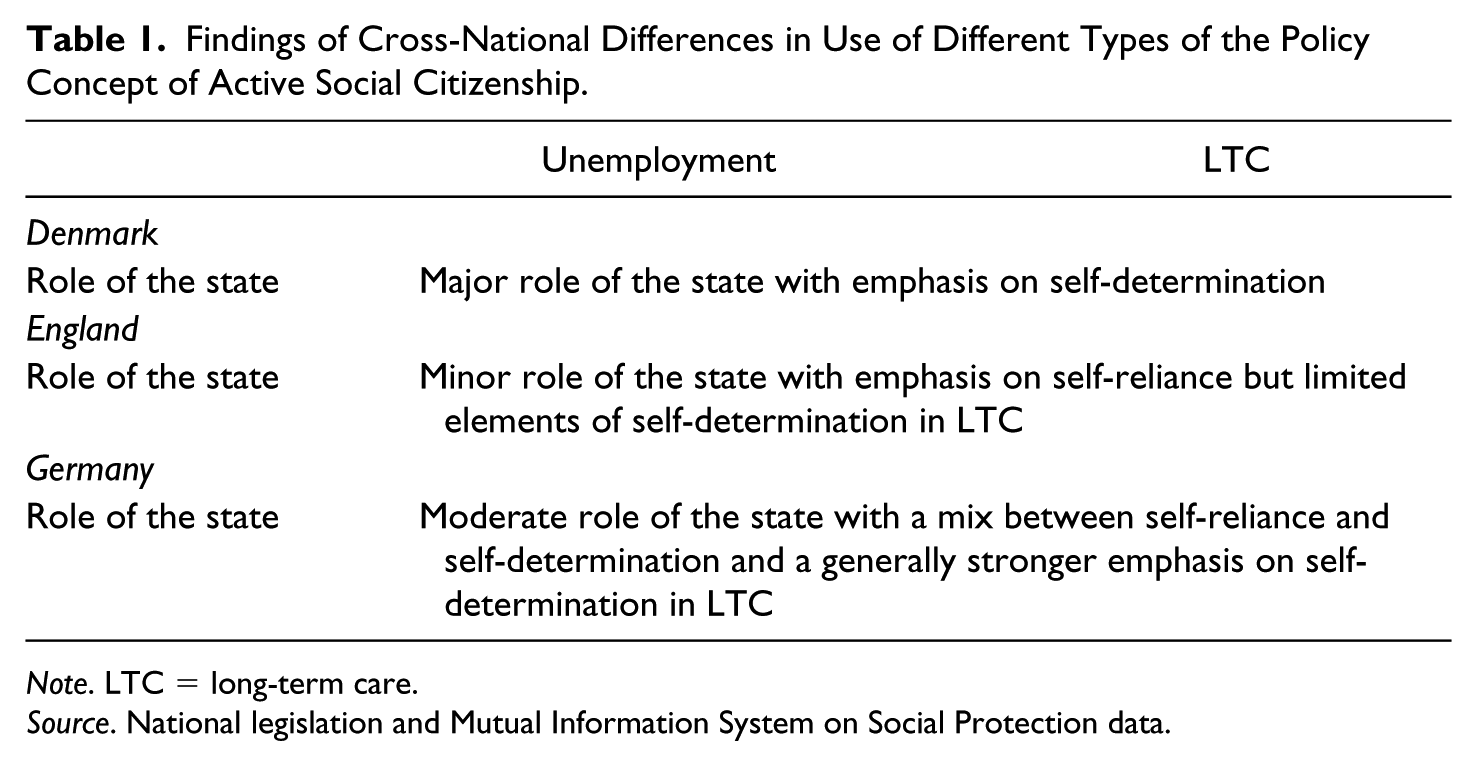
Note. LTC = long-term care.
Source. National legislation and Mutual Information System on Social Protection data.
Unemployment Policies
Denmark
Policy concept toward active social citizenship
Within Danish unemployment policy (Consolidation Act on Unemployment Insurance, 2017), citizens must have paid at least 52 weeks’ contributions into the voluntary contribution scheme which is equally funded by employees’ contributions and taxes in order to receive unemployment benefits (Andersen, 2011; Bengtsson, 2014). After generally 1 year of unemployment, the unemployed have to participate in mandatory activation programs including support for training, (re)education and assistance with the job seeking. Although active job seeking is expected, in principle, the public work agency is responsible for offering new jobs to the unemployed. Unemployed citizens are required to accept any job offer independent of occupational protection and mobility (4 hours of daily travel time can be required; Aurich, 2011; Bengtsson, 2014). The noncompliance with these requirements can lead to sanctions and the temporary suspension of unemployment benefits (MISSOC, 2018).
The Danish welfare state provides generous unemployment payments of 90% of the recipient’s previous salary for up to 2 years and therefore plays a major role (Andersen, 2011; Bengtsson, 2014). The welfare state organizes and funds generous active labor market policies and is dedicated to supporting the fulltime employment of parents by offering a universal right to full-time child care and generous parental leave of up to 1 year (Eydal & Rostgaard, 2011). Persons without entitlements to unemployment benefits receive tax-funded and means-tested social assistance of around 60% of the maximum unemployment benefit (80% for parents; MISSOC, 2018).
Therefore, it is possible to conclude that the welfare state plays a major role in Denmark with regard to the funding of unemployment benefits and social services. The state promotes the self-responsibility of active social citizens as described in the self-determination type of the policy concept toward active social citizenship.
England
Policy concept toward active social citizenship
Within the English unemployment policy, unemployed persons are entitled to a contribution-based Jobseeker’s Allowance (JSA) for 6 months if they previously earned more than €736 per month and had paid National insurance contributions for at least 2 years prior to their unemployment (Jobseekers Act 1995, 2014). 3 Contribution-based JSA can vary with the unemployed persons’ age, partnership status, and time of contribution but eligibility is independent of household savings or the work situation of the partner. Income-based JSA/Universal Credit 4 on the other hand is a tax-funded benefit and strictly means-tested for persons who work less than 16 hours per week (with a partner working less than 24 hours per week) and whose household income and savings are less than €17,788 (£16,000; see Andersen & Jensen, 2002). 5 Unemployed claimants have to agree to a “Claimant Commitment,” which includes requirements such as frequent meetings with a “job-coach,” proof of job-seeking and work programs (Dwyer & Wright, 2014). Furthermore, claimants can be forced to participate in voluntary work in the general public interest in exchange for their unemployment benefits.
The English welfare state plays a minor role in the context of unemployment policies. The amount that is paid in the different unemployment schemes is €332 per month for a single person and €522 per month for a couple (MISSOC, 2018) which is low in comparison with some other countries and close to the U.K. poverty threshold. People can receive additional welfare state support for housing-costs or heating. However, the state plays a stronger role in controlling and forcing persons who receive means-tested benefits to return to the labor market. If the unemployed person does not comply with the requirements (participation in “work trials” or work programs), the benefit could be reduced or suspended for 4 weeks to 3 years at a maximum (Dwyer & Wright, 2014). The state also plays a minor role in offering full-time child care in order to promote parents’ return to the labor market and tax deductions (e.g., Child Tax) for those employed in order to increase female employment and make child care more affordable (MISSOC, 2018).
Overall, the English welfare state has only a minor role regarding the funding of unemployment benefits and services because it offers only limited financial support and rather forces unemployed persons to assume self-responsibility based on the self-reliance type.
Germany
Policy concept toward active social citizenship
The German unemployment system has two different systems of unemployment benefit: “Unemployment Benefit I” (UB I) or “Unemployment Benefit II” (UB II).
Unemployment Benefit I: In order to receive benefits, all employed persons (with previous earnings higher than €450) have to have paid unemployment insurance contributions for at least 12 months in 2 years prior to their unemployment. The unemployment insurance is equally cofunded by contributions of employers and employees. Recipients of UB I enjoy some occupational protection and can be supported by active labor market programs such as job training, education, or subsidized job offers (Social Code III [SGB III], n.d.).
Unemployment Benefit II: Persons with no or very low employment income are entitled to UB II, a means-tested flat-rate payment which requires greater self-responsibility. Before being eligible for benefits, nearly all of the claimant’s financial resources (e.g., savings, assets, real estate, and share of the partner’s income) must be exhausted. Recipients of UB II have to agree to an “Integration Agreement” with the Employment Agency and fulfill the outlined requirements such as active job-seeking and regular meetings with case managers. Since there is no substantial occupational protection, recipients of UB II must accept almost every work offer and participate in programs provided by the job center such as voluntary work in the general public interest for a low salary (“1-EURO-jobs”). Failure to comply may lead to sanctions and benefits can be reduced or even stopped for a certain time (Social Code II [SGB II], n.d.).
The welfare state has a relatively strong responsibility for recipients of UB I, but a relatively low responsibility for recipients of UB II, since the persons eligible to UB I are entitled to 67% (parents) and 60% (childless persons) of their previous income taken as a 12-month average (SGB III, n.d.)., while recipients of the means-tested UB II receive €416 per month as well as additional costs for housing and heating (SGB II, n.d.), a sum which is slightly below the poverty line. Due to the strict means-testing, UB II only targets persons with very limited savings and no or very low income. The welfare state funds and partly provides all services of the Employment Agency such as case management or active labor market programs (MISSOC, 2018). It also supports the full-time employment of parents by offering a universal right to full-time child care and earnings-related parental leave (67%) for about 1 year (Leitner, 2013).
Therefore, it can be argued that the German unemployment policy is based on a mix of both types of the policy concept of active social citizenship. While self-responsibility of short-term unemployed (UB I) is underpinned by a major role of the state based on the self-determination type, long-term unemployed (UB II) are forced to be self-responsible based on relatively low benefits and strict eligibility conditions within the self-reliance type.
LTC Policies
Denmark
Policy concept toward active social citizenship
The LTC system in Denmark provides universal cover for the care needs of older people (Consolidation Act on Social Services, 2015). It is mainly the task of the municipalities to organize care provision. However, active social citizens can choose their preferred care provider from a range of options in which commercial providers play only a minor role (Bertelsen & Rostgaard, 2013). Families are only considered responsible for the care provision of older relatives to a limited degree, since generous and comprehensive extra-familial care is available. Older persons in need of care are required to improve their own health status where appropriate by participating in reablement measures in order to receive further forms of LTC (Rostgaard, 2015).
The Danish welfare state has a major role regarding the provision of very comprehensive extrafamilial care, since all costs for care needs and further costs (e.g., housework and reablement) are covered regardless of employment status or previous contributions. The organization of older persons’ care arrangements is mainly a state responsibility, but municipalities offer help and information regarding the decision-making process (MISSOC, 2018). The state plays also a major role in offering social rights for family members to provide care for their relatives based on generous pay and social security entitlements. Against the background of a generous extra-familial care system, the provision of family care is however an option but not an obligation (Frericks, Jensen, & Pfau-Effinger, 2014).
In the Danish LTC policy, the welfare state plays a major role in that the state very generously funds and organizes the LTC and supports active social citizens to adopt self-responsibility, instead of forcing them. This type of policy relates to the self-determination type.
England
Policy concept toward active social citizenship
Within the English LTC policy, active social citizens are strongly framed as self-responsible regarding their care arrangement. The LTC system is strictly means-tested and oldest persons must contribute to or even cover entirely their total care costs (MISSOC, 2018). Older persons in need of care must organize the majority of their own care provision by themselves (Care Act, 2014). They must gather the necessary information and choose their appropriate care provision from the care market or negotiate the conditions of their care arrangement with caring family members or personal carers. In addition, since older persons are often not able to pay for their care arrangement, their families often have to take responsibility for the care provision of their relatives (Glendinning, 2013). The improvement of one’s own health status by reablement is also promoted and partly a precondition for receiving other forms of LTC.
Overall, the state has rather a minor role in the English LTC system, since the public funding of care, including care by family members is limited to persons with lower income and limited private assets. However, the state has a major role in helping social citizens act as “consumers” by providing information, case management and monitoring. Nonetheless, the state does not ensure a high transparency of quality on care markets (Glendinning, 2008). There is also stronger state support for the older citizens’ universal right to improve their own health by rehabilitation (Wilde & Glendinning, 2012).
Overall, the English LTC policy is based on the self-reliance type due to a minor role of the state, especially because the funding forces a large number of older persons in need of care to be self-reliant for funding and organizing their own care arrangements.
Germany
Policy concept toward active social citizenship
Within the German LTC policies, older people in need of care must choose whether they want to receive care from home care services, in residential care or by family members, or members of their social network. They must organize their own care provision by collecting relevant information, choosing an appropriate care provision from the care market and/or negotiating the conditions of their care arrangement. While the state is mainly responsible for covering the basic care needs of older persons who receive home care services, those in residential care homes must pay around half of the total costs, because of relatively high costs for board and lodging (Social Code XI [SGB XI], n.d.). Only low-income groups are eligible for public cofunding based on social assistance. Family members are often regarded as responsible for care provision, but can receive payments for providing care. Although family care is not mandatory, the institutional design of care policies conceptualizes family care as an integral part of the LTC system to fill care gaps in the provision of household services or 24-hours care (Theobald & Hampel, 2013). Older people also have the option to improve their health status by participating in reablement measures.
Overall, the German welfare state plays a moderate role in the funding and organizing of care. The public LTC insurance offers support for extrafamilial care, regardless of the previous employment status or contributions. The costs for the basic care needs are covered, but not the costs for housework and household services (Frericks et al., 2014). However, active social citizens do not receive support in organizing their care arrangement. Furthermore, the state relatively strongly supports care by family members and acquaintances by offering them pay and social security entitlements. The state also promotes reablement measures for older persons in need of care (MISSOC, 2018).
Therefore, it can be argued that the policy concept of active social citizenship in the German LTC policy is mainly based on a moderate use of the self-determination type that underpins the self-responsibility of the active social citizen by a moderate role of the state regarding the funding and organizing of care.
Discussion
According to our theoretical assumptions, the ideal-typical differences in the welfare regime types according to Esping-Andersen’s (1990) classification approach and country-specific differences in welfare culture (Pfau-Effinger, 2005) may contribute to an explanation of cross-national differences in the use of the policy concept of active social citizenship.
The findings of all three countries show that the welfare states differ with regard to the type of the policy concept of the active social citizen. While Denmark underpins the concept of active social citizenship in both policy fields with a major role of the state based on the self-determination type, the English welfare state has in both policy fields a minor role and bases the policy concept of active social citizenship on the self-reliance type. Both welfare states have a similar way of using the policy concept in the two policy fields, which is apparently based on a superordinate social policy orientation in each of them. However, Germany applies partly both the self-reliance type (with a minor role of the state) and the self-determination type (with a major role of the state) in the field of unemployment policies. With regard to LTC policies, the German welfare state encourages self-determination by active social citizens.
The Role of the Welfare Regime Typology
The findings show that the particular ways, in which the Danish and the English welfare states are framing the policy concept, correspond substantially with the differences between the social democratic and the liberal welfare regime types. The way in which the German welfare state is using the policy concept is only partly characteristic for the conservative welfare regime, while it is also characteristic for the liberal and the social democratic welfare regime.
The Danish welfare state has a major role in ensuring social rights of the unemployed and LTC recipients, which is in each case based on the self-determination type that corresponds strongly with the basic characteristics of the social democratic welfare regime type. Danish unemployment policy corresponds to a high degree with the basic characteristics of the social democratic regime type in which a generous decommodification “frees” people in working age from being forced to participate in the labor market, while at the same time active labor market policies help unemployed persons maintain their employability and reenter the labor market. The generous LTC policy which is also based on the self-determination type can also be linked to the characteristics of the social democratic welfare regime that refer to universal access to services, a high-standard provision of social services and a dedication to extra-familial care services in order to promote female participation in the labor force.
The English welfare state uses in both policy fields the self-reliance type that is based on a minor role of the state regarding the promotion of social rights of unemployed and older persons in need of care, which matches well with the characteristics of the liberal regime type. On the one hand, within the current English unemployment policy, the welfare state strictly targets only those with the lowest means and the highest poverty risk, while the rest of the long-term unemployed have no alternative than to be self-reliant in funding themselves. This policy also differentiates between “deserving” short-term unemployed and “undeserving” long-term unemployed who are subject to a variety of behavioral expectations in order to prove their worthiness to receive benefits. This differentiation has a long tradition in liberal welfare regimes.
On the other hand, within the English LTC policy the minor role of the state relates primarily to the prevention of poverty by strict targeting of the benefits so that older care-dependent persons must rely on their own savings for the funding of their care provision. The welfare state will only intervene in funding or providing care services if those older persons in need of care have exhausted their personal savings and financial resources. Prior to that, they are forced to be self-reliant. However, the state shows a stronger engagement with regard to supporting the active social citizens in the organization of the LTC that resembles some elements of self-determination.
The German welfare state shows in comparison to Denmark and England a mixed use of the policy concept of active social citizenship: while some policies are based on the self-reliance type due to a minor role of the state, other policies are based on the self-determination type because of a major role of the state. The findings match with our theoretical assumption that we would typically find a mixture in the use of the different types of the policy concept in a conservative welfare state like Germany. However, the main features of this mixture in the German welfare state deviate from our main assumption according to which the self-determination type would be more relevant in policies for unemployed people and the self-reliance type would be characteristic for the field of LTC policies for older people.
The German unemployment system is based on both types of the policy concept. On the one hand, the state plays a major role regarding insured short-term unemployed (UB I), which still corresponds with the characteristics of the conservative regime that aims at the status maintenance during short-term periods of unemployment. On the other hand, the use of the self-reliance type regarding recipients of UB II, can only be linked to the characteristics of the conservative regime type to a limited degree. It contains features of the liberal regime type such as stricter means-testing, since the long-term unemployed have to exhaust most of their financial resources before being eligible for an unemployment payment which is close to the poverty level.
The use of the self-determination type in the German LTC policy, which is mainly also based on a major role of the welfare state for the funding of LTC, can also hardly be explained by reference to the characteristics of the conservative welfare regime type. In general, welfare states of the conservative regime type would mainly rely on unpaid care by (mainly female) family members within the family model of the male-breadwinner. However, the comparatively generous funding of extra-familial care and the stronger orientation toward the citizens’ self-responsibility deviates significantly from conservative characteristics and refers rather to characteristics of a social democratic welfare regime based on generous public funding of social services and an aim to support female employment. Only the option of paid familial care might sometimes indicate traits of the orientation toward family care that is characteristic of the conservative regime type.
The Role of Cultural Ideas
In Denmark the use of the self-determination type can mostly be explained by cultural ideas about universalism and social equality that are typical for the social democratic type of welfare regime. Neoliberal ideas are not relevant in both policy fields regarding the policy concept of active social citizenship. Regarding the Danish unemployment policy, it seems that modernized social democratic cultural ideas of the social investment paradigm are of relevance according to which generous social rights should be combined with positive incentives to support the labor market participation of its citizens (Morel, Palier, & Palme, 2013).
Likewise, the strong orientation toward extra-familial care in LTC policies can be linked to a traditional social democratic etatist culture and gender egalitarian ideas, since the generous extra-familial LTC provision potentially promotes female labor force participation by offering an option not to provide care. However, the treatment of family care as paid work, which can be connected with feminist ideas of ensuring the financial autonomy of family caregivers, somewhat deviates from the typical characteristics of the social democratic regime type. It indicates that there is a relatively new gender culture to which the Danish welfare state policies refer and which is based on the cultural idea that gender equality should not only aim at equality in employment but also at gender equality with regard to family care (Eggers, Grages & Pfau-Effinger, 2018). The pronounced significance of self-responsibility for the maintenance of one’s own health status and mental capacities is, however, an element that breaks with the traditional principles of the social democratic model and instead fits with the modernized social democratic welfare culture according to Stjernø (2008) and the Scandinavian line of the social investment paradigm (Léon, Ranci, & Rostgaard, 2014).
In England, however, the strong emphasis on the self-reliance type in both policy fields can clearly be linked to neoliberal cultural ideas that largely correspond with the characteristics of the liberal regime type. According to neoliberal ideas, unemployed persons are considered to be “rent-seeking” in that they would rather take unemployment benefits than participate in the labor market, unless the state sets negative incentives and conditions to “make” them work (Whitworth, 2016). Any work is regarded as better than none and almost everyone in working age—including persons with disabilities and persons with work but low incomes—are expected to find employment in order to be independent of welfare state support (Dwyer & Wright, 2014).
Within the field of LTC policies, the strong orientation toward the self-reliance type is also mainly based on neoliberal ideas in that older persons in need of care are to a large extent framed as self-reliant consumers of their own care provision (Glendinning, 2008). On the one hand, this could be explained by neoliberal ideas according to which LTC services are commodities like any other good that can be bought on the market. On the other hand, the stronger emphasis on self-responsibility can partly also be linked to libertarian ideas, which assume that rights and human dignity of people in need of care are best guaranteed on the basis of their personal autonomy and free choices. The option of paid family care may be linked to conservative ideas according to which individuals should support their family members. However, based on the low generosity of support for paid family care, this could also be viewed as a side-effect of neoliberal ideas, which force people to rely on cheap alternatives to professional care.
The findings regarding the role of cultural ideas in Germany for the use of the concept of the active social citizen only partially support the theoretical assumption that its use is mainly based on neoliberal ideas. The policy concept is based on the self-reliance type with regard to policies toward long-term unemployed (UB II), which can indeed be explained by a relatively strong orientation toward neoliberal ideas. According to these ideas, unemployed persons are mainly regarded as egoistic and “rent-seeking” in that they would rather live on benefits than participate in the labor market (Butterwegge, Lösch, & Ptak, 2008). Therefore, the role of the state is seen as providing mainly negative incentives such as strict targeting, workfare and very limited benefits in order to force the unemployed to reenter the labor market. In that sense, any work is considered better than none.
However, LTC policies in Germany are mainly based on the self-determination type. They are based on a cultural orientation toward an etatist culture regarding the option of older people in need of care to choose between paid care by family members and extra-familial care services. The autonomy of older persons to choose their own care arrangement can on the one hand be explained by the role of libertarian ideas according to which human dignity and rights of social citizens are best guaranteed on the basis of personal autonomy and free choices (Eggers, Grages, & Pfau-Effinger, 2018). Gender egalitarian ideas played also a role, since the option of extra-familial care “frees” the mainly female caring family members of their caring obligation, while the pay for family care ensures their financial autonomy if they choose to provide the care by themselves. The public pay for family care, is partly based on gender egalitarian and feminist ideas to ensure the financial autonomy of the mainly female family carers, while the relatively generous provision of extra-familial LTC potentially promotes female labor force participation. However, since the pay and social security of caring family members is still not equal with formal employment, it could also be argued that conservative ideas about the family as the main provider of care still prevail, although the decision about which care should be provided is left open to the care recipients and their families.
Conclusion
In the theoretical debate about the role of active social citizenship in European welfare states an analytical approach that systematically differentiates between different ways in which welfare states use the policy concept of the active social citizen in social policies has been missing. Furthermore, research that aims at the explanation of cross-national differences in the use of the policy concept are also rare. This article has therefore attempted to answer the questions of how far European welfare states differ in their use of the policy concept, and how far it is possible to explain the differences with the welfare regime typology and welfare culture.
The article has distinguished between two different types of the concept of active social citizenship with regard to the role of the state vis-à-vis the active social citizens’ self-responsibility. It has argued that the active social citizen’s self-responsibility could be underpinned either by a major role of the welfare state, which would promote the self-determination of the citizens, or by a minor role of the state, which would rather force citizens to be self-reliant in funding and organizing their own social security and services.
According to the main theoretical assumptions concerning the role of the welfare regime typology, social democratic welfare states apply the policy concept primarily in the meaning of self-determination based on a major role of the welfare state, while liberal welfare states connect it with a minor role of the state, conceptualizing it as self-reliance. In contrast, conservative welfare states are assumed to show an orientation toward self-reliance in LTC policies and an orientation toward self-determination in unemployment policies. The findings of a cross-national comparative study for two policy fields (unemployment and LTC policies for older people) in three welfare states (Denmark, England, and Germany), which was based on analysis of the legal framework, data from MISSOC and secondary literature, support this argument only in case of Denmark and England, whereas the findings deviate in part from our assumptions in the German case.
They show that welfare states of different regime types use the policy concept in different ways regarding the role of the welfare state. England uses the self-reliance type and underpins the active social citizens’ self-responsibility in both policy fields with a minor role of the state, while Denmark applies the self-determination type based on a major role of the state. Germany represents a mixed case regarding the role of the state. It uses the self-determination type in LTC policies for older people and in policies for short-term unemployed people and the self-reliance type in policies for long-term unemployed people.
The findings also indicate that differences in welfare regime types contribute to some degree to the explanation of the differences in the ways in which the policy concept is used. Especially the findings for the Danish and English welfare states show that their use of the policy concept of the active social citizen more or less corresponds to the ideal-type of the social democratic, respectively, the liberal welfare regime types. The German welfare state uses a mix of the self-determination and self-reliance type which in part cannot be explained by the characteristics of the conservative regime type.
The findings concerning the role of welfare culture for the explanation support the main assumptions for England and Denmark. The policy of the active social citizen is based on neoliberal ideas, which are to some extent combined with a mix of both libertarian and conservative ideas in England, and it is mainly based on a combination of traditional and modernized social democratic etatist culture, which is complemented with gender egalitarian ideas in Denmark. They findings to not match our assumption that the use of the concept of the active social citizen in the German welfare state is mainly based on neoliberal cultural ideas. Instead it is based on a combination of neoliberal and conservative ideas in the field of unemployment policies and on a mix of libertarian, gender egalitarian and modernized social democratic etatist ideas in the field of LTC policies.
The article makes a new contribution to the scientific debate in that it distinguishes between two different types of the policy concept of the active social citizen, the self-determination type and the self-reliance type, which differ with regard to the role of the welfare state. It is also innovative in that it offers new findings about differences between welfare states concerning the type of the concept of active social citizenship that they use, and the role of welfare regimes and welfare culture for the explanation.
Footnotes
Declaration of Conflicting Interests
The authors declared no potential conflicts of interest with respect to the research, authorship, and/or publication of this article.
Funding
The authors received no financial support for the research, authorship, and/or publication of this article.