



Abstract
This study develops a technosocial framework for assessing the efficacy of global aid agencies’ use of Twitter’s algorithmic affordances for participatory social change. We combine computational and interpretive methods to examine tweets posted by three global aid agencies—U.S. Agency for International Development, Swedish International Development Cooperation Agency, and the International Committee of the Red Cross—as well as public tweets that mention these agencies (N = ~100,000). Results indicate that when an agency (a) replies to or retweets public tweeters, (b) includes publicly oriented hashtags and hyperlinks in its tweets, and (c) tweets about topics that the public is also interested in and tweeting about, the social network that develops around the agency is more interconnected, decentralized, and reciprocal. Our framework can help development institutions build more participatory social networks, with multiple voices helping determine collective goals and strategies of collective action for sustainable social change. We also discuss the theoretical implications and methodological significance of our approach.
Keywords
Public engagement is a key objective of institutions that aim to bring social change, such as global aid agencies (see Denzin, 2009; Smith & Gallicano, 2015). Effective engagement can enable these agencies to develop a grounded understanding of the needs of local communities and devise their social change priorities and strategies accordingly (Cooke & Kothari, 2001). However, public engagement tends to be more rhetoric than reality (Drydyk, 2005). Building social networks based on formal and informal ties with communities is the key. Such networks can help in two ways. They can serve as channels of interaction and reciprocal communication between agencies and communities (Waisbord, 2015). These networks can also allow agencies to listen to communication between community members themselves and learn organically about what they need and how those needs could be met (Bryson, 2018; Karpf, 2016).
Social networking sites (SNSs) like Twitter present aid agencies with an exciting opportunity to build social networks with communities around the world (Aaker & Smith, 2010). SNSs have become globally popular in a short time (Chaffey, 2016). Their interactive potential makes them channels of reciprocal communication, allowing agencies to not only transmit information to communities but to also hear back from them. In addition, agencies can listen in on communication among community members taking place on these networks. Therefore, building online social networks that facilitate such conversations can be an effective means for agencies to improve both the level and quality of public engagement.
This study brings together the insights of recent public relations scholarship on SNSs and ideas from network theory to develop a technosocial framework for assessing and improving global aid agencies’ public engagement online. Our framework is “technosocial” because it utilizes the technological affordances of an SNS like Twitter in inherently social ways—and with an eye on larger objective of social change. We adopt the emerging “ecological view” in public relations, which draws attention to the embeddedness of institutions and individuals within larger networks of social relations and focuses on the constitutive process through which they (re)shape each other’s capacities (Himelboim, Golan, Moon, & Suto, 2014; A. Yang & Taylor, 2015).
Our empirical analysis proceeds in three stages. First, we compare how three major aid agencies—the U.S. Agency for International Development (USAID), Swedish International Development Cooperation Agency (SIDA), and the International Committee of the Red Cross (ICRC)—use Twitter. The purpose is to identify differences in their adoption of various technological affordances of Twitter, including the content of Twitter posts as well as structural features like replies, retweets, hashtags, and hyperlinks. Next, we compare how the public engages with these agencies on Twitter—using multiple social network metrics that indicate how “participatory” such engagements are. Finally, we draw on both these analyses to infer how different ways of using Twitter’s affordances by agencies can shape the degree and quality of public engagement.
Our study has theoretical, practical, and methodological significance. The technosocial framework we develop may be used to study public engagement practices of other aid agencies as well as other types of institutions engaged with the public. In addition, aid agencies and other institutions may themselves apply this framework to improve public engagement online. Our comparative research design and the analytic difference we make between outbound tweets posted by agencies and inbound public tweets that “mention” these agencies can help network analytic research move beyond description to inference. Finally, our mixed-method approach, a combination of computational and interpretive techniques that enables us to closely investigate the content as well as the structural features of Twitter conversations, offers a template for holistic analysis of SNSs (Brock, 2018; Moser, Groenewegen, & Huysman, 2013).
Review of Literature
Twitter and Its Affordances
A decade ago, boyd and Ellison (2008) defined SNSs as web-based services that allow individuals to construct a public or semi-public profile within a bounded system, articulate a list of other users with whom they share a connection, and view and traverse their list of connections and those made by others within the system. (p. 211)
We broadly agree with this frequently employed definition, but would add two vital features that it excludes. One, SNS users are not just “individuals;” they may also be “institutions” of various types, from news channels and private companies to political parties, interest groups, nongovernmental organizations, and aid agencies (Gil de Zúñiga, Jung, & Valenzuela, 2012). Two, individual and institutional users do not simply “traverse their list of connections” on SNSs but perform a wide range of social actions that engage these connections in varying degrees—indeed, one can say that the purpose of forging social connections on SNSs is to engage them in such actions (Hoffmann, Lutz, & Meckel, 2016).
An affordance is “an action possibility available in the environment to an individual, independent of the individual’s ability to perceive this possibility” (McGrenere & Ho, 2000; see also Gibson, 1979). Each SNS creates its own environment—or what boyd and Ellison called “bounded system”—with its own set of affordances, although a number of affordances are common to many SNSs. Twitter, launched in 2006, has become one of the most popular SNSs worldwide on account of its wide range of affordances (Chaffey, 2016). Twitter users, called tweeters, can publish short posts of up to 280 characters, called tweets, which pop up on the Twitter feeds of other users. Posting tweets with textual or audio-visual content is therefore one of Twitter’s most basic affordances. Tweets can include hashtags signifying keywords ( . . . #keyword . . . ) that allow other users to easily find their tweets, as well as hyperlinks ( . . . https:// . . . ) to other websites. In addition, users can reply to other users (@username . . . ), or they can retweet other users’ tweets (RT @username . . . ).
Posting of tweets, hashtags, hyperlinks, replies, and retweets constitute Twitter’s affordances, or “action possibilities” that exist within the Twitter environment irrespective of users’ knowledge or perception. However, each of these affordances can have multiple interpretations, which are more perceptual in nature. For instance, publishing a tweet can be a means of sharing information—but it can also be a means of forging a bond with one or more users on Twitter, participating in a protest and so on (Bennett & Segerberg, 2013). Similarly, retweeting another user’s tweet can suggest endorsement of the views expressed in the tweet—but it can also imply quite the opposite (Metaxas et al., 2015). Thus, while Twitter provides a number of action possibilities or affordances, these affordances may be used for multiple purposes and can have multiple social meanings (Evans, Pearce, Vitak, & Treem, 2016; Rathnayake & Suthers, 2018). It is therefore apt to consider these affordances as not just technological but “technosocial” in character. We will begin our empirical inquiry by investigating,
Networked Participation
Global aid agencies aim to promote social change, or “the reduction of social inequalities and the provision of opportunities particularly for people who have few choices” (Waisbord, 2015, p. 146). Instead of modular one-size-fits-all solutions for different societies, social change favors the adoption of multiple, culturally sensitive solutions that address a wide range of issues, including poverty, race, gender inequality, health, education, and so on (Pillai & Maleku, 2015). This requires a bottom-up approach—based on listening to local communities and understanding their concerns from within before coming up with strategies to deal with those concerns (Drydyk, 2005).
Public participation is a “political . . . process where the actors involved in decision-making processes are positioned towards each other through power relationships that are (to an extent) egalitarian” (Carpentier, 2012, p. 175). Carpentier adds that the participatory process unfolds through the juxtaposition of access and interaction. Organizations need to offer citizens access by ensuring their presence within the organizational structure, including media production spaces. Interaction, meanwhile, relates to the “social–communicative relationship” that organizations establish with public participants.
In other words, public participation is the process by which organizations transform from institutions to networks. An institution “refers to macro-political forms of power that primarily rely on vertical organization and concentrate decision making and ideological production in particular positions” (Servaes & Hoyng, 2017, p. 260). As a result, institutions typically have low levels of public participation. In contrast, networks are “micro-political forms of power that primarily rely on lateral communication and interaction” (p. 260). Public participation is higher in networks. But network topology varies: some may be more centralized and others more dispersed. Our study will therefore examine,
Affordances and Participation
Yang and Ott (2016) identify two “governing rules for participation”: the market norm, under which organizations offer people monetary incentives to participate, and the social norm, under which people participate for “maintaining communal relationships with others” on grounds such as altruism, politeness, and reciprocity (p. 833). Their experimental study argues that individuals can be just as motivated by the social norm as they are by monetary compensation. However, “unless people feel properly recognized and acknowledged (by the organization), they will not take actions to participate purely on account of altruism or reciprocity” (Yang & Ott, 2016, p. 839). These findings substantiate long-standing views in public relations about “recognition” and “appreciation” being the key for people to participate in communal activities (Clark & Mills, 1979).
Studies of organizations built around digital technologies, such as Wikipedia and benevolent hacker movements, also indicate that organizational practices and communication strategies directly influence public participation (Fieseler & Fleck, 2013). Organizations that are more open, transparent, and willing to delegate decision-making power to the public are able to generate higher levels of participation (Bandura, 1977). Bowen et al. (2010) describe these approaches as marking a shift “from one-way information sharing, through two-way dialogue and collaboration, to community leadership or empowerment” (p. 304).
This shift corresponds with Grunig and Hunt’s (1984) classic typology of public relations models. The typology includes two models of “one-way communication”: the press agentry model that relies on propaganda by any means through mass media and other channels, and the public information model that typically provides accurate information but also holds back negative information from the public. These models are typically not very effective. As organizations realized this, they turned to dialogic or “two-way communication,” which is also of two types: the asymmetric model, where organizations use dialogic strategies instrumentally to change public behavior for their own benefit, and the symmetric model, in which organizations communicate with the public in order to develop shared meanings for a mutually beneficial relationship. Essentially, the shift from one-way communication to asymmetric and finally symmetric communication reflects the transformation of an organization from an institution into a network through the devolution and decentralization of power.
Several scholars have employed Grunig and Hunt’s (1984) typology to understand the use of SNSs like Facebook and Twitter by nonprofit organizations. Cho, Schweickart, and Haase (2014) content analyzed the Facebook posts of 36 U.S.-based nonprofits. They found “high levels of engagement with organizational messages when two-way symmetrical communication is used, compared to public information or two-way asymmetrical models” (Cho et al., 2014, p. 565). But despite the effectiveness of two-way symmetric communication, most studies suggest that nonprofilts typically employ the one-way models or the asymmetric model. For instance, in Lovejoy, Waters, and Saxton’s (2012) analysis of tweets posted by 73 nonprofits, only 20% of tweets demonstrated conversations with the public and only 16% attempted to make indirect connections with particular Twitter users. They concluded that “nonprofits are primarily using the site to relay information using one-way communication” (Lovejoy et al., 2012, p. 316). Similarly, Waters and Jamal’s (2011) study found that “[r]ather than capitalizing on the interactive nature and dialogic capabilities of the social media service, nonprofit organizations are primarily using Twitter as a means of sharing information instead of relationship building” (p. 323).
This body of research makes it obvious that the manner in which an aid agency uses an SNS like Twitter can shape the level and quality of public participation with the agency. In this study, we examine this relationship at the level of affordances so as to better understand how each affordance influences public participation. This enables us to develop a multidimensional technosocial framework that (a) specifies the relationship between different technosocial affordances of Twitter and public participation and (b) helps strategize how each affordance may be used by aid agencies to improve the level and quality of public participation. Therefore, we finally ask,
Method
Research Design and Data Sampling
This study uses a “most different systems” design of comparative inquiry (Przeworski & Teune, 1970). Systems are understood as spatially or temporally defined networks of social relationships. The specific systems—or cases—examined in such a study are of the same type (e.g., nation–states, social networks) but differ substantially in terms of their sizes, structural features, and other properties. The purpose of the empirical analysis is to match the variation across systems in the values of a particular property with a corresponding variation across systems in the values of another property. Formally speaking, in a study of three most different systems, say “1,” “2,” and “3,” with properties “a,” “b,” “c,” . . . “z” that have very different values in each system, if y1 > y2 > y3 and x1 > x2 > x3, then “x” is likely to be the explanation for “y” as there are no other parallel relationships. In other words, the vast differences across the three systems serve as a “control” for other possible explanations of “y.” It means that any of these systems could increase the value of “y” by raising the value of “x.” Moreover, the relationship between “x” and “y” is expected to be generalizable to other systems. Of course, the relationship should be theoretically and logically explicable, or else it would simply be an example of spurious correlation.
In this study, systems are defined as temporally bound Twitter networks formed around the handles of particular aid agencies. Each system comprises two components: tweets posted from that agency’s Twitter handle (outbound tweets) as well as tweets posted by other Twitter users in which that agency’s handle is “mentioned” (inbound tweets). By comparing the agencies’ use of various Twitter affordances in their outbound tweets (Research Question 1) and then comparing public engagement with these agencies in terms of various network variables in their inbound tweets (Research Question 2), our analysis aims to explain how differences in the use of Twitter affordances matched with differences in the level and degree of public participation (Research Question 3).
We chose USAID, SIDA, and ICRC as the three cases for our study. While each of them is a major aid agency engaged with projects of global social change, they are also quite different from each other. USAID is a U.S. government agency that administers civilian foreign aid. Created in 1961, it works closely with various divisions of the U.S. government and counts “the promotion of U.S. foreign policy interests” as a key objective. As of 2016, it had a funding of $22.7 billion and staff working in more than 100 countries around the world (USAID, n.d.). SIDA was created in 1965 and works under the Swedish ministry for foreign affairs. It focuses on 33 partner countries around the world and is funded by a “guarantee portfolio” worth ~$368 million (SIDA, 2015). ICRC is a Geneva-based international organization that works with multiple governments and nongovernmental organizations worldwide and has staff in more than 80 countries. Created in 1863, its 2015 budget was $1.85 billion (ICRC, n.d.).
Tweets were collected over 3 months (from July to September, 2016) through the social data mining platform Netlytic.org, which uses the Twitter REST API v1.1 (Gruzd, 2018). The API has a cap of 1,000 tweets per 15 minutes, which is well above the frequency at which the tweets were posted (Gruzd, Mai, & Kampen, 2016). The corpus comprises six data sets. Three of these are outbound data sets of tweets posted by USAID, SIDA, and ICRC’s primary Twitter accounts—@usaid, @sida, and @icrc. These include 756, 466, and 513 tweets, respectively. The other three are inbound data sets of public tweets that mentioned any of these three Twitter handles in their texts. These include 40,100 (mentioning @usaid), 5,072 (mentioning @sida), and 50,568 (mentioning @icrc) tweets. The two SIDA data sets (outbound and inbound) had a high proportion of tweets in Swedish, which were translated into English using Google Translate’s machine translation system. Although the accuracy of the translation system varies by language pairs, the English←→Swedish translation, as tested against manual translation by native speakers in a comprehensive study, is the third highest of all language pairs (Aiken & Balan, 2011).
Analysis of Outbound Tweets
The outbound data sets were relatively small in size and so were studied inductively using Glaser and Strauss’s (1967) method of constant comparison with the help of the software NVivo. Our analysis aimed to understand if the agencies were using Twitter’s technosocial affordances—content, replies, retweets, hashtags, and hyperlinks—to transmit information about themselves or to meaningfully engage with communities and build participatory social networks. As each tweet would typically focus on a particular issue, special attention was paid to the frequency of use of keywords and the specific contexts in which they were used. One of the authors carried out the initial coding of all outbound tweets and collected descriptive information regarding hashtags, hyperlinks, replies, retweets, as well as the topic of the tweets. Both authors then discussed the coding and agreed to organize the analysis along three dimensions that form the technosocial framework developed in this study.
Analysis of Inbound Tweets
While each agency’s Twitter handle is the hub of its social network, the network itself is constituted of inbound tweets that mention the agency’s Twitter handle. Two different methods were used to analyze the three inbound data sets.
Social Network Analysis
Inbounds data sets were not only much larger in size but also presented a significantly more complex structure—with multiple tweeters, each connected to multiple other tweeters through mentions in tweets and conversation patterns formed through chains of replies. These data sets were therefore studied using social network analysis, which not only allowed us to interpret their complex network structures but also use quantitative measures to compare them. Users, or tweeters, form the “nodes” of the network. When a user’s tweet mentions another user, it constitutes a “tie” between the tweeter and the mentioned user.
Network properties are analyzed on the basis of five parameters. Diameter, or the maximum number of nodes it takes to get from one node to another, is a measure of the network’s size. Degree centrality refers to the number of direct ties a particular node has within a network, and the average degree centrality of all nodes represents the network’s centralization. It is a normalized statistic; a high centralization value—closer to 1—means only a few nodes dominate the flow of information within the network. Density is the proportion of existing ties to the total number of possible ties in the network. Higher values closer to 1 suggest a close-knit network with participants talking to many others. Reciprocity is the proportion of ties that show two-way communication in relation to the total number of ties in the network. A higher value means more participants have two-way conversations in the network. Finally, large-sized network are typically subdivided into “clusters” of differentiated but overlapping subnetworks of nodes that are more likely to converse with each other. Modularity represents the degree of differentiation among these clusters. Higher values mean clusters are less likely to overlap, while lower values indicate more interconnections among the different clusters of a network (Butts, 2008; Gruzd, 2018). We used these parameters to compare the three inbound networks in terms of their structural properties. Our data mining platform, Netlytic.org’s network analysis tool was used for the analysis.
Topic Modeling
While social network analysis allowed us to interpret the network structure of the inbound data sets, it did not tell us a lot about the content of the tweets or the issues they were dealing with. To examine their content, we used topic modeling, specifically latent Dirichlet allocation—a machine learning technique that works inductively to discover “the main themes that pervade a large and otherwise unstructured collection of documents” (Blei, 2012, p. 77). The method emerged in the field of computational linguistics but is now being employed in various other fields, including media and communication studies (e.g., Jacobi, Atteveldt, & Welbers, 2016; Shahin, 2016) as well as for analyzing large-volume Twitter data (e.g., Guo, Vargo, Pan, Ding, & Ishwar, 2016). It works on the assumption that every document comprises a finite number of themes, or “topics,” that determine how words are used in relation to each other. The algorithm parses the text to yield “probabilistic models for uncovering the underlying semantic structure of a document collection” (Blei & Lafferty, 2009, p. 71). Topic modeling of a document produces two outputs: (a) a set of topics, with each topic comprising keywords that are supposed to represent a meaningful theme and (b) the proportion of use of each topic within the document. The researcher interprets how the keywords within each topic constitute a theme. Topics used in higher proportions represent the dominant themes in the text, while the remaining topics represent secondary or marginalized themes.
In this study, topic modeling was conducted separately on each of the three inbound data sets, using the Machine Learning for Language Toolkit (Mallet) software. Each inbound data set—including all the tweets mentioning an aid agency, ordered chronologically—was defined as a document. Preprocessing included lowercasing, tokenization, and removal of stopwords. We added the terms “https,” “http,” “rt,” “la,” “en,” “de,” and “el” to Mallet’s dictionary of stopwords as these terms did not contribute to the analysis. We used Mallet’s default alpha and beta parameters, which determine the prior weight of each topic within a document and each keyword within a topic, respectively. The analysis started with 10 topics and a hyperparameter optimization of 10 in each document, as recommended by the software developers (McCallum, 2002). These iterations produced four topics in each document with minuscule proportions of use (less than 1%). So we conducted the analyses again with six topics for each document. This systematic approach ensured that our models were both statistically sound and semantically meaningful.
Results
Aid Agencies’ Use of Twitter’s Affordances
The textual analysis of outbound data sets, which represented how the aid agencies used Twitter’s technosocial affordances (Research Question 1), revealed three broad dimensions across which they could be compared.
Replies and Retweets
Just over 6% of USAID’s tweets were replies to other users (see Table 1). Replies mostly addressed other official accounts, such as USAID administrator @GayleSmith, rather than members of the general public—although the exact proportion was difficult to determine as all users do not include such information in their profiles. In addition, over 26% of USAID posts were retweets—again mostly of tweets originally posted by official accounts such as @GayleSmith, @USAIDAfrica, @USAIDMiddleEast, @USAIDEducation, @WhiteHouse, @POTUS, @StateDept, and so on. For instance, a retweet posted on July 6 read, “RT @WhiteHouse: We can end global poverty and hunger within our lifetimes. —@POTUS on Congress’s vote to support @FeedtheFuture.”
Comparison of Replies, Retweets, Hashtags, and Tweet Topics in Outbound Tweets.

Note. USAID = U.S. Agency for International Development; SIDA = Swedish International Development Cooperation Agency; ICRC = International Committee of the Red Cross.
SIDA replied more often (8.6%), and its replies also appeared to address members of the public more frequently than USAID. For instance, a reply posted on September 15 read, “@robinalm Det vore kul om det här nätverket spred sig till andra länder . . . ” (@robinalm It would be great if this network spread to other countries . . . ). The tweeter replied to, @robinalm (Kung Robin), is a Stockholm-based former music producer according to the profile information. SIDA also retweeted more than USAID—indeed, nearly three fourths of its posts were retweets (339 of 466, or 72.7%). The original tweets came from both official and public accounts.
ICRC’s outbound data set was the weakest in terms of replies (0.1%). Its retweets (34.3%) were proportionally higher than USAID, but the original tweets almost always came from other ICRC accounts (e.g., @ICRC_Africa, @ICRC_NYC, @ICRC_uk, @ICRC_ye). For instance, a July 10 post read, “RT @ICRC_Africa: 3/3 Hospitals, humanitarian workers must be protected from attacks by all parties. #SouthSudan.” Another retweet, on September 30, said, “RT @ICRC_ye: More people can learn how to walk again now after our completion of the new training area at Sanaa’s Physical Rehabilitation Center . . . ”
Hashtags and Hyperlinks
The hashtags in USAID’s tweets mostly related to programs organized by USAID itself or other divisions of the U.S. government (see Table 1). The two most-used hashtags were #globaldevelopment (139 times) and #letgirlslearn (52 times). The former referred to a summit meeting on global development organized in July by the White House. The latter referred to Let Girls Learn, another government initiative. The hyperlinks in USAID tweets often led to web pages related to such programs, especially USAID’s YouTube channel.
SIDA’s most-used hashtags were #Almedalen (86 times) and #sverigeivarlden (49 times). The former referred to Almedalen Week, a gathering of political parties, lobby groups, companies, nongovernmental organizations, and the media in Visby’s Almedalen park; the latter to Sverige i Varlden, or Sweden in the World, a seminar series on how Sweden could contribute to sustainable development worldwide. Like USAID, SIDA’s hyperlinks also directed mostly to the agency’s YouTube channel or Swedish government websites.
ICRC’s hashtags mostly referred to conflict-plagued Middle Eastern nations, such as #Syria (43 times) and #Iraq (36 times). For instance, a July 5 tweet noted, “As #Ramadan ends, @PMaurerICRC calls all parties in #Syria & #Iraq to uphold human dignity: https://t.co/0VASVMiHUp https://t.co/8hO7hv8WbE.” The Twitter handle mentioned in this tweet, @PMaurerICRC, belongs to ICRC President Peter Maurer. ICRC’s hyperlinks mostly directed to pages on its own website. For instance, the two hyperlinks at the end of this tweet direct to Maurer’s statement on the ICRC website.
Tweet Topics
USAID’s tweets focused on women’s issues. The terms “girl” and “girls” were used 101 times in the agency’s outbound data set, while “woman” and “women” were mentioned 63 times (see Table 1). These tweets typically related to girls’ education and women’s empowerment. For instance, a September 7 tweet read, “POTUS: ‘When a girl gets an education not only will she grow up healthier but her children will too. Her community will prosper.’ #ObamaLaos.” Other issues mentioned frequently were food security (43 times) and health (29 times). Issues like climate change and sustainable development were rarely mentioned.
In contrast, SIDA’s tweets almost entirely focused on sustainable development, especially water shortage and water quality. The terms “water” and its Swedish form “vatten” were used 66 times in the agency’s outbound data set, while various forms of “sustainability,” including the Swedish “hållbar,” were mentioned 37 times. In addition, the hashtag #wwweek—referring to World Water Week, a global meeting on water-related issues that took place in Stockholm in August to September—was also used quite often.
In ICRC’s data set, the tweets focused on refugees and displaced people, especially in the Middle East. Various forms of “refugee” and “displaced” were used 72 times, while “war” or “conflict” were mentioned 61 times. Tweets often dealt with the impact on children. For instance, retweeting its president Peter Maurer on July 7, ICRC posted, “RT @PMaurerICRC: Another reality of #war and #displacement. Children have to fetch water or work, instead of going to school . . . ” Water shortage and water quality in war-torn regions was another focus, mentioned 41 times. In contrast, very few tweets referred to issues of girls and women.
Public Engagement With Aid Agencies
Social Network Analysis
The network graphs indicate that the inbound data set of tweets mentioning each aid agency is of a different type—an inference supported by the quantitative properties of these networks. USAID’s network has a number of small groups, represented by different colors in the network graph (Figure 1). It also has the highest modularity of the three data sets, followed by SIDA and ICRC (Table 2). This implies a number of conversations are taking place around it, constituting multiple online communities. Participants tweet not only to USAID but also to other participants within each of these communities, although not quite as much to members of other communities in the network.

USAID’s inbound social network.
Comparison of Social Networks in Inbound Tweets.

Note. USAID = U.S. Agency for International Development; SIDA = Swedish International Development Cooperation Agency; ICRC = International Committee of the Red Cross.
In SIDA’s network graph, all participants are closely wound around its Twitter handle and there are only a few isolated nodes (Figure 2). It also has a relatively higher density and reciprocity (Table 2). This suggests that SIDA’s network is highly interconnected, with most participants tweeting not only to SIDA but also to other participants across the network and engaging in two-way conversations with each other. It indicates that SIDA’s network is highly participatory.

SIDA’s inbound social network.
ICRC’s network, on the other hand, has many isolated participants tweeting to ICRC but not to each other (Figure 3). Its high centralization implies very few nodes dominate the conversation—but low modularity means other participants do not constitute subgroups either (Table 2). Low density and low reciprocity means these participants are not interconnected and they are not having reciprocal conversations with each other. Members of the network are simply relaying messages to ICRC, but there is little exchange of ideas among them—or even with ICRC. Such a network is not very participatory.

ICRC’s inbound social network.
Topic Modeling
While social network analysis helped us understand the types of networks formed by the aid agencies’ inbound tweets, topic modeling explained the semantic structure of inbound tweets—identifying the key issues discussed in their content and how these issues varied in proportion in each network. The USAID data set covered a fairly broad range of issues. Women, children, and climate change emerged as the dominant issues, featuring in the two most prominent topics (Table 3 and Figure 4). Health, nutrition, youth, and education were of secondary importance, while issues such as water, food security, poverty, and disease were marginalized. Region-wise, Africa emerged as an important concern.
Topic Model of USAID’s Inbound Tweets.

Note. USAID = U.S. Agency for International Development.
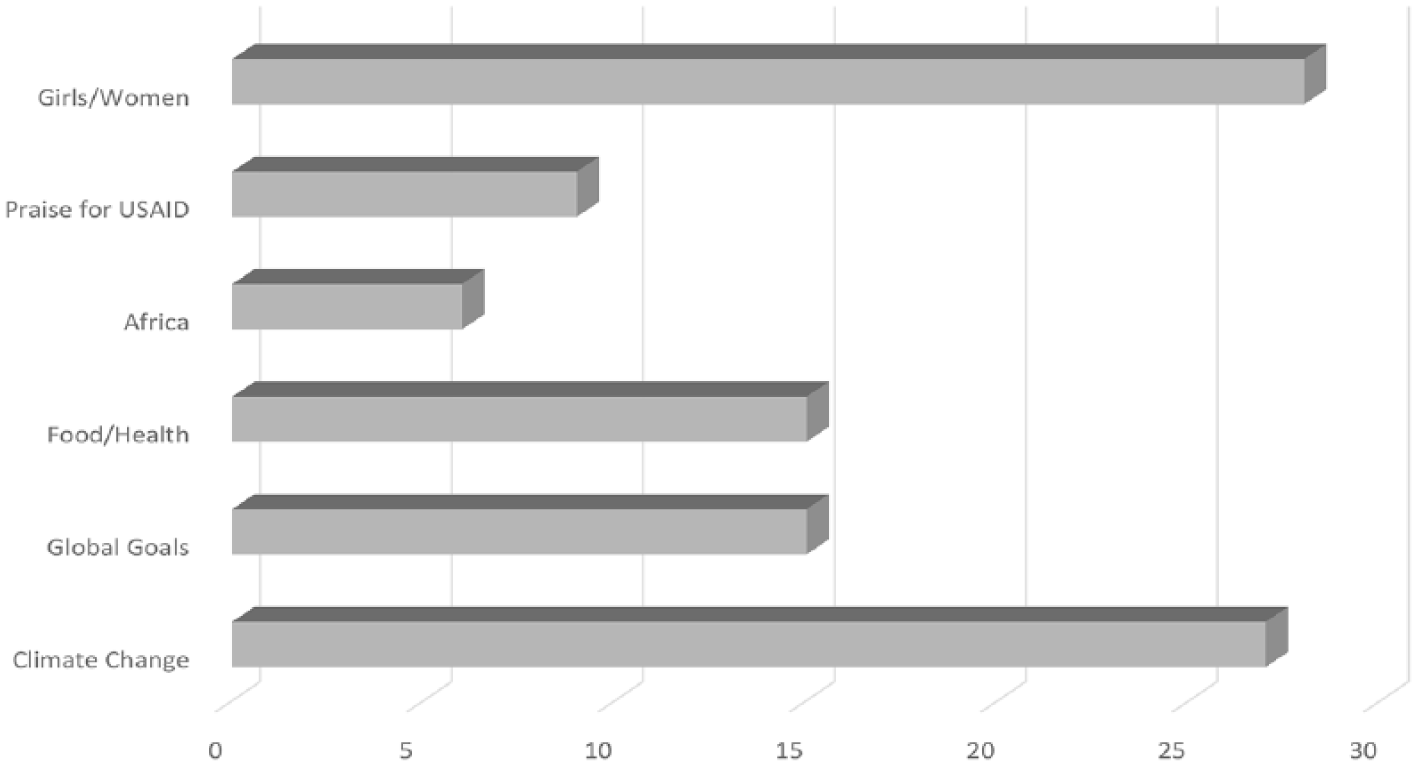
Proportion of use of different topics in USAID’s inbound tweets (%).
SIDA’s inbound data set focused on a much smaller and different range of issues. Water was by far the most important issue, followed by sustainable development and global development (Table 4 and Figure 5). Women and gender issues emerged as a secondary concern. Like the USAID data set, though, Africa was a key area of interest.
Topic Model of SIDA’s Inbound Tweets.

Note. SIDA = Swedish International Development Cooperation Agency.

Proportion of use of different topics in SIDA’s inbound tweets (%).
Tweets in ICRC’s inbound data set focused on a broader range of issues than the SIDA data set, but not quite as many as the USAID data set (Table 5 and Figure 6). The dominant issues—conflict, refugees, and disappeared people—were quite different from the other two data sets. There was a special emphasis on conflict zones such as Syria, Yemen, Iraq, and Kashmir, as well as on the impact of conflicts on families. There was also some concern over nuclear weapons.
Topic Model of ICRC’s Inbound Tweets.

Note. ICRC = International Committee of the Red Cross.

Proportion of use of different topics in ICRC’s inbound tweets (%).
Relationship Between Affordances and Public Engagement
The analysis indicates that each agency’s outbound and inbound data sets—or how an agency uses Twitter and what sort of social networks come into being around it—are closely interlinked (Research Question 3). Three broad relationships can be identified. First, the more an aid agency replies to or retweets the public, the more participatory social networks it creates. SIDA’s outbound data set has the highest proportion of replies and retweets. Correspondingly, its inbound data set forms the most dense, decentralized, and reciprocal social network. USAID’s midrange proportion of replies and retweets corresponds to the midrange density, decentralization, and reciprocity of its inbound social network. And ICRC, with a very low proportion of replies and retweets of the public, also has the lowest levels of density, decentralization, and reciprocity in its inbound network. These results imply that an aid agency’s willingness to reply to tweets addressed to it and retweet members of the public can lead to more participatory social networks in which members of the public often mention and reciprocate each other, and a larger proportion of participants drives the conversation.
Second, a similar relationship can be observed between an agency’s proclivity to use publicly oriented hashtags and hyperlinks and the participatory potential of its inbound social network. Once again, SIDA emerges as the agency most likely to use hashtags not related to official programs and hyperlink to nonofficial pages—corresponding with its highly participatory social network. On the other hand, USAID and ICRC often use hashtags of official programs and hyperlinked to official web pages—and their inbound social networks are not as participatory. These relationships indicate that if an aid agency uses Twitter’s structural elements—replies, retweets, hashtags, and hyperlinks—to directly engage in conversations with the public rather than to simply transmit information about itself and its programs, it is likely to build more participatory social networks.
Finally, there is a broad consonance of tweet topics in each agency’s outbound and inbound data sets, suggesting that the specific issues an agency focuses on in its tweets tend to be the same issues that the public tweets to it about. Some of the issues that emerged as important in our data may well have been on account of the time period of data collection—for instance, most ICRC tweets about nuclear weapons related to the 20th anniversary of the release of the International Court of Justice’s advisory opinion on the legality of nuclear weapons, which fell on July 8, 2016. Nonetheless, the topical connection between each agency’s outbound and inbound data sets is apparent.
Discussion
Public relations research has begun to adopt an “ecological view” of the relationship between organizations and the public—in which they are both viewed as social actors embedded within networks of social relationships operating across multiple dimensions (Himelboim et al., 2014; Lai, She, & Tao, 2017; A. Yang & Taylor, 2015). Drawing on this perspective, our study has comparatively examined three global aid agencies and their engagement with the public on Twitter. Our analysis makes a number of theoretically and socially significant contributions.
While several scholars have previously examined if nonprofits are using SNSs for “one-way” or “two-way” communication with the public (Cho et al., 2014; Lovejoy et al., 2012; Waters & Jamal, 2011), we study the relationship between aid agencies’ use of Twitter and public participation at the level of platform affordances. Our study’s key theoretical contribution is the development of a technosocial framework to analyze how different affordances can influence the degree and quality of public participation. This framework has three dimensions: (a) replies and retweets, (b) hashtags and hyperlinks, and (c) tweet topics. Replying to and retweeting members of the public corresponds with the most interconnected, decentralized, and reciprocal social networks. Including publicly oriented hashtags and hyperlinks also bolsters the interconnectivity, decentralization, and reciprocity found in inbound social networks. In addition, the more agencies tweet about topics that people are also concerned about, the more participatory their inbound networks appear to be.
The broader implication is that if aid agencies themselves use Twitter for listening to and talking with the public—as opposed to just transmitting information about their programs or instrumentally attempting to use Twitter to change public behavior—their social networks are also likely to be more participatory (Cho et al., 2014). In other words, if institutions adopt what Grunig and Hunt (1984) called a “two-way symmetrical approach” to communication and delegate more power to the public in the communicative process, the public in turn would be more willing to participate. Delegating such power, as Carpentier (2012) argues, implies creating a “social-communicative relationship” through access and interaction that is more or less egalitarian. Our study suggests that in the context of Twitter, such egalitarianism can be created by aid agencies replying to and retweeting members of the public, using publicly oriented hashtags, and tweeting about topics the public is also tweeting about. These activities may also be considered as “recognition” and “appreciation” of the public by aid agencies, which, as F. Yang and Ott’s (2016) experimental study noted, is critical to motivate members of the public to participate in communal activities (see also, Clark & Mills, 1979).
Crucially, such acts of power devolution do not simply generate reciprocity between organizations and the public. As our study shows, they also precipitate higher levels of public-to-public conversations, constituting a deliberative network that aid agencies can listen to better understand the needs and concerns of various communities. While power is thus dispersed through the network, creating possibilities of change from below, a central node—the organization’s Twitter handle—holds the network together. The aid agency’s Twitter network thus comes to resemble what Rossiter (2006) called an organized network, in which “information flows and socialtechnical relations are organized around site-specific projects that place an emphasis on process as the condition of outcomes” (p. 207). Such networks combine scale with sustainability, drawing on the power of the “crowd” while still maintaining a certain degree of hierarchy to ensure long-term viability.
Of the three aid agencies we studied, SIDA’s inbound network was the most participatory. SIDA was also the aid agency most likely to reply to and retweet public posts as well as use publicly oriented hashtags and hyperlinks—but only in comparison with USAID and ICRC. Our study reveals a preponderance of institutionally oriented retweets, hashtags, and hyperlinks even in SIDA’s outbound data set (see Table 1). It implies that despite relative differences, all three aid agencies primarily use Twitter for transmitting information and promoting themselves, their programs, and the larger bureaucracies they represent—similar to the nonprofits whose social media use has been critiqued in various studies previously (Lovejoy et al., 2012; Waters & Jamal, 2011). It also suggests that all these agencies mainly view Twitter as an extension of their offline work and a means of one-way communication or, at best, two-way asymmetrical communication: when they launch a program such as USAID’s Let Girls Learn or SIDA’s World Water Week, they turn to Twitter as one more channel through which to transmit the information.
This orientation needs to be reversed. Participatory social change will become a reality only when aid agencies, instead of launching programs and then trying to get people to participate in them, will begin by trying to understand what a particular community needs and then come up with programs that address those needs (Cho et al., 2014; Grunig & Hunt, 1984). Public conversations on online social networks like Twitter, although not without its own limitations, can provide such inputs—and the more densely interconnected, decentralized, and reciprocal these networks are, the more representative the issues raised in their conversations would be. But that can only be the first step. Aid agencies not only need to make an effort to build participatory social networks but also need to empower these networks to drive their policy making—from identifying issues that need to be addressed to formulating strategies for addressing them.
In addition to its social and theoretical significance, our study makes methodological contributions. We show how textual analysis, social network analysis, and topic modeling can work in tandem—responding to calls for multimethod approaches to the study of networks that pay attention to their structure as well as content (Moser et al., 2013). While textual analysis helped us understand how aid agencies were utilizing the algorithmic affordances of Twitter, social network analysis and topic modeling enabled us to uncover the structural and semantic properties of the social networks formed around them. Our analytical differentiation between outbound and inbound data sets is also a contribution to the study of public participation with ego-centric networks. Finally, we show how a formal comparative research design—the “most different systems” approach (Przeworski & Teune, 1970)—may be used to study social networks. Analyses of social networks are often faulted for being too descriptive; our study suggests a comparative approach can be used to build theory with the help of social network analysis.
Our study has a number of limitations, which can serve as avenues for future research. Some of these limitations relate to the construction of our data sets. First, we constructed our outbound and inbound data sets are ego-centric networks—or networks formed around particular Twitter accounts (“egos”). This was necessary for systematic comparative analysis that can lead to actionable outcomes for aid agencies. However, our analyses—especially social network analysis—could be influenced by the data sets’ ego-centricity. Building on our analysis, future studies can formulate and test hypotheses on the impact of Twitter affordances on public engagement in different types of networks—for instance, issue networks or hashtag networks. Second, we operationalized network ties in terms of “mentions” of aid agencies. Examining the relationships, we identify in social networks formed through “retweets” or “replies” can enhance confidence in the findings we report. Third, our outbound and inbound data sets are concurrent. Longitudinal study designs, which analyze inbound tweets from a later time period than outbound tweets, can help move our arguments closer to causality. Finally, we have not looked at multimedia component of tweets, such as still photos, animated GIFs, memes, and videos. Multimedia are yet another technosocial affordance of Twitter, and may also influence the participatory potential of social networks in their own ways. They offer another important avenue for future research.
In conclusion, we would like to underline that Twitter and other SNSs have the potential to enable global aid agencies and other development institutions to communicate more effectively with local communities. Our study has outlined some specific ways in which institutions can build participatory social networks online—which would offer them an opportunity to speak with and listen to communities and better understand their needs and concerns. However, the larger purpose of these efforts must be to give the public a say in social change policy making. Tweeting and building participatory social networks should not turn into ends in themselves. This should instead be the beginning: enabling agencies and other social change institutions to develop more meaningful policy objectives and better implementation strategies for delivering social justice.
Footnotes
Declaration of Conflicting Interests
The authors declared no potential conflicts of interest with respect to the research, authorship, and/or publication of this article.
Funding
The authors received no financial support for the research, authorship, and/or publication of this article.
