



Abstract
This article is concerned primarily with preparing for and conducting field research by examining innovative methods and techniques that support the effectively utilization of our time in the field. Specifically, it examines innovations for identifying and communicating with potential respondents to secure interview appointments. Procuring interview notes is dependent first on the ability to secure interview appointments; however, this aspect of the field research life cycle has received insufficient attention. Securing interviews requires identifying potential respondents through our network of contacts, relevant websites, and traditional and social media. Field research has moved onto the Internet—an innovation that contributes to conducting field research effectively. Once potential respondents are identified, interview appointments are then secured by clearly understanding the mode, content and timing of respondent communication. Interview methods, data recording and data analysis are also considered. When conducted effectively, these purposeful activities produce the interview notes that then become the data used for case analysis. This article concludes by reviewing the field research life cycle.
Keywords
The study and practice of field research constitute a large domain, as demonstrated by scholarly contributions from agriculture, biofuel production, education, ethnography, nongovernmental organization disaster response, political science, strategic management, and water quality—a list based on the top 10 citations within a Google Scholar search for “field research” publications between 2015 and 2019 (“Field Research,” 2019).
This article will narrow the focus by first defining field research, then examining a type of field research that cuts across every social science domain: case study field research. We further narrow our focus by examining an essential but little-investigated aspect of field research: the on-the-ground practice that results in the accumulation of sufficient interview notes to justify the documentation and publication of a case that can support theoretical understanding. This article therefore concentrates on innovations in identifying and securing potential respondents for interview appointments, while also addressing interview methodology, data recording, and data analysis.
Field research is not defined by its physical locale, but rather by a work’s degree of naturalism, which allows for a continuum-based rather than a dichotomous conceptualization. Nonexperimental field methods include personal observations, participant observation, ethnography, interviews, a daily journal, trace measures, ambulatory assessment, population observation, and situation and characteristic observation (Paluck & Cialdini, 2014). Such methods can be utilized to gather the data needed to build a case. A case study is defined as an empirical inquiry that investigates a contemporary phenomenon (the “case”) in depth and within its real-world context. Case data are collected from documentary information, archival records, interviews, direct observation, participant observation, and physical artifacts. These six sources provide data for an analysis that can be conducted through qualitative and quantitative techniques (Druckman, 2005; Yin, 2018).
In addition to the single case, several other methodological approaches to case study research exist. Comparative case analysis receives the greatest scholarly attention (Druckman, 2005; Odell, 2001; Yin, 2018; Zartman, 2005). Other approaches include analytically enhanced case studies, time series case studies, aggregate case comparison, and mixed methods within a case study design (Druckman, 2005; Guetterman & Fetters, 2018). These additional methods move beyond this study, as we are primarily concerned with organizing research that results in field interviews including Internet-based innovations that support these efforts. We will elaborate on this task now.
The purpose of this article is to fill a gap in a body of literature that recommends “snowball sampling” as the primary technique for securing interviews, while highlight innovations in field research methodology emanating via the Internet and through the effective management of respondent recruitment.
Snowball sampling, also known as chain-referral sampling, is one type of purposive sampling where the respondent (those we interview) offer their social and professional network by referring the researcher to others who could participate in the field study (Mack, Woodsong, MacQueen, Guest, & Namey, 2005). Snowballing is especially relevant when studying “hidden” communities and networked relationships—such as people engaged in unlawful behavior, people with a particular illness, and other socially significant groups.
Traditionally, the field researcher begins by examining their personal and professional network of contacts to get the “snowball” rolling, while traditional media can support such efforts. More recently, however, social media—LinkedIn, Twitter, and so on—have become useful for identifying potential respondents. Field research moved onto the Internet starting with the introduction of e-mail in the 1990s, which continues to be the most important Internet platform for conducting field research. This article also considers Internet-based innovations that complement traditional field research methodology.
Once potential respondents are identified, we engage them through techniques that are based on an understanding of the mode, content, and timing of communication—a framework that represents an innovative leap toward effectively field research. On the other hand, there is nothing new to say about interviewing as much has been written on this topic (see Bailey, 2017; Seidman, 2013; Yin, 2018) and so this article does not offer a comprehensive review of interview methodology. Alternatives for recording data and methods for analyzing case data are also considered. This article concludes by examining the field research life cycle.
The data on which this article draws are useful to consider. The author has conducted 12 field studies at 39 research sites, resulting in 719 field research interviews (including one or more respondents in each). Bilateral, regional, and multilateral trade treaty negotiations have been a major theme in the author’s field work since 2004 although this research interest evolved into field research on international organizations such as the G20, the UN Food and Agricultural Organization, the UN Framework Convention on Climate Change, and the World Trade Organization (WTO). More recent field research has examined regional associations such as Mercosur and the Pacific Alliance (each in Latin America), the Union for the Mediterranean (UfM), and the Asia-Pacific Economic Cooperation forum. This field research experience provides the conditions for a participant–observer case method, which is utilized for conceptualizing the current article.
Before proceeding, the legal and ethical implications of conducting field research must be considered. Within Australia, for example, we have recently revised the National Statement on Ethical Conduct in Human Research (2018). There are multiple ethical issues to be considered when identifying respondents, communicating with and recruiting potential respondents, gaining informed consent, conducting and recording interviews, storing interview records, privacy, and related matters. Legal and ethical systems change from country to country and over time. It is essential that the field researcher understands and conform to the legal and ethical environment of their institution of affiliation long before arriving in the field.
Four sections follow the introduction to a prototype field research summary (providing an overview of the subsequent sections): these examine methods for procuring respondents, methods for communicating with respondents, interviewing, and data analysis. The article concludes with a review of the field research life cycle.
Prototype Field Research Summary
Every research project begins with conceptualization, which directly affects the research methodology. Climate change became a contemporary topic of compelling academic interest for the author around 2006. As with most research projects, this one began by broadly reviewing the relevant literature and seeking out others with expertise on the topic. Eventually, sufficient understanding of the literature, and the phenomena on which that literature is based, is gained to enable the construction of research questions. Sometimes, we branch off into something new; while at other times, we build on prior academic experience. To study climate change, the author chose the latter path by considering climate change in the context of international trade policy. In 2008, the world experienced a food shortage because some nations that traditionally had exported agricultural goods ceased or restricted exports. Food security appeared to fit within a study involving climate change and agricultural trade policy. This research topic had both contemporary and immediate relevance to world affairs.
Little was known about the relationship between climate change, agricultural trade policy, and food security at that time—and perhaps this is still the case today. Field research methodology has utility when not much is known about a particular area or a specific set of research questions, as field research has exploratory qualities. The central questions concerned who could be interviewed and where they were located, as the field researcher always operates within constraints imposed by time and funding. Ultimately, interviews will be conducted at one or more sites, while each additional site requires additional resources. Are there centers of expertise on research questions involving climate change, agricultural trade policy, and food security? Yes—the WTO with a secretariat in Geneva and the Food and Agriculture Organization (FAO) of the United Nations with a secretariat in Rome. Two research sites can be managed during a one-semester research sabbatical supported with a small research grant, but seeking the views of institutional officials exclusively appears too narrow for a topic this large. A diversity of views is ideal.
Fortunately, the national embassies that surround an international organization usually contain ambassadors and diplomats with relevant expertise. Embassies in Geneva include many trade economists and embassies in Rome include many agricultural economists. Neither of these groups is likely to have had any particular expertise in climate change; however, most professionals have an informed view about the relationship between their area of expertise and contemporary affairs. Furthermore, this is being conceptualized as an exploratory study.
There are a couple of hundred national embassies located in Geneva and Rome. Given that a random sample is not relevant to this study, which embassies should be contacted? The world’s leading national agricultural exporters and national agricultural importers can be found in the FAO Statistical Yearbook, so this study focused on 50 nations—the 25 leading exporters and the 25 leading importers—as well as FAO and WTO secretariat officials.
The study conceptualization can now be described in four simple paragraphs, but it should be remembered that this intellectual exercise required a couple of years to formulate. So, with a study conceptualized, the next task is to summarize it into a single page (see Figure 1, for the one-pager on a climate change, trade policy, and food security study). This single page, or the “one-pager,” will later serve as a marketing tool to assist the researcher in gaining appointments. More will be written on the importance of the one-pager later.
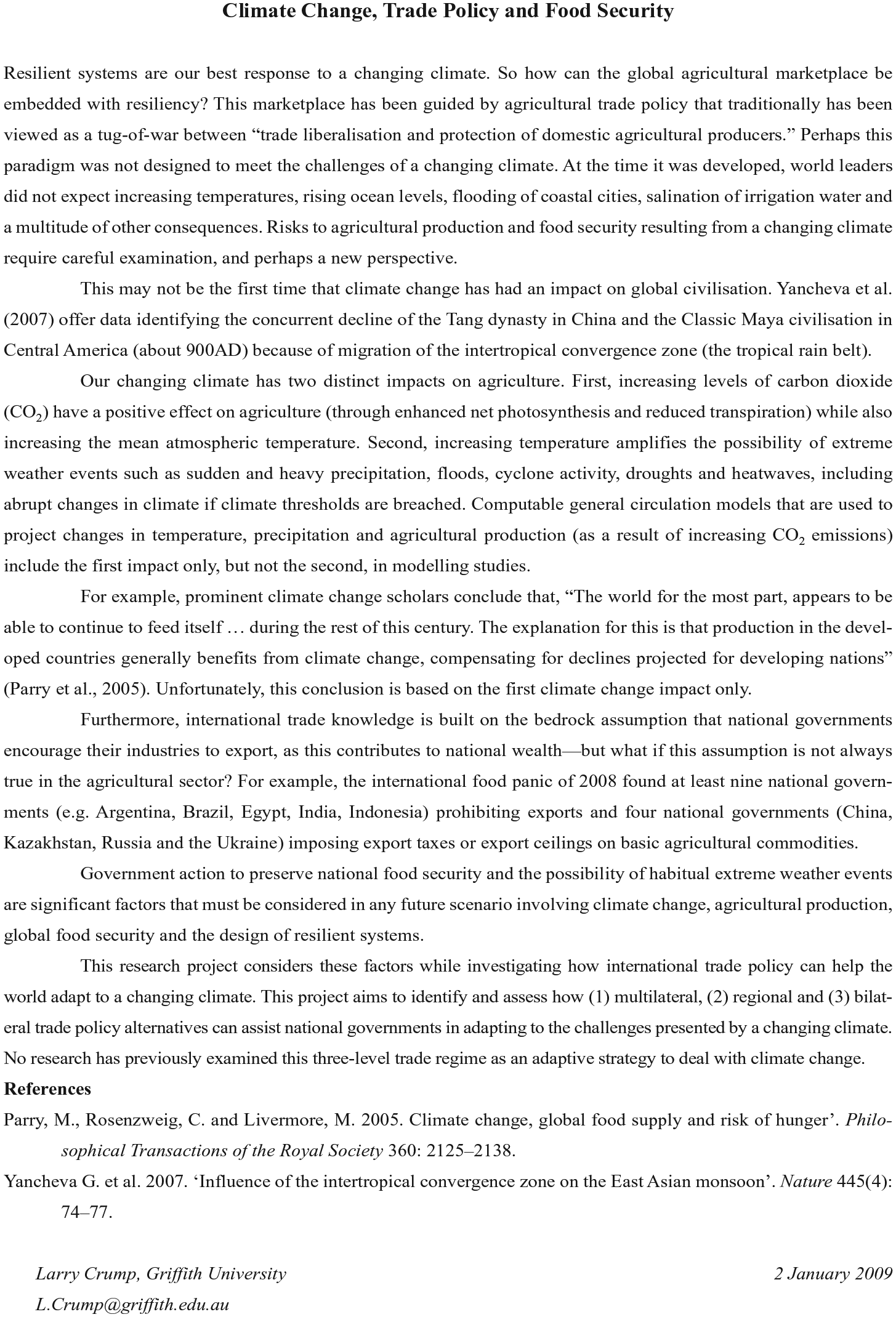
One-pager: Climate change, trade policy, and food security.
The author began by mailing a letter, including the one-pager, to these ambassadors. Letters are rarely used these days, so are more likely to be noticed.
Once a field research project is conceptualized, the next step is to identify potential respondents. The author had no prior field research experience with the FAO and some field experience with the WTO, although prior WTO research was not directly related to the currently study. Nevertheless, this prior experience offered a context for understanding how to proceed in Geneva. Spending substantial time researching on the WTO website and searching for relevant documents prepared by secretariat officials was useful for identifying relevant officials via the WTO secretariat directory. The WTO had officials focused on agricultural trade policy and had organized an in-house panel that had just completed a study examining trade and climate change. The WTO seemed unwilling to accept the concept of food security, as the free market is the answer to food security. Perhaps climate change may alter such logic; nevertheless, no assigned trade and food security officials had been appointed at the WTO.
The FAO was a little more challenging. Of course, the website was valuable for identifying relevant officials via a staff directory and through documents. The FAO was very interested in food security, given the “food shock” of 2008, and it was generally interested in climate change and international trade. More important than the website, however, was a personal relationship. A former student who had remained in contact with the author had previously worked for the FAO. This talented professional offered valuable introductions after receiving the one-pager and assurances that field interviews were scheduled for Rome.
Gaining access to some of the 50 national embassies in Geneva and some of the 50 national embassies in Rome was a simple process of identifying these 100 ambassadors and acquiring their contact details. This is public information and easily located via the Internet.
This is an exercise in marketing, to improve the chance of getting noticed. A PDF of each letter (organized by country name in a Geneva folder and a Rome folder) was also kept for later use. Ambassadors do not normally respond to interview requests, so after making e-mail or telephone contact with the Ambassador’s personal assistant (PA), the letter would be followed up with an e-mail that included a PDF of the relevant letter and the one-pager as attachments. Sometimes, an interview would be secured with an ambassador but more often the task was passed to a diplomat.
Through such methods, interviews were conducted with ambassadors or diplomats representing 33 nations. In total, 67 interviews were conducted that included 84 respondents. Of these 31, were employed by international organizations (primarily the FAO and the WTO) and 53 were representatives of national governments through permanent missions or embassies located in Geneva and Rome.
Interviews were recorded via handwritten notes that were later organized and typewritten within 48 hours of each interviews. On completion of field research, interview notes became data that were analyzed by searching for themes relevant to the initial research questions. These themes combined with relevant literature eventually became a draft research paper. The most significant publication from this period of field research is titled “Adam Smith in a Warmer World: Climate Change, Multilateral Trade and National Food Security” (Crump, 2014). This prototype summary has offered an overview of the field research process; now we will examine each component of that process in greater detail.
Identifying Respondents
Assessing our personal and professional network in relation to a particular research project should begin 6 to 12 months before the first field site visit. What is the nature of our network? Many who conduct field research are affiliated with a university or research center so such networks typically consist of academic colleagues, business partners relevant to our expertise, former students, acquaintances, and strangers available through social media.
The Introduction
Once, a letter, to be hand-delivered by the researcher, represented the ideal introduction. Today, an introduction is often conducted via SMS/text or call, an e-mail or supported by social media such as LinkedIn. However, many do not appreciate or are too busy to notice that the name that someone mentions in passing is also an introduction. At those moments (over drinks or dinner, chatting at a conference, in some kind of meeting, even talking to a stranger on a train or plane), it is critical that certain information be noted, as this information will be required later if we wish to turn that comment into an introduction and a potential respondent. This includes the date and situation, the correct spelling of the name of the person that mentioned the name (and the name of their organization if possible), the correct spelling of the name of the potential respondent and the name of their organization (the division/department is also useful). Securing an e-mail address and cell/mob number is also of great value. The potential respondent’s name and organization are the most critical pieces of information. Six months later, the researcher will refer to this note in seeking to contact a potential respondent (more on communicating later).
Identifying Contacts Through Your Network
Colleagues may be useful, but business partners more so, as they often have greater relevance to our research interests. For example, for 5 years, the author served on the Executive Committee of the Australian Institute of International Affairs (AIIA)—a nonprofit membership-based organization that hosts a bimonthly speakers’ program. One speaker was the Colombian Ambassador to Australia, whom the author met through that AIIA that evening. Later, the Ambassador and the author organized several Colombia-based projects together (the author visits Colombia annually to teach negotiation in an MBA program) including providing negotiation training at no cost to the Colombian Ministerio de Relaciones Exteriores in 2014 and 2016.
After receiving funding to conduct research on regional associations, the author suggested conducting field research on the Pacific Alliance to the Colombian Ambassador in her office. Later, the Ambassador organized coffee with representatives of Pacific Alliance member nations including the Chief of Staff for the Embassies of Chile and Peru based in Australia (the Mexico embassy was visited separately). These diplomats had one question: they wanted to know the specific dates when field research would be conducted in their capital city. Half of the 39 interviews conducted on the Pacific Alliance occurred because these four governments arranged interview appointments (Crump, 2018).
The author did not join the AIIA or make a point of attending the Colombian Ambassador’s speech because of some hidden research agenda. The AIIA clearly has relevance to the author’s international career, but this association will not fit everyone. Rather, investigate your own community and join any professional association that has relevance to your career, as you may find it will support your future research agenda. Networking, persistence, and creativity are useful skills to develop for those who wish to conduct field research. What can we do today to build a relevant network that will effectively serve us tomorrow?
Identifying Contacts Through an Organizational Website
The advent of the Internet has reduced the transaction costs of conducting field research. In the initial stages of a research program, many hours should be spent “wandering-around” a target organization’s website to become familiar with its leadership, mission, goals, structure, and activities. When we examine a target organization’s website, we are looking for names of organizational members who might have information relevant to our research goals. Often, such names appear as a list on a formal meeting agenda or meeting minutes—normally on the final page of a document. This is a list of those who attended a meeting or sometimes a document distribution list. This is what we look for when planning to conduct field research involving formal meetings.
Often, such documents do not appear on the external organizational website (the site for the public), but only the internal, password-protected site—although occasionally mistakes are made and a document prepared for internal use appears, however briefly, on the external site. For example, the author was “wandering around” the European Union website—which is vast—in 2005, in preparing to conduct field research on European Union–Latin American free trade negotiations. After hours of searching, the minutes and agenda for a couple of negotiation rounds (meetings) were located, which included the names of all government officials in attendance. This list of 40 names served as the basis for initial interviewing in Brussels in the winter of 2005, which snowballed me into Latin America in the spring of 2006 (Crump, 2011).
Traditional and Social Media
Senior corporate and government officials, ambassadors, and other organizational leaders are often quoted by name in the media, while many organizational professionals are forbidden from speaking to the media. However, occasionally such professionals will be quoted. All these names are useful when they appear to have information or experience relevant to a research project. For example, during research into the Korea–Australia free trade agreements (FTA) negotiations, the author hired a research assistant in Korea and another in Australia, who took a timeline of negotiation rounds (meetings) between 2009 and 2014 and used it to search traditional media for names and other information of interest.
Media articles will begin to appear about a week prior to the start of a negotiation round and continue for about a week after that round has concluded. Searching the traditional media is a rather structured task that can be effectively conducted by any competent and motivated undergraduate. After conducting this media search the Korean Research Assistant went on to conduct more complicated tasks such as contacting potential respondents via e-mail and phone and establishing appointments (Crump & Moon, 2017).
Social media have become particularly useful for identifying potential research contacts. LinkedIn is useful for gaining introductions by asking someone who is part of our LinkedIn network to introduce us to a potential respondent. In addition, LinkedIn has a very useful search tool available to any LinkedIn member. In preparing to conduct research on the UfM in 2016, for example, the author used the LinkedIn search function (upper left-hand on the LinkedIn member website) by simply entering “Union for the Mediterranean.” If we do that today, 74 results (names) appear with most results being UfM employees. Compare this source with the UfM official website (UfM → Who are We → Structure), which includes the names of 14 UfM senior officials only. It appears that we can search every organization and if a LinkedIn member lists that organization as their employer, then that “LinkedIn member/organizational employee” will be listed when searching an organization.
Some websites include Twitter feeds. Visit the Pacific Alliance official site (in English), for example, and look for a small Twitter logo in the upper right-hand corner. Click on that logo and it shifts to the Spanish website, which includes a Twitter feed in Spanish. This data source is full of valuable information, including descriptions of meetings and events, references to documents, and pictures that sometimes include names. The Latin American research assistant employed for the Pacific Alliance project read this Twitter feed in Spanish and provided relevant information in English (Crump, 2018).
Note that the Pacific Alliance English website also has the logo for Facebook, Flickr, Instagram, and YouTube, which probably transfers the researcher to the Spanish Pacific Alliance website. Many organizational websites have such links on their home page, which may also support respondent procurement.
Communicating With Respondents
By focusing on our network of contacts, relevant websites, traditional media, and social media for an extended period, we will not only have the required knowledge to engage with potential respondents, but we will also have acquired the confidence to do so.
To get to this stage, we have created a list of contacts that include random information about each potential respondent—although in most cases this is no more than a name, contact details, and how we acquired this name. A Word document is useful for this purpose. Now we need a second document that tracks our communication with each potential respondent. An Excel spreadsheet is useful for this purpose when working independently. If a research assistant is employed, then a collaborative document app such as Google Sheets (GSheets—like Excel) or Google Docs (GDoc—like Word) can be helpful, as it allows the researcher and their field assistant to enter information that is instantly available to everyone who has the document password (thus avoiding the critical double-appointment-booking problem).
This second document will list the date and mode of communication (e-mail, telephone), the person with whom we actually communicated (usually the potential respondent or their PA) and the outcome of that effort (hopefully a date, time, venue, address, and even guidance when using public transport for travelling to an appointment—Google Maps is essential for this purpose).
Please note that a communication tracking document is unnecessary when contacting five or six potential respondents, but if communicating with 20 to 50 at the same time, then we will quickly become lost and appear incoherent. Interview appointments are not offered to researchers who seem confused.
We begin by considering the cold call, a techniques typically conducted via e-mail or telephone (the mode). Effective communication requires an understanding of each mode and when it is useful to employ a particular mode, the message content presented via each mode, and the timing of each message.
Initial Communication: The Cold Call
The cold call presents a brief pitch about our research project and its value, normally conducted via e-mail or telephone, although often repeated briefly when first meeting face-to-face. Prior to a cold call, we must clearly focus on why our research project might be intellectually stimulating or attractive to a potential respondent, as the logic of contact is based on an idea rather than a relationship (see the section on the introduction for a discussion of this). The cold call generally works in egalitarian and informal cultures and is less effective in cultures that are fundamentally hierarchical and/or formal—in these situations, we require an introduction and so secure the resources to engage in snowballing.
Names found via social media, traditional media, and organizational websites will mostly involve cold calling. Initially, it is useful to directly but briefly communicate how we obtained someone’s name (here it is important to keep an accurate record about how names are secured). When making a pitch to a potential respondent over the telephone, if that potential respondent declines to setup an appointment or expresses real disinterest in our research, then it is over, as it is unethical to pursue a potential contact further (at some point, it could be considered harassment and even stalking—something that journalists may do but certainly not field researchers).
Initial Communication: The Face-to-Face Pitch
Ideally, the researcher has an established relationship with a key decision maker in the target organization, as it is very useful to have an “organizational sponsor.” The alternative is to secure a meeting with a key decision maker, normally via an e-mail, in order to “pitch” the value of the study and respond to the decision maker’s questions, face-to-face. Essentially, we are asking for permission to conduct interviews in a particular organization.
In 2004, the author shifted into the study of bilateral FTA, with the first study involving three separate trade negotiations: Australia–Singapore, United States–Singapore, and Australia–United States. After some thought, it became clear that it might be difficult to secure interviews in Singapore and the United States if the author had not first conducted interviews in Australia—the home country. Within Australia, all trade policy negotiations are conducted by the Department of Foreign Affairs and Trade (DFAT). Reviewing the DFAT online organizational chart allowed for the identification of a senior official responsible for trade—a Deputy Secretary. An e-mail, which was essentially a cold call, secured an appointment. When we met, the author briefly elaborated on the research purpose and motives, and after 30 minutes of questioning the Deputy Secretary assigned a staff member to assist the author in making appointments. It was unnecessary to seek the same organizational approval overseas, as Australian respondents snowballed the author into Singapore and Washington, DC, and these overseas respondents snowballed the author back into Australia: it was the U.S. Chief FTA Negotiator who offered an introduction to the Australian Chief FTA Negotiator. It is valuable when a high-level respondent offers an introduction to their counterpart (Crump, 2006, 2007, 2010).
Initial Communication Mode: Telephone Versus E-mail
Once a potential respondent’s name is secured, the next step is to make contact. Appearing unannounced in an office is socially unacceptable and so the choice is between the telephone and e-mail, recognizing that a telephone number (the office phone not the personal cell/mob number) is normally public information and easily obtained.
Initial contact via telephone is efficient, but may not be effective (here, good judgment is required on a case-by-case basis), as the field researcher is likely a stranger to this potential respondent and too many people see a stranger as a threat rather than an opportunity. Note that an introduction reduces the degree of being a stranger so a telephone call may be an appropriate “first contact” when we have a proper introduction. Nevertheless, an initial telephone request to conduct an interview includes complications that may not be managed well via two-way communication. It may be more effective to conduct this critical field research step by establishing one-way communication through e-mail. This requires the correct e-mail address for a potential respondent. So, what is the best way to proceed when the researcher has no idea about the correct e-mail proforma for a target organization?
An organization’s e-mail proforma is common knowledge to the organizational insider but often a researcher begins as an outside, so this is a special communication problem. To solve this puzzle, we need to locate the full name of any organizational member (not necessarily a potential respondent) and their e-mail address on a single document. Often, we have a name but not the e-mail address. We can use Google to find a published document authored by our potential respondent (or any organizational member) by searching their name, the name of their organization, and any other relevant information (such as their expertise). Typically, an organizational document will have the full name of the author and their contact details. Searching may require 1 or 2 hours—it is a bit like fishing—and sometimes we will switch to another name (within our target organization) as our patience becomes exhausted with our first choice.
Eventually, the required information is located and we will notice that an “organizational e-mail proforma” has two parts separated by the @ mark. The left-hand side of the @ mark provides the proforma for an employee name and the right-hand side of the @ mark includes the rest of the organizational e-mail proforma. For example, if Ms. Jane Doe is employed by the European Commission (EC) then the left-hand side of the e-mail proforma—established by the EC—is “first name, dot, last name” or jane.doe@ and the right-hand side is “@ec.europa.eu” with the full e-mail address as: jane.doe@ec.europa.eu. Once this puzzle is solved, the identified proforma is utilized for each employee in a target organization.
Please note that a large organization may have an e-mail variation on the right-hand side of the @ mark. The government of Chile, for example, has adopted first initial and last name with no dot on the left-hand side—Jane Doe becomes jdoe@—but the right-hand side changes from Ministry to Ministry. The Chile Ministry of Foreign Affairs e-mail format is: jdoe@direcon.cl, the Chile Ministry of Finance format is: jdoe@hacienda.gov.cl, and the Chile Ministry of Agriculture e-mail format is: jdoe@odepa.gob.cl.
Solving this puzzle begins by noting an e-mail “bounce-back” and confirming that the name (left-hand side) is correct, then realizing that organizational units have a unique right-hand e-mail proforma. Again, we need to locate a document—via Internet search—that includes the author and their contact details for the organizational subunit.
It is essential that each e-mail successfully sent is filed and properly organized if we actually want to set up an appointment (establish a sent e-mail folder for each field site or each organization), as very few people will respond initially unless the introductory e-mail has the name of a person (who introduced us), who is very senior or very familiar to the potential respondent. The purpose of our introductory e-mail is to create a document that later serves as a tool to effectively secure an appointment.
Initial Communication Content: The E-mail Pitch
There are variations based on the mode of communication, mostly due to one-way or two-way communication, so we will focus on one-way communication via e-mail first but address variations that may exist via telephone as we proceed.
Once we have the correct e-mail address, we need to build a marketing tool. This is NOT a copy-and-paste of the research abstract—which is too academic—but rather a tool that indirectly addresses one question: Why should a potential respondent devote 30 to 90 minutes of their busy life to meeting us? If we cannot find a convincing answer, then perhaps we are wasting our time. The researcher must design a marketing tool that captures the potential respondent’s heart and/or mind. This marketing tool is called a one-pager (see Figure 1).
The e-mail subject heading needs to be brief and intriguing. The e-mail itself should be very brief, as long e-mails are trashed. The e-mail tone is semiformal since we have not met the potential respondent, so start with “Dear Ms./Mr.” If we have received an introduction, then this is a good way to begin an e-mail, but if this is a cold call then it is best to explain how we found their name after we have introduced our research project.
The researcher may plan to remain at a site for several weeks or longer, or leave this research site and then return, but such information need not be shared initially, as the principle of scarcity works to our advantage. Always offer a 1-week opportunity to meet. The e-mail concludes with our name, organizational affiliation, and contact details. To have an impressive title is grand (Professor, Director, Senior Fellow) but if the title is not so impressive (Student, Lecturer, Assistant Professor) then why share such information? Simply present your full name, the name of your organization and e-mail address at the bottom. This is an exercise in marketing. Information management is not dishonest in this case. It is critical that we list our organizational affiliation, as it is difficult to be taken seriously otherwise. All of this is very brief, with the logic of the study explained in the attached PDF one-pager.
The e-mail may be slightly altered for each respondent, based on a number of factors, although it is often a copy-and-paste with only the name altered. The one-pager is written, and rewritten, and rewritten, and rewritten again, then given to an editor to make it perfect, then it is not normally modified again.
The e-mail invitation and one-pager provide sufficient information so that the potential participant can make an informed decision about participation. Research ethics, relevant to recruitment, are applicable here. Actual recruitment material—required by the ethical framework of our organization of affiliation—is not distributed at this time, but when the interview occurs, as material designed for an ethics application is not designed as a marketing tool but rather serves other important purposes. It is useful to distinguish between three documents: the invitation with the one-pager e-mailed in advance, the ethics information sheet about our research project distributed at the interview and the interview consent form (if required by your organization of affiliation).
If a potential respondent e-mails back, then we may secure an appointment, but most potential respondents never write back. Respondents will not normally make an appointment unless we demonstrate further commitment to our project.
Initial Communication: The Follow-Up Phone Call
Ideally, it is best to send out e-mails on a Monday and wait 1 week. If the potential respondent has not replied by Friday, then it is very unlikely that they ever will. Now we start to make phone calls the following week, but we need to be prepared for who picks up that call. A large organization will have gatekeepers with varying degrees of professionalism.
The author once employed the very capable 20-year-old daughter of an Australian Ambassador in Latin America to establish appointments in 2006. In one case, she was told, on several occasions, that a particular contact did not work in that office. After conferring with the author (the contact had recently represented their government in negotiations), she replied in a firm voice that she knew that the contact was employed and she identified the meeting dates; she was then passed to another gatekeeper, who passed her to the respondent’s PA. An appointment was secured.
In this example, we can see that there are organizational gatekeepers (also known as receptionists), office gatekeepers (probably receptionists but perhaps professional staff who happen to pick up the phone), PAs and the potential respondent. We need to get past the gatekeepers, but we really do not want to speak to the respondent via telephone, as it will likely complicate our goal of securing a face-to-face appointment. It can happen that our call goes from a gatekeeper directly to the potential respondent.
If the potential respondent comes on the phone, and we effectively make our pitch about the value of our research, then the respondent could say that they are very busy, but they have 10 minutes—so ask some questions. This is the moment for an interview, so be prepared for that possibility. It is not an ideal situation, which is why our telephone target is the PA when one exists. One strategy to avoid speaking to the respondent is to hire a research assistant able to establish appointments, which also indirectly communicates a sense of professionalism as we have secured funding to hire someone to assist.
When locating the PA by telephone, we confirm that they work for our target respondent. We are friendly and even somewhat “chatty” with the PA (and we teach our research assistant to be so as well), which is a different style of communication compared with the potential respondent where we are formal. The author does not recommend lying, but we tell the PA that we expect to arrive in their beautiful city soon (or we are already present) and how much we look forward to our brief visit to conduct important research. We seek to sound genuine and spontaneous but professional. Understand that a PA is a talented professional with organizational and communication skills in a job that many receptionists covet.
At some point, we get down to business. We do NOT ask for an appointment as the PA does not have sufficient information nor authority to make such a decision; rather, we ask the PA whether they have seen the e-mail we sent (give a specific date)—normally they have not. We then ask whether we can forward the e-mail we sent to their boss, and they always agree. It is essential to secure the correct spelling of the PA’s name, which can be confirmed over the phone by reviewing the left-hand side of the PA’s e-mail address.
Within an hour or two—don’t wait—forward the correct e-mail stored in the designated folder. The tone of the e-mail is warm and friendly (although use Mr./Ms. in a hierarchical culture). Ask the PA to print out this e-mail and the PDF (make sure the one-pager is attached) and then place it on the desk of the potential respondent. Now we have created an action-forcing event. We wait 3 days. Often, the PA e-mails back with a proposed date for a meeting by the third day, but just as often we hear nothing. So, call again and ask whether their boss has reviewed the request for a meeting. This may prompt the PA to print out our e-mail. Again, be friendly. The PA does not make such decisions but their views can influence such decisions. We want that PA working for us when the PA and the potential respondent discuss scheduling. Please note again—the researcher is unable to effectively manage so much communication when pursuing 20 or more contacts simultaneously, which is why we track this communication via an Excel or GSheets document.
Initial Communication: Timing
Engaging with potential respondents requires a sense of timing. For example, the author conducted interviews at four sites in Latin America in 2017, with about 1 week at each site. The author conducted 10 interviews with 20 government officials in Bogota, 12 interviews with 17 officials in Santiago, 8 interviews with 13 officials in Lima, and 9 interviews with 18 officials in Mexico City.
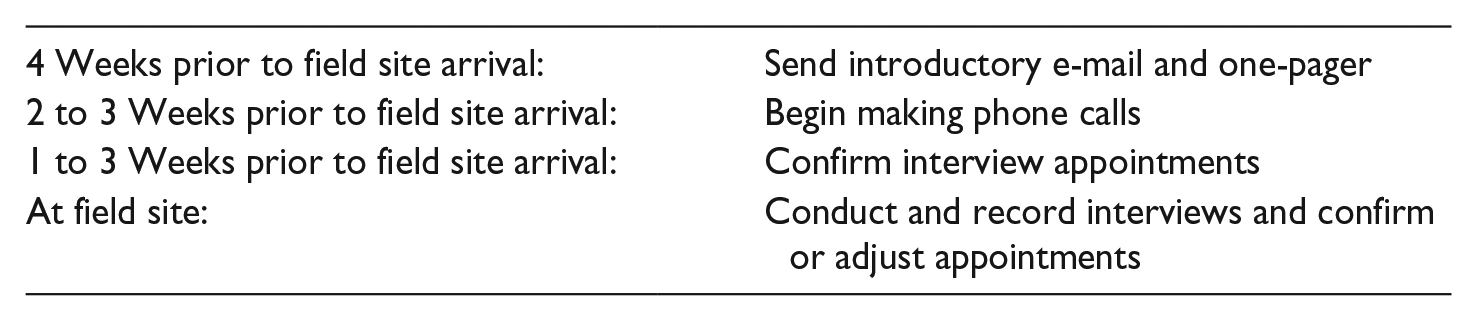
How was communication managed at each site? E-mails to Bogota, the first field site, were sent 4 weeks prior to arrival, which meant that e-mails sent to the last field site, Mexico City, were sent the week that interviews were being conducted in Bogota. A very capable research assistant managed follow-up phone calls via Skype to establish appointment, while the author coordinated with each government who kindly assisted in establishing interviews also. GSheets were used to confirm communication and appointments, and Google Maps were used to confirm that the author could physically travel from appointment to appointment on time.
The research assistant for this project began calling Bogota 3 weeks prior to arrival and started confirming appointments 1 to 3 weeks prior to arriving in Bogota. Of course, meetings were also confirmed (and schedules changed) while in Bogota (in some cases, meetings were established or changed on the day an interview actually occurred, so be flexible). Following is an outline for coordinating communication timing:
Interviewing
There is little, that is, new or innovative about interviewing, as many scholarly works address this critical task (Bailey, 2017; Seidman, 2013; Yin, 2018). A couple of points are worth noting, however, involving interview reliability and validity, rapport building and informed consent, and interview recording and its relationship to data analysis.
Gathering data through interviewing presents multiple challenges, including accessing data, and reliability and validity. Reliability seeks to assure that the same data could be gathered repeatedly if desired and validity asks whether the data actually reflect the reality that they claim to represent. Measurement procedures must be reliable if data are to be considered valid.
Questions about the validity of data gather through field research can never be removed, only minimized. Joseph Maxwell offers seven principles that can increase the validity of qualitative research, including intensive and long-term involvement in the field, rich data that are both detailed and varied, seeking feedback from respondents on interview data gathered, searching for discrepant evidence to test competing explanations, triangulation via the collection of converging evidence from differing sources, quasistatistics rather than adjectives (e.g., rare, prevalent) and comparisons across different settings, groups or events (Maxwell, 2009). The relationship between research design and field research is perhaps the most critical factor in terms of overall validity.
The research design is the logic that links the superordinate research question, the data to be collected and the approach adopted to analyze that data. The approach is addressed in the next section and the data are addressed now. Interview questions logically linked to the superordinate research question, interview format, and sampling strategy are the primary components addressed in this section.
The validity of the data gathered through interviews can be enhanced by developing carefully defined concepts, based on the superordinate research question, but then asking questions in a language familiar to the respondent. Understanding the language of the context being studied is critical. “If the questions tap into the target construct validity, responses to them should converge in predictable patterns” (Beamer, 2002, p. 88). The field researcher must pay careful attention to question format and wording. As for the overall interview, the field researcher must establish some kind of structure or format. This can include a list of specific questions to be asked in a certain order or a list of themes that are presented in a flexible conversational manner, recognizing that not all themes may be covered in each interview but a clear set of priorities is evident.
Sampling is about including and excluding. Who do we seek to include and why? In the climate change–trade policy case presented earlier in this article, the author set the limit at the leading 25 agricultural exports and the leading 25 agricultural importers. The specific number of 25 was an arbitrary decisions that had general relevance to the superordinate research question, as those nations deeply committed to exporting or importing might have developed a clear view on the superordinate research question.
Achieving rapport between respondent and the interviewer will likely influence validity in a positive manner. Building rapport as quickly as possible is critical to gaining insightful answers. Rapport is difficult to define, although everyone has their own style for building rapport. For this reason, each field researcher must establish their own methods for building rapport and then effectively utilize this attribute during interviewing.
The most important ethical issue during interviewing is to secure informed consent and to document such consent. We will address the issue of such documentation briefly. There was a time when Australian universities actually expected field researchers to prepare a consent form that each respondent would sign before an interview could begin. Imagine asking an ambassador or CEO for their signature in the initial minutes of a meeting and then trying to build rapport!
A signed consent form documents that a respondent is agreeing voluntarily to be interviewed and understands the risks of being interviewed. The respondent’s signature also acknowledges that they are aware they can withdraw from the interview at any time, that their questions have been answered, and, related matters such as identifying or not identifying respondent names in papers, written based on our interviews (National Statement on Ethical Conduct in Human Research, 2018).
If interviewing children or intellectually disabled people, or asking for blood or tissue samples, then a signed statement is mandatory, but this preference for a signed statement by competent and consenting adults is completely inconsistent with the art of building rapport. Australia’s approach to informed consent has become more moderate in recent years, as institutions have moved away from inferring that a signed consent form is required. In fact, the National Statement never required documentation via signature, as verbal informed consent is acceptable with documentation confirmed in interview notes. Some research ethics administrators do still assert that the signed consent form is the “gold standard,” thus giving the impression that it is expected when it is not. This is just university lawyers influencing research policy by seeking to minimize organizational risk at the cost of destroying the social atmosphere facilitating rapport.
The field researcher must determine the national and institutional policy framework for research ethics and make certain that the procedures outlined in their research ethics application do not compromise the ability to develop interview rapport. Push back against the mindless application of policies that interfere with scientific inquiry. Research ethics was built on serious abuses in biological, medical, and psychological research, while the policy framework that evolved from such abuse generally applies to all disciplines.
Finally, there are two primary methods for interview recording: via handwritten notes that normally are organized and typed shortly after conducting an interview, and electronically recorded interviews. Each method has advantages and challenges, which are directly related to the type of analysis that may be conducted.
Data Analysis
There is a relationship between the way in which interviews are recorded and the analytical methods available to interpret the interview data. The challenges and advantages of each recording method must be examined before we can consider how each method determines the alternatives available for data analysis.
Unless the researcher is using a set of written questions, the inherent challenge in taking handwritten notes is the difficulty of taking notes while concurrently thinking about the flow of the interview, the themes you seek to cover and your next question. Conducting an interview while taking handwritten notes is a skill that is only mastered through practice. Two important techniques increase the reliability of such methods. First, handwritten notes taken during an interview are as much “scribbles” as words, so adding clarifying information immediately after an interview is essential. Find a coffee shop or a bench and add the information that can still be recalled but was not fully recorded. Second, organize and type up interview notes within 24 to 48 hours after the interview (ideally on the evening of an interview), as this increases reliability. The real concern is missing or forgetting valuable statements provided by the respondent, rather than misrepresenting what the responded actually reported.
The challenge with electronically recording interviews is the effect it may have on building rapport. An ambassador, CEO, or some other senior official is completely comfortable being recorded, as this is a familiar experience; however, for most respondents being interviewed is a novel experience. In this situation, an electronic recording device seems to reduce the degree of rapport developed, as the respondent becomes less candid and spontaneous (Beamer, 2002). This is a serious issue if the goal is to obtain high-quality data.
It is almost impossible to analyze data from electronically recorded interviews, so the next step is transcribing these recordings into written notes. This can be a costly and time-consuming process that distracts the researcher from engaging directly with their data. Furthermore, electronically recorded notes can produce 15 or more single-spaced pages per interview, compared with handwritten notes that are converted into three- to five-page interview summaries. If a field study includes 50 interviews, the difference can be 750 pages compared with 200 pages.
Electronically recorded interview notes therefore normally depend on computer-assisted qualitative data analysis software. Programs that are widely used include ATLAS-ti, NVivo, and MAXQDA, among others. This approach is efficient but perhaps at the cost of effectiveness. The researcher must still conceptualize the desired analysis, then use the language or protocol of the selected software to achieve analysis (Yin, 2011). This software sits between the mind of the researcher and their data. Some may argue that this is an enhancement that results in higher quality analysis, while the alternative approach is for a researcher to utilize their own mind by engaging directly with their data.
Engagement between data and the mind of a researcher is a process that begins with organizing the field research record. The most important part of that record is the typewritten interview summaries, but often respondents provide documents and websites that should be accessed. The third part of the field research record is the field journal that a researcher will keep to document any significant experience, observations, and impressions related to their field research and the superordinate research question under investigation.
The initial task is to pull all this material together and place it into some kind of order that inherently corresponds with the research project. Printed research notes will sit as a single pile organized chronologically, but all the documents given and gathered will be organized into some kind of initial order. For example, in the earlier example about climate change, international trade and food security, the collection of documents was initially organized into three piles. Each of these three piles will then be reviewed and broken up into smaller thematic piles. These labelled piles can cover an entire table.
This exercise of organizing supporting material prepares the researcher/analyst for the most important task: disassembling of the interview notes into themes. To do this, the analyst will read and reread their interview notes. Themes relevant to their superordinate research question will naturally appear. In the author’s climate change, international trade and food security study, for example, the following themes (among others) emerged from this process: agricultural infrastructure investment; 2007-2008 food panic; national self-sufficiency; unilateral, bilateral, regional, multilateral strategies; export restrictions; WTO Doha; green box subsidies; special safeguard mechanisms; tariffs; national governments and climate change preparation; important ideas.
Each interview was then reviewed and disassembled into each of the identified themes. Some interviews would only address two or three themes, while others might address more. If a respondent said something relevant to tariffs, for example, then that comment—one or a couple of paragraphs—would be copied and pasted onto the “tariff theme” document. At the end of that quote, the name of the respondent and the interview page number would be recorded in bold type, to see easily where the ideas of one respondent ended and the ideas of another respondent began.
Each thematic document is printed, and read and reread. In the next step, each thematic document might be reorganized. If two or more respondents said something meaningful that could be linked together, then these quotes would be placed physically next to each other. Perhaps two or more respondents agreed or disagreed, or perhaps the analyst might find something coherent to say that linked two quotes together. At some stage, we would begin writing handwritten notes on these revised thematic documents.
Based on all these thematic documents, a final interpretive document is produced that is also organized thematically. In the climate change, international trade and food security example, this final document was titled “Master Analysis.” It includes 20 themes, with a sample including farming economics and risk, economics and food security, free trade and national self-sufficiency, global agricultural markets, income but not food security, government interference in global markets, net importing countries, net exporting countries, foreign direct investment, national government and decreased agricultural capability, national food security policy, climate change and agriculture, extreme weather events, WTO and climate change, and WTO and food security. This 35-page document copied and pasted the most significant ideas gained from the thematic review and listed the interview note page number at the end of each idea so that the interview notes could quickly be reviewed when quoting a respondent, as it is important to verify the context of that quote. The “Master Analysis” document was used in preparing the article “Adam Smith in a Warmer World: Climate Change, Multilateral Trade and National Food Security” (Crump, 2014).
To summarize this analytical approach, organizing the field research record supports the thematic organization of interview notes. Each thematic document is read and reread and usually reorganized (first draft, second draft, etc.) to support the development of a single “Master Analysis” document of the most critical ideas, which serves as the basis for a study summary in the form of a publishable paper.
Conclusion
This article documents innovations in field research, which have been created by the author during more than 30 years of engagement with this methodology and innovations that have occurred due to the advent of the Internet. Clearly, field research is supported by the Internet, although this methodology remains a physical activity that is centered on the researcher in the field.
The fundamental nature of “the introduction” has not been reviewed adequately in the field research literature: clarity about the various forms and the critical information to be documented represents an innovation in this methodology. Nor have the issues of clarity regarding how an organizational website is utilized and the specific documents and information that need to be secured received adequate consideration. The Internet is particularly useful for identifying potential respondents. LinkedIn was designed partly to build a network of contacts, while its search function is unnoticed but of equal value. Obtaining a list of every LinkedIn member who claims to work for a particular organization can be of substantial value to a researcher. Twitter and other social media platforms are also useful for identifying potential respondents.
Communicating effectively with potential respondents may be the single most important issue for establishing interview appointments, which is the key to securing interview notes and data for analysis. This entire exercise has not previously been unpacked and described in detail: the mode (e-mail or telephone), communication content (brief introductory e-mail and the “one-pager”), record-keeping, timing, and initial and follow-up communication are all critical aspects of the process, which can determine success or failure in the field.
As for the future, the Internet will continue to evolve and provide valuable support for field research. Social media is especially useful for identifying potential respondents. Google Maps can help the researcher determine whether it is physically possible to travel from one appointment to another in a defined period of time when establishing appointments and how to arrive on time. SMS or text messaging can support the process of organization and coordination in the field. Uber, Lyft, and other ride-sharing services are much safer than a taxi off the street in a location with high levels of crime. Skype is a low-cost method for conducting interviews, although it has not yet replaced the face-to-face interview. We can only expect the Internet to continue to provide solutions for managing the complexity that accompanies field research in the future.
Finally, a field research project operates within a kind of life cycle that begins by actively building a network of research contacts throughout one’s life. Often, we do not know that we are building this network until a research plan emerges, and then it is like pieces of a puzzle falling into place. It is an active rather than a passive process.
Much work must be conducted before entering the field. A specific research project begins with conceptualization. These fuzzy ideas slowly form into a reasoned framework, which eventually becomes a research question that is tested and refined against the extant literature. This should occur at least 12 months before entering the field, as many other tasks are dependent on the coherent focus that accompanies research conceptualization (see the initial discussion on a prototype field research summary).
Identifying research targets (organizations, people) must begin 6 to 12 months before entering the field (see section on procuring respondents), while contacting potential respondents begins 1 month before arriving in the field (see section on communicating with respondents). After all this hard work, we are in the field, and day-by-day interview notes (typed or recorded electronically) begin to accumulate. Finally, we need to send a thank-you note, often as an e-mail, one or 2 weeks after each interview.
Fieldwork concludes when we have collected sufficient data to justify the documentation and publication of a case that can support theoretical understanding. Hopefully, that is, before exhausting two critical field research resources: time and money. Fieldwork may end, but our scholarly journey has not, as interview notes must be organized and analyzed into themes, the extant literature must be framed and analysis of field data must fit within that framework. This is all followed by writing and rewriting, and then more rewriting, of a scholarly work and eventually by publication. These activities bring both closure to the field research life cycle and personal satisfaction.
Footnotes
Declaration of Conflicting Interests
The author declared no potential conflicts of interest with respect to the research, authorship, and/or publication of this article.
Funding
The author received no financial support for the research, authorship, and/or publication of this article.