




Abstract
College transition and support programs have emerged over the past century as important tools that institutions can employ to improve student outcomes. With the variety of approaches used, a common language is needed to discuss why and how programs relate to institutional goals and relate to student outcomes. In this article, we present and discuss the College Transition and Support Program Typology as a way of understanding how programs are similar and different in their approach to addressing barriers and creating opportunities for student success. The typology centers on student needs, focus, duration, and timing as important program dimensions. We then apply the typology to a comprehensive college transition program to illustrate the dimensions. The final section discusses a set of criteria for practitioners to consider when designing a program and making choices about what type of transition initiatives may be most suitable for one’s campus and student needs.
While many consider college transition a recent issue, over the past 100 years there have been numerous calls to ease transition to college with new concerns raised and efforts implemented. In the late 1800s, homesickness, newfound independence, and higher academic expectations in college were noted factors affecting student transitions. By the 1920s, social isolation and lack of high school structure were commonly identified issues affecting traditional college student transitions. Publications from the National Resource Center for the First-Year Experience and Students in Transition note how orientation and transition programs have existed for well over a 100 years, dating back to the late 1880s. Momentum to structurally address college transition issues gained traction in the 1920s as the student affairs profession was growing (Schmidt & Graziano, 2016; Van Haren & Friedman, 2018).
Colleges and universities expanded their efforts to help students be successful on campus as higher education increased enrollment after World War II with more diverse student populations who had not attended college in the past (e.g., adult, first-generation, low-income, and racially minoritized). These students brought a new set of transition issues layered on top of the existing ones experienced by students who had traditionally attended college, including little college knowledge and a lack of sense of belonging due to being minoritized and historically marginalized (e.g., because of race, socioeconomic status, and sex/gender identity), code switching, and having their cultural assets (be it race, community, or work) ignored or framed as a deficit. The TRIO programs, designed to provide historically underrepresented and underserved students specialized support services, are some of the best-known college transition programs targeting first-generation and low-income college students and have been federally funded continuously since 1972. As new student populations increased and issues needing to be addressed expanded, transition programs have grown in comprehensiveness and expanded in terms of duration. Additionally, traditional students have faced new challenges and programs expanded to meet these needs as well. These challenges include mental health and emotional well-being, the increasing cost of college, navigating campus service offerings as student affairs and academic support have expanded, and managing highly mandated admissions and increasingly complex enrollment, grading, and financial aid procedures.
While programs have proliferated, no clear description or comparison of programs exists. In this article, we describe a College Transition and Support Program Typology that can help educators and policymakers understand key differences among these programs and make decisions about efficiency and efficacy. Such a typology can assist practitioners in identifying which programs might be most suitable for their campus needs. A typology also helps explain what each program type offers, which creates a common vocabulary for scholars and practitioners to discuss student support structures. The typology can also be used to guide conversations related to evaluating and estimating costs, feasibility, and impact of transition programming for campuses.
The College Transition and Support Program Typology is also valuable to researchers because there is little existing work comparing different types of college transition programs. Given educators’ interests in increasing student persistence, retention, and graduation, it would seem important to understand how these programs compare on addressing these outcomes. Similarly, comparing their efficacy with different populations, different institutional types or settings, and different goals (e.g., academic self-efficacy, improved grades, sense of belonging) seems important if practitioners are to make sound decisions about program choice. It is common for studies to group and study different transition programs together. A typology offers a new conceptual framing of the literature on student transition, development, learning, and success. The overall typology of transition programs we propose includes summer programs, first-semester programs, 1- and 2-year programs, and full-college and postcollege programs.
Next, we apply the typology to a 2-year comprehensive college transition program (CCTP) to illustrate how it can be useful in understanding how the typology relates to a program design and purpose. Given the emerging research on CCTPs, providing a detailed description of one such program also helps situate it within the research context. In the final sections, we review a set of criteria for practitioners to consider when designing a program and making choices about what type of transition initiatives may be most suitable for one’s campus and student population needs. We conclude by describing areas for future research.
Understanding College Transition and Support Program Design
To develop a typology in an area that lacked consensus or cohesion, we began by reviewing empirical examples documented in the literature. We collected examples of programs looking for similarities and differences, using existing practice as a guide, but focused more on examples that had been formally studied and documented. Second, we explored conceptual framings and literature explaining how to create a supportive environment for first-generation, low-income, and racially minoritized students, in particular Rendón’s (1994) validation theory and Bronfenbrenner’s (1994) ecological systems theory (discussed in detail in other articles in this issue). These theories informed our thinking by illuminating the importance of timing and duration as critical in deciding when and how many touch points may be needed, and they offered important ideas about the focus of programming that would be helpful to address underrepresented and underserved student needs that may differ from those of traditional students, such as career and major self-efficacy and programming that enhances mattering. The literature suggests the importance of multiple contexts being leveraged for support as students may have different ecosystems that they engage with during college. And these theories suggest that different subgroups of students may have unique challenges, and there is a need for campuses to understand their students’ needs and issues through evaluating institutional data specific to their campus context. Indeed, the onus is on the institutions and institutional agents to understand students and their needs in order to design effective programming.
One important aspect of our framing is worth highlighting. We intentionally considered the experiences of transfer students when developing and discussing the typology. Any modeling of college transition and support that does not include transfer students would be inadequate given the current context of postsecondary institutions. Programs for transfer students vary tremendously, and at times campuses have a transfer student office rather than a formal program (Myricks, DePree, & Landaw, 2018). Within the typology, we explore how transfer students could be included within multiple types of formal college transition and support programming.
Programmatic Dimensions
Insights about the students and institution, analysis of student and campus-level data, and review of relevant theories and research should serve as the foundation on which program dimensions are considered. Programs range from summer bridge opportunities to full-college and postcollege approaches. The following section explores key dimensions that are considerations for developing a program and defines the key areas of the typology: student needs, focus, and timing and duration.
Student Needs
Drawing from educator and practitioner experiences as well as institutional data, issues often emerge concerning potential barriers for students. In particular, there may be specific transition points when students are dropping out of school, receiving lower grades, or switching majors. Careful analysis of student experiences can illuminate when issues seem to emerge, what barriers might be causing the problem, and which groups of students seem most negatively affected. Students do not necessarily need to be failing classes or dropping out of school for an institution to determine that they may benefit from programming. Underrepresentation in a specific major or concerns about campus climate, for example, could be important reasons to develop programming. The needs of students should frame how institutions develop programs and interventions.
Focus
A program can either involve a targeted approach that addresses a specific student need or could involve a comprehensive approach that provides multiple forms of support. The program may focus specifically on academic remediation or enrichment efforts. Some programs are designed to support underrepresented student groups in a specific major or career. Other programs offer support with social aspects of college, including building connections with other students and getting involved on campus. The focus of a specific program generally reflects the areas of perceived need for a given student group that will be participating.
The program focus also relates to the intensity of support. Some programs involve low-touch or stand-alone interventions that specifically target a transition point of concern. Other programs have a high-touch approach that involves multiple interventions. A program may also vary the amount of support provided based on perceived student needs at different transition points. For example, the program may start out with a high level of intense support and slowly reduce the level of support to prepare students to become more independent. Or a program may target specific transition points throughout the students’ college career with high levels of intensity while reducing the level of support in between those transition points.
Timing and Duration
Timing refers to when within the college experience students receive support, and duration involves how long programming lasts. The decision about timing and duration should be driven by student needs. Figure 1 provides a continuum of student transition programs that illustrates the range of program timing and duration. Some programs focus on a key transition point for a short period of time. For example, summer bridge programs can focus on assisting students as they transition from high school or transfer from another postsecondary institution. For institutions concerned about first year students dropping out before classes begin or that want to provide additional supports to ease the transition to campus, summer programming can be implemented in the days or weeks before the first semester begins. At the other end of the spectrum, some students may benefit from support throughout their time in college as well as the transition to a career or graduate school after college. In between, institutions make the decision about the duration of support students may need while enrolled in classes—ranging from programming for one semester to their full-college experience. The timing of programming focuses on which transition points seem to be barriers to students achieving desired outcomes.

Continuum of college student transition and support programs.
College Transition and Support Program Typology
After considering the program dimensions, a specific mission can be articulated that will serve as a guide when selecting specific program elements to include. The mission and specific forms of support provided emerge from considering student needs, focus, timing, and duration. Table 1 provides a typology of college transition programming. In the sections that follow, we further explain each of the different program approaches discussed within the typology.
College Transition and Support Program Typology.
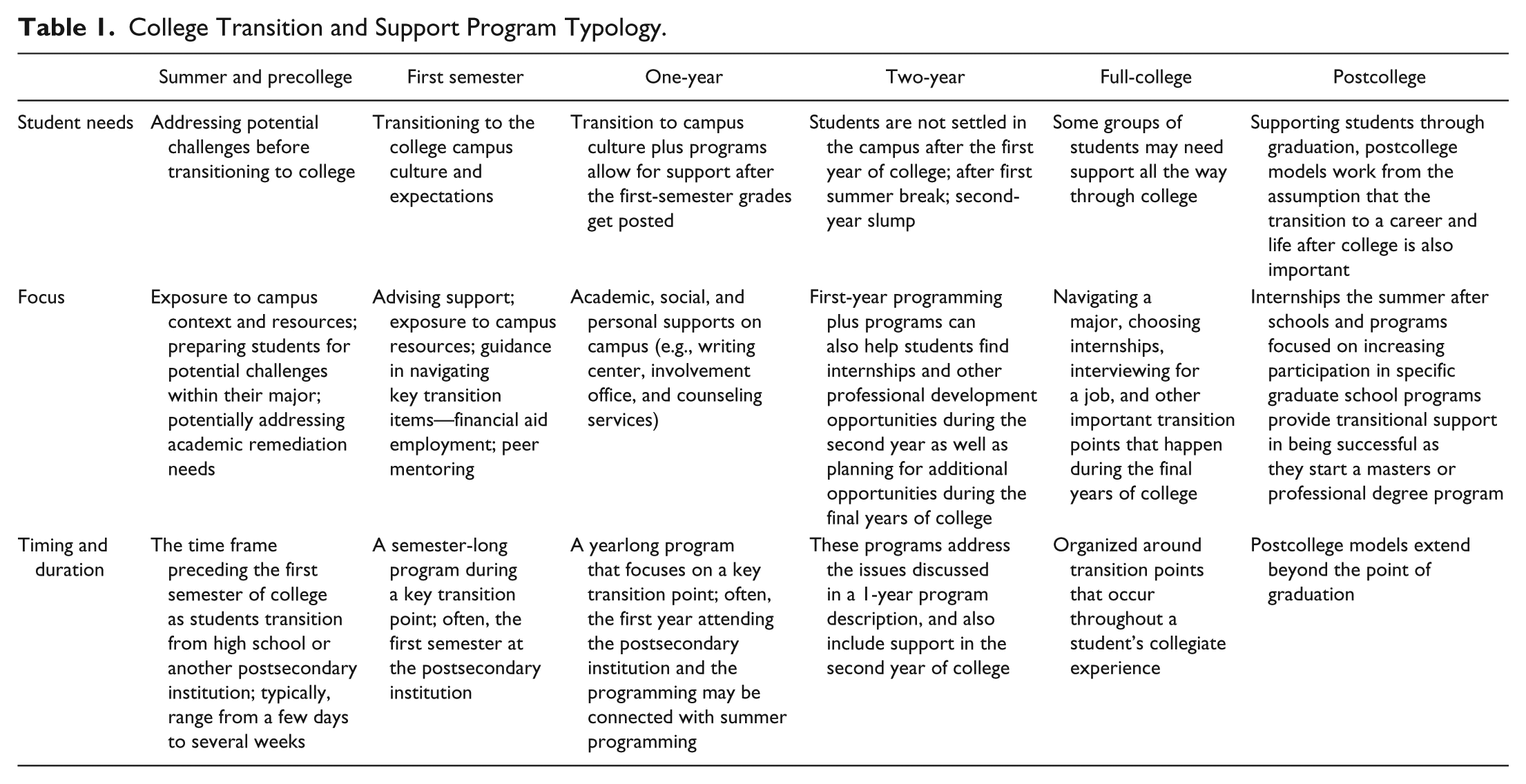
Summer/Precollege Programs
Student Needs
Some students benefit from programs that are short term and precede their college experience. Students might find it challenging to start their college experience without some information and experiences that will help them show up the first day without being overwhelmed or unprepared. Precollege programs address the needs of students by providing information and support that most suits the students based on their broader life experiences as well as scaffolding knowledge that may help them become immersed in the college experience before classes begin.
Precollege summer programs are also helpful for transfer students as they move from one institutional context to another. It is important to recognize that at many institutions, students transfer at several different junctures. Flexibility in offerings around transition programs is important to have support available as transfer students enter the institution at different points in their academic careers (Flores, 2018; Joseph & Poisel, 2018). For example, a “summer” transfer program may have to be repeated prior to the spring semester for students who transition midyear.
Focus
Summer and precollege programs focus on addressing student needs prior to their first semester at the institution. The goal is to provide support and training prior to classes in order to reduce potential barriers that may negatively affect grades and retention. The programs provide a bridge for students as they transition from high school or their previous postsecondary institution to the new institution they will be attending. Bridge programs on many campuses focus on racially minoritized students, first-generation college students, conditionally admitted students, or other subgroups of students that the institution has determined may need additional support as they make the transition to campus. These programs are designed to provide short-term support to ease the transition. In creating this bridge to postsecondary education, the idea is that students will be set up for success. The goal is to identify and address any issues that may be barriers prior to entering the institution, including challenges that may discourage underserved students from remaining in a particular field (e.g., science, technology, engineering, and math [STEM]; prehealth; and prelaw). Some programs provide support in areas where students may be identified as needing academic remediation to move students more quickly into credit-bearing coursework.
In addition to academic support, precollege programs often provide support with the social transition to postsecondary education. Underserved students may benefit from support in developing a sense of belonging on campus. The cohort nature of programming enables students to build connections with peers who may have similar experiences as well as meeting staff and instructors who are invested in their success. Representatives from student clubs and student affairs representatives can be brought in to discuss the social opportunities and forms of support available on campus. The goal is to assist students in developing initial social connections that will help them feel a sense of belonging on campus before classes begin.
Timing and Duration
These programs generally occur before a student’s official first semester at the institution; however, it is possible to have summer programming that focuses on key transition points at any stage of students’ academic careers. Precollege programs may also be a choice for students who work and find being involved in an intensive program while in school to be difficult. This is particularly important for commuter and part-time students (Joseph & Poisel, 2018). The timing of the program is intended to serve as a bridge for students. Many of these programs focus on first-time students as they transition from high school to college, while others provide similar supports for transfer students who may be coming from a community college or another 4-year institution.
These support programs range from a few days to several weeks in length. The programs are generally short in duration as the goal is to overcome the initial shock of transitioning to a new environment with the hope of providing enough intensive support and skills so that students can be successful after the short intervention. Some of the programs function in isolation with the assumption that bridging students to the campus can occur during the summer and the students will not need additional formal supports once classes beginning. However, many of the summer programs are linked to the other program types that continue as students begin classes.
First-Semester Programs
Student Needs
Programs may be introduced for a semester to meet specific needs as students transition into college. The underlying assumption is that transitioning to the college campus culture and expectations may be difficult for some students. Specific student groups (e.g., first-generation college, low-income, and racially minoritized) may have a difficult time acclimating to campus. Students may be unfamiliar with aspects of college knowledge that would enable them to be successful academically.
In particular, first-semester programs can be useful for institutions that identify completing the first semester as a significant barrier for students. The assumption being that supporting students in completing the first semester may build a foundation for students to be successful in future semesters. The institution may also identify a group of students needing academic remediation to access credit-bearing coursework. Addressing these academic issues during the first semester can enable students to more quickly move into more advanced coursework. Other students may need support in navigating the social and cultural dimensions of the campus. Creating opportunities for students to establish a sense of belonging on campus during the first semester can help them build networks of support to rely on throughout their academic careers.
First-semester programs can also be developed for students transferring from another institution. Transfer students often need a semester to acclimate, and support programs can alleviate the transfer shock (Laanan, 2001). These students often need guidance in learning how to navigate a new institution and may have a more difficult time building social connections since most of their peers in class started building relationships during their first year.
Focus
These programs frequently include seminars focused on college knowledge. Students often learn how to read a syllabus, tips for interacting with instructors, time management strategies, and ways to get involved in cocurricular activities. Students generally receive advising support and exposure to campus resources as well. In addition to academic issues, the students typically receive guidance in navigating financial aid award letters, budgeting, and making decisions about employment. Transfer students engage in similar activities, but they focus on topics appropriate for going further along in their academic careers. They benefit from learning about what services exist on their new campus and how to access them. In addition, they may need assistance with building connections with other transfer students who have had a similar experience as well as finding ways to connect with their peers who started their academic careers at the institution.
Building a social network of support tends to be an important aspect of most first-semester programs. The cohort nature of most programs also enables students to develop peer relationships with others in the program. Some programs include a peer mentoring component to build connections with a knowledgeable peer who has been successful on campus. Instructors and staff members connected with the program can provide guidance concerning how to access academic, social, and professional guidance on campus.
Timing and Duration
First-semester programs focus on the transition and college entry. They may last the entire first semester or may have concentrated support the first month of the first year of school. These programs work from the assumption that a semester of support can address transition challenges to prepare students for their academic futures. As previously mentioned, some first-semester programs are linked with a summer bridge program so students experience support before and after the formal start of college.
For transfer students, the support is situated in their first semester at the institution. Students may be at different points in their academic careers. Some may be transferring the second semester of their first year of college, while others may have completed 2 or more years of coursework at another institution. The varied academic experiences of transfer students mean that the timing of these programs focuses on their point of entry and is not consistently situated within students’ educational careers. Exploring student needs and determining a focus are influenced by this reality.
One-Year Programs
Student Needs
The underlying assumption guiding first-year models is that students need support beyond transitioning to the cultural milieu and expectations of the college campus.
In particular, the programs allow for support after first-semester grades get posted. Institutions may determine that some of their students experience challenges between the end of the first semester and the end of the second semester. There may be students who do not return to campus after winter break, regardless of their academic performance. Carrying support over two semesters can also allow program staff to monitor issues related to students returning after winter break. Multiple issues can emerge. Students may experience being homesick when returning to campus after spending time with family and friends. Personal conflicts with family, friends, or partners may have occurred during break.
The second semester may be the time when students are leaving a specific major. For example, underrepresented student groups in math and science fields may change majors during the first two semesters due to challenges with the entry-level coursework. Extending the program over two semesters also enables students to get support after receiving their first-semester grades, which may lead to students questioning their major, career path, or ability to persist in college. Students who struggled academically during the first semester can work with program staff to develop a plan for the second semester in order to encourage retention.
Focus
A yearlong program can enable institutions to provide support beyond focusing primarily on the transition to college. Students can be provided continued guidance in exploring different majors and engaging in initial exploration of career paths. These activities can be especially important for undecided students who may feel lost, which can create uncertainty about their place within higher education or ability to successfully achieve their educational goals.
The staff can continue to connect students with academic, social, and personal supports on campus over the course of the year (e.g., writing center, involvement office, and counseling services). They can also provide guidance with budgeting money, time management, and other issues that continue to emerge during the second semester. Program models include living learning programs that involve students living in the same residence hall (often, the same floor), taking a few general education courses and maybe a first-year seminar, and staff dedicated to supporting students. The California State University Science, Technology, Engineering and Math (CSU STEM) Collaboratives that includes a summer bridge, first-year experience seminar, tutoring and academic support, and revised introductory courses is an example of this type of program.
Programs vary in the level of intensity. Some begin with intensive support in the first semester and taper off in the second semester. For examples, many living learning communities provide more intensive support in the first semester and then move into more episodic programming for students’ transition in the second semester. The CSU STEM Collaboratives provides full support throughout the first year recognizing that students have unique challenges as they progress through their first year. They start with a first-year seminar, continue with redesigned introductory courses, offer tutoring and support, and provide activities related to becoming a STEM major throughout the year.
Timing and Duration
Postsecondary institutions may determine that students need support lasting the entire first year they attend college. The first-year model may include a summer bridge component that is linked to the first-year programming. The justification for the timing of providing support at the start of a student’s academic career is similar to first-semester programs—students may need support in transitioning to college.
However, the duration of a year comes from the assumption that students may need support that continues beyond the first semester. Extending the program to a full academic year enables institutions to also assist in the transition between the fall and spring semester, when students may be dealing with the challenge of returning to campus after winter break. In addition, the spring semester can incorporate programming to prepare students for the summer after the first year and begin preparing for the start of their second year.
A yearlong program specifically for transfer students is less common. Students transfer in the fall, spring, and summer, which makes it more difficult to create a yearlong program to support these students. A program might incorporate transfer students into the second semester of programming for those who are in transition within their first year of college.
Two-Year Model
Student Needs
The underlying assumption guiding the 2-year college transition model is that some students may not be settled into the campus after the first year of college. Institutional data may reveal that some student groups are less likely to return to school after summer break. There may also be an issue related to “sophomore slump,” where students’ grades drop or they consider leaving school. A 2-year program also enables students to get support in completing their general education requirements and begin transitioning to courses for their major.
This transition point may be when students experience new academic struggles and consider changing majors or leaving school. The underlying assumption is that students may need additional support as they move into more challenging courses and deal with transitions between the first and second years of college. Working with students during the second year can also enable the programs to identify issues related to major and career choice that may become more evident as students prepare for taking upper-level courses in the third year. Beyond academic concerns, an institution may recognize that some students are not as involved on campus or struggle to find leadership roles and internships.
Focus
Two-year programs build on what is generally accomplished within a 1-year program. In addition to addressing the “sophomore slump” that many students experience, these programs also focus on helping students finalize their choice of major and prepare for the transition to upper-level classes, which is another transitional point when some students may experience challenges. The program can help students ensure that they complete all of their general education requirements, which often involves a purposeful audit of classes and drafting a class plan to complete all coursework within a set period of time. By the end of a 2-year program, students should have settled on a major and have a general understanding of potential careers they might pursue.
Extending programming for 2 years also enables institutions to provide social support for students. The staff can provide guidance on not only getting involved on campus but also continuing to stay involved as coursework gets more difficult. They can also support students in making decisions about engaging in activities that will prepare them for internships and future careers. Continuing programming over 2 years allows for support returning from campus after leaving for the summer. The University of Nebraska’s Thompson Scholars Learning Community (TSLC) program is an example of a 2-year program, which we discuss in greater detail later in the article.
A 2-year program may be designed to be more intensive at the beginning. Similar to the first-semester programming discussed above, these programs may begin with significant support to students during the initial transition that slowly reduces over 2 years. The goal of these programs is to eventually transition the students into the campus context without needing additional supports.
Timing and Duration
The 2-year program model includes support throughout the first 2 years of college. The program may include a summer bridge component before the first year and support in between the first 2 years of college. The time commitment for students may be more significant in the first semester or year and then be reduced in the second year.
Generally speaking, postsecondary institutions do not design 2-year programs specifically for transfer students. However, students who transfer within their first 2 years of college may enter a program. For example, a student who completed a year at a different institution could join the TSLC program for the second year of programming—which would be the first year the student is at the institution. These programs may incorporate some specialized program elements to assist transfer students in transitioning into the program as well as the new institution.
Full-College Programs 1
Student Needs
The underlying assumption of a full-college model is that some groups of students may need support all the way through college. A first-generation college student, for example, may not be able to turn to family members with college experience for support related to navigating a major, choosing internships, interviewing for a job, and other important transition points that happen during the final years of college. These programs support students through their entire academic career.
Although the first year of college may be when students drop out at the high rates, some students still leave college or a specific major during the final few years of college. In addition, students receiving state or federal grants often only have 4 years of funding, which can lead to a financial crisis if they need a fifth year of schooling. The full-college model is often used to onboard transfer students who may come at end of their first, second, or even third years. As students transition from 2-year to 4-year institutions, they experience transfer shock and need help. The full-college model acknowledges that students do not just experience transition in the first year but that students experience multiple transitions, changes, and challenges throughout their time in college that they may need support in navigating.
Focus
The full-college model incorporates many of the elements previously discussed in the other models. Continuing support throughout students’ college career to degree completion allows for additional programming related to completing a major and finding internships during the final years of college when students are taking upper-level coursework. These programs can also provide support as students consider and prepare for life after college. For example, the programs may include job interviewing support and resume development. These programs may include mentoring opportunities from professionals in the community who work in fields related to the students’ career goals. Students can also receive guidance in making decisions about graduate and professional schools. For those who decide to pursue an advanced degree, these programs can assist students in understanding the process, choosing schools, submitting applications, and making decisions about which opportunities to accept. Regardless of the students’ decisions about life after college, programming can be incorporated to assist in the transition out of college, including financial planning and setting professional goals.
The Guided Pathways and the Meyerhoff Scholars program at the University of Maryland, Baltimore County, are examples of full-college models. The full-college model typically provides the most programming at the time of entry—first year for those coming in then or at the time of transfer. Programming tends to taper off over time for the programs. However, some models like the Meyerhoff Scholars have continued support throughout the completion of a degree. This program aims to send minority students to graduate school. They continue to offer support so that students excel in their STEM majors and have the grades to be admitted into graduate school.
Timing and Duration
The full-college model begins either in the summer before the first year or in the first semester of college and continues until the student graduates from college. Unlike the college programs focused on early transitions in a students’ college career, the full-college model is organized around transition points that occur throughout a student’s collegiate experience. They often incorporate similar elements as the previously discussed models and may or may not have a summer bridge component. In addition, full-college models incorporate programming to support students once they enter their upper-level courses within their chosen major. The timing and duration of the full-college models enable the programs to design supports for students at multiple transition points that students experience all the way until graduation.
Full-college models can serve transfer students in two ways. First, transfer students can be incorporated into a full-college program at whatever point they begin at their new institution. Second, two institutions can work together to create a smooth pathway for students. In particular, a community college may consistently funnel students into a local college or university. A support program could be designed that begins at the community college and transitions with the students to the 4-year institution.
Postcollege Programs
Student Needs
Postsecondary institutions often focus on degree completion, which may include support for preparing for life after college. However, postcollege models are rare. In particular, a postsecondary institution may have a difficult time continuing to connect with students after degree completion. As a result, the postcollege models tend to emerge from support programs outside the institutional context. A professional organization or foundation may determine that certain groups of students transition to careers or graduate school in a given field at significantly lower rates than their peers. Although these students completed an undergraduate degree, they may need continued support to successfully make the transition from undergraduate life to professional life or graduate school. Particularly for first-generation college students and racially minoritized students, the transition to career or graduate school may involve a new set of challenges with few family role models to turn to for support with experiential knowledge.
Focus
The postcollege model is an extension of a full-college model. Many of the programs in the aforementioned may include discussions on how to choose a career and life after college. However, the postcollege model includes more targeted supports to assist with the transition after college. There are pitfalls all the way past graduation as college is not geared for postcollege generally. Interventions are needed to help, particularly low-income, first-generation students to move past college into next phase. The Business–Higher Education Forum is an example of an initiative that works from the underlying assumption that degree attainment is not the end, but rather employment or graduate school is the ultimate goal.
The Cal-Bridge Program is an example of a transition program in which undergraduate students within the California State University system receive mentoring from faculty at research universities within the University of California system, where they aim to attend graduate school. In addition to mentoring, they take field trips to the University of California campuses and receive counseling about graduate school applications and best ways to navigate the programs. Postcollege program tend to be less intensive and focused on a single area of support. Transition to work and graduate school is seen as an extension of habits from your undergraduate time. Students have become well versed in academic habits, but graduate school is a unique task so these type of programs attempt to introduce students to the skills required for even more autonomous work in a PhD program or level of engagement in law or medical schools.
Timing
Postcollege models extend beyond the point of graduation. For programs that focus on increasing participants in a specific career field, the students may continue receiving support after college in the form of internships the summer after schools. For programs focused on increasing participation in specific graduate school programs, there may be similar transitional support to assist students in being successful as they start a master’s or professional degree program. Unlike the previous program models discussed, the duration of postcollege program could vary greatly from a couple of days the summer after graduation to several years of mentoring and guidance that continue through the students’ early career or graduate school attendance.
Exemplar 2-Year Comprehensive College Transition Program
Although we have provided information about how college transition programs may be designed and have described a typology of such programs, more closely examining a single program may better illustrate how the typology in Table 1 informs program design and implementation. As Figure 2 illustrates, the TSLC is a comprehensive 2-year program. Unlike typical learning communities, the TSLC program involves significant wraparound support lasting for the first 2 years students attend the university as well as a foundation-supported scholarship. Here, we describe the underlying assumptions, features, and outcomes of a comprehensive 2-year transition program that is designed to support low-income students at three campuses in the University of Nebraska system who are recipients of foundation-funded scholarships that provide up to 5 years of undergraduate tuition support. The final section explores how decisions about program dimensions influence the development of a specific mission and selection of program elements for the TSLC program.
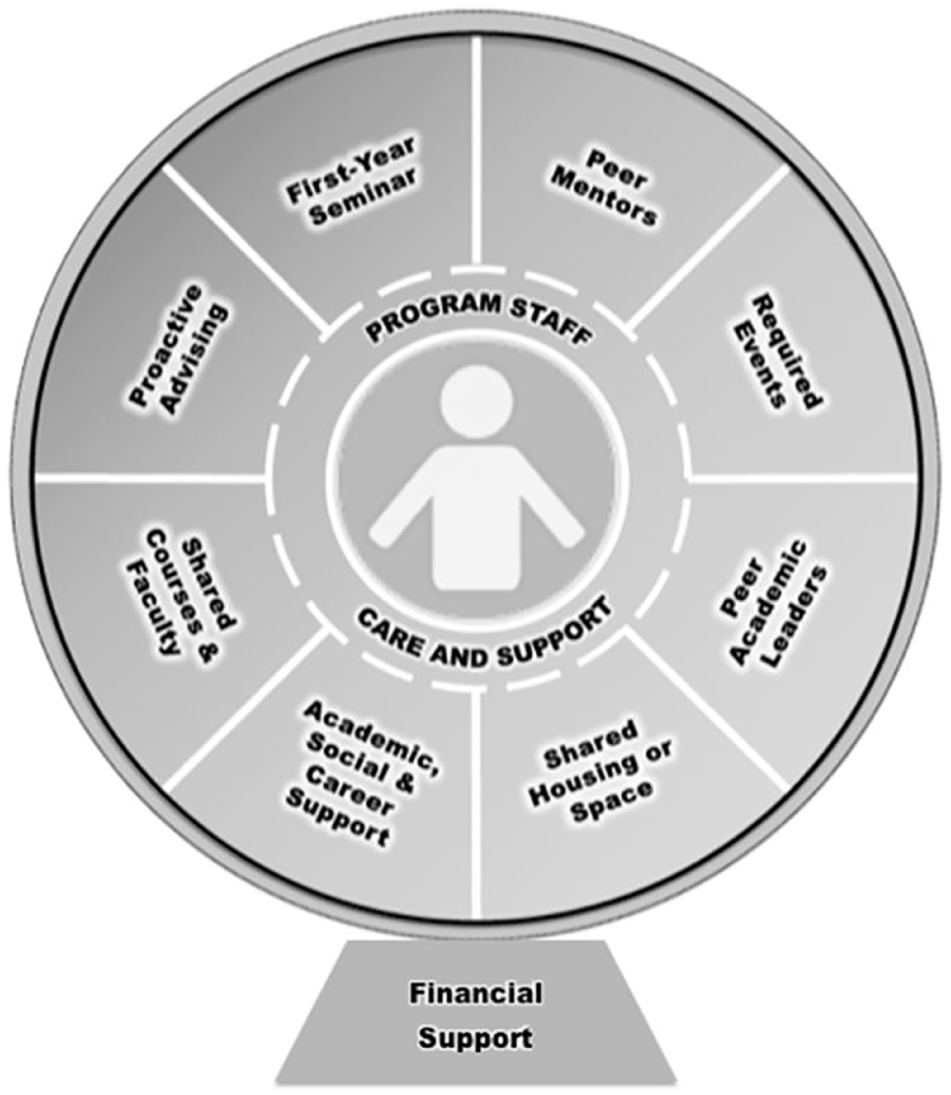
Thompson scholar learning community program structure.
Insights About Students and Campuses
The TSLC program supports low-income students, many of whom are first-generation college students and racially minoritized. This particular college transition program makes several assumptions about the students it serves that are based on their insights about students and the campus, evaluation of student and campus-level data, and review of research and theory related to college student retention: (a) financial support is necessary but insufficient for supporting matriculation, (b) students benefit from support with the transition into college and into their academic majors particularly college knowledge, (c) an asset- or strengths-based approach supports student success (Rendón, 1994; Yosso, 2005), (d) helping students find and build community supports their retention and success, and (e) small classes with a group of familiar peers can build academic self-efficacy and confidence. TSLC staff know from their institutional data that many of the people they serve are also first-generation college students and may need additional support navigating college. Institutional-level data and experiences also inform staff members’ understandings of students’ needs that may be distinctive to the campus. For example, one campus serves many students with familial obligations (e.g., parenting, caring for siblings, assisting elders), and this knowledge informs when the program schedules events.
The staff members in this transition program assume that collaborative relationships across the institution, particularly among academic and student affairs, will better enable the program to achieve its aims. Furthermore, program staff members believe that they should connect students with the resources on their campus rather than duplicating existing campus services. Staff and faculty members’ beliefs about how to best support retention, matriculation, and success at each of the three campuses are also informed by existing research, their prior experiences, and understandings of good practices to support low-income students such as research on the efficacy of learning communities, first-year experience seminars, and peer mentoring as key supports for this population. These educators are also mindful of how these particular good practices may best be implemented given their institutional contexts and missions since they are located at a research university, a metropolitan university, and a rural comprehensive university, respectively.
Programmatic Dimensions
Student Needs
The overarching assumption is that students from low-income backgrounds attending these institutions need additional support during the first 2 years of college to complete their degrees. In particular, students need the most intensive support during the first two semesters of college. Related to this overarching assumption, the programs believe that specific aspects of the college experiences are connected to retention. Students from low-income backgrounds attending these universities—particularly those who are also first-generation college students—may not have access to the college knowledge necessary to navigate a 4-year institution. In addition, the students may have a difficult time connecting with faculty and peers, which could negatively affect their academic engagement and retention. Furthermore, the programs work from the assumption that reducing financial stress will encourage retention of students from low-income backgrounds.
Focus
With the aforementioned assumptions and insights in mind, this program takes a comprehensive approach to serving low-income students. The program incorporates multiple foci to support students from low-income backgrounds as they navigate the first 2 years of college. Being situated within academic affairs, one of the primary goals of the program is to increase retention as well as support students in making decisions about majors and careers. The program also incorporates multiple forms of personal and social support, in part because they believe that doing so will increase students’ ability to succeed academically. The program attends to the transition to college and subsequently into students’ majors by providing an array of programs and services that are intended to support students’ academic and personal success.
The intensity of this 2-year program changes over time. Students have the highest contact with program during the first semester as they transition into college, and they are required to fulfill the largest number of requirements during this semester. In subsequent semesters, the intensity of contact decreases. There are fewer requirements during students’ second semester in the program than there are in the first year, and the second year in the program has fewer requirements than the first year. The shifting intensity of the program reflects the desire for students to develop increasing independence and to connect with other forms of community on campus (e.g., clubs, majors).
Timing and Duration
The programs work from the assumption that students from low-income backgrounds experience the most challenge during their first 2 years of college. Given the desire to support the transition into college and into students’ majors, the staff members have designed a 2-year transition program. Although the formal program is 2 years in length, students in this transition program have contact with staff prior to beginning college, and some maintain their engagement with the program after they have completed their formal requirements. In particular, staff continue to work with students who are on academic probation after the formal 2-year program ends. Students who transfer from another institution during their first 2 years of college are incorporated into the program on their transition to the new institution.
Aligning Program Dimensions, Mission, and Elements
Decisions about the program dimensions that frame TSLC influenced the development of a mission and decisions about which program elements to include. Given the assumptions and insights that inform this program, staff members in the program are intentional about initiating relationships with scholarship recipients before they begin their first semester. For example, students in this transition program are consistently referred to as scholars from the moment they receive their scholarship offer. This language is reinforced during their orientation and welcome to campus, which signals their capacity to succeed academically. The programs have an orientation prior to the beginning of the semester to welcome students to the community and campus and to clarify program expectations.
The first year of the program attends to the transition to college, and the programmatic elements at each campus are designed to enhance students’ college knowledge, to create a sense a sense of belonging, and to convey that their presence and abilities are valued. With this in mind, all students in the programs participate in a first-year seminar during the fall semester that explores study skills, time management skills, and other valued college knowledge (e.g., how to contact professors, importance of campus involvement). In addition to this seminar, students take two shared academic courses each semester that exclusively enroll members of the 2-year transition program. These courses are smaller in nature than most first-year, general education classes and are taught by instructors who are known to be good teachers. These smaller courses facilitate opportunities for students to build relationships with their faculty and their peers.
Throughout the first year, students in this transition program also receive multiple forms of support. For example, each student is assigned a peer mentor and works with a professional staff member throughout the year. Both peer mentors and staff members approach their work holistically, providing resources and support on an array of academic and personal issues. Students are also required to meet with a staff member for a midsemester meeting. These meetings are a formal way for students to discuss their academics progress, and they often described their contact with staff members as supportive and validating experiences that instilled confidence in their academic capabilities.
Notably, this 2-year transition program also works to create peer networks among students in various ways. For instance, two campuses require housing, which facilitates building peer relationships outside classes. The third campus does not require living on campus, and it uses mentoring groups that meet within the first-year seminar class to help students build community. The programs also have space outside their offices, where students can interact, such as study space, social areas, and/or a lobby area near staff spaces. The 2-year transition program staff members are also intentional about helping students connect with the campus more widely. For example, students at two institutions are required to attend campus programs and events that are opportunities to learn and engage outside the program.
As previously noted, the intensity of the program shifts as students move through the program. For example, students have fewer required shared academic courses during their second year in the program. At two of the campuses, the focus of the programs also shifts during the second year. Specifically, these two institutions have structured their second-year programming to focus more exclusively on major and career decision making. With the aim of helping students as they transition into their departments and future careers, these two campuses have major and career-related seminars and events, as well as resume and interview skill development activities. One institution also provides an opportunity for students to meet with professionals in their areas of interest with the goal of helping students build their social capital (Bourdieu & Passeron, 1977) and find future internship and job opportunities.
At the conclusion of the 2 years, students transition out of the formal programming. Although they continue to receive financial support associated with their scholarship, there are no requirements for students beyond their second year of college. Some students remain engaged with the program on their respective campuses through various leadership roles (e.g., peer mentor, peer academic leader, office staff member).
Review of Factors That Affect Identifying the Best Program for Campus
We have thus far described the spectrum of program models and an example illustrating one such model—further detailed in the articles that follow this paper. Identification of the most suitable program design for one’s campus should be informed by data, institutional trends, existing research, and ongoing program assessment. We recommend taking into consideration at least four factors when identifying the appropriate program design: (a) student population(s), (b) barriers to student success, (c) existing campus resources/assets, and (d) cost–benefit analysis.
Students in the local context should be the central focus of choosing an appropriate program model with components and goals aligned with a student population’s needs. While there is variation, different program models have been developed to address the needs of particular student populations, and the data that support the impact of many of these programs typically focus on their success in serving their intended student populations. For instance, TRIO and summer bridge programs were introduced as a way to compensate for earlier uneven educational (i.e., K-12) opportunities faced by certain student populations (e.g., low-income, minoritized students). Other program models, such as the “guided pathways” model, were typically developed to support students who are undecided or unclear about their major and career path. Studies examining the efficacy of these program types necessarily focus on the student populations served and may or may not apply to other student populations. A clear understanding of the student populations one intends to serve and factors that support their success should influence any decision to develop or implement a particular program type.
Hand in hand with identifying the student population to be served is the identification of the barriers to the success of that student population (i.e., problem identification)—whether it be low persistence rates, lack of college knowledge, social adjustment, time to graduation, or other issues. Different program types may be more suitable for addressing different problems, and identification of the right program for a problem is crucial to meet stated program goals and to address the barriers identified for a particular student population. Explicit identification of those student population needs will facilitate selection of an appropriate program. This is an important consideration to avoid program-population mismatch. Providing program services for a problem that does not exist for a particular student population or implementing the wrong kind of program may be a waste of resources that does not achieve stated program goals. For example, first-semester models are typically used with students who need “minor” support with initial adjustment, whereas the 2-year model is based on meeting the needs of first-generation and low-income students who lack college navigation skills and a sense of community, and address academic preparation issues.
An assessment of existing campus assets and resources should inform the selection and development of an appropriate program model to serve the student populations identified and to address barriers to their success. Campuses should take an inventory of existing support services to identify gaps in resources needed by a particular student population where a program can fill in to help address the identified problem (e.g., social adjustment, major/choice selection, persistence). Programs can leverage existing resources and services on campus to reduce cost and in order to devote resources to providing support aligned with a student population’s unmet needs. For instance, a campus with a strong, well-functioning—but underutilized—advising and career services center may not need to invest in the full guided pathways program model in order to address the needs of students who are undecided about their major/career path. Rather, a more cost-effective option may be a summer bridge or first-semester program that leverages existing campus advising and career services by linking students to those resources early on.
Finally, a systematic approach should be taken to determine which program type will yield the most desirable outcomes for a particular student population while maintaining budget consciousness. A cost–benefit analysis can help determine whether potential benefits yielded by a program merit the invested resources. The cost–benefit analysis will allow the institution to weigh different options available to address barriers to success for particular student populations and to determine what kind of program is most suitable for the greater good. Outlining clear programmatic outcomes and consistent assessment and evaluation of student experiences and program outcomes are crucial steps toward addressing barriers to student success and to maximize the associated investment of resources. For example, if an intense, costly summer bridge program that runs for a few days in the summer does not yield desirable longer term outcomes for a particular student population—such as persistence among first-generation students—the cost may outweigh the benefit. In such cases, those resources might be devoted to another more suitable program model, such as a 1-year or 2-year model that can provide consistent support to encourage persistence long-term in a way that a summer bridge program cannot. Choice of program model should be flexible if ongoing cost–benefit analysis reveals that the investment is not accruing the desired outcomes.
Future Research and Conclusions
While thousands of college transition programs now exist, there is very little research that captures and compares different program types. As programs have proliferated and expanded in purpose and type, there have been few studies that capture and describe the emergence of this field of practice. We offer a typology of such programs to aid in research/practice in this burgeoning area. Currently, there is the greatest articulation of the summer bridge/first-semester and first-year programs through literature developed by organizations such as the National Resource Center for the First-Year Experience and Students in Transition (and more recently, work on the sophomore year, the transfer transition, and the capstone experience). Emerging studies provide data to inform programmatic choices and have created principles for developing a summer bridge or first-year program (Chaney, Muraskin, Cahalan, & Goodwin, 1998; Nava, 2010; Ting, Grant, & Plenert, 2000). Other program types such as the 2-year, full-college, and postcollege remain largely unresearched both descriptively and in terms of outcomes and best practices and need future research and study. Additionally, there is no comparative research that examines and explores the various transition programs, particularly in terms of research that might inform cost–benefit analysis. Some studies of single interventions such as MDRC’s study of learning communities’ interventions at community colleges (a first-year transition program) and the Community College Research Center’s study of the Accelerated Study in Associates Program (ASAP; a 2-year transition program) showed very different results for two college transition and success programs (Scrivener et al., 2008). ASAP showed significant improvement for retention, while the learning communities did not (Kolenovic, Linderman, & Karp, 2013). But studies of transition programs are typically not compared as there has not existed a typology that could provide context for comparing such studies. Instead, these were seen as distinct program interventions. By providing some points of comparison through the typology, existing research can be examined through a meta-analysis for a greater understanding of the state of the literature on college transition interventions. Additionally, new studies can be developed that compare different type of programs on similar outcomes and practices.
As transition programs continue to expand, our analysis and development of this typology made us wonder, as well, whether college transition programs need to be reconceptualized going forward. Should colleges instead be considering how they can alter their overall environment—culture, structure, policies, and practices—to support students from diverse backgrounds? As transition programs grow in time, intensity, and focus, and as students largely come now from low-income, first-generation, and underserved populations, at the vast majority of campuses, when does the notion of transition and support program become stretched so far as to no longer be meaningful? We find great value in the expansion of program types to address growing needs and institutional failures, but at some point, institutions will need to consider when they need to be rethinking their overall environment rather than continuing to add programs and interventions on the side. A well-articulated vision of a college environment that is developed for the transition and support of all students is provided in a recent book by McNair et al. (2016), Becoming a Student-Ready College: A New Culture of Leadership for Student Success. We also encourage research that explores how colleges can reshape their culture, not just their programs. And from our time studying a CCTP, there is evidence that these programs themselves can also be structured in ways that help support innovation and change to the overall college environment. A line of research exploring transition programs’ role in reshaping campus culture to support diverse students would also make a powerful contribution to the literature. We imagine that there will always be a role for transition programs, but perhaps now is a time for reimagining the role.
In closing, we hope to have expanded the thinking of practitioners about how to determine the best interventions for your campus and some key steps in planning and implementing these efforts. We also hope that we have identified key areas for new research to enhance our understanding of the best ways to support all students who come to campus.
Footnotes
Declaration of Conflicting Interests
The authors declared no potential conflicts of interest with respect to the research, authorship, and/or publication of this article.
Funding
The authors disclosed receipt of the following financial support for the research, authorship, and/or publication of this article: Funding for the studies in this volume was provided by the Susan T. Buffett Foundation (TSLC project) and the Helmsley Charitable Trust (CSU STEM Collaboratives project).