



Abstract
This article presents a portrayal of Filipino and Indonesian female domestic workers’ life courses in migration, using the life history calendar data from the 2017 survey of migrant domestic workers in Hong Kong. Applying sequence analysis, we first analyzed migration trajectory features such as individual migration trajectories, duration spent in each state, and longitudinal diversity of state distributions. We found that Indonesian domestic workers, compared with their Filipino counterparts, are more diverse in their migration histories, indicating involvements in serial migration. We also conducted a cluster analysis of the domestic workers’ migratory trajectories. The analysis yielded three meaningful clusters/types of migrant workers—those moved late in life, those who participated in serial migration, and those migrated directly from their home country to Hong Kong. Finally, we investigated the effect of a complex migration history on job satisfaction and the characteristics of membership in the three ideal-typical migration types among the domestic workers older than 39 years.
Introduction
This article analyzes Filipino and Indonesian female migrant domestic workers’ migration histories, their individual characteristics, and the effects of such histories on job satisfaction, using the life history calendar data collected on a 2017 survey of 2,017 Filipino and Indonesian migrant workers in Hong Kong, via face-to-face interviews based on multistage cluster sampling (Chung et al., 2020). First, we analyze these migration trajectory data and compare migration trajectory patterns between the migrant workers from the Philippines and those from Indonesia. Second, we are interested in whether such migration trajectory patterns may have an impact on the workers’ job satisfaction, and if so, in what way. Finally, we are also interested in the association between the characteristics of migrant workers and their migration history types for those 40 years of age and older, namely, those who are old enough to have formed some patterns of migration.
To achieve these objectives, we employ state-of-the-art sequence analytic methods to analyze the women’s migration trajectory data. Sequence analysis has seen increasing applications in the social sciences since its introduction by Abbott and Forrest (1986) over three decades ago. The field has witnessed various methodological advances in social sequence analysis over the past couple of decades (see, e.g., Aisenbrey & Fasang, 2010; Fasang & Liao, 2014; Gauthier et al., 2010; Piccarreta, 2012; Scherer, 2001; Studer, 2013; Studer & Ritschard, 2016). Sequence analytic methods equip social science researchers with a visually appealing means for presenting life course trajectories in migration, family formation, employment, or other life course patterns. Furthermore, these methods can be used as a first step prior to a substantive analysis of a particular social outcome.
In this article, we apply sequence analysis by utilizing some of these methodological advantages. On the pages to follow, we first provide a review of the relevant literature on migratory patterns, especially the literature on Filipino and Indonesian domestic workers’ migration trajectories. We then present the sequence data from the life history calendar on our 2017 survey by providing some descriptive analyses of the patterns of migration trajectories. Two outcomes of the descriptive analyses become focal variables in a subsequent, substantive analysis. In particular, the complexity of migration trajectories in the form of “entropy” is employed in our analysis of the migrant workers’ job satisfaction. Research has shown that female domestic and care workers’ working trajectories are important for their job satisfaction (di Belgiojoso & Ortensi, 2019). We also analyze a typology of migrant workers in terms of migratory paths regarding the women’s individual characteristics, to explore the individual factors related to the types of migration. Finally, based on what we have learned, we offer come concluding remarks about our research, its policy implications, and future research needs.
A Review of the Literature on Migrant Domestic Workers in Southeast Asia
Filipinos and Indonesians have had a long migration history. Long before Filipino women started to migrate to Hong Kong for work, most of the migrant workers who had engaged in rural to urban migration in the Philippines were women as far back as in the 1980s (Lauby & Stark, 1988). This migratory pattern could be found not just in the Philippines but also in Indonesia (Costello et al., 1987). Fairly soon, migration streams from the Philippines and Indonesia turned internationally, and contributed favorably to the countries’ economic growths (Amjad, 1996). Major migratory destinations for these female migrant workers include several places in East and Southeast Asia that were already more developed, such as Hong Kong, Singapore, and Taiwan (Cheng, 1996). Such migration flows to East and Southeast Asia created a process of feminization (Cheng, 1996), and were termed as a process of transnational domestication in a new power dynamic (Silvey, 2004). While these observations apply to migrant workers from both Indonesia and the Philippines, the Filipino migrant domestic workers in Hong Kong in particular have been exposed to some high-quality ethnographic research (e.g., Constable, 1997, 2007).
The volume and the popularity of overseas domestic work were at least in part driven by both the sending and the receiving countries: The newly prosperous receiving countries in East Asia have recruited migrant domestic workers to fill the domestic needs in their countries (Lan, 2006). The neoliberal policies of the sending countries with an aggressive implementation of the policies of globalization such as in the Philippines rendered labor export a feature of the country’s political economy (Lindio-McGovern, 2013). Migrant domestic workers from Indonesia have also been an integral part of the neoliberal policies and unjust trade agreements (Rother, 2017).
Previous studies on domestic helper’s international migration tended to focus on a particular step of their migration process: How helpers are recruited in the home country, what their living and working conditions are in receiving countries, how they keep connections with families left behind, and how they readapt to the home society when returning after a long period of experience from working abroad; these are the topics that have been thoroughly discussed (Constable, 1997, 2007; Lan, 2006).
However, a few studies have indeed tried to describe and explain the migration trajectories of domestic helpers. Generally, migration trajectories were reviewed and summarized as a sequence of linked movements defined by periods of spatial settlement in socially constructed places (Schapendonk et al., 2018). Existing research on the domestic helper’s migration trajectory has primarily been qualitative. In-depth interviews were widely used to describe patterns of migration. For example, Paul (2011) interviewed 95 domestic helpers from the Philippines and found that they migrated step by step, following a hierarchy of destinations. Another recent in-depth interview of Filipino and Indonesian migrant domestic workers in the United Arabic Emirates identified the pattern of serial, multicountry labor migration as well (Parreñas et al., 2018). Some scholars have recently taken a similar approach to the one in this article and analyzed quantitative employment trajectory data of female foreign-born domestic and care workers in Italy by focusing on the types of work (di Belgiojoso & Ortensi, 2019). However, this type of analysis has not been done on the entire migration trajectory of a migrant worker.
Drawing on the literature on serial labor migration (Parreñas et al., 2018; Paul, 2001, 2017; Silvey & Parreñas, 2019), we intend to fill the gaps in the literature by providing a detailed sequence analysis of the Filipino and Indonesian domestic workers’ migration trajectories and the effect of trajectory complexity on job satisfaction as well as preliminarily looking into the characteristics and consequences of migration trajectories. When it comes to migration destinations of Filipino and Indonesian migrant workers in Asia, they share a set of destinations but not necessarily in the same preference order. Among the Filipino domestic helpers, for example, the top destinations for newly hired Filipinas in a decreasing preference order were Hong Kong, Kuwait, the UAE, Saudi Arabia, Qatar, Taiwan, and Singapore in 2010 while the preference order for Indonesian workers of all types in 2013 consisted of Malaysia, Taiwan, Saudi Arabia, the UAE, Hong Kong, and Singapore, also in the high to low order (Paul, 2019).
In addition to their differences in preferred destinations, the two groups of women differ in several other ways: For example, though labor migration from the two countries has had a high level of state involvement (Wee & Sim, 2004), the Philippines has a longer history of sending out female labors. Labor migration in the Philippines began in 1972 with the overseas employment program promoted under Marcos’ regime. In Indonesia, labor exports were first set for 1979 to 1984, at 100,000 migrant workers for 5 years as part of Indonesia’s national development plans (Sim, 2009). The longer labor export history results in a mature migration infrastructure in the Philippines. Apart from the governmental agency named the Philippine Overseas Employment Administration, there are also numerous private agencies to facilitate the export (Rodriguez, 2010). A greater number of Filipino females can therefore be attracted and recruited.
The two countries also differ in their colonial experiences. The colonial experiences with Spain and the United State strongly shaped the cultural and socioeconomic characteristics of the Philippines. More than 80% of the population practice Catholicism (Philippines Statistics Authority, 2018). On the other hand, the dominant faith of Islam among Indonesians possibly slows assimilation through distinct clothing and diet restrictions. Another important factor felicitating Filipinos to work overseas is that they use English as the official language while most Indonesian migrant labors have low proficiency in English. Last but not least, the two groups differ in their educational attainment. It is common for Filipinas with a bachelor’s degree to work abroad as domestic workers because their wages as domestic workers would still be higher than white-collar jobs back home (Constable, 2007; Parreñas, 2001). On the other hand, Indonesian workers tend to have just a junior high or high school education (Surtees, 2003). Thus, Filipinas often have a higher education level than their Indonesian counterparts (Cameron et al., 2001). A higher level of education helps Filipino helpers obtain labor market information, with potential financial and other benefits.
Therefore, for these substantive considerations, we will separately analyze the Filipina and Indonesian samples, either in the descriptive or in the multivariate analysis, in addition to the statistical reason that will be stated in the next section.
A Descriptive Analysis of Domestic Workers’ Migration Trajectories
In this section, we present a series of descriptive figures of the Filipino and Indonesian female domestic workers’ migration trajectories. By “trajectories” we mean a time series of qualitative states recorded over one’s life course. In this instance, a migration trajectory contains women’s migration destinations (i.e., countries) starting from the first month of age 15 until the time of the survey in 2017. Invariably, women from either the Philippines or Indonesia started their migratory journeys in their home nations and completed them in Hong Kong where the interviews took place. Some of the migrant workers arrived in Hong Kong recently while some others, years ago.
The migration trajectory data are obtained by the life history calendar in the survey instrument. The life history calendar survey method has come a long way over the past three decades, moving from a standard pencil-and-paper survey to our practice of the CAPI (computer-assisted personal interview) approach (for reviews of the review methods and techniques, see Axinn et al., 2020; Freedman et al., 1988; Glasner & van der Vaart, 2009). To help the respondent recall life history, we focus on the transitions of life events only. In the case of migration history, the quality of the data is particularly high because we asked a woman just her timing of a move and filled in the in-between states (i.e., between two moves) later when we set up the analysis. As a result, we had a high proportion of valid responses, resulting in 1,892 usable trajectories for the descriptive analysis, 611 of which belong to the Indonesian migrant workers and the remaining 1,281, the Filipino migrant workers.
In addition to the substantive differences that cannot be corrected by weights as the main reason for a separate analysis, the two subsamples also differ in the proportions to their respective larger populations in Hong Kong. Statistically, according to Hong Kong’s government, the ratio of Filipino helpers to Indonesian helpers in the domestic helper market of Hong Kong in 2017 (the survey year) is 1.26, lower than the ratio of 2.30 in our sample. Analyzing the data together would assume they were equally represented.
Individual Migration Trajectories
Figure 1 presents a comparison of the two samples of women’s migration trajectories in two side-by-side sequence index plots pioneered by Scherer (2001). The advantage of sequence index plots is its ability to present life courses holistically, by visually portraying an entire life course as is, in multiple colors indicating the various states.

Domestic workers’ migration histories, age 15 years to time of survey.
Each thin color line in either of the two plots represents a woman’s migration trajectory, and as she goes through life, her destination countries/places are represented by different colors. From these arrays of colors, it is obvious that all women started from their home nations and completed their journeys in Hong Kong. In addition to their home nation and Hong Kong, there are altogether eight other countries plus any “other” places the women may have spent some time in before coming to Hong Kong. The two plots are sorted by age. That is, an older woman at the time of interview toward the bottom of a plot shows a longer migration history. It appears that in the Filipino sample, there are some older women even though in both samples there are quite a few young female migrants. In addition, judged by the proportion of nonhome nation and non– Hong Kong colors, Indonesian women may have participated in greater amount of serial migration, that is, migrating through at least one intermediate destination before coming to Hong Kong. However, we will postpone the discussion of this point until our next pair of plots where a clearer contrast can be discerned.
Average Time Spent in Each Destination
To more easily compare these women’s time spent in various migration destinations, we present in Figure 2 the number of months spent in each of the destinations since the first month of age 15 years, excluding their home nation (because that state would have too high a proportion than the other places, as shown in Figure 1). The same color code as in Figure 1 is used here, except that now the “other” category takes the color of “home nation” in Figure 1.
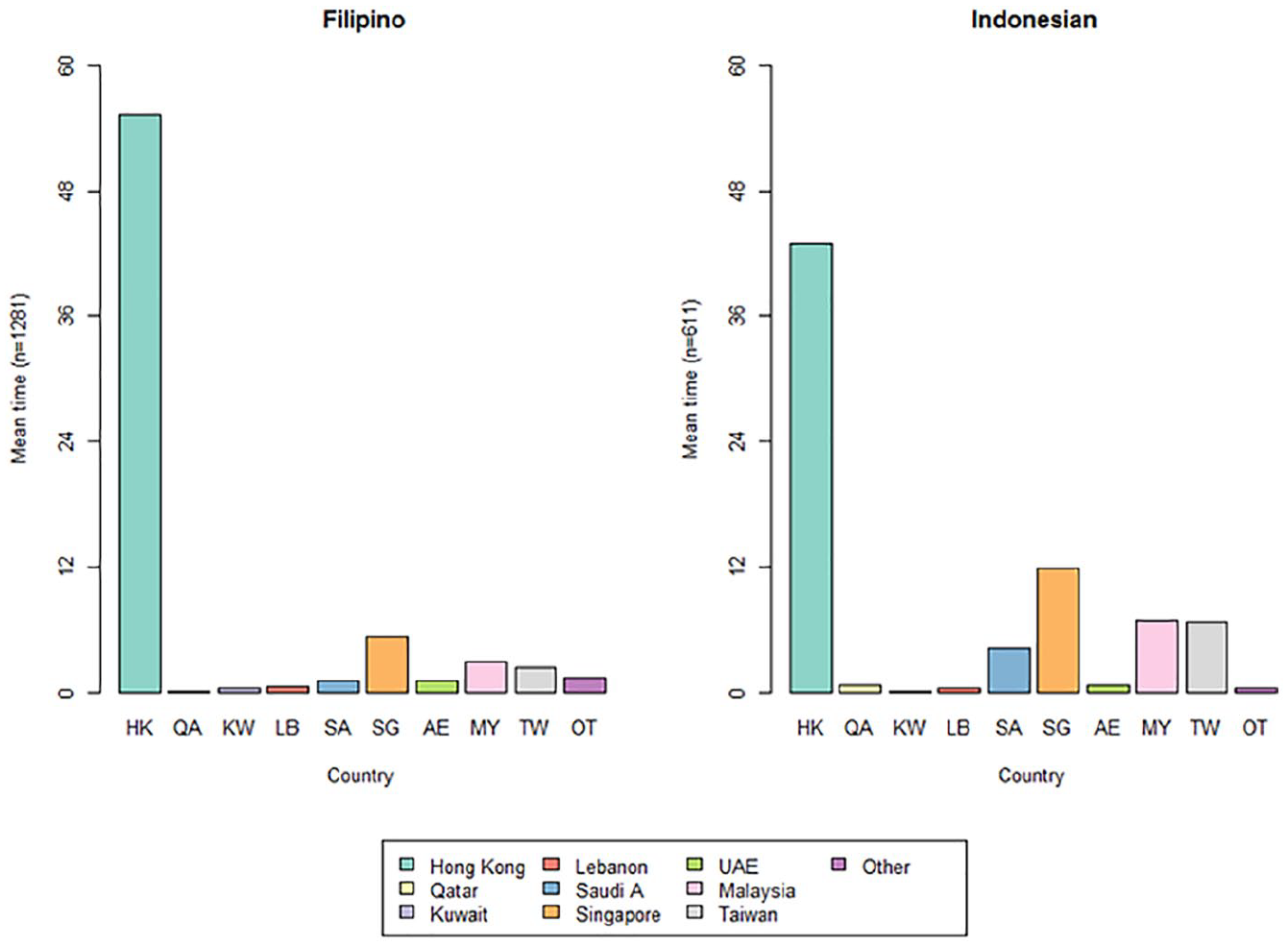
Average number of months, since turning age 15 years, spent in each foreign country.
We can make two observations from this figure. First, Indonesian women typically arrived in Hong Kong later, thus, having spent less time there. On the other hand, they may have gone through a few other destinations, spending more time there than their Filipino counterparts. The contrast is particularly clear in their times spent in Malaysia, Saudi Arabia, Singapore, and Taiwan. These differences suggest that Indonesians may have engaged in a greater amount of serial migration.
Entropy in Migration Trajectories
To further investigate and quantify domestic workers’ diversity in serial migration, we next analyze the sequence data with the concept of “entropy,” which measures the degree of diversity or complexity. The measure is based on Shannon’s information theory (for further details, see Billari, 2001). The measure is defined as follows:

where pi represents the proportion of time a case spends in state i at a given time point out of the entire life course for each of the individual sequence or person’s migration trajectory summed over all states (here destination countries). This way, each observation or person may have a unique longitudinal entropy value, and the resulting longitudinal entropy variable can be further used in a subsequent analysis as an outcome or explanatory variable. What do these longitudinal entropy values mean? If a given migrant worker spends an equal amount of time in each of all the destination countries throughout her life, then the migrant receives a value of 1, indicating the greatest amount of complexity. In contrast, if a woman never moves and stays in one country only, then she receives a value of 0, indicating the least amount of complexity in her migration history.
Figure 3 compares the overall longitudinal entropy curves representing the Filipino and Indonesian samples. These two entropy curves display two clear features. While both entropy curves show three modes, two larger and one smaller, the Filipino longitudinal entropy curve tends to concentrate on the lower portion of the scale while the Indonesian curve, the higher portion. This observation suggests a higher degree of diversity or complexity among the Indonesians’ migration trajectories. This finding results from the Indonesians’ greater likelihood of engaging in serial migration.
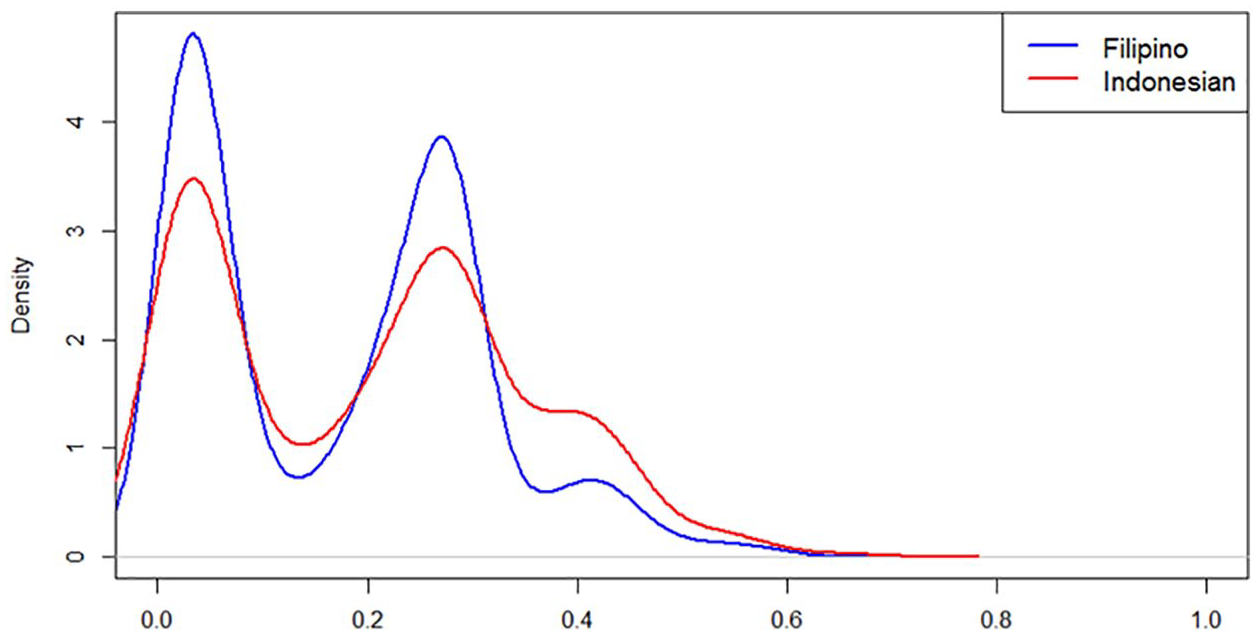
Domestic workers’ longitudinal entropy in migration history.
Cluster Analysis
Sequence researchers often generate typologies as a method for analyzing sequences (Aisenbrey & Fasang, 2010). We applied such a cluster analytic procedure described in Studer (2013) to identify the recurrent patterns of migration histories that can be represented by the typical successions of states through which the trajectories run. Individual sequences may differ from one another in various small ways, and the construction of a sequence typology is to ignore such small differences so as to identify typical trajectory types that are homogenous enough within types but different enough across types. By conducting cluster analysis of sequences, researchers can bring out recurrent patterns of the so-called “ideal-typical sequences” (Abbott & Hrycak, 1990). Like the longitudinal entropy measure, the resulting types or clusters can be used in subsequence analyses as an outcome or explanatory variable.
In cluster analyzing the migration trajectories, we relied on two statistics to select the number of clusters, the pseudo-R2 and the average silhouette width (ASW), especially the latter. The ASW measure is based on the coherence of assigning a sequence to a given group, comparing the average distance of an observation from the other members of its own group and its average distance from its closest neighboring group (Studer, 2013). Although a value is calculated for each sequence, the average value is the one of use here. In sequence analysis, there are various dissimilarity or distance measures to choose from. In this article, we used SVRspell (with parameters a = 1 and b = 0) in our cluster analysis because this particular distance measure is identified by Studer and Ritschard (2016) as a measure most sensitive to state order or sequencing. For us, the order of migratory destinations is of most important consideration here.
To make our cluster analysis meaningful, we focus on the women who were at least 40 years of age so that we can have their complete migration histories from the first month of age 15 up to age 40 years. We then conducted the analysis, which produced a pseudo-R2 of .71 and an ASW of 0.80 for a four-cluster solution for the Filipino data and a pseudo-R2 of .59 and an ASW of 0.64 for a four-cluster solution for the Indonesia data. Because we are not interested in the difference between two types of ideal–typical sequences—whether a migrant went through Singapore versus another country—we opted for the three-cluster solution with three rather distinct patterns of migration trajectories, which yielded a pseudo-R2 of .64 and an ASW of 0.76 for a three-cluster solution for the Filipino data and a pseudo-R2 of .48 and an ASW of 0.55 for a three-cluster solution for the Indonesia data. When ASW values are in the range of 0.71 to 1.00, a strong cluster structure is identified, and when they are in the range of 0.51 to 0.70, a reasonable structure is identified (Studer, 2013). We present the migration trajectories by cluster and country of origin in Figure 4.

Three clusters of Filipino migrant workers (distance = SVRspell, ASW = 0.76, N = 350) and three clusters of Indonesian migrant workers (distance = SVRspell, ASW = 0.55, N = 149).
These figures are state distribution plots that record distributions of migratory destinations that sum up to 100% at each time position (here a migrant’s age in month) across her age from 15 to just before turning 40 years old, with those representing the Filipino sample in the left panel and the Indonesian sample, the right panel. The plots are easy to interpret because dominant colors representing destination nations, the number of destinations and their timing together differentiate one cluster or type from another. It is obvious that the three-cluster solution is a substantively meaningful one. Type 1 of either the Filipino or the Indonesian women contains those who remained in their home countries and did not make any moves until after they had turned 40 years old. Type 2 represents migrant domestic workers who possibly engaged in serial migration throughout their 20s and 30s, involving various countries, most noticeably Singapore, regardless of their countries of origin. Finally, Type 3 women typically moved directly from their home nations to Hong Kong starting from as early as their late teenage years. Therefore, the three types of migration trajectories are distinctly different from one another especially in terms of the timing of moves and the complexity of such moves.
Note that the three clusters in either of the two samples seem correlated with the number of migratory moves. However, there is more than just the number of moves or complexity that contributes to the typology. For example, the timing of a migratory move is also important. All those women in Type 1 also made at least one move but this is not shown. It is because they made such moves at a later age. In sum, the state distribution plots reveal the type of migrant workers who share the features of timing, duration, as well as complexity of their migration.
Longitudinal Entropy as an Explanatory Variable: Analyzing Job Satisfaction
In this section, we use migration trajectory as a key explanatory variable for analyzing job satisfaction of domestic helpers in Hong Kong. It has been widely discussed that poor working conditions significantly lower job satisfaction of many domestic helpers in Hong Kong. Lack of proper resting/sleeping space, long working hours, employer abuse and a low payment are all the difficulties they are faced with (Bagley et al., 1997; Cheng, 1996; Constable, 2015). However, researchers have yet to consider if domestic helpers’ migration trajectory affects their job satisfaction in Hong Kong.
By examining the relationship between migration trajectory and job satisfaction, we intend to make a contribution to the literature regarding the life satisfaction of migrant workers. Extant studies have focused on the effect of assimilation. They suggested that more assimilated migrants are more likely to be satisfied with life. Local language proficiency, employment status in the local labor market, having friends in the host society, and discrimination in the host society are all proxies of assimilation (Chow, 2007; Neto, 1995; Safi, 2009). However, these variables describe migrants’ current situations only. Prior migration trajectory has traditionally received less attention due to the lack of data and proper analytical methods. There is a study using Italian data that examines how prior working trajectory affects job satisfaction. It found that foreign-born women, if taking domestic and care workers as their first job on arrival, tend to report higher job satisfaction (di Belgiojoso & Ortensi, 2019). But how does complexity in migration history affect job satisfaction?
There are two sources of the literature that may serve as our starting point: On one hand, the literature suggests that low-capital migrant workers may intentionally follow a stepwise migration pattern to work their way up the destination hierarchy (Paul, 2011, 2017). Based on this line of thinking, we expect a more complex migration trajectory to indicate that one has moved up the destination ladder higher to improve their lives and will likely be more satisfied with their jobs than those with a less complex migration history, which suggests someone who may not have had the chance to arrive at the desired destination. On the other hand, there is the literature on the precarity chains of serial labor migrants in the Middle East and Southeast Asia (Parreñas et al., 2018; Silvey & Parreñas, 2019). This line of thinking implies that a migrant domestic worker who has engaged in a longer series of migratory moves may be more deeply imbedded in a precarity chain and will less likely be satisfied with their jobs. In the following analysis, we entertain both possibilities of the relation between migration trajectory complexity and job satisfaction.
In addition to the migrants’ longitudinal entropy and their job satisfaction outcomes, we included a set of individual characteristics, migration characteristics, and social and working conditions as control variables. As stated earlier, we separately analyzed the domestic helpers by home country to capture their different patterns. The sample for the subsequent analysis contained 1,148 Filipino and 554 Indonesian women with valid observations on all these variables in the analysis.
Descriptive Analysis
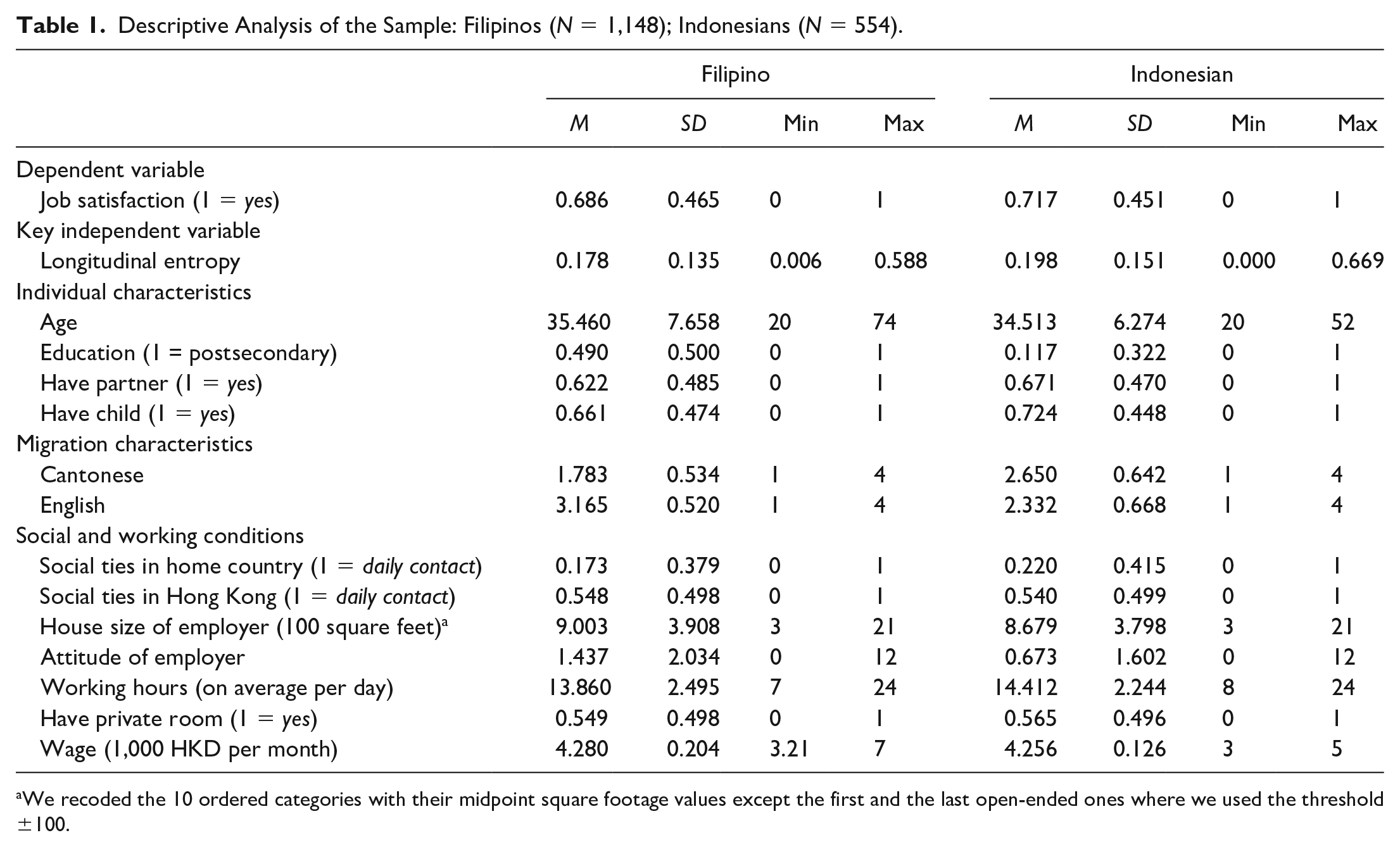
The dependent variable is job satisfaction. The information was collected by asking the degree to which a domestic helper agrees with the statement, “Overall, I am satisfied with my present job.” The respondents answered this question on a 5-point Likert-type scale. Considering the low counts in strongly disagree/disagree, we convert job satisfaction from an ordinal variable to a binary variable by contrasting the two combined categories of strongly agree/agree and neutral/disagree/strongly disagree. On average, Indonesian helpers are more satisfied with the job than Filipino helpers.
Longitudinal entropy is the key independent variable of our models. As previously mentioned, this variable ranges from 0 to 1. The greater the value, the higher diversity of a migration trajectory a migrant has had. In our sample, the Indonesian helpers on average have a more complex migration trajectory than the Filipino helpers.
There are three sets of control variables: sociodemographic characteristics, language abilities, and social/working conditions (Table 1). First, we control age, education, whether having a partner/child in our analysis, with all of them except age being dummy variables. Education is coded 1 if having an education beyond secondary, 0 otherwise while having versus not having a partner or child is represented by a 1 versus 0. We assume one’s demographic and socioeconomic features are very likely to be associated with job satisfaction. Second, we consider local language proficiency as an important contributor of job satisfaction. Good local language abilities would help domestic helpers assimilate into the local society and further increase satisfaction. A higher level of proficiency is indicated by a larger value. Third, stronger social networks and better working conditions are expected to be positively associated with job satisfaction. We use the strength of connection with friends in home and receiving country as the proxies of social ties in both places, with a value of 1 recording daily contact, 0 otherwise. Five aspects of working conditions are considered: an employer’s house size, an employer’s attitude, working hours, whether having private room, and wage. Some of these variables have been used in previous research on Filipinas’ job satisfaction. For example, salary, having a private room, and the number of relatives in Hong Kong have been found positively associated with job satisfaction in the 1980s (French & Lam, 1988). In studying domestic helpers caring for people with dementia in Hong Kong, Bai et al. (2013) found that live-in domestic helpers with better fluency in the local language of Cantonese had a higher degree of job satisfaction.
Descriptive Analysis of the Sample: Filipinos (N = 1,148); Indonesians (N = 554).
We recoded the 10 ordered categories with their midpoint square footage values except the first and the last open-ended ones where we used the threshold ±100.
Multivariate Analysis
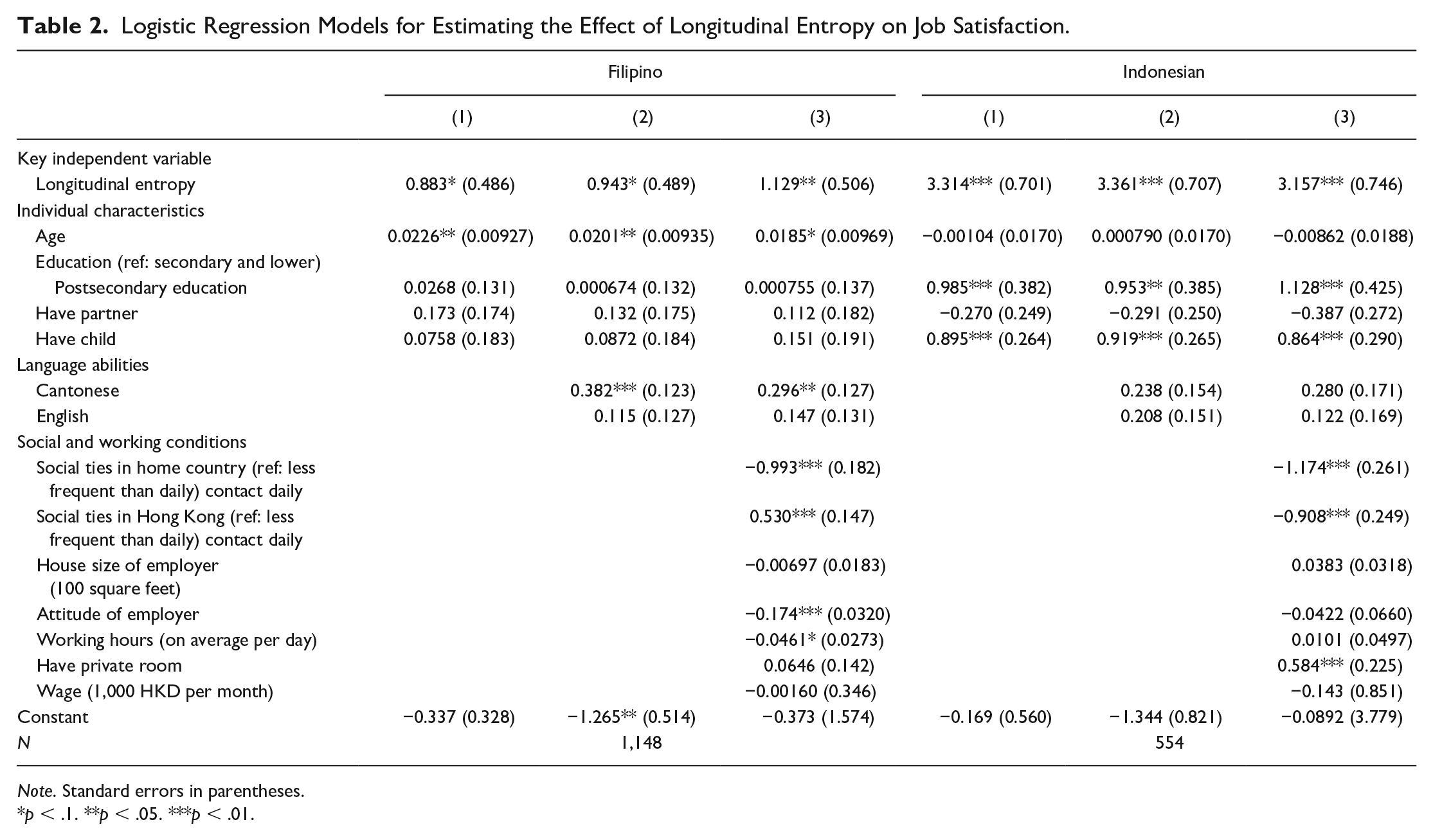
We employed binary logistic regression for the estimation, by entering the three sets of control variables one set at a time. Our findings suggest that the entropy of one’s migration trajectory is positively associated with the job satisfaction, and this positive association is stable regardless of the sets of control variables included. Our findings lend strong support to Paul’s (2011, 2017) stepwise migration theory on domestic helpers. Foreign migrant workers are able to work their way up the destination hierarchy, instead of negatively being involved in the precarious chain of migration. Through accumulating migrant capital, including professional skills, language proficiency and financial capital, helpers may start in another country such as one in the East Middle countries before reaching a more desired place of work. The process of stepwise migration manifested as migration diversity significantly increases their level of satisfaction toward the current job.
We make four observations on the control variables. First, having a child tends to increase the job satisfaction of helpers among the Indonesian helpers. Second, a higher level of proficiency in Cantonese is positively associated with the job satisfaction among the Filipinas. The positive association may be due to the fact that they already have the language facility in English, and having the ability to communicate in Cantonese would only increase their potential rapport with their employers. Third, the strength of social ties back home is negatively associated with job satisfaction for both groups. This finding suggests that unsatisfied domestic helpers are more likely to keep close connection with friends to seek help and emotional comfort. However, the strength of social ties in Hong Kong has a positive effect on satisfaction among the Filipinas yet negative effect among the Indonesians. This may be due to the frequent community activities based on hometown or home province affiliations in Hong Kong among the Filipinas. Finally, Filipino workers are more sensitive to employers’ attitude and the length of working hours, compared with the Indonesian (Table 2). It may reflect that Filipino migrant workers are more aware of their labor rights in work than their Indonesian counterparts (Alcid, 2006; Sim, 2009).
Logistic Regression Models for Estimating the Effect of Longitudinal Entropy on Job Satisfaction.
Note. Standard errors in parentheses.
p < .1. **p < .05. ***p < .01.
In summary, our final models with all the controls (Models 3) suggest that, with all individual, social, and workplace factors taken into consideration, migration history is strongly related to a migrant worker’s job satisfaction. Imagine the following two groups of women with rather different migration histories, one group with no prior migration history at all and the other group having spent an equal amount of time at every single destination country. For the Filipino women, the second group’s job satisfaction would be three times greater than those in the first group (exp(1.129) = 3.093); for the Indonesian women, the second group’s job satisfaction would be over 23 times greater (exp(3.157) = 23.500). While these are hypothetical situations, the magnitude of the effect shows the importance of a diverse migration history on job satisfaction. The greater diversity in the Indonesian women’s migration histories could in part be responsible for their greater effects.
Characteristics of Helpers With Three Types of Migration History
Migration scholars deconstructed migration process into a number of stages, including migration decision-making, integration, and return migration though not many of them examined migration as a continuous and serial process: Some early scholars first described the trajectory of internal migrants, from rural areas to small towns and then to big cities, as an example of stepwise migration (Conway, 1980; Ravenstein, 1885). This rationale was later extended to describing international migration, especially the migration trajectories of migrant domestic workers (Paul, 2011). A multistage international migration pattern tends to lend strong support to stepwise migration theory.
There are two explanations for the stepwise migration pattern of migrant domestic workers. Some researchers regard it as a process of accumulating migration-related capital. Low-capital workers intentionally learned working skills, established overseas social networks, and most important, increased financial capital, and sufficient migrant capital resources paved their way for working in Western countries, which provide them with high remuneration as well as the option of applying for permanent residence (Paul, 2015). However, others are reluctant to agree that migrant workers have the agency over where to move. The destination of migration can be decided by recruitment agency in the home country and the duration of each migration destination is restricted by policies in the receiving country. According to that perspective, serial migration of helpers is regarded as a precarity chain (Parreñas et al., 2018; Silvey & Parreñas, 2019). Either of these perspectives may be responsible for generating different types of migration patterns. Whereas our analysis below will not be definitively test which of the perspective is consistent with our data, we intend to find out which kinds of characteristics are related to migration history types.
Specifically, this section studies the relation between types of migration history and domestic helpers’ individual characteristics. Our cluster analysis presented earlier identified three types of migration patterns among the domestic helpers aged 40 and above (i.e., those with a long enough history). The first cluster includes domestic helpers who did not move until they have turned 40 years old. The second cluster consists of those moving to Hong Kong after a serial migration to other countries before age 40. Domestic helpers who moved directly from home countries to Hong Kong by age 40 are categorized as the third cluster. As noted earlier, we observed a clear separation of characteristics of each category.
Descriptive Analysis
The descriptive analysis here shows a clear difference of the distribution among the three migration trajectory clusters between domestic helpers from the Philippines and Indonesia. By age 40, the majority (70%) of Filipino helpers had moved to Hong Kong, 49% of them directly, while the bulk of Indonesian helpers stayed in their home country by that age. The difference reflects a longer tradition of Filipino females engaged in the domestic helper market in Hong Kong. According to the Census and Statistics Department of Hong Kong Special Administrative Region (2003, 2018), 81% of the market was occupied by Filipino helpers in 1997. Although the percentage of Indonesia helpers increased rapidly from 14% in 1997 to 49% in 2011, it decreased gradually after 2011 and kept being around 10% lower than that of Filipino helpers.
We still included the three sets of variables that we used for the analysis on migration entropy effects on job satisfaction. Individual demographic and socioeconomic characteristics, local language proficiencies, and social/working conditions can be associated with the types of migration trajectory before age 40. Particularly, we are interested in how the strength of social ties in both home country and in Hong Kong varies with migration trajectory. Migrant domestic helpers as a classic example of the transnational migrant maintaining connections with home country and receiving country at the same time (Madianou & Miller, 2013; Portes, Guarnizo, & Landolt, 1999). However, no studies in our best knowledge discussed the strength of transnational connections and how it varies with migration trajectory type. This section will provide some insights on this issue. To perform the multivariate analysis in the next subsection, we included 303 Filipino and 130 Indonesian domestic helpers for analysis who were at least 40 years of age with valid data (Table 3).
Descriptive Analysis of the Sample: Filipinos (N = 303); Indonesians Sample (N = 130).
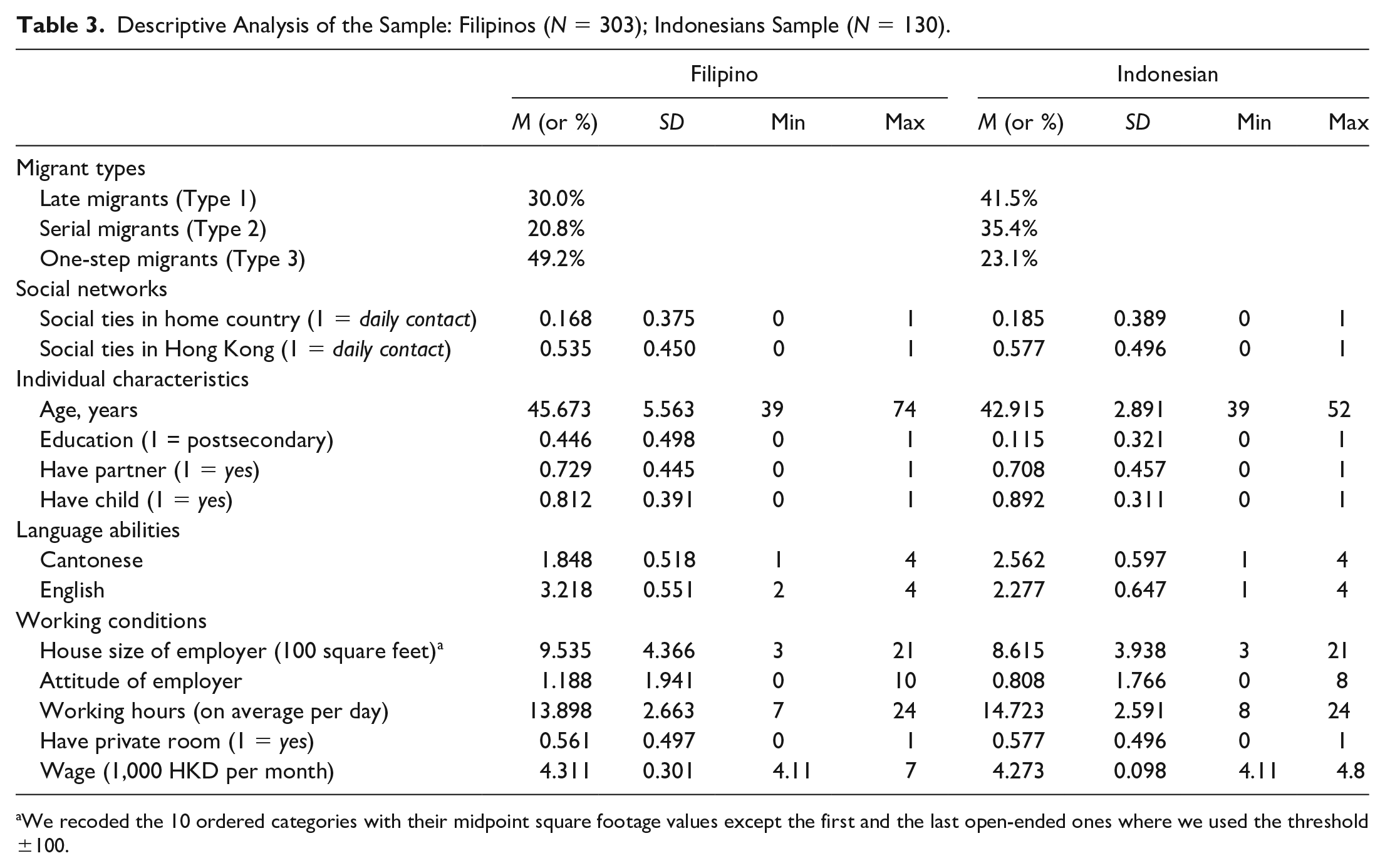
We recoded the 10 ordered categories with their midpoint square footage values except the first and the last open-ended ones where we used the threshold ±100.
Multivariate Analysis
Because migration trajectory type is a categorical variable, we employed the multinomial logit model. Even though many applications of multinomial logit models imply causal inference, we apply the multinomial logit model merely as an analytic method for revealing patterns of association between migration history types and migrant workers’ characteristics. In that sense, our purpose is to explore differences in characteristics between types, the task of a discriminant analysis, and because the logit model is closely related to discriminant analysis but much more widely used, we chose it for the analysis here. There are three contrasts for each multinomial logit model, with the first contrasting serial migrants with late migrants (no migration occurred by age 40), the second contrasting one-step migrants with late migrants and the third contrasting one-step migrants with serial migrants. The three contrasts together show a full picture of the comparisons among the three clusters/types.
We found that the strength of social ties in Hong Kong is related to migration trajectory types among both groups of women. Migrant helpers, either Filipino or Indonesian, who have a serial migration history by age 40 tend to have a weaker connection with friends in Hong Kong (Table 4). Filipino migrants with a serial migration history, compared with those late migrants, can be expected to be 0.380 times as likely to contact their friends daily in Hong Kong (exp(–0.968) = 0.380); put differently, their chance of daily contact would be decreased by 62%. In comparison, their Indonesian counterparts can be expected to be 0.40 times as likely to contact their friends in Hong Kong daily (exp(–0.913) = 0.401) or 60% less likely, compared with late migrants. These findings suggest that those migrant workers who came early to Hong Kong after a series of moves tend to have weaker social ties in Hong Kong by not contacting friends daily. This could be explained by their potentially greater social network in other places than home, an area our survey did not cover. Further studies will be necessary to completely consider this and other alternative explanations.
Multinomial Logistic Regression Models for Identifying Characteristics of Each Cluster.
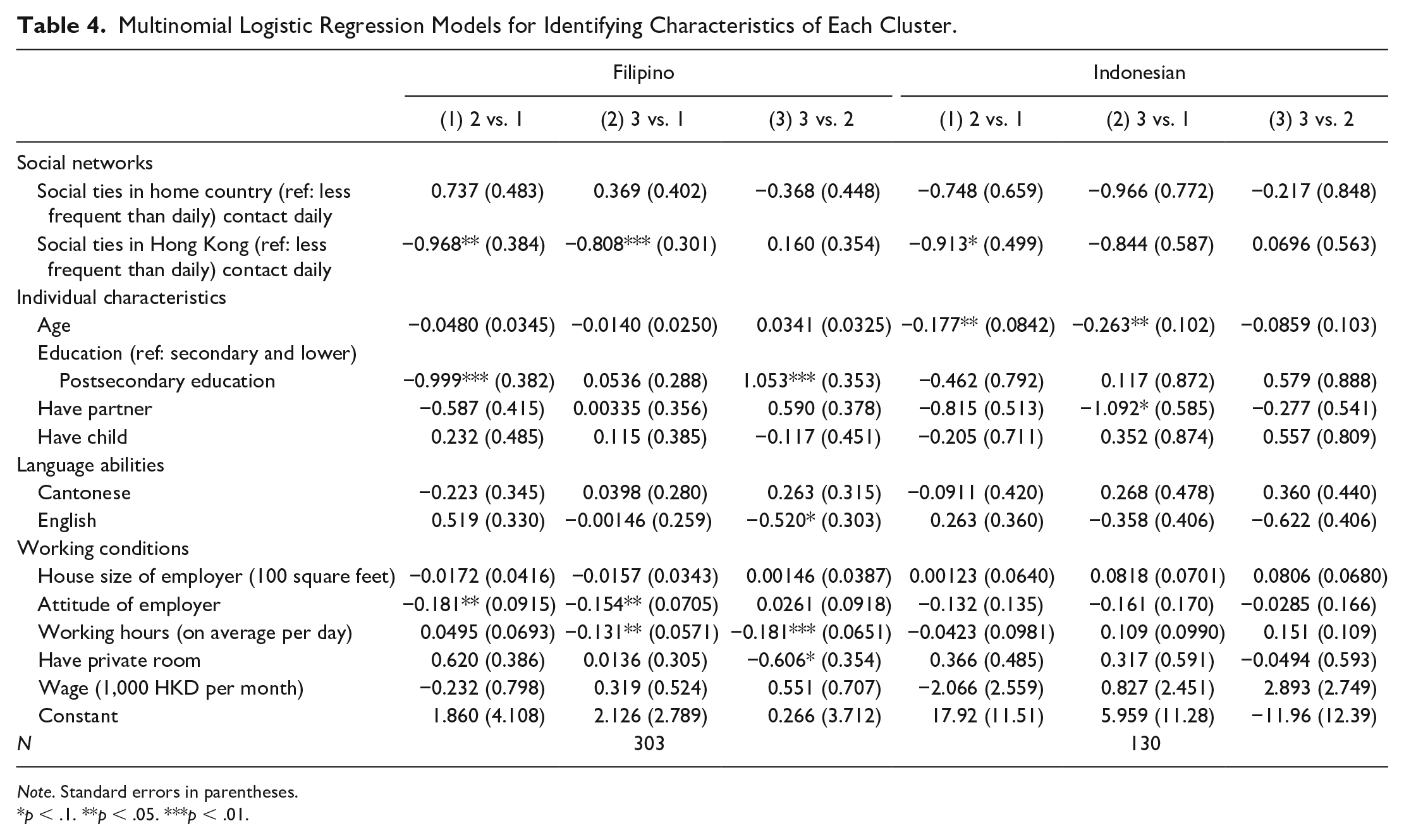
Note. Standard errors in parentheses.
p < .1. **p < .05. ***p < .01.
Three other interesting patterns also deserve attention. First, we found that younger Indonesian migrant workers are more likely to be engaged in a serial migration or one-step migration to Hong Kong than staying in their home country before age 40. For example, one year of increase in age would decrease the chance of engaging in serial migration by about 16% (exp(–0.177)=0.837) or in one-step migration by about 23% (exp(–0.263) = 0.769), as compared with the chance of late migration. The finding may reflect the relatively later participation by Indonesian women in the global maid market. Second, less educated Filipino helpers are more than 270% more likely to make a series of moves than staying in their home country by age 40 (1/exp(–0.999) = 2.716) and are about 290% more likely to have been a serial migrant than a one-step migrant (1/(1/exp(1.053)) = 2.866). Because lower educational qualification tends to hamper mobility to certain destinations (Parreñas et al., 2018), such migrants with lower educational attainment may have been forced to move on. Furthermore, they may have needed to draw work experiences from a series of migratory stops to compensate for their insufficient human capital unless they came early and decided to stay in Hong Kong. Last, Filipino helpers’ working conditions in Hong Kong are related to their previous migration trajectories. Generally speaking, Filipino workers with no migration experience by age 40 are faced with worse working conditions such as longer working hours and less supportive employer attitudes, probably due to their lack of work experiences from earlier migratory jobs (Model 2). Between the other two migration history types, those having made a series of moves would not fare as well as those single-step migrants when it comes to working hours and having a private room (Model 3). To sum up, domestic workers’ migration histories are associated with social network, socioeconomic, and work-related characteristics. According to the literature, social networks may affect migration history patterns in two ways. Social ties tend to encourage cumulative migration when potential migrants follow the paths of earlier migrants (Boyd, 1989; Garip, 2008). Furthermore, the existence of social networks may affect migrants’ decision of staying versus leaving (Korinek et al., 2005). However, neither of these explains the frequency of social network contacts other than the existence and the usefulness of such social networks.
Conclusion
We studied Filipino and Indonesian migrant workers’ migration histories in this article. We found several differences between Filipino and Indonesian female domestic workers including differences in diversity of migration history, number of migratory moves made, and time spent in locations. Both groups of migrant women aged 40 and above, however, can be summarized by three migration trajectory types.
We further analyzed these women’s migration entropy/diversity and its effects on job satisfaction. For women from either country, having a complex migration history exerts a positive effect on job satisfaction, and the effect is greater among the Indonesian women than the Filipino women. In our analysis of characteristics associated with the types of migration trajectories, we found that social network, sociodemographic, and working condition factors are related to migration history types.
Our study has the following policy implications. Past research suggests that existing policies in home and destination countries are inadequate for protecting migrant helpers’ rights (Constable, 2015; Ullah, 2015; Wijaya et al., 2015). Migrants without prior migration histories can be even less experienced with rights issues. Policy makers may wish to take migration history diversity into consideration when designing their supportive policies, perhaps by giving a higher priority to those without past migratory experiences because they tend to be in a less advantageous position. Specifically, a receiving country’s government could design better protective regulations for migrant helpers with certain types of migration histories. For example, efforts should be made to protect the work environment–/condition–related rights of those migrant helpers who were first-time migrants later than age 40. More generally and more important, the policy context is integral of the larger society (Silvey & Parreñas, 2020), together with the larger society, policies can significantly affect migrant workers’ welfare over their life courses.
Our article also suggests that studying migration trajectories can be an important and fruitful exercise beyond an analysis of job satisfaction or characteristics associated with migration history types. These additional analyses include an examination of past migration experiences or histories on migrant women’s mental and physical health, among other possible migrant workers’ individual outcomes. These possibilities also point to a major limitation of our research, that is, the lack of information on the migrants’ family members at home and in their home communities. Perhaps future follow-up research can explore these related issues.
Footnotes
Declaration of Conflicting Interests
The authors declared no potential conflicts of interest with respect to the research, authorship, and/or publication of this article.
Funding
The authors received no financial support for the research, authorship, and/or publication of this article.
