



Abstract
The accumulation of human and social capital plays a significant role in influencing migrants’ earnings and economic integration in the host society. Although the effects of foreign domestic workers’ bargaining power on their labor market outcome is constrained due to their unique migrant status, domestic workers may still strive to make use of various resources to secure “ideal” jobs as much as possible. Using a randomly selected unique data set collected in Hong Kong in 2017, this study examines whether foreign domestic workers’ human and social capitals are associated with their salary scale, working conditions, and work rights protection. We use education, previously held jobs, migration duration, and language proficiency to measure human capital, and friendship networks and church attendance to indicate social capital. We found that previously having middle-level job experience can reduce the likelihood of experiencing underpay and increase the likelihood of having overpay, taking the legal minimum salary as a reference. English language proficiency could also give them some leverage to access a better pay scale. Previous human capital accumulation is associated with having a private room in the employer’s home. It is also associated with better protection of work rights such as being less likely to experience a “no pay” month. For social capital, frequent participation in Sunday gathering with friends is mainly associated with rights protection. These findings indicate that although foreign domestic workers may be constrained in using their capital accumulation to improve their market value substantially, the capital accumulation can still give some leverage for them to bargain for a slightly improved salary, better working conditions, and protection of their rights.
Introduction
There were nearly 370, 000 migrant domestic workers in Hong Kong in 2017, and about 50% of them were from Philippines, followed by Indonesians (about 43%; Census and Statistics Department, 2019). As the majority of this population in Hong Kong is composed of women, the group has drawn many researchers’ attention, especially from the feminist and transnational labor migration perspectives (Chin, 1997; Cortes & Pan, 2013; Momsen, 2003; V. C. W. Tam, 2003). Most previous studies on migrant domestic workers in Asian cities such as Hong Kong and Singapore have focused on their well-being (Constable, 1996; Lau et al., 2009), their roles in employers’ family (Chan, 2005; Tse et al., 2009), employers’ perception and well-being (Cheung & Lui, 2017), and their transnational relationship with families, such as their role as breadwinners and how they manage transnational parenthood or partnership (Chan, 2008; Rahman & Fee, 2009). Few studies have focused on their labor market outcomes. Among a few noteworthy exceptions, Asato (2004) examined how foreign and local domestic workers compete and coexist with each other in Hong Kong’s domestic work sector. Despite this group being an important international labor force, the influence of capital accumulation on migrant domestic workers’ labor outcome is largely understudied.
In labor market research, it is well-known that both human and social capital play important roles in labor market attainment. For migrants or immigrants, the accumulation of human capital through education and work experience in the host society is particularly important for their earnings and socioeconomic mobility in the host society. Previous studies have suggested that migrants or immigrants often suffer from wage penalty in the initial stage of migration, as they have difficulty converting the human capital they accumulated from their home countries to the new one (Chiswick, 1978; Tong & Ting, 2018). Over time, they will gain more local-oriented human capital due to their greater incentives to work hard to catch up with the “natives,” including investing in extra training for skills or language proficiency in the host society (Chiswick, 1978). In addition to human capital, studies have also pointed out that social capital accumulation in the migration destination is a key factor for them in finding jobs or achieving promotion (Bridges & Villemez, 1986).
Despite the importance of capital accumulation on market success in general, research on capital accumulation and migrant domestic labor market outcomes is sparse, largely due to the lack of career ladders for the migrant domestic workers. This is in line with the argument from dual labor market theory (Doeringer & Piore, 1985), which states that there is a distinct low-wage labor market in which both education and experiences yield a lack of returns. This is characteristic of a secondary labor market dominated by low-skilled workers. In contrast, this theory also argues that there is a primary labor market, where human capital such as education and working experiences accumulation are particularly important for obtaining the job and promotion opportunities. Therefore, part of reason of lacking research among migrant domestic workers’ labor market outcome is due to no or little return of education for such jobs. Compared with human capital, social capital has been shown to play a key role for the low-skilled workers in job seeking (Aguilera, 2005), but no work has been done to examine migrant domestic workers’ labor market outcome, probably due to their contract-based employment visa status.
However, despite it being a secondary labor market, migrant domestic workers’ labor market also has its unique characteristics compared with other low-skilled labor markets. That is, although they face constraint in moving from one job category to another, their payment, working condition, and the basic work rights protection could vary case by case, due to a home-based work environment. Therefore, there is still some room for them to bargain for a slightly better payment or reduce the chance of being wage penalized for salary. Furthermore, there could also be wide variations in the working condition due to the demographic composition of employers’ household as well as their life status. Their living condition and timing of work could also vary greatly across different employers. Thus, it is possible that the accumulated human and social capital may help them improve their labor market outcome. Answers to such questions can expand our existing knowledge of the relationship between capital accumulation and labor market outcomes.
In this study, using a unique data set collected in 2017 in Hong Kong with a sample size near 2,000, we examine whether migrant domestic workers’ human and social capitals are associated with their salary scale, working conditions, and basic work rights protection. We use education, previously held jobs, migration duration, and language proficiency to measure human capital, and friendship networks and church attendance to indicate social capital. This study sheds light on how capital accumulation may still play an important role in the job categories that have very constrained bargaining power, as argued in the dual labor market theory.
Theoretical Background
Capital Accumulation and Labor Market Outcome for Migrants
Human capital includes education, working experiences, and skill sets such as language proficiency. Substantial research has long confirmed that human capital is one of the most important determinants of labor market attainment (Schultz, 1963). However, migrants or immigrants often experience a low return on human capital, especially when they have just arrived in the host society (Chiswick & Miller, 2009): They often have lower earning ability in the initial stages of migration, but their earnings will improve over the years as they assimilate into the host society. The disadvantages in the initial stage of migration are mainly caused by the difficulty of transmission of human capital from one society to another (Tong, 2010; Zeng & Xie, 2004). In addition, newly arrived migrants also often lack social networks, which can provide information to improve their people skills and protect their rights. Furthermore, they are more likely to suffer from discrimination from the host society due to their immigrant status and ethnic minority background (Pager & Shepherd, 2008).
Social capital is created through relationships with other people (Coleman, 1990). The relationships with others can help individuals to improve their economic well-being (Portes, 1995). Social capital such as friendship networks can deliver information that may have economic value for people. In migration studies, social capital is not only linked to the migration process but also linked to labor market outcome and citizenship attainment in the host society. Aguilera (2005) found that close ties for documented migrants and distant ties, friendship ties, and nonfamily ties for undocumented migrants are positively associated with the earnings of immigrants. Specifically, social capital can improve the labor market outcomes via several channels. One is the information channel, which facilitates the transfer of economic opportunities and information access (Coleman, 1990), leading to employment advantage. For immigrants or migrants, such information is particularly important, because they often lack knowledge of employment practices in the host society, such as knowing the workplace culture in the host society (Fernández-Kelly, 1995). Moreover, Coleman (1988) indicated the importance of norms, obligations, and expectations, which can be spread through social capital to help immigrants or migrants establish themselves in the host society. Migrants or immigrants are often obligated to assist members of their ethnic groups. Therefore, social capital acquires information with reduced trial-and-error periods for migrants or immigrants.
However, existing research has not discussed how human and social capital may have different effects on labor market outcomes between immigrants or migrants who are aiming for residency and the temporary migrants who have more constraints on their work status, such as contract foreign workers. On one hand, from the demand side, contract-based migrant workers may be constrained by the host society’s work policy such as their legal status of work, visa restrictions, and the pathway to social mobility in the host society. For instance, the six countries forming the Gulf Cooperation Council have restricted their policies with respect to the migrant workers in the oil industry (Winckler, 1997). On the other hand, from the supply side, the contract-based migrant workers are often the low-skilled workers, who often have little promotion potential in terms of the job hierarchy, as argued in the dual labor market theory we discussed above (Doeringer & Piore, 1985). Migrant domestic workers are low-skilled, contract-based workers, which means they can often only secure low-paid jobs. One would therefore expect capital accumulation to matter little to their labor market outcome. Based on this, we formulate our first hypothesis:
However, although migrant domestic work can generally be categorized as low-skilled work, which means they are in the secondary labor market, their special working environments could still lead to a variety of labor market outcomes. Specifically, as domestic help entails an individual working at someone else’s home, their working conditions and requirements would vary from case to case. Such variation can be affected by human and social capitals they have. Moreover, given the live-in nature, the intimate work relationship with employers, and the marginalized social status of domestic workers in the employers’ home, the protection of their basic rights can be considered as an employment benefit. Therefore, it is still possible that human and social capital will play roles for them to bargain for better pay or working conditions, thereby equipping them with better negotiation skills and more knowledge on the domestic labor market. This argument leads to the following two hypotheses:
Migrant Domestic Workers and Their Status in the Hong Kong Labor Market
Foreign domestic workers are contract-based migrant workers in Hong Kong society. Due to the rapid economic development in the 1970s, Hong Kong had a labor shortage and women were encouraged to participate in the labor force. During the same period, the government of the Philippines implemented a labor code to export labor in the form of overseas workers. As a result, Hong Kong started to receive migrant domestic workers from Philippines. Later, the source countries became more diverse, including Indonesia, Sri Lanka, Thailand, Bangladesh, Myanmar (suspended), Madagascar, Cambodia, and so on. However, more than 90% of the domestic workers are still from the Philippines and Indonesia. Since the 1970s, the proportion of Hong Kong families hiring migrant domestic help has been rising, and about 10% of the families in Hong Kong currently employ migrant domestic workers (Census and Statistics Department, 2017).
Migrant domestic workers make a significant contribution to Hong Kong society. In particular, they allow a large number of married women to stay in the labor force (M. Tam & Tong, 2013). Domestic workers’ work tasks vary greatly, including child care, cooking, bringing children to schools, washing cars, and so on. Many of them are even substituting for the parents in certain tasks—for example, attending parent–teacher conferences and supervising children’s homework. The needs associated with the care of both children and older adults are the most important factors leading families to hire migrant domestic workers. Due to the rapid increase of the aging population in Hong Kong, the demand for migrant domestic workers will rise in the near future.
Despite being an important labor force in Hong Kong society, migrant domestic workers face many legal and practical restrictions regarding obtaining permanent residence, bringing their direct families along or living outside of their employers’ home (Constable, 2019). However, even with such restrictions, Hong Kong is still considered to be the “best place to work in Asia” for overseas domestic workers (Constable, 2014, 2015), compared with Singapore and Taiwan, both having a similar geographic distance to the major sending countries of the Philippines and Indonesia. By comparing Hong Kong with different destinations, Constable (2019) argued that “Hong Kong’s official employment contract, its legislated minimum monthly wage and weekly day off, as well as Hong Kong’s rule of law and domestic worker protections (in theory if not always in practice) bolster its appeal” (p. 4).
However, migrant domestic workers live and work in employers’ houses, an atypical work place, which renders them vulnerable to many potential work place maltreatments, such as long working hours, being scolded by employers, living in unbearable conditions, being punished by underpay, not being able to get days off, and so on (Lai & Fong, 2020). As a result, seeking an “ideal” employer becomes the central issue during their job-seeking process. It often happens in two steps. First, when the potential employees are still in their home country and have not established enough ties with Hong Kong society, they mainly rely on employment agents to tie them with the potential employers. At this stage, potential employers and employees will have imbalanced information about each other. During this process, their human capital, such as their education level and proficiency in English, becomes the most important factor for them to be chosen by a potentially “ideal” employer because that will be the first thing the potential employers look for. Although some workers may find their first jobs via the kin or friendship network, such cases are rare, so human capital plays quite an important role for them to be able to bargain for a good working situation. After the worker arrives in Hong Kong, they will have a second chance to re-match with an employer. The second job-seeking stage starts on finishing their contract with the first employer, or when the first employment does not work out. Human capital makes them attractive for the potentially more “ideal” employers, which gives the workers more bargaining power regarding their benefits and working conditions. In contrast, social capital helps them target “ideal” employers more accurately as they often use the informal support system to get help in labor market and other need after they move to Hong Kong (Baig & Chang, 2020).
To the best of our knowledge, this is the first study that examines how capital accumulation may have an influence on migrant domestic workers’ labor market outcomes. Previous studies on capital accumulation and labor market outcomes have focused on those who have the freedom to change jobs and switch occupations, while ignoring labor forces who face more labor constraints. This study can be seen as a case study that sheds light on how human and social capital may still play important roles in a restricted labor market in terms of wage ranges but with various working conditions.
Data and Method
Data
We use a unique data set of migrant domestic workers collected in Hong Kong. This data set was collected in 2017 by the Research Centre for Migration and Mobility at the Chinese University of Hong Kong, which interviewed nearly 2,000 Filipina and Indonesian domestic workers at various locations in their free time on their Sundays off. This data collection effort is the first ever large-scale questionnaire survey about migrant domestic workers in Hong Kong. Previously very few studies have used the quantitative approach to study migrant domestic workers in Hong Kong, and part of the reason is that it is very difficult to draw a random sample due to the difficulty of obtaining a sampling frame. Although it is possible to get migrant domestic workers’ visa registration information from the immigrant department to use as a sampling frame, this channel has never been used because of privacy concerns and the potentially high risk of being refused a house visit at the employers’ homes. As a result, Research Centre for Migration and Mobility took a unique approach by locating the gathering spots of migrant domestic workers during their Sundays’ off time. After collecting the information about these gathering spots in the public spaces of Hong Kong (precise locations and the estimated number of people at each spot), the research team selected a random sample of those spots by considering the geographic locations and numbers of people in each gathering spot. The interviews were then conducted by Chinese University of Hong Kong students in English, and all the questionnaires were conducted on electric devices. The detailed information on data collection is included in the piece by Chung et al. (2020). The final data set has 1,377 Filipina and 612 Indonesian domestic workers who were working in Hong Kong at the survey time. After excluding the cases with missing information, our final analysis data set involves 1,733 migrant domestic workers.
Variables
Dependent Variables
The dependent variables are an array of variables related to migrant domestic workers’ labor market outcome. Given the unique nature of the job, we divided the labor market outcome into three domains—namely, wage scale, working conditions, and work rights protection. With respect to wages, Hong Kong government has stipulated a minimum wage level for migrant domestic workers, which is reviewed from time to time. During the survey time, there were two legal minimum wage levels, depending on when the work contract was signed between the worker and the employer. Therefore, we adopted the two legal minimum wage levels and decided that any wages falling between these two numbers would be treated as normal pay. For workers who receive a wage higher than the highest of the two minimum wages, we define them as being overpaid. In contrast, for those who receive a salary below the lowest of the two minimum wages, we define them as being underpaid. It is worth noting that it is a serious offense for an employer to underpay a domestic worker. Thus, for wage, we examine three dependent variables. The first dependent variable is an ordinal variable consisting of underpay, normal pay, and overpay. The second one is whether they are overpaid, and the third one examines whether they are underpaid.
The second set of dependent variables is related to working conditions, including whether they have their own room to sleep in, whether they received a gift from their current employers in the past year, and the surface area of employer’s home. Given the very crowded living space in Hong Kong and the extremely high living costs, many families cannot afford to provide a domestic worker with a private space. They often either have to share a room with the children or elderly, or sleep in the living room. Having a private room is thus a very important indicator of a relatively good living condition for migrant domestic workers in Hong Kong. Receiving gifts in kind or cash indicates a nice gesture from employers and shows a good relationship between employers and employees, so we included a dummy variable for whether they received cash bonuses or gifts from employers or their relatives on the occasions of the worker’s birthday or major public holidays in Hong Kong, such as Christmas or Chinese New Year. Moreover, the size of the employers’ home area could approximate the economic status of the employers’ family and show the house comfort, although by the same token, it can also mean more work. When the total area is beyond 999 square feet, we define those homes as “large flats.”
The last set of dependent variables is the basic work rights protection for the domestic workers. Again, we use three variables to indicate their basic work rights, which includes their daily average working hours, whether they were denied their rest day without additional pay, or whether they had ever experienced not getting their monthly salary. Despite it being difficult to legalize a standard number of working hours for domestic workers due to the nature of the job, frequently overtime work can substantially deteriorate one’s well-being. Having the day off to recharge, to hang out with friends, and to talk with family on the phone is also very important for domestic workers’ well-being, and it is legalized by Hong Kong government. However, there are still some workers who are denied the chance to enjoy their weekly day off from time to time. Similarly, although minimum wage is a law, not every domestic worker is protected by this law. They also do not often report this, either because they are afraid of losing their jobs immediately, or they simply do not know where or how to file a complaint.
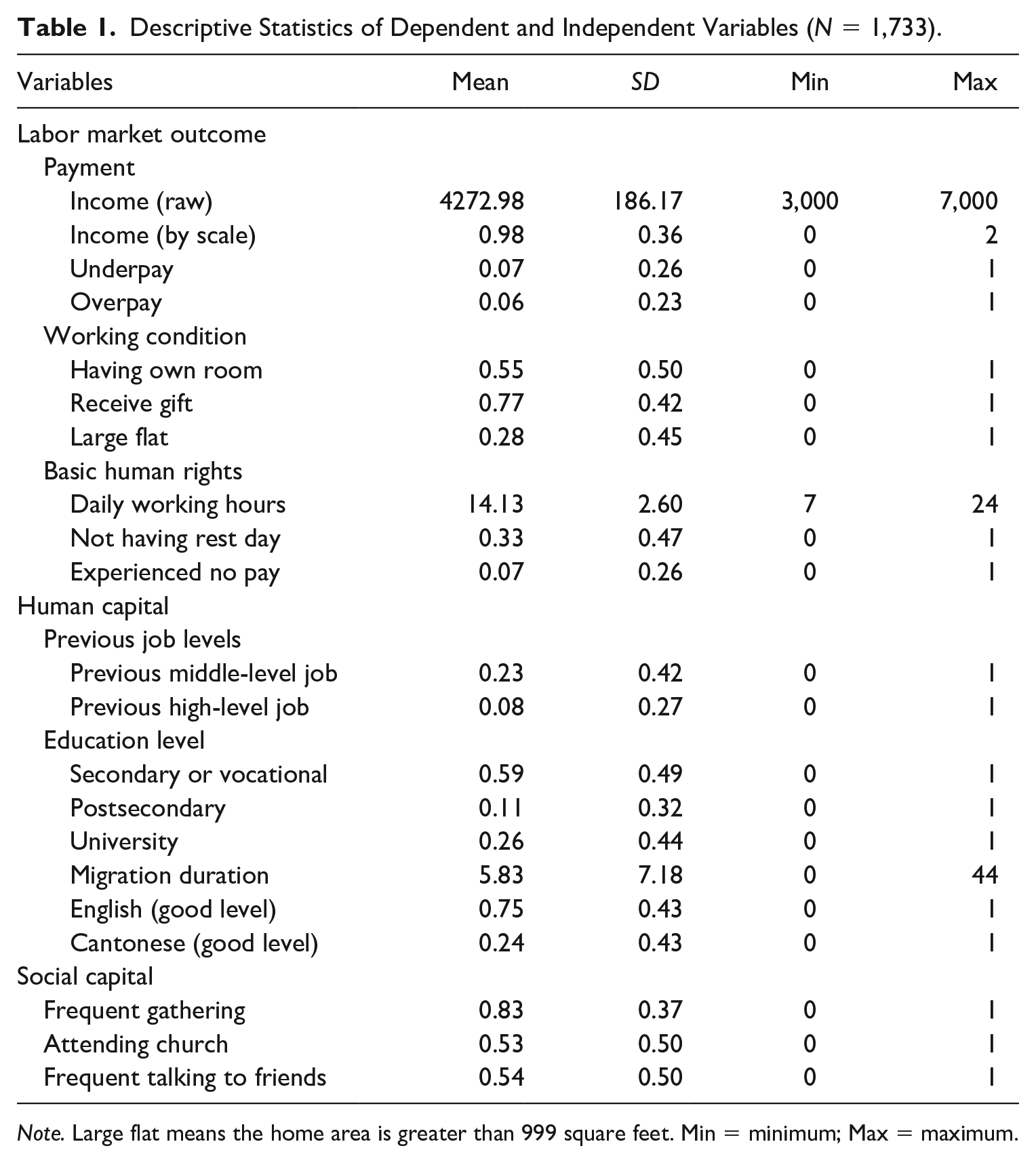
The list of dependent variables is in Table 1. It showed that the average wage is HK$4,276, near the legal minimum wage. About 8% of workers in our sample were underpaid, whereas about 6% were overpaid. As regards working conditions, about 56% of workers have their own private rooms. More than three quarters of the surveyed domestic workers have received a gift or cash from their employers on their birthday or public holidays. The size of house is a category variable dividing the home areas into different scales of square feet. The average size of employers’ house is between 800 to 999 square feet, and about 28% of our respondents worked for employers whose residence was larger than 999 square feet. As regards rights protection, the average working hours in our sample are rather long—at about 14 hours per day. About 11% of workers had the experience of not being granted a weekly day off for rest, and about 7% of workers had the experience of not being paid their regular salary.
Descriptive Statistics of Dependent and Independent Variables (N = 1,733).
Note. Large flat means the home area is greater than 999 square feet. Min = minimum; Max = maximum.
Independent Variables
Table 1 also includes information on the independent variables. To measure their human capital, we use education, professional levels of previously held jobs, migration duration, and language proficiency. Most of the migrant domestic workers—nearly 60%—have secondary or vocational-level education. However, it is worth noting that over a quarter of respondents have a university degree. Previous job level is divided into three types: low level (no skill requirement), middle level (semiskilled job), and high level (professional jobs). About 8% of workers had ever held a professional-level job, and about 23% had ever held semi-skilled jobs; the rest of them only had experience in low-skilled jobs, including domestic work. The average years of migration was 5.83 years among our respondents. About three quarters of the respondents reported their English proficiency to be good or above, and slightly less than a quarter of the respondents also had a “good or above” level in Cantonese. For social capital, we used three variables: whether they frequently met up with friends, whether they attended church regularly, and whether they frequently talked to friends on the phones or in person. About 84% of respondents frequently attend friends’ gatherings, more than half attend church frequently, and about 54% frequently talk with their friends.
Analytical Approach
Since we have multiple dependent variables that are measured at different measurement levels, we used different types of statistical methods to accommodate them. When the dependent variable is continuous, we use the ordinary least square method to conduct the analysis. When the dependent variable is binary, we use logistic regression. When the dependent variables are ordinal variables, we use ordinal logit regression. We note that the data are cross-sectional, so a causal relationship cannot be established for variables that are observed at the same time. However, for some of human capital variables, they were often obtained before they came to Hong Kong or were interviewed, so it is reasonable to claim that human capital has an impact on their labor market outcome. For social capital measures, they are largely observed at the same time with the dependent variables. Therefore, we hesitate to claim that the relationship is causal and, instead, describe the relationship as association. For instance, domestic workers who are able to attend Sunday gatherings with friends could simply have more “ideal” employers, who respect their basic human rights as an employee. Therefore, it is hard to claim that the influence only goes in a one-way direction.
Results
Capital Accumulation and Payment
In Table 2, the first set of models, we look at the capital accumulation and salary. Since the salary range for domestic workers is very narrowed and clustered at the minimum wage, in Model 1, we examined the salary with an ordinal variable with three categories: underpay, normal pay, and overpay. The result shows that neither does education level nor does migration duration have an effect on the amount they receive (an indicator for years of working experiences for migrant workers). However, having previously held a middle-level job raises the domestic workers’ chances of gaining a higher salary, but not necessarily a higher level job. This indicates that the typical human capital measures of education level and years of working experience are not very relevant to migrant domestic workers’ earnings in Hong Kong, which is in line with Hypothesis 1. However, being good at English is associated with a higher salary. Since overpay indicates a “reward” and underpay indicates a “penalty,” in Models 2 and 3, we further examined these two binary outcomes separately, with logistic regressions. Similar to the trend in Model 1, Model 2 shows that previously holding a middle-level job has a negative effect on the likelihood of being underpaid. In contrast, it is positively associated with overpay in Model 3. This result shows that having previously held middle-level jobs is beneficial for domestic workers’ bargaining power. Good English levels reduce the likelihood of being underpaid but does not have an effect on overpay. Therefore, Hypothesis 2 is not fully supported, but Hypothesis 3 is. For social capital, frequently talking with friends is associated with lower chances of underpay. However, it is also associated with a lower likelihood of being overpaid, although it is only marginally significant. This indicates that those who frequently talk with friends are also more likely to be those who are being paid minimum wage.
Social and Human Capital Accumulation and Pay Scale Among Foreign Domestic Workers in Hong Kong.
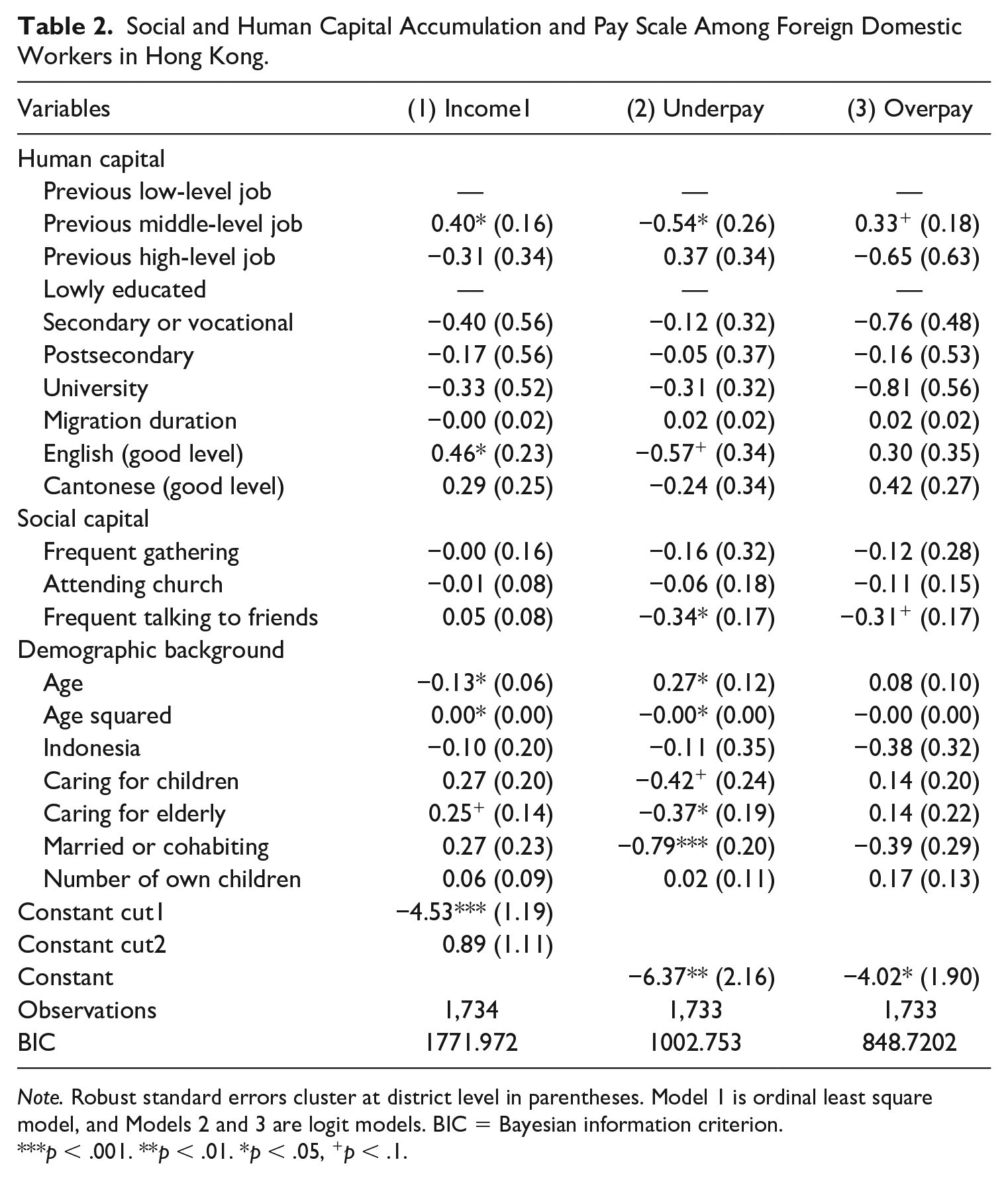
Note. Robust standard errors cluster at district level in parentheses. Model 1 is ordinal least square model, and Models 2 and 3 are logit models. BIC = Bayesian information criterion.
p < .001. **p < .01. *p < .05, +p < .1.
Capital Accumulation and Working Conditions
Table 3 presents the results of capital accumulation on working and living conditions in the employers’ home. Model 1 in Table 3 shows that having previously held a high-level job is associated with greater chances of having a private room, which might indicate the high expectation of such domestic workers regarding the need for privacy. Migration duration and English proficiency also help domestic workers bargain for private living space. Education level is not associated with the likelihood of obtaining a private room. Being good at Cantonese reduces the chance of receiving a gift from employers and also reduces the likelihood of working in a large flat, an indicator of the level of wealth of the employers. Migration duration is also associated with a higher chance of working with more wealthy employers. Social capital shows inconsistent patterns across these working conditions. Attending church is associated with a reduced likelihood of having a private room but is also associated with an increased chance of living in larger size flat. Frequent gathering and talking with friends are associated with working with less wealthy families. These results are again in line with Hypotheses 2 and 3.
Social and Human Capital Accumulation and Working Condition Among Foreign Domestic Workers in Hong Kong.
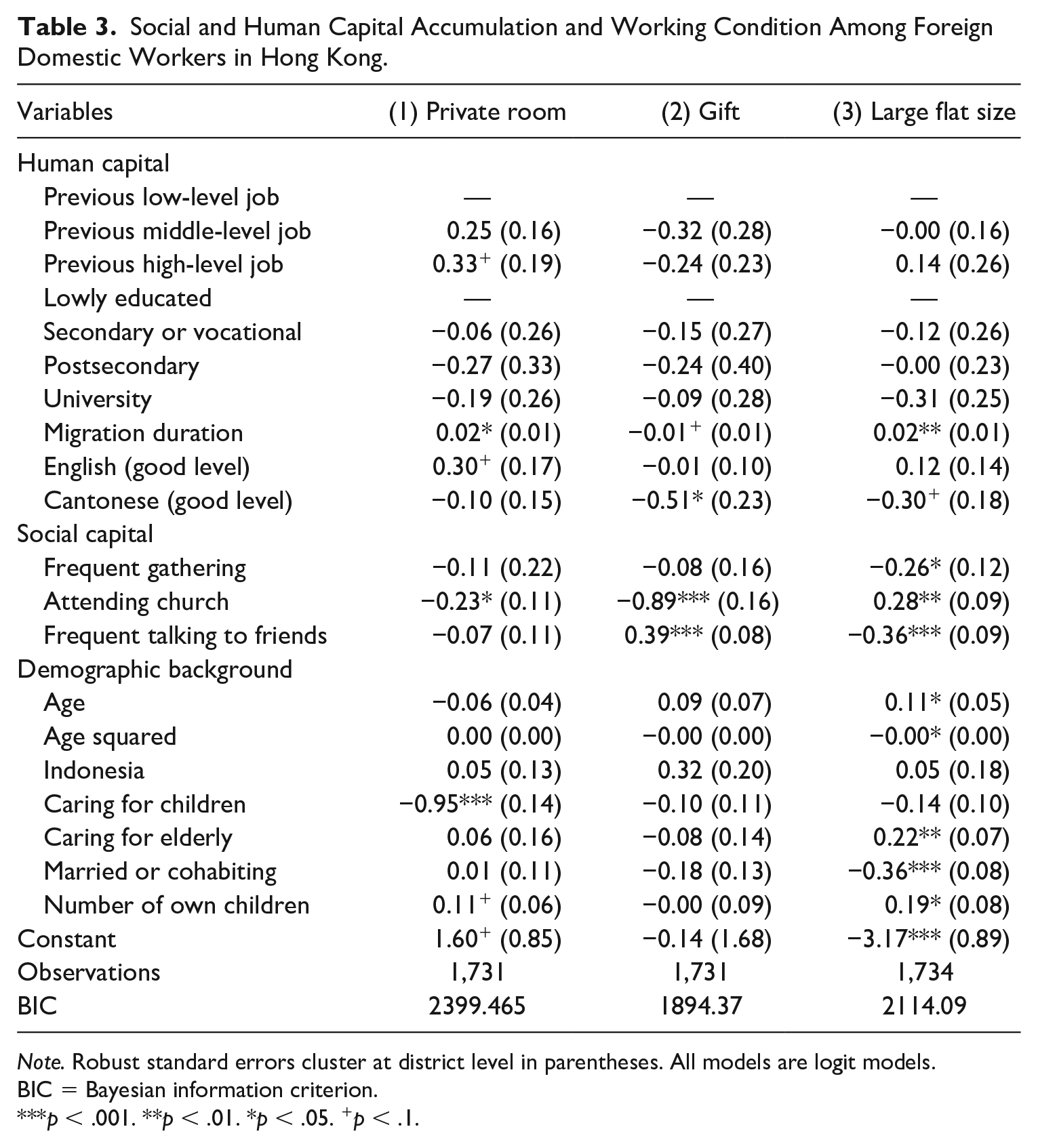
Note. Robust standard errors cluster at district level in parentheses. All models are logit models. BIC = Bayesian information criterion.
p < .001. **p < .01. *p < .05. +p < .1.
Capital Accumulation and Human Rights Protection
Table 4 presents the results for basic work rights protection. Model 1 is about number of working hours. It showed that having previously held a high-level job increases domestic workers’ working hours, which is counterintuitive. None of the other human capital variables are associated with the number of working hours. As regards not being granted a weekly rest day, Model 2 shows that migration duration is associated with a reduction on their chance of no pay, although it also increases the chance of being asked to work on a rest day. Domestic workers who speak Cantonese are more vulnerable as regards their rights protection, probably because they are largely from Indonesia and less active in fighting for their rights compared with their Filipina counterparts. Indeed, given the Philippines’ longer history of working in Hong Kong and more organized rights protection, Indonesian workers are more vulnerable. Specifically, they are more likely to experience not being paid and are also more likely to have to work on a rest day. Social capital seems to play a more important role in rights protection. Frequently gathering with friends on Sundays is associated with a relatively lower number of working hours and also corresponds with being less likely to have to work on rest days as well as to experience not being paid.
Social and Human Capital Accumulation and Basic Human Rights Among Foreign Domestic Workers in Hong Kong.
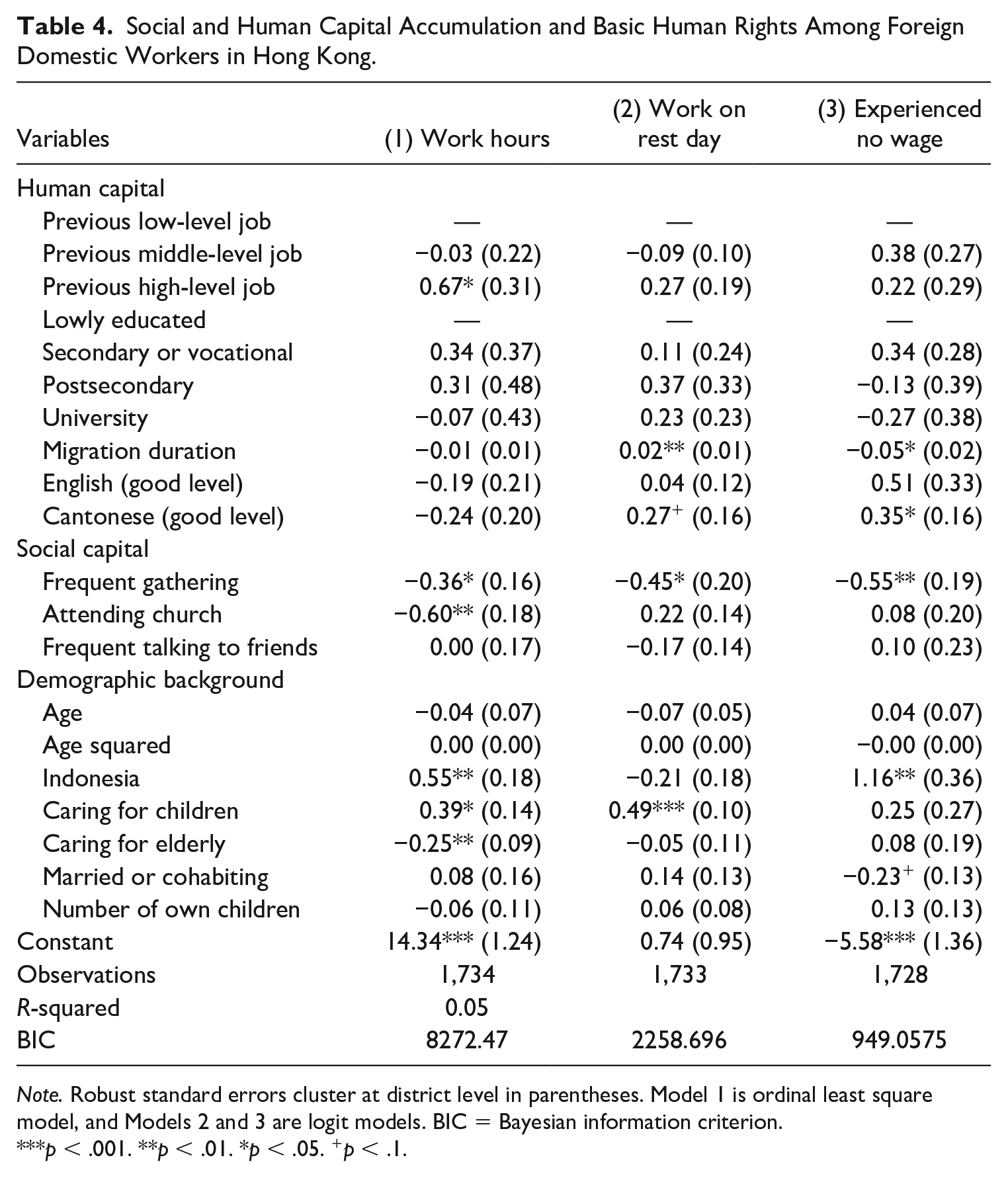
Note. Robust standard errors cluster at district level in parentheses. Model 1 is ordinal least square model, and Models 2 and 3 are logit models. BIC = Bayesian information criterion.
p < .001. **p < .01. *p < .05. +p < .1.
Discussion and Conclusion
In this study, using a unique data set with random sampling design collected in 2017 among migrant domestic workers in Hong Kong, we examine how human and social capital accumulation has affected or is associated with migrant domestic workers’ labor market outcome. This study moves beyond the previous research on human or social capital on labor market outcome by examining multiple domains of labor market outcomes for low-skilled workers who have restricted permission to work in the host society. We distinguish the following main findings according to human capital and social capital.
For human capital, consistent with the prediction from dual labor market theory’s argument with regard to the returns from education on the secondary labor market, we found that education does not matter for all labor market outcomes we examined in this study. As argued in the dual labor market theory (Doeringer & Piore, 1985), the returns coming from education on the low-skilled labor market is trivial. This could explain why a university degree does not matter for the domestic worker’s labor market outcome: University education overqualifies a person for domestic work. However, given the unique nature of domestic work, their communication skills, including English proficiency, play important role in the labor market outcome. Such human capital is more relevant for doing domestic work and living with employers under the same roof. Previously held middle-level jobs have also developed their people skills, enabling them to better get along with the employers, who are mostly members of the middle and upper classes. In addition, migration duration also helps them increase the likelihood to get a private room and work with more wealthy employers. Migration duration also reduces their chances of not being paid. Therefore, although they are in the low-skilled job domain, the work-related skill set still possibly leads them to a more favorable labor market outcome, which includes better payment, better living conditions, and some aspects of work rights protection.
For social capital, our findings mainly involved work rights protection. We found consistent results with regard to the protective role of social capital, especially the friendship network in the host city for their work rights protection in avoiding underpay, getting the rest days off, and not working extremely long hours.
Based on our findings, we argue that the role of capital accumulation may still apply to the secondary labor market, although it is limited to a specific skill set, and the main human capital variables—like education—do not really apply. Our findings go beyond the migrant domestic worker occupation and indicate an important direction to continue research, specifically to examine the labor market outcome in the domains beyond wages: Working conditions and work rights protection are namely very important elements for low-skilled workers, given their very limited freedom to choose in the labor market. In addition, our study also suggests that human capital and social capital play different roles in the labor market outcome. Previous studies on these two capitals mostly focus on how they can find jobs, get promotions, or pay raises, but few studies have examined how they might play different roles in different domains of work such as working condition and work rights protection.
This study has a few limitations that may affect its generalizability, especially given the cross-sectional nature of the survey data. The first limitation concerns the causal relationship: As we argued before, establishing a causal relationship between capital accumulation and labor market outcomes is fraught with complications, and we need to evaluate it variable by variable. Human capital factors such as education level, previous working experience, and language proficiency are less affected by this issue because human capital is often obtained earlier. For social capital, the reverse causality may exist. People who come out to Sunday gatherings are often those who know better how to protect their rights. The domestic workers who are treated badly by their employers may not have chance to go out to make friends, which is also related to our second limitation. That is, the sampling selection may be biased to some extent, as it only tapped into the group of workers who were able to go out on Sundays and public holidays. Despite the limitations, given the difficulty to obtain the sampling frame for this group and the difficulty to track them with panel data, our study makes an important contribution by examining this group of people with quantitative data. Qualitative interview study would be an advisable supplement to this research in the future.
In summary, the findings in this study indicate that although migrant domestic workers may be constrained in using their capital accumulation to improve their market value substantially, the capital accumulation can still give some leverage for them to bargain for a slightly improved salary, to avoid wage penalty, to secure better working conditions, and to protect their basic human rights. It has policy implications regarding how society and government can help migrant domestic workers to be better informed about their rights and improve their employment conditions.
Footnotes
Authors’ Note
Niantao Jiang is also affilated with Department of Social Work. The Chinese University of Hong Kong.
Declaration of Conflicting Interests
The authors declared no potential conflicts of interest with respect to the research, authorship, and/or publication of this article.
Funding
The authors received no financial support for the research, authorship, and/or publication of this article.