




Abstract
Disaster sociology has a rich and undeniably valuable history. Among other things, it has revealed much about the behavior of disaster survivors. In recent years, criminologists have turned their attention and the discipline’s theories, methods, and data sources to understanding behavior in the wake of disasters and have come to a number of additional and sometimes different conclusions than did sociologists. In this article, we examine property crime in the wake of some recent and high-profile disasters. We find short-term increases in burglary after a number of disasters, ostensibly challenging some long-held notions in disaster sociology. We contend that the use of criminological methods including secondary analysis of extant data to understand behavior after disasters provides a more nuanced and accurate picture of postdisaster behavior and conclude with a call for inclusion of these theories, methods, and data sources in disaster studies more widely.
Introduction
Disaster sociologists have amassed undeniable evidence of prosocial behavior in the wake of disaster. There are hundreds of studies that rely on sociological concepts to explain the impact of disasters on behavior (see Dynes & Tierney, 1994; Quarantelli, 1978; Rodríguez et al., 2007; Russell et al., 1987 for just some examples of this scholarship). One very important sociological concept in disaster research is collective behavior. As described by Wenger (1987), theories of collective behavior have undergone tremendous revision since the middle of the 20th century, thanks in large part to systematic disaster research beginning at that time that revealed postdisaster reactions characterized by altruism, cooperation, and rationality and not by antisocial or criminal behavior. In light of these empirical realities, collective behavior theories were modified to include focus on disruption of the existing social structure by a precipitating event such as a disaster and on norms and behaviors that emerge in the wake of such an event. These revisions had a dual effect: They provided a new framework for understanding behavior in disaster and they paved the way for the persistent claim that criminal behavior was a rarity in disaster. According to Dynes (1970), disasters do not create disorganization. Rather, they create organization in which the emergent norms support prosocial behavior. Barton (1969) called this the informal mass assault, which refers to the prosocial behavior that emerges in the wake of disaster to solve shared problems, such as tending to the injured and removal of the deceased, as part of the therapeutic community. Similarly, Drabek (1986) finds that while disaster survivors do experience fear, they nevertheless act in a composed, rational, and adaptive way in the wake of disaster that includes providing assistance to other survivors. Moreover, the desire to help is not limited to survivors—those who are not directly affected by a disaster have been observed going in droves to the affected area to provide relief.
Disaster sociologists have also attempted to explain antisocial behavior in the wake of disaster, but starting from the proposition that this behavior is rare. Most of the claims about the rarity of antisocial behavior in disasters are focused on looting. Looting is strongly condemned by disaster survivors, so what little of it occurs is done by outsiders in secret. This is in sharp contrast to looting during civil disturbances such as riots, in which the action is public, widespread, and condoned in order to send a message about the concept of private property. In other words, the norms that emerge in the wake of a disaster support a notion of collective property in furtherance of survival and recovery and are much different from those developing as a result of a riot that support nontraditional ways of claiming previously private property. The resulting behaviors are therefore also very different (Drabek, 1986, 2010; Dynes & Quarantelli, 1968a, 1968b, 1968c, 1970; Quarantelli, 1994; Quarantelli & Dynes, 1970; Van Brown, 2019). 1 Wenger et al. (1975) as well as Quarantelli (2008) identify looting as just one of the behaviors included in a disaster mythology. Other behaviors include panic flight (Johnson et al., 1994) and mass hysteria (Stallings, 1994). Fischer (2008) adds disaster shock, price gouging, and psychological dependency to this list. It may seem to make intuitive sense that these behaviors would follow something as disruptive as a disaster. Indeed, even some disaster survivors believe these myths to be fact (Wenger et al., 1980). However, empirical research dating back to at least the 1950s tends to bear these out as myths and confirm the opposite, namely, that prosocial behavior largely follows disasters.
However, some classic disaster studies and the research that followed present a more nuanced view of behavior in the wake of disaster. The indispensable work on the loss of community as a result of disaster is Erikson’s (1976) description of the flood in Buffalo Creek, West Virginia. The flood occurred when a coal company dam gave way and released hundreds of millions of gallons of slag onto the 16 towns in the valley below. Survivors described a loss of the community that had formerly provided the very structure of their individual and shared lives. Erikson (1994) describes similar losses of community in his later work, in which he covers events as diverse as a mercury spill in Canada, grand larceny of wages in Florida, a gasoline fume diffusion in Colorado, and the malfunction of the nuclear reactor in Three Mile Island, Pennsylvania. He calls these disasters a new species of trouble precisely because they result in loss of community and because this loss is especially pronounced in disasters that are thought to be human-caused rather than natural and those that involve toxic contamination.
The Emergence of Disaster Criminology
In addition to findings that reveal a broader array of individual and community responses to disasters based on their types than had been previously observed, relatively recent empirical realities also warrant a reexamination of postdisaster behavior. The first of these is Hurricane Hugo, which hit the island of St. Croix as a Category 4 storm on September 17, 1989. Hugo’s impact was devastating—it totally destroyed the island’s infrastructure and most of its buildings—and looting was widespread. The verified looting in the wake of Hugo forced a reconsideration of the position that looting is rare to nonexistent in the wake of disaster. Quarantelli (1994) contends that the looting that followed Hugo was in part the result of the response to the disaster. Hugo was truly devastating—not only did it ruin nearly every edifice on the island, it also rendered government agencies tasked with responding completely ineffective. Survivors of Hugo had no idea when and from whom to expect help. The looting was also in part the result of social circumstances in place prior to landfall, including extensive crime and severe social stratification.
The second of these empirical realities is Hurricane Katrina, which hit near the city of New Orleans, Louisiana, as a Category 3 storm on August 29, 2005. Katrina’s impact was also devastating—the storm caused three major levee failures, which flooded 80% of the city—and looting was once again widespread. Quarantelli (2006, 2007) drew on preexisting social conditions to explain the looting in both affected locations, noting that like St. Croix, New Orleans was characterized by crime and social stratification at the time of Katrina’s impact (see also Barsky et al., 2006; Brown, 2012; Tierney et al., 2007). Drabek (2010) summarizes this adjustment to thinking about looting during disaster based on Hurricanes Hugo and Katrina. Widespread looting did occur after both of these storms, and it is instructive to look to a variety of factors to explain it, including the presence of a highly stratified society before the storms struck, authorities’ loss of control immediately after the storms’ impacts, and an above-average rate of prestorm burglary in the impacted areas. When these conditions are present, looting is much more likely to occur after disasters.
Methods Matter
Hurricanes Hugo and Katrina forced disaster scholars to seriously consider the possibility that looting occurs during disasters. Largely beginning with Katrina, a small number of criminologists developed an interest in the factors that lead to disaster crime, especially looting. These criminologists brought their own methodological techniques to bear on understanding this phenomenon. The first of these techniques was to focus on burglary instead of looting. As explained by Frailing and Harper (2010a, 2010b, 2015a, 2015b, 2016, 2017), the focus on burglary instead of looting as a metric of property crime serves two purposes. The first of these is to permit comparisons over time. Just over a quarter of states have looting statutes (Kuo, 2012) and these are typically implemented after disasters; for example, Louisiana’s looting statute was enacted in 1993 after Hurricane Andrew. Burglary, on the other hand, is a long-standing offense in the criminal code of every state. Moreover, an examination of arrests or convictions for looting only permits understanding of this behavior in the immediate wake of disaster. Using burglary instead of looting permits comparison of the behavior of interest before and after a disaster to more accurately tease out the effects of the disaster on this crime. Second, using burglary instead of looting allows researchers to observe the behavior of interest more closely. In other words, it allows researchers to observe predatory acts of theft that have little to do with surviving disaster, such as the taking of liquor, narcotics, electronics, and jewelry, the so-called “bad” looting (Green, 2007). Indeed, it is reasonable to expect that people and businesses are more likely to report these sorts of losses to the police, meaning that the available data reflect the extent of this antisocial behavior in the wake of disaster.
Burglary in the Wake of Disaster
Hurricane Katrina
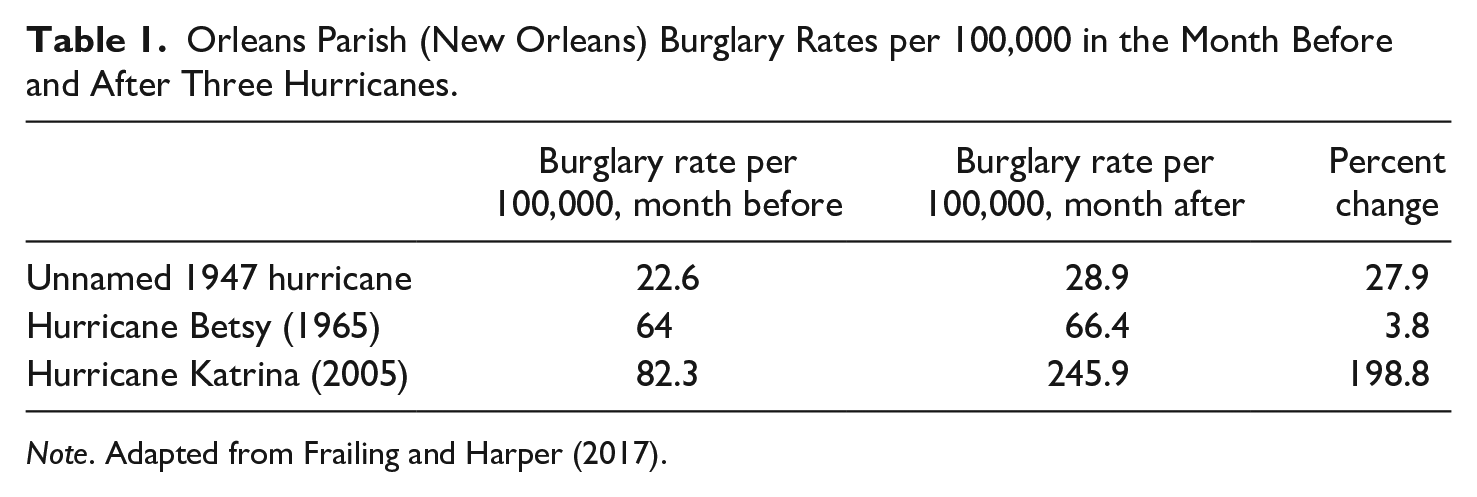
The most thorough examination of burglary in the wake of disaster is focused on Hurricane Katrina, which made landfall in southeastern Louisiana as a Category 3 storm on August 29, 2005. Using New Orleans Police Department (NOPD) data on burglaries in the month before Katrina hit and the month after, Frailing and Harper (2007, 2010a, 2010b, 2016, 2017) found that the burglary rate in New Orleans in the month before Katrina was 82.3 per 100,000 and that in the month after Katrina, it was 245.9 per 100,000—an increase of 198.8%. Importantly, the NOPD created a special code after Katrina, 21K, for those property losses that could not be determined to be due to the storm or to theft. None of the 21K losses are included in this tally, so it is possible that the post-Katrina burglary rate is higher than what is reported here. The pre- and post-Katrina burglary numbers seemed high, of course, but needed context, so Frailing and Harper (2007, 2010a, 2010b, 2016, 2017) compared the burglary rate in the month before and the month after two other powerful storms that hit New Orleans in previous decades, the unnamed 1947 hurricane and Hurricane Betsy in 1965. Using Uniform Crime Reporting data for the 1947 storm and for Betsy, as well as NOPD reports for Katrina, Frailing and Harper (2007, 2010a, 2010b, 2016, 2017) found the increases in burglary presented in Table 1.
Orleans Parish (New Orleans) Burglary Rates per 100,000 in the Month Before and After Three Hurricanes.
Note. Adapted from Frailing and Harper (2017).
Hurricane Gustav
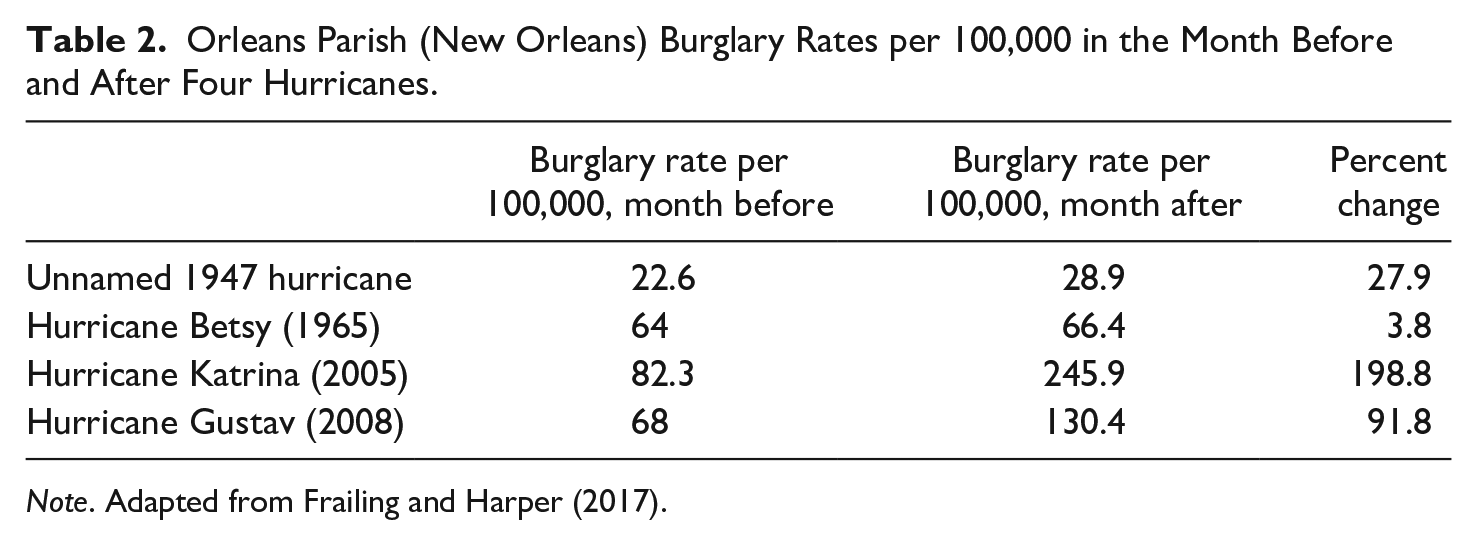
Frailing and Harper (2009, 2010b, 2016) once again used burglary instead of looting to understand the extent of property crime in the wake of Hurricane Gustav, which hit southeastern Louisiana as a Category 2 storm 3 years and 2 days after Katrina did. There was intense worry that Gustav was going to be much more powerful and that it was going to hit New Orleans directly; as a result, 2 million people evacuated southeastern Louisiana in advance of the storm, 200,000 of whom left from the New Orleans metro area (Frailing & Harper, 2016). Unlike Katrina, the levees did not breach during Gustav, and residents were permitted to return 3 days after the storm made landfall. Table 2 replicates Table 1 for context and adds the percent increase in burglary after Gustav.
Orleans Parish (New Orleans) Burglary Rates per 100,000 in the Month Before and After Four Hurricanes.
Note. Adapted from Frailing and Harper (2017).
New Orleans Tornado
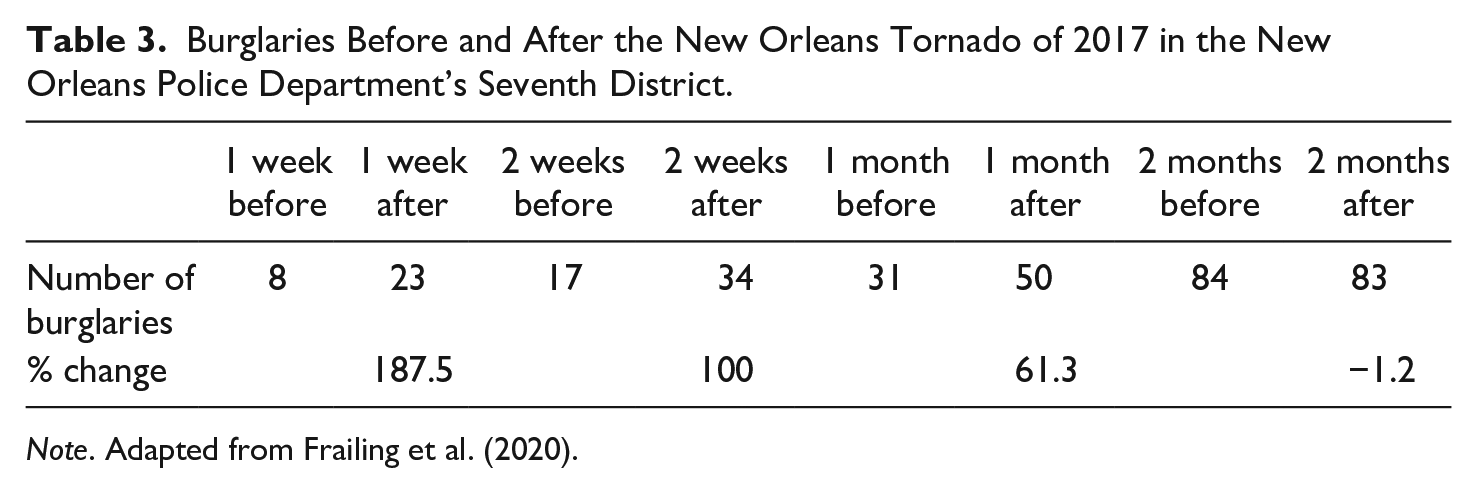
Importantly, increases in burglary after disasters are not confined to hurricanes that have hit New Orleans. In their examination of burglaries before and after the New Orleans tornado of 2017, Frailing et al. (2020) utilized the NOPD’s publicly available calls for service database, which includes location of each call for service by latitude and longitude for the district where the tornado hit for the 2 months before and the 2 months after its impact. They found an increase in residential burglary 1 week, 2 weeks, and 1 month after the tornado compared with the same time period before and that this increase was largely driven by the burglaries in the neighborhoods in the district that were directly affected by the tornado. They also found that after 2 months, the burglary rate had returned to pretornado levels. Table 3 summarizes these findings.
Burglaries Before and After the New Orleans Tornado of 2017 in the New Orleans Police Department’s Seventh District.
Note. Adapted from Frailing et al. (2020).
Superstorm Sandy
The increases in burglary after disaster are not confined to New Orleans. Researchers have also explored this combination of factors in the context of Hurricane Sandy, which hit the New York/New Jersey area as a Category 1 storm on October 29, 2012. There was a clear drop in all major crimes in New York City in the wake of Sandy as compared with the same time in 2011: murder down 86%, rape down 41%, robberies down 21%, assaults down 19%, auto theft down 20%—even larceny down 47%—an overall crime drop of 32%. However, there was a three% increase in burglary in the city as a whole, and those areas hardest hit by Sandy showed much more dramatic increases. For example, the Rockaway Peninsula area of Queens experienced a 350% increase in burglary in the week after Sandy as compared with that same week in the previous year (Frailing & Harper, 2015a).
Hurricane Harvey
There was also an increase in burglary after at least two of the hurricanes in 2017, one of the most active and devastating hurricane seasons for the United States on record. Hurricane Harvey hit the Houston area as a Category 4 storm in August of that year. It stalled over the metropolitan area for 4 days and dumped unprecedented amounts of precipitation, with many areas receiving at least 30 inches of rain in that time period (Tate, 2017). As Downen (2017) reports, calls for service to the Houston Police Department reached a record low on August 27, 2017, the third day of the storm’s stall over the Houston area, and there was a drop in larceny, automobile theft, assault, and robbery from August 25th to 31st, 2017, as compared with the same time period in the 2 preceding years. However, there was an increase in burglary, which nearly doubled during that week of 2017 compared with the same week in 2015 and 2016. Table 4 summarizes pre- and post-Harvey crimes in the Houston area.
Crimes Reported to Houston Police Department From August 25th to August 31st, 2017.

Note. Adapted from Downen (2017).
Hurricane Maria
Hurricane Maria hit Puerto Rico as a Category 5 storm on September 20, 2017. The entire island was devastated by the storm, and compounding the effects of Maria was the fact that the agency responsible for responding to disasters, the Federal Emergency Management Agency (FEMA) had already expended massive amounts of resources in the recoveries from Hurricanes Harvey, and Irma, which hit Florida in early September, 2017. FEMA’s response to Maria was slow and ineffective, leaving millions without electricity, potable water, cell service, and shelter for weeks and in some cases months. Moreover, Puerto Rico was experiencing a financial crisis, driven by the cancellation of tax breaks for corporations that did business on the island. As those corporations left Puerto Rico, governor after governor borrowed money to cover its deficits, and simultaneously, Puerto Rican bonds, which were previously solid and tax-free investments, lost their value. By 2015, Puerto Rico defaulted on its debt payments and was in extremely dire straits when Maria struck 2 years later (Young et al., 2018).
Like other disasters covered here, Puerto Rico, and more specifically the capital city of San Juan, experienced a lower number of many crimes in the year after Maria than the year of Maria, including aggravated assault, larceny, and automobile theft. Also, like other disasters covered here, San Juan experienced a higher number of burglaries in September of 2017, the month and year Maria hit, as compared with September of 2018. There were 150 burglaries reported to the San Juan Police Department in September 2017, compared with 76 burglaries in September 2018. Moreover, the burglaries in September 2017 largely drove the burglary totals through September 30, 2017 to their level above the total through September 30, 2018. The additional 74 burglaries in September 2017 accounted for 83% of the difference in the number of burglaries between the first 9 months of 2017 and of 2018 (San Juan Police Department, 2018).
Relevant Theories of Crime
Social Disorganization Theory
There are a number of extant criminological theories that we believe are useful in understanding disaster crime. The first of these is known as social disorganization theory. Social disorganization theory was developed by Shaw and McKay (1942), who built on the work of Burgess (1925). Working in the city of Chicago, Burgess (1925) believed that cities expand from an inner core, or industrial zone. Radiating out from that industrial zone are residential zones, the first of which is largely populated by recent arrivals seeking employment in the industrial zone; this first residential zone is known as the transition zone. The subsequent zones are populated by longer-term residents and are more stable than the transition zone. Shaw and McKay (1942) were particularly concerned with the transition zone, the area of the city immediately adjacent to the industrial zone. They contended that this zone is characterized by poverty, residential instability (in other words, a high turnover of residents), and ethnic heterogeneity (in other words, people of many different races, ethnicities, and nationalities) and believed these characteristics to be important in explaining the consistently high crime rate there, irrespective of who lived in the zone. Through their disorganizing effects on social structures, including the family and educational and religious institutions, Shaw and McKay (1942) maintained that these three characteristics of an area diminish the ability of adults who live in that area to exercise control over children, thereby freeing up children to consort with older delinquents and engage in crime. Sampson (1986) added an important fourth characteristic to this list, family disruption, meaning a large number of families beset by divorce, death, abandonment, or incarceration in a given area. In the United States, African Americans are more likely to live in neighborhoods that can be accurately characterized as socially disorganized, thanks to economic and political policies that resulted in the disappearance of high-paying manufacturing jobs, the building of dense public housing, the migration of middle-class African Americans away from these areas, and the resulting loss of social networks that once provided prosocial role models to young people. The ultimate effect of these policies was the creation of severely socially isolated neighborhoods where new value systems, some of which support crime and violence, emerged (Sampson & Wilson, 1995).
A number of studies in criminology find support for social disorganization theory’s ability to explain crime (e.g., Bursik & Grasmick, 1993; Sampson & Groves, 1989; Steenbeck & Hipp, 2011). Because social disorganization is so concerned with the characteristics of an area that might be criminogenic, it is a potentially important one for studying disaster crime. Albala-Bertrand (1993), Akimoto (1987), and eventually Quarantelli (2007) spoke of the necessity of considering the characteristics of an area before it is affected by a disaster to help understand the behavior that emerges in the wake of disaster. An area that is characterized by social disorganization prior to the impact of a disaster may be more likely to experience crime in the postimpact period. It may also be the case that a disaster can create a situation in which it becomes more difficult to exercise both formal and informal social control over people. Indeed, some disaster researchers have turned to social disorganization as at least a partial explanatory theory for a variety of postdisaster crime, including Teh (2008), Davila et al. (2005), Zhou (1997), and Frailing and Harper (2010a, 2010b, 2015a, 2015b, 2016, 2017).
Routine Activity Theory
Another theory of crime that may have relevance in explaining disaster crime is routine activity theory. Unlike social disorganization, routine activity theory is what is known as an opportunity theory of crime. In other words, it considers how the opportunity to commit crime affects criminal involvement. The architects of routine activity theory are Cohen and Felson (1979), who maintain that three factors must be present together in time and space for crime to occur, namely, motivated offenders, suitable targets, and a lack of capable guardianship. Rather famously in criminology, Cohen and Felson (1979) are not particularly concerned with motivated offenders. They believe that motivated offenders are omnipresent and that they become motivated due to widely recognized potentially criminogenic factors, such as socioeconomic status, parental involvement and effectiveness, level of impulsivity, presence of delinquent peers, and so on. Instead, Cohen and Felson (1979) focus their attention on suitable targets and lack of capable guardianship. People as well as property may be suitable targets, and capable guardianship is not limited to the formal guardianship provided by law enforcement and related agencies; informal capable guardianship may be provided by ordinary citizens. The reason the theory has the name it does is because some people’s routine activities, the things that they regularly do and the places they regularly go, bring them into contact with motivated offenders in the absence of capable guardianship, thereby rendering them and their property suitable targets. Cohen and Felson (1979) point to major changes in people’s routine activities in the United States following World War II that can explain the increase in crime during that time. After the war, people spent more time away from home at work, at school, and involved in leisure activities, which increased the possibility of their victimization. In other words, they became more suitable targets. Moreover, spending increased time away from home made residences and their increasingly portable contents more suitable targets because they lacked the capable guardianship that is provided when people are home.
A number of studies in criminology have provided support for the tenets of routine activity theory (e.g., Miller, 2013; Mustaine & Tewksbury, 1998; Sherman et al., 1989). Because it is concerned with opportunities for crime that are produced by suitable targets in the absence of capable guardianship, routine activity theory is another extant criminological theory that may be able to explain disaster crime. Disasters may create suitable targets, increase the number of motivated offenders, and may diminish especially formal guardianship; they may also change people’s routine activities so that they become suitable targets in the presence of motivated offenders and the absence of capable guardianship. In fact, of the handful of studies already published that utilize criminological theories to explain crime in the wake of disaster, routine activity theory is probably the most regularly employed; studies by Cromwell et al. (1995), Zahran et al. (2009), Teh (2008), and Frailing and Harper (2010a, 2010b, 2015a, 2015b, 2016, 2017) have all relied on this theory at least in part to explain crime in the wake of disaster.
Application of Relevant Theories of Crime to Property Crime in Disaster
Social Disorganization
The utility of the theories of crime detailed above have been most thoroughly examined in the case of Hurricane Katrina. New Orleans lost population every year from 1970 forward, which was largely driven by school desegregation and a loss of high-paying manufacturing and transportation jobs. The largely African American population left behind in the city was un- or underemployed and, if working, earning low wages in the service industry, while experiencing family disruption and children attending essentially resegregated public schools. These conditions were present when Katrina hit the city and appear to have contributed to the high rate of burglary observed after that storm as compared with after the 1947 storm and Betsy (see Table 1), both of which hit when the city was thriving (Frailing & Harper, 2007, 2010a, 2010b, 2016, 2017). This analysis lends credence to the importance of considering preexisting conditions in a disaster-impacted area to better predict whether property crime will occur (Albala-Bertrand, 1993; Barsky et al., 2006; Kreps, 1998; Quarantelli, 2006, 2007; Tierney et al., 2007) and advances social disorganization as a useful explanatory theory for property crime in disaster. Other researchers have applied social disorganization theory to disasters; Teh (2008) claims that social disorganization can partially explain the antisocial behavior observed in the wake of the 2004 Boxing Day tsunami; Davila et al. (2005) similarly claim that social disorganization can explain contractor fraud in the wake of two Texas floods.
Routine Activity Theory
However, when Frailing and Harper (2009, 2010b, 2016, 2017) examined the indicators of social disorganization in New Orleans in the lead up to Hurricane Gustav, they found that they were nearly identical to those in the lead up to Katrina, yet the increase in burglary after Gustav was much less than after Katrina. They contend that routine activity theory may also be useful in understanding postdisaster burglary. A mass evacuation plus physical destruction caused by a hurricane is likely to increase target suitability for property crime. According to routine activity theory, then, motivated offenders will have more suitable targets in the wake of a disaster. What accounts for the difference in increase in the burglary rate post-Katrina and post-Gustav is the presence of capable guardianship.
As noted above, New Orleans was thriving at the time the 1947 storm and especially at the time Betsy hit the city, relative to conditions in 2005 and 2008. While by no means perfect, macrolevel structural indicators reveal a more socioeconomically promising city when the earlier hurricanes struck than when either Katrina or Gustav made landfall. Moreover, it is well-known that formal guardianship was in place after the 1947 storm and after Betsy, with National Guard troops arriving in New Orleans the day after impact in both cases (Frailing & Harper, 2009, 2010b, 2016, 2017). The combination of a socioeconomically stable city and formal guardianship worked to keep burglary increases low.
As has been described in detail elsewhere, formal guardianship was notoriously absent in the wake of Katrina. Five hundred sworn NOPD officers, about a third of the force at the time, evacuated or quit in the immediate aftermath of Katrina and never returned to the city (Harper, 2016). Additionally, though the storm hit on August 29, it was not until September 2 that the National Guard arrived en masse to quell unrest and to provide assistance with evacuation (Voigt & Thornton, 2016). Importantly, the lesson of the importance of formal guardianship learned during Katrina was applied during Gustav. The entire 7,000 member Louisiana National Guard was mobilized a few days before Gustav’s projected landfall and requested 1,500 additional troops and supplies from nearby states. The National Guard troops assisted with prestorm evacuation and with patrolling the city. Part of the impetus for mobilizing the National Guard was so that residents would feel secure in evacuating, thereby reducing the temptation to stay in the storm’s path in order to protect their belongings (Frailing & Harper, 2016); reducing the fear of property crime is an important step in encouraging evacuation (Drabek, 1986).
Conclusion
Methods Do Matter
As we have seen, disaster sociologists largely claim that looting in natural disasters is rare. This claim may imply that all antisocial behavior in disaster is rare. However, this conclusion may be dependent, at least in part, on the methodology employed. While disaster sociologists tend to utilize intensive qualitative interviews with disaster survivors as their primary source of data, criminologists typically utilize secondary data, such as official statistics on crime, to better understand this phenomenon. The use of these data reveals that burglary—surely an antisocial behavior—appears to increase after disasters, and not just after disasters so atypical that researchers call them catastrophes instead, that is, Katrina (Rodríguez, Trainor, & Quarantelli, 2006). As seen above, burglary also demonstrably increased after the unnamed hurricane of 1947, after Hurricane Betsy, after Hurricane Gustav, after the New Orleans tornado, after Superstorm Sandy, after Hurricane Harvey, and after Hurricane Maria. Despite these firm conclusions, there remain a number of methodological considerations for disaster criminology. Among them are the challenges of accurately and ethically measuring crime in the wake of disaster, the appropriateness of various units of analysis, and consideration of both the temporal and spatial dimensions of crime, in general (e.g., Tita & Radil, 2010; Valasik et al., 2017), and disaster crime, in particular.
Unanswered Questions
In rethinking the conditions that may promote disaster crime, Quarantelli (2007) notes that a specific set of conditions will increase the likelihood of postdisaster looting, including a concentration of disadvantaged people, a subculture that is tolerant of minor stealing, the presence of criminal gangs, and a corrupt and inefficient police force. These conditions overlap with the preconditions we have seen in this article that are associated with postdisaster burglary, but the questions remain: “How much of a concentration of disadvantaged people, how much of a subculture that tolerates minor stealing, how much of a presence of criminal gangs, and how much of a corrupt and inefficient police force are necessary to make postdisaster burglary likely to occur?” And which of these, if any, is the most important predictor? Similarly, the connection between social disorganization variables and postdisaster burglary is strong, especially in the case of Hurricane Katrina, but that connection is much weaker for other disasters examined in this article, leaving open the question of how much disorganization is necessary to facilitate postdisaster burglary.
Now that disaster crime is a quantitatively verified phenomenon, future research should focus on quantifying the preconditions variables so that we can further test these notions and predict the occurrence of disaster burglary. Future research should also focus on quantifying the amount of especially formal guardianship necessary to prevent postdisaster burglary. Being able to accurately predict when postdisaster burglary is likely to occur and how much guardianship is necessary to prevent it should be of great use in effective response planning, from evacuation (on this point, see Drabek, 1986) to recovery.
COVID-19
We would be remiss if we did not take this opportunity to discuss the impact of COVID-19 on crime. As disaster criminologists, we feel reasonably confident in predicting a precipitous drop in residential burglary during the pandemic, due largely to the guardianship we are all constantly providing our homes. That is a marked departure from other disasters, as this article shows. However, there are likely to be some similarities to criminal activity that has been observed in the wake of other disasters. The first similarity is domestic incidents, including domestic violence and child abuse. The strain of the pandemic, combined with using alcohol and/or drugs to excess as a coping mechanism, combined with an even more inaccessible mental health system, is likely to drive an increase in these incidents. The second similarity is fraud. With the almost incomprehensible amount of money already dispatched to try to manage COVID-19 and its many effects and the ease with which that money can be obtained makes the inevitability of fraud, particularly unemployment fraud and public corruption, highly likely.
Footnotes
Declaration of Conflicting Interests
The author(s) declared no potential conflicts of interest with respect to the research, authorship, and/or publication of this article.
Funding
The author(s) received no financial support for the research, authorship, and/or publication of this article.