



Abstract
Many studies reveal that socioeconomic resources increase protest participation, lending more political voice to the affluent and reinforcing preexisting political inequality. But existing studies ignore whether this holds across different protest issues. We argue that some issues reinforce political inequality, while other ones do not. We differentiate between survival protests—in which people react to direct threats to their material and social survival—and furtherance protests—which press authorities to make policy changes that seek to improve some aspect of society. Regression models with Latin American survey data show that people with higher socioeconomic status are overrepresented in furtherance protests, by implication reinforcing preexisting political inequality. However, survival protests attract people socioeconomically similar to national averages, contributing to a more balanced political field. Our results emphasize the need to reconsider the place of issues in the study of protest participation, political inequality, and political behavior in general.
Introduction
Since the 1970s, abundant research across the globe has shown that protest participation is more frequent among people with higher socioeconomic status (SES hereinafter) as indicated by higher income, education, and/or occupational status (Barnes & Kaase, 1979, Dalton et al., 2010; Schussman & Soule, 2005, Verba et al., 1995). This finding, which we refer to as the “elitization of protest,” challenged the long-standing claim that protest and rebellion are mostly the weapons of deprived groups for improving their lot—a claim consistent with contemporary distributive conflict models (Acemoglu & Robinson, 2005, Boix, 2003). Additionally, this finding revealed that collective protest, while less institutionalized than other forms of participation, reproduced the socioeconomic biases consistently found in most types of political activities (Verba et al., 1995).
The elitization of protest is a problem for democracies. It indicates that citizens who already enjoy material and symbolic privileges will also have a stronger voice in the streets, while “what public officials hear clearly influences what they do” (APSA Task Force, 2004, p. 16). Gilens and Paige have recently demonstrated that, in the United States, the preferences of a tiny minority of wealthy citizens have stronger effects on a wide array of policy outputs than the preferences of the much more numerous nonaffluent citizens (Gilens & Page, 2014; Page & Gilens, 2017). For this reason protest elitization, as a mechanism for signaling opinions and preferences, may ultimately deepen political and economic inequalities. This “participatory distortion” (Verba et al., 1995, p. 178) contradicts, in practice, the basic tenet of democracy that all citizens are politically equal (Dahl, 2006; Dubrow, 2014, 2015; Dubrow et al., 2008; Verba, 2003). To be clear, by “elitization,” we mean a positive relationship between resources and protest. We do not mean that those who protest belong to the wealthiest 1% or 2% of the population (or any akin criterion).
Given the substantive importance of this topic, we revisit the debate about the socioeconomic inequalities in protest participation. A characteristic feature of most protest participation studies, including those cited in the first paragraph as well as the few available for Latin America (Desposato & Norrander, 2009, Justino & Martorano, 2016, Machado et al., 2011, Moseley, 2015), is that they employ survey questions that ask respondents about their past participation in protests in general—that is, disregarding the issue driving the event. The implicit assumption is that protest elitization remains constant across issues. However, in most nations, diverse issues drive protest participation, from low wages and lousy working conditions to environmental degradation, nuclear threats, or minority rights to name a few. We argue that different issues will attract protestors with different and, at times, even opposite socioeconomic profiles. For instance, protests motivated by economic scarcity should disproportionately attract lower class individuals, typically more exposed to unemployment and misery (Piven & Cloward, 1979). Conversely, protest elitization should be specially marked on issues that, by requiring more resources and civic and political skills, disproportionately attract the better-off. If this is the case, lumping all protests together may hide significant variations across issues with different implications for political inequality. Not all protests reinforce preexisting political inequalities, and some do so to a greater extent than other ones.
Given the inattention of past research to protest issues, this article contributes to debates about protest participation and political inequality by showing that the socioeconomic biases of protestors depend on the issue of the protest. We propose a distinction between survival and furtherance issues. Survival issues apply for protests in which people react to direct threats to their material and social environment and their immediate reproduction—like flooding, worsening economic conditions, or lack of basic services. Furtherance issues drive protests aimed at pressing public authorities to improve some aspect of society through public policy, even in the absence of survival threats—for instance, reforming the educational system or increasing political transparency. We argue that, by convoking people with different socioeconomic profiles, furtherance protests reinforce preexisting political inequalities, while survival protests do not.
Specifically, using survey data for 17 Latin American countries comprising over 30,000 respondents, we show that people with higher SES are overrepresented in furtherance protests, which by implication reinforces preexisting political inequalities. However, survival issues attract protestors with a socioeconomic profile very similar to that of the average citizen, contributing indirectly to a more balanced political field. We study empirically the relationship between SES and protest issues, but do not examine how socioeconomic biases affect political inequality (Paige & Gilens, 2017, for the United States). We leave for further research an empirical examination of this question in Latin America. More broadly, in line with Verba et al. (1995, chap. 14), our results highlight how different issues or collective problems shape political participation in different ways.
The Impact of Socioeconomic Resources on Protest Participation
There are two basic predictions about the impact of SES on protest participation. First, deprivation theories predict a negative relationship between SES and protest. For instance, absolute deprivation theory argues that people with low living standards and material shortages develop feelings of frustration and resentment that lead them to mobilize collectively for improving their situation (Piven & Cloward, 1979; Snow et al., 2005; Wilkes, 2004). Relative deprivation theory focuses on the relationship between conditions and expectations, but it also suggests a negative relationship between SES and protest, since frustration and grievances should be more frequent among the lower classes (Gurney & Tierney, 1982; Gurr, 1970). Deprivation theories are broadly consistent with contemporary distributive conflict theories, which argue that high inequality and the prospects of successful redistribution encourage the poor to revolt (Acemoglu & Robinson, 2005; Boix, 2003).
In a different vein, the resources thesis predicts a positive effect of SES on protest participation. Like any other political action, protest often requires a wide array of resources such as free time, energy, organizational networks, and money—for instance, for moving to the protest site or devoting a weekday to protest. Such resources are more common among high SES people (Dalton et al., 2010). Also, high SES is associated with more political efficacy, interest, information, and civic skills (Verba et al., 1995). All these factors increase protest chances. Indeed, one of the reasons why the wealthiest citizens have more political clout than the rest (Gilens & Paige, 2014, Paige & Gilens, 2017) is because they participate more in politics—be it protesting, voting, or donating money to politicians.
As part of our focus on socioeconomic resources, we are also interested in exploring the impact of student status on protest. Research on youth activism shows that college students, disregarding their SES, concentrate the abovementioned resources, skills, and political drives to a greater extent than the nonstudent population. For instance, full-time college students have a surplus of free time and energy not devoted to survival tasks, routinely develop civic skills in the classroom, and have access to politicized social networks on campuses and student centers. This explains their high rates of protest participation (McAdam, 1986; Paulsen, 1991, 1994; Schussman & Soule, 2005). Considering two adults with the same SES, one being a full-time student and the other one not, the former one should be more likely to protest.
Over the years, the accumulation of empirical studies provided more support to the resources theory than to deprivation theories. Research in developed countries has repeatedly shown that, on average, protestors have higher SES than nonprotestors (Dalton et al., 2010; Dubrow et al., 2008; Verba et al., 1995) and that students protest more than nonstudents (Paulsen, 1991, 1994; Schusmann & Soule, 2005). Latin American studies have arrived at similar conclusions (Justino & Martorano, 2016; Machado et al., 2011; Moseley, 2015).
Still we believe it is too early to close the debate. We argue that this is the case because researchers do not account for the kind of demands or issues put forward by protesters and how they relate to different socioeconomic groups. While some protest issues will decidedly attract the better-off, some other ones should resonate more among groups that are closer to the average SES and even among underprivileged groups. This will motivate these groups to overcome their comparative resource deficits and engage in collective action.
What Do We Know About Protest Participation Across Issues?
Our suspicion that protest elitization varies across issues draws on recent studies based on surveys with European demonstrators. Scholars have compared demonstrators across three kinds of issues: “bread and butter” (e.g., socioeconomic equality, wages, and social security); “postmaterialist” (e.g., the environment, nuclear energy, LGBTIQ [lesbian, gay, bisexual, transgender, intersex, and questioning] rights, and immigration); and austerity conditions prompted by global economic crises and governmental cutbacks (Eggert & Giugni, 2012, 2015; Grasso & Giugni, 2016; Hylmö & Wennerhag, 2015; Vráblíková, 2015).
These studies show that the socioeconomic profiles of demonstrators vary across issues. For instance, when compared with other demonstrators, participants in bread and butter demonstrations are more likely to come from those in the working class (Eggert & Giugni, 2015), who identify as such (Hylmö & Wennerhag, 2015), and have lower education (Grasso & Giugni, 2016). Those attracted by postmaterialist issues are, to a larger extent, college graduates (Eggert & Giugni, 2015). Participants in antiausterity demonstrations stand in the middle (Grasso & Giugni, 2016).
We draw on these studies but advance them in two ways. First, except for Vráblíková (2015), they do not consider the population that does not protest, which is majoritarian in all documented cases (Barnes & Kaase, 1979; Dalton et al., 2010). Thus, they cannot explore whether the elitization of protestors varies across issues when compared with nonprotestors. Second, while these studies refer to Europe, we explore protest elitization in Latin America. Latin America not only has deep and persistent economic inequalities (Hoffman & Centeno, 2003; M. López, 2018) but also showcases both popular (Rice, 2012; Silva, 2009) and middle-class social movements (Disi, 2017; Svampa, 2008). This seems to lend credence to both deprivation and resource theories, therefore setting an exciting puzzle for examining the role played by different issues in protest dynamics.
Protest Issues: Survival and Furtherance
While dozens of specific issues may motivate collective protest, our argument hinges on a basic distinction between survival issues and furtherance issues. We conceive them as ideal types: the issues motivating concrete protests can approach one or both issues in varying degrees, but for analytical purposes, it makes sense to distinguish them typologically.
The notion of survival issues is inspired by Inglehart’s notion of materialist values (Inglehart, 1997; Inglehart & Baker, 2000). He argues that people facing economic or physical threats give priority to these issues and postpone “postmaterialist” considerations such as self-expression or quality of life. Inglehart’s theory was influenced by the European social movements of the 1960s, which he construed as the ultimate expression of postmaterialism (see Foreword in Dalton & Welzel, 2014). Accordingly, he conceived protest participation in general as a type of self-expression activity and showed along with others that protest in developed countries was more common among the middle and upper classes (Barnes & Kaase, 1979; Dalton et al., 2010; Inglehart, 1997).
However, other scholars have forcefully argued that immediate threats to economic and physical security can trigger collective protest. For instance, people all over the world mobilize and protest when facing economic threats due to unemployment, austerity measures, and loss of housing, land, and food (Almeida, 2018). Likewise, populations becoming suddenly aware that they were exposed to pollution also tend to organize and protest (Walsh, 1981). Snow et al. (1998) have claimed that these protests result from the disruption of the taken-for-granted routines and expectations of everyday life. They argue that environmental accidents, intrusions of strangers in safe communities, and declines in material standards can destabilize people’s routines and motivate collective action, even if those affected have modest resources and must bear considerable costs for mobilizing.
In regions such as Latin America, where millions survive in precarious conditions and lack support networks (either state or community-based), these kinds of threats may move people dangerously close to the line dividing life and death. While the ensuing protests may resemble the austerity and bread-and-butter protests of richer countries (Eggert & Giugni, 2012, 2015; Grasso & Giugni, 2016; Hylmö & Wennerhag, 2015; Vráblíková, 2015), citizens in richer countries have more resources and support networks to resist adverse times than most Latin Americans. Of course, many protests may be motivated by a sense of threat—and even better-off citizens may protest moved by threat. However, the notion of survival issues refers to immediate material, physical, and environmental threats that affect people’s survival. Below, we illustrate this with concrete examples from Latin America.
The logic of furtherance issues is very different. It is more akin to the conventional understanding of protests driven by opportunities (Almeida, 2018; Tarrow, 2011). Furtherance protests occur when people mobilize to press public authorities to improve some aspect of society through public policy, especially if the expected outcomes involve complex political processes that unfold across considerable periods. Many aggrieved groups protest not because they risk survival, but because they want to improve their living conditions or change some aspect of society. The social movement organizations studied by McCarthy and Zald (1977), which pressed authorities for legislation on gun control, affirmative action, campaign finance, or gambling to name a few, seem more engaged in furtherance issues.
Indeed, many scholars study movements oriented to policy outcomes. As Amenta et al. (2010) note, for movements to shape policies, they often need to set the political agenda by persuading the media and political elites, build coalitions with powerful allies, influence legislative contents, and press politicians for the passage and implementation of laws. This attracts activists with considerable technical expertise, political capital, and knowledge of internal political dynamics—activists more easily found in the middle and upper classes.
It is important to note that our conception of furtherance issues differs from Inglehart’s notion of postmaterialism. The latter was coined for making sense of European affluent groups which, feeling overregulated by omnipresent postwar welfare states, sought to open spaces for autonomy, expression, and participation (Dalton & Welzel, 2014; Inglehart, 1997; Inglehart & Baker, 2000). These sort of asphyxiating states, however, are less tenable in Latin America. As Davis (1999) has argued, Latin American citizens often protest for pressing the state to improve some aspect of society through public policy—in our terms, “furthering.”
So far, the argument can be represented as in Figure 1.
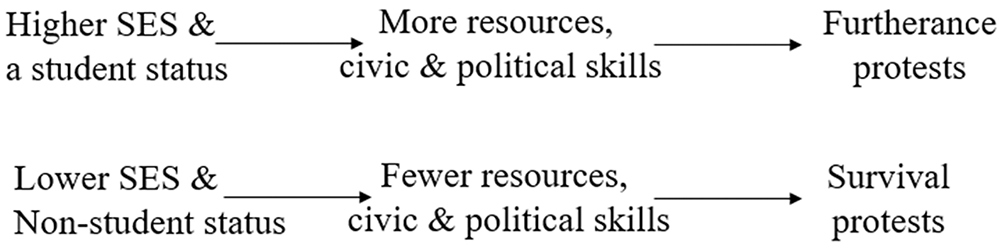
Socioeconomic resources and protest issues.
While by definition furtherance issues point at complex policy problems, they do not necessarily imply attempts to engage with redistributive or universalist policies. For instance, upper-class citizens may take the streets to press the government to advance a regressive tax policy, but this will certainly not promote equality. Likewise, citizens concerned with corruption may participate in furtherance protests aimed at improving political transparency, an issue in itself not directly linked to redistribution.
Hypotheses
Based on the distinction between survival and furtherance issues, we contend that the association between socioeconomic resources and protest participation is twofold. First, following the resources thesis, we expect that people with higher resources will be more likely to attend protests in general, but also that this pattern will be particularly acute for protests driven by furtherance issues. More resourceful people have the time, money, political information, and political efficacy required for taking care of issues whose solutions have longer time horizons and demand complex public policy processes and decisions. Less resourceful people face higher obstacles and are less encouraged to attend protests driven by these issues. Thus, the comparison between protestors in furtherance issues, and nonprotestors, suggests the following hypothesis (the ceteris paribus clause applies to all hypotheses):
Our second argument is closer to deprivation theories. We expect that protests driven by survival issues will attract people with varied socioeconomic resources, including some located at the bottom of the socioeconomic structure. Survival problems disproportionately affect the popular and poorer sectors of society, and their urgency prompt action with less regard to one’s resources. Accordingly, participants in survival protests should have average resources similar to that of the nonprotesting population. Therefore,
Following the reasoning underlying Hypotheses 1 and 2, we suggest a third hypothesis that only applies to the segment of the population participating in protests. The idea is that the sign of the association between SES and protest participation will change depending on whether survival or furtherance issues drive the protest reported by participants. Specifically, among protestors, we expect that more resources will encourage participation in furtherance protests, while fewer resources will foster participation in survival protests:
Survival and Furtherance Protests in Latin America
In its 2010 wave, the survey Latin American Public Opinion Project (LAPOP)—our data source fully described below—asked about 30,000 Latin Americans from 17 countries whether in the past 12 months they had “participated in a demonstration or protest march.” Those who answered positively—8% of the combined country samples—were asked an open question about which was “the purpose of the demonstration or public protest.” 1 If the respondent had participated in more than one protest, she was asked about the most recent protest. If the protest had more than one purpose, the respondent was asked to report the most important one. LAPOP analysts grouped the open answers into a small set of issues. As we argue below, the specific issues identified by LAPOP can be reasonably classified as either survival or furtherance issues (see Table 1). 2
Distribution of Protest Issues Among Protestors During Past 12 Months in Latin America.

Source. LAPOP 2010 (Americas Barometer, 2010).
Among the whole population of protestors, about 38% declared having protested for survival issues. These include three categories: economic factors, security problems, and lack of public services. Next, we explain why.
According to LAPOP’s questionnaire, protests motivated by economic issues related to jobs, prices, inflation, and lack of economic opportunities. They represent 21% of the protests reported. This is consistent with several studies showing that Latin Americans often mobilize against the economic consequences of market reforms implemented in the region since the 1980s and 1990s (Silva, 2009). Market reforms have dismantled the safety nets built by populist and developmental governments, resulting in informality, poverty, unemployment, and low wages. These economic threats motivate defensive reactions from the poor and the working classes in the form of protest campaigns. Major Latin American movements revolve around economic issues—such as the Argentinean Piqueteros (Rossi, 2017) or the Brazilian Landless Workers Movement (Ondetti, 2010)—and appeal to deprived sectors. It is thus true, as one would expect, that many Latin Americans protest not because they have more resources, but precisely because they lack them (Davis, 1999, p. 612).
Likewise, 11% of protestors were motivated by the lack of public services. These deficits are also linked to the privatization of public services such as water, energy, and transport (Petras & Veltmeyer, 2011). One key aspect of political inequality in Latin America is that of stratified access to services depending on the socioeconomic level and region (Luna & Soifer, 2017). Facing extreme circumstances, unprivileged sectors have displayed major protest campaigns such as the “Water Wars” in Cochabamba, Bolivia in 1999. These protests erupted for opposing a water privatization contract that would increase water fees and affect the survival of poor indigenous and peasants (Assies, 2003). Similarly, in 2013, a series of mass demonstrations took place in São Paulo, Brazil, due to the rise in bus fares (Saad-Filho, 2013), later developing into widespread protests with diverse and fuzzy demands (Hagopian, 2016).
Finally, about 6% report security problems as the central issue of the protest, specifically linked—according to the questionnaire—to the insecurity created by crime, militias, and gangs. Countries like Mexico, Colombia, Brazil, and most Central American ones have high rates of lethal violence and kidnappings. Drug barons and guerrilla groups dominate some localities, unleashing violent responses from paramilitary groups and resulting in civilian deaths and displaced populations. Feelings of insecurity and anguish have motivated massive protests (Davis & Denyer Willis, 2011). A recent example is the 2014 protest campaigns in Mexico after the assassination of 43 students by police officers and a drug cartel. Resourceful people can protect themselves through private guards and gated communities (Alvarez-Rivadulla, 2007). Yet the popular classes should be more attracted by protests against insecurity since the issue is more salient to them.
On a different vein, about 49% of protestors reported participation in furtherance protests. We believe that, in Latin America, political, educational, and human rights protests fall closer to our definition of furtherance protests. In general, protests driven by these issues seek to press authorities to remedy collective problems through political actions and policies that take time and are not directly linked to immediate survival. We elaborate below.
Protest motivated by political issues relates to laws, parties, political candidates, political exclusion, and corruption. They represent 25% of the protests reported. Nowadays, most Latin American countries have democratic or semidemocratic regimes, yet the quality of democracy is often low, and public institutions are weak and inefficient (M. López, 2018; Mainwaring & Pérez-Liñán, 2013). There are many recent examples of Latin American authorities that have committed electoral irregularities and fraud, attempted to change the constitution to allow presidential reelection, accepted bribes or illegal donations for funding electoral campaigns, governed by decree, or manipulated official statistics for embellishing their administrations. These wrongdoings have triggered massive protests. For instance, in 2012, a wave of national protests erupted during Mexico’s presidential election campaigns. The mobilizations, led by #Movimiento132 (132 Movement), called for the democratization of the media and demanded an additional presidential debate. Self-defined as “a movement concerned with the democratization of the country,” the #Movimiento132 was mostly composed of middle and upper-class university students, who skillfully used digital media to coordinate their actions against the presidential candidate Enrique Peña Nieto (Rovira Sancho, 2014).
About 16% of the protestors mentioned educational issues as the main driver of their protests. According to LAPOP, they include a lack of educational opportunities, high tuition, poor quality of education, and education policies. In recent decades, educational enrollment in secondary and tertiary education has expanded dramatically in Latin America, creating grievances among students that fueled protest campaigns (Disi 2017). We consider educational issues as furtherance issues because they strive for educational reforms and because students—the main constituencies in educational protests—would not necessarily benefit from these reforms in case they achieve their goals. Consider the 2011 Chilean student protests. Mobilized students demanded an entirely new financial system for higher education, a goal that, if achieved, would take several years and complex legislative processes that may not benefit them directly (Somma, 2012; von Bülow & Bidegain, 2015).
Finally, Latin Americans also protest due to human rights violations (8%). LAPOP does not inform about the contents of these protests. But, in Latin America, “human rights” problems are often related to the repression of civilians by military dictatorships during the 1970s and 1980s. Democratic transitions prompted the strengthening of human rights movements demanding “truth and justice” (Keck & Sikkink, 2014), and some of these movements are active to our days (e.g., the Madres de Plaza de Mayo in Argentina and the COMADRES in El Salvador). Most of these organizations are embedded in large transnational networks that supply economic, legal, and technical resources to carry out lobby and protest actions (J. A. López, 2017). They pursue institutional and legislative changes and gather substantial sympathizers among segments of the middle classes that suffered from state repression.
While we believe that this section puts some flesh on the issues that move Latin Americans to protest, it is important to recognize that in the same protest campaign, some participants may be driven by survival issues while others by furtherance issues. The 2013 protests in Brazil mentioned above illustrate this (Hagopian, 2016). These complexities do not invalidate our probabilistic hypotheses, which simply predict an affinity between socioeconomic resources and different protest issues, yet do not assume that protest events themselves are homogeneous.
Measurement and Statistical Modeling
We employ survey data from the 2010 wave of the LAPOP. This study includes nationally representative surveys of voting-age adults (urban and rural) conducted through face-to-face interviews following a multistage, stratified probabilistic design on 17 Latin American countries. 3 National sample sizes average 1,775 respondents, and sampling errors are estimated to be around ±2.35% on average (more details in Americas Barometer, 2010). LAPOP 2010 provides an exceptional opportunity to study protest participation across issues. It asked those who participated in a protest in the 12 months before the survey about the main issue motivating the protest. It also surveys nonprotestors and provides information about the most important predictors of protest participation, including SES and student status. This level of detail makes of LAPOP 2010 the best dataset for our research purposes. Other surveys, such as the World Values Survey or Latinobarómetro to name a few, do not provide information about protest issues and therefore prevent testing our hypotheses.
We estimate three sets of regression models with the dependent variable, protest participation, coded differently. The first set corresponds to a single binary logistic model (Model 1) that predicts whether the respondent had “participated in a demonstration or protest march” (1) or not (0) during the past 12 months. This follows the standard strategy in the literature of comparing protestors and nonprotestors lumping all issues together. The second set includes two regression Models (2 and 3) that predict whether respondents participated in a protest motivated by furtherance or survival issues, as classified in Table 1. Model 2 corresponds to a multinomial logit model that comprises all respondents, including those who did not participate set as the reference category; Model 3 is a binary logit predicting participation in furtherance versus survival motivated protests for the subsample of respondents that effectively participated in protests during the last year.
While these models directly put to test our hypotheses, they lump the issues categorized under each type of protest, and consequently might hide heterogenous associations between SES and student status, on one hand, and the different protest issues, on the other. Therefore, we estimate a third set of multinomial logit models that predict participation across the different issues motivating the protests. Model 4 comprises those who did not protest, while the remaining categories indicate, for those who protested, the specific issue of the protest. Model 5 is identical to Model 4 except that it drops all respondents who did not protest and its reference category is protesting for “political topics,” the most frequent protest issue.
We measure socioeconomic resources in two ways. First, following a long tradition (Cowan et al., 2012), we calculate a composite index of SES that combines the respondent’s education, household goods, and household income. 4 By combining these three elements, we capture the social, economic, and cultural resources available to respondents in a more reliable way. This index is calculated as the average of the three equally weighted items. The index varies from 0 to 1 and has a Cronbach’s α = 0.71. This statistic varies across countries included in the sample from 0.66 to 0.82. 5 As usual, the household income variable contains many missing cases in the LAPOP database (3,149 cases, or about 10% of the total sample). We recovered these missing cases via multiple imputation by chained equations (van Buuren, 2012, chap. 2). 6 The imputation model used to predict the household income observations has a high fit (R2 = .45), and includes several covariates such as education, household goods, age, skin color, employment status, and country-fixed effects. We imputed 10 complete data sets. The results shown below pool the estimates from the model fit separately to each completed data set using the rules established by Rubin (1987). 7
Our second key predictor, student status, is measured through a dummy variable that indicates whether the respondent’s main occupation is being a student (1) or not (0).
All models include as control variables the main predictors of protest participation according to previous studies. “Female” has a value of “1” for women and “0” for men. “Age” indicates the number of years of the respondent. “Employed” differentiates among those who are currently working or are not so but have a job (1), from the rest (0), including the unemployed, retired people, and homemakers. “Urban” has a value of “1” for urban residents and “0” for rural residents. We identify left-leaning respondents using a 10-point self-identification left–right scale. We coded as “leftist” (1) those choosing values 1, 2, or 3 in the scale, and 0 for the rest (including those not declaring a political identity). Some studies suggest that privileged ethnic groups protest less than those historically excluded (Schussman & Soule, 2005). Hence, in Latin America Whites should protest less than non-Whites. We use an 11-point skin tone variable coded by LAPOP interviewers using a palette, where “1” reflects the lightest skin tone and “11” the darkest tone (Telles & Steele, 2012). Previous studies show that participation in voluntary organizations promotes protest (Schussman & Soule, 2005; Somma, 2010; for Latin America, Moseley, 2015). We include an additive index of “organizational involvement” that records the frequency of participation in meetings of religious, community service, PTAs, and professional or business organizations. To enhance the comparability of the regression coefficients, all variables, except age, were coded to range between 0 and 1. 8 See Table 2 for summary statistics.
Descriptive Statistics of Independent Variables.

Source. LAPOP 2010 (Americas Barometer, 2010).
Last, since our focus is on the individual predictors of protest, all models include 16 dummy variables indicating the country of the respondent. This absorbs any country-level variability affecting protest participation. Thus, the regression coefficients reflect the within-country association between covariates and protest.
Results
We present the estimates from the binary and multinomial logit models as coefficient plots in Figures 2 and 3, where the horizontal segments correspond to 95% confidence intervals of the point estimates (see Section A of the online supplement for complete information of all regression models in tabulated form). Figure 2 contains the results from Models 1 through 3. Model 1 predicts whether respondents participated during the last year in a protest event or manifestation. Model 2 is the multinomial logit model predicting type of protest issue, with nonprotestors as the reference category, and Model 3 is equivalent to Model 2 but drops respondents that did not protest.

Binary and multinomial logit regression coefficients (and 95% confidence intervals) predicting protest participation (Model 1, number of observations = 29,722), protest type among all respondents (Model 2, number of observations = 29,376) and furtherance protest among respondents that protested last year (Model 3, number of observations = 2,089).

Multinomial logit regression coefficients (and 95% confidence intervals) predicting issue of protest participation for all respondents (Model 4, number of observations = 2,089), issue of protest participation for respondents that protested last year (Model 5, number of observations = 2,089), and predicted probabilities for issue of protest participation by socioeconomic status and type of issue based on parameter estimates from Model 5.
Model 1 confirms that in Latin America higher SES and a student status strongly and independently increase individuals’ chances of having participated in protests in general. The coefficient of SES equals 1.57, which implies that the odds of protesting among those with the highest observed level of SES is 4.8 times higher than those with the lowest SES level. In a similar fashion, but more moderately, the odds of having protested among students (β = 0.46) is 1.6 times higher than among nonstudents, while controlling for SES and all other variables.
Estimates from Model 2 (center of Figure 2) show that the association between socioeconomic resources and student status, on one side, and protest participation, on the other, vary dramatically according to the protest issue. The coefficient of student status predicting participation in survival protests is negative, close to zero and nonsignificant (as the confidence intervals include the value of 0), while the coefficient predicting furtherance protests is, in contrast, positive and significant. Regarding SES, the estimates indicate that the chances of participating in survival or furtherance motivated events increase significantly with SES, but it does so much more abruptly for the later type of issues. The odds of participating in survival protests (β = 0.66), versus not participating in any protests, is two times higher among respondents with the highest observed level of SES compared with those with the lowest level. The equivalent estimate (β = 2.68) for furtherance issues is 15 times higher, certainly a very large difference.
Among respondents who effectively participated in protests during the last year, the estimates from Model 3 (right side of Figure 2) corroborate that the likelihood of participating in furtherance protests, versus survival protests, strongly increases with SES. The odds of participating in the former type of protest (β = 1.8), versus the later, is six times higher among those with the uppermost observed level of SES compared with those with the lowest level. In a similar fashion, respondents who were students during the time of the interview were 2.2 times more likely to participate in furtherance protests than in survival protests.
The results from Models 2 and 3 provide strong support for our first two hypotheses. As predicted by Hypothesis 1, a higher SES and being a student increases, both significantly and substantially, the chances of participating in furtherance protests, compared with not having protested. Support for Hypothesis 2, according to which a higher SES or being a student has a null effect when compared with those not protesting, is also strong but involves a slight nuance. It holds perfectly well for student status but contains a small deviation for SES; the coefficient of this variable in Model 2 is positive and significant, but as we saw above, the magnitude of this association is marginal compared with the influence of SES predicting participation in furtherance protests.
We now consider the statistical models that estimate the associations between the predictor variables and protest issues separately. Results from Model 4 (left side of Figure 3) show that the association between socioeconomic resources and protest participation varies dramatically according to the main issue of the protest. Most important for our purposes, it also shows that such variation aligns with our conceptual distinction between furtherance and survival type issues. When compared with those that did not protest, the coefficients of SES predicting furtherance issues (education, human rights, and political topics) are positive, significant, and of large magnitude. For example, the odds of participating in a protest about educational themes (β = 2.97) and human rights (β = 2.66), relative to not protesting, are 19.5 and 14.3 times higher, respectively, for those with the highest observed level of SES compared with those with the lowest SES. In contrast, the coefficients of all three survival issues (economic, lack of public services, and security problems) are much smaller, and even nonsignificantly different from zero for lack of public services and security problems. The SES coefficient associated with economic protests is significant at a 95% level, but only doubles the odds of participation relative to not participating at all.
The estimates for student status follow a similar pattern to that of SES, but in a more modest fashion. Two of its coefficients, education, and political topics, are positive and significant at a 95% level of confidence, while the coefficient for the third furtherance issue, human rights, is also positive, but not significant. In terms of magnitude, being a student increases 2.97 times the odds, relative to nonstudents, of participation in educational protests. The coefficients for survival issues, as expected, follow a less clear pattern. The effect of student status on participation in public service protests is negative and marginally significant, whereas the coefficient for economic protests is very close to zero, and for security problems is positive but not significant.
Does this apparent alignment between the SES coefficients and our conceptual distinction of furtherance and survival type issues hold in a more formal test? In other words, can we formally conclude that the magnitude of the effects of SES over furtherance and survival issues is similar across protest issues? We evaluate this possibility testing the following null hypotheses:


To test this restriction, we calculate a multivariate Wald test for imputed data suggested by van Buuren (2012). The results indicate that neither
Last, we consider the result from Model 5, shown on the left side of Figure 3, which only includes respondents who participated in protests. The hypotheses motivating this specification assert that among those who protest, protesting for furtherance issues is positively related to SES and student status (Hypothesis 3a), and negatively related to participating in survival protests (Hypothesis 3b). The results are consistent with these expectations, though more so for SES than student status. All three survival issues have clearly negative SES coefficients, with only the one predicting participation in security protests being not significant at a 95% level. This confirms that lower SES increases the chances of participating in survival protests as compared with political protests. In contrast, the two furtherance coefficients are positive, and one of them, education, is statistically significant.
To illustrate the results more intuitively, we provide on the right side of Figure 3 the predicted probabilities of participation in protests motivated by different issues by SES, while all other variables are held at their sample average (or mode if categorical). 9 The steep negative curves predicting economic and public service protests range from 0.34 to 0.15 and 0.24 to 0.07, respectively. In contrast, the positive curve predicting educational protest varies from 0.07 to 0.30. These trends reflect two sides of a coin: economic and public service protests are dominated mostly by popular segments of the population with low SES, while educational protests are largely composed by members of elite segments of society. Political protests also increase with SES, but the slope is less steep, and therefore, cuts across socioeconomic groups more frequently.
The results for student status indicate that current students, even when controlling for SES, have a significantly lower propensity to participate in protests about lack of public services and a higher propensity to participate in educational protests. In terms of odds ratios, participating in each type of protest is 0.35 and 1.78 times, respectively, more likely among students than among nonstudents. The signs of all other coefficients are consistent with Hypothesis 3a and Hypothesis 3b, but they are not significant.
In sum, among those who have protested during the year previous to the survey, there is a remarkable degree of heterogeneity in the influence of socioeconomic resources. SES and student status are the only variables of all covariates included in Model 5 that have statistically significant effects that are both positive or negative. Following Gilens and Paige (Gilens & Page, 2014; Page & Gilens, 2017), this leads to the following speculation: while some issues reinforce the political voice, worldviews, and perhaps also the interests of the privileged ones, other issues are more representative of the overall population and perhaps even the less privileged groups, leveling the political field, and reducing political inequality of voice.
Discussion and Conclusions
Since the 1970s, most studies about individual protest participation have examined the differences between protestors and nonprotestors, arriving at a relatively robust set of findings. Grasso and Giugni (2016), however, recently noted that “studies that simply examine what variables impact on whether someone participates in a protest or not should not simply assume that the same dynamics underlie all protest participation” (2016, p. 51). This article has scrutinized this assumption by studying the influence of socioeconomic resources on protest participation across six important protest issues in Latin America. We took advantage of LAPOP 2010, a survey representative of voting-age Latin Americans which asked recent protestors about the issue of the protests in which they participated.
Our results indicate that the association between socioeconomic resources and protest participation varies greatly according to the main issue driving the protest. Participation in furtherance protests seems fairly elitized, as rising levels of socioeconomic resources increase the chances of partaking in them. Yet socioeconomic resources have a null effect on survival protests when compared with the population who does not protest. When restricting our analysis only to protestors, socioeconomic resources increase the chances of participation in furtherance protests, but decrease them for survival protests.
These findings provide new conceptual lenses for analyzing contemporary cases of protest mobilization in Latin America. Consider the protests that took place in Brazil in mid-2013. These were triggered by an increase in public transportation fares that squeezed the pockets of the popular sectors (survival). But the claims quickly shifted and centered on issues of political corruption and governance (furtherance). Those concerned with public transportation and other public services were mostly workers and neighborhood organizations, while those protesting against corruption came primarily from the middle classes (Saad-Filho 2013). Another example comes from recent mobilizations in Chile dubbed the “Chilean Spring” (Somma et al., 2020). Like in Brazil, the demonstrations began as a series of massive youth protests against an increase in subway fares (survival). As protests spread toward the middle classes, constitutional change became the main issue (furtherance). These examples show how our categories may help unraveling the dynamics of protest waves in ways that otherwise would gone unnoticed.
Taken together, these findings have interesting implications for research on political inequality. For instance, different protest issues may affect political inequality patterns in complex ways. In a hypothetical society that mostly experiences survival protests, the authorities would hear the voice of a socioeconomically more diverse pool of citizens, presumably acting accordingly (Gilens & Page, 2014, Page & Gilens, 2017). However, in a society that largely experiences furtherance protests, the better-off may prevail in the streets, deepening political inequality of voice.
This has curious implications for the relations between socioeconomic development and democracy. Countries undergoing socioeconomic development, by reducing survival threats, may encourage shifts from survival protests to furtherance protests, which promote political inequality. This may account for Dalton’s paradoxical finding that the positive effect of income on protest in general (i.e., disregarding the issue) is stronger in more developed countries (Dalton et al., 2010). Yet this ultimately creates a tension between socioeconomic development and democracy (Dahl, 2006; Dubrow, 2014), questioning old and new versions of modernization theory which expect an affinity between them (Inglehart, 1997).
And yet, economic development reduces political inequality when measured with a wide array of participatory activities (Somma & Bargsted, 2018). This opens the question about the different dynamics of political inequality across participatory activities, and its implications for democracy. The factors that reduce voting inequality may increase protest inequality, and the combined consequences of these processes may be complex. For instance, the recent erosion of well-established democracies has been mostly traced to changes in informal norms regulating the interactions among political elites (Levitsky & Ziblatt, 2018). But can democratic erosion be also traced to conflicting patterns of political inequality of voice across participatory activities? What are the consequences for democracy of having different segments of the population trying to influence authorities through different channels? Amplified by social media, might this cacophony disorient politicians and encourage them to subvert democratic understandings to reassert their power? We raise these questions but leave for future research an empirical examination of the relationships between protest elitization, political inequality, and democracy.
To conclude, we should acknowledge some important limitations of our article. First, the protest issues provided by LAPOP leave aside important issues among Latin American movements, such as indigenous and women’s rights (which perhaps were grouped by LAPOP analysts as “other issues”). Second, the number of respondents protesting for each issue is relatively small (see Table 1). Although the results support our hypotheses, a larger sample of protesters for each issue would increase the validity of the findings.
Finally, we focused on individual predictors of protest and controlled for country-level predictors through fixed effects. Yet future studies should explore country-level predictors, since national contexts could affect the chances of protesting for different issues beyond individual characteristics. For instance, citizens in poorer or more unequal countries, or in countries facing ecological devastation, may be more encouraged to protest for survival issues disregarding their socioeconomic resources. Additionally, the national political context may moderate the influence of individual-level predictors. For instance, hugely corrupt governments may cause enough moral indignation to bring to the streets the rich and the poor alike; and grossly misogynist or racist presidents may boost protests by men and women alike, or by people from different ethnic groups, respectively.
Supplemental Material
Online_Supplement_v2_sent_5.5.20 – Supplemental material for Protest Issues and Political Inequality in Latin America
Supplemental material, Online_Supplement_v2_sent_5.5.20 for Protest Issues and Political Inequality in Latin America by Nicolás M. Somma, Matías Bargsted and Felipe Sánchez in American Behavioral Scientist
Research Data
1._Data_base_construction – Research Data for Protest Issues and Political Inequality in Latin America
Research Data, 1._Data_base_construction for Protest Issues and Political Inequality in Latin America by Nicolás M. Somma, Matías Bargsted and Felipe Sánchez in American Behavioral Scientist
Research Data
2._Imputation_of_SES_and_Regression_Models – Research Data for Protest Issues and Political Inequality in Latin America
Research Data, 2._Imputation_of_SES_and_Regression_Models for Protest Issues and Political Inequality in Latin America by Nicolás M. Somma, Matías Bargsted and Felipe Sánchez in American Behavioral Scientist
Research Data
3._Coef_Plots_and_Tables – Research Data for Protest Issues and Political Inequality in Latin America
Research Data, 3._Coef_Plots_and_Tables for Protest Issues and Political Inequality in Latin America by Nicolás M. Somma, Matías Bargsted and Felipe Sánchez in American Behavioral Scientist
Research Data
4._Data_base_construction_2012-2014 – Research Data for Protest Issues and Political Inequality in Latin America
Research Data, 4._Data_base_construction_2012-2014 for Protest Issues and Political Inequality in Latin America by Nicolás M. Somma, Matías Bargsted and Felipe Sánchez in American Behavioral Scientist
Research Data
5._Imputation_2012-2014_data – Research Data for Protest Issues and Political Inequality in Latin America
Research Data, 5._Imputation_2012-2014_data for Protest Issues and Political Inequality in Latin America by Nicolás M. Somma, Matías Bargsted and Felipe Sánchez in American Behavioral Scientist
Research Data
6._Tables_2012-2014_data_analysis – Research Data for Protest Issues and Political Inequality in Latin America
Research Data, 6._Tables_2012-2014_data_analysis for Protest Issues and Political Inequality in Latin America by Nicolás M. Somma, Matías Bargsted and Felipe Sánchez in American Behavioral Scientist
Research Data
7._Multilevel_Analysis – Research Data for Protest Issues and Political Inequality in Latin America
Research Data, 7._Multilevel_Analysis for Protest Issues and Political Inequality in Latin America by Nicolás M. Somma, Matías Bargsted and Felipe Sánchez in American Behavioral Scientist
Research Data
8._Tables_Multilevel_Analysis – Research Data for Protest Issues and Political Inequality in Latin America
Research Data, 8._Tables_Multilevel_Analysis for Protest Issues and Political Inequality in Latin America by Nicolás M. Somma, Matías Bargsted and Felipe Sánchez in American Behavioral Scientist
Research Data
9._country-level_variables – Research Data for Protest Issues and Political Inequality in Latin America
Research Data, 9._country-level_variables for Protest Issues and Political Inequality in Latin America by Nicolás M. Somma, Matías Bargsted and Felipe Sánchez in American Behavioral Scientist
Research Data
README – Research Data for Protest Issues and Political Inequality in Latin America
Research Data, README for Protest Issues and Political Inequality in Latin America by Nicolás M. Somma, Matías Bargsted and Felipe Sánchez in American Behavioral Scientist
Footnotes
Acknowledgements
We thank the excellent comments from the anonymous ABS reviewers and the editors of this issue, which helped us improve the article in many ways.
Declaration of Conflicting Interests
The author(s) declared no potential conflicts of interest with respect to the research, authorship, and/or publication of this article.
Funding
The author(s) disclosed receipt of the following financial support for the research, authorship, and/or publication of this article: We thank the support of Chile’s National Agency for Research and Development (ANID) through a FONDECYT Regular grant (#1200190) and the Centre for Social Conflict and Cohesion Studies (COES) (ANID/FONDAP/15130009).

Supplemental Material
Supplemental material for this article is available online.
Notes
Author Biographies
References
Supplementary Material
Please find the following supplemental material available below.
For Open Access articles published under a Creative Commons License, all supplemental material carries the same license as the article it is associated with.
For non-Open Access articles published, all supplemental material carries a non-exclusive license, and permission requests for re-use of supplemental material or any part of supplemental material shall be sent directly to the copyright owner as specified in the copyright notice associated with the article.
