




Abstract
Even though the Spanish Constitution establishes that Spain is structured into Autonomous Communities and that the principles of solidarity and subsidiarity govern the relationship between the different regions, very often Spanish media publish news about territorial inequality, conflicts, and independency velleity. The objective of this investigation, avoiding digging into the reasons for these claims, is to identify whether the region of residence influences the legitimacy of the Spanish state. The legitimacy of the state is the degree of citizen’s support to the institutions. This support ensures the law compliance, the proper functioning of the country and citizen commitment with the social system. State’s legitimacy is very much linked with the trust on politics and politicians. In the regions characterized by independency issues and conflicts, state’s legitimacy will be limited, and the perception of the state’s meaning and power will be more fragile and instable. The effective and appropriate management of the state and the relevancy of the central politics would be complex in these regions and, finally, regional inequality and fragmentation will increase. To achieve this research objective, we carried out an analysis of the state’s legitimacy of each Spanish region considering the data extracted from the European Social Survey. The results of this research provide valuable information useful for regional political decision making and dig into the reasons why regional conflicts are rooted in the state’s institutions.
Introduction
Concerns such as terrorism or public safety have lost prominence for the Spanish compared with political factors that are the heart of the electoral agenda of political parties. According to the Barometer of the Centre for Sociological Research (CIS) in 2019, the main concerns of the Spanish were as follows: unemployment (58.9%), economic problems (27%), political problems in general (21.7%), and politicians’ poor behavior (18.3%). In addition, concerns that a few years ago were not perceived by the Spanish have been included in this list, such as the independence of Catalonia (10.7%) that burst into the list of concerns in September 2017.
These concerns have led to a change in the political scenario, turning a two-party system into a polarized multiparty system, largely due to the fact that 74.8% of Spaniards have a bad or very bad opinion about the political situation (CIS, 2019); and 65.3% of them think that the political situation will not improve and may even get worse. New parties have entered the political sphere and regionalist parties have become even more important, as they are key to forming government through coalitions, which are increasingly difficult to form and maintain. Like other countries, Spain has been forced to go to the polls several times to form a government. In this type of system, the government often depends on regionalist and/or minority parties for its formation at national level and to maintain its stability based on agreements and continuous negotiations. At this point, we ask ourselves, can a regionalist party support a state government responsible for ensuring the legitimacy of national institutions? Can regionalist parties that demand independence from the Spanish state pursue the common good of the entire nation? Is the electoral agenda of these parties in line with national objectives? Therefore, do regionalisms affect the legitimacy of the state?
Obviously, according to the Spanish Constitution of 1978, the Spanish State is a state made up of autonomies with delegated powers, but the Spanish state is an indissoluble union. Beyond the electoral claims of political parties that use regionalist arguments, it is necessary to respond to whether the citizens of Spanish regions really have the same opinion about the legitimacy of the state or instead state institutions are perceived differently depending on the region and therefore, deeper ruptures are observed in regions. If this is so, the absence or weakness of legitimacy in some regions would have profound implications for the way the state behaves toward its citizens (Blanco-González et al., 2017; Gilley, 2006). If the state lacked legitimacy, it would devote more resources to maintaining its government and less to effective governance, which would reduce its support and make it vulnerable to be overthrown or collapse. In other words, if the support of political parties with electoral agendas that do not pursue state protection as a whole is not managed properly, it could create divisions within the institutions themselves and weaken the legitimacy of the state (Gilley, 2006).
Despite the recognized importance of legitimacy, no study on state legitimacy based on the region has been carried out. Hence, the objective of this research is to relate state legitimacy with regionalism in a country characterized by imperfect federalism (Garmendia, 2014). For this, the theoretical foundations of state legitimacy and regionalism are presented, emphasizing the case of Spain, a country characterized by its difficulty to form a government in the 2019 elections and a motion of censure in the 2016 term of office, which resulted in a change of government; and the pressure of regionalisms on the political and electoral sphere. By using the data extracted from the European Social Survey (ESS) in 2016, we measure state legitimacy in different regions and its relationship with the political parties that have been voted for. In addition, the legitimacy of regions is related to interest in politics and identity with the nation. All this allows for interesting conclusions to be drawn on how and why regionalist parties influence the legitimacy of the state, and whether these parties weaken trust in national institutions with their electoral strategies.
Theoretical Framework
State Legitimacy and Its Dimensions
Legitimacy is studied in different contexts: institutions, processes, or actors. This research focuses on the State as the basic institutional and ideological structure of the political community (Blanco-González et al., 2017; Gilley, 2006). The legitimacy of the state is a different concept, but related to democratic legitimacy, political efficacy, or satisfaction (Dahl, 1971; Easton, 1975; Inglehart, 1997; Linz, 1988; Torcal & Montero, 2006). In general, in democratic countries, citizens differentiate between the state and political parties, but the stability of the state is guaranteed through citizen participation, trust in its institutions and good governance (Lillbacka, 1999; Muller et al., 1982). Therefore, there is a close connection. Furthermore, aspects such as corruption, citizen participation, attitudes to immigration, political ideology or national identity weaken or strengthen legitimacy (Del-Castillo et al., 2018).
State legitimacy refers to social support to institutions and to the exercise of power (Beetham, 1991; Easton, 1975; Gilley, 2006) and is a determinant of the structure and effective management of countries. Countries with low levels of legitimacy and therefore, lacking social support, are sensitive to social instability or political, social, and economic crises (Blanco-González et al., 2017; Gilley, 2006). Legitimacy can be managed (Deeds et al., 2004; Díez-Martín et al., 2016; Suchman, 1995). Several academic studies have analyzed how certain actions can help obtain or lose legitimacy (Phillips et al., 2004). Legitimacy is a metrics of the situation (Walzer, 2002) and can have different degrees of intensity (Gur, 1971), that provide information on the strength of the system.
The legitimacy of the state is analyzed from three dimensions: legality, justification, and consent (Beetham, 1991; Blanco-González et al., 2017; Gilley, 2012; Power & Cyr, 2009; Prado-Román et al., 2016; Seligson & Booth, 2009). First, the legality dimension refers to the exercise of power regarding laws, rules, and customs. Some indicators of this dimension refer to how citizens perceive corruption and the rule of law or the actions of the law and police. Second, the justification dimension measures support to the ideas and values of the state and are related to the moral grounds of a State to act in a particular way (Kanji & Nevitte, 2002) or, the set of shared beliefs managed through state institutions (Beetham, 1991). Some indicators of this dimension are confidence in political leadership or opinions about the effectiveness of political institutions.
Third, the consent dimension takes into account citizens’ participation and support (which does not have to do with a normative, but participatory vision). That is, it is formed by those actions that express the recognition by a citizen that the State has global political authority and that it must follow the resulting decisions. Indicators of this dimension are voter participation, the participation level in associations or membership in political parties.
As mentioned, the connection between legitimacy and the political agenda is unavoidable. If a state does not have legitimacy, the government will hardly be able to remain in power for long, unless it uses force (Levi et al., 2009). If citizens consider that the state is being well managed and is concerned about its citizens’ interests, state legitimacy will be positive and economic, social, and political stability will be in good shape (Blanco-González et al., 2017). If legitimacy is high, policy makers may have more scope to do what they want without experiencing popular discontent and will have more resources to design their political strategies without fear of destabilizing the system.
Tyler (2006) points out that legitimacy generates, on the one hand, support to institutions and authorities, and on the other hand, political reactions. Politicians can “take advantage” of legitimacy because it is a kind of “filter” that minimizes the importance of certain negative results, such as lower growth. The way it does this is by reducing the voters’ willingness to acquire information about the effects of growth policies (Caplan, 2007), and talking about regionalism or independence causes voters to turn their attention to other issues. However, politicians should not ignore that populism can have a negative effect on the country’s growth (Berggren et al., 2015). In the process of getting more votes, politicians can develop electoral programs to act in the short-term, even against long-term interests in a populist way (Caplan & Stringham, 2005; Weede, 1996).
Legitimacy and Regionalism
A determining aspect of legitimacy is the state’s ability to continue functioning and ensuring political stability. Fukuyama (2005) argues that the greatest virtue of any state is the ability of the political system to stay together or remain dominant over rival social organizations in the face of socioeconomic change. Henderson and Arzaghi (2005) and Jennings (1998) have attributed decentralization and federalism within states as one of the main issues that must be managed correctly if legitimacy crises do not want to be experienced.
According to Gilley (2006), some regions may be more likely to have legitimate states and others less likely. Perhaps such regional effects are due to the fact that some regions have inherited particular cultural values that are open to legitimacy (Huntington, 1996) or to the existence of deep-rooted divisions between the state and society in such a way that legitimacy will always suffer. Some authors have analyzed the impact of regions on legitimacy, for example, in the Middle East (Hudson, 1977), Latin America (Horowitz, 1969), Africa (Englebert, 2000), Eastern Europe (Ramet, 1999), China (Zhong, 1996), or Asia (Alagappa, 1995; Compton, 2000).
Along the same lines, Berggren et al. (2015) study how politicians take advantage of their power to promote regionalisms. Political leaders can use the advantages derived from good levels of legitimacy to defend their political objectives, which, in some cases are contrary to the country’s growth. Politicians can design electoral campaigns and government programs with populist claims or taxes and expenditures to consolidate political positions instead of pursuing rational growth, with the aim of obtaining votes (Caplan, 2007; Downs, 1957; Nannestad & Paldam, 1994). High legitimacy may cause voters not to analyze political messages cautiously, due to overconfidence, so politicians are in a better position the greater the state legitimacy is.
However, according to Garmendia (2014), both extreme decentralization and overconcentration of countries make state legitimacy unstable (Bednar, 2008; De Figueiredo & Weingast, 2005; Filippov et al., 2004; Riker, 1964). Federal equilibrium is dynamic and when there are alternative constitutional options that could produce different divisions of relative winners and losers (Roust & Shvetsova, 2007), incentives are generated to negotiate about alternative federal agreements (Riker, 1964).
In situations where the federal system is asymmetric due to insufficient uniform formal treatment for the different units within the system (Laforest, 2005) consequences for legitimacy can be produced. Regions that are considered losers in the territorial distribution can demand “equality” (Solnick, 1995; Weller & Nobbs, 2011; Zuber, 2010) and those that do not consider themselves losers can continue fighting for better benefits and generating constant negotiation in their search, sometimes, for demanding their differences (Hughes, 1984; Keating & McGarry, 2007; Kymlicka, 1995; Requejo & Nagel, 2011). Many of these demands can be based on linguistic, religious, or ethnic aspects (Amoretti & Bermeo, 2004; Stepan, 1999), but not always. When the regional limits do not coincide with the demands, greater tensions can be caused.
In addition, regions governed by parties that also govern the state obtain benefits, such as positive fiscal policies or transfer of powers (Cox & McCubbins, 2005; Dixit & Londregan, 1996; Jones et al., 2000; Larcinese et al., 2006; Simón-Cosano et al., 2014). Some studies have shown that the greatest benefits have been obtained by parties with a bargaining power due to being represented in the central government (Gibson et al., 2004; Heller, 2002; Pitlik & Kouba, 2015; Samuels & Snyder, 2001). It has also been shown that the distributional implications of decentralization are accumulated over time, generating variations in the party system (Chhibber & Kollman, 2004), that produce incentives for the creation and strengthening of regional parties (Brancati, 2006) or significant transformation of state parties (Amat et al., 2009; Thorlakson, 2009).
The issue is to determine if these asymmetries result in party strategies, causing problems at national level that weaken state legitimacy. Spain is an example of an asymmetric structure in which renegotiation processes with regionalist parties are constant (Garmendia, 2014) and which put the formation of stable governments in a predicament. Furthermore, asymmetry in the electoral calendar makes differences between regions generate consequences in national elections. The Spanish system lays the foundations for a type of interregional centrifugal competence that diverts the strategy of state parties at different levels (Garmendia, 2014). A shared government with regionalist parties affects the ability of citizens to identify the state of the economy in their regions, and forces a negotiation to contact between central and regional governments
However, regionalism and regionalist parties do not always have to be analyzed as a source of conflict or tension. Citizens can also share a regional identity and a state identity and share their institutional loyalties at both levels of state legitimacy (Moreno, 2006). The absence of one of these identities is what leads to a socio-political rupture and demands for self-government would probably take the form of secessionist independence. Identity exclusivity and demands for independence form a binary relationship in which either of the two elements can encourage nonlinear causal processes. The two elements can certainly reinforce each other, but an interconnection cannot be established a priori.
In the case of Spain, regionalist parties are represented in Parliament and are often the key for the formation of a government. In the 2019 elections, the PSOE and Unidas-Podemos formed a coalition government with the support of regionalist parties: PNV (Basque Nationalist Party; Basque Country), Canary Coalition (Canary Islands), BNG (Bloque Nacionalista Galego; Galicia), and Teruel Existe (Aragón), in addition to the essential abstention of two regionalist parties: ERC (Esquerra Republicana de Catalunya; Catalonia) and EH Bildu (Euskal Herria Bildu; Basque Country). These regionalist parties focus their political arguments on demanding regional identity, which even leads to demanding independence, as well as demanding greater transfer of power for their regions.
In the case of the relationship between Catalonia and Spain, the effects of the 2008 economic crisis contributed to the independence movement, which most of the media described as a conflict between the regional and central government, which some parties used opportunistically to justify others ways of economic growth (Serrano, 2013). This claim led to the mobilization of Catalans and to forms of identification in terms of Catalan identity, or more Catalan than Spanish (Muñoz & Tormos, 2015). Without any intention of getting to the heart of the reasons for the conflict or the roots of the regionalist or independence sentiment, which was already highlighted with the Ibarretxe Plan of 2001 in the Basque Country, the aim of this research is to confirm whether national identity feelings influence state legitimacy throughout the different regions and to confirm whether support to state institutions is affected/altered by this identity.
Finally, citizens’ interest in politics is essential because this interest will lead to supporting institutions to a greater or lesser extent and even more so, in some regions which are demand greater self-management or independence, where political mobilizations are the usual trend. For example, in 2019, political mobilizations in Catalonia were frequent and shown in the media almost every day. The media around the world covered the demonstrations of independence of Catalonia, including this political issue in the agenda setting at global level (Sintes Olivella, Micó Sanz, & Alvaro Vidal, 2020). Therefore, it is essential to demonstrate whether state legitimacy according to the region differs due to an interest in politics by the inhabitants of the region:
Sample and Methodology
Our study is delimited to Spain, where there are 17 autonomous regions (Autonomous Communities); regionalist parties participate in the formation of government at national level; the electoral agenda of the regionalist parties demands higher levels of self-management; and citizen mobilization claims their national and/or regional identity (Requejo, 2017).
The data to analyze the legitimacy of the State and its determinants have been obtained from the ESS, which is prepared every 2 years by the Permanent Committee of Social Sciences of the European Science Foundation leading the ESS. It collects information on the attitudes, beliefs, and behavioral patterns of the different European populations older than the age of 15 years. The total sample obtained for Spain is 1958 inhabitants.
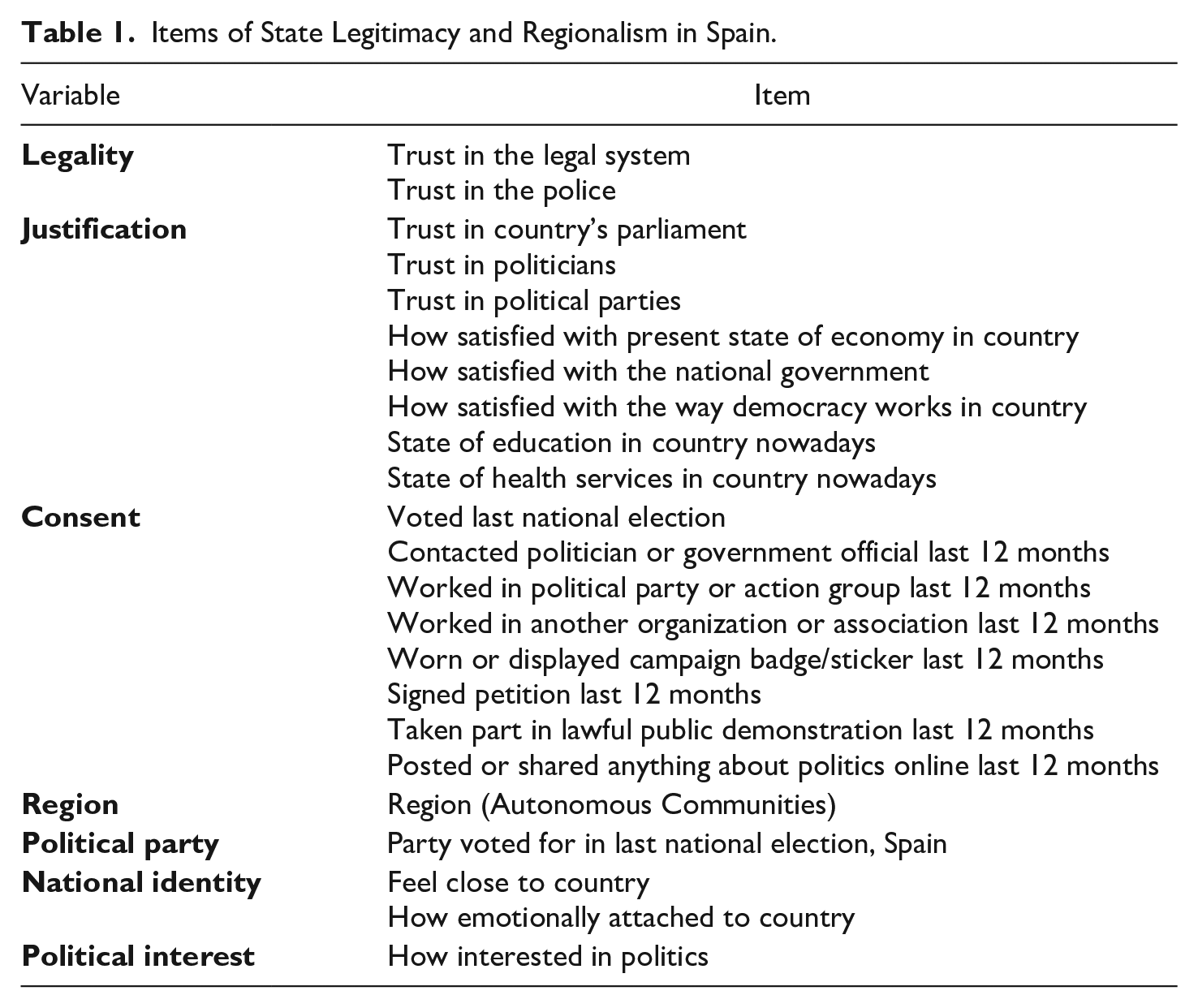
The items selected to carry out the study are those shown in Table 1 and have been selected following the studies of Blanco-González et al. (2017) and Gilley (2006). To measure legitimacy, the recommendations of Blanco-González et al. (2017), Gilley (2006), Grimes (2008), and Rothstein (2010) have been followed and a value between 0 and 100 has been constructed that facilitates the development of rankings and the comparisons between the values reached by the different regions.
Items of State Legitimacy and Regionalism in Spain.
Results
In the first place, the legitimacy results of the 17 regions are shown taking into account the region (Table 2). As we can see, Spain’s legitimacy level is medium and is about 50 points globally. This value is not adequate since any event or factor would make legitimacy be lower than 50 points and would indicate the weakness of the institutions. If the results are analyzed throughout regions, a great variation in the values is confirmed, which allows us to accept Hypothesis 1, which indicates that the region influences legitimacy. Regarding legitimacy, it is confirmed that the variation ranges from 46.3 points in Catalonia to 59.8 points in La Rioja (13.5 point difference). On the one hand, the regions that obtain the best values are Aragón (54.3), La Rioja (59.8), and Murcia (53.1), which are regions without regionalist parties in the central government and are not characterized by independence or regionalist claims. On the other hand, the regions that obtain the worst values are Catalonia (46.3), the Balearic Islands (47.7), and the Basque Country (47.2), which are regions with the presence of regionalist parties in the central government (with the exception of the Balearic Islands) and with demands for self-government, with a language and recognition of historical regions by the Spanish Constitution (within these recognized regions is also Galicia).
Legitimacy and Region.
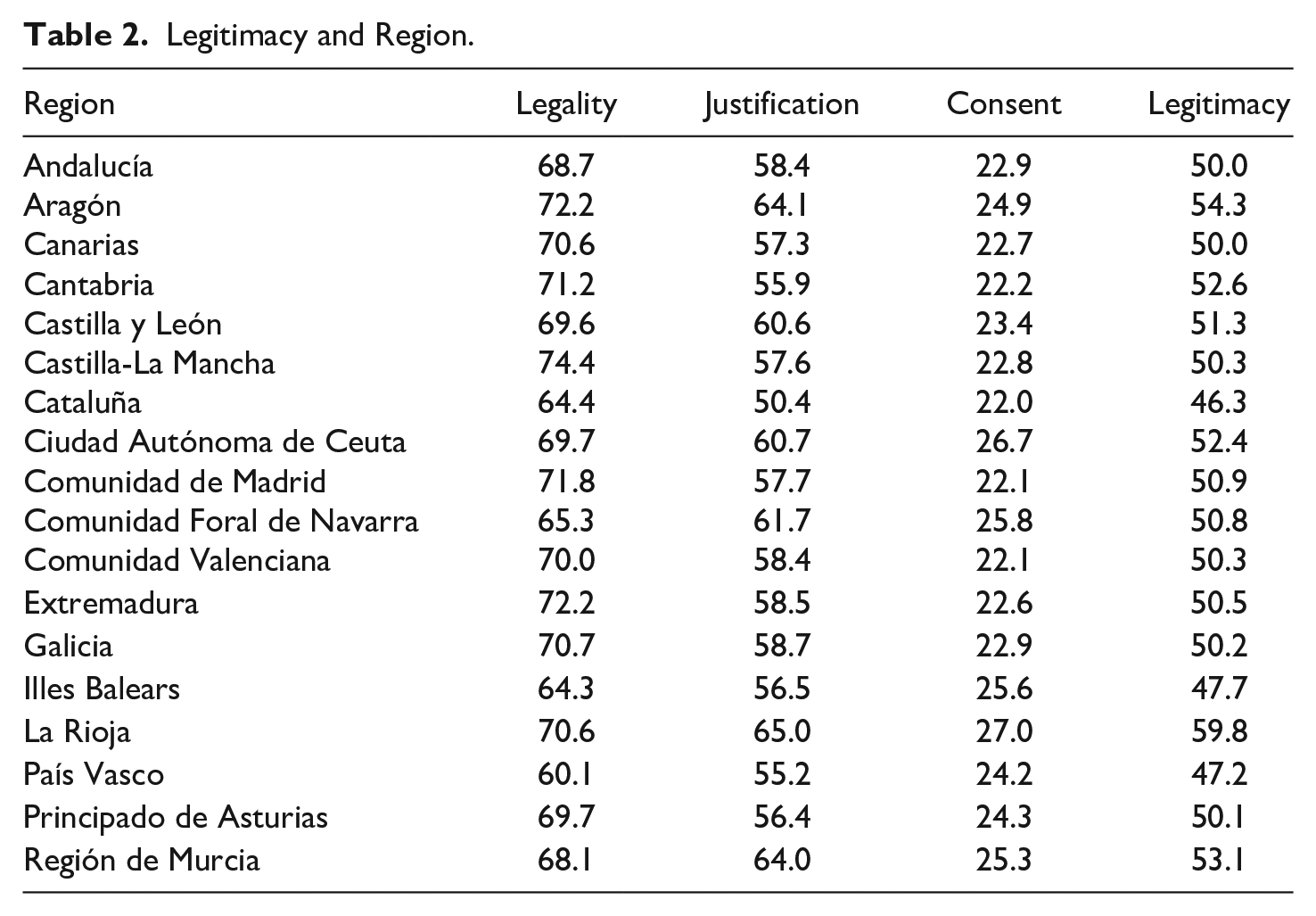
If the values itemized by dimensions are analyzed, general trust in law and order stands out in the legality dimension (the lowest value is that provided by the Basque Country). In the justification dimension, variation depending on the region and values greater than 50 points in all the regions stand out and in the consent dimension, involvement of the inhabitants of La Rioja.
Second, legitimacy has been itemized according to the party voted by citizens to find out in which regions regionalist parties obtain representation and the variation between the legitimacy values of the regionalist party voters versus global legitimacy. Table 3 shows the results of legitimacy by region and political parties, which validate the hypothesis that voters of regionalist parties provide lower levels of state legitimacy. Therefore, the support of these citizens to state institutions is lower. There are five regions that have regionalist parties that play electorally at national level and these are as follows: Canary Islands, Catalonia, Valencian Community, Galicia, and the Basque Country. In general, voters’ legitimacy values of these parties are lower, with the exception of Coalición Canaria, which obtains higher values than traditional parties.
Legitimacy, Political Parties, and Regions.
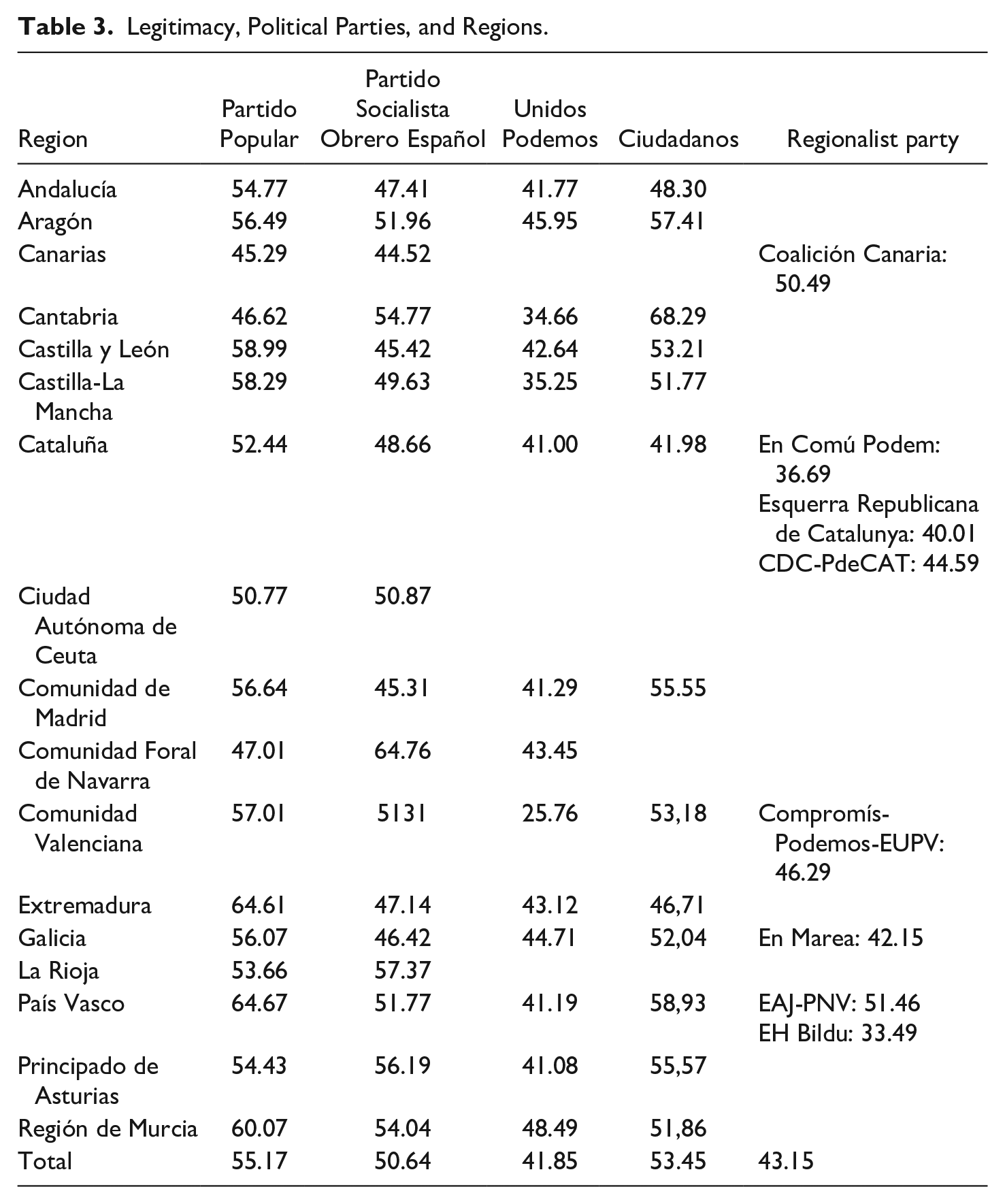
If we focus our attention on the voters of regionalist parties and their political actions, it is confirmed that trust in state institutions is not good, in fact, in the case of EH Bildu, it obtains a value of 33.49; in Comú Podem 36.69 or in Marea 42.15. As a matter of fact, their electoral programs use claims that have nothing to do with national objectives or demands, for example, EH Bildu claims “Democracy, freedom, rights, justice and sovereignty” and is committed to defending the Basque right of self-determination, self-government, building a sovereign people or fighting the 1978 Constitution. Comú Podem calls for Freedom, dialogue and solutions for Catalonia and safeguarding its own powers, fulfilling pending commitments, and reinforcing self-government. Or the EAJ-PNV, member of the current national government, which has announced in its electoral program that they have made progress and resources for their country (referring to the Basque Country), negotiating transfers and attracting investments.
Finally, regarding the relationship between legitimacy and national identity and interest in politics, different levels of national identity are confirmed (Figure 1). Note that the feeling of national identity is slightly lower in Catalonia and Navarra and does not exceed five points in the Basque Country. These results show that those regions that provide less legitimacy are those in which national identity is lower.

National identity by regions.
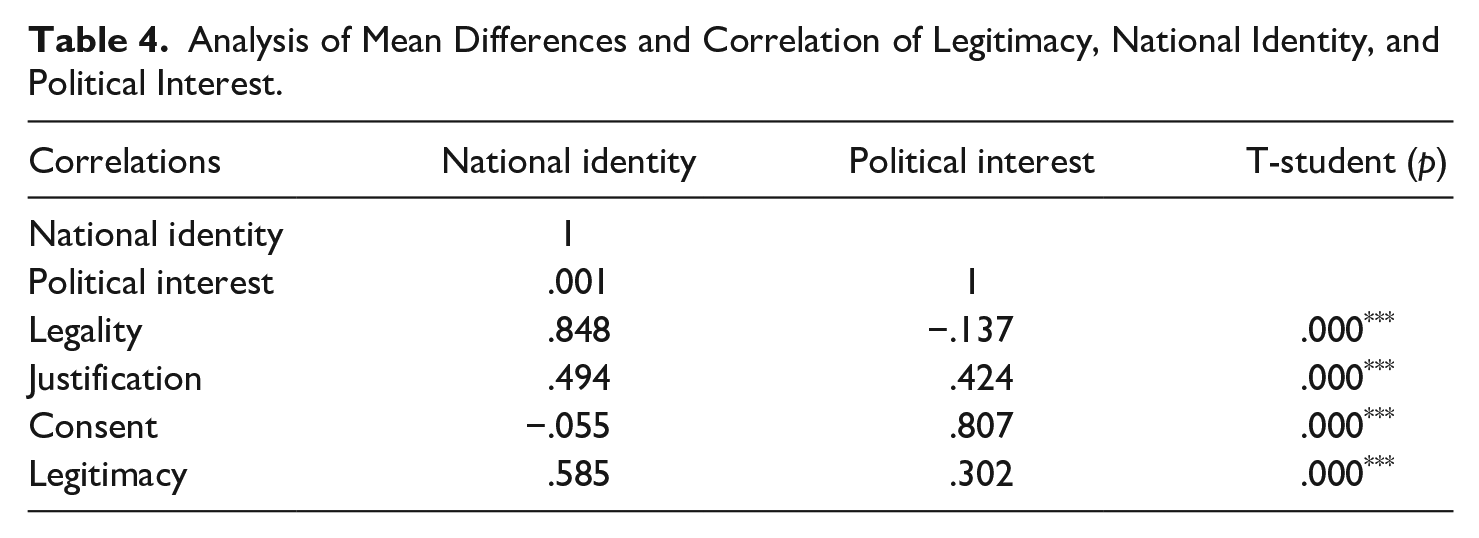
To confirm whether feeling identified with Spain and an interest in politics are related to state legitimacy, a correlation analysis and an analysis of mean difference, T-student (Table 4) is performed. The results confirm that feeling Spanish is related to the legality and justification dimension, as well as with legitimacy. Therefore, Hypothesis 3 is confirmed and it is evident that feeling part of the state generates greater state legitimacy and that it differs depending on regions. Furthermore, it is confirmed that an interest in politics, which differs according to regions, influences political participation (Hypothesis 4).
Analysis of Mean Differences and Correlation of Legitimacy, National Identity, and Political Interest.
Discussion and Implications
From Ancient Greece in which politicians argued in the agora and the concept of politics emerged, going through Leviathan and the common good, to the reality of current politics of mass parties and short-term goals in order to obtain votes has caused citizens’ concerns to change and our politicians, who should be the representatives of the people have caused concern about their poor behavior. The current political situation and the electoral “game” move in environments of greater instability generated by the perception of a bad political situation, the instability of governments or the growth of populist parties. All of this influences a fundamental indicator of countries’ health, which is legitimacy, which measures social support to institutions.
Legitimacy has proven to be a good indicator of a country’s stability and prosperity, as well as a predictor of political, social, and/or economic fluctuations (Gilley, 2006). Low legitimacy levels indicate weak institutions and a situation of uncertainty and risk that drives investors away or decreases the rate of entrepreneurship (Blanco-González et al., 2017). Legitimacy is not oblivious to the political sphere, since an effective management of states depends largely on politicians (Levi et al., 2009). The 2008 crisis and the difficulty of forming a government in various European countries, such as Spain lead to new political parties emerging and empowered regionalist parties, without which the formation of governments is not possible.
The relationship between state legitimacy and regionalisms is a factor that must be taken into account, especially in countries in which the regional structure is imperfect (Garmendia, 2014) and demands for the transfer of powers are the usual trend in political negotiations and electoral programs. In this context, inadequate management of these negotiations could weaken social support to state institutions. For this reason, when asked whether living in a region influences legitimacy, we confirm that it does, and that the regions with the greatest regionalist claims, which are the Basque Country and Catalonia, obtain the lowest state legitimacy values. These results show that the regions that historically claim greater self-management, support state institutions less. This may be the source of possible tensions that must be properly managed so as not to undermine legitimacy.
These results lead to the question: Can a regionalist party that claims its self-management and independence ensure support to state institutions? This is not a petty response, since a study is required on whether it is an electoral claim and a negotiating strategy, or if there really is a lack of concern for the health of the state which they are part of. It should be borne in mind that if the state transfers powers to some regions or the negotiation is friendlier with some of them, this can cause legitimization of inequality. If this were to happen, the disparity between regions and the feeling of inequality would cause a more polarized political scenario and electoral objectives of a local and regionalist nature, regardless of the common good as a country.
In this study, it has also been shown that voters of regionalist parties provide low state legitimacy, which indicates that the electoral agenda of these parties is attractive to voters and that it is necessary to study in depth why they feel identified with statements such as the repeal of the Constitution of 1978 (Bildu) or the right to self-determination (En Comú). Regarding the previous argument, this may be due to a perception of inequality compared with other regions or a feeling of regional identity that would lay the foundations for independence movements.
Furthermore, with the aim of responding to these questions, legitimacy has been related to national identity and whether feeling connected to the country is different throughout regions has been explored, and if this determines legitimacy levels. The regions that obtain lower values in national identity are those with lower legitimacy values. The results of the Basque Country, which are below average, are striking, as well as its legitimacy level. Therefore, the greater the patriotic feeling, the greater the legitimacy and trust in the law and institutions. Therefore, it is necessary to find a balance between national and regional identity, which are identities that do not have to be antagonistic but can be complementary.
Finally, it has been shown that the greater the interest in politics, the greater the participation in public life, which leads to better values in the consent dimension. This confirms the research of Caplan (2007), that ensures that the more legitimacy, the less interest. In regions with lower legitimacy levels, interest in politics is greater and mobilizations are more frequent. For example, the mobilizations of Catalonia in 2019 that claimed the right to choose.
This study is not without limitations, since the results of a specific year are analyzed and the impact of an electoral campaign before, during, and after on state legitimacy cannot be quantified. There are several future lines, such as analyzing longitudinal data, comparing the results with other countries, or applying causal research methodologies that delve into the causes of variations in legitimacy.
Footnotes
Declaration of Conflicting Interests
The author(s) declared no potential conflicts of interest with respect to the research, authorship, and/or publication of this article.
Funding
The author(s) received no financial support for the research, authorship, and/or publication of this article.
