



Abstract
Political interest is a key predictor of likelihood to vote. We argue that the political interest–vote intention relationship can be explained by well-established theories that predict behavior across domains (e.g., theory of reasoned action, theory of planned behavior). Relying on the integrated behavioral model, we propose a core mediation model with vote likelihood (i.e., behavioral intention) as the dependent variable. Two types of media use (conservative and liberal–moderate) are then assessed in relation to the core model. We explore the ways in which our results contribute to theory and outline a research agenda.
Voter turnout in the United States lags behind most other advanced industrialized democracies, such as Belgium, South Korea, or Israel (Desilver, 2020). With only a bit over half of Americans casting a ballot, voters’ preferences can diverge, sometimes substantially, from the public’s preferences (Leighley & Nagler, 2014). Scholars have explored variations in turnout, exploring why subgroups vote at different rates, including differences based on age (Holbein & Hillygus, 2020), race and ethnicity (Cassel, 2019; Fraga, 2018; Soto-Vásquez, 2020), gender (Dassonneville & Kostelka, 2019), various attitudinal dispositions (Blais & Achen, 2019; Geys, 2006; Prior, 2019), and even the method by which a ballot is cast (Kaplan & Yuan, 2020). Although substantial progress has been made, there is still considerable unexplained variation in our understanding of which citizens will actually turn up at the polls on Election Day.
We argue that behavioral theories developed outside a political context can help us better explain who turns out and why. Though voting is an important behavior, it is just a behavior, and thus can be fit into theories of behavioral intentions (Fishbein & Ajzen, 2010). Accordingly, we offer an integrated behavioral model (IBM) approach to the study of anticipated voter turnout in the 2020 U.S. general presidential election. Building on the theory of reasoned action (TRA) and the theory of planned behavior (TPB), the IBM identifies attitudes toward the behavior, normative beliefs, and perceived control as key predictors of behavioral intention (Montaño & Kasprzyk, 2015). Drawing on a March 2020 survey of U.S. adults (N = 1,089), we first test a mediation model using political interest and an IBM-based voting scale to explain the likelihood that a given voter plans to vote, treating IBM as the mediator between interest and vote intention. Two types of media use (conservative and liberal–moderate) are then incorporated relative to the core model in order to better understand communication’s potential influence on this important democratic process. The final section of this essay focuses on the theoretical implications of these findings and future lines of research.
Political Interest and Behaviors
Lupia and Philpot (2005) describe political interest as “a citizen’s willingness to pay attention to political phenomena at the possible expense of other topics” (p. 1122). As noted by Verba et al. (1995), “citizens who are more interested in politics—who follow politics, who care about what happens, who are concerned with who wins and who loses—are more likely to be politically active” (p. 345). Such observations go back to the earliest political communication studies of the 1940s and 1950s (e.g., Berelson et al., 1954; Lazarsfeld et al., 1948). Unsurprisingly, meta-analyses find that political interest is a strong predictor of a wide range of political behaviors (see Smets & van Ham, 2013). Prior (2019) emphasizes that political interest affords membership into “the self-governing class” (p. 1) in that self-governance begins with the ability to cast a vote for one’s preferred candidates, parties, and policies (e.g., referenda).
Political interest is a concept with great dexterity that has been found to have significant explanatory power for a diverse range of political communication processes. Knobloch-Westerwick and Meng (2009) find political interest is a positive predictor of choosing dissonant political media content, reducing the likelihood of becoming enveloped within an echo chamber (see Dubois & Blank, 2018). Political interest is also a positive predictor of TV news exposure (Boulianne, 2011), with news media engagement affecting subsequent political talk. At the same time, political interest is a positive predictor of not only personal political communication behaviors, but the political communication activities of one’s friends (Thorson et al., 2019). Gil de Zúñiga and Diehl (2019) show political interest to be a key mediator of the relationship between perceptions of adequate levels of incidental news exposure (i.e., “news finds me”) and voting. Regardless of its importance, there is a need to stress that political interest is a concept, not a theory. While powerful, political interest’s strengths can be enhanced by situating it within a larger theory built for the purposes of predicting behavior. Here, we situate political interest within the IBM in order to clarify how it affects vote likelihood and to assess communication’s role in this process.
Integrated Behavioral Model
The IBM builds on the TRA and the TPB. The TRA emphasizes the importance of attitudes toward the behavior and subjective norms as the two lone predictors of behavioral intention, where behavioral intention is the key predictor of actual behavior (see Ajzen & Fishbein, 1980; Fishbein & Ajzen, 1975). Attitudes toward the behavior speak to perceptions of its importance and whether there is pleasure associated with the activity. The normative component recognizes that individual behaviors are driven by larger social factors, such as whether those around an individual expect they will perform the behavior and whether those around an individual are engaging in the behavior. According to the TRA, anything exogenous to this basic mediation model works through attitudes toward the behavior and subjective norms. The TPB expanded the TRA to include perceived behavioral control as a predictor of not only behavioral intention, but of actual behavior as well (see Ajzen, 1985). Perceived behavioral control focused on the degree to which individuals felt they were able to perform a behavior and their perceptions that the decision to perform the behavior was under their control (for more on the connection between these models, see Madden et al., 1992).
The IBM also emphasizes attitudes toward the behavior, perceived norms, and personal agency as key predictors of behavioral intention (Montaño & Kasprzyk, 2015), but offers a larger overarching framework for predicting behavior. The IBM details how actual knowledge of the behavior, its salience, a wide range of environmental constraints, and habits developed over time have powerful direct effects on actual behavior, above and beyond the influence of behavioral intent. Political communication researchers have studied the influence of behavioral beliefs, perceived norms, and personal agency on vote intention (e.g., Gerber & Rogers, 2009; Pinkleton et al., 1998; Shah et al., 2009), but rarely together or nested within a single theoretical framework (cf., Netemeyer & Burton, 1990). In short, an IBM approach to predicting vote likelihood brings together several seemingly disparate lines of research (e.g., self-efficacy, political socialization, and media effects), providing much needed organization to this important area of study.
We broaden the IBM framework, acknowledging that behavioral beliefs, perceived norms, and personal agency are not the only factors that influence behavior. For activities such as voting and other forms of political participation, political interest also affects an individual’s decision to take action. Prior (2019) notes that a “person develops interest in politics during adolescence and then maintains a fairly unchanging level for much of life” (p. 145). Accordingly, we treat our voting-age respondents’ interest as a “central element of political identity, not like a frequently updated attitude” (Prior, 2010, p. 763). In particular, we posit that interest initiates a mediation-based process of influence defined by an IBM approach to predicting vote likelihood (see Figure 1).

IBM-based mediation model.
In light of the wealth of empirical evidence concerning political interest as a positive predictor of political behavior, we expect to observe a direct (positive) relationship between interest and vote likelihood. However, an IBM approach to this relationship would suggest the IBM-voting scale acts as a significant mediator whereby behavioral beliefs, perceived norms, and personal agency are positively predicted by political interest, but are also the primary and most immediate predictors of behavioral intention. The IBM-voting mediator reflects how important respondents feel it is to cast a vote in the upcoming 2020 general election (behavioral belief), perceptions that their friends and family members expect them to vote in the 2020 election (perceived norms), and how much the respondent thinks she knows about how, when, and where to cast a vote (perceived behavioral control). Our dependent variable is behavioral intention (i.e., 2020 general presidential election vote likelihood).
The Role of Media Use in the IBM Model
An important place to begin an assessment of media’s role in the IBM-based vote intention model is to ask whether the strength of the model’s variable relationships differ between unique levels of media use. From a normative theory perspective (see Althaus, 2012), the IBM-based mediation model outlined in Figure 1 represents a positive, almost ideal democratic process. Individuals who are interested in politics retain positive beliefs about voting and this all leads to a greater likelihood to cast a vote. If this process is found to be conditioned by different levels of media use, then communication may be generating varied normative influence depending on whether the relationships are strengthened (positive normative influence) or weakened (negative normative influence). Conditional effects of this kind are best addressed by treating media use as a moderator. Moderator variables assess whether the direction or strength of a preexisting relationship is conditional based on different levels of a third variable (MacKinnon, 2011). As a result, media use is inserted as a moderator of the IBM-based mediation model (see Figure 2).
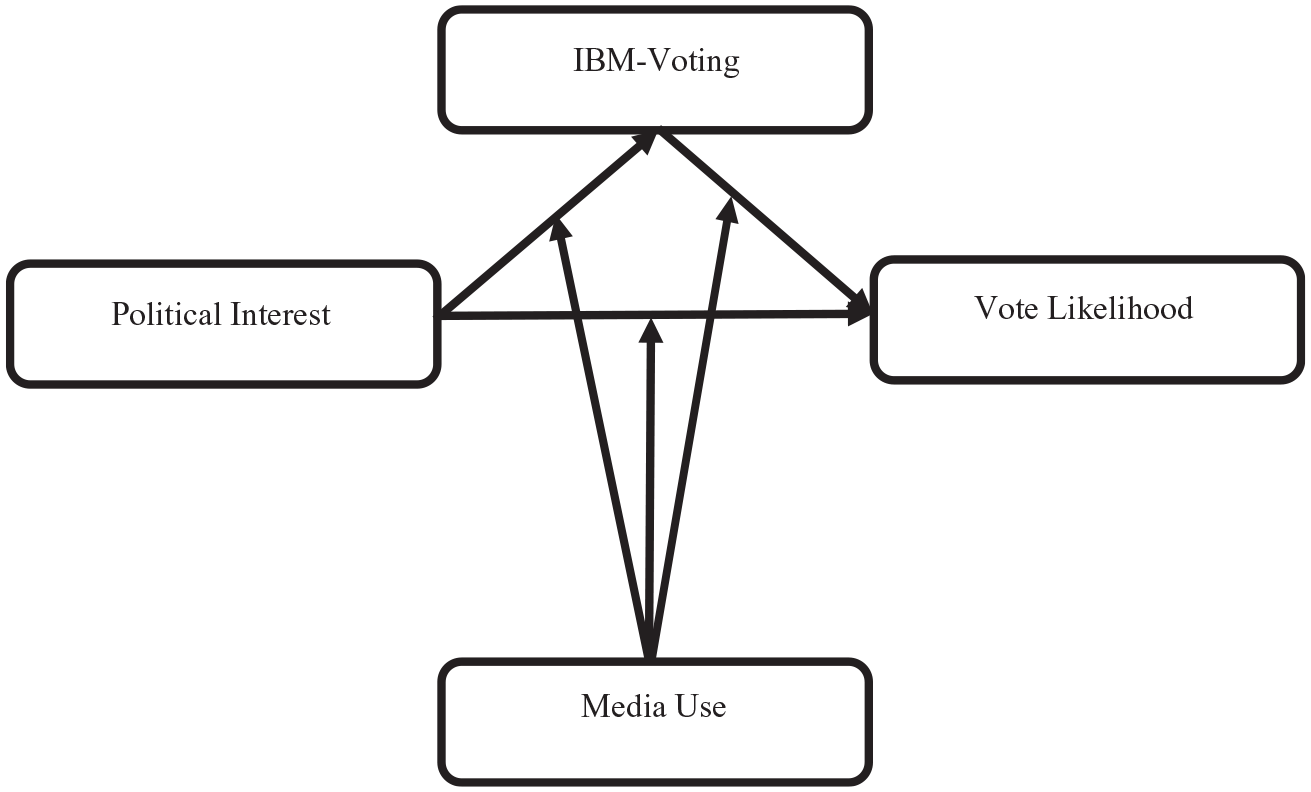
Media use as moderator.
Beginning an assessment of media use influence with moderation, rather than mediation, runs counter to much extant research (e.g., Gil de Zúñiga et al., 2017; Holbert, 2005; Strömbäck et al., 2018). In studying processes of influence involving political interest and communication, it is more common to treat any form of political communication as a mediator of the relationship between interest and various democratic outcomes spanning the hierarchy of effects from salience to behavior. Such processes are theoretically sound and have been shown to provide quality insights. However, it is important for political communication scholarship to recognize that communication need not be typecast solely as a mediator. The assessment of moderation and the identification of conditional effects may allow more subtle communication effects to become evident in a manner that a more immediate assessment of mediation would not reveal.
Method
Data
A cross-sectional survey was administered online to a national nonprobability sample of U.S. adults (N = 1,089) collected by Qualtrics panels. The survey fielded on February 24 to 27, 2020, just before former U.S. Vice President Joseph R. Biden, Jr. began to solidify the Democratic Party’s nomination with a decisive South Carolina primary victory and the U.S. reported its first COVID-19 death. Both of these events occurred on February 29, 2020. The survey targets were as follows: Even splits for gender (male–female), age (18-34, 35-55, and 55+ years), and party identification (Democrat, Republican, and Independent); Region (20% for Midwest, Northeast, and West; 40% South).
Exogenous Measures
Demographics
Five demographic characteristics were captured through the survey instrument: age, income, education, gender, and race. Age was measured on a 6-point scale ranging from 1 (18 to 24 years) to 6 (65 years or older), education was captured with an 8-point scale ranging from 1 (less than high school) to 8 (postgraduate or professional degree), and income was represented with a 13-point scale ranging from 1 (less than $10,000) to 13 ($1 million or more). The median age is 35 to 44 years, education’s median is some college, and income’s median is $35,000 to $50,000. The gender and race items were recoded to form dichotomous items: Male (n = 537, 49.3%) for gender and White (Caucasian; n = 825, 75.8%) for race. Respondents who indicated Caucasian as either their only race or one among several races with which they identity were defined as Caucasian in the recoded dichotomous item.
Political Individual Differences
We used three items to determine strength of partisanship. Respondents were first asked if they were a member of a political party. If so, they were asked to indicate which (Democrats, n = 385; Republicans, n = 351). If a respondent indicated they were a member of either the Democratic or Republican parties, they were also asked whether they were a strong or weak identifier. A pair of 3-point political party strength scales, one for each major political party, were created from this combination of items and ranged from 0 (nonidentifier) to 2 (strong identifier): Democrat strength, M = 0.58, SD = 0.83; Republican-strength, M = 0.55, SD = 0.84.
Trump-Source Credibility
Incumbency is a powerful force in American politics, and this is true of presidential elections as well (Campbell, 2005; Mayhew, 2008; Weisberg, 2002). It is thus important to account for people’s perceptions of the 45th President of the United States, Donald J. Trump. Respondents were asked how well each of the following traits applied to U.S. President Donald J. Trump: qualified to be President, trustworthy, and cares about people like me. These three traits reflect the three dimensions of source credibility (see McCroskey & Teven, 1999): expertise, trustworthiness, and goodwill. Responses were offered on 5-point scales ranging from 1 (not well at all) to 5 (extremely well). The three items form a reliable scale (Cronbach’s α = .95): M = 2.67, SD = 1.54.
Endogenous Measures
Political Interest
A single political-interest item was included on the survey instrument: “Some people seem to follow what’s going on in government and public affairs most of the time, whether there’s an election going on or not. Others aren’t that interested.” Would you say you follow what’s going on in government and public affairs: 1 = most of the time, 2 = some of the time, 3 = only now and then, or 4 = hardly at all. Responses were reverse-coded so that a higher value signals a higher level of interest: M = 3.07, SD = 0.91.
Vote Likelihood
Respondents were asked the following: “How likely are you to vote in the November 2020 presidential general election?” with possible responses ranging on a 4-point scale from 1 (definitely will vote) to 4 (definitely will not vote). Responses were reverse-coded to allow a higher score to indicate greater behavioral intent: M = 3.55, SD = 0.84.
IBM-Voting
A three-item scale was created from single items tapping belief toward the behavior, injunctive norm perceptions, and efficacy beliefs. The belief item asked, “How important is it for you to vote in the presidential election in November?” with possible responses ranging on a 4-point scale from 1 (not at all) to 4 (very): M = 3.35, SD = 0.98. The injunctive norm item is as follows: “Do most of your close friends and family members expect you to vote in the presidential election in November?” Possible responses ranged on a 5-point scale from 1 (they definitely expect me NOT to vote) to 5 (they definitely expect me to vote): M = 3.89, SD = 1.19. The efficacy item asked, “How much do you know about how, when, and where to cast a vote in the presidential election in November?” with possible responses ranging on a 5-point scale from 1 (nothing at all) to 5 (a great deal): M = 3.80, SD = 1.27. The three items were standardized in order to place them on a common scale and added to create a single measure. The three-item scale is reliable (Cronbach’s α = .80).
Media Use
Respondents were presented with three, randomly ordered sequences (conservative, liberal, and moderate) of media use items. These sequences do not focus on individual media sources, but content classifications defined by dominant political message leanings (or lack thereof). These varied media use classifications have been shown to produce differential effects in past research (see Hilgard & Jamieson, 2017). The conservative sequence started with the following: “Thinking about sources like FOX News Channel, Rush Limbaugh, Breitbart, and others like them. . . . How often do you come across information from sources like these?” Possible responses ranged on a 5-point scale from 1 (never) to 5 (all the time). Of those who provided a response of (never), the following was asked: You said that you never come across information from sources like FOX News Channel, Rush Limbaugh, or Breitbart. Is that mostly because (I just don’t happen to come across sources like that) or (I have set up ways to make sure these kinds of sources do not reach me [e.g., by blocking them on social media or using a DVR]).
Of those who offered any response other than (never) to the initial item in the sequence, the following was asked: “Which of the following best describes what you do when you come across sources like FOX News Channel, Rush Limbaugh, or Breitbart?” with possible responses being as follows: actively seek out sources like these, actively avoid sources like these, or do not actively seek out or avoid sources like these, but pay attention when you come across them. The responses to the latter two items allow for the formation of a single, ordinal-level measure of the likelihood of engagement with conservative media, with the sequencing as follows: (a) Use media tools to avoid, (b) do not come across, (c) actively avoid when encountered, (d) do not seek out but pay attention when encountered, (e) actively seek out and pay attention.
The same media use sequence was presented for liberal and moderate media. The only changes in item structure concern the media outlet referents. The liberal media referents were “MSNBC, Huffington Post, The Guardian, and others like them” and the moderate media referents were “The New York Times, USA Today, ABC News, and others like them.” The result is a total of six political media items, three tapping level of exposure (conservative, liberal, and moderate) and three measuring the likelihood of engagement (conservative, liberal, and moderate).
The six media use items were subjected to an exploratory factor analysis (EFA: maximum likelihood, direct OBLIMIN). The EFA produced two articulated factors (see Table 1). The two conservative items load onto the first factor, while the four liberal and moderate media items form the second factor. All primary loadings are strong (i.e., above .65) and none of the second loadings indicate possible cross loaders (i.e., are below .30). The conservative media versus all other media distinction matches the network associations detailed in Benkler et al. (2018).
Exploratory Factor Analysis: Media Use.
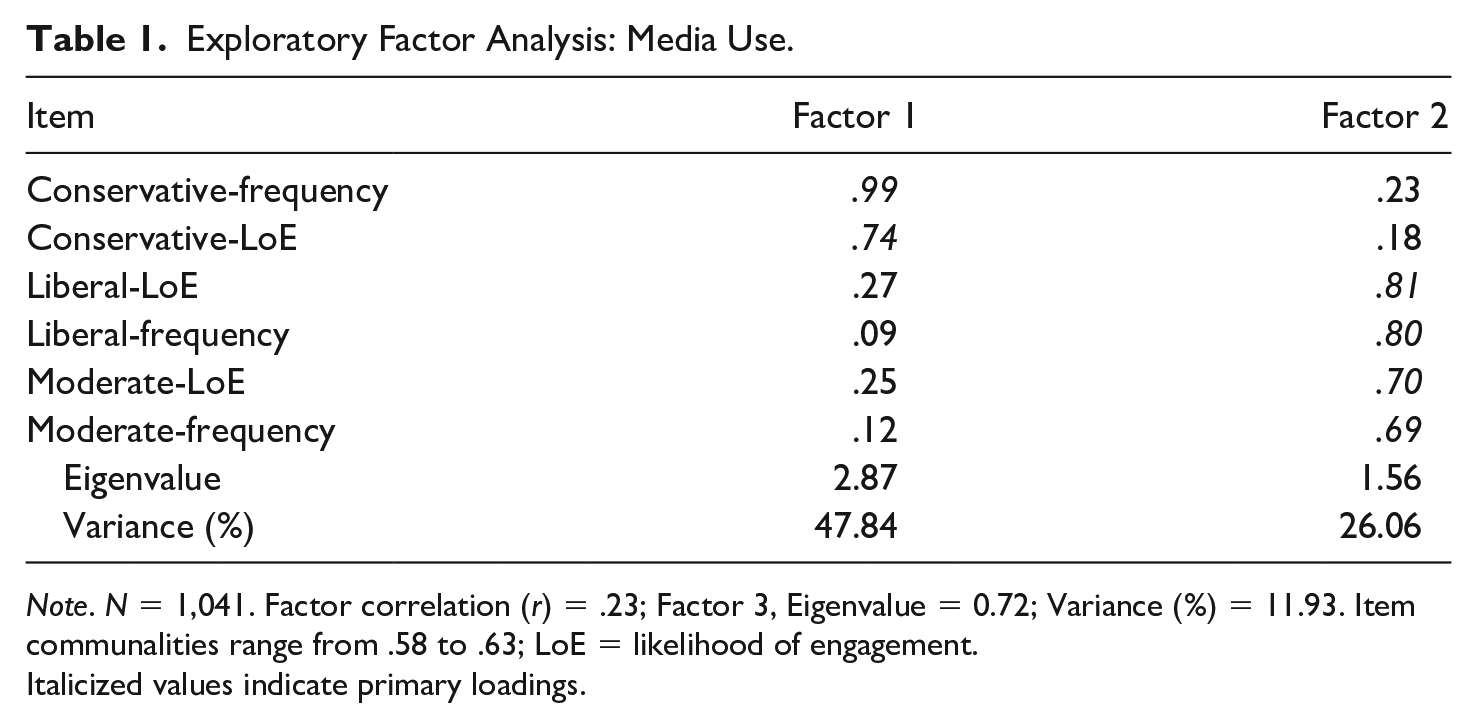
Note. N = 1,041. Factor correlation (r) = .23; Factor 3, Eigenvalue = 0.72; Variance (%) = 11.93. Item communalities range from .58 to .63; LoE = likelihood of engagement.
Italicized values indicate primary loadings.
Based on the EFA results, two media use measures were created: conservative and liberal–moderate. Both scales are reliable: Conservative (zero-order r = .74; M = 3.30, SD = 1.10) and liberal–moderate (Cronbach’s α = .84: M = 3.40, SD = 0.89).
Analytical Plan
A pair of ordinary least squares hierarchical multiple regression equations are constructed to assess the baseline political interest–vote likelihood relationship, as well as the effect of introducing an IBM approach to the prediction of vote likelihood. The first block of each equation consists of the demographic, political, and Trump-source credibility measures listed above. The first equation includes political interest as a Block 2 variable, IBM-voting as a Block 3 variable, and vote likelihood as the dependent variable. The second equation regresses IBM-voting onto the Block 1 exogenous variables and political interest as a lone Block 2 variable.
The role of conservative and liberal–moderate media use is first assessed as possible moderators of the mediation model using the Hayes PROCESS macros (Version 3.4.1, Model 59; see Hayes, 2013). This step allows for an estimation of whether the basic mediation model varies in strength at different levels of political media use. Additional mediation and moderated mediation analyses are then performed in order to gain a better understanding of the exact part played by both types of media use in an IBM-based approach to vote likelihood.
Missing Values
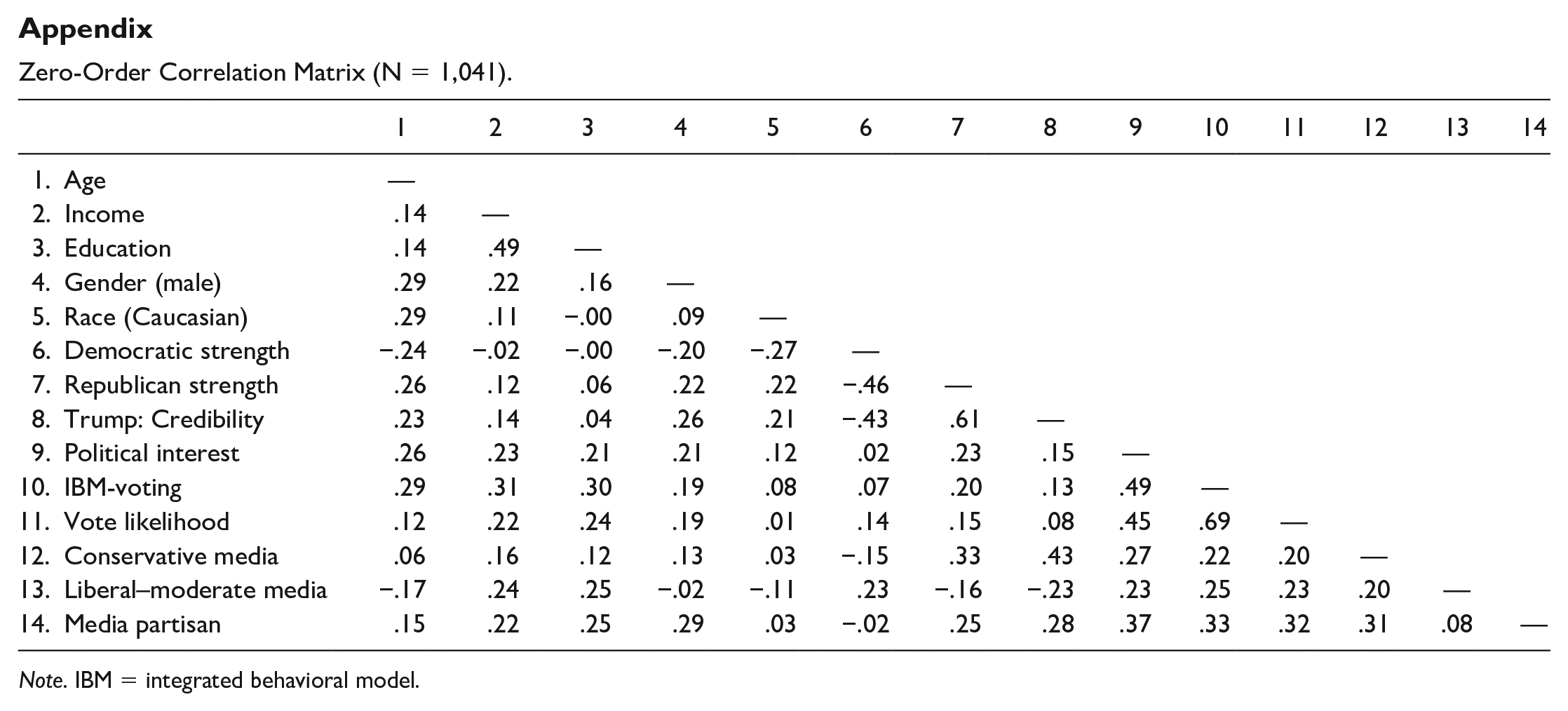
Listwise deletion of respondents based on missing values for any one item included in this study yields a final N of 1,041. With a loss of only 48 subjects (4.4%), a decision was made not to engage in any type of multiple-imputation replacement of missing values. Only the listwise-deleted N of 1,041 is employed for all analyses (see the appendix for zero-order correlation matrix).
Results
IBM-Voting as Mediator
The baseline mediation-based model reveals a series of strong, positive relationships between the noncommunication variables (see Table 2). The Block 1 variables account for 17.8% of the variance in political interest, 23.9% in IBM-voting, and 16.0% in vote likelihood. Political interest is a positive predictor of both variables, accounting for 11.0% of variance in vote likelihood and 10.5% of IBM-voting on entry (i.e., above and beyond the Block 1 influence). IBM-voting accounts for a substantial percentage of variance (24.8%) in vote likelihood beyond the Block 1 exogenous variables and political interest. 1
Mediation Model.
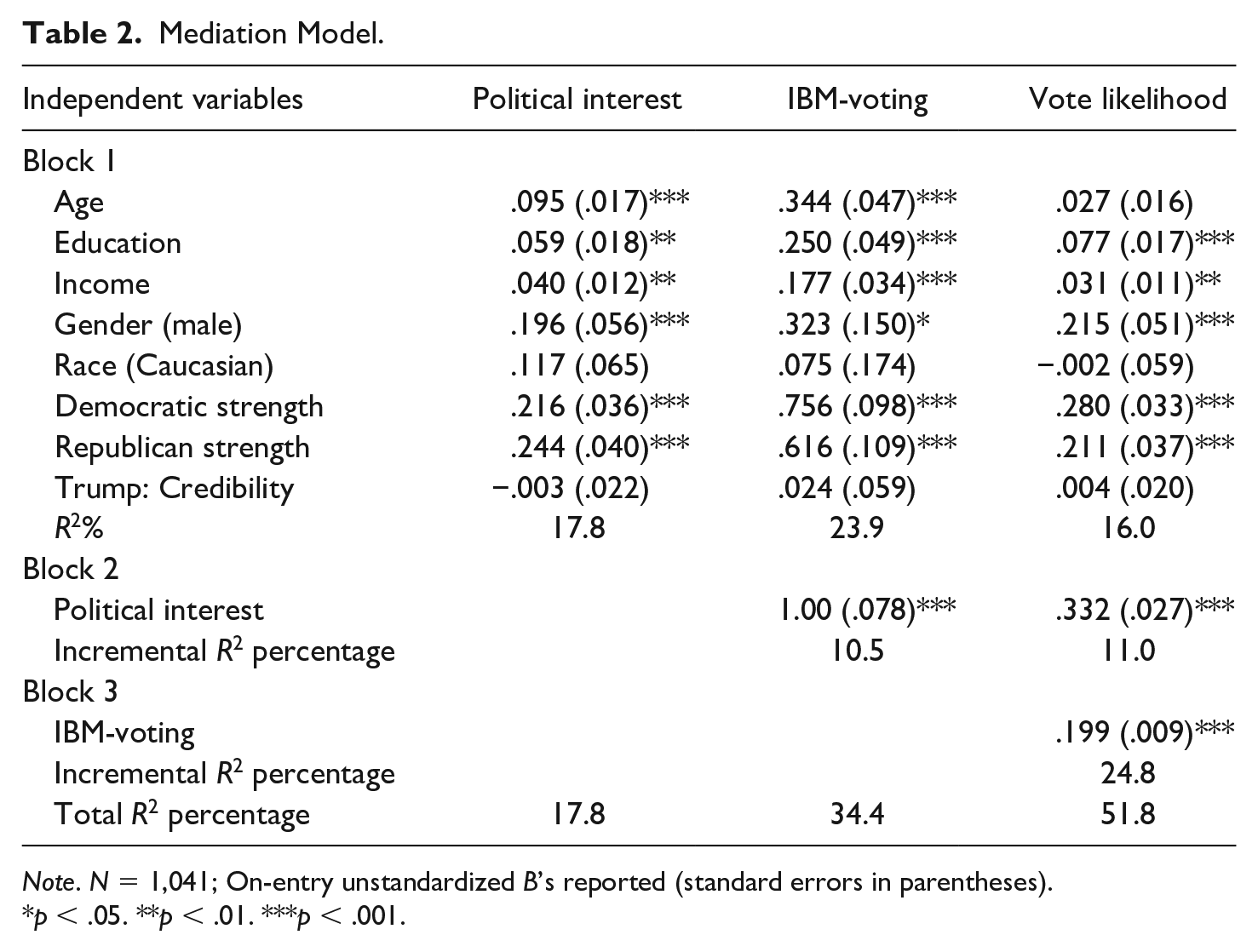
Note. N = 1,041; On-entry unstandardized B’s reported (standard errors in parentheses).
p < .05. **p < .01. ***p < .001.
The direct influence of political interest on vote likelihood weakens once IBM-voting is introduced to the model (Unstandardized Β = .132, standard error [SE = .023]). There is a statistically significant indirect effect of political interest on vote likelihood through IBM-voting, indirect effect = .200 (bootstrapped SE = .022; 95% confidence interval [CI: .16, .24]). These results indicate IBM-voting serves as a partial mediator of the political interest → vote likelihood path, with the indirect effect being greater in size than the direct effect. The total effect of political interest on vote likelihood in the mediation model is .332 (SE = .027; 95% CI [.28, .39]). So, while political interest does drive intention to vote (as expected), much of that effect appears to operate through IBM-voting.
Media Use as Moderator
Conservative media use is a moderator of two of the three paths in the mediation model, political interest → IBM-voting (ΔR2 = 0.29%, F = 4.58, p < .05) and IBM-voting → vote likelihood (ΔR2 = 1.38%, F = 30.38, p < .0001). It is not a moderator of the political interest → vote likelihood path (ΔR2 = 0.01%, F = 0.26, p > .60). Liberal–moderate media use is a moderator of all three paths: political interest →vote likelihood (ΔR2 = 0.20%, F = 4.30, p < .05), political interest → IBM-voting (ΔR2 = 0.74%, F = 12.03, p < .001), and IBM-voting → vote likelihood (ΔR2 = 0.21%, F = 4.48, p < .05). The moderation analyses reveal differences in the overall strength of the mediation model’s paths at various levels of both types of media use. Additional analyses are required to better understand how exactly both types of media use are affecting the model.
Media Use as Mediator
First, analyses were performed on the core IBM-based mediation model with conservative and liberal–moderate media use introduced as additional mediators. These two mediators were placed in the same block as IBM-voting (see Figure 3).
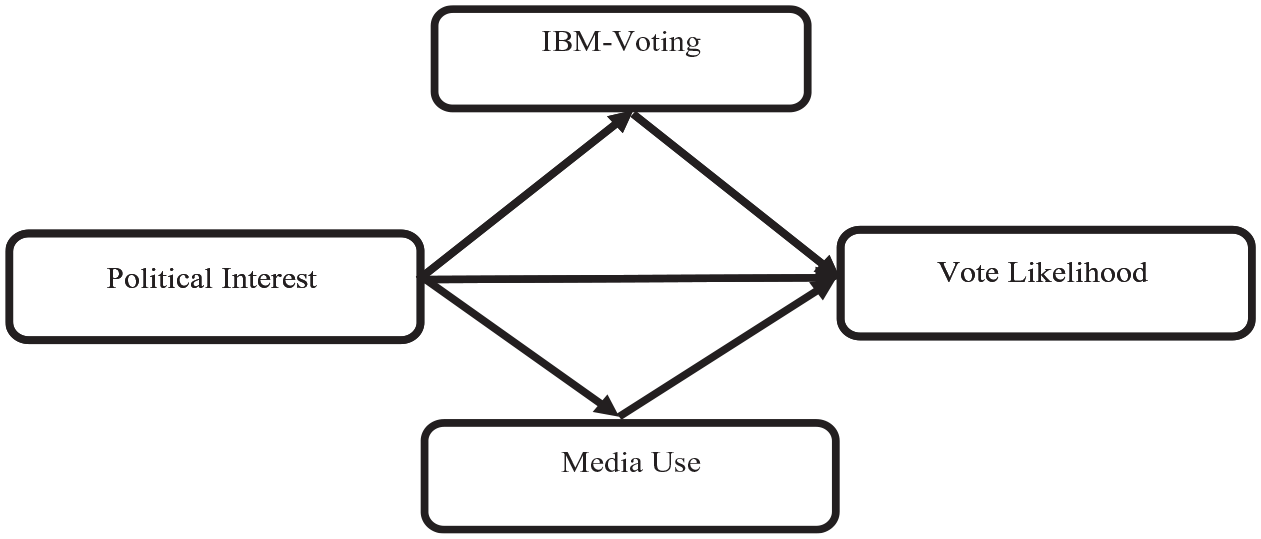
Media use as mediator.
IBM-voting remains a strong and statistically significant mediator of the political interest → vote likelihood relationship, even with the introduction of the additional media use mediators (unstandardized indirect effect .199 [.022], 95% CI [.162, .248]). However, neither of the media mediators produced statistically significant indirect effects: Conservative media use (unstandardized indirect effect .003 [.005], 95% CI [−.006, .012]), liberal–moderate media use (unstandardized indirect effect .001 [.008], 95% CI [−.014, .017]). These additional mediation-based analyses suggest that media uses do not appear to be an alternative pathway through which political interest influences voting intentions. At the same time, they shed little light on the influence of these different patterns of media consumption.
Delving deeper into the matter, the role of the IBM variable was shifted from being a mediator to serving as a moderator of the relationships between the two types of media use and vote likelihood (see Figure 4). While IBM-voting may serve as a mediator of the relationship between political interest and vote likelihood, it may also be serving as a moderator of news media’s role in the model. That is, the influence of political interest on media use and subsequent vote intentions could be different depending on the beliefs that comprise IBM. Hayes (2013) PROCESS Model 14 was used to assess these relationships.

IBM-voting as moderator.
IBM-voting is a statistically significant moderator of the relationship between conservative media use and vote likelihood (ΔR2 = 1.6%, F = 36.03, p < .001), as well as for liberal–moderate media use’s impact on the dependent variable (ΔR2 = 0.06%, F = 13.46, p < .001). As for the IBM-voting as moderator of the relationship between conservative media use and vote likelihood, conservative media use has a statistically significant and positive effect on vote likelihood when IBM-voting is low (see Table 3). This type of media use can serve to encourage participation among individuals who retain relatively low levels of behavioral beliefs, norms, and efficacy about voting. However, this type of partisan media use slightly reduces the likelihood to vote for those with strong beliefs that voting is important, that others around them assume the respondent will cast a vote, and who feel they have a solid understanding of the voting process.
IBM-Voting as Moderator.
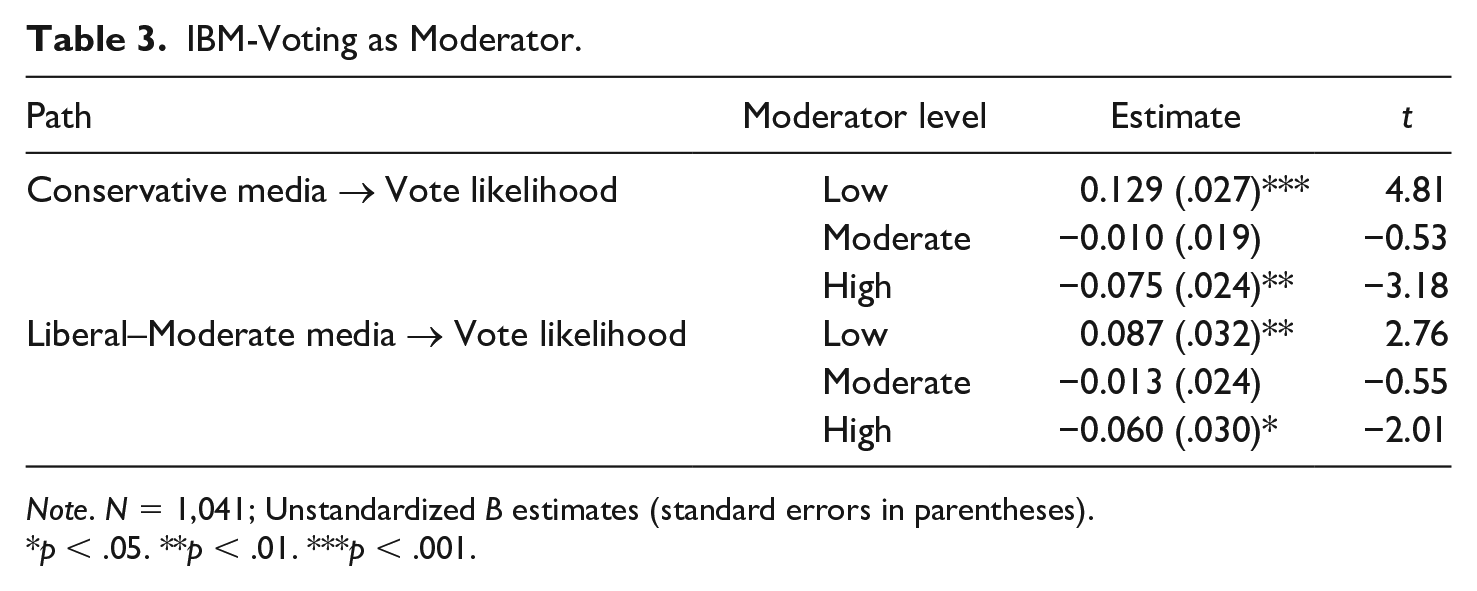
Note. N = 1,041; Unstandardized B estimates (standard errors in parentheses).
p < .05. **p < .01. ***p < .001.
The conditional nature of the liberal–moderate media use to vote likelihood relationship matches that which was just detailed for conservative media use (see Table 3). For those citizens with low levels of IBM-voting, consuming more liberal–moderate media use helps them overcome their negative voting perceptions and retain a greater likelihood to vote. Hence, both types of news media use can serve to aid those who are low in IBM-voting. However, the opposite is the case for high levels of liberal–moderate media use. For those with high IBM-voting levels, IBM-voting has such a large effect on vote likelihood that this type of media use can only serve as a slight detractor of the relationship. This is true for conservative media use as well.
Discussion
This work contributes to the literature in four ways, three focusing on communication dynamics and a third speaking more broadly to who will cast a vote. On the communication front, by operationalizing the likelihood of engagement as a dimension of media use, we add a useful measure to the scholar’s toolkit. Our measure of likelihood of engagement works alongside a more basic self-report estimate of media exposure and stresses the importance of capturing selective avoidance, incidental exposure, and selective exposure dynamics. Although there has been substantial work and an intense debate over how best to measure media exposure (e.g., Dilliplane et al., 2013; LaCour & Vavreck, 2014; Prior, 2013), communication researchers should also study how people are avoiding and/or engaging with various types of political content (see Garrett & Stroud, 2014). Just as Chaffee and Schleuder (1986) argued long ago that attention needs to be assessed alongside exposure to best capture the concept of media use, this study signals the importance of measuring the type of communicative engagement associated with exposure (or the lack thereof). Our operationalization of likelihood of engagement matches well with the spirit of Chaffee and Schleuder’s emphasis on the somewhat more amorphous concept of attention while grounding possible responses in how people are behaving, managing, and reacting to various types of political media content.
As for the effects of media use on the IBM-based mediation model, both types of media use serve a positive role when IBM-voting levels are low. These types of communicative engagement serve to fill a bit of the void left by poor individual beliefs concerning voting. However, when IBM-voting is high, these forms of media use just serve to take away slightly from what is a democratic ideal. Those individuals who believe in the importance of voting, perceive others around them expecting them to vote, and perceive knowing how, when, and where to vote have very high levels of vote likelihood. Increased media use only serves to get in the way of these high-quality relationships.
A final contribution of this work for the study of communication in the context of politics is its willingness to explore the influence of media use as more than simply a mediator. If the more traditional treatment of media use as mediator was the lone assessment of communication influence in this study, there would be little to offer in terms of effects. Both conservative and liberal–moderate media use were relatively weak, nonsignificant mediators of the relationship between political interest and vote likelihood when judged up against the powerful IBM-voting mediator. However, by beginning our media influence inquiry with moderation, rather than mediation, conditional effects became evident immediately. Mediation was ultimately employed to better understand the exact role of media use in the IBM-based model, and important conditional relationships between IBM-voting and both forms of media were uncovered. These conditional effects would have remained unknown if media use was only allowed to perform the role of mediator alongside IBM-voting, reinforcing the notion of minimal media effects.
Outside of communication, we highlight the value of the IBM for analyzing voter turnout. While work in Political Science and Communication has sought to explain voter turnout (e.g., Ansolabehere et al., 1999; Ansolabehere & Iyengar, 1995; Mutz & Reeves, 2005), few scholars have employed the IBM. Although communication scholars in other domains (most notably health communication) have made extensive use of the IBM (e.g., Ajzen et al., 2007; Fishbein & Yzer, 2003; Kasprzyk et al., 1998), its use in political communication is rarer (e.g., Holbert et al., 2017). Future scholarship can build on our efforts here. For example, although this study includes a measure of instrumental beliefs toward voting (is the behavior important?), the IBM stresses the importance of assessing experiential beliefs as well (i.e., is voting exciting?). Citizens can have widely different voting experiences, with some standing in a line for several hours, others enjoying a chance to catch up with neighbors, and yet others sending a ballot by mail weeks before Election Day (and these differences may be especially stark when voting amid a pandemic, as in 2020). In addition, while this study focused its attention on injunctive norms (Do others expect you to perform the behavior?), future research should include estimates of descriptive norms (Will others around you perform the behavior?). Finally, the study of perceived knowledge (Do you know how, where, and when to vote?) would be enhanced by the introduction of a measure of perceived control (It is up to you and you alone to decide whether to vote?). The additional dimensionality of behavioral beliefs, perceived norms, and personal agency may serve to further enhance the predictive and organizational power offered by an IBM approach to voting.
While this work focused on behavioral intent, our use of the IBM establishes a plan for research that measures actual voting. Researchers will want to measure concepts such as actual knowledge, salience, environmental constraints, and habits. New ways to vote (e.g., early voting) make actual knowledge more relevant, and there is no question that there is variance in the degree to which voting is a top-of-the-head concern for voters. Finally, past research has shown the importance of voting habits (Fujiwara et al., 2016; Gerber et al., 2003) as well as variations in the likelihood that adverse events like rain might undermine an individual’s likelihood of making it to the polls (cf. Gomez et al., 2007). The IBM allows for this work to be placed within a single framework and linked to the study of behavioral intention. Communication may play an important role for each of these predictors of actual voting and future research should explore a wide range of effects. Hence, the IBM can serve to bring together a broad range of seemingly disparate lines of research, including those involving the study of media effects.
Footnotes
Appendix
Zero-Order Correlation Matrix (N = 1,041).
| 1 | 2 | 3 | 4 | 5 | 6 | 7 | 8 | 9 | 10 | 11 | 12 | 13 | 14 | |
|---|---|---|---|---|---|---|---|---|---|---|---|---|---|---|
| 1. Age | — | |||||||||||||
| 2. Income | .14 | — | ||||||||||||
| 3. Education | .14 | .49 | — | |||||||||||
| 4. Gender (male) | .29 | .22 | .16 | — | ||||||||||
| 5. Race (Caucasian) | .29 | .11 | −.00 | .09 | — | |||||||||
| 6. Democratic strength | −.24 | −.02 | −.00 | −.20 | −.27 | — | ||||||||
| 7. Republican strength | .26 | .12 | .06 | .22 | .22 | −.46 | — | |||||||
| 8. Trump: Credibility | .23 | .14 | .04 | .26 | .21 | −.43 | .61 | — | ||||||
| 9. Political interest | .26 | .23 | .21 | .21 | .12 | .02 | .23 | .15 | — | |||||
| 10. IBM-voting | .29 | .31 | .30 | .19 | .08 | .07 | .20 | .13 | .49 | — | ||||
| 11. Vote likelihood | .12 | .22 | .24 | .19 | .01 | .14 | .15 | .08 | .45 | .69 | — | |||
| 12. Conservative media | .06 | .16 | .12 | .13 | .03 | −.15 | .33 | .43 | .27 | .22 | .20 | — | ||
| 13. Liberal–moderate media | −.17 | .24 | .25 | −.02 | −.11 | .23 | −.16 | −.23 | .23 | .25 | .23 | .20 | — | |
| 14. Media partisan | .15 | .22 | .25 | .29 | .03 | −.02 | .25 | .28 | .37 | .33 | .32 | .31 | .08 | — |
Note. IBM = integrated behavioral model.
Declaration of Conflicting Interests
The author(s) declared no potential conflicts of interest with respect to the research, authorship, and/or publication of this article.
Funding
The author(s) received no financial support for the research, authorship, and/or publication of this article.