



Abstract
In recent years, diversity advocates have organized a national campaign to get environmental organizations to reveal data on their institutions’ demographic characteristics publicly. Environmental organizations are urged to be more transparent and put their data on GuideStar (renamed Candid). Past research indicates that as of 2018, less than 4% of the organizations have done so. Still, diversity and transparency campaigns focus on disclosing data on Candid. Despite the push to get environmental nonprofits to disclose their demographic data, scholars and diversity advocates have not investigated if and how organizations collect and reveal demographic and other types of diversity data. This article addresses this gap in our knowledge about environmental institutions’ collection and disclosure of diversity data. The article reports the findings of a national study of 516 environmental organizations that analyze the following questions: (a) To what extent do environmental nonprofits collect diversity data? (b) What kinds of diversity data do organizations collect? (c) Why do organizations collect or refrain from collecting diversity data? (d) Where do organizations disclose their diversity data if they collect any? I collected the data reported here in 2018. The study assessed if organizations collected data on 12 different diversity metrics. The study found that 31.4% of the nonprofits collected or tracked data on at least one metric. Nonprofits are also more likely to collect data than to divulge them. Almost 26% of the organizations said they shared data on at least one diversity metric. The results show that a much higher percentage of organizations collect and reveal data than are currently disclosing such data on Candid. The research also found that organizations are more likely to collect data on their boards than on their staff. The nonprofits are more likely to share diversity data with funders and their boards than any other kinds of external or internal sources. The findings suggest that in crafting diversity and transparency campaigns, diversity advocates should pay more attention to the kinds of data organizations collect and how they reveal such data.
The Context
Calls for Greater Diversity and Leadership Responses
American environmental organizations are criticized for their demographic characteristics. There is ample documentation showing that for most of the 19th century, environmental organizations were composed of mostly wealthy, White men. Though White women gained a foothold in these organizations during the late 19th century, few ascended to top leadership positions until the second half of the 20th century. The White working class and people of color did not have a place in such organizations (Bramwell, 1989; Cohen, 1988; Fox, 1981; Judd, 1997; Oelschlaeger, 1991; Reiger, 2001; Taylor, 2016).
The lack of racial and ethnic diversity in environmental organizations mainly went unnoticed until the 1960s when academics and activists questioned the overwhelming whiteness of the environmental movement and its workforce. Environmental leaders responded to the criticism by arguing that increasing the racial diversity of their staff, board, or membership was not a part of their environmental mission. The role of racial diversity in environmentalism remains a controversial topic today (Fox, 1981; Taylor, 2014; Taylor et al., 2019).
Nineteen ninety was a pivotal year for enhancing racial diversity in environmental organizations. As Earth Day 20 neared, environmental justice activists published a letter in the New York Times arguing that few people of color worked in environmental organizations. The activists of color addressed the letter to the ten largest environmental organizations. The letter intimated that the green groups discriminate in their hiring practices. It also argued that environmental organizations could benefit from working more collaboratively with communities of color and hiring more people of color (Shabecoff, 1990).
The narrative tropes that environmental leaders evoked to explain the lack of people of color on their staff during the 1990s are still in vogue today. People of color are often blamed for their absence from environmental organizations. Environmental leaders frequently claim that people of color (especially Blacks) are not working in environmental organizations because they are not knowledgeable about the environment, lack awareness about environmental issues, do not apply for environmental jobs, and will not stay in such organizations if hired. Furthermore, environmental leaders portray people of color as avaricious; such leaders claim that people of color want salaries that are too high for the environmental organizations to afford to pay (“Earth issues lure,” 1990; Environmental Careers Organization, 1992; Shabecoff, 1990; Taylor, 1989, 2007, 2015, 2018; Taylor et al., 2018).
Some attendees at the 2019 New Horizons in Conservation Conference in Chicago voiced an ongoing storyline that environmental organizations cannot find people of color to work for them. In front of an audience of about 300 attendees—most of whom were people of color—a top leader of one of the largest environmental organizations opined that his institution could not find any people of color to hire in a recent search for an executive at the organization. As the skeptical audience listened, the moderator turned to the audience and asked, “How many of you want an executive job at _________?” Many in the audience put their hands up. The moderator then asked anyone desirous of an executive job to bring their resumes and business cards to the front and give it to Mr. _______. It took less than a minute for several conference attendees to pull their resumes and business cards from their bags and hand them to Mr. _______ (see “New Horizons in Conservation,” 2019).
Some White environmentalists find diversity conversations and initiatives unnerving because many environmental leaders still distinguish between concern for the environment, social justice issues, and social responsibility. Such environmentalists see these as unrelated issues. For example, Fred Krupp, executive director of the Environmental Defense Fund responded to the 1990 letter to the New York Times by arguing that minorities are “cause-oriented,” and attracted to discrimination and poverty rather than to environmental issues. Bob Norman, the National Audubon’s director of human resources, had a slightly different interpretation. He agreed that his organization had a dreadful track-record of engaging people of color, but he did not think racism factored into hiring decisions. Hence, he conceded that “We are not proud of our record—we are terrible.” However, he hastened to add, “I can’t believe it is racism. We are not getting the candidates from the minority community” (“Earth issues lure,” 1990; Shabecoff, 1990).
Recent studies show that these arguments still have currency among environmental leaders when discussions about racial/ethnic diversity in environmental organizations arise (Taylor, 2014). Yet, there is ample evidence that people of color are interested in environmental issues and governance. For instance, hundreds of environmental organizations founded and administered by people of color are currently in operation. Moreover, there continues to be a proliferation of outdoor recreation and wilderness-experience groups spearheaded by people of color (Taylor, 2018; Taylor et al., 2018; Taylor et al., 2019). Additionally, studies show that people of color are interested in working in environmental nonprofits (Environmental Careers Organization, 1992; Taylor, 2007, 2015, 2014, 2018; Taylor et al., 2018). People of color reject the disinterest thesis and argue that structural factors such as poor recruitment, discrimination, cultural isolation, lack of mentoring, and limited promotions contribute to the low levels of people of color in the environmental workforce (Taylor, 2014).
This article seeks to accomplish four goals. It aims to find out (a) the extent to which environmental nonprofits collect demographic data on their staff and board, (b) the likelihood that these organizations share their demographic data publicly, (c) where are such data revealed, and (d) the factors influence organizations to collect or refrain from collecting demographic data.
This study is crucial as it is one of the first to examine a national sample of organizations to determine if they collect diversity data and why. Thus far, the campaign to increase transparency in environmental organizations has focused on the percentage of organizations that share their diversity data on one public platform—GuideStar (Taylor et al., 2019). Before the study discussed herein, there have been only modest attempts to examine the extent to which environmental organizations collect and track diversity data (Green 2.0, 2017, 2018, 2019). However, organizations cannot report diversity data if they are not collecting it in the first place. Hence, finding out if organizations are collecting diversity data is an essential first step in assessing how environmental organizations are transparent by publicly sharing their diversity data.
To date, campaigns to encourage environmental organizations to collect and report diversity data tend to focus on the largest and most prominent environmental organizations (Green 2.0, 2015; 2017; 2018; 2019). But at least one study suggests that large organizations report their diversity data at a higher rate than smaller organizations (Taylor et al., 2019). It means that if diversity advocates want to get a complete picture of reporting on diversity data, they need to examine a broad range of organizations. Consequently, this study examines if small, medium-sized, and large environmental organizations collect and disclose diversity data. The focus on environmental organizations of different sizes will further our understanding of how organizational size relates to collecting and using diversity data.
This study is significant because it examines why organizations choose to or refrain from collecting diversity data. This type of information is not available currently. As a result, it is challenging to assess why organizations do or do not collect diversity data. Without asking organizations directly about why they make their decisions, diversity advocates end up speculating about the reasons.
This study makes a fourth significant contribution to our understanding of institutional diversity and transparency. It assesses where organizations reveal their diversity data. One should not assume that if an organization does not disclose diversity data on GuideStar, they are not releasing such data. Quite the contrary. Organizations can share their diversity data in various places and on multiple platforms. Examining the dissemination of diversity data on GuideStar provides information on only one mode of disclosure. This study examines institutional data sharing in numerous arenas.
Literature Review
The Salience of Institutional Diversity in Environmental Nonprofits
Why is workforce diversity relevant to environmental nonprofits? A wide array of activities, policies and practices fall under the domain of institutional diversity. Yet conservation practice ignores diversity, equity, and inclusion frequently. But, recent events at major conservation organizations demonstrate that conservationists can ill-afford to neglect diversity, gender dynamics, and the retention of people of color in their workplaces.
Increasingly, American environmental organizations are forced to confront diversity, equity, and inclusion issues in the workplace. For instance, when the president and three senior executives of The Nature Conservancy (TNC) resigned abruptly in 2019, diversity was crucial in the maelstrom. Women employed at TNC allege that sexual harassment and wage discrimination are commonplace at the nonprofit (Ayesh, 2019; Colman, 2019a, 2019b; Jones & Solomon, 2019). The allegations catapulted issues of sexual harassment and wage inequity to the top of the agenda at one of the world’s largest, most influential conservation organizations. However, similar complaints surfaced at Conservation International (Belmaker, 2018), and women birders or members of the National Audubon Society also report sexual harassment while birding or on the job (Saha, 2019). In addition, a former employee filed a sexual harassment lawsuit against the National Wildlife Federation in 2010 (Pendleton v. National Wildlife Federation, 2010), and Chambers et al. (2019) argue that sexual harassment and assault are widespread in the wildlife profession.
Claims that racial discrimination occurs at the National Audubon Society have also been in the news (Colman, 2020). Audubon’s chief executive officer resigned suddenly in 2021 amidst widespread staff dissatisfaction regarding the organization’s efforts to address diversity-related complaints (Colman, 2021; Hardaway, 2021). Allegations of gender and racial discrimination are surfacing at environmental nonprofits when the Trump administration makes it more challenging to obtain discrimination information. The Obama administration required the Equal Employment Opportunity Commission (EEOC) to collect gender and racial/ethnic data from companies with 100 or more workers. Unfortunately, the EEOC initiative ended in 2017 (“Trump Administration Shuts,” 2017).
Like other institutions, environmental organizations should pay attention to diversity, as it is a crucial measure of effectiveness. Organizational research supports this claim. Studies of corporate executives worldwide contend that diverse backgrounds, perspectives, and experiences in their workforce are integral to innovation and the generation of new ideas. Executives also argue that having a diverse and inclusive workforce is key to recruiting, attracting, and retaining top talent (Deloitte Development LLC, 2017; Forbes Insights, 2011). Corporate executives are not alone in making these arguments. Scholars argue that workplace diversity is a significant factor in building cognitive growth, improving critical thinking, problem solving, skills acquisition, and enhancing productivity (Cletus et al., 2018; Ferrini-Mundy, 2013; Green et al., 2012; Saxena, 2014; Shaban, 2016; Taylor et al., 2019). Others also claim that more significant heterogeneity in the workplace can lead to more committed, better satisfied, and high-performing employees (Patrick & Kumar, 2012).
Diversity can also foster more desirable environmental outcomes and greater profitability in institutions. For instance, Westermann et al. (2005) conducted an international comparative study of 46 natural resources management groups, and found a positive association between gender diversity and effective conservation outcomes. Similarly, Glass et al. (2015) did a 10-year study of Fortune 500 companies. They that firms with women chief executive officers (CEOs) and board members were more effective at pursuing environmentally friendly business strategies than those with fewer women in these top leadership positions.
Liu (2018) argues in a similar vein that corporations can save money and be more environmentally responsible by diversifying their leadership. She found that having more women as corporate heads is associated with reduced environmental violations. Liu studied 1,893 environmental lawsuits involving U.S. companies listed on the Standard and Poor’s 1,500 composite indexes and found that the firm experienced an average of 1.5% reduction in the risk of litigation for every additional woman on a corporation’s board. Others agree that firms with greater gender diversity on their boards perform better financially (Erhardt et al., 2003; Joecks et al., 2013) and have higher market valuations (Campbell & Minguez-Vera, 2008).
Population shifts will also drive greater institutional interest in diversity. The United States is undergoing a demographic transition that will affect the ethnic/racial composition of the environmental workforce. The census projects that ethnic/racial minorities will constitute most of the population by 2045 (Frey, 2018; U.S. Census Bureau, 2018). Environmental issues are complex and environmental organizations deal with local, national, and global issues that are best tackled by people who can solve problems at macro and micro scales. Excluding people of color from the workforce means ignoring the skills, talents, insights, and experiences in roughly 42% of the population today (U.S. Census Bureau, 2018). It means that organizations that want to be successful and influential will have to recruit, hire, and retain people of color in their workforce. It is particularly true for organizations that want to hire talented people. Ergo, if environmentalists wish to succeed in their missions to protect the environment and foster greater sustainability they must engage more people of color in meaningful ways since people of color currently comprise a rapidly growing segment of the population and will constitute a majority of it in a few decades.
Consequently, some environmental organizations have undertaken diversity initiatives, and the idea of increasing racial/ethnic diversity has gained credence among environmental activists. This shift occurred because it is increasingly difficult for White environmental activists to claim that people of color (who have founded and joined environmental justice and climate justice organizations by the thousands) do not know about the environment and care little for it.
Efforts to Promote Transparency
Environmental organizations will find it easier to connect with people of color if they are more transparent about their diversity efforts and demographic characteristics. Transparency is salient because it signals an end to deliberate or unintentional secrecy, and the hiding of information or actions. Transparency aims to provide openness, the revelation of activities and actions, and an increased flow of information (Florini, 2000; Gupta & Mason, 2014; Lockwood et al., 2012; Peterson, 2020). Florini (2000) argues that transparency and secrecy are two ends of a continuum rather than either-or positions. She contends that transparency is a profound change from secrecy because of the shifts in the distribution and use of power. Hence, there may be resistance when outsiders demand transparency. It is the case because organizations that have institutionalized certain practices are chagrined by demands to report what they do to outsiders. However, some scholars warn that it is not just a matter of demanding and getting transparency. Actors should ensure that mechanisms are in place to obtain adequate transparency (Gupta et al., 2020).
Calls for clarity and openness in the environmental sector have increased as researchers find that enhanced transparency helps organizations and global partners find solutions to complex environmental problems (Peterson, 2020). In the United States, the lack of demographic information about environmental nonprofits led to coordinated efforts in 2014 to get the organizations to increase transparency by collecting and reporting such data. That year, diversity advocates from Green 2.0—a people-of-color-led group of environmental professionals—teamed up with GuideStar. GuideStar, an organization with a repository of financial and descriptive information for over 2.7 million nonprofits, created a program to help environmental organizations provide their demographic data as they update their institution’s profiles. The GuideStar system opened in October (GuideStar, 2014), shortly after The State of Diversity in Environmental Organizations (Taylor, 2014) was released. The report called for greater inclusivity in environmental organizations, increased racial/ethnic diversity, and more sensitivity to and recognition of lesbian, gay, bisexual, transgender, and queer issues. The document also recommended increased public disclosure of demographic data by environmental organizations (Taylor, 2014).
It raises the question—why is transparency relevant in the environmental context? This paper examines two aspects of transparency, that is, (a) the internal use and (b) the external release of institutional demographic data. Transparency is an essential element of diversity as it allows environmental organizations and third parties to identify baselines, set targets, reveal accomplishments, and measure progress toward achieving stated goals. Leaders of the most prominent environmental organizations recognize that the gathering, tracking, and public release of diversity data are important elements of strengthening the environmental movement.
When the GuideStar data-collection program debuted, several leaders of major environmental organizations commented on the salience of increasing racial and ethnic diversity in environmental nonprofits and pledged to support efforts to increase tracking, disclosure, and transparency. Hence, Tripp Van Noppen, the president of Earthjustice; David Yarnold, the president and chief executive officer of the National Audubon Society; the president of the Union of Concerned Scientists, Ken Kimmell; the former president and chief executive officer of TNC, Mark Tercek; Rhea Suh, former president of the Natural Resources Defense Council; Michael Brune, executive director of the Sierra Club; and Jamie Rappaport Clark, the president/chief executive officer of the Defenders of Wildlife, supported the call for increased transparency. The leaders mentioned above pledged to disseminate their organization’s demographic data on GuideStar and the people of color activists in Green 2.0 who spearheaded the effort were optimistic (GuideStar, 2014).
Presidents of prominent environmental grantmaking foundations also supported the data disclosure campaign. The presidents of the Bullitt Foundation, Ford Foundation, Hewlett Foundation, Kresge Foundation, the Rockefeller Brothers Fund, and Wilburforce Foundation advised environmental organizations and funders to collect and release demographic data (GuideStar, 2014; Marrow, 2015). In 2015, Rip Rapson, President of the Kresge Foundation, pondered the progress of the transparency campaign in an op-ed in the San Francisco Chronicle. Rapson (2015) said, “I wish I could report that [this campaign] has lit a fire under environmental funders[.] [R]eporting is a modest first step in bringing genuine diversity to the mainstream environmental movement. But it is an indispensable one.”
Hence, this article examines four questions: (a) Do environmental organizations collect diversity data? (b) What kinds of diversity data are collected? (c) What are the reasons for collecting or not collecting such data? (d) Where is the diversity data shared if it is collected?
Research on Tracking and Reporting Diversity Data in Environmental Nonprofits
Since opening the GuideStar portal to disclose the diversity data of environmental nonprofits, there has been limited assessment of the extent to which environmental institutions are using the system to reveal their demographic characteristics. Green 2.0 tracks the submission of diversity data of the 40 largest environmental nonprofits and funders. The group reported that more than 25 of the most influential environmental groups and eight major environmental grantmakers revealed their demographic characteristics on GuideStar by Earth Day 2015 (Green 2.0, 2015). A year later, Green 2.0 announced that another six of the top 40 environmental organizations released their diversity information through GuideStar (West, 2016). Though Green 2.0 tracks the reporting of the top 40 organizations, this activity tells us nothing about how environmental organizations outside of the top 40 use the system. It raises the question, to what extent are the actions of the 40 most prominent environmental nonprofits reflective of the diversity data collection and public release in environmental organizations that are smaller and less visible?
Hence, Taylor et al.’s (2019) comprehensive study of the reporting of diversity data in environmental nonprofits from 2014 to 2018 is relevant here. That study assessed the reporting of diversity data in 12,054 organizations and found that 449 (or 3.7%) of the organizations divulged their diversity data publicly on GuideStar. Further analysis shows that 3.7% of the institutions revealed their gender characteristics, 2.1% reported on their racial/ethnic characteristics, and 0.3% divulge sexual orientation data.
The reporting of diversity data varies by region. Consequently, 4.7% of organizations in the Mid-Atlantic and 4.5% of those in the Pacific region publicly reveal information about the demographic characteristics. In contrast, only 1.2% of the environmental nonprofits in the South divulge any diversity data. Organizations in urban areas are also much more likely to disclose their demographic data than those in a suburban and rural locations. Hence, 5% of the urban nonprofits, 2.9% of the suburban ones, and 2.3% of the rural organizations reveal diversity data on GuideStar (Taylor et al., 2019).
While 13.4% of environmental justice organizations reveal information about their demographic characteristics on GuideStar, a much lower percentage of all the other types of environmental nonprofits do likewise. Size has a bearing on whether an organization reports demographic data on GuideStar. While 0.9% of the organizations with budgets that were $100,000 or less reveal diversity information publicly, 25.7% of the organizations with budgets over $20 million do the same. The larger an organization’s budget, the more likely it is to report diversity information on GuideStar. The pattern is similar with staff—the larger the staff, the more likely it is that an environmental nonprofit reveals its diversity information on this platform. Organizations with women chief executive officers/chief operating officers/executive directors/presidents (after this, CEOs) have a greater propensity to divulge diversity data on GuideStar than those with men CEOs. Similarly, organizations with CEOs of color are more likely to reveal their demographic characteristics than those with White CEOs (Taylor et al., 2019).
Methodology
Data Collection
This article reports the findings of a survey of environmental organizations that assesses whether the nonprofits collect diversity data, why they collect such data, the extent to which they disclose diversity data, and where they divulge their data. It is a national study of small, medium-sized, and large environmental nonprofits. Environmental organizations’ names and contact information are obtained from GuideStar, ProPublica’s Nonprofit Explorer, Charity Navigator, and the internet (Charity Navigator, 2019; Paul, 2016; Tigas et al., 2019). The survey, designed in Qualtrics, was administered from March to December 2018. I sent the surveys to the directors of human resources or a senior leader in each organization. I distributed surveys to 1,500 environmental organizations. The sample was stratified by state, region, organizational size, and type. Seven hundred and eighty-eight surveys were returned (a 52.5% response rate). This study analyzes 516 of the responses. The remaining returned surveys come from branches of government, commercial entities, or were too incomplete to analyze. These data are analyzed in Statistical Package for the Social Sciences (SPSS) 27.0 (IBM, 2020). I gathered information on the factors shown in List 1 to answer the questions posed above.
Variables Examined.
Data Sources and Organizational Selection
The three main search engines used to find environmental organizations are GuideStar, ProPublica, and Charity Navigator, but the internet (organizations’ web pages, Facebook, Twitter, and LinkedIn) is also used to supplement the information gleaned from the primary search engines. I used the search engines mentioned above because these platforms usually have the names of key staff, and they typically attach the organization’s latest tax returns to the nonprofit’s profiles. I obtained budget information for 2017 (the tax year of interest) from organizations’ tax returns. Nonprofits can file different types of tax forms depending on their revenues and the type and purpose of the organizations. The institutions in the study could file either Form 990, Form 990-EZ, Form 990-PF, or Form 990-N.
Relevant organizations are identified by using search terms such as “environmental quality,” “environmental protection,” “environment and animals,” “conservation,” “sustainability,” “energy,” “environmental justice,” and “zoos and aquarium.” This approach yields some organizations that are not environmental; such organizations are excluded from the database.
Organization Typology
The National Taxonomy of Exempt Entities (NTEE) codes are used to classify environmental nonprofits. The Internal Revenue Service uses the NTEE codes to classify nonprofit organizations (National Center for Charitable Statistics, 2019). Candid, ProPublica, and Charity Navigator also use the NTEE codes to organize institutions in their databases. Though organizations may select major and minor categories to describe themselves, one cannot rely solely on classification codes downloaded from the data sources aforementioned above for research classification purposes. I checked the classification of each organization and found hundreds of organizations are labeled as environmental quality, protection, and beautification even though they are not environmental organizations. Another common type of misclassification occurs when organizations mention activities like recycling that they organize or host. Hence, I found that several nature centers that teach children about recycling are categorized as recycling centers rather than nature centers. There is also a tendency to classify nonprofits with environmental-sounding names as environmental entities even though they may be a church missionary group, spiritual retreat, pet-adoption program, preschool, or school sports team. Such organizations are excluded from the data set.
I developed a typology that contains 42 different categories of organizations. My classification includes categories such as environmental justice and environmental media not in the NTEE codes. Study participants used the categories I provided on the survey to select the best descriptor for their organizations. If none of the categories fit, respondents could choose “other” and briefly describe their organizations.
Defining Regions
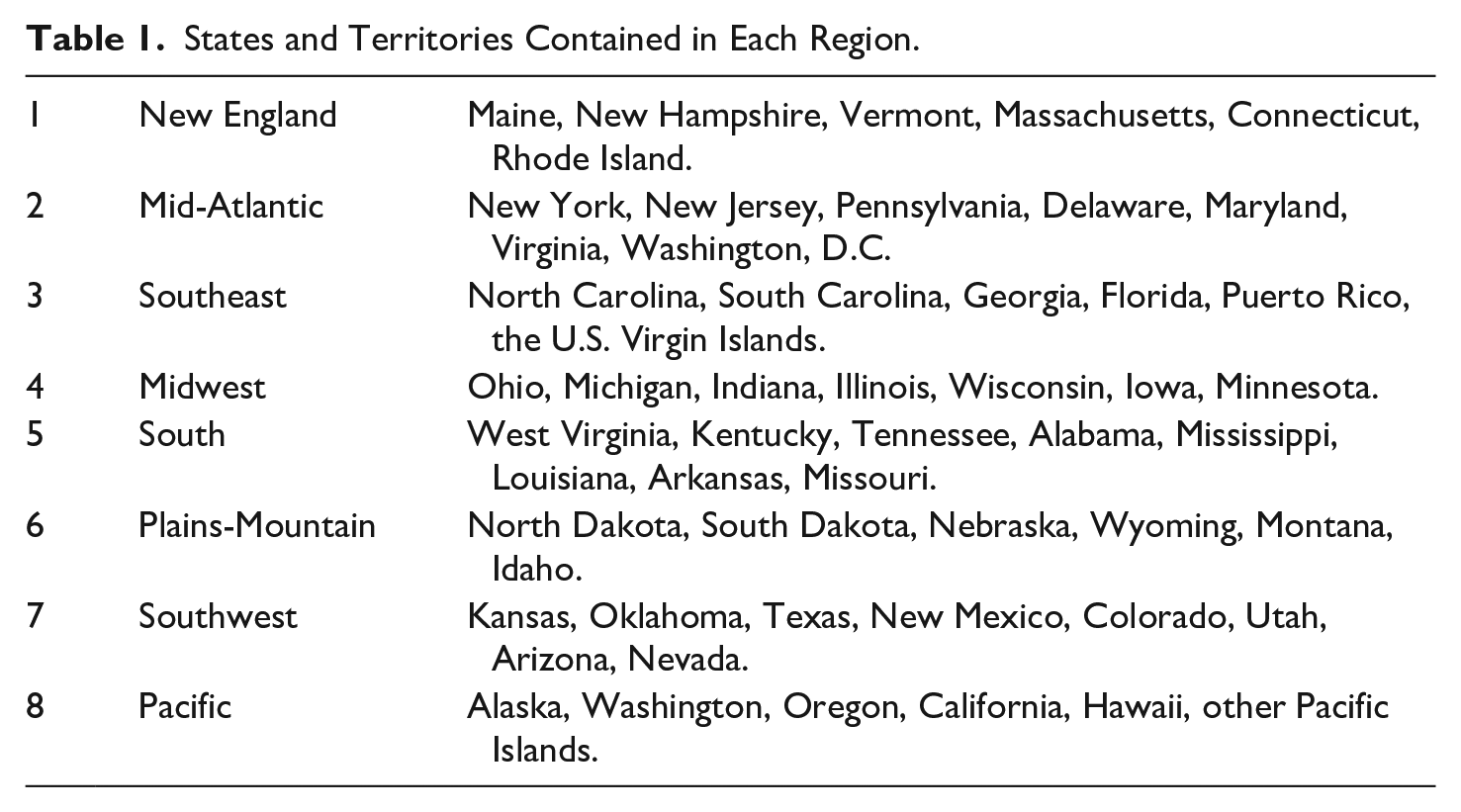
For this study, I assign the nonprofits to one of eight regions. Table 1 contains the states and territories in each region.
States and Territories Contained in Each Region.

Urbanized Areas, Urban Clusters, and Rural Designations
I use U.S. Census Bureau 2020 guidelines to classify urbanized areas, urban clusters, and rural areas. According to the census, an urbanized area is a continuously built-up setting with a population of 50,000 or more. The bureau classifies an urban cluster—a small urban space—as a locale outside of a metropolitan area incorporated with a population of at least 2,500 residents but less than 50,000 inhabitants. The third category, rural areas, are incorporated entities or census designated places with fewer than 2,500 inhabitants; these are not located in urban areas (Ratcliffe et al., 2016; U.S. Census Bureau, 2020; 2013).
Results
A Description of the Organizations in the Sample
The sample is composed of various environmental organizations (Table 2). Initially, respondents chose the description that best describes their organizations from a list included in the survey. For this analysis, the selected categories are collapsed into 20 organizational types. Collapsing the categories allows enough organizations to be in each category to enable statistical analyses. The most common organizations are the natural resources conservation and protection entities; 105 or 20.3% use this descriptor. Fifty-six organizations (10.9%) are land resources conservation types, while 54 (10.5%) are described as environmental quality, protection, and beautification nonprofits. There are also 47 (9.1%) water resources, wetlands conservation, and management organizations, 31 (6.0%) environmental justice organizations, 25 (4.8%) environmental education and outdoor survival programs, and 21 (4.1%) research institutes/public policy organizations.
Characteristics of Environmental Organizations in the Sample.
Most of the organizations are in urbanized locales—319 or 61.8% are in large cities or metropolitan areas. There are 134 (26%) organizations in small towns or urban clusters, and 49 (26%) are rural. The locations of 14 (2.7%) organizations are unknown. Survey responses come from 45 states plus the District of Columbia and Puerto Rico. It means that organizations in the sample are from all eight regions identified above. The biggest aggregation of organizations are in the Pacific region; 25.6% (132) organizations are in this region. It is followed by the Midwest, where 103 (20.0%) of the organizations are located. The 86 organizations in the Mid-Atlantic region constitute 16.7% of the sample, while the 52 New England organizations make up 10.1%. There are 44 organizations in the Southeast and 39 in the Southwest. The two regions with the fewest organizations are the South with 25 and Plains-Mountain with 21.
This study focuses on two key decision makers in the institutional setting—the CEO and the board chair. There are more women CEOs than men CEOs in the sample. Almost 47% (242) of the CEOs are women and the 227 men CEOs comprise 44.0% of the sample. Twenty-eight organizations have co-CEOs; hence 5.4% of the organizations in the sample have both a man and a woman sharing the top staff position. The gender of the CEO in 19 organizations is unknown, or the organization does not have anyone in this staff position.
Men are much more likely to be the chair or president of the board (after this chair) than women are. While 51.2% of the board chairs are men, 29.7% are women. Eight organizations have board co-chairs, with men and women sharing the position. The gender of 91 board chairs is undisclosed, or the organization does not have this position.
Though women outnumber men in the CEO position, women CEOs are concentrated in small organizations. As a result, 54.2% of the organizations with fewer than ten employees have women CEOs. On the flip side, 70.0% of the organizations with 50 or more workers have men CEOs, and 22.5% have women CEOs. Men dominate the board positions in all sizes of organizations, but the largest concentration of men board chairs occurs in the nonprofits with the largest number of staff. So, 62.5% of the board chairs in organizations with 50 or more staff are men. Only 20% of the board chairs in these large organizations are women.
Whites dominate the CEO positions. Hence, 79.1% (408) of the CEOs are White. People of color occupy 9.9% or 51 of the CEO spots. Sixty-four percent or 333 of the CEOs are White. Eight organizations have co-CEOs—both Whites and people of color share the position. The race/ethnicity of the CEO is unknown, or the post does not exist in 49 organizations. An even lower percentage of people of color are board chairs than are CEOs. Thus, only 36 organizations (or 7.0% of the sample) have people of color board chairs. Three organizations had co-chairs wherein Whites and people of color share the role of chair of the board. The race/ethnicity of the board chair is undisclosed or does not exist in 115 of the organizations in the sample.
The staff in the organizations vary from none to 4,000. However, most of the organizations studied are mid-sized or small. Forty organizations (7.8%) have 50 or more staff. Roughly 27% (140) have 10 to 49 staff, and 52.9% have 1-9 staff. The remaining 63 or 12.2% of the organizations have no staff, or the number of staff is undisclosed. Only 40 or 7.8% of the organizations have a diversity committee.
The study examines the 2017 operating budget of the organizations. Some organizations report having no operating funds, while others have budgets as large as $1.2 billion. Fifty-five (10.7%) organizations have $5 million or more budgets. One hundred and 24 organizations have budgets ranging from $1 million to $4.9 million. About 40% (207) of the organizations have budgets between $100,000 and $999,000. Almost 22% of the organizations have budgets that are between $1,300 and $99,000. Seventeen organizations had no funds or did not disclose their annual budgets.
Men also dominate the CEO position in the organizations with the largest budgets. Hence, 72.7% of the CEOs of nonprofits with budgets of $5 million or more are men; 20.0% are women. Men also comprise 50.8% of the CEOs in organizations with budgets of $1 million to $4.9 million. Women CEOs are most common in organizations with budgets of $100,000 to $999,000; that is, women occupy 58.9% of these CEO positions. Almost two-thirds of the board chairs in organizations with budgets of $5 million or more are men. A mere 21.8% of the board chairs in the nonprofits with the largest budgets are women.
The Extent of Data Collection
Which Organizations Collect Diversity Data?
The survey asks organizational representatives if their institutions collect data and track several diversity metrics. This article analyzes 12 diversity metrics. Though the study gathered information on a wide range of metrics, it is beyond the scope of this article to discuss all the diversity indicators studied. Future articles will discuss diversity indicators that are not the subject of this article.
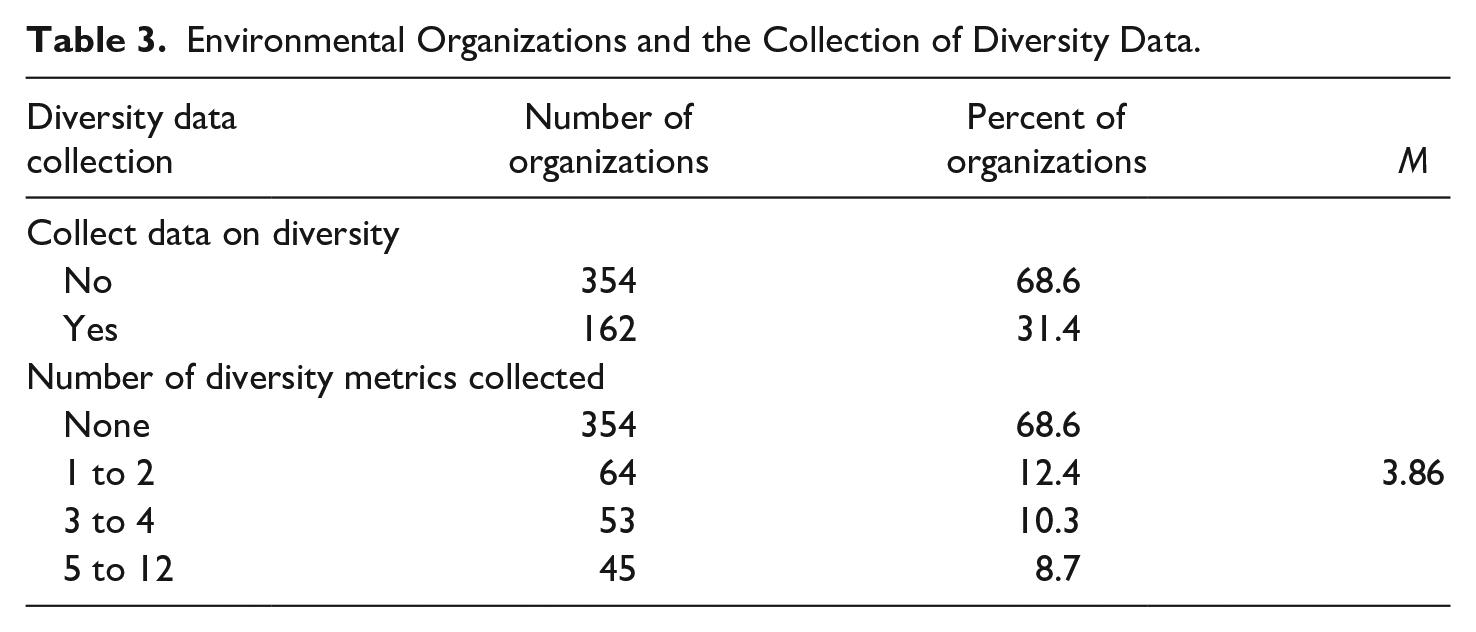
The study reported herein finds that 162 or 31.4% of the organizations collect data on or track at least one diversity metric in 2018. It means that 68.6% of the organizations do not collect data on any of the 12 metrics studied in this article. Though, the organizations collecting diversity data collect information on anywhere from one to 12 of the metrics reviewed, the mean number of diversity metrics that the 162 organizations collect data on is 3.86 (see Table 3). Most frequently, data are gathered on the gender of the staff, race/ethnicity of the staff, gender of the board, and the race/ethnicity of the board.
Environmental Organizations and the Collection of Diversity Data.

The collection of diversity data occurs primarily in urbanized areas. Accordingly, 106 or 65.4% of the 162 organizations that collect diversity data are in urbanized settings. When the three different locales are studied, 33.2% of environmental nonprofits in urbanized areas collect diversity data, so do 30.6% of the organizations in urban clusters. Only 22.4% of rural environmental nonprofits collect diversity data (Table 4).
Characteristics of Environmental Organizations that Collect Diversity Data.
There are noticeable regional variations in the collection of diversity data. Diversity data is most often collected in organizations in the Southwest region and least likely to be collected in the Plains-Mountain region. Hence, 43.6% of the environmental organizations in the Southwest collect diversity data, 34.9% of those in the Mid Atlantic, 34.1% of those in the Southeast, a third of those in the Pacific, and 31.1% of those in the Midwest collect diversity data. A fourth of the New England organizations also collect diversity data. In comparison, only one fifth of the organizations in the South and 9.5% of those in the Plains-Mountain region collect diversity data.
Organizational typology also matters in the likelihood of collecting diversity data. The organizations with the greatest propensity to collect diversity data focus on food security issues; two thirds of these organizations gather diversity data. Moreover, between 42% and 55% of the climate action, alliance and advocacy, environmental justice, and environmental quality organizations also assemble diversity data. By far, the largest number of organizations in the sample are categorized as natural resource conservation and protection institutions, yet only 27.6% of these institutions collect diversity data. The environmental organizations that are least likely to collect diversity data are recycling, forest conservation, professional associations, and outdoor recreation institutions. Less than 20% of these last four environmental organizations collect diversity data.
The gender of the CEO also influences whether diversity data is collected. Organizations with women CEOs are much more inclined to collect diversity data than organizations with men CEOs. Therefore, 37.6% of the women-headed environmental organizations and 24.2% of the men-headed environmental organizations collect diversity data. Where men and women share the CEO position, 35.7% of those organizations collect diversity data.
The gender of the board chair is also consequential in diversity data collection. Organizations with men chairing their boards are less likely to collect diversity data than organizations with women board chairs. So, 37.3% of the organizations with women board chairs collect diversity data compared with 29.9% of the organizations with men board chairs. However, the organizations most likely to collect diversity data have men and women co-chairs. In these organizations, 62.5% collect diversity data.
The race/ethnicity of the CEO is also influential in diversity data collection. Organizations with White CEOs are less likely to collect diversity data than institutions with CEOs of color. The study finds that 32.4% of the organizations with White CEOs collect diversity data compared with 43.1% of those with CEOs of color. In organizations with Whites and people of color sharing the CEO position, a quarter of them collect diversity data.
The pattern is similar for the relationship between the race/ethnicity of the board chair and the collecting diversity data. While 41.7% of the organizations with board chairs who are people of color collect diversity data, a third of the organizations with White board chairs collect this type of data. Only three organizations have co-chairs who are White and people of color; none of these organizations collect diversity data.
Organizations with women of color CEOs are more likely to collect diversity data than nonprofits with White women, White men, or men of color CEOs. The same is true for organizations with women of color board chairs. The study finds that 53.1% of nonprofits with women of color CEOs collect diversity data. In comparison, 37.2% of nonprofits with White women CEOs, 26.1% organizations with White men CEO, and 25.0% of the institutions with men of color CEOs collect data.
When women of color are the board chairs, their organizations are more likely to collect diversity data than organizations with other types of board chairs. Consequently, 43.8% of the organizations with women of color board chairs and 42.9% with men of color board chairs collect diversity data. The data show that 39.7% of the nonprofits with White women board chairs and 30.5% of those with White men board chairs collect data on diversity.
The article examines two indicators of size—staff size and budget size—and finds that the relationship between size and diversity data collection is not linear. Organizations with 10 to 49 staff are more likely to collect diversity data than others. While 30.8% of institutions with less than ten staff and 30.0% of organizations with 50 or more staff collect diversity data, 43.6% of those with 10 to 49 employees gather such data.
The organizations with the smallest budgets (under $100,000) are far less likely to collect diversity data than organizations with larger budgets. Only 5.9% of organizations that report having no budgets or do not disclose their budgets collect diversity data and fifteen percent of those with budgets between $1,300 and $99,000 collect such data. In contrast, 33.1% to 39.6% of the remaining institutions collect diversity data.
The presence of a diversity committee significantly increases the likelihood that an organization collects diversity data. While 70% of the organizations that have diversity committees collect diversity data, 44.2% of those that do not have such committees collect this kind of data. Only 11.9% of the organizations that do not say if they have a diversity committee collect any diversity data.
Differences in Collecting Diversity Data on the Staff and Board
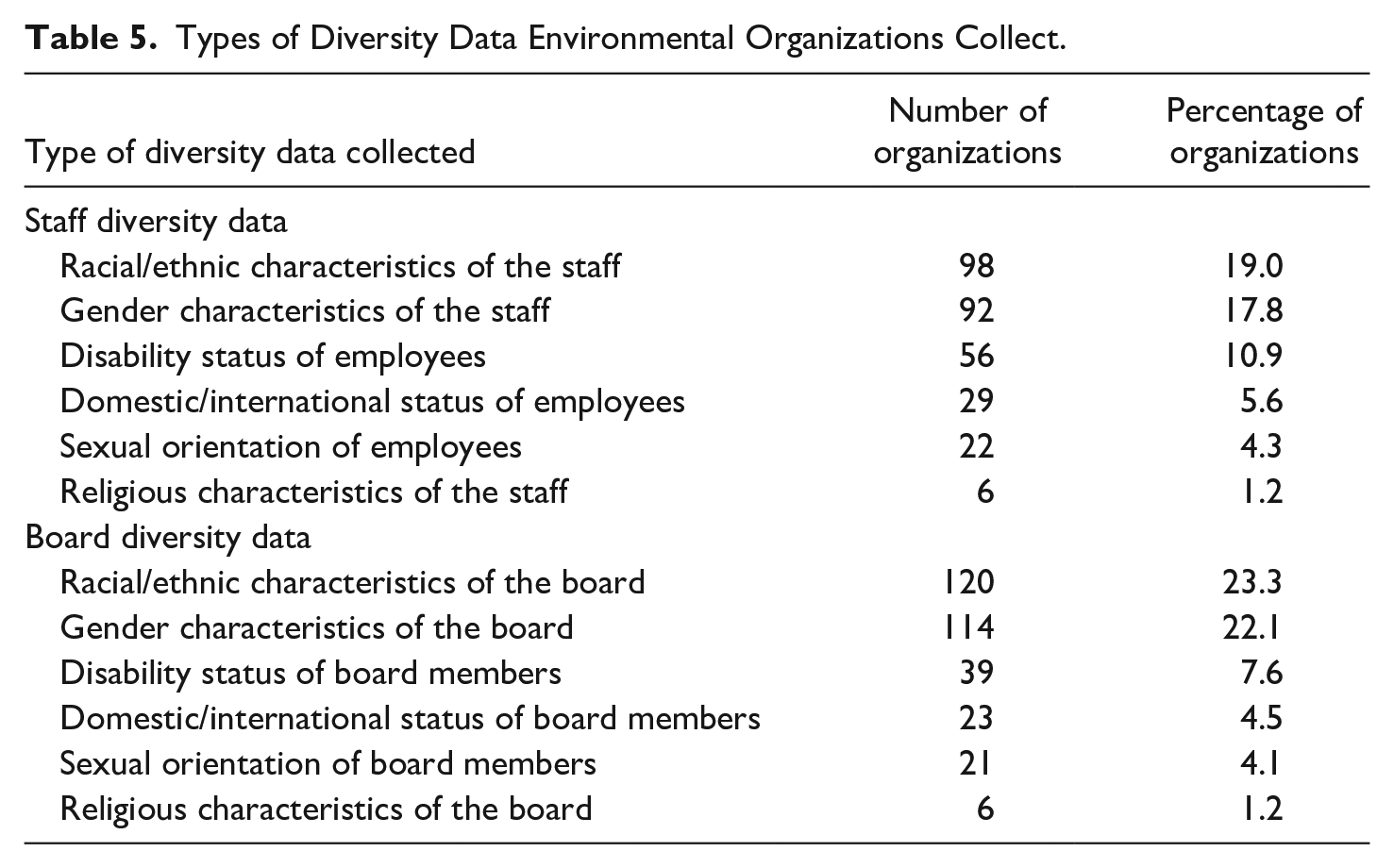
Though diversity advo- cates focus on whether organizations collect and disseminate staff diversity data, nonprofits studied are more likely to collect diversity data on their boards than on their boards than on their staff (Table 5). The most frequently collected diversity metric in the environmental organizations studied is the racial/ethnic composition of the board, and gender characteristics of the board follow this. The study results show that 23.3% (120) of the nonprofits report that they collect data on their boards’ racial/ethnic characteristics. In comparison, 22.1% (114) collect data on the gender characteristics of the board. In contrast, 19.0% (98) of the organizations collect racial/ethnic data on their staff, and 17.8% (92) collect data on the gender characteristics of their staff.
Types of Diversity Data Environmental Organizations Collect.
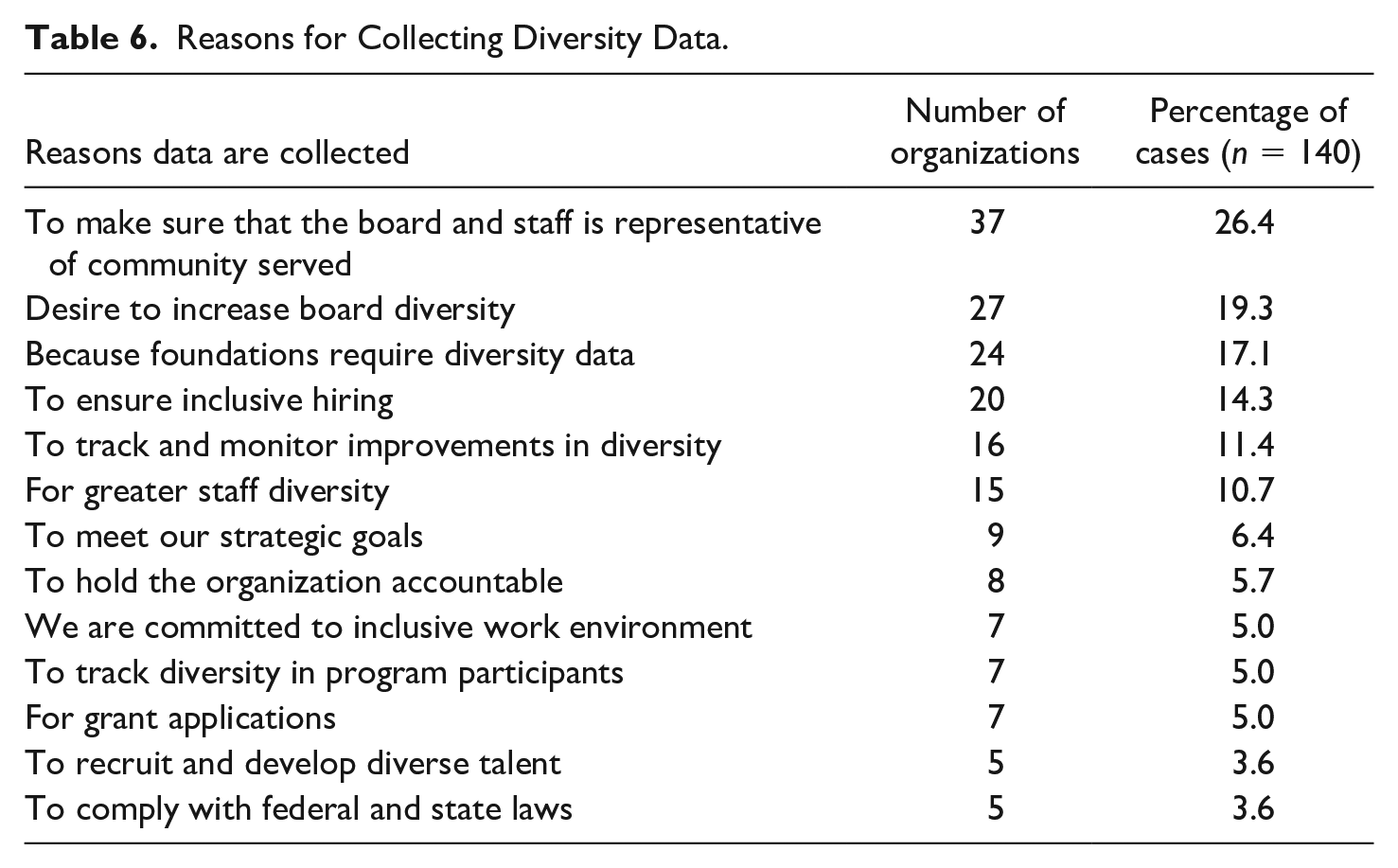
Table 5 also indicates that more environmental nonprofits collect disability data on their staff than on their boards. While 56 institutions collect staff disability data, only 39 collect this metric for their boards. The pattern is similar for collecting data on the domestic or international status of employees versus the board. Almost the same percentage of organizations collect sexual orientation data for their staff and board. Hence, 22 (4.3%) of the organizations in the study gather staff sexual orientation data and 21 (4.1%) collect data on this metric for the board. The least-collected diversity metric studied is religious background; 1.2% (6) organizations assemble this data for their staff and boards.
Reasons for Collecting Diversity Data
Making the Board More Representative
The survey asks respondents to say why their organizations collect diversity data. A total of 140 organizational representatives answered this question. The top reason is that organizations collect diversity data to ensure that their boards and staff represent the communities they serve; 26.4% of the responses mention this factor (see Table 6).
Reasons for Collecting Diversity Data.
However, there is greater concern for the board to be representative of the community than the staff. This concern is evident in statements such as, “We do collect demographic data for our board, including some diversity-related data, in an attempt to ensure we’re representative of our community.” For another organization, tracking board diversity helps it to better represent their service area. According to the organization’s representative, the “primary factors for tracking diversity on our board is to have a representative sample from the different communities in our service area.”
Another organization takes a similar approach. Hence the respondent writes, We collect basic information on gender, age, race, geographic representation, and occupation. We feel this is the information we need to ensure our board is representative of our watershed.
There is a strong concern for gender imbalance on boards and community representation. Consequently, organizations respond to this challenge by collecting and using diversity data to effectuate change. According to a respondent, We want to be representative of our community as a whole. We are very out of balance when it comes to gender on the board, vs. our community, so we are tracking that data in particular.
Shifting the Balance of Power
One environmental organization attempts to become more representative by shifting the balance of power in the organization and giving community members more influence over how the organization functions. The study participant says, We make an effort to be representative of these diverse communities as a matter of providing equal voice and a balance of power but do not collect diversity data specifically.
Responding to Funders
Environmental organizations are sensitive to requests from funders to collect and provide diversity data. Consequently, several study participants say they collect diversity data to satisfy funding requirements. The following statements reflect these reasons: “The only time we collect diversity data is when applying for grant funding, and then the figures are only approximate.” Organizational representatives also say we collect diversity data, “For [the] purposes of applying for grants and funding proposals,” or “A growing number of foundations request diversity data from organizations applying for funding,” and “We collect data for internal monitoring and to report to foundations.” One respondent notes that “There are not many requirements for us to track this information. However, some foundations do request diversity data.” Other comments on collecting diversity data for funding purposes include the following: We sometimes need to know diversity information for grants and we know who is who and report that info as needed but we do not formally collect data on much of anything. We collect data on underprivileged youth for funding and program purposes. We collect data on various diversity issues to build diversity among our board, staff and students. To track our progress on meeting increased diversity and equity goals, for funding agencies.
Reducing Bias in the Hiring Process
Organizations also use diversity to discourage discrimination during the hiring process. They track diversity data because, “It is important for us to ensure we are inclusive in our hiring decisions and also for reporting to funders who request this information.” Another study participant reports, “We track racial and gender data to help evaluate our hiring practices and our progress towards our goal to having a more diverse staff.” Other respondents say, We have a policy not to discriminate in our hiring process. To this point, we’ve hired and recruited board members based on qualifications impartial to diversity data. We’ve discussed how to gather diversity data and are still discussing when and how to best proceed. “_____ introduced us to Green 2.0 and . . . the State of Diversity in Environmental Organizations. . . . The report made me realize just how easy and almost automatic it is to simply call someone that I know in the tree community when trying to fill a staff or board position. When hiring our most recent staff person, who is Latina, I could have filled the position with someone I knew within 2 weeks. Instead we took 4 months to keep the position open and continue to share the opportunity via our environmental justice partners.
Some small organizations use the hiring process to achieve greater diversity, for instance two study participants report that We are a very small organization. Although we don’t track this information officially, we are aware of our diversity mix and do our best to address it in hiring and recruiting. We exist in a very male-dominated industry and are proud of the amount of women in our organization. It is a start. We’re a very small organization. We see the need for more voices at the table to represent perspectives that we know are not being considered. The “data” we collect is the most obvious—race and gender because it’s an informal conversation with the hiring and nominating committee rather than a deliberate exclusion/inclusion policy.
Considering Future Diversity Strategies
The survey made respondents reflect on future diversity strategies their organizations may adopt. As one study participant states, Diversity of a bunch of kinds is important to us, but I don’t think it has occurred to us to track data on sexual orientation, disability, or national origin - which is to say, we haven’t consciously sought those kinds of diversity in our hiring pool or board positions. We have very consciously focused on racial and ethnic diversity of staff and board. Gender diversity we pay attention to . . .
Reasons Why Organizations do not Collect Diversity Data
Small Size Perceived as Limiting
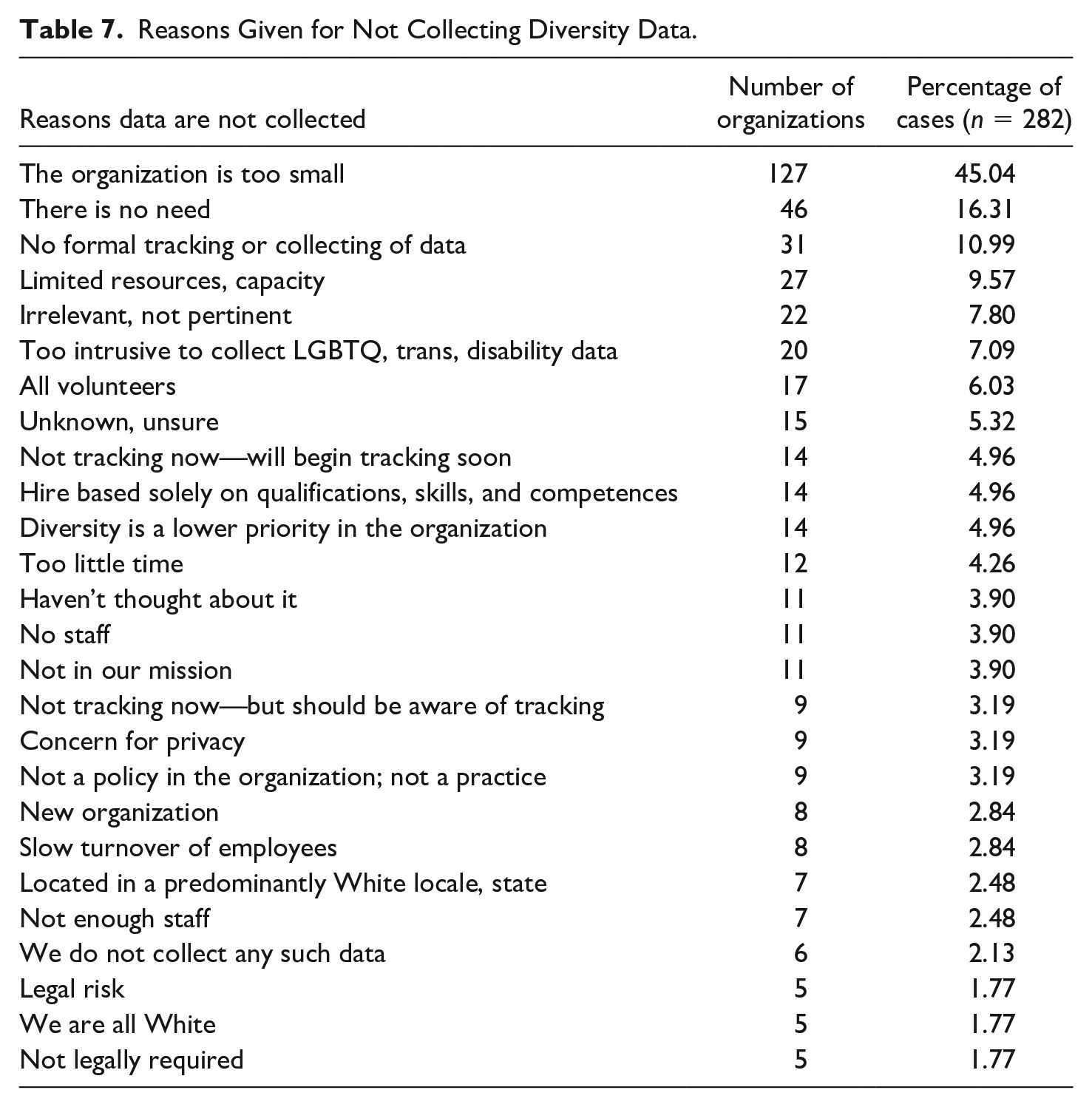
Overwhelmingly, respondents say that their organization refrained from collecting diversity data because the organizations are too small (Table 7). Roughly 45% (or 127) of the organizations that explained why they do not collect diversity data say they are not collecting this type of data because they are too small to do so. Forty-six organizations feel there is no need to collect diversity data and 31 organizations have no formal tracking of this type of data.
Reasons Given for Not Collecting Diversity Data.
Responses related to the organization’s size had comments indicating that all the staff is familiar with each other, so there is no need to collect and track data. Some respondents in small organizations said they tracked diversity, but there is no formal documentation. They also suggest that if there is an external need to collect diversity data—such as a request from funders—they will collect such data.
Such participants say, We are a small under-resourced nonprofit and this is not data pertinent to our hiring practices. Therefore, we do not collect it. We are a small staff, so “collecting data” really is just looking at the room. We are very small, so we don’t keep track of it officially. I informally keep track of it but we do not have a formal program to do so, it is mostly in my head . . . We’re a very small group, and don’t see the need for it. We’re too small and don’t have the resources to track this stuff. We know these characteristics because we’re a small team, but we do not document them or ask outright as part of our hiring or reporting process. As we grow larger, we may begin to do this. We are aware of the need to increase diversity in our board, staff and supporters. However, we are such a small organization, no one has the data officially tracked. We are a small organization, and we haven’t collected diversity data in the past. As part of our new diversity and inclusivity efforts, we are beginning to track this information in a more systematic way . . . We are small, there is no use for the data if we were to keep it. We are a small recycling non-profit and don’t see a reason to collect this. I have never considered doing so [collecting diversity data]. We see little turnover at our small organization, so we “know” who is here and who isn’t. I have pressured the board to be more conscious of gender balance (more women!) but we have never thought about or aimed to diversify race here in WV [West Virginia].
The small size of some nonprofits also interfered with the ability of organizations to hire human resources (HR) staff to collect and track diversity data. Some respondents comment on this factor in statements such as the two below: We are a relatively small organization and have not had dedicated HR staff until recently where this information could be gathered. We are a small organization, and the tracking/collection of data has never been assigned to anyone for official tracking.
Not a Funding Requirement
When funders do not ask for diversity data, organizations tend not to collect it. According to an organizational representative, we do not collect diversity data because there is a “lack of requirements” to gather such information “for reporting in grants.” Other respondents make similar comments. For instance, Since it does not seem to be an influencing factor for grants (public or private), it is therefore not collected. For the first time last year because of information asked by a private funder, people were asked, but that was specifically geared to race. We don’t receive grants, we’re barely able to make ends meet. . . collecting data on someone’s sexual orientation is literally the last thing I could imagine caring about.
Not Pertinent, Relevant, nor a Priority
Twenty-two respondents indicate that they do not collect diversity data because such information is not pertinent to their organization’s work. At the same time, 11 say diversity data is irrelevant to their mission. A study participant notes, “These data have no bearing on our work.” The respondent goes on to say, “We don’t have a lot of funding and work super hard to make sure our work and impact continues for future generations; we have to stay focused on our mission.” Another participant indicates that their organization does not collect diversity data because they do “Not know . . . why it is needed or relevant.”
A respondent from the Plains-Mountain region, where only two organizations in the region collect diversity data, explains that collecting diversity data was not a priority for their organization because, We are a small organization, in a state that is predominantly White (truly, Montana is primarily White—especially rural Montana). We just brought on the first Native American board member within the last month! It has not been a priority for the previous executive directors or board of directors, primarily due to naivete and White privilege . . . not malicious, just unconscious.
Lowering Skills, Qualifications, and Work Experience of Employees
A recurrent theme in the responses is the notion that diversity hinders hiring qualified and experienced staff. For instance, a respondent writes, “Hiring at our organization is based solely on skills needed to perform the job.” About 5% (14) of the respondents associate diversity and the collection of diversity data with lower qualifications and skills in workers. They also feel that data undermines their ability to hire the most qualified candidates. The following statements reflect their feelings: We are committed to not hiring on the basis of skin color, ethnic heritage, gender, age, sexuality, religion (or lack thereof), etc. We rely on qualifications and experience as our basis of hiring and retaining employees. As the executive director, I develop a relationship with each employee, and encourage love and respect for all people no matter what. [Diversity data collection is] not material to our business. We hire the most suitable and best qualified candidate for a position, regardless of diversity. … We’re a very small organization with one part time staff person and a 10-member board. . . . Race is a sociocultural phenomenon and not a scientific category. [I] do not want to participate in reifying something with no scientific existence. Hiring is done based on the applicant’s experience and ability to perform the job duties. Because we’re small, we hire staff based on qualifications, and thus far none of our funders or partnering organizations have ever requested this data. We are very small, and every person is interconnected on our staff, so personality fit and team working ability is primary. Common sense. People are employed based upon their interest and ability. Period. We are very small, in a remote area of northern California where the population is predominately White, and the people in our field are predominately women. With limited resources and a small employee pool in our community, we hire individuals who are best suited for the job, and look for diversity when available.
Invasion of Privacy and Intrusion
Study respondents also indicate that their organizations do not collect and track diversity data out of concern for the privacy of their staff and board members. Such respondents also feel that collecting diversity data is inappropriate and too intrusive. Small organizations are concerned about these factors because they fear that staff and board members cannot remain anonymous if they amass and reveal the data. Examples of these comments are as follows: … Collecting information on religion, gender identity, sexuality . . . it just seems too intrusive. We have a non-discrimination policy, and as the ED [executive director] I work to ensure it is enforced for staff and board. But honestly, I don’t think it’s my business if someone is transgendered or gay or Christian. They can tell me if they want, but that’s their business, not mine. … I may have queer-identifying staff—I’ve considered it inappropriate to ask those questions in small workplace (and town). [It] seems inappropriate and invasive to outright ask and document some types of characteristics. We are a small intimate organization. We believe in full inclusion and strive for diversity. However, we also believe in privacy. … We do not inquire or track diversity information relative to LGBTQ, Transgender or disability because that seems intrusive. Since we are so small, we would have no easy way to collect certain information from staff and board members without compromising anonymity and/or feeling intrusive. Very intrusive on the person information is collected about, also very small organization we pretty much know each other’s business. It feels like an invasion of privacy sometimes.
Legality of Data Collection Questioned
Some organizational representatives question the legality of collecting diversity data. In some cases, the organizations’ legal counsel discourages the collection of such data; in other cases, respondents indicate that they are not required to collect the data, therefore, do not gather it. Study participants explain, For staff, we don’t track/collect this info as I thought that was illegal. We work in many countries, and in some of these it is either illegal or highly risky to be queer/gay/lesbian. So, we do not ask people about their sexual orientation. Religion is also something that we do not track for all staff; although some staff are openly religious, many are not. While we track disability accommodations when requested, we do not ask everyone about their access needs (and could do a better job of this in the future). There are legal reasons why we cannot collect such data. Maryland law prohibits asking about most of these characteristics. We are not legally required to and have historically not made collecting this information a priority. We refrain from collecting this data because we are unsure of how to do it in a way that respects the privacy of the individuals within our organization as well as does not put us at risk of legal action for discriminatory practices. Don’t do HR or legal work in house, [we have a] subcontractor. Only collect what is legally required or offered by the employee. We don’t have spare time. It doesn’t seem appropriate, ethical, or in some instances legal (i.e., asking people about disabilities). Legal advice from counsel and lack of resources to do such work. We are a very small organization interested in monitoring land use decisions at the county, city/town and sometimes state level. Legal risks. Cultural expectations around what identity information is considered “private” and “public.”
Placing a Premium on Friendship and Fitting In
Some study respondents who question the validity of incorporating diversity factors into the hiring process say they place a premium on friendships, personality, and fit with the existing staff and culture of the organization when hiring. Hence, they do not see the need to collect diversity data. Study participants say, … . the Executive Director who is hired for their personality and skills and usually stays on for 5 or more years. There’s no need [to collect diversity data]. Everyone in the organization has known everyone else since they were children. We are very close friends, and so we know all of this information about each other.
Do not Know How To
One respondent reported that their organization is interested in collecting diversity data but does not because they did not know how to collect and use it.
We do not collect other data because we don’t know how to. We would like to collect diversity data on our entire membership but aren’t sure the proper way to do so. We wish to increase diversity in order to invite diverse ideas and life experiences to improve our work.
Sharing Diversity Data
The study finds that organizations are more likely to collect diversity data than sharing it internally or externally. As the article reports above, 31.4% (162) of the nonprofits collect information on at least one diversity metric. In comparison, 25.8% or 133 institutions disseminate information on at least one of the diversity metrics.
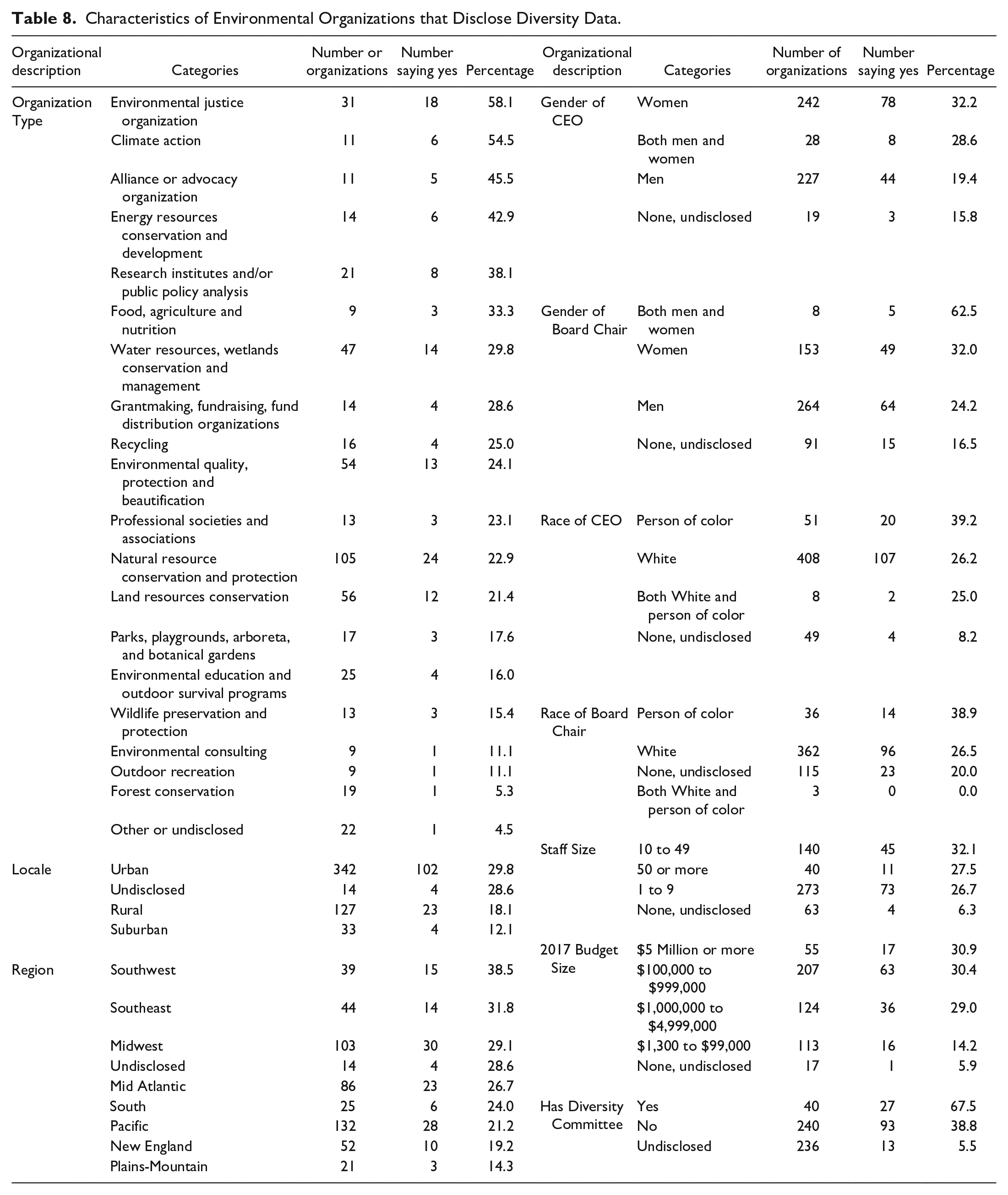
Organizations in urbanized areas are much more likely to reveal the diversity data they gather than those in urban clusters or rural locales (Table 8). While 29.5% of the nonprofits in urbanized areas disseminate their diversity data, only 20.1% of the environmental organizations in urban clusters and 16.3% of rural organizations disclose their diversity data. There are also noticeable regional variations in reporting. A higher percentage of organizations in the Southwest disclose diversity data than anywhere else in the country. So, 38.5% of the Southwest nonprofits divulge their diversity data. However, only 14.3% of the Plains-Mountain organizations do the same.
Characteristics of Environmental Organizations that Disclose Diversity Data.
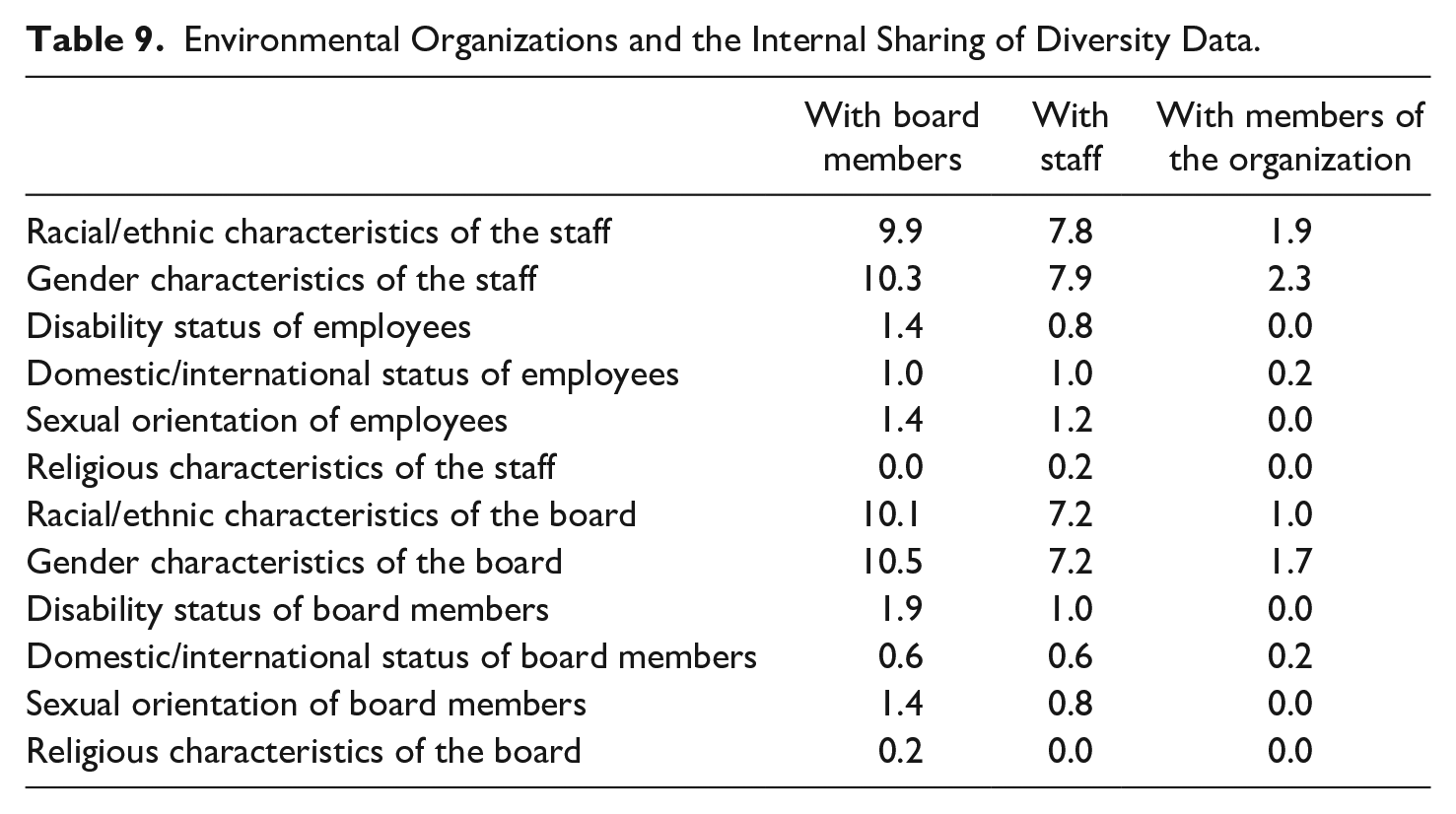
Table 8 also shows a big variance in reporting in the different types of environmental organizations. More than half of the environmental justice and climate action organizations disseminate their diversity data (58.1% and 54.5%, respectively). Additionally, over 40% of alliance/advocacy organizations and energy resources institutions divulge their diversity data. On the other hand, less than 20% of the parks and playgrounds, environmental education, wildlife preservation, environmental consultancies, outdoor recreation, and forest conservation organizations disclose their diversity data.
Organizations with women CEOs are more likely to disclose their diversity data than those with men CEOs. While 32.2% of the environmental nonprofits with people of color CEOs divulge diversity data women CEOs disseminate their diversity data, only 19.4% of those with men CEOs do similarly. There is also a gap between the disclosure rates of organizations with women board chairs and men board chairs. When women chair the boards in organizations, 32.0% of those nonprofits reveal their diversity data. In contrast, 24.2% of the organizations with men board chairs share their diversity data.
The presence of people of color in the CEO and board chair positions is also positively associated with the revelation of diversity data. Thus, 39.2% of the organizations with people of color CEOs divulge diversity data. In comparison, only 26.2% of organizations with White CEOs disseminate their organization’s diversity data. The pattern is strikingly similar when board chairs are considered. If the nonprofits have people of color board chairs, 38.9% of those organizations reveal their diversity data. It can be contrasted to organizations with White board chairs—26.5% of these nonprofits disclose their diversity data.
When organizations have no staff or do not disclose the size of their staff, they are far less likely than other organizations to disclose any diversity data. The organizations most likely to disseminate diversity data have 10 to 49 employees. Organizations with budgets less than $100,000 are significantly less likely to share diversity information than those with larger budgets. Between 29.0% and 30.9% of the organizations with budgets exceeding $99,999 reveal their diversity data.
Having a diversity committee is also integral to the release of diversity data. Roughly two-thirds of the organizations with diversity committees disseminate their diversity information. However, only 38.8% of those who do not have such a committee disclose their diversity data.
Sharing Data Internally
The analysis uncovers three target audiences for internal data sharing—disclosure to board members, employees of the organization, and members (Table 9). The results show that organizations divulge diversity data about their board more willingly than their staff. Moreover, organizations are more comfortable sharing gender diversity data than any other diversity data.
Environmental Organizations and the Internal Sharing of Diversity Data.
Organizations tend to report diversity data most frequently to their boards. So, most often when boards hear about their organizations’ demographic characteristics, they receive information about themselves. Thus, 10.5% of the organizations report the gender characteristics and 10.1% the racial/ethnic characteristics of the board to their boards. Similarly, 10.3% report gender characteristics and 9.9% report their staff’s racial/ethnic characteristics to their boards. Less than 8% of the organizations make diversity reports available to their staff, and around 2% share their diversity data with their memberships.
Sharing Data Externally
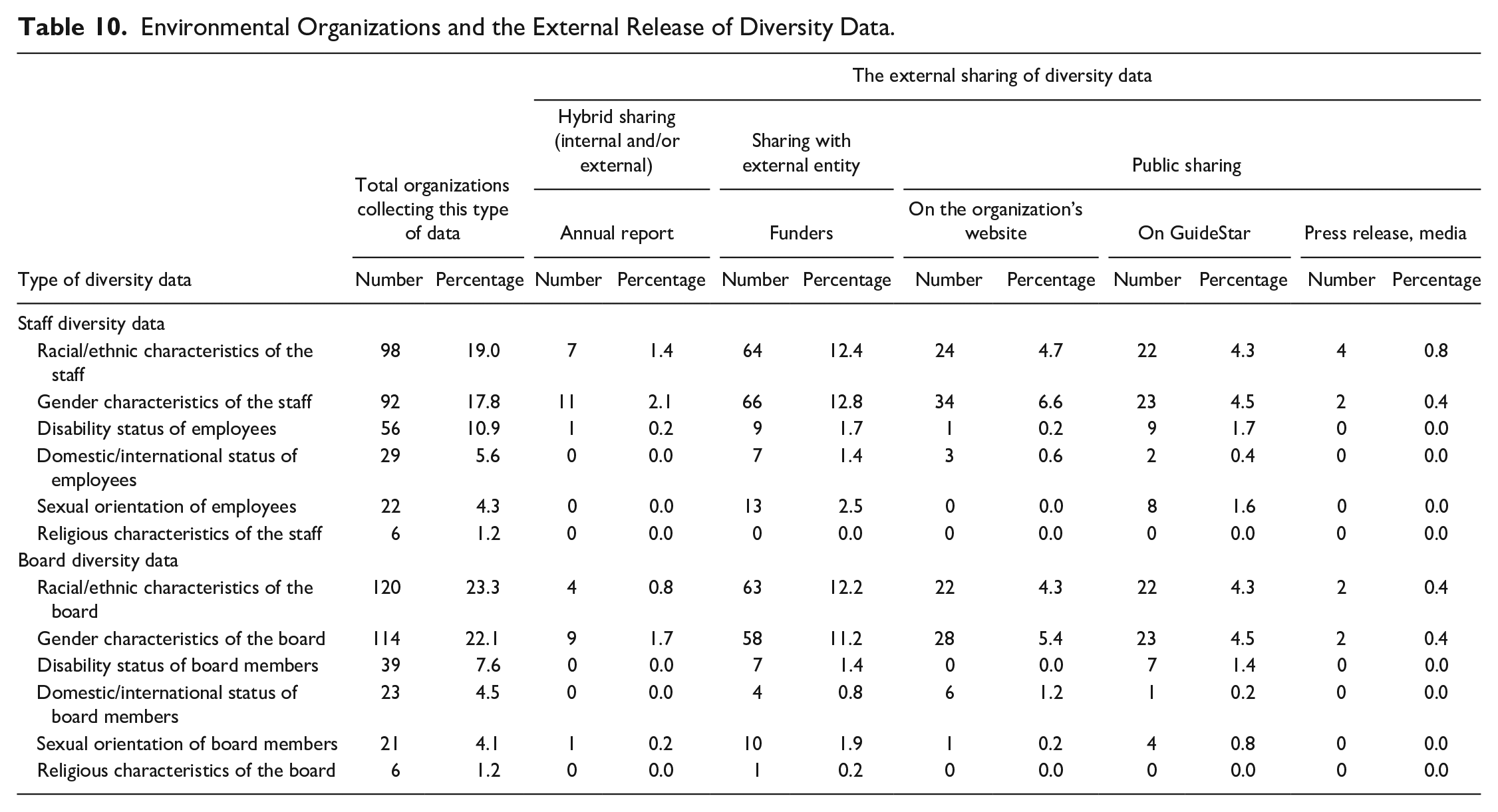
The study examines five mechanisms through which organizations share diversity data externally (Table 10). The first is in annual reports. Annual reports can be internal documents, or they may be publicaly available. They are a hybrid form of data sharing that can be inward-facing or outward-facing. The results show that this is a little-used form of sharing diversity information. Only 2.1% of these documents contain diversity information about the gender composition of the staff, and 1.4% have information about the racial/ethnic composition of the staff. Less than 2% of the annual reports contain any information about the demographic characteristics of the board.
Environmental Organizations and the External Release of Diversity Data.

Though funders are external to an organization, diversity data shared with these entities are usually kept private. Environmental organizations that collect diversity data are more likely to reveal such data to funders than anyone else. In a departure from the patterns established above, organizations are more likely to divulge staff diversity data to funders than board-related diversity data. Comments made by respondents above suggest that this may be the case because funders ask for staff diversity data more often than other data types.
As a result, 12.8% of the organizations impart diversity information about the gender composition of their staff and 12.4% divulge the racial/ethnic make-up of their staff to funders. In comparison, 12.2% of the organizations in the sample reveal their boards’ racial/ethnic characteristics and 11.2% the gender composition of their boards to funders.
The three remaining mechanisms for sharing data involve disclosing the data in public places: on the organization’s website, on Candid, or through the media in press releases, etc. The public sharing of diversity data occurs at a much lower frequency than sharig internally with funders. A slightly higher percentage of the organizations post their diversity data on their websites than on Candid. Therefore, 6.6% of the organizations disclose their staff characteristics and 4.7% their race/ethnic composition on their websites. Despite the transparency campaign to get environmental organizations to release their diversity data on Candid, a modest 4.5% of the organizations share diversity data on the gender composition of their staff and boards and 4.3% disseminate information about their staff and boards’ race/ethnicity make-up on the platform. Only a handful of organizations distribute any diversity data through the media.
Discussion
Rethinking Transparency
This article furthers our understanding of how transparency relates to the collection and distribution of diversity information in environmental organizations. The article also suggests that the time is right to rethink what is needed to enhance the dissemination of diversity data and assess progress on efforts to improve data-sharing efforts. To date, transparency campaigns and research have focused on disclosing employees’ gender and racial/ethnic characteristics on Candid. However, the article demonstrates that such a narrow focus and misses critical aspects of transparency that should be a part of diversity campaigns. The focus on Candid also underestimates how organizations are collecting and disseminating diversity data.
Results from the survey discussed in this article show that there might be a disconnect between diversity advocates and environmental organizations. While transparency advocates focus on staff diversity, the article shows that environmental organizations are more likely to focus on diversifying their boards and reporting those results. The article also suggests that diversity information on the board, membership, volunteers, program participants, vendors, other service providers, headquarters and branch offices of national environmental nonprofits, and so on can be tracked and incorporated into an organization’s overall diversity strategy. The dissemination of diversity data can be followed through annual reports, on various Internet portals, and by various other means.
Transparency campaigns are still in their infancy; advocates are making demands to halt the secrecy about the demographic composition of staff and insisting that this is made public. Scholars would agree that this is an important first step in increasing the flow of information from environmental nonprofits to interested parties (Florini, 2000; Gupta & Mason, 2014; Lockwood et al., 2012; Peterson, 2020). However, Gupta et al. (2020) argue that it is just as important to establish structures get adequate transparency.
The above findings suggest that for transparency campaigns to build on their successes, diversity advocates must distinguish between the different dimensions of transparency and incorporate these into their campaigns. So, it is not just a matter of asking if diversity data are collected; the focus should also be on the kinds of diversity metrics gathered. Similarly, it is not enough to assess if diversity data is posted on one dissemination portal; it is important to determine how organizations share data internally, in hybrid forms, or externally. Hence advocates should pay attention to multiple mechanisms for public disclosure. In addition to the dissemination platforms examined in this study, a growing number of environmental organizations—especially the smaller ones—share information about their institutions on Facebook, Twitter, Instagram, LinkedIn, and other social media platforms. It means that diversity advocates should be conscious of how they can use these outlets to promote diversity.
Diversity advocates will achieve greater success with transparency campaigns if they expand their focus to examine organizations in small towns and rural areas. When transparency campaigns target only the largest 10, 20, 40, or 50 environmental organizations, the campaigns inadvertently focus only on organizations in a few metropolitan areas. It is the case because the largest environmental organizations are found in a handful of cities. To reach and influence the greatest number of enviros, diversity advocates must appeal to as many organizations as possible, not just a small select group.
The Disclosure Gap
This study identifies an uninvestigated disclosure gap in research on diversity and transparency in environmental organizations. The gap occurs on several levels. First, the research finds a gap between the collection of diversity data and the diffusion of that data. In essence, more organizations are collecting diversity data than are revealing those data. Hence, it would behoove diversity advocates to recognize and pay attention to this gap in their campaigns. One cannot assume that because an organization does not disclose diversity data, they have not gathered it.
Second, if organizations reveal their diversity data, there are gaps between the extent to which diversity data is shared internally and externally. This phenomenon merits further investigation as there is currently very little information on the balance between internal and external sharing of diversity data.
Organizations in the sample raise essential concerns about disclosing organizations’ demographic data that must be taken seriously and factored into how diversity strategies are developed. Study participants worry about the lack of anonymity that the public disclosure of diversity data can cause. More effort should be invested in finding solutions to such challenges. For instance, small organizations could reveal a 3-year or 5-year average instead of showing diversity data for each year. Such an approach may not solve all the problems but could alleviate many.
Funders and Financial Leverage
The research finds that organizations are more likely to share diversity data externally to sources with financial leverage than any other source. The findings suggest that foundations and funders wield significant influence in getting organizations to collect diversity data, use such data to guide operations, and share that data. Several respondents indicated that their organizations do not collect such information when funders do not request diversity data.
It is intriguing to consider the foundation leverage more. GuideStar’s merger with the Foundation Center put nonprofit and environmental grantmaking databases under one roof (Olsen, 2019; Paynter, 2019). It presents an opportunity to have foundations do aggregate disclosure of the diversity of their environmental grantmaking and other portfolios. Thus far, diversity campaigns urge foundations to reveal the demographic characteristics of their staff and to encourage their grantees to disclose diversity data on GuideStar (Green 2.0, 2015, 2017, 2018, 2019; GuideStar, 2014; Marrow, 2015; Rapson, 2015; Taylor, 2014, Taylor et al., 2019; West, 2016). However, diversity advocates have not asked foundations to review their grant portfolios and reveal the demographic characteristics of their grantees. Given that foundation sizes, grant budgets, and the overall number of grants vary, foundations could report this information in aggregate and as multi-year averages. The Candid platform is well-positioned to be a space for such disclosure and analysis. In addition, foundations can continue to encourage their grantees to disclose diversity data to foundations and the public.
Organizational Size, Gender, and Race of Leadership
The results presented above show that environmental nonprofits with budgets of less than $100,000 and fewer than ten staff are less likely to collect and disseminate diversity data than other organizations. Taylor et al. (2019) contend that larger organizations report diversity data at a higher rate than smaller organizations. However, the findings of this article suggest that the relationship between staff size and data collection and reporting is not necessarily linear. The relationship between budget size and data collection and reporting is also nonlinear.
This article implies that researchers further examine how organizational size relates to data collection and reporting. The results presented above show nonlinear relations between the two indicators of organizational size and data collection and dissemination. It is the case because of the interaction effects between the gender of the top leaders and organizational size. The study finds that organizations with women CEOs and board chairs have a greater propensity to gather and reveal diversity data. Furthermore, women of color CEOs and board chairs are more likely than any other group to collect and disclose diversity data.
Though there are more women CEOs in the sample than men CEOs, they are not equally distributed in the sample. There are a much larger number of men board chairs than female board chairs. Then again, the distribution of the board chairs across organizations of different sizes also matters. Women CEOs and board chairs are concentrated in mid-sized organizations (that have 10 to 49 staff and budgets of $100,000 to $999,000). Women of color CEOs are also concentrated in this type of organization. This category of organizations collects and discloses diversity data more than other institutions. Overwhelmingly, men CEOs and board chairs are at the helm of organizations with budgets of $5 million or more and 50 or more staff. Organizations with men CEOs and board chairs are less likely to collect and reveal diversity data. As a result, the largest organizations do not have the highest rate of collecting and reporting diversity data.
The location of so many men CEOs and board chairs in the largest organizations suggests that diversity campaigns should focus on diversifying this segment of the environmental workforce and the role these leaders can play in urging their organizations to collect reveal diversity data. The article shows that outcomes also depend on the kinds of diversity data collected and assessed. Hence, it is also essential to account for how and where the data is being disseminated.
Dispelling the Myths about Qualifications, Missions, and the Relevance of Diversity
Not all senior leaders of environmental organizations think that diversity efforts will enhance the quality of their workforce. They contend that they do not collect diversity data because they believe that hiring employees from diverse backgrounds and striving toward having a diverse workforce will introduce unqualified workers onto their staff. Some think that diversity data collection is irrelevant to the operations of their organizations. Such leaders also agree with environmental organizational leaders of a bygone era who argued that focusing on diversifying the workforce is anathematic to their organization’s mission (Cohen, 1988; “Earth issues lure,” 1990; Shabecoff, 1990).
The respondents who expressed this viewpoint are running counter to the findings of the scholarly literature on the benefits of diversity to institutions like environmental organizations. Researchers such as Patrick and Kumar (2012) find that organizations with more diverse workforces have higher-performing staff. Studies also find that organizations with more diverse staff have more effective conservation outcomes (Westermann et al., 2005). Such organizations also have more environmentally friendly business strategies (Glass et al., 2015; Liu, 2018). The above discussion suggests that activists and researchers must articulate how environment and diversity are related more clearly. It is vital to make the case that diversity is beneficial to the whole organization. Issues such as transparency in compensation, promotions, and advancement benefits all employees when such diversity activities are incorporated into institutional operations.
Conclusions
The widespread unrest in the United States. in the summer of 2020 has led to renewed interest in diversity and improved race relations in American environmental organizations. For the first time, major environmental nonprofits such as the Sierra Club, National Audubon Society, and Save the Redwood League acknowledge the racism and discrimination that underpinned the founding of these groups (Brune, 2020; Nobles, 2020; Taylor, 2020, 2016). The organizations accompany these distancing acts with greater commitments to institutional diversity, and the disclosure of their diversity data. The focus on diversity should go beyond recognizing historical blind spots and inconvenient truths. Major environmental organizations should put more resources into attaining greater diversity outcomes. The organizations should take a leadership role in helping their branches and affiliates to enhance diversity in their institutions. Large environmental organizations can also play a role in influencing other environmental groups to collect and release diversity data.
Funders can also play essential roles in helping organizations to diversify. Not only can foundations help small and mid-sized organizations undertake diversity activities through increased funding earmarked for such purposes, but funders can also continue to ask their grantees to report on their diversity engagement in their annual reports.
Diversity advocates cannot assume that everyone agrees that institutional diversity is needed or is beneficial. Advocates must articulate why organizations should invest in enhancing diversity more clearly. They have to help organizations facing real hurdles develop viable options to help them think about and make progress on diversity efforts.
Footnotes
Declaration of Conflicting Interests
The author(s) declared no potential conflicts of interest with respect to the research, authorship, and/or publication of this article.
Funding
The author(s) disclosed receipt of the following financial support for the research, authorship, and/or publication of this article: The JPB Foundation, The Nathan Cummings Foundation, and the C. S. Mott Foundation.