



Abstract
As respondents assess the cultural normalcy of social events, they employ both affective and cognitive criteria. Does this event feel normal? Does this event make sense? While these related questions often have the same answer, we know little about the assessment process under circumstances of signal mismatch. Using qualitative and quantitative data from two experimental studies, this research separately evaluates the effects of deflection level (is this event affectively normative) and institutional concordance (do the components of this event obey the guiding parameters of social institutions) in the assessment of social events. Online-administered surveys gathered data for a 3-condition experiment in an undergraduate sample (N = 74) and a 4-condition experiment in a non-undergraduate quasi-nationally representative sample (N = 507). Results from linear mixed models and ANOVAs show that (1) both concordance and low deflection are significant predictors of event assessment ratings, (2) when controlling for concordance, event deflection level remains a statistically significant predictor, and (3) deflection and concordance have a significant and positive interaction effect. Qualitative data patterns and a visualization of predicted probabilities from a multinomial logit model further suggest that (4) cognitive work in respondents’ assessments—transforming high-deflection events into low-deflection events through contextualized reinterpretations in accord with institutional domain parameters—follow affect control theory principles. This research strengthens understanding of and predictive abilities concerning social responses to culturally contextualized events.
Introduction
In defining a social situation, context matters. Individuals expect social event elements to appropriately combine with one another to create a consistent context—the setting of the scene, the actors involved, and the labels assigned to their behaviors must all be appropriate to one another. Violations of this concordance impact our ability to understand, respond to, and act appropriately in social events (Berger & Luckmann, 1966). Fortunately, an expectation-guiding interpretation often arises without the necessity of conscious choice (Heise, 2007, p. 27): a culture’s social institutional domains (e.g., family, law, sport (Heise, 2019)) 1 provide ready contextualizing frameworks.
Affect control theory, a formal and mathematically expressed theory of cultural action (Heise, 1979, 2007), provides one of the best tools in the field for modeling social events (e.g., Kemper, 1991, p. 342; Troyer, 2004, p. 30). This theory assumes that people work behaviorally and cognitively to reduce deflection, or the experienced discomfort that manifests when a scenario (inclusive of the settings, actors, and actions that comprise it) does not unfold in accord with one’s (affective) cultural expectations. Deflection is a quantification of social oddness based on affect.
Both these signal sources—institutional domains and affective cues—provide information concerning the cultural acceptability or normativity of social events. In practice, these signals often align. 2 Theoretically and methodologically, however, they are not equivalent constructs. Their relative predictive power for event assessment remains under-investigated, and our understanding of how respondents assess cultural events in the face of a signal mismatch is particularly inchoate. To address this gap and investigate how the two predictors jointly operate, I analyze quantitative and qualitative respondent assessments of simple social events via two experimental studies (factorial design using events that are either high or low deflecting and institutionally concordant or discordant). Results elucidate cognitive processes underlying culturally contextualized emotion and behavior responses to social events.
Affect Control Theory
Language is the repository of culture; culturally shared sentiments for cultural concepts (identities, behaviors, and modifiers) are evoked by the terms used to describe them. Affect control theory’s measurement structure quantifies sentiments along three universal dimensions of affect: evaluation (goodness-badness), potency (powerful-weak), and activity (lively quiescent) (Osgood et al., 1975). Evaluation-potency-activity (EPA) profiles represent concepts’ affective definitions within a culture, averaging out measurement error, temporary deflections, and idiosyncratic personal experiences (Heise, 2010). A set of nine impression change equations is the engine of affect control theory predictions (Heise, 2015): one each for the evaluation, potency, and activity ratings of any simple event’s Actor, Behavior, and Object-person. 3 These equations generate predictions by solving for maximum reduction of deflection.
Deflection arises whenever the elements of social events are affectively misaligned, regardless of whether the valence of that affective disturbance is positive or negative. The event Criminal Mugs Victim, for instance, creates less deflection (is more consistent with affective expectations) than does Criminal Rescues Victim, even though the second event would be more welcome than the first. One need not be the event’s Actor (Criminal) or Object-person (Victim) to experience deflection stemming from this event—as deflection is about the affective disturbance of a social scenario, it is experienced by observers and actors alike.
Events have lower deflection levels when they are in accord with culturally cultivated affective expectations, higher deflection levels when they deviate from them. For example, the normative event Father Snuggles Baby has a deflection level of 6.5, while the affectively startling event Father Abducts Baby has a deflection level of 65.5. Deflection increases incrementally, but responses to it have cognitive threshold levels of disturbance: deflection scores in the range 0–7.9 are considered “normal,” 8–14.9 seem “unusual,” 15–21.9 “weird,” and 22+ “impossible” (Boyle & McKinzie, 2015).
Social Institutional Domains
Language does not contain only connotative affective content; labels for cultural concepts hold denotative social institution information as well (Heise, 2019). Institutional codes provide filters for social situations (MacKinnon & Heise,, 2010); these filtering aids are instrumental in the labeling process that so heavily impacts the evaluations people make about social events (e.g., responding to the same behavior from your “scrub nurse” or from your “sister,” if the same individual possesses both identities in relation to you). Social institutions are referential to both the tangible (as in the settings and material culture contained in a hospital) and the intangible (as in the mental framework associated with the role alters “scrub nurse” vs. “sister”) aspects of social structure.
Like cues from deflection, social institutions provide mental partitioning; they orient the individual concerning the larger social structure in which events are embedded (Heise, 2019, p. 98). Guidelines provided by institutional domains tell people what sets of behaviors and identities are appropriate in a particular context, even when those same behaviors or enacted identities may be completely inappropriate elsewhere—or when two identities or behaviors from the same area of affective space are institutionally inappropriate as stand-ins for one another. Social institutions are inherently stored in our language (Heise, 2019; MacKinnon & Heise, 2010), manifest in social roles (Berger & Luckmann, 1966, p. 93), and are embedded in our mental processes (Heise et al., 2015).
Disambiguating Deflection and Institutional Concordance
Deflection levels are indicators of whether an event is in accord with affective expectations. This is not the same as determining whether an event is meaningful, understandable, or reasonable according to institutional parameters. 4 Affect control theory’s impression change equations (the basis for all its predictions), operate by minimizing deflection. While affect control theory is highly predictive at modeling culture (e.g., Heise & Mackinnon, 1987; Robinson & Smith-Lovin, 1999; Schröder et al., 2013; Schröder & Scholl, 2009), it does not empirically account 5 for the absence or presence of institutional concordance (Heise & MacKinnon, 1987).
The largest full event space validation study of affect control theory predictions occurred in 1987 and tested the theory’s ability to predict likelihood ratings of real-life respondents. The authors found that deflection was indeed a predictor, but that Institutional clarity of identities was…the main conditioner of the relation between affect and likelihood. When an actor’s identity is institutionally vague, deflections predict likelihoods but the level of predictability is low. … High levels of predictability are attained for events that involve people acting in roles that are central and normal in standard institutional contexts. (Heise & MacKinnon, 1987, p. 149)
Heise and MacKinnon correctly hypothesized that the greater the institutional specificity of events, the greater the predictability of respondent likelihood ratings given the events’ deflection scores; their results showed an R-square value of .61 for institutionally clear events (defined as those with an Actor that the authors assumed belonged clearly to a singular and identifiable social institution) compared to an R-square of .24 for institutionally vague events (Heise & MacKinnon, 1987). They further posited that institutionally vague identities call for cognitive work. They conjectured that when a cognitive accounting is readily available (when institutional cues are concordant and specific), likelihood assessments are solely a function of deflection reduction, but that when a cognitive accounting is difficult due to lack of institutional cues, “a reduced likelihood for the event results independently of affective processes” (Heise & MacKinnon, 1987, p. 149).
A similar and more recent study replicated this pattern, finding that the institutional clarity or vagueness of an event predicted likelihood ratings that deviated from those predicted by deflection. In addition, events involving identities likely to co-occur in one institutional domain seemed more likely than deflection would predict, and those which spanned more than one institutional domain seemed less likely than deflection would predict (Rogers, 2021). Thus, lack of cues for a predominating institutional domain (Heise & Mackinnon, 1987), or a disruption in the institutional consistency of the contextual cues for a given event (Rogers, 2021, p. 15), make deflection-based predictions less successful. The framing of a situation contributed by institutional domain concordance is a nontrivial factor in event assessments, conceptually distinct from event deflection level.
The Present Research
To investigate how these two predictive mechanisms operate together, I designed two experiments: an exploratory study gathering qualitative and quantitative respondent data on events from three of four possible event conditions (low deflection-concordant, low deflection-discordant, high deflection-concordant) followed by a larger quantitative event assessment experiment of full factorial design (including high deflection-discordant events).
Measures and Stimuli
Both studies had two key independent variables: event deflection level and event status as institutionally concordant or discordant. Both studies’ dependent variable was a measure of the cultural normativity of simple social events, captured via sliding semantic scales.
Event stimuli were crafted to 1) be either high or low deflecting and 2) possess or lack concordance with institutional domain parameters, where institutional domains are defined as “complexes of standardized role integrates activated in standardized contexts and having a strategic significance in the social system” (Heise, 2019, p. 1). By this definition, institutional concordance/discordance encompasses a wide range of relevant factors that require future work to precisely define. For the purposes of this study, I operationalized the concept as extra-affective misalignment of event elements and selected representative events for each experimental condition ad-hoc, according to the construction rules described below.
Events designated as low deflecting all had deflection levels below 5 (well within the “normal” range of 0–7.9), while those designated as high deflection events all had deflection levels in the range 15–20 (placing them in the cognitively “weird” bracket). I used several construction formats in crafting the institutionally concordant/discordant aspects of the events for each condition. Those designated as concordant all feature identities that are either from the same social institution (e.g., CEO-secretary), are structurally expected to interact in a particular contextualized manner based on their role relationships to each other (e.g., priest-mugger), or both (e.g., physician-patient, policewoman-suspect). Those designated as discordant events subverted the low deflection-concordant events in an institutionally inappropriate but affectively appropriate manner, generally by making the Actor(/Object-person) identity the Object-person(/Actor) identity and selecting a counter-identity from a different social institution but similar area of EPA space as the original Object-person(/Actor) identity. For example, the low deflection-concordant event The Physician Injects the Patient with Medicine (deflection level 2.4) becomes the low deflection-discordant event The Plumber Injects the Physician with Medicine (deflection level 3.9). The Physician has become the Object-person rather than the Actor, while the new Actor (Plumber) has a similar EPA profile to the original Object-person (Patient).
Study 1 Events by Experimental Condition.
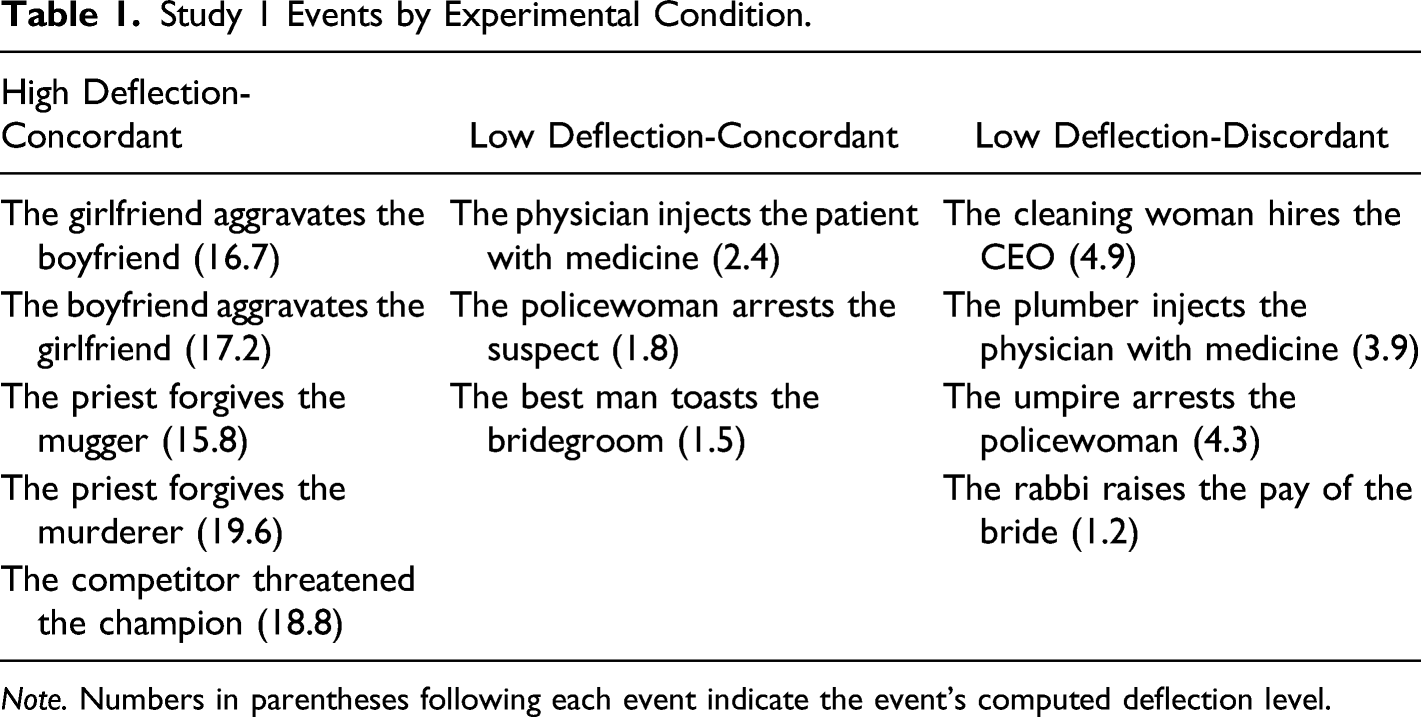
Note. Numbers in parentheses following each event indicate the event’s computed deflection level.
Every respondent rated events for only one of the available three conditions. After rating all events, each provided qualitative responses to a short series of survey questions. The questions were: 1. For [event 1–5], did you rate this as likely or unlikely? 2. How sure were you of your answer? 3. How sure were you that others would agree? 4. What made you choose this response? 5. What made you sure/unsure of your choice?
I use responses from these questions to explore respondents’ own interpretations of their thought processes as they rated events.
Individuals are notoriously poor at providing accurate rationalizations for implicit cognitive processes (e.g., Haidt, 2001), but the value of this qualitative data neither presumes nor requires that respondents faithfully explain their cognitions. Rather, these questions were included to allow for possible examination of explanatory narrative patterns as they may vary by experimental condition. Because all respondents who provided qualitative responses did so for only one experimental condition’s events (all events for which any single respondent provided quantitative ratings and qualitative justifications were either high deflection-concordant, low deflection-concordant, or low deflection-discordant), differences in types of responses between conditions can offer insight into how an interaction effect between deflection and institutional concordance may operate.
Study 2 Events by Experimental Condition.
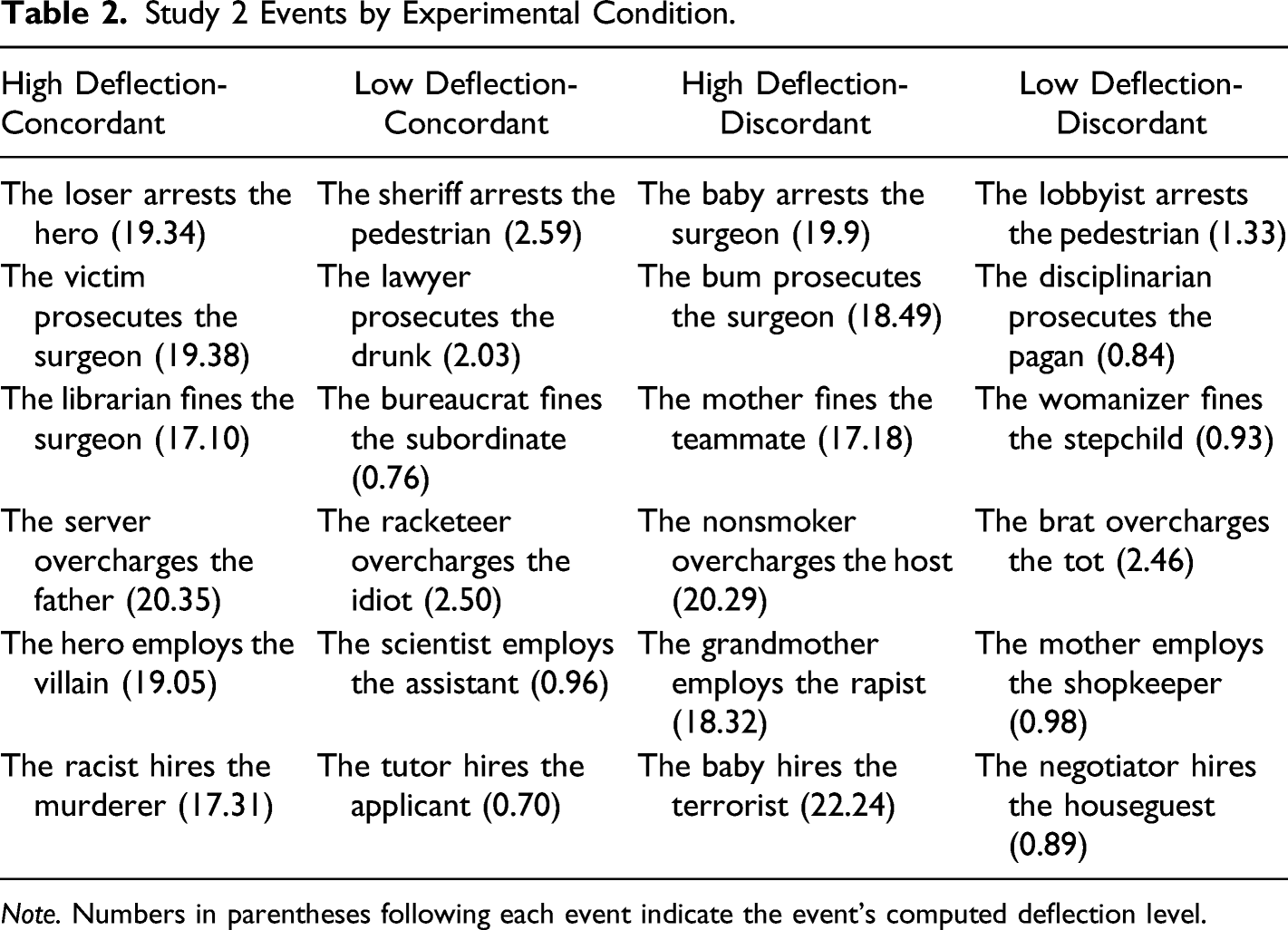
Note. Numbers in parentheses following each event indicate the event’s computed deflection level.
Samples
The sample for study 1 comprised 74 undergraduate students at a large Southeastern university who were 18 years of age or over. Because affect control theory is predicated on cultural meanings imbued in labels, inclusion criteria necessitated that all respondents have English as their first language. While national boundaries are not indicative of bounds of culture, I excluded any participants who had spent more than 10% of their lives outside of the United States as a proxy measure for adequate enculturation. 7 All participants completed the survey in a laboratory setting on individual computer stations. Average time to study completion was less than an hour. Respondents were not deceived about the nature of the study and each received $10 for their participation. The sample for study 2 comprised 507 respondents from a population of United States residents over the age of 18 8 and was nationally representative on the basis of age, race, and education. 9 As in study 1, respondents were required to have English as their first language.
Analytic Approach
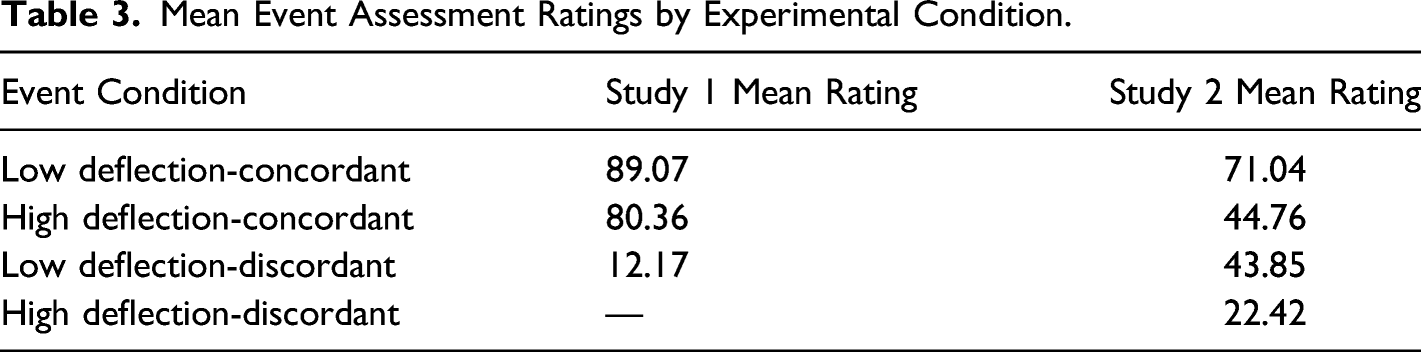
Mean Event Assessment Ratings by Experimental Condition.
Effects on Event Assessment Ratings: Linear Mixed Models.
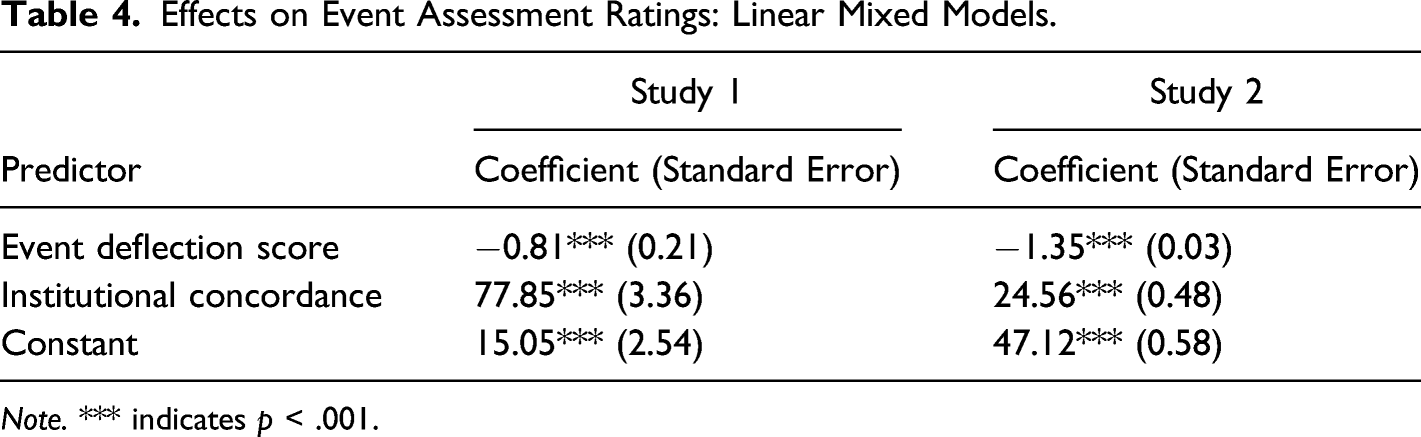
Note. *** indicates p < .001.
Two-Way ANOVAs: Effects of Institutional Concordance and Deflection Level.

Note. *** indicates p < .001.

Probability of event acceptance by event deflection level and institutional concordance status.
Probability of Event Acceptance by Event Deflection Level and Institutional Concordance Status, with Test of Interaction Effect (N = 12,168).

Note: Standard errors of the predictions in parentheses. ***p < .001, two-tailed tests of differences.

Probability of respondents selecting event assessment categories by deflection level: Institutionally discordant events.
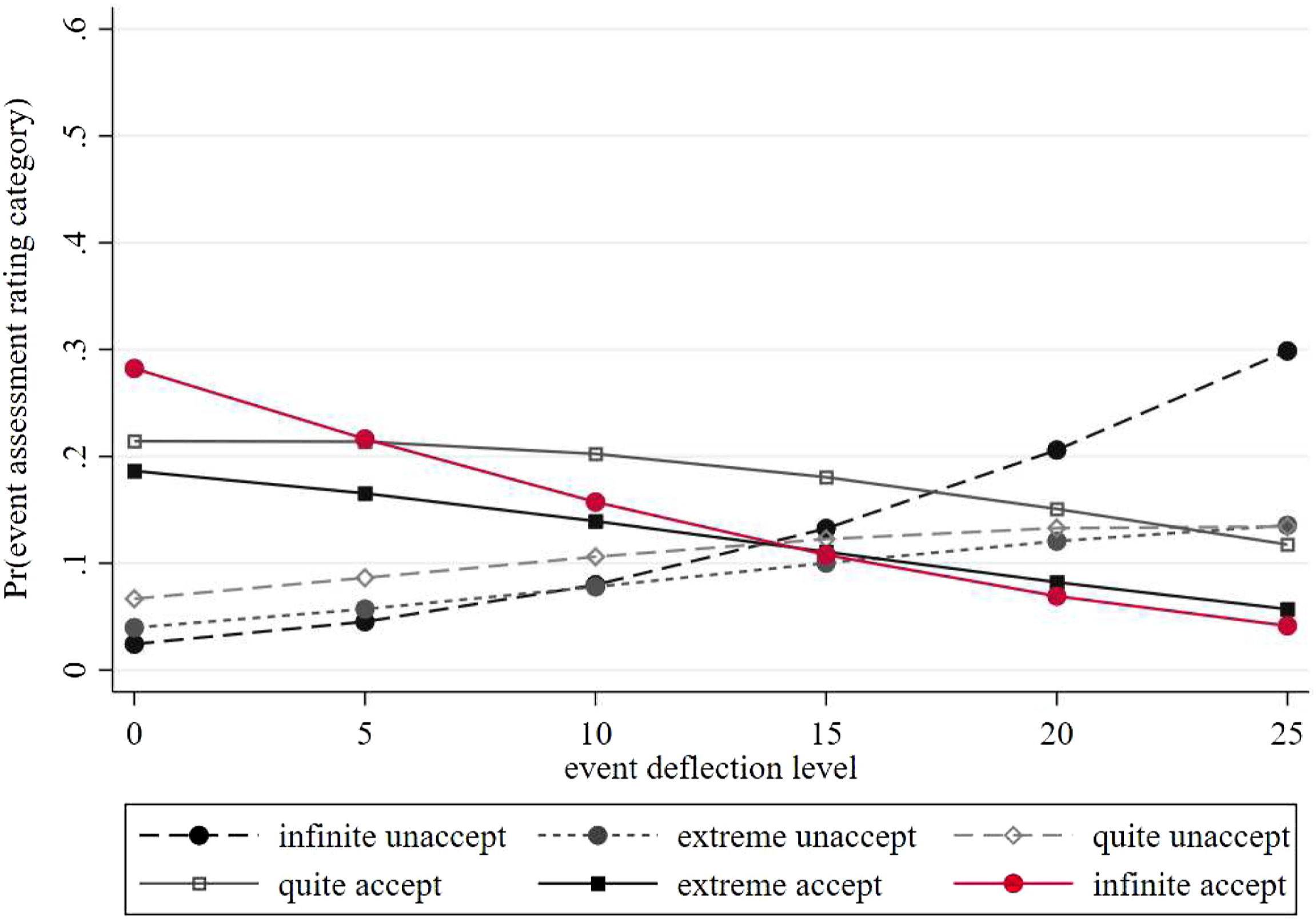
Probability of respondents selecting event assessment categories by deflection level: Institutionally concordant events.
Quantitative Results
Mean ratings showed that respondents in both samples found events possessing both institutional concordance and low deflection to be the most likely (see Table 3). In study 1, institutional concordance had a greater impact on event assessment ratings than did deflection level: institutionally concordant events were seen as likely regardless of the deflection they produce (mean rating of 80.36 for high deflection-concordant events and 89.07 for low deflection-concordant events). Institutionally discordant events were seen as unlikely despite their low deflection levels: events in the low deflection-discordant condition had a mean rating of 12.17. While the difference between the mean ratings for the two institutionally concordant conditions was small, a comparison of means using a Tukey Honest Significance Difference test confirmed statistical significance at the .01 level.
Study 2 participants had more moderated responses; the highest and lowest average event assessment rating were both less extreme than in study 1. This is a noteworthy difference, for study 2 participants also rated events in the high deflection-discordant condition omitted in study 1 (mean rating of 22.42 (extremely improbable), least likely condition). Low deflection-concordant events were rated most likely (mean of 71.04 (quite normative)). All experimental condition differences—save for that between the high deflection-concordant and low deflection-discordant conditions—were statistically significant at the .001 level. A Tukey Honest Significance Difference test confirmed that differences between the high deflection-concordant and low deflection-discordant event ratings were not statistically significant (p = .58). Such patterns in means across conditions indicate that both deflection and concordance are important predictors of event assessment ratings; absence of either institutional concordance or low deflection renders an average event normativity rating below the mid-point (neutral) of the event assessment scale. That the means of the two signal mismatch conditions did not differ for these respondents further suggests that deflection and concordance operate in tandem: each predictor may be necessary for, but not sufficient to ensure, an event assessment rating to the positive (normative, plausible) end of the dependent variable scale.
Linear Mixed Model
To account for the non-independence of subject ratings, I conducted a subject-and-event-level linear mixed model with deflection as a continuous variable (see Table 4). In results from both studies, deflection and institutional concordance status were both significant predictors of event assessment ratings. In the study 1 data, institutional concordance status had a comparatively greater impact than did deflection level. However, that result should not be interpreted as indicating the comparative substantive insignificance of deflection. Looking at the study 1 data: net of event institutional concordance status, deflection remained highly significant (p < .001) and had a nearly 1:1 relationship with likelihood ratings (decreased by .81 for every one-unit increase in event deflection score). To illustrate these results with an example mentioned earlier, a highly deflecting event such as “Father Abducts Baby” (deflection level 65.5) would be given a likelihood rating about 48 points lower than would a low deflecting event like “Father Snuggles Baby” (deflection level: 6.5), even when controlling for the incredibly predictive nature of the event’s status as concordant or discordant. Both processes are strongly predictive of likelihood ratings.
ANOVAs
Results showed that both main and interaction effects were statistically significant (a result that Heise and MacKinnon also found in the 1987 study) (see Table 5). This suggests that low deflection makes a person rate an event as more acceptable; this effect is increased when that event is also institutionally concordant. Institutional concordance makes a person rate an event as more acceptable; this effect is increased when that event is also low deflecting. In other words, it appears that the predictive effect of each mechanism for event assessment ratings becomes amplified in the presence of the other.
Results thus far indicate 1) that deflection and institutional concordance are empirically separable, 2) that each is an independently significant positive predictor for the assessment of social events net of the other, and 3) they have a statistically significant interaction effect.
Binary Logistic Regression
I transformed the continuous dependent variable into a nominal binary variable of categories “acceptable” (a rating to the normal/socially plausible/unsurprising side of the event assessment scale) and “unacceptable” (a rating to the implausible/surprising/abnormal side of the event assessment scale) and conducted a logistic regression on the study 2 data using binary predictors of deflection level (high/low) and adherence to institutional parameters (concordant/discordant). The predicted probabilities of rating a given event as “acceptable” by deflection level and institutional concordance status are shown in Figure 1 and listed in Table 6. 11
These results show that the probability of “acceptable” ratings for institutionally concordant events are significantly higher when the events have low rather than high deflection levels (0.787–0.463 = 0.324, p < .001). The probability of institutionally discordant events receiving an “acceptable” rating is also significantly higher when those events have low rather than high deflection levels (0.426–0.167 = 0.259, p < .001). The effect of deflection level itself—with low deflecting events being more likely to receive a rating of “acceptable” than high deflecting events—is greater for institutionally concordant than for discordant events (second difference 0.324–0.259 = 0.065, p < .001). Deflection and institutional concordance, both significant predictors of event assessments, have an amplifying effect on one other.
Multinomial Logistic Regression
I performed multinomial logistic regression (study 2 data) to examine how the probability of choosing each level of the dependent event assessment variable (from infinitely implausible—infinitely normal, using interval labels as cut points) 12 may vary as deflection rises for stimuli events with and without institutional concordance (event assessment rating of “neutral” as base outcome category). Results 13 are shown visually in Figure 2 (institutionally discordant events) and Figure 3 (institutionally concordant events).
Figure 2 shows the effect of deflection on event assessment ratings for institutionally discordant events. More specifically, this figure shows predicted probabilities for a respondent choosing each category of the dependent event assessment variable (rating of “neutral” as the reference outcome) as the deflection levels of the rated institutionally discordant events rise. For institutionally discordant events, predicted probabilities for ratings to the negative end of the scale (i.e., assessing the event as culturally “unacceptable”: depicted as dashed lines) are generally higher than for those to the positive end of the scale (i.e., assessing the event as culturally “acceptable”: depicted as solid lines). This pattern only strengthens as deflection levels rise—the probability of a respondent selecting a “normative” rating decreases immediately, with diminishing effect of increased deflection level past the “weird” threshold. Predicted probabilities for an event assessment rating of “infinitely improbable” increase dramatically as event deflection levels rise.
Figure 3 shows the effect of deflection on event assessment ratings for institutionally concordant events. A stark difference exists between concordant and discordant events in the predicted probabilities of each category of the dependent variable as deflection level increases. For institutionally concordant events, the probability of respondents choosing any categories from the positive end of the assessment scale (event “acceptance”: solid lines) is initially higher than for any categories from the negative end of the scale (event “unacceptance”: dashed lines). Rising deflection levels do not overcome the effect of institutional concordance to shift rating probabilities to a greater likelihood of event unacceptance categories until a particular threshold level—again, around the cusp of affectively “weird” events.
This pattern of persistent resistance to the effect of deflection in the face of a predominating institutional domain framework suggests that the presence of this frame allows respondents to contextualize events that, by the combination of the Actor, Behavior, and Object-person affective components alone, would normally prove too deflecting to deem the event culturally acceptable. Because mean assessment ratings for events in both the low deflection-discordant and high deflection-concordant conditions of study 2 were less than 50 (level of neutral assessment), I suggest that each of these predictors may be “necessary but not sufficient” for respondents to deem an event culturally acceptable (normal, socially plausible, unsurprising) rather than unacceptable (implausible, surprising, abnormal). However, given evidence of the interaction effect between the two variables (see Table 6 and Figure 3) and the comparative magnitude of the effect of institutional concordance versus deflection in study 1 (Table 4), this may be more the case for concordance than for deflection: to a certain point, the negative effect of a high deflection level can be counteracted by the provided institutional domain framework.
Qualitative Contributions
Qualitative responses from the questions in study 1 provide some support for the above interpretation. Participants who encountered low deflection-concordant events tended to invoke the normative nature of the event’s institutional elements as full justification for their likelihood ratings (e.g., “that is part of a physician’s job,” and “physicians are thought of with medicine”)—with no further exposition. Respondents encountering low deflection-discordant events followed a similarly succinct response pattern, but in the negative (e.g., “that is not a plumber’s job,” or “plumbers do NOT administer medicine to physicians”). For respondents in both of these conditions, the content of the events themselves were explanation enough: the events made sense to them because the events made sense (e.g., “I’m pretty sure that is how it works”), or did not make sense to them because they did not make sense (“this wouldn’t actually happen”; “it was very unlikely”).
Those respondents who encountered high deflection-concordant events, however, provided more extensive justification narratives:
“I'm in a relationship, and I know that I aggravate my boyfriend at times, and that it's perfectly normal to get aggravated with a significant other at times. No one can please the other person every second of every day, and people make mistakes.”
Sometimes participants parsed different aspects of the situation in justifying their ratings (e.g., “My answer did not have anything to do with the gender, but has to do with two people being in a relationship. One is bound to aggravate the other occasionally in a long-term relationship so I thought it was likely”). However, regardless of the elements they thought needed explaining, respondents in this condition did not seem to find the reasoning for their events as self-evident, but as requiring explication.
The narratives concerning these high deflection-concordant event explanatory responses seem to be indicative of an affect control process at work. Respondents’ narratives reframed and interpreted the simple Actor-Behavior-Object-person events in their explanations, providing plausible institutional domain-relevant extraneous details. An Interact assessment of some of these redefined events shows them to be lower deflecting than the events initially presented (and thus, in accord with the deflection process, more likely than the initial events’ deflection levels would imply).
The following sample responses demonstrate the use of an institutional domain framework for understanding the high deflection-concordant event The Competitor Threatened the Champion (key redefinition indicators highlighted in bold): ▪ I believe we all have an innate competitive drive and it is only common for ▪ ▪If someone is competing with a champion then they must be ▪
Respondent reinterpretations of this particular event seem to redefine it within the sports institutional domain (Heise, 2019). This is not surprising; competitor and champion are both top scoring collocates in the “athletes” component of the sports social institutional domain (Heise, 2019). As individuals make mental redefinitions, they alter the scenario in question so that it follows the affective rules of social interaction (Hunzaker, 2016), and members of the same language culture use the same types of cues in selecting an appropriate context for a potentially ambiguous term. Institutionally discordant combinations appeared unlikely to these respondents, even when low deflecting, but the institutionally concordant events were interpreted (and affectively reinterpreted) within the institutional frame offered by the cues in the event elements.
Event The Competitor Threatened the Champion has a deflection score of 18.8. Though to threaten has many different meanings, none of the respondents seemed to picture the Competitor waiting alone in a dark alley with a weapon, intending to spring out and intimidate the Champion. Rather, respondents interpreted the ambiguous behavior in the context of the cues provided by the Actor-Object-person pair: they understood “threaten” as a symbolic action. Respondents seem to have interpreted this event as something like The Ambitious Athlete Competes with the Defensive Athlete on a Tennis Court. The deflection score for this redefined event is only 6.7—a “weird” event became an “expected” event through the process of redefinition, in accord with the cues provided by institutional domain. Quantitative results from study 2 seem to corroborate this interpretation as well (compare Figures 2 and 3): a deflection-reduction process is at work in the presence of institutional concordance.
Discussion
Results from two experimental studies show that both deflection level and institutional concordance status are significant positive predictors of the cultural acceptability or normativity of a given social event. Results from study 1 suggest that institutional concordance is the more powerful influencer of the two, while results from study 2 suggest that rating an event as culturally normative requires the presence of both—each necessary, but alone insufficient, to assess an event as culturally acceptable. Taken together with the interaction effect depicted in Figure 3 and the insights gained from the qualitative data, my results suggest two things: that institutional concordance may be a prerequisite to assessing events as culturally normative or acceptable, and that affect control processes are in continual operation to bring affectively discordant event elements in line with one another in accord with the parameters of the culture’s social institutions. The interaction shows further that the two have an amplifying effect on one another; the effect of deflection is stronger in the presence of institutional concordance, and the effect of institutional concordance is greater when deflection levels are low.
Although high deflection-concordant events are rare in daily life, these findings about the joint operation of cognitive and affective processes give valuable insights concerning assessment of everyday social events. Individuals interpret social events through the lens of social institutions; their event reinterpretations are driven by a desire for deflection reduction. Elements of events must affectively align, and in defining an ambiguous event, individuals draw upon institutional domains already present within a culture. These domains impose perspectives and shape expectations. This understanding—and the amplification effect of each process on the other as they operate in tandem—provides clarity concerning the depth of culture’s influence to shape and maintain individuals’ perspectives on social situations.
Effective approaches to altering social inequalities benefit from a complete understanding about the processes that guide impressions of social events. As the present work offers insight into understanding where and by what means definitions of a situation may be susceptible or resistant to change, it is my hope that these theoretical and empirical findings may also be of use in shaping future applied sociology endeavors.
Limitations
While I found similar and statistically significant patterns in two different studies in two divergent samples, I advise caution in interpretation of these new findings. Event constructions across the conditions did not systematically control for individual effects of EPA, nor did they follow a defined method for selection of which extra-affective features would represent institutional concordance in the events across conditions. Events in this study covered only a very small range of possible contexts. Further, while the events in each condition were selected with a desire for comparability across conditions, this was difficult to accomplish: an expectation of identical concordance/discordance across concordant and discordant events is not assumed. This may be a product of the interaction of deflection and institutional concordance, but it is also a possibility that this non-equivalence in design accounts for the interaction finding itself.
The same consideration may also account for the discrepancy between the two studies concerning institutional concordance as either a substantially more effective predictor than deflection (study 1), or not statistically different from deflection in its effect (study 2). Future studies should correct for these limitations with a larger experimental body of events, an even distribution across institutional domains, and control for the social scarcity and EPA effects of the Actor, Behavior, and Object-person event concepts. Future work should also attempt to account for domain-specific inculcation and enculturation features (knowledge of and belief in subcultural norms) of future study respondents.
Future Directions
The goal of this research was to investigate the joint operation of two predictive event assessment mechanisms and begin to explicate their interrelationship. With this work as a basis, attention should turn to incorporating institutional concordance into affect control theory’s predictions in a systematic way. Perhaps codes should be assigned to each institution and incorporated as weights for identities and behaviors within that institution. However, weighting would require the institutions of our society be rank-ordered for predominance, another aspect of society about which we currently know too little. Even before institutional concordance can be incorporated empirically, it must be carefully defined theoretically—this task will require accounting for identity scarcity, the intra-institutional likelihood of identity pairs, the institutional clarity of behaviors, the access to institutionally controlled identity and behavior labels, etc. Whatever the method and eventual construction, combining these two predictors’ results for a cleanly predictive hybrid affect/cognition model will take a great deal of thought and work yet to be completed.
I also draw attention to next steps in the goal of fully comprehending the joint relationship of deflection and institutional concordance highlighted in this paper. Should the interaction effect found here prove robust and replicable in future experimental studies, understanding what aspects of event assessments are attributable to each predictor will be essential. We may find for instance that the relation of deflection and institutional concordance is semi-orthogonal, jointly answering the question of event acceptability with different relative strengths. I suggest that a subsequent study of sufficient sample size and highly controlled event design investigate this possibility further.
Conclusion
This research provides new insights into the complementary but distinct influences of two significant predictors on culture members’ assessments of the cultural normativity of social events. I have shown that institutional concordance is distinct from event deflection level, that deflection is a significant predictor of event assessment ratings net of concordance, that concordance is a significant predictor of event assessment ratings net of deflection, and that deflection and institutional concordance have a significant and positive interaction effect on event assessment ratings. Despite the intentional creation of events with characteristics that should make them less likely than deflection would predict, results in this paper provide strong support for affect control theory and its predictive equations. This work opens the door for a larger body of research literature investigating social institutions and sheds light on cognitive processes underlying culture members’ assessments of everyday social events.
Footnotes
Acknowledgments
I am grateful to Dawn T. Robinson and Lynn Smith-Lovin for their invaluable advice and guidance on earlier versions of this paper, to James Coverdill for his helpful comments on analyses, and to the editors and anonymous reviewers for their valuable suggestions.
Declaration of conflicting interests
The author(s) declared no potential conflicts of interest with respect to the research, authorship, and/or publication of this article.
Funding
The author(s) disclosed receipt of the following financial support for the research, authorship, and/or publication of this article: This work was partially supported by the Army Research Office (W911NF1510180, W911NF1710509).