



Abstract
The novel coronavirus (Covid-19) that plagued the world in 2020 also brought with it the need to rapidly disseminate information to the public to encourage health-related behavior change. This study examines Covid-19-related Twitter messaging disseminated by the Centers for Disease Control and Prevention and the World Health Organization from February 29 to September 22, 2020. The research examined tweets from four constructed weeks, with the first 2 weeks representing days prior to President Donald Trump’s announcement of U.S. withdrawal from WHO, and the second 2-week period after the announcement. The Health Belief Model was used as the theoretical foundation for this study. Frequencies and chi-square analyses revealed less of an overall focus on barriers but no significant differences in messages for tweets related to consequences, benefits, and barriers. Significant differences (p < .01) were found in engagement messaging for the second 2-week period.
The Covid-19 pandemic that permeated throughout the world in 2020 has changed life as we know it. Many fear exposure to the infection, knowing the consequences could be deadly. Others who are healthy and maybe consider themselves invincible are not so much concerned about the adverse health impact, but instead consider Covid-19 as a nuisance to their everyday lives. To stem the virus, social distancing and the wearing of face masks have not only been strongly encouraged but also mandated in many parts of the country. Some are more receptive than others regarding these mandates. Many doubt whether such mandates even make a difference, given their opinions that “hysteria” about the pandemic by the press may be overblown. In an attempt to gain control over the Covid-19 virus, and to address the general skepticism, health organizations strive to develop and direct messaging to the masses that will influence beliefs and, in turn, instigate behavior change. For this study, the particular interest is to examine Twitter messaging in relation to Covid-19 by the World Health Organization (WHO) and the Centers for Disease Control and Prevention (CDC). Given that WHO is an international organization with many participating countries and the CDC is an organization of the United States government, we were interested in analyzing Covid-19-related tweets originated by both organizations to compare them and determine whether their areas of emphasis contrast. Of even more interest is President Donald Trump’s June 29, 2020, announcement that the U.S. would withdraw from WHO in 2021. In consideration of this, in addition to general trends in messaging the study aims to compare WHO and CDC original Twitter messaging prior to Trump’s announcement, as well as afterward, to determine whether any changes in messaging focus by either or both of the two organizations occurred.
This research adds insight to how messaging is disseminated about a serious health issue—in this case a 100-year pandemic. The United States currently lags behind other countries in its efforts to contain the virus. According to the Johns Hopkins Center for Systems Science and Engineering Covid-19 data repository (which is updated once a day), approximately 552,000 deaths (representing approximately 20% of the world’s 2.85 million deaths from the virus) were documented as of 7:30 pm on March 31, 2021. The withdrawal from WHO (which the United States has since rejoined upon the election of Joe Biden as president) served to further isolate the United States from the rest of the world in addressing this pandemic. It raises the question, “How are other countries succeeding when we are not?” Could the messaging be a factor? Analysis of the messages from these two organizations serves to guide others (public health entities, university, or educational administrators, etc.) as they decide how to develop and frame crucial messaging that instigates behavior change, and thus contains the virus.
Literature Review Overview and Theoretical Framework
Many researchers have recently utilized quantitative content analysis to explore the intersection between public health issues and social media. For instance, Brett et al. (2019) examined posts on Reddit to better understand youth perceptions of vaping, specifically JUUL use, and found that social norms are a strong influencer—but not so strong that they cannot be countered with barriers put into place via public health interventions (such as age restrictions). Gurman and Clark (2016) conducted a quantitative content analysis analyzing tweets about emergency contraception. From their findings they deduced that Twitter is a powerful medium for sharing messages about public health issues, and that public health organizations should include Twitter in their overall mass communication strategy. Through further exploration the literature revealed three emerging themes regarding the use of quantitative content analysis to explore health issues: (1) the use of social media to communicate about outbreaks that threaten public health, (2) the prevalent use of tweets and pins communicate about important health issues, and (3) the increasing use of the Health Belief Model as a theoretical framework for conducting quantitative content analysis.
Using Quantitative Content Analysis to Study Social Media Messaging about Health Epidemics
Timely and effective dissemination of accurate and relevant information is crucial for raising awareness about threatening disease outbreaks. Researchers have used quantitative content analysis to study the circulation of information pertaining to outbreaks. Kim and Liu (2012) investigated how corporate and government organizations responded to the first phase of the 2009 H1N1 epidemic, finding that while government organizations generally supplied useful information on how to respond to the crisis, corporate interests were more likely to emphasize reputation management. Gui et al. (2017) investigated Zika virus-related information circulated on Twitter and found there were discrepancies between the general public’s expectations for information and what was provided by public health authorities. And while the recent Covid-19 pandemic is still currently very much a part of our reality, researchers have spared no time to explore the circulation of messages related to Covid-19. Medford et al. (2020) searched Twitter and extracted tweets matching hashtags related to Covid-19 to measure themes and frequency of keywords that may play a part in prevention practices. In their evaluation of more than 126,000 tweets, they found that almost half expressed fear and 30% expressed surprise with the economic and political impact being the most commonly discussed topics. All of these studies pulled messaging from Twitter, with the latter two devoting their analysis exclusively to Twitter tweets. The second stream of inquiry addresses the use of social media sites such as Twitter and Pinterest.
Using Tweets and Pins in Quantitative Content Analysis to Analyze Messaging About Important Health Issues
While both Gui et al. (2017) and Medford et al. (2020) have used quantitative content analysis to explore messaging during outbreaks, other researchers have also turned exclusively to Twitter to examine other relevant health issues. Twitter has a wide breadth and depth of reach, thus providing a means to disseminate important health information to millions throughout the world (Gurman & Clark, 2016). It has also experienced phenomenal growth within the past decade, with use almost doubling since 2010 (Brenner & Smith, 2013). Guidry et al. (2020b) examined 1,200 tweets from 12 national health departments. Their research revealed a limited breadth of topics covered in tweets, with coverage lacking about cardiovascular disease but plentiful regarding infectious disease.
Pinterest, with more than 335 million active monthly user accounts worldwide (Sehl, 2020), is another growing social media venue that has frequently been used for the dissemination of health communication. As a photo sharing platform, Pinterest’s visual nature serves to help viewers recall information (Houts et al., 2006). Pinterest has led the way among social media platforms in responding to misinformation, such as with vaccine-related information—as when Pinterest formulated its policy in 2019 to only show vaccine information from public health organizations (Caron, 2019). Guidry et al. (2020a) used quantitative content analysis to analyze the content and nature of 500 flu vaccine-related Pinterest posts, finding a more balanced picture (compared to other social media outlets) in the posting of pins that support the vaccine versus those that critique it (prior to Pinterest’s policy changes in 2019). However, they also found that higher engagement was associated with anti-vaccine variables. Quantitative content analyses of Pinterest pins have also explored posts related to skin cancer (Tang & Park, 2017), as well as breast cancer-related posts (Miller et al, 2019).
Using the Health Belief Model as a Theoretical Framework to Analyze Messaging About Important Health Issues
Interestingly, many of the studies referenced above used the Health Belief Model (HBM) as a theoretical framework (Guidry et al., 2020a, 2020b; Miller et al., 2019; Tang & Park, 2017), as the majority of pins and tweets lend themselves well to being categorized within the constructs of the model.
This study used the HBM as the theoretical framework for conducting a content analysis of Twitter tweets to analyze messaging disseminated by the CDC and the WHO about the Covid-19 pandemic. Developed in the 1950s by social psychologists working in public health the HBM seeks to explain why people fail to participate in programs to prevent and detect disease (Hochbaum, 1958; Rosenstock, 1960). The premise of the HBM is that people are more likely to engage in a health behavior if they hold certain beliefs, such as they are susceptible to a condition, or that there are benefits to taking action (Skinner et al., 2015). The constructs include perceived susceptibility, perceived severity, perceived benefits, perceived barriers, perceived self-efficacy, and cues to action.
Conceptualization of the Health Belief Model as It Pertains to Covid-19 Messaging
In approaching this research, the researchers considered conceptualization of the HBM constructs as they relate to messaging disseminated by public health organizations. Based on the established constructs, the following definitions are offered
• Perceived susceptibility. Belief about the likelihood of contracting Covid-19.
• Perceived severity. Beliefs about the seriousness of contracting Covid-19 and its consequences.
• Perceived benefits. Beliefs about the positive aspects of adopting a health behavior.
• Perceived barriers. Beliefs about the obstacles of performing a behavior and the negative aspects (both tangible and psychological costs) of adopting a health behavior.
• Self-efficacy. Beliefs that one can perform the recommended health behavior or preventative measures.
• Cues to action. Internal or external factors that could trigger health behavior.
How This Study Illuminates the Body of Research
The HBM serves as a solid theoretical model for the project at hand. Specifically, we explored messaging that appeals to and possibly narrows in on perceived beliefs about Covid-19. For instance, a tweet that provides information about escalating infection rates may be coded as a message that appeals to a person’s perceived susceptibility, whereas a message that addresses the challenge of determining where to go to get tested might fall under perceived barriers. A tweet that emphasizes social distancing as the key to containing the virus might be coded under perceived benefits.
This model serves to add to the growing body of literature addressing communication in the Covid-19 era. Given the recent emergence of the pandemic, limited research currently exists to provide any insight on how public health organizations formulate messaging to address a crisis of this magnitude. Examining messaging disseminated by WHO and the CDC via Twitter is important—not only because the potential reach of these messages numbers in the hundreds of millions but also because the CDC and WHO are crucial key players in the spread of Covid-19 information to people (Yum, 2020). Yum also found that President Trump played the most important role in social networks among the top 20 key players for both in-degree centrality and content in tweets. While targeted examination of Trump’s tweets in relation to Covid-19 are beyond the scope of this study, his prominent role is grounds to examine whether his actions (specifically, the withdrawal of the United States from WHO) may have had an impact on how one or both organizations frame their messages to the public. It is also worth noting that WHO and CDC messaging pertaining to crucial health issues has been compared previously by Biswas (2013), who examined Facebook and Twitter posts of both organizations in relation to the 2009 H1N1 epidemic. This research, however, was approached from a risk/crisis communication lens, whereas this research will examine content through the lens of the HBM.
On this note, while a substantial amount of research investigates health communication from the lens of the HBM, and while several research studies explore the use of social media using the HBM, we have not found research that compares messaging by two separate public health organizations utilizing the constructs of the HBM. This research not only does that, but it also considers how a world leader’s drastic action impacting both organizations could influence the consistency of messaging by one or both organizations.
Research Questions
The research questions posed in this study focus on the messaging of WHO and CDC with regard to the pandemic. Since things change rapidly during a pandemic, the analysis requires a medium that captures this change, and there is no better medium than Twitter for this particular task. In 280 characters or less, a tweet can capture the essence of the message and also update the public in real time (Suh et al., 2010).
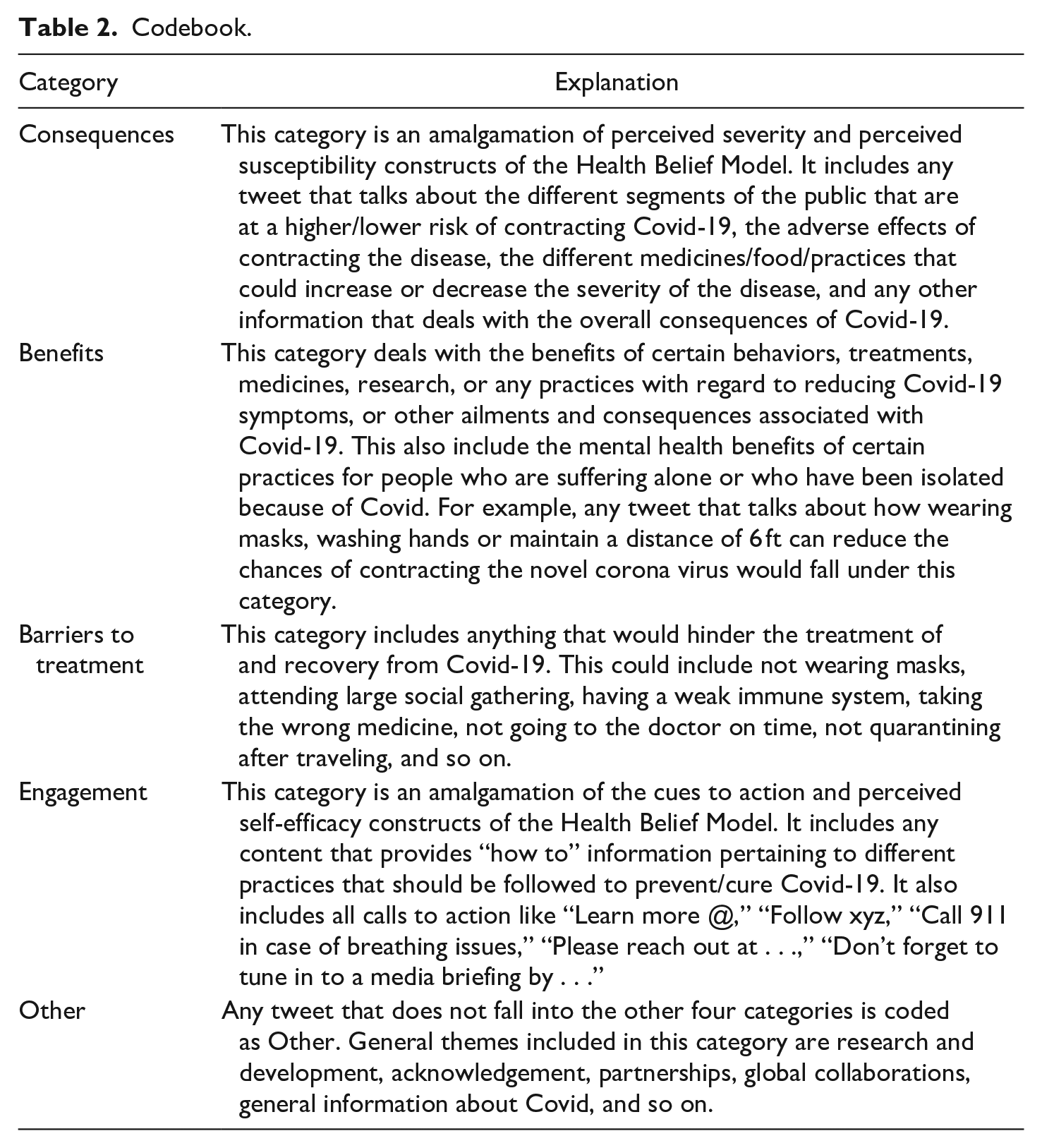
The researchers initially approached this research with the intention to code tweets in accordance with the exact HBM constructs. However, initial assessment determined frequent overlap between the constructs of susceptibility/severity and self-efficacy/cues to action. Thus, these constructs were collapsed into the single categories of “consequences” and “engagement,” respectively. The constructs of benefits and barriers remained as is, and an “other” category was created to code tweets that did not fit into any of the other defined categories. Based on these categories and the initial review of Covid-19-related tweets by the CDC and WHO, the following research questions were proposed:
RQ1: How do Twitter messages that address consequences of Covid-19 compare between the CDC and WHO?
RQ2: How do Twitter messages that address benefits to behavior about Covid-19 compare between CDC and WHO?
RQ3: How do Twitter messages that address barriers to treatment for Covid-19 compare between the CDC and WHO?
RQ4: How do Twitter messages that illicit engagement to respond to Covid-19 compare between CDC and WHO?
RQ5: Are there any major changes in the focus on messaging between the two organizations after President Trump’s announcement that the United States will withdraw from WHO?
The initial review of the literature related to the HBM and the tweets of the organizations indicated that the CDC messaging might be more focused on the perceived self-efficacy and cues to action (coded as engagement) of the American people to deal with the pandemic. Moreover, since WHO is a global organization that caters to an international audience, its messaging strategies are more diverse in that they target all the different aspects of the HBM.
Method
Sampling
This study is a quantitative content analysis whereas a random sample of four constructed weeks’ worth of Covid-19-related tweets (with the unit of analysis being a single tweet) originated by both WHO and the CDC (excluding retweets) was analyzed. Since both organizations tweet about a myriad of different issues, a keyword search of Covid-19 was used to select the tweets required for this particular study. The selection of the sample took into consideration three main dates and events as the anchors: (1) February 29, 2020, when the first death by Covid-19 in the United States was reported; (2) June 29, 2020, when President Trump announced the U.S. withdrawal from WHO; and (3) September 22, 2020, the day media sources reported that the U.S. death toll had exceeded 200,000. Tweets from two constructed weeks starting from the report of the first death until Trump’s announcement, and then tweets from two constructed weeks from the announcement until the report of 200,000 deaths were analyzed. By using constructed weeks, the researchers were able to code a sufficient, yet manageable, number of tweets while capturing a breadth of dates between February and September 2020. The reason for selecting this particular timeline is to provide a depth to our analyses by examining whether these critical incidents had any impact on the messaging of the two organizations and to spot existing trends.
Taking these core dates into consideration, each day from February 29, 2020, to September 22, 2020, was assigned a chronological number from 1 to 207 (the exact number of days between these two dates). Numbers 1 through 121 (representing the dates prior to the Trump announcement) were randomly drawn until two constructed weeks were formed. Similarly, days 122 through 207 represented the second phase of the sample (representing the days of and beyond the Trump announcement), and two constructed weeks were drawn from this lot. In addition, a constructed test week (4 days prior to the Trump announcement and 3 days afterward) was drawn to test for intercoder reliability.
Data Collection
Twitter data was collected using the Twitter scraper tool provided by Scrapehero.com. To do this, one researcher utilized a free trial from Scrapehero and then purchased a 1-month subscription at a cost of $5. A 1-month subscription provides 300 pages of scraped data. Twitter searches collecting combined CDC and WHO data for 1 day would typically scrape four to six pages. Thus, the 1-month subscription was sufficient to collect Twitter data for four constructed weeks and a test week.
The specific collection of the data entailed conducting an advanced Twitter search. For both the CDC and WHO, the advanced Twitter search entailed plugging in the specific date, indicating use of the Covid-19 keyword and each organization’s Twitter handles. This search netted a Twitter page containing that particular day’s Covid-19-related tweets, as well as a distinct URL address. Each distinct URL address was then, in turn, inputted into the Scrapehero Twitter scraper. The scraper than used each distinct URL to search for and generate Twitter data that was provided via an Excel file. Select data, including record numbers, organizational handles, the applicable dates, and actual content of the tweets, was then extracted from the Scrapehero Excel file and inserted into the researchers’ own Excel templates for coding. In all, data was organized into 35 Excel files—one file for each day of the test week, as well as separate files for each of the 28 actual sample days.
Reliability and Validity
To test intercoder reliability, the researchers (two doctoral students) coded under the categories inspired by the HBM constructs for a total 168 test tweets. Intercoder reliability analysis was performed using the ReCal 0.1 Alpha for Two Coders that was accessed at dfreelon.org (Freelon, 2013). On the first attempt, sufficient intercoder reliability was not achieved within any of the defined categories. After brief discussion to assess differences, a second attempt to reach intercoder reliability used 60 random tweets from the test sample. This attempt also failed to reach intercoder reliability. After this second attempt, the researchers met via videoconference to discuss each occasion of difference in coding. A third attempt, coding the same 60 tweets (representing approximately 12% of the total sample) that were coded in the second attempt, resulted in achieving intercoder reliability in each category, with Cohen’s κ ranging from .77 (in the “other” category) to .97 (in the “engagement” category) (Table 1).
Intercoder Reliability.

After reaching intercoder reliability, the researchers proceeded to code the actual sample of four constructed weeks (two prior to President Trump’s announcement of withdrawal from WHO and two after). One researcher coded Weeks 1 and 3, while the other researcher coded Weeks 2 and 4. In total, 491 tweets—108 from the CDC and 383 from WHO—were coded. Given that the total sample was manageable for two people, coder fatigue was not a factor that hindered reliability.
As to validity, we deduced that the vast majority of messages were easily categorized within the revised categories. Those not falling within the established categories were coded as “other.” While there is not a vast wealth of research that examines social media health messaging from the HBM lens, enough published research does exist to confirm that using the HBM as a framework to compare and contrast WHO and CDC tweets satisfactorily measures the intent of the tweets within the selected sample. As to external validity, the CDC has 3.1 million Twitter followers and WHO has 8.3 million Twitter followers. While we do not have a demographic breakdown of these followers, the pure quantity of followers was a significant consideration for determining whether the disseminated messaging is broadly applicable to many different types of people and situations.
Coding
The coding categories were inspired by the constructs of the HBM: perceived susceptibility, perceived severity, perceived benefits, perceived barriers, cues to action, and self-efficacy. Based on the past literature pertaining to the HBM in the context of social media (Skinner et al., 2015) and through an initial analysis of the tweets, some of the coding categories were collapsed which resulted in a total of five different categories: consequences, engagement, benefits, barriers, and other. Consequences are an amalgamation of perceived susceptibility and perceived severity while engagement is a combination of cues to action and self-efficacy. A detailed codebook further details the coding scheme (Table 2).
Codebook.
Data Analysis
To analyze the data, we coded each tweet into its applicable category and then ultimately conducted frequencies on the data. We analyzed each organization’s total tweets within the selected sample, as well as the percentage breakdowns for the total number of tweets for each category (compared to the total number of tweets). First, we determined whether there were any obvious differences in total. We then analyzed the first two constructed weeks’ tweets for each organization (consisting of dates prior to the June 29, 2020, Trump announcement of withdrawal from WHO) as well as tweets for the third and fourth weeks (the day of and following the WHO announcement). To analyze further, we conducted χ2tests to determine whether significant differences in focus for the entire 4-week period existed in each category. We also used χ2 analyses to determine whether the focus of messaging had changed in either organization after the Trump announcement to withdraw from WHO.
Results
In total, 491 tweets were analyzed—108 that were posted by the CDC and 383 that were posted by WHO. For the first two constructed weeks, CDC posts numbered 61 and WHO tweets numbered 260. The second two constructed weeks netted 47 tweets from the CDC and 123 by WHO. Thus, Covid-19 messaging by WHO decreased by more than half in the second 2-week period (Table 3).
Tweets.

Note. CDC = Centers for Disease Control and Prevention; WHO = World Health Organization.
From an analysis of frequencies, the CDC’s focus on engagement in both sets of constructed weeks was much more prevalent. Additionally, WHO tweets focusing on other themes beyond the established categories were much more prevalent than CDC. Frequencies also revealed that neither organization had a substantial focus on barriers to treatment for Covid-19 for either of the two time periods, and that the focus on benefits substantially declined during the second 2-week period.
More sophisticated analyses entailed conducting χ2 tests. RQs 1 through 4 asked how CDC messaging compares with WHO in the categories of consequences, benefits, barriers, and engagement, respectively. Of the five categories (consequences, benefits, barriers, engagement, and other), only the engagement category and other categories revealed significant differences between CDC and WHO messaging (though no research questions were posed about the other category). To examine overall messaging focused on engagement, a χ2 test of independence was performed to examine the relation between the two organizations and their tendencies to focus on engagement in their Covid-19 messaging. The relation between these variables was significant, χ2(1, N = 746) = 15.22, p < .01. Thus, there is a difference in engagement focus between the CDC and WHO to promote engagement.
However, in addressing RQ5, there was a variance on differences between the first 2-week period and the second 2-week period. In the first two constructed weeks, the relation between variables was not significant, though barely so, χ2(1, N = 485) = 5.85, p < .05, indicating there were no differences in significance in engagement testing. However, Weeks 3 and 4 revealed a significant difference in engagement messaging, χ2(1, N = 261) = 10.08, p < .01. This not only indicates that engagement messaging differences were significant between Weeks 3 and 4, but also it reveals shifts in messaging by one of the organizations. The CDC’s proportion of messaging that focused on engagement far exceeded that of WHO during the second 2-week period.
To examine messaging focused in other categories, a χ2 test of independence was performed to examine the relationship in other messaging between the two organizations. The relationship between these variables was significant, χ2(1, N = 605) = 11.79, p < .01. Thus, there was a significant difference in other messaging, overall, between the two organizations. However, the differences were only significant during the first 2-week period, χ2(1, N = 380) = 6.89, p < .01.
Discussion
WHO had almost four times as many tweets as CDC, which could be because the WHO is a global organization that disseminates messages pertaining to all the nations that are part of this organization CDC, on the other hand, only focuses on the United States. Moreover, we observed that the number of tweets was significantly less in the third and fourth constructed weeks for both WHO and CDC. However, this decrease was much more profound for WHO. This decrease could be attributed to the decrease in the spike of Covid-19 cases during the summer, when the curve was reported to be flattened, and states, cities and communities were again open for business.
The results also revealed that CDC emphasized more on tweets pertaining to engagement, while WHO emphasized on tweets that fall under the “other” category. Although the purpose of this study is not to establish any causation, logic dictates that WHO being an international organization would naturally tweet more about global collaborations, research and development happening all over the world, and acknowledging efforts made by various professionals from around the globe, all of which fall under the other category. As for the CDC, the percentage of engagement tweets was always higher in the four constructed weeks than that of WHO but it increased even more after Week 3. This could again be attributed to the summertime when people in general and families in particular need more guidance with regard to traveling, keeping themselves safe, and making sure that their children also have a mentally and physically stimulating summer. Since CDC is catering to the U.S. audience, it is easier for them to focus their tweets on particular topics. Thus, they took the opportunity to send out tweets that could potentially benefit people over the summer when the cities were lifting lockdowns and there was again some semblance of normalcy. The engagement tweets provided enough information to equip the audience with the knowledge and resources required to enjoy a safe and healthy summer.
Overall, we observed that both organizations placed very little emphasis on tweets that focused on barriers to treatment of Covid-19, and that the focus on benefits substantially declined during the second 2-week period. Based on the analysis, the exact reasons cannot be determined, but the results definitely show the gaps in the information dissemination system for both organizations. As to the limited focus on barriers, perhaps both organizations did not acknowledge barriers to testing and treatment in favor of a more optimistic, or “glass half full” approach. During the overall time period, fears about Covid-19 were escalating. Thus, it is feasible that both organizations did not want to exacerbate fears by focusing on barriers that could not be controlled. Both CDC and WHO should focus on messages that also talk about the behaviors, conditions, and situations that could hinder treatment and enhance the healing process. A simpler explanation may exist for the decrease in focus on benefits during the second time period—that during that time the curve was going down so the focus to promote benefits of behavior change was relaxed.
The results from this study not only provide practical insights but also contribute to theory by highlighting the issues with the constructs of the HBM. The coding process revealed that a few categories had a lot of overlap and it was better to collapse them and form few categories. For example, cues to action and self-efficacy were too similar to be considered separate categories. Likewise, perceived susceptibility and perceived severity experienced overlap. By combining these constructs, coding the tweets became easier as the researchers were able to create mutually exclusive categories.
Limitations and Directions for Future Research
This study is inspired by the constructs of the HBM to provide insights into the kind of content CDC and WHO are disseminating with regard to Covid-19. However, much like every other study, this one also has certain limitations. First, there is a stark difference in the quantity of the tweets between CDC and WHO for the constructed weeks. To conduct a more appropriate comparison between the two organizations, it would be a better strategy to increase the sample size for CDC or to adopt another sampling strategy for future studies.
Second, the study examines the “other” category as a whole without delving into the different issues and topics that fall under that category. Therefore, we may have overlooked some useful topics or themes. Future studies could approach this category in more detail and unpack the various topics and themes that emerge.
Third, the analysis conducted for this study is limited to frequencies and χ2 tests. While this analysis answers all the questions posed in this study, it would be helpful in the future to modify the research questions and carry out more detailed analysis.
Finally, the constructed weeks do not consider dates beyond September 2020. Major events (including the 2020 presidential election, a second worldwide spike in Covid-19 cases, and the potential development of effective vaccines) have occurred. An extension of this study could look at these events and subsequent tweets by CDC and WHO to examine whether any significant differences exist.
Conclusion
The Covid-19 pandemic of 2020 has had a major impact on all facets of daily life. Organizations such as CDC and WHO have been on the forefront with regard to disseminating information and dispelling false information with regard to Covid-19. To examine the trends in messaging by the two organizations, this study focused on the Twitter feeds of CDC and WHO as they pertain to Covid-19 and used coding categories inspired by the HBM constructs to compare the messages. The study used a total of four constructed weeks, two before President Donald Trump’s June 29, 2020, announcement that the United States would withdraw from WHO in 2021, and 2 weeks post-announcement. In consideration of this, the study aimed to compare WHO and CDC original Twitter messaging prior to Trump’s announcement, as well as afterward, to determine whether any changes in message focus by either or both of the two organizations occurred. Based on the results of this study, the only significant difference that could be seen between the tweets of the two organizations was in the engagement category, with CDC tweeting almost twice the amount of engagement content than WHO. Another interesting find was the lack of emphasis on the barriers to treatment by both organizations, which was relevant during this time period but may change in relevance as access to testing and vaccines increases.
This study provides insights into the major Covid-19 themes that are a common focus to both CDC and WHO as well as themes that vary. However, this research is just the first step toward comparing how prominent public health organizations create and distribute vital pandemic-related messaging via Twitter. Further studies should further address these issues, providing more detailed and salubrious information for scholars and practitioners.
Footnotes
Declaration of Conflicting Interests
The author(s) declared no potential conflicts of interest with respect to the research, authorship, and/or publication of this article.
Funding
The author(s) received no financial support for the research, authorship, and/or publication of this article.