



Abstract
Toward better understanding the nature of sport global protest, this article examines the profiles of users of the #boycottqatar2022 (N = 111,172), a global initiative calling to boycott the 2022 World Cup on grounds of Qatar’s alleged breach of human rights. A social network analysis identified that 82% of users of the hashtag were from North America and Western Europe, that 88% of the uses of the hashtag were on Twitter (and a minority on Facebook and Instagram), and that the users’ political inclination was mostly liberal in comparison to random users. Overall, the findings indicate that the hashtag was used almost exclusively by activists from the so-called Global North on the more elitist Twitter platform, thus portraying a picture as an act of the global elite rather than a truly inclusive and overarching global initiative. We discuss further theoretical and practical implications of the findings.
Introduction
One of the main realms in which political protest is most evident is sport events, where political and/or human rights movements, such as the Black Live Matters or the Climate movement find as a hub to promote their ideals during major national and/or global sporting events (Carney, 2016; Mundt et al., 2018; Galily, 2019, 2021). Specifically, the issue of sport and protest is evident before mega global sport events such as the Summer Olympic Games and the soccer World Cup, where activists have a chance of promoting their ideas to a large-scale international audience (Giulianotti et al., 2015; Lauermann, 2019). In some cases, the hosts of mega sport events have also been the target of global protest due to their policies (Qi et al., 2009; Horne, 2017). Understanding whether these protests reflect a new form global cooperation, where activists from various countries gather around behind global and social issues or, alternatively, whether these protests are exclusive to a group of Western activists, can greatly contribute to sport literature, specifically to studies relating to the interplay between sport and politics.
The question whether global sport protests are characterized by heterogenous global networks concerned about supranational issues beyond national boundaries or, alternatively, dominated mainly by the highly developed countries in the so-called Global North 1 is an additional perception relevant for globalization studies. Explicitly, to the question regarding the nature of contemporary global power play.
In addition to the origin of the protesters, it is also vital to understand the nature of the protest, specifically as one motivated by contemporary political tensions or by liberal motivations. Thus, for example, whereas protests took place against the 2008 Beijing Olympic Games and against 2014 Sochi Winter Olympic Games, it is interesting to get an indication whether this is a reflection of Western nationalists’ tension and bias against these countries (and regimes) or whether they are moved by human rights activists (in the case of Beijing) and LGBTQ+ groups in the case of 2014 Winter Olympics in Sochi to better understand the nature of the protest.
Qatar 2022 World Cup and the State’s Delusions
Hosting sport mega-events like the Olympics or soccer World Cup tournaments contribute in improving a nation’s image by raising the publicity and awareness of a country in the international media, showcasing the nation, spreading its language, heritage, culture, and as a result of the honored position of hosting such an important international event, attracting tourism (Grix, 2013; Grix & Brannagan, 2016). Several governments have claimed that the strategy of hosting major sport events is highly effective (Samuel-Azran et al., 2016). A growing number of scholars have recently documented Qatar’s association with global sports and its efforts to gain global recognition through sport. Over the last decade, the small gulf state has been investing heavily in the sport segment: the country hosts prestigious sporting events, promotes elite sport success by local and naturalized athletes, and invests in famous sports clubs around the world. Indeed, by investing so heavily in sports, Qatar has gained international recognition, and its successful bid for hosting the 2022 soccer World Cup is regarded as one of a series of attempts to change Qatar’s image as a terror-sponsoring state.
Nonetheless, according to Brannagan and Reiche (2022) for some spectators, Fédération Internationale de Football Association (FIFA) awarding Qatar the hosting rights to the 2022 World Cup provided a different opportunity altogether. While the tournament granted Qatar a unique communications platform, the spotlight brought about by the event also provided others a stage on which to critically highlight many of the state’s delusions. Taken together, such criticisms have manifested around three areas. The first, led mainly by various sporting officials from across the globe, has centered on Qatar’s (un)suitability as a major sports event host. At the center of this debate has been the claim that Qatar acts as a “high-risk” World Cup destination for visiting fans and athletes, in large part due to the state’s summer climate, which, in the hottest months, can reach highs of over 40°C. Second has been the enquiry concerning accusations of bribery and corruption surrounding Qatar’s successful bid to secure the rights to the 2022 World Cup. Among substantial discussion in the global media and political and sporting spheres on the reasons for the bid’s success, UK newspaper, The Sunday Times, reported to have received plentiful streams of emails and other communications from inside the Qatari sports system, which alleged to reveal that the state had infringed FIFA rules by bribing key political and sporting officials in order to win favor (The Sunday Times, 2019).
Thirdly, and most importantly, has been the criticism from various international nongovernmental organizations and global media networks in relation to Qatar’s human development issues at home, relating, for example, to limitations in civil and political rights. Since being awarded the 2022 World Cup, central here has been the intense global scrutiny the state has faced for its treatment of migrant workers, particularly in the construction sector. Global North media outlets, such as the BBC, CNN, Le Monde, The Guardian, and The New York Times, along with Amnesty International and Human Rights Watch, have criticized Qatar for its reluctance to end kafala, a sponsorship system that is a product of British colonial rule. This system binds migrant employees from poor regions to their Qatari employers in legal and social terms (Brannagan & Reiche, 2022, p. 4)
Consequently, this study aims to provide a unique perspective to current analyses of the issue using the social networks analysis (SNA) technique. Whereas so far, the majority of studies of global protest examined the issue of sport and global protest via content analysis of international and local news station (see, e.g., Yu, 2022; Zeng et al., 2011), we postulate that since contemporary protest actions are being coordinated mostly via online social networks (Carney, 2016; Mundt et al., 2018), studies should rely mostly on social networks analyses to illuminate the extent and nature of global protest in the sport realm.
Accordingly, this study examines the issue of global protest in the sport realm taking a SNA approach, examining the origin of users of the hashtag #boycottqatar2022, the social platform that the hashtag was used and the political inclinations of the users. The hashtag was built to gather protests against Qatar’s treatment of the migrant construction workers who built the stadiums during the preparation for the games, in which allegedly more than 6,500 workers died, arguably some due to negligence of human rights by the Qatari hosts (The Guardian, 2021), as well as the persecution of homosexuals in Qatar which led LGBTQ+ movements to encourage a boycott of the 2022 Qatar World Cup.
The different elements analyzed aim to provide an overall picture of the nature of the anti-Qatar protest. The analysis of the users’ origin aims to understand whether it is spread out in a manner that reflects global participation or, alternatively, participation was exclusive to users from developed countries, also known as the Global North, thus reflecting that the global North-South divide extends to sport protest realm. The analysis of the platform used aims to understand the extent that the hashtag was used on the more elitist platform Twitter (Paul et al., 2019) versus the more popular Facebook and Instagram. Finally, the analysis of the political inclination aims to illuminate whether the users behind the protests are mostly conservatives, as past studies showed the Republicans in the United States specifically were behind the banning of Al-Jazeera America (Azran, 2004; Samuel-Azran & Hayat, 2017) as well as other Al-Jazeera outlets, a comparable Qatari ambition to gain global recognition, on grounds of religious/racial motivations. Or, alternatively, comprised mostly by liberals, indicating that the motivation was more likely human rights.
Global Protest: The Rise of Globalization or An Extension of the North-South Divide?
The argument that contemporary international protest reflects a new form of global unity in the age of globalization falls within the (hyper)globalist paradigm, born during the decline of the Cold War and the rise of transnational news networks (Held, 1999). The argument was inspired by Robertson’s (1994) assertion that globalization creates a new “global consciousness,” where cultures work together to promote supranational issues. The argument further claims that the main bearers of this global consciousness and protest are mainstream satellite news channels CNN, BBC World Service, Euro News, Star News, and Sky News broadcasting to a “global audience,” which scholars argued are extending the bounds of the nation-state and bring about the emergence of a “global public sphere” (Volkmer, 1999). Under these terms, allegedly, these satellite news networks work together with nongovernment organizations such as World Watch and Greenpeace to promote global issues such as global warming and human right breach to a global audience and promote global protests (Hjarvard, 2001; Serra, 1999).
In contrast, the counterargument goes that those global protests emanate predominantly by networks from the Global North, as the leading international news channels CNN, BBC World Service, Euro News, Fox News, MSNBC News, and Sky news all originate from Western countries (Boyd-Barrett, 2014; Thussu, 2006, 2018). Thus, they broadcast news events and raise global issues to the agenda from the Western perspective, thus not representing globalization but a reincarnation of Western cultural imperialism (Boyd-Barrett & Mirrlees, 2019). It is worth noting that while the rise of networks from the Global South such as the Qatari Al-Jazeera English decreases the trend, in scale its impact is still dramatically smaller than their Western counterparts (Samuel-Azran, 2010, 2013).
The Global North–South Divide
The concept of the Global North–South divide (Arrighi, 2001; Kiely, 2016) is a major tenet in this article and requires further elaboration. Despite the geographic reference, the terms describe a grouping from a socioeconomic perspective. The Global North, which often pertains to highly developed countries, refers mostly to the North American region, specifically the United States and Canada as well as Western Europe (although Australia, New Zealand, Japan, Singapore, and other highly developed countries in other regions are also included in the definition). The Global South relates to the regions of Latin America, Asia, Africa, the Middle East, and Oceania, mostly to the less developed countries in these regions (Caison & Vormann, 2014). The concept was used during the Cold War as a more neutral description of developing countries than the Third World definition (Mitlin & Satterthwaite, 2012), but an article examining the usage of the terms in social science and humanities articles found that it is still substantially used to describe the persistent gaps between the developed and developing world in academic publications in the 21st century (Hagel et al., 2014).
The literature has been divided over whether the Global North-South divide is diminishing in the age of globalization. On one hand, The World Bank claims that the North South gap diminishes as the developed countries are growing at a faster rate than developed countries and that developed countries are getting more capital flow than the developed countries (Horne, 2017). Accordingly, The World Bank announced in 2016 that it will no longer distinguish between a Global North–South in its annual World Development Indicators.
In contrast, dependency theory (Hays, 1964) posits that the Global South is characterized by former colonies which result in being much slower in being able to develop a successful and independent economy and thus, that the gap continuously increases (Odeh, 2010; Steffen et al., 2015). A recent article (Uddin, 2021) argued that the COVID 19 pandemic vividly illustrated the North–South divide considering the Global North both developed and allegedly had immense priority in using the vaccine to at the expense of the Global South, illustrating the continued relevance of the argument regarding the growing gaps between have and have nots countries.
The next section moves from the global realm to review the motivations of Qatar in hosting the World Cup and the resistance that this tiny Gulf country face in the sport realm and beyond.
Qatar’s Global Ambition and Subsequent Resistance to Its Actions
Qatar is a microstate with massive access to natural resources. The country’s high oil and gas revenues have transformed it into one of the richest countries, with one of the world’s highest GDP per-capita and lowest unemployment rate (Samuel-Azran et al., 2016). According to Powers (2009), Qatar has stronger ambitions than major international states to operate a network that serves as its global voice and is therefore willing to invest billions to use Al-Jazeera to leverage its political status in the emergent “global network society” atmosphere (Castells, 2011). Two of Qatar’s most famous attempts to promote its global image are from the media and sport realms, with Al-Jazeera and hosting global sport events, respectively. The example of Al-Jazeera is relevant to understand Qatar’s motivation because it illustrates both Qatari ambition and global response in a parallel and arguably comparable realm. The example of Al-Jazeera illustrates that the Qataris are willing to invest billions in an international news network that competes with the leading international news stations on providing global viewers the Southern perspective of events and simultaneously raises the image of the Qataris worldwide.
Some see a difference between the treatment of liberals versus conservatives in the United States, specifically during the 2011 Arab Spring, as Al-Jazeera’s global viewership spiked by 2,500%, the majority of whom were Americans (Samuel-Azran, 2013). Even as American networks refocused their gaze toward the Middle East, AJE continued to be the place to go to for breaking, real-time news about the ongoing situation. While the Al-Jazeera Network deployed seven teams of journalists in Egypt, CNN International relied on just two of its star journalists to cover events on the ground. Allegedly, President Obama and his foreign policy staff were closely watching the network’s coverage, and thus, when Egyptian authorities closed Al Jazeera’s Egypt office, revoking its journalists’ press credentials and arresting six of its journalists, Hillary Clinton intervened and secured their quick and safe release (Powers, 2012). As a result, the American print media, including the New York Times, the Wall Street Journal, and the Los Angeles Times, have called for the addition of AJE onto the cornucopia of news channels offered on subscription cable providers (Ibid.). However, studies show that some bodies, most notably led by U.S. Republicans, persistently tried to block Al-Jazeera’s ability to broadcast to U.S. audiences and thus gain credibility as a legitimate news source. First, a large-scale study of the representation of Al-Jazeera Arabic identified that the main U.S. news networks, but most notably the Fox News Channel, persistently censor and manipulate images from Al-Jazeera (Azran, 2004). Next, another study documented how Republican bodies were able to block Al-Jazeera English from findings a US satellite or cable provider host to carry the channel as Republican organizations and members threatened to discontinue their subscriptions due to an alleged anti-American bias of Al-Jazeera (Samuel-Azran, 2010). Finally, a 2017 study found that one of the reasons behind the fiasco of Al-Jazeera America channel in the United States is that it had virtually zero viewers from the conservative camp (Samuel-Azran & Hayat, 2017).
In the field of sport as well, Qatar has made considerable efforts to host major global sport to promote Qatar’s international reputation. For example, the Qataris have hosted the 2006 Asian Games, the 2011 Asian Cup Football, the 2011 Pan Arab Games, the 2015 AIBA World Boxing Championship, and most impressively the 2022 World Cup, making them the first Arab nation to do so. Qatar also acquired Paris Saint Germaine in 2011 via Qatar Sport Investment sponsored the Barcelona soccer team via Qatar Airways. However, Qatar’s polices led to resistance in this realm as well and during the 2016–2017 season the United Arab Emirates censored Barcelona’s Qatar Airways team due to the major dispute between Qatar and its neighbors during and following the Arab Spring events, specifically during to its sponsorship of the Muslim Brotherhood (Samuel-Azran, 2017).
In addition, Qatar attracted more anger from the Arab world following the 2003 launch Al-Jazeera Sport (AJS), which throughout the following decades grew to monopolize the sports broadcasting market in the Middle East and North Africa (MENA) region. To illustrate, AJS has exclusive rights to the French, Italian, English, Russian, and Spanish leagues and the German league, giving it exclusivity to all of Europe’s best football leagues. It also has exclusive broadcasting rights to FIFA World Cup, UEFA European and World Championships, AFC Asian Cup, Africa Cup of Nations, and Copa America, among others. Whereas since the 1950s, MENA region citizens were able to watch these culturally significant sports events for free through the government-controlled channels. Ayish (2002) under AJS’s new monopoly, many citizens, particularly from the poorer MENA countries such as Egypt, Morocco, and Jordan, which have relatively strong football teams but widespread poverty (and thus many are unable to afford AJS subscription fees), feel that the rich Qataris who sponsor AJS are trampling on their rights.
Global Resistance Against the Qatar 2022 World Cup
Qatar’s success to become the first Muslim country to host the World Cup Games has gained resistance almost since from the announcement on winning the bid on December 2, 2010, on various grounds. The first and for many the main affair that threatened to lead to cancellation of Qatar's successful bid relates to bribery allegations. In May 2011, members of the English Football Association accused two members of the FIFA Executive Committee of receiving one and a half million U.S. dollars each in bribes from Qatar to support its bid for the tournament. Suspicions regarding Qatari bribery peaked in March 2014 when it was alleged that the former Confederation of North, Central American, and Caribbean Association Football president Jack Warner and his family received almost two million U.S. dollars from a firm linked to Qatar. While the allegations and further official investigations did not lead to cancellations of the games, they do cast a shadow of the credibility of Qatar’s bid for some.
Other controversies relate to the alleged breach of human rights in Qatar, including gay and lesbian rights movements protesting against the illegality of gay relationship in Qatar. The protest included openly-gay Australian soccer player Josh Cavallo’s statement that he would be afraid to play in the World Cup. In response to the protests, Qatar allowed the rainbow flags at the 2022 World Cup.
In addition, another highly notable alleged breach of human rights relates to the deaths of human rights of migrant workers building the stadiums. In May 2021, The Guardian newspaper published an investigative report claiming that over 6,500 migrant workers, mostly from Bangladesh, India, Nepal, and Sri Lanka have die in Qatar throughout the 10-year period of building the stadiums due to negligence of the Qataris. These alleged human rights breach have led to the formation of various groups dedicated to pressure Qatar to improve its human rights record. The main hub for this collective action is around the hashtag #boycottqatar2022, which is the focus on this paper’s analysis. Before moving to the analysis, the next section examines Qatar’s global ambitions, specifically sport and media ambitions, and the groups and countries which appear active against these ambitions.
Methodology
Data Collection
We used the SNA method, which focuses on the structure of relationships among units—whether individuals, groups, or organizations—and on the way these relationships affect processes in a network (Wasserman & Faust, 1994). The links in a social network depict various kinds of relationships, including collaboration, kinship, shared ideologies, economic exchange, and communication. The basic premises underlying SNA are as follows: (1) nodes and their actions are interdependent due to their relational structure (nodes are not viewed as independent autonomous units); (2) links between nodes are channels for transfer or flow of resources (material or nonmaterial); (3) the network structure is an environment that provides incentives, opportunities, or constraints on individual action; and (4) network models conceptualize structure as a lasting pattern of links between individual nodes. This structure persists as a relationship beyond the time in which it formed (Wasserman & Faust, 1994).
In this study, we built on recent work using a network approach, called ego network analysis, to describe followers’ ties in social networks (e.g., Hayat & Lyons, 2017; Hayat & Mo, 2015; Hayat et al., 2017). According to this approach, individuals are represented as nodes in the network; nodes are connected to one another by an edge if there is a following/follower relationship between them. Our study uses data from Twitter, an internet platform through which users connect and communicate with each other. The primary data source used in this article is a sample of Twitter accounts that twitted the #boycottqatar2022 hashtag between April 20th, 2021, and April 20th, 2022 (N = 111,172). Additionally, we sampled 111,172 Twitter users who reside in the United States and that did not mention the #boycottqatar2022 hashtag. Strata were defined according to the geographical distribution of the Twitter users who used the #boycottqatar hashtag. For each ego, we coded in our database whether he or she used the #boycottqatar hashtag (coded as yes or no). Following which, we proceeded in the following three steps for our users:
Step 1
Using the data in “Congressional Twitter Accounts” (https://ucsd.libguides.com/congress_twitter), we compiled a complete list of all Twitter accounts of the members of the U.S. 117th Congress. The political score of each congressperson was taken from the 2020 Americans for Democratic Action (ADA) ratings of Congress members. The ADA publishes an annual report of the voting records of congresspersons and assigns each a score based on their voting record, from 0.0 (most conservative) to 1.0 (most liberal). ADA scores constitute a widely accepted measure of political position.
Step 2
We then constructed a list of all the Twitter users who used the #boycottqatar2022 hashtag.
Step 3
We then assigned to each of the “users” in our sample (N = 222,344) an inferred political score (P-score) based on the simple average of the ADA scores of all congresspersons he or she follows. Thus, people who follow more than one congressperson have a P-score that is equal to the average of the ADA scores of all congresspersons they follow. Our approach relies on the assumption that people’s political preferences will, on average, reflect those of the congresspersons they follow. Prior literature on selective exposure to political information suggests that this assumption is reasonable since people seek information from those with similar political views. Our final data set included the following for each of the three examined Twitter accounts in our sample.
The data in Step 2 were collected using a dedicated scraping tool written by the authors specifically for this project. It was designed to query the Twitter’s Streaming API. No other third-party tools were used for the data collection process. API, the acronym for “Application Programming Interface,” is a set of instructions and protocols that allow users to access a web-based software application. Twitter’s streaming API (https://dev.twitter.com/) offers access to new public Twitter messages and their associate “metadata,” such as the user who posted them, date, location, language, and so forth (Rossi & Giglietto, 2016), as soon as the data are available. Notably, there is no guarantee that the API captures all tweets that match the tracking criteria: Temporary interruptions may cause gaps in transmission that even a secondary check through the search API cannot fill. Thus, in line with previous work on Twitter API data collection (e.g., Bruns & Stieglitz, 2013), we introduce a small margin of error in our captured data and treat the resulting data sets as close approximations rather than as completely exhaustive representations of the data described in Steps 2 and 3 above.
Results
We extracted geo-location data (for each user) from the collected data; we had the latitude and longitude coordinates for each ego in our sample, based on their recent tweets. We were only able to collect this data for content posted with global positioning system–enabled devices. We then converted this extracted geo-location data from latitude/longitude coordinate format into the country in which the latitude/longitude exists, using the Google Maps Geocoding API.
Overall, as can be seen in Figure 1, during the examined period there were 137,971 interactions among users who mentioned the #boycottqatar2022 hashtag.
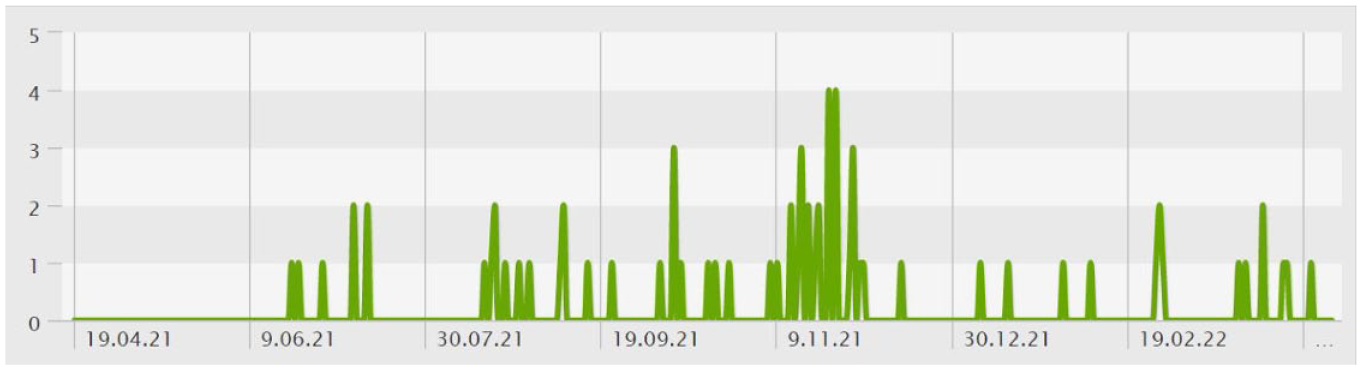
Interactions among users who mentioned #boycottqatar.
Eighty-two percentage of the users who used the #boycottqatar hashtag (n = 91,161) were from either the United States or Western Europe. Furthermore, the interactions among these users took place mainly on Twitter (88% of the interactions) and the remaining 12% took place on either Instagram of Facebook (see Figure 2).

Platforms on social media where the discussions about #boycottqatar2022 took place.
We calculated the P-score for the users who mentioned the #boycottqatar2022 account. The average P-score of the 111,172 followers (who used the hashtag). An independent t-test was then conducted to compare the P-score differences between these users and a randomly selected user. The 111,172 users (who used the hashtag) (M = .678, SD = .023) compared to the 111,172 random users (M = .512, SD = .025) demonstrated significantly more liberal P-score among those who used the hashtag t(111,170) = 7.2, p = .002.
These results suggest that users of hashtag boycottqatar2022 are more liberal in terms of their political inclination. Specifically, as we can see in Figure 3, the distribution of the users who used this hashtag was more diverse in terms of political inclination.

Distribution of social media users.
Discussion and Conclusions
( . . . ) the awarding of mega-events such as the Olympic Games and football’s World Cup and the opposition to bids for the hosting of these events are particularly privileged sites for studying the role of sport in society as they frequently necessitate a dialogue involving a range of stakeholders and debate over the economic, social, physical and ethical impacts of sport in local, national and global contexts. (Kilcline, 2017, p. 158)
Undeniably, sporting mega-events habitually spawn protests from local groups discommoded by the building of new infrastructure, environmental lobbies contesting the long-term legacies of such events, and expressions of outrage at the expenditure of public funds on events often restricted to an elite selection of participants and spectators (Galily, 2021; Kilcline, 2017).
Hence, the current article examines the nature of global protest in the sport realm using a social network analysis method. The analysis identified that the great majority (82%) of those using the hashtag #boycottqatar2022 as a protest against Qatar human rights breach were from North America and Western Europe, indicating that Global North–South divide argument is definitely valid in terms of the demographics of those actively protesting. Next, the analysis revealed that the great majority of the hashtag users used it on the Twitter platform, which is identified as a more elitist platform than the other two platforms used: Facebook and Instagram (Edwards, 2013; Paul et al., 2019). Finally, the analysis revealed that the political inclination of the followers is mostly liberal, indicating that the motivation is mostly the human rights cause rather than a blunt anti-Qatar sentiment illustrate in former studies of resistance against Qatar’s Al-Jazeera initiative (Samuel-Azran, 2016; Samuel-Azran and Hayat, 2017).
From a global perspective, taken together, the findings strengthen the notion that global action is mostly taking place as “global elite” conversation (Schlesinger, 1999; Thussu, 2018). Hence, Sparks (2002) notes that under globalization a new form of a global elite which is disproportionately upmarket is indeed interested in global action but it is an exclusive audience centered in the West. Similarly, Schlesinger (1999) notes that transnational action reaches a very small audience, which can be described as a “global elite conversation.” The findings also further strengthen the argument regarding that Global South–North divide (Odeh, 2010; Steffen et al., 2015), showing that the argument is germane in the context of sport and protest as well.
Fan activism and critical engagement with contemporary sporting culture is an emergent topic in the area of sociology and (of) sport, which has recently attracted increasing academic attention (Numerato, 2018). Accordingly, the current study is one of the first to tackle the interplay between sport and politics from a globalization theories perspective and also one of the first to approach the issue of mega sport events protest using the social network analysis method to identify the origin and political inclination of participants in the protest. Thus, the study illuminates that whereas in the past, a lot of the sport boycotts were organized by governments and were followed by implementation of the threat as countries did not appear to the games, as illustrated in various cases, from the 1936 Olympics in Berlin (Guttmann, 2013) through to the 1980 Moscow Olympics and the 1984 Los Angeles Olympics (Guttmann, 1988), this is not the case with social media sport protest. One reason could be the relatively small numbers of those using the hashtag; a second reason could be that, as illustrated, the protest’s demographics was very limited and did not spread globally; and a third explanation could be the limited effect of social media protests in the context of sport. Future studies should examine whether the bottom-up approach to protest actually proves ineffective in sport in comparison to those starting from sportsmen and governmental bodies.
Footnotes
Declaration of Conflicting Interests
The author(s) declared no potential conflicts of interest with respect to the research, authorship, and/or publication of this article.
Funding
The author(s) received no financial support for the research, authorship, and/or publication of this article.
