



Abstract
This study explores the differences in reporting of instrumental identity theft to law enforcement among United States (US)-born White, non-Hispanic (NH), US-born racial/ethnic minority, and immigrant victims. Data from the 2021 National Crime Victimization Survey Identity Theft Supplement were used to complete descriptive and logistic regression analyses. Reporting of instrumental identity theft to law enforcement was least frequent among immigrant victims and most frequent among US-born racial/ethnic minority victims. Immigrant victims of instrumental identity theft were significantly less likely than US-born racial/ethnic minority victims to report their victimization to law enforcement. The most common reason for victims among all immigration groups to not report their instrumental identity theft victimization to law enforcement was another organization taking care of the issue. The percentage of victims who did not think about reporting their victimization to law enforcement was significantly higher among immigrant victims of instrumental identity theft and significantly lower among US-born White, NH victims. Implications of these findings are discussed.
Introduction
Reporting (or not reporting) victimization to law enforcement can have important implications for not only the criminal justice process but also for victims’ recovery. This can be especially the case for victims of instrumental identity theft, a rather unexplored group among identity theft victims, who experience fraudulent use of their personal information by others for tax returns, applying for jobs or government benefits, receiving medical care, filing false tax returns, providing false information to the police and government, and other frauds (Burnes et al., 2020).
Victims of instrumental identity theft, and especially victims of government-related identity frauds, have been found to experience not only the most complicated cases but also the most legally and financially substantial outcomes among all identity theft victims (Green et al., 2020; Harrell, 2021, 2023). These victims have also been shown to handle their cases themselves (Green et al., 2020; Irvin-Erickson, 2024) which puts them at high risk for experiencing harmful outcomes. This necessitates a more in-depth study of the barriers against reporting of instrumental identity theft to law enforcement. Being formally recognized as a victim is extremely important in instrumental identity theft cases as victims of instrumental frauds have been found to experience greater ramifications in comparison to victims of other forms of identity theft such as the time spent proving they are victims and issues faced in securing a credit line, driver’s license, government benefits, housing, medical care, or a job (Green et al., 2020; Irvin-Erickson & Ricks, 2019).
Immigration status can be connected to non-reporting tendencies among all victims including instrumental identity theft victims due to fear or mistrust of authorities and a lack of knowledge or resources to invoke the criminal justice system. The research on reporting of identity theft to law enforcement is very limited and immigration status of a victim has not been explored as a potential correlate of reporting of identity theft to law enforcement. The United States (US) literature on the connection between identity theft and immigration has generally focused on identity theft as a tool or outcome of illegal immigration. This study fills this critical gap in the literature by exploring the relationship between immigration status of a victim and reporting of instrumental identity theft to law enforcement using nationally representative data from the 2021 iteration of the National Crime Victimization Survey Identity Theft Supplement (NCVS-ITS). Specifically, this study examines the differences in victim reporting of instrumental identity theft through a lens of the immigration status and racial/ethnic identity of the victim.
Conceptual Framework
A Critical Gap in the Literature on Victimization Experiences of Immigrants in the US
Studies on victimization experiences of individuals from different immigration statuses in the US have been very scant. The scarcity of studies on the connection between victimization and immigration status in the US can be simply due to the unavailability of citizenship information in nationally representative data sources until very recently due to the challenges of including sensitive questions on immigration in national surveys (Irvin-Erickson, 2023; Ousey & Kubrin, 2018; Xie & Baumer, 2021; Zatz & Smith, 2012). Another possible driver of this omission can be the theorizing underlying the connection between immigration and crime where immigration status of an individual has mainly been considered as a risk factor for offending. This also has been the case for the early discourse on the relationship between identity theft and immigration (see Cebula & Koch, 2008; Cebula et al., 2006; Hovey, 2009; Mortensen, 2009; Stana, 2002).
In the past decade, there has been a significant shift in the theorizing surrounding the connection between immigration and crime due to studies showcasing the lower odds of offending among the foreign born in comparison to these odds among the US-born (Bersani & Piquero, 2016; MacDonald & Sampson, 2012; Martinez & Lee, 2000) and lower odds of substance abuse and anti-social behavior among immigrants (Salas-Wright et al., 2018; Szaflarski et al., 2010; Vaughn et al., 2014)—factors that are critical correlates of offending. With the inclusion of a question on the citizenship status of respondents to the NCVS in 2017, studies recently started incorporating immigration status as a potential correlate of victimization risk in the US.
A study by Xie and Baumer (2021) was the first study which used data from the 2017 iteration of the NCVS to compare violent and property crime victimization odds of US-born citizens, naturalized citizens, noncitizens, and individuals with an ambiguous citizenship status in the US (a category more likely to capture undocumented immigrants). Specifically, Xie and Baumer (2021) used the “do not know” and missing responses to the citizenship question in the NCVS to identify individuals with an ambiguous citizenship status. Xie and Baumer (2021) demonstrated significantly lower odds of violent and property crime victimization risk among foreign-born individuals in the US compared to US-born citizens. However, an analysis of victimization risk among only foreign-born in the same study showed that individuals who have an ambiguous citizenship status had higher odds of violent crime victimization in comparison to naturalized citizens and noncitizens. Another study by Espinoza et al. (2022) using NCVS data found lower odds of intimate partner violence victimization among foreign-born Hispanic women in comparison to their US-born counterparts.
Only two studies to date examined the relationship between immigration status and identity theft risk in the US using national data from the NCVS-ITS. One study by Irvin-Erickson (2023), similar to Xie and Baumer (2021), examined the identity theft victimization risk among individuals from four immigration statuses. Irvin-Erickson (2023) found that in comparison to US-born citizens, individuals with an ambiguous citizenship status had lower odds of identity theft victimization. This study further found that among the foreign-born, individuals who are naturalized citizens and noncitizens had significantly higher odds of identity theft victimization in comparison to individuals with an ambiguous citizenship status. Irvin-Erickson (2023) attributed these observations to the relatively low visibility of individuals with an ambiguous citizenship status for a largely technological and digital crime like identity theft due to their exclusion from digital and economic spheres in the US.
Another study by Maher (2024) examined the relationship between a person’s citizenship, ethnicity, and their risk of identity theft victimization. This study’s findings were similar to those of Irvin-Erickson (2023); in that noncitizens were found to have lower risk of identity theft victimization than citizens. However, Maher (2024) further showcased that among noncitizens, the risk of victimization was not homogeneous. Specifically, Hispanic noncitizens had higher odds of identity theft victimization than non-Hispanic (NH) noncitizens. Maher (2024) attributed this finding to the double marginalization faced by Hispanic noncitizens.
Reporting of Identity Theft Victimization to Law Enforcement in the US
Identity theft affects millions of people in the US every year (Harrell, 2017, 2019, 2021, 2023) and involves theft and subsequent fraudulent use of personally identifying information. Identity theft is distinct from majority of crimes law enforcement handle due to several reasons. First, theft of personal information might not temporally overlap with fraudulent use of this information, and there can be a significant time lag between the theft of personal information and discovery of fraudulent use of this information by victims or authorities. Second, once a person’s information is stolen, the person can become victim of fraud multiple times. Third, increasingly, more identity theft cases involve theft of information over the internet and organizational data breaches (Pascual et al., 2018). Lastly, a large majority of identity theft victims do not know how their information was stolen or who stole their personal information (Harrell, 2021, 2023).
Because of the ambiguous nature of identity theft, victims might have confusion about what to do once they discover their information is stolen, and especially in cases where a monetary lost is not apparent or immediate. Recent iterations of the ITS show that identity theft is underreported to law enforcement and reporting of identity theft to law enforcement has been decreasing over the years perhaps because a large majority of identity theft victims—and especially victims of identity theft involving misuse of existing bank, credit card, and other accounts—reach out to banks, credit bureaus, and other financial organizations to resolve the issue (Harrell, 2017, 2019, 2021, 2023; Harrell & Langton, 2013).
While aggregate statistics on identity theft show that approximately 1 in 10 identity theft victims report their victimization to law enforcement (Harrell, 2017, 2019, 2021, 2023; Harrell & Langton, 2013), a closer look at reporting patterns across victims of different forms of identity theft suggests that a higher percentage of victims of instrumental identity theft report their victimization to law enforcement (approximately 1 in every 4 victim in 2021; see Harrell, 2023) underlining the more substantial consequences of instrumental identity theft.
A handful of studies to date tested correlates of victim-reporting of identity theft to law enforcement. One study by Golladay (2017) found that racial/ethnic minority victims (in comparison to White, NH victims) and victims who know the offender were more likely to report their victimization to the police. Golladay (2017) further found that individuals who have been repeat identity theft victims in the past year and beyond were less likely to report their victimization to law enforcement than victims with no repeat identity theft experiences. Another study by Betz-Hamilton (2023) found a positive relationship between the victim’s age, the amount of money lost, and police reporting and found a negative relationship between the victim being married and police reporting of familiar identity theft incidents involving known offenders.
According to another study by Reyns and Randa (2015), seriousness of the offense (i.e., incidents in which victims experienced more emotional distress, victims had more out-of-pocket loss, or perpetrators obtained more money) is the only common factor affecting the decision to report victimization to the police among all identity theft subcategories considered by this study. Other factors such as knowing how personal information was obtained and a shorter period between the incident and discovery of victimization were associated with increased odds of contacting the police among victims of credit card and bank fraud. According to the same study, reporting the incident to another non-law enforcement agency was associated with increased odds of contacting the police among victims of existing account frauds; however, a sub-analysis of reporting patterns among bank fraud and credit card fraud victims showed that, while bank fraud victims who contacted other agencies were more likely to contact the police, victims of credit card fraud who contacted other agencies were not as likely to contact the police. This study also showed that victims of credit card fraud with higher income and female victims of new account frauds were less likely to report their victimization to the police.
Reynolds (2022) also found a positive relationship between offense seriousness (i.e., amount taken as a result of the incident, out-of-pocket loss, time resolving the incident, and distress felt as a result of the incident) and police reporting of victimization. Reynolds (2022) further found that victims who know the offender, victims who contacted a credit bureau, older individuals, and victims who live in the Midwest were more likely to report their victimization to the police, whereas victims whose information was used longer and victims who were contacted by a financial institution about the misuse of their information were less likely to report their victimization to the police.
These studies suggest that several incident-related and demographic factors—and especially offense seriousness and knowing anything about the offense—are potential correlates of victim-reporting of identity theft to law enforcement. However, these correlates likely vary by the form of identity theft victimization and the entity identity theft is reported to. The current study expands upon this literature by exploring the impact of the immigration status of a victim, a previously unstudied factor, on law enforcement reporting of a rarely studied form of identity theft, instrumental identity theft, which has substantial ramifications for victims.
Expectations on the Reporting of Identity Theft by Victims with Different Immigration Statuses
The literature on crime reporting of immigrants in the US has been limited to the study of certain neighborhoods, cities, or regions because there was not national level data on immigrants’ victimization experiences in the US until recently (Morgan & Truman, 2019; Xie & Baumer, 2021). Furthermore, due to the scarcity of data on victimization of immigrants, the theoretical development on this topic has been limited (Xie & Baumer, 2021). One study of crime reporting behavior in immigrant communities found that rates of reporting of violent crime in traditional immigrant communities were similar to those rates in other communities, but the rates of violent crime reporting were lower in comparatively newer immigrant communities (Xie & Baumer, 2018).
Within the category of foreign-born individuals in the US, noncitizens might be exposed to conditions that decrease their chances of engaging the law. For instance, the political environment in the US and the lack of trust in law enforcement are argued to contribute to noncitizen immigrants’ (and especially undocumented immigrants’) hesitation to engage the law (Chapin, 2011; Menjívar & Abrego, 2012; Winton & Yi, 2006; Zatz & Smith, 2012). Furthermore, citizenship itself can provide access to economic and other opportunities and free naturalized citizens from the threat of deportation if they choose to engage social institutions (Forrester & Nowrasteh, 2018; Kubrin, 2014; Miles & Cox, 2014; Treyger et al., 2014; Van Hook et al., 2006). The lack of knowledge about resources or the perception of unavailability of resources for reporting can also reduce noncitizens’ odds of reporting victimization and seeking help (Xie & Baumer, 2021).
Based on the macro-level political environment in the US surrounding immigration and the assumed differences in familiarity regarding institutions and resources available to victims of identity theft among US-born citizens and immigrants, this study hypothesizes that immigrants in the US as a whole (i.e., naturalized and noncitizen immigrants) are less likely to report their instrumental identity theft victimization to law enforcement compared to US-born White, NH victims of instrumental identity theft (Hypothesis #1) and US-born racial/ethnic minority victims of instrumental identity theft (Hypothesis #2). Based on earlier evidence by Golladay (2017) on the increased odds of police reporting of identity theft by racial/ethnic minorities, this study further hypothesizes that US-born racial/ethnic minority victims of instrumental identity theft are more likely to report their victimization to law enforcement compared to US-born White, NH victims of instrumental identity theft (Hypothesis #3).
Methodology
Data Source
The ITS is a supplemental survey to the NCVS and was first commissioned in 2008 to capture individuals’ experiences of identity theft. The ITS is administered to all of the NCVS respondents who are aged 16 years and older. This study used data from the 2021 iteration of the ITS due to two reasons. First, the 2021 ITS is one of the two iterations of this data collection effort capturing the citizenship status of respondents. Second, the 2021 ITS is the first survey in this series where the survey only captures completed identity theft incidents as opposed to previous data collection on completed and attempted incidents (Harrell, 2023). The data for this study were downloaded from the Inter-university Consortium for Political and Social Research website (Bureau of Justice Statistics [BJS], 2023).
The 2021 ITS was administered from July 1, 2021 to December 31, 2021 to approximately 133,000 individuals in NCVS sampled households. From those individuals, approximately 93,300 completed the ITS survey (i.e., 69% response rate for the ITS and a 46% combined response rate when NCVS response rate is considered). The BJS estimated little to no bias due to nonresponse in the 2021 ITS (Harrell, 2023). Although NCVS data collection activities have been changed at the beginning of the COVID-19 pandemic, data collection resumed as usual in 2021. Still, this study used ITS weights to make the sample nationally representative.
To capture instrumental identity theft incidents experienced by the respondent in the past year, the ITS asks if the personal information of the respondent was used for other fraudulent purposes (i.e., not in relation to misuse of existing accounts or opening of new accounts) including tax returns, applying for jobs or government benefits, receiving medical care, filing false tax returns, providing false information to the police and government, and other frauds. Out of the 9,234 identity theft incidents identified by the 2021 ITS, 508 were instrumental identity theft incidents.
Measures
Dependent Variable
The dependent variable reporting to law enforcement captured if the victim reported the instrumental identity theft incident to the local police, a sheriff’s office, or a federal law enforcement agency.
Independent Variable-Immigration Status
As of 2017, the NCVS asks respondents if they are US citizens and codes respondents as US-born citizens (born in the US, born in a US territory, born of US citizen parent[s] abroad), US citizens through naturalization, and noncitizens. This variable captured if the respondent was a US-born citizen or an immigrant (i.e., a naturalized citizen or a noncitizen). Recent studies differentiated between immigrants with an ambiguous citizenship status and naturalized citizens and noncitizens. The current study was not able to observe differences in law enforcement reporting of victims with an ambiguous citizenship status because none of the instrumental identity theft incidents in the study sample included victims with an ambiguous citizenship. Similarly, this study did not compare the law enforcement reporting behavior of naturalized and noncitizen immigrant victims because a very small number of instrumental identity theft incidents in the study sample (n = 12) included noncitizens.
The immigration status variable was stratified by the victim’s ethnic/racial identity for the US-born victims but not immigrant victims due to the low number of instrumental identity theft incidents involving immigrants in the sample (n = 34). Racial/ethnic identity captured if the respondent was White, NH or not. The resulting classification of immigration status included the following three categories: (1) US-born, White, NH, (2) US-born racial/ethnic minority, and (3) immigrant (i.e., naturalized or noncitizen immigrant).
Control Variables
This study controlled for several factors tested by the literature on reporting of identity theft. Age is a continuous variable capturing respondent’s age. Sex captured if the victim is female or male. Household income captured if the victim’s annual household income was less than $75,000 or higher. Educational attainment captured if the respondent has a less than a Bachelor’s degree or higher. Offender known captured if the offender was a relative (i.e., current/past spouse or intimate partner or other relative), known non-relative, or unknown. This study used one measure to capture offense seriousness. Out-of-pocket loss captured if the victim lost any money that was not covered or reimbursed and was coded as no loss/unknown loss or non-zero $ loss. Distress and time to resolve the incident variables used in other studies were not included in the analysis to limit the offense seriousness variables to immediate consequences of the incident.
Multiple type identity theft captured if the incident involved only instrumental identity theft or other types of identity theft along with instrumental identity theft (i.e., identity thefts involving existing accounts such as bank, credit, e-mail/social media, and other existing accounts and identity theft incidents involving opening of new accounts). Lastly, reported to other entity captured if the incident was reported to any of the following entities: a state or local government consumer affairs agency, the Federal Trade Commission (FTC), a nongovernment consumer agency, a government agency that issues documents like driver’s licenses or Social Security card, a nongovernment agency that issues documents, such as insurance cards, or an office or agency other than the police that deals with victims of crime.
Modeling
From the 508 instrumental identity theft incidents in the study sample, approximately 2% (n = 10) did not include information on one or more of the variables included in the analysis. Considering the relatively low percentage of missing data, these cases were deleted listwise and the final sample size was 498.
Descriptive analyses were conducted to compare demographic and socioeconomic attributes and law enforcement reporting of victimization across US-born White, NH, US-born racial/ethnic minority, and immigrant victims of instrumental identity theft. The ITS asks victims who did not report their victimization to law enforcement to indicate their reasons for not reporting their victimization to law enforcement. For these victims, chi-square tests were run to observe if there were differences across different immigration groups for their reasons to not report their instrumental identity theft victimization to law enforcement. p-values for chi-square tests were calculated using adjusted residuals. Logistic regression models presented in this study were run using the SPSS Complex Samples add-on using weights and accounting for the complex sample design of the NCVS. Custom adjusted weights were created using the ITS weights and the original sample size in the model. Collinearity tests suggested no issues of multicollinearity in the models.
Results
Sample Characteristics
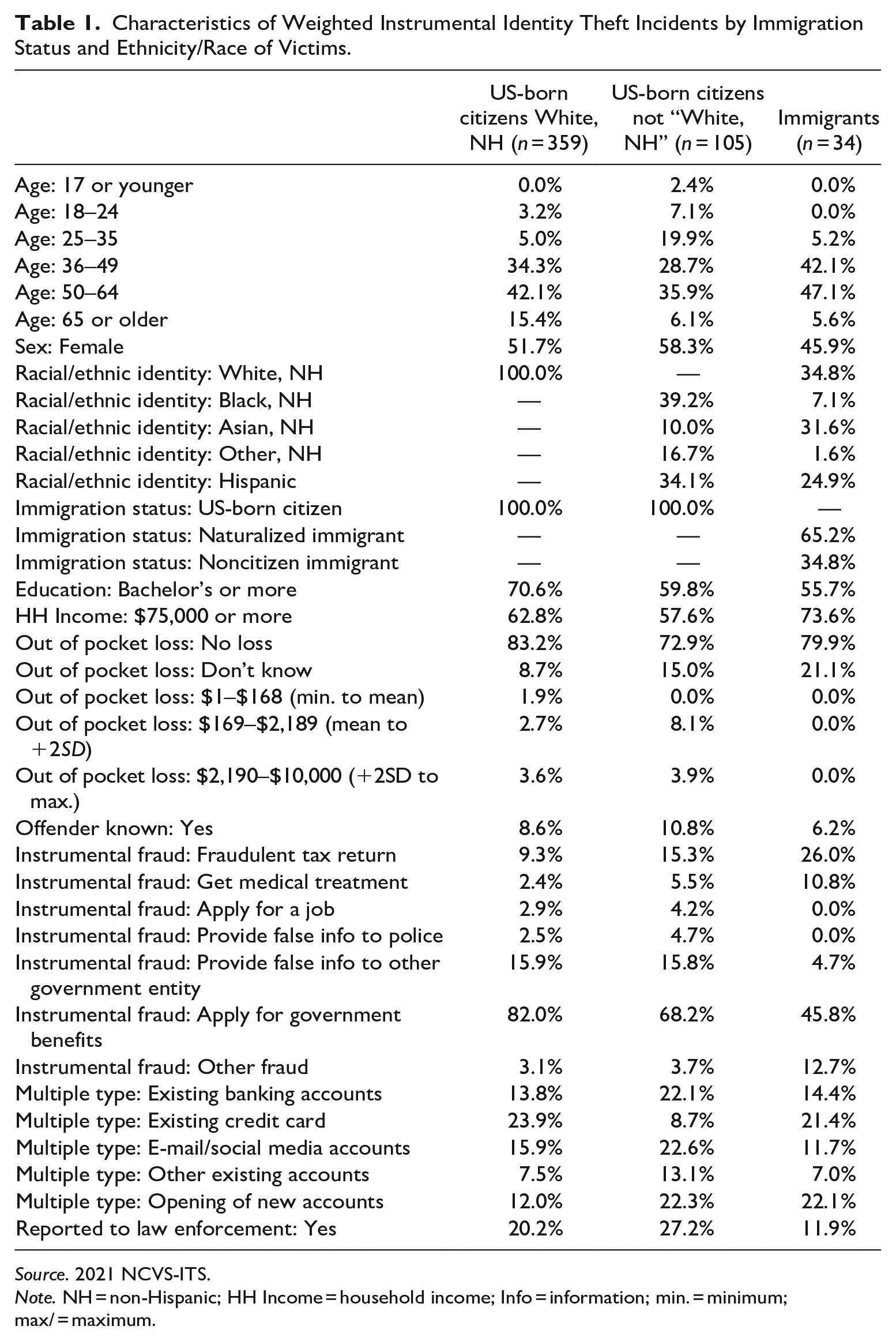
Table 1 presents socioeconomic and victimization profiles of instrumental identity theft victims in the sample across immigration groups. The majority of the instrumental identity theft victims in the sample were US-born (n = 464) with 72% (n = 359) identifying as US-born White, NH citizens. Among immigrant instrumental identity theft victims (n = 34), only 35% (n = 12) were noncitizens and the rest of the immigrant victims (n = 22) were naturalized immigrants. A higher percentage of US-born White, NH victims and immigrants were in the higher age categories in comparison to US-born racial/ethnic minority victims. The highest percentage of female instrumental identity theft victims were observed among incidents involving US-born racial/ethnic minorities (58.3%), followed by US-born White, NH (51.7%), and immigrant (45.9%) victims. A high percentage of instrumental identity theft incidents among immigrants involved White, NH (34.8%) and Asian, NH (31.6%) victims.
Characteristics of Weighted Instrumental Identity Theft Incidents by Immigration Status and Ethnicity/Race of Victims.
Source. 2021 NCVS-ITS.
Note. NH = non-Hispanic; HH Income = household income; Info = information; min. = minimum; max/ = maximum.
Among instrumental identity theft incidents involving US-born racial/ethnic minorities, a majority of incidents were perpetrated against Black, NH (39.2%) and Hispanic (34.1%) victims. A higher educational attainment was observed among US-born White, NH victims of instrumental identity theft with 70.6% of the victims in this group having attained a Bachelor’s degree or higher in comparison to 59.8% and 55.7% of US-born racial/ethnic minority and immigrant victims, respectively. Among immigrant instrumental identity theft victims, 73.6% had a household income of $75,000 or more compared to 62.8% and 57.6% among US-born White, NH and US-born racial/ethnic minority victims.
A majority of the instrumental identity theft incidents involved no monetary loss across all immigration groups considered for the study. Surprisingly, none of the immigrant victims in the sample reported a non-zero monetary loss. Comparatively, a slightly higher percentage of instrumental identity theft incidents among US-born racial/ethnic minorities (10.8%) involved a known offender in comparison to incidents involving US-born White, NH (8.6%) and immigrant (6.2%) victims. A majority of incidents experienced by US-born White, NH (82.0%) and US-born racial/ethnic minority (68.2%) victims involved the use of the victim’s information for applying for government benefits.
The most common purpose of the use of immigrant victims’ information was to apply for government benefits (45.8%). Misuse of victims’ information for fraudulent tax returns (26.0%) and getting medical treatment (10.8%) were also common among immigrant victims (and more common among immigrant victims in comparison to their US-born counterparts). Among all instrumental identity theft incidents (n = 498), 57.1% involved another category of identity theft in relation to the same incident. Reporting of instrumental identity theft incidents were low across the board, however, a higher percentage (27.2%) of incidents involving US-born racial/ethnic minority victims were reported to law enforcement by the victim in comparison to incidents involving US-born racial/ethnic minority (20.2%) and immigrant (11.9%) victims.
Group Differences in Reporting Identity Theft Victimization
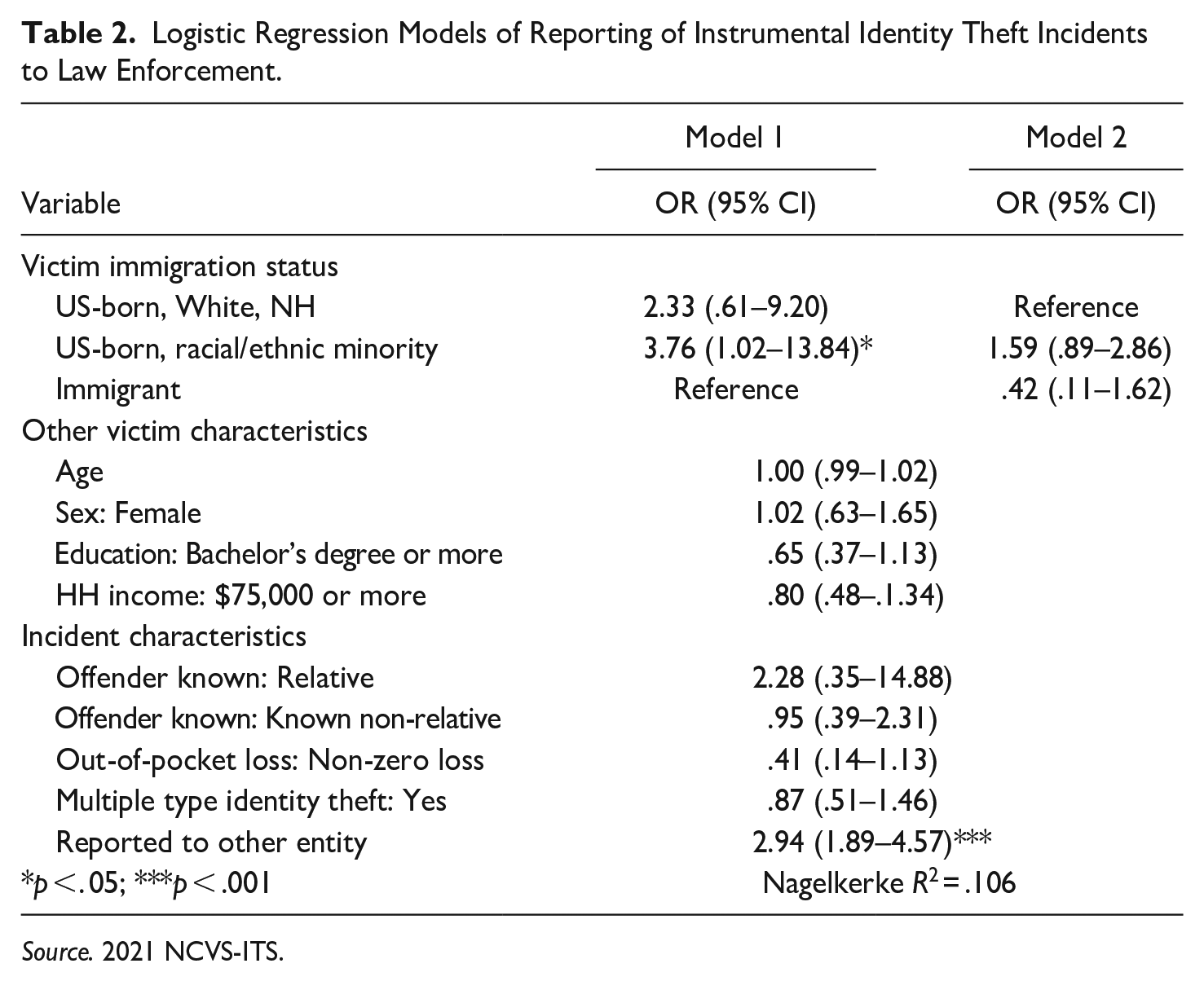
The results from the logistic regressions of victim reporting of instrumental identity theft incidents to law enforcement are shown in Table 2. Table 2 contains two models corresponding with the three hypotheses for the study: one model for comparing the reporting differences among immigrants and US-born citizens (Hypotheses #1 and #2) and another model for comparing the reporting differences between US-born White, NH and US-born racial/ethnic minority victims (Hypothesis #3).
Logistic Regression Models of Reporting of Instrumental Identity Theft Incidents to Law Enforcement.
Source. 2021 NCVS-ITS.
As shown in Table 2, immigrant victims are less likely than US-born victims to report their victimization. However, this observed relationship only reached statistical significance for the comparison between immigrant and US-born racial/ethnic minority victims providing support for Hypothesis #2 but not Hypothesis #1. Specifically, US-born racial/ethnic minority victims of instrumental identity theft had significantly higher odds of reporting their victimization to law enforcement than immigrant victims (OR = 3.76, p = .046).
Although, US-born racial/ethnic minority victims of instrumental identity theft were also observed to have higher odds of reporting than their White, NH counterparts, this finding did not reach statistical significance and accordingly study findings did not provide support for Hypothesis #3. Among all of the control variables included in the regression analysis, only reporting the identity theft victimization to another entity was observed as a statistically significant and positive correlate of reporting of instrumental identity theft to law enforcement (OR = 2.94, p < .001).
Reasons for Not Reporting Victimization to Law Enforcement
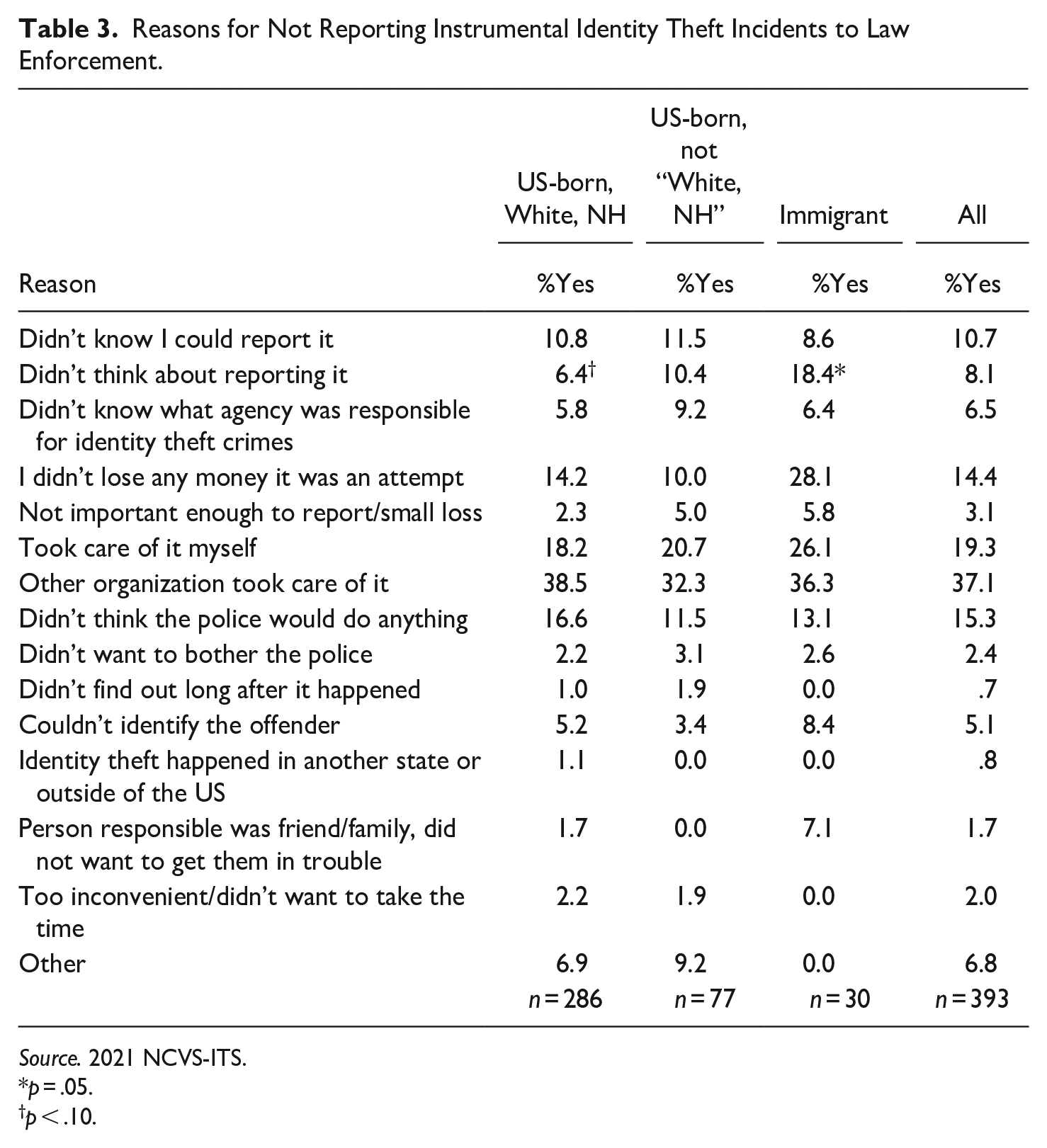
As shown in Table 3, the most common reason for victims from all immigration groups to not report their instrumental identity theft victimization to law enforcement was another organization taking care of the issue (32%–38%). The other common reasons across the immigration groups for not reporting their victimization to law enforcement included victims taking care of the issue themselves (18%–26%) and victims thinking the police would not do anything about the issue (11%–16%). The only significant difference between victims across immigration groups for the reason to not report their victimization to law enforcement was observed for the proportion of victims who did not think about reporting the issue. The percentage of victims who did not think about reporting their victimization to the police was significantly higher among immigrant victims of instrumental identity theft (p = .05) and significantly lower among US-born White, NH victims (p < .10) in comparison to this prevalence in the full sample of non-reporters (n = 393).
Reasons for Not Reporting Instrumental Identity Theft Incidents to Law Enforcement.
Source. 2021 NCVS-ITS.
p = .05.
p < .10.
Discussion
On the basis of the arguments in the literature regarding the inclusion of immigrants in the society and the lack of trust in law enforcement, this study posited that immigrant victims of instrumental fraud will be less likely than US citizens as a whole to invoke the law. Although, there were no statistically significant differences between US-born White, NH and immigrant victims of instrumental identity theft in their odds of reaching out to law enforcement, immigrant victims were observed to be statistically less likely than US-born ethnic/racial minorities to reach out to law enforcement providing support for this study’s second hypothesis. This finding might be capturing the comparatively less knowledge among immigrants about the role law enforcement can play in the handling of identity theft cases or a comparatively higher level of distrust in the ability of law enforcement in handling instrumental identity theft experiences. This assumption is partially supported by the descriptive analysis of reasons for not reporting among non-reporters which showed that immigrants are significantly less likely to think about law enforcement as a resource in the aftermath of instrumental identity theft victimization. The aforementioned finding, when coupled with the significantly lower odds among immigrant victims of instrumental frauds to contact the police in comparison to US-born racial/ethnic minorities, provides support for the existing literature regarding the lower level of literacy among immigrants about resources in the aftermath of victimization (Xie & Baumer, 2021) and lower level of trust in law enforcement among immigrants (Forrester & Nowrasteh, 2018; Kubrin, 2014; Miles & Cox, 2014; Treygeret al., 2014; Van Hook et al., 2006).
There were no statistically significant differences among US-born victims of instrumental identity theft or between immigrants and US-born White, NH victims of instrumental identity theft. This lack of support for Hypotheses #1 and #3 can be partially explained by some of the methodological limitations of this study. Due to the limited number of immigrants and noncitizens in the study sample, the immigrant category could not be stratified by the race/ethnicity of the victim or the naturalization status of the victim to understand the differences in police reporting between White, NH immigrants and racial/ethnic minority immigrants or between naturalized and noncitizen immigrants.
Some of the arguments regarding immigrants’ relative position in a host country can be more applicable to immigrants with a more vulnerable immigration status such as noncitizens or undocumented immigrants. Past studies suggest that there are significant differences between the socioeconomic profile of naturalized and noncitizen immigrants. Looking at the differences within the foreign-born population in the US, noncitizen immigrants are less educated, younger, less likely to be married, and in more financial strain than naturalized citizens (Gelatt & Zong, 2018; Sumption & Flamm, 2012; US Census Bureau, n.d.; Xie & Baumer, 2021). Although this study was not able to observe the law enforcement reporting differences between naturalized and noncitizen immigrant victims and among noncitizen immigrant victims, it is reasonable to argue that noncitizen victims of identity theft might have lower odds of reporting their victimization and seek help (or know how to seek help). With more iterations of the ITS becoming available in the coming years, the ITS data can be used to discern help-seeking differences between US-born citizens, naturalized citizens, noncitizens, and individuals with an ambiguous citizenship status.
Conclusion
This study examined the differences of reporting of instrumental identity theft to law enforcement between victims from different immigration groups in the US using national victimization data. The study findings suggested that there is a concerning issue of underreporting of instrumental identity theft incidents to the police among all victims and especially among immigrants victims in comparison to US-born racial/ethnic minority victims. This underreporting issue might be attributable to the ambiguous nature of identity theft, a focus by victims on the immediate monetary loss associated with identity theft, and a lack of understanding among victims about the resources available to them through law enforcement in the aftermath of victimization and future vulnerability to victimization once the personal information is exposed.
Cross-sector collaboration between financial and non-financial institutions in education of consumers in the US, and especially immigrants, about the risks of identity theft and steps to be taken to be formally recognized as a victim of identity theft by the law enforcement and the federal government is of utmost importance. As this study showed, reaching out to a non-law-enforcement entity is a significant correlate of reaching out to law enforcement among instrumental identity theft victims. Messaging can focus on the importance of contacting the police or the FTC to obtain an identity report; contacting financial institutions and credit bureaus to dispute charges/avoid legal fees and place a fraud alert/freeze; and contacting the FTC, consumer bureaus, and victim service organizations for services, recovery plans, and to keep track with these plans.
Footnotes
Acknowledgements
I would like to thank Dr. Wendell C. Wallace and Dr. Casandra Harry for their support and the peer reviewers for their feedback.
Declaration of Conflicting Interests
The author declared no potential conflicts of interest with respect to the research, authorship, and/or publication of this article.
Funding
The author received no financial support for the research, authorship, and/or publication of this article.