




Abstract
Spanish women finally surpassed the 40% threshold of political representation in 2008. Yet, despite this progress, they continue to face unequal media visibility and have increasingly turned to social media to enhance their public presence. Although research shows that women are as active as men online, men’s posts tend to have greater reach and influence, revealing persistent gender disparities. This article examines how these differences manifest in the X (formerly Twitter) communication of the leading male (first-position) and female (second-position) candidates from the five parties with the largest parliamentary representation during Spain’s November 2019 general election. This election was historically significant as feminism featured prominently in the campaign agenda. Paradoxically, however, all five parties selected men as their first-position candidates and women as their seconds, thereby reproducing traditional gender hierarchies within an explicitly feminist context. Using a mixed-methods approach, the study analyses candidates’ presence and thematic focus during the campaign’s second and final week, the period of highest communicative intensity. The quantitative results revealed a significant gender imbalance, with female candidates contributing only one-fourth of the total activity. While male candidates primarily generated content, female candidates mostly shared posts from their male counterparts. Female candidates thus played a secondary role, mainly supporting male candidates’ tweets and occasionally addressing issues concerning women as a group. By adhering to topics already addressed by male candidates, these female candidates may have aimed to avoid criticism for stepping outside conventional roles, thereby illustrating the constraints imposed by the double bind. The study highlights the persistent prioritisation of male politicians’ messages in political discourse and suggests that female candidates’ reduced activity may stem from gender constraints.
Keywords
Introduction
Women’s inclusion in politics is the outcome of a feminist struggle for equality that has been ongoing for almost two centuries (Puente & Miguel, 2019). Several factors have contributed to an increase in women’s representation in public life (Fernández Fraile, 2008, p. 12). Women’s incorporation in the labour market and measures taken to conciliate work and motherhood, for instance, have allowed for their higher recognition in public spaces. The establishment of gender quotas that were driven by the women’s movement has also become central to boosting their presence in public and private institutions, such as government offices (Montero & Pérez, 2021).
In the political arena, Spanish women have seen important advances. For example, they have finally surpassed the 40% threshold of political representation in the Spanish Parliament due to the implementation of a gender quota system in 2008. However, it was not until June, 2018 that most leading ministry positions (a total of 11) were occupied by women for the first time in the history of Spanish democracy, as noted in a national newspaper El Confidencial (Romero & Rodrigo, 2018). While the number of women participating in the political sphere has undoubtedly increased and continues to do so, politics continues to be male-dominated and, as a matter of fact, female politicians continue to receive different media coverage compared to their male counterparts (Bürger et al., 2020; Garcia-Blanco & Wahl-Jorgensen, 2012; Goodyear-Grant, 2013).
For years, the media’s representation of female politicians has been marked by links to gender stereotypes, and their political role has been considered secondary (Norris, 1997; Redondo & Gonzalo, 2018). Female politicians have often been trivialised by their private lives being focused on, sexualised by their bodies being emphasised, or commodified by their appearance being focused on (Ross, 2009, p. 73). Recent studies on Spanish female politicians’ visibility in media coverage have revealed similar results despite attempts to neutralise the media coverage on female politicians who hold high-ranking positions (Fernández-Rovira & Giraldo-Luque, 2022). The media’s representation of female ministers in Spain continues to focus on physical appearance and personal characteristics by building on established gender roles and stereotypes (Fernández-García, 2018; Verge & Pastor, 2018).
This lack of equal media coverage has resulted in female politicians turning to social media platforms such as Twitter, as these platforms provide them with full control of the content they publish, increase their public visibility, and normalise their active role in politics (Kreiss, 2016). While research has shown minor gendered differences between Spanish female and male politicians’ Twitter activity, female politicians’ posts were much less influential than those of their male counterparts, thereby indicating gender disparities (Guerrero-Solé & Perales-García, 2021).
This article focuses on gendered differences in an election season between key Spanish female and male politicians’ political communication on X (formerly Twitter), referring to the platform as it existed prior to its rebranding and change of ownership in 2022 to 2023. It examines how these differences manifest in the X (formerly Twitter) communication of the leading male (first-position) and female (second-position) candidates from the five parties with the largest parliamentary representation during Spain’s November 2019 general election (10N election). Using a mixed-methods approach, it analyses candidates’ presence and thematic focus during the campaign’s second and final week, the period of highest communicative intensity.
This election was historically significant as feminism was explicitly placed at the centre of the campaign agenda for the first time (Cabeza Pérez et al., 2023). Therefore, it was expected that there would be a higher involvement of leading female candidates in the electoral campaign and that the issues brought up by the women’s movement (Comisión 8M, 2019, e.g., gender pay gap, abortion, domestic violence) would be central topics in the candidates’ campaigns (Brandariz Portela et al., 2021). Paradoxically, however, all five parties chose men as their first-position candidates and women as their seconds, reproducing traditional gender hierarchies even in a context of heightened feminist discourse, thereby motivating the comparative approach taken in this study.
This introduction is followed by a contextual overview of the evolution of women’s representation in the Spanish Parliament and the composition of electoral lists. Next, a literature review provides a theoretical framework for understanding the role of social media in political campaigning and explores gender differences in issue mobilisation and leadership ranking, which lays the groundwork for formulating the research questions. The following section details the empirical material and methods used in the study. The results section first presents and discusses the findings from the analysis of the interactivity patterns displayed by selected male and female candidates and then examines their thematic focus. The study concludes with some final reflections and suggestions for future research.
Women’s Underrepresentation and Gender Quotas in the Spanish Congress
Women’s underrepresentation in the Spanish Congress of Deputies (the lower house) has been constant in the history of Spanish democracy. It was not until the 1990s that the representation of women in Congress rose to 10%. This increase reflected the leftist parties’ voluntary quotas from the late 1980s that advocated for the political representation of women (Verge, 2006, p. 173). However, the introduction of gender quotas only became mandatory in 2007, with the approval of the Law for the Effective Equality of Women and Men (hereafter Equality Law). This new legal framework put measures in place for the positive discrimination of women, especially in political institutions and business management bodies. This law’s point of departure is that women are discriminated against solely because they are women, hence measures that extend beyond the formal safeguarding of equal treatment for all must be implemented (Bustelo, 1999, p. 34). Thus, political parties must ensure the equal representation of women and men by including a minimum of 40% of each gender in their lists. Since 2008, the implementation of mandatory quotas has translated into an increase in women deputies, reaching the 40% threshold (see Figure 1).
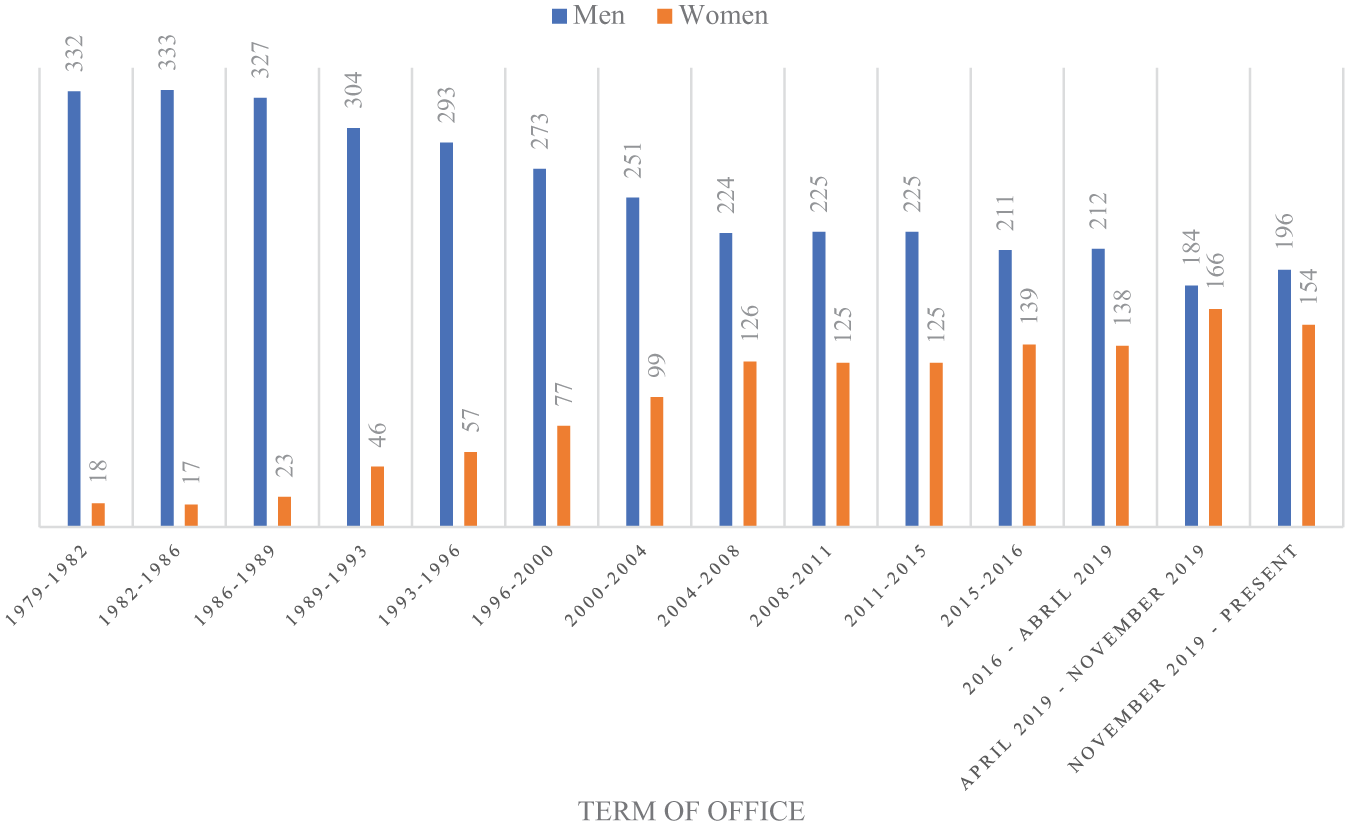
Evolution of female and male representatives in the Spanish Congress (own elaboration). (Data from the website of the Congress of Deputies as of 15 February 2023).
To understand how these quotas work in practice, it is important to consider Spain’s electoral system. The Congress of Deputies is elected under proportional representation with closed party lists in multi-member constituencies corresponding to each province. Voters choose a party list rather than individual candidates and seats in the Congress of Deputies are distributed using the D’Hondt method, which is a formula that divides each party’s votes by a series of divisors (1, 2, 3, etc.) to assign seats proportionally. This system generally favors larger and regionally concentrated parties while still allowing for greater representation of smaller parties. In contrast, the United States uses a winner-takes-all system in which voters choose individual candidates in single-member districts, and only the candidate with the most votes secures the seat, reinforcing a two-party structure.
Within Spain’s closed-list system, the ranking of candidates on party lists is a critical determinant of electoral success. This study focuses specifically on the first and second candidates in the list, who ahead of the 10N election were a man and a woman, respectively. The lead candidate, positioned first, is almost guaranteed a seat if the party wins representation in the district, whereas the second candidate faces a comparatively lower likelihood of being elected. Women are frequently positioned second on lists as a way to appear gender-balanced while still ensuring the first (and thus safer) seat goes to a man (Verge, 2011). Although list positions function as gatekeeping mechanisms in closed-list systems, occupying one of the top positions—particularly first or second—is almost a prerequisite for election. The ensuing study of the social media communication produced by those occupying these two positions makes it possible to understand how gender dynamics operate within parties’ internal hierarchies and in the distribution of real political opportunities, highlighting that legal quotas alone do not guarantee equitable access to political power. Likewise, this analysis allows for the identification of a possible division of topics and provides insight into the sensitivities of the different parties regarding the issues shaping the campaign agenda.
While the Equality Law imposes severe penalties on the parties that fail to meet gender parity requirements, it leaves plenty of room for parties to place female candidates in positions in which they are less likely to be elected in a constituency when creating their lists, thereby indicating the lack of political will (Martínez Pérez & Calvo Barobia, 2010, p. 30). Thus, parties do not compose their lists to actively reduce gender inequality but to comply with the law to avoid sanctions (Martínez Pérez & Calvo Barobia, 2010, p. 25).
Although women’s presence at the lower levels of party structures has increased, they remain underrepresented in leadership positions. Ahead of the Spanish 10N general election, women were again relegated to occupying the second candidate position, despite this being the campaign in which issues related to women’s rights and the need for gender equality received unprecedented attention (Cabeza Pérez et al., 2023). While holding the same merits as their male counterparts, they were consigned to a lower category of political leadership. This points to a problem within the party system itself and its uneven structure of opportunities. These differences are better explained with the metaphor of “glass ceiling” (Morrison et al., 1987), which alludes to those invisible frontiers that women must face to achieve the same position as men. While women broke the gender glass ceiling in political representation long ago, in light of the above, it cannot yet be said the same for political leadership.
Electoral Campaigning on Social Media and the Role of Gender
The consolidation of digital communication technologies and the professionalisation of politics due to the adoption of a media logic have spurred the development of a state of “permanent campaigning” (Blumenthal, 1980). Nevertheless, electoral campaigns are still considered periods of intense communicative activity (Martínez Nicolás, 2007), and their study, therefore, continues to be of relevance.
The 10N election displays the characteristics of a communicative accommodation of politics (Norris, 2004; cf. mediatisation of politics, Strömbäck, 2008), which is the result of political actors adopting criteria of newsworthiness in their communication to attempt to influence and shape the media (Strömbäck, 2008). In particular, the 10N campaign shows features of postmodern campaigns (Norris, 2004), which are highly professionalised and characterised by the fragmentation of media use brought about by the development and consolidation of Internet-based media. In postmodern campaigns, communication experts (e.g., sociologists, statisticians, publicists) contribute their non-political knowledge to the implementation of political strategies (Pont-Sorribes et al., 2018).
Social Media Use in Electoral Campaigning
The development of social media platforms has expanded the array of communication tools now available to politicians. These social media platforms, such as X (formerly s Twitter), have become central to the self-mediated campaigns of political parties, governments, and individual politicians (Campos-Domínguez, 2017; McGregor et al., 2017). Politicians’ communication on X (formerly Twitter) is generally characterised by interactivity and personalisation. On the one hand, politicians use these platforms to communicate with constituencies, other politicians, and journalists, while, on the other hand, they use social media to spread personal information about themselves, such as their daily activities and journalistic articles about them (Golbeck et al., 2010; Kruikemeier, 2014). However, in Spain, political candidates do not place much focus on interacting with their X (formerly Twitter) followers during elections. Instead, this social media platform is mainly used as a tool for self-promotion by transmitting information about the campaign itself or the administration of the government (López-Rabadán et al., 2016), sharing candidates’ media appearances, spreading self-propaganda and counter-campaign content, and asking for votes (Calvo-Rubio, 2017; Zugasti-Azagra & García-Ortega, 2018). For example, sharing social media posts from mainstream media that ideologically align with a particular political representative’s or party’s agenda is a self-promotion strategy widely used by Spanish politicians (Salaverría & Martínez Costa, 2021).
Politicians’ social media activity has also become “a driver for media attention” (Guerrero-Solé & Perales-García, 2021, 470). Female politicians’ social media activity has particularly contributed to increasing their public presence and visibility, thereby normalising their active role in politics (Kreiss, 2016). In this respect, social media activity is a priority for female politicians, even though their contributions receive less visibility as they are shared less often than those of their male counterparts, and they are generally perceived negatively by users (Armstrong & Gao, 2011).
The Role of Gender in Political Communication on Social Media
The role of gender in online political communication is substantial, influencing both the tone, style, and content of messages shared, and topics addressed by politicians, often reflecting broader societal stereotypes and expectations. Likewise, gender shapes the style and content of online messages received by politicians.
Female politicians are generally prone to receive more harassment, threats, and hate than their male counterparts in the public sphere (Krook, 2017, 2020). In the social media domain, female politicians are thus more likely to receive misogynistic and abusive posts than male politicians. While research found that both male and female politicians received similar amounts of tweets that stereotyped them, much of the stereotyping for male politicians was about their parties while female politicians were mostly stereotyped based on their gender rather than as political representatives (Southern & Harmer, 2019). In a related study, Harmer and Southern (2021) found that female politicians received a broad range of digital microaggressions in the form of abusive messages, tweets containing everyday sexism and othering, and messages disregarding their experiences of discrimination and accusing them of reverse discrimination.
Turning to how politicians communicate on social media, research has found gendered differences that go from the tone of messages and the writing style to the content of messages (Beltrán et al., 2021; Evans, 2016; Evans & Clark, 2016). In the US context, Evans and Clark (2016) found that female congressional candidates were more likely to post tweets with a negative and aggressive tone than their male counterparts. This result stands in contrast to the findings of the study conducted by Beltrán et al. (2021) in Spain, showing that female politicians chose to communicate on X (formerly Twitter) from an emotional standpoint, while men were generally more factual. Regarding writing style, differences between Spanish male and female politicians aligned closely with gender stereotypes. Women representatives’ tweets presented a considerable number of female-linked words and words about social issues, whereas men representatives’ posts showed no gender-related words and words about ideological issues.
In terms of the content of the messages shared by politicians during elections, studies have shown some mixed results (Evans, 2016; Evans & Clark, 2016). While female politicians focused on and devoted a significant part of their Twitter presence to discuss “female issues,” that is, issues “that disproportionally focus on women as a group” (Evans, 2016, p. 663), women also posted more about policy and business issues, stereotyped to be more masculine, than their male counterparts (Evans, 2016; Evans & Clark, 2016).
Gender Issue Ownership, Ranking, and Campaign Strategy
The relation between the issues addressed by political candidates and their gender requires nevertheless elaboration. There is a large body of literature about what constitutes a female issue and a male issue (Evans, 2016, p. 663, see also above). This literature initially separates the issues in which male and female candidates are assumed to be competent, and this separation is based on traditional gender stereotypes (Kahn, 1992; Reingold, 2000). Thus, female candidates, who are perceived as compassionate and caring, are seen to be more competent in terms of social issues such as education, healthcare, welfare, poverty, domestic violence, environment, family and sexuality while male candidates, who are associated with strength and roughness, are said to be more concerned with economy, security, military and foreign affairs such as terrorism, defence, war, budget and taxes (Evans, 2016, pp. 663, 672; Koch, 1999). Hence, male and female representatives are expected to address issues according to gender norms and expectations.
The literature also separates female issues based on whether they pertain to women traditionally or exclusively (Cowell-Meyers & Langbein, 2013, p. 162; Gelb & Palley, 1996; Reingold, 2000). For example, issues such as childcare, children’s welfare, and poverty have traditionally belonged to women, while reproductive freedom, sexual harassment, violence against women, gender pay gap, glass ceiling and breast and cervical cancer have exclusively pertained to women (Reingold, 2000, p. 167 as quoted in Cowell-Meyers & Langbein, 2013, p. 162). In addition, feminist issues such as “role equity” issues (with a focus on being equal to men) and “role change” issues (with a focus on challenging the patriarchy) can be considered another subgroup of questions belonging to women (Gelb & Palley, 1996 as quoted in Cowell-Meyers & Langbein, 2013, p. 162).
This study argues that, on the one hand, the constitution and separation of female versus male issues based on gender stereotypes is problematic because “women’s interests are not homogeneous or self-evident” as they are social constructions that are connected to history, culture, and the wider socio-political context (Cowell-Meyers & Langbein, 2013, p. 162). On the other hand, candidates are compelled to emphasize topics that can provide them with electoral advantages. Campaign messages often highlight topics and issues where the candidate has an advantage and downplay others (Sellers, 1998). This is aligned with issue ownership theory (Petrocik, 1996). According to the latter, parties and candidates build reputations for competence on specific issues based on their expertise or ideological commitment. This concept can be extended to gender-related issues, suggesting that parties or candidates might develop a reputation for competence on issues based on gender (for instance, female candidates on family, equality or domestic violence), if they consistently address these topics and demonstrate expertise or strong commitment to them.
In this context, gender norms and expectations can put female politicians in a “double bind” situation in political campaigns (Jamieson, 1995). Research has shown that female candidates who strategically mobilized female issues to target women voters gained a significant advantage at the polls (Herrnson et al., 2003). Nevertheless, according to Jamieson (1995), a female candidate emphasizing her strengths in traditionally female issues may be perceived as limited in scope, reinforcing stereotypes that women are only suited to specific, less significant policy areas. In contrast, a female candidate focusing on traditionally masculine issues may risk being perceived as unfeminine or too aggressive, potentially alienating voters who expect her to embody nurturing and compassionate qualities. This dynamic often forces women candidates to craft their campaign strategies carefully, balancing the need to project strength and competence while not deviating too far from traditional gender norms. Therefore, the prominence of female issues during a campaign depends on the election context.
Ranking and Gendered Campaign Opportunities in the Spanish Context
In Spain’s closed-list proportional representation system, the ranking order of candidates on the party list is decisive for their election prospects and campaign visibility. Because voters cannot alter the order of the list, parties effectively determine who will be elected by assigning the highest positions to their preferred candidates (Verge, 2011). The first candidate on the list, often referred to as cabeza de lista (head of list), acts as the public face of the party in that constituency, receiving most of the media attention and campaign resources (Coller et al., 2018). This position is almost always electable, making it a highly strategic post within internal party dynamics. Although the Spanish system does not encourage personal voting, social media communication can create spaces for personalisation where candidates compete for visibility within their own party.
By contrast, the second candidate occupies a more ambiguous role. Although still visible and often involved in campaign activities alongside the head of the list, this position functions largely as a semi-safe slot whose election depends on the party’s expected number of seats in the district. Parties may use the second position to fulfil gender quota requirements or to balance internal factions and regional representation (Verge & Wiesehomeier, 2019). As mentioned earlier in Section 2, empirical research shows that women are more frequently placed in these second or lower positions, technically compliant with parity laws but less likely to secure a seat unless the party performs strongly (Verge, 2011). Quotas, therefore, ensure presence but not necessarily power or voice, underscoring that list placement can itself generate unequal opportunities for political influence.
This hierarchical ranking also shapes candidates’ issue emphasis and campaign strategies. The head of the list, enjoying greater visibility, tends to focus on broader or core party issues such as economic policy, security, or institutional reform, areas more traditionally associated with male issue ownership. Meanwhile, candidates ranked second or lower often highlight social and welfare-related issues, community engagement, or gender equality, partly because these resonate with their perceived competence areas and local networks. In doing so, lower-ranked women may reinforce the association between female candidates and soft issue domains but also contribute to redefining the scope and salience of these issues within their party’s campaign.
Therefore, ranking not only determines electoral success but also campaign voice. The distribution of media exposure, internal party support, and thematic focus across candidates reflects broader gendered patterns of political visibility and legitimacy. As Verge (2011) argues, in closed-list systems like Spain’s, rank order on the ballot “is decisive for election” (p. 665). Consequently, the capacity of women candidates to influence issue ownership or expand the thematic agenda often depends on whether they are placed in electable positions on the list. Nevertheless, while list positions remain fixed, social media communication can alter candidates’ relative prominence during the campaign.
Building on this understanding, the present study explores how these structural gender and ranking dynamics manifest on social media during an electoral campaign. It aims to investigate how these differences manifest in the X (formerly Twitter) communication of the leading male (first-position) and female (second-position) candidates from the five parties with the largest parliamentary representation during Spain’s 10N election. This election was historically significant as feminism featured prominently in the campaign agenda. Paradoxically, however, all five parties selected men as their first-position candidates and women as their seconds, thereby reproducing traditional gender hierarchies within an explicitly feminist context. The study specifically explores how gender intersects with ranking to shape candidates’ online presence and thematic focus.
Accordingly, the study addresses the following research questions:
How did first-position male political candidates’ X interactive behaviour differ from that of second-position female political candidates during the 10N campaign?
How did first-position male political candidates’ X discursive behaviour differ from that of second-position female political candidates during the 10N campaign? 2.1. What topics or issues were brought up by the male candidates versus those introduced by the female candidates in their posts? 2.2. Were there any female issues that were articulated in the studied posts? If so, how and by what candidates were they articulated?
Data and method
The data analysed in this article consisted of a set of 840 X (formerly Twitter) posts (including tweets and retweets) from the official accounts of the two main candidates from the five political parties that had their own parliamentary groups in the Congress of Deputies after the general election in April 2019. These five parties’ order according to their number of seats, from highest to lowest, is as follows: the PSOE (centre-left), the People’s Party (PP; centre-right to right), Ciudadanos (Cs; centre-right), Unidas Podemos (UP; left), and Vox (far-right). In all these parties, as aforementioned, the first-position candidates were only men: Pedro Sánchez (PSOE), Pablo Casado (PP), Alberto Rivera (Cs), Pablo Iglesias (UP), and Santiago Abascal (Vox). The second-in-command positions were only occupied by women: María Jesús Montero (PSOE), Ana Pastor (PP), Inés Arrimadas (Cs), Irene Montero (UP), and Rocío Monasterio (Vox).
The selection of these cases followed a comparative design intended to minimise bias. By including both the first-position and second-position candidates from each major party, the analysis compared male and female politicians operating under the same organisational, ideological, and communicative conditions. This strategy controlled for contextual variation between parties and ensured that any observed differences could be more confidently attributed to gender rather than structural factors such as ranking. Furthermore, limiting the sample to parties with parliamentary representation guaranteed that all included candidates were nationally visible actors, reducing potential bias arising from unequal media exposure.
The study focused on the second and final week of the electoral campaign, from Saturday 2 November to Saturday 9 November 2019. This period was deliberately chosen to capture the most intense and representative phase of political communication, when campaign activity typically peaks and candidates strive to consolidate voter support (Martínez Nicolás, 2007). Furthermore, the only two televised debates involving these candidates occurred during the second and final week of campaign, one on November 4 (men only) and another on November 7 (women only), creating an ideal context to observe gendered dynamics under comparable campaign pressures. Although the time window of study is narrow, it offers a concentrated and analytically rich view of candidates’ Twitter communication at a decisive campaign moment.
The analysis employed a Critical Discourse Analysis (CDA) framework focused on interactivity and discourse (Krzyżanowski, 2018). The first domain of analysis examined the interactive strategies used by the selected candidates, operationalised through performed interactivity (e.g., retweets) and intended interactivity (e.g., thematic hashtags, weblinks, or personal mentions using @Name). The goal was to compare male and female candidates’ online behaviour both quantitatively and qualitatively, first, by measuring the proportion of self-produced versus externally sourced content, and second, by identifying whether interactions originated from party-related or external accounts. This design enabled comparison across parties and between male and female candidates sharing the same ideological context.
The second part of the analysis examined the discursive strategies employed by the selected candidates. It focused purely on the social media discourse produced of their own volition (i.e., only their tweets), and it operated within the two-step method proposed in the Discourse-Historical Approach in Critical Discourse Studies (see Krzyżanowski, 2010, 2018; cf. Reisigl & Wodak, 2015). The first step involved mapping and categorising tweet topics through a mixed deductive-inductive process. A deductive reading identified themes typically associated with gendered political communication (see Section Gender Issue Ownership, Ranking and Campaign Strategy), while inductive reading captured emerging themes not covered in prior literature. Irrespective of whether these posts elicited replies or other forms of user interaction, the analysis focused on the textual content of candidates’ own tweets. This emphasis reflects the CDA perspective that meaning, power, and ideology emerge from textual production, not necessarily from interaction. Examining the candidates’ own tweets, therefore, allows insight into the deliberate communicative strategies through which political actors construct identity, express values, and perform agency in an online space.
The second step consisted of an in-depth linguistic analysis of the strategies used to articulate gendered or “female” issues. This pragmatic analysis examined lexical choices and discursive constructions of agency, focusing on how candidates framed social roles, processes, and actions. Together, these two analytical domains allowed for a systematic comparison of interactive behaviour and discursive production across gender and ideology, providing a robust basis for interpreting how gendered communication operates within the Spanish political field.
Results and Discussion
Quantitative Analysis of Interactive Strategies
The analysis of the Spanish key male and female candidates’ interactive behaviour in the run-up to the 10N election showed a clear gendered imbalance in their X (formerly Twitter) presence. The number of tweets and retweets from the female leaders’ accounts accounted for 237 (28.2%) of the total 840 posts, which stands in stark contrast to the male leaders’ total, which accounted for 603 (71.8%) posts of the 840. Hence, the female candidates’ social media presence only amounted to roughly one fourth of the total Twitter posts (see Figure 2). This imbalance in Twitter presence clearly indicates the limited leadership space that women as second-position candidates occupied on Twitter compared to the men as first-position candidates during the studied period.
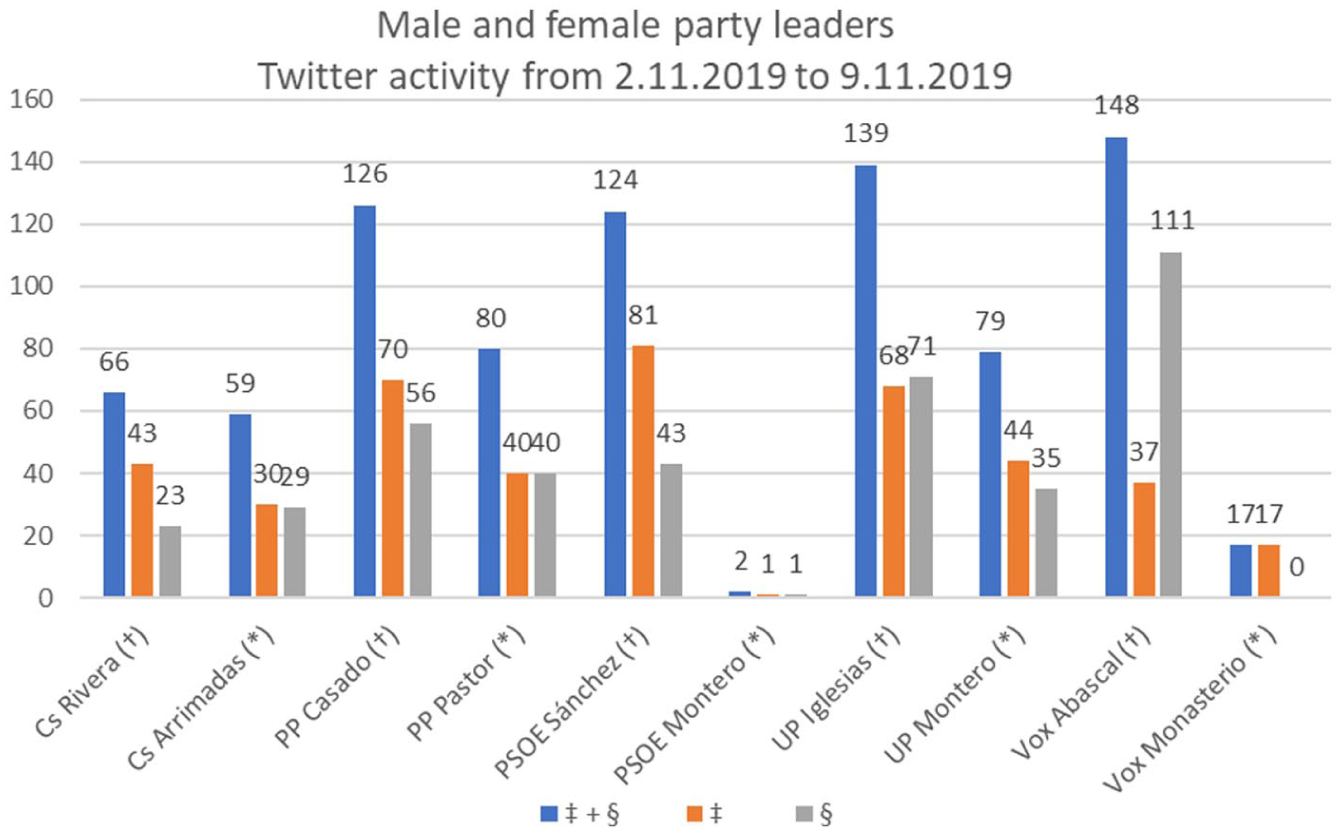
X (formerly Twitter) activity of Spanish male and female candidates during November 2–9, 2019.
In terms of the total tweets and retweets made by the female representatives, Pastor (PP) and Montero (UP) published the most posts at roughly the same amount of 80 and 79 posts, respectively, which was followed by Arrimadas (Cs) with 59 tweets and retweets, then Monasterio (Vox) with 17. At the very bottom, the PSOE’s female candidate stood out due to her very limited Twitter presence during the studied period, with only one tweet and one retweet. Unfortunately, the reasons for this minimal activity are beyond the scope of this study. In terms of the male representatives, Abascal (Vox) and Iglesias (UP) published the most posts, with 148 and 134 tweets and retweets, respectively. The leaders for the mainstream PP and PSOE followed, with an almost equal number of tweets and retweets at 126 and 124, respectively. Last on the list is Cs’s leader, who tweeted and retweeted the least among the male leaders, with a total of 66 tweets and retweets, which was roughly half of Abascal’s and Iglesias’s totals.
The ratio of own tweets to retweets between the male and female representatives was rather similar, amounting to 55.7% of all the women’s posts and 49.3% of all the men’s posts. Women candidates’ self-produced presence on Twitter was somewhat higher (some 6%) than the self-constructed presence of men candidates. The most significant difference in terms of gender was between the Vox female candidate and male candidate as they registered the highest and lowest ratio of their own tweets versus retweets, respectively. Whereas the female candidate of Vox only posted her own tweets in the studied period, one out of every four posts (25%) published by the male candidate was his own.
Additionally, the percentage of retweets from party-internal accounts (e.g., official national or regional party accounts, party members’ accounts) versus party-external accounts (e.g., media outlets, journalists, public figures, Twitter followers) showed similar interactivity tendencies between the female and male candidates. On average, roughly 75% of all retweets came from party-related accounts, while 25% were originally published by party-external accounts. When reviewing this ratio for the male candidates, the PSOE’s candidate account registered the highest number of retweets from party-related accounts, accounting for 41 posts or 95% of his retweets. By contrast, the UP’s candidate’s account registered the highest number of retweets from party-external accounts, with 41 posts or 58%. Moreover, three female candidates (PP, Cs, and UP) presented very similar ratios of retweeting from party-internal versus party-external accounts.
Qualitative Analysis of Interactive Strategies
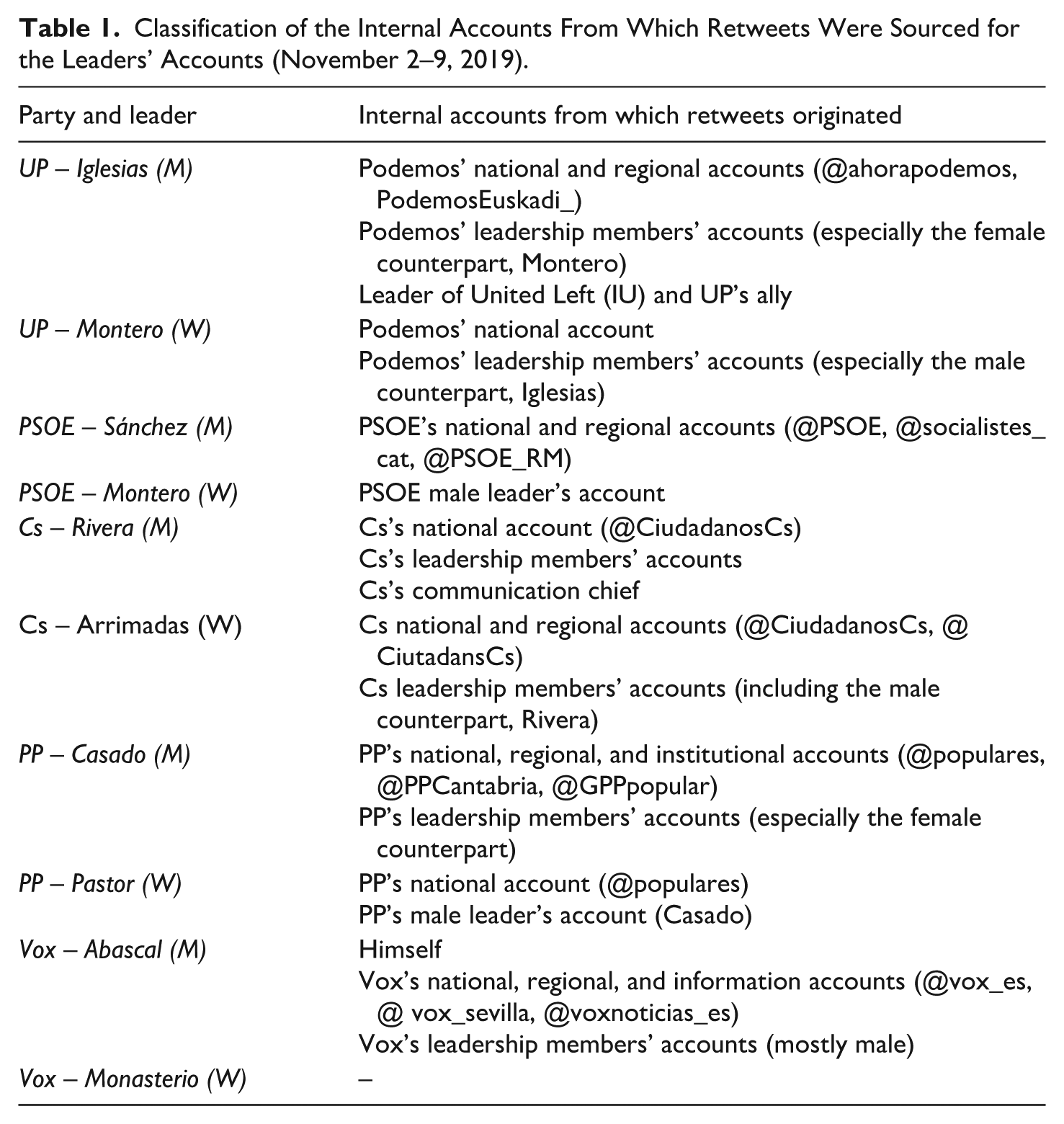
A qualitative analysis of the retweets from internal accounts showed that the male and female candidates’ interactivity was limited to retweeting from very few party-related accounts (see Table 1). All of them focused on retweeting the posts from their party’s institutional accounts and their fellow candidates in their parties. In this respect, female candidates placed a strong emphasis on reposting the messages tweeted by their male counterparts, which was a tendency not shown by the male candidates. For example, the male candidates from Cs and PSOE did not retweet any content from their female counterparts’ accounts, suggesting that the tweets from the female candidates were not prioritized or perhaps deemed unnecessary to share by these male candidates.
Classification of the Internal Accounts From Which Retweets Were Sourced for the Leaders’ Accounts (November 2–9, 2019).
In terms of the external accounts from which retweets were sourced (see Table 2), all of the candidates retweeted content from media-related accounts (e.g., journalists, mainstream media outlets, television [TV] or radio hosts and shows). For example, they very often published posts that shared news articles, interviews, and TV and radio appearances featuring a party and a candidate. Hence, all leaders retweeted content from accounts that had published a message that disseminated or supported their own party’s ideas and proposals, thereby using the social media platform for self-promotion (Calvo-Rubio, 2017; Kruikemeier, 2014; Zugasti-Azagra & García-Ortega, 2018). A comparison of the external sources of retweets for the accounts of the male and female candidates of the same party showed that they all retweeted content from the same external sources.
Classification of the External Accounts From Which Retweets Were Sourced for the Leaders’ Accounts (November 2–9, 2019).
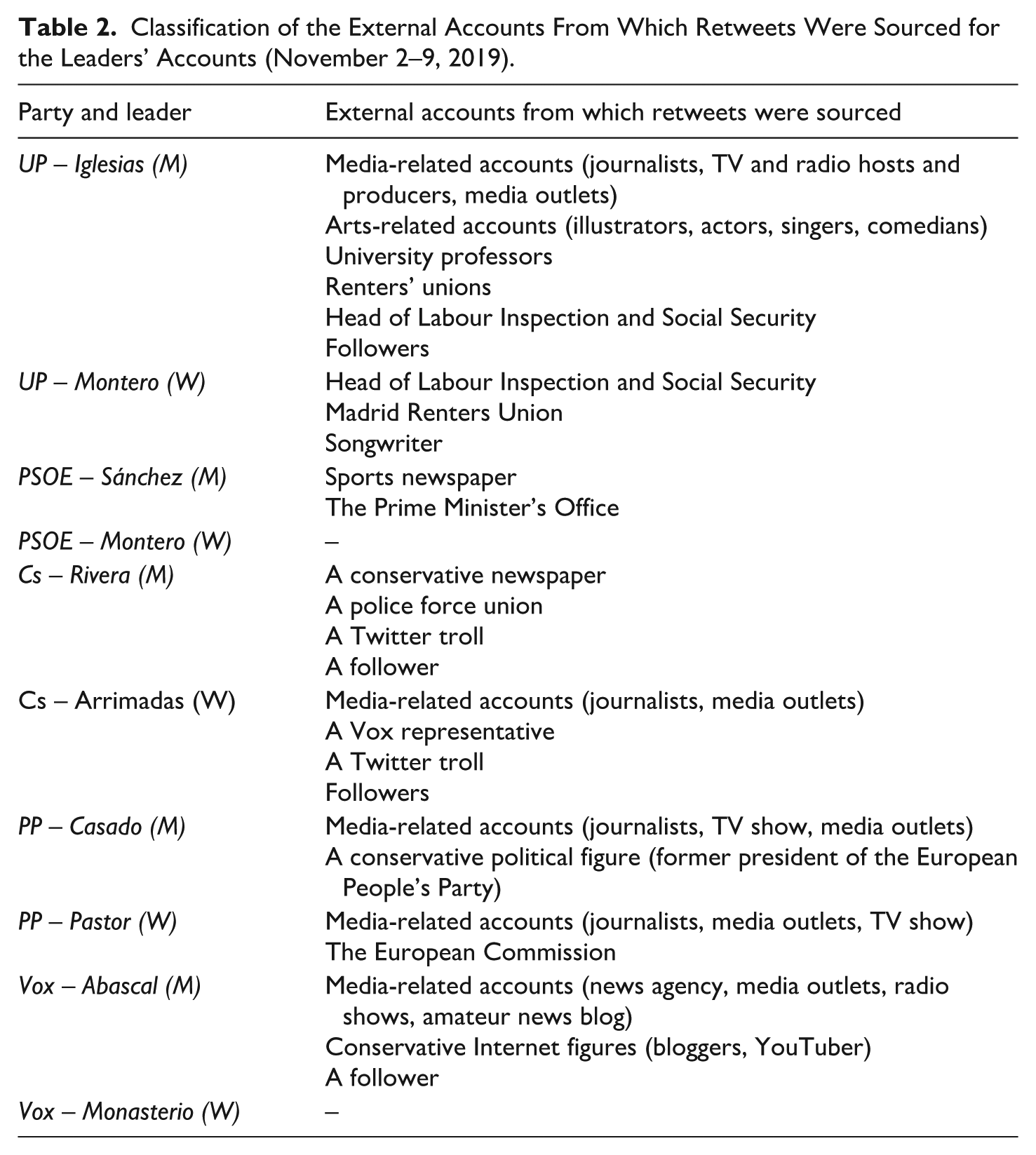
At an individual level, the UP’s male candidate’s account had both the highest percentage of retweets from external accounts (see Section 5.1) and the most varied array of external sources. A qualitative analysis revealed that his account retweeted content from the accounts of numerous journalists, arts-related figures, intellectual figures, and even renters’ and workers’ organisations. This finding suggests that, in line with Salaverría and Martínez Costa (2021), he placed special emphasis on amplifying the messages from external sources that aligned with and were supportive of his own party’s ideas and proposals.
Thematic Analysis
The thematic analysis of the male and female candidates’ X (formerly Twitter) discourse (see Table 3) revealed two common topics regardless of gender: asking for votes and party identity. The first topic of asking for votes was not surprising considering that the period of the study focused on the last week of the campaign prior to the election, so all of the candidates felt the need to appeal to indecisive voters. In terms of party identity, each party articulated this topic differently, but the authors labelled the topic with an overarching term herein. The candidates used these posts to differentiate themselves and their parties’ ideologies from the other parties (cf. “ideological square,” van Dijk, 2011). The Vox and UP candidates presented themselves as direct competitors to all the parties participating in the 10N election. This lack of a specific adversary stands in contrast to the ways in which the candidates from the PSOE, PP, and Cs articulated their party identity in their tweets. The PSOE’s male candidate’s tweets presented the socialist party as the main opponent of the far-right party. However, he did not name a particular party in any of his tweets, thus leaving it open to interpretation. The PP’s candidates, in contrast, identified their one and only adversary as the PSOE. Lastly, The Cs’s candidates tweeted about the unity of the country, thereby indicating that they were in opposition to any parties that favoured the independence of Catalonia.
The Topics Contained in the Male and Female Candidates’ Discourse on X (formerly Twitter) (2–9 November 2019).
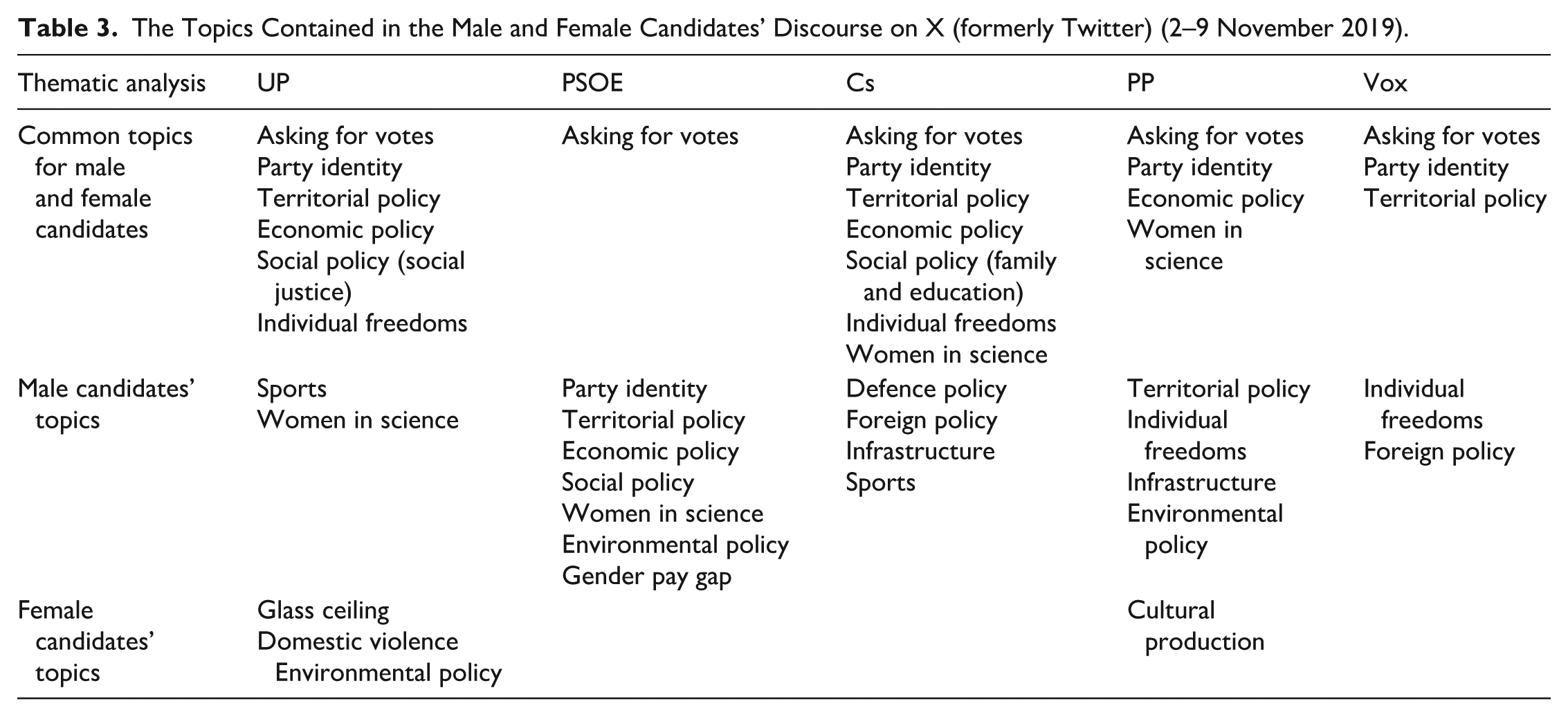
Three additional topics were discussed by several of the male and female candidates: economic policy, social policy, and territorial policy. Economic policy was discussed by the candidates from the PP, UP, and Cs. The male and female candidates from the UP and Cs were the only ones who discussed the topic of social policy in their tweets. While Cs’ candidates focused on presenting the party’s proposals on family and education, the UP’s candidates placed emphasis on proposals for social justice. Although it is somewhat unexpected given that social policy issues are often associated with female representatives (Evans, 2016, p. 672; Koch, 1999), these parties highlighted this topic in their electoral programs. Territorial policy, which is the constitutional organisation of the country, was broadly discussed by all of the candidates, with the focus mainly centring around the political process for ensuring independence in Catalonia, a topic on which each party displayed different positions.
Most candidates discussed the topic of women in science on Twitter during the analysed period, except for the far-right party Vox. The presence of this topic can be straightforwardly explained by the passing of Margarita Salas, a renowned Spanish researcher and advocate for women in science, just 3 days before the 10N election. Most parties seized this moment to address the issue, taking ownership of it (Petrocik, 1996) by commemorating Salas’ achievements in a male-dominated field and aligning with the contemporary feminist movement in Spain.
In-depth Analysis of Female Issues
Regarding the topics articulated in the male candidates’ X (formerly Twitter) discourse, several of them comprised the issues in which male politicians are stereotypically considered competent (Evans, 2016; Kahn, 1992; Reingold, 2000): foreign policy (Cs, PP, Vox), defence (Cs), infrastructure (PP, Cs), and sports (Cs, UP). The leaders of both the PSOE (Sánchez) and the PP (Casado) brought up the topic of environmental policy in various tweets, which was somewhat unexpected since issues related to the environment have traditionally been discussed by female politicians (Evans, 2016, pp. 663 and 672). Both candidates, however, discussed the protection of the environment as part of their efforts to present themselves positively (see Example 1). This finding could suggest that they may have felt compelled to emphasize this issue with the goal of gaining electoral advantage (Petrocik, 1996; Sellers, 1998) or, perhaps, could signal a move away from gendered stereotypes in issue attribution and a shift towards recognizing environmental politics as a more significant topic, particularly considering the climate emergency and related social movements.
When looking closely at linguistic features, the PP’s male candidate’s tweet stated that he “like[s] the idea . . . of Green Budgets” (1.1) as a measure against climate change. Hence, he talked about these budgets as a measure but not as a party proposal, thereby creating the image that he is environmentally engaged. In contrast, the tweet from the PSOE’s candidate (1.2) first criticised the far-right’s proposals on the matter and then stated that “The PSOE defends growth for today’s and future generations [by] respecting the environment.” By discussing economic growth as a tangible object and not a process that has an impact on the environment, Sánchez did not address the fact that economic growth is a significant contributor to human-induced climate change.
Example 1: 1.1. “The defence of the environment is a hallmark of the PP. I like the idea of the President of the [Andalusian] Board, @JuanMa_Moreno, of Green Budgets. In the fight against climate change, we all go together.” @pablocasado_ (6.11.2019) 1.2. “The far-right takes . . . the climate crisis [lightly], and we see the consequences in the Minor Sea. Environmental plunder is bread for today and hunger for tomorrow. The @PSOE defends prosperity for today and for future generations, respecting the environment”. @sanchezcastejon (7.11.2019)
The second unexpected finding was the PSOE’s candidate bringing up the topic of gender pay gap on Twitter. Historically, this issue has been more commonly championed by female politicians, according to existing literature. However, given the candidate’s centre-left position, it is understandable that he would address this topic, reflecting his ideological commitment and perceived expertise in the area (Petrocik, 1996). Due to the Equal Pay Day that was celebrated on November 2, Sánchez tweeted the following:
Example 2: “European women earn 16% less than their male counterparts for the same job. An injustice that would mean that, from today until the end of the year, their work was not paid. We have already started to act. Let’s not stop. Let’s keep working for equal pay.” @sanchezcastejon (2.10.2019)
This is a post that focusses on increasing awareness about the economic inequality suffered by female workers. A close examination of the lexical choices made in the post revealed though something interesting. In “European women earn 16% less than their male counterparts for the same job,” Sánchez (PSOE) made use of statistical information on the gender pay gap to refer to it as “an injustice.” By labelling unequal pay between men and women as such rather than as an outcome of policies, he obscured the socialist party’s agency and responsibility for the issue, which is a party that is supposed to represent workers’ interests regardless of gender. Sánchez tried to make up for this avoidance of responsibility with “We have already started to act,” where “we” seems to refer to his cabinet and himself as an incumbent in the election. What is more problematic was the choice of verb (“started to act”), which indicates a material process that has no clear goal nor a recipient of these actions.
The thematic analysis of the female candidates’ Twitter discourse revealed a few topics that stereotypically or traditionally pertain to women (Cowell-Meyers & Langbein, 2013, p. 162; Evans, 2016, pp. 663 and 672) or context-specific topics mobilised by the Spanish feminist movement at that time (Comisión 8M, 2019). Nevertheless, the female candidates from the PSOE, Cs, and Vox did not introduce any new topics as they only engaged in those discussed by their male counterparts (see above). This aligns with the double bind concept (Jamieson, 1995), which posits that women in leadership positions must conform to traditional expectations of femininity, which can limit their political agenda, or they risk being perceived as overstepping societal norms.
The only two female candidates who introduced new topics were those from the PP and UP. While the PP’s candidate simply posted a tweet about cultural production, the UP’s candidate alluded to the topics of environmental policy, gender-based violence and economic inequality. In terms of the latter two topics, Montero posted the following:
Example 3: 3.1. “We will take to the streets as many times as it takes to denounce the patriarchal justice. Being raped in turns and saying that there was no violence or rape because you were unconscious is unfair and intolerable. Today, united, we will shout again #EnoughOfPatriarchalJustice” @IreneMontero (4.10.2019) 3.2. “When we say that women are those who suffer most [due to] this economic model [that is] incompatible with life and that we need more feminism and to make larger what is common, we refer precisely to that. It urges #AFeministGovernment that takes care of its people.” @IreneMontero (8.10.2019)
In the first tweet (3.1), the UP’s candidate discussed the issue of sexual violence against women and the problem of patriarchal legislation that devalues female victims and the crimes of which they are victims. Indeed, these questions belong to the contemporary feminist movement (Comisión 8M, 2019). Several lexical choices in this tweet piqued the authors’ attention. Firstly, Montero used an inclusive “we” to present herself as an activist within the feminist movement while holding a leadership position in her political party. In the second sentence, an explicit mention of the perpetrators of rape and the victims thereof (i.e., the agents and subjects of the rape) was avoided using the passive voice (“being raped in turns”). Furthermore, the “saying” in “saying that there was no violence or rape” divorces the male judges’ from their responsibility to punish male offenders and hence protect women from similar acts in the future. The passive voice was used to emphasise the weakness of the argument (“because you were unconscious”) that judges use to make decisions on rape cases. However, these choices only have a contrary effect by avoiding men’s actions on this topic.
In the second post (3.2), the UP’s female candidate brought up the issue of glass ceiling, particularly the neoliberal economic model and its negative impact on women and motherhood, thereby positioning the UP as a party knowledgeable and concerned about these issues. By framing her critique within the UP’s perspective (“When we say. . .”), she leveraged the party’s established reputation for advocating social justice and feminist causes, aligning with Petrocik’s theory that parties can strengthen their electoral advantage by emphasizing issues they “own.” Moreover, her call for “more feminism” and the demand for “#AFeministGovernment” strategically reinforced the UP’s association with feminist issues. Although referring to feminism as something quantifiable might risk undermining the movement’s historical depth, this portrayal aimed to make the concept more tangible and urgent in the current political context. By suggesting that a feminist government is an unquestionable necessity, she implicitly positioned the UP as the natural champion of this cause, reinforcing the party’s issue ownership and attempting to attract (female) voters who prioritize gender equality and social justice.
Overall, the analysis confirms and nuances some theoretical expectations. First, it shows that the leadership position (i.e., the head of the list) is strongly associated with men, granting them greater visibility, one-directional internal amplification, and thematic autonomy. Female candidates (placed second) mainly amplify their male leaders’ messages and operate within a narrower thematic scope largely defined by those leaders. This asymmetrical dynamic between first-position male candidate and second-position female candidate mirrors the structural hierarchy embedded in party lists and extends it into the digital sphere, where male leaders dominate both visibility and thematic focus. The limited thematic autonomy observed among women suggests the persistence of symbolic constraints: female candidates appear to negotiate the double bind of needing to be visible while avoiding criticism for transgressing expected roles. Consequently, their communicative behaviour online reflects a delicate balance between compliance and differentiation, revealing how gendered hierarchies of political voice are reproduced even in spaces that ostensibly allow for greater individual agency.
Conclusion
This article examined how gender differences manifested in the X (formerly Twitter) communication of the leading male (first-position) and female (second-position) candidates from the five parties with the largest parliamentary representation (PSOE, PP, Cs, UP, and Vox) in the lead-up to the 10N Spanish general election. The quantitative analysis of the candidates’ interactive behaviour indicated a clear gendered imbalance in their social media presence. The female candidates’ activity amounted to roughly one fourth of the total activity, thereby demonstrating their very reduced social media presence in the run-up to the 10N election. In contrast, the analysis revealed very similar ratios between the male and female candidates’ tweets and retweets. This suggested that the male candidates were the main producers of the content that was used to increase their Twitter visibility during the campaign, while the female candidates chose to share the posts from their male counterparts and the leaders in their respective parties. Whether this pattern is motivated by the gender and ranking of the candidates or by internal communication strategies is beyond the scope of this study.
It should also be noted that candidates’ social media accounts are not always personally managed. In many cases, campaign teams or communication advisors are responsible for drafting, scheduling, and publishing posts, which makes it difficult to determine the degree of personal involvement of each candidate in their social media activity. This methodological limitation implies that the observed differences might not fully reflect individual communicative preferences, but rather the strategic decisions made by campaign staff. Moreover, content production is typically centralized and coordinated to ensure message discipline, meaning that posts often adhere to party-wide narratives designed to maximize electoral impact, while simultaneously constraining individual expression and reinforcing hierarchical control over candidates’ communication. Nonetheless, as these accounts serve as the official voices of the candidates during election periods, they remain a valuable source for understanding the communicative patterns and gendered representations promoted by political parties.
In terms of the retweets from non-party accounts, both the male and female candidates displayed the same behaviours by replicating the tweets from mainstream media accounts that ideologically aligned with them and their parties. This action reinforced the candidates’ and parties’ legitimacy in the online public sphere, thereby demonstrating how important mainstream media narratives continue to be in the run-up to elections.
Regarding the candidates’ discursive behaviour, the analysis revealed that the female candidates had a very secondary role in the lead-up to the 10N election. Above all, their tweets were aimed at reinforcing those of their male counterparts, and, on a small number of occasions, topics of interest for women as a group or the feminist movement were introduced. By adhering to topics already addressed by male candidates, these women may have aimed to avoid criticism for stepping outside conventional roles, thereby illustrating the constraints imposed by the double bind. The only topic related to gender that was owned by all of the parties and candidates, except for Vox, was women in science. However, none of the candidates took advantage of the opportunity to start a debate about the difficulties encountered by women, suggesting that the topic may have been raised primarily for electoral gain. The only candidates who brought up issues traditionally or exclusively belonging to women were the PSOE’s male candidate and UP’s female candidate. Their posts raised important issues such as sexual violence against women, the gender pay gap and the glass ceiling. A closer examination of their lexical choices showed though, an instrumentalisation of female topics to gain electoral credit among female voters. However, none of the candidates provided detailed policies aimed at mitigating increasing gender inequalities.
This study provides only a snapshot of the gender differences in the interactive and discursive behaviours of Spanish male and female candidates on Twitter during the second and final week of the 10N electoral campaign. It demonstrates that messages published by male politicians on social media continue to be prioritized, reflecting the traditional association of men with politics and public opinion, despite female politicians’ efforts to normalize their public presence. While the choice of sampling period was justified to capture the peak of communicative activity, a sampling of the entire campaign might yield different results. Additionally, the chosen methodological approach provided a broad overview of several elements of Twitter communication among a limited number of key candidates.
Based on the findings of this study, several avenues for future research could be explored to deepen the understanding of gender differences in political communication on social media. One suggestion could be to conduct a longitudinal analysis that spans the entire electoral campaign, not just the final week. This would provide insights into how gender differences in social media communication evolve over time and whether the patterns observed in the final week are consistent throughout the campaign. Another suggestion could be to include other social media platforms such as Facebook, Instagram, or TikTok. Each platform has its own dynamics and audience, which might influence how gender differences manifest in political communication. Future research could also examine cases in which a woman occupies the primary position and a man the secondary one, to explore how such reversals of traditional gender ordering might alter the campaign’s communication strategies and visibility dynamics. Lastly, a more detailed examination of the strategic decisions behind social media communication by male and female candidates could be undertaken. This could include interviews with campaign strategists or analysis of campaign documents to understand the rationale behind the observed communication patterns.
Footnotes

Funding
The author disclosed receipt of the following financial support for the research, authorship, and/or publication of this article: Grant PID2024-158308OB-I00 funded by MICIU/AEl/10.13039/50110 0011033 and by “ERDFA way of making Europe”
Declaration of Conflicting Interests
The authors declared no potential conflicts of interest with respect to the research, authorship, and/or publication of this article.