



Abstract
These reflections concern ongoing confusions in holding together the gestalt of the natal body, sex, gender, and procreation. Highlighting theoretical confusions is the shifting history of relations among the material body, the “psychoanalytic body,”:sex, and gender. Studying these confusions and collecting more data may help the field advance where a rush to theoretical foreclosure will not. Observe, for example, how commonly foreclosing are the terms “masculine” and “feminine” when automatically applied to the merely biological attributes of a sexed body. More confusions arise from theorizing gender identity using split-off images of body parts divorced from any natal referent. In a published clinical case, for instance, the role of the procreative body is characteristically ignored in gender theorizing. Apparently unspeakable horrors of the female body come with its birthing potential and may be a motive for erasure. Julia Kristeva, an exemplary writer, accepts simultaneously a sexed, procreative, and gendered layering in the mind. Her account of the “abject” can shed light on the suppressive horror in our field, which remains almost silent on the body’s procreative potential in everyday life. By contrast, even Ice Age sculptors were engaged with procreative female bodies.
Keywords
The natal biological body enjoys a crucial relationship with the mentalized body, the “psychoanalytic body.” On the surface this statement might seem straightforward, indeed obvious. But the history and present status of this relationship is so vexed in psychoanalytic theory that it becomes obfuscating. Originally, for Freud and most of his followers, the link appeared to be no problem. Karen Horney and Ernest Jones, however, among other early dissidents, raised essential questions about the distortion of females and their bodies in Freud’s theory, which was clear only about the male body. Confrontation of Freud’s “psychoanalytic body” was greeted by his ever more zealous insistence that little girls begin as boys (Freud 1908, 1925). This theory was the first effort in a shaky sex and gender theory that nonetheless pointed usefully to levels of mentation in which the material body is subjected to the mind’s version of it, an area defined as the territory of psychoanalysis.
This early one-sex version 1 continued as received psychoanalytic theory until at least the mid-1960s. Despite the many papers pointing to its flaws, and female analysands themselves repeatedly exposing them, the teaching of that version of gender theory persisted in analytic institutes. For example, in child therapy circles it was never thoroughly challenged as frankly incorrect. Nor was an alternative offered that could have been similar to male theory, but based on a two-sexed system with recognition of body difference. Instead befuddlement reigned in body territory. This murky arena was filled with questionable comparisons such as “the little boy is x; however, the little girl has to be y”—repeating endlessly the underlying theme that males are anatomically complete and satisfied, whereas females are incomplete and dissatisfied. Maintenance of this fogginess well served a nostalgia for the “oedipal” complex (Balsam 2015a,b). Indeed, the one-sex version has persisted undaunted into the present—with Lacan, for instance. Newer theories like self psychology, as well as the theories of Bowlby and Bion, have tended more or less to ignore the material body and the thorny territory of specifically sexed attributes of daily life that I will discuss. Ignoring the obvious creates its own problems, but that is another issue.
Especially in the United States after the 1960s, the early pseudo-clarity about the relations among the natal body, sex, gender, and object choice became far more ambiguous amid general social turmoil, the second wave of feminism, gay rights, LGBTQ issues, the introduction of queer theory, and changing views of sexed and gendered roles in society. The material body too was becoming more malleable due to advances in medical science. A history of changing the body’s sex via surgery and/or hormones was building, from very rare situations in the 1930s to the topic’s appearance in university clinics in the U.S. in the 1960s in transgender situations. The safety and ethics of changing the material body were debated intensely as the number of people seeking such help increased. In the female domain, introduction of “the pill” in 1960 to the U.S. changed a woman’s view of her reproductive capability and control. Thus, the natal body itself could be radically changed by external means.
In the academy, philosophically informed postmodern scholars queried “authority,” especially the power of the medical world over the individual body. Medicine of course endures, however, given its important experience with the human body’s functioning. In analysis, previously established psychoanalytic “truths” were fruitfully interrogated. Received theory that encoded biological essentialism was undermined, and new ideas emerged (see Chodorow 1994). In 1973 “homosexuality” was finally recognized by the American Psychiatric Association as nonpathological. The word “sexuality” became the plural “sexualities,” and the previously clear line between pathology and a normative range of agency and the uses of the body became blurred. We are still trying to catch up with, weigh, and integrate the helpfulness (or not) of ideas both old and new (for a contemporary attempt to integrate the old-fashioned term perversion, see, e.g., Celenza 2014).
Confusion, I believe, is today a legitimate response for therapists and analysts working with the disparate ways in which the natal body has been and is currently viewed and employed by theorists. Patients turn to us for help, and by the nature of their problems are themselves perplexed. In theory building, however, we should not efface the state of confusion created by the gap between the natal condition and the concatenation of discordant wishes and fantasies expressed by our theories as much as by our patients. I suggest that we embrace the bewilderment by trying to own and define our ignorance. We can then put ourselves in a position to accumulate data about embodiment that can be discussed. This is more important (and more prudent) than rushing to assert new “truths” that risk foreclosures at this stage of our field’s evolution.
I will take up in the rest of this essay an issue that, by eliciting denial, most powerfully adds to our befuddlements. Even from the beginnings of psychoanalysis, Freud and his followers inadvertently created fog by failing to take into account the biological reality of the programmed procreative potential of our natal bodies. To our philosophical chagrin (given our eschewal of polarized thinking in psychology), bodies commonly do manifest a sharp polarity in being programmed procreatively as either male or female. Psychologically we may wish, and to some extent are certainly able, to transcend these bodily limitations.
I will outline some of the muddles here, and point out a few directions we might go, promising and otherwise. As a result of my previous efforts to restore the female body qua female to parity alongside the male body (see, e.g., Balsam 2012, 2013), the issue of procreative body potentials in both sexes now seems to me a non-accidental source of erasure in our theory building. This seems to apply also to queer theory and much writing on gay, lesbian, bisexual, and transgender issues. Frankly, the body’s procreative potential is not even noticed by many analysts in imaginatively portraying their patients’ interior gender concerns, unless wanting a baby is a consciously active clinical concern for a given patient. My contention is that this erasure of the body’s procreative capacities involves archaic anxieties about the female body’s power to house an alien other and then expelling it into the world. In turn, this archaic anxiety is linked to resistance in allowing the biological reality of the body itself to have a meaningful role in psychoanalytic theory building. I worry that until we analysts can hold in mind questions that might rectify this oversight (even while clinically engaged in matters of the psychoanalytic body that seem quite distant from procreative action), we will remain in a conceptual limbo amid the nebulous missing pieces in our gender stories. We tend to be content, prematurely, with a fragmented collage of body parts that we defensively insist is some “real truth” about the psychoanalytic body that needs no further refinement.
History of the Psychoanalytic Body
Psychoanalysts know that anyone’s inner body portrait, or any psychoanalytic body that is communicable, is heavily influenced by an unconscious viewpoint, traditionally most detectable through the veil of a patient’s free associations. Freud’s psychosexually staged theory was integrated into the 1923 structural theory of mind; psychodynamics, supposedly, were shaped universally by the oedipal complex. If heterosexually phallic, all males, boys and men, were viewed as “masculine.” If not, they were “feminine.” For example, the sexual use of the male anus inevitably made a male “female” (more on this topic later). Libido theory also provided a notion of innate biological “bisexuality” that served as a rationale for how society thought males could end up “feminine” or females “masculine.” These ideas were based on profound biases and misunderstandings about the material female procreative body (e.g., an imagined role of the clitoris as male and denial of the vagina). And if women were not heterosexual, then they were supposedly “masculine.” Thus, psychoanalytic theory portrayed all homosexuals as underdeveloped. The counterintuitive, arcane version of girls’ and women’s bodies needed to be cleverly constructed in order to maintain phallic centrality and the oedipal complex as conceptual cornerstones of the international psychoanalytic movement. And yet Freud was clear, too, that the oedipus complex was specifically modeled for males. Females as female beings needed to be erased lest they spoil the intellectual coherence of the theory and the growing belief systems that held together his internationally burgeoning movement. 2
Many have written about the shifts and changes in psychoanalytic theory that have led to a more open-minded pluralism: the falling fortunes of libido theory; the rise of object relations theory (first traced in detail by Greenberg and Mitchell [1983]); postmodern deconstruction’s undermining of all forms of stated “authority,” especially biology and the claims of knowledge of positivist science; the privileging of subjectivity over objectivity; the awareness of trauma; the key role of countertransference in interpreting patients’ inchoate communications, including those conveyed by their psychoanalytic bodies (e.g., Aron 1998; Stern and Hirsch 2018); the rise of a search for personal bias and the normalization of homosexuality; and, finally, shared skepticism toward any binary or categorical thinking regarding sexuality, gender, and object choice and behaviors. 3 The list of steps leading away from the more orderly classical theory goes on. In the post-1970 era, there was (and still is) a sense of joyous liberation from what is now recognized as eighteenth- and nineteenth-century social oppression regarding gender and gender roles. Surprisingly though, the ubiquitous character of procreation potential 4 is often missing in these more open attitudes toward the psychoanalytic body.
Obstructive Uses of the Words “Masculine” and “Feminine”
Sex and gender have been soldered into rigidities about “masculinity” and “femininity.” There has been a massive confusion in amalgamating the sexed body’s maleness or femaleness (biological facts) with the terms “masculinity” or femininity” (subjective states). 5 For example, muddles persist about “masculine” behavioral ideals that are really social value systems, adherence to which is regarded as a measure of mental health for those who possess a male body and thus possess a penis (erect, as in “phallus”). “Feminine” ideals that likewise are social value systems (e.g., being sexually supportive to men) are treated as if necessarily a function of and measure of health for those possessing a female body. This pastiche of socially approved personality qualities and the body, treated as if natural partners, still operates, while using older theories like Kleinian phantasy constructs, 6 which of course emerged in the same early-twentieth-century cultural milieu as Freud’s theory. Especially in the United States, helpfully, “masculine” and “feminine” have gradually tended to be rendered in scare quotes.
Here are two examples from different eras of how major theorists can unwittingly disseminate misleading social messages that obfuscate psychoanalytic gender theory.
The first scene takes place in the late 1970s, in the elegant New York apartment of Kurt Eissler. He taught us candidates with urgency and sincerity. “The reason men are superior,” Eissler mansplained, “is because they have millions of sperm, you see, to only one single egg that can be produced from the woman!”
The next moment is from 2016, in Pavia, in the heart of a wonderful and generous home of Italian psychoanalysis. There I attended a seminar taught by the beloved and imaginative Antonino Ferro, the father of post-Bionian field theory. He took from atop his desk a little can holding pens, and, pushing the pens in and out of the opening with his other hand, said something to the effect, “You see, this is feminine,” looking at the hand holding the can, while “This is masculine,” referring to the hand with the thrusting pens. At least one other analyst and I exchanged winks! No, I’d like to say—that is merely a demonstration of various sexual intercourse positions. It could be the missionary position in heterosexual intercourse for a man and a woman; or an oral or anal male-to-female sexual position or oral or anal male-to-male sexual intercourse. What is gendered “feminine” and what “masculine” is far more individual. This statement does not deny a biological reality to the penis as male (but not necessarily “masculine”) and the vaginal orifice as female (but not necessarily “feminine”). A woman, for example, might assert that for her, asexuality is the height of “feminine.” And that may be based on her perception of her own mother’s sensibilities. Suffice to say that the language employed in theory deserves to reflect our most careful thinking processes.
Loss of the Procreative Body
In many postmodern circles, anything denoting sexed gender can purposely become fractured from body referents, in the interest of de-coupling sex and gender. Individuals in treatment, of course, regularly demonstrate split thinking on these topics. Often this defensive splitting is an attempt to cope with anxiety and trauma. However, metatheories too can manifest splitting mechanisms that appear to collude in keeping body and mind too far apart. Elisabeth Young-Bruehl (1991) pointed out that conceptual mystifications tend to get repeated and compounded in the retelling. Thus, the basic objective fact of the sexed body—as its acknowledgment may involve trauma also about its important procreative potential—recedes even further into the swirling mists.
Social constructivism can be fruitful in helping us unmoor rigid notions of “masculine” and “feminine” from their biological essentialist roots, so gnarled with age. 7 But this decoupling can be taken too far—especially if one is concerned about how to talk about and imagine the full functional range of the sex-gender relation. A recommendation of complete detachment is proposed by Judith Butler (1990) in her influential book Gender Trouble: “the ostensibly natural facts of sex [are] discursively produced in the service of other political and social interests.” She concludes: “If the immutable character of sex is contested, perhaps this construct called ‘sex’ is as culturally constructed as gender; indeed, perhaps it was always already gender, with the consequence that the distinction between sex and gender turns out to be no distinction at all” (p. 7).
The distinction between sex (referring to the biological body) and gender (the mentalized portrait of a sexed self)—first offered by Stoller in 1968—is still viewed by many analysts as a helpful conceptual advance on Freud’s conglomerate term “sexuality.” Also, this distinction was used profitably in the second-wave feminist reexaminations of psychoanalytic theory. The biological body was thus seen as more separate (or separable) from the mentalized body than in the older model. This move facilitated further understanding of the differences between sex and gender, with less rigid, more porous interactions between the two. However, what Butler put forward in Gender Trouble is a total split, so that the material body again becomes fused with a sex-and-gender single entity, all of which is seen now as “socially constructed” and “performative,” thus leaving no room for a more independent material body housing. But there is a vast and positive difference here from Freud’s original “sexuality” conglomerate. Butler’s (and many others’) newer emphasis on social interpretation is the absolute opposite of a binary gendered “biological essentialism,” 8 (an offense attributable to Freud and his followers, especially those who were medically trained). The idea that “the ego is first and foremost a bodily ego” (Freud 1923, p. 26), however, side by side with these advances, has never been subjected to any genuine revision in psychoanalysis. Rather, instinctual drive/conflict theory has tended to sunset along with the strictures of biological essentialism, leaving “the ego,” though, as a recurrent concept in many theories, but with a far more uncertain relation to the biology of the body than it had possessed originally. A good suggestion to replace the old terms “femininity” or “masculinity” is Elise’s “sense of femaleness” or of “maleness” (1997), which emphasizes subjectivity while yet suggesting some attunement to processes of knowing the body (derived also from that person’s sexed body). This phrase is less prone to value judgment. The term “primary femininity,” introduced helpfully by Horney, has over the years been usefully questioned (Kulish 2000).
The body qua body that includes its procreative assets, is now in need of being rediscovered and reconceptualized. A recent step in that direction was a symposium held at the Columbia Psychoanalytic Center and published in a 2018 book edited by Vaia Tsolas and Christine Anzieu-Premmereur titled A Psychoanalytic Exploration of the Body in Today’s World: On the Body. In the context of rapid social and technological change, the contributors reintroduce a contemporary relationship of the psyche to the large spectrum of changing body phenomena while holding the materiality of the body central. They contemplate, as examples, the sick body, the sexual body, the speaking body, the body of the changing family from assisted reproduction, and the use of changing pronouns to reflect subjectively experienced gender. It includes a contribution by Kristeva on the fragility of heterosexuality within her sense of modern “parentality” (Kristeva 2017). The authors highlight that the body in this era, due to advances in medical technology, is more changeable than ever before and that the interactive psyche in the internet era is socially more protean.
A question worth asking, then, is this: How far can we travel away from our fully functioning biological bodies in order to claim optimal mental independence from them, and yet still be able to hold together the crucial interaction between body and mind that yields the most capacious version of our individual “psychoanalytic body”?
Julia Kristeva on the Body in Theory, Including the Female Procreative Body
Julia Kristeva’s sense of “the abject” and descriptions of sheer horror (1980) may help capture the quality of violence and antipathy to the female body that in many quarters provokes the general desire to denigrate females, to control and abuse those with female bodies. More subtly, there can be hostile desires to erase these bodies and, especially, banish them from their place of equality with men. Graphically, suggestively, and poetically, Kristeva draws us into her imagery and, I suggest, the rawest aspects of a general attitude toward females unconsciously aimed at their potential to give birth. Female humans, in this general attitude, are compared to lower animals whose cycles of birthing are dominant, and whose bodies are mainly in the service of their young, or their men, or their own excitement to be in these cycles. This vision of women, part of the societal unconscious, often takes on horrific features based on the birthing process and experience, and on women’s capacity to give birth.
The concept of the “abject” is directly opposite to the cold distance of clinical interest and classical psychoanalytic theory in regard to birthing. For Kristeva, the anthropologist, or for readers and scholars of eighteenth- and nineteenth-century fiction, or for students of the history of obstetrics, or of just plain history—the traumatic unconscious stench of death and agonized mourning is in the air when we are close up to birth itself, and the jouissance of life. It is as if this horrific unconscious fantasy has come too near too often to the reality of “lying-in,” thus over many years creating intergenerational trauma for men and women alike. Take, for ex-ample, statistics from a 2018 World Health Organization newsletter. The lifetime risk of death from “maternal” causes can be gauged by the probability that a fifteen-year-old woman will eventually die from complications of pregnancy or childbirth is 1 in 180 in developing countries, and 1 in 54 in countries assessed as “fragile states.” In developed countries the risk is 1 in about 4900, which is still quite shocking. This is the stuff of all-too-common everyday tragedy, but it is also the stuff of severe mentalized trauma. No wonder both men and women turn away psychologically from the ferocity of birth. Lest a reader need help in imagining the body’s vicissitudes, here is the list from the same WHO source: “severe bleeding (mostly bleeding after childbirth); infections (usually after childbirth); high blood pressure during pregnancy (pre-eclampsia and eclampsia); complications from delivery; unsafe abortion.”
Kristeva (1980) writes: “A wound with blood and pus, or the sickly, acrid smell of sweat, of decay. . . . These body fluids, this defilement, this shit are what life withstands, hardly and with difficulty, on the part of death. There, I am at the border of my condition as a living being” (p. 3). She explains that it draws her “toward the place where meaning collapses” (p. 2). “Abjection preserves what existed in the archaism of pre-objectal relationship, in the immemorial violence with which a body becomes separated from another body in order to be” (p. 10).
With these words, Kristeva brings us to the site of the physical ordeal, the profundity of separation, loss, the detritus of the dead placenta, the drama of life and death that is human birth, and the woman in this act of birth, about to create the interplay with her infant that begins living (Kristeva 2011), the feeling sensory states that help civilization create language and communication.
Language about the Body
Griffin Hansbury’s recent paper, “The Masculine Vaginal” (JAPA 65/4, with commentaries), offers an interesting contemporary take on the relationship of the body and gender; it’s not clear whether Hansbury provides creative help or just further obfuscation of our understanding. In the paper he describes analytic work with a patient he calls Kevin. For Hansbury and his commentators, the sexual body parts of Kevin’s “psychoanalytic body” that he (and they) struggle with, are spoken about as if they relate only to their yield for pleasure or pain in the sex act and how they contribute to Kevin’s sexual identity. No mention or concern about reproduction: any implications in that direction are quite erased.
Hansbury (2017) claims—for a natal, cisgendered male gay—a new sex organ, as it were, a “masculine vaginal,” and demonstrates the importance of the therapist’s interactive acceptance for this adult natal male patient and, especially, for his experience of the presence in his body of “my cunt” (p. 1010). The metatheoretical suggestion here is to hold the “Vaginal” as the female iconic counterpart to the male “Phallic.” Symbols of female bodily power can then, Hansbury claims, be freed from the anatomical body, 9 and by virtue of this freedom “Vaginal” could be viewed as interchangeable between men and women, as is “Phallic” power in Lacanian theory. Importantly, this male “cunt” is not viewed here by the therapist and patient as a fantasy of his anus in sexual action—as Donald Moss (2017) observes in his commentary (p. 1054). Instead, this patient’s “cunt” is seen as a psychic-reality-blended-as-material-reality for this male, and the concretization of an “as if” space is celebrated by both patient and therapist in a psychological arena “not to be questioned” (much like Winnicott’s advice on handling a toddler’s need for omnipotence with his transitional object). For Hansbury, the “‘masculine vaginal’ goes beyond the conceptual to the fleshy, embodied experience of many transgender men, who live in whole, partial, and/or temporary ‘female’ bodies” (p. 1009).
At another point the patient tells of an obsession to introduce increasingly large objects into his anus—at one moment actually perforating the colon and being rushed to surgery. This part of the body story is downplayed. Is dilating his anus perhaps an attempt to approximate, or imitate, the fantasied dimensions of the female birth canal as a baby is born? I wondered here whether this case discussion might exemplify how the Kristevean horror of the abject state of femaleness can operate within clinical material but be silent to the theory deployed, leaving us in the ghostly realm of the unspeakable dimension of birthing.
Simply put, Hansbury’s iconographic effort to make the vagina itself the female organ signifying that the mature height of sexual power is equivalent to an erect penis (a phallus) is a misunderstanding of the female body. The female body-power-as-reproduction is minimized, and the function of sexed organs downplayed in favor of exclusively erotic sex. In contrast to Hansbury, I have suggested that the pregnant uterus is the equivalent power symbol to the fully erect penis (Balsam 2003). While I agree wholeheartedly that such mentalized symbols need not specifically be tied to the material body from which they are derived and have shaping powers as fantasies, the abiding and ubiquitous difficulty in holding the idea of sex organs as equally erotic and procreative is likely due to the archaic terrors evoked in the Kristevean realm. Hansbury and Kevin are far from alone in shying away from functions of the vagina other than the sex act.
What Hansbury and Kevin expound that is very helpful is a version of this patient’s legitimate “psychoanalytic body” that sought expression. This therapeutically interactive validation would be rare in this man’s life. Thus, his ego functioning and identity were helpfully supported and nurtured.
Another dimension of this particular “psychanalytic body” is that analyst and patient have together strayed from fantasy into an arena of delusion; the therapist’s affirmation of the organicity of a male “cunt” reflects a folie à deux. Kevin’s judgment about the limits of his corporeal body and his ability to protect himself is shown to be dubious, his having suffered the life-threatening colon perforation while seeking an experience of excitement by abusing (or punishing) his anus. Analyst and patient collude in reifying a sex organ “change” for Kevin as he struggles to make his own anus a version of a birthing vagina; this struggle manifests in conscious mental short-circuits that might signal underlying procreative trauma.
Hansbury’s most kind and well-meaning intentions in supporting Kevin’s naming-distortion magically appears to grant identical “fleshy” experiences to the other natal sex by merely cross-dressing the name; at the same time, the power of the anus is suppressed. As Moss notes, “The ‘anus’ is doing no work here. In fact, it has disappeared, replaced by ‘my cunt’” (2017, p. 1054). Hansbury does seem in a bit of a rush to see eye-to-eye with this male patient, to help him in his desire to be as-if female. An opportunity to explore nonjudgmentally the full eroticism of Kevin’s male anus remains rather murky, both for him and for the analyst. The area of anal eroticism this man enjoyed in male-to-male love-making and sex-making is still a “dark continent” to psychoanalysts. I believe that Freud, too, rushed to imagine that such an “accepting” sex act must be “female.” Why so fast? We can afford to seek more detail to correct our ignorance.
There are other complications that could be discussed here. As I speculated earlier, Kevin may have become engaged in a life-threatening emergency by enacting a scene of traumatic childbirth. The therapist’s elective nonintervention in this emergency situation is viewed positively by Hansbury as being outside the scope of a proper psychoanalytic stance. Many analysts, including me, would disagree with this strategy, on the basis of this patient’s escalation into life-and-death territory.
Hansbury, however, has been courageous in taking this controversial stand on the open-ended, unsettled, and continually debated issue that Wilson (2017) brings up regarding the future of psychoanalytic thinking: While it seems inarguably the case that the move from body to symbol—from the limit of the one to the potential of the many—is the move from animal to human, from relative constraint to relative freedom, it is also true that in recent times psychoanalysts have become fascinated again by the body—though we might put the “body” in scare quotes, as it is now in fact, as well as in the imagination, more fungible, more mutable, than the concrete anatomical body one finds in Netter’s Atlas of Human Anatomy [p. 1005].
Perhaps we need to develop a greater sense of pliability within this notion of the “concrete,” which in some analytic sensibilities is a pejorative. The word is used nowadays rightly to signal regressive and less inclusive phenomena, but wrongly used to signal a form of inferior thinking. Perhaps we can do more linguistically with processes of sublimation of material bodily features. Perhaps, for example, a word like “uterophallic” might replace “phallic” as capturing the elements necessary to abstract the powers of the sexual/reproductive body. We do need to experiment with our language and conceptions, and Hansbury leads us down new experimental paths.
“Body” Language and the Future of the Body
Let us say that it is no accident that women’s singular, magical participation in bringing into being another human creature is a core feature of the most primitive reaches of what is for many an unrepresentable psychic event. 10 A key feature of the procreative state’s difficulty in being represented in body theory may relate to the primitive nature of this maternal site of the origins of language itself, as Kristeva understands it. We need language to express our theory. The obfuscations in communication that I have highlighted in our theories of the body, theories that have ignored birthing, may involve deeper resonances from the very formation of the means of human communication itself. How can we who were once born be expected to speak about this unspeakable process? And how can we therefore think about what in our own origins is literally unspeakable?
Kristeva stresses even fetal experiences of communicable feelings, sounds, tones, and rhythms, and a mutual communication from within the primordial mother. For the mother who is an adult, her personal experience during her pregnancy and the birth of that individual child is in large measure representable, but it is further enriched by her being regressively porous to the sonar reverberations of the infant, within and without.
KHôRA, Separation, and the Birth of Language
With her concept of khôra or chora (1974) Kristeva denotes the bringing into being of sound, which is shared between an infant responding to the rhythms of speech and intonations of the mother that are filtered through her body walls to the living, developing external and internal membranes of that child. She conveys the sovereignty of these echoes and tones in the deep connections of the infant’s body and mind with the physiobiological mothering corpus. The softness or depth of voice, the vigor or passivity conveyed in the tones, the rhythms of activity and sleep all play proto-roles developmentally in an individual’s favoring hardness, softness, intensity, calm, active vigor, or stillness.
“By speaking the echolalia and the language of her child (and thus rediscovering the instinctual foundations of phonation . . .), each mother in her own way undertakes the Proustian search for ‘lost time.’ And, step by step, she resolves the ‘incongruence’ separating affect from cognition” (Kristeva 2011, p. 78). Kristeva passionately enters her own text: “The child ‘loses’ me (‘kills’ me) in order to leave me. . . . And I leave him by ‘abjecting’ him” (p. 76).
The Power of the Fecund Mother
To further study the awe-inspiring, fearful power of this female body, this body with dominion over the production of infants through pregnancy and the birth process, we can look beyond Freud’s legacy of anthropological fantasy schemata, and beyond modern evolutionary psychology, and turn to artistic representations. The following images were created by humans from past eras. I add these examples as part of my ongoing effort to explore the hidden reaches of how defended we remain to engaging with and thinking about the full potential of our bodies; such defenses obviously affect our understanding of our minds.
Fecundity 25,000–30,000 Years Ago
In 2013, the British Museum mounted an exhibit of very rare sculptures and images called “Ice Age Art: Arrival of the Modern Mind.” It was reviewed by the British art historian T. J. Clark in the London Review of Books in an essay titled “Lucky Hunter-Gatherers.” Some of the earliest known images ever made by human beings were on display. Amazingly, they turn out to be female shapes, and even more to my point about how ubiquitous is the centuries-old preoccupation we share in common with our ancestors, they are suggestively shapes of pregnant women that had come from the famed French caves and other sites in Europe. 11 The sculptures and carvings (see Figures 1–3) were fashioned, it is thought, in the Stone Age, and at the edge of the Ice Age. The most famous of these figurines is the Venus of Willendorf (Figure 1).
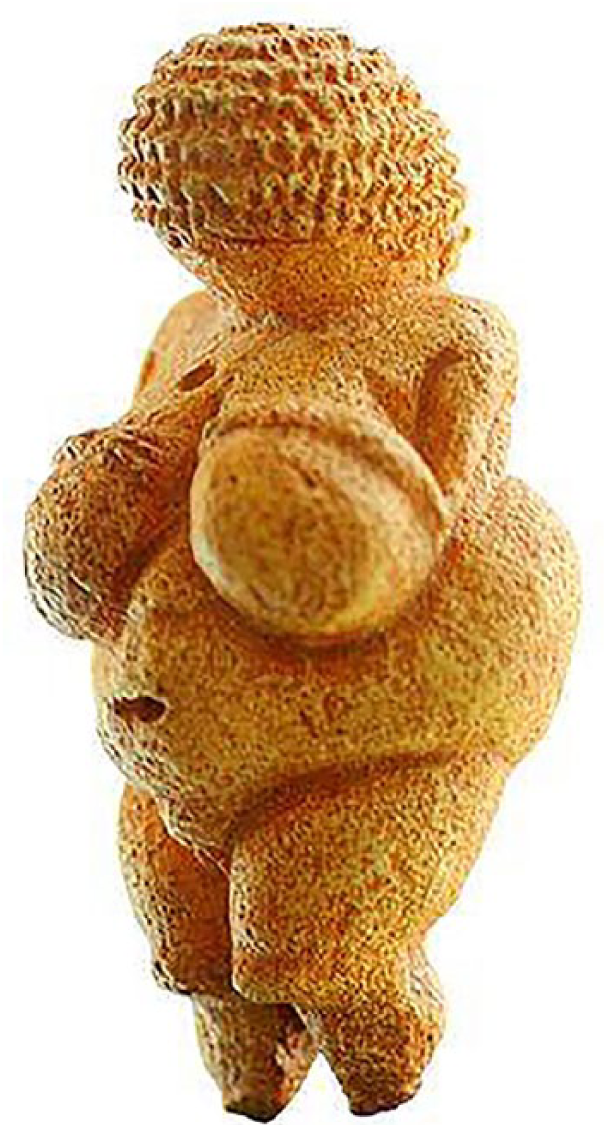
Venus of Willendorf (Lower Austria)
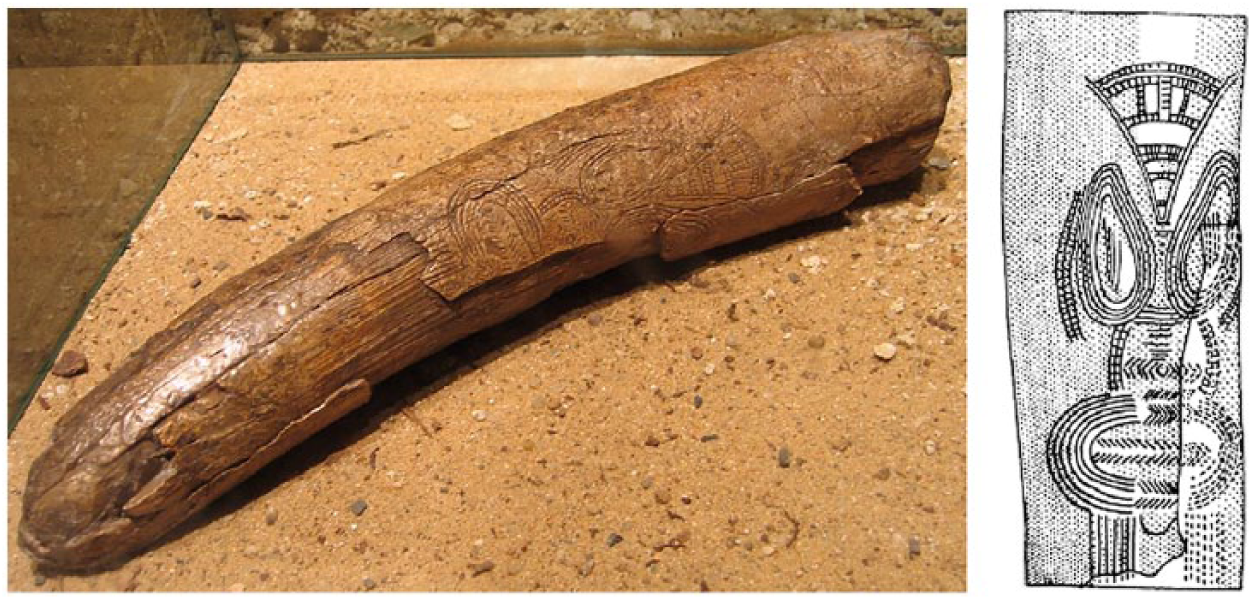
Figure of woman carved on a mammoth tusk (Predmosti, Czech Republic)
The Lespugue Venus (Figure 3) is surprisingly tiny, 4.7 inches, as are the other figures, the result, it is thought, of many hours of fashioning. Historians have wondered how the size of these figures is so dramatically small, in comparison with the immensity of the surrounding animals—the bison, the mammoth, the horse, the cave bear, the reindeer, the wolverine” (Clark 2013, p. 12) that then roamed the earth. I would note that the smallness of their overall form is quite at odds with the gigantic proportions of the marked pregnant features! Were men seen as insignificant and vulnerable in comparison, both with the frightening animals in the surround and with these large swollen pregnancies? Imagine how terrifying childbirth would have been to witness in an Ice Age cave, with an undoubtedly heavy death toll for babies and mothers. The carvings reveal a fascination similar to our own, expressed in the ever-fresh child’s question, “Where do babies come from?” The sculptures emphasize bilateral huge orbs of pendulous, full breasts set above a protruding abdomen, the widened umbilicus on the abdominal wall straining to hold in the bursting contents of the uterus, the bottom and thighs bulging beneath. The woman’s hands in the Lespugue carving are folded on top of the gravid rotundity, her back and shoulders rising slender, tall, almost aloof from the plenty, her head aloft but bowed slightly—like a swan’s head sailing on top of the round, bursting, unwieldy swollen body. The whole is the size of something perhaps to wear around the neck. Clark, in his review, observes: “Bewilderment, mis-estimate of sizes, a sense of familiarity but also slight wariness, always a background tinge of alarm: in front of the cases these brain-states come and go” (p. 11). 12
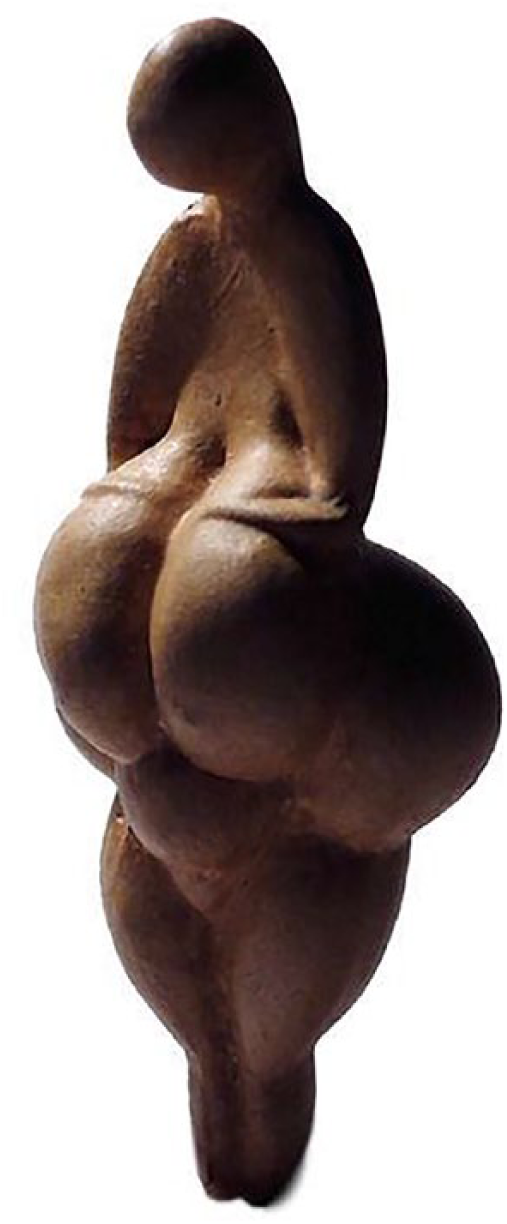
Replica of the Venus of Lespugue (Amiens, France)
Some figures are missing heads and legs. Some are scarified on the back as if punished, either after the making of the image or perhaps before, in real life—no one will ever know. The tiny rotund, swollen images look like clusters of ripe fruit at a distance, and have apparently been —so the archaeologists think—purposely damaged at some point. “A wonderful figure of a swollen-breasted, haltered and necklaced woman from Kostienki had her head and lower legs knocked off before she was buried in a pit” (p. 12). Theories abound as to why. Were the little figurines fertility gods that had disappointed their owners? Did the power of pregnancy arouse primitive man in the same way that today a man can be aroused to violence against a pregnant partner? Is our misogyny as a race so ancient and fixed as ultimately to be a hopeless cause? Clark concludes: “mind-boggling finds . . . a drive to depict the ‘human’, the not-quite-like-me, in all its shape-shifting a concreteness and abstraction. The human ‘herself’, one might say. . . . Bearing her otherness as burden or threat” (p. 12). Clark’s reaction to this cache is a fine segue to Kristeva’s graphic reminders in The Powers of Horror of the human reaction to the “abject.”
Kristeva’s stuff of nightmares is a fantasy of a primitive reaction to being expelled from the inside of another body. All the while one is self-absorbed with one’s own fate in being expelled—from a body, from gender theory, from life itself. An active response to rejection seems a path to survival in this agonized struggle for separateness: “nausea makes me balk at that milk cream, separates me from the mother and father who proffer it. ‘I’ want none of that element, sign of their desire” (Kristeva 1980, p. 3). There are paroxysms of grief experienced mutually in this infant’s separation from the passionate maternal core. Kristeva calls this state “melancholic jouissance,” a state “at the edge of repression” (2011, p. 74). These are the processes that produce language. In an earlier work she writes: “I give birth to myself amid the violence of sobs, of vomit. Mute protest of the symptom, shattering violence of the convulsion that, to be sure, is inscribed on the symbolic system, but in which, without either wanting or being able to become integrated in order to answer it. It reacts, it abreacts. It abjects . . .” (1980, p. 3).
The maternal body can be a site of pleasure, ecstasy, and liberation, as conveyed also in some of these Ice Age sculptures. But it may, however, as easily become a sarcophagus, and the site of “the abject” so vividly characterized by Kristeva. There is much to be afraid of in the body of the mother.
I will close by offering Joan Raphael-Leff’s
13
prose, a passage that captures the connections that I have made among sex, gender, the power of sexed/gendered language, the khôra, the mother’s body, and its avoidance due to awe, terror, and the abject. I have offered a panoply of connections to try to make a case for the legitimacy and integrity of our apparent confusions in being able to theorize more satisfactorily the ubiquity of the biological body’s connections to the mind. Returning to the original mother: these people who had the power of life and death over us . . . we sensed through the emotional quality of the touch, warmth of tone, activity rhythms and smell of their sweat. We scrutinized their facial expressions and experienced their reactions through the nerve ends of our own sensors, striving to make sense of the implicit communications. But then, on becoming care-ers in our own right, we are catapulted right back into our own preverbal primary bodily processes. . . . Beguiled by baby-soft tenderness, pristine smooth on our rough skin, the infant’s raw emotions permeate into us . . . which throw us back into subsymbolic formlessness [Raphael-Leff 2015, p. 103].
Footnotes
Associate Clinical Professor, Yale Medical School; Staff Psychiatrist, Yale Student Mental Health and Counseling; Training and Supervising Analyst, Western New England Institute for Psychoanalysis; recipient, Sigourney Award for the Advancement of Psychoanalysis, 2018.
1
2
See Freud (1931), even late in his career, for his own statements in this regard; see Makari (2008) for details of the relationship between oedipal theory and politics necessary to the growth of “die Sache,” the cause, as shown by the banishment of dissidents; see  on the consequences for the field of the ill fit of the oedipal myth with female development within a female body.
3
Seen in many contemporary texts (e.g., Dimen 2003; Harris 2009; .
4
I emphasize “potential” repeatedly to differentiate such consideration from any implied action. I want to suggest that we might imagine its impact far more frequently than appears in clinical or theoretical texts, and think of children’s and our own ubiquitous preoccupations with babies and where they come from as just as important and abiding through life as in Freud’s 1905 assertion—before he lapsed into rigidity concerning sex and gender.
5
7
See, for example, Silverman’s account of the history (2003) or on the negative impact of biological essentialism.
8
A reminder on “biological essentialism”: if one were born with male or female reproductive organs, a prescription for behavior followed for exactly matching “masculinity” or “femininity.” Biological essentialism is a seriously erroneous concept. It flies in the face of clinical experience.
9
One might ask why the author so rapidly needs to flee and then erase the female body anatomy that is the bodily basis for development of this symbol.
10
Similar forays into the archaic reaches of the earliest imaginable mental states have been offered in Rank’s trauma of birth; Klein’s fantasy of animating inbuilt “phantasy” systems of the mind; Spielrein’s destruction within creation; Bion’s primitive protomental states existing alongside more sophisticated ones; and Green’s psychotic core, the most primitive aspect of libido.
11
Until 1960 they were considered evidence of spiritual Mother Goddesses. However, in recent decades this has been questioned by anthropological researchers, and related more pragmatically to body form and context of location. Figurines from later eras, for example, show images of animals, males, and sexually ambiguous people as well as women. But these Paleolithic Ice Age figures are certainly female images, of possibly different ages, symbolizing possible fertility; or corpulence in the middle-aged, symbolizing hoped-for survival in well-nourished maturity, longevity, and possibly past successful reproductivity (all potentially desirable features in the Ice Age). I think my point here carries even if the sculptures are not actively pregnant—that these earliest images show evidence of the creators’ intensities concerning female sexed body maturity, which includes procreative potential.
12
This statement could sum up the typical analyst in the confusion (that I am recommending, as promising to show us more knowledge) and bewilderment of trying to think about the fullness of the human body on the couch in the consulting room!
13
Raphael-Leff, a prolific Middle Group London analyst, is less well known in the U.S., but is perhaps the only analyst with as much hands-on experience in working with women psychoanalytically as Helene Deutsch had (see, e.g., ). She was the founder of the International Psychoanalytical Association’s COWAP (Committee on Women in Psychoanalysis).