



Abstract
A current trend emphasizes simplified models of traits and personality functioning that would reduce individuals to as few as five potential traits and one dimension of personality functioning. However, the evidence behind those models is based on linear methods of analysis that authors from Cattell to Kernberg (2016) believe do not capture the potential moderating interaction effects of personality. Using models of traits and functioning from the DSM-5, this study demonstrates not only that traits and functioning interact, but that they do so in a rich and meaningful way that points up the dangers of collapsing these concepts. Without taking the interaction into account, satisfaction in romantic or work relationships often could not be predicted or understood. If we cannot predict satisfaction in these relationships with precision, honest confusion arises over how to guide others toward these goals. Low Detachment depends on high levels of Self-Definition, just as low Antagonism relies on high levels of Empathy to be successful. Most interestingly, negative traits and low functioning can actually lead to individual satisfaction, suggesting not only that interaction is key but that nonlinear effects may also be present.
In current personality research there is concern that some authors have placed a greater importance on traits than on functioning (Meehan et al. 2019). Traits are defined as stable aspects of individuals’ personality and can be adaptive or maladaptive. Functioning is characterized as the way individuals express and manage their traits and is collected under aspects of self-functioning and relational functioning. Exploring self and relational aspects of functioning could provide the opportunity to explore how individuals express their traits and any ensuing levels of pathology (or its lack) that might exist in this interaction. In turn, our therapeutic interventions can attend more closely to the patient’s experience as we explore the interaction between personality traits and actual lived experience (level of functioning). Functioning could therefore be a more accessible route to insight-related change and a more relevant approach to reducing stress (Lingiardi and McWilliams 2017), since arguably it is more behaviorally oriented than traits, which may be more resistant to change. Separating functioning from traits also allows us to explore how individuals’ functioning (management and expression of personality traits) is a match or mismatch for those traits. This could open alternative avenues for treatment and new ways to conceptualize the source of their distress (e.g., they are engaged in their work, but their low sense of self prevents them from being effective).
DSM-5’s Alternative Model of Personality Disdorder (AMPD, in Appendix III) initially described functioning as a multidimensional construct interacting with traits; many authors, however, have since moved away from that conceptualization by collapsing functioning to one dimension (e.g., Hopwood, Good, and Morey 2018) and using models that do not include statistical exploration of the interaction effect. This is problematic because the lack of inclusion of interactions in the statistical models prevents an assessment of their validity and will result in apparent support for simpler models. For the clinician it is also problematic, in that it reduces the individual to a few dimensions that are even less likely to capture the full range of human experience (Meehan et al. 2019), further alienating clinicians who prefer rich descriptions of human experience over the briefest summary score for use in case conceptualizations and treatment (Hilsenroth, Katz, and Tanzilli 2018).
According to Kernberg and Caligor (2005), personality includes temperament, object relations, character, identity, values, and cognitive capacity. While overall distress is a dimension that underlies all of these aspects, the key is to understand how they interact (Kernberg 2016). The maladaptive ways these models of self or other are used predict conflict and pathology. People with maladaptive traits are still able to function adaptively. Our research explores the theoretical moderation (i.e., interaction) of traits by functioning articulated by Kernberg, as opposed to simple factorial main effects of these variables, in order to gain a more complete understanding of how individuals engage with their environment and to form a more appropriate understanding of their personality structure. To anchor the analysis in something external to the questionnaires administered to prospective study participants—something sampled later in time and relevant to the domains on the initial battery—we selected two key domains (work and relationship satisfaction). We sampled these two weeks later in order to explore how traits interact with functioning to predict later satisfaction in these aspects of life.
Method
Two hundred two individuals were recruited to fill out an MTurk survey and replied to the follow-up two weeks later. At time 1, these individuals were administered the PID-5-BF, a measure of DSM-5 pathological traits (e.g., Detachment and Antagonism), as well as the DLOPFQ-SF (e.g., Identify, Self-Definition, Intimacy, and Empathy). Two weeks later they were asked to indicate their relationship and work status and level of satisfaction with both. A two-week follow-up was used to allow for prediction, while also minimizing demand characteristics and maximizing the number of individuals participating at follow-up.
The demographics of this sample were 55% male, average age 24.27 (SD = 10.78) and primarily White/Caucasian (76.7%). At time 2, 67.8% were in a relationship and 64.7% were employed.
Measures
DSM-5 Levels of Personality Functioning Questionnaire (DLOPFQ- SF; Siefert et al in press, shortened from Huprich et al. 2018). This self-report questionnaire measures functioning in relationships in work or school domains on 24 items with a scale from 1 (Strongly disagree) to 6 (Strongly agree). These domains are broken into two areas with two facets for each area (Self-Identity, Cronbach’s alpha .88) and Self-Direction (.86), and Interpersonal (Empathy, .83; Intimacy, .81) that are based on the guidelines for assessing levels of functioning from Section III of DSM-5. The scales are combined from items such that higher scores indicate higher levels of pathology.
Two sample items from the Self-Directedness scale are “When people ask what my future plans are, I have a difficult time answering and often feel that it doesn’t really matter” and “I find myself in the same dilemmas over and over again even though I keep trying to make things better.” Two sample items from the Empathy scale are “It’s difficult to believe others when they tell me that I do not understand them” and “It is a waste of time to think about my or others’ personal reactions.”
Personality Inventory for DSM-5—Brief Form (PID-5-BF) Individuals rate 25 different traits, derived from five broad factors: Negative Affect (NAF), Detachment (DET), Antagonism (ANT), Disinhibition (DIS), and Psychoticism (PSY). These are rated on a 4-point scale, ranging from 0 (Very false) to 3 (Very true). Early psychometric support for the PID-5-BF has been promising (Anderson, Sellbom, and Salekin 2018; Bach et al. 2016; Fossatti et al. 2013). In the present study, Cronbach alpha values for the five factors were, respectively, .82, .75, .71, .64, and .77.
On Satisfaction at Work, participants rated how satisfied they felt about their work performance on a scale of 0 (not at all satisfied) to 10 (completely satisfied). The range was 0 to 10, mean of 7.16, SD = 2.24.
Regarding Satisfaction in Romantic Relationships, two questions were asked in which the participants rated their satisfaction on a scale of 0 (not at all satisfied) to 10 (completely satisfied). The range was 0 to 10, mean of 6.63, SD = 3.21.
Analysis Plan
As moderation of one variable by another is statistically expressed in the interaction term of an ANOVA, we collapsed individual’s traits and functioning into adaptive (healthy 2/3rds) and maladaptive (unhealthy 1/3rd) and looked for interaction terms.
To avoid type 1 familywise error inflation due to exploring all 20 possible interactions (5 traits by 4 aspects of functioning, using the AMPD model), we first explored which traits and which functioning variables were most related to work satisfaction (these were Detachment and Self-Definition) or romantic satisfaction (Antagonism and Empathy) in a linear forward regression without interactions (Sexton 2018). Kernberg (2016) was similarly ambiguous about whether traits are categories or dimensions, suggesting some analytic approaches may capture the underlying phenomena better in difference situations.
Results
An ANOVA for PID detachment and DLOPFQ self-definition predicting work satisfaction (for the 131 participants who were employed) resulted in a significant main effect for self-definition (F(1,127) = 6.036, p = .015, hp2 = .05) where those with strong self-definition were more satisfied; however, this was qualified by an interaction F(1,127) = 4.171, p = .043, hp2 = .03, such that low levels of detachment (e.g., engagement) were related to high satisfaction only when there were high levels of self-definition (see Figure 1). For those in romantic relationships (n = 137), the pattern was similar, the crucial difference being that there were no main effects, only the interaction F(1,136) = 5.260, p = .023, hp2 = .04, where those low in antagonism were more satisfied only if they were also low in empathic problems. See Figure 2 for the overall pattern.
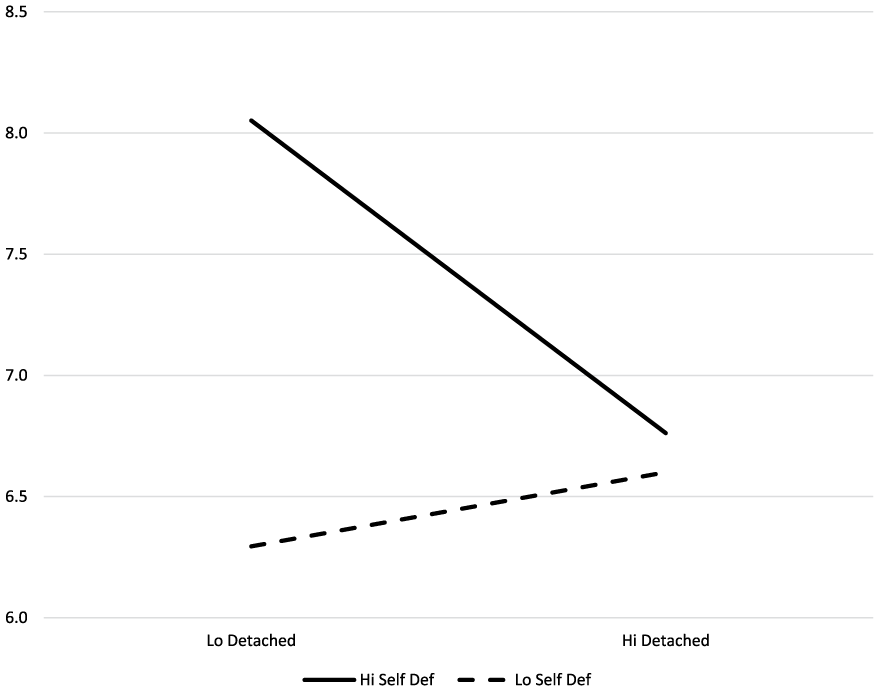
The interactation of Detachement and Self-Definition predicting work satisfaction two weeks later
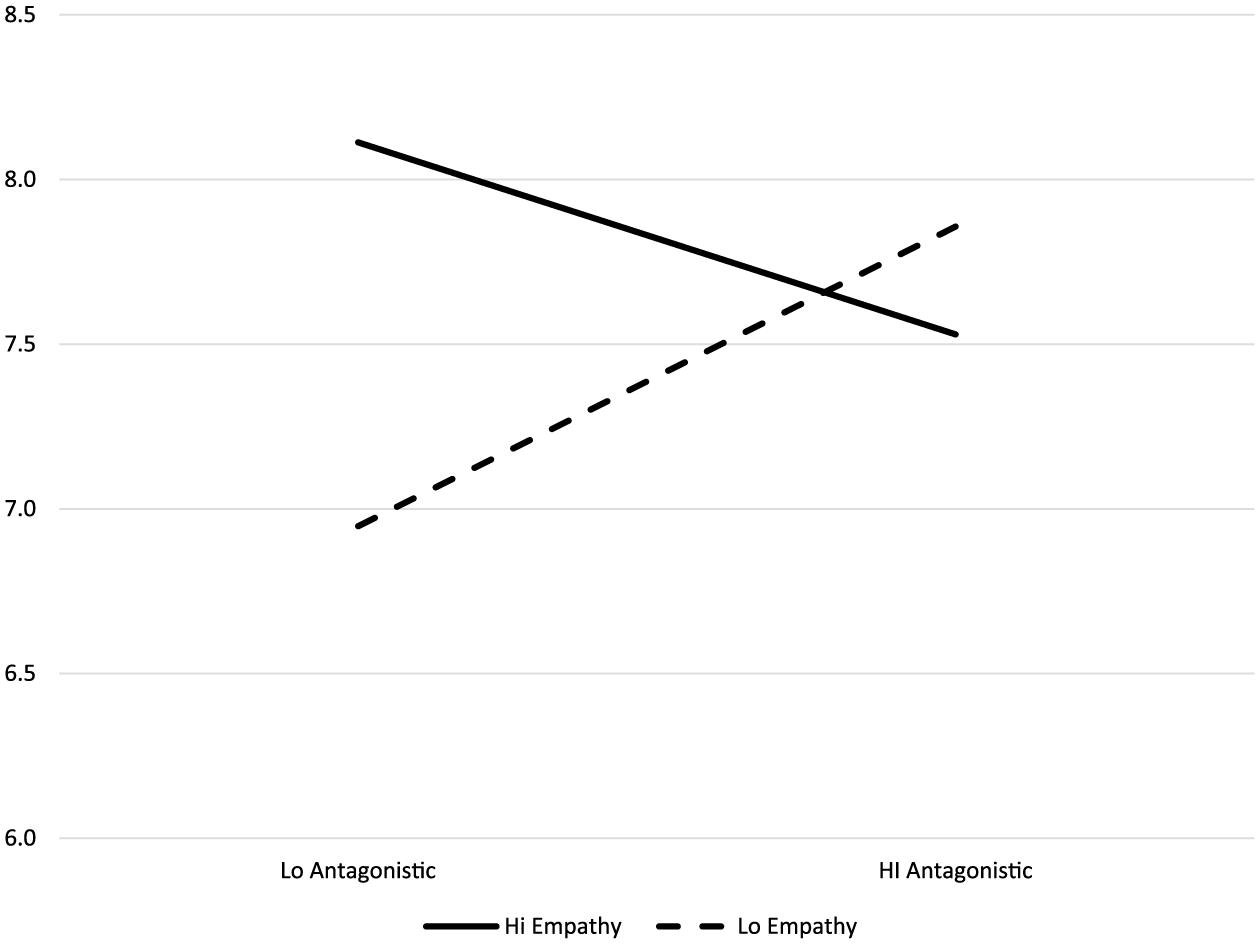
Antagonism and Empathy on relationship satisfaction two weeks later
Discussion
While traits and functioning are often correlated moderately (here from .28 to .57), the lack of parallel lines in the figures (i.e., the interaction) suggests that the impact of a trait can depend on the level of functioning, as Kernberg predicted. Low Detachment (e.g., being engaged) results in high job satisfaction only when the subject is also high in Self-Definition. Likewise, low Antagonism results in high relationship satisfaction only when there is high Empathy.
The pattern for satisfaction when the subject is lower in Detachment depending strongly on levels of Self-Definition is interesting because it suggests that the desire to engage in a work environment is not sufficient to be satisfied. It is also necessary to have a strong sense of self. Further research is needed to determine more exactly what the crucial role played by a strong sense of self is, and whether it involves being better able to set and move toward personally rewarding goals or whether it is being better able to be less reactive to negative feedback because of a greater sense of moving toward such a goal. Negative feedback could be overwhelming if the sense of self is externally derived.
For high levels of Detachment, Self-Definition appears to be irrelevant and lower satisfaction is found overall. Here a high level of Self-Definition does not help individuals achieve satisfaction if they are also Detached. This may be due to an overall devaluing of others, which may protect the self, but ironically diminishes any sense of achievement. Thus, when working with individuals who are dissatisfied with work, it would seem best to explore the issues of self-definition and detachment independently to explore which attribute is lacking. With those who have a strong sense of self, the function of being detached could be explored to determine if it is serving a defensive function protecting that sense of self at the expense of happiness. With those who are not detached, building a sense of self would be key.
The pattern is similar for romantic relationships, in that being low in Antagonism is itself insufficient to increase satisfaction; it is helpful only when one is also high in Empathy. Here satisfaction is highest theoretically because there is both lower motivation to engage in conflict and a greater ability to read others and cope with conflict when it occurs. Similar to work, when one is high in a trait (in this case Antagonism), level of functioning becomes less relevant. What is different is that satisfaction tends to be high. Those high in Antagonism and low in Empathy are slightly happier, but having Empathy oddly does not tend to decrease satisfaction as much as might be anticipated, despite the likelihood of frequent conflict. Those high in Antagonism but low in Empathy can actually be significantly more satisfied than their low Antagonistic / low Empathy counterparts. Presumably, being low in empathy serves this group because they do not experience the negative feelings their antagonistic behavior causes. This clearly moves the trait by functioning model beyond potentially masking a simple additive phenomenon, in that a negative trait can combine with negative functioning to result in less distress. More research would be needed to explore whether these relationships are indeed healthier.
If the two concepts of trait and functioning were completely redundant, then theoretically there would be no interaction, as a pure additive effect would simply be two main effects. Linear models (e.g., regression or structural equation models that do not specify interactions and factor analysis) are adequate tests of the additive model. However, there were more than main effects in both domains (work and relationships). In fact, for relationship satisfaction the pattern is even more intriguing, in that the factors combined differently depending on the level. Empathy may or may not result in satisfaction, which is similar to research on hard emotional awareness and couples’ satisfaction (Croyle and Waltz 2002). In both cases, it is evident that traits and functioning have a moderating relationship such that the level of one influences the impact of the level of the other. From a measurement and case conceptualization perspective, it is apparently important to understand both, as focusing on one element leaves us with an incomplete picture. Linear models (e.g., factor analysis and regressions that do not include interaction terms) are insufficient tests of the relative contributions of traits and levels of functioning, given the evidence that they interact.
Kernberg (2016) discusses personality as involving traits, but asserts that these traits are moderated by personality functioning (good models of self and other). Thus, mental health could be best understood as good personality functioning moderating the impact of personality traits demonstrating a healthy level of flexibility and capacity to use their strengths in social environments. Kernberg’s interactive model may help us better understand how personality impacts life and may best guide us in therapy when confronted with individuals with different traits and different levels of functioning. Future research could expand on these findings, ideally with more objective measures and a longer time frame.
Footnotes
James Sexton, Assistant Professor, Professional Psychology Program, The George Washington University; Margaret Hilton, doctoral candidate, Professional Psychology Program, The George Washington University; Stephanie Benson, doctoral candidate, Professional Psychology Program, The George Washington University; Adam Rosen, doctoral candidate, Professional Psychology Program, The George Washington University.
Submitted for publication April 9, 2019.
