



Abstract
More than a hundred years into our field’s development, examining Freud’s place in psychoanalytic education is timely. What authority does he hold for psychoanalysts in 2021? Is he still the architect, or overseer, of psychoanalysis? Freud has been a metonym for psychoanalysis, yet the history of Freud’s identification with the totality of psychoanalysis has had important unfortunate consequences. Negative aspects of this identification subtly linger, interfering in our collective appreciation of post-Freudian theoretical innovations. Too much of psychoanalysis has been “bought at the company store” of Freud’s ideas. Though part of this problem is created by idealizations of Freud, much of it stems from Freud’s precocious emphasis on psychoanalytic findings within his tripartite definition of psychoanalysis. As a result, many of his theoretical accounts were taken prematurely as definitive building blocks for a comprehensive psychoanalytic theory, when in fact they were only provisional formulations. Presently, portions of Freud’s theories are silently withering on the psychoanalytic vine. Data from the PEP-Web archive reveal the declining use of a set of once important, closely linked conceptions—Freud’s psychosexual theory and his characterology—and illustrate the kinds of Freudian ideas that have lost their usefulness. The indispensable and enduring elements in his work are identified.
Keywords
A science which fails to forget its founders is lost.
Psychoanalysts’ present-day views on the teaching of Freud are complex and varied. Even in 2021, some institute faculty hope that entrance into the world of psychoanalysis brings psychoanalytic candidates a reverence for Freud—if not also a career-long desire to read and return to his words. However, many faculty members no longer hold such wishes. At the same time, an increasing number of candidates come to us not only with little exposure to Freud, but with little interest, or even an aversion, to the study of Freud’s words. How are we to respond to them? Does their dislike of Freud mean that they should not become analysts? I propose to consider here the usefulness of Freud’s ideas in psychoanalysis over a century into the field’s evolution. Asking “What use is Freud?” within the institute challenges us to contemplate the specifics of how the study of Freud’s words serves our field at present.
Raising the question “What use is Freud?” in psychoanalytic education may seem shocking. But it is time the question is considered. As analysts struggle to understand their patients and themselves, Freud’s writings are less and less frequently sources to which they turn for ideas. Ever fewer papers in the literature of psychoanalysis refer to Freud as a necessary launching point or touchstone. Most psychoanalysts seem to feel that the work of three generations since Freud has yielded a greater and more helpful understanding of what psychoanalysis is, as a field, as a set of theories, and, especially, as a clinical practice. Along with much greater understanding of the psychoanalytic clinical situation, much has come as well concerning which of Freud’s contributions to psychoanalysis remain useful, and which are less so, even to the point of uselessness. Yet the totality of our field and its twelve decades of development remains closely identified with Freud’s work. For Freud long ago became a metonym for psychoanalysis.
Given the ongoing development of the field, it is time for us to start to formulate answers to questions including “With which of Freud’s ideas is it absolutely necessary for a psychoanalyst to be familiar?” and “Which of his hundreds of thousands of words must all psychoanalysts read?”
Freud and Psychoanalysis: One and The Same?
As we all know, criticism of Freud’s work has been clamorous and very public over the last several decades. At the same time, among educated Americans Freud has remained intimately identified with the whole of our field, as if his words and current thinking in psychoanalytic practice coincided (see, e.g., Park and Auchincloss 2006). Given the extensive criticism of Freud’s words, both in the cultural surround and from various mental health disciplines, educated citizens might reasonably conclude that psychoanalysis is an intellectual museum piece rather than a living discipline (Redmond and Shulman 2008). Yet the present vitality of other scientific fields (e.g., astronomy, computing, biochemistry) owes almost nothing to perceptions of the founders of these fields (see Goldberg 1990, especially chap. 3). Is it helpful for our field, we must ask, that psychoanalysis has been so connected to the figure of Freud?
To the extent that Freud remains a metonym for psychoanalysis, it seems he has slowly morphed from figurehead for the field to albatross around its neck. Analysts should consider how much value there might be in our working consistently to end acceptance of the metonym “Freud equals psychoanalysis” in both the culture and the institute. Otherwise, our field, unlike others, is easily misunderstood as moribund rather than as relevant, self-questioning, and evolving. Alfred North Whitehead, a careful student of historical progress in emerging fields that offered themselves as sciences, observed that “a science which fails to forget its founders is lost” (1916, p. 413). Religious scholasticism suffered this fate. Whitehead thus underlined the potentially fatal problem of a field of inquiry’s remaining closely bound up with the theories of its founder. Educated persons of our time don’t speak of Copernican astronomy as a living field; they speak simply of astronomy. Why should it be that they so often conflate the words of Freud, our genius, the Copernicus of psychoanalysis, with the ideas of psychoanalysis in its present form?
For the sake of clarity and the future of our field, it is time to carefully separate the living wood in Freud’s words from the dead. And we must better understand how to remind ourselves that we are explorers of a vast new world Freud opened, but could scarcely begin to explore himself.
After all, the identification of Freud with the whole of our field hasn’t been a problem only for the public. Many analysts continue not only to revere Freud but, more subtly, to feel bound to him as an embodiment of psychoanalytic ideals. Some consider him a great and exemplary psychoanalytic writer, perhaps even the greatest. Others believe that his scientific curiosity, his openness to revising his own ideas, or his willingness to self-reveal is a model for all analysts. In large part because of such idealizing processes, the invocation of Freud as metonym for all that we do has long persisted in our literature, not only among the broader public.
Here is Robert Wallerstein in 1995: “Essentially, psychoanalysis was the single-minded creation of the genius of one man” (p. 32); “perhaps more than any other branch of human knowledge, psychoanalysis has been the singular creation of the creative genius of one man” (p. 510). Jay Greenberg and Stephen Mitchell (1983) twelve years earlier: “Psychoanalysis is, for all intents and purposes, the creation of one man” (p. 21). Lionel Trilling (1961), twenty-two years before Greenberg and Mitchell, in his introduction to the abridged edition of Jones’s Freud biography: “That Freud should have been not only the one man who originated the science but also the one man who brought it to maturity is perhaps not wholly to the advantage of psychoanalysis” (1961, p. 8). Martin Bergmann in 2008: “psychoanalysis, unlike the geographical entity of the New World, did not wait to be discovered; it was created by one man” (p. 144). And Bergmann again: “the complexity inherent in the tripartite structure . . . predestined psychoanalysis to remain the creation of one man. If it had been only an investigative method like archaeology, or a practical application of basic sciences like medicine, psychoanalysis would have remained open-ended, permitting the inclusion of numerous men. The tripartite structure leaves room for only one man of genius—its founder” (1990, p. 3). Bergmann refers here not to the tripartite structural model but to Freud’s three-part definition of psychoanalysis in 1923: “Psycho-Analysis is the name (1) of a procedure for the investigation of mental processes which are almost inaccessible in any other way, (2) of a method (based upon that investigation) for the treatment of neurotic disorders and (3) of a collection of psychological information [psychologische Einsichten, misleadingly translated in the Standard Edition: a direct translation of Freud’s German is “psychological insights”] obtained along those lines, which is gradually being accumulated into a new scientific discipline” (p. 235).
Bergmann’s last statement holds particularly problematic implications, about which more will be said shortly. The “creation of one man” notion, and the accounts of Freud’s awesome genius expressed in these quotations, even though less often spoken aloud than in previous generations of analysts, still linger in their influence on us. While meant to express an appreciation of Freud, they also suggest an ongoing “too-muchness” of his presence.
Our field has greatly evolved since Freud’s time and need not be hindered in its development by this presence. To remain alive, his words ought not to be regarded by us as more than the seed from which the living tree of psychoanalysis grows. The seed is not the tree: though this view is now generally accepted within our field, the place of Freud at the base of the tree remains poorly defined. Ought psychoanalysts think of Freud as “creator,” “founder,” “discoverer,” “architect,” “overseer,” “pioneer,” or simply “initiator” of psychoanalysis? What perspective do we take on him? What would count as too little appreciation for his place within psychoanalysis? When does overreverence impede recognition of the limitations of his thought and of the dead-ends within it? When does it diminish recognition of the contributions of scores of analysts since, as well as diminishing appreciation of the field’s evolutionary paths of development away from the first psychoanalyst’s ideas?
And what kind of authority is Freud for the psychoanalyst in 2021? To suggest that Freud brought psychoanalysis to “maturity,” as Trilling wrote, is by general agreement now a false and misguided notion. But where is Freud to be situated by us, as students of both the development of an intellectual field and of a therapeutics that we wish to see endure? As history unfolds and psychoanalytic history with it, the best of Freud’s ideas prove their durability and utility. But to the extent that we return to his words seeking some special imprimatur or a talisman, or that we imagine Freud as architect or master of our field, we idealize destructively. He does not “superintend” psychoanalysis. Contra the implications of his metonymic status, Freud is no authority on psychoanalysis, if by the term “psychoanalysis” we wish to refer to a living field.
How Freud’s Definition of Psychoanalysis Causes Ongoing Problems for the Field
Bergmann’s words on the tripartite structure of psychoanalysis underline a difficulty central to the assessment of Freud’s contributions to our field. As Freud defined it, his creation was a method of gaining access to the mind and a therapy based on this means. But he went beyond these two. He also laid claim to the notion that a substantial series of “psychological insights” had already been the yield of applying the method. However, when he did so, the great majority of these insights had been derived by Freud himself. He often presented them as definitive knowledge, even though they had not been accumulated in a disciplined and open-ended manner, via independent observations by others in dialogue with one another, as well as with Freud. The third part of psychoanalysis in Freud’s 1923 definition of psychoanalysis, its findings, should have been the most open and welcoming of contributions from other analysts. Its investigative tool, the method of free association in clinical psychoanalysis, permitted such open inquiry by those who had learned the principles of its use. However, though the particular unconscious mental contents he studied and described were almost certainly an important part of the draw of others to the early psychoanalytic movement, Freud’s precociously generating so large a number of “psychological insights” on his own freighted the field with a premature and often immobilizing burden.
Insights into unconscious mental contents, fantasy content in particular, constituted the treasure-trove of psychoanalytic findings for Freud. As has long been observed, he was significantly less interested in the treatment he had created than in such “insights.” His love of theorizing unconscious fantasy content is notable throughout his clinical cases, some or all of which are still taught in most institutes. This love often overwhelmed a need for evidence of his claims. As we know too, it interfered in the treatment.
Consider the Wolf Man case. Freud’s relentless pursuit of unconscious fantasy content, as well as the strength of his confirmation bias in the clinical search for its verification, typically alarm present-day students of the Wolf Man narrative (1918). This dogged pursuit and this bias make teaching candidates the case a very challenging exercise. Freud’s technique with his patient, as is readily evident to candidates, is anything but empathic or attuned to the Wolf Man’s ego functioning. Instructors are hard-pressed if they want to teach the case in the tradition in which it has long been taught: as a study of infantile fantasy and sexuality, of reconstructing the primal scene and the infantile neurosis. These instructors have two choices. The first is that they suggest that candidates should attempt to put aside their reactions to Freud’s blunt, sometimes brutal, words to his patient, in the name of understanding how he sought at the time to formulate and reconstruct the patient’s infantile sexuality and infantile neurosis. The second is that they can share their own criticisms and concerns about Freud’s work with his patient. But even this second approach leaves aside what has become a larger problem: that, in reading the Wolf Man case, candidates are being asked to invest themselves in studying a part of theory—the infantile neurosis and its reconstruction—that has been falling into ever greater disuse by clinical psychoanalysts for decades (Reed 1994). On top of this, Freud’s extensive countertransference difficulties, so evident here in his unending quest to uncover and decode fantasy content, come quickly into any open discussion of the case in our time. They render next to impossible defending his understanding of the Wolf Man, let alone his technique (cf. Leffert 2010).
The Wolf Man case can still be a great teaching case, but now for entirely different purposes than its traditional one. It and Dora—which typically suffers an even worse reception among candidates these days—can still be taught to illustrate Freud’s clinical reasoning. Now, though, in light of post-Freudian skepticism, historical research on the Wolf Man, and clinical experience, the case report exemplifies incomplete and inadequate initial forays in inference-making, as well as the limitations of Freud’s psychosexual models and his conceptualizations of the infantile and adult neurosis. Today the case reads as a study of Freud’s deafness to the effects of his technique on his patient. It shows the analyst’s abrogation of the need to consider the effects of trauma, as well as the near-psychotic level of psychic organization this breach created in the patient. The case is no longer a convincing story of regression from the oedipus complex so often seen in obsessional neurosis. It exemplifies questionable means of drawing psychoanalytic inferences, whereas, in earlier psychoanalytic times, it might have been taught as a masterful demonstration of Freud’s theory by the master himself.
Freud developed the third part of his tripartite definition of psychoanalysis so rapidly that he effectively forced other analysts to “buy at the company store” of his ideas. Other analysts had neither time nor encouragement to develop theories that might have emerged from clinical application of the method of free association by a broader group in communication with one another. Many procrustean beds for later analysts and their patients were built of materials furnished by Freud’s company store. The hindrances caused to the field by the overweighting of Freud’s “insights” are most obvious in the history of psychoanalytic thinking about normative female gender and sexuality development. The germinal form of these theoretical hindrances is already visible in Freud’s cases in Studies on Hysteria (Breuer and Freud 1895); it is fully in bloom when we encounter Dora (Freud 1905a). Freud’s unhappily fixed ideas of female development are only further extended, reified and calcified in his writings, through his last decade (see, e.g., Freud 1937). These fixed ideas had a lingering influence on psychoanalytic thought for decades. But related hindrances can also be seen in the long-standing effects on psychoanalytic thinking of the reifications and limitations of Freud’s “insights” on normality and pathology throughout his theorizing on psychosexual development. They can be seen in the ongoing effects of his habitual subordination of aggression to sexuality in the workings of the psyche (Rizzuto, Meissner, and Buie 2003). These hindrances further evidence themselves in the decades-long effects on the field of Freud’s privileging unconscious fantasy over trauma in his accounts of psychopathology after the mid-1890s.
As drive and unconscious fantasy took center stage in his writings, with the lead roles reserved for unconscious anxiety and guilt, Freud wrote progressively less about the power of other affects in psychological suffering, including shame, rage, and helplessness. It took decades to bring psychoanalytic attention back to the power of these essential affects. 1 His theories caused him to opine, prematurely, that narcissistic problems are unanalyzable because he had been led to conclude that narcissistic patients don’t produce transferences (Freud 1914). This conclusion affected the field for over fifty years, until the work of Modell and Kohut. Finally, Freud furnished a distinctly and chronically impoverished account of mothers’ contributions to psychological functioning in infancy and beyond. This account was adopted by his followers as a powerful, even a complete, description of maternal functions, impeding recognition of the full importance of the first caregiver’s role and of preoedipal development for years after his death.
Though Freud spoke to the necessity of building psychoanalysis on a foundation of determined openness in observing and listening to patients without preconceptions, he often wrote in tones of conviction regarding what he took as a definitive psychoanalytic insight. This authoritative tone was accompanied by authoritarianism in constructing theory. Even after Beyond the Pleasure Principle (Freud 1920), the primary force to which Freud attended in his thinking about patients remained the sexual force. Aggression, rather than being elaborated in any detail, remained conceptually locked away in the vault of the death instinct. When earlier confronted by the views of Adler, Jung, and Ferenczi questioning the centrality of sexuality in psychoanalysis, Freud became more insistent on sexuality’s keystone position in the development of psychopathology, often “arguing” by assertion, rather than thoughtfully and fully taking up opposing views. An obvious instance of this occurs in “On Narcissism” (Freud 1914), where he dogmatically reasserts sexuality’s importance, while at the same time providing incomplete arguments in response to Adler’s and Jung’s alternative ideas. This was true even as the paper gestures toward, yet does not affirm, the role of aggression in both self-regard—for instance, in Freud’s references to criminals, humorists, and beasts of prey (p. 89)—and in formation of the hostile self-critical parts of ego ideals (p. 96). The seeming hypertrophy of aggressivity characteristic in so many of Melanie Klein’s formulations might well be understood as her insistence on aggression’s psychoanalytic importance in the face of Freud’s on sexuality’s.
Within the psychoanalytic field, we continue to face the problem that a major portion of Freud’s influence within psychoanalysis occurred via his extensive writings on psychosexual development and remains tied to those “insights.” Much of this writing was “served before it could be baked,” however. It suffered the limitations imposed by Freud’s life, clinical experience, and convictions, as well as the limitations of his self-analysis of his fantasies and his highly selective use of Western myths as a data source. Freud’s insistent drumbeat on behalf of his psychosexual theory, much of it formed already by 1905, had a stultifying effect on the field. Freud was repeatedly categorical in stating the need for theory to be regarded as a flexible superstructure of ideas resting on a firm foundation, which only clinical observation could provide (see 1914, p. 77; 1915, p. 117; 1926, p. 194). Yet he was persistently unable to follow his own advice on this matter. 2 A critical result is that our field was burdened early on by a set of one person’s theories that, however brilliant, came prematurely and erroneously to be regarded as definitive building blocks of a comprehensive theory, rather than mere preliminary sketches. We are to this day still recovering from this problem. Given the power of Freud’s words in the first several generations of analysts, and the maintenance of his authority by organizational structures he and his inner circle created, little space was left for major “insights” not Freud’s own. Thus, the field continues to come to terms, relatively slowly, with the implications of the work of those bold enough to immerse themselves in Freud’s ideas and, after sojourning with him, to leave him aside to extend the vision of psychoanalysis.
These contributors wrote not only from experiences in their own clinical practice and those of colleagues in consultation and case discussion, but also from fantasies in their own minds. These analysts challenged and supplemented the first framework constrained by Freud’s ideas, observations, experiences, and fantasies of his mind. They were individuals capable of taking Freud’s works as launching points, but as launching points only, to their pursuit of new directions within the vast territory that Freud had opened up. Rather than being viewed as analysts whose alternatives to Freud’s ideas showed their limitations and suggested the need for their correction or major supplementation, each of the major “modifiers” (Bergmann 1993) of Freud’s ideas—most prominent among them Klein, Ferenczi, Winnicott, Bion, Fairbairn, Lacan, Laplanche, and Kohut—were routinely branded at first as thinkers whose ideas weakened or corrupted the foundation of psychoanalysis. But only with their work could psychoanalysis begin to stretch itself substantially beyond its founder’s enormous and spellbinding edifice of ideas. Were it not for their new ideas, psychoanalysis may well have perished in the “maturity” to which Trilling and many others believed it had evolved by mid-century.
Documenting the Diminishing Use of Freudian Concepts in Psychoanalysis
The PEP-Web archive is not simply a means to read and search psychoanalytic periodicals; it also allows us to chart the increase or decrease in use of psychoanalytic concepts over time. A kind of empirical psychoanalytic intellectual history is the beneficial result. Using the search capabilities of PEP-Web, the rise and decline in use of various concepts within Freud’s psychosexual developmental and psychoanalytic characterology schemas can be clearly demonstrated 3 (Table 1).

With these figures, we bear witness to the fading use of Freud’s psychosexual concepts over the past forty years. We can observe the rise to prominence of narcissism as a term in our literature, as well as the increase into the 1980s in references to some of the psychosexual stages and the Freudian character diagnoses linked to them. We can note the marked simultaneous decline thereafter in the use of all of these concepts, save “narcissistic.” Its use declined but remained at a much higher level than did that of the others.
As another example, there emerges a gradually increasing independence from each other of Freud’s conceptually linked psychosexual terms “anal” and “sadistic” (Table 2).
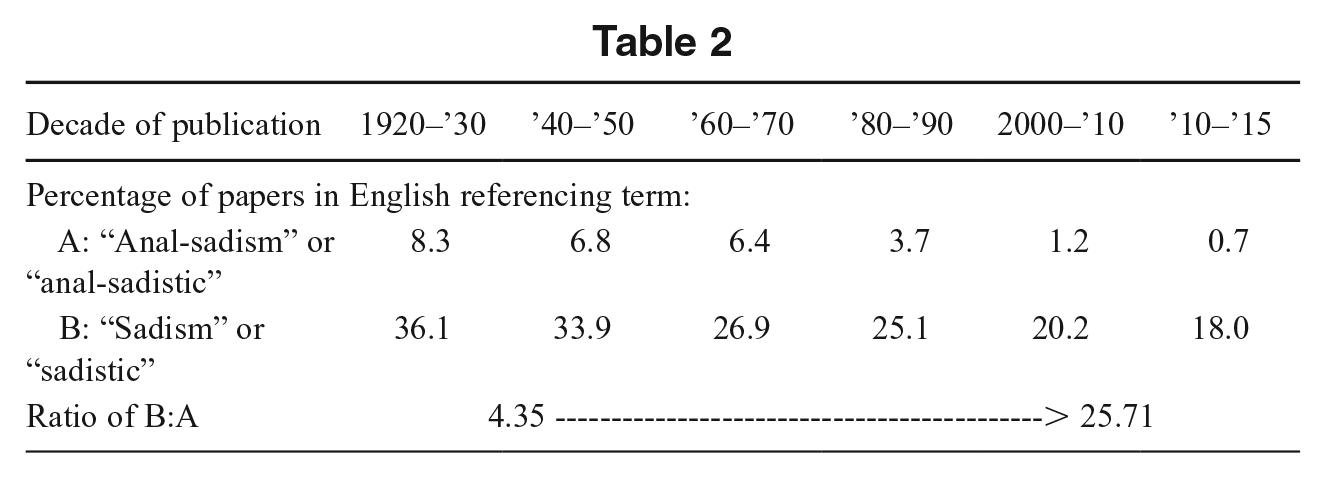
References in psychoanalytic papers to “sadism” and “sadistic” have always been more frequent than those to “anal-sadism” and “anal-sadistic.” But the ratio of uses of the former terms to the latter increased from 4.35 in the decade of the 1920s to 25.71 by 2010–2015, evidencing an ever greater loosening in psychoanalytic discourse of the association of sadism with Freud’s anal phase. Sadism as referenced in psychoanalysis has become essentially divorced conceptually from its origins in Freud’s vision of anal-sadism. Thus, “sadism” and “sadistic,” like “narcissistic,” appear likely to be useful and durable psychoanalytic concepts, while “anal-sadistic” and “anal-sadism” do not.
A Case Study in Our Collective Evolution Away From Freud
Freud’s psychosexual theories are prime examples of those of his “insights” or findings that came prematurely to be considered definitive concepts. Much psychoanalytic theoretical work today has attempted to correct the premature acceptance of Freud’s ideas, such as those based in putative linkages between a psychology of gender and his theory of psychosexual development. The project of deconstructing Freud’s procrustean bed of ideas linking gender psychology and the “phallic” phase was spurred by a recognition that the field needed to build psychoanalytic gender theorizing on almost entirely new foundations (see the journal Studies in Gender and Sexuality, which began publication in 2000; see also, e.g., Harris 2005; Elise 2002, 2017; Corbett 2009; Dimen and Goldner 2002; Kulish 2002, 2010). This work was set in motion not only by the cumulative clinical experience of several generations of analysts post-Freud, but at least as strongly by the cultural forces of feminism and the gay rights movement. These “outside” forces virtually demanded that the psychoanalytic field reform, and try to forget, Freud’s gender theories if it wished to survive. The new gender theorizing conspicuously invited a spirit of open and unprejudiced inquiry in the consulting room into the experience and unconscious construction of gender. The resulting clinical theory stands in marked contrast in its rich complexity to the reductive and all-too-often closed system of Freud’s ideas. Finally, the forces of reform also changed analysis because they helped put the testimony of patients, including nonheterosexual analysts, at the center of psychoanalytic inquiry, rather than the testimony of analysts who had mastered (or been mastered by) a set of what had become highly prescriptive theories.
The use of Freud’s psychosexual developmental schema, not just those portions of it linked to gender psychology, appears to be slowly eroding, as the data I have presented suggest. Some of the changes needed in psychoanalytic developmental theory have been occurring much less publicly than have modifications to psychoanalytic thinking about gender. For example, the putative dynamics of libido in the anal phase, as well as the obsessional character issues that Freud connected to those dynamics, have been slowly replaced by a novel, more clinically useful conceptual framework. These conceptions revolve around childhood helplessness, wishes for control, fantasies, affects, and defenses that are sequelae to the experience of dependency and compliance in a child’s individual search for parental love. The developments that Freud described as those of the anal phase have come to be understood in this more complex, much richer affective and unique-relationship-dependent framework. At the same time, attention to obsessional neurosis has all but disappeared from the literature. Why? It is difficult to imagine this hasn’t occurred because thinking about obsessional neurosis no longer seems of much use in clinical practice. Obsessionality seems to have faded greatly as a significant psychoanalytic reference point, as narcissistic issues and the power of related affects like shame and narcissistic rage, as well as omnipotent fantasies and defenses against helplessness, have become better appreciated and understood. 4
If historical trends continue, it is quite possible, if not likely, that Freud’s work on the anal phase will be little remembered, by adult analysts at least, in another two or three decades. Perhaps it will be taught as an historical curiosity. In my view, the broad but quiet waning of interest in Freud’s libidinal-stage psychodynamics and resulting characterology has several causes. Most important is the fact that the day-to-day activity of psychoanalytic differential diagnosis has ebbed in the wake of a greatly expanded conception of analyzability—a practical one that is all but completely de-linked from earlier psychoanalytic categories, including those of character diagnosis. The meticulous attention to psychoanalytic diagnosis in earlier times, most obviously as a putative basis for assessing analyzability (see, e.g., Zetzel 1968; Bachrach and Leaff 1978), has yielded to a much less “knowing” approach to considerations of diagnosis and prognosis, and, in this process, to a much less prejudicial view of patients and their “suitability” for analysis. This more recent agnostic approach is simply much more clinically productive than methods of assessing and predicting analyzability that relied on extensive psychosexual developmental categorizations of patients (see, e.g., Freud, Nagera, and Freud 1965). Such categorization mostly proved a dead-end in the practice of clinical analysis, at least adult analysis. An important factor additionally at work in the diminution of interest in the psychosexual stages, though perhaps less obvious, is this: attention to the dynamics of libido and its deployment in zonal psychosexual development was a function of a reductionist quest of Freud’s to somehow derive the effects of a unique relationship experience from an account of a universal bodily experience. Freud, in Three Essays (1905b) and two subsequent papers on the anal phase (1908, 1917), attempted to root the development of mind in bodily sensations with little regard to the affective qualities of the particular relationship with a child’s early caregivers that uniquely contextualize bodily sensations and fantasies about the body; within that relationship these sensations and fantasies acquire meaning in each individual’s psychic reality. The evolution of psychoanalytic ideas about development has led most analysts to the conclusion, implicit or explicit, that it is this contextualization that causes movement through a given psychosexual phase to become psychologically problematic or not, rather than something inherent in pleasures, anxieties, and fantasies associated with stimulation of the mucous membranes of the rectum. 5
Too, as already shown, present-day psychoanalytic thinking increasingly de-links the anal phase from sadism. My experience is that when analysts today describe a patient’s sadism, they usually think of the developmental challenges posed the patient by his relationships, such as challenges due to parents’ or siblings’ chronic sadism or masochism, or to trauma in the patient’s early life. In seeking to understand a patient’s sadism, most no longer focus their attention on conceiving the patient’s experiences with defecation or retention and the associated pleasures and anxieties, or on the events of toilet training—without at least also taking account of the patient’s childhood surround of parental personalities in which this training finds its specific affective meaning and potential pathogenic significance. For instance, we might formulate that our patient’s sadism, evidenced in a spiteful need for control, developed in the face of a chronically angry parent’s demand for compliance. Another way to describe this evolutionary path away from Freud is that most analysts no longer conceive a child’s relationship with his bodily function in elimination, per se, as yielding much understanding of his sadism.
Laplanche (2011) expressed dismay that the psychosexual stages were frequently being taught in institutes as a “catechism” (p. 11), writing that Freud’s “purported succession of libidinal stages . . . has been endlessly discredited, as much by clinical observation as by theoretical critique” (pp. 46–47). Even if one of the terms “obsessional,” “obsessional neurosis,” or “anal-sadistic” occasionally lives on upon a present-day analyst’s lips as a basic descriptive term regarding the issues or character style of a particular patient, few analysts seem to make much use of these Freudian concepts in their routine clinical work anymore. They are becoming vestigial ideas. Perhaps hysterical neurosis and character will have a longer life as conceptions that are more than descriptive categories in psychoanalysis, but their fate does not seem likely to be a happy one. In contemporary psychoanalysis internationally, it is only within Lacanian analysis that obsessional and hysterical neurosis are maintained as critically valuable terms for distinguishing real, living groups of patients from each other, and thus as terms that hold distinct implications concerning the analyst’s understanding and technique (Fink 1997). It is my impression that attending to, and theorizing, anality matters in particular ways in child analytic work and will always have a use there. Perhaps that means that adult analysts are missing out on the opportunity to bring understanding of the anal phase and anal issues more into play in their work—or, more gravely, in forgetting about anality, that they are failing to acknowledge the critical importance of this libidinal way station in their patients’ lives, thereby neglecting these patients, worsening analytic outcomes, and diminishing the field in the process. But I don’t think so, nor do I think do most of my colleagues—though they may not yet have explicitly recognized how little use they actually make of Freud’s conceptions of the anal phase in their daily work.
Toward an Outline of the Useful and the Durable in Freud
Which elements of Freud’s work are durable? Which have withstood history’s winnowing scythe? Which have not, and which are likely not to? I propose that we embrace six sets of elemental ideas. I will try to identify what makes them durable and useful while contrasting this utility with that of such fading Freudian conceptions as the psychosexual stages.
1. Freud’s work on the intentionality and meaningfulness of all mental life. This was already evident in Studies on Hysteria (1895) but is most luminously visible in The Interpretation of Dreams (1900). Freud’s work in the dream book demonstrates over and over the power of personally meaningful themes to determine the content of dreams. It provides a set of lessons in unconscious intention, both expressive and defensive, and in unconscious forms of thinking in primary process. The conviction that everything the patient says, does, and experiences is meaningful and intentional (however much also unconscious) is the conviction “meta” to all other convictions in psychoanalytic work.
2. The decisive importance of unconscious psychic reality, in contrast to material reality, as the reality that dominates patients and determines their particular suffering.
3. Mind as a system of forces in continuous interaction, including forces of wish and instinct, of self-criticism, and of anxiety-triggered defense, that often operates in the service of self-deception. This model of mind was first expressed by Freud in topographic form and further elaborated and refined in structural form, but both forms are fundamentally dynamic.
4. Childhood as a time of maximal psychological vulnerability for the human being. This vulnerability makes childhood with its anxieties the weightiest of all periods in determining later suffering.
5. The intertwining of sexual sensations, wishes, and fantasies within each individual’s search for love.
6. The encounter of a patient and an analyst as replay of a botched story about the patient’s search for love. Transference as the fundamental vehicle of meaningfulness within the psychoanalytic situation, the means of the showing and telling that provides the basis for understanding the unconscious psychic reality in which the patient is trapped in the present, and from whose traps it is the job of the analyst and patient working together to try to free him.
These six sets of elements, which I regard as indispensable, include Freud’s durable findings about the operation and development of mind while placing the psychoanalytic situation, free association, and the relationship of analyst to patient at the center of psychoanalytic understanding. These are elements essential in the psychoanalytic task that provide generative tools that open the potential to new discovery, while avoiding the creation of new and problematic procrustean beds that define illusorily or prescribe destructively. 6
An epistemic cleavage, a fundamental divide, separates two domains within psychoanalytic theory: a realm of ideas known to Freud, and a realm of ideas known to all psychoanalysts. Some of Freud’s conceptions are absolutely indispensable, foundational concepts upon which psychoanalysts rely. Others, like the psychosexual stages, are not foundational despite having long been taught as if they were. An analyst can understand and work effectively with an angry, sadistic, and withholding male patient without recourse to Freud’s conceptions of the anal phase, and with a depressed female patient without conceiving her as a human being enraged over the lack of a phallus. However, the analyst cannot work without a conviction that the patient unconsciously intends his words and actions, without understanding that his associations are meaningfully organized, without ways to conceive how anxiety functions in his mind and life, or without the idea that the patient’s here-and-now interactions in the analysis embody his psychically living in earlier, intensely vulnerable times and places.
Freud and the Psychoanalytic Future
Over time, psychoanalysis will probably stand or fall based on the utility of its ideas to those employing them to understand and help patients. If it is to endure as a clinical practice, its practitioners must continue to strive to unite its ideas with their daily application in our work with patients—in other words, to nurture a praxis that uses understandings of the mind that have evolved well beyond those that could have been conceived by its founder. To omit Freud’s words from a psychoanalytic education is inconceivable. But to maintain that Freud must still be taught extensively within such an education promulgates a psychoanalytic fundamentalism that submerges psychoanalytic innovation post-Freud, discourages new work on how to better understand psychoanalytic processes and our patients, and endangers this living praxis. Over a hundred years after the beginning of our field, it is absurd to hold that most of Freud’s psychologische Einsichten concerning human development are useful in clinical psychoanalysis. Yet it is my experience that suggesting that the study of Freud’s works ought to be less central to psychoanalytic education is met in some quarters with suspicion, anger, or sadness. Rather than being understood as a healthy sign of the field’s success in leaving behind, and usefully forgetting, the work of its founder, as a good indicator of our field’s vitality, of our commitment to achieving better understanding via discovery, and of our success in winnowing fruitful from unfruitful ideas, this diminishment of Freud in the training curriculum is for some a significant concern. This concern persists even in the face of solid evidence that the use of once universally taught Freudian concepts is progressively diminishing in our practice and literature. 7
Our personal relationships with our inner Freuds can make the loss of time spent teaching and reading Freud in institutes very difficult. The difficulty is even greater when we cannot allow Freud to be simply the first analyst, the beginner, rather than the psychoanalyst for all time.
It is time for each psychoanalyst who loves our field to ask questions like these: “What do I actually consider essential in Freud to my daily work?” “When does what I bear with me of Freud’s words liberate me, and when does it detain or shackle me?” “What is my Freudian ‘root system,’ and which of Freud’s ideas make up a superstructure of thoughts that were buds on the psychoanalytic tree that never grew, or that earlier did but have now become dead wood, or are withering?” “How much of Freud resides in me as a cluttered attic? And when, on the other hand, does my engagement with his words re-create me as a psychoanalyst?” Only by asking ourselves such questions can we do the work that needs to be done, on behalf of our field and its future, to clarify what use we still have for Freud.
