




Abstract

H

Talking with you on this occasion is a privilege based on my “retired” status as APsaA’s immediate past president. That person is traditionally invited, six months later, to speak on a theme that is both personally meaningful and significant to psychoanalysis. 1
When I conceived my topic for this plenary, “Female Leadership: Difficulties and Gifts,” I had in mind my experience as APsaA president and how my being a woman contributed to that experience. My thinking has evolved in the interim. My interest has become “The Feminine in Leadership,” and I will focus on that too in my remarks.
I hope to take you on my relatively recent journey without sacrificing my original goal: to inspire more women within APsaA to pursue leadership roles. The significant turn in my thinking has been in the direction of the feminine as a set of capacities that are not tied to biological sex and are critically important to both women and men who wish to become effective leaders in democratic, collaborative, forward-looking organizations.
There tends to be a conflation of female and feminine that does not serve us well. I will focus on the differences between female and feminine in relation to leadership using the lens suggested by Muriel Dimen (1997). She wrote about the fundamental interrelationship of psychoanalytic, feminist, and social theory. This triangular lens permits a disentanglement of terms and a move away from old categories that restrict us, including conflation of the female with the feminine.
I am aware that I am wading into territory having to do with such complex matters as gender identity and gender theory, subjectivity, female development, patriarchy, and family romance, topics that many of you have studied in depth and have given a great deal of thought to. Therefore, unlike what happens at most APsaA plenaries, I plan to leave a half hour at the end of my talk for comments and questions—to allow for correction and further advance in my thinking, and hopefully also in your readiness to think further about what is required for effective leadership.
Visuals and the Personal
I will begin my comments on female leadership with sociocultural and evolving psychoanalytic considerations, and will use a few personal vignettes as “clinical data.” But first, on the premise that a picture is worth a thousand words, I want to show you some images that inform what I have to say in dramatic terms. Although my experiences as president of APsaA were predominantly positive and affirming, a few were difficult. In fact, each time I’ve found myself in a leadership position—starting at age twelve when I was an elementary school “hall guard” and continuing through adult positions of leadership in academic psychiatry, at my home psychoanalytic center in San Francisco, and in my term as APsaA president—I have had experiences that surprised me. They were difficult ones in which I became acutely aware of my femaleness and felt unwelcome, put down, or attacked simply because I am a woman. The rawness of those experiences, which were sometimes with other women but more often with men, put me squarely in the realm of patriarchy as it exists externally in our culture and internally in both women and men.
For the purposes of this talk I will differentiate patriarchy as a sociocultural phenomenon from misogyny as a primarily psychological one. This is certainly an oversimplified distinction. But it is my impression that those who are patriarchal are not necessarily misogynistic, while those who are misogynistic are patriarchal as well. Basically, patriarchy has to do with power and its preservation for the benefit of men; misogyny has to do with the conscious or unconscious fear or hatred of women.
Early on, such experiences made me want to retreat, silence myself, and hide whatever it was about my being female that seemed to draw fire. More recently, my psychoanalytic understandings coupled with greater sociocultural knowledge have helped me see that the psychological and the political are interrelated (Gilligan and Snider 2017). Our psychological and sociocultural experience is connected with the innate human desire to be in relationship with others. Mother-infant research data, including videos created by investigators like Beatrice Beebe, Joseph Jaffe, and Edward Tronick, show us that infants react with immediate distress to the interruption of connection with their primary caretaker. Loss of relationship early in life is abandonment, and it is terrifying. Later in life, given good developmental circumstances, loss of relationship may be less alarming, but it is always disorienting and painful. The political is constituted by the ways in which society structures relationships in the arena of power. Although this focus on power may fulfill the defensive function of preventing loss (Gilligan and Snider 2017), it often ends up creating loss by obstructing the essential connection we seek, the link born of love.
I was in London in June 2018 for my last invited visit as APsaA president to a board meeting of the International Psychoanalytical Association. While there I visited the Tate Gallery, where I saw an amazing exhibit called “All Too Human: Bacon, Freud and a Century of Painting Life.” Included was the work of an artist named Paula Rego, a Portuguese woman who studied in London and has now lived there for many years. She narrates through pastels and oil her personal and political development in the patriarchal context of Portugal. I found a book in the museum bookstore titled Love and Authority in the Work of Paula Rego: Narrating the Family Romance, by Ruth Rosengarten (2011). The image used for the cover of this comprehensive book about Rego and her art—one of the artist’s most evocative works—is a searing depiction of both the power and the fragility of patriarchal dominance (see Figure 1).
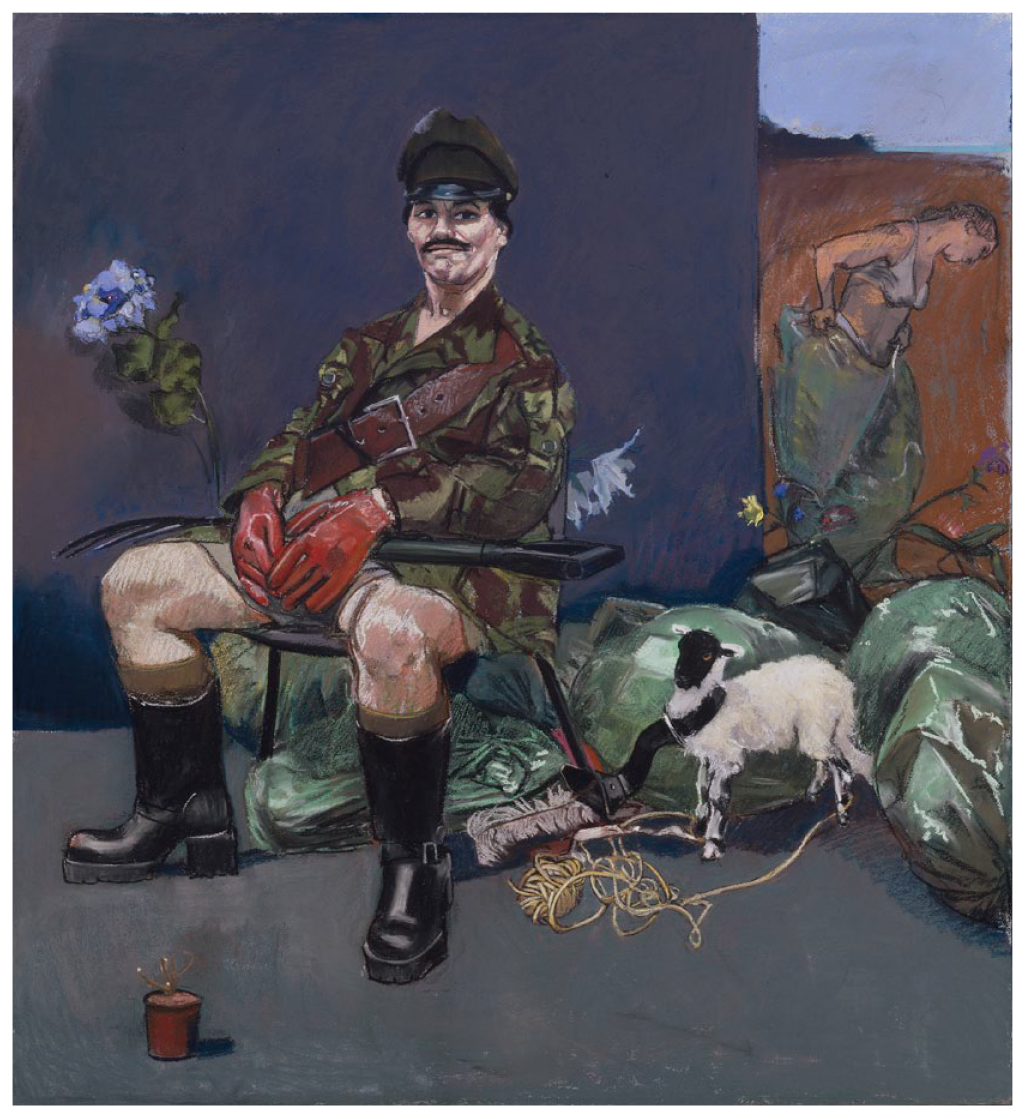
The Interrogator’s Garden, © Paula Rego 2000
The man portrayed here appears powerful, but his legs are bare and his vulnerability is revealed by his improbable dress and his apparent need to cover his naked body with symbols and instruments of power. With this painting of Rego’s, Love and Authority is introduced through a fellow who has to make or find love while in uniform, with rubber gloves on his hands and a whip in his lap. He is not the kind of guy you can imagine as tender or compassionate.
Rego’s depiction seems to confirm Stoller’s hypothesis (1974) that patriarchal masculinity’s insistence on separateness from women stems from the male child’s original maternal separation and disidentification, which often must be fetishized in order to convince the boy of the legitimacy and permanence of this disidentification. His doubts require constant proof of his separateness, and he views assertive women as threats to his potency. One can see how deeply alienating and lonely this position becomes for a man whose upbringing has led to such a constricting outcome.
Rosengarten is an art historian who offers a psychoanalytic interpretation of Rego’s work and highlights the impact of patriarchy on the painter’s development and oeuvre. In another of Rego’s paintings (Figure 2), the “father” is cared for by several women, perhaps a maid at the back, as well as a wife or daughter at the front and a younger daughter looking on, learning the tools of her future trade of control through nurturing subterfuge and/or identification with the male imago.
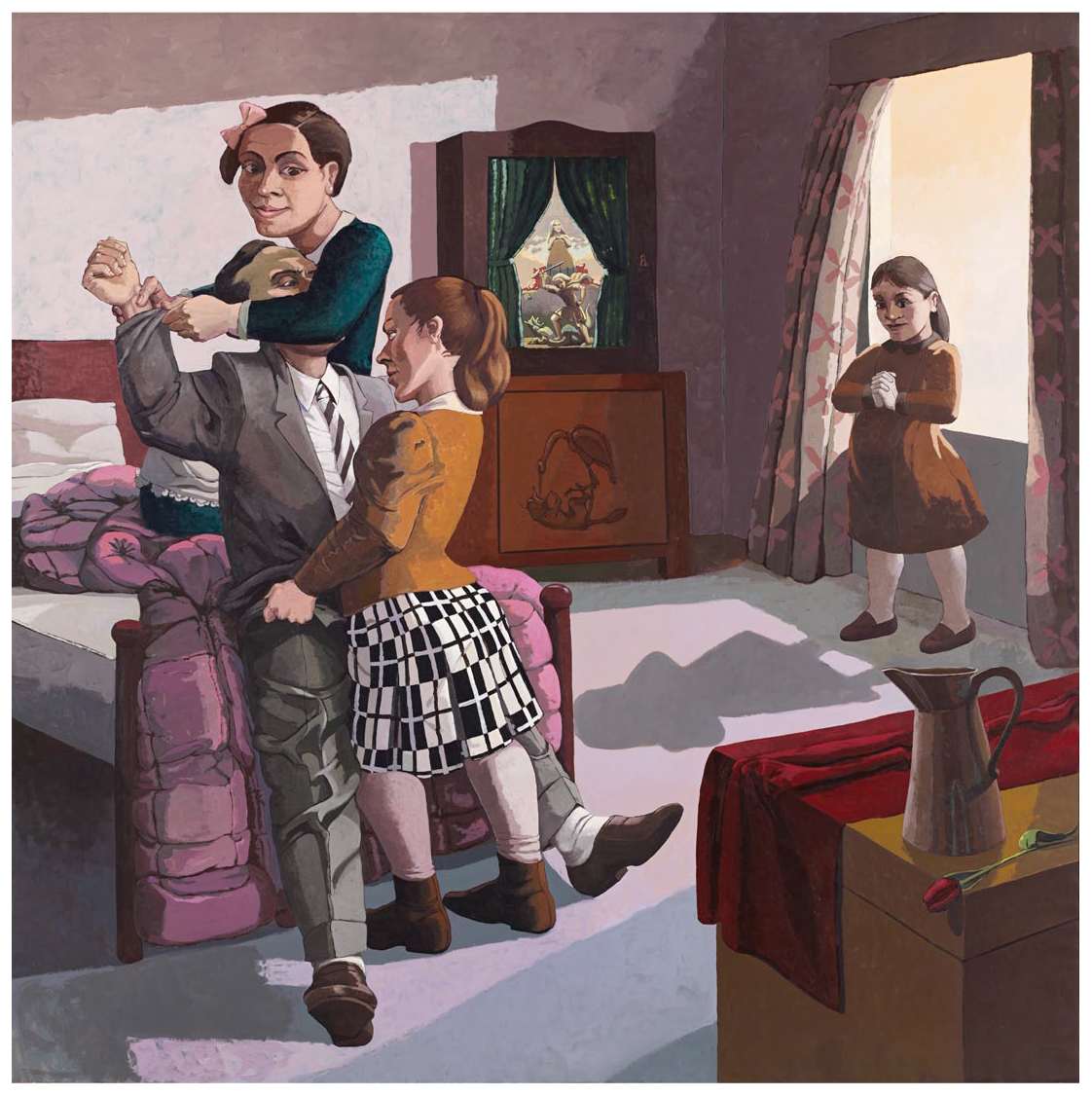
The Family, © Paula Rego 1988
The energy of the painter’s style indicates to me that the women are basically suffocating the man with their attention. While socially they are submissive, intimately they hold the power.
In a third Rego image (Figure 3), the girl’s identification with the power and violence of her father permeates what is once again an allegedly submissive act. Here it is polishing her father’s boots.
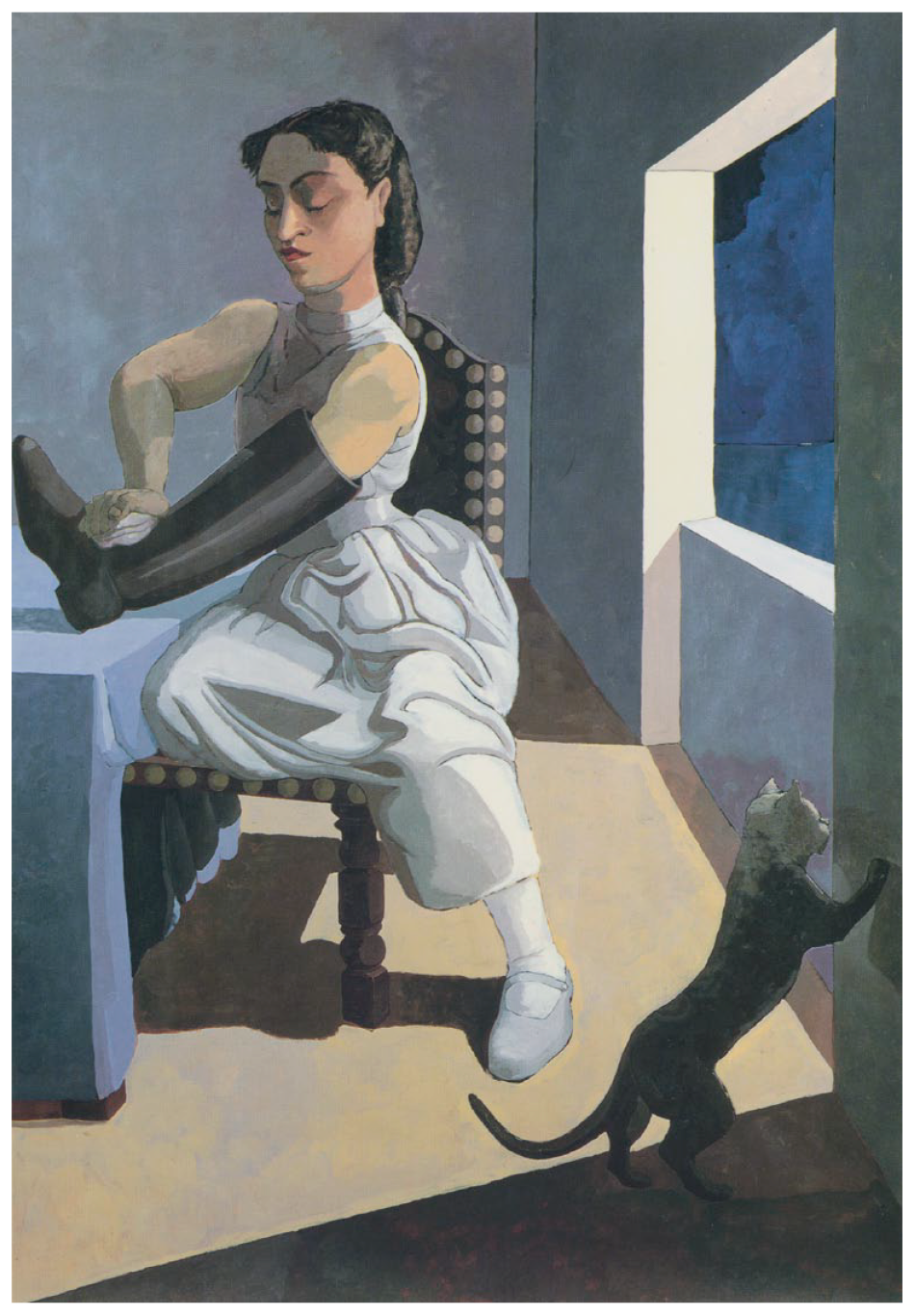
The Policeman’s Daughter, © Paula Rego 1987
Rego, in all her figurative art, presents women as terrifyingly passionate and very hard to tame. In the last of her images that I will present (Figure 4), we see the power of a woman who refuses to be dominated, even as she is reduced to a kneeling position.
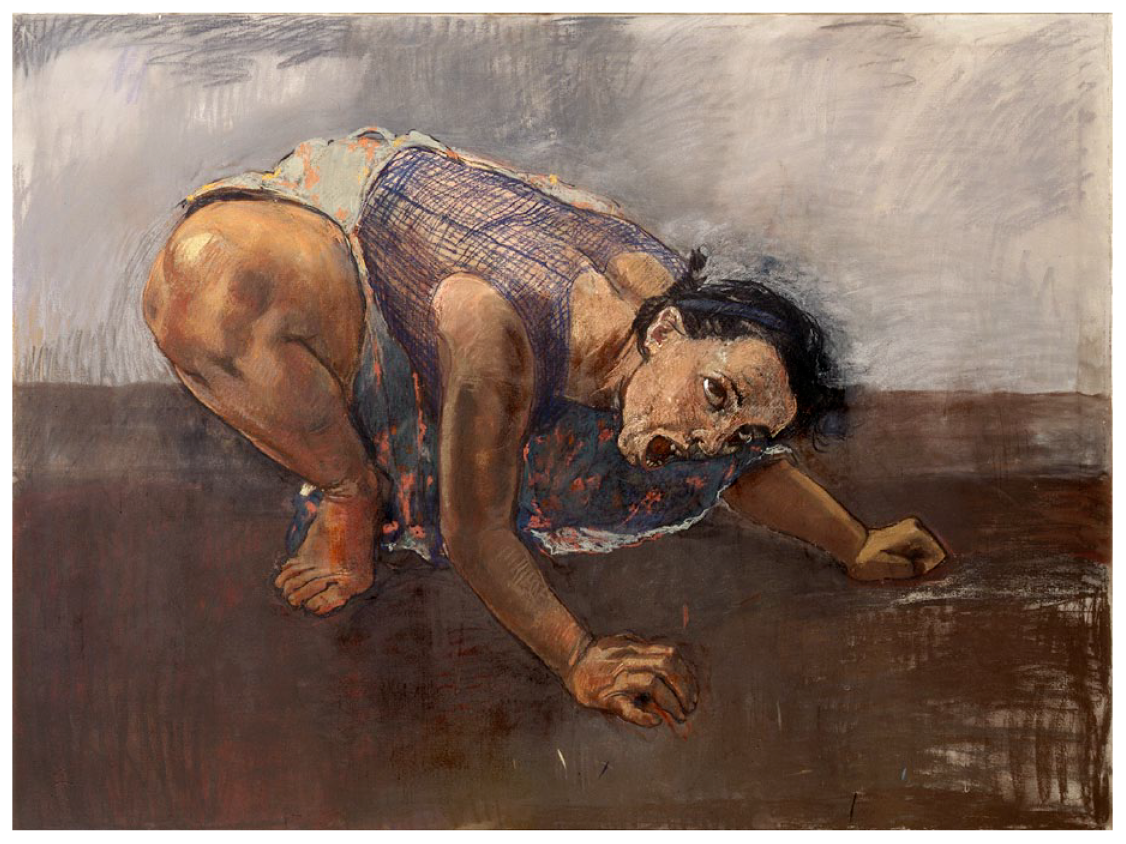
Dog Woman, Paula Rego © 1994
The very size of her knees alludes to the fact that she will neither slavishly obey the commands of her master nor drift away faintly into the night. I am an example of a woman who grew up in the 1950s in a Midwestern American suburb where no one admitted to being gay, where the traditional heterosexual family unit was the norm, and where girls were subjected to a double standard regarding sexuality and freedom of social movement. I am aware that this story of mine is both a generational story and a family story. Some families, even in the fifties, were more tolerant of aggression and equality in their young daughters. Today girls and young women, in general, seem to feel much more empowered. They are rugby players, social activists, firefighters, Marines; they legally carry guns; they are confident partners and mothers; their decision to have a baby does not depend on a man, nor does it stem solely from society’s expectations; gender identity has become fluid and is an individual matter.
Yet I often had the experience of women of different ages approaching me in my APsaA role after Executive Council meetings, or after my involvement in a scientific program, to say how much they appreciated my ability as a woman to provide leadership. Some said: “It is good to see a woman at the head of the table”—that is, a woman in a position of authority. This is why I chose my topic for today. I am convinced that these women, too, can provide leadership if they are so inclined and if they embrace the confidence that results from working through resistances based on a legion of possible fears, including those of exposure, shame, envy, loss of femininity, and loss of love.
Before going further, I have one more image to share, this one mental (a video cannot be shown in print). It illustrates the powerful voices of modern girls and women. Virginia Ungar, the first female president of the IPA, showed a video in Los Angeles at a November 2018 conference of the IPA Committee on Women and Psychoanalysis (COWAP), titled “Psychic Survival in the Face of Misogyny: The Dialectic between the Internal and External Glass Ceiling.” The video documents the “green flag movement” in Argentina and the massive demonstration by women and girls (and also men) that occurred in the summer of 2018, as a first vote was being taken on whether abortion, at or before fourteen weeks, should be legalized. The green flag on participants’ banners contained the image of a wire clothes hanger, an implement commonly used to perform illegal abortions. Women were speaking out in a different and powerful way regarding their wish to have control over their bodies and life choices. The classical fear of loss of femininity or of love—through frank expression of anger, through an aggressive outcry—was not in evidence here. Their voices were not silenced.
Sociocultural Considerations
Last fall I was invited to participate on a panel at a meeting of the Latin American Psychoanalytic Federation (FEPAL). The topic was “Femininity Today: Still a ‘Dark Continent’?” The dark continent, of course, was Freud’s 1926 conception of female psychology, reflecting an era of psychoanalytic thinking that featured an anatomical approach to women, whose lack of a penis was seen as eased only by the capacity to bear children. Anyone who listens to women today knows they have a lot to say about who they are and what they have, not what they are not or do not have.
It was over ninety years ago that Freud recognized, in his reference to female psychology as the dark continent, what has been perpetuated as an enduring social dynamic, one that places women in a less than or lacking position. A patriarchal mindset dismisses the value of notable women in public leadership roles. Little weight is given to the accomplishments of women who become speakers of the house, prime ministers, chancellors, CEOs of multinational corporations, directors of cultural institutions, past presidents of APsaA, or the current president of the IPA. Today many young women are poised to become future leaders, and in terms of numbers, they are well represented in the student bodies of professional schools and psychoanalytic institutes. But their future as leaders is not guaranteed based simply on their growing numbers.
Women’s relative failure to advance in business, the arts, and academia continues to be a problem. Women now speak out loudly, individually and in mass marches, but they experience lower levels of appointment, lower salaries, and the phenomenon of the glass ceiling. In Sweden, which has led the way globally in mandating and facilitating gender equality, a biannual report of statistics shows that as of 2016 only 6 percent of CEO positions and 29 percent of board seats were filled by women (www.Sweden.se, 2018).
In North America, the metaphor of the dark continent is, I think, still quite germane. When Freud used the term, it was an allusion to Africa, a continent whose interior remained largely unexplored by Europeans. It was just beginning to be mapped out during the late 1800s when he began to write. Currently, the metaphor suggests an association between women and a dimly seen “other,” one whose value is uncertain and who may, in fact, be dangerous.
Evidence of this continuing potential for women to be seen as dangerous was described recently in the New York Times as #MeToo backlash (Bennold 2019). Businessmen are reportedly less likely to travel with female associates than before, do not want to be alone with women at work, and are retreating from mentoring relationships with women. Women are not treated with empathy and compassion, nor are they seen as needing acknowledgment of their worth and their suffering. Rather, the backlash reflects a perception of women as vengeful and retaliatory if offered cause to vent their inherent destructiveness.
The perception of women as frightening, foreign, marginal, or “other” remains a powerful and largely unconscious dynamic in many Western cultures. This dynamic underlies the difficulties that women in leadership positions often experience. It informs the social science literature that describes the double bind they face: women must be assertive if they are to lead, but that contradicts the expectation that their behavior should be “communal”—helpful, kind, and sympathetic (Eagly and Karau 2002). Social prejudice against them is based on their exhibiting the very behaviors required of them as leaders.
I experienced such biases myself as president of APsaA. Although I considered describing in detail some of the inadvertent insults and direct vitriol I experienced in my role, I decided not to report interactions in which anyone might be identifiable. I will say that my transition from president-elect to president in June 2016 coincided with the beginning of the national presidential campaign, and many APsaA members were understandably concerned about how the campaign and the election might go. Some contacted me as APsaA president to express varying levels of distress regarding APsaA’s organizational policy of speaking out about national issues, but not about individual candidates.
Of course, leaders of organizations often become transference objects and suffer characterizations that reflect something other than who they actually are. But it is an experience that discourages some women (and men) from running for office. I have to say that it is possible to get used to distorted public perceptions of oneself. In fact, these distortions actually help one become more confident about the reality of who one is. I did not develop a sense of humor about ad hominem attacks when they occurred, but I did connect with the courage that is part of the clinician in me—something Clara Nemas (2016) has written about as a maternal aspect central to the clinical work we psychoanalysts do. I think of this as the courage to endure the anxieties and challenges of a deep dive with a patient—or with an organization.
I share my experience to illustrate how a female voice can be perceived as corrupt or dangerous when it dares to take command. In the twentieth century and now the twenty-first, we have seen an upward trajectory of women’s voices and opportunities for self-expression. The #MeToo movement in the United States and elsewhere represents the growing recognition within civil society that domination and subjugation of others cause real damage and must be jettisoned. In this regard, feminism as a social movement transcends women and touches the part of a human psyche that struggles to find a voice against whatever attacking forces are confronted. In clinical psychoanalysis, we are quite aware of accommodations to psychic struggle that surpass gender. For example, Winnicott (1960) described the defensive effort to survive through creating a false self. We theorize too about the struggle against adversity found in the marginalized thoughts relegated long ago to corners of the psyche that have not been symbolized but relate to early maternal care—what Bollas (1987) calls the unthought known.
To be authentic, true to oneself, open, and affirming requires an other who is willing to listen. From the outset in psychoanalysis, women have been ready to talk about their development, the female self-experience, and their sexuality. In general, men and women in psychoanalysis have been a societal exception in their open attitude to women leaders. APsaA’s first woman president was Grete Bibring in 1962. Since then, APsaA presidents have included Rebecca Solomon (1979), Judith Schachter (1994), Lynne Moritz (2006), Prudence Gourguechon (2008), and me. Virginia Ungar became the IPA’s first woman president-elect in 2015. It took 105 years for that to happen (the IPA was founded in 1910).
Nonetheless, throughout psychoanalytic history, a tradition of female conceptual leaders has thrived. Early examples include Sabina Spielrein, Marie Bonaparte, Anna Freud, Melanie Klein, and Melitta Schmideberg. By contrast, though, Karen Horney (1924, 1926, 1933) stands out as a woman vilified for suggesting major theoretical advances (Balsam 2015), including an emphasis on social dynamics rather than libido theory as critical to understanding human development, female development in particular.
It takes a society ready to listen before a real synergy emerges to the collective betterment of all. In my view, one cannot talk about truth unless there is first a voice and, second, an other who is receptive to hearing and acknowledging. In a recent edited volume, Changing Notions of the Feminine: Confronting Psychoanalysts’ Prejudices (Cerejido 2019), Nancy Goodman (2019) describes the importance of a community of colleagues—in her case, a study group—with whom to discover, explore, and transform unconscious identifications with influential personal and professional mentors and their theories. Goodman’s Washington D.C. group of women analysts met for many years, studying and writing together about how their attention to patients’ utterances was influenced by their early male-centric psychoanalytic education and how difficult it was to transform prejudices.
A social reality that complicates readiness for open, nongendered dialogue is the existence of patriarchy. Paula Rego’s images capture my sense of patriarchy as a complex, conflicted, and passionate social reality. Gilligan and Snider (2017) have written about patriarchy as a defense that protects male power from the threat of loss, including loss to the profoundly envied woman who, rather than lacking a penis, has a clitoris and a womb, gives birth, and perpetuates life. In authoritarian regimes such as Nazism, the conflation of femininity with reproduction has resulted in women being idealized as bearers of male replenishment (Rosengarten 2011). In other words, women may be used by men to ensure men’s continuing domination. This sort of practice informs the experience of women leaders whose contributions become the property of male colleagues who claim their successes as their own.
In this focus on patriarchy as it can exist in both men and women, I want to emphasize that I am talking about a phenomenon of social hierarchy that supports domination and subjugation as organizers of social behavior. I am not talking about the developmentally crucial paternal function as described so well by analysts like Michael Diamond (2017) and James Herzog (2005). In contrast to their psychoanalytic formulations about the importance of triangulation to the evolution of the self, I am speaking of patriarchy as a sociocultural phenomenon that interferes with parenting, both fathering and mothering, that is based on close connection and loving attachment.
Buried in female development are gifts women commonly bring to the table: intuitive knowing and emotional connectedness. Gilligan puts it this way: “girls are more able to name and women to retain the intuitive knowing and emotional connectedness that is present at the outset of development—a knowing often split off from consciousness” (Gilligan and Snider 2017, p. 142). To the extent that these attributes were split off in me, based on my early life experience in a male chauvinist culture, psychoanalysis rendered them not only accessible and enjoyable but also useful. As Paula Ellman (2017) writes in The Courage to Fight Violence against Women, “unconscious fantasy rooted in hateful early attachments can lead to enactments of violence against women” (p. 5). Fortunately, my early life experience included identifications with strong and benevolent women, my mother and maternal grandmother, and also our family doctor, a woman who graduated from medical school in 1929. She delivered the three children in our family and cared for three generations of us. She was respected and loved by us all, including my father. She represented to me, through her choices, a door to the broader world. And her behavior was specifically aggressive, effective, decisive, or calm, as the situation required. This sort of feminine identification is protective for both men and women. It allows for a sense of perspective regarding distortions of self that come from the outside world and contributes to an internalized motivation to care for others.
From a sociocultural point of view, both patriarchy and misogyny exist outside us but also within us. The related challenges a leader experiences are not deal breakers as long as a leader can keep in mind why she wanted to lead in the first place. The bumps along the way are both external and internal, but the core sense of pursuing her leadership job for a good cause will carry the day when projections and transference distortions erupt, as they inevitably do. Leadership, in my view, is a direct expression of thoughtfulness and of active receptivity to the frequently divergent narratives of others, which is essential to careful listening, holding, working through, and ultimately representing the best interests of the group. As such, it is a very feminine mindset, well suited to women and useful to men.
Evolving Theoretical Considerations
Psychoanalysts’ early views of female and feminine emerged in an era when biology was considered destiny. The notion of an other, one who is receptive to hearing and thereby essential to human development, came later. Despite Freud’s early radical, clinical openness to the truth of women’s experience, his theoretical views (1905, 1925, 1926, 1933) rigidified as he encountered hysterical pathology and facilitated women’s associative discovery of the source of their pain (Gilligan 2004; Schafer 1974). Women’s subjectivity did not enter into his theories; women remained defined by their anatomical difference, what they lacked in comparison to males. As Rosemary Balsam (2015) writes, “this cultural fantasy of female inferiority compared to males’ was instantiated as metatheory” (p. 85).
Psychoanalytic theory building later took a turn away from the binary or male-centric point of view through the work of theorists like Janine Chasseguet-Smirgel (1976), Adrienne Harris (2000), and Emilce Dio Bleichmar (1995, 2012, 2015). In “Freud and Female Sexuality: The Consideration of Some Blind Spots in the Exploration of the ‘Dark Continent,’” Chasseguet-Smirgel articulates a universal, preoedipal, human fear of helplessness: “The theory of sexual phallic monism (and its derivatives) seems to me to eradicate the narcissistic wound which is common to all humanity, and springs from the child’s helplessness, a helplessness which makes him completely dependent on his mother” (1976, p. 281). Thus Chasseguet-Smirgel anchors the normal defensive tendency to demean the mother (or first caregiver) in the profound power that that caregiver has, physically and psychologically, over an individual’s development.
Harris (2002) examines the complex mother-daughter dance, seeing this core relationship as the ground zero of female misogyny. Her view highlights the role of unconscious, enigmatic signification within the mother-daughter dyad and its susceptibility to stirrings of envy, aggression, shame over needs and desires, and unresolved bodily anxieties as they cross the generational boundary. This internalized misogyny captures the difficulty many women have in assuming leadership roles as they grapple with self-esteem and identity issues.
Dio Bleichmar writes about the intersubjective field that defines a child’s experience of self and the degree to which the child feels feminine, masculine, or a mix of the two. She builds on the work of Laplanche and his notion of gender as plural, not binary, and on Money’s research with children who had received a false gender assignment at birth and then later were reassigned, creating a traumatic and virtually impossible psychic shift for their parents. Dio Bleichmar (2012) articulates the role of relationship in representation: “what is formulated as ‘the social construction of gender’ refers to the constant intersubjective exchange, to the conscious and unconscious representation of the mother and father, of the feminine or masculine that are part of their modalities, of their personalities, and the way in which each member of the couple relates to the other” (p. 86; translation mine).
These are just three examples of modern thinking about development, both female and male. But I want to bring us back to the fact that femininity is not defined by gender. It is a set of psychological capacities, one that is innate in young boys as well as girls (Gilligan 2004). Gilligan defines femininity as being decidedly direct, attentive, articulate, and authentic, relationally attuned and perceptive, empathic and intuitive. She argues that it is present but then lost in both girls and boys, though at different developmental stages. Boys tend to decrease their use of these functions at about the age of five or six, when they enter kindergarten. Gilligan’s colleague Judy Chu has observed that boys become more indirect, inattentive, inarticulate, and inauthentic—more like “real boys”—at that time (Chu and Gilligan 2014). Girls also change but not until adolescence, when they become “nice” and tend to lose their strong voice.
Early formative relationships with adults who represent the strengths of a feminine attitude are equally important to female and male development and to a person’s capacity to develop and retain a feminine attitude.
The Feminine in Leadership
The feminine defines a space in which to grow and be, to be nurtured, protected, and to evolve in one’s own terms. Viviane Chetrit-Vatine (2014), in The Ethical Seduction of the Analytic Situation: The Feminine-Maternal Origins of Responsibility for the Other, refers to this as a matricial space in which the analyst, like the infant’s primary caregiver, has the ethical responsibility to recognize the otherness of the other, the not-me. Indeed, “the analyst, by virtue of offering analysis, thereby takes on a passionate responsibility for the other, the patient” (Wilson 2014, pp. 109–110). This stance is exactly what is needed by both women and men to successfully lead organizations, including psychoanalytic ones. The values of ethical responsibility and caring for humanity affirm an organization’s moral ground and enable its constructive reach into the world.
According to Wilson (2014), Kristeva (2009) locates ethics in the maternal thing, “what she terms herethics—a maternal/feminine place of passion, caring, vocation, and responsibility” (p. 108). Wilson observes that Kristeva clearly implants the maternal “at the heart of the ethical,” emphasizing care and responsibility (p. 109).
I view organizational leadership as a direct extension of the ethical stance of the clinical analyst in a responsive and responsible matricial caring for the patient. As clinical analysts, we give light to that dark-continent aspect of self that goes unrecognized or is suppressed. Preserving the psychoanalytic encounter, with as much intensity and continuity as possible, is a vital act of caring and a feminine way of conceptualizing analytic process. It also serves as an ethical platform for leadership.
I have been asked, “What about authority? How does that fit into this idea of the feminine in leadership?” Authority in my model of leadership resides in the ethical stance described by Emmanuel Levinas (1981), who sees responsibility for the other as the very definition of ethics. When Levinas writes metaphorically of the face as that which summons caretakers so strongly as to take them hostage, what I think of is the experience of a screaming infant, a baby no one can soothe. The new mother’s common fantasy of throwing that baby out the window is not acted on. The active ability to hold steady and remain a responsible and caring parent in the face of such an impulse is what Scarfone (2014) terms radical passivity in his introduction to Chetrit-Vatine’s exposition of matricial space (p. xvii). It is what I see as the strength of the feminine in leadership. It is the ability to remain passionately engaged when “taken hostage” by the aggressive, despairing outcries of injured or disappointed members and maintaining authority through the absence of a reactive response. This sort of ethical core in leadership, as well as in clinical psychoanalysis, permits an ongoing connection, the ability to listen, and the ability to engage in dialogue.
An organization is not simply a space for collegial sharing; it is a space for thinking, problem-solving, and consensus-building, which can be difficult to attain and then retain. Societal pressures and tensions often spill over into organizations, which then must deal with the implications for members while preserving what is essential to their professional identity and survival. When tensions build, organizations are prone to action at the very moment thought is needed.
Leadership means attending to the dark-continent aspect of an organization, the unarticulated and often unrepresented within it. We must be sensitive to what voices are not being heard within the organization and how ideologies that make us feel comfortably certain may also blind us to important truths.
Bion (1962) suggested that truth is essential for psychic growth, and this likely applies to organizations as well. Of course, there is no sure way to know truth, especially in an organization as broad and diverse as APsaA or the IPA. Nonetheless, there is a way of building consensus by thoroughly acknowledging what is conflictive, uncomfortable, hard to face, and even divisive. This takes patience and endurance. There is something very matricial about good leadership. Leaders of all stripes should take their cue from psychoanalysts: we know truths simply arise, more than they can ever be actively pursued. Consensus is a form of truth in organizations, and consensus evolves when leaders make the space and time for it to emerge.
To stay with Bion for the moment, he offers a further parallel between leadership and the psychoanalytic encounter. I am thinking of his counsel that the analyst listen without memory or desire (1967). Decision making is an intricate process in organizations. It involves much more than a majority vote, for example. Bion would have been very aware that the analyst’s subjectivity is an inevitable part of the field, and hence we arrive saturated with memory and desire. It stirs within us. His advice was aimed not at striving for an impossibility, but at holding the other’s welfare separately as another fundamental ethic—clearing the mind, and in so doing increasing permeability so that we can hear what is novel and yet to be said.
It is the transformative aspect that is fundamental to my understanding of leadership. It is what I mean about receptivity and its relation to the feminine. In this regard, I do not view leadership as a take-charge, impose-one’s-will enterprise. At the same time, there is something vital about having a vision of what would be best for the organization and how one would like to influence and inspire. But implementation of a vision is a theory of technique more than one of achieving specific aims or goals. It is about process, not specific outcome. It requires a deep appreciation for differences and a capacity to reach into the corners of the organization to represent the voices least likely to be heard. A leader needs to “hold” the organization with a benign, attentive, active receptivity to hearing what is loud, as well as what is so soft as to be almost inaudible.
Concepts like containment, and holding, which have served to elaborate the analyst’s role, as well as that of the primal parent, apply equally to leadership. Can these concepts be seen as specifically feminine? I think they can be, as long as feminine is not limited to gender but evokes the value of conciliation by placing the self in the service of the other even if this comes with a price. Freud’s association of this feminine value with masochism missed entirely the growth-enhancing attribute that holding provides. It is about love and not suffering. We have all had patients who pushed us to our personal and professional limits. As a result, our goal can become—whether for the moment or for a longer time—solely that of survival, of containment without retaliation. This might be termed feminine, but it would never be accurate to view it as masochistic, even if it entails paying a price.
In Conclusion
My aim is to continue to be a feminine leader—not because I am a woman, but because I perceive these values and this orientation as central to the analytic method, which is the basis of my ethics and mindset concerning leadership.
What Freud saw as missing from the female was really a barely concealed capacity for vital passion and generativity that is powerful and meaningful in its own right. As feminism brought this to the fore, the dividend proliferated, enriching men and women alike. Society profits when gender is viewed as an attribute that complements, enhances, and qualifies, but does not itself determine what and who someone is.
Ironically, psychoanalysis itself has often been viewed as a dark continent—obscure and impenetrable. Does this mean that we analysts, both male and female, are the feminine expression of the talking cure? We are, after all, receptive, introspective, reflective, and creative. If so, it is time to shine a light on our strengths, to open up our thinking toward the future and transcend the old categories that have defined and burdened us.
Footnotes
Plenary address, American Psychoanalytic Association, February 8, 2019.
1
The world has changed since this plenary was presented, in part as a result of the Covid-19 pandemic. At a time when leadership has become an increasingly important and fraught topic, I hope what I have to say here proves helpful. The “ism” of interest in this plenary is sexism. Racism is not explicitly considered (as it would have been had the plenary been given more recently), but the theme of othering through patriarchy is certainly transferable to systemic racism.