



Abstract

As a photographer and psychoanalyst, I have been intrigued by what makes a portrait memorable. How do photographer and subject collaborate in producing an iconic image? In my own work as a photographer and writer, I have explored the relational image, which can be defined as the new visual/emotional event created when two mutually vulnerable partners come to see one another in an entirely fresh way. This essay is a further exploration of the relational image, through a close examination of two biographies: Portrait of a Life: Melanie Klein and the Artists (2019), by Roger Amos, and Diane Arbus: Portrait of a Photographer (2016), by Arthur Lubow. The juxtaposition of these two remarkable women, one as the portrayed, the other as the portrayer, provides an exciting palette of contrasts and similarities in which to explore portraiture and psychoanalysis through the relational image.
The Roaring Lion
I begin, not with Klein or Arbus, but rather with Yousuf Karsh, the photographer who created the famous and iconic portrait of Winston Churchill in 1941 (Figure 1). Karsh, one of the great portraitists of the twentieth century, survived the Armenian genocide and became Canada’s most renowned photographer. Karsh and Churchill were mutual partners in the photographic endeavor, but with quite different roles. As Karsh (1971) explained in his recollection of the event, Churchill “was in no mood for portraiture and two minutes were all that he would allow me as he passed from the House of Commons chamber to an anteroom.” The photographer thought: “I must try to put on film a man who had already written or inspired a library of books, baffled all his biographers, [and] filled the world with his fame, and me, on this occasion, with dread.” Although he was anxious, Karsh responded with an audacious attunement that produced an image of the great man and became equated with the essence of Churchill. Karsh described the moment in these words: Churchill’s cigar was ever present. I held out an ashtray, but he would not dispose of it. I went back to my camera and made sure that everything was all right technically. I waited, he continued to chomp vigorously at his cigar. I waited. Then I stepped toward him and without premeditation, but ever so respectfully, I said, “Forgive me, sir,” and plucked the cigar out of his mouth. By the time I got back to my camera, he looked so belligerent he could have devoured me. It was at that instant that I took the photograph.
In the picture, Churchill is staring with barely concealed contempt at the man who had the nerve to take his cigar. How did Karsh, immigrant and survivor, find the courage to confront a person of such power and opposition? Perhaps, he recognized in Churchill the force that had guided his family from the brink of destruction to a safe, new life on Canadian soil. The photographer is present in the photo as the source of Churchill’s defiance, while Churchill provides the energy of resolute opposition as a co-creator. A new relational image was produced through the mutual vulnerability of artist and subject (Levine 2016). Following the instant that the photograph was taken there was a deafening silence. Karsh recalled, “Then Mr. Churchill, smiling benignly, said, ‘You may take another one.’ He walked toward me, shook my hand and said, ‘You can even make a roaring lion stand still to be photographed.”
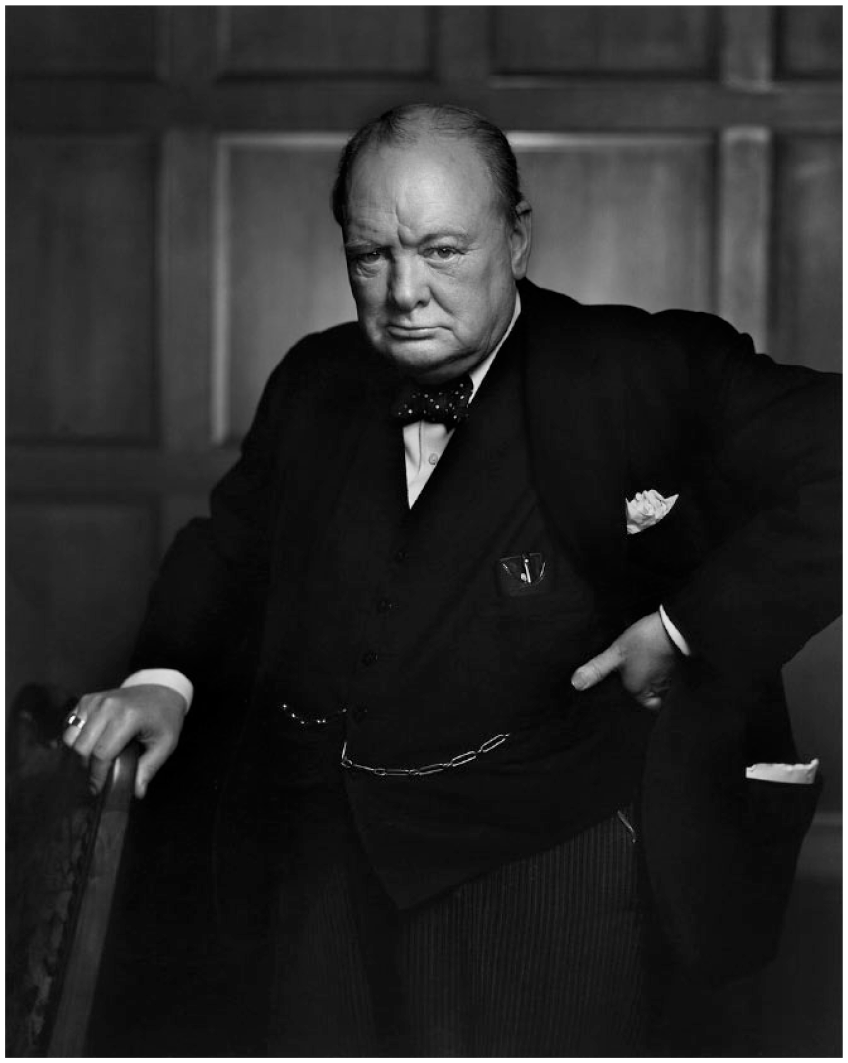
Winston Churchill photographed by Yousuf Karsh in 1941
Levine, building on the work of Ferro, Bion, and field theory, defines mutual vulnerability as a state and a place that require the courage to be unsettled and permeated by the other, while abandoning assumptions of impermeability. This state includes “elements of the frame, aspects of time and space . . . and . . . the intersecting of two subjectivities” (2016, p. 572). These are the conditions that Churchill and Karsh inhabit in their relational image.
Portraits of Melanie Klein
Roger Amos has created a splendid book in which relational images of Melanie Klein tell her story. Amos comes to his work neither as a psychoanalyst nor as a formal artist. According to the book’s author note, he spent his career as a hematologist working for the National Health Service in London. His connection to his book’s subject is through his wife, Anne, a Kleinian analyst, and he describes his work as an attempt to get to know Klein better. Amos tells her life story in text and images, fifty-nine in all, of which thirty-nine are portraits of the psychoanalyst. The integrative motif begins with the cover art, in which a portrait of the seventy-seven-year-old Klein, one of the last pictures taken of her, by Jane Brown, is used as the backdrop on which Amos superimposes many of the other photographs found in the book. These are photos of Klein at various stages of life, along with images of artists who photographed, painted, or sculpted her. These overlaid images provide a strong message about the embeddedness in every image of innumerable encounters that have come before the image and reside within it. Because Amos includes the artists, we see the shadow of the artist in the outcome of the artistic endeavor, like Churchill’s roaring lion, where the audacious photographer Karsh is contained in the picture of a defiant Churchill.
Clearly, Amos is interested in the intersecting lives of both sitter and artist. Although Klein was reticent in sharing information about her personal life, Amos amassed a treasure trove of portraits, photographs, paintings, and sculptures. He told me that Klein herself kept albums of the photographs taken of her throughout her life (personal communication, May, 13, 2021). The images supplement the scant literary narrative of documents and correspondence, much of which Klein destroyed. Amos emphasizes the importance of these images as relational, saying they “provide an opportunity to observe the convergence of often very different lives: how the portrait—the fruit of the brief creative collaboration between artist and psychoanalyst—is influenced by their life experiences, both shared and disparate” (pp. xiii–xiv).
The earliest photos of Klein—taken when she was a child, teenager, and young woman—were studio portraits, and in most instances the photographer is unknown. There were a few exceptions in which Amos used whatever material he could find to develop a story of how photographer and subject met to create a new image. Amos supports his thesis that the artist must be able to see the subject from the subject’s perspective by deconstructing the final portraits in the book, created by Jane Brown. Brown, then thirty-five, photographed the elderly Klein shortly before she died.
Brown carried a lifelong sense of being an outsider, according to Amos, someone who sought anonymity. He connects this idea to her discovery as an adolescent that one of the aunts who raised her was in fact her mother, while her father was a deceased patient her mother had cared for when she worked as a hospice nurse. Presumably this revelation made Brown less sure of herself and led her to choose work in which she could be unobtrusive. Behind the camera, she worked spontaneously as a portraitist. “I don’t make pictures, I try to find them,” Brown has said (2000, p. 6).
The images taken of Klein in her old age are infused with a gentle thoughtfulness (Figure 2). In that period, Klein was the dominant presence hovering over the acrimonious “talks” between her supporters and those of Anna Freud. These “Controversial Discussions” took place at the British Psychoanalytical Society between October 1942 and February 1944. Nonetheless, Jane Brown sees the aging Klein as someone looking inward. Perhaps the photographer knew her subject as a fellow traveler on the lonely road of life. Klein and Brown are both honored and present in these enigmatic photos that reflect grace and softness. Brown, the motherless photographer, had found in her subject—the mother who had lost two of three children to death and to permanent estrangement—a mirror in which she could see herself in a loving pose.

Melanie Klein photographed by Jane Brown in 1959
The Collision of Artist and Subject
Not every attempt at creating a portrait results in an outcome that pleases both parties. For example, Klein was very upset with the results of two “creative collaborations” and ultimately destroyed both. Amos uses these examples, a painting by William Coldstream and a sculpture by Oscar Nemon, to emphasize what he sees as a central tension in portraiture: For what the artist “sees” and what the subject “wants” may be two very different things. How is the truth of the artist’s vision—what the artist conceives to be the essential character lying beneath the mask and how to capture it most effectively—to be reconciled with the needs and wishes of the subject, how the subject wants to be seen and remembered by posterity? Working through this minefield of perception and expectation is the essential task that artist and subject must face together if the collaboration is to bear fruit [pp. 5–6].
Artists may be so committed to their vision that they fail to see their partner in the creative enterprise. When this condition is joined by a subject strongly motivated to present a particular facade, or to hide in some way, the outcome is bound to hurt both parties and fail to result in a fresh new image. There is an impasse in which neither party can relent, a condition not unfamiliar to psychoanalysts. Amos describes this painful process at work in the commissioned painting by William Coldstream, which Klein ended up burning. It is Amos’s contention that Coldstream and Nemon, both men, failed to see Klein as a woman, with her warmth, maternal losses, and feminine nature. Amos holds that in these instances the male gaze resulted in gender misrepresentation; these artists were intimidated by a strong woman and thus viewed her as monstrous.
Those who saw the Coldstream painting, including Klein herself, appreciated it as a work of art by a gifted artist. He depicted his subject as “portraying the nobility and tragedy in the human experience of acute depression” (Joan Riviere, quoted in Stonebridge 2007, p. 113). But Klein and her supporters in the British Psychoanalytical Society felt that the painting made her look too old and hard and would be weaponized by her adversaries. The conflict between the artist’s vision and the subject’s wishes was enacted between these two, and there was not sufficient mutual vulnerability to hold the space for a new relational image.
This result may be contrasted with the benefits that a “successful” portrait offers, such as Karsh’s portrait. “My portrait of Winston Churchill changed my life,” Karsh said. “I knew after I had taken it that it was an important picture, but I could hardly have dreamed that it would become one of the most widely reproduced images in the history of photography.” Churchill also seemed to relish the image of himself seen by the artist as “the roaring lion.” Fortunately for Klein, she had and would continue to experience more attuned relationships with the artists trying to portray her. These encounters may have repaired some of the narcissistic wounds she experienced during her time with Coldstream, although such wounds can last a lifetime.
The idea of an inherent conflict between the vision of the artist and the need of the subject is central to the groundbreaking essays by Susan Sontag in On Photography (1973). In her critique of the reductive and dehumanizing effect that the popularization of photography had wrought, she focused a good deal of attention on the portraiture of Diane Arbus. Sontag’s book was critical of the photography of the 1960s and 1970s, which “render[ed] history and politics irrelevant.” In singling out the portraiture of Arbus for her most searing attack, Sontag portrayed Arbus as distant and privileged. Sontag described Arbus’s photography as “anti-humanist” and said that for photographers like her, “The camera is a kind of passport that annihilates moral boundaries and social inhibitions, freeing the photographer from any responsibility toward the people photographed” (Sontag 1973, p. 41). In this way, Sontag positioned Arbus as disconnected from the needs of her subjects, and as such unable to make room for a new, mutually created relational image.
An Artist Portraying Herself: Diane Arbus
Arthur Lubow’s biography of Arbus takes a more balanced and sympathetic look at the life and work of the artist whose unsettling photographs of freaks and eccentrics “drastically altered what is permissible in photography” (Boswell 1984, p. ix). In his title, Lubow signals his own attempt at portraiture, and he makes the case that the artist is showing a picture of herself in the portraits she creates. Perhaps Arbus sought images that would help her see her subjects as a reflection of herself. Her friend, and fellow portrait photographer, Richard Avedon, said, “Photography for me has always been a sort of double-sided mirror. The one side reflecting my subject, the other reflecting myself” (quoted by Lubow, p. 235). This idea, that the artist is revealed in her portrait work, whether consciously or not, can be especially fraught when the subject represents darkness and disturbance for the portraitist. Both subject and artist may have to take a courageous leap to confront and release the violence that emerges from the relational image.
Elsewhere I have written (Gerald 2020) about a famous photo portrait of Joseph Goebbels, titled “Eyes of Hate,” taken by the Life magazine photographer Alfred Eisenstaedt in 1933 (Figure 3). The Nazi propaganda minister was in Geneva for the League of Nations meeting when the photo was taken. Eisenstaedt took several pictures that day, in which the Reich’s emissary is seen busy at work. There is even one where Goebbels smiles broadly for a close-up. At some point, Eisenstaedt approached the subject again, and by this time Goebbels, a homicidal anti-Semite, realizing that he was being photographed by a Jew, released the full viciousness of his hatred, unmistakable in his eyes.
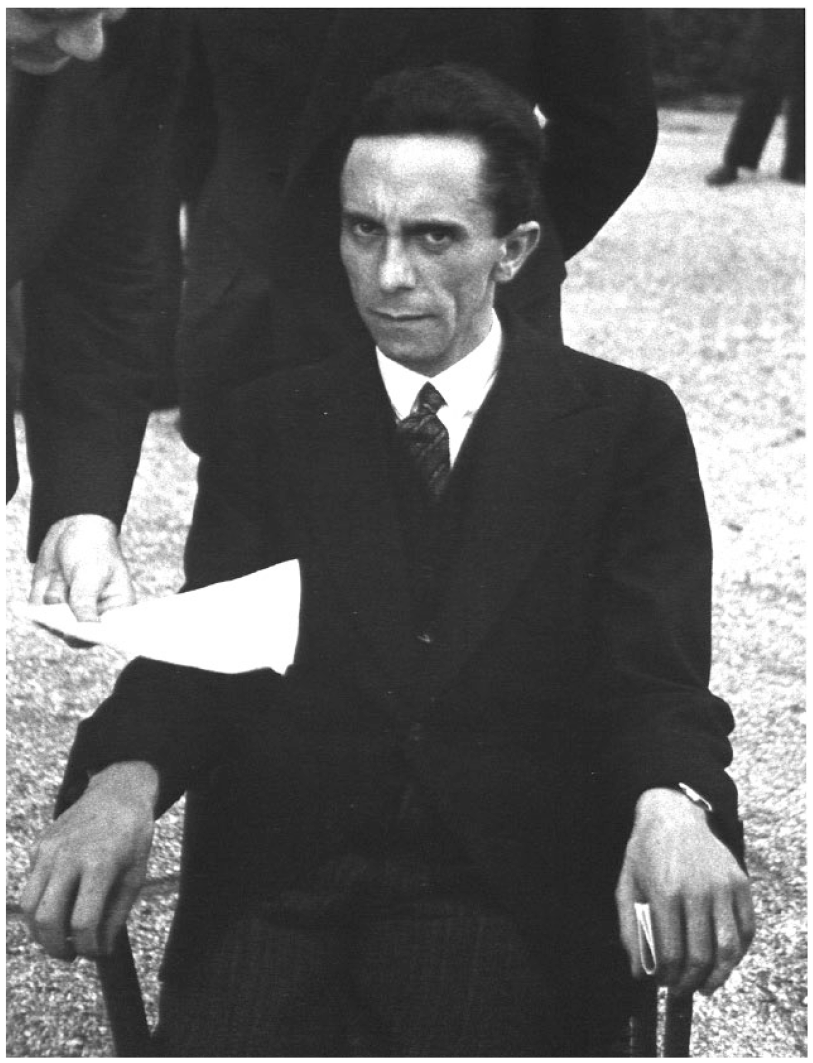
Joseph Goebbels photographed by Alfred Eisenstadt in 1933
In this relational image both Goebbels and Eisenstaedt are vulnerable in different ways. Eisenstaedt, a German Jew, would have felt vulnerable in the knowledge of increasing restrictions put on Jews in Nazi-occupied Germany, where an office of “racial hygiene” had been established in 1933. It took courage, but perhaps even more a willingness to identify as a despised other, for Eisenstaedt to approach Goebbels. What Eisenstaedt said about the photograph can be applied to all of portrait photography: “There is no substitute for close personal contact and involvement with a subject, no matter how unpleasant it may be.” And Goebbels, caught in the crosshairs of the photographer’s lens, could not hide behind a pleasant facade and was revealed as a monster.
Diane Arbus photographed what many would consider unpleasant subjects. She ventured into circus sideshows to take pictures, gravitating toward extreme human forms such as dwarfs and giants, and visited residential centers for mentally handicapped people. Her work was damned for its voyeurism and praised for its compassion. Her photography has been described as “an unflinching yet often strangely lyrical vision of the oddity of normality, and the normality of oddity” (Cole 2011). Her biographer Lubow has compassion for Arbus and sees in her history and photography a troubled woman coping with her own suffering and alienation, who is looking for reflections of those struggles in her subjects (Figure 4). Although controversial, she was admired by many of her contemporaries and critics and, like Melanie Klein, was a giant in her field. She changed the course of photography, and her portrait collaboration and staging techniques have heavily influenced the work of Cindy Sherman, Mary Ellen Mark, Robert Mapplethorpe, and Nan Goldin (Lubow, p. 611). The photographer Bruce Davidson said, “If you could make a series of bridges in the history of photography, in taking what the medium can do to another departure point, you might have Atget, Cartier-Bresson, Robert Frank, then Arbus” (quoted by Lubow, p. 342).
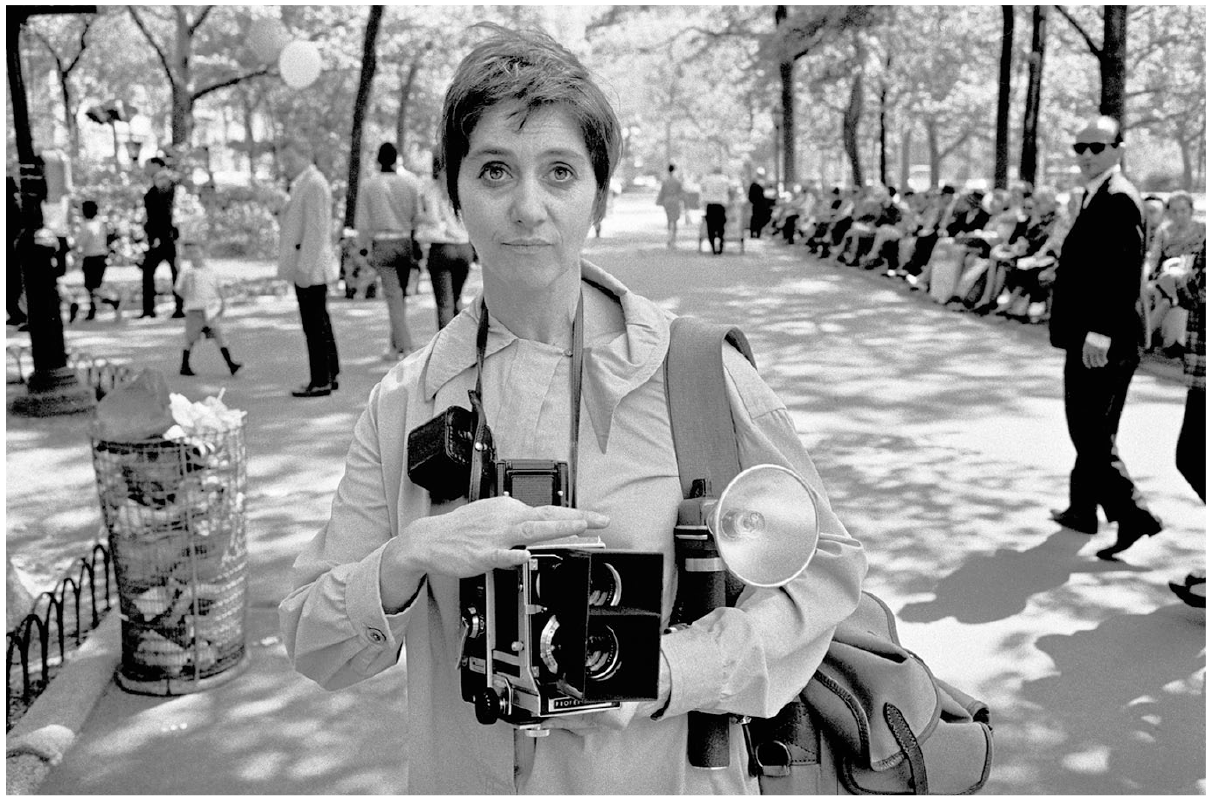
Diane Arbus photographed by Tod Papageorge in 1967
Lubow’s 733-page book covers the life of his subject, from her privileged and isolated childhood on Park Avenue to her self-imposed death by barbiturate overdose and cut wrists in a bathtub in the Westbeth housing complex for artists in lower Manhattan. She was only forty-eight. Although Lubow’s biography is extensively researched, we are left to wonder what went wrong. As Lubow’s epigraph, a quote from Arbus, notes: “A photograph is a secret about a secret. The more it tells you the less you know.” We are told it is likely that Arbus and her older brother, Howard Nemerov, at one time the U.S. poet laureate, were sexually intimate as adolescents and continued to be lovers right up to a few days before her suicide. Was the incest the secret, its violation of norms the underpinning of Arbus’s despair? No single reason can account for the whole story. As Leonard Cohen reminds us, you can add up the parts, you won’t have the sum.
One photograph of Arbus’s, titled “Child with a Toy Hand Grenade in Central Park, N.Y.C.,” represents for me the complexity of her work and the jointly constructed nature of portraiture. Arbus would frequently shoot in Central Park, the backyard and playground of her childhood home. On this particular day in 1962, she encountered a seven-year-old boy, Colin Wood, walking with his nanny after school. Lubow describes Colin as someone who “bristled with nervous, violent energy. . . . He was both reckless and scared. Like the young Diane, he was a frightened child who despised his timidity” (pp. 266–267). Lubow suggests that Arbus must have recognized something of herself in this intense, disheveled, and neglected child. He is holding a toy grenade in a fierce grip in his right hand while his left hand is clenched like a claw. He is wearing shorts that reveal his bony, twig-like legs. The contrast with the two sturdy trees over his right shoulder and the tranquil setting and light of a spring afternoon emphasizes his distress. One suspender strap has fallen off his shoulder. He is wearing a short-sleeved patterned shirt with a Peter Pan collar. His head is tilted, while his dark, wide eyes stare at the camera, his mouth clenched and distorted. The image reflects an overwhelming feeling of fright.
Colin Wood felt seen by Arbus. As an adult looking at the photograph, he remarked that “she saw in me the frustration, the anger at my surroundings, the kid wanting to explode but can’t because he’s constrained by his background. She’s sad about me” (Lubow, p. 268). Norman Mailer too saw the child’s explosive rage and ironically noted, “Giving a camera to Diane is like putting a live grenade in the hands of a child” (quoted by Lubow, p. 257). The subject of the portrait appreciated that it was a new image, relationally constructed, that could not have existed without the mutual vulnerability of artist and subject. Wood said, “I am convinced that in the picture I am actually collaborating with her” (Lubow, p. 269).
A Portrait of Klein and Arbus
I like to imagine a scenario in which Melanie Klein is being photographed by Diane Arbus. Hypothetically, it could have happened, since Arbus was thirty-seven when Klein died and had been photographing for several years. And what if Arbus had found Klein as an analyst? What would the encounter and collaboration between these two remarkable women have produced? Born on different continents and separated in age by more than forty years, each was a product of her time. Melanie Klein’s early world was fin de siècle Vienna, which at the time of her birth was a vibrant center of Jewish culture. Jews had been granted the rights of full citizenship fifteen years earlier, and the Jewish population of the city was expanding with the influx of Eastern European and Russian Jews fleeing the rise of anti-Jewish violence. At the same time, in 1882, the year of Klein’s birth, German-Austrian student fraternities passed the anti-Semitic, Waidhofer Resolution, denigrating and banning all Jewish participation. These expansive and restrictive forces were tensions that were to follow Klein in her personal and professional life.
Arbus’s New York childhood of the 1920s and 1930s was quite different. Living a privileged Park Avenue existence, she was shielded from the Great Depression. Lubow sets a scene of the child Diane, with her French governess, high in her family’s gilded apartment, overlooking the homeless encampments of Central Park. Although the girl was seemingly protected from these darker, disturbing, and deathly realities, their contagion was always hovering in the background. It is not surprising that she had the capacity to find the painful, ugly disturbance of Colin Wood in the bucolic splendor of Central Park.
Both the photographer, Arbus, and the psychoanalyst, Klein, were intimate with depression. The deaths of Klein’s sister and brother shaped her young life, while an unhappy and ultimately failed marriage left her without a life partner. Added to her grief were the accidental death and possible suicide of her son Hans and the permanent estrangement from her only daughter, the psychoanalyst Melitta Schmideberg (Grosskurth 1986). Klein discovered psychoanalysis through reading Freud and later was supported and encouraged to become an analyst by Karl Abraham and Sàndor Ferenczi. She had sought analysis following her mother’s death, after she fell into a state of acute depression (Grosskurth 1986, p. 72). However, Klein had earlier experienced depression in her twenties when, married with two children, she went to a sanatorium for a rest after “fits of weeping and despair” (p. 56).
Arbus came to recognize her depression later in her adult life, having spent her younger years in what seemed a manic drive for experience and sexual expression. Yet when she was eleven, her mother had suffered a nervous collapse and was was unable to dress or wash herself. Around that time, the future photographer began to lock herself in her bedroom and stay isolated for hours. Arbus learned from her mother that expecting to be unhappy was a way to cope with those feelings. Two years before she took her life, she started seeing the psychiatrist Helen Boignon. Arbus was suffering from the effects of hepatitis B and depression, but also became provocative and restless in the confinement of the therapist’s office (Lubow, p. 493). By this time, she was in a state of despair and feeling disconnected. Her often indiscriminate sexual encounters yielded little lasting comfort. Her intense romantic and sexual relationship with the art director Marvin Israel caused her much agitation. Not only was he devoted to his wife, but Arbus reported to her therapist that Israel was also having an affair with Arbus’s daughter, Doon. Arbus no longer found her work satisfying, and most of what she was producing at this time was simply to make the money she needed.
Boignon was about the same age as her patient and had lost her husband shortly before she met Arbus. A photograph of Boignon taken around that time reveals a thin, casually dressed woman with a hard-to-read expression. By the time Arbus sought therapy, too much damage had ensued, and the therapeutic relationship, like that between artist and subject, was a delicate affair. The patient must feel a degree of trust in the authority of the analyst if the work is to have a chance. A certain curiosity about the process and perhaps the analyst herself can fuel the work. I imagine a younger Arbus stepping into the consulting room with Melanie Klein. I see these two pioneering and suffering women regarding each other with recognition. Klein’s deep, penetrating interpretations and her experience as a maligned creative woman reach Arbus. Meanwhile, seeing in this analyst something of her tortured self, and through a therapeutic descent into painful recognition, Arbus emerges into a depressive position between the intolerable extremes of frustrated enactments to be known and suicidal hopelessness. In this fantasy, Arbus creates a portrait of her analyst, a new relational image, in which the subject would have lowered her guard to be vulnerable with the mutually vulnerable photographer. The two would have produced the iconic image of Melanie Klein, poignantly revealing both the pervasive life of loss, the aspiration of love that she deserved, and a faithful reflection of the artist, Diane Arbus.
Footnotes
Mark Gerald, faculty, NYU Postdoctoral Program in Psychotherapy and Psychoanalysis, the Stephen Mitchell Relational Study Center, the Institute for Contemporary Psychotherapy (New York), and the National Training Program of the National Institute for the Psychotherapies.