



Abstract
An alternative to Mahler’s separation-individuation model of child development is presented to explain differences in the development and experience of a sense of self in Indian culture and other cultures where the Western sense of individual selfhood is not seen as the goal of maturity and adulthood. In the absence of such a formulation, called here integrative individuation, the familial and relational experience of people from non-Western cultures is often misunderstood and pathologized by clinicians. Features of this non-Western sense of self include looser boundaries, different relational priorities, and greater tolerance regarding personal space. Though these differences have been commented on by scholars, a detailed developmental model has not previously been formulated.
There is no universal transhistorical self, only local selves; no universal theory about the self, only local theories.
Over the last several years I have been refining a way of looking at the developmental process from birth to adulthood that feels like a better fit for many of my patients (as well as myself) who come from cultures that are more collectivist and extended-family-oriented than most Western communities. Over time I have come to refer to this alternative model as “integrative individuation” (the absence of a hyphen, as in separation-individuation, is intentional). My goal is not to posit another unitary or unifying developmental theory (we should be skeptical of any grand unifying theory of psychological development that purports to explain every one of the 7.6 billion human beings living across five continents and four oceans unless it is based in hard science), nor is it to deny the relevance or significance of the separation-individuation model. I am simply presenting another way of looking at the developmental pathway that might explain why patients coming from certain cultures often feel misunderstood, and very often harmed, by clinicians who have only one way of thinking. The pathologization of experience and behavior due to a lack of understanding of the role of culture and the power of social realities has been deeply traumatizing to people who come to psychoanalysis seeking help and are then told that some aspect of their experience is invalid because it is about culture or racism. A patient whose mother is German and father Mexican, and who grew up in Canada, Germany, and the U.S., and has never learned to speak either Spanish or German, reported to me that her previous therapist had said to her, “Whenever you bring up culture my bullshit meter goes up.” Of course he didn’t realize that the reason his bullshit meter went up, or why he had one in the first place, was because of his acculturation within classical Western pychoanalysis. Culture is the mechanism through which the universal components of human beings become transformed into the wonderful diversity of human be-ing. To my mind, to ignore culture is to ignore the very essence of what makes experience what it is. We have this notion that finding universality is what constitutes truth, that it is more scientific, more basic, or deeper—the bedrock, as psychoanalysts are fond of saying. But we need to challenge this perception. When it comes to human experience, which is what we have to engage with, it is all about context, not about universality (itself a culturally driven perspective); Indian culture is a more “context-sensitive” culture (Ramanujan 1989). Even though the influence of culture has been addressed by many, and Layton’s recently published collection of papers (Toward a Social Psychoanalysis; Layton and Leavy-Sperounis 2000) is evidence of its increasing acceptance, the idea that culture is psychic bedrock is still an elusive and mostly unacceptable notion in psychoanalysis. Dajani (2014) has argued, using Bion’s container-contained paradigm, that culture is a “dynamic mental structure” essential in the way “flour is an ingredient to a cake” (p. 1). Ignoring this reality has been not only deleterious to individuals whose cultural background is not taken into account; it has also served for too long to keep the consequences of social dynamics, racism, and trauma out of the realm of psychoanalytic investigation. One reason it has been hard for clinicians trained in Western psychoanalytic models (even clinicians from different cultures and in different parts of the world) to think in other ways is the lack of theoretical formulations arising from a different cultural terroir. Alternative models, then, are sorely needed as scaffolding for our clinical thinking.
My formulation of the integrative individuation model rests on clinical encounters, the cross-cultural, sociological, anthropological, and psychoanalytic literature, and interoceptive reflection emerging from my own Indian cultural background. Several scholars have written about the different contours of selfhood seen in the Indian cultural context (see, e.g., Roland 1980, 1984, 1988; Kakar 2001, 2018; Kurtz 1992), but their formulations are not accompanied by a developmental model delineating the pathways to those contours. Kurtz (1992) proposed a model of “separation-integration” (pp. 272–273), but, apart from its being an unelaborated idea tucked into an endnote, the model continues an emphasis on separation. While I am approaching this from the perspective closest to my experience, that of Indian culture, similar ideas have been expressed, and questions raised, by scholars from other continents and cultures. As increasingly we export psychoanalysis around the globe, we must be mindful to not create a franchising system allowing some variation in menu but prohibiting an altogether different cuisine. Kakar (2018) makes the point that psychoanalysts around the world think and work in the same ways, thus creating a transnational culture that remains parochial in its essence. Akhtar (2009) similarly emphasizes that if we ignore the deep cultural traditions of non-Western cultures we are left with “North American geographical ignorance and cultural provincialism” (p. 3). While the separation-individuation model has become widely accepted and is still central to much of psychoanalytic thinking (Fonagy and Target 2003; Pine 2004; Blom 2018), there is also a significant body of literature pointing to inaccuracies, deficiencies, and flaws in the model, especially when viewed in cross-cultural perspective (Kirschner 1996; Bonovitz 1998; Cushman 1995; Taylor 1989; Pine 2004). With the development of attachment theory and its acceptance into psychoanalytic thinking, scholars have explored the relationship of separation-individuation and attachment paradigms (Lyons-Ruth 1991; Carlson and Sroufe 1995; Coates 2004; Blom 2018). The integrative individuation model I am proposing might be equally, if not more, in line with current attachment models.
Just as criticisms and revisions have been brought to bear regarding psychoanalytic theories of sexuality, gender, therapeutic action, and technique, so alternatives to the central developmental concept of separation as a condition of individuation can benefit psychoanalysis. Although several different developmental models have been proposed over the years (see Fonagy and Target 2003), they are all based, explicitly or implicitly, on separation-individuation as a precondition. I will argue that cultural bias, rooted in the evolution of the Western concept of self (Cushman 1995, 2019), makes it difficult for us to conceive of a truly alternative point of view. In proposing the integrative individuation model, I hope to move from critique to construct. While I come to this from an Indian cultural perspective, I invite the reader to wonder about other cultures and communities for whom the separation-individuation model, unmodified, may be a poor fit.
The Separation-Individuation Model
Margaret Mahler (1897–1985) was born in Hungary, started medical school in Budapest, finished it in Jena, Germany, and immigrated to the U.S. in 1938 at the age of forty or forty-one, having already trained as a psychoanalyst in Vienna. She and Manuel Furer established the Masters Childrens’ Center in New York City in 1950, where she carried out her research on child development. The bulk of her ideas on separation-individuation were formulated and published in the 1960s and 1970s, a culturally tumultuous time in America. Despite her starting from observing mothers and infants in real life, unlike traditional psychoanalysis, which focused on fantasy life, Mahler’s ideas were quickly integrated into psychoanalytic thinking (Pine 1994). As Alexandra Harrison noted at a 2019 panel titled “The Legacy of Margaret Mahler,” organized by the New York Psychoanalytic Society and Institute, separation-individuation became “part of the lingua franca of modern psychoanalytic theory.” Fred Pine (2004) suggests that there were “three waves of psychoanalytic interest” that helped Mahler’s model surf its way into popularity: an implied turn toward object relations theory, increasing interest in the preoedipal period, and a burgeoning interest in applying direct observational studies to formulations from clinical reconstruction. Fonagy and Target (2003) state that Mahler’s model “has strengthened the tendency to reconstrue the psychoanalytic situation as a developmental one” (p. 97). Besides becoming well integrated into psychoanalytic practice, theory, and teaching, Mahler’s developmental model, and particularly the phrase “separation-individuation,” has seeped into the cultural consciousness of parents and educators. The Margaret Mahler Foundation (founded in 1991) has conducted an annual symposium for three decades now, and has published a series of books based on those meetings. The foundation’s mission statement describes its work as “aimed at increasing understanding of a child’s psychological and emotional development, particularly as observed in the separation-individuation process, and communicating that understanding to parents, therapists, and childcare providers.” Over the last sixty years or so, since Mahler began writing about separation-individuation, the idea, the phrase, and the model have become deeply integrated into our notions of what constitutes a normal developmental process—how an infant, starting off as more or less psychically fused with the mother/caregiver, gradually comes to be a separate individual. Equally important are implied notions of what is not normal development. That is, abnormal development and failure to separate from the mother/caregiver have become firmly associated both in the professional mind and among the lay public.
Mahler’s separation-individuation model consists of three developmental stages: normal autism, the symbiotic phase, and separation-individuation (consisting of four subphases: differentiation/hatching, practicing, rapprochement, and consolidation of individuality / beginning of emotional object constancy) (Mahler, Pine, and Bergman 1975). I will not go into the details of the various phases and subphases because my goal here is not to critique the granular details of the model but to point to how the basic concept has arisen out of a particular cultural history to acquire a deep cultural meaning, and how a different model might function. Mahler’s research arose out of her interest in what she called “infantile psychosis” or “symbiotic child psychosis” (1979). Pine (2004) in a revisionist look at Mahler’s model argues for what is useful about the idea of symbiosis and other phases, and that the phases need to be looked at not as linear but as intertwined from the beginning. He makes it clear, though, that, “if there is no symbiosis, then there is no need for a separation-individuation phase to detail the infant’s steps in moving beyond it.” He asks, “Where did this idea of symbiosis originate? For Mahler, in two places. First, from deep within herself where, like so many truly creative individuals, she sensed a human truth that had personal meaning for her. . . . And second, from her earlier studies . . . of what she called ‘symbiotic psychosis of infancy,’ a relatively rare condition in which the child seems to react to intense, premature rupture of the mother-infant bond (a separation) with desperately panicky clinging, followed at times by regression to an autistic-like state” (p. 515). So the autistic and symbiotic phases were important for Mahler because that is where her primary clinical interest was focused. As Bonovitz (1998) points out, “Her sample consisted of thirty-eight children and their twenty-two mothers living in a nuclear family structure in a white middle class community. Approximately half the families were Protestant, and the others were evenly divided between Catholic and Jewish, or a mixture of the two” (p. 174). She then asks, “If Mahler had emigrated to India rather than the United States, what theory of separation-individuation would she have woven from her observations of Indian mothers and their babies?” (p. 178) This paper is an attempt to answer Bonovitz’s question.
Criticism of Mahler’s Model
Criticism of Mahler’s model generally falls into three categories: criticisms based on findings from later infant observational studies; criticism involving issues with clinical correlation; and criticism deriving from cultural/anthropological psychology. This paper is chiefly concerned with the last category, but I will briefly review the others.
Referring to Mahler’s formulation of the infant being in a state of symbiotic nondifferentiation, and primary narcissism, during the first few months, Fonagy and Target (2003) state that “evidence from infant research casts considerable doubt on this formulation” (p. 94). “Indeed,” Milton Klein (1981) states, “Mahler’s concepts of the normal autistic and normal symbiotic phases are saturated with theoretical presuppositions, without the backing of observational evidence” (p. 74). According to Klein, the notion of an undifferentiated newborn was not borne out by infant studies on the first two months of life, as reviewed by Emde and Robinson (1979). Others (Bahrick and Watson 1985; DeCasper and Fifer 1980; Harrison 1986; Meltzoff and Moore 1989; Beebe and Lachmann 1994; Beebe and Stern 1977) have contributed to these conclusions as well. As Pine (2004) writes, “Did Mahler have it right about infants and boundarylessness and about awareness of differentiation being only slowly achieved? Certainly not exactly” (p. 517). She did, however, stick to the separation-individuation model, even though it relied fundamentally on those formulations of psychic symbiosis.
The application of Mahler’s model to adult psychopathology and clinical work has contributed to its integration into psychoanalytic theories, even as it has been a target of criticism. Regarding both autism and early psychotic disorders, Mahler’s formulations have not proven to be accurate or helpful. As Fonagy and Target (2003) point out, overwhelming neurobiological evidence locates the causes of schizophrenia in the final months of gestation rather than with separation issues in early infancy (see also Marenco and Weinberger 2000). The other clinical syndrome often associated with Mahler’s model is borderline personality disorder (BPD). While themes of rapprochement have often been applied in the understanding of borderline dynamics, a criticism levied against the model cites the high prevalence of trauma in the history of individuals diagnosed with BPD (Battle et al. 2004). Cattane et al. (2017) note that “several studies have shown that a diagnosis of BPD is associated with child abuse and neglect more than any other personality disorders, with a range between 30 and 90% in BPD patients” (p. 2). Yen et al. (2002) investigated the prevalence of a history of significant trauma among various personality disorders (borderline, schizotypal, avoidant, and obsessive-compulsive) and found a strong association between BPD and sexual trauma. Fonagy and Target (2003), while acknowledging the application of Mahler’s model to BPD, also agree that Mahler’s model does not account for the prevalence of childhood trauma in patients with the disorder. Perhaps the reason Mahler’s rapprochement imagery and language are used so often in work with BPD is not so much their etiological accuracy as that they work rather well as a clinical metaphor with patients who are unstable in their relational tolerance and consistency.
Kirschner (1996), in exploring the cultural-historical antecedents of psychoanalytic developmental theories, explains that the psychoanalytic developmental narrative has been in existence far longer than psychoanalysts care to admit. The idea of a struggle between “fusion and separation” that leads to the birthing of a self, and the idea that the outcome of such a linear, staged process has to be a bounded, separate, autonomous, and therefore mature, rational self (as opposed to the primitiveness of childhood) is one that results from the gradual secularization of Judeo-Christian religious themes. That psychoanalysts generally do not acknowledge these antecedents, and that these origins are not taught in psychoanalytic curricula, runs counter to the orientation of the psychoanalytic profession. We are supposed to be self-reflective, history-oriented, in pursuit of context and what lies out of awareness. Yet we have not applied this same orientation to understanding the culturally and historically particular context of our own theories, and how this failure affects our clinical work.
Another approach to demonstrating the neglect of cultural realities in psychoanalytic theory is taken by Joanna Ryan (2017) in Class and Psychoanalysis. She argues that “the construction of theory by Freud . . . led to the extrusion of class from psychoanalytic discourse, leaving a theoretical vacuum which has . . . had effects on clinical work” (p. 36). In her view, Freud’s formulations of both oedipal theory and primal scene dynamics were based significantly on experiences with nannies, whose socioeconomic reality was never acknowledged in his theory.
Cushman (2019) defines “self” as “the set of embodied beliefs and activities that live out what are considered by a particular culture or historical era to be the proper ways of being human and the limits and potential nobility of humans” (p. 1). “The self,” he adds, “is a historical, cultural artifact” (p. 3). Cushman (2019, like Kirschner, argues that psychoanalysis has failed to have an “historically situated perspective on its discourse and practices,” particularly so when it comes to individualism and “the bounded masterful self—as an unchangeable transhistorical entity” (p. 8). Instead of an historical-cultural perspective what we have is an ahistorical developmental perspective, Mahler’s model being dominant in that respect. Mahler’s model is not simply the result of a scientific, objective observational study. It is also a cultural metaphor that tries to capture how development can be conceptualized in a particular culture, much as the oedipal myth is a cultural metaphor that can be seen as capturing an experience belonging to a particular culture. If we reify it as a universal scientific fact, we run the danger of limiting our understanding of how selves can develop differently, and become something different, in other places and among other people. The self that Cushman (1995, 2019) outlines is the product not only of a particular sociocultural-historical developmental path, but also of a familial-personal developmental path that is itself configured by being embedded in the sociocultural history described by Cushman. It is not enough to consider one without the other. If in fact the notion of the modern self, and that of the “individual,” is predicated on influences and shifts in Western culture, then the nature of the self and how it comes to be, in personal and cultural history, is going to be quite different in other cultures. Elsewhere, the self that becomes constructed will be embedded in, and develop out of, the history and shifts in the cultural context of that place. Cushman (1995), not going back as far as Kirschner, traces the origins of this “bounded, masterful self” all the way from the rise of Athens (5th century
Mahler and Attachment Theory
The difference between John Bowlby’s attachment theory and Mahler’s separation-individuation model suggests a bridge to the integrative individuation model I am proposing. Bowlby (1907–1990) developed his attachment theory, in parallel with Mahler’s work, during the 1960s and 1970s. However, unlike Mahler’s work, which found a ready reception in psychoanalysis, Bowlby’s work was not so easily accepted (Blum 2004). Coates (2004) attributes that to the field’s deep investment in the drive model and the need to look at developmental stages as closely linked to it. Kieffer (2012) writes that the difference is that attachment theory “does not posit a need for that developmental push toward separation, and does not stress ambivalence as an essential ingredient in development” (p. 47). Thus, attachment theory helps us toward an alternative framework in which the focus is no longer on separation from the mother/caretaker, but rather on conditions activating the attachment system. In recent decades attempts have been made to bring about a rapprochement (pun intended) between Mahler’s and Bowlby’s work (Lyons-Ruth 1991; Carlson and Sroufe 1995; Coates 2004; Brandell 2010; Blom 2018). Several reasons suggest themselves for why, initially, the two theories were received so differently by the psychoanalytic community. One reason may be that Mahler’s model was more acceptable as a cultural metaphor than Bowlby’s. As Daniel Stern wrote in a cover blurb for Bowlby’s first volume (1969), “It seems almost incredible that, until Bowlby, no one had placed attachment at the center of human development.” But it would seem that the psychoanalytic community was more prepared to focus on separation than on attachment. However, once we shift our focus to attachment as the more significant paradigm, rather than separation, it becomes possible to look at the different cultural contexts in which the attachment system is activated. Yet attachment models have themselves been criticized for their lack of universality by several scholars, primarily cultural anthropologists 1 (LeVine 1997; Otto and Keller 2014; Marga 2013; Quinn and Mageo 2013). What remains unexplored is the developmental path that would lead to a self shaped to fit with cultural contexts like Everett’s “concentric circles of attachment” (2014) or Seymour’s “diffusion of affect and multiple bonds of attachment” (2013). Though the concepts of attachment, intersubjectivity, mutuality, and relationality have made a dent, they have not essentially moved psychoanalytic theory beyond the two-person model. Culture, society, and sociocultural history continue to be stepchildren, refugees ready to be deported at the slightest attempt to create unrest. Toward a Social Psychoanalysis (Layton and Leavy-Sperounis 2020) is a notable recent contribution to elaborating the cultural context of psychoanalytic theory, though the collection is not without its problems (Kanwal 2021b)
Integrative Individuation: General Comments
How, then, do we conceptualize the developmental path that leads to such a different outcome? I am proposing that we think of the process (at least in the Indian cultural context) that leads to integrative individuation (without a hyphen, so that the two terms can exist without any inevitability of association or implication of one being a prerequisite for the other) rather than separation-individuation. Much as Mahler described separation and individuation, I view the processes of integration and individuation as concurrent and intertwined. Bonovitz (1998) considers “the development of a sense of self and of other” to be “fundamental, universal and multifaceted” (p. 173). I agree with this statement and would by no means suggest that the development of a sense of self and other does not happen in Indian culture. What I am suggesting (as have others) is that the “self”’ that becomes aware of the “other” is a differently structured self, one that has not been structured around the core dynamic of separation as a precondition of individuation. Nor is the “other” that the Indian “self” is becoming aware of structured by that dynamic. Thus, while there is, as in any other culture, a growing awareness of self and other, they are a very different self and other, which, despite that growing awareness, are deeply conjoined with each other and with wider familial and social circles.
As we have seen, Mahler’s separation-individuation model proceeds from the idea of a psychically fused mother-infant unit (notwithstanding the autistic phase) proceeding through various phases of separating to become an individual, well-bounded self with a capacity for emotional object constancy (see Figure 1). In the proposed integrative individuation model the conception is different; in some ways, in fact, it is almost a reversal. The infant is seen as beginning its life journey as an individual entity that has innate attachment and relational capacities, but these capacities have yet to be fostered and developed. Primary caretaker and infant have to “live an experience together” (Winnicott 1945) to become an increasingly integrated unit. It is at birth that the newborn is least related, even if most relationally receptive, and therefore least integrated with its interpersonal, familial, and social world. When one looks at behavior that can be described as rapprochement and refueling, one can focus either on aspects of the behavior that have to do with the child’s return to the caretaker, or on the expectations that propel the child to seek integration with wider social circles. A separation model focuses on the return to mother along with the significance of separation and stranger anxiety. In my alternative model the driving force is the cultural need and expectation that the child be integrated into ever wider “concentric circles of attachment” (Everett 2014). The end product, therefore, is not a “bounded, masterful self” but a semipermeable “we-self” (Roland 1988). There is no “psychological birth” (Mahler, Pine, and Bergman 1975) as such in this model. Physical birth puts the child in a precarious situation where dependency needs require activation of attachment and relational systems. From there on, whether the child is shaped in the direction of a “bounded, masterful self” or a “we-self” depends entirely on the expectations and structures of the cultural context, and consequently on the kind of interactions that are internalized. Cultural expectations are an extremely potent force in shaping parenting behaviors.
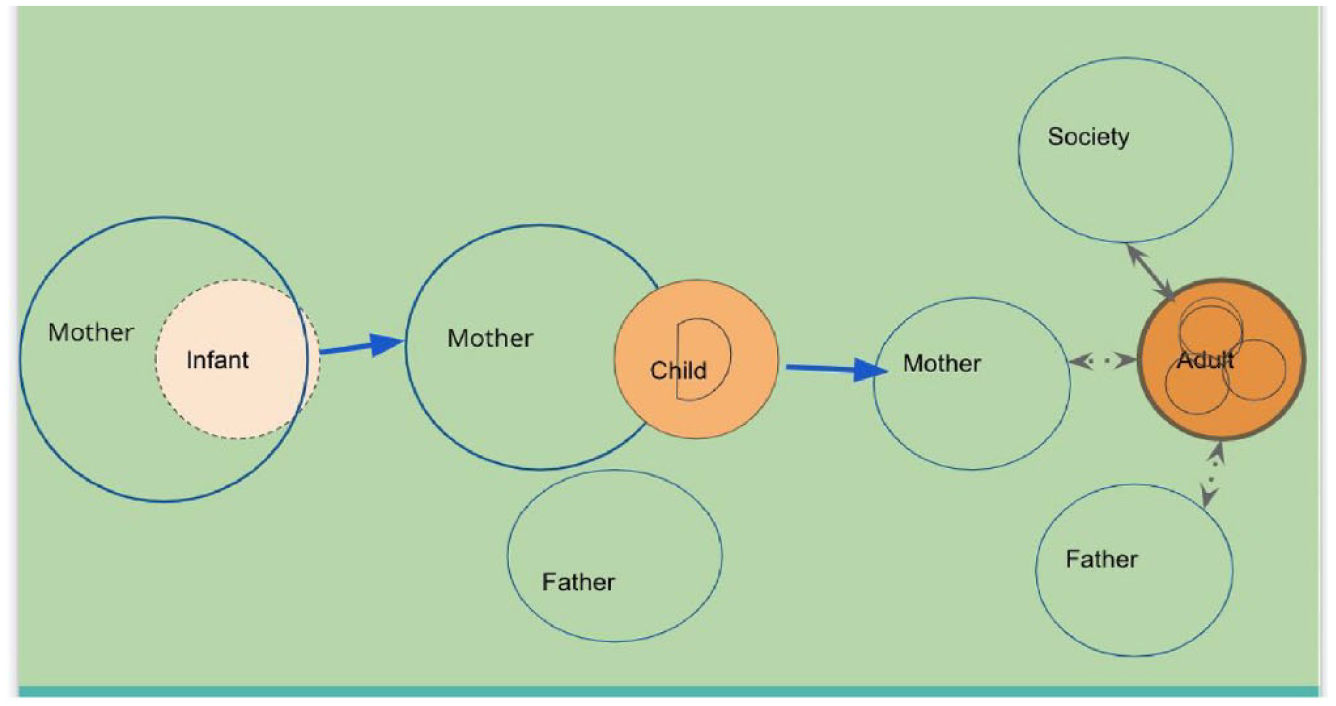
Mahler’s separation-individuation model
Integrative Individuation: The Model
A developmental model in psychoanalysis generally consists of three elements: a staged description of psychic development; a basis for explaining childhood and adult normative psychology; and a correlation with childhood and adult psychopathology (Pine 1990; Fonagy and Target 2003). Pine’s classic text (1990) organizes clinical and developmental phenomena around four conceptual domains: drive, ego, object relations, and self. The description of integrative individuation offered here can be seen as largely and loosely falling under Pine’s fourth domain, that of self, embracing “phenomena of differentiation and boundary formation, of personal agency and authenticity, and of self-esteem” (p. 4). In what follows I will propose four stages of development that constitute my integrative individuation model in the Indian cultural context.
I wish to emphasize that these stages do not imply a linear chronological sequence, although the first stage is certainly the earliest one and almost exclusively dominant in the first three to five years of life. Nor do the labels imply mother as only the mother or father as only the father. The parental labels are more operational and functional, meant mostly to differentiate one kind of activity from another. The model (see Figure 2) should be considered a work in progress intended to foster further thought and study.

The integrative individuation model
1. Stage of Contact Internalization (Integration with Mother): Birth to School Age
This is the most important stage for development of the we-self. I term it “contact internalization” because I believe it is literally the internalization of a very high frequency and duration of skin-to-skin, body-to-body contact between caregivers and infants that becomes solidified as an experience of “we-ness.” Besides body-to-body contact, the two other important developmental-relational experiences during this stage are on-demand mothering (including but not limited to breast-feeding) and toilet training.
Body-to-body contact between infant and caretakers. “In Western societies,” Bigelow and Williams (2020) write,
On-demand mothering (including allomothering). Another feature of Indian childhood is the constant availability of caregivers. These can vary from the biological mother to aunts and grandmothers, as well as, in households with enough income, the cook, the washerwoman, and the cleaning woman. In rural environments, this allomothering may be provided by family members, as well as by other women in the village. Such on-demand allomothering further enhances the experience of nonseparation from others, as sources of gratification. As Alan Roland (1980) notes, “There is an extraordinarily close tie of the developing child to the mothering person(s), based on tremendous gratification in the first few years of life. The self becomes profoundly identified with the ‘we’ of the family, enormous sensitivity and consideration are developed for the feelings of others, and ego boundaries are less sharply delineated” (p. 85). In a study conducted in South India (Joseph et al. 2013), 87.1% of mothers were found to practice demand feeding. If gratification is immediately and easily available, the opportunity and need for self-recognition is diminished, laying the groundwork for the development of a we-self.
Toilet training. Generally in the West, as also in psychoanalytic theory, we think of toilet training as a function of autonomy, control, and discipline (Freud 1908, 1917). Even Gilmore and Meersand (2015), while adopting a nonlinear dynamic systems model of development that allows much more room for the mutuality of influence between culture and individual, see toilet training as largely concerned with issues of autonomy, self-control, separation-individuation, and self-other boundaries during the toddler years, thus sticking with a Western cultural perspective. The dynamic around toilet training tends to be different in Indian culture. This difference begins with the observation that the onset of toilet training in India (and many other non-Western cultures) begins at a stage of childhood when autonomy and control are not yet the dominant paradigms. In India, it occurs within the first year of life, and may even start as early as six months. Elimination communication (Bauer 2001) is the term used to describe the way infants begin to learn to use the potty at such an early age. The term is important in that instead of the disciplinary “training” concept, it refers to “communication,” thereby highlighting the relational and contact nature of this process. Thus, toilet training, instead of being an experience of separation and self-recognition, becomes part of the familial-relational basis for the development of a we-self.
2. Stage of Dharma (Rules and Ideals) Internalization: Integration with Father
After the early years of instant gratification, constant close contact with caretakers, and on-demand mothering, the Indian child encounters a fairly sudden shift into a mode of social training that involves entering the learning environment at preschool/school and facing behavioral expectations at home. During this phase, the child is expected to start focusing on performance to please the father, as well as other elders. Academic achievement becomes increasingly important and competition with peers is highly encouraged. At the same time, good behavior at school is highly valued because the child now begins to be seen as increasingly responsible for the family’s “good name.” To preserve the family honor, the child must know the rules of conduct. As Roland (1980) states, “Various commentators on Indian childhood all testify to a severe and often sudden crackdown on the child, usually starting between the ages of 3 to 5 or 6 and lasting through the latency years well into adolescence—contrasting strongly with the enormous narcissistic gratification of the previous years” (p. 78). This internalization of the rules of social conduct is the beginning of the internalization of what in Hindu Indian culture is known as “Dharma” (cosmic law, righteousness, religious and moral duties). This encompasses the usual ideas of morality, but also rules of conduct regarding how one behaves with various members of the extended family. For example, touching the feet of certain elders, and rules of modesty for girls in front of specific relatives.
In contrast to the instant gratification of earlier years, now even the sequencing of morning rituals and bedtimes begins to be strictly enforced. Children also have to learn to be quiet in the presence of elders as a sign of respect. Nonassertiveness is valued as a sign of good upbringing and maturity.
3. Stage of Internalization of Obligations: Integration with Society
In Indian culture, marriage is a significant developmental landmark. Once again, the emphasis in marriage is not on separation from the family of origin. While the statistics are changing, especially in educated urban communities, the basic function of marriage is expansion of the family and integration of new members into the joint family. So in most instances, the son gets married and brings the bride home to live with her husband and in-laws, and very often the husband’s grandparents as well. For the woman, this is a difficult, often traumatizing period of adjustment, as she has had to leave her childhood home and start life in a new home and family. The separation involved in this process for the bride is not for her own individuation, or personal ambitions; it is to fulfill her duties toward her family (old and new) and society. The married couple have a whole new acculturation to undergo. They must manage their marital relationship under the gaze of many, and must do so in a way that safeguards the joint family from any shame and gains approval by the larger community. The obligations that have to be internalized and mastered are complex and challenging. These include being respectful in a myriad of different ways to each older generational member of the joint family. In more traditional, patriarchal households the new husband has to find his place as a provider and contributor of money to the family, while the wife has to navigate very fine lines between discharging responsibilities and overstepping authority, whether in the kitchen or in the living room. What constitutes maturity in these newly wedded adults is very different from what might be considered mature adulthood in Western cultures. The more one can suppress individuality successfully, and artfully, the more mature one is perceived as being.
4. Stage of Transcendent Internalization: Integration with the Cosmic Self
The final developmental task prescribed in Hindu Indian culture is the pursuit of spiritual development. As old age approaches, and obligations to society are seen as fulfilled, the couple are granted permission to turn their attention away from household duties and toward religious, spiritual, and transcendental preoccupations. In this stage there is greater freedom to ignore social and familial constraints and truly pursue individual development. In this sense, one might say that this is where a kind of separation-individuation from family begins in the Indian developmental cycle. Except, now the aspiration becomes that of integrating with cosmic existence, merging the earthly, constricted, obligation-bound “I” with an all-encompassing, unconstrained, boundaryless “I.” Freud (1930) expressed his inability to discover the oceanic feeling in himself (p. 65). He saw such a feeling as belonging to a very early phase of ego development, before “clear and sharp lines of demarcation” (p. 66) are established between the ego and external reality. I believe that those who grow up in we-self-oriented cultures have an easier time accessing experiences like the oceanic feeling because their self is structured differently, with more permeable and flexible boundaries. While Freud saw the oceanic feeling as a regressive phenomenon, in Indian culture the capacity to experience it is seen as a sign of ultimate maturity and self-actualization.
Related Literature
The developmental model I am proposing has been touched on (with important differences) in various ways by several scholars. These writers point to the different characteristics of the “self” that comes to be in the Indian cultural setting. Kakar (2001), much like Cushman, writes, “In a fundamental sense, psychoanalysis does not have a cross cultural context but takes place in the same culture across different societies” (p. 171). His descriptions of “maternal enthrallment” and “prolonged infancy” in Indian culture speak to how and why a different kind of individuation might be at play. In India, Kakar and Kakar (2007) write, “The self . . . is not primarily a psychological category . . .” (p. 110). They point out that “it is not uncommon for family members who often accompany a patient for a first psychotherapeutic interview to complain about the patient’s autonomy as one of the symptoms of his disorder” (p. 197). That is a very different perspective from that of Cushman’s “bounded, masterful self.” Here we are talking about autonomy being seen as psychopathology. Roland (1984, 1988) describes the experience of relationality in Indian culture as “symbiosis-reciprocity.” He sees the joint family system as being responsible for the development of this “we-self” or “familial self,” “where there is a constant affective exchange through permeable ego boundaries and where emotional connectedness is always central in these relationship-centered cultures’’ (1984, p. 574). Kurtz (1992) similarly observes the different path to adulthood by positing a model of separation-integration: “In the early stages of the process, the child’s sense of separateness and desire is relatively strong. Toward the end of the process the child is fully integrated into the family group, and its selfish infantile desires are consequently renounced” (p. 273). In my view, while Kurtz is on the right track, his model does not go far enough because he adheres too closely to Mahler’s emphasis on separation, despite his hyphenating it with integration instead of individuation. Akhtar (2005), though much of his basic orientation is along the lines of Mahler’s work, writes, “In the West, autonomy and separateness are upheld as ideals to strive for, while in the East, premium is placed upon attachment and interdependence” (p. 16). He also points out that while in the West one is concerned about “optimal distance,” in Indian culture the concern is with “optimal closeness.” As noted earlier, Seymour (2013), researching attachment in the town of Bhubaneswar, India, came to similar conclusions about individuation in Indian culture, concluding that it produces not “what Western attachment theories might label ‘insecure attachment’ but rather a diffusion of affect and multiple bonds of attachment” (p. 288). She also makes the point that “interdependence does not . . . preclude intrapsychic autonomy” (p. 131). Taylor (1989) writes, “The Indian pattern tends to encourage a kind of identity in which it is difficult for me to know what I want and where I stand on an important range of subjects if I am out of phase or not in communication with the people close to me. The Western pattern tries to encourage just the opposite” (p. 40). Hajime Nakamura (1964), a Japanese Indologist and philosopher, makes an interesting observation about this kind of self-structure: “The underlying idea that motivates this minimizing of the individual, as a concretely perceived being, is the Indian tendency to think that all particular beings perceived by the senses are only illusions because only the universal is real. . . . And the more anything is individualized, the less it shares in the essence of reality”(pp. 65, 67). The work of cultural anthropologists makes clear that such integrative developmental processes are not limited to South Asian cultures. For example, Everett (2014) refers to this kind of integrative individuation in describing “concentric circles of attachment” among the Piraha people of the Amazonian rainforest. “At each stage of development,” he writes, “the child is attaching to various sets of individuals, each more inclusive than the other—mother, parents, family, village, larger Piraha population” (p. 170). Markus and Kitayama (1991) describe something similar in Japanese culture: “Experiencing interdependence entails seeing oneself as part of an encompassing social relationship. . . . The Japanese experience of the self, therefore, includes a sense of interdependence and of one’s status as a participant in a larger social unit” (p. 227). This raises an important clinical point: Interdependency is an ego strength, to be carefully distinguished in clinical settings from dependency as an ego deficiency. Gottlieb (2014) approaches the issue of integration in collectivist societies by investigating the notion of stranger anxiety. In her work with the Beng people of West Africa, she found that there is no normal developmental stage of stranger anxiety. Children are socialized from infancy to accept strangers into their lives with ease.
What these scholars are implying is that the way we are used to thinking about the mature, healthy, normal adult self in Western psychology and psychoanalysis is not a universal truth, but a parochial, contextual truth. Elsewhere, the end product of individuation can result in a very different kind of adult self-structure, equally mature, healthy, and normal.
Elsewhere (Kanwal 2021a) I have written about the intersectionalities of mind/body, individual/community, and human/nature that are not attended to by Western psychoanalytic theory. These intersectionalities are much more integral to the kind of adult self-system one finds in Indian culture. Nature, community, and body are integrated into the Indian Ayurvedic system of medicine and seen as different orders of existence simultaneously comprising the individual and the whole. This kind of medical thinking, in which a psychological illness can be understood as a disturbance in family/community relations, body states, diet, or surrounding natural occurrences, is possible only because of the different sort of self-structure acquired during the integrative individuation process.
In this paper I have not focused on clinical applications of the proposed model. Even when developmental models are not easily translated into clinical vignettes they do form a background of thinking and expectation on the part of therapist and patient that shapes a lot of the work we do. For example, think about all the words associated with the culturally embedded pathologization of nonseparation: enmeshment, dependency, overly attached, codependent, failure to launch, overly intrusive, helicopter parents. Unless we examine such language for the meanings it carries, and where those come from, patients will continue to feel harmed and misunderstood.
An example of working with transference-countertransference around separation vs. integration perspectives was brought home to me in my work with an Indian patient whose mother, having become psychotic, was institutionalized early in his life. He was brought up primarily by his grandmother and uncles, who lived as a joint family, while his father moved to the U.S. When the patient finally moved to the U.S. as a high school graduate and tried to live with his father, intense issues of abandonment and rage emerged. We went through a phase of therapy where I decided to see the patient and father together as a couple. My American supervisory superego kept saying to me, “What are you doing? Aren’t you going to cause further regression and dependency? Shouldn’t you be helping him to separate instead?” And for a long while the father kept wondering and asking me about that also. But another part of me kept thinking, “No, this is not a separation problem. This is a problem of not knowing how to belong to each other, to the surrounding culture. What he needs is a deeper connection, not help with separating. After a while, they began to tolerate living together. Today the patient is a visiting professor in another country. In a recent online consultation during the Covid-19 pandemic, I had been talking for almost an hour with an older Indian gentleman with a professional background. At that point, in response to a question, he said to me, “You can ask my wife, she is sitting right here.” Unbeknownst to me, she had been a silent and invisible participant in the room for the entire hour. It took me a second to switch codes into my Indian self and without batting an eye, I turned to her to see what she had to say. There was no reason, at least at that moment, to question the arrangement, which was so typically culturally determined.
Conclusion
As one looks around the world, tensions everywhere seem to be about belonging, alienation, xenophobia, and cultural displacement, and about imperialistic ambitions of cultural erasure and terrors of loss of homogeneity and identity. An ahistorical psychoanalysis lacking cultural context of the sort Cushman (1990, 1995) has described, seems an increasingly irrelevant model in such a world. So construed, our field is in danger of becoming complicit with larger social maladies rather than standing as an inquiring, reflective, and enlightening critique.
I have proposed a developmental model alternative to Mahler’s separation-individuation paradigm. I refer to it as an integrative individuation model because the emphasis is on the integration of the growing infant into larger and larger social circles, rather than on separation as a prerequisite for individuation. In this model integration is both the process and the goal of development. The driving force is the cultural expectation that the child will become part of a joint family, an extended family, and a community. There is no need to posit some psychically fused beginning between caretaker and infant, and there is no “psychological birth” out of that state. An awareness of being a self apart from others occurs, but, paradoxically, the self is becoming more and more deeply entwined with others. The end result of such an individuation is a different kind of adult self, one that is more flexible and permeable, rather than “bounded and masterful,” highly oriented toward family and group expectations and roles, and much more interdependent, rather than living in the dichotomy of dependence vs. independence. A major goal of constructing such alternatives in psychoanalytic theory is to establish pathways for cultural, historical, and social factors to become integrated into our thinking and practice.
Footnotes
Clinical Associate Professor of Psychiatry, Weill Cornell Medical College; Supervising Psychoanalyst and faculty, William Alanson White Psychoanalytic Institute.
Submitted for publication November 2, 2021; revised March 30, 2022, July 5, 2022; accepted July 8, 2022.
1
It is important to differentiate attachment as a universal evolutionary-biological system from attachment behaviors shaped differently in different cultures.