




Abstract
This article investigates the determinants of orgasm and sexual enjoyment in hookup and relationship sex among heterosexual college women and seeks to explain why relationship sex is better for women in terms of orgasm and sexual enjoyment. We use data from women respondents to a large online survey of undergraduates at 21 U.S. colleges and universities and from 85 in-depth interviews at two universities. We identify four general views of the sources of orgasm and sexual enjoyment—technically competent genital stimulation, partner-specific learning, commitment, and gender equality. We find that women have orgasms more often in relationships than in hookups. Regression analyses reveal that specific sexual practices, experience with a particular partner, and commitment all predict women’s orgasm and sexual enjoyment. The presence of more sexual practices conducive to women’s orgasm in relationship sex explains some of why orgasm is more common in relationships. Qualitative analysis suggests a double standard also contributes to why relationship sex is better for women: both men and women question women’s (but not men’s) entitlement to pleasure in hookups but believe strongly in women’s (as well as men’s) entitlement to pleasure in relationships. More attention is thus given to producing female orgasm in relationships.
Hooking up is common among adolescents and young adults in the United States, particularly on college campuses (England, Shafer, and Fogarty 2007; Manning, Giordano, and Longmore 2006; Paul, McManus, and Hayes 2000). The phrase is ambiguous, but most young people seem to agree that hooking up involves sexual activity, ranging from kissing to intercourse, outside of an exclusive relationship. Much of the growing body of research on hooking up expresses concern for women’s well-being and suggests that hookups benefit men at the expense of women (Bogle 2008; Bradshaw, Kahn, and Saville 2010; Eshbaugh and Gute 2008; Glenn and Marquardt 2001; Grello, Welsh, and Harper 2006; Regnerus and Uecker 2011). This concern is based in part on the assumption that a committed relationship is the most likely context for pleasurable sex, especially for women. Research supports the claim that sex in committed relationships is better (Laumann et al. 1994; Pederson and Blekesaune 2003; Richters et al. 2006; Waite and Joyner 2001a, 2001b), particularly for women (Darling, Davidson, and Cox 1991; Davidson and Darling 1988; Hurlbert and Apt 1994; Mah and Binik 2001). Because there is little empirical research on the quality of sex in heterosexual college hookups and relationships, we do not know if these patterns hold for this group. In fact, relatively little is known about the quality of sex among adolescents and young adults more generally, as most existing research focuses on explaining early sexual debut and detailing its negative consequences. This situation is unfortunate given that the vast majority of heterosexual Americans engage in premarital sex, and do so in contexts ranging from high to no commitment. 1
This article investigates orgasm and sexual enjoyment in hookup and relationship sex among heterosexual women college students. Our decision to treat orgasm as a central measure of the quality of young women’s sexual experiences may be controversial. Some might see this decision as flowing from male-centered and medicalized views of sex and argue that women are not particularly concerned about orgasm (Bancroft, Loftus, and Long 2003; Gavey, McPhillips, and Braun 1999; Nicholson and Burr 2003; Potts 2000). We did not want to assume, a priori, that women do not care about orgasm. Because little systematic research examines the role of orgasm in young women’s sexual satisfaction we decided to investigate this relationship empirically.
We use data from women respondents to an online survey of undergraduates at 21 public and private colleges and universities and from in-depth interviews at two universities. The survey data, although not derived from a probability sample, result from nearly full-population responses from the classes in which recruitment took place. To our knowledge, only one other survey includes detailed questions about practices in the last sexual event (e.g., whether intercourse occurred and who gave or received oral sex or hand stimulation of genitals), whether orgasm occurred, and the relationship context of the event. 2 This article capitalizes on the strengths of our dataset to examine effects of specific sexual practices on women’s orgasm and sexual enjoyment in hookups and relationships, and to observe how orgasm and sexual enjoyment differ between hookups and relationships. Supplementation with in-depth interviews deepens our understanding of the differences between hookup and relationship sex.
Conceptions of the Sources of Sexual Satisfaction
We identify four ways that prior research has conceptualized the sources of women’s sexual satisfaction in heterosexual sex. One view focuses on sexual practices, implicitly treating good sex as a technical accomplishment achieved through deploying the right practices to achieve genital stimulation. A second view focuses on relationship-specific skills acquired by a partner over time. A third perspective sees good sex as a consequence of commitment and affection. A fourth focuses on how gender inequality may degrade women’s experiences of sexuality. Much past research on sexual practices and orgasm focuses only on committed couples (Bancroft et al. 2003; Parish et al. 2007; for a review, see Christopher and Sprecher 2000). Other research focuses on the relationship between sexual satisfaction and relationship context, ignoring sexual practices (McNulty and Fisher 2008; Waite and Joyner 2001a, 2001b). We develop hypotheses as we proceed.
Technical perspective
This approach treats orgasm and sexual enjoyment as primarily a consequence of the delivery of competent genital stimulation. The nature of stimulation provided and its duration are expected to be highly associated with orgasm and sexual enjoyment. Studies find a strong association between form of stimulation and orgasm (Fugl-Meyer et al. 2006; Herbenick et al. 2010; Mah and Binik 2001). Men and women are more likely to orgasm if they engage in a greater number of sexual practices (Haavio-Mannila and Kontula 1997; Parish et al. 2007; Richters et al. 2006). For women, oral or manual genital stimulation increases orgasm (Bancroft 2002; Fugl-Meyer et al. 2006; Herbenick et al. 2010; Richters et al. 2006). Sexual knowledge increases sexual satisfaction, and health problems diminish it (Carpenter, Nathanson, and Kim 2009; Parish et al. 2007). The technical approach focuses on the embodied character of sexuality. Viewing sexual problems as dysfunction and turning to pharmacological solutions goes even further by extracting sexuality from social life and placing it in the purview of biology. 3 The technical approach views erotic competence as portable, so that a woman who knows how to reach orgasm is likely to achieve orgasm with any partner who is willing to provide her with competent stimulation. This perspective leads us to expect all sexual practices will be positively associated with orgasm in both hookups and relationships. It also leads us to predict that observed differences between the probability that hookups and relationship events will lead to orgasm or satisfaction can be statistically accounted for by differences in the sexual practices experienced in the two contexts.
Partner-specific experience
Laumann and colleagues (1994) articulated a rational choice perspective on sexuality that sees individual sexual tastes as variable, so that it takes time to learn how to please a new partner, making sexual competence partner-specific rather than entirely portable. They argue that investing in learning to pleasure a particular partner is rational. One might question whether learning a new partner’s sexual desires qualifies as onerous enough to be deemed investment, which implies a cost now for a later gain. Even so, Laumann and colleagues point out that finding a new partner is costly, which makes staying with a partner and learning to please that partner rational. As Waite and Joyner (2001b:248) note, “sex with the partner who knows what one likes and how to provide it is bound to be more satisfying than sex with a partner who lacks such skills.” If deliberate investment is required to learn how to please a partner, we would expect women’s orgasm to remain low across all hookups—even repeated hookups—because one can presume investment is motivated by commitment. But if, as we hypothesize, learning occurs even without commitment, then sex should get better with each event, even if the context is a hookup. This version of the partner-specific experience perspective predicts that ongoing relationships will lead to orgasm more than hookups will, because the partners have more practice with each other. Furthermore, it predicts that first-time hookups with a particular partner will lead to orgasm less and be less enjoyable than later hookups with that partner, because less partner-specific learning has occurred. 4
Commitment and affection
This perspective sees sexual satisfaction as generated by the quality of the relationship. Commitment may be important because it brings trust in sexual exclusivity, a feeling of security in the future of the relationship, or because it often accompanies affection. Mutual affection may enhance sex whether or not it is accompanied by a long-term commitment. Waite and Joyner (2001b) find that men and women report greater emotional satisfaction in sexually exclusive relationships that they expect to last a long time. Other scholars have found that relationship satisfaction influences sexual satisfaction and vice versa (Christopher and Sprecher 2000; Parish et al. 2007).
Relationship quality affects men’s and women’s sexual enjoyment, but some scholars have found emotional factors are particularly relevant for women’s sexual response. Some research focuses on relationship quality (Bancroft et al. 2003; Kaschak and Tiefer 2001), while other work focuses on commitment (Waite and Joyner 2001a, 2001b). Waite and Joyner (2001b:261) argue that “only lifetime relationships are ‘long enough’ for women’s emotional satisfaction,” although they note that patterns for physical satisfaction are “less consistent.” Research shows that women connect sex and love more than men, and women desire fewer sexual partners (Baumeister, Catanese, and Vohs 2001; McHugh 2006). Scholars have offered a variety of explanations for gender differences in how commitment and affection affect sexual satisfaction. 5 These researchers tend to treat gender differences in sexuality as a durable social fact (Baumeister and Vohs 2004; Regnerus and Uecker 2011).
Given that our analysis is limited to women, it is beyond our scope to examine whether women’s orgasm and enjoyment are more strongly affected by relationship quality than are men’s, or whether context affects both genders similarly. For our analysis, this perspective generates the expectation that in either relationships or hookups, reported affection and commitment will be associated with orgasm and enjoyment. Given that we can assume relationships, on average, entail more affection and orientation to the future than do hookups, this perspective also leads us to expect that women’s higher level of orgasm and sexual enjoyment in relationships compared to hookups, if observed, is not explained entirely by differences in sexual practices.
Gender inequality
This perspective draws attention to the cultural suppression of (or indifference to) women’s sexual pleasure (Brownmiller 1975; Reiss 1986; for a review, see Baumeister and Twenge 2002). Scholars adopting this perspective often view gender differences in sexuality as a result of the operation of power. Researchers point to explicit attempts to prevent female sexual satisfaction, such as female genital mutilation, and note that women often have little control over when and with whom they have sex and often lack access to contraception and other gynecological services. College women in the United States typically do not experience these harsh forms of gender inequality. Even so, evidence suggests that gender inequality in sexuality persists on U.S. college campuses (Bogle 2008; Martin 1996; Regnerus and Uecker 2011). Rates of sexual assault appear to be high and resistant to change (Fisher, Cullen, and Turner 2000).
Little stigma remains associated with premarital sex in relationships, except among conservative religious groups (Regnerus 2007), so the older version of the double standard, in which women are judged more harshly than men for having premarital sex, is largely dead. However, a new version of the sexual double standard, in which women who seek sexual pleasure outside of committed relationships are judged more harshly than men who do so, has emerged in its place (Crawford and Popp 2003; Peterson and Hyde 2010; Risman and Schwartz 2002). This new double standard also involves judgments about appropriate levels of sexual enthusiasm or initiative, as men are assumed to have a strong, active drive to seek sex, whereas women are viewed as more sexually passive, responding to men’s desire. In hookups, men may be more selfish sexually because of their tacit lack of respect for women’s right to pleasure in a casual context. Women participating in hookups may not feel entitled to communicate their sexual desires. Or, a partner’s disrespect may block women’s desire (Graham et al. 2004; Tolman 1994). In relationships, men are more likely to invest in learning to please their partners, not only because of the presence of affection and commitment, but also because relationship sex is more egalitarian and less affected by the new double standard. This perspective leads us to expect that both men and women will report that men are not concerned about women’s pleasure in hookups, and that women will report feeling more entitled to pleasure in relationships and more disrespect from men in hookups.
Data and Methods
Data
The quantitative portion of our analysis uses the Online College Social Life Survey (OCSLS), conducted between 2005 and 2011. 6 The 15 to 20 minute survey was administered online because self-administered questionnaires produce higher rates of reporting of sensitive behaviors than do face-to-face interviews (Bradburn and Sudman 1979; Schroder, Carey, and Vanable 2003).
The OCSLS collected data from men and women, but we used only women’s responses for our quantitative analysis, beginning with the 14,583 undergraduate women at 21 colleges and universities granting bachelor’s degrees. Given our analytic focus on sex between men and women, we did not utilize the 8 percent of these women who reported themselves to be lesbian, bisexual, or not sure or did not answer the question. This left us with a sample of 13,484 women. Our two analytic samples were overlapping subsets of these women. The first sample included the 8,132 women who reported they had ever hooked up, and when asked about their most recent hookup, said that it was with a man. 7 After deleting the 15 percent of cases with missing values on any of the variables in our hookup models, we were left with 6,881 cases for analysis. The second sample included the overlapping group consisting of the 7,063 women who reported a relationship of at least six months with a man. After deleting the 7 percent of cases with missing values on any of the variables in our relationship sexual event model, we were left with 6,591 cases for analysis. 8
Most survey recruitment took place in classes. Almost all participating instructors gave students some course credit for taking the survey. To make the survey voluntary, students had the option of an alternative assignment designed to take the same amount of time. Virtually no one elected this option or to forgo the credit. Thus, the response rate in most classes was 99 to 100 percent. 9 Because our sample is nearly a census of classes, non-representativeness within universities emerges mainly from who selects into participating classes. Our sample was only 11 percent sociology majors, despite recruiting largely in sociology courses. We found few differences between sociology majors, technical majors (computer science, engineering, natural science, and math), and other majors on items such as the percent who had an orgasm on the most recent hookup or who gave or received oral sex on the last hookup. Major was thus not a source of non-representativeness, although students who choose sociology electives may differ from other students. Unfortunately, we cannot assess how much non-representativeness this introduces. 10
Our quantitative analyses are largely based on heterosexual undergraduate women’s reports of two distinct events. Respondents were asked about their most recent hookup, if they had had one in college. The instrument did not define a hookup, but said, “Use whatever definition of ‘hookup’ you and your friends use.” The instrument specified that we were interested in their most recent hookup with someone with whom they were not in a relationship. The women were then asked a series of questions about their most recent hookup, including all the sexual practices that occurred in the event with a “check all that apply” list. They were also asked whether they had an orgasm and how much they enjoyed the sexual aspect of the event. Next, the women were asked about their most recent sexual occasion in their current or most recent relationship of at least six months. If they had been in such a relationship, they were asked about the last time they and this partner did anything sexual “that went beyond kissing.” Respondents were asked the same questions about the sexual practices, orgasm, and sexual enjoyment that were asked about the most recent hookup. The two sets of questions did not elicit reports of the same event because the questions about the most recent hookup specified that we were asking about a hookup with someone with whom they were not already in a relationship.
We augmented the survey data with in-depth interviews gathered in 2006 and 2007 at Indiana University (n = 17 women) and Stanford University (n = 43 women, 25 men), using the same interview guide (available upon request) at the two institutions. The interviews, lasting approximately one hour, were with college seniors and asked about experiences with hooking up, dating, and relationships. We drew on male interviews for insight into how men treat women in hookups and relationships. Fifty-one of the 68 Stanford respondents (26 women, all 25 men) were recruited from a probability sample of college seniors, with a response rate of approximately 50 percent during 2006 to 2007. Our goal was to delve into the meanings of sex for this population and to identify social processes, rather than to provide representative incidence statistics. Thus, to achieve more diversity in the sample, we added a convenience sample from Indiana (17) as well as more women from a convenience sample from Stanford during 2007 to 2008.
Interviewers were graduate and undergraduate students because we felt that similarity of age and student status would facilitate rapport. 11 Women conducted the vast majority of the interviews, even with men. This may have led male respondents to underreport attitudes and behaviors that they thought might offend the female interviewers. Interviews were conducted in a private place on campus selected by the respondent. Using a semi-structured interview guide and a conversational manner, interviewers led respondents through their college years, asking about hookups, dates, and relationships in each year and in the summers between academic years. Respondents were asked about their experiences with orgasm as they described specific events, and also their experiences with and views on orgasm in more general terms toward the end of the interview. They were explicitly asked whether sex was better in hookups or relationships, and more generally about the advantages and disadvantages of being in a relationship versus being open to hookups.
Statistical Models
We conducted logistic regressions to assess determinants of women’s orgasm and enjoyment of sexual activity. In models predicting orgasm, we estimated four regression models: one for all hookup events, one for only the hookup events that included intercourse, one for all relationship sexual events, and one for only the relationship events that included intercourse. We provided separate models for events that included intercourse (which are a minority of all hookup events but the vast majority of relationship events) because effects of other sexual practices may be different when intercourse is present. In models predicting sexual enjoyment, we have three nested models for each of the four cases mentioned above. 12
We also used regression results to compute predicted orgasm probabilities under specified assumptions of interest. We show the predicted probability of orgasm with and without selected sexual practices, taken one at a time, while holding all other variables (which can be thought of as control variables for the purpose of the exercise) at their sample means. By holding all variables at their sample means except the variable whose effect on the probability of orgasm is being assessed, results show how the presence or absence of that practice affects the probability of orgasm in a population that has the distribution on each other variable of our sample. In the case of setting each of a set of dummy (control) variables to their means, we computed the probability of orgasm for a population that has the proportion in each category of the dummy variables of our sample.
Using this method of computing predicted probabilities also allowed us to decompose the difference between women’s orgasm rate in hookups and relationship events by assessing how different the orgasm rate in hookups would be if the means on selected variables observed in relationships were to occur in hookups. This entailed substituting means on measures of the selected variables from the sample of relationship events into the regression equation for hookups. We did this one variable at a time, as well as for a group of variables combined, again holding all other variables at their (hookup) means. Holding variables at their means has the same interpretation as discussed in the paragraph above. Unfortunately, we could not include both hookup and relationship events in the same regression analysis because some key measures available for one kind of event were not asked about for the other event. Respondents answering questions about a hookup were asked about interest in a relationship and the number of previous times they had hooked up with this person, while those answering questions about a relationship sexual event were asked about interest in marrying this partner and whether they had cohabited.
Variables
Dependent variables
Our two dependent variables are a respondent’s report of whether she had an orgasm in the event (yes or no) and the level of enjoyment reported. The latter dependent variable is from responses to the question, How much did you enjoy whatever happened physically? Respondents chose I did not enjoy the sexual activity at all, I enjoyed the sexual activity very little, I enjoyed the sexual activity somewhat, or I enjoyed the sexual activity very much. We dichotomized responses for enjoyment, splitting them into the top one (enjoyed very much) versus the bottom three. Analyses dichotomizing the variable so that the bottom two categories were combined in the reference category yielded qualitatively similar results. (Descriptive statistics in Table 1 retain the full detail for comparison.) We did not use ordered logistic regression because a Brant test showed it to be inappropriate.
Range, Mean, and Standard Deviation for All Variables

Note: Standard deviations are in parentheses next to the mean, when applicable. Within each of the four overlapping subsamples, means are computed only for cases not missing on any of the variables in regressions displayed in Tables 2 and 3.
R = respondent, P = respondent’s partner.
Includes Beloit, Carroll U., Evergreen State U., Framingham State U., Harvard U., Ithaca, Middle Tennessee State U., Radford U., UC-Riverside, UC-Merced, U. Pennsylvania, and Whitman, which contributed small Ns.
Technical
Sexual practices were reported in a dichotomous fashion and coded into dummy variables scored 1 if the behavior occurred. All respondents were asked separately about the most recent hookup and relationship event. The variables are her hand stimulated own genitals, indicating if the respondent stimulated her genitals with her hand; his hand stimulated her genitals, indicating if her partner stimulated her genitals with his hand; her hand stimulated his genitals, indicating if she stimulated her partner’s genitals with her hand; received oral sex, indicating if she received oral sex from her partner; performed oral sex, indicating if she performed oral sex on her partner; had intercourse, indicating if the pair had vaginal intercourse; and had anal sex, indicating if the respondent was anally penetrated by her partner.
Partner-specific experience
In models pertaining to hookups, partner-specific experience was tapped by the variable previous hookups with this partner. For the question, How many times had you previously hooked up with this person before this hook up? we coded responses as none, 1 to 2, 3 to 5, and 6 or more hookups.
Commitment and affection
In models pertaining to relationships, we measured commitment with two variables. One measure was whether the couple had cohabited. Regarding the person they were in a relationship with, respondents were asked, Have you ever lived together with this significant other? Response categories were No, we never lived together in any fashion, We had our own places, but spent most of our nights together, and We shared an apartment or room. Individuals sometimes cohabit to save money, but cohabitation often indicates that the couple views the relationship as ongoing into at least the near-term future, although it does not imply a life-long commitment. Another measure tapping commitment or affection was interested in marrying partner. Respondents still in the relationship were asked, How likely do you think it is that you will want to marry this partner? Response categories were very unlikely, somewhat unlikely, somewhat likely, and very likely. We combined somewhat and very unlikely into one category and used the other two categories. We created a separate category for respondents no longer in the relationship, because they were not asked the question and in most cases would not expect to marry this ex-partner. In models pertaining to hookups, we measured affection and interest in moving toward commitment with interested in relationship prior to hookup. Respondents were asked, Were you interested in having a romantic relationship with the person you hooked up with before you hooked up? Response categories were No, I wasn’t at all interested; Possibly, I didn’t really know yet; Maybe, it has some appeal; and Yes, I was definitely interested. We dichotomized into the top-two and bottom-two categories.
Our control variables included age (18 to 19 years, 20 years and above), self-rated physical attractiveness, whether respondent is an immigrant (i.e., not born in the United States), and mother’s education. We included the respondent’s and the partner’s race, based on answers to questions that asked respondents to check all categories that applied (i.e., white, black, Hispanic, Asian, and other). 13 We included the number of drinks prior to the sexual event, and whether drugs were used. We included whether the partner attended the same college and, for analyses of relationships, how long the respondent knew the partner before the relationship. Past sexual behaviors controlled for include number of intercourse partners ever, whether respondent has ever had concurrent sexual partners, and whether respondent has ever had sex with one person, then another, and then the first person again. In models limited to hookups or relationships involving intercourse, we controlled for whether the respondent reported that the couple used a condom. Table 1 shows means for all variables for the subsamples used for separate regression models.
Quantitative Results
Overview of Women’s Sexual and Romantic Lives in College
We begin with an overview of women’s sexual and romantic activity in college because we need to know what women are doing sexually before addressing whether it leads to orgasm or enjoyment. By their senior year, 69 percent of heterosexual women reported at least one hookup and the median was three (retaining respondents with no hookups in the computation). 14 The rise of hookups has not meant the demise of relationships. By their senior year, 74 percent of women reported they had been in a relationship that lasted at least six months while in college. In interviews, we learned that many more have had shorter relationships. Hookups typically involve less sexual activity than do relationships. Among hookups, 34 percent involved just kissing and non-genital touching, 16 percent also involved manual stimulation by one partner of the other’s genitals (but not oral sex or intercourse), another 11 percent involved oral sex but not intercourse, and the remainder (39 percent) included intercourse. By contrast, approximately four-fifths of relationship sexual events included intercourse. Many college students view relationships as the most appropriate context for intercourse and do not engage in intercourse in hookups. Almost one-fifth (18 percent) of female college seniors reported that they are virgins. The median number of intercourse partners senior women reported was three (retaining those with no partners). Numbers in this paragraph are from results not shown in tables, calculated from the sample of heterosexual female undergraduates.
Figure 1 shows what percent of heterosexual undergraduate women had an orgasm in first hookups, higher-order hookups, and relationship sexual events. Women had orgasms more in repeat hookups compared to hookups with a new partner, and relationship sex led to orgasm most often. Women reported orgasms in 11 percent of first hookups, 16 percent of second or third hookups, 34 percent of higher-order hookups, and 67 percent of relationship sexual events. 15
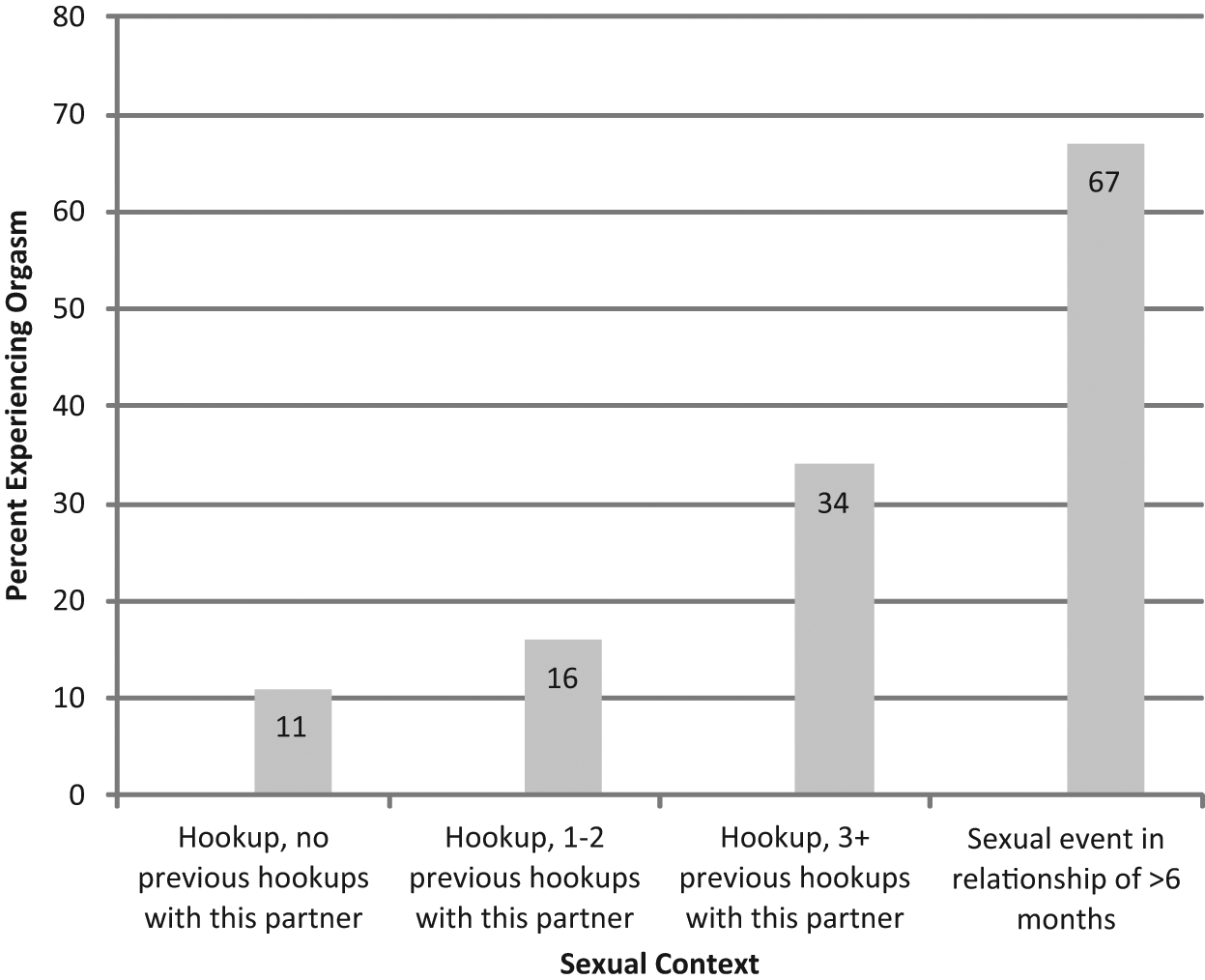
Percent of College Women Experiencing Orgasm, by Sexual Context
Women reported that they enjoyed the sexual activity very much in 50 percent of hookups (and 81 percent of relationship sexual events) (see Table 1). If we include respondents who enjoyed the event somewhat, reported levels of sexual enjoyment reach 86 percent for women in hookups and 97 percent for women in relationships. Lack of orgasm does not mean the absence of sexual enjoyment. However, as we shall see below, respondents who had an orgasm were much more likely to say they enjoyed the activity very much.
Determinants of Orgasm and Sexual Enjoyment in Women’s Hookups and Relationships
We now turn to results from regression analyses of the determinants of women’s orgasm (Table 2) and sexual enjoyment (Table 3). To make implications of the regressions more concrete, for each of the four overlapping subsamples for which we did orgasm regressions in Table 3, Table 4 presents the regression equations to provide the predicted probability of women having an orgasm with and without certain sexual practices and commitment and affection present, with all other variables held at the sample mean for that subsample.
Odds Ratios for Effects on Whether Respondent Had an Orgasm in Most Recent Hookup or Most Recent Sexual Event within Relationship

Note: University is controlled in all regressions.
R = respondent, P = respondent’s partner.
p < .05; ** p < .01 (two-tailed tests).
Odds Ratios for Effects on Sexual Enjoyment in Most Recent Hookup or Most Recent Sexual Event within Relationship

Note: University is controlled in all regressions.
R = respondent, P = respondent’s partner.
p < .05; ** p < .01 (two-tailed tests).
Predicted Probability of Women’s Orgasm, Manipulating One Variable and Setting Others to Their Mean

Note: Predicted probabilities calculated from Model 1 in Table 2 holding all other variables at their means. They are predicted probabilities of orgasm with (yes) and without (no) the behavior.
R = respondent, P = respondent’s partner.
Sexual practices
Tables 2, 3, and 4 show the importance of sexual practices to women’s orgasm and sexual enjoyment. Most sexual practices had strong positive effects on orgasm in both hookups and relationships (see Table 2), consistent with the technical perspective. The odds of orgasm were greater when a couple had intercourse, with odds of orgasm over three times as great in hookups and over two times as great in relationships if intercourse occurred (see Table 2). The predicted probability calculation in Table 4 shows that a hookup without intercourse (and all else at the all hookups sample means) offered women only an 8 percent probability of orgasm, while a hookup with intercourse boosted this to 24 percent. Within relationship events, the probability of orgasm without intercourse (with all else at the relationship means) was 53 percent, whereas with intercourse it was 75 percent (see Table 4). Vaginal intercourse thus appears more predictive of women’s orgasm than some authors (e.g., Hite 1976) have suggested. However, the finding that intercourse increases the odds of orgasm is subject to other interpretations; for example, it is possible that when women have an orgasm first, they go on to have intercourse either as reciprocation or because orgasm increased their interest in intercourse (Gavey et al. 1999). In hookups, women reported less enjoyment if they had intercourse, despite it positively affecting orgasm, suggesting that women are sometimes worried about reputational effects of having intercourse in a casual context or are coerced or talked into intercourse. In relationships, by contrast, intercourse was associated with more enjoyment, which is explained by its association with orgasm (see Table 3, Models 2 and 3).
Practices providing direct clitoral stimulation were extremely important to orgasm and enjoyment. Women who stimulated their own genitals during sexual activity more than doubled their odds of orgasm in hookups or relationships, and these large effects were true even when intercourse also took place (see Table 2). As Table 4 shows, all else held at the mean, women who self-stimulated their genitals boosted their rate of orgasm from 12 to 24 percent in hookups taken as a whole, from 39 to 57 percent in hookups with intercourse, from 67 to 83 percent in relationship events taken as a whole, and from 74 to 86 percent in relationship sex involving intercourse. When men used their hands to stimulate women’s genitals there was also a strong positive effect on orgasm in hookups and relationships (see Table 2). Receiving oral sex also increased women’s orgasm, increasing the odds by approximately half in hookups with intercourse, nearly doubling the odds in all hookups, and more than doubling the odds in relationships (see Table 2). Table 4 shows that when hookups did not provide oral sex for the woman, we predict an 11 percent probability of the woman’s orgasm; this rises to 20 percent with receipt of oral sex, with other variables at their means. In hookups with intercourse, receiving oral sex moved the probability of orgasm from 37 to 48 percent. Oral sex helped women in relationships as well—boosting the probability of orgasm from 58 to 80 percent in all relationship events combined, and from 66 to 83 percent in relationship events with intercourse (see Table 4).
Several practices that do not entail even indirect clitoral stimulation nonetheless show significant effects in Table 2 and increase the probability of orgasm in Table 4, raising questions about the mechanism. The following behaviors were associated with higher odds of orgasm in at least one of the four subsamples: using her hands to stimulate her partner’s genitals, performing oral sex, and having anal sex. We suspect that willingness to engage in a variety of sexual practices indicates the partners were erotically in sync, and this generated both a diversity of practices and orgasm. The practices themselves may not have causal effects.
As we have shown, most sexual practices increased orgasm and enjoyment, lending support to our hypothesis from the technical perspective. Perhaps more surprisingly, some practices also increased—or decreased—sexual enjoyment over and above their effects through orgasm (see Model 3 for each subsample in Table 3). This applied in at least one of the four subsamples to women hand-stimulating their own genitals, partners stimulating women’s genitals, and receiving as well as performing oral sex.
The most important finding from regressions predicting enjoyment, however, was seen in the effect of orgasm itself (Model 3 in each subsample in Table 3). The odds of reporting enjoyment were approximately five to six times higher in relationships and hookups if women had an orgasm. These large effects should put to rest doubt about whether women care about orgasm.
Partner-specific experience
Women had orgasms much more in relationships than in hookups and reported enjoying relationship sex more (see Table 1 and Figure 1). This is consistent with partner-specific learning, as all relationships reported on here had lasted at least six months.
We also found support for our hypothesis regarding partner-specific experience within hookups; the more times a woman had previously hooked up with her current hookup partner, the more likely she was to orgasm. Compared to a first hookup with a partner, respondents who hooked up with this partner three to five times before were over 40 percent more likely to orgasm, and respondents who hooked up more than six times were more than twice as likely to orgasm (see Table 2). 16 Past experience with a hookup partner also vastly increased the odds that a woman said she enjoyed the hookup sexually (see Table 3), whether she had an orgasm or not. Of course, these findings could reflect selection into higher order events based on enjoyment—that is, women were less willing to hook up again if the sex was not good—rather than a causal effect of partner-specific experience. We suspect, however, that some learning was present. This learning occurred even in the absence of commitment; we can infer this from the fact that, given how students use the term hookup, even six hookups with the same partner typically does not entail the commitment of a relationship. Figure 1 indicates that rates of women’s orgasm in repeat hookups never converged with rates of orgasm in relationships, suggesting there may be a categorical difference between hookups and relationships, a difference we suspect is related to commitment, affection, or gender equality.
Commitment and affection
One variable regarding hookup partners was suggestive of affection or long-term orientation: whether the woman was interested in a relationship before the hookup. Respondents who were interested in a relationship were about a third more likely to orgasm (see Table 2), and more than twice as likely to say they enjoyed the hookup (see Table 3). Consistent with the perspective stressing affection and commitment, this suggests that romantic interest enhances sexual enjoyment for women. Of course, it is possible that the association indicates only that enjoying the sex increases romantic interest.
For respondents in relationships, we treated marital interest as an indicator of affection and commitment. Respondents who had already broken up and those who said they were unlikely to marry had the same odds of orgasm, but relative to the first group, women who said it was somewhat likely they would marry were about half again as likely to orgasm, while those who said it was very likely were approximately twice as likely to orgasm. More enjoyment was also reported by those likely to marry. We suggested that cohabitation with the partner could be seen as an indicator of affection or future orientation, and it too increased orgasm likelihood by about a third, as did spending most nights together. Neither of these increased enjoyment, however, and in events with intercourse, cohabitants expressed less enjoyment. 17 Overall, we find substantial but not entirely consistent support for the notion that commitment and affection enhance orgasm and sexual satisfaction.
Do Differences in Sexual Practices Explain the Higher Orgasm Rate in Relationships?
Our previous descriptive results (see Figure 1) as well as the probabilities in Table 4 established that the base level of orgasm and sexual enjoyment is much higher in relationships than in hookups. Here we examine how much of the hookup/relationship gap in women’s orgasm can be explained by the fact that more sexual practices occur in relationships, as the technical perspective suggests. To do this decomposition, we used predicted probabilities from our logistic regressions under varying assumptions of values of the independent variables. We took the means on independent variables from relationships and substituted them into the hookup regressions (slopes and intercepts). Doing this, a variable at a time, for our sample reporting on hookups, speaks to the following thought experiment: What if the population of women in hookups experienced this behavior (e.g., receipt of oral sex) at the level observed for women in relationships, but all other variables had remained at the average for hookups, and, equally important, the intercept and slopes from the hookup equation remained the same? (Results discussed in the next paragraph are not shown in tables.)
Taken one variable at a time, the effects of variables other than intercourse look very small, often increasing the probability 1 to 3 percentage points. For example, women received oral sex 23 percent of the time in hookups and 56 percent of the time in relationship sexual events; if hookups moved to 56 percent and all else remained constant, including the intercept and slopes associated with hookups, women’s rate of orgasm would increase from 13 18 to 16 percent. Intercourse happened in 41 percent of hookups but 81 percent of relationship events. Simply adding intercourse to hookups would boost the female hookup orgasm rate from 13 to 20 percent. While boosts from individual variables other than intercourse are relatively small, if we simultaneously gave women the relationship means on all the sexual practices, their orgasm rate would move from 13 to 37 percent, clearly a big jump, but still much below the rate of orgasm predicted from these same (relationship) means if we used the slopes and intercepts in force for relationship events—72 percent. Thus, practices explain less than half of the percentage point hookup/relationship difference in orgasm. That practices are important is consistent with the technical perspective. Couples go farther in relationships—they have intercourse more often than in hookups and women are provided much more direct clitoral stimulation—and these factors explain a sizeable part of why women have orgasms more. But, inconsistent with the technical hypothesis, which practices occur does not fully account for the orgasm gap between hookups and relationships. 19 We turn now to our qualitative data to deepen our understanding of how hookups and relationships differ.
Qualitative Results
In interviews, women reported they most frequently had orgasms when they were with a caring sexual partner: he was concerned with her pleasure, willing to take time and perform the practices that worked, and she could communicate about what felt good. In describing good sexual partners, women often emphasized attentiveness:
I know that he wants to make me happy. I know that he wants me to orgasm. I know that, and like just me knowing that we are connected and like we’re going for the same thing and that like he cares.
Women often also highlighted good partners’ willingness to perform oral sex. One woman explained, “And I didn’t come during sex but I did come from oral sex. . . . So he made sure I came before he came. And he was like okay with having sex and then going down on me, so I came, and then going back to having sex and then he came. . . . It was great.” Another said, “He was always very . . . considerate and conscious of my side. . . . I didn’t have an orgasm from intercourse but from . . . like oral or touching.” As one woman eloquently explained, caring facilitated the communication key to learning to sexually please a partner:
I think it’s because when you actually care about the other person, you’re also more in tune with what they want and so you can be more comfortable communicating and more knowledgeable and intuitive about their body and really work together, passing the awkward steps or any obstacles.
These conditions were much more likely to be met in relationships than in hookups. In all the cases quoted, women were referring to boyfriends rather than hookup partners. With a few exceptions, women told us that relationship sex was better than hookup sex. Although our quantitative data show that women who said they were likely to want to marry this partner had higher rates of orgasm and enjoyment, women we interviewed did not attribute their greater enjoyment of relationship sex to commitment or a future, but rather to affection and caring.
Part of why good sex is more likely in relationships is probably gender-neutral. For example, a number of women talked about the “awkwardness” of sex with a new partner, frequently contrasting it with the “comfort” of sex with an established partner. One woman said:
No one who has sex with someone for the first time is gonna say that it wasn’t an awkward experience. Like body parts, not sure what the other person wants, it’s hard what to say, you know, and all that. So as you get more comfortable, you . . . do stop thinking . . . about the way you look when he’s looking down at you.
Another woman explained:
I think with any relationship over time, they just learn how to please you and you learn how to please them and you work with each other. So I guess the benefit of a relationship is that you can tweak your skills.
These reports suggest that sex improves for both men and women with partner-specific experience, as partners become familiar with each others’ bodies and sexual tastes.
Although the evidence is indirect, qualitative data also support the version of the gender inequality perspective that posits that the new sexual double standard reduces the quality of hookup sex for women. Women reported hookups characterized by their partners’ complete disregard for their pleasure. For example, one woman said, “When I . . . meet somebody and I’m gonna have a random hookup . . . from what I have seen, they’re not even trying to, you know, make it a mutual thing.” Another woman complained, “I just was with some stupid guy at a frat party and we were in his room and I gave head. And I was kind of waiting and he fell asleep. And I was like, ‘Fuck this,’ and I just left. It’s degrading.” Moreover, women did not always trust that their sexual boundaries would be respected. For example, one woman attributed the better sex she had with a boyfriend to the fact that she could tell him when to stop and that he would stop: “I felt comfortable with him, to tell him you know, what to do, what not to do, when to stop.” That she explicitly mentioned this suggests this was not the case with all partners.
Men, too, reported that they were frequently sexually inconsiderate with hookup partners. Even when interviewed by women, men’s reports of how they treated women in hookups were consistent with women’s reports of how they were treated by men. 20 For example, one man said:
If it’s just a random hookup, I don’t think [her orgasm] matters as much to the guy. Say they meet a girl at a party and it’s a one night thing, I don’t think it’s gonna matter to them as much. . . . But if you’re with somebody for more than just that one night, I think guys, it is important for guys. I think guys feel that they should make sure that a girl has an orgasm. And I think if you’re in a long-term relationship, I know I feel personally responsible. I think it’s essential that she has an orgasm during sexual activity.
Another male respondent, when asked how important his partner’s orgasm was to him, noted that it was “more important if it’s in a real relationship than if it’s a one night stand.” Still another said he would care more “if it’s somebody I care about.” Another man explained that in a “onetime hookup thing” he would not be concerned about his partner’s orgasm because “I guess it’s more of a selfish thing.”
The man who expressed feeling “responsible” for his girlfriend’s orgasm was not alone. A number of men expressed pride in their ability to evoke orgasms in their girlfriends. For example, one man explained, “I feel like it’s important to have her satisfied, too, otherwise I’d feel I didn’t get the job done. Like I know that I would not be maximizing my potential.” His comments, and those of other men, indicated that men believed that sexually satisfying their girlfriends reflected on their masculinity. 21 They did not, however, feel obliged to care about the sexual satisfaction of hookup partners. For example, another man told us, “I’m all about just making her orgasm,” but when asked if he meant “the general her or like the specific her?” he replied, “Girlfriend her. In a hookup her, I don’t give a shit.” Another man noted that his girlfriend’s orgasms were important because “you have a certain stake in your own manhood,” but when asked directly about whether the investment applied to a more casual context, he clearly stated “definitely you feel less investment.” While a few men reported being equally invested in their partners’ orgasms in both hookups and relationships, they were in the minority. Most men operated with different understandings of their sexual obligations to girlfriends and hookup partners. 22
One might suspect that men’s differential regard for hookup and relationship partners is a simple reflection of the casual context. Neither men nor women typically have great affection for a hookup partner, and perhaps it takes affection to care about a partner’s pleasure. If this was the case, we would expect women to report a level of disregard for their hookup partners’ pleasure similar to that reported by men. But this was not the case. Women often reported concern about hookup partners’ pleasure. For example, one woman explained, “I will do everything in my power to, like whoever I’m with, to get them off. Just because it makes me feel like I’m good at sex . . . because in a hookup, that’s really all you have.” Similarly, another woman described herself as “a giver”: “I don’t feel like I’ve had a sexual experience if the guy doesn’t come. . . . I don’t think that we hooked up if the other person hasn’t.” Another woman, who hooked up a lot, reported that sometimes she just decided to “focus completely on giving them an orgasm” instead of worrying about whether she was going to orgasm. Except in a few cases, women did not seem to view boyfriends and hookup partners as owed categorically different levels of consideration.
Respondents’ comments led us to see this gender difference in sexual regard as resulting from gender inequality. Men and women both implied that sexual equality is expected in relationships but not in hookups. For example, one woman, implicitly contrasting relationships with hookups, pointed to the more egalitarian nature of relationship sex:
I think also just because in a relationship, there’s much more expected as far as like equality-wise, like give and take sexually. If you’re gonna be in a relationship, it’s expected, like more equality.
This woman suggests equality is not expected in hookups. Another woman explained that she cared a lot more about her own orgasms in relationships than in hookups. She viewed having orgasms in relationships “as an issue of balance. It is an issue of equality. You do have to learn how and work on it, work on it together.” Because she did not expect hookups to be “balanced,” she did not expect orgasms in hookups. A man explained that “with my partner now, now that I’m in a relationship, I think [her orgasms are] actually pretty important. More important than I think the hookup because you have more invested in that person. You know, when you have sex, it’s more a reciprocal thing” (emphasis added). This man implied that relationship sex is expected to be reciprocal while hookup sex is not.
Men seemed to take their entitlement to pleasure in hookups for granted, while women sometimes expressed uncertainty about whether it was acceptable to want their sexual desires met. For example, when the man above unapologetically described hookups as “selfish,” he revealed a sense of entitlement to his own sexual pleasure in hookups. By contrast, one woman explained that, for her, “being able to communicate” about what she wanted was important for good sex, but, she added, “I feel like when it’s just a hookup, I just feel like I almost like don’t have the right. Or not that I don’t have the right but it’s just not comfortable enough to be like, ‘You know, hey, this isn’t doing it for me.’” Another woman said,
I didn’t feel comfortable I guess. I don’t know. I think I felt kind of guilty almost, like I felt like I was kind of subjecting people to something they didn’t want to do and I felt bad about it. So I think that was partly it. But probably I just got so much encouragement from giving . . . but I didn’t even really like it, to be honest. I like . . . making someone feel good.
This woman expressed guilt about having her sexual desires met in a hookup, but at the same time she performed sexual acts that she did not “really like” in service of her partner’s pleasure.
Neither men nor women explicitly stated that women are only entitled to pleasure in relationships but men are also entitled to pleasure in hookups. This double standard can, however, be inferred from women’s complaints of lack of mutuality and uncertainty about whether they had the right to expect pleasure in hookups, men’s descriptions of their own behavior in hookup sex as “selfish,” and women and men both describing relationship sex as more equal. The OCSLS survey data offer further support for this explanation. Asked Have you ever hooked up with someone and afterward had the feeling that the person respected you less because you hooked up with him/her, 54 percent of heterosexual women but only 22 percent of heterosexual men said yes (results not shown). We surmise that the greater gender inequality in hookups than relationships flows, at least in part, from today’s version of the double standard—both women and men are seen to deserve pleasure in relationships, but women’s entitlement in hookups is not fully accepted.
Discussion and Conclusions
We have investigated what factors encourage orgasm and sexual enjoyment in heterosexual college hookups and relationships, and what explains why sex in relationships provides more orgasm and enjoyment for women. In support of the technical perspective, we found that most sexual practices increase women’s orgasm. Intercourse itself increases orgasm in both hookups and relationships, although it decreases enjoyment in hookups. Women’s orgasm is also enhanced by receiving oral sex, and by having her genitals stimulated by her own or her partner’s hand, and these practices were more common in relationship sex. These findings suggest that 1970s feminists such as Hite (1976) and Koedt (1973) were correct about the importance of direct clitoral stimulation. At the same time, these authors may have contributed to a misconception that intercourse contributes little to women’s orgasm. College women and their partners typically engage in more sexual practices in relationships than in hookups, and this explains some—albeit less than half—of the hookup/relationship gap in orgasm, with the higher rates of intercourse in relationships a large part of this.
Rates of orgasm and enjoyment increase dramatically between the first hookup and subsequent hookups, suggesting that partner- specific learning plays a role even in the absence of long-term commitment. Consistent with this, in interviews women talked at length about the awkwardness of first sex and the importance of getting to know each other’s bodies.
Affection and commitment are also important. In hookups, interest in a relationship increased orgasm and enjoyment. In relationships, women who said they were likely to want to marry their partner were more likely to report orgasm and enjoyment. Our data did not allow us to quantitatively estimate what portion of the hookup/relationship gap was a result of affection or commitment. Relationships are likely accompanied by higher levels of affection and commitment than are hookups, and a portion of the hookup/relationship gap is thus likely attributable to these factors. Interviews also support the role of affection. Although there was virtually no mention of the importance of commitment, women talked extensively about the role of “caring” and “love” in good sex.
Our interview data suggest that gender inequality also contributes to the hookup/relationship gap in orgasm and sexual enjoyment for women. Both men and women reported that men are typically not concerned with women’s pleasure in hookups, but both reported that men are very attentive to women’s pleasure in relationships. We interpret these findings as consistent with the new version of the double standard in which entitlement to sexual pleasure has become reciprocal within relationships, but doubts about women’s entitlement to pleasure in casual liaisons keep women from asking to have their desires satisfied and keep men from seeing women as deserving of their attentiveness in hookups. This does not reflect just a gender-neutral indifference to partners’ pleasure in the casual context, as women reported extensive efforts to please men in casual hookups.
This research has implications for sex education. One motivation for our inquiry was imbalance in past research, which has focused on the dangers of sex for youth with little attention to what promotes pleasure and enjoyment. Sex education—particularly for young adults—might attend as much to the pleasure of sex as its perils. Our analysis speaks to what would make sex better—in terms of orgasm and enjoyment—for college women at four-year institutions. First, because sex is, for most women, better in relationships, they would enjoy sex more if more of their sex was in relationships, which might occur more readily if women and men were educated about relationship-building skills. Second, sexual behavior in hookups would lead to women’s orgasm and enjoyment more if men attended to women’s pleasure in hookups more like they do in relationships. A reduction in the double standard might increase men’s attentiveness to women’s pleasure in hookups and women’s sense of entitlement to pleasure. This suggests that education related to gender equity in general, but particularly in the sexual arena, might improve the quality of young adult sex.
The status of non-relationship sex is contested in our society, and our readers undoubtedly have differing opinions about its appropriateness to which our empirical analysis cannot speak. What our analysis can speak to is the question of what would increase college women’s levels of orgasm and sexual satisfaction: women’s pleasure would increase by either increasing the prevalence of relationships in college, and thus relationship sex, or by increasing men’s attentiveness to women’s pleasure and women’s sense of entitlement to pleasure in hookups.
Footnotes
Acknowledgements
An earlier version of this article was presented at the 2009 annual meetings of the American Sociological Association. Thanks to Roger Friedland, Emily Kazyak, Ed Laumann, Karin Martin, Brian Powell, Lotus Seeley, Martin Weinberg, the University of Michigan Gender & Sexuality Workshop, and ASR reviewers and editors for comments.
Notes
References
Supplementary Material
Please find the following supplemental material available below.
For Open Access articles published under a Creative Commons License, all supplemental material carries the same license as the article it is associated with.
For non-Open Access articles published, all supplemental material carries a non-exclusive license, and permission requests for re-use of supplemental material or any part of supplemental material shall be sent directly to the copyright owner as specified in the copyright notice associated with the article.
