



Abstract
This study uses a sample of Japanese university scientists in life and materials sciences to examine how academic entrepreneurship has affected the norms and behaviors of academic scientists regarding sharing scientific resources. Results indicate that high levels of academic entrepreneurship in a scientific field are associated with less reliance on the gift-giving form of sharing (i.e., generalized exchange) traditionally recommended by scientific communities, and with a greater emphasis on direct benefits for givers (i.e., direct exchange), as well as a lower overall frequency of sharing. We observe these shifts in sharing behavior even among individual scientists who are not themselves entrepreneurially active; this suggests a general shift in scientific norms contingent on institutional contexts. These findings reflect contradictions inherent in current science policies that simultaneously encourage open science as well as commercial application of research results, and they suggest that the increasing emphasis on commercial activity may fundamentally change the normative structure of science.
Keywords
Academic science has become increasingly entrepreneurial over the past decades as science and technology (S&T) policies have been revised to strengthen links between academia and industry. Universities and scientists worldwide have increasingly engaged in entrepreneurial activities (Etzkowitz 1998; Geuna and Rossi 2011; Nagaoka et al. 2009; Organisation for Economic Co-operation and Development [OECD] 2003; Slaughter and Rhoades 1996), but there is growing concern about effects of this changing context on norms and practices of science (e.g., Frickel and Moore 2005; Kleinman and Vallas 2001; Slaughter and Leslie 1997). Policy scholars (e.g., Dasgupta and David 1994; Nelson 2004) and scientific communities (National Academy of Sciences [NAS] 2003; Schofield et al. 2009) have raised concerns that this trend could undermine the practice of unconditional sharing of scientific resources that underpins scientific progress.
Unconditional sharing of scientific resources is a regularized, concrete expression of the norms of open science (Dasgupta and David 1994; Merton 1973). In natural sciences, scientists share research inputs such as cell lines, model organisms, viruses, proteins, new materials, reagents, software, and data. Social scientists share copies of questionnaires, experimental protocols, and datasets. In the case of U.S. life scientists, about 80 percent of scientists have made a recent request for others’ research material or data, averaging three to five requests per year, with 80 to 95 percent of requests fulfilled (Blumenthal et al. 1997; Campbell et al. 2002; Walsh, Cohen, and Cho 2007). This exchange allows scientists to avoid redundant efforts, reproduce previous findings, standardize research methods, and equalize distribution of scientific resources, all of which accelerate the accumulation of scientific discoveries. Put differently, an inability to access others’ research materials can impede the progress of science (Campbell et al. 2002; Murray and Stern 2007; Walsh et al. 2007). Scientific communities have a norm that requested materials should be provided gratis and unconditionally (NAS 2003). 1 This norm is echoed in funding agencies’ sharing policies 2 and in journal practices 3 that require authors to deposit research materials and data in publicly accessible archives or share research inputs on request.
Although most policy statements take an absolutist position on the norm of unconditional sharing, actual practices are more nuanced. In particular, over the past 30 years, as government policies have drawn universities into the service of industry to advance national political and economic agendas, greater emphasis has been given to university–industry relations (UIRs), and universities and scientists have been encouraged to claim their private rights and apply their research outputs for commercial purposes (Etzkowitz 1998; Glenna et al. 2007; Slaughter and Leslie 1997; Slaughter and Rhoades 1996). One high profile change was the U.S. Bayh–Dole Act and similar policies in other countries that encourage university patenting and licensing (Grimaldi et al. 2011; Kenney and Patton 2009; Mowery and Sampat 2005). A substantial number of scientists now engage in entrepreneurial activities such as university startups, patenting research findings, and technology transfer to industry (Association of University Technology Managers [AUTM] 2007; Grimaldi et al. 2011; Nagaoka et al. 2009; OECD 2003). This growth in academic entrepreneurship is a global phenomenon, as countries around the world have adopted policies based on the perceived success of the U.S. system (Arocena and Sutz 2001; Geuna and Rossi 2011; Kenney and Patton 2009; OECD 2003; Van Looy et al. 2011; Woolgar 2007), and this implies an institutional isomorphism in this domain (Dimaggio and Powell 1983).
The rise in academic entrepreneurship raises concerns about adverse effects on science (Dasgupta and David 1994; Nelson 2004). Commercially active scientists are more likely to withhold research materials, avoid sharing information about their current research, and delay publication (Blumenthal et al. 1997; Blumenthal et al. 2006; Walsh et al. 2007). Scientists funded by or collaborating with industry are also likely to limit access to their research results (Blumenthal et al. 1997; Vogeli et al. 2006). Scientists who apply for patents tend to be more secretive (Campbell et al. 2000; Murray and Stern 2007). Evidence also indicates that compliance with sharing requests has been decreasing (Walsh et al. 2007). These studies suggest that participation in entrepreneurial activities affects scientists’ compliance with the sharing norm.
Prior literature focuses mainly on antinormative behaviors of entrepreneurially active scientists, but here we are interested in the more fundamental question of how growing entrepreneurship affects scientific norms in general. Because scientific norms can be contingent on context (Blume 1974; Hackett 1990), the entrepreneurial regime may have transformed norms (Etzkowitz 1998; Glenna et al. 2007; Nelson 2004; Owen-Smith 2003) and affected the majority of scientists not directly engaged in entrepreneurial activities. We draw on social exchange theory (Ekeh 1974; Emerson 1981; Molm 1994; Takahashi 2000) to develop a set of hypotheses regarding the impact of entrepreneurship on sharing practices. To test these hypotheses, we conducted a survey of Japanese university scientists in several fields of life and materials sciences. We found that a high level of academic entrepreneurship in a field discourages scientists from sharing resources, and that forms of sharing shifted from unconditional (generalized exchange) toward return-based (direct exchange).
Theoretical Background and Hypotheses
Scientific Norms in Context
Unconditional sharing of research materials as an ideal is consistent with the communism norm described by Merton and others: scientific findings are possessions of the community and an individual’s ownership right is limited to recognition and esteem (Barber 1952; Merton 1973). However, these norms have never been followed perfectly, and the extent of compliance depends on circumstances (Frickel and Moore 2005; Hackett 1990; Merton 1973; Mitroff 1974). At the individual level, systemic forces against the sharing norm include scientific competition, costs of supplying materials, and potential commercial benefits (Cohen and Walsh 2008; Merton 1973; Stephan 1996). Contextual factors such as historical period and organizational environment also affect norms and compliance (Hackett 1990). Blume (1974) contends that modern science is highly dependent on a society’s social, economic, and political systems. Scientific norms may not necessarily be formed with the autonomy portrayed by Merton (1973) or Polanyi (1962). Among other contextual factors, the growth of academic entrepreneurship has been of particular interest because it may deter unconditional sharing (Blumenthal et al. 1997; Walsh et al. 2007). Prior literature argues that universities and scientists are adopting a new set of values and norms (Glenna et al. 2007). Owen-Smith (2003) and Murray (2010) argue that contemporary academic science increasingly operates in a hybrid space that integrates norms and practices of industry with those of open science. Frickel and Moore (2005) and Kleinman and Vallas (2001) contend that the two sets of norms have resulted in university scientists behaving contrary to traditional academic values.
Social Exchange and Sharing in Academia
We draw on social exchange theory (Ekeh 1974; Emerson 1981; Molm 1994, 2010; Takahashi 2000) to investigate how the norm of unconditional sharing in academia has been sustained and can be undermined in the entrepreneurial regime. Social exchange theory, in examining resource exchanges undertaken by actors within a social structure, generally distinguishes two forms of exchange: generalized exchange and direct exchange. Generalized exchange consists of three or more actors who can give to or receive from one another, where givers do not expect a direct return from their recipients but expect support from a third party in the future; direct exchange consists of two actors, both of whom directly contribute to each other, where one’s giving is based on the expectation or agreement of reciprocation from the other (Befu 1977; Blau 1964; Ekeh 1974; Sahlins 1972). Among several forms of generalized exchange described in the literature (Ekeh 1974; Yamagishi and Cook 1993), pure generalized exchange, characterized by no fixed structure of giving and receiving (Ekeh 1974; Takahashi 2000), most closely corresponds to the unconditional sharing in academia. Pure generalized exchange is the most general, flexible, and least restricted type of exchange and is observed in various scenes in social life, such as giving blood, helping stranded motorists, and watching out for burglars in a neighborhood (Ekeh 1974; Molm, Collett, and Schaefer 2007; Takahashi 2000; Yamagishi and Cook 1993). In these examples, acts of giving may appear to occur independently and may not look like an exchange. 4 Nevertheless, because every actor has a certain probability of becoming a recipient of goods or services at some point, the expectation for future benefit leads actors to provide their resources without demanding immediate return, which collectively lends the system a quality of exchange (Bearman 1997; Ekeh 1974; Yamagishi and Cook 1993). This is what we observe in academia’s unconditional sharing. Scientists are supposed to provide their material to anyone who needs it without expecting a return from the recipient (consumer of the material), and the sharing occurs between unfixed pairs of scientists. In the long term, most scientists have a high probability of needing someone’s material and benefiting from unconditional sharing (Blumenthal et al. 1997; Campbell et al. 2000; Walsh et al. 2007).
Generalized exchange is generally vulnerable to the free-rider problem of social dilemmas, in which self-interested actors have incentive to receive without giving (Molm 1994; Takahashi 2000; Yamagishi and Cook 1993). The existence of free riders makes it less probable for givers with goodwill to have their future requests fulfilled, so rational actors should not engage in such exchange; in this scenario, generalized exchange would never emerge in the first place. To explain why generalized exchange does exist in reality, several lines of literature have proposed solutions for this problem. One is that generalized exchange is driven by cultural beliefs or norms of reciprocity (Ekeh 1974; Gouldner 1960; Lévi-Strauss 1969). Rather than being completely egoistic, actors are supposed to feel obliged to return benefits they receive from others. Free riding is thus a violation of the norm and is avoided (Ekeh 1974; Uehara 1995). Another argument is that free riding is resolved by selective incentives such as rewarding and sanctioning mechanisms, assuming that actors are rational benefit seekers (Coleman 1990; Hechter 1987; Kollock 1998; Olson 1965). Such mechanisms may be enforced by external authorities (Hardin 1968) or internally implemented by exchange participants (Ostrom 1990). Yamagishi (1986) suggests that actors who value the benefits of collective actions and are worried about free riding are willing to participate in such sanctioning mechanisms. A third solution draws on individual-level behavioral strategies, independent of collective mechanisms. Among the strategies that could overcome the free-rider problem, Takahashi (2000) proposes the “fairness-based selective-giving strategy,” in which actors give resources without direct reciprocity to recipients chosen in accordance with the giver’s fairness criterion. Because stingy actors are not chosen as recipients, free riding is discouraged. Literature on the evolution of cooperation proposes similar strategies (e.g., discriminator strategy), in which actors cooperate only with those who have a good record of cooperative behavior (e.g., Nowak and Sigmund 1998). In these strategies, actors need to know who is cooperative and who is not, so social information (e.g., reputation and rumor) plays an essential role in sustaining generalized exchange (Nowak 2006; Ohtsuki and Iwasa 2004).
These solutions are observed in the real world in an intertwined manner (Coleman 1990; Lindbeck 1997). In academia, the norm for unconditional sharing is conceptualized as the communism norm (Merton 1973) and is articulated in science policies, funding, and publication rules, which form the basis of the incentive structure against free riding. For example, the National Academies (NAS 2003) recommends that free riders be sanctioned by funding agencies, journals, and their universities. Scientists who encounter stingy recipients can spread this information, compromising free riders’ reputations. Given such information, not only direct victims but also other scientists in the community will not support stingy scientists. In this way, pure generalized exchange in academia seems to be sustained with a high compliance rate.
Impact of Academic Entrepreneurship
The entrepreneurial regime can jeopardize generalized exchange-based sharing in several ways. First, the sharing norm would be weakened by the increase in entrepreneurial scientists. Because entrepreneurial scientists tend to withhold and act as free riders, their increase means a decrease in norm followers, which makes the norm less effective due to loss of positive externalities (Coleman 1990). In addition, the total quantity of sharable resources in a community falls, and the probability of being denied rises. This should lower the collective benefit from unconditional sharing, making following the norm less rational (Festre 2010). Furthermore, because economic incentives emphasized in the entrepreneurial regime contradict the sharing norm, scientists could doubt the legitimacy of the traditional norm. Introduction of economic incentives can change actors’ perceptions of social norms and lead them to act in accordance with economic rationality and deviate from collectivist norms (Akerlof 1980; Festre 2010). Second, the incentive structure would not function properly. Sanctioning mechanisms in academia are not completely centralized. Individual scientists have to take part, even if funding agencies and academic institutions may play primary roles (NAS 2003). Free-riding entrepreneurial scientists may be uninterested in sanctioning other free riders. More importantly, weakening of norms and the generalized exchange system compromise the rationale for all scientists to participate in sanctioning mechanisms (Coleman 1990; Hechter 1987; Lindbeck 1997; Olson 1965). Third, behavioral strategies based on social information would be destabilized. With more free riders, actors’ capacities to deal with social information can be overwhelmed, and erroneous social information can be produced. Because imprecise social information impairs fairness-based strategies, free riders would not be eliminated effectively (Nowak 2006; Ohtsuki and Iwasa 2004).
The whole process should be progressively aggravated: weakening norms allow more scientists to engage in entrepreneurial activities (Bercovitz and Feldman 2008; Stuart and Ding 2006), further accelerating this process. In summary, the entrepreneurial regime should undermine the unconditional sharing norm and lead scientists to more frequently deny generalized exchange-based sharing, even among those who do not engage in academic entrepreneurship.
Hypothesis 1: The higher the level of academic entrepreneurship in a field, the higher the denial probability for generalized exchange-based sharing.
Shift in Sharing Forms
In the face of a malfunctioning generalized exchange system, scientists who need others’ materials have a few options, aside from giving up their research. For one, they can offer incentives to the material’s owner, such as co-authorship or acknowledgment in their publications, promise of future support, or paying money. Such a transaction is substantially different from unconditional sharing and looks more like market exchange. Social exchange theory refers to such exchange, where two actors directly contribute to each other based on mutual agreement, as negotiated exchange, a form of direct exchange (Emerson 1981; Molm 1994). The two actors can know what they give and receive in advance, and hence the risk of non-reciprocity is substantially reduced (Cheshire, Gerbasi, and Cook 2010; Molm 1994; Molm et al. 2007). Another strategy that may secure cooperation is to restrict the scope of the generalized exchange network and decrease the cost for monitoring free riders (Molm 1994). The extreme case is a two-actor network, where each actor unilaterally cooperates with the other, expecting the other to reciprocate in the future. This is referred to as reciprocal exchange, another type of direct exchange (Emerson 1981). Unlike negotiated exchange, reciprocal exchange is initiated without a joint agreement but with a reasonable expectation for future reciprocity (Molm 1994; Molm et al. 2007). It is thus considered less certain than negotiated exchange but still safer than generalized exchange (Molm 1994; Molm et al. 2007). Because both types of direct exchange are characterized by lower risk of non-reciprocity, we expect that scientists will increasingly choose direct exchange over generalized exchange when the risk of exploitation by free riders increases.
Several lines of research suggest the plausibility of this shift toward direct exchange. The literature on social dilemmas and psychology argues that smaller networks (including dyads) are favored under conditions prone to free riding (e.g., Bonacich et al. 1976; Fox 1985; Kollock 1998). In large networks, information about free riders is not effectively communicated (Olson 1965), and anonymous defection is possible (Dawes 1980). Literature on the evolution of cooperation also suggests that reciprocal exchange is a robust alternative in the face of invading free riders (Axelrod and Hamilton 1981; Trivers 1971). Behavioral strategies conducive to reciprocal exchange can emerge even without monitoring or sanctioning mechanisms (Nowak 2006; Nowak and Sigmund 1998; Trivers 1971).
Literature on social exchange and social dilemmas argues that a low level of general trust and social uncertainty facilitate commitment formation, where actors continue transactions with previous exchange partners (i.e., repetitive direct exchange) (Cook, Rice, and Gerbasi 2004; Yamagishi, Cook, and Watabe 1998). General trust should decline when scientists know that the growing number of entrepreneurial scientists will not follow traditional norms. 5 In addition, because entrepreneurial scientists tend to withhold, the level of uncertainty about reciprocation should rise. 6 Thus, the entrepreneurial regime should facilitate repetitive direct exchange among limited partners. Of the two forms of direct exchange, negotiated exchange may be preferred, especially under high uncertainty (Cook et al. 2004), because it leaves no obligations for the future and requires lower degrees of trust (Molm, Schaefer, and Collett 2009).
The shift toward negotiated exchange can also result from scientists’ changing perceptions of scientific norms. Empirical studies on social norms suggest that economic incentives intended to facilitate voluntary activities (e.g., donation) actually decrease them, and moreover, the level of these activities does not recover even after incentives are withdrawn (Frey and Goette 1999; Gneezy and Rustichini 2000). This can be interpreted as a shift of equilibria from one where social norms govern behavior to one where economic incentives prevail and most actors do not follow the norms (Festre 2010; Lindbeck 1997). In academia, the entrepreneurial regime reinforces economic incentives (Slaughter and Leslie 1997), which could crowd out traditional scientific norms. If such a transition occurs, negotiated exchange will be the most likely form of exchange because scientists can engage in explicit bargaining over terms of exchange in an attempt to maximize their own benefit (Molm et al. 2009).
In summary, with prevailing academic entrepreneurship, we hypothesize that suppliers’ preferences for direct exchange (reciprocal or negotiated) over generalized exchange increases. This should have two consequences. First, the presence or absence of reciprocity should have a greater impact on suppliers’ decisions to share. When entrepreneurship is uncommon and the sharing norm functions effectively, suppliers’ decisions are made regardless of expected return. However, when entrepreneurship prevails and the sharing norm weakens, sharing is encouraged by expected return.
Hypothesis 2: The higher the level of academic entrepreneurship in a field, the greater the effect of reciprocity in decreasing the denial probability (i.e., the difference in the denial probabilities between direct and generalized exchange-based sharing should be greater in fields with high levels of entrepreneurship than in fields with low levels).
Second, suppliers will demand reciprocity more frequently and consumers will take it as an ordinary condition. Hence, direct exchanges should account for a larger proportion of material requests.
Hypothesis 3: The higher the level of academic entrepreneurship in a field, the larger the proportion of direct exchange-based sharing (versus generalized exchange).
Overall Transactions
The shift in exchange forms can also affect the overall frequency of sharing transactions although the direction is ambiguous. On the one hand, the shift toward direct exchange reduces the risk of non-reciprocity (Molm 1994; Molm et al. 2007), which could motivate exchange between specific pairs of scientists, thus boosting the overall number of transactions. However, we suppose this positive effect will be limited. In general, when the scope of an exchange network is restricted and actors commit to limited partners for direct exchange, this limits their choices for exploring better opportunities that might exist outside current relationships (Kollock 1994; Rice 2002; Yamagishi et al. 1998). This can be especially problematic in academia, where individual scientists specialize in a narrow scientific area but draw on diverse knowledge sources and skills. Scientists cannot necessarily find what they need from limited fixed suppliers. This limitation is even more serious in negotiated exchange where two scientists have to simultaneously find useful resources from each other’s pool of resources. Considering that money is almost never used in resource sharing in academia, the lack of a universal means of exchange should lead to the common limitation of barter economies (Weber 1978). Negotiated exchange is prone to the risk of failing to reach an agreement of exchange while avoiding the risk of non-reciprocity (Cheshire et al. 2010). In addition, direct exchange incurs immediate costs for consumers. This forces scientists to think carefully about making requests and they may refrain from bearing the cost of reciprocity, especially for early-stage or exploratory research with low probability of success (Heller and Eisenberg 1998). Furthermore, direct exchange is especially vulnerable in a system characterized by inequality in goods of exchange, a key characteristic of academia (Fox 1983; Lotka 1926; Zuckerman 1988). A few productive scientists have many resources and are repeatedly asked to supply, while the majority of scientists may have little of value to trade. This imbalance gives productive scientists significant power (Cook et al. 1983); they can demand more than reasonable reciprocity for their resources (e.g., first authorship or control over the research project) while less productive scientists may have to take such exchanges in order to do research in that field. This inequality would make direct exchange-based sharing too expensive and deter potential consumers from requesting resources.
In summary, we hypothesize that under the entrepreneurial regime, where direct exchange-based sharing is more common, scientists should make fewer requests. 7
Hypothesis 4: The higher the level of academic entrepreneurship in a field, the fewer the requests for exchange.
The Science Community in Japan
This study draws on a sample of Japanese materials and life scientists. To understand the implications of our findings for the sociology of science, it is important to describe the organizational, cultural, and political context in which these scientists are embedded (Blume 1974). Institutionalized modern science in Japan started in the late-nineteenth century and has quickly developed. In particular, life and materials sciences have been well integrated into the international science community. For example, our respondents published the majority of their papers in international peer-reviewed journals. In terms of publication counts, Japan is ranked high in several subfields of life and materials sciences (Adams et al. 2010; see also http://sciencewatch.com). High rates of international publication and frequent collaboration with foreign scientists expose Japanese scientists to international standards for sharing. In addition, Japan’s science ministry (Ministry of Education, Culture, Sports, Science, and Technology [MEXT] 2002) and the Prime Minister’s Council for Science and Technology Policy (CSTP 2007) have published statements that scientists should not impose any restrictions on the use of their research output by other scientists and should supply them for free. Like the National Science Foundation in the United States, Japan’s principal funding agency requires grant applicants to present a plan for dissemination of their research outputs. Overall, Japanese scientists are exposed to scientific norms similar to their U.S. peers (see notes 1, 2, and 3).
As for the entrepreneurial context, Japanese academia has a long history of strong connections with industry (Branscomb, Kodama, and Florida 1999; Nagaoka et al. 2009). University scientists had close, although usually informal, ties with industry through various channels such as receiving donations, accepting corporate researchers in their laboratories, and assigning patent rights to industry partners (Branscomb et al. 1999; Kenney and Florida 1994; Walsh et al. 2008). In addition, key figures from industry and academia are involved in S&T policy bodies, contributing to a shared perspective on policy making (Tanaka and Hirasawa 1996). In particular, during the economic recession in the 1990s, policymakers began to recognize universities as a source of innovation and economic growth and implemented a series of policy reforms modeled on the U.S. system (Kneller 2007; Nagaoka et al. 2009; Walsh et al. 2008). The 1998 Technology Transfer Law enabled the establishment of technology licensing offices (TLOs) and allowed national universities (which account for most academic research in Japan) to claim intellectual property (IP) rights in publicly funded inventions. In 1999, the Japanese equivalent of the Bayh–Dole Act permitted industry to retain IP rights derived from publicly funded research. IP regulations have been intermittently revised since the mid-1990s to further encourage university patenting (Nakayama 2003). Beginning in 1997, employment conditions at national universities were relaxed so that professors could establish startup companies, serve on scientific advisory boards in private companies, and officially engage in paid consulting. Finally, in 2004, national universities were incorporated, giving universities greater autonomy in pursuing UIRs (Woolgar 2007). Emphasis on entrepreneurship has been clearly articulated in policy statements. For example, the national Intellectual Property Strategy Headquarters (2006:50), established in 2003 under the supervision of the Prime Minister, stated: “Individual universities and public research institutes should work harder to carry out activities relating to intellectual property. . . . They should also endeavor to strategically obtain and exploit rights based on basic patent rights for essential inventions.” Individual universities followed this direction. For example, the University of Tokyo IP policy declares that all faculty members have the duty to protect their IP and use it for the good of society (generally interpreted as commercializing the invention). 8 In these transitions, Japanese scientists have begun to recognize their new role in the entrepreneurial regime (Baba and Goto 2007) and increasingly engage in patenting, licensing, startups, and contracts with industry (Kneller 2007; Nagaoka et al. 2009; Walsh et al. 2008).
Data and Methods
Sample and Data
To test our hypotheses, we conducted a survey of life and materials scientists in Japan, focusing on their entrepreneurial activities and their experience in the sharing of research material (material transfer). We included data from life sciences, where the impact of academic entrepreneurship has been a major issue (NAS 2003). Life sciences are divided into 12 fields, such as basic biology, clinical medicine, and agricultural science. To move beyond prior work, we also added materials science, where UIRs play an important role and the sharing of materials is common. Materials science consists of four fields, including compound chemistry and nano-chemistry. In total, our sample consists of 16 fields. From our interviews with scientists, we expected these fields to vary significantly in the prevalence of entrepreneurial activity. Our analytic strategy takes advantage of this variance across fields and compares sharing behavior in fields with more and less prevalence of entrepreneurship. We chose full and associate professors as survey respondents because they are the primary decision-makers in material transfer in Japanese universities. In addition, to focus on active researchers (i.e., those at risk to share materials), we selected scientists in the top-45 research universities (based on total university research funding) who received national funds in the prior five years. Drawing on the list of recipients of Grants-in-Aid for Scientific Research (the primary competitive funding source for Japanese university scientists), we prepared our sampling frame of 8,013 scientists, which covers 62 percent of grantees across all universities who satisfy our population criteria and accounts for about 80 percent of all research funding.
We developed the survey instrument based on prior surveys and semi-structured interviews with 30 Japanese scientists. To validate the instruments, we conducted cognitive interviews with 10 scientists to detect unclear or inappropriate questions. We mailed the revised survey to 1,674 randomly sampled scientists (stratifying by university, field, and rank). The survey was conducted from February through April 2009. We received 698 responses (42 percent response rate).
We tested for non-response bias as follows. First, we obtained Web of Science publication data for 100 scientists from the response group and 100 from the non-response group. We found no significant difference between the two groups (7.4 versus 9.1 publications per year, p = .22). Second, using a Japanese patent database, 9 we examined the number of patent applications for the two groups and found no significant difference (.27 versus .34 applications per year, p = .49; 74 versus 73 percent with no patents). Third, we tested for differences in response rate by scientific field. Although we did not find significant differences (p = .11), as a robustness check, we tested our hypotheses excluding fields with the highest and lowest response rates and confirmed a similar pattern of results. Fourth, we compared the response rate across ranks and found that full professors were somewhat less responsive than associate professors (38 versus 46 percent, p < .01). To alleviate a potential bias due to overrepresentation of associate professors, we randomly dropped some respondents to balance the proportion of full and associate professors and re-ran our analyses. Using this subsample, we obtained qualitatively similar results.
Among our respondents, 83 percent were life scientists and 17 percent were materials scientists. On average, they obtained their highest degree (PhD or MD) in 1988, had worked in 2.8 laboratories in their career, and had been working in their current laboratory for 13 years. Mean laboratory size was six researchers. Mean number of publications for the past two years was 12.
Measures
Academic entrepreneurship
We measured academic entrepreneurship using three indicators drawing on prior work (Blumenthal et al. 1997; Blumenthal et al. 2006; Walsh et al. 2007). First, we asked if respondents were involved in commercial activities in the two-year period 2007 to 2008, including negotiations with industry, planning a new business, establishing a startup firm, development of new technologies for commercial purposes, or earning licensing income. We assigned respondents involved in at least one commercial activity a value of one on a dummy variable (individual-level commercial involvement), zero otherwise (Campbell et al. 2002). Second, following Hong and Walsh (2009), we asked respondents to list up to seven recent collaborators. If at least one collaborator was from industry, we coded a dummy variable one (individual-level industry collaboration). Third, we asked respondents what proportion of their research funds were from industry. If industry funding was greater than zero, we coded a dummy variable one (individual-level industry funding) (Campbell et al. 2002; Hong and Walsh 2009). 10 We averaged these three individual-level measures at the field level to obtain measures of field-level academic entrepreneurship (field-level prevalence of commercial involvement, industry collaboration, and industry funding, respectively). 11
Material transfer transactions
Following Walsh and colleagues (2007), we asked respondents how many material transfer requests they made as a consumer in the two years 2007 and 2008 (# request made) and how many were fulfilled (# material received). Likewise, we asked how many requests they received as a supplier in the same period (# request received) and how many they fulfilled (# material provided). We also asked how many received requests included an offer of co-authorship. We then calculated the percentage of requests that included co-authorship in return (percent co-authorship requests received). Following Walsh and colleagues (2007), we asked several questions focusing on the latest request received as a supplier, to reduce recall bias and allow more detailed questions about the specific transaction. First, we asked if respondents had denied or fulfilled the request (denial for the latest request). Regardless of whether they denied or fulfilled the request, we asked if the respondent had expected any return from the consumer if she fulfilled the request, including (nonexclusively) co-authorship, acknowledgment, data or materials in exchange, or monetary compensation. If respondents believed that co-authorship would be given, assuming the consumer’s research was published, we coded a dummy variable one (co-authorship). 12 As another measure of direct exchange, we asked if the respondent believed she would benefit from the relationship with the consumer in the future (future benefits). Taking the maximum of co-authorship and future benefits, we created an additional dummy variable (expected return).
Control variables
We included the following dummy variables regarding the latest request. First, because competition affects sharing (Vogeli et al. 2006; Walsh et al. 2007), we asked if the respondent believed the consumer’s research would compete with her own (competing relationship). Second, although previous studies have shown commercial involvement reduces sharing (Campbell et al. 2002; Walsh et al. 2007), we assume this effect may depend in part on whether the sharing interferes directly with commercial activities. We thus asked if the requested material was related to the respondent’s commercial activities (commercial material). Third, because previous relationships can affect sharing, we asked whether the consumer was a previous collaborator with the respondent (previous collaborator).
We also controlled for respondent’s total funding because this may affect capacity for handling requests (Walsh et al. 2007). We asked the amount of research funding in the year 2008, on a seven-point scale from “less than 5 million JPY” to “more than 100 million JPY” (¥ funds) (roughly, less than $50,000 to over $1 million U.S. dollars). We also controlled for the number of publications (Campbell et al. 2000). Because frequency of publication differs significantly across fields, we standardized publication counts by field means and standard deviations (# publications). 13 Employment stability may change attitudes toward cooperation, so we coded a dummy variable one if respondents had a permanent or tenured position, and zero if their contract was temporary (permanent position). We also controlled for number of grant awardees in each field (field size), because it might affect efficacy of monitoring mechanisms.
Results
Description of Material Transfer Transactions and Entrepreneurial Activities
Table 1 presents descriptive statistics and the correlation matrix of the variables. In two years, 59 percent of our respondents made at least one request for a material transfer and 60 percent received at least one request. Of requests received, 69 percent were from scientists who were not former collaborators. The high probability of being a giver and a recipient of materials, as well as the high rate of transactions between unfixed pairs of scientists, suggests this setting shares characteristics of pure generalized exchange. On average, respondents made 2.1 requests and received 4.8 requests in two years. 14 Of all requests made, 11 percent were denied, and respondents denied 5.1 percent of all requests received. 15 As for the latest requests received, 8 percent were denied. The frequency of material transfer requests and ratio of denial varied widely across fields (see Figure 1). The frequency of receiving requests was highest in biological sciences and lowest in medical engineering and nano-chemistry. The denial rate was highest in veterinary sciences and lowest in molecular biology. In terms of sharing forms, respondents answered that, assuming they provided the requested material, they expected 49 percent of cases would result in co-authorship, 25 percent in acknowledgment, 31 percent in data feedback, and .5 percent in monetary compensation. In addition, they assumed 41 percent of requests would bring about some return from their consumers in the future.
Description and Correlation Matrix
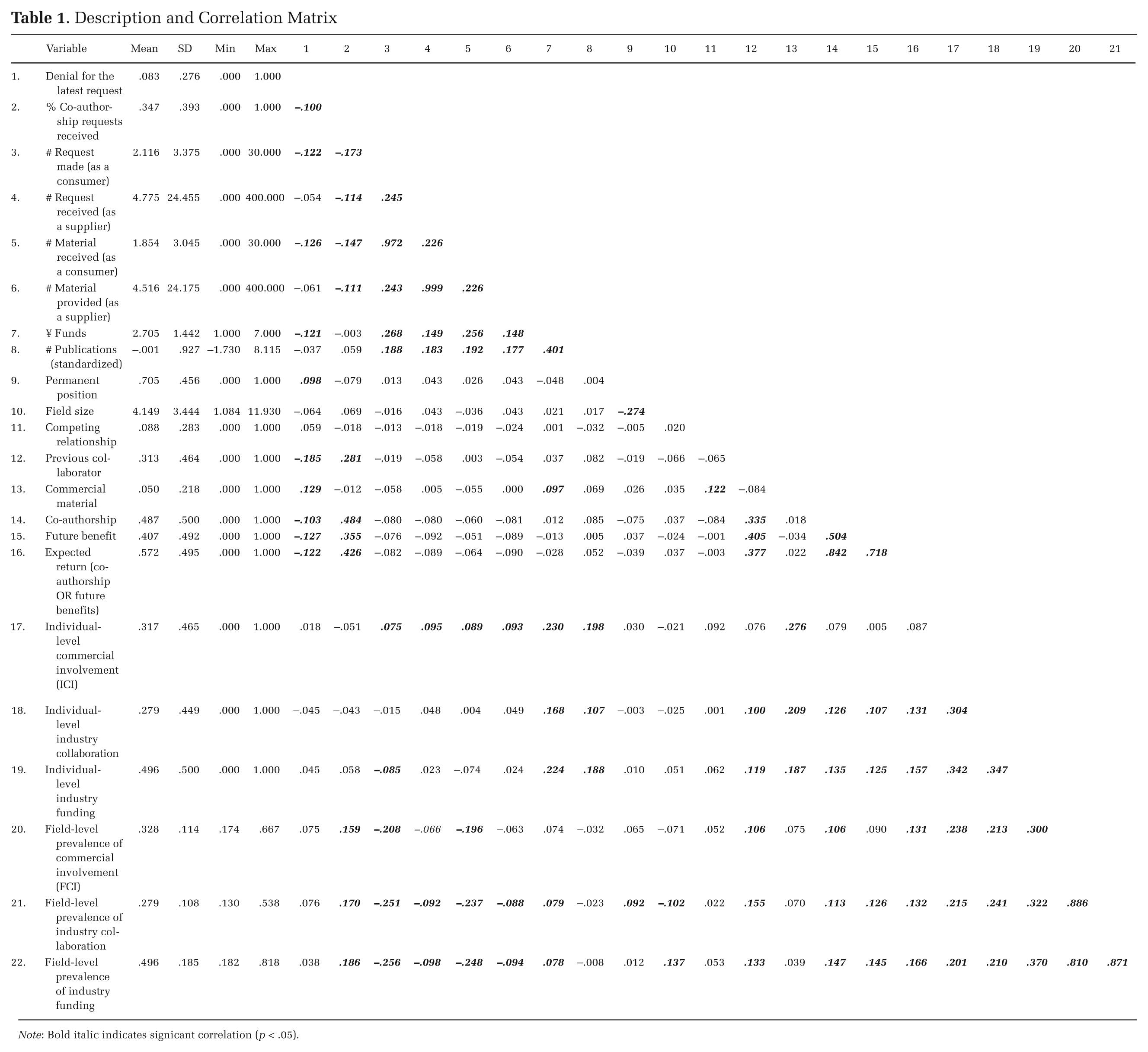
Note: Bold italic indicates signicant correlation (p < .05).

Frequency and Denial of Material Transfer Requests
As for entrepreneurial activities, 32 percent of respondents were engaged in at least one form of commercial activity in the two years 2007 and 2008: negotiations with industry over their IP rights (29 percent), founding startups or marketing new technologies (8 percent), or out-licensing of their technologies (9 percent). In addition, 50 percent of respondents received industry funds (on average, industry funds accounted for 12 percent of total research expenses), and 28 percent collaborated with industry. Figure 2 shows the three field-level measures for prevalence of academic entrepreneurship, which are highly correlated (r ≈ .9). Analyses of variance (ANOVA) indicate all these variables differ significantly across fields (p < .01). Academic entrepreneurship is common in medical engineering, molecular biology, and material chemistry but relatively rare in basic biology and agricultural science.

Field-Level Prevalence of Academic Entrepreneurship
Impact of Academic Entrepreneurship
Probability of denial by exchange forms
Our first hypothesis is that compliance with requests for generalized exchange should be lower in fields with higher levels of academic entrepreneurship, even among scientists who are not entrepreneurially active. Our second hypothesis is that the sharing decision is more strongly affected by exchange forms when academic entrepreneurship is high. To test these hypotheses, we ran logit regressions predicting denial of the latest request for material transfer (see Table 2). 16 First, we used expected return as a broad measure of direct exchange. Among the three measures of academic entrepreneurship, only results for commercial involvement are featured in Table 2 because the other two show the same pattern. We controlled for number of materials received (as a consumer), number of requests received (as a supplier), research funds, number of publications, permanent position, and field size. Regarding sharing conditions, we also controlled for whether the consumer was a direct scientific competitor, whether the consumer was a previous collaborator, and whether the requested material was directly related to the supplier’s commercial activities.
Logit Regressions Predicting the Probability of Denial for the Latest Request

Note: Unstandardized coefficients and robust standard errors (parentheses). Model 5 excludes cases where a request was made by a previous collaborator, so previous collaborator is dropped from the regression. Model 6 excludes respondents involved in commercial activities, so ICI and commercial material are dropped.
p < .10; * p < .05; ** p < .01; *** p < .001 (two-tailed tests).
Model 1 shows results with control variables and individual-level commercial involvement (ICI), similar to prior models (Campbell et al. 2002; Walsh et al. 2007). We find that ICI has a positive, but not significant, effect on denial of requests for sharing. In Model 2, we add field-level commercial involvement (FCI). Both individual and field-level commercial involvement show insignificant positive coefficients.
These models mix generalized and direct exchange. To examine the denial likelihood for each exchange form, Model 3 adds the interaction term between FCI and expected return. The significantly positive coefficient of FCI (b = 4.833, p < .1) indicates that higher FCI leads to a higher denial probability when no return is expected (i.e., generalized exchange). This supports Hypothesis 1. When return is expected (i.e., direct exchange), higher FCI results in a lower probability of denial (b = −4.968, p < .05). 17 For better interpretation of the nonlinear interaction model (Wiersema and Bowen 2009; Zelner 2009), Figure 3A illustrates the probability of denial with and without return over the observed range of FCI. The expectation of a return (direct exchange) has a bigger impact as commercial involvement becomes more prevalent. To examine the statistical significance of the effect of reciprocity, Figure 3B shows the difference between the two curves in Figure 3A along with a 95 percent confidence interval. It indicates that the difference of denial probabilities is not significantly different from zero at low FCI, but it turns significantly greater than zero when FCI exceeds about 35 percent (slightly above the mean). These results suggest that the advantage of direct exchange (over generalized exchange) increases with field-level prevalence of academic entrepreneurship, supporting Hypothesis 2.

Denial Probability with Field-Level Academic Entrepreneurship

Difference in Denial Probabilities
Thus far, ICI does not show a significant effect. To further examine its effects, Model 4 incorporates the interaction between ICI and expected return. Although the interaction effect is weakly positive (b = 1.875, p < .1), further analyses indicate it is not significant. 18 Thus, individual-level involvement alone does not change the likelihood of sharing or the impact of reciprocity.
We also find that previous collaboration strongly decreases denial probability in all models. Because the sharing norm is supposed to apply beyond one’s direct network ties, we ran the same regression excluding cases involving previous collaborators, and we found qualitatively similar results (Model 5). Likewise, we also ran the regression limiting the sample to scientists not involved in commercial activities (Model 6). This shows a similar result, but the focal effects turn insignificant (perhaps due to decreased power of the test). In addition, all models show negative coefficients for number of materials received, suggesting that prior receiving encourages material transfer, as expected for generalized exchange.
To distinguish the two types of direct exchange, we also tested effects of co-authorship (negotiated exchange) and expectations for future benefits (reciprocal exchange) separately (see Table S1 in the online supplement [http://asr.sagepub.com/supplemental]). Figure 3C indicates that the denial probability is substantially lower when co-authorship is offered under higher FCI. When only future support is expected, the denial probability is not as low as when co-authorship is offered. This suggests scientists prefer negotiated exchange to reciprocal exchange under highly entrepreneurial conditions.

Denial Probabilities for Different Types of Return
Proportion of direct exchange-based transactions
Next, to examine more directly the shift in exchange forms, we estimated effects of field-level commercial involvement (FCI) on the proportion of direct exchanges among all completed exchanges. As a medium of direct exchange, we focused on co-authorship for its importance in material transfer. In Table 3, we test whether the percentage of direct exchange (versus generalized) increases as FCI grows (Hypothesis 3). We used hierarchical linear modeling (HLM) regressions. 19 Model 1 includes individual commercial involvement (ICI) and Model 2 adds FCI. Model 1 shows that ICI is not significantly associated with the proportion of direct exchange, and Model 2 indicates that FCI increases the proportion of direct exchange (b = .562, p < .05). This supports Hypothesis 3. When the percentage of commercially active scientists increases by 10 percent, direct exchange transactions increase by 5.6 percent. For the subsample of scientists who were not commercially active, Model 3 still shows a significantly positive coefficient for FCI (b = .612, p < .1), suggesting entrepreneurship prevalence has fieldwide effects.
HLM Regressions Predicting the Percentage of Co-authorship Requests Received

Note: Unstandardized coefficients and standard errors (parentheses).
p < .10; * p < .05; ** p < .01; *** p < .001 (two-tailed tests).
Overall transactions
To examine how entrepreneurship affects overall quantity of transactions (Hypothesis 4), we regressed total number of requests on ICI and FCI (see Table 4). Models 1, 2, and 3 show requests made by respondents (as consumer), and, as a robustness check, Models 4, 5, and 6 show requests received (as supplier). We used the logarithm of request counts to address the skewness of requests. 20 We employed HLM regressions with individuals nested in fields. 21 We controlled for research funds, publications, permanent contract, and field size. Model 1 shows that ICI is associated with making more requests, which might imply complementarities between commercial and scientific activities at the individual level (Breschi, Lissoni, and Montobbio 2007). Model 2 shows a significantly negative effect of FCI on number of requests made (b = −2.040, p < .001), consistent with Hypothesis 4. A 10 percent increase in FCI results in an 18 percent decrease in requests made. Model 3 shows that this result holds for scientists who are not commercially active. For the supplier side (requests received), Models 4, 5, and 6 show the same patterns. Model 5 indicates a significantly negative effect of FCI (b = −1.940, p < .01), implying that a 10 percent increase in FCI leads to an 18 percent decrease in requests received. This result holds even when we exclude commercially active scientists (Model 6). We thus have strong support for Hypothesis 4: a high level of entrepreneurship leads to fewer sharing attempts.
HLM Regressions Predicting the Number of Requests
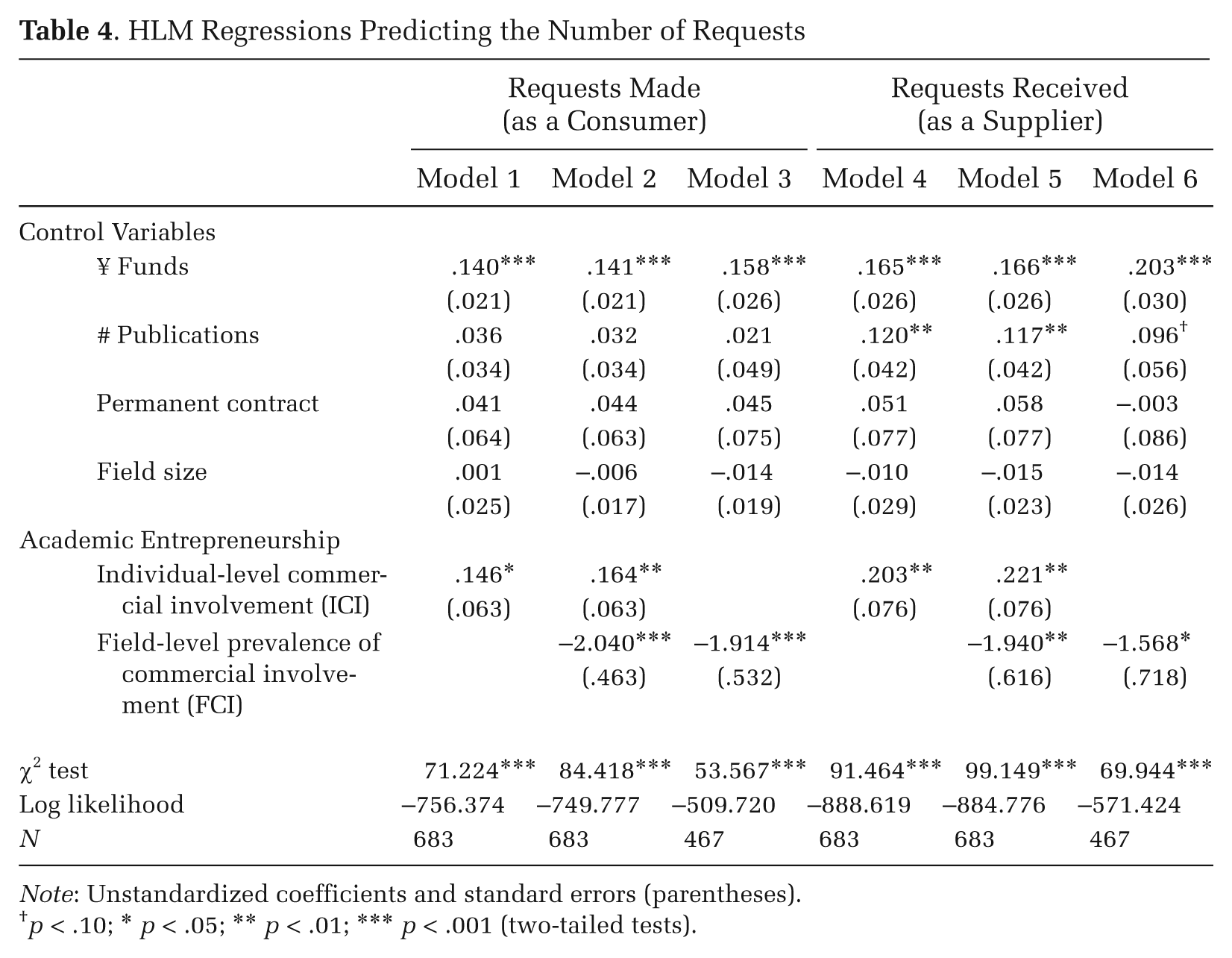
Note: Unstandardized coefficients and standard errors (parentheses).
p < .10; * p < .05; ** p < .01; *** p < .001 (two-tailed tests).
We also ran the same models with number of requests fulfilled as the dependent variable (see Table S2 in the online supplement). Results show a similar pattern to Table 4. In summary, these results imply that a high prevalence of academic entrepreneurship decreases the total number of material transfer transactions.
Alternative Explanations
Because our analytic strategy depends on differences across fields to test effects of academic entrepreneurship, our results might be due to other factors that vary by field and happen to correlate with entrepreneurship. We examined several rival explanations. First, results could be driven by differences in types of materials shared in each field. 22 To test this, we re-ran our regressions, respectively excluding the subsample of materials science, clinical science, pharmaceutical sciences, and medical engineering, which our interviews suggested might use special types of materials, and we obtained similar results. We also asked about characteristics of requested materials, such as scarcity, reproducibility, and ease of preparation, which might affect willingness to share. When these measures were included, our results were unaffected. Thus, the findings do not seem sensitive to material types.
We also considered other field characteristics. We controlled for (domestic) field size in the regressions, because size could affect sanctioning mechanisms and normative structure. In addition, we controlled for field globalization (proportion of publications in each field co-authored with foreigners), and results were not affected. We considered scientific competition, which might affect willingness to share or preference for direct exchange (Hong and Walsh 2009). However, our survey measure did not show significant difference in competition across fields. Although we cannot rule out the possibility that our results might be driven by unmeasured heterogeneity across fields, our results were largely unaffected when we controlled for material and other field characteristics.
Finally, although we assume prevailing entrepreneurship has affected norms and exchange forms, the opposite explanation is possible. That is, some fields may have had weaker sharing norms, and it might be those fields that most readily adopted academic entrepreneurship. To examine this, we tested our hypotheses splitting the sample into two generations: the older generation who experienced the regime transition late in their careers, and the younger generation who experienced the transition early in their careers. In terms of denial probability, we found greater effects of FCI for the younger generation than for the older generation (see Table S7A in the online supplement). For exchange forms, we found no significant generation difference (see Table S7B, Model 1, in the online supplement), but number of requests made and number of materials provided decreased more strongly with FCI for the younger generation (Models 2 and 3, respectively). Overall, results imply that younger scientists, who should be more sensitive to the regime shift, are more strongly influenced, consistent with our proposed causal order.
Discussion and Conclusions
Figure 4 summarizes our results. We find that, in highly entrepreneurially active fields compared to less entrepreneurially active fields, (1) the likelihood of denial for generalized exchange-based sharing increases, and the likelihood of successful exchange becomes more tied to direct exchange offers; (2) the proportion of direct exchange-based sharing increases; and (3) the total number of requests declines. In other words, differences in prevalence of field-level entrepreneurial activity are associated with differences in the rates and forms of sharing. Going beyond prior literature that focuses on antinormative behavior of entrepreneurially active scientists (e.g., Campbell et al. 2000; Walsh et al. 2007), this study suggests a general shift in norms that affects even scientists who are not themselves entrepreneurially active.

Transition of the Forms and Compliance of Sharing
Our results address key debates in the sociology of science. Prior literature, building on general discussions of scientific norms (Merton 1973), suggests the normative structure can be affected by contextual factors such as historical period, organizational environment, and policy designs (Blume 1974; Hackett 1990). Much of the prior work emphasizes organizational contexts as a key determinant of norms (e.g., Fox and Mohapatra 2007; Long and McGinnis 1981), but this study focuses on field-level contexts. In particular, changing policies and growing emphasis on entrepreneurship at the field level affect scientists’ research material sharing even when they are not directly engaged in entrepreneurial activities. These findings suggest scientific norms are contingent on the context of scientific fields. More importantly, rather than simply arguing that academic entrepreneurship is associated with a divergence from Mertonian norms, this study shows a shift from unconditional sharing (generalized exchange) toward return-based sharing (direct exchange), which more closely resembles transactions in a market economy. This shift of exchange forms is consistent with the concept of hybridization of industry and open science norms (Murray 2010; Owen-Smith 2003).
These findings suggest the science system can adapt to changing contexts. Further work is needed to see if this new form of sharing is sustainable. Overall decline in transactions, and problems of direct exchange in a system of vast inequality, suggest this direct exchange-based sharing system may reduce overall access to scientific materials, particularly among scientists who are not able to offer valuable resources in exchange. The rise of direct exchange may not simply increase publication inequality, but might limit whole research domains to elite scientists who can pay the admission fee with materials or high-quality co-authorships to trade. That is, scientists who are not in a position to offer valuable resources in exchange might be cut off from the exchange network, potentially extending the bases of inequality in science (Allison and Stewart 1974; Han 2003; Hermanowicz 2009). The result may be a significant shift in the underlying structure of inequality from one based on quantity (of inputs and outputs) to a qualitative one based on access to materials specific to particular research questions. Scientists in the middle and lower tiers may find themselves cut off from participation in current research domains that depend on access to recently produced materials from others’ labs, generating new channels for accumulative advantage (Allison and Stewart 1974). Requiring direct exchange for material access could lead to a balkanization in science, undermining some of the overlaps in research aspirations and participation across tiers of universities observed in prior work in the sociology of science (Hermanowicz 2009).
This study, drawing on theories of social exchange and social dilemmas, frames the results in terms of deteriorating conditions for generalized exchange and greater reliance on direct exchange. Although social exchange literature has intensively compared different forms of exchange (e.g., Lawler, Thye, and Yoon 2008; Molm 1994), few studies have examined their transition (Cheshire et al. 2010). This study does not directly test this transition, but it does offer field data that can expand this agenda. In a setting where both direct and generalized exchange are available, manipulations that undermine norms underpinning generalized exchange can produce a shift to direct exchange (even in a case where this would be suboptimal from a social welfare perspective). Future research should test these findings in more rigorous settings, to see which of the posited mechanisms (e.g., monitoring, uncertainty, or normative structure) is most important for the shift of exchange forms (Cheshire et al. 2010).
Future work could develop our findings in several respects. First, various forms of academic cooperation should be investigated, such as data sharing and discussing ongoing research, as these may have different drivers and respond differently to changing contexts (Blumenthal et al. 2006; Haeussler et al. 2009). Second, although we focus on norms measured at the field level as a determinant of cooperation, norms affect the values of individual scientists, and vice versa (Glenna et al. 2011). Examining individual-level values would thus allow us to understand the normative and behavioral shift at a higher resolution. Third, this study draws on scientists in Japanese universities. The Japanese science system is well integrated into the global arena, and the level of entrepreneurial activity is similar to that in the United States (Walsh et al. 2007). The frequency of sharing is comparable to U.S. counterparts, and the denial probability is similar to that of the United States 10 years ago (Walsh et al. 2007), consistent with Japan’s later adoption of pro–academic-entrepreneurship policies. Observing sharing behavior soon after the new regime was institutionalized provides a window on how scientists are reacting to the new context. Nevertheless, because local contexts are important for understanding scientists’ behavior (Hackett 1990), comparative studies across institutions and countries are needed. In particular, although the decline of generalized exchange seems consistent with observations in other countries, the shift toward direct exchange might be related to underlying culture (Yamagishi et al. 1998) and should be investigated in different contexts. Fourth, given our cross-sectional data, we cannot rule out the possibility of the opposite causality, that underlying differences in scientific norms influenced the adoption of academic entrepreneurship. Mowery and colleagues (2001) argue that academic entrepreneurship was driven by underlying science (e.g., the biotech revolution in life science) and general policies, suggesting that entrepreneurship differences were not the result of prior normative differences, and our empirical analyses of cohort differences are consistent with this interpretation. Still, more work is needed to confirm the direction of the causality.
In conclusion, our results suggest that growing emphasis on academic entrepreneurship may have adverse effects on materials sharing, even among scientists not directly engaged in entrepreneurship. These changes are associated with changes in exchange forms, with greater emphasis on direct exchanges rather than the generalized exchange recommended by scientific communities. These results reflect contradictions inherent in current science policies that simultaneously exhort scientists to freely share their results as well as exploit the commercial potential in their findings. The resulting shift to direct exchange suggests that scientific norms are contingent on institutional contexts. Future work is needed to develop our understandings of the drivers of the normative structures of science and their implications for social exchange and sociology of science.
Footnotes
Acknowledgements
We are grateful to Waverly W. Ding, Mary Frank Fox, Aldo Geuna, Carolin Häussler, Pam Popielarz, and Nobuyuki Takahashi for their insightful and critical comments. We are also thankful to the ASR reviewers and editors for helping us improve the article significantly. We appreciate all the interviewees and respondents to our survey. Hideaki Takeda at the National Institute of Informatics and Motoki Sekine at the Japan Science and Technology Agency kindly provided us with databases of Japanese scientists. Asako Chiba gave us technical support.
Authors’ Note
Supplementary results and the questionnaire (in English and Japanese) are available on the corresponding author’s website (http://www.prism.gatech.edu/~jwalsh6/JPNorms.html) and ASR’s website ( ).
).
Funding
This study is partly supported by a Postdoctoral Fellowship for Research Abroad of the Japan Society for the Promotion of Science (to Shibayama); Grant-in-Aid for Scientific Research (B) Program (#17330082) from The Ministry of Education, Culture, Sports, Science and Technology (MEXT) of Japan (to Baba); and a fellowship from the International Center for Economic Research (Turin and Prague) (to Walsh).
Notes
References
Supplementary Material
Please find the following supplemental material available below.
For Open Access articles published under a Creative Commons License, all supplemental material carries the same license as the article it is associated with.
For non-Open Access articles published, all supplemental material carries a non-exclusive license, and permission requests for re-use of supplemental material or any part of supplemental material shall be sent directly to the copyright owner as specified in the copyright notice associated with the article.
