



Abstract
Competing visions of who is deserving of rewards and privileges, and different understandings of the fairness of reward allocation processes, are at the heart of political conflict. Indeed, social movement scholars generally agree that a key component of most, if not all, social movements is a shared belief that existing conditions are unfair and subject to change (Gamson 1992; McAdam 1982; Snow et al. 1986; Turner and Killian 1987). In this article we consider the role that residential segregation by education level plays in shaping perceptions of distributive justice and, in turn, providing a context conducive to conservative political mobilization. We apply these ideas in an analysis of Tea Party activism and show that educational segregation is a strong predictor of the number of Tea Party organizations in U.S. counties. In a complementary analysis, we find that individuals with a bachelor’s degree are more likely than people who do not have any college education to support the Tea Party; this relationship is strongest in counties with higher levels of educational segregation.
If politics is about “who gets what, when, and how” (Lasswell 1936), then those who engage in politics on behalf of the relatively prosperous have some explaining to do. Because democratic political institutions provide opportunities for the disadvantaged to fight for a greater share of societal resources, individuals seeking to protect their advantages have an incentive to try to convince others that their privileged position has been earned through hard work and superior talent, and that programs and policies designed to redistribute wealth are inherently unjust (Gaventa 1982; Jackman 1994). Indeed, political mobilization, to a great extent, involves battles over distributive justice. Organizations representing the interests of oppressed or disadvantaged groups argue that their constituencies are being treated unfairly (Gamson 1992; Snow et al. 1986); those who resist such efforts are typically defending a reward system from which they benefit (McVeigh 2009; Tilly 1978).
Perceptions of distributive justice are the product of social construction processes and are dependent, to a great extent, on the social context in which people are embedded. In this article, we are particularly interested in examining how residential segregation in local contexts that is based on education levels may influence political action focused on the government’s role in redistribution of wealth. This interest is rooted in our recognition of how other forms of segregation have implications not only for group access to valued resources, but also for how inequality is perceived and acted on. For example, the role of racial segregation in sustaining racial inequality has been well documented. Racial segregation can restrict minority group members’ access to jobs and quality schooling (Massey and Denton 1993; Quillian 2012; Wilson 1987), and it is implicated in how minorities are depicted in political, scholarly, and public discourse. Massey and Denton (1993), for example, point out that people who explain racial inequality in terms of a culture of poverty (e.g., Miller 1958) are blaming the victim, and failing to consider the ways residential segregation, rather than inherent cultural deficiencies, impedes social mobility. Racial segregation restricts group access to valued resources, and it can also facilitate the development of racial stereotypes that members of majority groups use to justify their advantages. If minority group members appear to be at fault for their disadvantaged position, conservatives may characterize government efforts to promote racial equality as both unwise and unfair (Hunt 1996; Kluegel and Smith 1986). 1
These segregation outcomes are not confined to racial inequality. Social psychological work in the status generalization (e.g., Cook 1975) and status construction (Ridgeway 1997) traditions suggests that segregation can contribute to a vicious cycle that perpetuates inequality. Segregation can contribute to inequality by denying members of one group access to valued resources. The ensuing inequality, in turn, provides evidence for dominant group members of the “natural” basis of group differences (Brezina and Winder 2003). We know, for example, that occupational sex segregation not only restricts women’s access to economic resources (England, Thompson, and Aman 2001; Jacobs 2001; Petersen and Morgan 1995) but also influences beliefs about women’s capabilities and aptitudes. As Ridgeway (1997) points out, frequent interaction between men and women who are status-distant can reinforce traditional beliefs about gender roles held by both men and women.
The recent rise of the Tea Party movement in the United States provides us with a unique opportunity to examine political mobilization that is directly engaged in core debates about government’s role in redistribution of wealth. Postel (2012:33) argues that the Tea Party’s “moral center” is the free market, and the Tea Party, for the most part, celebrates the achievements of those who have succeeded. At the same time, he adds, Tea Party views about the poor harken back to arguments of Social Darwinists “who believed that any social policy to protect the poor or address the gaping social inequalities of the Gilded Age violated the allegedly natural order of laissez-faire economics.” Similar to how racial segregation shapes perceptions of racial inequality, and occupational sex segregation shapes perceptions of gender inequality, we consider the possibility that residential segregation of the highly educated may facilitate mobilization of a social movement, such as the Tea Party, that opposes redistribution of wealth to society’s less prosperous citizens.
Political conflict over the government’s role in redistribution is rooted in competing visions of how people achieve economic success. As Schlozman, Verba, and Brady (2012) point out, Americans are somewhat unusual when compared to citizens of other nations in terms of the faith they place in education for achieving not only individual mobility but also fair and equitable economic outcomes. As these authors express it, “not only do Americans believe that equality of opportunity should exist, they believe that equality of opportunity does exist” (Schlozman et al. 2012:60). Yet, as research consistently shows, educational attainment is strongly influenced by parental affluence (Blau and Duncan 1967; Schlozman et al. 2012). Although optimistic views in regard to equal opportunity are broadly held in the United States, these views vary significantly across social groups and, we expect, across local settings that display variation in how educational differences structure social life. This variation provides very different contexts for mobilization of a movement such as the Tea Party that strongly advocates a limited role of government in dealing with social inequality.
Rise of the Tea Party
In January 2009, Barack Obama assumed the presidency as the U.S. economy was sinking into the most severe recession since the great depression of the 1930s. Because the crisis began during a Republican president’s administration, news of failing banks, a failing auto industry, government bailouts, a disastrous housing market, and rising unemployment rates made voters receptive to Obama’s message of hope and change (Scotto, Clarke, and Kornberg 2010). Obama’s honeymoon was short-lived, however. Many Americans soon became impatient with the Democratic administration’s progress in dealing with the crisis and a “Tea Party” movement opposing Obama’s agenda quickly emerged. Tea Party activists generated broad support for fiscal conservatism at a time when many Americans were seeking relief from economic hardship and insecurity.
Tea Party activists staged well-attended rallies and proved adept at capturing free publicity via media attention (Boykoff and Laschever 2011; Williamson, Skocpol, and Coggin 2011). In town hall meetings with congressional representatives across the nation, and in numerous other venues, Tea Party activists vociferously opposed the Obama administration’s attempts to expand health care coverage. In 2010, the Tea Party flexed its muscle by backing congressional candidates who toed the Tea Party line—a strategy that proved most successful when electing candidates to the House of Representatives who served relatively homogeneous constituencies (Miller and Walling 2012; Williamson et al. 2011). A congressional Tea Party Caucus formed in July 2010, consisting of approximately 60 members of the House of Representatives and four U.S. Senators. Republican legislators and politicians gearing up for a run at the presidency in 2012 sought to curry favor with Tea Party constituents to shore up their conservative base of support (see Miller and Walling 2012).
In a recent book about the movement, Skocpol and Williamson (2012:202) comment admiringly on the energy that Tea Party activists bring to civic participation, but they express deep concerns about a form of participation that is highly polarizing and based on misinformation propagated by Fox News and other powerful media outlets: “Tea Partiers’ factually inaccurate beliefs about many policy matters are particularly striking given their relatively high levels of education and overall savvy about the political process.” While Tea Party members and adherents tend to support some government programs, such as Social Security and Medicare, they strongly oppose programs they believe will redistribute wealth and resources to individuals they perceive as undeserving (Skocpol and Williamson 2012).
The Tea Party is notable for presenting itself as a grassroots populist movement representing the interests and values of ordinary Americans, while being heavily dependent on resources provided by elite sponsors acting on behalf of large business corporations (Parker and Barreto 2013; Skocpol and Williamson 2012). Indeed, some pundits and scholars call the Tea Party an “Astroturf movement,” suggesting the grassroots populist image is merely a sham deliberately constructed by the business elite and conservative news outlets (e.g., see DiMaggio 2011). Although it seems clear the media has exaggerated the movement’s grassroots aspects, recent research indicates it would be misleading to overlook the importance of local organizing. Especially in the early stages of the movement’s growth, researchers have had little trouble locating “real” Tea Party activists who were engaged in meetings and organizational activity in their communities (Braunstein 2014; Fetner and King 2011; Perrin et al. 2011; Rafail et al. 2011; Skocpol and Williamson 2012).
Based on their ethnographic research, Skocpol and Williamson (2012:80) note that Tea Party activists show deep suspicion toward liberals: “Regulations supported by liberals are perceived as a foreign moral code, an imposition of un-American ideals.” Indeed, Tea Party supporters tend to view their opponents as inhabiting a different world, and they overestimate the extent to which others share their ideals (Braunstein 2014). In a New York Times/CBS News poll administered in April 2010, 84 percent of self-declared Tea Party supporters said they thought the Tea Party movement reflects the views of most Americans. In the sample as a whole, only 25 percent expressed that belief. Zernike (2010:146) describes Tea Party activists as residing in an “echo chamber,” embedded in social networks that reinforce their beliefs and convictions. We expect this type of reinforcement of a worldview can result from living in segregated communities that impose constraints on the formation of social ties that might provide alternative perspectives on political issues (Baldassari and Bearman 2007; Blau 1977). Before developing this argument further, we first consider the nature of conservative mobilization more generally.
Economic and Status-Based Threat
While most Americans experienced at least some economic hardship due to the recession, economic hardship is not a primary motivating factor for Tea Party adherents (Fetner and King 2011). Tea Party supporters strongly oppose government relief efforts and instead advocate deficit reduction (Zernike 2010). The April 2010 New York Times/CBS poll reveals that Tea Party supporters were faring better than most Americans during the recession. Only 6 percent reported being temporarily out of work (compared to 15 percent in the sample as a whole), and Tea Party supporters also tend to be older, wealthier, and more highly educated than the average American. These differences are even more pronounced among Tea Party activists (as opposed to those who merely claim they support the movement’s goals). Skocpol and Williamson (2012:23) report that “nearly all” activists they met during their field work had at least some college education.
Researchers studying conservative movements often argue that incentives to mobilize are rooted in emerging threats to constituents’ interests (Almeida 2003; Goldstone and Tilly 2001; Olzak 1992; Tilly 1978; Van Dyke and Soule 2002) or declining power in economic and political exchange (McVeigh 2009). At a general level, it seems clear that Tea Party activists and supporters are reacting against a perceived threat to their interests resulting from the election of a Democratic president in the midst of a severe recession. As the economy went into decline, Tea Party activists expressed anger about government bailouts of banks and failing industries, government spending programs designed to stimulate the free falling economy, and the Obama administration’s expansion of health care coverage. They expressed grave concerns about the growing national debt and sensed that government spending involved redistribution of their tax dollars to others undeserving of special treatment (Williamson et al. 2011).
Although it is clear that Tea Party supporters are partly motivated by a threat to their economic interests, many Americans in similar economic circumstances do not support, and even strongly oppose, the movement. Some scholars have sought to explain conservative mobilization as a reaction to a threat to constituents’ status and cultural values. Tea Party activists seek to portray their conservative agenda not only as sound economic policy, but also as being inspired by the Founding Fathers’ vision for the United States. Opponents’ ideas are dismissed as anti-American and socialistic (Braunstein 2014; Skocpol and Williamson 2012). Not only do Tea Party supporters overwhelmingly disapprove of President Obama’s handling of the economy, the vast majority (75 percent, according to the April 2010 New York Times/CBS News Poll) also believe Obama does not share “the values most Americans try to live by.” Indeed, only a minority of Tea Party supporters in the poll (41 percent) acknowledged that Obama was born in the United States, and 92 percent said they thought Obama’s policies are moving the country toward socialism (Zernike 2010).
These kinds of suspicions and assertions may lead scholars to focus on the seemingly irrational aspects of the movement. Perhaps Tea Party supporters are not really committed to fiscal conservatism but are instead motivated by resentment and perceived threats to their status embedded in progressives’ aspirations for “hope and change.” Writing in the 1960s, Hofstadter (1964) condemned what he viewed as “the paranoid style” in U.S. politics, commonly practiced by right-wing movements of the day. This paranoid style, he argued, was rooted in a sense, held by some segments of society, that modernization was undermining and displacing their values and their way of life. Similarly, Gusfield’s (1963) status politics theory proposed that conservative moral reform movements reflect a form of status substitution embraced by members of the old middle class who are falling behind in the modernizing economy. Rather than directly addressing their economic grievances, they respond by seeking to gain recognition of the superiority of their group’s lifestyle and values.
Beisel (1997), however, criticizes the old status politics arguments for imposing a radical separation of class and status interests when seeking to explain conservative movements. The Tea Party, above all, advocates a conservative economic agenda, and supporters are incensed about policies and programs they believe will exacerbate budget deficits and will require them to pay taxes to support people they perceive as undeserving. Yet these economic arguments are embedded in a shared cultural vision about what it means to be an American and a good citizen. To understand how economic interests and values combine, as we argue in the next section, it is essential to give close attention to the structural context for mobilization.
Educational Segregation and Distributive Justice
Tea Party activists perceive the Obama administration’s policies as threatening their interests and at odds with ideals laid out by the nation’s Founding Fathers. Yet individual discontent often fails to result in collective action, and the majority of Americans, many of whom are similar to Tea Party supporters in many other respects, do not support the movement or its goals. Indeed, a recent Gallup Poll found that 47 percent of Americans have an unfavorable view of the Tea Party, and only 33 percent have a favorable view (Gallup April 8, 2011). Moreover, many who are sympathetic to the movement’s goals may not be sufficiently motivated to pay the costs associated with participation in collective action when they could instead free ride on others’ efforts (Olson 1965).
The emergence of collective action, of course, does not require participation from all who are sympathetic to a movement’s goals. Instead, collective action requires the emergence of a critical mass of highly motivated activists who can provide the resources needed to sustain organized activity (Marwell and Oliver 1993; Oliver and Marwell 1988). Oliver and Marwell’s (1988) work draws attention to how spatial distribution of individuals with both means and motive to provide a collective good can affect the emergence of collective action. Communication, and the capacity to identify who might contribute, for example, is enhanced by density of network ties among people who share a common interest (Marwell, Oliver, and Prahl 1988; see also Button, Rienzo, and Wald 1997). Spatial concentration of the highly educated should be particularly relevant for social movement activism. The Tea Party is not unique among social movements in terms of having an overrepresentation of individuals with college education among its activists. As Verba, Schlozman, and Brady (1995:305) note, education enhances participation in civic and political activity “more or less directly by developing skills that are relevant to politics—the ability to speak and write, the knowledge of how to cope in an organizational setting” (see also Nie, Junn, and Stehlik-Barry 1996).
While the spatial concentration of the highly educated facilitates interaction and communication among people most likely to possess organizational skills, we expect that educational segregation also provides a favorable context for Tea Party mobilization because it shapes perceptions of economic inequality and of who is deserving of government support. Bartels (2008) shows that economic inequality has increased dramatically in recent decades—particularly during periods when Republicans occupied the White House—but citizens’ perceptions of inequality poorly track objective conditions. Americans often express egalitarian sentiments, yet as Bartels (2008:27) describes it, “egalitarian impulses are likely to gain real political traction only when citizens perceive contradictions between egalitarian ideals and social realities.” Scholars who study distributive justice remind us that the vast majority of Americans do not believe that inequality, in and of itself, is illegitimate (Berger et al. 1972; Homans 1961; Jasso 1980). Instead, Americans tend to evaluate the fairness of the distribution system in existential terms, based on factors widely understood to be key determinants of individual placement within the class structure (Berger et al. 1972; Shepelak and Alwin 1986).
Inequality resulting from educational differences tends to be viewed as legitimate because it is seen as reflecting differences in skills and work ethic (Bobo and Kluegel 1993; Kelley and Evans 1993). Similarly, Bourdieu (1974:32) argues that educational credentials legitimize income inequality, identifying education as “one of the most effective means of perpetuating the existing social pattern, as it both provides an apparent justification for social inequalities and gives recognition to the cultural heritage, that is, to a social gift treated as a natural one.” If economic rewards are perceived simply as reflecting varying skills and training, and if access to that training is understood to be available to all, then government programs designed to aid society’s less fortunate (e.g., the unemployed, the under-employed, those lacking access to quality health care, or the working poor) may provoke anger from people who think they are being asked to sacrifice on behalf of the undeserving.
The proportion of Americans earning a college degree has increased over time, but most Americans have not graduated from college. Recent Census data show that just over 70 percent of Americans age 25 and older do not have a four-year degree. These figures vary substantially across local settings, however. When examining variation across U.S. counties, the percentage earning at least a bachelor’s degree ranges from a low of 4.5 percent to a high of 69.6 percent. Moreover, counties vary substantially in terms of residential segregation of the highly educated. Due to segregation, college graduates may have very limited contact in their daily lives with individuals who have not graduated from college. Similarly, people without a college degree may have little contact with college graduates. These differences, we expect, can lead to substantial variation in individuals’ perceptions about access to higher education, which in turn can influence perceptions of the fairness of redistributive policies. Educational segregation can reinforce preferences for homophily in social relations, resulting in misperceptions about the ease of access to higher education, and generating resentment toward “outsiders” who are making claims on the government that are at odds with “insiders’” worldview (see, e.g., Baldassari and Bearman 2007; Blau 1977; McPherson, Smith-Lovin, and Cook 2001).
We also consider how educational segregation may combine with other community attributes to reinforce perceptions that redistributive policies are either unnecessary or unfair. One factor to consider is income inequality. Income inequality could potentially generate broad support for redistributive policies (given that wealth is concentrated in the hands of the numerical minority), yet segregation of the highly educated from other county residents could increase the likelihood that inequality is interpreted as a natural and just outcome, simply reflecting different levels of skill and ambition. We also consider how local economies differ in terms of average economic returns gained through higher education. Some local economies have a high demand for skills acquired through higher education, creating a situation in which economic inequalities are tightly linked to differences in educational attainment. These conditions, in combination with educational segregation, should reinforce perceptions that inequality simply reflects a fair and just return to differences in skills and ambition, increasing the likelihood that a critical mass of activists will emerge to resist redistributive economic policies.
Political Partisanship, Race, and Religion
To assess the relationship between educational segregation and Tea Party activism, it is essential to control for other features of local settings that could facilitate Tea Party support. Political partisanship is perhaps the most important factor in this regard. Indeed, the Tea Party rose in direct opposition to President Obama and his policy agenda (Skocpol and Williamson 2012). Political partisanship can act as a lens through which individuals interpret a broad range of issues (Aldrich 2011; Campbell et al. 1960; Green, Palmquist, and Schickler 2002), and the Tea Party’s focus on reduced government spending and lower taxes should resonate most strongly in Republican strongholds where voters believe that conservative economic policies will benefit them as individuals and stimulate economic growth more generally.
The Republican Party, of course, represents voters on a range of issues that extend beyond opposition to high taxes and deficit spending. Responding to significant backlash to civil rights gains in the 1960s, the national Republican Party appeals to many white voters within and outside the South who oppose affirmative action and other policies designed to facilitate racial equality (Carmines and Stimson 1989). Similarly, the Republican Party attracts religious conservatives by taking conservative stances on social issues such as abortion and gay rights (Oberschall 1993). Some scholars argue that Tea Party activists are motivated, at least in part, by a desire to protect white privileges (Disch 2012; Parker and Barreto 2013), while others note that the movement seems to appeal particularly to evangelical Protestants (see, e.g., Montgomery 2012). One might thus expect that the Tea Party would find fertile recruiting ground in predominantly Republican areas, where the population is mainly white, and where evangelical Protestants make up a sizeable share of the community. However, even after taking these and other community factors into account, we expect to find that educational segregation strongly influences Tea Party mobilization.
Data and Methods
Given our interest in local context and the distribution of the highly educated within local contexts, we examine variation in the number of Tea Party organizations across U.S. counties. 2 Counties, as units of analysis, provide us with considerable comparative leverage, in that we are able to use a total of 3,106 cases. A focus on counties allows us to examine variation in the structuring of social relations that individuals experience in their immediate surroundings. A state-level analysis would miss important intra-state heterogeneity that may influence shared perceptions and collective outcomes. It is possible, however, that state-level factors may be influencing Tea Party organizing. For example, the emergence of a Tea Party candidate for the U.S. Senate in Nevada could have spawned more Tea Party organizations than would otherwise have been the case without such a candidacy. To increase confidence in our findings pertaining to county-level effects, we employ a fixed-effects design that takes into account state-level differences. The procedure is equivalent to including a dichotomous variable in the analysis for each state. Because our main dependent variable of interest is a count variable—the number of Tea Party organizations located in a county—we use negative binomial regression to estimate our models. Negative binomial regression is preferable here to a Poisson model, because the former allows for overdispersion by relaxing assumptions that the variance is equal to the mean and that counts are statistically independent (King 1989). 3
Most of our county-level variables, as we describe below, are calculated using data measured in the late 2000s, immediately prior to the rise of the Tea Party movement. However, to include a measure of religious distributions, we used religion data collected in the year 2000. County boundary changes in Colorado and Virginia occurred soon after 2000. To ensure the 2000 religion data correspond with the same geographic units used to collect data for the later time period, we created a “county cluster” in Colorado and one in Virginia. These new units were created by aggregating data for the five counties affected by the boundary change in Colorado and the two county units affected in Virginia. 4
Dependent Variables
To measure Tea Party organizing, we use data collected by the Institute for Research and Education on Human Rights (IREHR). The IREHR derived these data through extensive examination of online directories of major national Tea Party faction websites. IREHR data provide us with an exhaustive list of local organizations identified by the major national Tea Party factions. 5 These factions include ResistNet, Tea Party Nation, and the Tea Party Patriots. IREHR geo-coded the organization data, making it possible for us to locate each organization within a specific county. IREHR collected these data from May 1 to May 5, 2010. Based on our data, 1,960 counties (63.1 percent) included in our analysis did not have a Tea Party organization. A total of 2,806 organizations are spread across the remaining 1,147 counties. Of these, 136 chapters are affiliated with ResistNet, 323 are affiliated with Tea Party Nation, and the majority (2,347) are affiliated with Tea Party Patriots. 6
Educational Segregation
We use data from the American Community Survey (ACS) (U.S. Census Bureau 2009) to calculate our measure of educational segregation. County-level measures for the ACS are derived from annual surveys administered to a sample of the population by the U.S. Census Bureau. To ensure a large enough sample size for reliable estimates of even the least populous counties, the ACS aggregates data for the years 2005 through 2009. We calculated the index of dissimilarity to measure educational segregation. We consider the extent to which people who have a college degree or above are distributed unevenly across Census block groups within each county. The dissimilarity index can range from 0 to 100 (in our data the measure actually ranges from 0 to 53.4), where 0 represents complete integration and 100 indicates complete segregation. The value indicates the percentage of individuals either with a four-year college degree or without a college degree who would have to be relocated to a different Census block group to create an even distribution of college graduates across Census block groups. 7 In our dataset, 28 counties contain only a single Census block group, meaning these counties would have a value of zero on the segregation measure (there is no segregation across block groups because there is only one block group). We estimated our models with these cases included, but we also checked to see if excluding them affected our findings in any meaningful way. We obtained results similar to those presented here when the cases were excluded. 8
Control Variables
To assess the role of educational segregation, it is necessary to account for several other features of U.S. counties that may be associated with Tea Party organizing. Unless otherwise noted, the control variables are calculated with data from the American Community Survey using the same 2005 to 2009 time period. We argue that the distribution of the highly educated, rather than simply the size of the highly educated population, facilitates Tea Party organizing. Therefore, it is necessary to control for the percent of county residents age 25 and older who have earned a four-year college degree or above. Because individuals with higher levels of education also tend to have higher income, we calculate a measure of residential income segregation so we can rule out the possibility that any effects we observe related to educational segregation could instead be attributed to the segregation of the wealthy from the non-wealthy. We calculate the measure in the same way as we calculated the educational segregation measure: the extent to which households with income of $200,000 and above are segregated from households with income below $200,000. 9 In the ACS data, $200,000 and above is the top category; this lets us examine segregation of the wealthiest income group from the rest of the population. The Tea Party represents a coalition between (mostly) middle-class supporters and highly resourceful organizations representing the interests of large business corporations (Skocpol and Williamson 2012). Holding educational segregation constant, it may be that integration (rather than segregation) of the wealthiest county residents facilitates such a coalition, as wealthy residents may be better situated to influence their less wealthy neighbors.
As discussed earlier, political partisanship should also be an important factor to consider when explaining Tea Party mobilization. Indeed, Tea Party activists are strongly opposed to the Obama presidency and to Obama’s policy agenda. We use Congressional Quarterly’s America Votes (Scammon, McGillivray, and Cook 2010) to calculate the percentage of voters who voted for Barack Obama in the 2008 election. Because we think that perceptions about distributive justice are central to the Tea Party’s recruitment efforts, we also include a measure of income inequality. ACS data include a Gini coefficient based on the distribution of household income in each county. Also relevant to perceptions of distributive justice is the extent to which educational differences structure income differences in local settings. Local economies can vary substantially in terms of returns to higher education. To address this, we calculate a measure of the median income of county residents with four years of college, divided by the median income of county residents who completed four years of high school. A low value would indicate that securing a college education provides minimal additional rewards in the local economy, whereas a high value indicates that returns to higher education are substantial.
The number of Tea Party organizations in a county, all else constant, should depend on the size of the population. Therefore, we include a measure for the natural log of total population size. We also calculate a measure of the log of population density to assess the extent to which our dependent variable is related to urban versus rural difference rather than simply population size. To make sure that predicted effects of educational segregation do not simply reflect differences in prosperity, we control for median family income. Tea Party activists are disproportionately white, and some scholars note that Tea Party supporters are more likely than non-supporters to express negative views about African Americans (see Parker and Barreto 2013). Many Tea Party activists are also strongly in favor of strict enforcement of immigration laws (Zernike 2010). Therefore, we control for the percent of the population that is African American and the percent that identifies as Hispanic or Latino. Because Tea Party supporters tend to be older than non-supporters, we control for median age in the county (Skocpol and Williamson 2012). Although Tea Party activists, for the most part, avoid social issues such as same-sex marriage and abortion, several prominent figures identified with the movement, such as Sarah Palin and Michele Bachmann, are also highly regarded by the Religious Right, and many Tea Party activists are religious conservatives (Skocpol and Williamson 2012). We use data from the 2000 Religious Congregations and Membership study (Jones et al. 2002) to calculate a measure of the percent of church adherents in a county who are affiliated with evangelical Protestant denominations. To capture dimensions of economic and social stability in these counties, we include measures of the percent of homes that are owner-occupied, the percent of individuals age 16 and over who are married, and the unemployment rate.
We also control for the percent of workers who are employed in agricultural occupations and the percent employed in manufacturing occupations. Because Tea Party activists are primarily drawn from the middle class, we would not expect organizations to form in counties where agriculture or manufacturing are vital to the local economy. Finally, we consider the possibility that Tea Party organizing may be influenced by the presence of other activist organizations within counties. We use data from the National Center for Charitable Statistics (2008) to calculate a measure of the number of nonprofit organizations in each county, registered with the Internal Revenue Service (IRS), that are listed under the category of “Civil Rights, Social Action, and Advocacy” (category R) according to the classification scheme of the National Taxonomy of Exempt Entities (NTEE). Tax exempt organizations with at least $5,000 in annual gross receipts are required to register with the IRS. Our data include the total number of organizations that filed with the IRS within 24 months of December 2008. Because the variable is severely skewed, we calculate it as the natural log of the number of organizations plus one.
Results
Figure 1 depicts the geographic distribution of Tea Party organizations. Tea Party organizations have established a presence in counties throughout the nation and are not confined to any particular region. Of course, this distribution reflects differences in county attributes, as well as state-level targeting strategies similar to those discussed earlier. In the analyses that follow, we seek to explain variation in the number of Tea Party organizations in U.S. counties after controlling for state-level differences. This strategy allows us to assess the extent to which educational segregation in local settings is particularly hospitable to Tea Party organizations. 10

Tea Party Organizations in U.S. Counties
Table 1 presents negative binomial estimates of the number of Tea Party organizations in U.S. counties. In the first column, we omit our measures of educational segregation and the control for income segregation. Among the other control variables we find that, as expected, population size has a strong positive effect on the number of organizations in a county. The coefficient for population density, on the other hand, is negative. In other words, Tea Party organizations tend to be found in populous counties, but after taking population size into account, they are less likely to be found in highly urbanized counties. 11 Median age has a positive impact on the number of Tea Party organizations, whereas these organizations are less likely to be found in counties where high proportions of residents are employed in agricultural occupations. The coefficient for the measure of the percent with a four-year college degree or more is statistically significant and is positively related to the presence of Tea Party organizations. We also see, as expected, that Tea Party organizations are significantly less likely to be found in Democratic strongholds where the vote for Obama in 2008 was high. As noted earlier, Tea Party organizers should have an easier time establishing organizations where large proportions of the population are sympathetic, by virtue of political partisanship, to the Tea Party agenda.
Number of Tea Party Organizations in U.S. Counties: Negative Binomial Regression Estimates with Controls for State-Level Effects

Note: Standard errors are in parentheses.
p < .05; **p < .01; ***p < .001 (two-tailed test).
The second column of Table 1 presents results after adding the measure of educational segregation to the model. With the addition of educational segregation, the coefficient for percent college variable falls to nonsignificance. The measure of educational segregation, on the other hand, has a highly significant positive effect on Tea Party organizing in U.S. counties. This provides support for our claim that the spatial distribution of people with higher education, rather than simply the size of the highly educated population, is relevant to understanding the establishment of Tea Party chapters in counties. Coefficients in negative binomial regression can be interpreted using the expression [(exp b) – 1] x 100. This transformation gives us the expected change in the dependent variable associated with a one-unit increase in the independent variable, net of effects of other variables included in the analysis. In this case, a one-unit increase in educational segregation is associated with a 3.36 percent increase in the measure of Tea Party activism. An increase in the segregation measure equivalent to one standard deviation (7.54) would be associated with an increase in the dependent variable of approximately 25.3 percent.
As mentioned previously, we want to make sure that any effect we attribute to educational segregation should not, instead, be attributed to segregation of those with higher incomes. When we add income segregation to the model (column 3 in Table 1), the coefficient of educational segregation is not reduced (in fact, it is modestly strengthened). After controlling for residential segregation by income, educational segregation remains a strong predictor of Tea Party organizing. Interestingly, segregation based on income, net of other variables, is negatively related to Tea Party organizing. Note that although the Tea Party receives significant funding from elite benefactors, their grassroots membership is drawn primarily from the middle class (Skocpol and Williamson 2012). Our findings indicate that the Tea Party is more likely to take root in counties where the wealthiest families (i.e., families with greater than $200,000 in household income) are integrated into the community. As mentioned previously, this may reflect the capacity of wealthier individuals who oppose Democratic policies (e.g., President Obama’s proposal to raise taxes on families making more than $250,000 per year) to influence their less wealthy neighbors.
These results show that educational segregation and political partisanship are both important factors in explaining variation in the location of Tea Party organizations. Although Tea Party supporters are disproportionately white, and the movement draws strong support from evangelical Protestants, our measures of racial and religious distributions do not predict Tea Party organizing when controlling for other factors. To gain deeper insight into these findings, column 4 of Table 1 shows that measures of percent African American and percent evangelical Protestant are, in fact, significant predictors of the dependent variable when we do not control for the Obama vote. This suggests that although racial and religious distributions may contribute to Tea Party organizing, political partisanship mediates these effects.
Reinforcing Perceptions about Redistributive Policies
We argued that educational segregation should facilitate Tea Party organizing by shaping collective perceptions about the fairness of government’s role in redistribution of resources. Inequality resulting from differences in educational attainment is broadly viewed as legitimate, and the segregation of the highly educated can influence perceptions about ease of access to education. If we are correct about these underlying mechanisms, we might expect the effect of educational segregation would be reinforced or enhanced in local settings where educational differences do, in fact, track closely with differences in income, and in settings where income inequality is relatively high. As Table 2 shows, these expectations are confirmed. The first column of Table 2 presents results when we include an interaction between educational segregation and returns to education. To facilitate interpretation, variables included in the interaction are centered on their mean values. When the interaction is included, the main effect of educational segregation remains positive and significant. This indicates that when the measure of returns to education is at its mean value, educational segregation has a predicted positive effect on Tea Party organizing. The significant coefficient for the interaction term indicates that the positive effect is even stronger in counties with higher than average values on returns to education. Similarly, results presented in the second column indicate that educational segregation has a positive effect on Tea Party organizing when income inequality is set at its mean value, and this positive effect is stronger in counties with higher than average levels of income inequality. 12
Number of Tea Party Organizations in U.S. Counties, Interaction Effects: Negative Binomial Regression Estimates with Controls for State-Level Effects
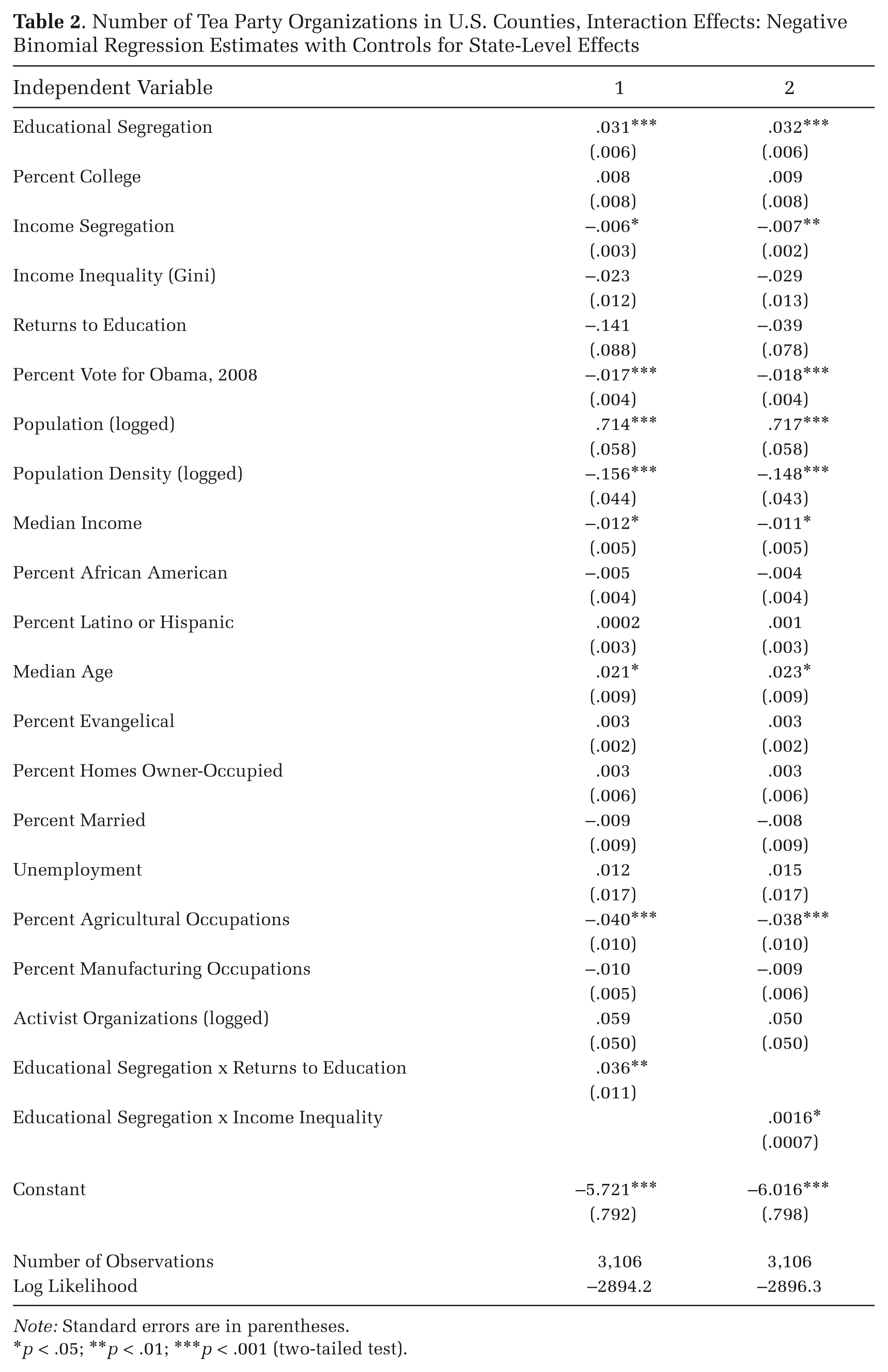
Note: Standard errors are in parentheses.
p < .05; **p < .01; ***p < .001 (two-tailed test).
Individual-Level Support for the Tea Party
These results offer strong support for our argument about the role of educational segregation in explaining variation in Tea Party mobilization in U.S. counties. In our analyses up to this point, after controlling for numerous other factors, we find that counties with higher levels of educational segregation are significantly more likely to have Tea Party organizations, and this effect is particularly strong in counties with high levels of income inequality and where economic returns to college education are high. Our theoretical argument suggests this reflects how educational segregation shapes perceptions about distributive justice among people with a college education—the group that prior research shows are most likely to be involved in Tea Party activism. Our county-level analysis, however, does not allow us to show that individuals with a college degree are particularly likely to be predisposed toward the Tea Party movement in contexts characterized by high levels of educational segregation. For this task, we must turn to individual-level data.
A CBS News/New York Times poll administered in early September 2010 allows us to assess how educational segregation in local settings may influence how individuals’ educational attainment is related to their support for the Tea Party. 13 Like our organizational data, this captures a time period when the movement had recently been involved in the fight over health care and was turning attention to the upcoming congressional elections. Important for our purposes, respondents’ county identifiers are included in the poll. We can thus evaluate the extent to which opinions about the Tea Party are related not only to personal attributes, such as educational attainment or political partisanship, but also to levels of educational segregation in people’s local surroundings. County identifiers are unavailable for respondents who were interviewed by cell phone. Nevertheless, our sample includes a total of 741 individuals residing in 472 different U.S. counties. 14
For this analysis, the dependent variable is self-identified support for the Tea Party. This variable is based on answers to the following question: “Do you consider yourself to be a supporter of the Tea Party movement, or not?” Respondents’ education is the primary independent variable of interest, and we measure it using four mutually exclusive categories—less than college, some college, a four-year degree, and postgraduate work or degree. We also include measures of political party identification and political views. These include a binary variable for respondents who identify as being a Republican and another binary variable for those who self-identify as an Independent (Democrat is the omitted category). Another dichotomous variable is coded one for respondents who report that they think of themselves as being conservative on most political matters. We also control for several other individual-level factors that likely influence attitudes about the Tea Party (Parker 2010; Zernike 2010). Binary variables for sex (1 = male), race (1 = white), marital status (1 = married), and region (1 = South), as well as an ordinal variable for household income and a continuous variable for respondent’s age, are included in all model specifications. After evaluating the effect of these factors on Tea Party support, we add educational segregation and the other county-level measures previously described. Because of the dichotomous nature of the self-identified Tea Party support variable, we use logistic regression to analyze it.15,16
Looking at Model 1 in Table 3, we see that relative to people who have no college education, those who have some college education or a four-year degree are significantly more likely to support the Tea Party (the difference between postgraduate work or degree and no college education is not statistically significant). In terms of magnitude, the odds of the some-college-educated and the bachelor-degree-educated supporting the Tea Party are both about two times that of the non-college-educated (exp[.754] = 2.123 and exp[.671] = 1.956, respectively). This model also shows that political partisanship, political views, sex, and region are all significant predictors of Tea Party movement support. Not surprisingly, Republicans are more likely than Democrats to support the Tea Party (Independents also have a positive effect). Being politically conservative sharply increases the likelihood of support. 17 Finally, men and people living in southern states are also more likely than women and non-southerners to be Tea Party supporters. 18
Predicting Individual-Level Support for the Tea Party: Logistic Regression Estimates

Note: Robust standard errors are in parentheses.
p < .05; **p < .01; ***p < .001 (two-tailed test).
Model 2 in Table 3 adds the county-level educational segregation measure. By itself, it does not significantly differentiate Tea Party supporters from non-supporters. Furthermore, introduction of this measure does not substantively alter any of the significant individual-level factors identified in the previous model. This is not surprising because our theoretical arguments lead us to expect that the role of educational segregation in shaping individual attitudes toward the Tea Party depends on individuals’ educational level. Our main goal in the individual-level analysis is to determine which educational groups are most likely to be influenced by educational segregation when forming attitudes toward the Tea Party. In the next model, we thus enter interaction terms for each individual-level education category and the county-level measure of educational segregation. While the interaction terms for some college education and postgraduate work or degree are not significant, the interaction term for bachelor’s degree is. The main effect of the four-year degree variable indicates that people with a college degree are significantly more likely than those with less than college education to support the Tea Party when educational segregation in a county is at mean levels. The coefficient for the interaction effect indicates that the positive effect grows even stronger in counties with higher than average levels of educational segregation. This effect is robust to inclusion of a range of other county-level factors. As Model 4 shows, the interaction term for educational segregation and possession of a bachelor’s degree remains significant even when we add all the contextual variables that were included earlier in the county-level analyses. 19
Prior research on the Tea Party has already revealed the disproportionate representation of college graduates and those with some college education among Tea Party supporters and activists, and our analysis confirms those findings. Yet we also know that many college graduates oppose the Tea Party and instead rally around progressive causes. Here, we find that college graduates are particularly likely to support the Tea Party when they live in counties with high levels of educational segregation.
Conclusions
The Tea Party has established organizations throughout the nation and in a broad range of communities that, on the surface, seem to be dissimilar in many ways. Indeed, the movement has established a strong organizational presence in heavily populated areas such as Orange County, California and Maricopa County, Arizona, but also in more suburban settings such as Middlesex County, Massachusetts, and Kane County, Illinois, and in less densely populated locations such as Chatham County, North Carolina, and Dodge County, Georgia. One feature that these and other Tea Party counties tend to have in common is unusually high levels of educational segregation. In fact, 55.8 percent of Tea Party organizations in our dataset are located in counties falling into the highest quartile on the measure of educational segregation, and 79.1 percent can be found in counties in the top two quartiles on the measure. After controlling for numerous other attributes of U.S. counties, we still find a strong, statistically significant relationship between educational segregation and formation of Tea Party organizations. Furthermore, we find that individuals with a four-year college degree are more likely than those who have not attended college to express support for the Tea Party, with that relationship being strongest in counties with high levels of educational segregation.
Social movements typically pressure the government to take action to address a problem or to remedy societal inequalities. Tea Party activists, on the other hand, have organized to pressure the government to reduce its role. “Big government,” they argue, is the problem rather than the solution. Problems associated with the economic recession will self-correct if taxes are lowered and government spending is sharply curtailed (Skocpol and Williamson 2012). This understanding of the economy, of course, did not originate with the Tea Party, and it is clearly not the first social movement to represent people who fear that new policies and political agendas will impose new costs on them. Martin (2008), for example, shows how the 1970s property tax revolt in California was triggered by progressive reforms that were designed to promote tax fairness but removed informal tax privileges that benefited many homeowners and offered them a degree of protection from market forces. Moreover, in the 1920s, leaders of the Ku Klux Klan went so far as to argue that legislation designed to redistribute wealth through taxation is unconstitutional (McVeigh 2009).
Conservative activists typically do not justify their activities simply in terms of rational pursuit of individual self-interest, nor do we expect them to perceive their actions as completely, or even primarily, self-serving (see Gross, Medvetz, and Russell 2011). Social movement scholars emphasize the importance of developing an injustice frame when seeking to attract support for collective action (Gamson 1992; McAdam 1982). As Turner and Killian (1987:242) express it, “The common element in the norms of most, and probably all, movements is the conviction that existing conditions are unjust.” 20 While scholars have almost exclusively focused on injustice frames constructed by progressive movements, we see no reason why a sense of injustice would be any less important for conservative movements. Clearly, this is true of the Tea Party. While supporters and activists do not want to bear the costs of government programs from which they do not directly benefit, they also argue that recipients of expanded government are undeserving of support (Skocpol and Williamson 2012), and thus that an injustice has taken place.
Assessments of who is deserving and who is undeserving, and what is just versus unjust, are not made in a vacuum. Perceptions of collective grievances, as well as opportunities to engage in organized conflict, can vary substantially across local settings. Community structure, for example, can determine whether latent feelings of racial or ethnic animosity will result in episodes of collective conflict (Blalock 1967; Olzak 1992). Binder and Wood (2013) show how different contexts influence the different ways conservative students engage in activism on university campuses. Even collective conflict over art, as Tepper (2011) shows, can be traced to structural features of local settings.
While we know that structural context matters, we hope our study will lead to more research that focuses on how a specific feature of the context—segregation—is linked to formation of shared values as well as opportunities to act collectively. We suspect educational segregation is especially relevant when conflicts emerge over class interests and redistributive policies and programs. As we argued, differences in educational attainment are broadly viewed as legitimate determinants of unequal outcomes. Other forms of segregation may be in play when it comes to shaping views pertaining to distributive justice having to do with identity boundaries. We have already mentioned segregation by sex and by race. It may also prove useful to examine how spatial segregation based on religious identities or sexual orientation shapes perceptions of what constitutes moral behavior and what rights and privileges should be afforded to different subgroups in the broader society. More investigation into consequences of segregation based on income is also called for, particularly in light of our findings showing that segregation based on educational differences supports Tea Party activism, while segregation of the wealthy hinders Tea Party organizing. Holding constant educational segregation, segregation of the wealthy may facilitate more progressive forms of populist activism that accentuate divisions between the “haves” and “have nots.”
In this article we focused on educational segregation and its implications for collective mobilization in local settings. We did not directly examine the link between segregation and individual perceptions of inequality and justice, but we see this as a very promising line of research for future work. Segregation imposes constraints on opportunities to engage in intergroup relations (Blau 1977), thereby limiting the range of information available to individuals as they ponder both the causes of, and solutions for, a broad range of social problems. In a highly segregated society, individual understandings of what is fair and just tend to be formed and reinforced within homophilous networks and structures.
Footnotes
Acknowledgements
We are grateful to David Campbell for helpful comments on an earlier draft of the manuscript. We also benefited from feedback provided by participants of Notre Dame’s social movement workshop and participants of the Conservative Movements Workshop at the University of California-San Diego.
Data
Some data utilized for this project were made available through the Association of Religion Data Archives (http://www.thearda.com) and were accessed through the website of the Inter-university Consortium for Political and Social Research (http://www.icpsr.umich.edu). All data utilized in this article are available on the lead author’s website  .
.
Notes
References
Supplementary Material
Please find the following supplemental material available below.
For Open Access articles published under a Creative Commons License, all supplemental material carries the same license as the article it is associated with.
For non-Open Access articles published, all supplemental material carries a non-exclusive license, and permission requests for re-use of supplemental material or any part of supplemental material shall be sent directly to the copyright owner as specified in the copyright notice associated with the article.
