




Abstract
In the early twenty-first century, women continue to receive substantially less media coverage than men, despite women’s much increased participation in public life. Media scholars argue that actors in news organizations skew news coverage in favor of men and male-related topics. However, no previous study has systematically examined whether such media bias exists beyond gender ratio imbalances in coverage that merely mirror societal-level structural and occupational gender inequalities. Using novel longitudinal data, we empirically isolate media-level factors and examine their effects on women’s coverage rates in hundreds of newspapers. We find that societal-level inequalities are the dominant determinants of continued gender differences in coverage. The media focuses nearly exclusively on the highest strata of occupational and social hierarchies, in which women’s representation has remained poor. We also find that women receive greater exposure in newspaper sections led by female editors, as well as in newspapers whose editorial boards have higher female representation. However, these differences appear to be mostly correlational, as women’s coverage rates do not noticeably improve when male editors are replaced by female editors in a given newspaper.
Media attention has significant consequences for social stratification. For politicians running for office, it translates into campaign donations and votes (Mutz 1995). Actors and authors whose movies and books are ignored by the media suffer from reduced salaries, sales, royalties, and income from commercial campaigns (Sorensen 2007). Victims of catastrophic events who receive ample media coverage often benefit from greater medical aid and donations (Adams 1986; Eisensee and Strömberg 2007). Missing children whose cases are publicly reported are more likely to be found (Min and Feaster 2010). In addition, lesser media attention to certain categories of social and health problems may impede policy and drug development. Finally, public attention not only affects various forms of inequality, it is itself a dimension of social stratification, curiously absent from traditional scholarship (Van de Rijt et al. 2013). People aspire to be rich, powerful, and healthy, but also famous.
Women are substantially underrepresented in the media in general and in the written press in particular (Davis 1982; Duncan, Messner, and Williams 1991; Greenwald 1990; Potter 1985; Zoch and Turk 1998). Scholars argue that the differential media coverage of women and men is not merely a reflection of existing gender inequities in economic participation, but rather that media practices exacerbate and artificially magnify these inequalities (De Swert and Hooghe 2010; Gallagher 2010; Tuchman 1978; Zoch and Turk 1998). In addition to stereotypical and often sexualized and demeaning depictions (Fiske 1996; Lester and Dente Ross 2003; Tuchman 1979; Van Zoonen 1988), female names and female-related topics are often censored and silenced. Some media scholars argue that such “symbolic annihilation” (Tuchman 1978) poses a serious problem and plays an important role in maintaining the gendered balance of power (De Swert and Hooghe 2010).
Differential media visibility may reinforce long-standing gender status beliefs and serve as manifestation of these beliefs. Gender scholars have found that societal status beliefs regarding men’s greater competence compared to women may be key in sustaining gender inequality (Ridgeway 2001; Ridgeway et al. 1998; Ridgeway and Erickson 2000; Wagner and Berger 1997). For instance, men are expected to be proactive, speak up, and take the initiative, whereas women are systematically relegated to reactive roles. These expectations legitimize and normalize men’s overrepresentation in leadership positions and have an adverse effect on female leaders’ ability to exercise power and achieve compliance. Consistent with the adage “any publicity is good publicity,” the quantity and salience of mass media coverage may matter more than the actual content of the coverage (Andrews and Caren 2010; Mazur 2009). Media visibility—whether positive or negative—may then further enhance entrenched status beliefs, serving as a signal for what and who society sees as important. Individuals who are not in newspapers (whether because of their gender, race, or other factors) are implicitly framed as less important. In this view, the actions and behaviors of men are more noteworthy simply because they are done by men. Levels of visibility may thus be considered a metric of women’s social status or influence, even when that influence carries a negative connotation.
Yet, despite the importance of and sustained scholarly attention to the equal coverage issue, the testing of theoretical claims regarding the causal factors that produce and sustain the sex imbalance in media attention has been hampered by methodological constraints, particularly tedious hand-coding of sources. How can we account for the ongoing sex disparity in coverage rates? In this article, we examine some sources of this disparity in English-language newspapers. We put two major explanatory approaches to an empirical test. First, a long tradition of scholarship in the sociology of the media has examined the close relationship between societal-level inequalities on the one hand and media production and reporting patterns on the other. Unequal occupational opportunities sort men and women into positions of differential public prominence and media access. Structural constraints and organizational practices endemic to the media industry determine the sorts of societal positions that enjoy regular media attention, positions that in practice are heavily male-dominated. The second approach, promoted by gender and mass communication scholars, focuses on media-level explanations—the role of newsrooms’ gendered ideologies and culture, and the coverage choices of media editors, the majority of whom continue to be men.
A test of these theoretical propositions requires data on sufficient quantities of content from an adequately large number of media sources. Moreover, multiple observations per source are necessary to circumvent the confounding effects of unobserved source-specific factors. We employ a newly developed computational methodology, using data collected by the Lydia text analysis system (Bautin, Vijayarenu, and Skiena 2008; Bautin et al. 2010). This computerized system performs named entity recognition, classification, and analysis of text corpora. Lydia allows us to analyze extensive amounts of data on the historical coverage rates of millions of female and male names in 13 daily U.S. newspapers between 1983 and 2008, and in approximately 2,000 English-language newspapers and online news websites between 2004 and 2009.
Our study thus provides two essential and novel contributions. First, we present the most comprehensive analysis to date of the factors that explain sex imbalances in coverage, providing a systematic large-scale examination of factors that have thus far been tested only anecdotally (i.e., by comparing a limited number of occurrences in one or a few sources) or not at all. Second, using panel regression analysis, we are the first to test whether the sex of media personnel significantly affects imbalances in newspaper coverage, even when accounting for various real-world factors impacting coverage and newspaper characteristics such as political slant and circulation. Our analysis thus offers important contributions to the sociology of the media and the sociology of gender, highlighting the significant roles of these two branches of thought to our understanding of media and gender inequalities.
Our results suggest that gender imbalances in newspaper representation are mostly driven by corresponding gender imbalances in socioeconomic participation. We show that real-world differences at the top—among well-known individuals—are crucial in determining differences in coverage. The fact that newspapers predominantly focus on the very top of occupational and social hierarchies, with men occupying an overwhelming majority of these positions, limits the impact journalists and editors can have on the gender ratio in the news. Women do receive greater coverage in newspaper sections led by female newspaper section editors, as well as in newspapers whose editorial boards have higher female representation. However, these differences appear to be mostly correlational, as women’s coverage rates do not noticeably pick up when male editors are replaced by female editors in a given newspaper.
Empirical Research on Women’s Newspaper Coverage: A Persistent Sex Gap
Over the past 40 years, a host of media studies have examined women’s representation in the press (Armstrong 2004; Jolliffe 1989; Kahn and Goldenberg 1991; Len-Rios et al. 2005; Rodgers and Thorson 2003; Zoch and Turk 1998). These studies make different breadth versus depth trade-offs: Some work examines all pages of a single newspaper over a period of time (Davis 1982; Gallagher 2005, 2010; Len-Rios et al. 2005; Spears and Seydegart 2000); other research focuses on the front pages of a larger number of sources over a longer period of time (Gibbons 2000; Potter 1985; Zoch and Turk 1998); and some studies focus on news photographs (Blackwood 1983; Miller 1975; Rodgers and Thorson 2000), the business section (Greenwald 1990), or the sports section (Duncan et al. 1991; Huggins 1997). The findings of these studies are consistent: They all report substantial underrepresentation of female names, and they typically find that female names constitute approximately one fourth of all mentions.
Our own data reveal similar trends (for details, see Shor et al. 2014b, and the Data and Analyses sections of this article). Figure 1 presents the rate of female names in 13 major U.S. newspapers for which historical data are available from scanned content. Male names have historically received at least four times as much exposure as female names and this ratio is still nearly 3:1 by the end of our observation period. When looking at the larger and more representative set of newspapers in our database, for which only recent digital data is available, the ratio is nearly 5:1. There are differences between the various sections of papers, but in no section does the relative exposure of female names approach equality. How can we account for the persistence of this disparity?

Trends in the Percent of Female Names Appearing in 13 U.S. Newspapers by Section, 1983 to 2008 (Historical Sample)
Consistency of Gender Gaps in Media Coverage: Theory and Research Hypotheses
In recent decades, women have made great progress in various social realms, including higher education (England 2010; Goldin, Katz, and Kuziemko 2006; Lewin 2006; Perry 2009), workforce participation (England 2010; Goldin 2006), and even as subjects in books and novels (Michel et al. 2011). However, the underrepresentation of female names in the written news media remains substantial. We present two major theoretical lines of thought on the nature of this disparity. The first set of explanations emphasizes the interaction between media routines and gendered societal-level and occupational inequities; the second set focuses on the demographics and cultural practices of news producers.
Societal-Level Explanations: News-Cycle Routines and Everyday Social Realities
Sociological scholarship on the media tends to highlight organizational constraints in the work of individual journalists and editors (Craft and Wanta 2004; Fishman 1980; Gans 1972, 1980; Reese and Ballinger 2001). This work discusses the formal organization of the media, its reliance on work routines, and its ongoing need for reporting events (Andrews and Caren 2010; Downs 1972; Molotch and Lester 1974; Oliver and Maney 2000; Tuchman 1973). News producers are often bounded by their limited ability to reach information and by strict deadlines. They are further restricted by what Oliver and Myers (1999) call “news holes,” the relatively fixed amount of space available for news stories in traditional media. Stories that fit into an obvious template and time frame are likely to receive preference.
Reporting is also influenced by what Oliver and Myers (1999) call “news beats”: Events that happen in places reporters frequently attend (e.g., the House of Representatives, courts, and police stations) are much more likely to be covered. Individuals situated in key positions (e.g., government or police officials, army generals, politicians, and major corporate figures) enjoy habitual access to the media and regularly use these routines to their advantage (Herman and Chomsky 1988). Indeed, Sigal (1973) found that almost three quarters of sources in the New York Times and Washington Post were routine, primarily government officials. This unevenness of media attention is further enhanced by newsmakers who, under conformity pressures, recycle past high-profile subjects in new configurations and media formats (Bielby and Bielby 1994; Gitlin 1983, 1998).
Media routines, news beats, and news holes often mean that reporters seek to cover individuals in key strategic positions, with whom they are already familiar and to whom they can gain easy access. This, in turn, contributes to high inequality in the media, where most of the attention focuses on a small number of individuals (Cowen 2000; Gabler 1998; Gamson 1994; Gitlin 1998; Kurzman et al. 2007; Milner 2010; Rojek 2001). Coverage thus follows a winner-take-all distribution, with small differences in coverage between individuals of low and medium prominence but large differences between the very top and everyone else (Erickson and Nosanchuk 1984; Frank and Cook 1995; Goode 1978; Hilgartner and Bosk 1988; Rosen 1981; Van de Rijt et al. 2013).
How does such extreme inequality in media coverage affect exposure rates of female names? We propose that inequalities in media coverage often reflect social realities and everyday societal inequalities. That is, one of the main reasons why certain groups of people (including women and minority groups) remain substantially under-covered in the media is that they are underrepresented in key real-world power positions in politics, business, and professional sports—the subjects on which the news tends to focus. The latest Global Media Monitoring Project (GMMP) report (Gallagher 2010) reveals that nearly half of the stories in print media are devoted to either politics and government or the economy. The topics of science and health, in comparison, constitute only 10 percent of all stories. Hence, the persistent social realities of acute gender inequalities at the top in politics, the business world, and sports translate into highly imbalanced gender coverage patterns. 1
Numerous studies demonstrate that women often face a “glass ceiling,” where their progress in the workforce, politics, and other public arenas is hindered by powerful and persistent ideologies and dominant institutional structures (Alessio and Andrzejewski 2000; Davidson and Cooper 1992; Kay and Hagan 1995). The glass ceiling metaphor describes a point in a hierarchy beyond which advancement suddenly becomes more difficult, but only for women. Recent data show that women constitute only 3.6 percent of the CEOs in Fortune 1000 companies (Catalyst 2012). In politics, women are also highly underrepresented in the upper echelons. As of 2015, only 19 percent of U.S. congress members were women (World Bank 2014), and no woman has ever served as president of the United States. Recent work by notable gender scholars such as England (2010) and Ridgeway (2011) attributes the persistency of gender inequalities and the stalled emancipation in various social spheres to a combination of deep-seated cultural beliefs and frames, socialization practices, and status distinctions, in addition to gendered power relations and embedded institutional arrangements.
We suggest that the persistent sex inequality in newspapers may be largely due to the confluence of two major factors: (1) structural media coverage patterns and routines, in which the very few at the top of the political, business, and sports fields receive the most attention, and (2) the overwhelming dominance of males at the top of these social realms. We therefore expect to see a “paper ceiling” in printed news coverage, mirroring the glass ceiling that characterizes the gendered occupational reality in the early twenty-first century. At low levels of coverage, that is, among individuals who appear in the media only infrequently, the significant progress in women’s public and economic participation over the past few decades will be reflected in a steep temporal increase in the proportion of female names appearing in newspapers. However, at higher levels of newspaper coverage (i.e., among individuals who frequently appear in the media), we expect a large and persistent difference in female and male coverage volume, due to stagnation in women’s occupation of top political, government, managerial, professional sports, and executive positions.
Hypothesis 1: Over time, sex differences in media coverage have decreased more among individuals who receive infrequent coverage than among people who receive regular coverage.
Media-Level Explanations: Editorial Choices, Newsroom Culture, and Political Slant
Publishers’ and editors’ sex
While some hold the view that individual journalists have considerable autonomy in their decisions about the stories and people they wish to cover (Powers and Fico 1994), most scholars believe the real power lies in the hands of senior publishers and editors. Beginning with White (1950), media scholars have emphasized the role of publishers and editors as gatekeepers and the importance of their views and beliefs in choosing news stories. Breed (1955) argued that journalists’ stories eventually reflect newsroom policies more than their own personal beliefs. Scholars have further suggested that editors’ personal characteristics may affect a newspaper’s general patterns of coverage. Differences in editors’ gender or race can play a significant role in their decisions (Bissell 2000; Theberge and Cronk 1986). Male editors, for example, may consider “feminine” or “soft” news items less important than other stories (Smith and Wright 1998).
Following this line of thought, one may expect newspapers with male editors to devote less space to “female issues” and women. Indeed, some anecdotal evidence supports this. Anderson (1988), for example, finds consistent resistance by male editors to providing more coverage of women’s sports. Pantin (2001) reports on a UNESCO initiative in which women across the world took key editing positions for one day. He concluded that when women have decision-making power the news looks different: more stories focus on social issues rather than on politics, and stories feature more female names. According to Craft and Wanta (2004:135), “women editors may feel sympathy for female reporters because, in many cases, the editors faced similar obstacles early in their careers.” They may therefore be more likely to promote female reporters, who in turn are more likely to write about women’s issues. Other media observers have suggested that female editors offer a different perspective on the news. Female editors, they argue, bring forward women’s issues, present more positive portrayals of women, and turn stories about women into front-page news (McCormick 1991; Wood 1994).
Hypothesis 2: Newspaper sections with a female section editor will dedicate a higher proportion of their coverage to women than will newspaper sections with a male section editor.
Hypothesis 3: Newspapers with a female publisher or editor will dedicate a higher proportion of their coverage to women than will newspapers with a male publisher or editor.
Ratio of female to male editors
Other scholars, however, are more skeptical regarding the agency of individual editors. They argue that the historical dominance of men in editorial positions has created a power structure, and women are expected to conform to traditional male-dominated editing norms (Rodgers and Thorson 2003). According to Pahlen (2000), women in management positions are often pressured to adopt management styles that reflect men’s priorities more than their own. Jolliffe and Catlett (1994) argue that because men’s hegemony in the media is so entrenched, even when women do reach positions of power, they often do little to change existing coverage norms. Indeed, some small-scale empirical studies on female editors question their ability to influence the subject and content of coverage. Splichal and Garrison (1995), for example, found no difference between male and female editors’ judgment regarding politicians’ private lives. Similarly, Craft and Wanta (2004) found that editors’ sex had only a mild effect on patterns of coverage. Shoemaker and Vos (2009) conclude there is little evidence for direct links between the sex of journalists and editors and variations in media content, as journalistic routines appear to wash out those differences.
In this view, there is an interaction between agency and structure in media organizations, and individuals’ ability to make a difference is conditioned by the organizational environment in which they operate (Rodgers and Thorson 2003). Male dominance in most organizations (in terms of both numbers and ideology) may thus curtail the ability of individual (female) journalists to produce real change. Kanter (1977a, 1977b) introduced the theory of tokenism and proportional representation when examining women’s participation in U.S. corporate settings. According to Kanter’s critical mass theory (see also Childs and Krook 2007, 2009; Dahlerup 1988; Izraeli 1983; Spangler, Gordon, and Pipkin 1978; Yoder 1991), the proportion of women in a given group or organization is important. When women constitute less than 15 percent of a group (a skewed group), men have complete control over the group and its culture, and the token women have little power to change ideologies and practices. When women make up 15 to 35 percent of a group (tilted groups), opportunities for alliances and coalitions start to form, allowing women to begin changing the culture of the group and address gendered concerns. Finally, when women comprise 36 to 64 percent of the group (balanced group), the group’s culture and interactions become balanced between the majority and minority groups and outcomes are increasingly related to group members rather than to the group’s composition. According to this typology, we might expect newspapers in which women constitute at least 35 percent of the editorial board to be more egalitarian in their coverage of men and women. More generally, we may expect the ratio of female editors and executives to make a difference:
Hypothesis 4: Greater representation of women among news executives and on editorial boards will be associated with higher proportions of female names in a newspaper.
Other scholars, however, are more skeptical about the “number balancing” principle, which they find to be overly optimistic (Blum and Smith 1988; Yoder 1991). Ridgeway (1991), for example, demonstrates how gender status beliefs create a network of constraining expectations and interpersonal reactions that sustain the glass ceiling. In mixed-gender work contexts, gender status beliefs hamper women’s likelihood to emerge as leaders and their ability to show assertiveness, influence change, and gain compliance with their directives. Similarly, media scholars argue that because media outlets have historically been and continue to be male-dominated, they have developed implicit masculine norms of journalistic practice that masquerade as professional routines, and to which all journalists are expected to subscribe (Ross 2009; Ross and Carter 2011; Van Zoonen 1998). According to these scholars, such historical traditions and deeply entrenched cultural beliefs are very hard to change, even when women do enter editorial boards in higher numbers.
Political agendas and slants
Many media outlets have traditions, self-identities, political affiliations, and political agendas. Although these agendas are not always explicit and they may change over time, in many outlets they are quite stable. Furthermore, political agendas often shape decisions such as the selection of editors and journalists, the topics on which a paper focuses, and the political tilt this coverage takes. These choices, in turn, may contribute to the reproduction and fortification of the paper’s agendas and political inclinations. Studies suggest that political agendas may influence the coverage of women and women’s issues (Armstrong 2004; Patterson and Donsbach 1996; Shoemaker and Reese 1996). Yet, it remains unclear how political agendas and slants affect the level of exposure of female names. Anecdotal evidence on the relationship between newspapers’ political slant and the rate at which female names appear has not been conclusive. Some work suggests that conservative newspapers may cover women less (Potter 1985), but other studies report the opposite tendency (Adkins Covert and Wasburn 2007; Shor et al. 2014a).
Notwithstanding these inconclusive findings, there are several reasons to believe that more conservative outlets will be less likely to cover women and women’s issues compared with their more liberal counterparts. First, conservative media often view feminism and women’s issues in a relatively negative light (Baker Beck 1998; Brescoll and LaFrance 2004), making them potentially less likely to cover these issues. Second, and related to the first point, conservative media may also be less likely to employ female reporters and female editors. Finally, conservative papers may be more likely to cover “hard” topics that are traditionally considered more important or interesting, such as politics, business, and sports, rather than reporting on issues such as social welfare, education, or fashion, where women have a stronger presence.
Hypothesis 5: Conservative newspapers will dedicate a smaller portion of their coverage to females.
Data
Our primary data source is the Lydia news analysis system (Bautin et al. 2008; Bautin et al. 2010). Lydia provides time-stamped occurrences of person-names in the scanned and digital records of more than 2,000 newspapers, magazines, and online news sources up to 2009, when most online newspapers placed most content behind paywalls. For each name occurrence, Lydia provides the date, newspaper, newspaper section, sex, and sentiment with which the name was mentioned. Lydia determines the sex of a named person through Anaphora Resolution (statistically observed gender associations of names in U.S. Census data; for a detailed explanation of the sex classification process and a table indicating the validity of this process for a random sample of names, see Part 1 of the online supplement [http://asr.sagepub.com/supplemental]).
Our analyses consist of three parts. First, we go back several decades through text analysis of scanned newspaper content to test whether historical trends in media coverage of women and men mirror parallel trends in female socioeconomic participation (Hypothesis 1). Lydia provides such scanned newspaper content for 13 newspapers, and we refer to these papers as the historical sample. The second part of our analysis tests whether newspaper sections with a female section editor exhibit higher female coverage rates (Hypothesis 2). For 95 of the newspapers for which Lydia provides section-specific coverage data, we were able to code section editors’ sex in 2008 from secondary sources; these papers are the sections sample. In the final part of our analysis, we test whether organizational features of a newspaper affect its coverage of female subjects (Hypotheses 3, 4, and 5). Of the newspapers for which Lydia enables longitudinal comparisons of newspaper-wide female coverage rates, we were able to acquire data on key control variables from secondary sources for 193 papers; these newspapers form the organizations sample. For the full lists of newspapers included in the historical, sections, and organizations samples, see Part 2 of the online supplement.
The newspaper samples we analyze are orders of magnitude larger than past databases, which simply consisted of too few distinct media sources for any quantitative comparison. However, for reasons of data availability, the samples are not formally representative of any particular population of newspapers. Nonetheless, the samples include bigger and smaller newspapers and papers appearing in most U.S. states (see Part 2 of the online supplement). We believe there is no apparent dimension of representation along which our nonrandom selection of cases could have seriously affected the generalizability of our results.
Analyses
Trend Analysis of the Historical Sample
The trend analysis tests Hypothesis 1, stating that the sex gap in newspaper coverage has decreased substantially at low coverage frequencies but only minimally at high coverage frequencies. We analyze annual numbers of name references to female and male names in all scanned historical content available in the Lydia database; this covers 13 distinct newspapers between 1983 and 2008. To test Hypothesis 1, we measured these numbers separately for different coverage frequencies. Accordingly, Figure 2 presents the numbers of female and male names (vertical axis) mentioned at different frequency intervals (horizontal axis) in the first and last year for which data are available: 1983 (Panel 1) and 2008 (Panel 2).
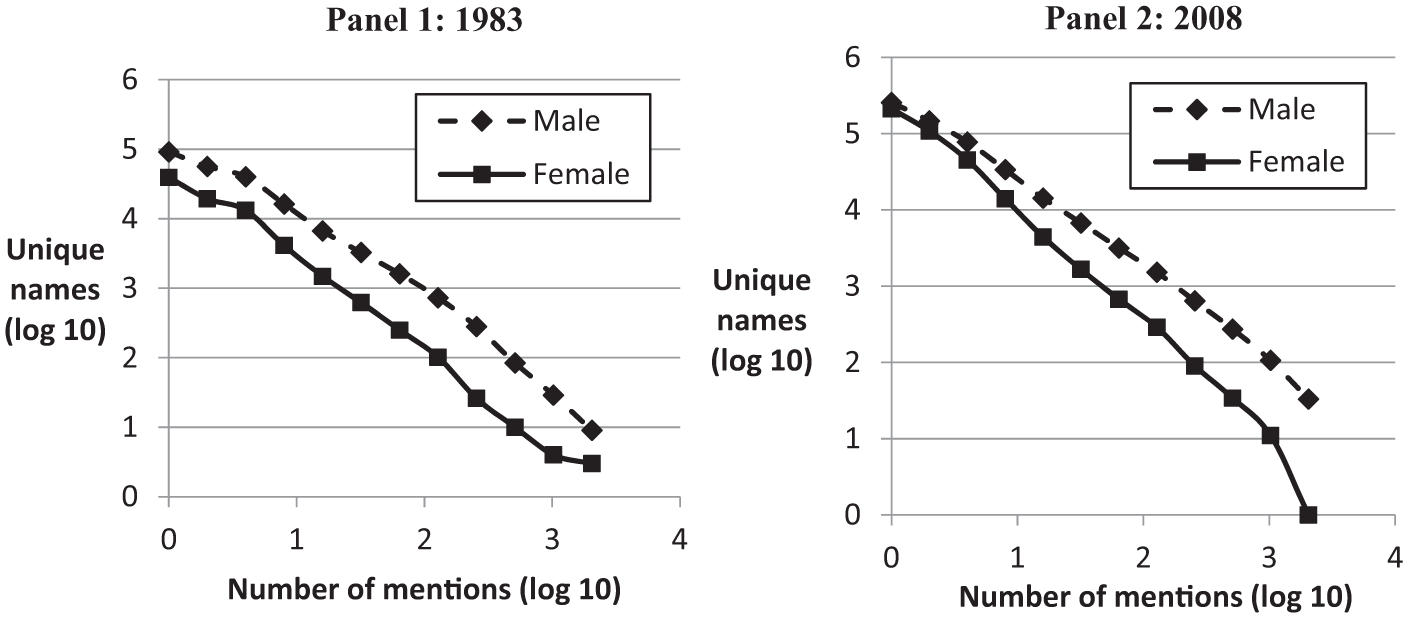
Distribution of Coverage by Sex in 13 U.S. Newspapers: 1983 and 2008 (Historical Sample)
The argument from which Hypothesis 1 was derived states that, despite increased female participation in public life, the persistently low presence of female names in newspapers is mostly due to the continued dominance of men in top organizational positions (i.e., a societal-level explanation). This argument relies on the assumption that media coverage is concentrated on a small number of very famous individuals. Both panels in Figure 2 show straight lines on double-logarithmic plots, which approximate power-law distributions with scaling exponents around 1.2 (Clauset, Shalizi, and Newman 2009). These distributions exhibit extreme inequalities; about 40 percent of all newspaper coverage goes to only 1 percent of the names. As extreme as they are, these figures still substantially understate true inequality in public attention, because people whose names never appear in the news (the large majority of people) could not be included in our analysis.
Having established that media coverage indeed focuses on a very small number of individuals, the question remains: “What is the sex of these famous individuals?” We suggested that sex differences in coverage would be greater among individuals who receive higher levels of media coverage, especially in later years. This prediction (Hypothesis 1) is borne out in the data. Panel 1 of Figure 2, for 1983, shows a trend for female names that is roughly parallel to that for male names, which means that at all frequencies male names receive a factor of three to five more exposure than female names. For 2008, Panel 2 shows two diverging trends, with female names being on par with male names at low frequencies of exposure, but lagging far behind male names at high levels of exposure. In 1983 one still sees differences between male and female names in both the higher and lower echelons; by 2008, the differences in the lower echelons have all but disappeared, but those at the top remained. In other words, the more mentions a person receives today, the larger the chances that this person is a man. In the very top echelon—people who receive thousands of mentions—we find almost only male names. This close correspondence between trends in occupational inequality (with its glass ceiling) and coverage inequality (exhibiting a paper ceiling) provides strong support for claims that gender imbalances in media coverage are predominantly driven by gender imbalances in real-world top positions.
Analysis of the Sections Sample
We consider the four common newspaper sections from Figure 1: news, business, sports, and entertainment. The sections sample includes 95 high-circulation newspapers for which we were able to derive the sex of one or more section editors (1 = female) based on first and last name data from Easy Media List (Easymedia.com 2009) and for which Lydia provides a measure of the fraction of name references to female names. Because data on at least one of these two variables were missing for 30 of the sections, the final sample includes 350 newspaper sections.
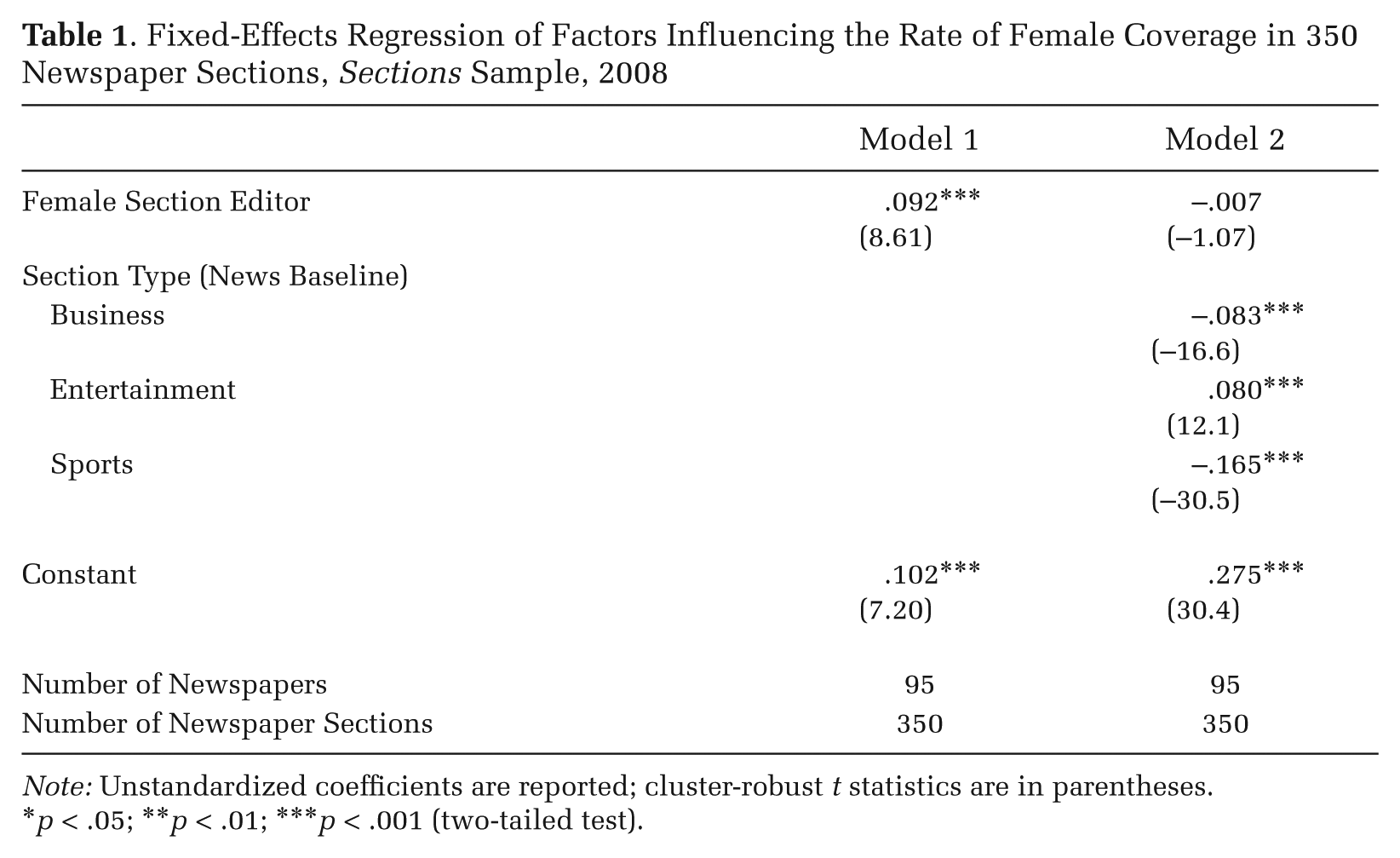
Table 1 shows results of fixed-effects regression models predicting female coverage rates in these sections. These fixed-effects models base estimates on comparisons across sections of the same newspaper, thereby eliminating any newspaper-specific tendency for greater or lesser coverage of women. Hence, these models ensure that effects are not attributable to a potential general tendency for woman-oriented newspapers to both recruit more female section editors into their organization and cover women at higher rates.
Fixed-Effects Regression of Factors Influencing the Rate of Female Coverage in 350 Newspaper Sections, Sections Sample, 2008
Note: Unstandardized coefficients are reported; cluster-robust t statistics are in parentheses.
p < .05; **p < .01; ***p < .001 (two-tailed test).
Model 1 includes as sole predictor a dummy variable indicating whether the section editor was female. The effect of having a female editor is significant and in the expected direction, suggesting that female section editors tend to be in charge of newspaper sections where the coverage of female names is about 9 percent higher. We consider two explanations for this pattern. The first is that female editors tend to be assigned to section types that traditionally cover women to a greater extent (e.g., the entertainment section). The second explanation is that levels of coverage of women increase when male section editors are replaced by female section editors. To differentiate between these two explanations, we included dummy variables for all but one section type in Model 2, with the news section serving as baseline. Each dummy variable has a significant effect, indicating that female coverage differs by section type. However, the effect of editor sex, which was significant in Model 1, is no longer significant in Model 2. This leads us to conclude that the key mechanism that produces what may at first appear to be differential coverage patterns by editor sex is actually the self-selection (or assignment) of female section editors into sections that a priori exhibit higher female coverage rates.
Figure 3 illustrates the findings of these cross-sectional regression analyses. In each of the four domains (news, business, entertainment, and sports), the figure shows very small differences between newspaper sections that have male versus female editors in terms of sex rate coverage, consistent with Model 2. Hence, the difference in overall coverage initially found in Model 1 clearly comes from the differential assignment of female section editors, as indicated in the figure caption. For example, women edit 60 percent of the entertainment sections in the newspapers sampled here (the field where exposure of female names is clearly highest), but they comprise only 3 percent of all sports editors (the section with the lowest exposure for female names).

Mean Coverage of Female Names by Newspaper Section and Section Editor’s Sex in 2008
Overall, these findings refute Hypothesis 2, showing none of the expected differences between the coverage patterns of male and female section editors. The strongly confounding influences of selection effects that our analysis was able to identify indicate that anecdotal studies are at high risk of finding a spurious effect of editor sex. Finally, Figure 3 shows that all sections of contemporary newspapers, whether under the editorship of a woman or not, continue to provide substantially greater coverage of men than of women.
Analysis of the Organizations Sample
The goal of the final stage of our analysis is to identify the impact of organizational features of newspapers on their female coverage rates. The organizations data combine annual newspaper-level rates of female name mentions with key organizational features, such as level of conservatism and gender of publishers and editors. We conduct a multivariate analysis, in which we control for influences of various local factors, such as the sex of local individuals with very high status and women’s participation in the top strata of local high-visibility industries. Table 2 describes the variables in the organizations sample, including details on measurement, data sources, and summary statistics.
Descriptive Statistics of the Variables Appearing in the Organizations Data Analysis (Table 3)
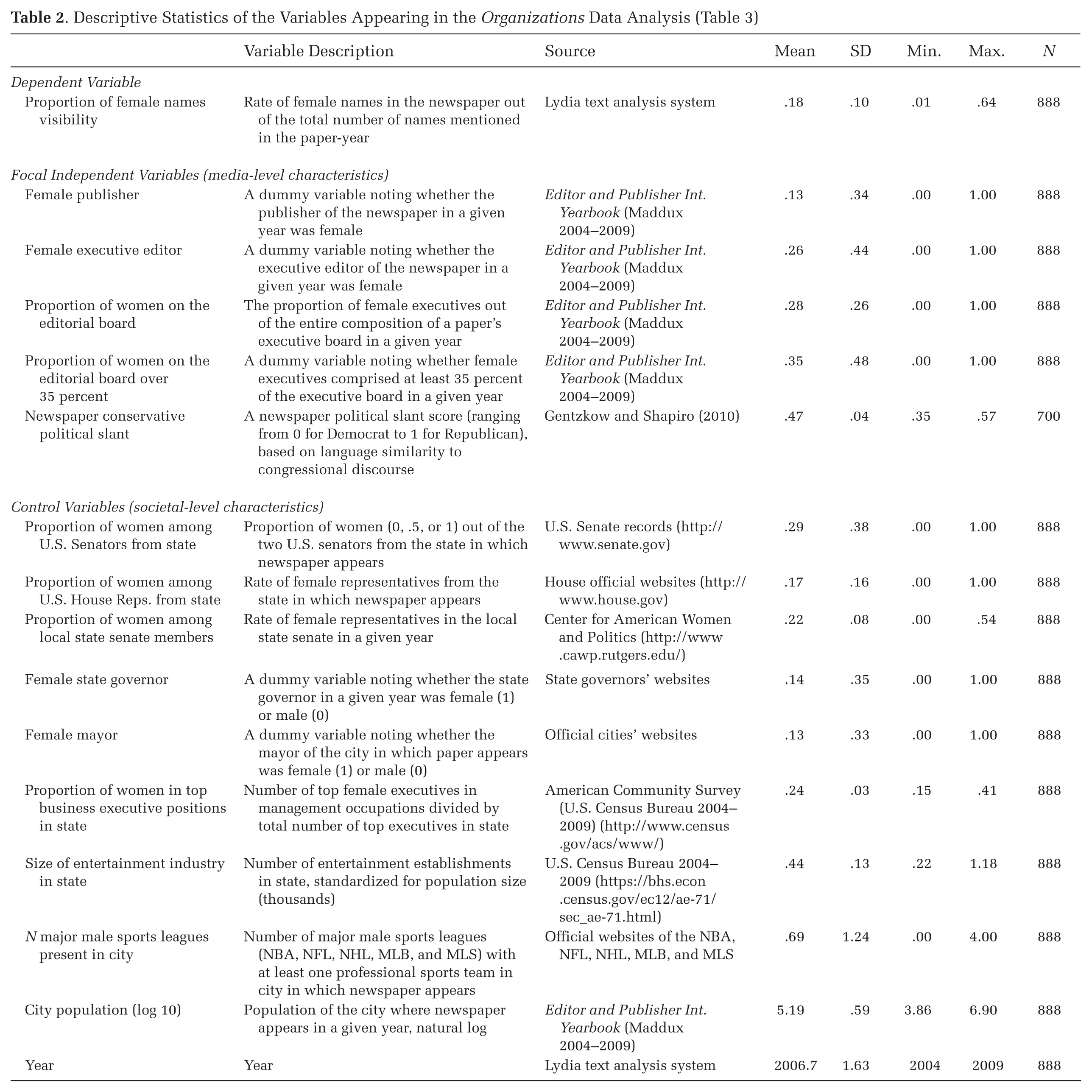
Our dependent variable of interest is the fraction of all person-name mentions in a given year in a given newspaper referring to women. Our multivariate analysis includes the following media-level focal independent variables: We coded data on the sex of newspaper publishers (female publisher, Hypothesis 3) and editors (female executive editor, Hypothesis 3), as well as the sex composition of editorial boards (proportion of females on editorial board, Hypothesis 4) from the Editor and Publisher International Yearbook (Maddux 2004–2009). For each newspaper, we divided the number of female executive editors by the total number of executive editors in the paper. For newspaper conservative political slant, we obtained a conservative political slant score for each newspaper from Gentzkow and Shapiro’s (2010) database, which is based on similarity of a news outlet’s language to that of congressional Republicans and Democrats.
We also obtained data on various control variables that should capture relevant features of real-world environments that may affect female coverage rates in local news. These include measures of the relative presence of women in local high-level political, business, sports, and entertainment positions. These control variables by no means exhaust societal-level factors and potential effects on coverage. Thus, their inclusion is not intended to gauge the full impact of societal-level realities. Rather, we aspire to estimate the effects of the focal independent variables described earlier (the organizational media variables) while accounting for the potentially confounding impact of local newspaper-specific environments, where possible.
We coded information from 2004 to 2009 on high-level political positions in cities and states in which a newspaper appears. Specifically, we coded data on the following: (1) the proportion of female U.S. senators from a given state in a given year; (2) the proportion of women out of all U.S. representatives from a state; (3) the proportion of women out of all local state senate members; (4) whether the state had a female governor in a given year; and (5) whether the city had a female mayor in a given year.
We collected data from the American Community Survey of the U.S. Census Bureau (U.S. Census Bureau 2003–2009a), estimating the proportion of female top executives out of all top executives in the relevant state. 2 Based on data from the Arts, Entertainment, and Recreation section of the U.S. Census Bureau, 2004 to 2009 (https://bhs.econ.census.gov/ec12/ae-71/sec_ae-71.html), we coded a measure of the density of entertainment establishments in the state where newspapers are printed (U.S. Census Bureau 2003–2009b), calculated as the number of establishments divided by state population size (in thousands). 3 Women seem to have achieved broader representation in the entertainment field, so variation across cities in the size of this industry may produce variable rates of women’s coverage in local entertainment news.
We also coded information on professional sports teams for newspapers’ cities. For each city, we counted the number of major male sports leagues with at least one professional team in that city (out of the following five leagues): the National Hockey League (http://nhl.com/ice/teams), the National Football League (http://nfl.com), Major League Soccer (http://mlssoccer.com/clubs), the National Basketball Association (http://nba.com/teams), and Major League Baseball (http://mlb.com/team). Sports is the largest section in many daily newspapers (Shor and Yonay 2011), and male athletes dominate in U.S. professional sports coverage. Therefore, variation in the number of professional sports teams in a city may be a source of variation in women’s coverage across newspapers printed in different cities.
From the respective editions of the Editor and Publisher International Yearbook (Maddux 2004–2009), we coded a measure of the population size of the city in which a newspaper is printed. We expect a negative correlation between city size and the rate of female-names coverage, mainly because newspapers from larger cities are more likely to have national rather than just local distribution patterns. This, in turn, means they will be more likely to cover issues such as foreign affairs, the global economy, Washington politics, and professional (versus college) sports, which are heavily dominated by men.
Because some coverage data are not available for all years, the organizations panel data are unbalanced, but variations in sample size across years are modest. Results of a Hausman test (p < .05) indicate systematic differences between the fixed-effects (FE), in which effect estimates are based only on variation within newspapers over time, and random-effects (RE) (specifically, random intercept) models, in which all variation is used for estimation, suggesting that the former should be preferred on consistency grounds. We present results for both FE and RE models, because some key independent variables do not vary with time (most notably, newspaper slant). With regard to issues of multicollinearity, we found that in pairwise correlation analysis, two pairs of predictor variables had high correlations. The rate of female top executives is strongly correlated with the executive manager being female (Pearson = .64), but substantive results are the same in models in which one of these two is left out, so we present models with both predictors left in. As an alternative to the city size control variable, we also used newspaper circulation. Models with either control variable look very similar. Because the two variables are very strongly correlated (.80) we present models including only city size in our analyses.
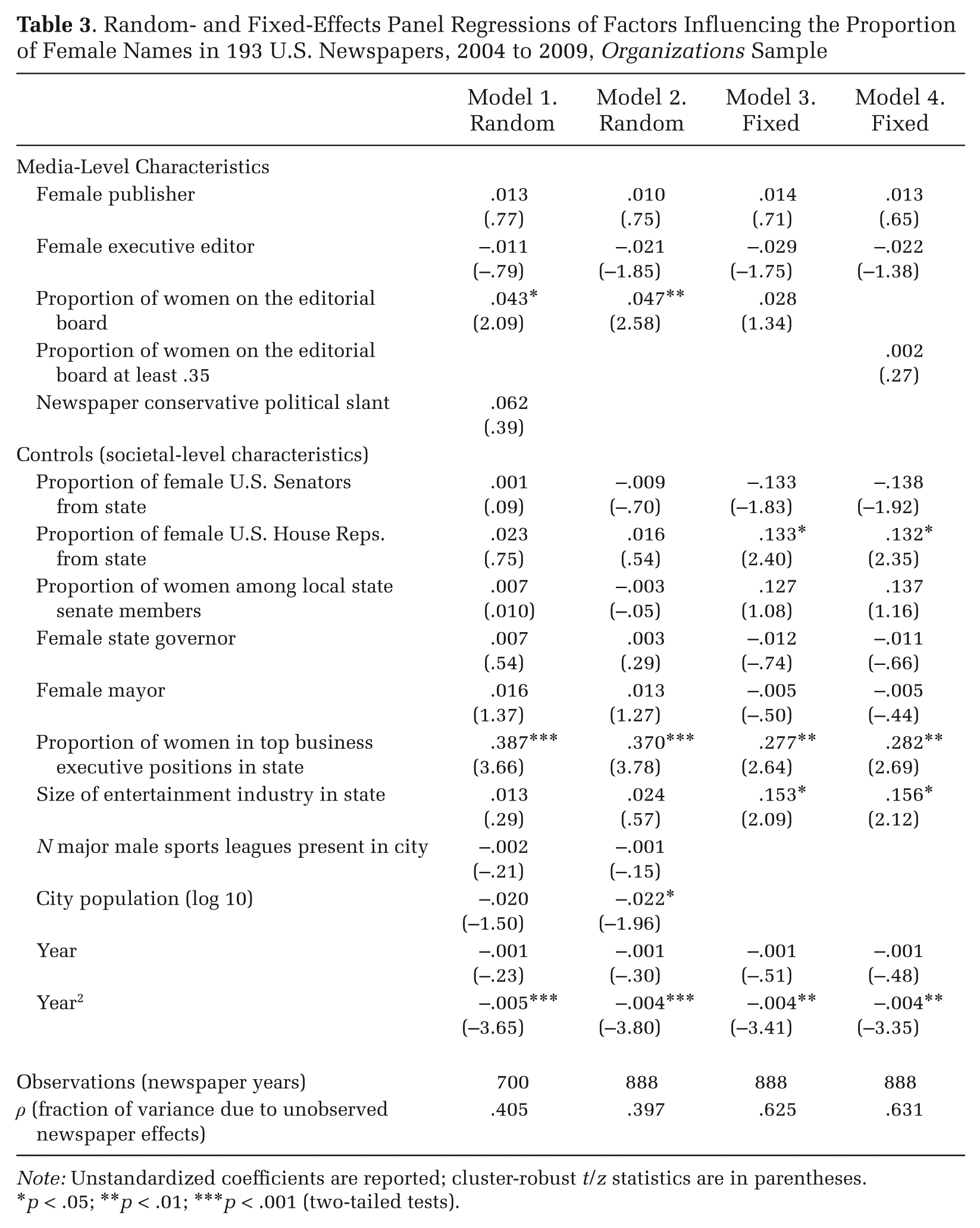
Table 3 presents random-effects (Models 1 and 2) and fixed-effects (Models 3 and 4) panel regression models predicting female coverage rates in 193 U.S. newspapers. The random-effects models have a random intercept for newspapers. Significance levels are determined using cluster-robust standard errors, where each newspaper is a cluster. Model 1 includes an effect of newspaper slant, which reduces the number of observations, as this information is available only for a subset of newspapers. Models 2 through 4 are performed on the full sample.
Random- and Fixed-Effects Panel Regressions of Factors Influencing the Proportion of Female Names in 193 U.S. Newspapers, 2004 to 2009, Organizations Sample
Note: Unstandardized coefficients are reported; cluster-robust t/z statistics are in parentheses.
p < .05; **p < .01; ***p < .001 (two-tailed tests).
Models 1 through 4 in Table 3 suggest that the identity of a single newspaper publisher or executive editor (Hypothesis 3) has little influence on quantitative sex coverage patterns. Simply having a female publisher or a female executive editor at a paper is not enough to noticeably increase women’s coverage rate in that paper (and female executive editors are weakly associated with lower coverage rates for women).
Single individuals in media organizations may not be able to make a big difference, but sociological studies of gender inequalities in organizational settings suggest that a large presence of women in a given organization and its management may lead to a change in both culture and practices (Hypothesis 4). Greater representation of women on newspaper executive boards is indeed significantly and positively associated with the proportion of female names in the random-effects models (Models 1 and 2). However, our fixed-effects analysis (Models 3 and 4) suggests these may be largely correlational associations. In Model 3, the proportion of women on an editorial board has a smaller and nonsignificant effect on coverage rates. This suggests the relationship is at least partly due to the tendency of female editors to serve on the boards of newspapers that focus on women in their coverage. When the editorial board composition of a newspaper changes from one year to the next, we do not see a significant change in coverage as a result.
Furthermore, the size of the effect in Model 3 should be carefully considered. The coefficient of .028 indicates that even if a newspaper were to implement the most radical possible change to its organization—replacing a male-only editorial board with a female-only editorial board—it could expect to see the relative exposure of female names rise by less than 3 percent. This upper limit on the effect of women’s participation in media management is an order of magnitude smaller than the sweeping historical change in the rate of female names at low frequencies that we observed in Figure 1—changing representation at the bottom from highly unequal in 1983 to about equal in 2008. Model 4 tests Kanter’s (1977a, 1977b) original critical mass theory, dividing newspapers’ executive management into skewed/tilted groups (women make up less than 35 percent of the editorial board) and balanced groups (women comprise 35 percent or more). These results again show no significant effect of above-threshold female representation.
Finally, a newspaper’s political slant (Hypothesis 5) does not seem to affect the degree to which its news coverage pertains to female subjects. Model 1 shows that conservative papers do not provide significantly greater or less exposure for female names than do their liberal counterparts.
With respect to the local real-world factors we were able to capture, they appear to affect female coverage rates to a considerable degree. In particular, some measures for the political, business, and entertainment environments of states and cities where newspapers are located were influential. We found a significant effect in both of the fixed-effects models (Models 3 and 4) for the proportion of women out of all members of the U.S. House of Representatives coming from the state. We did not find support for the proportion of female senators or the presence of a female governor or mayor affecting rates of female coverage. This is likely due to very low variability across time for these variables. During the six years captured in our analysis, over 90 percent of the newspapers in our sample had no change in the sex of the mayor or governor or the proportion of female senators in their respective city and state.
The proportion of women in top local business executive positions had a large and significant effect on the proportion of female names in both the random- and fixed-effects models. In other words, newspapers appearing in states where women were able to reach high-level positions in the business world tend to exhibit a much higher rate of female names in their news coverage. In addition, when the proportion of women among top business executives in a given state increases, it noticeably affects female representation in coverage. Similarly, a large local entertainment industry is positively associated with female coverage, and this effect is significant in the fixed-effects models (Models 3 and 4), indicating that growth in the size of the entertainment industry is correlated with growing coverage. Together, these results suggest that variation in the share of women among locally newsworthy characters has substantial influence on coverage patterns. When women occupy high-level positions in higher numbers, newspaper coverage of women increases. As expected, the population size of the city in which a newspaper is printed is negatively associated with coverage of women. Newspapers in larger cities are more likely to have a national distribution and focus on top national characters, who are predominantly men. As such, the real-world glass ceiling may more clearly translate into a paper ceiling for these newspapers.
Conclusions and Discussion
Our main objective was to evaluate various theoretical explanations for the persistent gender gap in newspapers’ coverage. We examined a number of media-level explanations, focusing on the role of newspapers’ political slant, individual editors, and newsroom composition. We attempted to assess whether these are influential even when holding some societal-level structural factors constant. Our findings show that the difference between the rate of female and male names in today’s newspapers is due primarily to external factors, namely, the persistent dominance of men in top positions across various social categories, that is, among well-known and highly covered individuals.
Our analysis reveals the importance of the link between coverage patterns and societal-level inequalities. Newspapers’ coverage is characterized by very high inequality: almost all coverage focuses on a relatively small number of famous individuals whom are largely men. Our findings suggest that women’s growing presence in the public sphere, and their increasing entry into the job market (as doctors, lawyers, university professors, lower-level administrators, and the like), may be the primary reason behind the minor improvements in the visibility of female names over the past few decades. However, because the change in top political, administrative, corporate, and athletic positions has been minimal (Ridgeway 2011), sex differences in coverage at the top have also stagnated. And because the large majority of newspapers’ coverage is devoted to people at the top, the visibility of female names has not been able to rise above one fifth of all references.
This stagnation in reducing real-world inequalities may lead some to conclude that newspapers are simply doing their job in covering figures of public interest, and coverage patterns cannot dramatically change as long as social inequalities persist. Although this “stalled revolution” indeed appears to be a major part of the story, our findings also suggest that newspaper policies, newsroom culture, and male-dominated editorial board composition may be responsible for exacerbating gender differences in coverage. On the one hand, contrary to previous anecdotal evidence (e.g., McCormick 1991; Pantin 2001; Wood 1994), our analysis shows no significant relationship between newspaper coverage patterns and either a newspaper’s political tendencies or the sex of individual editors and publishers. Liberal and conservative newspapers and male and female editors are all significantly more likely to cover male names. On the other hand, our findings do provide some support for explanations that emphasize the importance of female organizational representation as a way to change organizational practices. Greater female representation among section editors and news executives on editorial boards is associated with greater coverage of women, suggesting that greater sex equality in news making may bring about a change of culture in the newsroom and increase coverage of women.
However, while these associations between coverage and female representation are significant when comparing different newspapers, they are not significant when looking at the same newspaper over time. Hence, a plausible interpretation of the associations may simply be that female editors tend to work for newspapers that focus more on coverage of women and women’s issues. Moreover, even if increasing female participation on newspapers’ editorial boards makes a difference, this difference is small. The newspapers in our sample that had greater representation of women on editorial boards still mostly covered men. For example, over a third (35.26 percent) of the editorial boards in our sample may be defined as Kanter’s balanced groups (i.e., groups where at least 35 percent of members are women). Yet, only in less than 1 percent of these cases did female names receive at least half of the total share of names in a given year. Such findings put into question predictions about slowly but surely closing gaps. According to Sarah Macharia, the coordinator of the latest GMMP project, “at this rate, it will take at least 43 years . . . to achieve gender parity in mainstream news” (Gallagher 2010:1). However, our findings suggest that much (although probably not all) of the change that has occurred over the past few decades can likely be attributed to women’s higher public visibility, rather than to the increase in women’s occupation of senior positions in news organizations. Hence, the growth we have witnessed in the media exposure of female names over the past few decades may be approaching a plateau. Further changes in the composition of newsrooms and editorial boards are clearly important and may assist in promoting greater balance in coverage, but they are unlikely to eradicate the large existing disparities. 4
Given these tendencies, we agree with gender and media scholars (e.g., Craft and Wanta 2004; De Swert and Hooghe 2010; Jolliffe and Catlett 1994; Liebler and Smith 1997; Risman 1998; Ross 2009; Ross and Carter 2011) who question the ability of individuals or even groups within the media industry to substantially change the coverage imbalance. Risman (2004:432) notes that a “structural perspective on gender is accurate only if we realize that gender itself is a structure deeply embedded in society.” She further argues that gender constitutes a multilevel social structure, in which men and women may make individual decisions that are gender-progressive, but their ability to change the status quo is limited by macro-level gender inequality and gendered institutional norms. Indeed, traditional media are bound by journalistic norms (often reflecting public demand) that dictate dedicating ample coverage to top politicians, public officials, business people, athletes, and entertainers. As long as these individuals remain overwhelmingly male, journalists’ ability to make a substantial change and report equally on women and men remains limited. Put differently, as long as the real-world glass ceiling remains resistant to change (England 2010; Ridgeway 2011), the paper ceiling of newspaper coverage is likely to remain in place.
Study Limitations and Directions for Future Research
Our dataset and analyses examine the quantitative representation of female names in media at great depth, but they do not allow us to closely inspect the specific ways women are portrayed or the specific roles women take when mentioned in newspaper articles. Hence, this article clearly tells only part of the story. Numerous studies argue that women’s marginalization in the media is due not only to their underrepresentation, but also to the stereotypic and often subordinating, belittling, and demeaning ways in which they are portrayed (Fiske 1996; Kang 1997; Lester and Dente Ross 2003; Lovdal 1989; Rakow and Kranich 1991; Ross and Carter 2011; Tuchman 1979; Van Zoonen 1988, 1994). In this respect, coverage of women often resembles that of ethnic minorities and immigrants (Shor 2008; Shor and Yonay 2010, 2011; Yonay and Shor 2014). When women are mentioned, it is sometimes done in ways that sexualize them (in both text and pictures, which our analysis cannot speak to) and highlight mainly their physical attractiveness. Alternatively, journalists may focus on women’s motherly qualities, while playing down or trivializing their talents, abilities, and ideas (Boutilier and SanGiovanni 1983; Carroll 1994; Higgs, Weiller, and Martin 2003; Kahn 1994; Kahn and Goldenberg 1991; Kane 1996).
Furthermore, previous research suggests that women are often mentioned as wives (Michelle Obama) or mothers (Gloria James) of well-known politicians (Barack Obama) or sports superstars (LeBron James), rather than as the main characters in news stories. Considering this tendency, the ratios of newspaper articles that actually focus on women and their independent actions and ideas may in fact be even lower than the ratios found in the present study (see, e.g., Gallagher 2010). Future research should therefore continue to be sensitive to the roles that women portray when they do appear in the media. Merely being covered does not guarantee a respectable, positive, and empowering portrayal; quantitative goals are clearly not sufficient.
While these issues cannot be explored in depth in the current manuscript, we are able to offer preliminary results from large-scale sentiment analysis. Part 3 of the online supplement shows a comparison of the sentiment associated with female and male names (calculated using the terms juxtaposed with each name) and the adjectives most commonly associated with these names. These results highlight two important points. First, while “loving,” “wonderful,” “beautiful,” and “hot” are indeed more commonly associated with women, and “serious” and “successful” with men, the coverage patterns for men and women nonetheless exhibit striking similarities in terms of the sentiment associated with them. Second, this sentiment tends to be quite positive. Together, these findings suggest that although coverage rates indeed tell only part of the story, there is clearly great value in examining these rates, as they are apparently associated with an unequal distribution of a largely desired resource (media coverage and fame), for both women and men. Before we can talk about the portrayal of certain groups and individuals, we first need to examine and explain the extent to which they are covered to begin with.
A second major limitation of our study is that almost all of the results reported here come from traditional news sources. Our results do not address other media, such as television, radio, and new social media (e.g., blogs, Facebook, Twitter, and YouTube). This focus on traditional news media and newspapers may seem especially problematic given the rapid developments and changes over the past two decades in how the news media operate. The past two decades have seen a significant rise in Internet use and the proliferation of digital media. This has had a profound impact on the newspaper industry, changing some of the key aspects in the production, reporting, and dissemination of news (Franklin 2014; Skogerbø and Winsvold 2011). With increasing numbers of readers turning to online media, the circulation figures for most U.S. newspapers have plummeted, triggering a wave of staff layoffs, bankruptcies, and mergers in the industry (Fan 2013; Franklin 2014; Siles and Boczkowski 2012; Soloski 2013). Looking to produce cheaper content, some newspapers increasingly employ part-time or amateur “content builders” rather than professional journalists. They also often turn to aggregated news and “content farms” for local investigative reporting (Bakker 2012). Such changes reduce journalists’ influence over content. Finally, newspapers increasingly rely on social media platforms, such as Twitter, as a source of breaking news and to disseminate information and attract and retain audiences’ interest (Franklin 2014; Vis 2013). This tendency blurs the boundaries between producers and consumers of news.
What are the consequences of these rapid changes for the results we present? We were unable to analyze the most current newspaper data (over the past five years) due to accessibility issues. However, we conducted a small scale manual examination of a few selected issues in some of the newspapers we analyze here, and the approximately 5:1 male to female ratio does not seem to have changed much. We also have no reason to believe that shifts in the newspaper industry will affect the relationships between the main variables in our multivariate analysis. More specifically, although individual journalists’ power is gradually diminishing, editors continue to make important content decisions. As for the growing reliance on content builders, content farms, and news agencies, these may make the coverage of national issues and individuals increasingly similar, but these sources are less likely to affect coverage of local issues and individuals. This coverage of local issues produces the majority of variability that still exists in newspapers. As differences between newspapers’ content are narrowing, making it harder to detect significant effects, the effects that we do detect in our study are likely to be important ones.
We are limited in our ability to comment on the exposure rates of female names in new media and this is clearly a matter for further research. However, our database of media sources does include the websites of newspapers, television stations, and radio stations, and coverage patterns in these do not seem to differ qualitatively from those reported for print newspapers. The close connection between female underrepresentation in top positions in government and business on the one hand, and the names that dominate public discourse on the other, leads us to believe that the paper ceiling holds in the paperless media.
Further supporting this assessment, Part 4 of the online supplement presents preliminary findings from a random sample taken from 2014 Facebook data, showing the visibility distribution of male and female names by number of mentions. Social networks and blogs provide an interesting case for comparison, mainly due to the reduced influence of traditional gatekeepers, who are still very influential in the newspaper industry, whether in press or online (Shoemaker and Vos 2009). One might therefore expect to find more equal sex coverage in these more democratic bottom-up forms of mass communication production. However, the Facebook data distribution follows a very similar pattern to the newspaper distribution presented in Figure 2, Panel 2. In both cases, references to female names are on par with references to male names at low levels of mentions but lag far behind at high levels. This suggests that even democratically produced content, such as for Facebook and Twitter, follows similar patterns, where popular men far outnumber popular women. Further research is needed to corroborate these empirical tendencies for other social media, but we believe these preliminary analyses support one of the main conclusions from our research: regardless of media, as long as real-world glass ceilings remain in place, media coverage gaps are likely to linger.
Footnotes
Acknowledgements
We thank the editors and anonymous reviewers for useful comments; H. Andrew Schwartz for providing the Facebook data; and Charles Ward for assistance with analysis of the newspaper data.
Funding
This research was partially supported by a Social Sciences and Humanities Research Council of Canada Insight Grant (to Shor); by an American Sociological Association fund for the Advancement of the Discipline (to Shor and Van de Rijt); by National Science Foundation Grants SES-1340122 (to Van de Rijt), DBI-1355990 (to Skiena), and IIS-1017181 (to Skiena); and by a Google Faculty Research Award (to Skiena).
Notes
 ), a media measurement company based on his Lydia text/sentiment analysis system.
References
Supplementary Material
Please find the following supplemental material available below.
For Open Access articles published under a Creative Commons License, all supplemental material carries the same license as the article it is associated with.
For non-Open Access articles published, all supplemental material carries a non-exclusive license, and permission requests for re-use of supplemental material or any part of supplemental material shall be sent directly to the copyright owner as specified in the copyright notice associated with the article.
