




Abstract
Scholars have documented the emergence of apparently race-neutral discourses that serve to entrench racial stratification following the elimination of de jure segregation. These discourses deny the existence of both present-day racism and the contemporary effects of histories of racial oppression. Researchers posit that individuals are socialized into these views, but little empirical attention has been paid to the processes through which such socialization occurs. Focusing on the South African case study, I draw on five months of daily observations in seventeen 9th-grade history classrooms, content analysis of notes distributed in class, and 170 in-depth interviews with teachers and students to document how and why students are taught not to attend to the effects of apartheid on their society. To mitigate race-based conflict in their local school context, teachers told “both sides of the story,” highlighting that not all whites were perpetrators and not all blacks were victims. By decoupling the racialized coding of victims and perpetrators, and sidelining discussions of beneficiaries, teachers hindered students’ abilities to make connections to the present. In outlining how and why individuals are taught about the irrelevance of the past, this study contributes to literatures on race, education, collective memory, and transition to democracy.
How is racial inequality justified and tolerated in the era of civil liberties? A growing body of literature documents the consolidation of apparently race-neutral attitudes and beliefs that provide ideological support for a racially unequal status quo in the era of de jure equality (Bobo 1988; Bobo, Kluegel, and Smith 1997; Bonilla-Silva 1997, 2014; Quillian 2006; Sears 1988). These attitudes and beliefs involve a denial of both the contemporary effects of histories of racial oppression and the realities of present-day discrimination. Individuals, particularly whites, now claim they are “colorblind”—they neither see nor care about race. This argument holds that racial discrimination is a thing of the past, the past has no effect on the present, and race has nothing to do with life chances in the contemporary era. In positing an equal playing field where none exists, proponents of these ideologies do not make race or racism disappear. Instead, they protect a racially unequal status quo from challenge.
But where do these ideas come from? How do they solidify and take hold? Scholars have identified the prevalence and contours of what Bonilla-Silva (2014) calls “colorblind racism,” 1 but less attention has been paid to how and why these ideologies are transmitted. In what follows, I focus on schools as key institutions of socialization to examine whether and how individuals are taught about the effects of histories of legislated racism on the present. Although other institutions, such as the media and the family, are important sites in which racial socialization occurs, schools in general—and history classrooms in particular—present an important setting for understanding how young people learn about the connections between histories of racial oppression and the contemporary racial order. My findings demonstrate how high school history education, far from teaching lessons that connect past to present, can provide students with the tools to enact colorblind ideologies.
I focus on South Africa—a country that abolished de jure racism approximately 20 years ago but already displayed colorblind discourses, similar to those documented in the United States, within the first decade of democracy (Ansell 2006; Steyn 2001). My study focuses on a unique moment in South African history, as the country’s first generation born into democracy—the “born frees”—confront their country’s past for the first time in a formal and systematic way through the educational system.
Drawing on 18 months of fieldwork in two racially and socioeconomically diverse public high schools in Johannesburg, South Africa—including observations in history classrooms, content analysis of notes distributed in class, and 170 in-depth interviews with teachers and students—I demonstrate the micro-interactional processes through which students are taught to deny the continued effects of apartheid on their society. Specifically, I document how a variety of micro-social dilemmas lead teachers to weave a narrative into their lessons that limits students’ abilities to connect the racialized past to the racialized present. Using a term that emerged during data collection, I call this narrative both sides of the story. The narrative emphasizes that (1) not all whites were perpetrators and (2) not all blacks were victims during apartheid. This narrative blurs the racialized coding of victims and perpetrators, and it sidelines discussions of beneficiaries. It presents an individualized story of how different people made different choices, but it obscures an understanding of the benefits and disadvantages that accrued (and continue to accrue) to individuals as a result of their racial group membership. In so doing, the narrative hinders students’ abilities to make race-based assumptions about the legacies of apartheid and to articulate the effects of racism on their everyday lives.
Both sides of the story did not appear in national curricular guidelines. Yet, all teachers introduced this narrative into their teaching. Teachers in this study were not “cultural dopes” (Garfinkel 1984) blindly reproducing the content of official curricula. Instead, they improvised on official curricular guidelines, actively drawing on scripts and narratives—many of which resonated with ideas promoted during the country’s transition to democracy—to solve micro-interactional dilemmas emerging from the content of the official curriculum. These dilemmas included minimizing conflict in their classrooms, maintaining their position as authority figures in mixed-race schools, and assuaging students’ feelings of guilt and anger.
In documenting the processes through which young South Africans were taught to ignore the contemporary effects of apartheid, this article makes two central contributions that bring together literatures on racism, education, and collective memory. First, I document how recounting histories of racial oppression through the trope of both sides of the story can become a mechanism for denying the effects of the past and promoting colorblindness in the present. Second, in outlining the micro-social considerations that led teachers to deploy this narrative in the face-to-face setting of classroom interactions, I add to our knowledge of the uses and functions of colorblindness. I highlight the question of why individuals reproduce racial ideologies in particular settings populated by specific types of people—an underexplored aspect of racial formation theory (see Whitehead 2009).
Racism in the Era of Civil Liberties
The abolition of racist laws does not mean the eradication of racism. As Omi and Winant (1994) argue, different historical periods are characterized by different “racial projects” that reconfigure our understandings of race and the articulation of racism. Several U.S. scholars have documented the consolidation of newer forms of racism following the elimination of de jure racial segregation (e.g., Bobo et al. 1997; Bonilla-Silva 2014), and similar discourses have been documented in post-apartheid South Africa (e.g., Ansell 2006; Durrheim 2010; Steyn 2001).
Describing these newer forms of racism, Bonilla-Silva (1997, 2014) argues that we are living in an era of “racism without racists,” where the status quo of racial inequality is maintained through the promulgation of colorblind ideologies. These ideologies are expressed in various ways. The most obvious way asserts a literal “colorblindness,” as individuals profess that they neither see nor care about race. But colorblindness is articulated in other ways too. Individuals, for example, construct arguments that are blind to the continued effects of histories of racial oppression and the realities of contemporary racial discrimination. The result is what Bobo and colleagues (1997; see also Bobo 1988) call laissez faire racism, whereby racial inequality is maintained through putatively race-neutral market dynamics. Drawing on ideas of individualism and meritocracy, adherents to colorblindness resist acknowledging the racist structuring of society. As a result, they actively oppose race-conscious policies aimed at redressing these inequities, allowing the status quo of racial inequality to continue unfettered.
These theories were developed in the United States following the Civil Rights Movement, but they have been usefully employed to understand the reconfiguration of racism in post-apartheid South Africa. In spite of significant historical and demographic differences between the two countries, South African scholars have documented racial discourses remarkably similar to those found in the United States (Ansell 2006; Durrheim 2010; Steyn 2001). 2 In describing these discourses as racist, scholars make two distinct points. First, they identify the reconfiguration and rearticulation of racist attitudes in an era when explicit forms of racist discourse have become less and less acceptable. 3 Second, they point to the racist consequences of these discourses in protecting a racially unequal status quo from challenge. 4
Researchers in both countries have documented the contours of these discourses and outlined their consequences for racial inequality, but less attention has been paid to how these ideas are transmitted in face-to-face settings. Scholars hypothesize that individuals are socialized into these views (see Kinder and Sears 1981; Sears 1988). 5 Yet, we know little about how such socialization occurs, leading Bonilla-Silva (2015) to identify racial socialization as a key area for future research (see also Hagerman 2014). In this article, I explicitly examine the processes through which individuals are taught not to attend to the effects of histories of legislated racism on the present. In addition, the findings provide insight into why individuals promote colorblind ideologies, by pointing to the power of these discourses in diffusing potential conflict in contexts of diversity and inequality. In this way, the article offers an account of the emotional and interpersonal considerations that play into the reproduction of racial ideologies—in particular, in an institutional context where ideas about race and inequality are transmitted to young people.
Race and History in Schools
Schools transmit lessons about race in a variety of ways. As Lewis (2003:4) notes, “[R]ace is not a fixed characteristic that [students] bring to schools with them and take away unaffected and intact. Something happens in schools . . . that forms and changes people in racial terms.” A growing body of school-based research identifies how racial identities, attitudes, and inequalities are created and reinforced through informal processes that occur between peer groups (Holland 2012; Ispa-Landa 2013), between teachers and students (Carter 2012; Pollock 2004), and through formal policies such as tracking (Tyson 2011) and discipline (Morris 2005).
By documenting how school practices reproduce (and occasionally subvert) broader social structures, these studies bring our attention to the role of the “hidden curriculum” (Apple 2004; Bowles and Gintis 1976)—norms and values that are taught implicitly throughout the school day and distinguished from official curricular content—in sustaining racial hierarchies. In focusing on the covert curriculum, however, this research tradition has left the manifest curriculum largely unexplored (Apple 2004; Bonikowski 2004; Giroux 1981). Yet, certain classes transmit lessons about race more explicitly than others, and history classrooms are one such space. In history classrooms, individuals might learn not only about histories of racial conflict, but also about the relationship between those histories and the present social order (Willis 1996). Research shows that individuals’ understandings of history affect their perspectives on a variety of contemporary social issues, such as racial attitudes (Griffin and Bollen 2009), support for war (Schuman and Rieger 1992), and perceptions of crime (Teeger 2014). Yet we know little about the processes through which individuals learn not only about the past, but also about the connections between past and present.
For the most part, our knowledge about history as a school subject comes from studies of textbooks and official curricula. Scholarship on collective memory reminds us that representations of the past are often characterized by blindspots and omissions (Rivera 2008; Vinitzky-Seroussi and Teeger 2010; Zerubavel 2006), and history textbooks and curricula are no exception. Apple (2004) and Giroux (1981), for example, argue that official history curricula avoid discussions of conflict in order to provide ideological support for the hidden curriculum’s focus on cooperation in preparing students to function in a capitalist economy (see also Loewen 2007). Other work documents the more explicitly ideological nature of history curricula as political elites rework history textbooks for nationalist goals (Pavasovic-Trost 2012; Weldon 2009). Still others document contestations by interest groups in gaining control over the content of curricula (Binder 2002).
Researchers focusing on race and history curricula highlight the implicit messages about belonging transmitted to students by “what is left in and what is left out of the knowledge presented as legitimate in school” (Erickson 2010:46). This is especially true with regard to the presence and representation of people of color in history curricula. Banks (1989:17), for example, has criticized the “Heroes and Holidays” and “Contributions” approaches that often characterize multicultural education in the United States. These approaches present black history as “an appendage to the main story of the development of the nation.” Furthermore, history curricula often eschew discussions of the constitutive role of racism in national histories (Banks 1989). Discussions of slavery and other forms of racial oppression are often ignored or sidelined (Weiner 2014).
These studies provide insight into the ideological dimensions of official curricula, but our knowledge about what happens once textbooks and policy guidelines arrive in classrooms is much more limited (but see Epstein 2009; Willis 1996). Do teachers merely reproduce prescribed content? Do they deviate from the official curriculum? If so, when, how, and why do they deviate? In particular, what happens when the content of the curriculum mandates difficult and potentially divisive topics? If we are to understand the ideological nature of curricula, it is important to pay attention to how they are transmitted on-the-ground and in real time.
This article reports on how South African teachers in multiracial schools dealt with the challenges of teaching the apartheid section prescribed in official curricular documents. Teachers in my study were concerned about difficult dynamics that might occur in schools and classrooms if students made connections between the apartheid past and contemporary inequality.
Race and Inequality in a Democratic South Africa
In 1948, apartheid was introduced as official state policy in South Africa. This signaled the intensification and codification of existing racist state policies. A series of laws entrenched political, economic, and social discrimination against black South Africans. 6 These included “grand apartheid” laws, which denied blacks the right to vote, regulated their freedom of movement in areas designated for whites, created separate and unequal educational spaces, and entrenched a color-bar in employment. They also included “petty apartheid” laws that reserved park benches, beaches, and other public spaces as “whites only.”
By the late 1980s, heightened internal resistance, combined with international sanctions, brought many in power to believe that apartheid was both economically irrational and practically unsustainable. A context had been created for a negotiated settlement (Fagan 2000; Marais 2001). A central debate during the transition to democracy (1990 to 1994) was how to deal with the past. The outgoing apartheid regime wanted complete immunity, but members of anti-apartheid organizations insisted on accountability. The compromise was individual (rather than blanket) amnesty that would be conditional on full disclosure of past wrong-doings. Negotiators agreed to the principles of what would become the Truth and Reconciliation Commission (TRC).
Focusing on gross human rights violations, the TRC was given the mandate to grant amnesty to individuals who fully disclosed their crimes and showed these crimes were politically motivated. The legislated structural violence of segregation, economic exploitation, and unequal education fell outside the TRC’s scope. In one of its most controversial moves (Wilson 2001), the TRC also required members of resistance organizations to apply for amnesty for human rights violations they committed during the fight against apartheid, thus constructing a moral equivalence between apartheid’s enforcers and resisters. Furthermore, by focusing on individuals rather than institutions or groups, the TRC “invited beneficiaries to join victims in public outrage against perpetrators” (Mamdani 1998:40; see also Lodge 2003; Posel 2002).
Although accountability was individualized, Commissioners often worked to reinterpret the suffering of individual victims in collective terms, so the pain would be “shared by all, and merge into a wider narrative of national redemption” (Wilson 2001:111). The healing metaphor that pervaded the life of the TRC suggested that all South Africans—black and white—suffered because of apartheid, and the entire body politic was in need of restoration. By individualizing accountability, collectivizing suffering, and sidelining discussions of beneficiaries (Posel 2002; Wilson 2001), the TRC dealt with the past, but it did so in ways that safeguarded the majority of white South Africans from having to account for how they benefitted, and continue to benefit, from apartheid.
Others have argued that the racial ideologies of social healing and racial reconciliation solidified through the TRC helped prevent a white backlash and facilitated the handing over of power through a negotiated settlement rather than a violent revolution (Mangcu 2003). 7 The 1995 Promotion of National Unity and Reconciliation Act, which set in motion the TRC, expressed this agenda clearly in clause 3(1) by stating that “[t]he objectives of the Commission shall be to promote national unity and reconciliation in a spirit of understanding which transcends the conflicts and divisions of the past.” Indeed, the work of the TRC, and the reconciliation ideology that pervaded the Mandela presidency, have been praised for allowing the relatively peaceful transition from racist authoritarian rule to multiracial democracy. Internationally, the “South African Option” is often promoted as a model for successful political transition. Scholars and commentators point to the success of the TRC in that it allowed South Africans to acknowledge the past without reigniting conflict (Goldstone 2000; Minow 1998; Olick 2007). Instead, the TRC helped promote the idea of the Rainbow Nation—a metaphor coined by Archbishop Desmond Tutu, Chairperson of the TRC, to describe the new South Africa. This image, of a country united in its diversity, remains a powerful one in the post-apartheid era (Kiguwa 2006).
In consolidating the founding myth of the new South Africa as a Rainbow Nation that “transcends the divisions and conflicts of the past,” the TRC constructed a narrow definition of the effects of apartheid. It focused on individual victims and perpetrators of gross human rights violations, rather than on racialized structures of inequality that created beneficiaries. Recently, such narrow definitions have allowed the Minister of Human Settlements to declare that people under 40 are not entitled to public housing, because they “have lost nothing” to apartheid (City Press 2014); and a backlash against affirmative action policies has framed these policies as forms of reverse discrimination that perpetuate racial divisions (see Habib and Bentley 2008).
This is not to suggest there are no challenges to the racial ideologies of reconciliation and Rainbow Nationalism. Increasingly, black South Africans are pointing to the continued legacies of apartheid that undermine these ideologies. In the most recent elections, a new political party—the Economic Freedom Fighters—garnered attention (and votes) not insignificantly for their focus on the persistence of economic apartheid in South Africa. In this way, they echo Mazrui’s (2001) assertion that the South African transition allowed whites to keep “the jewels” while giving up “the crown.” Economic indicators support this view. While intra-racial inequality has grown since the transition to democracy (Seekings and Nattrass 2005), aggregated data nonetheless demonstrate persistent racial stratification. For example, Figure 1 presents median income figures by race, and Figure 2 presents unemployment figures by race. These data map perfectly onto apartheid’s racial hierarchy: on aggregate, black Africans are still the most economically disadvantaged, followed by coloureds, and then Indians/Asians. Whites remain, on aggregate, the most economically privileged in the new racial order. 8

Median Monthly Earnings by Race (in USD)
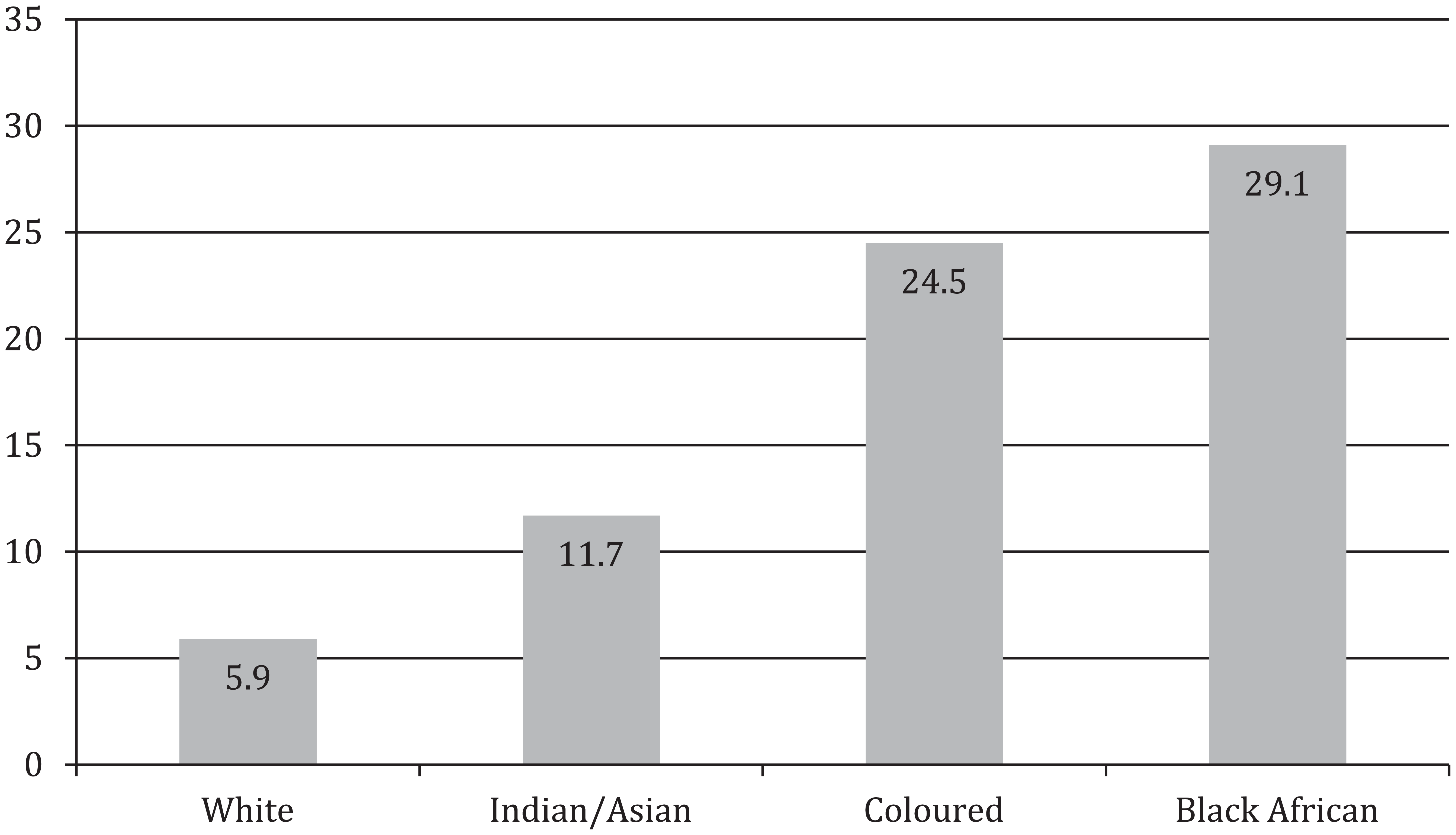
Unemployment Rate by Race
In the context of enduring (but evolving) structures of racialized inequality, how is the history of apartheid being taught to young South Africans sitting in the desegregated classrooms made possible by the country’s historic transition to democracy?
Data and Methods
Case Selection
I collected data in two English-medium, public high schools in Johannesburg, South Africa, over an 18-month period between February 2010 and August 2011. The schools chosen for this study are not meant to be representative of all schools in South Africa. Instead of using the logic of statistical sampling—which, as Small (2009) argues, is not the most fruitful way of conceptualizing this type of research—I sampled on theoretical grounds (see also Yin 2003). I strategically chose two top-performing “former Model-C” schools: these schools were reserved for whites during apartheid and desegregated during the transition to democracy. 9 Top performing former Model-C schools are the most racially and socioeconomically diverse schools in the country (see Dolby 2001; Soudien 2012). In many ways, they are a microcosm of the promises of the post-apartheid moment. They embody the ideals of racial diversity, Rainbow Nationalism, and the possibility for upward mobility. As such, they are often presented as “an important testing ground for new ideas in the battle for transformation” and as “sites of excellent practice where many of the goals of the South African nation can be realised” (Bloch 2009:148). Several studies have documented how these schools fail to actualize these promises (Carter 2012; Soudien 2012; Teeger 2015), but they remain important spaces representing the aspirations of racial integration and reconciliation in the new South Africa.
The schools chosen for this study—Glenville and Roxbridge High 10 — are two of the top performing schools in the country based on standardized matriculation tests. They are precisely the type of school held up as an ideal for public education in post-apartheid South Africa, with their high academic standards and racial diversity.
Nonetheless, there were important differences between the schools. Although both were racially diverse, only 5 percent of the student body at Glenville was white, in contrast with 50 percent at Roxbridge. 11 Table 1 summarizes the demographics of the schools by race.
Schools by Race of Students (percentages)

As in most former Model-C schools (Carter 2012; Vandeyar and Killen 2006), teaching staff in both schools were predominantly white, even more so at Roxbridge than at Glenville. This was clear in the demographics of the history teaching staff interviewed for this study (see Table 2). At Roxbridge, all history teachers were white. At Glenville, three history teachers were white and two were black. Although both were English-medium schools, half the history teachers interviewed did not have English as their first language.
Characteristics of History Teachers

Glenville displayed a type of internal segregation that Roxbridge did not. Specifically, Glenville separated students into classes based on their choice of second language: Afrikaans or Zulu. This meant that students who elected to take Zulu as a second language would also take every other class with classmates who chose to take Zulu as their second language. The same was true for students who chose Afrikaans. The Afrikaans classes were multiracial, whereas the Zulu classes were composed entirely of black African students. This type of internal segregation did not take place at Roxbridge, where all students took Afrikaans as their second language. Thus, while all classrooms at Roxbridge were racially diverse, Glenville had some classrooms that were diverse and others that were not. Despite this variation in educational experience, both sides of the story emerged dominantly in every classroom I observed. All teachers, regardless of race, gender, first language, or age introduced this narrative into their teaching. At Glenville, they did so whether they were teaching a multiracial “Afrikaans class” or a black African “Zulu class.”
Grade Selection
My study focuses on the 9th grade where, for the first time, South African students across the country learn about apartheid in a formal and systematic way in their history classes. For students who drop history at the end of the 9th grade, when it is no longer mandatory, this may be the last time they learn history in a formal educational context. Although the curriculum is centralized in South Africa, the state provides very little content guidelines. Figure 3 reproduces the guidelines provided to teachers by the state in its National Curriculum Statement. 12 At the time this research was conducted, there was no state mandated textbook, and neither school used a textbook for 9th-grade history.
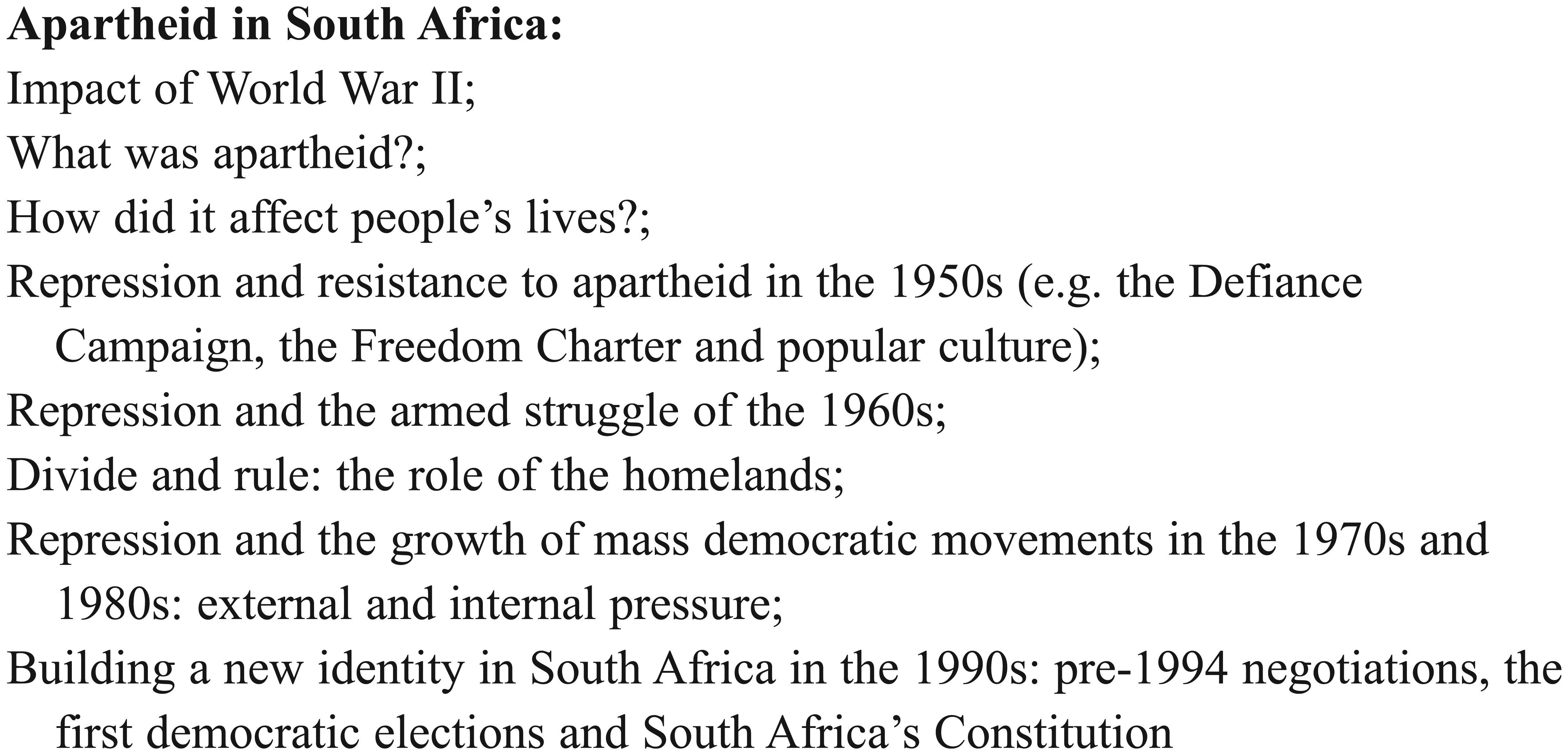
National Curricular Guidelines for Apartheid Section (9th Grade)
By focusing on young people age 14 to 15, I tap into an age bracket in which lessons learned about “us” and “them,” and history and politics more generally, are expected to be highly salient. According to Mannheim (1952; see also Schuman and Scott 1989), political experiences and messages encountered during adolescence remain disproportionately influential throughout the life course. This study highlights the importance of understanding the lessons students learn not only about but also from the past (Vinitzky-Seroussi 2001) during this crucial developmental period.
Data Collection
In 2010, I embedded myself in Glenville High and, in 2011, I did the same in Roxbridge High. In each school, I conducted daily observations in 9th-grade classes for the duration of the apartheid section: two and a half months in each school, totaling five months of daily observations in 17 distinct history classes, resulting in approximately 400 hours of formal observations. I collected all handouts distributed in class for the apartheid section, as well as handouts for other sections taught during the year (which I did not systematically observe).
I conducted 160 semi-structured in-depth interviews with two samples of students, whom I randomly selected from class lists stratified by race and gender. Different students were interviewed in each sample. 13 I interviewed the first group of students before they were taught the apartheid section in school, and the second following their exposure to this section of the history curriculum (I refer to the two samples as “pre” and “post”). In addition, I conducted formal, semi-structured, in-depth interviews with all 9th-grade history teachers in both schools (N = 10). Interviews lasted an average of one hour. All formal interviews were recorded and transcribed. Table 3 provides demographic characteristics of students.
Characteristics of Students

My research in schools was supplemented by observation of two workshops I attended in 2012—one for pre-service teachers on how to teach about the TRC and one for educators on how to teach the topic of race.
Data Analysis
I analyzed these data using descriptive and analytic codes (see Miles and Huberman 1994) with the use of the qualitative data analysis software program, Atlas.ti. I adopted an inductive grounded theory approach (see Charmaz 2006). In the first round of coding, I applied descriptive codes to the data and wrote detailed memos about emerging themes. In the second round of coding, I applied analytic codes developed from the first round of analysis. The process resulted in more than 100 codes, but much of the data presented here is based on the following two descriptive codes: “WHITES_AP” and “RESISTANCE_AP.” The former refers to discussions of what life was like for whites during apartheid; the latter refers to conversations about resistance to apartheid. The analytic code “BOTH SIDES OF THE STORY” emerged inductively from the process of memo-ing around these descriptive codes.
Positionality
How did my position as a white woman, roughly the same age as many of the teachers, affect my participants? In the context of the findings of this article, I do not think my identity had a significant impact. Most of the data presented here were gathered from classroom observations. Both schools were accustomed to having observers in their classrooms, often in the form of pre-service teachers and their supervisors. In addition, as noted earlier, most of the adults in these schools were white. My presence in classrooms was therefore not out of the ordinary.
As I will detail, students in the post-sample introduced both sides of the story into their interviews with me more often than did their counterparts in the pre-sample. The likely explanation for this is simply that they had been taught this narrative in class. This narrative emerged predominantly in sections of the interview that asked about historical knowledge. My sense during this part of the interview was that students were trying to get things “right” and display what they had learned in class. Still, it is possible that learning about apartheid made students in the post-sample more sensitive to my race, leading them to introduce the narrative more frequently in order to appease me, the white interviewer. If that is true, then it supports the argument that people draw on this narrative to minimize interpersonal discomfort when talking about racist pasts.
Both Sides of the Story
In every classroom I observed, teachers wove a narrative, which I call both sides of the story, into their teaching of apartheid. The narrative suggests there is another side to the story of apartheid: rather than merely a story of black victims and white perpetrators, it also, importantly, depicts a story of white victims and black perpetrators. Why did teachers choose to recount the history of apartheid in this way?
My findings indicate that educators were concerned that teaching about apartheid could cause conflict in their local school contexts. Teachers managed the potential for conflict by introducing narrative lines that limited students’ ability to make connections between past and present. In her interview with me, Ms. Mokoena (African, Glenville) explicitly summarized the content and purpose of both sides of the story. She told me that, when she first began teaching, she did indeed have race-based conflict in her classroom, and this conflict started when black students made connections between the racialized past and the racialized present. She further explained how she modified her teaching as a result. Her description of the new narrative foci she introduced into her teaching mapped onto the practices of other teachers in my study:
Maybe you could just start by talking about what it’s like to teach apartheid history.
It’s a bit challenging. You’ve got to accommodate all the kids in the class. You’ve got to be sensitive to all the racial differences. You want to emphasize the wrongs that were done in the past but you also want to, you know, not to make kids feel like it’s their fault. So you want to use the wrongs of the past to try and unite the kids . . .
So what kind of things do you do?
Well I normally highlight the fact that people that were struggling were not just the blacks, it was all the races. And I give examples of the people . . . from all walks of life, all races, and highlight how they suffered as well as a result of apartheid, particularly the whites. . . . What I noticed, particularly my first year of teaching apartheid, I noticed that the black kids made the others feel responsible for what happened. . . . I had a lot of fights. . . . A lot of kids started hating each other because, you know, the others are white and the others were black. And they started saying, “My mother is a domestic worker because she was never allowed an opportunity to get good education.” . . .
I didn’t see any of that now when I was observing.
. . . Like I was saying I think that because of the re-emphasis of the fact that, look, everybody did suffer one way or the other, they sort of got to see that it was everybody’s struggle. . . . They should now get to understand that that’s why we’re called a Rainbow Nation. Not everybody agreed with apartheid and not everybody suffered. Even all the blacks, not all blacks got to feel what the others felt. So ja [yes], it’s [pause] it’s a difficult topic, ja. But I think if you get the kids to understand why we’re teaching apartheid in the first place and you show the involvement of all races in all the different sides, then I think you have managed to teach it properly. So I think because of my inexperience then—that was my first year of teaching history—so I think I—maybe I over-emphasized the suffering of the blacks versus the whites [emphasis added].
The point of teaching apartheid history, according to Ms. Mokoena, is to create Rainbow National unity, not conflict. To achieve this end, Ms. Mokoena explained that she minimizes the potential for conflict by emphasizing that not all whites supported apartheid and not all blacks suffered under apartheid. This narrative diffuses the potential for conflict because it blurs the line between victims and perpetrators and dislodges the coding of “white = perpetrator” and “black = victim.” If race does not denote culpability or victimhood, then students are less likely to make racialized claims about contemporary inequality that could spill into classroom tensions or hostilities.
This narrative was presented to students across schools and classrooms. I was not looking for it during my data collection. It emerged inductively as a salient theme during data analysis. That it was so prevalent was surprising. Given that the National Curriculum Statement provided only vague content guidelines (see Figure 3), and neither school used a textbook, I did not expect to find such similar practices in the two schools. All teachers—regardless of race, gender, first language, or age—deployed this narrative. At Glenville, this was true for both the multiracial “Afrikaans classes” and the black African “Zulu classes.”
White Victims and Resisters
In every classroom I observed, teachers emphasized that not all whites supported the apartheid system. While this is undoubtedly true, it is also true that between 1948 and 1994, the white electorate voted the National Party and its policy of apartheid into power on 11 separate occasions. Teachers did not mention this in class,
14
nor did they fully explore why some people supported the system while others did not. They noted that different people made different choices, but they did not discuss the motivations behind these choices. Ms. Prescott (white, Glenville) told me that, as an educator, she strives to get her students to understand “both sides of the coin.” When I asked her what she meant by that term, she explained:
To obviously make them understand that it’s not this black versus white situation, that there were whites who disagreed with apartheid and there were those that agreed, so they can get a whole idea of what it’s all about.
At Roxbridge, several teachers began the apartheid section with a discussion of stereotypes. Ms. Roux (white) concluded the discussion in her class by reminding students that not all whites were racist. She implored her students to “think about this the whole year,” thus framing the forthcoming discussion of apartheid within the both sides of the story narrative:
Now I want you to think about this the whole year. . . . Don’t make up your mind about a group of people before you got to know the whole story. When we learn about apartheid, don’t think all the whites were racists [and that] they all wanted everyone to suffer.
Ms. Roux framed the discussion of apartheid within an understanding of racism as individual-level prejudice rather than as a broader structural system of inequality. Ms. Ndlovu (African, Glenville) similarly directed students away from contemplating apartheid as a system with beneficiaries by focusing on whites who opposed the system. Ms. Ndlovo taught four 9th-grade classes. In each class she recounted how, in a former history class, she invited the parent of a white student to talk to the class. Reflecting on this experience in her interview with me, she noted:
He wanted to show us that even whites were not happy about the system . . . and, you know, black students were so fascinated because they were asking him . . . “But you had benefits, why were you against this system because you were benefiting from the system?” But he was saying, “No, it’s not about benefits. It is more about ubuntu, about being human.”
In recounting this story, Ms. Ndlovu highlighted the white parent’s focus on ubuntu—an African concept popularized by Archbiship Tutu during the TRC to refer to a shared humanness that connects all South Africans (Posel 2002; Wilson 2001). Directing attention away from questions of privilege, she failed to explore the fact that one can oppose a system and at the same time benefit from it.
Students were not only told that many whites were part of the resistance, but also that some whites suffered during apartheid because they could not, for example, love whom they wanted to love. An African student in Mr. Lane’s (white, Glenville) class asked one day whether the apartheid laws also affected whites. Another African student answered resolutely, “No.” Mr. Lane responded: “What happened if a white person fell in love with a black person?” At Roxbridge, a white student in Ms. Lesley’s (white) class similarly asked, “So, if you were white could you go where you wanted and do what you wanted?” Like Mr. Lane, Ms. Lesley responded: “Yes, but you couldn’t mix with people of other races. If you marry them, then you’d be arrested.” Morris (coloured, post-sample, Glenville) articulated a similar sentiment when I asked him who was oppressed or victimized during apartheid:
Well I think everybody was. Everybody was oppressed and victimized, even the white people. In a way, the white people were also being oppressed because they weren’t experiencing black culture but now they’re experiencing it, now they’re enjoying it.
Madison, a white student in the same subsample, answered this question in a similar manner:
I think we all were [victimized and oppressed] actually because not only the other races but like the whites also didn’t get to grow up with other races and stuff.
Students were also told that many whites simply did not know what was going on during apartheid. Ms. Devin (white, Roxbridge), for example, told her students that “a lot of times people didn’t know about what was happening ’cause it was kept secret.” While this may be true of the types of extreme violence that were the focus of the TRC, whites certainly did know that only they could vote. They knew that blacks were permitted only certain types of jobs and had to live in certain types of neighborhoods. They knew that schools were segregated and white schools were better. They knew that their black domestic workers lived in a small room behind their homes and were required to have permits to be there. They knew that blacks had to ride different busses, use different restrooms, and enter through different entrances. To say that “they did not know” not only lets these historical actors off the hook, but it also prevents students from understanding the pervasive and systemic nature of apartheid.
The everyday structural violence of apartheid was further muted by a curriculum that focused predominantly on larger political events, such as the Soweto uprisings and the Sharpville massacre. In my interviews, several black students told me that their parents were not really affected by apartheid. Nicole (coloured, post-sample, Glenville), for example, recounted: “My mom went to a coloured school. She lived in Westbury, so it was a coloured township. So she was never affected by it.” Focusing on extreme acts of violence perpetrated by the apartheid regime led students to suggest that, because their parents were not targeted for these extreme forms of violence, they did not really feel the effects of apartheid. The contradiction between whites being affected by laws because they could not love whom they wanted to love, and blacks being considered to have been affected only if they suffered extreme forms of violence, was missed by both teachers and students.
Students clearly took in the message that many whites were victimized by or resisted the apartheid regime. As Figure 4 shows, students were three times more likely 15 to mention that not all whites supported the system after they had been exposed to the apartheid section in school than beforehand. 16
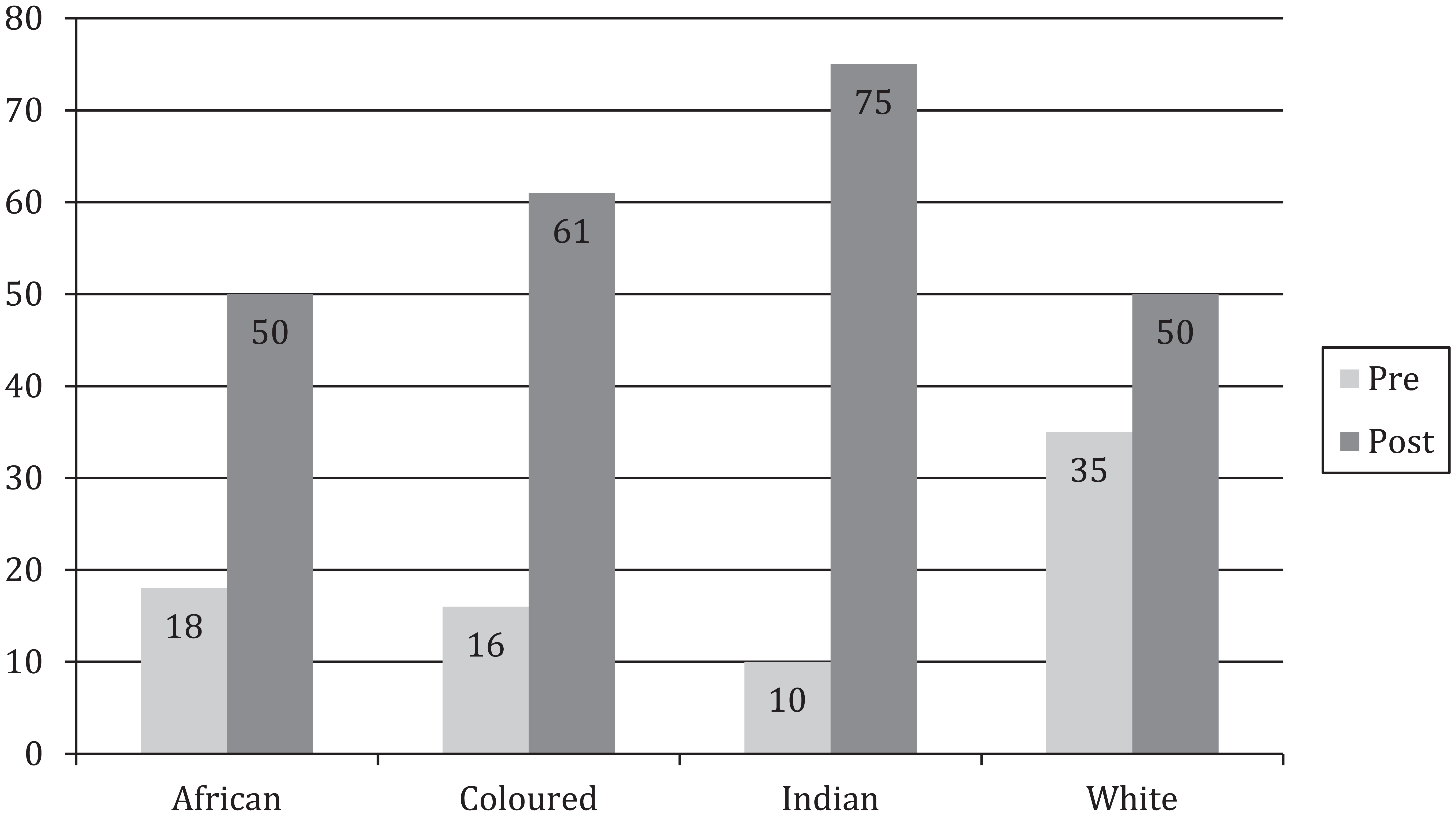
Percentage of Students who Noted that Not All Whites Supported the System, by Race and Sample
Thandi (African, post-sample, Glenville) summed it up well. When I asked her if learning about apartheid changed the way she sees her teachers, she answered in the affirmative. I asked her to elaborate and she responded as follows:
Some of them I think they didn’t like apartheid, [they] just wanted to mingle and talk to different races . . .
And did learning about apartheid make you realize that or did you realize that before?
Apartheid made me realize.
Why? How?
That it wasn’t only us black people who were affected.
In describing how learning about apartheid in school changed the way she thinks about whites in general, and her white teachers in particular, Thandi deployed a component of the both sides of the story narrative. She emphasized that whites too were affected by apartheid because, like blacks, they could not “mingle with other races.” She expressed an understanding of apartheid as a system that separated people, but the inequality inherent in that system of separateness was strikingly muted in her description.
Black Perpetrators
The second part of both sides of the story involves complicating the association of blacks as victims. The clearest articulation of this occurred around discussions of the Pan Africanist Congress (PAC). The PAC, which broke away from the African National Congress (ANC) in the 1950s, led the movement from passive to violent resistance through the formation of its military wing Poqo. The leaders of the PAC argued that blacks needed to take control of their own liberation and should not rely on whites to liberate the country. One way of examining the PAC, as well as other anti-apartheid organizations, would be to interrogate their different ideas around resistance and visions of what a liberated South Africa would look like. Teachers did not do this. Instead, they presented the PAC as a foil to the ANC, South Africa’s ruling party since 1994.
Teachers used the fact that the ANC also formed a military wing, Umkhonto we Sizwe (MK), to establish the ANC’s moral high ground by arguing that, unlike Poqo, MK attacked only non-human targets. This depiction of the ANC’s armed resistance is not entirely accurate (Teeger and Vinitzky-Seroussi 2007). Nonetheless, the contrast between the ANC and the PAC that teachers presented helped them construct a story of how some blacks engaged in activities that were morally equivalent to those of the apartheid regime. They used the PAC’s ideas about black consciousness to argue that, like some whites, some blacks were also “racist.”
This discourse presents apartheid as a conflict between two groups who, in the words of Ms. Viljoen (white, Roxbridge), “hated each other,” rather than the story of one group resisting the oppression of another group. A discussion in Mr. Pretorius’s (white, Glenville) class exemplified these ideas and introduced the notion of “reverse apartheid,” which students used during class discussions and in interviews to characterize contemporary affirmative action policies. Mr. Pretorius began his class by recapping the previous lesson. He asked students, “Remember what the PAC stands for?” Instead of responding “Pan Africanist Congress,” the students answered in chorus: “reverse apartheid.” Mr. Pretorius affirmed their answer: “Yes. And what race was only allowed to be in the PAC?” Students responded: “Blacks.” Mr. Pretorius told them they were correct and added: “It was trying to reinforce apartheid, just vice versa.”
Ms. Viljoen (white, Roxbridge) made a similar point when she explained to her students that groups from across the political spectrum refused to participate in talks during the negotiation process that ushered in the end of apartheid. She explained that the political spectrum is more like a circle than a line, with groups on both ends of the extreme being quite similar to each other:
[On the one end, you get the people who] want the old ways. . . . At the other end [you get groups] like the PAC who had slogans . . . like “one settler one bullet”—so to get rid of all the whites. And can you see how I drew my spectrum so the arrows come together at the end? They actually become very similar at the end, they believe in violence to get their way and they are very extreme; they say “only my way.” And they will hate each other. But if you look at it on paper they are getting quite close to each other in the way they do things, in their beliefs. The one is saying the whites should have everything, the other [is] saying the blacks should have everything—same system, different colors [emphasis added].
In both schools, this story of PAC violence and ideology was juxtaposed with Nelson Mandela’s famous quote from his treason trial. Notes distributed in both schools reproduced the following section from his speech:
During my lifetime, I have dedicated my life to this struggle of the African people. I have fought against white domination and I have fought against black domination. I have cherished the ideal of a democratic and free society in which all persons live together in harmony and with equal opportunities. It is an ideal which I hope to live for and to achieve. But, if needs be, it is an ideal for which I am prepared to die [emphasis added].
In both schools, students were asked to interpret what Mandela meant by “black domination.” Fieldnotes from Ms. Roux’s (white, Roxbridge) class represent how this was discussed in classrooms:
What do you guys think?
He’s neutral. He wasn’t being racist. He had nothing against the white people.
Yes, because he fought against black people also. So for him it wasn’t a color thing, it was a thing of right and wrong. So the black people he fought against were the PAC and also the few black people who supported apartheid.
The narrative of moral equivalence re-emerged in discussions of the TRC. The TRC itself represents an earlier institutionalized version of the both sides of the story narrative. As discussed earlier, the TRC constructed a story of moral equivalence by requiring members of resistance movements to apply for amnesty in the same way as members of the apartheid regime. When teaching about the TRC, teachers did not promote listening to “both sides” of the debate about this institution. Instead they advanced the TRC’s narrative about moral equivalence. In most classrooms, students simply accepted the narrative presented by teachers. However, in Ms. Prescott’s (white, Glenville) classroom, students challenged her reading of the TRC. Why students in this classroom objected is unclear. Ms. Prescott taught only one 9th-grade class and, although neither school officially tracked students, her class was known as “the clever class.” This coding may have given students the confidence to challenge their teacher. For our purposes here, what is noteworthy in this classroom interaction is that Ms. Prescott clearly wanted to impart a narrative of moral equivalence. Her students’ refusal to accept this narrative exasperated her to the point of telling them they are “messed up in [the] head.”
Ms. Prescott began by proposing two scenarios. In the first, a member of the apartheid regime killed someone. In the second, a member of a resistance organization killed someone. Ms. Prescott asked: “Should [they] get the same punishment or different ones?” Lizzie, a biracial student, 17 answered that “it depends on the justification around why [they] did the crime.” Ms. Prescott responded by saying: “Listen to the words that are coming out of your mouth! That’s bull crap.” Lizzie countered that “by killing, [the resister] brought change around. He ended apartheid.” Ms. Prescott seemed genuinely frustrated and said: “Oh my soul! So you are saying it’s okay to kill? Oh so now we get to different degrees of killing? So if I kill the little old lady who was irritating me versus one that stole from me it’s okay? Oh my lord!” Ravi, an Indian student, jumped to Lizzie’s defense and said that the resistance fighter killed “to gain his freedom.” Another student agreed and stated that “[he did it] in order to support his movement,” and added that “he’s being oppressed.” Ms. Prescott made it clear that she disagreed and said, “just because he’s oppressed does not give him the right to kill. Killing is not the right way to go about it. . . . This is ridiculous. Killing is killing. You people are messed up in your head.”
Students continued to challenge Ms. Prescott by arguing that all killing is not the same, and that members of the resistance organization were acting in self-defense. At that point, Ms. Prescott closed down the discussion and concluded: “[The resistance fighter is] not acting in self-defense. He’s acting for political reasons. If [the member of the apartheid regime has] to be held accountable for killing as part of a political war then so should [the member of the resistance movement].” She discredited the students’ debate by suggesting they were not thinking about this “logically” and were merely being contrarian to annoy her. “Logically think about it,” she said. “You guys are just trying to piss me off now.”
By focusing on violent resistance, teachers drew on the TRC’s narrative of moral equivalence between white perpetrators and black resisters. This narrative displaces the racialized coding of victims and perpetrators. It also helps construct grand narratives around racial reconciliation where the new, united polity is contrasted to the old regime in which different groups acted badly toward each other. A quote from Sibongile (African, post-sample, Glenville) exemplifies this point. Half-way through my interviews with students, I transitioned from asking them about contemporary social issues to discussing the specifics of the country’s apartheid past. Drawing on methodology advanced by Schuman and colleagues (e.g., Schuman and Rieger 1992; Schuman and Scott 1989), I began by asking respondents what they considered to be the most important event, and whom they considered to be the most important person, in South African history. Over 89.6 percent of respondents named Nelson Mandela as the most important person. Sibongile explained why:
Who would you say was the most important person in South African history?
Mandela obviously.
Why?
Because like he was able to forgive and put his life on hold for everyone.
Okay. Who did he forgive?
Like everyone for the commotion that was caused—because I can’t only say white people were the cause of everything . . . so I think he forgave everyone who was part of it.
Mandela is hailed for having forgiven, not whites, but “everyone who was part of it.” The past here is understood as a conflict between two sides who, to quote Ms. Prescott, were involved “in a political war” and who both did wrong. Moreover, in complicating the narrative, teachers suggested that it is difficult to know what “side of the story” individual actors may have been on based solely on their race. The purpose of learning apartheid, as Ms. Mokoena (African, Glenville), quoted at the beginning of this section, explained, is not to create divisions between “us” and “them.” Instead, the salient boundary becomes between “then” and “now.” Focusing on black perpetrators allows for the construction of a narrative where “then” was a time when people were in conflict and individuals on all sides did terrible things. “Now” is the new Rainbow Nation represented in the multiracial schools I studied. Njabulo (African, post-sample, Roxbridge) summarized this aspect of the both sides of the story narrative when he answered my question about who was victimized or oppressed during apartheid:
Every race, even whites were a bit because blacks would also come and they’d hurt white people just because they couldn’t get the things white people had. So it was really unbalanced because it affected both sides.
Managing Guilt and Anger
Why did both sides of the story form such a focal part of the teaching of apartheid? In this section, I highlight teachers’ concern over the implications of narratives of continuity between past and present for their local school contexts. Teachers were worried that learning about apartheid could cause conflict and uncomfortable moments in classrooms. They used both sides of the story to assuage white students’ feelings of guilt, to delegitimize black students’ claims about historical and contemporary racism, and to maintain their credibility as authority figures in mixed-race classrooms.
In Ms. Devin’s (white, Roxbridge) class one day, Taryn, a white student who sat at the back of the class, picked up her hand. It was the only time I heard her speak during my observations. She said: “It almost makes you feel ashamed of being white when you hear this.” This was not the type of comment students usually made in class, and I listened carefully for the teacher’s response. Identifying with her student as a white South African, Ms. Devin answered empathetically by recounting her experience in school shortly after the transition to democracy:
It is tough and when I was in school and we studied apartheid I felt really bad about what white people did to black people and I wasn’t even there. And one of my good friends was not white and I felt really uncomfortable sitting next to her in the lesson, but you have to remember it was years ago and people were brought up years ago and they believed different things and they weren’t as educated as us. Remember in 1948 there was not even TV. So now we’re exposed to a whole lot of different cultures. But if you feel uncomfortable during the lessons please come tell me and I’ll try [to] change my lessons so you don’t feel uncomfortable. Remember none of us should feel uncomfortable ’cause none of us did it.
Ms. Devin was clearly concerned that her student felt ashamed because of her race. 18 She responded by introducing a component of the both sides of the story narrative, namely that many whites simply did not know. She reiterated this point after Andrea, another white student, interjected and introduced another component of the narrative, namely that many whites resisted:
Ma’am there were also a lot of white people who fought against it.
It’s true—my grandpa got arrested. So there were white people. When I think of a bystander I think of my mom. . . . And I remember I spoke to my mom once about it and she said she didn’t know what was going on and I said: “How is that possible?” And she said it was not in the newspapers, her family shielded her.
In emphasizing that many whites did not know, Ms. Devin focused on bystanders rather than beneficiaries and thus sidelined discussions of the contemporary racialized effects of apartheid. She also emphasized that “none of us did it,” thus distancing herself and her students from the historical actors who perpetrated (rather than benefited from) apartheid crimes. 19 In focusing on individuals, Ms. Devin further hindered an understanding of structural racism—both past and present.
Teachers worried about making white students feel guilty, but they seemed especially preoccupied with making sure black students knew they were not the ones who suffered under apartheid, and they should therefore not use apartheid “as an excuse.” Ms. Viljoen (white, Roxbridge), for example, explained how learning about apartheid could cause black students to focus on collective notions of suffering and the redress this might entail. She suggested that instead of leading to divisions, the apartheid section, “if taught correctly,” should create a sense of unity between black and white students. In so doing, she echoed the TRC’s mandate of using the past to create unity rather than strife:
If [the apartheid section]’s not taught correctly, it can lead to more division because you can have that whole idea of “But that’s how much we suffered” and “I should get this.” But if it’s taught correctly it should not do that; it should do the opposite.
Similarly, when I asked Ms. Mokoena (African, Glenville) about the one or two things she hoped students would take away with them from learning the apartheid section, she drew on tropes of individualism and hard work to delegitimize black students’ claims about the continued relevance of the past:
I’d hope that they learnt that hard work will get them through life. That they should stop sitting down and blaming somebody for the wrongs that were done in the past. They should get on with it and make something out of their lives. Black, white, or Indian, it doesn’t matter.
Ms. Devin (white, Roxbridge) also emphasized that blacks should not focus on the past. In her interview with me, she linked the question of white guilt with black students using apartheid “as an excuse”:
I think that a lot of the white kids feel quite guilty about what happened and they’re more sympathetic and empathetic about it because they think, “Oh it was me, like I’m responsible.” But I think in the two history classes I’ve taught, I think people dealt with it very maturely and no one used it as an excuse.
What would it look like if a kid did use it as an excuse?
. . . We’ve had issues on the netball court. They’ll be like, “Ja Ma’am, you know what you white people used to do to us black people” blah-blah-blah. And then she said to us, “Oh it’s just because I’m black.” I just turned around and was like, “Actually you don’t know what you’re talking about. You may know a little bit about it but you have no right to claim what happened because you didn’t go through it. It’s not your hurt that you’re carrying” [emphasis added].
Ms. Devin argued first, that black students have no right to make claims based on apartheid; second, that their contemporary experiences of racism are illegitimate because they are based on historical claims; and third, that it is the responsibility of black students to “handle things maturely” and not make whites feel uncomfortable.
Observations I conducted at a postgraduate seminar for pre-service teachers triangulated these findings. Data from this seminar highlight two points: First, imperatives around limiting the potential for conflict are a function of social roles, specifically, the social role of “teacher.” Second, both sides of the story forms part of the “cultural toolkit” (Swidler 1986) from which teachers draw to solve micro-interactional problems in the present.
The postgraduate students I observed were taking a class on how to teach about the TRC. The class began with a short introduction by the lecturer. As the lecturer finished her remarks, Luke, an African student, interjected and asked how he was supposed to teach his own students that the TRC had “dealt with the past” when they are living in poverty in the present. He continued: “We haven’t all moved to Sandton [an affluent area in Johannesburg] . . . These kids are not dumb. They know what’s going on.” The lecturer answered that the RDP 20 (Reconstruction and Development Programme) was supposed to deal with the economic aspects of apartheid. Luke responded indignantly, “A four walled box? With no amenities nearby?” 21 Another African student, Themba, jumped in and added: “The TRC looked at crimes committed within a bigger crime. It let whites live comfortably with the past while blacks have to live in the present where they are blamed for their own conditions. You know, we’re still literally living in concentration camps down the road. And let me tell you, it’s not good in the hood.”
After a short debate, students broke up into smaller groups to discuss the assigned readings. I asked Luke’s group if I could sit in on their discussion. At one point, Luke turned to me and said, “You know, going back to your research topic, this is very difficult to teach in multiracial classrooms.” He said that especially as a black teacher, he felt that white students anticipate that he is going to make them feel guilty. I asked him how he would have responded if one of his students raised the points he himself raised earlier. He said, “It is very, very difficult.” He thought for a few moments and then added, “I think in teaching this history, it would be important to explain both sides of the story, to show that not all whites supported the system and that there were blacks who actually did support the system and worked with the government” [emphasis added].
These interactions highlight the process that Luke went through in realizing that telling both sides of the story is a way to minimize conflict and emotions, such as guilt and anger, in the classroom, including feelings directed at him—the teacher. Luke himself did not necessarily believe these things. When he was in his role as student, he—with Themba—focused on beneficiaries and the systemic violence of apartheid. As he transitioned to imagining his role as a teacher, however, his focus shifted to individuals and the choices they made. He came to the realization that he could minimize the potential for conflict in his classroom by highlighting individual agency and complicating the racialized coding of victims and perpetrators. In this way, he echoed the very narratives of the TRC that he strongly criticized at the beginning of the class.
Conclusions
This article documented how and why teachers in racially diverse South African schools taught about the country’s apartheid past in ways that distanced it from young people’s lived realities. In analyzing the processes through which the history of apartheid was transmitted to students in the dynamic settings of face-to-face classroom interactions, this article makes two central contributions that bring together scholarship on education, racism, and collective memory. First, I identified how recounting histories of racial oppression through the trope of both sides of the story can become a mechanism for promoting colorblindness in the present. Second, I extended our understanding of why individuals reproduce racial ideologies by documenting how these can be used to forestall micro-interactional conflict.
Mechanisms of Colorblindness
The idea that “the past is in the past” is a key storyline of colorblind racism (Bonilla-Silva 2014). With so much evidence of the enduring effects of histories of legislated racism, how and why do individuals come to believe that these histories of racial oppression have no effect on the present? I addressed this question empirically by studying a site where individuals learn about the past: high school history classrooms. Ironically, my findings demonstrate how history lessons can become a mechanism for promoting colorblindness in the present. I showed that learning about histories of de jure racism through the trope of both sides of the story stimulates—rather than contradicts—ideologies of colorblindness.
Focusing on schools as key institutions of racial socialization, I documented how teachers improvised on the official curriculum by weaving narrative threads into their teaching of apartheid that disconnected the racially oppressive past from the contemporary racial order. In every classroom I observed, teachers told both sides of the story, emphasizing to their students that not all blacks were victims and not all whites were perpetrators during apartheid. This narrative focuses on individuals rather than social structures and it obscures an understanding of the institutional racism of apartheid that created beneficiaries. As a result, it limits the potential for race-based claims about the enduring effects of apartheid on racial stratification in South Africa, creating space for the race-neutral discourses of colorblind racism. Focusing on the mechanisms of colorblindness, this article advances our understanding of the conditions under which individuals learn to disconnect the past from (rather than interpolate the past into) the present.
Functions of Colorblindness
Why did teachers recount the history of apartheid in this way? My data point to a variety of micro-social and emotional considerations that led teachers to focus on both sides of the story. Ms. Mokoena, for example, explained how she learned from experience that teaching about apartheid could cause conflict between students of different races, and this conflict emanated from black students making connections between past and present. She began to focus on both sides of the story to avoid such conflict. Ms. Devin used similar narratives to delegitimize black students’ claims about contemporary racism in school and to assuage white students’ feelings of guilt and shame. Luke—the pre-service teacher—also described how he thought he could maintain his authority in the classroom, and minimize uncomfortable feelings directed at him as a black teacher in a racially diverse school, by telling both sides of the story. These observations emerged organically during fieldwork and they mapped onto the practices of every teacher in this study.
In documenting these processes, this article points to the localized, practical, and emotional considerations that play into the reproduction of racial ideologies. Scholars have identified the functions that colorblindness serves for whites in helping them maintain their racial privilege without resorting to explicit forms of racism (Bobo et al. 1997; Gallagher 2003). My findings add to this literature by illustrating the functions that colorblindness can serve for individuals in contexts of diversity. In addition to using both sides of the story to assuage white guilt, teachers drew on this narrative to maintain their credibility as authority figures and to keep order in their micro-interactions by delegitimizing black students’ claims about the enduring effects of racism on their lives.
Existing research on colorblindness tends to use surveys and one-on-one interviews to tap racial attitudes. Drawing primarily on ethnographic observations, this article highlights the importance of studying how individuals deploy colorblindness in interactional settings as well as what this deployment allows them to achieve in these contexts. As scholars of identity have long noted (e.g., Brubaker and Cooper 2000; Stryker and Burke 2000), individual behavior is guided both by our internally held sense of identity and by the role expectations placed on us in particular contexts populated by particular kinds of people. Indeed, findings from this study showed that some educators may not actually believe both sides of the story. Luke, for example, criticized this type of narrative when he was in his role as student. However, in his role as a black teacher in a racially diverse school, he suggested he would draw on both sides of the story to manage interpersonal dynamics in his classroom. In other words, individuals may use colorblind ideologies instrumentally in certain settings but not others, regardless of what they truly believe. Attending to the situational cues that are likely to encourage the articulation of these discourses advances our understanding of how racial ideologies are recreated on the micro-interactional level. In schools, this insight allows us to examine not only what young people are taught to believe, but also when and how they are taught to deploy (and thereby perpetuate) racial ideologies.
Beyond Glenville and Roxbridge
Is both sides of the story more likely to be part of history education in multiracial classrooms? Findings from Glenville suggest this may not be the case. There, black educators in classrooms that had only black African students in them (the “Zulu classes”) also told both sides of the story. This likely had to do with the broader school environment of diversity, which led black teachers to draw on this narrative to forestall anticipated race-based conflict in their local school contexts. 22 It is also possible, however, that the content of the curriculum could raise alternative micro-interactional dilemmas specific to monoracial contexts. Such dilemmas may, for example, have to do with black teachers’ role as authority figures in institutions that reproduce and reflect enduring racial segregation and inequality; or they may have to do with the anticipated conflicts that black teachers believe their students will face elsewhere. 23 To distinguish the effects of conflict avoidance particular to monoracial and diverse contexts, future research could focus on township schools that were designated for black Africans during apartheid and that remain de facto completely segregated in the contemporary social order. Studying how the history of apartheid is taught in such schools could give us greater purchase on the reproduction of racial ideology. It may also reveal the presence of more critical narratives and advance our understanding of how such ideologies can come to be challenged.
Future research could also examine whether both sides of the story forms part of the curriculum beyond the South African case. Do the same types of emotional and interpersonal dilemmas, for example, affect the teaching of history in racially diverse U.S. schools? Do teachers in U.S. schools draw on narratives similar to both sides of the story during classroom discussions of slavery and the Civil Rights Movement? 24 Addressing these questions offers the opportunity for a comparative research agenda that expands our theoretical understanding of the mechanisms and functions of colorblindness in cross-national perspective.
Scholars may also wish to look for similar narratives in non-school contexts. One example might be diversity training workshops. Like history classrooms, these are contexts where individuals are required to talk about race but facilitators are invested in creating a sense of unity rather than conflict. 25 Regardless of the context, researchers need to pay more attention to how individuals’ desire to avoid conflict in their micro-interactions can profoundly and systematically shape discussions of race and racism, and how such discussions can contribute to the perpetuation of existing stratification systems.
Transition to Democracy
In conflict resolution circles, the South African Option is often promoted as an ideal case of successful transition from racist authoritarian rule to democracy, in that it sought to acknowledge the difficult past while fostering racial reconciliation. Other work documents how these strategies created order on the macro-political level by facilitating a negotiated settlement rather than a violent revolution (see Mangcu 2003). Yet we know little about the long-term and micro-level consequences of this model of social transformation (Teeger 2014). I addressed this issue by examining how South Africa’s first generation born into democracy—the “born frees”—are taught about their country’s past in the educational system. The findings reveal that teachers drew on strikingly similar ideas to those articulated during the country’s transition to democracy. Like the TRC, teachers focused on individual victims and perpetrators, but not beneficiaries, and constructed a moral equivalence between apartheid’s enforcers and resisters. A key insight of this article is that the same strategies that allowed policymakers to “solve problems” during the “unsettled times” of transition now form part of the cultural “toolkit” that helps teachers “solve problems” in the micro-social contexts of classroom discussions (see Swidler 1986). In this way, I point to the power of these discourses in curtailing social conflict and unrest on the macro and micro levels.
Both the TRC and history teachers may have intended to facilitate knowledge about the past while minimizing racial conflict and turmoil. The use of individualized discourses of moral equivalence in both contexts, however, ultimately serves to limit a thorough understanding of how the past links to the present. Paradoxically, in trying to “heal” the harmful past, both institutions told narratives that favored privileged groups by protecting a racially unequal status quo from challenge. The narratives constructed in both institutions reinforced a boundary between “then” and “now,” while trying to suppress the boundary between “us” and “them.” In doing so, they limited South Africans’ abilities to discuss the persistence of racial inequality in the era of civil liberties.
Arguably, a historical pedagogy focusing on individuals and the choices they made allows for an understanding of the lived realities of history. It can also facilitate a discussion of white allies and open up a conversation about different modes of resistance. However, such lessons threaten to mute the realities of systemic oppression and to blind individuals to the legacies of these histories in the present. The findings of this article demonstrate that telling both sides of the story—without embedding this narrative within a complex understanding of power, structural discrimination, and systemic advantage—opens doors for the denial of the continued effects of race and helps cement barriers to addressing the problems of racial inequality in the democratic era.
Footnotes
Acknowledgements
For helpful comments and conversations, I thank Bart Bonikowski, Anmol Chaddha, Tapiwa Chagonda, Marc Fletcher, Nicole Hirsch, Simone Ispa-Landa, Matt Kaliner, Kevin Lewis, Kammila Naidoo, Kim Pernell-Gallagher, Cassi Pittman, Brenna Marea Powell, Carin Runciman, Tracey Shollenberger, Graziella Silva, Jocelyn Viterna, Mary Waters, William Julius Wilson, and members of the Culture and Social Analysis and Sociology of Education Workshops at Harvard University. I am also grateful to Larry Isaac, Holly McCammon, and the anonymous ASR reviewers for their extremely helpful feedback and suggestions. Earlier versions of this article were presented at the American Sociological Association Annual Meeting in San Francisco, the Apartheid Archive Conference in Pretoria, and the Narratives and Intergroup Conflict Resolution Conference at Stanford University.
Funding
This research was supported by a National Science Foundation Dissertation Improvement Grant (#1029273), by the Weatherhead Center for International Affairs at Harvard University, and by the South African National Research Foundation.
1.
Bobo and colleagues (1997) and Bobo (1998) use the term “laissez faire racism” to describe similar attitudes. Although there are differences in the theoretical and empirical work that underpins these studies, they are united in their focus on how apparently race-neutral beliefs and attitudes are used to sustain a racially unequal status quo (see  ). For the sake of parsimony, I use the term colorblind racism in this article.
2.
3.
Scholars debate whether these attitudes emanate from whites’ affective dislike of blacks (Sears 1988); from broad, supra-individual ideologies (Bonilla-Silva 1997, 2014); or from prejudice resulting from a sense of group position (Bobo 1988; see also ).
4.
Although these two points are often interrelated, it is important to note that colorblind discourses have racist consequences even when they do not merely reflect racial attitudes in the sense of negative affect or individual-level prejudice (see Bobo 1988; ). Indeed, these discourses, when promoted within the context of racially unequal societies, have racist consequences regardless of actors’ intent. This article is located within such a structural perspective on racism. I add to this work by showing how a variety of interpersonal and micro-social considerations can lead individuals to reproduce narratives that provide ideological support for a racially unequal status quo.
5.
6.
South African social science tends to divide the population using the apartheid categories, and these remain salient in how individuals self-identify. These categories are African (or black African), coloured, Indian (or Asian), and white. Echoing anti-apartheid resistance movements, when I use the term “black,” I refer inclusively to Africans, coloureds, and Indians, and in contrast to whites. When respondents in my study used the term “black” they tended to refer to black Africans only. I maintain their terminology in direct quotations and fieldnote extracts.
8.
Data from the Quarterly Labour Force Survey show the persistence of this racial hierarchy not just at the median but across the income spectrum (Statistics South Africa 2010:viii). Data also indicate that the relationship between race and unemployment holds even while controlling for education (:xiii).
10.
Names of schools and respondents have been changed.
11.
Both schools were in areas reserved for whites under apartheid. The neighborhood surrounding Glenville is now home to a sizeable middle-class Indian population; the neighborhood surrounding Roxbridge remains predominantly white. In addition to middle-class students of all races who live in these areas, both schools enroll children of domestic workers (usually African) who live in the neighborhood. Glenville also includes an African township in its catchment area.
12.
A new national curriculum (CAPS) was issued after data collection for this study was completed. The content of the apartheid section remains virtually unchanged.
13.
Because my interview guide for the two samples was identical (save for several questions about their experiences in class, which I added at the end of the post-sample interviews), and because there was a short time lag between waves, I was concerned that, if I re-interviewed students, data in the post-sample could be contaminated by respondents’ recollection of their first interview. Given that students were randomly selected from class lists, and given the high overall response rate (82.5 percent), it seems reasonable to assume there were no baseline differences between the two groups.
14.
One teacher, Ms. Viljoen, mentioned this fact on one occasion. However, she immediately reminded her students that many whites were also against these policies.
15.
The difference was least marked for white students, suggesting they may have been exposed to this idea at home more than other students.
16.
This code arose when I asked students directly who suffered during apartheid or what life was like for whites during apartheid. On occasion, it also came up in other parts of the interview. I counted the code only once per student, regardless of where or how many times it was mentioned in the interview.
17.
Five students, including Lizzie, opted out of apartheid-era racial categories by identifying as “biracial” or “mixed” in interviews.
18.
20.
The RDP outlined the government’s economic policies following the transition.
21.
In the RDP, the government stipulated its policies concerning the provision of services, including houses. The “RDP houses” that were built are easily identified by their uniform and basic structure.
22.
These historically white schools may also exert pressure on educators who wish to tell more critical narratives. Black educators may tell both sides of the story to avoid conflict with their mostly white colleagues. Teachers who are inclined to tell this narrative may also be more likely to seek and obtain jobs in such schools.
23.
This could, for instance, be part of a process whereby black students are socialized into navigating white-dominated spaces.
24.
25.
References
Supplementary Material
Please find the following supplemental material available below.
For Open Access articles published under a Creative Commons License, all supplemental material carries the same license as the article it is associated with.
For non-Open Access articles published, all supplemental material carries a non-exclusive license, and permission requests for re-use of supplemental material or any part of supplemental material shall be sent directly to the copyright owner as specified in the copyright notice associated with the article.
