



Abstract
We propose a synthesis of two lines of sociological research on boundary spanning in cultural production and consumption. One, research on cultural omnivorousness, analyzes choice by heterogeneous audiences facing an array of crisp cultural offerings. The other, research on categories in markets, analyzes reactions by homogeneous audiences to objects that vary in the degree to which they conform to categorical codes. We develop a model of heterogeneous audiences evaluating objects that vary in typicality. This allows consideration of orientations on two dimensions of cultural preference: variety and typicality. We propose a novel analytic framework to map consumption behavior in these two dimensions. We argue that one audience type, those who value variety and typicality, are especially resistant to objects that span boundaries. We test this argument in an analysis of two large-scale datasets of reviews of films and restaurants.
Categorical boundaries organize social life. Symbolic distinctions between different practices and behaviors maintain social order by institutionalizing differences between the people who enact them (Bowker and Star 2000; Douglas [1966] 2003; Lamont and Molnár 2002; Zerubavel 1997). Accordingly, sociologists have paid a considerable amount of attention to boundary spanning—instances in which categorical boundaries are traversed (Hannan 2010; Murray 2010; Telles and Sue 2009; Wimmer 2013). These studies demonstrate that novel combinations of behaviors and ideas across different domains hold the potential for novelty and change, but they also consistently find that categorical mixing more commonly receives reproach than enthusiasm (Hannan 2010; Uzzi et al. 2013). Cultural systems strongly resist change. For cultural novelty to have an impact—and occasionally catalyze change—some agents must be tolerant to violations of category codes. Who are these audiences?
A common answer to this question posits that cultural omnivorousness—a taste for a broad variety of cultural products and practices—embodies openness toward boundary spanning (Fishman and Lizardo 2013; Peterson 1992; Peterson and Kern 1996). Nevertheless, the mechanisms assumed by proponents of the omnivore thesis lead to contradicting predictions about how omnivorousness relates to tolerance for boundary crossing. On the one hand, cultural omnivores enact multiple social identities through their broad consumption choices. Scholars often assume that such social multivocality reflects a lack of compliance with categorical boundaries. Omnivores, in other words, resist cultural scripts and thus should appreciate cultural novelty. Yet omnivores’ appreciation for diversity also serves as a symbolic marker of high status that reproduces cultural boundaries (Bryson 1996; Erickson 1996; Johnston and Baumann 2007; Warde, Wright, and Gayo-Cal 2008). If omnivorousness is about drawing symbolic boundaries between different social strata, then individuals with a variety of cultural likes should resist cultural innovations that transgress institutionalized boundaries.
We argue that this seeming contradiction can be resolved if one views boundary spanning through two different prisms: variety and atypicality. Whereas a taste for variety pertains to the tendency to appreciate multiple types of cultural practice, a taste for atypicality concerns a preference for cultural practices that defy conventional categorical boundaries. Contra received wisdom, we argue that individuals with broad cultural tastes—conventionally referred to as omnivores—are most protective of categorical boundaries and therefore less receptive toward atypical cultural innovations. They practice symbolic exclusion on one dimension, while projecting openness on another. We formalize this argument with a two-dimensional model of boundary spanning, introduce tools for operationalizing our analytic constructs, and provide evidence in support of our prediction using data on the preferences of more than 100,000 movie and restaurant goers.
Two Perspectives on Boundary Spanning
Variety and Atypicality
What does it mean to span a cultural boundary? Recent sociological theory and research generally takes two different approaches to this problem. Cultural sociologists tend to think of boundary spanning through the prism of variety, that is, the extent to which consumers engage a diversity of cultural types. Studies that take this approach tend to treat genres as socially constructed organizing principles that ritualize and maintain the social boundaries dividing the audience segments that consume them (DiMaggio 1987; Lizardo 2014; Pachucki and Breiger 2010). Audience members with a taste for genre variety presumably crosscut these boundaries.
This assumption informs a variety of studies that provide consistent evidence of a link between social position and omnivorousness in Western societies (Bryson 1996; Goldberg 2011; Katz-Gerro 2004). Formulated originally by Peterson (1992; see also Peterson and Kern 1996), the omnivore hypothesis posits that the tendency to appreciate a broad variety of genres reflects sociocultural shifts that celebrate diversity and multicultural inclusion, rendering exclusionary snobbism obsolete. Omnivorousness, in other words, is the empirical signature of a culturally open mind (Ollivier 2008). In a recent comparative study, for example, Fishman and Lizardo (2013) argue that different levels of cultural omnivorousness in Portugal and Spain reflect the different paths the two countries followed in transitioning to democracy in the late 1970s: greater omnivorousness in post-democracy cohorts in Portugal, they contend, reflects the country’s more inclusive democratic institutions.
Studies focused on the omnivore thesis locate boundary crossing in the audience role in the audience–producer interface. 1 They conceptualize boundary spanning in terms of the consumers’ breadth of cultural preferences (Peterson and Kern 1996). A fan of both opera and rock, to use a common example in this literature, traverses a cultural boundary by endorsing musical genres commonly associated with different class locations. By arguing that some individuals are less likely to adhere to genre boundaries, this work features heterogeneity on the audience side of the interface. Yet it reifies genre boundaries by assuming homogeneity within genres and crisp boundaries between genres. 2 For instance, these empirical investigations typically ask respondents to report how much they like or consume genres such as opera or rock, a measurement strategy that orients subjects toward the typical instances (or prototypes) of the genres. We characterize this analytic position as featuring heterogeneity on the audience side and typicality on the producer side.
Organizational sociologists, on the other hand, focus on the other side of the interface, on agents who play the producer role and the objects they create. These studies focus on the relative atypicality of producers or products, or the extent to which particular objects or behaviors conform to conventional genre codes. Studies in this tradition examine how actors in markets cross boundaries by taking actions or offering products that combine characteristic elements from disparate genres. Boundary spanning occurs when an action or object fails to abide by established genre conventions. In one recent study, Phillips, Turco, and Zuckerman (2013) demonstrate that high-status, corporate-law firms are frowned upon when they engage in personal injury law, because their clients perceive such practice as inconsistent with corporate-law identities. This work demonstrates that audiences generally have a strong aversion for hybridity and therefore tend to devalue, if not outright reject, boundary-spanning actors and objects (Ferguson and Hasan 2013; Hsu, Hannan, and Koçak 2009; Kovács and Hannan 2010). 3 From this perspective, boundary-spanning consumers are seen as having a high tolerance for objects and performances that crosscut established genre distinctions.
Whereas omnivore studies tend to reify categories while assuming audience heterogeneity, the organizational literature generally pays attention to atypicality at the cost of treating audiences as homogeneous (mostly as an analytic convenience, but see Pontikes [2012] and Kim and Jensen [2011] for exceptions). All other things being equal, the organizational theorists assume that audiences share cultural codes and are equally cognizant of and resistant to instances of code subversion. Faced with the case of audiences reacting favorably to code defiance, this research conventionally attributes such exceptions to the social or reputational resources available to the actor traversing cultural boundaries, but not to divergent perceptions and preferences (Kennedy 2008; Phillips and Zuckerman 2001; Rao, Monin, and Durand 2005; Smith 2011; Wry, Lounsbury, and Jennings 2013). 4 Here we have the reverse picture: heterogeneous producers and products facing homogeneous audiences.
Theoretical Synthesis
We propose a theoretical synthesis between these two approaches, allowing us to consider heterogeneity on both sides of the audience–producer interface. We argue that pursuing and appreciating variety and atypicality are different and potentially orthogonal dimensions of boundary spanning.
Consider, for example, a music aficionado who likes a variety of genres—the typical protagonist in research on cultural omnivorousness—including classical baroque and electronic music. The collective imagination associates these genres with very different social identities; variety, in this sense, traverses symbolic social boundaries. But this consumer’s penchant for variety says nothing about her willingness to accept musical creations that combine elements from these two dissimilar genres in an unconventional way. Indeed, when Wendy Carlos and Benjamin Folkman produced such a fusion with their groundbreaking Switched-On Bach, released in 1968, some critics were thrilled by the innovation but others were appalled by what they perceived as a debasement of an icon of classical music (Pinch and Trocco 2002).
Our analytic framework distinguishes between two dimensions along which cultural consumption has social meaning. Variety relates to the enactment of multiple social identities. Consumers who prefer country music and hip-hop (Goldberg 2011), fine wine and fast food (Johnston and Baumann 2007), or lattes and bird-hunting (DellaPosta, Shi, and Macy 2015), enact incongruent racial, class, and political identities, respectively. For such patterns of liking to convey multiple identities, however, the discrete consumption events over which agents express tastes—going to a hip-hop concert or drinking latte in an espresso bar—must comply with recognizable templates.
Atypicality, in contrast, concerns noncompliance with cultural codes. Sampling and appreciating atypical objects enacts a distinctive identity—as opposed to a variety of identities—through endorsement of counter-institutional cultural practices (whether out of concerted intention to subvert the sociocultural order or due to obliviousness or indifference to it). This distinctiveness emerges when cultural elements get blended in unconventional ways.
Imagine an agreed-upon system of classification that organizes a social domain—for example, the division of dining into different cuisines—as a multidimensional space. Imagine further that each dimension in this space relates to the prevalence of a feature. In the context of cuisines, such features can be ingredients, preparation methods, or presentation styles. Figure 1 illustrates such a stylized space; for presentation purposes, we draw only two dimensions. Dashed circles delineate different genres (broadly conceived), cuisines in our example. The shaded dots denote four hypothetical audience members; their locations in the space illustrate their two favorite restaurants.
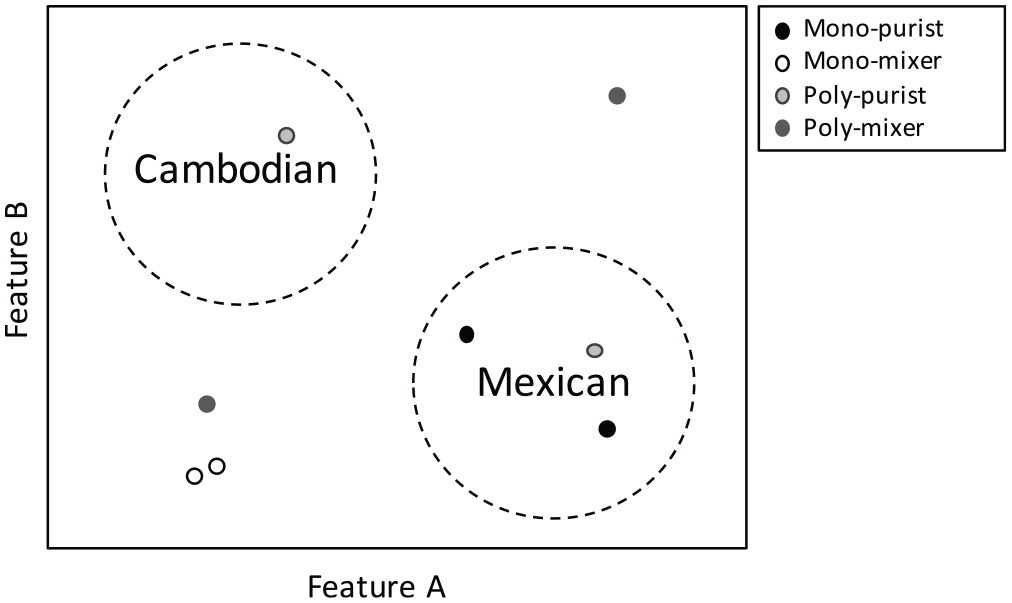
Stylized Feature Space
Audience members with an orientation toward variety will sample widely across this space and like very different kinds of restaurants. They might be fans of Mexican and Cambodian cuisines, each located in different and far apart areas of the feature space. In contrast, individuals with an orientation toward atypicality are characterized by their tendency to travel in areas that lie outside the boundaries of established categories and to appreciate all kinds of atypical offers. They might enjoy Cambodian fish paste on their tacos, although they would be hard pressed to find a restaurant that serves such a concoction. 5
By drawing the analytic distinction between variety and atypicality, we can think about audience members in terms of the positions they occupy in a two-dimensional space. Positions in this space characterize agents by their affinity for variety and atypicality. We find it helpful to think about four general positions, as illustrated in Figure 2. For simplicity, we focus on the positions toward the corners in this space. On the variety dimension, we distinguish individuals with a narrow (mono) focus from those with diverse (poly) foci. On the typicality dimension, we distinguish those who accept and respect genre codes and like typical, code-conforming objects (purists) from those who like atypical objects, that is, objects that mix elements that conventionally characterize categories that lie far apart in the feature space (mixers). The four hypothetical consumers in Figure 1 correspond to these four audience types.
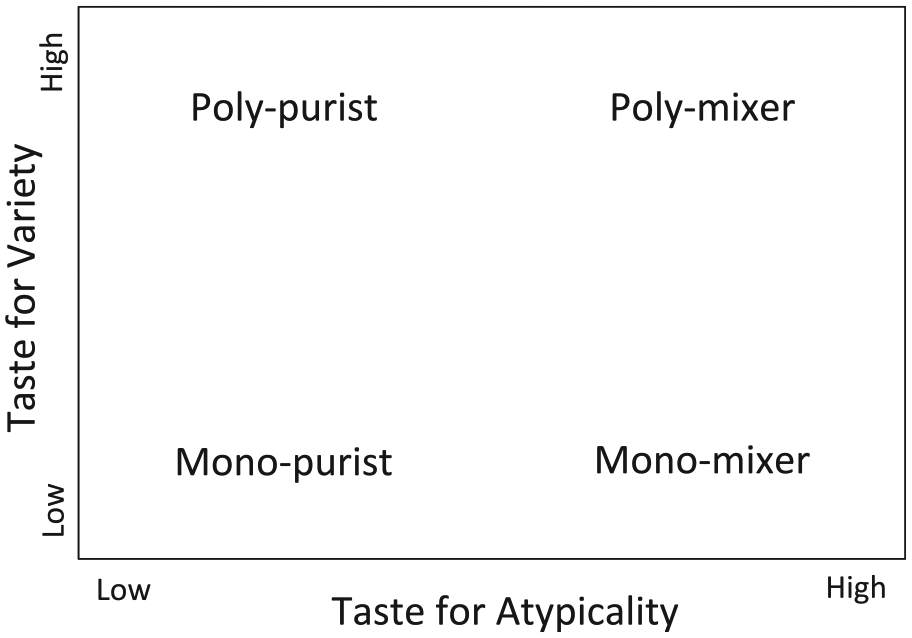
Typology of Audience Positions in Two-Dimensional Space Defined by their Liking for Variety and Atypicality
Mono-purists do not span boundaries on either dimension. These consumers like a singular established category; they have a single social identity in the focal cultural domain, and they comply with the cultural scripts associated with its enactment (Bryson 1997). In contrast, poly-mixers do not adhere to category codes, nor do they stick to one region of the feature space. These unconstrained audience members travel freely anywhere outside the territories demarcated by existing categories. Mono-purists and poly-mixers, although never referred to as such, are often invoked in accounts of cultural taste that pit narrow-minded, traditionalist “univores” against open-minded avant-gardes.
Our typology points to the existence of two other types that the existing literature overlooks. Poly-purists like to sample broadly, but only within the confines of established categories. They enact multiple identities, but they are averse to defying cultural codes. Mono-mixers are their mirror image. These consumers operate in the uncharted hinterland outside genre boundaries but stay relatively local. Unlike poly-mixers, they prefer a particular, albeit not-yet-categorized, form of genre fusion.
Current research treats tastes for variety and atypicality interchangeably. Consequently, it conflates consumer types that are not mono-purists—namely mono-mixers, poly-purists, and poly-mixers—into one overarching construct: the omnivore. In fact, quantitative work on consumer preferences typically uses survey data to generate scales of omnivorousness by counting the number of cultural genres a respondent likes or consumes. These scales are often interpreted as if they were measuring taste for atypicality (e.g., Bryson 1996; Elchardus and Siongers 2007). But because the survey questions orient respondents toward categorical prototypes, these scales effectively tap one’s proclivity for variety. 6 Thus, although additive scales are assumed to proxy the cosmopolitan, inclusive, and boundary-subverting “sociopolitical orientations characteristic of omnivores” (Fishman and Lizardo 2013:217), in reality, the vast majority of empirical work on the topic distinguishes only the variety of genres sampled and liked. This work cannot discriminate on the “purist/mixer” dimension.
Who Rejects Boundary-Spanning Objects?
If boundary spanning comes in a variety of flavors, what kinds of audiences should we expect to be most open-minded about, or resistant to, cultural innovation? In line with previous research, we think of cultural innovation as a quality that emerges from actions that combine elements of otherwise disconnected cultural codes (Fleming 2001; Nelson and Winter 1982; Phillips 2013; Ruef 2002). Think again of Switched-On Bach as an example of such cultural novelty. The release of the album was, in the words of celebrated classical pianist Glenn Gould, “one of the most startling achievements of the recording industry,” one that would fundamentally transform rock, pop, and classical music and inspire scores of pop and electronic renditions of classical masterpieces (Pinch and Trocco 2002:131). Whom would we expect to be most hostile to this novel musical crossover? Connoisseurs of classical music enraged by its supposed trivialization of the genre? Synthesizer enthusiasts unhappy with the mundane use of this new technology? Or perhaps consumers of both types of music who were uncomfortable with this unholy mixture between different musical traditions and identities?
Put differently, how does receptiveness to atypicality relate to an orientation toward variety? Existing studies point in opposing directions. On the one hand, work in the omnivore-studies tradition, as noted earlier, tends to regard a taste for variety as the expression of cultural open-mindedness. Johnston and Baumann (2007), for example, link the expansion of repertoires of food critics and writers in recent years with a process of cultural democratization. Indeed, the erosion of the relevance of genre boundaries among culinary elites was, at least in part, catalyzed by the counter-institutional currents in Western societies of the late 1960s (Rao, Monin, and Durand 2003). Scores of studies on omnivorousness similarly appear to assume, mostly implicitly, that an appreciation of variety is the empirical signature of an underlying resistance to cultural rigidity (for critical discussions, see Atkinson 2011; Lahire 2008; Ollivier 2008; Savage and Gayo 2011). According to this line of research, cultural breadth is more prevalent among cultural elites, such as individuals with a college education. College graduates are more likely to espouse liberal ideologies and express tolerance toward cultural noncompliance. It stands to reason, then, that people who consume multiple types would also appreciate genre hybridity.
But an appreciation for diversity can also function as an identity claim, an enactment of a social boundary. Recent research in cultural sociology interprets cultural breadth as a social resource (Erickson 1996) and as a form of cultural capital that marks elite status (Khan 2012). In that reading, omnivorousness has become an exemplary manifestation of what Bourdieu (1984) terms “distinction” (Lizardo and Skiles 2012). Research in this tradition assumes that cultural tastes signal one’s social status, and exclusionary cultural dynamics reproduce social inequalities. People at the top of the social hierarchy therefore have strong incentives to maintain these symbolic boundaries (Lamont and Molnár 2002; Lena 2012; Phillips 2013).
Perspectives regarding omnivorousness as open-mindedness and as distinction-seeking seem antithetical to one another if one regards boundary spanning as a singular (unidimensional) phenomenon. Our analytic framework challenges this assumption and diffuses the tension between these seemingly contradictory views. If liking variety and atypicality are different ways to span boundaries, as we argue, then a taste for variety does not inherently imply openness to disruption of cultural codes. Poly-purists embody this duality. On the one hand, they prefer typical objects. But, unlike the seemingly narrow-minded mono-purists, they exhibit a familiarity with and preference for a variety of cultural categories. They span boundaries on one dimension but not on the other. 7
In fact, we hypothesize that poly-purists can best recognize and least appreciate code disruption. We posit that this pattern results from complementary, but independent, social and cognitive processes. Our argument has two parts. First, we argue that poly-purists are socially motivated to protect genre boundaries. Seeking distinction through the appreciation of variety can yield the desired result only to the extent that others can distinguish various genres. Enacting this form of omnivorous identity requires that others associate the focal actor with multiple institutionalized identities. In other words, signaling an appreciation for cultural variety requires the maintenance of genre boundaries. Indeed, empirical investigations find that consumers with broad cultural likes also tend to prefer legitimated cultural forms (Bryson 1996; Savage and Gayo 2011; Warde et al. 2008). The seeming democratization of the culinary field, for example, has been mostly confined to codified cuisines that connote authenticity or exoticism through their categorical purity (Johnston and Baumann 2007). In a social environment in which omnivorousness carries a cachet—which is often the case in contemporary Western societies (Chan and Goldthorpe 2007; Peterson and Kern 1996)—individuals who adopt a multivocal identity have incentives to resist cultural boundary subversion, which can lead to devaluation of their multicultural capital.
Second, we assume that agents generally sample disproportionately in regions of the cultural space close to areas they know they will like. Because poly-purists are socially motivated to consume a broad variety of genre-conforming objects, we expect them to gain broad knowledge of genre codes, and therefore be able to recognize pure types when they see them. Compared to other consumer types, who either sample narrowly or are less attuned to genre codes, poly-purists are most likely to identify hybrid offerings as instances of several genres, rather than simply as unfamiliar types. As experimental research across a variety of domains demonstrates, the closeness of an object to a prototype increases its cognitive fluency, and consequently its positive valence (Alter and Oppenheimer 2009; Oppenheimer and Frank 2008; Reber, Schwarz, and Winkielman 2004). The opposite holds as well: objects perceived as mixtures of familiar but incompatible categories require greater cognitive effort to make sense of than objects that are unrecognizable in familiar categorical terms. By virtue of their extensive knowledge, poly-purists are therefore most likely to perceive a random atypical object as a disfluent instantiation of two or more types. Not only are they socially driven to protect categorical boundaries; they are also cognitively at highest risk of experiencing negative (or at least less positive) affective reactions to objects that fall between genres.
To summarize, we argue that the effect of a taste for variety on the appeal of boundary-spanning (atypical) objects runs opposite to what research on the omnivore thesis tends to assume. We explore this issue in two forms, the first concerns the effects of the quantitative measures:
Hypothesis 1: Appreciation for boundary-spanning (atypical) objects decreases with a taste for variety, once one accounts for taste for atypicality.
The second approach examines the claim that the two dimensions do not have simple additive effects on appreciation for atypical objects. Here we cast the prediction in terms of the effects of positions in the four-fold typology on appreciation of atypical objects. We expect poly-purists to be most protective of genre boundaries:
Hypothesis 2: Compared to the three other audience types, poly-purists are most likely to reject boundary-spanning (atypical) objects.
Locating Audience Members and Objects in Cultural Space
Our Analytic Approach
To distinguish between variety and atypicality, we depart from current practice in cultural sociology in three important ways. First, we shift from thinking of consumption of genres to consumption of discrete objects such as a film or a restaurant meal. The extant literature on omnivores merely counts the number of genres consumed by an individual. So the profile of affiliation is composed of binary affiliation scores with genres. The problem is that many cultural objects get classified as belonging to more than one genre (see Hsu 2006). This leads to a complication that has not yet been addressed in cultural sociology: how should one deal with multi-genre offerings? Suppose that an audience member reports attending and liking the rock-opera Tommy. Should we code this as participation and positive evaluation of both opera and rock? Then this profile of consumption/evaluation would be indistinguishable from that of another agent who attended a performance of Rigoletto and one by Bruce Springsteen. Using our terminology, an analysis at the genre level would conflate audience members’ orientation toward variety with their orientation toward atypicality.
Second, we build our analysis on an explicit geometric representation of cultural space. Consistent with the illustration in Figure 1, we think the meaning of spanning depends on the distances between genres in a cultural space. For example, a consumer who dines at Cambodian and Vietnamese restaurants spans a shorter distance than someone who dines at Cambodian and Mexican restaurants, even though the count of genres consumed is two in each case. Constructing this kind of representation requires that we analyze genres and objects in a way that accounts for the structure of genres and the distances between them (Kovács and Hannan 2015; Lizardo 2014; Pontikes and Hannan 2014).
To incorporate category distances, we follow the co-occurrence approach. Kovács and Hannan (2015) propose that the relatedness of categories gets reflected in their tendency to co-occur in systems of classification (Gärdenfors 2004; Widdows 2004). For example, if films categorized as Western also tend to be categorized as drama, then these genres have more similar meanings than pairs that do not tend to co-occur (e.g., Western and comedy). Such a frequentist approach enables researchers to map out the relationships among genres as they cohere in sociocultural space. Genres that rarely co-occur with one another sit on two different sides of a cultural hole (Lizardo 2014; Pachucki and Breiger 2010). This is because only a few objects—movies in this example—belong to both. The procedure relies on the assumption that co-occurrence maps to similarity and similarity maps to distance.
Suppose the language of the relevant domain contains a set of labels for objects denoted by

This index takes values in the [0,1] range, with 0 denoting perfect dissimilarity and 1 denoting perfect similarity.
A basic intuition, backed by extensive research in cognitive psychology, holds that similarity and distance are inversely related. Following the foundational work of Shepard (1987) (see also Chater and Vitányi 2003; Tenenbaum and Griffiths 2002), we posit a negative exponential relationship between perceived sociocultural distance and similarity:

Thus, the distance between two labels li and lj is derived as follows:

For example, our dataset on restaurants contains nine restaurants labeled as Malaysian and 11 labeled Singaporean. Four receive both labels. The similarity between Malaysian and Singaporean in these data is 4/(9 + 11 – 4) = .25. With γ in Shepard’s law (Equation 3) set to .5, the distance between these genres is 2.78.
Finally, our analyses distinguish between consumers’ seeking and taste behaviors, namely, between the sets of objects they sample, and how they evaluate them. The latter invariably depends on the former, that is, one can only (credibly) evaluate an object one has actually sought. Several implications can be derived from this distinction, yet they lie mostly outside the scope of this article. One implication has special relevance for our empirical exploration: measurement of a consumer’s taste profile inherently depends on the objects sampled. For example, a restaurant-goer who only samples and likes typical Cambodian restaurants differs from one who samples many restaurant types but likes only typical Cambodian. To account for this, we develop measurements for consumers’ tendencies to seek and appreciate taste variety and atypicality. We include both measures in our models, such that we estimate the effects of taste controlling for one’s sampling of objects. 10
Conceptualizing Atypicality
What does it mean for an object to be atypical in a cultural domain? We address this question by building on a geometric model of conceptual space (Gärdenfors 2004; Kovács and Hannan 2015; Pontikes and Hannan 2014; Widdows 2004). This model treats concepts as subsets of a multidimensional space of domain-relevant features. These subsets contain the prototypes of the concept. The probability that an object gets assigned a category label depends on its distance from the nearest prototype, its typicality of that concept. Due to the probabilistic nature of categorization, the set of objects that an agent assigns to a category generally exhibits variations in typicality.
The basic model assumes knowledge of distances of objects from prototypes and thus of typicality. Recent research on categories in markets works in contexts where the analyst does not observe distance but instead observes the categorization decisions. This is the case with our data. We see the list of category labels that get assigned to each object, for example, which film genres get assigned to each film. Inference in such settings is most straightforward when we assume that an object assigned only one label is more typical of the associated concept than is an object that gets assigned more labels. In other words, this line of research assumes that assignment of multiple labels to an object signals that its position in the feature space lies between the concepts applied. A multi-category object is atypical of each of its labels.
Here we sketch this approach. We begin with a binary label-index function l(i, x) that equals one when the label i applies to the object x. Furthermore, let lx = {i|l (i, x) = 1} denote the set of labels applied to object x. An object whose categorization vector has a single entry of one and is zero elsewhere is prototypical of a single category. Such objects are easy to perceive and interpret. As the number of label assignments in the vector increases, the object becomes more atypical of each assigned category and therefore more difficult to interpret.
The magnitude of atypicality grows not only with the number of labels assigned, but also with the distance among them. We use the measure of overall atypicality proposed by Kovács and Hannan (2015). We define the atypicality of an object as a function of the average pair-wise distance between the labels it gets assigned. So we learn, say, that Francis Ford Coppola’s film The Godfather is classified simply as crime and drama. Its atypicality depends on the distance between these two labels.
First, we introduce a notation for the sum of the distances between the labels assigned to object x:

An object’s atypicality is given by
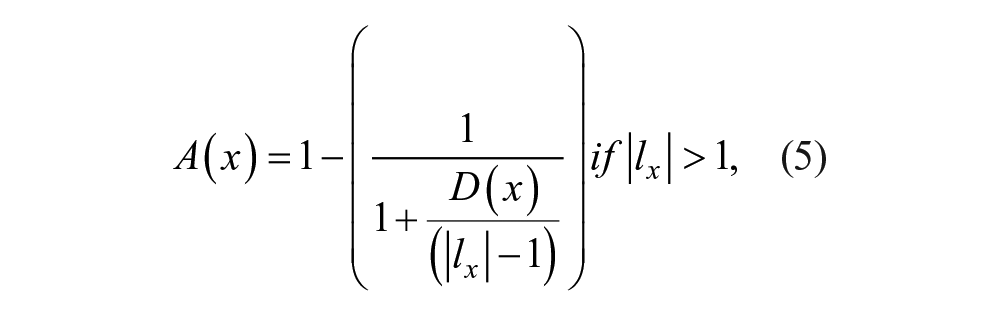
and it equals zero if only one label is applied, that is, | lx | =1 (where | • | denotes the size of a set). We use average pairwise distance in forming the definition, as opposed to the total or average distance between labels, because we want the measure to be sensitive to the number of categorical labels assigned to the object and to the overall distance between them. As Kovács and Hannan (2015) demonstrate, the definition in Equation 5 satisfies these criteria. 11 We now can show that the geometric representation allows the distinctions needed for a deeper analysis of boundary spanning.
Atypicality seeking
Atypicality-seekers tend to sample highly atypical objects, as defined earlier. Let

Taste for atypicality
Next we incorporate valuation to measure preference for atypical objects. Let α(x,y) denote the expressed appeal of object x to audience member y. We assert that people have a taste for atypicality if they especially like category-spanning objects. We derive this measure by calculating the average atypicality of the set of objects a person consumes, weighted by the ratings the respondent provides:

Note that our measure of taste for atypicality depends on the agent’s sampling behavior. The more an agent samples typical objects, the lower the atypicality taste measure, irrespective of whether the agent likes or dislikes these objects (because these objects are typical). We conducted a series of additional analyses that demonstrate that this operationalization does not bias our results. We discuss these analyses in the online supplement.
Conceptualizing Variety
Next we propose parallel measures of variety. Consider, for example, two audience members: one has sampled one action and one romance-and-action movie, and the other has sampled one romance and one action movie. Which one seeks more variety? And, if they liked the two movies they sampled, which one has a greater appreciation for variety? If we simply count the number of genres in each sample, the two do not differ. Our intuition suggests that the scenarios do differ, because the distances between the individual members of the two pairs of movies differ. A romance-and-action movie is closer to a pure action movie than is a pure romance. We build this kind of distance notion into our formal representations of orientations to variety.
We propose that variety seeking can be understood as the average distance between the objects consumed, and that a taste for variety means liking pairs of objects that stand far apart in the cultural space. An important complication arises. A sample of objects can be associated with genre sets of size greater than one when an object has multiple categorical assignments. So constructing appropriate measures for orientations to variety involves measuring distances between sets of varying sizes.
The most widely used measure of the distance between sets is Hausdorff distance (Burago, Burago, and Ivanov 2001), which sets the distance between two sets to the maximal of the shortest pairwise distances between members of the two sets. Consider two restaurants, A and B, illustrated in Figure 3. Each restaurant is assigned a set of labels. These labels are located in a hypothetical sociocultural space (for simplicity, we draw a two dimensional space). The Hausdorff distance between the two restaurants is the distance between Mexican and Thai, the greatest distance between a label in one set and the closest label in the other set.
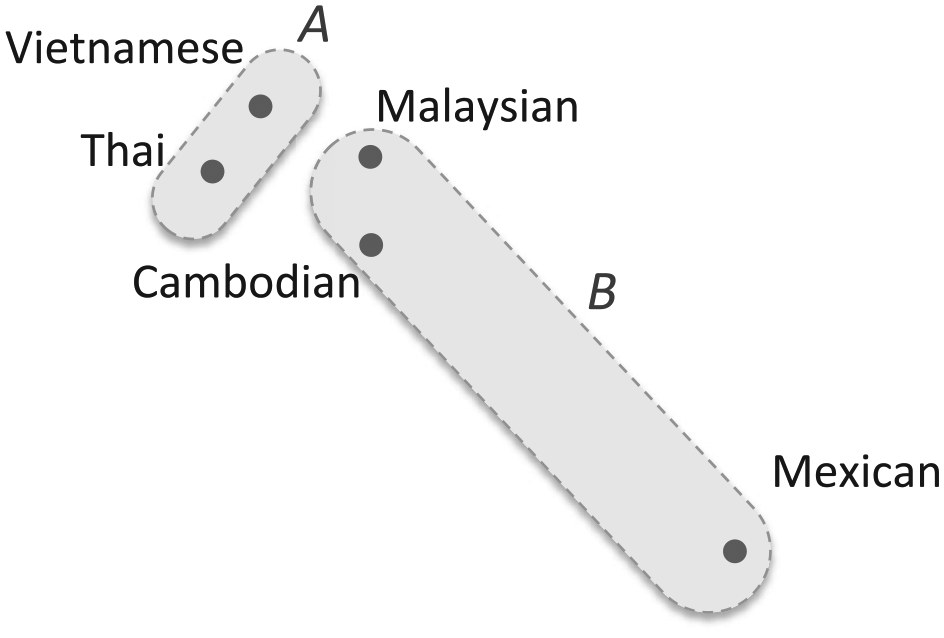
Two Labeled Restaurants in a Sociocultural Label Space
The standard Hausdorff distance presents a problem for cultural analysis because it takes only the farthest label into account. Imagine a third restaurant labeled only Mexican. The Hausdorff distance between this restaurant and restaurant A would be as great as the distance between restaurants A and B. This seems counterintuitive, given that restaurant B mixes Mexican cuisine with other cuisines that are much closer to restaurant A’s cuisines.
We therefore use a variant of the Hausdorff measure, first introduced in Dubuisson and Jain (1994). This modified Hausdorff distance calculates the average of the distances between all the categories of one set and the closest category in the other set: and it defines the distance between a pair of sets as the maximal of these two averages. Let

Variety seeking
We build our measure of variety seeking on distance in cultural space. We measure an agent’s tendency to sample for variety as the average of the pairwise distances among the objects sampled:
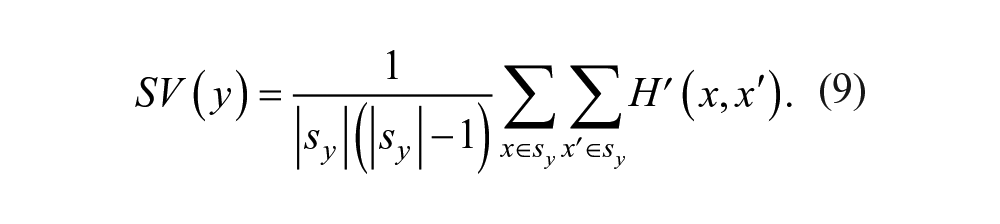
Taste for variety
Similarly, a taste for variety means liking a wide range of objects and genres. 12 Specifically, we propose that audience members have a strong taste for variety when they especially like pairs of items that stand far apart in the space of the domain. We represent this intuition formally as follows:
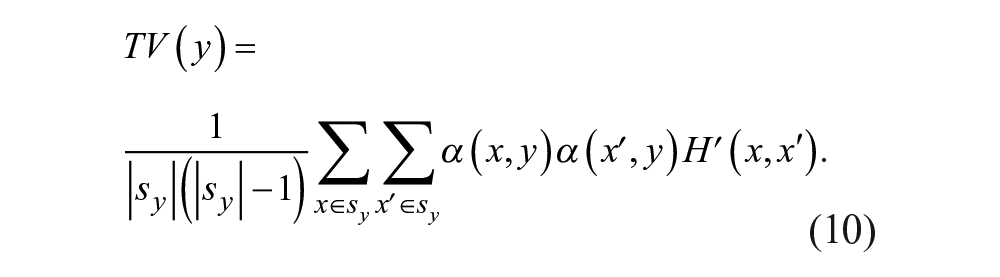
Empirical Settings
We test our hypotheses in two empirical settings: film and food. Data on consumers’ evaluations of films come from the online DVD rental and streaming service Netflix, and data on evaluations of restaurants come from the review website Yelp. We chose these two domains for several reasons. First, both settings present users with broadly agreed-upon classification systems, namely, genre in films and cuisine in food. Second, both systems of classification are social constructions (Baumann 2007; Zerubavel 1997). Third, displays of film and food consumption are communicative acts that serve as performances of identity (Anderson 2005; DiMaggio 1987; Ferguson 2014).
The two settings differ in three important ways. First, genre boundaries are more pronounced for the food domain than for film (as demonstrated by label distributions, as we will discuss). Not only are different types of cuisines served in different types of restaurants, the same movie theater screens multiple types of film. Moreover, genre distinctions in food are strongly essentialized by their practitioners as an objective reality rooted in nature (Douglas [1966] 2003).
Second, whereas the cost of film consumption rarely varies within a given geographic region, restaurant meals vary dramatically by price. As we will discuss, price variance in dining affects how social status can be enacted through food consumption.
The sites from which we collected data also differ in at least one important way. Movie reviews are private on Netflix, but reviews on Yelp are public. Hence, Yelp users are more directly subject to social influence and reputation management pressures, although previous research finds that Netflix users’ consumption behaviors are also driven by identity concerns (Milkman, Rogers, and Bazerman 2009). Overall, given these differences, whatever commonalities we find across the two domains should serve as strong evidence for the generalizability of our findings to domains that are structured by socially constructed systems of classification.
Movie reviews
Our first dataset contains movie ratings from Netflix, which we downloaded from the Netflix Prize website (http://www.netflixprize.com) in January 2009. 13 The dataset comprises 100,480,507 ratings, provided by 480,189 unique users to 17,770 unique titles. Reviewers are identified solely by a unique numerical identifier. Titles are similarly identified by a numerical identifier in the dataset. Each data point is a quadruplet containing the user-id, title-id, date of rating, and rating.
A separate dataset provided by Netflix contains additional title identifiers: a textual string corresponding to the title, and a number corresponding to year of production. The original data do not contain any additional identifying information. Because the title by itself does not distinguish films from television shows, we did a complicated merge with data on films from the Internet Movie Database (IMDB) to identify the films in the Netflix data and to associate film characteristics, notably genre labels used by IMDB (as well as additional data used as controls in our models). 14 Overall, we identified 9,817 unique film titles. To reduce computation intensity, we randomly selected 20,000 unique reviewers (of films) for this analysis and sampled all of their film reviews. This yielded 3,641,961 reviews of 9,768 films.
Restaurant reviews
We analyze reviews on Yelp of restaurants in Los Angeles and San Francisco. Our observation period runs from October 2004 through September 2011. The Los Angeles sample contains 617,141 reviews of 8,131 restaurants, written by 57,211 reviewers. The San Francisco sample contains 767,268 reviews of 3,976 restaurants, written by 59,473 reviewers. 15
Yelp categorizes producers in 397 categories, grouped into 22 super-categories, such as restaurants and financial services. The category labels appear prominently on the website. Our data include all the organizations in Los Angeles and San Francisco that Yelp assigned at least one genre in the restaurant domain. Restaurants receive very frequent reviews, and they are distributed over a broad diversity of categories. Some labels concern food genres, such as various ethnic/national cuisines (e.g., American [traditional] or Basque). Others refer to the mode of service, such as buffet or food stand. Still others pertain to key ingredients or dishes, such as burgers, chicken wings, and seafood, and some refer to food codes, such as, halal, kosher, and vegan.
Measurement
The dependent variable is the rating given by an audience member to a film or restaurant. In both datasets, ratings range from 1 to 5, in full integer increments, with 5 being the most positive rating.
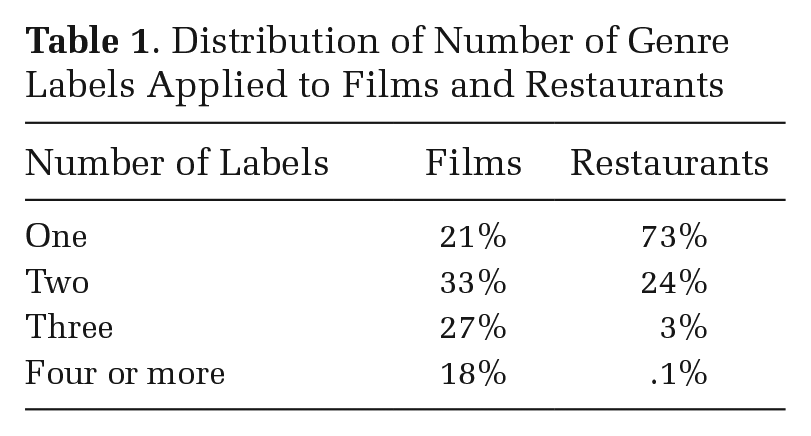
For object atypicality, we use the labels assigned to films by IMDB and to restaurants by Yelp. Films tend to get assigned more genres than do restaurants (see Table 1). Note that only about one quarter of the restaurants, but nearly 80 percent of the films, are assigned more than one label. No doubt much of this difference reflects the existence of the drama genre, the source of many of the other genres in the domain. Here we see a marked advantage of our distance-based approach. Drama is close to most other genres; it is lenient in Pontikes’s (2012) terms. Its nearness means it does not have much influence on the calculation of typicalities. The situation would be dramatically different if we were to use the prior approach of merely counting the number of genres applied to an object. Taking account of distance makes the two empirical settings more comparable.
Distribution of Number of Genre Labels Applied to Films and Restaurants
For the sampling and taste variables we must use some kind of temporal span. We chose moving windows, and we calculated our measures for each rating/sampling event using the reviewer’s observed behavior over the previous n rating/sampling events. With this kind of specification, seeking and taste measures vary for individuals across time. In the results presented here, we set the size of the window to n = 20 for films and n = 10 for restaurants. 16 This means we use information on reviews only for reviewers of at least 21 films or 11 restaurants.
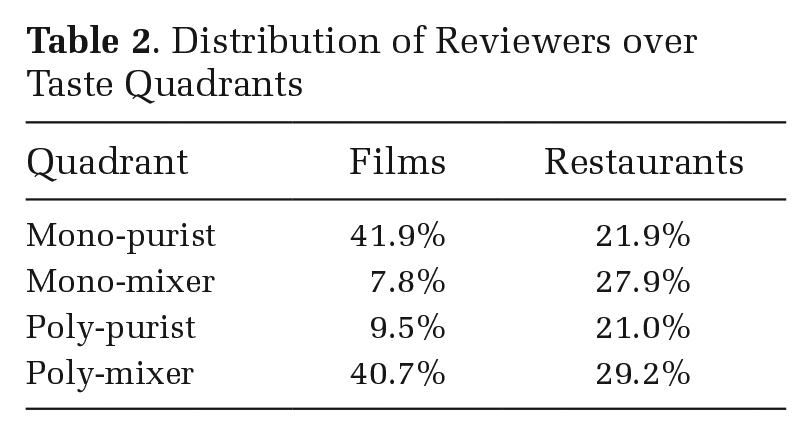
Consistent with the typology depicted in Figure 2, we used our measures of taste for variety and atypicality to locate reviewers in the four quadrants at each time point. We determined quadrant assignments by whether a reviewer’s levels of taste for variety and atypicality (during the preceding time window) fall above or below the median level of the respective measures in the full audience. To avoid overweighing active reviewers, we calculated these medians by averaging the two measures for each reviewer and then determining the median average level for each measure. We distinguish between reviewers below the median on both measures (the mono-purist type), above the median on atypicality but below on variety (the mono-mixer type), below the median on atypicality but above on variety (the poly-purist type), or above both medians (the poly-mixer type). Table 2 shows the distribution of reviewers over the four taste quadrants. For example, in the case of films, we see that most reviewers are either mono-purists (41.9 percent) or poly-mixers (40.7 percent). The distribution for restaurant reviewers differs considerably, with a much more even spread across the four types.
Distribution of Reviewers over Taste Quadrants
Because the cognitive argument depends on exposure, we explore whether these audience members tend to sample close to what they liked previously. One way to look at this is by contrasting the average atypicality of the objects sampled by people in the different taste quadrants. As Table 3 shows, mono-mixers and poly-mixers are the most likely to sample atypical films and restaurants, whereas mono-purists, and especially poly-purists, tend to sample objects that are typical. Poly-purists sample objects that are significantly more categorically compliant than those sampled by all other audience types in both settings. The sampling behavior of audience members is consistent with our expectations.
Means of Sampled Object Atypicality by Audience Members’ Position in the Four Quadrants
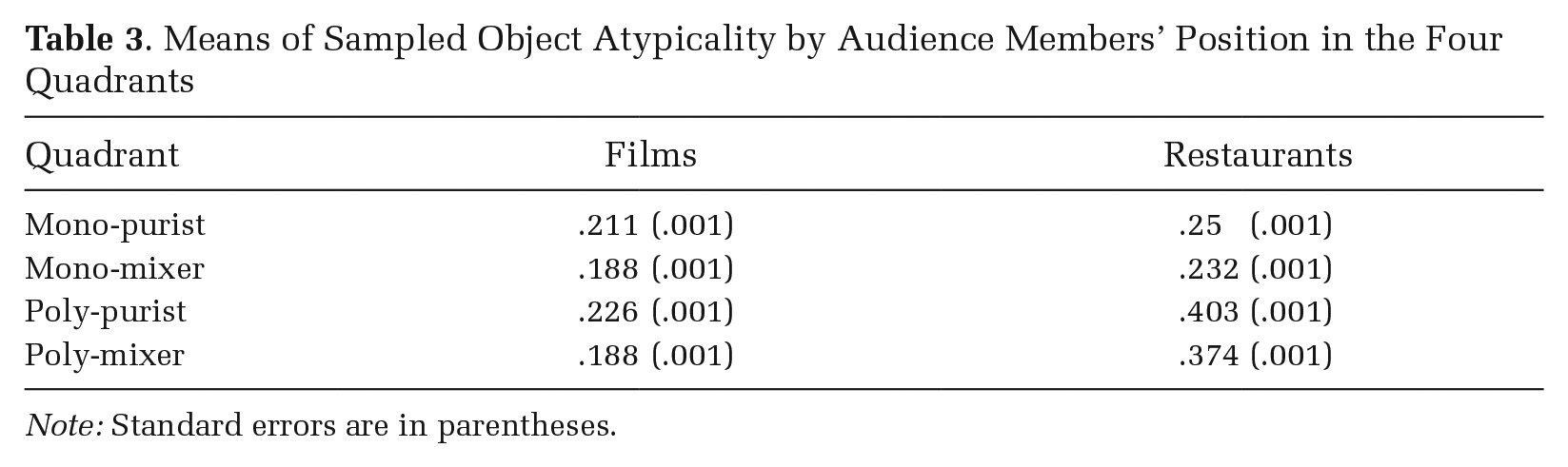
Note: Standard errors are in parentheses.
We include a variety of controls in our models. We measure a reviewer’s enthusiasm by the (log of) the number of her reviews posted over her observation window divided by the length of that window. We include enthusiasm in our models and interact it with object atypicality, to account for the possibility that active consumers differ in their receptivity for categorical hybridity. 17
We also include additional control variables that are unique to each setting. For films, we control for a film’s run-time, the number of awards it won (bestowed by major award-granting institutions), and whether it is a sequel (all of which previous studies show to affect appeal). For restaurants, we control for the average price of the restaurant as reported by Yelp. 18 To control for possible geographic heterogeneity among restaurants, our models include zip-code dummies. Descriptive statistics of all variables can be found in Table A1 in the Appendix. 19
Estimation
We observe the number of stars a reviewer gives an object. We assume that the assignment of starts reflects the underlying appeal of the object to the reviewer. We therefore estimate effects on appeal using ordered-logit specifications estimated by maximum likelihood to assess the effect of reviewer i’s taste profiles and other covariates on the (latent) appeal of a film or restaurant. The stochastic specification has the following form:

where
Because this setup does not yield consistent estimators with fixed effects (Greene 2004), we use an approximation: we include the effect of the reviewer’s mean rating and the mean rating received by the film or restaurant. 20 Note that in the results reported here, the various measures of taste and seeking included as predictors are calculated by observing a window of activity preceding the rating in question.
Results
Receptiveness to Boundary Spanning
Our two hypotheses concern the relationship between taste profiles and the (latent) appeal of atypical (boundary-spanning) films and restaurants. These hypotheses focus on interactions of object atypicality with taste profiles and their effects on latent appeal. Table 4 reports the relevant results. (Table A2 in the Appendix presents the full set of results for this analysis.)

Note: Standard errors are in parentheses.
p < .001 (two-tailed tests).
Unsurprisingly, reviewers with a high taste for atypicality during the preceding window are more likely to appreciate atypical offerings than are those with a weaker taste for atypicality: the interaction of an object’s atypicality with the strength of the taste for atypicality is positive (and statistically significant) for both films and restaurants. As predicted, the interaction of object atypicality with the strength of the taste for variety is negative (and significant) for both domains. In both settings we find that, controlling for the taste for atypicality, openness toward atypicality declines with a taste for variety.
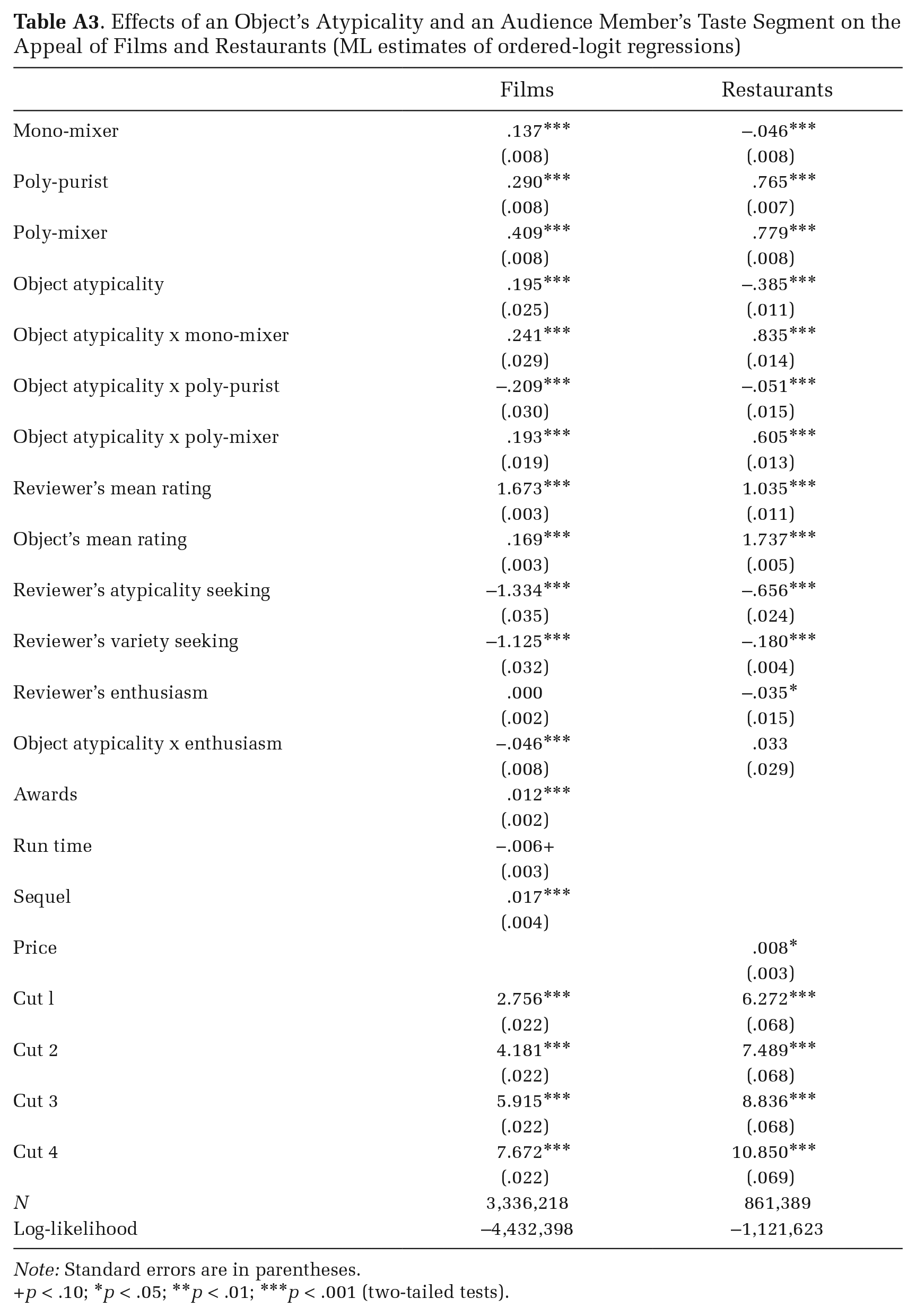
Next we address the second hypothesis, which concerns interactions of the two taste dimensions. The results are easier to interpret when we use the sector assignments, the four types, to represent the interaction. We therefore estimate interactions of object atypicality with the reviewer’s type (the omitted taste profile is mono-purist). Table 5 reports the relevant results. (Table A3 in the Appendix presents the full set of results for this analysis.) As predicted, we find that reviewers in the poly-purist quadrant are significantly less appreciative (relative to mono-purists) of boundary-spanning films and restaurants: this interaction effect is negative and significantly lower than zero.
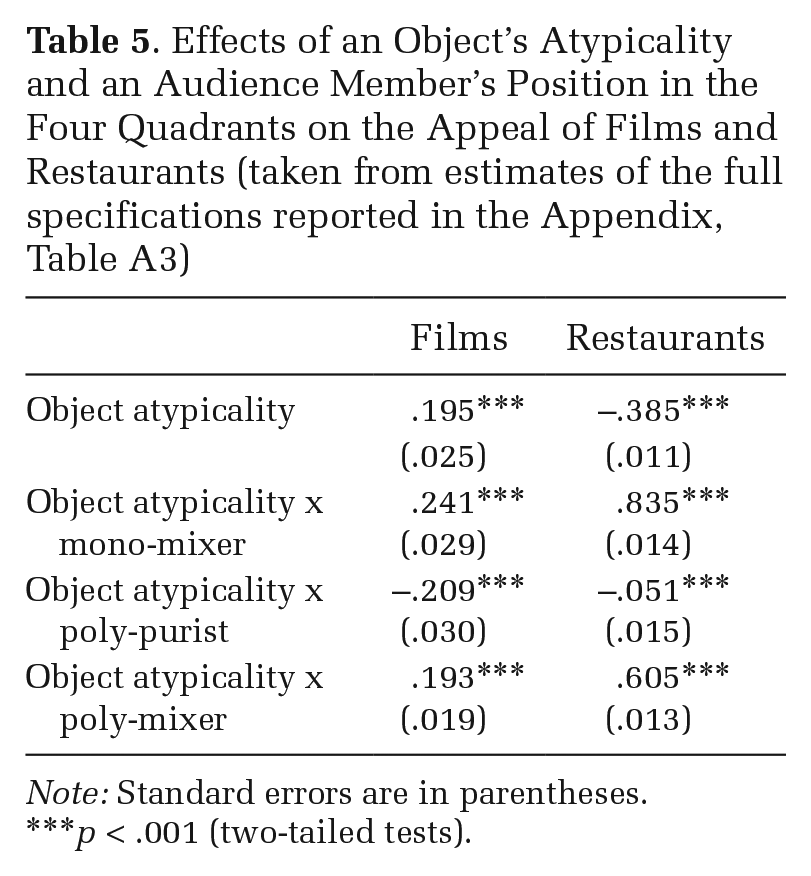
Note: Standard errors are in parentheses.
p < .001 (two-tailed tests).
Note the strong difference between domains in the main effect of the atypicality of the object sampled. As mentioned earlier, 73 percent of the restaurants but only 21 percent of the films have a single categorical assignment. Audiences have much more exposure to multiple-genre films than to multiple-genre restaurants, so it makes sense that the main effect of increasing atypicality is to lower the appeal of a restaurant but to increase the appeal of a film.
Figure 4 plots the estimated total effect of object atypicality on appeal by consumer type (the combination of the main effect of object atypicality and the interactions). The two types that favor atypicality—mono-mixers and poly-mixers—appreciate boundary-spanners significantly more than do those who favor purity. Only poly-purists are negatively disposed toward boundary-spanning offerings in both settings (due to the modest size of the effect for films, this effect is not significantly smaller than zero; nevertheless, it is significantly different from the effects for all other consumer types, for whom object atypicality has a significantly greater than zero effect on appeal). This pattern is consistent with the view that the audience segment that knows and appreciates multiple genres, but favors offers that conform to genre codes, plays the genre-policing role in these markets.
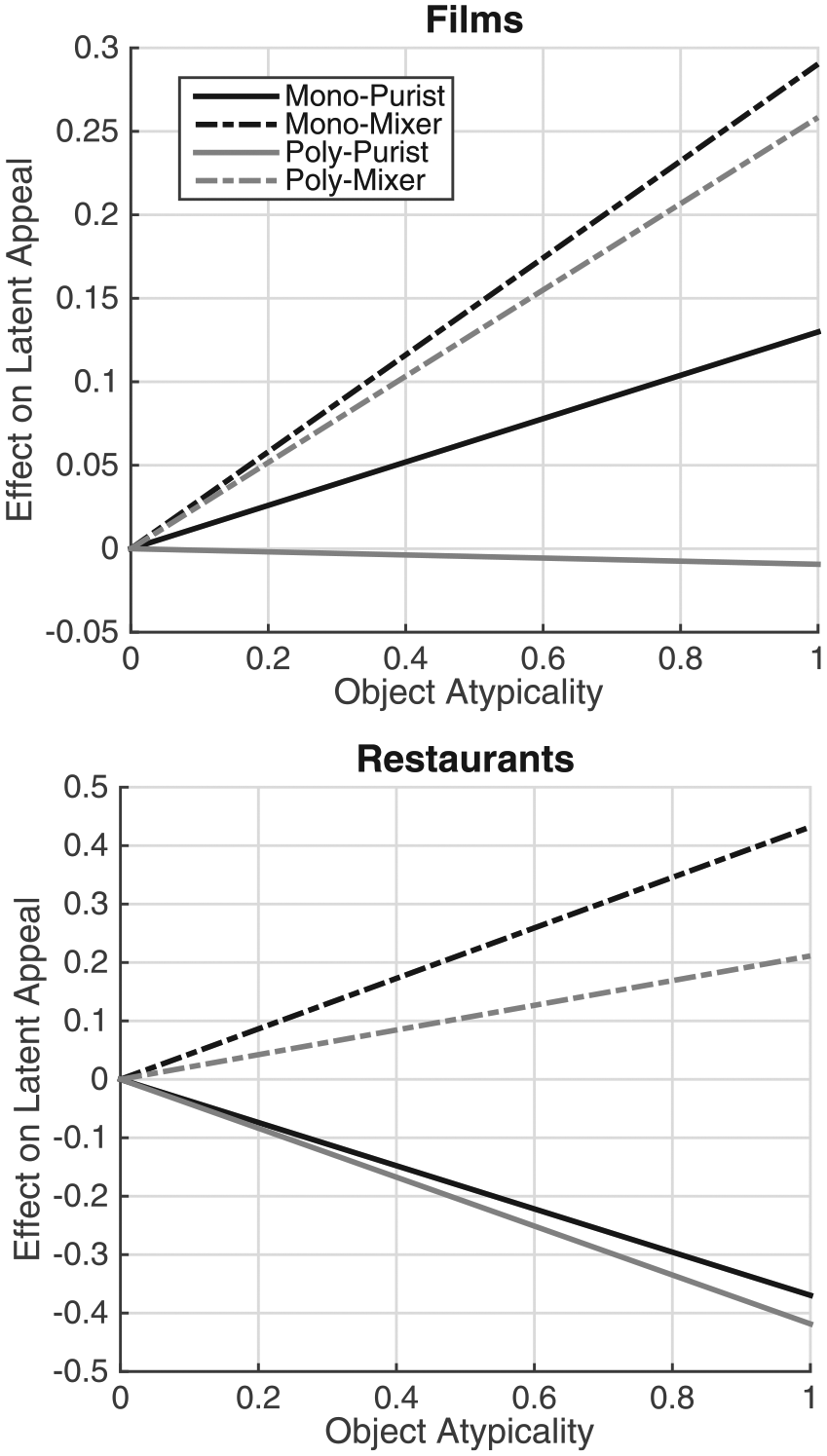
The Effects of Object Atypicality on Appeal (as Reported in Table 5)
The patterns illustrated in Figure 4 also point to differences between the two settings reflecting the main effects of object atypicality, discussed earlier. Whereas in restaurants both mono-purists and poly-purists are averse to cuisine-spanning establishments, in film only poly-purists dislike movies that span distant genres. On average, an object’s atypicality is positively related to evaluation in film. Moreover, effect sizes for mono-purists and poly-purists differ substantively more in film. These distinct patterns are not surprising given that categorical boundaries are significantly more pronounced in cuisine than they are in film. Yet these differences not-withstanding, the findings support the hypothesis that variations in fluency and distinction-seeking for newly sampled atypical objects correspond to the agent’s position in the space of taste variety and atypicality. As we predicted, poly-purist consumers especially dislike atypical objects that they happen to sample.
Given this pattern of empirical support, we turn now to a more speculative effort to characterize the poly-purists. Cultural sociologists might wonder whether our analytic deconstruction of the notion of the cultural omnivore has laid waste to the substantive terrain. Can we connect these audience types with other standard notions of cultural sociology?
Poly-purism as a Display of Refined Taste
Our results are consistent with our predictions that a taste for variety increases one’s adherence to genre codes, but they say nothing about the social significance of such consumption patterns as identity markers. Who are poly-purists? What social identity do they project through their categorically varied compliance with genre boundaries?
Existing sociological literature does not speak to this issue, because it has not distinguished the two dimensions of taste. Nevertheless, as we noted earlier, most studies on cultural taste operationalize omnivorousness as a taste for variety. And those studies consistently find that consumers with an orientation toward variety tend to be drawn from the higher end of the socioeconomic distribution. Whereas earlier work in this vein tended to assume that broad cultural taste was a product of cultural openness that crosscuts traditional distinctions between high and low brow, recent qualitative reappraisals of the theory point in a different direction. In two such studies, Savage and Gayo (2011) and Atkinson (2011) find that people who profess a liking for a variety of cultural genres also tend to be appreciative of objects within these genres that are associated with sophistication, complexity, and prestige. Cultural distinction, in other words, operates through the symbolic mastery displayed by appreciation for consecrated works within, rather than across, genres.
It would therefore be consistent with these findings to regard poly-purism as a performance of high status. Familiarity with genre codes, in itself, constitutes a form of cultural capital that is acquired through education and experience (Bourdieu 1984). Extending this logic, Lizardo and Skiles (2012) argue that cultural omnivorousness is an “aesthetic disposition” based on one’s ability to appreciate form in separation from content and to apply such prototypical abstractions to unfamiliar objects. That is precisely the skill in which poly-purists should excel. Moreover, genre boundaries reify social differences between their consumers; people who have or aspire to high social status are therefore more likely to protect genre codes with enthusiasm, as we see for poly-purists. Is poly-purism indeed a performance of cultural refinement?
We do not have data on the sociodemographic characteristics of individual consumers, and therefore we cannot explore their positions in socioeconomic space. We do, however, have information about the attributes of the objects they consume. If poly-purists enact a high-status social identity (irrespective of their actual social position), we should find that they tend to like offerings that are generally considered expressions of refined taste and reject those that convey populism, commercialism, or fashion.
In film, the distinction between refined and common productions is manifest in the sacralization of certain movies as art, and their filmmakers as artists (Baumann 2007). Critics play the institutional role of distinguishing artistic movies from commercial ones (Becker 1982). We use the aggregation of critical appraisals of the movies contained in our dataset from the online review aggregator Rotten Tomatoes. 21 Rotten Tomatoes averages critics’ reviews on a 0 to 100 scale. These include reviews published at time of release as well as later reviews. The latter are particularly prevalent for movies such as The Godfather that, over the years since their release, became widely regarded as cinematic masterpieces.
Unlike film, what constitutes a display of refined taste in cuisine gets complicated by the strong price differentiation among restaurants. The consumption of luxury haute-cuisine is, by definition, a display of wealth, because only those on the upper end of the income distribution can afford it. The distinction between economic success and prestige comes into play here. As Bourdieu (1993) argues, these constitute competing principles of legitimacy in cultural fields. Whereas consumption of luxury goods signals high economic capital, consumption of prestigious goods marks high cultural capital. There is a tension: commercial success is generally perceived as antithetical to true artistry. Authenticity therefore functions as a means to distinguish artisanal restaurants from those with a commercial orientation (Carroll and Wheaton 2009; Johnston and Baumann 2007). We use Kovács, Carroll, and Lehman’s (2014) methodology to measure perceived authenticity, as manifest in textual reviews posted by Yelp users. 22 The method relies on the crowd-sourced wiki-survey technique (Salganik and Levy 2015) to detect words connoting authenticity, and then rates individual reviews by the weighted frequency of authenticity-related terminology. Individual restaurants are assigned an authenticity score as a function of their reviews’ average authenticity score.
We mean-center our measures of prestige—critical acclaim in film and authenticity in restaurants—and multiply prestige by the reviewer’s normalized rating. 23 This measure of refined taste takes positive values when a reviewer provides a high rating to a prestigious offering or a low rating to an unprestigious offering, and it takes negative values when the reviewer gives a low rating to a prestigious offering or vice versa. Figure 5 summarizes the distribution of refined taste across our four types of consumers. In both domains, poly-purists exhibit the strongest inclination toward objects that convey refined taste. In film (upper-left panel of Figure 5), poly-purists are most likely to value critically acclaimed movies and dismiss those not well-received by critics. In dining (upper-right panel), poly-purists tend to value authentic restaurants and devalue non-authentic ones.
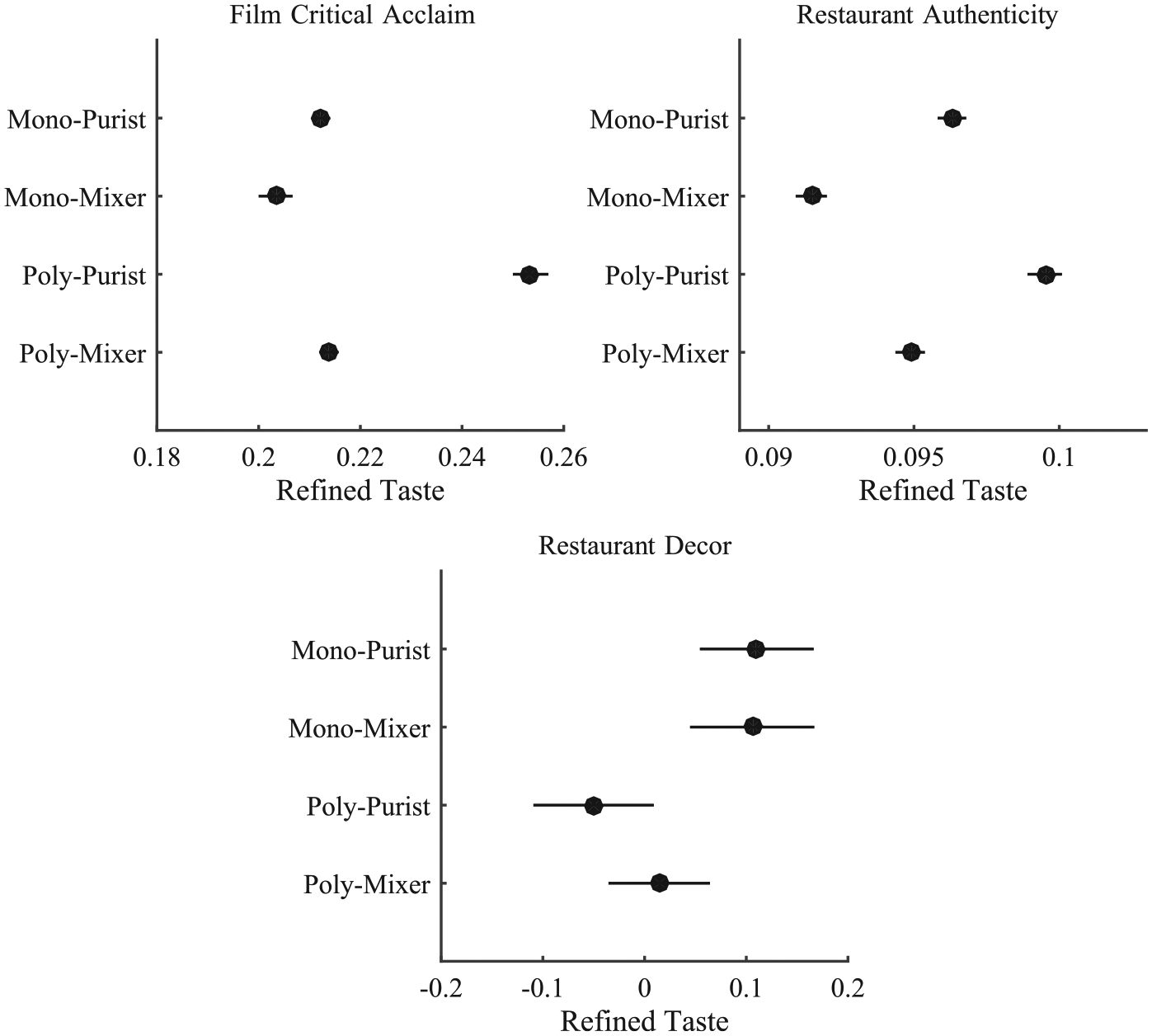
Group Orientations toward Refined Objects (mean values and 95% confidence intervals)
The bottom panel in Figure 5 summarizes the average appreciation for restaurant decor by the four audience types, as reflected in the Zagat rating for that restaurant. 24 Zagat is a print and online restaurant guide that aggregates non-expert reviews. Of the four dimensions of restaurant attributes it assesses (price, food quality, decor, and service), decor is least related to food quality and authenticity. Rather, in the eyes of connoisseurs, a dining establishment’s investment in decor signals dilettantism. It provides patrons who have the financial means, but who lack the true cultural capital necessary to distinguish authenticity from commercialism, the means to perform ceremonies of cultural sophistication. It is not surprising, therefore, that only poly-purists tend to downgrade restaurants that receive a high score on decor: they are averse to establishments that invest in non–food-related aesthetics. Overall, in both settings poly-purists are most likely to exhibit a taste for well-regarded offerings. The performance of poly-purism, in other words, constitutes a social display of refined cultural taste.
Are poly-purists the cosmopolitan, well-educated, high-status omnivores described by Peterson and the scores of studies inspired by his work? Because we do not know the socio-demographic characteristics of the movie and restaurant reviewers in our data, we can only hazard an informed guess. We do know, however, that the consumer segment we label poly-purist exhibits the empirical signature that other studies label omnivorousness, and that these consumers are most likely to appreciate consecrated movies and restaurants. We cannot tell whether these connoisseurs belong to social or economic elites; yet, their patterns of cultural taste are unequivocally elitist.
Discussion, Limitations, and Future Directions
Boundary crossing, blurring, and maintenance have become major sociological preoccupations in recent years. But sociologists often mean different things, and describe different processes, when they talk about boundary spanning. We explored boundary spanning in terms of audience members’ taste for variety and atypicality, assuming heterogeneity in audience preferences for boundary spanning and its manifestation in the objects they consume. Extending findings in cultural sociology that demonstrate the existence of cultural omnivores, we identified a taste for atypicality as an additional dimension of consumption behavior and developed a novel methodology to assess audience members’ taste for atypicality and variety. As predicted, we find that poly-purists play a distinct, boundary-policing role: they generally reject category-spanning objects.
Our analyses have important implications for the fields of cultural sociology, the sociology of consumption, and the sociology of organizations. We make two major contributions to these literatures. First, our analytic distinction between variety and typicality sheds new light on the cultural omnivore thesis. Whereas prior research often uses omnivorousness as synonymous with openness, we show that a taste for variety decreases one’s receptivity to cultural innovation. Our analytic framework demonstrates how consumption breadth can simultaneously serve as a display of inclusiveness and an act of exclusion through boundary reenactment. In fact, we show that omnivorousness (as variety seeking and liking) concerns not boundary erosion, but rather the opposite, its protection. Cultural omnivores require genre boundaries—and concomitantly reject their subversion—to make their breadth of consumption socially meaningful.
Over the past two decades, the omnivore thesis has generated heated debate as to whether recent findings on cultural consumption are consistent with—or refute—Bourdieu’s model of cultural distinction (e.g., Erickson 1996; Johnston and Baumann 2007; Khan 2011; Lizardo and Skiles 2012). Our analytic approach identifies poly-purists as boundary-spanners who simultaneously engage in cultural distinction. We interpret our results as strongly consistent, albeit in a nuanced way, with Bourdieu’s argument about cultural taste as a ritual of social distinction. Poly-purists’ distinctive orientation toward culturally legitimized offerings, namely critically acclaimed films and authentic restaurants, suggests that their pattern of evaluation of consumption acts reflects a concern with social distinction. This is particularly pronounced in dining, where poly-purists reject restaurants that lay Zagat reviewers celebrate for their decor. Previous research has produced conflicting evidence about the nature of cultural omnivorousness and its orientation to boundary spanning because it conflates different types of consumers under the umbrella term “omnivore.” But, as our results suggest, omnivorousness should be thought of as a two-dimensional phenomenon. Future research will hopefully build on our typology to elaborate how variety and atypicality map on, subvert, or reproduce status hierarchies, as Bourdieu, Peterson, and others have debated.
Overall, our findings might extend beyond the domain of cultural consumption. The rise of cultural omnivorousness in Western societies is associated with a broader sociocultural historical shift, whereby practices of symbolic exclusion, whether on the basis of gender, race, or class, have become increasingly delegitimated. Our two-dimensional analysis of boundary spanning might help explain how social exclusion is maintained in this age of multiculturalism. Consider, for example, the symbolic production of ethnicity. Whereas previous studies focus on the dimensions of ethnic boundaries (e.g., Bail 2008), our framework suggests it is also important to distinguish between people who span ethnic boundaries through variety—namely, those who appreciate multiple ethnic identities—and those who span such boundaries through endorsing behaviors that mix cultural motifs from multiple ethnicities—such as serving tacos with Cambodian fish sauce. Drawing on our conclusions, one might predict that individuals who espouse multiculturalism through variety will be strongly inclined to resist behaviors that undercut ethnic boundaries.
Our second contribution relates to studies of categorical systems and noncompliance in organizational fields and markets. A voluminous literature demonstrates that novelty emerges when existing components are recombined in ways that defy traditional configurations. The literature also finds, however, that audiences—whether customers, organizational members, or other stakeholders—are generally resistant to such recombinations. Categorically noncompliant behaviors are interpreted as displays of incompetence and are therefore discounted or rejected. Recombinant behaviors are received favorably when the actors enacting them possess social or symbolic capital, or when categorical systems are in flux or dissensus.
With relatively few exceptions, previous organizational research assumes that, when categorical systems are agreed upon, audiences are homogeneously averse to novel combinations. We show that, at least in cultural fields, this assumption is incorrect: there exists variability in audience members’ receptiveness toward genre crossover. The few studies that assume audience heterogeneity tend to attribute it to the roles that audience members occupy: ambiguously labeled software companies are more appealing to venture capitalists than to consumers (Pontikes 2012), and critics are more receptive of unconventional operas than are opera season-ticket holders (Kim and Jensen 2011). Perhaps the different audience segments that we identify also occupy different social roles. Yet our work also demonstrates that different orientations toward atypicality are linked to audience members’ orientations toward variety, irrespective of role differentiation. Thus, future work might explore whether, as our findings suggest, atypical start-ups or job applicants—both domains that research shows are shaped by the categorical illegitimacy discount—are more likely to appeal to venture capital firms or employers that focus on a narrow variety of candidates. It may also be useful to apply our typology to producers. Like audience members, organizations such as film studios and restaurant chains differ in their levels of product variety and atypicality. Some studios, for example, specialize in particular genres, whereas others do not, and some adhere more to genre codes than do others. Organizations, too, can be thought of as poly-mixers, mono-purists, and so forth.
More broadly, our findings can inform further research on the circumstances and audience structures that nurture category spanning, and by implication, sociocultural innovation. The finding that category spanning is welcomed by mono-mixers and poly-mixers but discouraged especially by poly-purists indicates that categorical innovation more likely happens in domains where mono-mixers and poly-mixers are prevalent. Thus, variance in audience composition might explain why one observes so much variance across settings in terms of people’s propensity to innovate and change categories. Granted, we do not explore, nor hypothesize, about the difference between mono- and poly-mixers. We speculate that the latter are indifferent to genre codes, whether due to ignorance or volition, whereas the former are consciously engaging in the legitimation of a nascent category. This reasoning suggests a new argument about audience-composition change: first mono-mixers embrace new category combinations, then, when these combinations become legitimated (as in the case of Asian fusion), mono-purists and poly-purists enter the arena. We find this avenue of research particularly promising.
Several questions remain unanswered. Because we observe consumers only in one setting, we do not know whether cultural consumption orientations are fixed personal traits, or whether they vary across contexts. Are poly-purists, in other words, always disposed toward consuming myriad pure types and protecting categorical boundaries, or can the same individual exercise poly-purism in one domain and mono-mixing in another? Work in cultural sociology suggests that actors possess multiple and potentially inconsistent cultural toolkits, leading the same actor to activate different cultural schemas, and adopt different social identities, across different situations (Lahire 2008, 2011; Swidler 2001). Moreover, whereas we assume a high degree of consensus across individuals about conceptual space, research in cognitive science (Verheyen and Storms 2013) and sociology (Goldberg 2011) shows that individuals do not always agree on the meanings of categories or on how items should be categorized. Schematic variability within individuals across situations, or across individuals within the same situation, introduces cultural boundary crossing even if such hybridity is not purposefully pursued. We suspect these cleavages enable cultural innovation to diffuse and eventually become legitimized. Given our current data we are not able to explore such processes. We leave this for future research.
Footnotes
Appendix: Descriptive Statistics And Complete Results Associated With Tables 4 And 5
Effects of an Object’s Atypicality and an Audience Member’s Taste Segment on the Appeal of Films and Restaurants (ML estimates of ordered-logit regressions)
| Films | Restaurants | |
|---|---|---|
| Mono-mixer | .137 *** | –.046 *** |
| (.008) | (.008) | |
| Poly-purist | .290 *** | .765 *** |
| (.008) | (.007) | |
| Poly-mixer | .409 *** | .779 *** |
| (.008) | (.008) | |
| Object atypicality | .195 *** | –.385 *** |
| (.025) | (.011) | |
| Object atypicality x mono-mixer | .241 *** | .835 *** |
| (.029) | (.014) | |
| Object atypicality x poly-purist | –.209 *** | –.051 *** |
| (.030) | (.015) | |
| Object atypicality x poly-mixer | .193 *** | .605 *** |
| (.019) | (.013) | |
| Reviewer’s mean rating | 1.673 *** | 1.035 *** |
| (.003) | (.011) | |
| Object’s mean rating | .169 *** | 1.737 *** |
| (.003) | (.005) | |
| Reviewer’s atypicality seeking | –1.334 *** | –.656 *** |
| (.035) | (.024) | |
| Reviewer’s variety seeking | –1.125 *** | –.180 *** |
| (.032) | (.004) | |
| Reviewer’s enthusiasm | .000 | –.035 * |
| (.002) | (.015) | |
| Object atypicality x enthusiasm | −.046 *** | .033 |
| (.008) | (.029) | |
| Awards | .012 *** | |
| (.002) | ||
| Run time | −.006+ | |
| (.003) | ||
| Sequel | .017 *** | |
| (.004) | ||
| Price | .008 * | |
| (.003) | ||
| Cut l | 2.756 *** | 6.272 *** |
| (.022) | (.068) | |
| Cut 2 | 4.181 *** | 7.489 *** |
| (.022) | (.068) | |
| Cut 3 | 5.915 *** | 8.836 *** |
| (.022) | (.068) | |
| Cut 4 | 7.672 *** | 10.850 *** |
| (.022) | (.069) | |
| N | 3,336,218 | 861,389 |
| Log-likelihood | –4,432,398 | –1,121,623 |
Note: Standard errors are in parentheses.
p < .10; *p < .05; **p < .01; ***p < .001 (two-tailed tests).
Acknowledgements
We appreciate the comments we received at the Junior Faculty Workshop at the University of Chicago, Booth School of Business, and at the Category Working Group meetings at Stanford GSB and in Heidelberg, as well as comments from Oliver Hahl, Greta Hsu, Giacomo Negro, Amanda Sharkey, John-Paul Ferguson, and Ezra Zuckerman. We also thank the University of Lugano, the Stanford Graduate School of Business, and the Stanford GSB Faculty Trust Fellowship for generous financial support for this project.
Notes
References
Supplementary Material
Please find the following supplemental material available below.
For Open Access articles published under a Creative Commons License, all supplemental material carries the same license as the article it is associated with.
For non-Open Access articles published, all supplemental material carries a non-exclusive license, and permission requests for re-use of supplemental material or any part of supplemental material shall be sent directly to the copyright owner as specified in the copyright notice associated with the article.
