




Abstract
While influential across a wide variety of subfields, cultural analysis in sociology continues to be hampered by coarse-grained conceptualizations of the different modes in which culture becomes personal, as well as the process via which persons acquire and use different forms of culture. In this article, I argue that persons acquire and use culture in two analytically and empirically distinct forms, which I label declarative and nondeclarative. The mode of cultural acquisition depends on the dynamics of exposure and encoding, and modulates the process of cultural accessibility, activation, and use. Cultural knowledge about one domain may be redundantly represented in both declarative and nondeclarative forms, each linked via analytically separable pathways to corresponding public cultural forms and ultimately to substantive outcomes. I outline how the new theoretical vocabulary, theoretical model, and analytic distinctions that I propose can be used to resolve contradictions and improve our understanding of outstanding substantive issues in empirically oriented subfields that have recently incorporated cultural processes as a core explanatory resource.
The past two and a half decades have seen a virtual explosion of interest in culture among sociologists, first as a delimited topic of analysis (“the sociology of culture”) and more recently as a general resource for explanation (“cultural sociology”). In this sense, cultural sociologists can proclaim with confidence that their work stands “at the crossroads of the discipline” (Jacobs and Spillman 2005), helping to inform the research of scholars in virtually every substantive area of sociology (DiMaggio 1997; Patterson 2014; Sewell 2005). Yet, despite its widespread influence, cultural analysis in sociology is limited, and thus prevented from fulfilling its putative discipline-unifying role, in at least two important respects. 1
First, sociologists generally have an impoverished understanding of how analytically and empirically distinct forms of culture are acquired and used by persons. Instead, one-size-fits-all proposals, deploying the term “culture” as a generic (and thus ambiguous) category of analysis, seem to be the rule rather than the exception (Alexander 2003; Swidler 2001a). Second, even when incipient analytic distinctions are made (Sewell 1992; Swidler 2001b), we find partial, insufficiently developed, and sometimes empirically inadequate conceptualizations of how different kinds of cultural elements relate to one another (Patterson 2014). One of the primary goals of this article is to provide a coherent analytic and empirical basis for the distinction between different forms of culture and to provide the first steps toward a model of how the distinct modalities of culture interrelate to produce the empirical phenomena of interest to sociologists.
A roadblock to reaching this goal is that, under the most influential approaches, the implicit, or nondeclarative aspects of culture (phenomenologically opaque and not open to linguistic articulation) are usually conceptualized as being inherently intertwined with, or as being of secondary analytic importance in relation to, its explicit or declarative facets (phenomenologically transparent and elicited as linguistic reports). That is, knowledge “how” is not properly differentiated from knowledge “that” (Ryle 2002:25–26). In the modal case, linguistically articulated forms of culture are presumed to be of more inherent substantive interest than “how” knowledge, or at least of being capable of serving as a relatively unproblematic point of access to the latter (Jerolmack and Khan 2014).
My argument in what follows is that a serious consideration of the distinction between declarative and nondeclarative culture (at the personal level), and both from the way culture is manifest in public (extra-personal) form (Strauss and Quinn 1997), is a requirement for effective cultural analysis on analytic and empirical grounds. I will show that having an adequate conceptualization of both the analytically relevant differences between cultural elements as well as the multifaceted relations that these elements enter into, helps resolve a host of empirical issues that would otherwise remain shrouded in ambiguity, confusion, and paradox.
Having stated my positive goals, allow me to clarify what I do not intend to do here. First, my aim is not to formulate another grand approach to cultural analysis, in the vein of classical normativist functionalism (e.g., Parsons 1951) or “the strong program” (e.g., Alexander 2003). Nor is it my goal to displace influential contemporary approaches to the culture/action linkage (e.g., Swidler 2001a; Vaisey 2009), or to provide a full-fledged defense and exegesis of previous work that emphasizes the tacit bases of action (e.g., Bourdieu 1990). Instead, my goals are more modest but not necessarily less programmatic. My aim is to provide a flexible (but principled) conceptual vocabulary that cultural analysts may draw upon regardless of underlying persuasion or commitment to any specific program. The conceptual toolbox should then be used to qualify, sharpen, and extend the quality of theorizing focused on cultural processes across diverse empirical settings. 2
Naturally, the distinctions I propose are not completely neutral as to how the concepts of “culture” and “action” are conceptualized, and while the argument attempts to be ecunemical it is not neutral as to conceptualization. My own thinking on these issues has been most strongly influenced by the line of work known as “practice theory,” which is most clearly articulated in the work of Pierre Bourdieu (1990) and Ann Swidler (2001b). While acknowledging these influences, the approach I propose is neither a reproduction nor a retranslation of Bourdieusian or Swidlerian insights into a different set of theoretical terms. In the case of Bourdieu, one problem with even attempting such a recasting is that he saw the project of cultural explanation in social science, available to him mainly in the form of mid-twentieth structuralist and symbolic anthropology, as a dead end (Bourdieu 1973). This stance led him to develop a counter-project in which the concept of culture entered only as a topic to be accounted for but never as an analytic resource for explanation (Lizardo 2011). This required the development of a somewhat idiosyncratic, and in many ways unwieldy, theoretical vocabulary—one that has never been coherently incorporated into Anglophone cultural analysis (e.g., Alexander 2003; Sewell 1992; Swidler 2001b). Furthermore, Bourdieu’s ambivalence in relation to the culture concept essentially meant he made little effort to provide an empirically defensible account of how persons acquire and use culture in context, outside of some suggestive, but ultimately elliptical, allusions.
In contrast to this stance, the approach developed here remains fully committed to a robust notion of culture as an analytic resource for explanation (Sewell 2005). Accordingly, I attempt to integrate the practice-theoretical insight that a lot of what functions as culture remains in the tacit dimension, never rising to the level of discourse, with the empirical fact that a lot of what gets referred to as “culture” presents itself to the analyst in the form of explicit talk and discourse (e.g., Swidler 2001a). To that end, I draw on recent interdisciplinary work on the enculturation process to provide a principled account of how we may be able to pull off this feat, an account that should be usable by social scientists committed to the project of cultural explanation. This reformulation has several analytic advantages over previous synthetic attempts, whether of Bourdieusian provenance or not, including the fact that it does not require either the adoption of an idiosyncratic terminology (opting instead for terms with wide currency in social science) or all-out commitment to a delimited theoretical system or program.
To showcase the substantive payoff of the approach I propose, I take contemporary studies of the role of culture in the reproduction of inequality as paradigmatic test cases for conceptual clarification. I do this with full knowledge that this is precisely the area that may be thought of as having been settled by practice-inspired models, such as that developed in the early work of Bourdieu and Passeron (1990) and the cottage industry of work that grew around the concept of cultural capital following this intervention. My intent here is neither to replicate nor displace the insights generated by these lines of work, nor to develop a generic model linking culture, institutions, and the reproduction of power. Instead, my aim is to show that we can do better cultural theory and provide more compelling, convincing, and generative modes of cultural explanation when the right set of distinctions is made and we focus on the right kind of processes.
To that end, I chose primarily empirically driven efforts in the study of culture and inequality in the United States as my main source of material. This has two additional analytic and substantive advantages. First, this is an area where a consideration of cultural processes, after a long period of self-imposed banishment (Patterson 2014), have re-emerged with a renewed vigor, but where the ultimate substantive implications of this cultural turn remain to be fully demonstrated (Lamont, Beljean, and Clair 2014). Second, culture and inequality studies is an area where empirical researchers are forced to deal with fundamental issues in cultural theory that, while superficially presenting themselves as purely empirical debates, can be directly traced to analytic choices affecting how culture is (or is not) brought in as an explanatory factor in the first place. The synthetic benefits that can accrue from moving to the framework I propose are thus most evident here.
We will see how substantive issues that would otherwise be accounted for using incompatible or globally incoherent theoretical vocabularies, or segregated into seemingly competing forms of cultural explanation, can be brought under a coherent conceptual umbrella. I also show how the analytic vocabulary I develop provides a way to avoid having to engage in strained acts of intellectual gerrymandering, in which cultural explanations are deployed for a selective range of cases and arbitrarily foreclosed for others (Skrentny 2008), or in which equally arbitrary distinctions between culture and not-culture (e.g., structure) have to be brought in through the backdoor (Hays 1994). Both of these issues continue to serve as obstacles to effective cultural analysis in the field.
A Theory of Enculturation
With these preliminary considerations out of the way, I begin by providing a theoretically informed account of the enculturation process that connects analytically distinct ways in which persons internalize culture to processes of cultural activation and use.
The theory of enculturation that I propose is grounded in approaches to the study of culture in action with a strong basis in the interdisciplinary study of human cognition or “cognitive social science” (e.g., DiMaggio 1997; Patterson 2014; Strauss and Quinn 1997; Vaisey 2009). The analytic advantage of a cognitively grounded conception of the enculturation process comes from its capacity to link distinct pathways and mechanisms of cultural exposure and transmission to correlatively distinct ways culture comes to be stored in long-term memory (Smith and DeCoster 2000).
Following cognitively motivated theories of cultural meaning, I conceive of enculturation as a process of internalization of experiential patterns encountered in the world via a developmental learning process (Tomasello 1999). Internalization, in turn, can be thought of as the modification (e.g., strengthening or weakening of links) of neural pathways constitutive of memory consolidation processes (Changeux 1997), entailing the encoding and storage of cultural knowledge in functionally and physiologically distinct memory systems (Whitehouse 1996). When subject to an internalization process, culture becomes a (relatively) enduring part of a person’s knowledge repertoire (Lizardo and Strand 2010).
A key insight of recent work on memory systems is that different forms of knowledge are differentially encoded such that they are dissociable. That is, even when it comes to the same domain, knowledge encoded in one form may be lost but other forms may be retained. Even when both forms are present, one knowledge structure may be activated without implying the necessary activation of the other form. The mode of cultural encoding is connected to cognitive process, because the way that culture is accessed, retrieved, and ultimately used is systematically influenced by the format in which it is encoded in the first place.
Declarative and Nondeclarative Pathways of Cultural Acquisition
Declarative culture
A key premise of the model to be proposed is that, in its personal state, culture may take two empirically and analytically distinct forms. On the one hand, persons may acquire explicit, symbolically mediated culture via a relatively small number of exposures, with the limiting case being one-shot, long-term storage in “flashbulb” memories (Whitehouse 1996). Memory for this type of culture is consolidated via fast-binding neural mechanisms (given the relatively low number of exposures necessary for acquisition) in a declarative memory system (Smith and DeCoster 2000). Encoded in this form, culture may also be accessed and deployed in the same explicit, symbolically mediated format (Kolers and Smythe 1979). I refer to this type of culture as declarative culture (Patterson 2014:10).
The primary symbolic medium via which persons are exposed to declarative culture is spoken or written language (Tomasello 1999), although other public non-linguistic symbolic systems (e.g., audio-visual codes, iconic symbols, ritual performance) may also serve as a conduit for the transmission and internalization of declarative culture. Most forms of declarative culture therefore consist of “know-thats” stored in a semantic memory system (Martin and Chao 2001), with declarative know-thats constituting (lay or folk) knowledge in the phenomenological sense (Berger and Luckmann 1966). Semantic knowledge is usually impersonal and thus mainly stated as propositions about the world, at varying degrees of abstraction, without explicit reference to individual experience (e.g., “in the United States, doing well in school leads to better jobs”). For instance, when political scientists query persons as to whether they know who their congressional representative is (Zaller 1992), they are trying to access declarative culture in the political domain stored in semantic memory (i.e., political knowledge). In the same way, when sociologists ask persons to report what national or world events are especially significant (Schuman and Scott 1989), they are trying to access mnemonic knowledge stored in autobiographically significant semantic forms.
As is the case of the “collected memories” reported by large segments of the population, declarative culture is distinctive in that it is capable of retaining a high degree of fine-grained detail in relation to the original encoding experience. Declarative culture is also “intentional”: it is about (points to) entities, persons, events, objects, happenings, and experiences in the world (Searle 1983). The term “world” should be understood in the phenomenological sense to include, in addition to the commonsense world of the here-and-now, imaginary, presumed, possible, theoretical, previously experienced, counterfactual, or temporally and spatially distal “worlds” (Schutz 1967). In addition to being intentional, declarative culture has the potential to be phenomenologically transparent, in the sense of being open to inspection via reflective cognitive acts (Heiskala 2011). Persons not only “know” declarative culture, but upon reflection, may also “know that they know it.”
Declarative culture is normally accessed, and thus put to use, in a deliberate (slow), linear fashion (as in the construction of life narratives or motivational justifications), and in the case of declarative culture used for such tasks as reasoning, evaluation, judgment, and categorization. In these cases, persons are aware of applying explicit criteria or rules (Sloman 1996). This may involve chaining together a series of cultural chunks to produce a judgment (e.g., working out the reasoning steps that lead to a given conclusion). Examples of such judgments are evaluating an action as proper or improper using explicit ethical rules or deciding that a given token belongs to a certain type using overt assignment criteria (Margolis 1987:73). Persons also use declarative culture when producing justifications for their public stances and commitments, spinning out vocabularies of motive (Mills 1940) and generating post hoc justificatory rationalizations for their actions (Vaisey 2009). Declarative culture is also elicited when persons report their normative commitments and aspirations or when they deliberate about different courses of action and future projects (Mische 2009).
Nondeclarative culture
On the other hand, persons may acquire culture via a “slow learning” pathway in the form of implicit, durable, cognitive-emotive associations, bodily comportments, and perceptual and motor skills built from repeated long-term exposure to consistent patterns of experience (Bourdieu 1990; Cohen and Leung 2009; Wacquant 2004). This culture retains very little of the detail of each of the exposure episodes, keeping only the experiential structure that is common across each episode. The resulting knowledge produced by the slow enculturation process is not structured according to semantic or logical links among explicit symbolic elements. Instead, this variant of the enculturation process leaves behind recurrent linkages based on patterns of physical and perceptual similarity and spatial and temporal contiguity (Strauss and Quinn 1997). Ultimately, this culture is stored for later use in a nondeclarative memory system; accordingly, I refer to this type of culture as nondeclarative culture (Patterson 2014:11).
The acquisition and internalization of nondeclarative culture differs from declarative culture in both the mode of exposure and the mode of encoding. This means that the latter differs from the former in how it is put to use. First, in terms of the mode exposure, persons can acquire nondeclarative culture only via slow learning (habituation and enskillment) processes after a (relatively) large number of repeated encodings; this is different from declarative culture, which may be acquired via fast memory binding even after a single experience (Smith and DeCoster 2000). Second, nondeclarative culture may be internalized (and later elicited), without explicit symbolic mediation, directly via experiential correlations or manipulation of the body (Cohen and Leung 2009). This differs from declarative culture, which requires some form of symbolically (e.g., linguistically) mediated interaction to be internalized (Strauss and Quinn 1997). 3 Third, nondeclarative culture is not stored in a format that is akin to external symbols (Kolers and Smythe 1979). Instead, nondeclarative culture is stored in the form of a complex multimodal and multidimensional network of associations between a large number of subsymbolic elements, each of which has a close link to experience (Strauss and Quinn 1997).
The underlying neural imagery is that of Hebbian learning: when two neurons (or neuronal systems) fire together they wire together, and the more often they fire together the stronger the link becomes and the slower it decays over time. The underlying cognitive imagery is that of connectionist models and knowledge accessibility via “spreading activation” and “soft constraint satisfaction” in a network of cognitive associations (Kunda and Thagard 1996). Finally, nondeclarative culture has the potential to be accessed and deployed, ultimately affecting action, cognition, emotion, and judgment via fast (non-reflective, intention-independent) pathways (Strack and Deutsch 2004).
Skill acquisition is the prototypical example of nondeclarative enculturation (see Wacquant 2004), although the same mechanism is behind the acquisition of the “implicit associations” and “implicit attitudes” that have become the bread and butter of social and cognitive psychology for the past two decades (Shepherd 2011). In the same way, the extraction of an implicit categorical schema from a large number of exposures to category members, allowing persons to classify via “family resemblance” rather than the application of explicit rules, is made possible through nondeclarative structures acquired via slow internalization processes (Rosch and Mervis 1975).
Once acquired, nondeclarative culture subsists as a resource to be applied to action situations that bear a structured similarity to those in which the relevant associations were formed. Persons thus deploy nondeclarative culture “online” and in real time, as a result of perceiving an environmental prompt or opening that requires a response (e.g., categorizing a person by gender and race when encountering them for the first time). This is in contrast to declarative culture, which, due to its encoding as (relatively) context-free representations, can also be used for “offline” processes of reasoning, planning, imagining, anticipating, remembering, justifying, and narrating outside the action contexts under which it was initially acquired. Because nondeclarative culture has an underlying associationist basis, it is usually deployed online in a fast (effortless) mode; this is in contrast to declarative culture, which usually requires relatively high levels of attention, motivation, and cognitive capacity (e.g., activation and temporary retention in a short-term memory store) to be deployed (Strack and Deutsch 2004).
Public Culture, Declarative Culture, and Nondeclarative Culture
In this section, I link the analytic distinction between declarative and nondeclarative culture with the higher-order distinction between culture made manifest at the level of the individual, namely personal culture, and culture externalized in the form of public symbols, discourses, and institutions, that is, public culture (Patterson 2014; Strauss and Quinn 1997). 4 This is meant to combat the often-noted tendency to use the term “culture” in unqualified, undifferentiated, generic, and ultimately analytically unproductive ways, thus obscuring the relation between different cultural elements.
The resulting cross-classification is shown in Figure 1, a diagram modeled after similar branching depictions in the literature on memory systems (e.g., Squire 2004). The first branch splits the public and personal facets of culture. At the second level, the rightmost branch splits the declarative and nondeclarative forms of culture at the personal level. We could imagine further splits along the declarative and nondeclarative leaves (and further splits in types of public culture, such as symbolic versus material), but I stop at two levels for the sake of simplicity, economy of presentation, and relevance to the present argument. 5

Branching Diagram Depicting the Distinction between Declarative Culture, Nondeclarative Culture, and Public Culture
The classification outlined in Figure 1 clarifies something that is usually not explicitly articulated in existing formulations. As Figure 2 shows, any attempt at cultural analysis must consider, either implicitly or explicitly, at least three sets of relations between cultural elements. Recent theoretical efforts have been characterized by a tendency to privilege only one set of dyadic considerations at a time. While there is nothing wrong in principle with a strong argument for the substantive primacy of any one set of relations depicted, these arguments have to be made in the context of a careful consideration of the full set of relations as a whole. Minimizing or excluding one set of relations from explanatory primacy is an argument that has to be made explicitly, taking into consideration both analytic warrant and empirical adequacy. Otherwise, we end up in a situation in which analysts are not even clear on what they actually disagree on, and are speaking past one another as each emphasizes their preferred set of relations without articulating this clearly (see, e.g., Swidler 2008; Vaisey 2008).
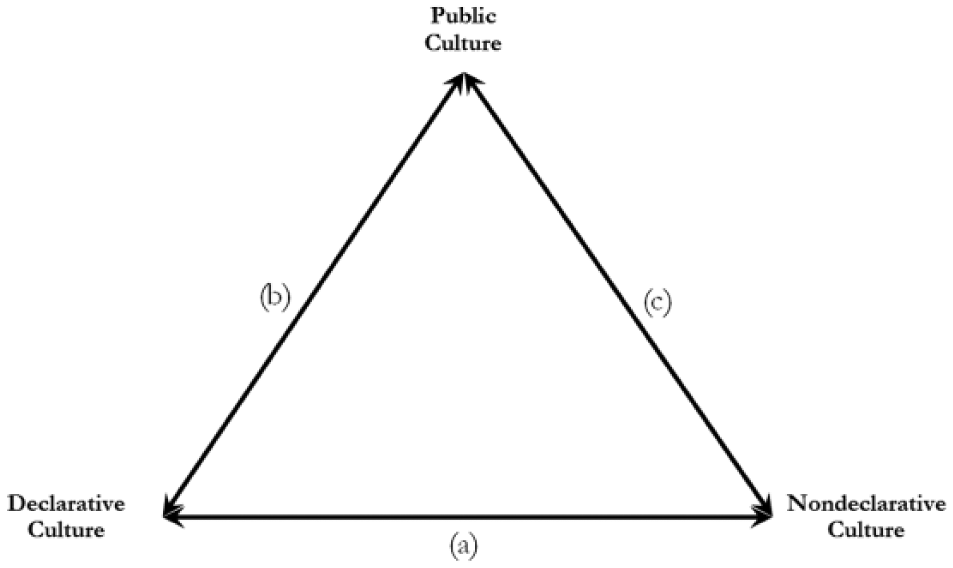
“Cultural Triangle” Depicting Three Sets of Relations among Cultural Elements
For instance, proposals such as Vaisey’s (2009) dual process model are primarily concerned with the (a) relation of declarative and nondeclarative cultural elements at the personal level. This type of account (strategically) deemphasizes the public/personal interface (Swidler 2008). The most explicitly elaborated aspect of Swidler’s (2001a) “toolkit” approach, on the other hand, is concerned with the (b) relation between the declarative commitments reported by her informants and public codes and institutions. Her analysis, however, only partially theorizes (although it strongly nods toward) the nondeclarative/public linkage, especially in pointing to the role of “cultured competences” and skills in relation to external cultural scaffolds (Lizardo and Strand 2010). Finally, most forms of practice theory, from Bourdieu (1990), to Sewell (2005), to Biernacki (1995), to the “cultured competences” aspects of Swidler’s toolkit model, concern themselves with the (c) relation between hard to articulate commitments (in the form of cultural practices) and public culture, whether this latter element is conceived as “fields” (in Bourdieu), “semiotic structures” (in Sewell), systems of accounting and production (in Biernacki), or “codes, contexts, and institutions” (in Swidler). As noted at the outset, however, these variants of practice theory falter when it comes to offering a coherent formulation of how declarative commitments link to action within fields independently of nondeclarative practices, and in specifying the within-person dynamics governing the relation between declarative and nondeclarative knowledge (on this last score, see Leschziner and Green 2013).
Further complexities (and misunderstandings) emerge because any one of the three sets of relations may be characterized as a form of weak or strong coupling, with different analysts emphasizing one side of this polarity or sometimes making an ambiguous nod toward both sides. Three sets of relations between cultural elements, each with a bipolar structure, results in six analytic possibilities. These are depicted in Table 1. The table cross-classifies each of the three forms of culture against one another, ignoring the reflexive (diagonal) cells. Shaded cells (upper triangle) depict approaches that are concerned with theorizing strong coupling; unshaded cells (lower triangle) list approaches primarily concerned with theorizing weak coupling. 6 The table makes clear that extant theoretical perspectives in cultural analysis are concerned with either the interface between personal culture (in either its declarative or nondeclarative forms) and public culture, or the within-person relation between different forms of culture. In addition, theorists may be concerned with theorizing either decoupling or coupling phenomena across these different forms of culture.
Relation between Public, Declarative, and Nondeclarative Forms of Culture in Classical and Contemporary Cultural Theory
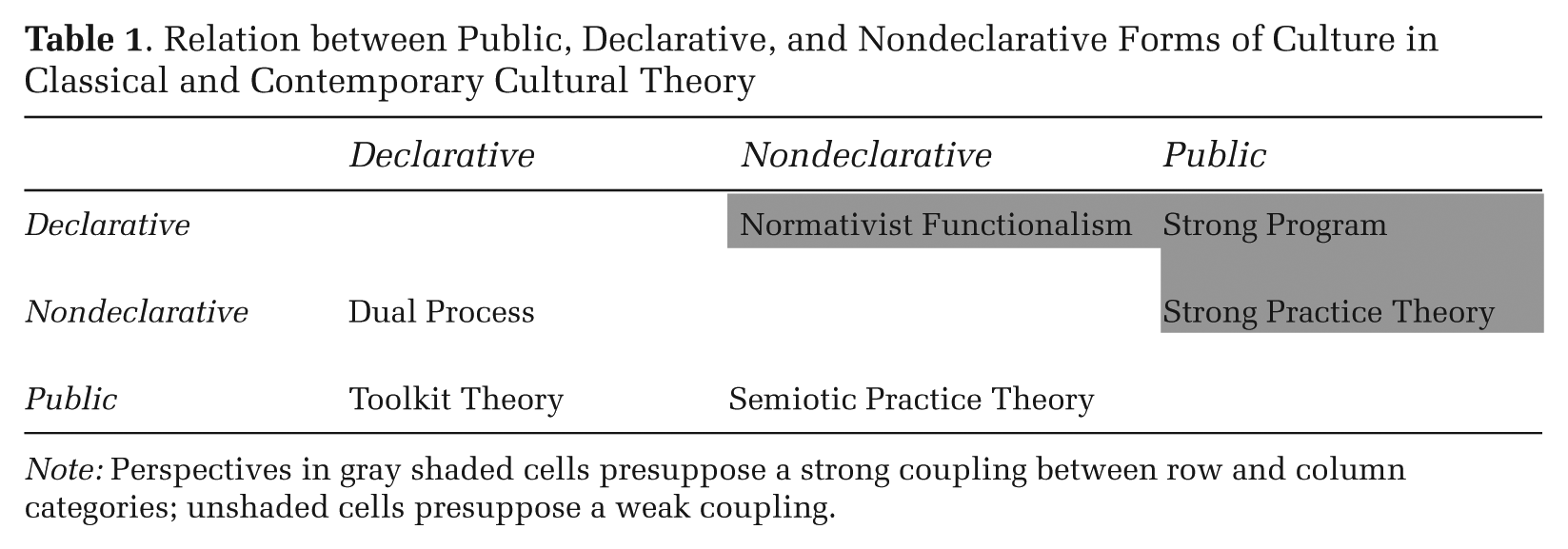
Note: Perspectives in gray shaded cells presuppose a strong coupling between row and column categories; unshaded cells presuppose a weak coupling.
Accordingly, Vaisey’s (2009) dual process model is best thought of as emphasizing the weak coupling between the two different forms of personal culture. One part of Swidler’s (2001a, 2001b) most recent articulation of the toolkit perspective deals with the weak coupling between declarative commitments at the personal level and institutions at the public level. 7 Practice theory shows up in two guises, depending on whether the analyst emphasizes weak or strong coupling between nondeclarative and public culture (Patterson 2014). 8 Some forms of “semiotic practice theory,” evident in the work of analysts such as Biernacki (1995), emphasize the weak coupling between unarticulated techniques embedded in material practices and explicitly institutionalized systems of commensuration. 9 To the extent that Swidler’s appeal to “cultured capacities” and “strategies of action” can be read as a nod toward nondeclarative culture, the toolkit approach can also be considered a theory concerned with the weak coupling relation between nondeclarative culture and public cultural codes; as a form of semiotic practice theory, this weak coupling approach has been endorsed by Sewell (2005).
In Bourdieu (1990) and related work, rendered under the label “strong practice theory,” the emphasis is on the strong coupling (e.g., ontological complicity) between nondeclarative skills and cognitive structures at the personal level and the public contours of fields and institutions at the public level (Lizardo and Strand 2010). The “strong program” of cultural analysis (e.g., Alexander 2003) emphasizes the (obviously) strong coupling between declarative discursive commitments at the personal level and public cultural codes. This strategy is also followed by most forms of “culturalist” analysis in cognitive sociology (Brekhus 2007). Eliasoph and Lichterman (2003) respond to various empirical inadequacies in such strong programs by proposing their own weak coupling account between public culture and declarative discourse (a form of semiotic practice theory). In their formulation, the semantics of public codes may fail to match the declarative implications drawn by persons in context, because this link is mediated via the (interactive) deployment of a form of nondeclarative culture that they refer to as “group style.” Sewell’s (2005) version of semiotic practice theory, like Swidler’s, can be considered a more ambiguous argument, as he offers a contingency theory in which, depending on circumstances, we may observe either strong or weak coupling between nondeclarative cultural practices and public semiotic structures. 10 Finally, the normativist-functionalist theory of action (Parsons 1951), against which the original version of the toolkit argument was initially forged (Swidler 1986), is characterized by the much maligned proposal of a strong coupling (almost fusion) between declarative commitments (e.g., values) and nondeclarative culture (e.g., need dispositions) at the personal level (Swidler 2001b). 11
The fact that we can locate most schools or proposals in contemporary cultural analysis today within a space defined by such a deceptively simple set of distinctions speaks to the face validity of the proposed classification. In essence, the proposed set of distinctions makes analytically clear what previous analysts have rendered in obtuse, incomplete, and confusing ways. Of course, with parsimony comes some level of analytic aggregation. Note that this organizing portrayal of current strands of cultural analysis as revolving around three sets of relations is premised on the simplifying assumption of a single unitary analytic category referred to as “public culture.” While this is sufficient for our analytic purposes, it is important to point out that it is insufficient for any compelling attempt to apply the scheme to concrete empirical cases, since most analysts (implicitly or explicitly) distinguish between different facets of public culture (e.g., Eliasoph and Lichterman 2003; Swidler 2001a). However, it is also important to keep in mind that any conceptual disaggregation of public culture into more than one facet (as suggested by Sewell [2005] or Patterson [2014]) would increase the analytic burden to a consideration of a larger set of relations between cultural elements and runs the risk of introducing unjustifiable levels of analytic complexity.
For instance, if an analyst were to distinguish between facets of public culture that themselves happen to be objectifications of personal culture in its declarative mode (e.g., textual materials, codified rules) and those that come closer to objectifications of nondeclarative skills and competences (e.g., material culture, artifacts, implicit rules), then the analyst would be forced to consider six relations among cultural elements. Some relations cut across the public/personal divide while remaining in the same mode (e.g., the relation between declarative culture at the personal level and the implicit component of public culture and institutions), some require a consideration of cross-mode relations among elements at the same level (e.g., implicit and explicit facets of public culture; as in Geertz 1973), and another set requires a consideration of relations between elements that cut across both location and mode boundaries (e.g., the relation between nondeclarative competences at the personal level and the explicit facet of institutions).
The Relationship between Declarative and Nondeclarative Culture
Having clarified how extant approaches in cultural analysis fit into the set of analytic distinctions that I propose, in this section, I provide a reconstruction of the theoretically crucial (a) relation depicted in Figure 2. Most cultural analysts have devoted sustained attention to the relationship between personal culture (in either its declarative or nondeclarative forms) and how it relates to public culture (the (b) and (c) relations). However, contemporary cultural theory continues to suffer from a lack of clear theorizing of the within-person relationship between declarative and nondeclarative culture (Strauss and Quinn 1997), with Vaisey’s (2009) dual process proposal having done a lot to bring attention to this issue. The key problem here is that Vaisey’s memorable formulation of this linkage, built around the “warring systems” perspective proposed in Haidt’s (2012:46) Platonic imagery of the struggle between the nondeclarative “elephant” and the declarative “rider,” may have led to more confusion than enlightenment. The key analytic issue here is the unwarranted presumption that the process via which nondeclarative culture is put to use is characterized by involuntary “hot” or “emotive” cognition, whereas the process of declarative cultural use is characterized by “cold” cognition under voluntary control.
In what follows, I develop a model of the relationship between declarative and nondeclarative culture that goes beyond the limitations of the warring systems formulation and separates issues of cultural acquisition from issues of cultural process and cultural use. My basic proposal is that rather than being the result of a tug of war between cognitive and emotive systems, weak coupling (dissociation) between declarative and nondeclarative commitments at the personal level emerges as a natural outcome of the dual enculturation pathways detailed earlier. To make this insight productive, I introduce a novel theoretical vocabulary useful for understanding these processes. In this way, my argument can be read as a reformulated case for the weak within-person coupling of declarative and nondeclarative culture, in which both facets of personal culture are conceived as equally worthy of the labels “cultural” and “cognitive” without implying any strong hiatus between these two statuses. The wager is that after having secured an understanding of the origins and consequences of weak coupling between the declarative and nondeclarative dimensions of personal culture (relation (a) in Figure 2), we will be in a better position to theorize how both relate to public systems of cultural symbols, codes, and institutions (relations (b) and (c)).
Correspondence, Redundancy, and Dissociation
The correspondence principle
A misleading premise in contemporary cultural theory has been to presume there is a single way in which persons encode knowledge in long-term memory: namely, in quasi-linguistic format. 12 This linguistic fallacy is misleading to the extent that it prompts analysts to elide the nondeclarative/declarative distinction and fail to consider their interrelation. It is also methodologically harmful to the extent that it fosters the practice of analyzing textual responses, or even creative readings of nonverbal cues provided by co-presence (e.g., Pugh 2013), as giving unproblematic access to nondeclarative culture-in-use (Jerolmack and Khan 2014).
I propose that we substitute the single-encoding premise with the principle of correspondence between the mode of exposure and the mode of encoding, such that culture becomes personal in a format that matches how it is encountered in the world without having to be transduced into a common code (Ignatow 2007). This implies that cultural knowledge encountered in explicit forms and internalized via fast-binding pathways after a small number of exposures will be encoded as declarative culture, whereas cultural knowledge encountered in experiential, multimodal forms internalized as embodied skills and implicit associations via slow-learning pathways will be encoded as nondeclarative culture.
Redundant encoding and dissociation
The fact that encultured persons tend to have access to cultural knowledge about the same domain in declarative and nondeclarative formats follows from the correspondence principle. Rather than restricting themselves to mapping cultural knowledge about a given domain in single-purpose formats, persons appear to follow the principle of redundant encoding (Karmiloff-Smith 1995). This follows naturally from the existence of multiple pathways to enculturation at the personal level, resulting in distinct, or dissociable, modes of familiarity with any given domain. Dissociability implies a weak coupling between the different forms of personal culture.
The notions of redundant encoding and dissociation are not obscure or mysterious. In fact, most cultural analysts are at least implicitly familiar with the phenomenon of redundant encoding and dissociation in the case of skill acquisition (Wacquant 2004). The basic observation is that novices rely on explicit rules and strategies when they are beginning to acquire a skill (a declarative form of cultural knowledge), but they are able to dispense with this form of representation once the skill has become embodied and can be deployed automatically (Dreyfus 2004). Of primary importance is the observation that rule-based declarative knowledge about the skill does not disappear when the nondeclarative competence is perfected. Instead, both exist as redundant personal representations of cultural knowledge in that domain, but only one of them (the nondeclarative encoding) is central for the production of skilled action. Of course, once a person becomes an expert, she may draw on the declarative representation of the skill for purposes of teaching or serving as a role model for a novice (Holland 1992). The two forms are potentially dissociable, in the sense that the declarative representation can be lost, replaced, modified, or elaborated, without necessarily interfering with the non-representational competence.
The redundant nature of personal culture carries important implications for how we conceptualize the connection between culture and action. As outlined earlier, different experiential histories at the personal level result in distinct modes of encoding of cultural knowledge. The mode of encoding determines the type of settings in which personal knowledge will be activated. The context of activation modulates the way that knowledge is accessed, which in turn constrains how this cultural knowledge may be used. In this way, the mode of exposure has an indirect effect (via encoding) on the way that cultural knowledge is actually implicated in the structuring of everyday action.
For instance, persons may have a very narrow exposure to a domain of experience because this exposure is primarily textual or linguistic, relying on fast-binding memory mechanisms requiring only a small number of exposures. This personal culture will thus be encoded in explicit form mediated by public symbols. This (largely semantic) knowledge then becomes available to persons in a form that matches the one in which it was originally presented (as declarative discourse) but not in other forms (as skillful practice). Persons usually evince semantic knowledge of a given domain by the production of offline declarations related to that domain, which can be characterized as its form of expertise (Collins and Evans 2008). Most importantly, this is also how declarative culture becomes available for analysts when they elicit it in a default setting that mirrors its conditions of acquisition and use (Eliasoph and Lichterman 2003:743). The capacity to produce these declarations does not imply that persons also have the nondeclarative knowledge useful for the production of online performances necessary to navigate that same domain.
This implies that, depending on the existence of overlapping histories of familiarity with a domain, knowledge may be encoded in formats that allow for the retrieval and use of declarative knowledge, or in ways that are keyed to the elicitation of nondeclarative culture and thus resist this sort of redescription into discursive form. More commonly, personal culture will be encoded in overlapping formats. This is especially likely in institutional domains within which individuals have had sufficiently rich experiential history. These distinct modalities of personal culture may be layered by order of acquisition if the person is exposed to distinct ways of encoding knowledge about a given domain over time. That is, the existence of a given form of encoding does not determine whether some other form will also be present or absent. Only the specific history of enculturation in a given domain determines the form of encoding of personal culture. Persons may not only know more than they can tell (Polanyi 1966); they may also be able to tell more than they know how (Jerolmack and Khan 2014; Swidler 2001a).
Implications
To summarize, a key substantive implication of the theoretical proposal I outlined is that the two main forms in which personal culture presents itself to the analyst at the personal level—culture as declarative know-that and culture as nondeclarative know-how—are partially (and in many cases completely) dissociable. Persons can display declarative abilities to produce knowledge about (public) culture that they do not know how to use (Collins and Evans 2008; Swidler 2001a), or they may possess implicit cultural skills with no publicly accessible declarative counterpart (Bourdieu 1990; Polanyi 1966).
This does not imply that there is an unbridgeable phenomenological or practical hiatus between the two modalities of personal culture. Instead, as cognitive scientist Annette Karmiloff-Smith (1995) notes, nondeclarative culture could be “representationally redescribed” into declarative formats, and social scientists can use methods that facilitate this redescription (McDonnell 2014). However, this labor of redescription not only requires motivation, inclination, effort, and opportunity (all facilitated by external conditions), it also entails a partial removal of the features of nondeclarative culture that render it close to action. In this sense, redescription should not be mistaken for the one-to-one translation of nondeclarative culture into declarative forms, nor for a pristine mirroring or mapping of one form of culture via the other.
In this way, the mechanisms of redundancy and structured dissociation at the personal level open up two distinct (ideal-typical) ways in which declarative and nondeclarative culture may relate to the world of public culture. One possibility is that persons may behaviorally master, via the slow-learning pathway, a set of nondeclarative cultured capacities keyed to action that allows them to skillfully navigate, reproduce, and even modify, via the same acquired patterns, objectified cultural realms (relation (c) in Figure 1). However, when there is routine access and use of this nondeclarative cultural knowledge, individuals may not possess the skills, motivation, or habitual inclination to produce declarative (meta) knowledge about this mastery. Here we find a substantial store of nondeclarative culture without the accompanying declarative knowledge about it; cultural know-how is not available for redescription as explicit verbal statements and which does not relate to the world of public culture via the usual referential relations. This is culture that persons know how to use, but which lacks reflective phenomenological transparency (Heiskala 2011); that is, persons are unable to report that they know how to use this culture (a fact that might be obvious to an outside observer). This type of non-verbalizable culture may come to acquire objective phenomenological validity as simply “the way that things are.” Geertz (1975) and Swidler refer to this as “common sense,” and Bourdieu (1990) calls it “doxa”: nondeclarative knowledge so taken for granted that it never rises to conscious awareness, and when it does, it is in the form of (practically useless and generally self-contradictory) tautologies or pithy (seemingly self-evident) verbal formulae.
We can also envision a different (and analytically crucial) relationship between public and personal culture: the case in which persons are able to produce declarative “knowledge that” without a corresponding set of nondeclarative capacities allowing them to produce skillful performances in context (Collins and Evans 2008). Because of experiential and ontogenetic limits on the development of nondeclarative culture (e.g., the repeated exposure constraint), this state of affairs is in fact the norm when it comes to the majority of personal knowledge about public culture (relation (b) in Figure 1). Here, we encounter a situation in which culture that is external to persons, and which persons may be quite capable of reporting knowing about, is not really implicated in their everyday activities, exhibiting what an outside observer may note as a loose coupling in relation to action (Swidler 2001a). Persons may have developed the declarative capacity to produce talk about this culture and to orient themselves to the objective existence of this culture (e.g., they know that it exists, they orient their strategies of action around this knowledge, and they even might know that other persons can use this culture proficiently), but this knowledge is not stored or encoded for themselves as “how” knowledge.
The payoff of theorizing the mechanisms governing the relationship between different forms of culture at the personal level becomes evident once we consider the possibility that whether we find strong or weak coupling between these elements may depend on how both interface with public culture. For instance, Harding (2007) shows that the existence of a multiplicity of possibly conflicting behavioral codes at the level of public culture facilitates dissociation at the personal level between declarative commitments and nondeclarative cultural practices. This is an instance in which dissociation emerges as a byproduct of heterogeneity at the level of public culture. If semiotic practice theorists are right, and such heterogeneity, contestation, and multiplicity at the level of semiotic codes is the rule rather than the exception (Sewell 2005), then weak coupling at the personal level is overdetermined both by routine dynamics of cultural acquisition and by vicissitudes of linkage across the personal/public interface under high variability regimes.
Finally, it is a basic premise of contemporary cultural theory to deny that culture can be systematic at the personal level (Swidler 2001a). While this may be an eminently reasonable proposal (DiMaggio 1997), analysts seldom propose a principled account for why this is the modal case. The theory of correspondence between exposure and encoding does this in a principled way. Rather than being organized into corresponding within-person systems whereby the presence of one modality of personal culture implies the presence of another modality, personal culture is linked to experience and has no inherent systematic ordering, although the environment may be organized (e.g., via public institutionalization processes) to elicit such ordering (Martin 2010). Talk of institutional domains (e.g., art, politics, religion) as “cultural systems” (e.g., Geertz 1973) is misleading to the extent that the systematic nature of a cultural domain is seen as inherent in the nature of public symbols as such and separated from the relevant experiential contexts and from a concrete history of acquisition. Accordingly, a systematic experiential history may produce systematic traces at the personal level, but an unsystematic, haphazard one will not lead to such traces.
Shedding Light on Substantive Issues
Given the relatively abstract nature of the foregoing discussion, in what follows I provide a concrete exemplification of the analytic gains that can come from deploying the theoretical vocabulary developed here to make sense of some outstanding empirical and substantive problems in the fields of racial stratification and education, and culture and inequality studies. These are subfields that borrow cultural theory to shed light on their own empirical problems (Carter 2005; Lamont and Small 2008; Lareau 2011; Liu and Xie 2016; Skrentny 2008; Small, Harding, and Lamont 2010). We will see that various explanatory puzzles emerge here due to borrowing precisely the sort of cultural theory that deploys one-size-fits-all conceptions of cultural acquisition and use. These puzzles dissolve, and substantive insight is achieved, once we consistently apply the distinctions formulated and theorized in the preceding sections.
Ethnoracial Inequality in Educational Outcomes
The achievement-aspiration “paradox”
Attempts to incorporate culture into our understanding of ethnoracial inequality in educational outcomes in the United States have suffered analytically due to a penchant to use the term “culture” almost exclusively to refer to declarative discourses, relegating (with some notable exceptions) nondeclarative competences to the status of an extra-cultural factor. This is in spite of the fact that these carry the bulk of the explanatory weight at the end of the day (e.g., Ainsworth-Darnell and Downey 1998; Harris and Robinson 2007; Hsin and Xie 2014). This has led to the proliferation of explanatory “paradoxes” (Downey 2008; Farkas, Lleras, and Maczuga 2002; Kao and Thompson 2003), rising skepticism that culture “matters” for understanding large-scale group differences in educational outcomes (Harris 2006; Tyson, Darity, and Castellino 2005), and selective usages of “cultural” explanations for an arbitrary range of cases (Hsin and Xie 2014; Liu and Xie 2016; Zhou and Lee 2014). In spite of this, a consideration of the vicissitudes of cultural explanation in the educational stratification literature holds several important lessons that all cultural analysts would be wise to heed.
The basic empirical mystery has now acquired the status of a canonical finding in the educational stratification literature: in spite of having comparable aspirations and subjective assessments of their academic competence, substantial gaps exist in achievement and the likelihood of making educational transitions for black and Hispanic youths in comparison to white youths in the United States. Conversely, in spite of having relatively modest aspirations and self-assessments of competence, Asian American youth (on average) outperform white youth (Kao 2000; Kao and Tienda 1998).
The gap between declarative commitments and on-the-ground performance for minority youth is puzzling on two theoretical fronts. First, the classic line of research foundational for the “Wisconsin model” of educational attainment developed during the 1960s and 1970s found aspirations to be a consistent predictor of future behavioral outcomes. This linkage is now so tenuous that education researchers today doubt whether survey items tapping aspirations are capable of capturing the relevant behavioral factors in the contemporary context (Kao and Thompson 2003). Second, the line of anthropological work on “oppositional culture” elaborated by Ogbu and collaborators from the late 1970s to the late 1990s (Fordham and Ogbu 1986; Ogbu 1978, 1987; Ogbu and Simons 1998) seemed to propose a straightforward mechanism linking group-based differences in outcomes to group-based differences in (mostly declarative) cultural commitments.
“Oppositional culture” theory
According to the oppositional culture account, members of certain ethnoracial minorities (e.g., historically enslaved “involuntary migrants”), would come to develop a set of adaptive cultural patterns that alienate them from the achievement-oriented values of the dominant (in the case of the United States) white culture. The most important elements of this cultural pattern consist of skepticism and cynicism toward educational institutions, and adaptive expectations and aspirations for success that fall below those of the more advantaged majority group (Ogbu 2003). Black youth in the United States, according to this account, do not link achievement-oriented behaviors with success in school and beyond, as they see the game rigged against them regardless of the effort they put in. Alienated from dominant institutions, black youth develop a set of counter-normative attitudes that end up depressing their academic performance in relation to their white counterparts. To make matters worse, black youth who do take up the achievement-oriented values and aspirations of the white majority culture are predicted to be brought back in line via a peer-enforced social control mechanism linking these behaviors with lack of loyalty to the ethnoracial in-group. In other words, high-achieving minorities have the “burden of acting white.”
Although initially developed using intuitive interpretations of ethnographic data (Fordham and Ogbu 1986), oppositional culture theory makes explicit predictions regarding the link between declarative commitments, public culture, and action. In fact, almost all of the cultural mechanisms postulated in the oppositional culture account rely on declarative cultural elements, such as beliefs, attitudes, and explicitly formulated folk theories as to the functioning and linkage of dominant institutions (Harris 2006). In this account, “sayings,” in the form of explicit declarations of oppositional culture values and beliefs, inexorably lead to “doings,” in the form of counter-productive academic behaviors.
Researchers have tried to determine whether the culture-behavior-outcome links postulated in the oppositional culture account can be verified using large-scale, population-level data (Ainsworth-Darnell and Downey 1998; Carter 2005; Tyson et al. 2005). This work not only generally fails to verify the empirical linkage between declarative culture and on-the-ground outcomes laid out by oppositional culture theorists (e.g., Harris 2006), but it has instead uncovered a paradox: black youth seem to have equal or even higher commitments to pro-school goals, and they seem to make a stronger connection between success in school and status attainment in adulthood than do white students. In addition, no consistent evidence can be found that high-performing black students face a “burden of acting white” by being ostracized, teased, or dismissed by their same-race peers (Ainsworth-Darnell and Downey 1998; Downey 2008; Tyson et al. 2005).
“Asian values” theory
Another consequence of lack of theorizing the independent roles of declarative, nondeclarative, and public cultural elements (and their relations) is that in addition to paradox, we may also end up with a situation in which cultural explanations emphasizing the link between declarative commitments, action, and performance are deployed in blatantly selective ways. At the same time that cultural models emphasizing declarative elements are increasingly shunned for their failure to shed light on white/black (and sometimes white/Hispanic) differences in school performance, they are all the rage in studies dealing with the relatively higher performance of Asian American students in relation to white students (e.g., Liu and Xie 2016). 13
Accordingly, we find a growing cottage industry of studies purporting to explain the superior performance of Asian students by pointing to a whole slew of cultural factors. According to this line of work, Asians outperform whites because Asian students “prioritize self-reliance and achievement,” or are more likely to “believe in education,” or are more liable to feel “a greater obligation to their immigrant parents,” or are more likely to report belief “in the value of education for future socioeconomic mobility,” “have stricter work ethics,” and so on (Kao and Thompson 2003:433; see also Hsin and Xie 2014). An arbitrary grab bag of differences at the level of declarative culture (linked by purely semantic relations) is put back on the explanatory pedestal, even when the same type of culture-mediated mechanism is rejected when it comes to accounting for the underperformance of African American and Hispanic students. This is clearly not theoretically defensible, but it is the inevitable consequence of the incoherent way in which culture is conceptualized in this field.
However, as with oppositional culture theory, the “cultural explanations” trotted out to attempt to account for the Asian/white performance gap do not fare well when confronted with attempts at systematic empirical evaluation. For instance, one proposal is that Asian students outdo white students because of strong cultural beliefs that link effort and achievement, beliefs rooted in a cultural tradition of Confucianism that emphasizes people’s perfectibility via education and self-cultivation (Jiménez and Horowitz 2013). This explanation, however, runs against the recalcitrant fact that Asian students outperform white students whether they trace their ethnic ancestry to geographic regions plausibly construed as characterized by a Confucian heritage (East and Southeast Asians) or not (South Asians and Filipinos) (Hsin and Xie 2014).
A Reformulation
Beyond paradox
The empirical difficulties encountered by cultural explanations of ethnoracial inequalities in school performance, rather than resulting in head-scratching paradox, contain important lessons for cultural analysis. In the case of the achievement-aspiration paradox among minority youth, it is clear that if the analyst departs from a (biased) conception of personal culture as exclusively composed of declarative attitudes and aspirations, then said analyst would have a strong case for concluding that culture does not matter (Tyson et al. 2005). This further implies that something that is not culture—namely, structure (Hays 1994)—should carry the bulk of the explanatory weight. In fact, this is precisely the conclusion reached by some post-functionalist critical and conflict theorists in education research. This situation resembles, for similar analytic reasons, that faced by scholars who would like to bring a more theoretically robust understanding of cultural processes into the study of poverty (e.g., Lamont and Small 2008).
However, this conclusion emerges not from the superior empirical adequacy of structural models, but from the shortsighted understanding of culture deployed by the analyst. In the particular case of oppositional culture and Asian values theories, rather than being instances of well-conceptualized approaches that just had the hard-luck to run against the facts, their failure has to do with their analytic weakness as cultural theories. Essentially, if you live exclusively by the declarative sword then you die by the declarative sword. Insofar as action (and outcomes) is tied to cultured competences, and these competences are generally nondeclarative, then attempting to explain performance differences by linking them to differences in declarative commitments is like trying to get water from a rock. The very same lack of variance (oppositional, Confucian, or otherwise) in declarative commitments commensurate with the performance differences alluded to earlier will doom this sort of cultural explanation from the start.
Overcoming the strong coupling bias
The approach proposed here can help discipline researchers against the bias of expecting strong coupling between personal and public culture or between either of these and different facets of public culture, when the likely empirical pattern is a more complex tapestry of weak and strong coupling across different cultural elements (to be established in each case). For instance, rather than strong coupling between declarative and nondeclarative culture, and between both of these and public cultural codes, researchers attempting to test Ogbu’s explanation for achievement gaps among minority youth found a pattern of structured dissociation between declarative commitments and nondeclarative competences—and between the first of these elements and achievement outcomes on the ground (Farkas et al. 2002).
In this way, what appears paradoxical in standard accounts can be made sense of by consistently distinguishing between cultural elements and specifying their interrelations. From this perspective, the achievement-aspiration paradox emerges as the natural result of institutionalization of achievement discourse at the level of public codes; this public/personal coupling (relation (b) in Figure 2) is manifest as a homogenizing discursive constraint (resulting in a pattern of no variance) and chronic accessibility and use of institutionalized vocabularies of motive constitutive of the American cultural code of achievement and success (Downey 2008; Harris 2006). Because nondeclarative competences relevant for school success have an independent causal etiology, the discursive homogenization process has the potential to generate, in some cases, a structured dissociation evident as a contrast between the chronic accessibility, and thus easy elicitation, of declarative commitments to success and hard work and the lack of availability of the forms of nondeclarative culture relevant for meeting the expectations of schooling institutions (relation (c) in Figure 2).
Better specification of linkages between cultural elements
Establishing the distinct causal etiologies of both declarative discourses and nondeclarative competences and their links to public culture can help researchers provide more convincing and empirically adequate accounts of how culture is implicated in important substantive outcomes. This will also allow analysts to theorize which absent linkages are actually surprising (or paradoxical), which ones we should expect as a matter of course, and which ones should be regularly absent. Furthermore, due to the fact that, within persons, different facets of personal culture can arise via independent enculturation pathways, linkages of different cultural elements (e.g., of declarative attitudes and nondeclarative dispositions) should not be taken as given; instead, they should always have the status of empirical hypotheses. In this respect, researchers should be wary of connecting global characterizations of personal culture (e.g., summary typologies of attitudinal, dispositional, or behavioral clusters, such as “oppositional,” “street,” and “decent”), with aspects of public culture and institutions. Instead, each linkage between a given element of personal culture and a corresponding facet of public culture should be justified independently.
For instance, the fact that we can observe seemingly oppositional behaviors decoupled from performance (e.g., high academic performers who rebel against the culture of schools) should not be surprising (Carter 2005): oppositional behaviors and academic performance are outcomes that pertain to two different ways in which personal culture may interface with the public culture of schools. Accordingly, it is quite possible (and in fact to be expected) for persons to grind against some aspects of an institution while matching others. For instance, when the institutionalized culture of schools is hostile to students’ lifestyle-based nondeclarative competences (e.g., those related to speech, dress, cultural tastes, and interactive styles), both white working-class (Lareau 2011) and minority youth of middle- and working-class provenance (Carter 2005) display oppositional and nonconformist behaviors and attitudes. Yet this oppositional pattern may be empirically independent of performance as long as the relevant nondeclarative academic skills are available to the same youth (Harris and Robinson 2007).
In the same way, and despite its intuitive appeal, the hypothesis that highly institutionalized commitments to achievement and success are strongly coupled (in an oppositional relationship) to personal declarations of ethnoracial solidarity among black and Hispanic youth is false (Carter 2005). Contra Ogbu, there is no analytic reason to expect this oppositional link, since these deal with two very distinct forms of the declarative/public relation. One is tied to chronically accessible declarations of ethnoracial pride typical of black and other racialized ethnic minorities in the United States; the other is tied to equally long-standing and universal (across ethnoracial groups) commitments to American ideals of success and achievement. Because these emerge as distinct forms of strong coupling (and thus declarative homogenization) at the interface of declarative commitments and institutionalized public codes (Swidler 2001a), there is no theoretically defensible reason to expect that they should be negatively correlated within persons. Nor is there good reason to expect that declarative commitments to ethnoracial solidarity should have any relation (positive or negative) to nondeclarative practices productive of achievement and success in school (Carter 2005).
Accordingly, the issue is not that disadvantaged youth possess adaptively rational but globally deviant forms of cultural knowledge as to what it takes to be successful, or that they do not share the same attainment goals and values as their more advantaged peers. Instead, the key issue has to do with the mode of encoding of the kind of cultural knowledge that is linked to outcomes. For advantaged youth, cultural knowledge required for school success is redundantly encoded in both declarative and (most crucially) nondeclarative formats. For disadvantaged youth, in contrast, the link between school completion and the attainment of future goals is mainly encoded in semantic memory as “know that” knowledge, easily acquired via a small number of exposures and just as easily elicited in the interview situation (see Carter 2005). Because acquisition of nondeclarative knowledge must go through the multiple exposure bottleneck, it is more demanding in terms of time and parental resources and thus more tightly linked to patterns of material advantage and disadvantage (Lareau 2011; Weininger, Lareau, and Conley 2015; Zhou and Lee 2014).
From these considerations, we can derive the often-noted implication that, when it comes to situations that require nondeclarative know-how, especially in the context of navigating the established routines of educational institutions, skill-based background differences between and within groups should emerge with a vengeance (Carter 2005; Lareau 2011). For disadvantaged minorities, this process is sufficient to generate the often-noted within-person dissociation between declarative “belief” in education and practical “achievement” (Carter 2005:24). In other cases, some forms of declarative opposition to dominant values may emerge due to a structured mismatch between existing nondeclarative competences and the public demands of the institution. This implies that nondeclarative culture may, in some important cases, have an indirect effect on declarative (non)commitments when it repeatedly fails to fit existing public codes, with declarative non-commitment emerging as a result of this failure to fit (Harris and Robinson 2007; Stephens, Markus, and Phillips 2014). 14
Overcoming the declarative culture bias
The approach proposed here can also help discipline researchers against the pervasive bias of reserving the (generic) term “culture” (at either the individual or group level) only for declarative commitments, while ignoring that nondeclarative competences, skills, habits, and nonverbal styles are also deserving of the label, and in some settings may be the more relevant cultural mechanism to explain a given outcome. In race and education research, the causal relevance of nondeclarative culture applies to cases of under- and over-performance in relation to the (empirically arbitrary) white norm (Ainsworth-Darnell and Downey 1998; Harris and Robinson 2007; Hsin and Xie 2014).
For instance, Hsin and Xie (2014) find that a series of nondeclarative cultured competences—glossed under the antiseptic terms “noncognitive skills,” “self-control,” and “motivation”—are the primary mechanisms accounting for the academic advantage over white students for all student groups subsumed under the Asian label regardless of ethno-geographic origin (e.g., East Asian, South Asian, Filipino). In the same way, oppositional culture researchers find that rather than devaluation and self-destructive opposition on the part of minority youth in relation to white youth, what exists is a nondeclarative enculturation gap, especially when it comes to development of the “cultural skills, habits, and styles that are rewarded by teachers” (Downey 2008:299). Statistically adjusting for differences in previously accumulated (middle school) academic skills accounts for the bulk of the differences in schooling performance between black and white high-schoolers, even after adjusting for what have been referred to as oppositional behaviors (Harris and Robinson 2007). These factors, however, are usually not classified as cultural in the current literature, which reserves this label for the usual triad of aspirations, attitudes, and beliefs allegedly characteristic of cultural groups (Liu and Xie 2016). 15
Beyond groupism
Finally, the approach outlined here has the advantage of allowing the analyst to move beyond the “groupism” sometimes afflicting cultural analysis in culture and stratification research (Brubaker 2002; Zhou and Lee 2014). This tendency is sometimes magnified by the declarative bias and its attendant focus on the discursive commitments allegedly distinctive of minority groups composed of taxonomic (usually ethnoracial) categories (Liu and Xie 2016; Ogbu 2003). When we hone in on the right set of cultural elements, we are better able to theorize within- and between-group differences in orientations and performance (Lareau 2011; Hsin and Xie 2014).
The example of the rocky careers of oppositional culture and Asian values theories should not only make analysts wary of focusing on the wrong kind of cultural elements, but it should also sensitize us to always try to provide explanatory stories featuring similar kinds of cultural processes to explain within and between “group gap” outcomes regardless of the direction (i.e., positive or negative) of such outcomes. Maintaining a consistent distinction between declarative and nondeclarative culture, on the other hand, allows us to theorize both disadvantage and advantage (Carter 2005; Hsin and Xie 2014) by pointing to a unified set of cultural processes and mechanisms.
Autonomy, Obedience, and Class Cultures
Traditionally, cultural analysts interested in the origins of class cultures followed Weber in thinking that the primary empirical goal was one of documenting the existence of distinct, class-differentiated “images of the world.” These images were thought to be accessible via the declarative reports provided by informants in response to survey items or interview questions. Secondarily, analysts aimed to provide process-based explanations of the genesis of these class-based orientations in the routine work and domestic experiences of persons in class-differentiated societies. Finally, scholars presumed that these orientations were passed down intergenerationally from parents to children, thus contributing to a status reproduction process (Kohn 1977). More recently, incorporation of theories of practice into our understanding of the genesis of class cultures has enriched this picture by partially sensitizing analysts to the role of nondeclarative pathways of enculturation in the creation of structured linkages between class and life chances (Lareau 2011).
However, as with the literature on race-based educational inequalities considered earlier, conceptual confusion haunts the more recent incorporation of habit and practice theories into the study of the role of cultural processes in class-based inequality. This ambiguity leads to the emergence of empirical patterns that analysts are forced to conceptualize as paradoxical, absent a more precise formulation. The problem comes down once again to the deployment of an impoverished theoretical understanding incapable of distinguishing different modes of internalization of personal culture, as well as the relative absence of an explicit theory of enculturation capable of dealing coherently with multiple pathways of cultural acquisition and related dissociation phenomena.
When it comes to theorizing the genesis and dynamics of class cultures, an emphasis on structured dissociation and dual enculturation pathways sensitizes the analyst against the default expectation that there should be strong couplings between sayings and doings (of either parents or children) within classes. Instead, this approach naturally predicts that structured disjunctures should exist between the public semantics of the declarative culture(s) espoused and transmitted in explicit form in class-differentiated settings (e.g., self-direction versus conformity; cosmopolitanism and meritocracy) and the pragmatic goals of the nondeclarative practices (e.g., skillful adaptation to institutionalized adult authority; performance of ease and naturalness in status attainment) transmitted by both parents and peers via nondeclarative pathways. This is especially the case when it comes to the forms of cultural competence that prepare newcomers to navigate dominant institutions.
Weininger and Lareau (2009) set out to test Kohn’s (1977) proposal that middle-class parents emphasize a (declarative) orientation toward autonomy, self-direction, and freedom from control in relation to established authorities and conventions, whereas working-class parents emphasize an orientation toward conformity, obedience, and adaptation to extant rule structures. Not surprisingly, their research, triangulating between interview-based data useful for tapping into explicit declarations and observational data attuned to nondeclarative practices, uncovers a paradox: the Kohn prediction seems to obtain only when it comes to adult self-reports of parenting style and socialization goals or in terms of the declarative utterances verbalized explicitly by parents in their interactions with children. In these cases, middle-class parents did seem to emphasize a language of autonomy and independence (e.g., negotiation with children over rules, emphasizing choice behavior) and working-class parents did seem to emphasize a discourse of obedience (e.g., issuing directives without qualification, justifying decisions by reference to positional authority), especially when it came to intergenerational interactions within households.
However, when it came to enculturation processes linking children to institutional realms outside the household, middle-class parents spent countless hours attempting to shape the behavioral dispositions of their children in a direction of conformity and adaptation to institutional environments populated by adults in authority, and they maximized the amount of leisure time spent in structured (rule-governed) activities under tight adult supervision and control (Weininger and Lareau 2009). This type of enculturation occurred via both explicitly symbolized interaction (e.g., the issuing of verbal directives) and, most significantly, via the enmeshing of children in organizational structures endowed with nondeclarative routines centered on the inculcation of habits attuned to the spatial and temporal rules of the institution, sometimes involving the direct manipulation of the body, a clear index of nondeclarative enculturation (Cohen and Leung 2009). When it came to children’s leisure, working-class parents, on the other hand, followed a practical rule of autonomy, in which children spent the majority of their time in unstructured self- or peer-directed activities with very little in the way of intergenerational interaction. Children from working-class families had little to no exposure to practical enculturation dedicated to managing or navigating institutional environments controlled by adults in authority positions outside the household.
In many ways, working-class children experience more practical and bodily autonomy from adult demands than do their more discursively self-directed middle-class counterparts. For Weininger and Lareau (2009: 693), this finding implies that class-based patterns of enculturation involve “paradoxical pathways” not considered in the Kohn tradition. In our terms, however, this state of affairs is not paradoxical, because it is quite possible to enculture individuals in seemingly contradictory ways as long as this is done via distinct enculturation channels (e.g., primarily declarative versus nondeclarative). This type of paradox (or structured dissociation in our terms) is relevant for stratification outcomes, because it helps account for the subsequent advantage that middle-class children have in navigating and succeeding in middle-class institutions, in which they are expected to negotiate their way through an environment populated by authority figures in charge of dispensing material and symbolic rewards (Lareau 2011).
Omnivorousness, Ease, and the Culture of Privilege
A paradox besetting the sociological study of elite cultures is the rise of what Ollivier (2008) once provocatively referred to as “conspicuous openness to diversity” and what most analysts, following Peterson and Kern (1996), refer to as “omnivorousness.” This is the tendency, on the part of contemporary cultural elites, to claim a multicultural openness to a wide variety of forms of aesthetic experience and engagement with a seemingly broad cross-section of types of cultural goods. Across now countless studies using survey and interview methods to capture the stated preferences and associated vocabularies of motive of elites, researchers find that high-status culture today seems to be characterized by broad-ranging preferences and stated refusals to express dislikes or rejections of specific genres, forms, or objects across a wide range of aesthetic domains (Lizardo and Skiles 2012). The general phenomenon of omnivorousness is thus now a seemingly intractable issue for any theoretical account that conceives of elites’ nondeclarative culture as having to follow in lockstep with their stated declarative discourses, preferences, and motivations.
In contrast to this story, cultural analysts have observed that in spite of the discursive homogenization around the institutional language of multiculturalism, tolerance, respect for diversity, and non-comparability across forms of participation, elites continue to engage aesthetic objects in ways that seem both class-coded and linked to class-specific experiences (Khan 2011). When suitably prodded, the same elites betray an implicit preference for complexity, formal innovation, and a purposive authorial intention in cultural works, even when engaging objects and experiences where these are not to be expected (Holt 1998). In this case, while the declarative culture of contemporary elites is definitely attuned to highly institutionalized discourses regarding the value of inclusion, cross-cultural understanding, and the inherent value of all forms of cultural expression, they continue to engage ever-expanding sets of cultural objects in inherently class-marked ways.
These forms of class-differentiated cultural engagement are able to survive in spite of elites lacking a coherent declarative discourse marking them, or even themselves as a group, as particularly distinct (Khan 2011). Contemporary elites thus express, in the aesthetic domain, the same sort of structured dissociation between declarative and nondeclarative culture that Vaisey (2009) sees as characterizing the moral domain of contemporary youth. In spite of this hiatus between discourse and competence, there has clearly been a conservation of nondeclarative habits of cultural engagement, such that the ways in which elites engage cultural goods is an extension of aestheticist practices first developed in the traditional fine arts (Lizardo and Skiles 2012).
This implies that class-linked forms of aesthetic appreciation and judgment continue to be reliably fostered and transmitted in elite households, and concomitantly predicted by the usual markers of privilege and advantage, without explicit exclusionary reference to other forms of engagement or without the concomitant transmission of an elaborate declarative ideology privileging these forms of engagement as superior. As with the case of the dual transmission of paradoxical class cultures (Weininger and Lareau 2009), in which the semantics of explicit declarations do not necessarily match the pragmatic goals of nondeclarative culture, this is a plausible equilibrium. This also implies that the all too common analytic equation of elite declarative discourses as standing for the culture of elites would result in the unwarranted conclusion that class cultures do not make a difference for lifestyle practices (Atkinson 2011). The solution to this impasse is that elite culture (like other forms of culture imputed to taxonomic groups) is an amalgam of both declarative discourses and nondeclarative practices, which are more likely to display strong dissociations between semantics and pragmatics than to exhibit strong coherence and unity.
This last claim is supported in studies of the contemporary “culture of privilege” among elites in the United States (Khan 2011; Khan and Jerolmack 2013). This work has the advantage of getting a closer look at cultural transmission and encoding processes and thus at the experiential origins of weak couplings between declarative and nondeclarative cultural elements. This research reveals systematic links between the mode of encoding of cultural knowledge and subsequent dynamics of cultural use, as well as weak couplings between the different cultural elements so internalized. Not surprisingly, these take the form of structured dissociations between declarative “sayings” and nondeclarative “doings” and are produced by the discursive homogenization of declarative commitment mechanisms at the personal/public interface, which we observed in the case of oppositional culture theory.
The most salient manifestation of this phenomenon, and the one Khan (2011) sees as constitutive of modern forms of privilege, is that instanced in the declarative endorsement of highly institutionalized public codes promoting openness, cosmopolitanism, and meritocracy, along with pervasive rhetorics connecting “earned rewards” with “hard work.” This declarative/public coupling is accompanied by an unstated, socializing “group style” that marginalizes people who actually attempt to practice what they preach, and which decouples this declarative discourse from practice (Khan and Jerolmack 2013). In this case, the nondeclarative oppositional culture (in relation to institutionalized codes) of ease and naturalness enforced by elite peers happens to be the actual culture of privilege that garners social rewards in this context. At the level of public culture, the meritocratic code produces homogenization of declarative commitments and a simultaneous decoupling between declarations and practices that actually privilege those most adept at demonstrating effortless ease rather than nose-to-grindstone effort (Khan and Jerolmack 2013).
Because ease is a kind of bodily proficiency (Cohen and Leung 2009), it must be acquired, following the correspondence principle, via a mode of exposure bound to produce the right sort of encoding (know-how) rather than as declarative culture. This produces structured heterogeneity among privileged youth keyed to an implicit ranking as to who can display the nondeclaratively privileged forms of ease with the most proficiency. People who do this, however, are precisely those who become cultural omnivores capable of engaging all forms of experience, but especially potentially aesthetic experience, with aplomb, assurance, and a sense that the world is unproblematically open to them (Khan 2011).
Discussion and Concluding Remarks
Roughly eight years ago, in the pages of this journal, Gross (2009:374) noted that: The growth of cultural sociology in recent years owes little to a pragmatist theory of action or mechanisms, but the theory I propose implies a substantially broadened disciplinary role for cultural sociology, in part because it suggests that, where meanings vary among actors, cultural interpretation may generate more explanatory specifications of mechanisms.
This article began by noting, like Gross, the growing discipline-wide relevance of cultural analysis; however, I argued that without the requisite analytic specification of its central concept, cultural analysis will not be able to live up to its discipline-unifying potential, nor will it be capable of doing the work of specifying the generative mechanisms responsible for the phenomena of interest to social scientists at large. This analytic specification must be tied to a flexible, empirically grounded account of the way persons acquire culture in the first place. Such a theory of enculturation would provide a way to make the necessary distinctions while allowing the analyst to make sense of the relevant empirical phenomena.
As we have seen, without sound theoretical footing, this can very quickly become a daunting task. As a rule, analysts face a rather complex landscape of empirical facts that can be made sense of only by linking them to a coherent analytic account of the nature and dynamics of the enculturation process. Absent such a framework, we have seen various examples of how failure to make the distinction between declarative and nondeclarative forms of cultural knowledge can lead to paradoxes, puzzles, and the misclassification of relevant cultural processes as non-cultural. These conundrums emerge not because of a dearth of empirical work or available data, but due to the failure to apply the most effective theoretical framework to the interpretation of these data.
The analytic elaboration that I proposed is meant as a necessary first step in achieving these goals. The approach I laid out, while not necessarily tied to any particular action theory, is clearly influenced by formulations belonging to the broad family of “habit/practice theories” (e.g., pragmatism or Bourdieu-inspired approaches). These forerunners stand out for having emphasized the importance of habitual, nondeclarative competences in cultural analysis. It should be obvious that models of action that minimize or ignore nondeclarative culture altogether, such as rational-action, desire-belief-opportunity models, or notions of agency that define the term in question-begging terms as always implying voluntary (e.g., conscious and effortful) action, are not consistent with the proposal outlined here. Such conceptions would perforce result in an artificially restricted conception of personal culture as composed exclusively of explicitly espoused beliefs, values, and other declarations used in intentional ways. However, a sole focus on habits and habituation will not do either, because, as we have seen, the theoretical action lies precisely at the intersection of declarative and nondeclarative culture and the link of both of these with institutionalized public culture (Leschziner and Green 2013; Lizardo and Strand 2010).
In this sense, the theory of enculturation I outlined is more compatible with pluralist conceptions of personal culture focused on the interplay among different cultural elements, at the intra- and extra-personal levels, and deployed in different modalities of action, whether in a controlled, intentional manner or in automatic, habitual ways (e.g., Eliasoph and Lichterman 2003; Gross 2009; Swidler 2001a, 2001b; Vaisey 2009). However, as we saw earlier, most pluralist accounts in contemporary cultural sociology fail to make the required analytic distinctions. This work stands to benefit from a more concerted effort to clarify the particular linkages between the elements that serve as their focus (as well as the links that they deem secondary). Fruitful dialogue between different theoretical paradigms can thus be furthered by adopting a theoretically consistent vocabulary of the sort I developed here.
At the level of meta-methodology, the model of enculturation I outlined is thoroughly consistent with Gross’s (2009) call to specify the dynamic role of “social mechanisms” at multiple temporal scales and levels of aggregation. As such, a key line of future work is to begin to theorize how dynamic enculturation, cultural activation, and cultural use processes link with dispositional, relational, and institutional/environmental mechanisms across settings to generate important phenomena of both theoretical and practical interest.
I focused on issues of culture and inequality as the core domains where the approach outlined could be used to further theorizing and aid in conceptual clarification, but it is important to underscore that the framework provided here is in no way logically tied to the role of cultural processes in the reproduction of power, privilege, and difference (although this happens to be an area of broad disciplinary interest). Instead, maintaining a consistent distinction between declarative and nondeclarative culture at the personal level, and distinguishing both from (possibly disaggregated aspects of) public culture, is important in all arenas in which cultural processes figure prominently, including contemporary studies of racial and ethnic classification, organizational analysis, studies of culture of markets, and social science history among others. In all these areas of inquiry, proper specification and understanding of the role of cultural processes require the analyst to note and weigh the role of those understandings, habits, and skills that can be discursively articulated from those that remain below the surface but are evident in action, as both interlink with public culture in complex but decipherable ways.
Footnotes
Acknowledgements
Early versions of this paper were presented at the spring of 2013 University of Notre Dame’s Culture Workshop and at the fall of 2013 Yale University’s Workshop in Cultural Sociology. I would like to thank Terry McDonnell, Kari Christoffersen, Brandon Vaidyanathan, Daniel Escher, Phillip Smith, Ilana Silber, Emily Erickson, Andrew Cohen, Alison Gerber, Joe Klett, Tim Malacarne, Xiaohong Xu, Fred Wherry, and Jeff Alexander for their incisive questions, challenges, and suggestions. Special thanks go to Robert Fishman who read early versions of the manuscript and provided invaluable feedback. Finally, I’d like to acknowledge the graduate student participants in the spring of 2015 edition of my “Cognition, Culture, and Society” graduate seminar, especially Dustin Stoltz, Marshall Taylor, and Justin Van Ness, whose questions, reflections, and insight helped clarify the theoretical ideas presented here at a pivotal moment in the development of the manuscript. Finally, I would like to thank Larry Isaac and the anonymous ASR readers for pushing me, sometimes kicking and screaming, to expand and clarify the core theoretical contribution. This process made the paper an order of magnitude better than it otherwise would have been. All remaining errors and omissions, of the intended and unintended variety, remain my sole responsibility.
Editors’ Note
This article was conditionally accepted by the previous ASR editors (Larry W. Isaac and Holly J. McCammon) on September 16th, 2015, while they were still handling previously granted invitations to revise and resubmit as part of the editorial transition. To prevent any conflict of interest, Isaac served as the lead editor on subsequent revisions of the manuscript until its official acceptance on June 27th of 2016.