




Abstract
We examine immigrants’ earnings trajectories and measure the extent and speed with which they are able to reduce the earnings gap with natives, using a dataset that links respondents of the Survey of Income and Program Participation (SIPP) to their longitudinal earnings obtained from individual tax records. Our analysis addresses key debates regarding ethnoracial and cohort differences in immigrants’ earnings trajectories. First, we find a racially differentiated pattern of earnings assimilation: black and Hispanic immigrants are less able to catch up with native whites’ earnings compared to white and Asian immigrants, but they are almost able to reach earnings parity with natives of their same race and ethnicity. Second, we find no evidence of a declining “quality” of immigrant cohorts even after controlling for their ethnoracial composition and human capital. Immigrants arriving since 1994 actually experience similar or slightly higher earnings growth compared to immigrants from earlier eras. We identify a pattern of accelerated assimilation in which more educated immigrants experience much of their earnings growth during the first years after arriving.
Keywords
The extent and speed with which immigrants are incorporated into a host society is a long-standing topic of sociological research. Early work on immigrant assimilation focused on the process of acculturation and the inclusion of immigrants into primary social groups (Park and Burgess [1921] 1969; Thomas, Park, and Miller [1921] 1971; Warner and Srole 1945). More recent research emphasizes immigrants’ socioeconomic attainment over time and across generations as key benchmarks of assimilation. Sociological studies have generally found that immigrants are making substantial progress in narrowing the socioeconomic gap with natives, as measured by outcomes such as educational attainment and occupational status (Alba and Nee 2003; Kao and Thompson 2003; Park and Myers 2010; Waters and Jiménez 2005; Waters and Pineau 2015). Research has also found evidence that many immigrant groups are assimilating spatially with natives, even as high levels of residential segregation persist (Iceland and Scopilliti 2008; Logan 2007; South, Crowder, and Chavez 2005; White and Glick 2009).
Comparatively less sociological work examines the earnings assimilation of immigrants. Research on immigrants’ earnings growth has been disproportionately carried out by economists, who tend to emphasize different explanatory factors, and in particular human capital differences, for earnings disparities between immigrant groups (e.g., Borjas 1985, 1995, 2015; Borjas and Katz 2007; LaLonde and Topel 1992; Lubotsky 2007). In this article, we investigate immigrants’ earnings assimilation and test various explanations for group differences. We argue that immigrants’ ability to achieve parity with natives is an important benchmark for assimilation because earnings are strongly associated with individuals’ own well-being and that of their children (Case, Lubotsky, and Paxson 2002; Chetty et al. 2016; Currie and Stabile 2003; Kim et al. 2013). The economic progress made by immigrant parents over their lifetime strongly conditions the opportunities available for the second generation (Brooks-Gunn and Duncan 1997; Case et al. 2002; Condliffe and Link 2008; Currie and Stabile 2003). Moreover, because socioeconomic context during early childhood is particularly important for outcomes later in life (Duncan and Magnuson 2011; Evans, Brooks-Gunn, and Klebanov 2011), the speed at which first-generation immigrant parents are able to catch up economically matters, not just their eventual earnings at the peak of their careers.
Our study addresses two key questions regarding immigrants’ earnings assimilation. The first question is how to explain racial and ethnic differences in immigrants’ earnings growth, which overlap closely, albeit imperfectly, with differences by country of origin. Prior research suggests that Hispanic immigrants, and especially those originating in Mexico and Central America, lag behind other immigrants in their earnings trajectories (Borjas 1995; Borjas and Katz 2007; Lubotsky 2007; Schoeni 1997). Standard economic accounts attribute such racial and ethnic disparities to differences in human capital endowments. If Hispanic immigrants are less able to catch up with natives’ earnings over the course of their lives, it is because they arrive with lower levels of education and other unmeasured skills, which disadvantage them in the U.S. labor market (Borjas and Katz 2007). Our analysis will test the extent to which human capital explains differences in the earnings assimilation of immigrant workers. However, racial and ethnic disparities in earnings growth may also be a result of different experiences upon arrival. Given how racially and ethnically differentiated socioeconomic outcomes are in the contemporary United States even for native-born workers, the earnings assimilation of immigrants may also be expected to vary by race and ethnicity. Hispanic immigrants, for example, will likely face similar disadvantages in the labor market as their native Hispanic counterparts, in addition to encountering challenges specific to their immigration experience. To assess the extent to which immigrants’ earnings growth is conditioned by their race and ethnicity, we test whether immigrants achieve earnings parity with natives in the same ethnoracial category.
The second, and related, research question is whether recent immigrant cohorts are declining in their ability to catch up with natives’ earnings. Previous research based on decennial censuses and repeated cross-sectional surveys tends to show that newer immigrants experience lower earnings growth (Borjas 2015). Once again, economic explanations center on differences in human capital endowments (Borjas 1985, 1995; Schoeni 1997). The alleged decline in the earnings assimilation of immigrants arriving since the 1980s is attributed to the lower “quality” of immigrants, by which researchers mean their lower levels of education and other marketable skills. Immigrants’ declining human capital is, in turn, tied to changes in their national origins: newer immigrants are more likely to originate from developing countries that have lower levels of education overall, and from where immigrants are thought to be negatively selected by education (Borjas 1987, 1991).
Yet the alleged lower earnings assimilation of newer immigrants from developing countries may also reflect their experiences in the U.S. labor market. Because recent immigrants are more likely to be members of disadvantaged racial and ethnic minorities, they may face greater challenges in the U.S. labor market than did immigrants in the past (Portes and Rumbaut 2001; Portes and Zhou 1993). Structural changes in the U.S. economy, and in particular shifts in technology and increasing international trade, may also have reduced opportunities for new immigrants’ upward mobility (Portes and Rumbaut 2014). Our study first examines whether newer immigrant cohorts have indeed declined in their ability to catch up with natives’ earnings. In contrast to previous studies that limit their analysis to immigrants arriving in the 1980s or earlier (Borjas 1985, 1995; Duleep and Dowhan 2002; Funkhouser and Trejo 1995; Hu 2000; Lubotsky 2007), our longitudinal earnings data allow us to measure the earnings assimilation of immigrants arriving as early as 1980 to as late as 2000, and we follow them through the critical period of the Great Recession. We then test whether any differences in earnings growth between newer and older immigrant cohorts can be accounted for by their respective ethnoracial composition and human capital endowments.
Researchers’ ability to evaluate the various claims regarding immigrants’ earnings assimilation has been hampered by a lack of suitable data. General surveys tracking individuals’ earnings growth over time generally do not include a sufficiently large sample of immigrants, whereas specialized surveys of immigrants often do not contain longitudinal information. Consequently, studies usually rely on a synthetic cohort approach, in which immigrants who entered the country at approximately the same time period are assumed to be comparable across decennial censuses or repeated cross-sectional surveys (e.g., Borjas 1985, 1995, 2015; Funkhouser and Trejo 1995; LaLonde and Topel 1992; Schoeni 1997). This synthetic cohort approach suffers from well-known estimation problems. Chief among them is that repeated cross sections necessarily exclude individuals who return to their countries of origin between census or survey years, and they undercount circular migrants. The exclusion of circular and return migrants in the synthetic cohort approach may lead to an overestimation of immigrants’ ability to narrow the earnings gap with natives over their lifetime (Lubotsky 2007).
Our analysis of immigrants’ earnings trajectories instead relies on a unique dataset that links respondents of a large nationally representative survey to their longitudinal earnings obtained from individual tax records (W-2 forms). Our access to these restricted data allows us to follow individual immigrants’ earnings for up to 20 years after arrival and compare their earnings trajectories to those of similarly qualified natives. This longitudinal approach offers better estimates of the economic assimilation of foreign-born individuals than do synthetic cohort models based on repeated cross sections. Our longitudinal data also allow us to test individual fixed-effects models that control for the time-invariant effect of unobserved individual characteristics, including any characteristics on which immigrants are selected from their countries of origin. We can therefore rule out, insofar as possible, whether any observed differences in earnings assimilation between immigrants belonging to different ethnoracial categories and arrival cohorts are due to differences in immigrant selectivity, that is, the higher propensity for individuals from certain countries of origin to migrate based on characteristics that make them more likely to succeed in the U.S. labor market.
Finally, because we follow the earnings of the same individual immigrants for up to 20 years after arrival, we are able to uncover the shape of immigrants’ earnings trajectories, assessing not only the extent of earnings assimilation but also its speed. Existing studies tend to emphasize foreign-born individuals’ ability to achieve economic parity with natives by the end of their working lives. However, as noted earlier, the speed with which immigrants achieve parity is important because it will shape the opportunities available for the second generation. Earlier earnings growth will also increase immigrants’ total lifetime earnings, which can have implications for a range of outcomes in later life. In this study, we identify the categories of immigrants who experience much of their earnings growth within the first years after arrival in a pattern we call accelerated assimilation.
Ethnic and Racial Differences in Immigrants’ Economic Assimilation
Immigrant assimilation has been a topic of sociological research since the early twentieth century. The origins of classic assimilation theory are usually traced back to the work of Robert Park and his collaborators from the Chicago school of sociology (Park and Burgess [1921] 1969; Thomas et al. [1921] 1971). These early researchers defined assimilation largely in cultural terms, as a process by which new members of society come to share the norms and values of the majority and feel part of their new nation. According to Park’s theory of the cycle of race relations, to which his views about assimilation are often tied, ethnic differences among immigrants and their descendants are bound to eventually disappear. Later writings in the classic assimilation tradition were more skeptical (or at least agnostic) about the inevitable decline in ethnic identification and solidarity among immigrants and their descendants (e.g., Warner and Srole 1945). Still, for much of the twentieth century, what came to be known as the straight-line assimilation model was dominant. This model posited that new immigrants would become more like natives over time and across generations, and that ethnic differences would eventually disappear (Gans 1973; Sandberg 1973).
The straight-line assimilation model was originally formulated to explain the pattern of cultural rather than economic convergence of immigrants with natives, but it has been interpreted more recently to also imply that immigrants will reach socioeconomic parity with natives (e.g., Greenman and Xie 2008; White and Glick 2009). Advocates of the straight-line assimilation model often use as supporting evidence the experience of European immigrants who arrived during the great wave of migration in the late-nineteenth and early-twentieth centuries (see Alba and Nee 2003). The perceived inability of more recent immigrants from non-European countries to catch up socioeconomically with natives has led many to question straight-line assimilation. Critics argue that the socioeconomic advancement of immigrants from new sending countries is restricted by their race and ethnicity and by changes in labor market conditions (Portes and Bach 1985; Portes and Rumbaut 2001).
In one of the most influential critiques of the straight-line assimilation model, Portes and Zhou (1993) argue that immigrants and their descendants may follow divergent paths over time rather than a single path toward middle-class status (see also Portes and Fernández-Kelly 2008; Portes and Rumbaut 2001; Zhou 1999). According to Portes and Zhou’s segmented assimilation theory, some immigrants may actually experience downward assimilation toward parity with disadvantaged native minorities. Multiple factors may determine which path successive generations of immigrants will take, but race and ethnicity play a crucial role. Minority immigrants are at risk of assimilating downward because they face more unfavorable conditions, including prejudice and discrimination in their interactions with the wider society. Immigrant children growing up in disadvantaged areas may also be exposed to an oppositional culture that is detrimental to their educational attainment. However, Portes and his collaborators argue that the strategic preservation of strong cultural and social ties with the immigrant community may serve as a protective force that can facilitate economic assimilation (Portes and Rumbaut 2001; Portes and Zhou 1993).
Segmented assimilation theory has proven difficult to operationalize and test empirically because the model predicting immigrants’ divergent paths is insufficiently specified (see White and Glick 2009:38; Xie and Greenman 2011:967). This has led researchers to interpret the theory in various ways. In one particularly useful interpretation, White and Glick (2009) suggest that segmented assimilation theory implies differing trajectories for immigrants’ socioeconomic outcomes that depend on their minority status and national origin. Minority immigrants arriving from developing countries often start off with less human capital and therefore lower earnings than do other immigrants. They also face discrimination and other obstacles in the labor market that result in slower earnings growth over time. A key component of White and Glick’s formulation is their distinction between the starting point and later trajectory of immigrants’ socioeconomic outcomes. They argue that past researchers have confounded the lower education and earnings levels with which minority immigrants begin their lives in the United States and the progress they make over time, leading to an underestimation of minority immigrants’ socioeconomic assimilation.
Adapting White and Glick’s (2009) framework, we interpret a convergence between minority immigrants’ and native whites’ earnings over their lifetime as evidence of straight-line assimilation, and convergence between minority immigrants and natives of the same race and ethnicity as evidence of segmented assimilation. As we compare immigrants’ assimilation patterns, we are careful to distinguish the starting point and subsequent earnings growth of immigrants in each ethnoracial category. Figure 1 illustrates the expected trajectories for minority and non-minority immigrants’ earnings growth according to segmented assimilation theory. The top panel shows a hypothesized scenario in which minority immigrants are unable to catch up economically with the reference category of native whites. The y-axis in the graph measures the ratio of immigrant-to-native earnings, and the dotted line indicates full parity. In this instance, minority immigrants begin with a lower starting point than do comparable non-minority immigrants, and they also experience lower growth in subsequent years. The bottom panel shows what the same scenario may look like when the reference category is natives of the same race and ethnicity as immigrants. When this new reference category is used to gauge minority immigrants’ progress, they appear to be assimilating over time. Although minority immigrants start with lower earnings than native minorities, they are eventually able to catch up.

Expected Earnings Trajectories for Minority and Non-minority Immigrants Relative to Native Whites (above) and Relative to Natives of the Same Race and Ethnicity (below), Consistent with Segmented Assimilation Theory
The convergence of minority immigrants’ earnings with those of minority natives would suggest a racially differentiated process of assimilation consistent with segmented assimilation theory, and with a body of sociological work showing that minority immigrants’ experiences are conditioned by their race and ethnicity (e.g., Portes and Bach 1985; Portes and Rumbaut 2001). Racial and ethnic differences may be the result of outright discrimination. For example, in their influential study of Mexican immigrants’ assimilation over the span of four generations, Telles and Ortiz (2008) find evidence of a process of racialization by which Mexican immigrants and their descendants come to be identified as a distinct racial category occupying a low position in the U.S. hierarchy. This, in turn, affects how they are treated by the educational system and in the labor market.
However, outright discrimination is not the only possible impediment to minority immigrants’ socioeconomic advancement. For example, minority immigrants may be channeled into particular kinds of low-wage jobs in which previous immigrants from their countries of origin have been employed in the past (Portes and Böröcz 1989; Portes and Rumbaut 2014; Waldinger 1996). Social networks of co-nationals, on which new immigrants often rely, might also lead them to settle in certain neighborhoods with more limited labor market opportunities and professional networks (Portes and Zhou 1993). Recent studies also emphasize Hispanic immigrants’ more frequent undocumented status as an explanation for their lower socioeconomic attainment (Bean, Brown, and Bachmeier 2015; Hall, Greenman, and Farkas 2010; Massey and Gentsch 2014).
Although minority immigrants’ lower earnings assimilation may be a result of different experiences in the labor market and in the broader society because of their race and ethnicity, we must first rule out differences in human capital as a potential explanation. Minority immigrants from developing countries may have greater difficulty assimilating economically because they arrive with lower levels of education, rather than due to their experiences as ethnoracial minorities. A long tradition of economic research indeed attributes racial and ethnic disparities in immigrants’ earnings growth to differences in the education and skills of immigrants from different regions of the world (e.g., Borjas 1985, 1994, 1995). For example, Borjas and Katz (2007) argue that Mexican-born workers’ low education levels largely explain their lower earnings (see also Schoeni 1997). In our analysis, we therefore control for immigrants’ education and years of work experience when testing racial and ethnic differences in earnings growth. We also account for the time-invariant effect of any other individual characteristics (including unmeasured skills) using an individual-level fixed-effects model.
In summary, whereas the straight-line assimilation model predicts the convergence of immigrants’ socioeconomic outcomes along a single path, and hence the eventual disappearance of ethnoracial differences, segmented assimilation theory allows for the possibility of divergent trajectories for immigrants of different race and ethnicity. Because minority immigrants arriving from developing countries generally have less human capital, they are expected to start with lower earnings than other immigrants. They may also face discrimination and other obstacles in the labor market that lead to slower earnings growth over time. In our analysis, we use unique longitudinal data to analyze individuals’ earnings trajectories over their working lives. We interpret a convergence between minority immigrants’ and native whites’ earnings after accounting for human capital differences as evidence of straight-line assimilation, and a convergence between minority immigrants and natives of the same race and ethnicity as evidence of segmented assimilation.
Cohort Differences in Economic Assimilation
A second, and related, debate regarding immigrants’ economic assimilation has to do with differences across arrival cohorts. Economic research suggests that recent immigrants are making less progress narrowing the socioeconomic gap with natives over their working lives than immigrants in the past (e.g., Borjas 1995, 2015). Consistent with their emphasis on differences in human capital, economists largely attribute recent immigrants’ alleged inferior earnings growth to the lower skills with which they arrive (Borjas 1995; Funkhouser and Trejo 1995; Schoeni 1997). The debate regarding the declining “quality” of immigrants is tied, in turn, to the changing racial and ethnic composition of the immigration flow because minority immigrants from new sending countries generally arrive with lower human capital. As Borjas (1995:202) notes, “[b]ecause immigrants who originate in less developed countries do not perform as well in the U.S. labor market . . . the shift in the national origin mix away from the traditional European source countries toward Asian and Latin American countries generates a less ‘successful’ immigrant flow.”
Yet recent immigrants’ alleged lower earnings growth may also result from differential treatment in the labor market and experiences in the wider society based on their race and ethnicity rather than their lower human capital. As discussed in the preceding section, a large sociological literature shows that minority immigrants face greater obstacles than do other immigrants. In addition, more recent arrivals may encounter labor market conditions that afford them fewer possibilities for upward mobility regardless of their ethnoracial identification. Portes and Rumbaut (2014) argue that economic restructuring since the 1970s has led to a greater demand for both professional and low-skilled workers, but a lower demand for workers with middle-range skills. This new “hourglass” economy provides fewer paths for economic advancement compared to those available to earlier generations.
An important limitation of previous studies comparing the earnings growth of recent immigrant cohorts to their predecessors is a reliance on cross-sectional data. Early work compared the earnings of immigrants to those of natives based on the number of years since arrival using data from a single census year (e.g., Chiswick 1978). However, as Borjas (1985, 1995) points out, such cross-sectional comparisons are inadequate because they confound immigrants’ assimilation with differences in earnings potential across immigrant cohorts. Borjas instead proposed a synthetic cohort approach whereby arrival cohorts are followed across decennial censuses or repeated cross-sectional surveys as if they were the same set of individuals. Using this analytic strategy, he found that newer immigrants were experiencing lower earnings growth over their lifetimes (Borjas 2015). The synthetic cohort approach is nevertheless still problematic because it assumes that individuals who arrived at approximately the same time are comparable across decennial censuses, ignoring the selective attrition of immigrant cohorts due to return migration (see Lubotsky 2007). 1
By contrast, we are fortunate to have annual earnings information for a representative sample of adults obtained from their tax records. We are therefore able to follow specific individuals over time. Using this information, we measure differences in immigrants’ earnings trajectories across arrival cohorts, and we test whether any observed cohort differences can be explained by their human capital endowment and ethnoracial composition. To account for changes in overall U.S. economic conditions, we also control for period effects. Our longitudinal analysis produces better estimates than a synthetic cohort approach. Among other things, we are able to test fixed-effects models that control for the time-invariant effect of unobserved characteristics. We are also able to examine the speed with which immigrants of different race and ethnicity and arrival cohorts assimilate economically, not only whether they eventually catch up decades after arrival. Immigrants’ earnings growth early in their careers is important because it will result in greater lifetime earnings, and because earlier gains may have an especially beneficial effect on their children.
Finally, we also explore an understudied factor that may influence immigrants’ economic assimilation, namely the age at which they arrive (Friedberg 1992). Sociological studies have found that foreign-born individuals who come to the United States as children have better socioeconomic outcomes than do those who arrive as adults (Kim and Sakamoto 2010; Portes and Rumbaut 2001; White and Glick 2009). Unlike their parents, children who are educated in the United States will not have their formal educational credentials discounted because they were obtained in a foreign institution. Such children are also generally more culturally and linguistically assimilated than their parents, all of which helps them succeed in the U.S. labor market. In our analysis, we examine whether there are significant differences in earnings growth even among individuals who migrated as adults based on the stage in their careers in which they arrived. Because work experience in a foreign country is undervalued in the U.S. labor market, we expect immigrants who arrive later in their lives to be more disadvantaged.
Data
Data for this study are drawn from the 2004 and 2008 panels of the SIPP, which have been linked with individuals’ earnings records from tax filings. The SIPP is a nationally representative household-based panel survey administered by the U.S. Census Bureau. The core questionnaire asks about respondents’ employment, income, program participation, and basic demographic characteristics. Each SIPP wave also includes topical modules. Our base sample comes from the Migration History module, which is included in the second wave of each panel. This module gathers key information for our analysis, including respondents’ year of arrival to the United States. To increase our sample size and have a sufficient number of individuals from each ethnoracial category and arrival cohort, we pool samples from the 2004 and 2008 SIPP panels. A dummy variable indicating the SIPP panel is included as a predictor in all statistical models to control for differences across panels. 2
SIPP respondents are matched to their annual earnings contained in the Social Security Administration’s (SSA) Detailed Earnings Record (DER) based on agreements between SSA and the Census Bureau (McNabb et al. 2009). 3 A central advantage of these data is that they include SIPP respondents’ annual earnings from 1980 to 2014, which allows us to follow individual immigrants’ earnings growth from the year after they arrive to up to two decades later. It also permits us to follow different cohorts of immigrants arriving from the early-1980s to 2000. These administrative data provide a more accurate estimate of earnings than self-reports (Kim and Tamborini 2014) and, once SIPP respondents are matched, there is no sample attrition. We are able to follow an individual’s own earnings for all years. Moreover, because earnings in the DER file are primarily derived from W-2 tax forms, they provide better estimates than are found in previous studies using administrative data based only on Social Security-covered earnings (Duleep and Dowhan 2002; Hu 2000; Lubotsky 2007). In particular, our measure of earnings is not top-censored at the Social Security taxable ceiling every year, and it includes earnings from employment not covered by Social Security.
Despite its many advantages, a potential source of concern regarding the SIPP-SSA dataset is the rate at which SIPP respondents are matched with their earnings records. Fortunately, the rate of successful matches is high: 80 percent for the 2004 SIPP panel and 90 percent for the 2008 SIPP panel. Match rates are lower for immigrants as a subgroup, primarily because the matched sample excludes most undocumented migrants whose earnings are not reported to the Internal Revenue Service (IRS). Although the exclusion of undocumented immigrants from our sample may be considered a limitation of our study, it allows us to rule out immigrants’ legal status as an explanation for any observed disparities between immigrants’ and natives’ earnings. Past research on immigrants’ earnings assimilation using the synthetic cohort approach has relied on data from the decennial censuses and the CPS, which include an undetermined number of undocumented immigrants (e.g., Borjas 1985, 1995, 2015; Funkhouser and Trejo 1995). Because neither of these sources contains information regarding legal immigration status, researchers are unable to account for its effect on earnings growth.
Research shows the overall bias resulting from the procedure used to match SIPP respondents to their tax records is small (Czajka, Mabli, and Cody 2008; Davis and Mazumder 2011). Nevertheless, following previous work using this dataset (e.g., Couch, Tamborini, and Reznik 2015), we use modified weights in all our statistical analyses to correct for possible match bias. These weights are computed by first estimating a logistic regression of a match across key characteristics, and then multiplying the SIPP person weights by the inverse of the match probability given the characteristics. To illustrate, Table 1 compares key social and demographic characteristics of all men and foreign-born men from the full SIPP sample to those of men who were successfully matched. After using the adjusted weights, the social and demographic characteristics of the matched cases are extremely close to those of the full sample. 4
Selected Characteristics of the Entire SIPP Sample and SIPP-SSA Matched Sample with Adjusted Weights, Men Age 25 to 61 (Pooled 2004 to 2008 Panels)

We restrict our analytic sample in several ways. First, following previous work on immigrants’ earnings growth (e.g., Borjas 1985, 1995, 2015; Lubotsky 2007), we limit our analysis to men. Analyzing women’s earnings would require us to account for significant differences in selectivity into employment for immigrant and native-born women, which is difficult to accomplish. Second, we restrict our analysis to men’s earnings over the ages of 25 to 61 years. We start at age 25 to ensure that most men in the sample have finished their formal education. We stop at age 61 because the early eligibility age for Social Security retirement benefits is 62. Third, we examine men’s earnings for a maximum of 20 years, beginning with the first year after entering the United States if they are foreign-born, or the first year of earnings after age 25 if they are native-born. 5 Fourth, we only include immigrants who arrived in the United States between the ages of 25 and 45 and between the years 1980 and 2000. Individuals entering the United States before age 25 may not have completed their formal education abroad and will therefore be less disadvantaged in the U.S. labor market; individuals older than 45 years at the time of entry may not have sufficient years of observation before retiring. We focus on the noted calendar years to have sufficient years of observed earnings for each individual in the DER file (which covers the years 1980 to 2014), and to be able to distinguish immigrants by cohort of arrival. Finally, we exclude individuals who are very weakly attached to the labor market by eliminating a small proportion of men in our sample who had less than five years of substantial annual earnings, defined as $5,000 or more, over their observation period (3.0 percent of native-born men, and 3.9 percent of immigrant men). 6 The final sample consists of 25,626 person-years for immigrant men and 800,970 person-years for native men covering the period 1980 to 2014. This corresponds to 1,628 immigrant men and 35,734 native men.
Measurements
Immigrant
We define an immigrant as an individual born outside the United States who is not a child of U.S. citizens living abroad. Individuals born in Puerto Rico are not considered immigrants.
Earnings
The dependent variable in all our analyses is individuals’ logged annual earnings obtained from tax records. 7 Earnings include salaries, wages, and other compensation from all jobs, including taxable earnings from self-employment. 8 All earnings are converted into 2014 dollars using the CPI-W series. For our main analysis, we only consider annual earnings at or above a minimum annual threshold, defined as $5,000. This allows us to exclude earnings from workers who are marginally attached to the labor market in a given year. 9 Likewise, to mitigate the effect of extreme outliers at the top end of the distribution, we cap earnings at the 99.5 percentile. 10
Years since arrival
Immigrants’ earnings growth is measured as a function of the number of years they have been living in the United States, expressed in two-year intervals (e.g., one to two years, three to four years, five to six years). The Migration History module of the SIPP asks respondents the year in which they entered the United States. If the individual has lived in the United States more than once, the year of the most recent entry is reported. Immigrants’ arrival year is sometimes recorded by the SIPP in a one-, two-, or three-year interval (e.g., 1984 to 1985). We assign immigrants whose year of entry is recorded in an interval the latest year in that interval. In cases where the year of entry to the United States is missing or imputed in the Migration History module, we use the first year of reported positive earnings in the tax records as the year of arrival.
Race and ethnicity
Both native and immigrant men are classified racially and ethnically in the core SIPP questionnaire based on self-reports. This information allows us to compare the earnings growth of immigrants of different race and ethnicity to that of native whites, and to that of natives of the same race and ethnicity. The statistical models distinguish four standard ethnoracial categories: Hispanic of any race, non-Hispanic black, non-Hispanic white, and non-Hispanic Asian. 11 Sensitivity analyses using different ethnoracial classification schemes show results consistent with those reported here (see the Appendix).
Immigrant cohort
Immigrants are divided into three arrival cohorts based on the year in which they entered the United States. The three cohorts evenly divide the years of entry in our sample: 1980 to 1986, 1987 to 1993, and 1994 to 2000. Grouping individuals who arrived in the United States in multiple years is customary in studies of immigrants’ earnings assimilation (e.g., Borjas 1995; Lubotsky 2007). Moreover, in the second part of our statistical analysis, we interact variables identifying these cohorts with the years since arrival, which requires us to limit the number of cohorts. 12
Education
Individuals are classified into three broad educational categories according to whether they have less than a high school education, completed high school, or completed college or more. Using educational categories allows for nonlinear effects, and it simplifies interaction terms introduced in later parts of the analysis. 13
Years of work experience
Individuals’ earnings are modeled as a function of their years of work experience, which are obtained by subtracting the estimated age of completion of formal education from an individual’s current age. 14
Years of work experience on arrival
Immigrant workers are divided into three categories according to the amount of work experience they have when they arrive in the United States: 0 to 5, 6 to 10, or more than 10 years. Years of work experience on arrival is calculated by subtracting the estimated age of completion of formal education from an individual’s age at arrival. Men who arrived after working abroad for many years, and who are therefore older, are expected to experience slower earnings growth (Borjas 1995; Friedberg 1992; Schaafsma and Sweetman 2001). We use years of work experience on arrival instead of age at arrival for consistency with the time-varying measure for current years of work experience.
Analytic Strategy
There is now a well-established model for examining immigrants’ earnings growth over time. The model was first developed by Borjas (1985, 1995) using repeated cross-sectional data, and it has been used by many other researchers (e.g., Antecol, Kuhn, and Trejo 2006; Funkhouser and Trejo 1995; Lubotsky 2007). We adapt this model for our analysis of longitudinal earnings records, with some modifications. Following Borjas (1995), the model is specified using separate equations for native and immigrant men’s earnings, but the equations are estimated jointly using a pooled sample with both categories of men. A stand-alone immigrant dummy is interacted with all immigrant-specific variables.
In the baseline model, native men’s logged earnings in a given year are a function of their education, years of labor market experience, the SIPP year from which the case is drawn, and calendar-year time effects. Formally, the baseline model for natives may be expressed as follows:

where wit are the annual earnings for individual i in year t; yrsexpit is the number of years of labor market experience (a quadratic term is introduced to allow for nonlinear growth in earnings with greater experience);
The baseline model for immigrants includes all the predictors in the equation for natives’ earnings as well as some additional variables:

where
In the model specification above, the dummies for years since arrival (
Examining differences in immigrants’ earnings growth by race and ethnicity
We estimate differences in immigrants’ earnings growth across racial and ethnic categories by introducing interaction terms between immigrants’ ethnoracial identification and years since arrival (e.g., Hispanici×
Examining differences in immigrants’ earnings growth by arrival cohort
We test differences in earnings growth across immigrant cohorts by interacting the immigrant cohort dummy variables described above with years since arrival (i.e., cohort 8186i ×
Time-varying effect of education
When examining differences in the earnings growth of demographic groups, it is important to distinguish between time-invariant and time-varying effects of predictors. For example, educational attainment is constant over time for all individuals in our analysis because they are assumed to have completed their formal education. 16 Yet the effect of educational attainment on annual earnings may be modeled as either constant for immigrants’ entire working life, by including it as a stand-alone predictor in the model, or time-varying, by interacting it with years-since-arrival. Modeling the effect of educational attainment as constant means individuals with higher education receive a constant premium over their lifetime, whereas modeling it as time-varying allows for the possibility that the payoff for education increases over time. In a second set of models, we explicitly relax the assumption of a constant educational premium, and we allow earnings growth for immigrants of different race and ethnicity to vary by level of education. To simplify our analysis, we contrast immigrants with and without a college degree.
Fixed-effects models
Finally, we take advantage of our longitudinal information on immigrants’ earnings to estimate individual fixed-effects models of annual earnings. Fixed-effects models are particularly useful for our study because they allow us to examine intra-individual changes in earnings after arrival to the United States across ethnoracial groups and arrival cohorts, accounting for the time-invariant effect of unobserved characteristics (Halaby 2004). Our objective is to rule out, insofar as possible, differences in immigrant selectivity from their countries of origin as an explanation for earnings growth differentials by race and ethnicity and arrival cohort.
Because the fixed-effects models control for time-invariant characteristics, all variables that remain constant over individuals’ working lives are dropped from the equation. In addition, to avoid near perfect collinearity, the dummies for calendar-year time effects cannot be included as predictors along with years since arrival in the fixed-effects models. This leaves the effects of number of years of potential labor market experience (yrsexpit), and most importantly, years since arrival in the United States (
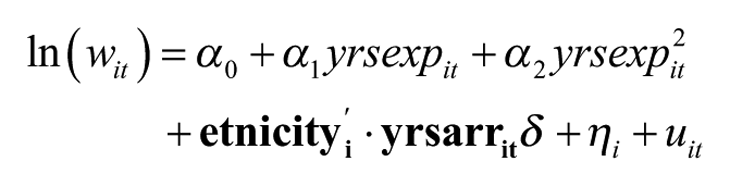
where ηi are the individual-level fixed effects, and uit is a person-year error term. The coefficients for the dummies for years since arrival by ethnoracial group (
Results
Descriptive Results
Figure 2a plots the median (inflation-adjusted) earnings of immigrant men in each ethnoracial category over the 20-year follow-up period since arriving to the United States. Immigrant men of different race and ethnicity begin their labor market trajectories in their new country with different earnings levels. These initial differences widen over time. Hispanic immigrants have both the lowest starting point and the lowest upward trajectory of all groups; Asian and white immigrants have the highest. As previously discussed, such differences may be at least partly explained by immigrants’ level of education and years of work experience with which they arrive. Our statistical models attempt to account for such factors.
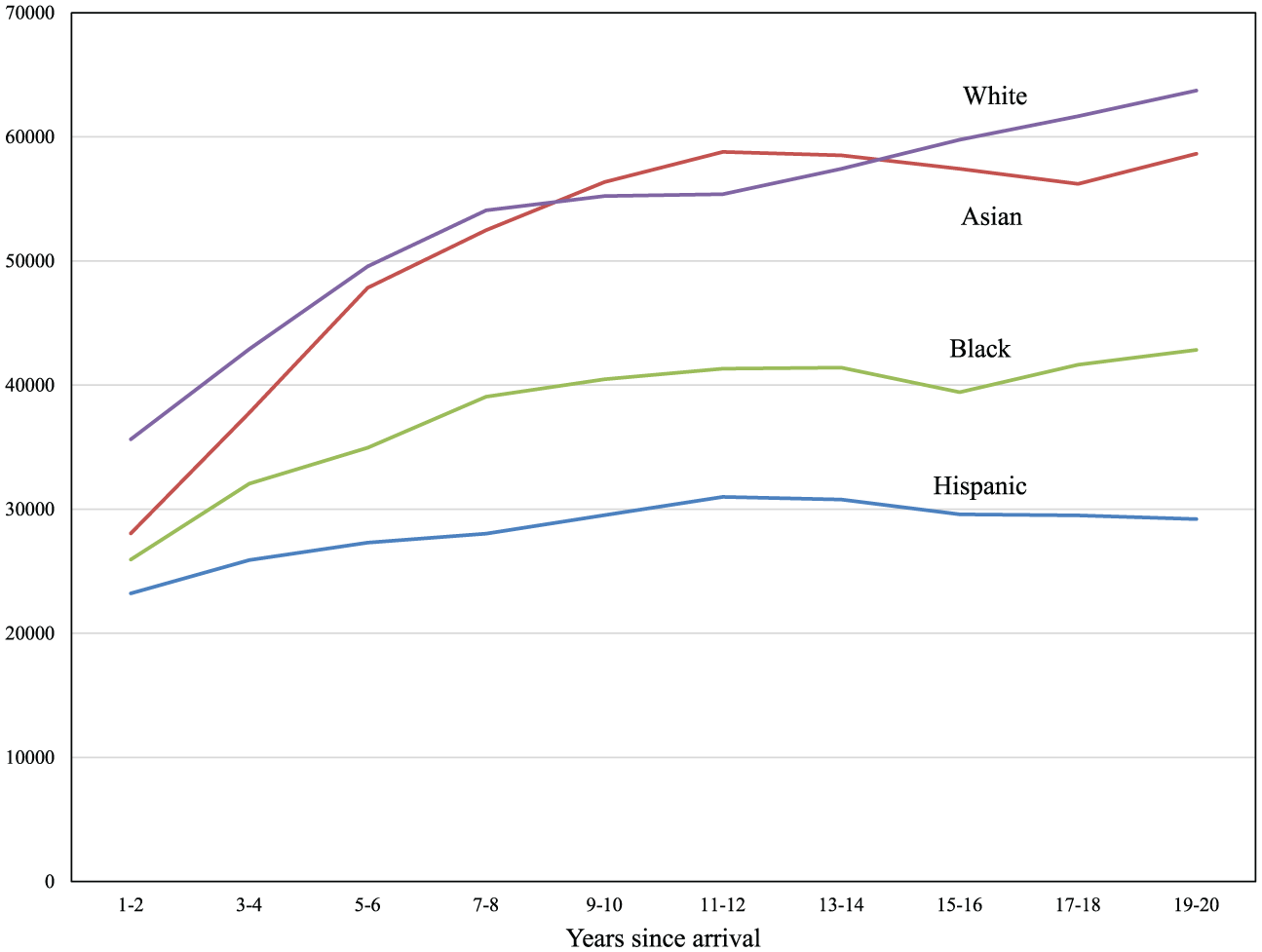
Median Inflation-Adjusted Earnings of Foreign-Born Men in Each Ethnoracial Category by Years since Arrival

Median Earnings of Foreign-Born Men in Each Arrival Cohort by Years since Arrival
Figure 2b shows the median earnings for immigrant men belonging to the three arrival cohorts. The graph shows no evidence of a decline in earnings growth for newer immigrant cohorts relative to those arriving in the early 1980s. In fact, the estimates suggest that immigrants belonging to the most recent arrival cohort (1994 to 2000) experience modestly greater earnings growth compared to earlier cohorts (e.g., 1980 to 1986). In the regression analyses, we evaluate the extent to which these differences may be explained by arrival cohorts’ educational and ethnoracial composition.
Baseline Regression Model
Table 2 presents results of the baseline random-effects model predicting men’s logged annual earnings. Immigrant men have lower annual earnings than native men overall, as indicated by the negative and significant coefficient for the stand-alone immigrant dummy variable. However, immigrant men are able to reduce much of the earnings gap over their working lives, as indicated by the positive and increasing coefficients for years since arrival. The earnings gap with natives also varies by immigrants’ year of entry, and even more so by number of years of work experience before arriving. As noted previously, years of work experience on arrival is closely tied to the age at which immigrants arrive.
Results of the Random-Effects Model Predicting Immigrant and Native Men’s Annual Earnings
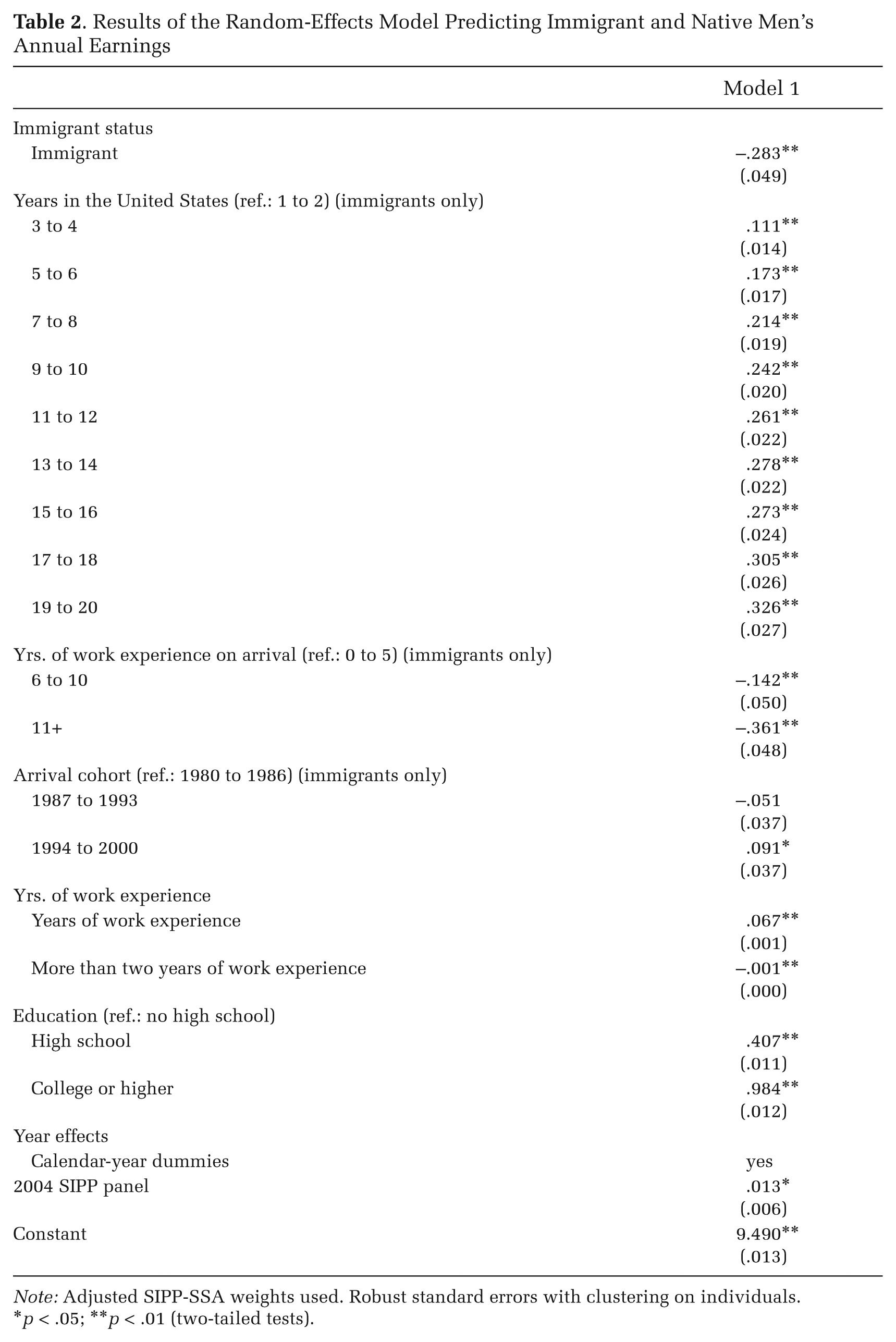
Note: Adjusted SIPP-SSA weights used. Robust standard errors with clustering on individuals.
p < .05; **p < .01 (two-tailed tests).
To better visualize how the immigrant–native earnings gap narrows from the time of arrival, Figure 3 uses estimates from the regression model in Table 2 to plot the ratio of immigrants’ earnings to those of native men with the same level of education and work experience. We compute separate trajectories for immigrants in the three categories of prior work experience (0 to 5, 6 to 10, and 11 or more years) to highlight how the earnings gap varies over time with immigrants’ years of work experience before arrival. The trajectories are all estimated with the median cohort of arrival, 1987 to 1993.

Ratio of Immigrant to Native Earnings for Immigrants with Different Years of Work Experience before Arrival, Based on Results from the Random-Effects Model
Figure 3 shows dramatic differences in the pattern of earnings assimilation based on the number of years of work experience before arrival. Foreign-born men who arrived in the United States with only one to five years of work experience are essentially able to close the earnings gap with natives after 20 years in the country, but those who arrived with 11 or more years of experience continue to have annual earnings 31 percent lower than natives with comparable levels of education and work experience. The differences in earnings growth between immigrants who come to the United States with different amounts of work experience are in many cases greater than the differences in earnings growth for immigrants of different race and ethnicity and arrival cohort. The stage in immigrants’ working lives in which they arrive in the United States, and by implication their age, therefore emerges as a key predictor of immigrants’ earnings assimilation.
Differences by Race and Ethnicity
Results of the model presented in Table 2 indicate that immigrants as a whole are making substantial progress in narrowing the earnings gap with natives over the course of their working lives. However, such overall convergence may hide important differences across ethnoracial groups. As described in the methodological section, we examine ethnoracial differences in earnings growth by estimating a random-effects model in which immigrants’ years since arrival is interacted with their race and ethnicity. We used results of this model to predict the ratio of earnings of immigrant men to native whites and to natives of their same race and ethnicity with comparable levels of education and work experience. Examining immigrants’ ability to achieve parity with natives of their same race and ethnicity allows us to test one interpretation of segmented assimilation theory.
We present the predicted earnings ratios in graphical form for ease of interpretation. 17 Figure 4a shows a bifurcated pattern in which white and Asian immigrants substantially reduce the earnings gap with native whites over the span of 20 years, whereas black and Hispanic immigrants lag behind. Asian immigrants, for example, begin their labor market trajectory in the United States with earnings 45 percent lower than native whites with comparable levels of education and years of work experience, but after working in the United States for 20 years, they earn only 9 percent less. In contrast, Hispanic immigrants begin with earnings 39 percent lower than native whites and end up with earnings 23 percent lower after 20 years.
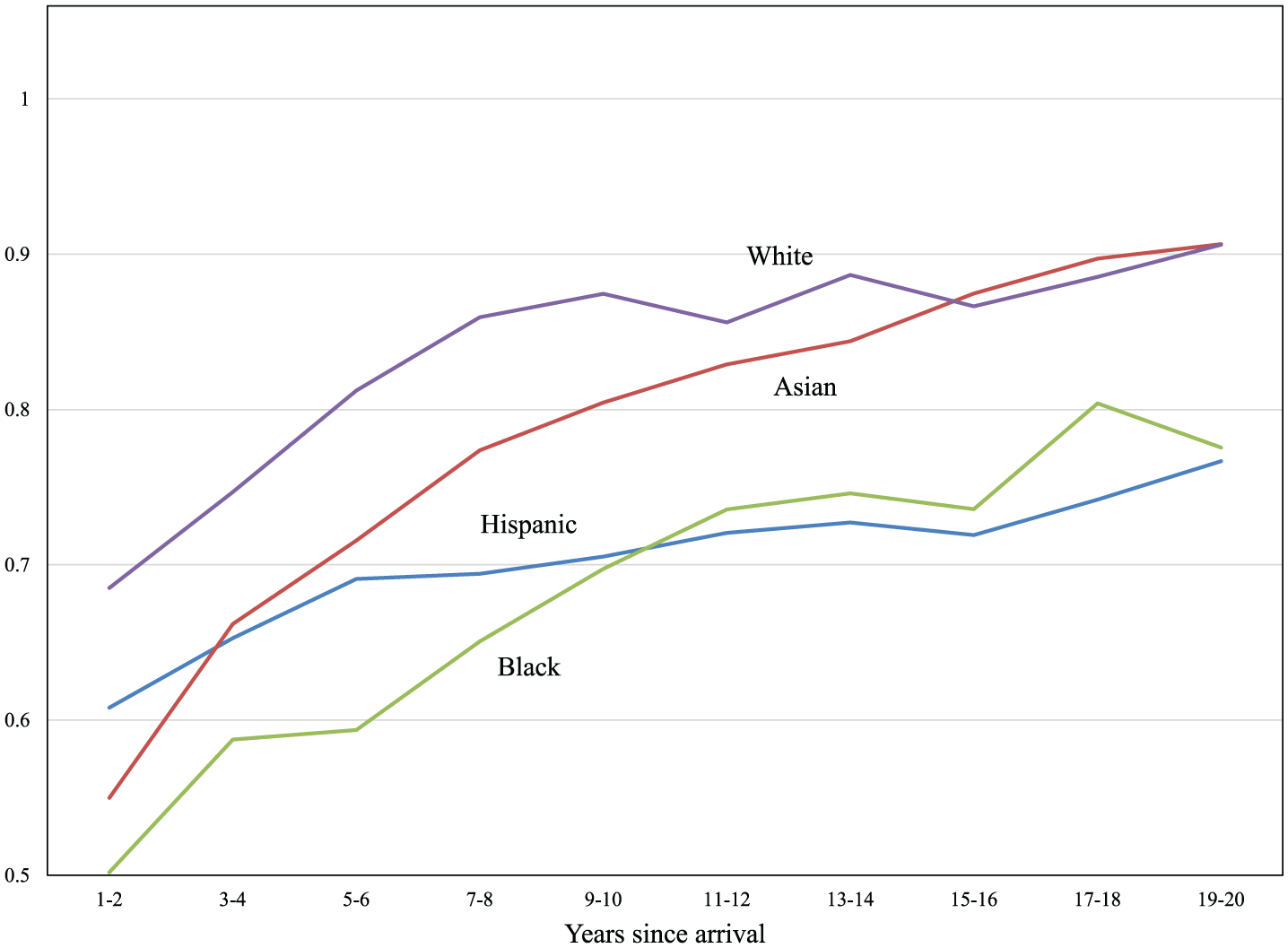
Ratio of Immigrant to Native Earnings for Immigrants of Different Race and Ethnicity Relative to Native Whites, Based on Results from the Random-Effects Model
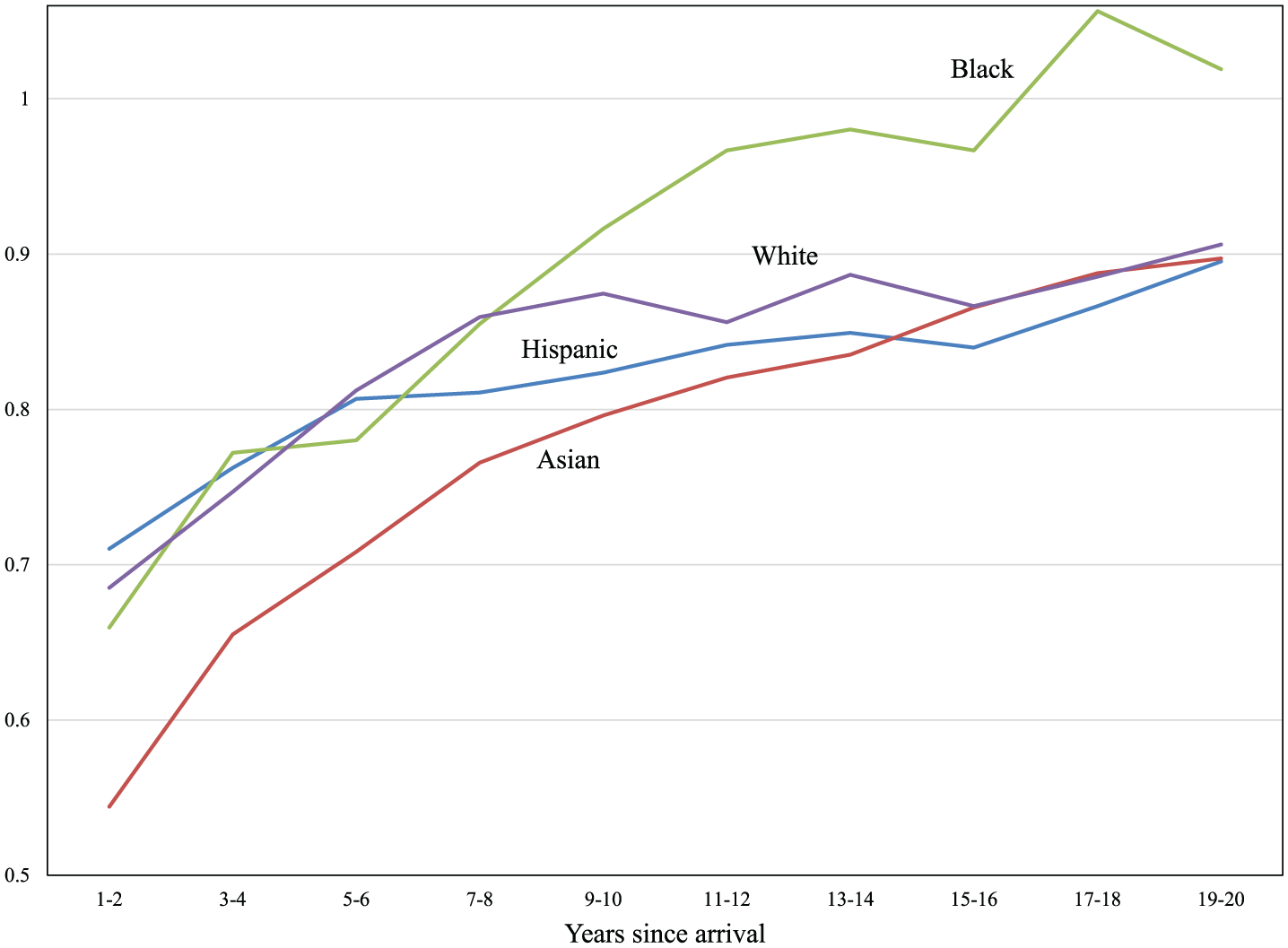
Ratio of Immigrant to Native Earnings for Immigrants of Different Race and Ethnicity Relative to Natives of the Same Race and Ethnicity, Based on Results from the Random-Effects Model
The earnings growth patterns in Figure 4a highlight the importance of distinguishing between immigrants’ starting points and subsequent trajectories after arrival. As noted, Asian immigrants begin their careers in the United States with a large earnings gap relative to native whites, but then experience the fastest growth of any immigrant group. Such rapid growth allows Asian immigrants to fully converge with white immigrants even though the latter start with higher earnings. Black immigrants experience the second fastest growth in earnings during their first 20 years in the United States. However, because they begin their trajectories with the lowest earnings relative to comparably qualified native whites, they are not able to catch up with white immigrants during the course of their working lives. Finally, Hispanic immigrants begin with a modest earnings gap relative to native whites, but they experience the lowest earnings growth of any immigrant group.
The shape of the earnings trajectories reveals important differences in the speed at which immigrants assimilate economically with natives. White and Asian immigrants are not only able to reduce the earnings gap with native whites more during their lifetime, but they also do so more quickly. The estimates reveal that much of white and Asian immigrants’ progress is made in their first years after arrival. Using the midpoint in the earnings trajectory as a benchmark, we find that white immigrants achieve 86 percent of their overall earnings growth relative to native whites by years 9 to 10, whereas Hispanic immigrants only achieve 61 percent of their overall growth. As we will see, this pattern of accelerated assimilation partly reflects differences in educational attainment between ethnoracial groups. More educated immigrants are able to reduce the earnings gap with similarly educated natives more quickly.
Figure 4b shows the evolution of immigrants’ earnings gaps relative to natives, but this time the reference category is natives of the same race and ethnicity rather than native whites. The earnings gaps are substantially smaller than those between immigrants and native whites because native whites generally have higher earnings. Immigrants in all ethnoracial categories come close to achieving parity with natives of their same race and ethnicity within 20 years of arriving. Black immigrants actually exceed full parity with native blacks, and the annual earnings of Hispanic, Asian, and white immigrants are only 10 percent lower than their native counterparts by the end of the 20-year observation window. This convergence of immigrants’ earnings with those of natives of the same race and ethnicity is consistent with a racial pattern of assimilation predicted by segmented assimilation theory. Hispanic and black immigrants are not literally assimilating “downward,” in the sense that they are in fact experiencing earnings growth and narrowing the gap with natives over time. However, their earnings trajectories appear to be converging with a specific segment of the population, namely natives of their same race and ethnicity, with whom they likely share similar labor market opportunities.
The results presented in Figures 4a and 4b suggest that Hispanic and black immigrants’ lower earnings assimilation is in fact conditioned by their race and ethnicity, but we cannot yet rule out other potential explanations. In particular, differences in human capital and unobservable skills may account for racial and ethnic disparities. Our previous models controlled for the time-invariant effect of immigrants’ educational attainment. However, as noted earlier, rewards to education may vary over individuals’ working lives. To more rigorously account for the effect of educational attainment on ethnoracial disparities, we tested a model in which we disaggregated immigrants by both their ethnoracial category and their level of education. To simplify our analysis, we divide men into two broad educational categories: those with and without a college degree. Figures 5a and 5b show the ratio of immigrants’ to native whites’ earnings based on results from this regression model.
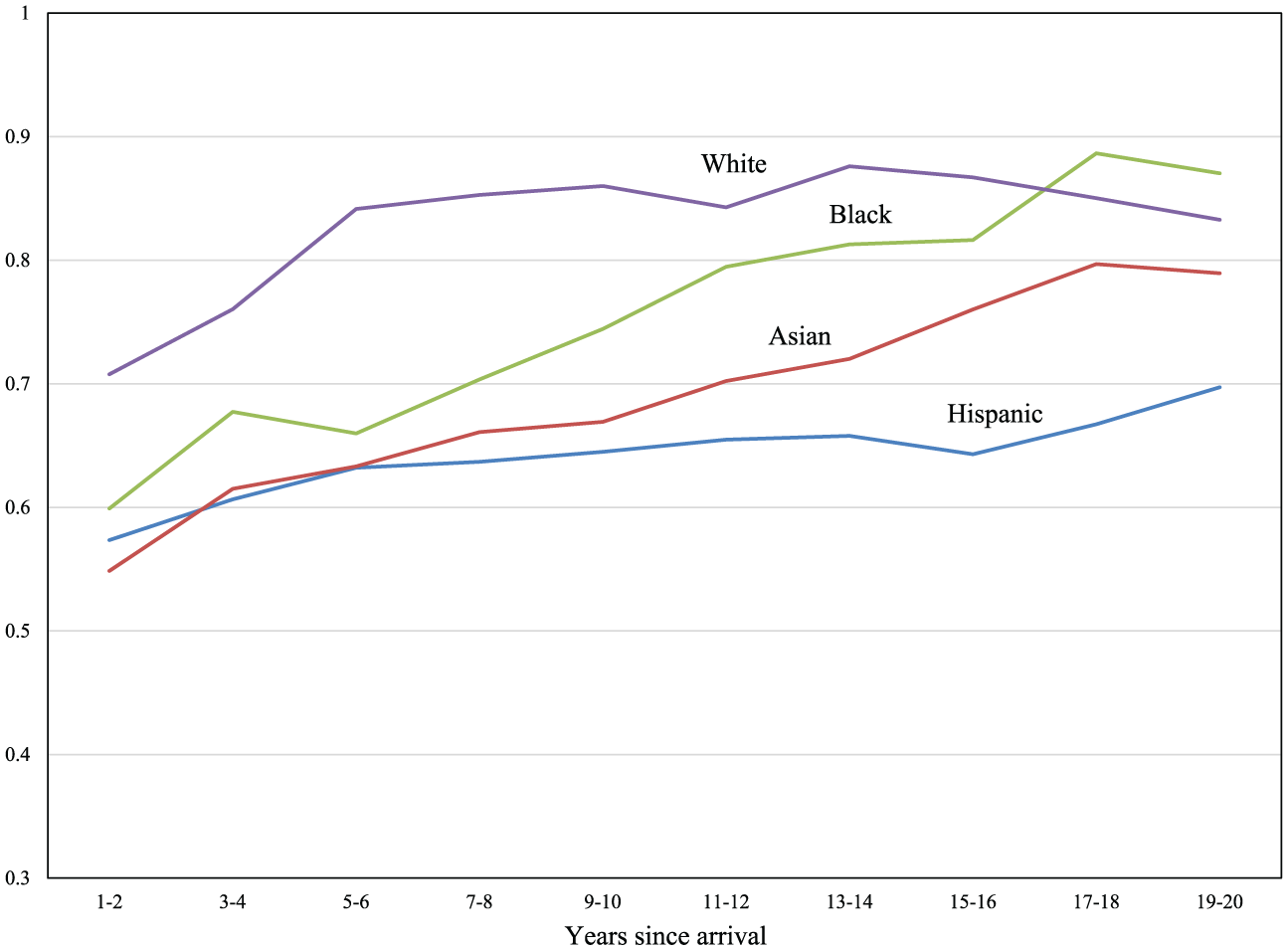
Ratio of Immigrant to Native Earnings for Immigrants of Different Race and Ethnicity without a College Degree Relative to White Natives with the Same Education, Based on Results from the Random-Effects Model

Ratio of Immigrant to Native Earnings for Immigrants of Different Race and Ethnicity with a College Degree Relative to White Natives with the Same Education, Based on Results from the Random-Effects Model
A comparison of the results for the two educational categories indicates that Hispanic immigrants’ lower level of education upon arrival does not fully explain why they are less able to reduce the earnings gap with native whites during the course of their working lives. In fact, Hispanic immigrants who hold a college degree experience a slightly larger earnings gap with comparable native whites after 20 years (37 percent lower compared to 30 percent lower). Overall, Hispanic immigrants have the lowest earnings growth in both educational categories. By contrast, black immigrants experience different assimilation rates depending on their level of education. Black immigrants without a college degree make substantially more progress in narrowing the earnings gap with comparable native whites than do black immigrants with a college degree.
The pattern of accelerated assimilation, whereby certain immigrant groups are not only able to make greater progress in reducing their earnings gap with natives during their careers but also experience faster earnings growth, is strongest for college-educated immigrants. For example, black immigrants without a college degree achieve 54 percent of their eventual reduction in the earnings gap relative to similarly educated native whites by years 9 to 10, but black immigrants with a college degree achieve 100 percent of their eventual reduction by the same time. Although we lack time-varying information regarding job characteristics, one possible explanation for why college-educated immigrants narrow the gap with similarly educated natives more quickly is that they are able to obtain jobs commensurate with their education within the first years after arrival. Such jobs would allow them to more quickly reap the economic rewards of their greater human capital (see Akresh 2007).
Finally, we estimated a fixed-effects model to control for the time-invariant effect of unobserved individual characteristics that might account for differences in the earnings growth between immigrants of different race and ethnicity. Figure 6 shows immigrants’ growth curves estimated using the median years of work experience on arrival (11 years). As noted earlier, because fixed-effects models only estimate within-individual changes in earnings over time, we cannot compare immigrants’ earnings relative to natives. The trajectories shown in Figure 6 instead capture the earnings growth of each immigrant group relative to their own earnings in the first two years after arrival (used as the baseline category). For this reason, the growth curves estimated from the fixed-effects models do not capture cross-group differences in immigrants’ starting points, but rather their subsequent trajectories relative to the first two years after arrival.

Earnings Growth Estimates by Race and Ethnicity, Based on Results from the Fixed-Effects Model
The results of the fixed-effects models show a similar ethnoracial pattern in earnings growth as observed in the random-effects models: Asian immigrants experience the fastest growth during their careers, followed by black, white, and Hispanic immigrants, in that order. As noted earlier, Hispanic immigrants’ lower performance cannot be entirely explained by differences in their level of education. The fixed-effects model allows us to further rule out the time-invariant effect of any unobserved characteristics on which immigrants are selected from their countries of origin, including skills. Taken together, these results provide evidence that human capital differences do not fully account for the observed ethnoracial disparities in immigrants’ earnings assimilation.
Differences by Immigrant Cohort
We now turn to differences in the earnings trajectories of immigrant cohorts. Figure 7 shows the ratio of immigrant to native earnings for the three cohorts defined earlier, based on the results of our random-effects model. This model interacts immigrants’ years since arrival with their cohort of entry, thereby allowing cohort differences to vary over individuals’ working lives. Immigrants’ earnings are only followed for the first 14 years to make sure all members of the most recent cohort (those arriving between 1994 and 2000) are observed during the entire time span. Contrary to previous economic studies, which find a lower earnings growth for more recent immigrant cohorts, Figure 7 indicates that immigrants arriving since 1994 actually experience greater earnings growth than immigrants who arrived earlier, even after controlling for education and years of work experience (the differences with the other two cohorts are statistically significant).

Ratio of Immigrant to Native Earnings for Immigrants of Different Arrival Cohorts, Based on Results from the Random-Effects Model
Figure 8 compares the earnings growth pattern for immigrants of the three arrival cohorts using results from our fixed-effects model. This model allows us to control for the time-invariant effect of any individual characteristic, including individuals’ race and ethnicity and their level of education. 18 Once again, the growth curves estimated from the fixed-effects model cannot measure differences in immigrants’ starting point across the three cohorts, but rather only capture their subsequent trajectories relative to the first two years after arrival (used as the baseline category). Overall, the results of the fixed-effects model show no statistically significant differences in the earnings growth patterns of immigrants belonging to the three arrival cohorts. This suggests that any differences in the earnings growth between the most recent immigrant cohort and earlier cohorts can be explained by their relative composition. Yet even after controlling for the time-invariant effect of all individual characteristics, we find no evidence of a declining earnings assimilation for more recent immigrant arrivals.
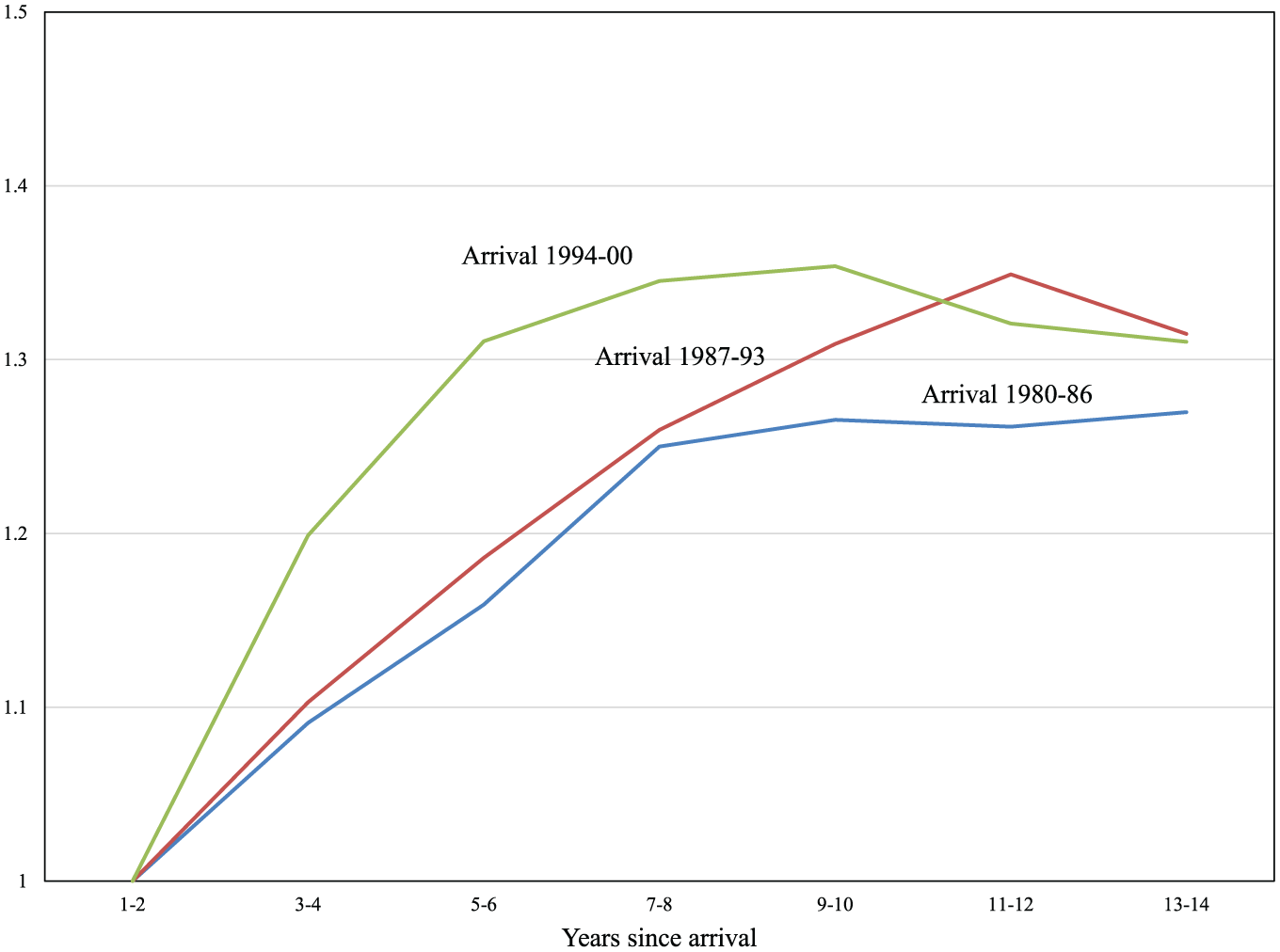
Earnings Growth Estimates for Immigrant Arrival Cohorts, Based on Results from the Fixed-Effects Model
Conclusions
This study addresses two long-standing questions regarding immigrants’ economic assimilation. The first question is how to explain differences in the economic outcomes of immigrants of different race and ethnicity. Following the earnings of immigrants for up to 20 years after their arrival, we found that black and Hispanic immigrants are less able to catch up with native whites’ earnings compared to white and Asian immigrants. Contrary to explanations proposed by economic studies, these racial and ethnic differences cannot be fully explained by differences in human capital. In fact, the gap in earnings between Hispanic and black immigrants on the one hand, and white and Asian immigrants on the other, is even larger among men with a college degree than among those without one.
Although black and Hispanic immigrants fall well short of achieving earnings parity with native whites overall, they make considerably more progress catching up with natives of their own race and ethnicity. Black immigrants earn the same as black natives 20 years after arriving in the country, and Hispanic immigrants earn only 10 percent less than Hispanic natives after the same amount of time. These findings suggest a racially differentiated pattern of immigrant assimilation consistent with segmented assimilation theory. One interpretation of the economic convergence of minority immigrants with natives of the same race and ethnicity is that it constitutes evidence of successful assimilation. However, such convergence may instead signal a lack of progress of the second and later generations with which minority immigrants are being compared. If first-generation minority immigrants are achieving parity with later-generation minorities it may be because economic assimilation is stalling after the first generation.
Our analysis allows us to rule out some potential explanations for the observed ethnoracial disparities in immigrants’ earnings assimilation. First, as already mentioned, racial disparities in earnings trajectories cannot be entirely explained by differences in human capital. Second, because our dataset excludes virtually all undocumented immigrants who cannot be matched with tax records, we can also rule out immigrants’ legal status as an explanation for their lower earnings growth. If undocumented immigrants were included in the sample, we would likely see an even greater earnings disparity between Hispanic immigrants and native workers, since Hispanic immigrants are among the most likely to be undocumented, and undocumented immigrants earn lower wages (Bean et al. 2015; Hall et al. 2010; Massey and Gentsch 2014). Third, our fixed-effects model allows us to rule out the time-invariant effect of unobserved characteristics on immigrants’ earnings growth, including the effect of any characteristics on which immigrants are selected from their countries of origin.
Our distinction between immigrants’ starting point and subsequent earnings trajectory provides additional insights regarding ethnoracial differences. Whereas Hispanic immigrants’ inability to achieve earnings parity with comparable white natives is largely due to their low earnings growth instead of a low starting point, the opposite appears to be true for black immigrants. Black immigrants experience considerable growth in earnings over their working lives but start with low initial earnings. Results of the fixed-effects model highlight this pattern, showing that black immigrants have one of the largest earnings growths among all ethnoracial groups, and Hispanic immigrants have the lowest. The large earnings growth experienced by black immigrants is consistent with prior work indicating the successful integration of immigrants from Africa and the Caribbean in the U.S. labor market (Dodoo 1997; Elo et al. 2015; Kollehlon and Eule 2003).
Decomposing immigrants’ earnings assimilation into their starting point and later growth brings up the question of how economic assimilation should be defined. If we use an absolute definition of assimilation, by which immigrants’ progress is measured based on the remaining gap between immigrants and a reference category of natives such as native whites, then black immigrants fall short. After 20 years in the United States, a large difference in earnings remains between black immigrants and native whites overall (although there are important differences based on level of education). However, if we use a relative definition of assimilation, which measures immigrants’ progress relative to where they start, then black immigrants are assimilating at an impressive rate, since they experience one of the largest growths in earnings during their working lives. The relative definition of assimilation has some intuitive appeal because it recognizes that some immigrants, for example those with lower levels of education, begin at a greater disadvantage but may nevertheless make greater strides toward parity with natives.
The second research question addressed by our study relates to differences in the economic assimilation of immigrant cohorts, and the alleged decline in the “quality” of immigrants arriving in the United States in recent years (Borjas 1985, 1995, 2015). We find no evidence that recent immigrants’ earnings growth is lower than that of immigrants in the past. On the contrary, we find that men arriving from 1994 through 2000 experienced slightly higher earnings growth compared to those who arrived earlier. Recent immigrants’ earnings advantage appears to be largely explained by their composition. For example, higher educated men and Asian men constitute greater proportions of the most recent immigrant cohort, thereby raising this cohort’s overall earnings growth. However, even once immigrant cohorts’ ethnoracial and educational composition is taken into account, we do not observe a decline in immigrants’ earnings growth.
Finally, the number of years immigrants had worked before moving to the United States, and by implication their age of arrival, emerged as a key predictor of earnings growth. Previous research has focused on differences between immigrants who arrive as adults and those who arrive as children. It is well established that individuals belonging to the so-called 1.5 generation do better than their parents on various measures (Portes and Rumbaut 2001; White and Glick 2009). Our study highlights important differences in socioeconomic outcomes even among adult immigrants based on the stage in their working lives at which they emigrate. Individuals emigrating early in their careers experience much greater earnings growth over time than do those who arrive in later stages. Indeed, the differences in earnings growth between immigrants arriving at different stages of their careers (and therefore at different ages) are in many cases larger than the differences between immigrants of different race and ethnicity and arrival cohort. Historically, immigration policy debates have focused on immigrants’ level of education and national origin, with the assumption that immigrants with lower levels of education and those originating in particular countries have greater difficulty assimilating. These debates rarely focus on the age at which immigrants arrive, despite the importance it has for their eventual assimilation.
Our analysis based on data matching survey respondents to tax records provides better estimates of immigrants’ progress toward earnings parity with natives than a synthetic cohort approach used in most previous studies. Nevertheless, one limitation of our analysis is that we are unable to examine the progress made by children of immigrants. Sociologists often rightly define immigrant assimilation as a multigenerational process. Although our results show that some subgroups of immigrants are almost able to fully catch up with natives’ earnings during their lifetimes, it typically takes more than one generation to achieve socioeconomic parity with natives. Unfortunately, our data do not contain sufficient information about the children living in each household to examine earnings growth across generations.
Analyzing the economic progress of first-generation immigrants is nevertheless important, among other reasons, because it strongly conditions the life chances of the second generation. Numerous studies link low parental income to negative outcomes for children, including worse health, greater likelihood of dropping out of school, higher risk of teenage pregnancy, and lower emotional and cognitive development (Brooks-Gunn and Duncan 1997; Case et al. 2002; Condliffe and Link 2008; Currie and Stabile 2003; Kim et al. 2013; Kirby 2007). Prior research also suggests that the harmful effects of living in a low-income household accumulate over a child’s lifetime (Case et al. 2002), hence the importance of understanding how immigrant adults’ earnings evolve over time. The pattern of accelerated assimilation we identified, whereby certain groups of immigrants reduce the earnings gap with natives more quickly, is likely to provide greater benefits to their children, who will be able to enjoy the benefits of greater parental resources earlier in their lives.
Supplemental Material
villarreal_online_supplement – Supplemental material for Immigrants’ Economic Assimilation: Evidence from Longitudinal Earnings Records
Supplemental material, villarreal_online_supplement for Immigrants’ Economic Assimilation: Evidence from Longitudinal Earnings Records by Andrés Villarreal and Christopher R. Tamborini in American Sociological Review
Footnotes
Appendix: Robustness Checks
Funding
This study was funded by a grant from the National Institute of Child Health and Human Development (1R03HD091424). The views expressed in this paper are those of the authors and do not represent the views of the Social Security Administration (SSA) or any federal agency.
Notes
References
Supplementary Material
Please find the following supplemental material available below.
For Open Access articles published under a Creative Commons License, all supplemental material carries the same license as the article it is associated with.
For non-Open Access articles published, all supplemental material carries a non-exclusive license, and permission requests for re-use of supplemental material or any part of supplemental material shall be sent directly to the copyright owner as specified in the copyright notice associated with the article.
