



Abstract
This article argues that national border crossings act as focal points for xenophobia. Two mechanisms converge to produce this pattern. First, when the nation-state is under pressure, border crossings make cross-national differences salient, producing a perceived link between international forces and socioeconomic problems of vulnerable social classes. Second, border crossings come to symbolize international threats and attract aggressive nationalist mobilization by radical movements who frame ethnic outsiders as an international evil. In this distinct spatial landscape, ethnic outsiders become scapegoats for broader social problems among individuals losing social status. I develop my argument through the study of local variation in antisemitism in Weimar Germany before the Holocaust. Statistical analysis of Jewish bogeymen and an in-depth exploration of local reports on antisemitism reveal how pluralism in the Weimar Republic started eroding among members of the lower-middle class living at the margins of the state. In doing so, I draw attention to the spatial sources of xenophobia and demonstrate that borders between nations activate borders within nations, shedding new light on the complicated relationship between pluralism and state formation.
Studies of anti-immigrant mobilization in Western Europe (Koopmans and Olzak 2004), race relations in the United States (Olzak 1994; Spilerman 1970; Tolnay and Beck 1995), Hindu-Muslim riots in South-East Asia (Biggs and Dhattiwala 2012; Brass 2011; Varshney 2003; Wilkinson 2006), and antisemitism in Central Europe (Brustein 2003; Charnysh 2015) all draw attention to how xenophobia manifests differently across space. Given this empirical regularity across the globe, it is hardly surprising that many have tried to formulate an explanation for spatial heterogeneity in resentment toward outsiders. Most of this scholarship highlights the importance of either political or economic threats in explaining xenophobic variation. On the political side, scholarship demonstrates how perceived political threats and instigation by movement leaders (Brass 2011; Wilkinson 2006) shape local variation in xenophobic conflict. Economic arguments, in contrast, emphasize the importance of scapegoating (Blalock 1982), a process through which outsiders are blamed for social disorganization or economic crisis in general (Bendix 1952; Blumer 1958; Olzak 1994) and among vulnerable social classes in particular (Lipset 1960).
Much of this work uses place as the unit of observation, treating locations as containers that carry variables to be deployed for statistical analysis. In contrast, this article highlights how place in and of itself (Garrido 2019; Gieryn 2000; Logan 2012) shapes xenophobia by coordinating collective sentiments (Simmel 1997) and altering the perception of social problems (Simmel 1994). To be more precise, I argue that when the nation-state is under pressure economically and politically, national border crossings—the physical spaces where people cross borders—become focal points for xenophobia, in particular for people who are losing social status.
Two converging mechanisms link national border crossings to fear of outsiders. First, a perception mechanism activates the internationalization of social problems. Border crossings make the nation visible and prime people to perceive international influences on their lives (Barth 2012; Gellner 1964; Pfaff 2006). As such, border crossings produce an international lens through which local vulnerable groups perceive their social problems. This leads these groups to link their problems to international origins. Second, an attraction mechanism produces external radical nationalist mobilization. Border crossings often symbolize international threats and therefore attract radical nationalist movements who frame ethnic outsiders as responsible for negative international influences on social life (Brubaker 1996; Häkli 1998; Radcliffe 1998). Whereas the latter mechanism intensifies the framing of ethnic outsiders as scapegoats for international problems (Snow et al. 1986), the former mechanism links social problems to international origins in a way that makes these frames stick among people who are losing social status (Koopmans and Olzak 2004; McDonnell, Bail, and Tavory 2017). Hence, it is the confluence of political and economic interactions in a distinct spatial setting that produces xenophobic hotbeds, revealing that the influence of political threats, movement instigation, economic discontent, and social class on xenophobic discourse is conditional on its broader place within the nation (Garrido 2019; Schaeffer and Legewie 2016).
I develop this argument through a study of antisemitism in Weimar Germany. Out of dissatisfaction with existing measures of subnational antisemitism that rely heavily on extreme episodes of collective violence, I construct two new datasets that capture over-time and geographic variation in antisemitism. The first dataset builds on data collected by folklorists and captures antisemitism in 19,828 localities by looking at the prevalence of Jewish bogeymen in Kinderschreck (children’s fright), an oral tradition that deploys fear to induce obedience in children. The second dataset contains a coding of 2,283 antisemitic incidents culled from local reports compiled by the Centralverein, the largest secular Jewish organization in the Weimar Republic dedicated to monitoring and combatting the rise of anti-Jewish thought and behavior. Using two datasets ensures the robustness of my findings, as each dataset has different strengths: the former offers an over-time dimension and provides an opportunity to compare fine-grained variation in antisemitism before and after the introduction of national border crossings; the latter allows us to unpack the key processes and actors involved in the production of resentment toward Jews.
The empirical analysis is recast along the lines of Lipset’s lower-middle-class thesis, 1 which argues that small business owners and farmers were more likely to look for scapegoats, as they were particularly affected by Weimar’s political and economic problems (Lipset 1960). Caught between organized labor and capital, the lower-middle classes saw their relative position deteriorating because they were both sellers and buyers in the market (Jensen-Butler 1976), and in times of massive inflation, they could not set their own prices (Geiger 1930).
The Kinderschreck data show that border crossings in Weimar Germany formed hotbeds of antisemitism after the nation-state was established, and this was particularly true for localities that were home to more small business owners and farmers. Reports from the Centralverein suggest border crossings were magnets for radical nationalists and activated resentment toward international influences among the lower-middle class, who were disproportionally suffering from the economic upheaval of the 1930s. Over time, this local resentment and external nationalist mobilization converged, producing a fertile ground for the spread of Jewish scapegoating. This finding has important implications for the study of xenophobia, because it shows that the influence of political mobilization, social economic problems, or social class on xenophobia is conditional on spatial position within the nation (Garrido 2019; Schaeffer and Legewie 2016), thereby specifying a spatial link between xenophobia and the rise of the nation-state (Wimmer 2002, 2012). This study also reveals how ancient xenophobic tropes interact with contemporary spatial configurations to produce outbursts of hatred (Charnysh 2015; Voigtländer and Voth 2012).
Border Crossings and Xenophobia
Previous research on ethnic conflict (Blalock 1982; Olzak 1994), immigration (Koopmans and Olzak 2004), and antisemitism (Kopstein and Wittenberg 2018) has identified several explanations for xenophobia that move beyond a straightforward link between minority group size and hostility. Intellectual diversity notwithstanding, two predominant themes that emerge from these literatures are the role of economic and political threats. These two strands of research provide the building blocks for the border-crossing thesis articulated here.
Research on the economic logic of ethnic prejudice suggests members of dominant ethnic or racial groups tend to blame minorities in times of economic crisis or social disruption (Blumer 1958). Perception is key in this process (Bélanger and Pinard 1991), as scapegoating is particularly prevalent among majority members who perceive themselves to be in competition with minorities over scarce resources such as jobs (Olzak 1994), or who view minorities as brokers between themselves and elites (Blalock 1982). In his lower-middle-class thesis, Lipset (1960) links these dynamics to class, arguing that scapegoating is a common strategy among vulnerable members of the lower-middle class who are trapped between organized labor and large capital owners.
This approach dovetails with historical scholarship on economic antisemitism in interwar Germany, which links antisemitism to economic modernization and crisis. The rise of capitalism, industry, and liberalism emancipated the Jews economically, politically, and socially. Jewish social mobility elicited fear among Gentiles, and their prominent position in finance produced resentment (Niewyk 2018). In line with Lipset’s thesis, scholars have argued that the losers of industrial advancement, most prominently middle-sized farmers and small business owners, harbored the strongest antisemitic resentment because they suffered the most from the economic upheaval of the 1930s (Heberle 1962; Loomis and Beegle 1946).
Work on political dynamics and xenophobia highlights the importance of electoral threats and subsequent instigation of ethnic rivalry by movement leaders. Again, perception is crucial to understanding this logic. In this view, minority groups will only become scapegoats for socioeconomic problems if they are seen as posing an electoral threat to the political establishment or nation-state as a whole (Kopstein and Wittenberg 2018). In these cases, majority members might produce outbursts of xenophobia either independently or under influence of the ideological frames, collective identities, and mobilizing networks provided by movement entrepreneurs (Biggs and Dhattiwala 2012; Brass 2011; Wilkinson 2006). Empirical support for this political threat model has been found in a wide range of cases, including twentieth-century antisemitism in Europe (Brustein 2003).
Overall, the evidence regarding xenophobia and different types of ethnic threats is far from conclusive. In part, this is because most work in this vein is vague about how and when different threats are perceived as such (Bélanger and Pinard 1991). A growing body of work tries to specify more refined conditions under which economic and political threats translate into resentment toward minorities (Garrido 2019; Schaeffer and Legewie 2016). I join this literature by conceptualizing how space and place condition the effects of economic and political threats on xenophobia by shaping the perception of social problems. In this way, I advance a spatial social analysis by considering the relative locations of places as variables (Logan 2012). Here, place and social processes are deeply intertwined, because place—defined as a fixed, unique, and physically built location in the universe—is imbued with meaning and value. As I will show, it is through social processes that locations like border crossings come to represent distinct forms of power, memory, and identity (Gieryn 2000).
The work of Georg Simmel provides a useful starting point to understand how place can shape behavior (Garrido 2019). According to Simmel, fixed physical locations, such as bridges, churches, or doors, shape social behavior through attraction and by shaping the perception of differences. First, place can organize collective sentiments by providing fixed points of orientation that act as magnets for collective action. Simmel (1997) gives the example of church chapels that become pivotal points for the formation of religious relationships, unleashing communal rather than isolating forces that transform believers into a collective of churchgoers. Second, fixed places partition and connect separate spaces, shaping perception by rendering the experience of difference more concrete and intense (Simmel 1994).
Attraction Mechanism: Radical Nationalist Mobilization
The attraction and perception mechanisms provided by Simmel seem particularly apt for describing the social influence of national border crossings, that is, fixed physical points such as custom houses, border guards, or checkpoints that simultaneously connect and separate different nation-states by transcending otherwise impermeable border lines. 2 Because borders symbolize international rivalry and cross-border influence, nationalists who already have xenophobic attitudes see border crossings as places where territory can be won or lost for the nation (Häkli 1998; Wilson and Donnan 1998). Border crossings thus attract xenophobes, and in particular, mobilization by radical nationalist groups that aim to defend the nation-state against outsiders (Brubaker 1996; Elcioglu 2020), transforming border crossings into centers of nationalist agitation (Elcioglu 2020; Wilson and Donnan 1998). These radical nationalist groups carry with them xenophobic frames featuring international scapegoats, through which they hope to shape local sentiments. I refer to this process as the attraction mechanism. Needless to say, the intensified use of xenophobic frames does not automatically make them resonate (McDonnell et al. 2017; Snow et al. 1986). For that, I turn to the second mechanism, which sheds light on why xenophobic frames are more readily accepted among vulnerable social classes living in border regions.
Perception Mechanism: The Internationalization of Social Problems
Border crossings not only intensify external agitation and xenophobic frame deployment, they also influence how local populations perceive social problems. Border crossings are anchored in an inherent tension because they make the nation-state both powerful and vulnerable, activating a liminal process that spotlights international differences and challenges (Gellner 1964; Pfaff 2006). On the one hand, border crossings physically inscribe the powers of the nation-state and enhance its visibility by delineating the extent of its power (Barth 2012). On the other hand, they function as membranes through which peoples, goods, resources, and information from other nation-states travel (Wilson and Donnan 1998).
As a result, people living near border crossings are not only disproportionally exposed to the authorities, markets, and citizens of their own state, but also to those across the border. Depending on the local context, border crossings can signify rival conceptions of national and ethnic identity (Brubaker 1996); the negative effects of cross-border currency differences, smuggling, invasion, migration, tourism, and other forms of foreign competition (Radcliffe 1998; Wilson and Donnan 1998); and the defiance of national categories by groups such as ethnically mixed, stateless people or regionalists (Elcioglu 2020; Sahlins 1989).
Independently, each of these interstitial processes render border crossings a prism into international divergences created by major geopolitical, social, and economic events such as warfare or economic crisis (Wilson and Donnan 1998). In times of crisis, border crossings amplify the perception of international inequality, threat, and negative cross-border influences (Brubaker 1996). In this social setting, economically vulnerable locals will become more likely to attribute their increased social problems to forces located outside the nation and become susceptible to xenophobic sentiments. I refer to this process as the perception mechanism.
Convergence
Together, these two mechanisms converge to produce xenophobic spaces involving international scapegoats. The radical nationalist mobilization activated by the attraction mechanism intensifies the top-down supply of xenophobic frames involving international scapegoats, but it does not explain why these frames would resonate among local populations losing social status. Frames are more likely to resonate if they connect with the ways people conceive of their practical challenges of everyday life (McDonnell et al. 2017). This is where the perception mechanism comes into play. By highlighting the international origins of local social problems, it makes vulnerable groups more receptive to xenophobic frames involving international scapegoats. This process of convergence is summarized in Figure 1. A social group loses status. Proximity to a border crossing makes these groups link their loss to negative international influence. In addition, the border crossing attracts radical nationalist groups, which intensifies the framing of ethnic outsiders as an international evil. These frames resonate (Koopmans and Olzak 2004; Snow et al. 1986) among groups losing social status who live near border regions because they already link their social loss to negative international influences.
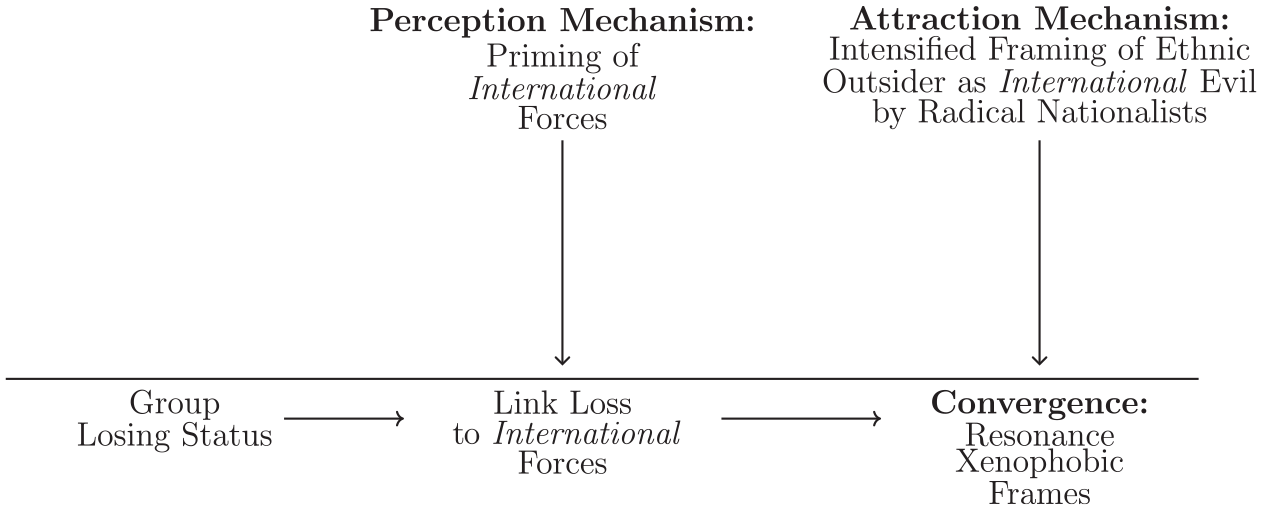
Schematic Overview of the Argument
Several dynamics highlighted by the economic and political threat approaches converge at border crossings. A common strand in both literatures is that xenophobia is most likely to emerge in times of social and economic upheaval (Bendix 1952) when vulnerable social classes (Lipset 1960) perceive outsiders as a political (Kopstein and Wittenberg 2018) or economic (Olzak 1994) threat. National border crossings make this more likely as they shape perception by linking social problems to cross-national differences and forces that transcend the nation. Dovetailing with the notion of movement instigation developed in the political threat approach (Biggs and Dhattiwala 2012; Brass 2011; Wilkinson 2006), the production of xenophobia is further reinforced by the attraction of radical nationalist entrepreneurs near border regions who deploy frames, identities, and networks to mobilize resentment toward xenophobic scapegoats in order to “protect the nation.”
This argument builds on, but is distinct from, Mann’s (2005) hypothesis that regions near threatened borders are more likely to nurture aggressive forms of nationalism and Brubaker’s (1996) notion that the nearby presence of ethnic compatriots outside the state hardens ethnic boundaries. The border-crossing thesis put forward in this article is both more general and more specific. It is more specific in that it focuses on small clusters located near border crossings and not entire provinces or regions. It is more general in that it identifies all national border crossings as focal points for xenophobia, not just those that are contested. Historians have criticized Mann and Brubaker for being too general (Applegate 1990), but I would suggest their arguments about border effects are not general enough.
Weimar’s Borders and Boundaries
With the end of World War I in 1919 and the establishment of the Weimar Republic, one era gave way to another. The latter ended the rule of the German Emperor through a socialist revolution and finalized the formation of a democratic nation-state, and the former unleashed destabilizing dynamics in the geopolitical, social, and economic domain that would define the newly established republic for years to come.
Consider first the geopolitical transformations. The Treaty of Versailles that ended the war seriously challenged Germany’s sovereignty, forcing the country to cede control of Eupen-Malmedy, Alsace-Lorraine, a portion of Schleswig-Holstein, parts of Upper Silesia, Danzig, the Polish Corridor, and all recent military gains, either directly or after plebiscites. In addition, Germany had to demilitarize the Rhineland and pay the Allied powers reparations to compensate for losses caused by the war. When the Germans defaulted on their payments, Belgium and France occupied the Rhineland in response (Weitz 2018).
These geopolitical challenges were further exacerbated by social unrest. The socialist revolution that produced the Weimar Republic had a long-lasting and polarizing effect, pitting the political left against the political right. The latter blamed the former for undermining German unity and losing the war, a tension that was made more salient by a series of socialist strikes (Heberle 1962).
This brings us to challenges in the economic realm. To meet wage demands of striking workers, the Weimar government printed banknotes that were not backed by gold, resulting in hyperinflation affecting all segments of society. Apart from economic mismanagement, a series of global economic and agrarian crises, culminating in the Great Depression, further added to the economic misery of all Germans (Loomis and Beegle 1946).
Farmers and small independent business owners suffered even more than others (Lipset 1960). These lower-middle classes were both sellers and buyers in the markets (Jensen-Butler 1976). However, due to strict government regulation of food prices and competition from giant warehouses, they were not able to adjust their sale prices independently when faced with inflation. As a result, their expenses increased while their income deteriorated, forcing them into debt (Geiger 1930).
Differences between the geopolitical, social, and economic domains notwithstanding, radical nationalists framed Jews as scapegoats for all three sets of problems, producing a major uptick in antisemitism (Niewyk 2018; Wildt 2014). As a result of a historical overrepresentation in finance, the far-right characterized Jews as miserly manipulators of money who engaged in unethical business practices that undermined the national economy (Niewyk 2018). Prominent Jewish figures in the Russian and German revolution, in turn, led right-wing movements to accuse Jews of forming the backbone of an international subversive left-wing conspiracy that aimed to undermine the status quo (Hecht 2003). The infamous stab-in-the-back myth took these logics one step further and claimed Jews were responsible for the German defeat in World War I. All three of these branches of antisemitism shared a common denominator: by appealing to myths of the wandering and unrooted nature of Judaism, they depicted Jews as outsiders without national loyalty who instead aligned themselves with international forces that transcended the nation (Niewyk 2018).
Apart from hardening fault lines inside Germany, World War I also solidified borders between Germany and its neighbors. Until the early twentieth century, international borders played little role in people’s lives; before 1914, one could cross the German border without even noticing (Murdock 2010). The Great War ended this abruptly. Spies entering to report back to an enemy state, smugglers funneling out valuable assets, productive workers leaving for greener pastures, and citizens escaping military service revealed to officials and bureaucrats alike that unchecked migration could pose a serious threat to the livelihood of the nation-state. This led to the introduction of guarded borders. After the war, European states did not return to lax border controls; refugee flows and revolutionary threats magnified the risks of uncontrolled migration. Instead, they resorted to carefully designed checkpoint systems located at the nation’s crossroads and required passports to enter the country (Torpey 2018).
To fully comprehend the effect of border crossings on the life of individuals, it is instructive to look at pre-war, wartime, and post-war pictures of the Dutch–German border crossing at Glanerbrug (see Figure 2). The crossing looks like a normal twentieth-century Dutch street before becoming completely militarized during the war. It is not until after World War I that it turns into a visible checkpoint that partitions and connects, denoting closure, entrance, and difference.

Border Crossing at Glanerbrug, 1908 to 1922
Data
Was there a spatial relationship between the resonance of xenophobic sentiments and the emergence of national border crossings? Existing subnational analyses of antisemitism in Europe before the Holocaust often rely on pogrom data (Johnson and Koyama 2019; Voigtländer and Voth 2012). Yet, pogrom data suffer from three shortcomings. First, pogroms are an extreme form of antisemitism, and anti-Jewish sentiments are likely to exist even in the absence of pogroms. Second, pogroms cannot take place in the absence of Jewish targets. Deploying pogroms as a proxy therefore assumes a local Jewish presence as a precondition for the emergence of antisemitism, something that remains an open empirical question (Charnysh 2015). Third, pogroms are not a pure measure of local sentiments toward Jews, as they also tap the capacity to mobilize and, in some cases, the presence of instigation by movement entrepreneurs. 3 Consequently, pogroms tell us about organized forms of antisemitic violence but do not fully capture latent and non-violent sentiments.
Given these shortcomings, I use data on antisemitic themes in children’s stories collected by folklorists and local Centralverein reports to investigate the border thesis. These sources tap both latent and less extreme forms of antisemitism and do not require the presence of Jews for antisemitism to appear. The two datasets have different strengths. Whereas the folklore data is fine-grained and has an over-time dimension that enables us to explore antisemitism through time and space, the Centralverein reports allow us to unpack the processes and actors that produce antisemitism.
Kinderschreck
The collapse of the German empire, hatred toward the Versailles Treaty, destabilizing economic transformations, and social unrest shattered German trust in modern progress, producing an “explosive spiritual vacuum” (Kurlander 2017:18). In part, this void was filled by a renaissance in occult beliefs, folklore, and mythology. Folk tales centered around national myths, stereotypes, and symbols gave Germans a lens through which to perceive the daily struggles of post-war life (Snyder 1951). These stories, filled with supernatural and natural monsters, such as cannibals, witches, vampires, magicians, and demons, instilled a romantic sense of German identity while also constructing a range of imagined enemies that threatened national values (Grober-Glück 1974).
This article zeros in on the genre of folk tales known as Kinderschreck (or children’s fright) to capture local variation in popular antisemitism. Kinderschreck is an oral tradition of storytelling widespread in Central Europe during the nineteenth and twentieth centuries. It was deployed by parents to discipline children through the inducement of fear. The setup of Kinderschreck stories is brief and basic, involving only two components: a spatial location and a bogeyman. Parents would tell their children to stay away from a certain place (e.g., river, corn fields) because otherwise bogeymen would come and get them. Kinderschreck tales often featured fantasy figures or animals that acted as bogeymen. In some villages, however, the bogeyman was the “Forest Jew,” “Blood Jew,” or “Wandering Jew” (Beitl 1933; Mannhardt 1884). In the 1930s, Kinderschreck were widespread and touched all segments of society. Survey evidence from the 1930s suggests that over 66 percent of all respondents had been exposed to Kinderschreck (Beitl 1933).
I build on data collection efforts by folklorists to map where and when Jewish bogeymen started appearing in German history. Folklore studies was established as a professional discipline by the Grimm brothers; in addition to collecting and publishing children’s stories, they had a deep interest in documenting different oral and material traditions that existed in German lands. Over time, the collection of materials became more professional. The work of Grimm student Wilhelm Mannhardt (1884) is particularly noteworthy, as he was probably the first to collect folklore through systematic expert surveys in a large number of European villages. Mannhardt’s approach inspired many and culminated in the Atlas Der Deutsche Volkskunde (ADV) (Schmoll 2009; Zender 1958). This research project, funded by Deutsche Forschungsgemeinschaft (the German equivalent of the National Science Foundation), was grandiose for its time. The study was based on expert surveys in almost 20,000 German localities between 1930 and 1935. For each locality, the ADV sent questionnaires to pre-screened and pre-selected local experts who were able to write independently and lived in the surveyed community for a prolonged period of time. The 1930, 1931, and 1932 surveys included questions about local Kinderschreck stories and explicitly asked about the bogeymen featured in these tales (Schmoll 2009; Zender 1958). 4 The Nazi takeover and World War II ended analysis of the questionnaires. 5
However, the original surveys survived the war and are currently located in the basement of the Abteilung Kulturantropologie of the Rheinische Friedrich-Wilhelms University in Bonn, Germany. During the summers of 2017 and 2018, I received permission to access the survey material, which had not been touched for over 20 years. During this period, I hand-coded the answers to the Kinderschreck questions. The resulting dataset includes information on bogeymen reported by 50,356 experts living all over Germany. I transformed this database into a locality-level dataset with 19,828 observations. 6 For 5.620 percent of these localities, at least one expert reported the presence of a Jewish bogeyman.
Individual judgment is prone to systematic biases, so reliability is a major concern when using expert-based measures (Maestas 2016). A discussion of the reliability of this measure can be found in Part A of the online supplement. To ensure the reliability of the measure, I also cross-checked the findings with a separate measure of antisemitism compiled from reports created by the Centralverein (see Part F of the online supplement).
Centralverein Reports
The ADV data allow us to capture the geographic spread of antisemitism, but they do not help us identify the processes that produce its spatial clustering. Therefore, I also use qualitatively richer data culled from the archives of the largest secular Jewish organization in twentieth-century Germany: the Centralverein. The Centralvereins Deutscher Staatsbürger Jüdischen Glaubens was founded in 1893 to formulate an enlightened response to the upsurge in antisemitism across Europe and to fight for equal Jewish rights in Germany (Barkai 2002). As part of this response, the founders wanted to inform their home society about the breath and nature of German antisemitism. To do this, they set up a decentralized research center consisting of over 650 local chapters and 70,000 members tasked with documenting antisemitic incidents across the country (Wildt 2014). 7 Information on antisemitism was gathered through careful reading of local newspapers and magazines as well as the collection of complaints by fellow Jews. Despite being confiscated by the Gestapo, local Centralverein reports for the Weimar period survived World War II and were rediscovered in the Russian Sonderarchiv in February 1990 (Barkai 2002). A nearly complete series of photocopies of these archives are available at the Central Archives for the History of the Jewish People 8 and Yad Vashem. 9
During the summer of 2019, I retrieved all antisemitic incidents reported in the local Centralverein reports between 1919 and 1932, the last year before the Nazi takeover. I define an antisemitic incident as all acts hostile toward Jews because of their ethno-religious identity. This includes conventional forms of public claim-making, such as editorials, parliamentary statements, interviews, opinion articles, columns, and protests, as well as more disruptive forms such as antisemitic attacks, boycotts, and protests. For each event, I coded the location, date, actors involved, form of antisemitism, and a brief synopsis of the incident. The geographic information for many cases was less precise than that for the ADV data, so I often relied on county-level comparisons of antisemitic incidents. In total, I was able to identify 2,283 incidents of antisemitism in 448 different counties. All sources are listed in Part D of the online supplement.
Scholars have recently started using Centralverein reports to map the evolution of antisemitism over time (Hecht 2003; Wildt 2014). To my knowledge, this is the first project that uses the archives to explicitly explore spatial variation in antisemitism. Although the decentralized nature of the organization offers many opportunities for subnational analysis, two shortcomings of the Centralverein data need to be acknowledged up front. First, because of its roots in the enlightenment, the association strongly believed racism could be fought through legal means and, most importantly, by the advancement of Jewish citizenship in Germany. As a result, the organization stood in stark conflict with Zionist ideology. Antisemitic incidents against Zionists are therefore likely to be underrepresented in the data (Barkai 2002). Second, although xenophobia against recently arrived Jewish refugees from the East feature prominently in the archives, we should probably assume the data undercount antisemitism toward non-German citizens (Hecht 2003). Although we cannot say this with absolute certainty, it seems plausible this bias might produce an underestimation of border effects, as both refugees and Zionists put a spotlight on the boundary-transcending nature of Jews.
National Border Crossings
To test the border-crossing thesis, I paired the data on antisemitism outlined above with geocoded information on national border crossings. I compiled this data in three steps as depicted in the first three panels of Figure 3. First, I obtained information on all paved roads based on postal maps (Panel a). 10 Second, I georeferenced the roads (Panel b). Third, based on this newly created road network, I then marked locations where a paved thoroughfare crossed Weimar’s national borders and then calculated the road distance of these crossings to localities that experienced different levels of antisemitism (Triangles in Panel c). Panel d shows all borders across Germany. In the analysis presented here, the Rhineland border (marked in bold) is also considered a national border. 11

Creation of Border-Crossing Variable
The analysis only includes land borders and therefore excludes international ports. This is done for three reasons. First, on a methodological level, ports are unique places with distinct histories of tolerance and hatred (Jha 2013), introducing high levels of omitted variable bias. Second and more substantially, I want to draw explicit attention to the spatial dynamics of land crossings, which have received little to no attention compared to port cities (Jha 2013). Third, on a theoretical level, international ports are often large cities, making focal point effects more diffuse. Nonetheless, I reran the analysis with international ports as border crossings (see Part E, Figure 2 and Table 8, of the online supplement). The border effects become somewhat weaker but remain robust in this specification. In the present analysis, I control for the presence of international ports to investigate border port effects separately. Results of port effects are discussed in the Conclusion.
Analysis of Bogeymen
Main Results
The central thesis developed in this article would lead us to expect that antisemitic bogeymen cluster around border crossings. As a first cut at the data, I mapped all the localities in the dataset and mark those with Jewish bogeymen. Figure 4, panel a, reveals that Jewish bogeymen tend to cluster near the borders with Denmark, France, Belgium, Switzerland, parts of Austria, the Netherlands, and Czechoslovakia. Panel b displays the geographic distribution of Jewish citizens living in Weimar Germany in 1925. In total, 71 percent of all 1,114 towns reporting Jewish bogeymen are located within 50 kilometers of border crossings. There does not seem to be a strong overlap between the presence of antisemitic themes in children’s stories and the density of Jews, suggesting antisemitism without Jews was quite prominent (Charnysh 2015).
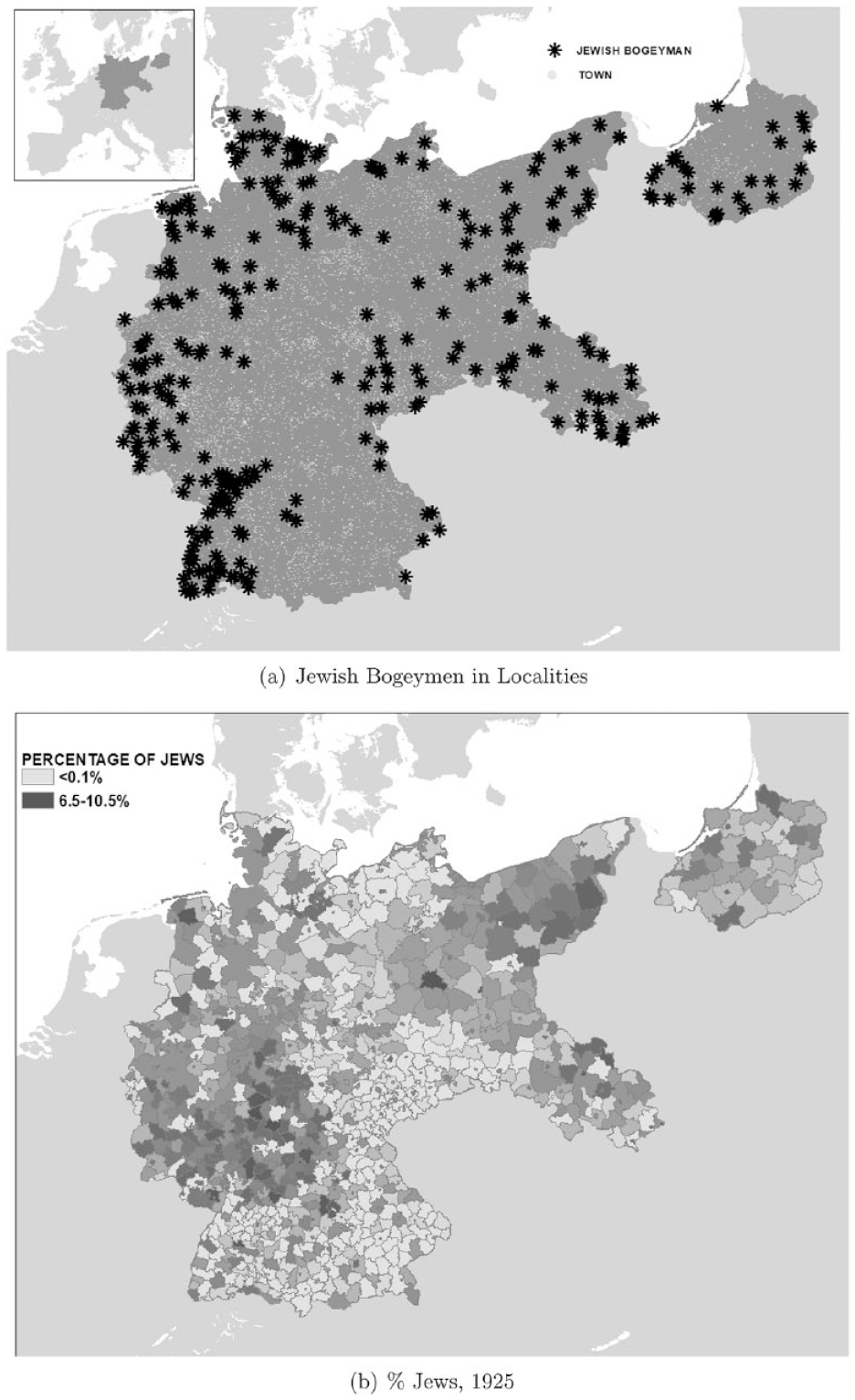
Jews and Jewish Bogeymen in Weimar Germany
Border regions often have distinct histories of tolerance as well as conflict and undergo unique demographic, economic, political, and military transformations that can be plausibly linked to the outbreak of antisemitism (Segal 2016). I therefore statistically analyze the relationship between bogeymen and proximity to border crossings while including a range of controls that tap (1) demographic composition, (2) legacies of hate and tolerance, (3) economic problems, (4) political threats, and (5) exposure to World War I to partly address this. 12 The control variables and their descriptives can be found in the Appendix. Sources are described in Part B of the online supplement. The analysis is based on 19,828 localities nested in 946 counties and uses county-clustered standard errors. To further isolate the effect of border-crossing proximity as opposed to just being in a border region more broadly, I ran models in which I kept constant the distance to the borderline. These models provide a refined test of the border-crossing thesis as they compare localities that are equidistant from the borderline but differ in their proximity to border crossings. Hence, these models compare places near the border where no border crossing roads exist with places near the border where border crossings do exist.
Conventional statistical analysis assumes independence of observations. The bogeymen data used in this article likely violate this assumption, as oral traditions tend to diffuse through space (Grober-Glück 1974). Spatial dependence creates autocorrelation and typically introduces bias in standard errors and coefficients. To account for spatial autocorrelation, I use spatial filtering (Murakami and Griffith 2019). This approach absorbs autocorrelation in the residuals through the inclusion of Moran eigenvectors as synthetic controls among the right-hand side of the statistical model. Because the presence of bogeymen is a binary outcome, I use a logistic link function. Finally, I utilize generalized additive models (GAM), which allow for any functional relationship between the prevalence of antisemitism and road distance to the nearest border crossing (Wood 2017). 13 The results are presented in Figure 5. Full model results are reported in Part C, Tables 4 and 5, of the online supplement.
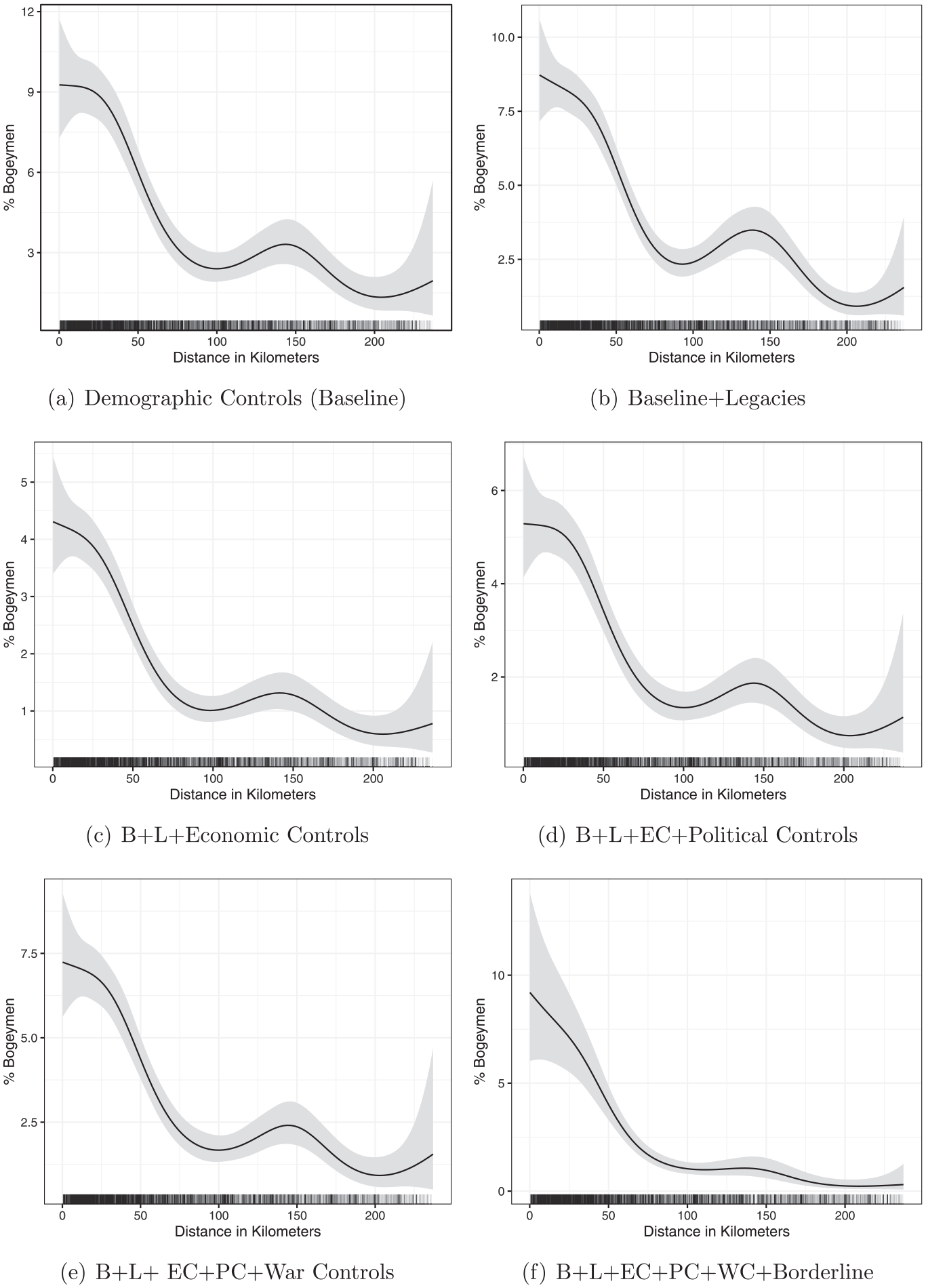
General Additive Models: Antisemitic Bogeymen and Distance from Border Crossing with 95 Percent Confidence Intervals
Panel a of Figure 5 visualizes the result of the baseline model. Initially, there is a strongly negative relationship between distance to border crossings and antisemitism. Almost one in ten of all towns adjacent to border crossings report antisemitic bogeymen, but this rapidly declines to less than 2 percent if one moves 60 kilometers inward. The strong negative relationship between distance to border crossings and antisemitism levels off and flattens once we reach the 100-kilometer point. This suggests border effects become much weaker once we move inward, and it is exactly what we would expect if xenophobia does indeed cluster around border crossings. Panels b to f in Figure 5 show this pattern is not fundamentally altered when we control for demographic differences, legacies of hate and tolerance, economic downfall, political threats, exposure to World War I, and distance to the borderline. Although the initial negative effect weakens slightly, the clustering around border crossings remains pronounced.
Instrumental Variable and Difference-In-Differences
Another major methodological concern stems from endogeneity or reverse causation bias. Historically, Jewish migration has played an important role in the construction of trade routes, which frequently included roads that cross-cut Weimar’s borders (Welford and Bossak 2010). We also know that in the centuries following the plague, Jewish migration was at times driven by outbreaks of anti-Jewish violence (Johnson and Koyama 2019). As both road construction and antisemitism persist in space (Voigtländer and Voth 2012), it is plausible that both historic borders and the roads forming Weimar crossings were produced by local-level antisemitism instead of the other way around. To solve this problem, I use two strategies: an instrumental variable approach and a difference-in-differences design.
Before introducing these approaches, I would like to make one technical comment. Both instrumental variables and difference-in-differences designs are hard to integrate into the flexible generalized additive framework used in the previous section. Because the analyses above indicate the existence of a curvilinear relationship between antisemitism, distance, and border crossings, I use inverted logged distance to border crossings to capture this functional form in the next analysis. In addition, I allow errors to be correlated across observations within the same county by deploying clustered standard errors.
To rule out worries that antisemitism produced border crossings through legacies of forced long-distance migration that took place after the plague, I draw on pre-Black Death road data collected by epidemiologists (Welford and Bossak 2010) to construct an instrumental variable. Based on a wide range of sources, scholars interested in the social transmission of the Bubonic plague have constructed fine-grained data on medieval road networks from before the Black Death’s initial outbreak and predating the first major waves of antisemitism. I use these data to capture the location where pre-plague roads cross Weimar’s national borders. I then use these pre-plague crossings as an instrument for Weimar’s border crossings. Mapping the data reveals that information on roads in Poland are sparse compared to the rest of Europe; inspection of the original source material indicates epidemiologists were not able to identify any original Polish sources on medieval roads. Therefore, I exclude localities nearest to Polish border crossings from the dataset. This results in a reduction of more than 3,000 observations. 14
For pre-plague border crossings to be a valid instrument, I need to make two assumptions. First, the location of Weimar border crossings needs to be strongly influenced by the location of medieval road networks. This is commonly referred to as the relevance assumption. I test this assumption in the first-stage regression, which uses an OLS model to predict the proximity to Weimar border crossings with a variable that measures the proximity to pre-plague crossings (see Table 1). As we can see from the large F-statistic, Weimar’s border crossings are highly correlated with pre-plague crossings, regardless of whether we control for distance to the border line (Model 2) or not (Model 1).
The Validity of Pre-plague Border Crossings as an Instrument
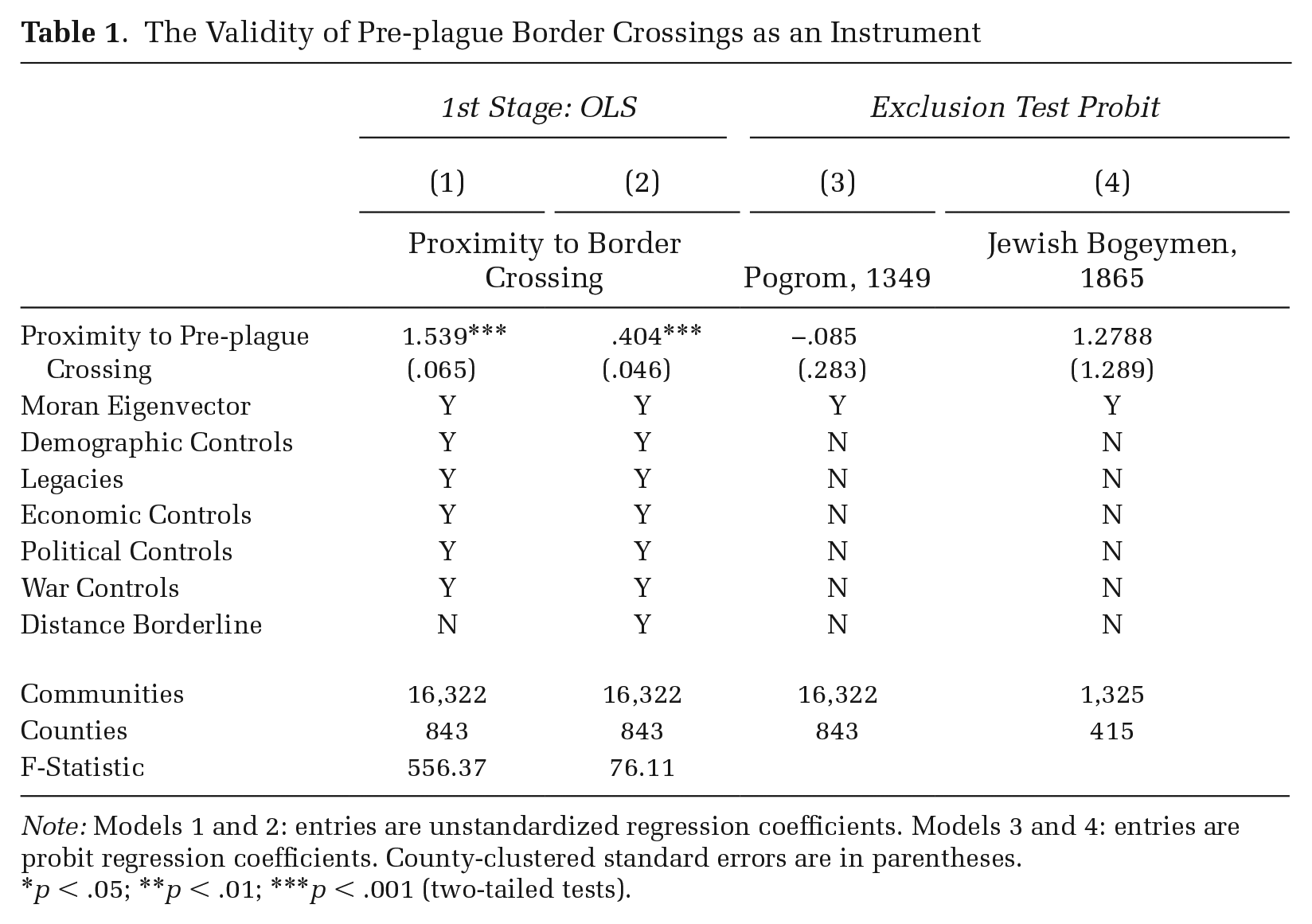
Note: Models 1 and 2: entries are unstandardized regression coefficients. Models 3 and 4: entries are probit regression coefficients. County-clustered standard errors are in parentheses.
p < .05; **p < .01; ***p < .001 (two-tailed tests).
Second, the exclusion restriction needs to be met. This requires that pre-plague crossings themselves do not directly influence local-level antisemitism, other than via the creation of later established national border crossings. This assumption is more likely to be valid if pre-plague crossings did not influence the rise of antisemitism before the establishment of a national border crossing in 1871. Therefore, I corroborate this assumption by regressing pre-plague crossings against the occurrence of pogroms during the first wave of post-plague antisemitic violence, and the resonance of Jewish bogeymen in 1865, six years before the creation of the German nation-state in 1871.
The pogrom data was compiled by Voigtländer and Voth (2012). I obtained the data on Jewish bogeymen for 1,609 localities from the earlier mentioned expert surveys conducted by Wilhelm Mannhardt (1884). This survey was digitized based on original source material held by the Staatsbibliothek Berlin, Preussischer Kulturbesitz. 15 In total, 284 of the 1,608 localities surveyed by Mann-hardt were not used in this analysis because they were closest to Polish border crossings (for which we lack complete data, as previously discussed).
As Models 3 and 4 in Table 1 show, distance to pre-plague crossings is not significantly correlated with the prevalence of pogroms after the plague or antisemitic bogeymen before the emergence of the German nation-state, providing suggestive evidence that proximity to pre-plague border crossings was not related to antisemitism before the rise of the nation-state, and making it more plausible that the exclusion restriction is met.
The reduced form analysis, presented in Table 2, Models 5 and 6, shows a positive relationship between the presence of Jewish bogeymen and proximity to pre-plague crossings. Models 7 and 8 present the second stages of two-stage probit models. This second stage uses border proximity (based on proximity to pre-plague road networks) to predict whether localities were reported to have Jewish bogeymen or not. The effect of national border proximity is robust in the IV specification. The size of the effects is summarized in the top half of Figure 6. Increasing the instrument with one standard deviation increases the likelihood of Jewish bogeymen by over 8 percent, even if we keep constant the distance from the borderline.
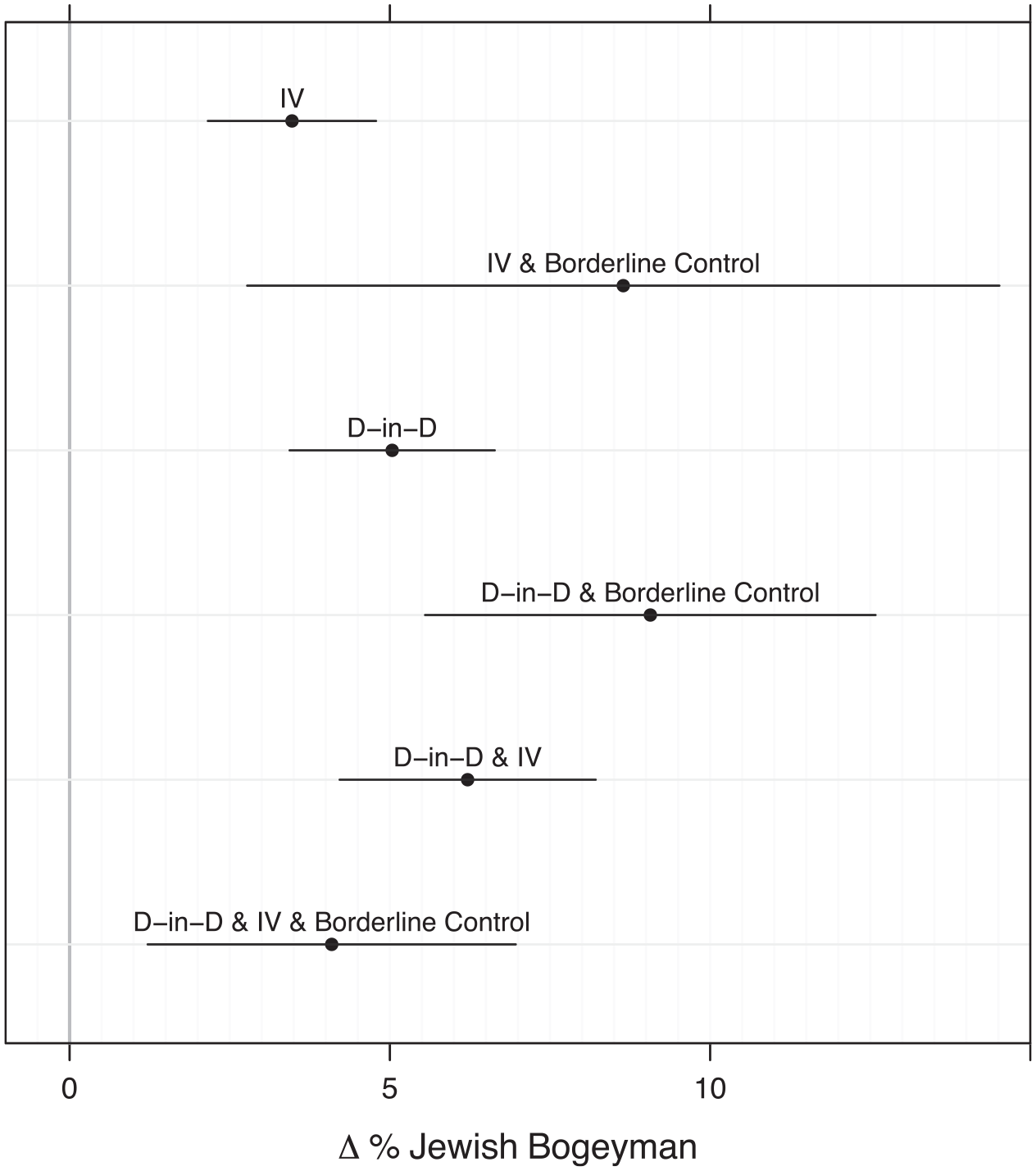
The Effect of Increasing Proximity One SD on the Percent of Local Communities with Jewish Bogeymen Using Estimates of Difference-in-Difference (D-in-D) Design and Instrumental Variable Approach (IV) with and without Borderline Control
The Effect of Exposure to Border Crossings on the Presence of Antisemitic Bogeymen: Results Based on Pre-plague Border Crossings
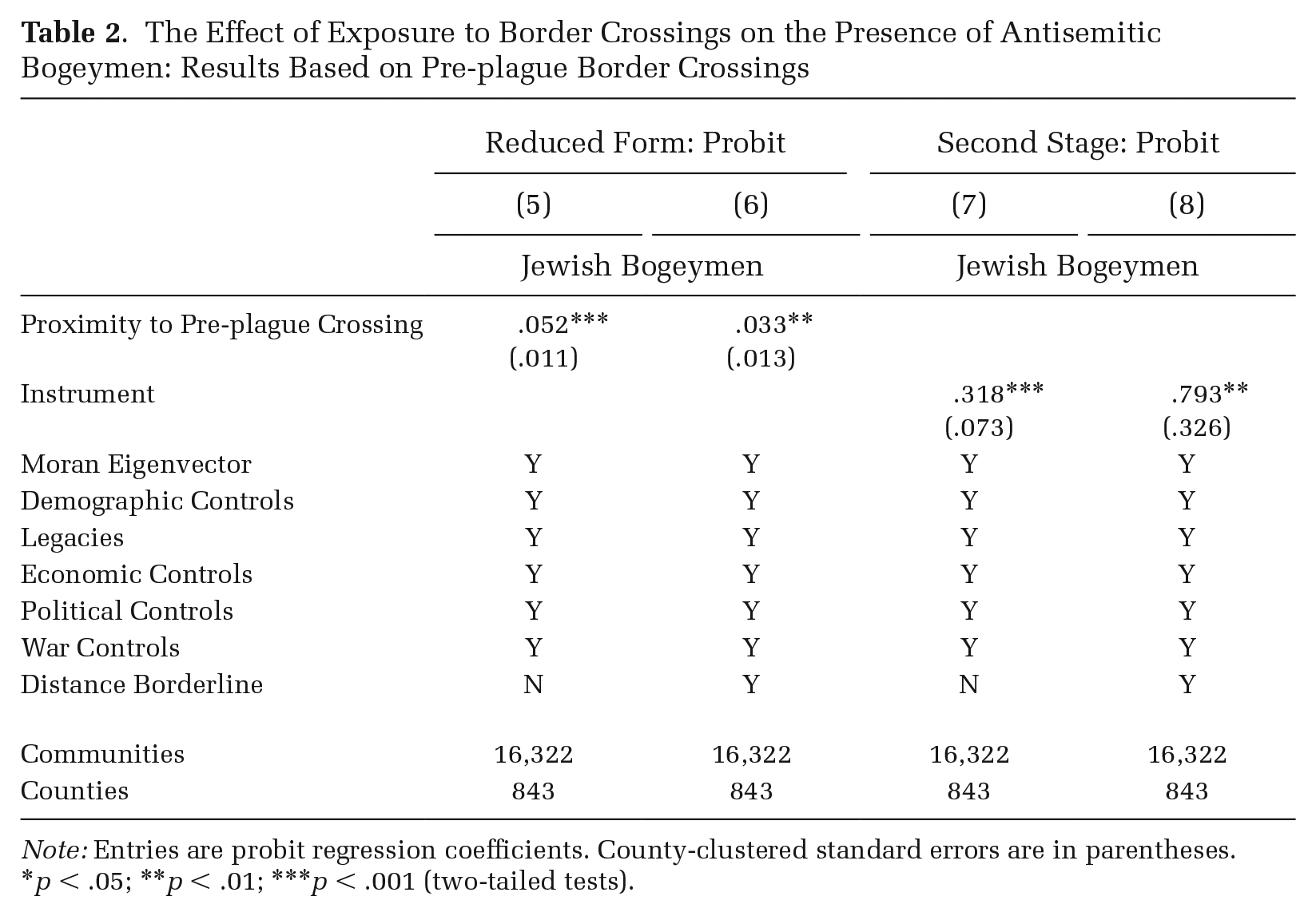
Note: Entries are probit regression coefficients. County-clustered standard errors are in parentheses.
p < .05; **p < .01; ***p < .001 (two-tailed tests).
Pairing the Weimar data from the ADV with Mannhardt’s 1865 survey also allows us to explore the clustering of Jewish bogeymen before and after the introduction of national border crossings. Figure 7 shows the percentages of localities with Jewish bogeymen in 1865 and 1930–1932 by region. Two things immediately stand out when we look at Panels a, b, and c. First, we see an overall increase in Jewish bogeymen between 1865 and 1930–1932. This pattern can be plausibly linked to two factors: the overall increase in antisemitism and the uptick in nationalist myth-making. Second, regardless of the distance threshold, the upward trend in antisemitism is much stronger in localities near Weimar’s border crossings. Jewish bogeymen are almost twice as likely in border regions when we use a 10-kilometer buffer to mark border-crossing proximity (Panel a). Again, the effect levels off when wider radii are used to calculate border regions (Panel d). Taken together, this supports the idea that proximity to newly created national borders had an independent and positive influence on the production of antisemitism.
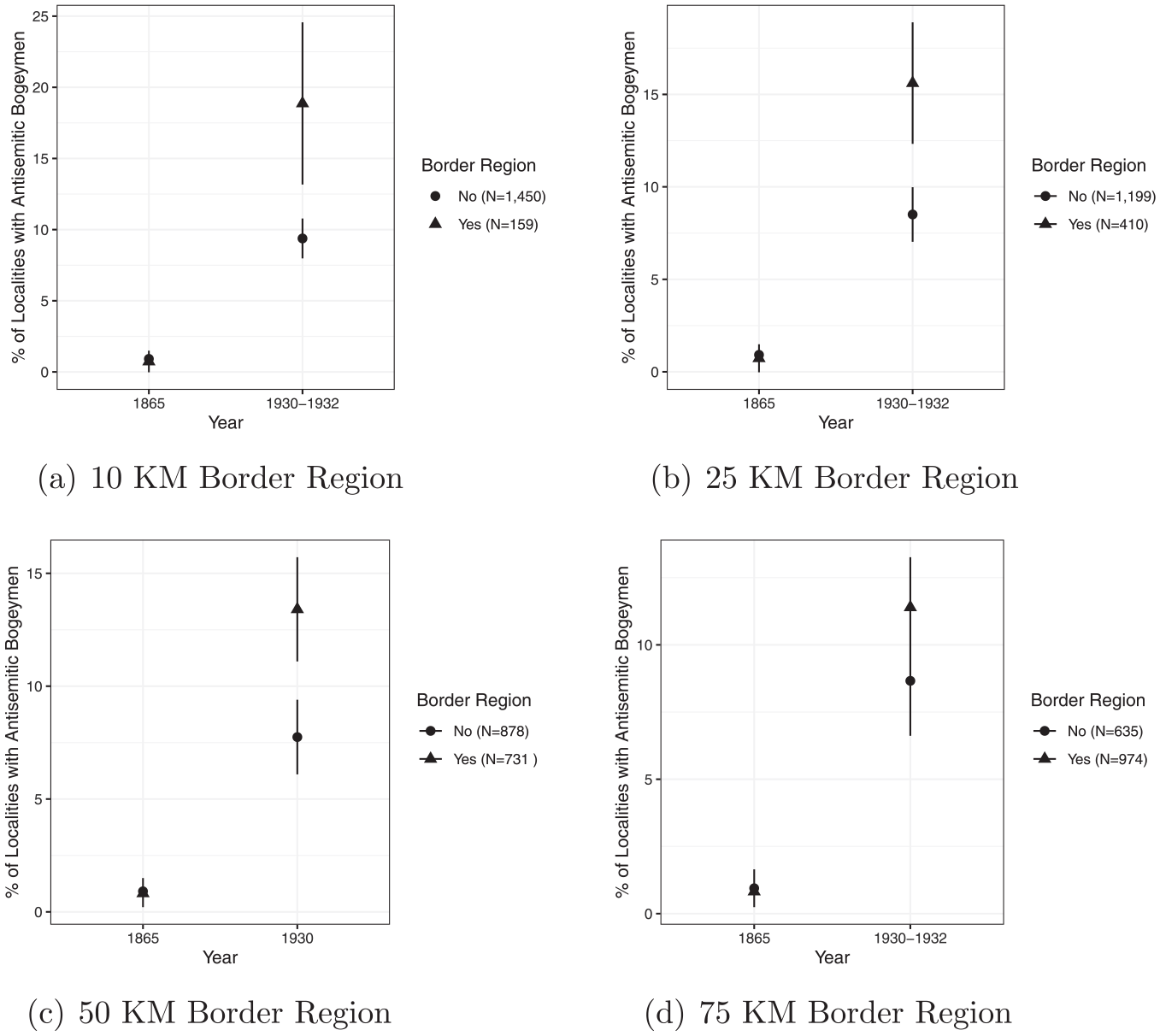
Percent of Villages with Jewish Bogeymen by Region before and after German Unification with 95 Percent Confidence Intervals
We can evaluate this relationship more systematically with a basic difference-in-differences setup where we model the interaction of time and logged distance to border crossings with time and locality fixed effects and locality-clustered standard errors to account for time-constant omitted variable bias. The model also interacts all control variables with time to account for time-varying omitted variable bias. If we consider the introduction of national border crossings an experimental treatment, localities near border crossings are the treatment group, and localities far away from border crossings are the control group. As the nation-state was established in 1871, the 1865 data provide a pre-test and the 1930s data provide a post-test. The difference-in-difference set-up allows us to estimate the effect of border crossings on antisemitism by comparing the average increase in antisemitism between 1865 and 1930 for localities near national border crossings versus localities that are not proximate to border regions, while keeping constant other time-varying factors. The difference between these increases (or the difference in differences) captures the average treatment effect of border crossings on antisemitism. The third effect line in Figure 6 displays the effect of border-crossing proximity for the difference-in-differences set-up. Increasing proximity to border crossings with one standard deviation leads to an over 5 percent higher probability of Jewish bogeymen. This effect is robust to the inclusion of distance of border line as a control and in the IV specification using pre-plague crossings as an instrument. Full models can be found in Part C, Table 6, of the online supplement.
The analyses in this section show that regions surrounding national border crossings were not more antisemitic before crossings were established, reducing concerns about early selection effects and endogeneity. Of course, the attraction mechanism requires that selection effects after the establishment of border crossings could still play an important role. Indeed, the next section reveals that the attraction of radical nationalist antisemites to the border was crucial in producing antisemitic climates.
Analysis of Centralverein Reports
The quantitative analysis in the previous section demonstrated that antisemitism clusters around border regions, but it does not tell us what processes are driving this spatial pattern. To shed light on the actors and sentiments underlying the production of antisemitism in border regions, I analyze 2,283 incidents culled from the archives of the Centralverein. The sources are described in Part D of the online supplement. In addition to exploring the incident data more systematically in Part F of the online supplement, I present an in-depth exploration of the northwestern border with the Netherlands, which the maps in Figure 4 showed to be an antisemitic hotbed. This region is particularly important because the Netherlands remained neutral during World War I and the Dutch–German border had been stable for decades, meaning prominent theories linking radical nationalism to lost territory (Mann 2005) or the presence of compatriots outside the nation (Brubaker 1996) cannot fully account for the emergence of antisemitism. That the Dutch–German border was barely touched by World War I further suggests that war violence was not necessary for the production of antisemitic bogeymen. Accordingly, a better understanding of antisemitism in the northwest will likely hold the key to a better understanding of antisemitism in general.
During the early 1920s, Bruno de Levie, a Jewish cattle trader from North Germany, regularly traveled to the livestock market in Leer, about 20 kilometers from the Dutch–German border. Upon arrival at the market on August 4th, 1928 (more than five years before Hitler’s seizure of power), he noticed something different. To De Levie’s shock, two students wearing antisemitic NSDAP symbols were parading alongside the stands. Chaos erupted after several Jewish traders, including De Levie, tried to remove the students from the market and rip off the Nazi emblems. Somewhat surprisingly, several gentile farmers and businessmen stepped up and protected the students from the assault, resulting in repeated skirmishes between groups of Jews and Gentiles. 16 The violence was not an isolated episode; similar eruptions took place in other market towns along the Dutch–German border in the months that followed. 17 In the aftermath of this wave of unrest, several restauranteurs and hotel owners stopped serving Jewish customers, 18 pamphlets encouraging locals to boycott Jewish financiers began circulating, 19 synagogues and Jewish cemeteries were vandalized, 20 and antisemitic slurs uttered by children could be heard in the streets across the northwest. 21
It is tempting to link this shift toward antisemitism to class relationships or the economic challenges small independent businesses and farmers were facing due to taxation and price regulation. However, what makes the events along the German border stand out is that market towns in Germany’s interior often formed islands of tolerance where small business owners, farmers, and Jewish traders cherished their mutual interdependencies and rejected racist resentment (Fischer 2010). Why did class and decline play out so differently in border regions?
Attraction Mechanism
An in-depth exploration of the northwestern region reveals two characteristic processes, both of which can be traced back to the proximity of border crossings. First, the visit of the two right-wing students that instigated the outpour of antisemitism in Leer was unlikely a coincidence: border regions acted as magnets for radical nationalist movements of many stripes. When going through Centralverein reports for counties with a national border crossing, 68 percent of them involved Freikorps paramilitaries, 22 right-wing veteran’s associations such as Stahlhelm, 23 members of the Pan-German League or their antisemitic wing the German Nationalist Protection and Defiance Federation, 24 and several national socialist factions, including Hitler’s NSDAP. 25
Looking at the ideologies anchoring these movements, the prevalence of their involvement near borders is not hard to understand. Apart from their open embrace of antisemitism, these organizations had one additional feature in common: each ascribed symbolic value to border regions, conceptualizing them as spaces that had to be defended from foreign influence. This motivated these actors to actively seek out the nation’s borders. While Freikorps units came together at Germany’s eastern and western borders to cut off external support for left-wing insurgencies, 26 and Stahlhelm’s veterans associations moved westward to celebrate the border as something to be insulated from Dutch and French influence, the Pan-German League went one step further to argue that parts of the Dutch borderlands should be incorporated into the German nation-state altogether (Müller 2015). Taken together, this suggests the importance of the attraction mechanism, as radical nationalist groups were drawn to border crossings to mobilize. 27
Perception Mechanism
In addition to attracting outside mobilization, border crossings also shaped how local populations living in border regions perceived their socioeconomic problems. From the early 1920s onward, the effects of Weimar’s weak currency and price control policies for food items were visible for lower-middle-class individuals living near border towns. Dutch traders and consumers crossed the border and bought livestock and other resources, posing enormous challenges for local farmers and small business owners. The “hole in the west” 28 through which valuable raw materials left the country started to symbolize the negative consequences of inflation for farmers and businessmen who, due to government regulation, competition from warehouses, and a devaluing currency, were unable to increase their prices (Feldman 1997).
The situation at border crossings also explicitly linked economic problems to international forces. Frustration grew with Dutch visitors, who at times “descended like hyenas” (Feldman 1997:237) to buy out their hapless neighbors. Retailers in Duisburg, for instance, started describing the Dutch as foreign plunderers and “dark uncontrollable elements” that behaved like sharks in blood-spilled waters. Some restaurant owners and hoteliers stopped serving Dutch customers altogether, so they could focus on their German clientele (Feldman 1997:237).
Figure 8 provides a powerful illustration of how border crossings shaped local sentiments. It depicts emergency money produced in the border town of Goch during the financial crisis of 1921 to 1923. During the early years of the Weimar Republic, many local farm and trade communities would issue their own billets to satisfy the need for small change. Considerable effort was put into the design of the money. These designs often featured celebrations of local historical events or attractions, but at times they also included political messaging. Here we see how the prints explicitly turn the border crossing in Goch (Figure 8, panel a) into a focal point for social problems: they lament the loss of goods to Dutch neighbors who buy up resources in Germany (Figure 8, panel b). This indicates that borders activated a perception mechanism through which social problems were linked to international origins.

Emergency Money Published in the Town of Goch, 1922
The internationalization of social problems also produced distinct forms of political mobilization. Between 1924 and 1928, farmers staged a wave of protests demanding that the Weimar government protect them from international competition and price differentials (Bergmann and Megerle 1989). Small business owners would often join these protests to express their shared discontent with international economic influences. Apart from this form of extra-parliamentary mobilization, small business owners also organized themselves into a special interest party, the Business Party (BP), which ran on a protectionist platform in the national elections of 1924 and 1928 (Schumacher 1972; Winkler 1976). 29
Convergence
In the late 1920s, the influx of far-right groups and the resentment of small business owners and farmers toward international forces started to converge. Radical nationalists’ initial attempts to draw workers into their organizations had limited success. The propaganda activities of the far-right did not resonate with laborers’ daily experiences (Noakes 1971). This suggests propaganda alone cannot account for the clustering of antisemitism near borders. It was not until National Socialists, veterans, and the Pan-German League started to actively reach out to small business owners and farmers that they saw their base grow.
These radical groups initiated boycotts against international Jewish bankers and warehouses to lure in shopkeepers, 30 and they depicted Jewish traders as border-transcending parasites that made money off the backs of hardworking farmers. 31 Their propaganda linking social problems to international enemies dovetailed with how the lower-middle classes in border regions had come to perceive the sources of their daily struggles.
After radical nationalists started targeting lower-middle classes, many of the restaurants and hotels near the border who boycotted the Dutch now became clubhouses for far-right associations and refused to serve Jewish customers. 32 During this period, local farm associations started issuing emergency money again, this time in response to the Great Depression. On this occasion, however, the billets featured a Jewish financier hugging a bag of coins instead of Dutch women wearing bonnets. 33 Interestingly, these dynamics were present in both Protestant Lower Saxony and Catholic Westphalia. The latter region was characterized by the well-organized Catholic Zentrum party, which insulated its constituents from nationalist propaganda, so this suggests the border thesis cuts through strong partisan walls. It also provides support for the notion that Catholics rejected National Socialism but not antisemitism as such (Kauders 1996). 34
At the turn of the decade, a coalition of German militias, Stahlhelm veterans, members of the Pan-German League, wings of the National Socialist movement, and disgruntled farmers came together in the Landvolk Bewegung. 35 This movement started organizing violent protests against international capitalism, Weimar’s trade policies, and low food prices. The protests featured a range of antisemitic tropes linking Jews to international finance and socialist governance. Two of the largest riots took place in Emden and Norden, 36 counties bordering the Leer market (where we began this section). 37
Radical nationalist frames deploying antisemitism resonated near border crossings in northeast Germany because the lower-middle classes living in these areas already linked their social problems to international processes. In Germany’s other border regions, this internationalization of social problems took different forms. Along all of Weimar’s borders, border crossings activated ethnic fault lines and antisemitism among vulnerable social classes by increasing exposure to nationalist Frenchmen, African soldiers (North Rhine), regionalist conflict (Schleswig), Poles (Eastern Prussia), refugee flows (Silesia), and price differentials (Saxony) (Braun 2021). Although the exact source of international resentment varied across border regions, the same spatial configuration played a powerful role by linking social problems to international forces and attracting radical nationalists, which together produced a fear of Jews. Space limitations prevent me from zeroing in on each of the cases. Instead, Part F of the online supplement provides more comprehensive statistical analyses of all antisemitic events. Taken together, these analyses show that a disproportionally large number of all antisemitic events involved radical nationalist groups or vulnerable social classes and took place near border crossings. Equally important, farmers, small business owners, and external radical nationalist groups were much more likely to be involved in events near border crossings, providing evidence that the border theory picks up on a pattern across the whole of Germany.
Mechanisms
The in-depth case study of the northwestern border revealed two mechanisms that turn border crossings into hotbeds of xenophobia. First, national border crossings prime national differences, forging a perceived link between social problems and international factors among groups that are losing social status (the perception mechanism). In line with existing work (Heberle 1962; Lipset 1960; Loomis and Beegle 1946), the Centralverein data show this was particularly true for farmers and small business owners who were most likely to face the consequences of price regulation and hyperinflation. Second, border crossings attract radical political mobilization (the attraction mechanism). In this section, I assess the plausibility of the different components of the argument with quantitative data.
Let us start with the important role the lower-middle classes played in the production of antisemitism. If the perceived internationalization of social problems among farmers and small business owners was responsible for the production of antisemitism, the border-crossing effect should be stronger in localities with sizable farm communities and large numbers of small business owners. To investigate these empirical implications, I use kernel density interactions (Hainmueller, Mummolo, and Xu 2019) 38 to examine the heterogeneity of border-crossing effects across localities with and without vulnerable economic classes experiencing economic downfall. 39 Figure 9 presents the marginal effects of changing the logged proximity to national border crossings by one standard deviation on antisemitism, conditional on the percentage of the population employed as farmers or small business owners. The latter captures the presence of the middle classes that were losing status in the Weimar Republic (Heberle 1962; Lipset 1960; Loomis and Beegle 1946).

Marginal Effect of Changing Inverse Distance (Logged) One SD Conditional on Percent Farmers and Percent Small Business Owners with 95 Percent Confidence Intervals
In line with the perception mechanism, which states that border crossings increase attribution of social problems to international forces by lower-middle classes, the overall effects are indeed stronger in regions with large proportions of economically vulnerable social classes. Whereas proximity to border crossings has little to no effect in localities with few farmers and where small business owners experienced little economic decline, increasing logged proximity to border crossings by one standard deviation increases the prevalence of antisemitic bogeymen by almost 10 percent in localities with sizable vulnerable groups facing deteriorating economic conditions. This confirms the importance of lower-middle classes in the production of anti-Jewish resentment.
An analysis of different forms of political mobilization provides quantitative evidence consistent with the attraction and perception mechanisms. Unfortunately, it is not possible to find fine-grained data on different forms of political mobilization for each of the 19,829 German localities. However, secondary literature and membership books allow me to retrieve county-level information on several of the radical nationalists groups and different forms of lower-middle-class mobilization introduced in the previous section. 40
If border regions act as focal points for radical nationalist movements, as the attraction mechanism postulates, we would expect to find more far-right mobilization in the vicinity of border crossings. I compiled county-level information on the presence of local chapters of the Pan-German League and Freikorps units, significant membership rates in Stahlhelm, as well as campaign events held by Hitler’s NSDAP and protests staged by the Landvolk Bewegung. From this information, I created a binary outcome variable that marked whether counties were touched by at least one form of mobilization.
To capture the perception mechanism, I created three variables that tap lower-middle-class mobilization around the perceived internationalization of social problems. If borders indeed activate the perceived internationalization of social problems, we would expect this form of political mobilization to be more intense near border crossings. As discussed in the previous section, between 1924 and 1928 farmers staged a series of protests to demand government protection against international competition and price differentials (Bergmann and Megerle 1989). Small business owners frequently joined these demonstrations, and they also rallied for protection against international competition by supporting the Business Party (BP) in the 1924 and 1928 elections (Schumacher 1972; Winkler 1976). I therefore mark counties in which farmers engaged in pro-protectionist protests between 1924 and 1928. I also mark counties in which small business owners participated in pro-protectionist protests, and I take the average percentage of votes for the BP between 1924 and 1928 to measure the extent to which small business owners mobilized against the international origins of social problems. The latter variable is logged to deal with its skew.
Figure 10 shows the results of generalized additive models that include all control variables described in the Appendix. 41 In line with the attraction mechanism, panel a shows that radical mobilization is most prevalent near border crossings and declines rapidly when moving inward. This decline, however, is curvilinear and levels off with distance. Panels b and c show that all three forms of pro-protectionist mobilization against international threats by lower-middle classes follow a similar pattern. Taken together, this provides tentative support for the attraction mechanism, which postulates that border crossings operated as magnets for radical nationalist mobilization; the perception mechanism, which postulates that lower-middle classes living in the vicinity of border crossings were more likely to perceive the international origins of social problems; and the notion that both of these mechanisms converge at border crossings.

Generalized Additive Model (Full Set of Controls) of Radical Nationalist Mobilization, Pro-protectionism Protests, Votes for Business Party, and Distance to Border Crossings with 95 Percent Confidence Intervals
In Part G of the online supplement, I explore whether alternative mechanisms can account for the clustering of antisemitism near border crossings. In particular, I considered five alternative causal processes induced by borders: regionalism, early post-war nationalism, pre-war antisemitism, increased exposure to Jewish populations, and distinct socioeconomic characteristics of Jewish communities. Generalized additive models suggest none of these processes provide a plausible link between border crossings and antisemitism.
Conclusions
A considerable body of work on xenophobia has identified political and economic sources of resentment. Whereas the former emphasizes the importance of electoral threats and instigation by movement leaders, the latter zeros in on how vulnerable social classes that are losing status scapegoat outsiders in times of socioeconomic upheaval. This article brings together both branches to develop a spatially contextualized explanation for xenophobia by showing that whether economic decline, the presence of vulnerable social groups, or political instigation by social movements converge to produce fear of outsiders is conditional on relative location within the nation.
The article reveals that national border crossings, spatial locations that link two nation-states, activate both top-down and bottom-up processes that together provide a fertile breeding ground for the production of ethnic fear. First, groups losing social status are more likely to attribute their decline to international factors when national differences are made salient by a nearby border crossing. Second, border regions disproportionality attract radical xenophobic movements that want to protect the nation from alien threats. The first process creates bottom-up demand for international scapegoats among vulnerable social groups, and the latter fulfills these demands top-down by framing international actors as the root of all evil.
Before discussing potential strengths and contributions of this project, I would like to briefly highlight one of its key weaknesses. Although the article compellingly shows that antisemitic bogeymen and events cluster near border crossings and begins to unpack the socioeconomic dynamics underlying these clusters, it does not really explain how the latter dynamics were able to shape the content of children’s tales in the first place. Research tracing this process is currently in progress.
This weakness notwithstanding, this study unearths a specific interaction between space, class, and political mobilization that holds important implications for the study of ethnic conflict, antisemitism, and German history. At a general level, this article joins a growing body of work that situates inter-group dynamics in the context of broader cleavage structures (Braun 2019, 2020) through the demonstration that borders between nations activate borders within nations. Existing research often looks at how relationships between insiders and outsiders influence mutual resentment, but this article suggests intersections within insider groups (i.e., national borders between Christian Gentiles) alone can activate hatred toward a third group (i.e., the Jews) by shaping the perception of social problems and producing ethnic mobilization.
The findings also provide a micro-foundation for macro-sociological theories on the rise of nationalism and ethnic conflict. The shift from empire to nation-state has produced intensified political exclusion along ethnic lines (Wimmer 2002, 2012). I suggest this shift was particularly strong in border regions between different nations. Mechanisms that specify how this shift materialized at a local level show how cognitive and mobilization processes at the margins of challenged nations are important in shaping the forms ethnic exclusion might take at the political center.
The exclusion of Jews is a case in point. While most historians and some social scientists recognize the early roots of antisemitic thought (Niewyk 2018; Voigtländer and Voth 2012), a majority of social scientists argue that the importance of deep-seated hatreds is perhaps overstated (Kopstein and Wittenberg 2018). The over-time analysis of Jewish bogeymen reveals that although the antisemitic theme of the Jew as a border-transcending actor is ancient, its influence varies through time and space. Fear of Jews as measured in children’s stories became stronger after the establishment of the German nation and mainly concentrated along Germany’s borders. The border thesis put forward here thus shows how ancient xenophobic themes about border transcendence and disloyalty interact with contemporary spatial configurations to produce hatred toward outsiders near places that symbolize cross-national connections and influence (Charnysh 2015).
Finally, this article also returns to the now debunked geographic interpretation of German history. This controversial approach claims that Germany’s precarious geographic location in Central Europe played an important role in the emergence of the Third Reich and the Holocaust. Bordering enemies on all sides, this approach states Germany could not afford democracy and was forced to embrace radical nationalist authoritarianism (Evans 2006). Although my findings should not revitalize this somewhat teleological geographic thesis, they do shed light on how pressure at Germany’s borders produced a xenophobic climate that could be exploited by radical movements, some of which played an important role in the establishment of Hitler’s rule.
This brings us to the generalizability of the border thesis. Further research is required, but there is suggestive evidence that the mechanisms outlined here travel beyond the confines of the truly unique German case and operate elsewhere when the nation-state is under pressure. Eastern Europe also saw the rise of aggressive antisemitism that was closely aligned with distinct patterns of nationalist mobilization in the border regions of Hungary, Czechoslovakia, the Ukraine, and Bulgaria (Segal 2016).
Outside the realm of antisemitism, research on the Armenian Genocide indicates that conflict between nationalist Turks and the Armenians was most salient along borderlines due to fear of Russian influence (Bloxham 2005). Similarly, hatred toward Tutsis was more severe in Rwanda’s border regions, partly due to radical mobilization by recent nationalist immigrants (McNamee 2018). Closer to home, recent ethnographic work on the U.S.–Mexico border shows that status anxiety drove anti-immigrant groups from across the country to southern Arizona in the early 2000s to work with local vigilantes and prop up what they perceived as fundamental weaknesses in the armor of the nation-state (Elcioglu 2020). The border also attracted progressive groups, leading immigration politics to become highly polarized around border crossings (Elcioglu 2020), which intensified anti-Mexican attitudes (Branton and Dunaway 2009). Backing up these different cases, a recent statistical analysis with worldwide coverage also provides support for the notion that in times of instability, domestic ethnic conflict is more prevalent near national borders (Wucherpfennig et al. 2011).
Closer inspection of the mechanisms provide an opportunity to elucidate potential scope conditions of the border theory (Ermakoff 2019). The attraction mechanism is activated when border crossings symbolize threats to national security and act as magnets for radical nationalist groups. This (perhaps too) obviously implies that an organized nationalist movement rooted in xenophobia needs to exist for border crossings to turn into xenophobic focal points. Unfortunately, this scope condition is not very restrictive given the recent resurgence of nativist movements around the globe. More interestingly, it also suggests border crossings are more likely to turn into hotbeds of xenophobia when they becomes symbols of international threat. This could perhaps explain why the Arizona–Mexico border became more contentious in the early 2000s (Elcioglu 2020). Because some of the 9/11 bombers entered the country via land, the government dedicated more resources to border protection, at the same time politicians and pundits started framing U.S. borders as being part of a sustained intensive antiterrorism operation, turning border crossings into symbols for nationalist defense (Andreas 2012). This process is similar to what happened at Weimar’s borders near the end of World War I (as summarized in Figure 1).
The perception mechanism postulates that border crossings activate the internationalization of social problems by priming international differences and influences. We can deduce from this that border crossings are less likely to become focal points for xenophobia when they fail to make international differences visible. As Allport (1954) pointed out long ago, differences between social groups become less salient when they are rooted in cross-cutting interactions that are both equal and cooperative in nature. Consequently, this suggests the xenophobic effects of border crossings will become less powerful the more they are embedded in harmonious and cooperative border-spanning communities. This might explain why the U.S.–Canadian border is a rather harmonious region characterized by little ethnic resentment or mobilization. The fact that local elites on both the Canadian and U.S. side of the border work together to promote regional prosperity (Gilbert 2005) might account for the fact that ethnic tensions have remained limited. In contrast, Weimar Germany was surrounded by states it deemed inferior or that were in fact economically superior, making it plausible that the border thesis only operates in the absence of extensive equal and cooperative ties between national communities that could potentially reduce the perception of international difference.
On the flip side, it is important to highlight that border mechanisms might operate beyond the land crossings that are investigated in this article. Changes in international transportation have created new sites where goods and people from different nations meet, such as air- and seaports. Recent waves of airport protests against and in support of travel bans suggest these hubs could also become focal points for xenophobia as they come to symbolize external threats and prime national differences. 42
Some scholars suggest the era of the nation-state is coming to a close. Could this imply that the coordination of xenophobia around border crossings in times of crisis will disappear altogether? The answer is probably no. If anything, the number of border crossings has increased over the past few decades. Apart from this quantitative shift, border crossings have also become more important in a qualitative sense. Borders are under renewed scrutiny from local populations, external vigilante groups, political movements (from the left and right), right-wing media outlets, and political elites (Simmons 2019). It only requires a little bit of speculation to make the argument that this salience will continue to have psychological effects, spark political contention, and consequently organize inter-group relations for decades to come.
Supplemental Material
sj-pdf-1-asr-10.1177_00031224211071145 – Supplemental material for Bloodlines: National Border Crossings and Antisemitism in Weimar Germany
Supplemental material, sj-pdf-1-asr-10.1177_00031224211071145 for Bloodlines: National Border Crossings and Antisemitism in Weimar Germany by Robert Braun in American Sociological Review
Footnotes
Appendix: Control Variables and Descriptives
Border regions have distinct histories and experience unique demographic, political, economic, and military dynamics that can be plausibly linked to antisemitism (Dower et al. 2018). To investigate the independent influence of the attraction and perception mechanisms on the clustering of antisemitism, we therefore need to consider a wide range of confounders. Let us go back in time and start with the long-term legacies that borderlands carry. Unless indicated otherwise, all variables are measured at the county level. I use county-clustered standard errors to deal with the dependence in measurement.
Acknowledgements
Earlier versions of this article benefitted from discussions at the School for Advanced Studies in the Social Sciences, Paris, the CHSS Workshop at Northwestern University, the Department of Political Economy at the University of Barcelona, the Department of Sociology at Stanford University, the Comparative Politics colloquium at the University of Wisconsin-Madison, INCITE at Columbia University, the Comparative Politics Colloquium at UC-Berkeley, the Institute of Sociology at the TU Dresden, the Department of Sociology at the European University Institute, the Department of Political Science at UC-Irvine, and the Institute for European Studies at the University of British Columbia. Thanks to Maja Adena, Brian Bossak, Paul Thurner, and Mark Welford for sharing data. I am grateful to Maria Abascal, Karen Barkey, Peter Bearman, Elias Dinas, Kerice Doten-Snitker, John Efron, Jeremy Ferwerda, Claude Fischer, Neil Fligstein, Makoto Fukumoto, Otto Kienitz, Jennifer Lee, Jonah Levy, Andrew Little, Aliza Luft, Kasia Nalewajko, Jim Mahoney, Chris Muller, Alison Post, Monica Prasad, Dylan Riley, Seymour Spilerman, Ann Swidler, Mathijs de Vaan, Martha Wilfahrt, Jason Wittenberg, and four reviewers for conversations along the way. I would like to thank Laura Acosta-Gonzalez, Alison Chai, Yannick Coenders, Emilio Lehoucq, Luna Kohut, and Tihomir Vrdoljak for their superb research assistance.

Notes
References
Supplementary Material
Please find the following supplemental material available below.
For Open Access articles published under a Creative Commons License, all supplemental material carries the same license as the article it is associated with.
For non-Open Access articles published, all supplemental material carries a non-exclusive license, and permission requests for re-use of supplemental material or any part of supplemental material shall be sent directly to the copyright owner as specified in the copyright notice associated with the article.
