




Abstract
This article argues that folklore (orally transmitted group knowledge) shapes far-right voting by inculcating feeling rules that resonate with nativist and autocratic ideas. Drawing on recently rediscovered archives of nineteenth- and twentieth-century folklorists, we pair a dataset of local support for the far-right in all Reichstag elections in Germany’s Weimar period, with unique information on the prevalence of ethnic bogeymen in local folktales. Using spatial autoregressive models, we find a robust and considerable effect of the presence of fearful folktales on radical right voting. These effects are particularly strong for localities where citizens face political and economic threats. We use an instrumental variable analysis drawing on folklore data from the 1860s to establish the long-term roots of this pattern, disentangle the effect of folktales from contemporary political influences, and establish causal order. Our findings suggest that folklore plays a key role in aligning the supply and demand for far-right movements by shaping how citizens see and feel the world around them. In addition, we illustrate that folklore archives provide a unique opportunity to unpack affective-discursive canons across space and time.
Political parties that combine authoritarianism and nativism (Rydgren 2007) are threatening pluralism in the United States (Bonikowski 2017), Europe (Mudde 2007), and beyond. Dominant explanations of these radical right movements have zeroed in on either demand- or supply-side factors (Muis and Immerzeel 2017; Rydgren 2007). Whereas the former suggests ethnic outsiders are blamed for objective economic (Olzak 1994), demographic (Knigge 1998), and political threats (Blalock 1967; Koopmans and Olzak 2004), the latter looks at how macro-level developments in political alignments (Arzheimer and Carter 2006; Kitschelt and McGann 1997) create room for the radical right to grow. Both types of explanations have received mixed support and are deemed incomplete (Bonikowski 2017; Golder 2016), particularly if one takes into account the subnational geography of voting (Della Posta 2013; Golder 2016).
In this article, we propose that local folklore, that is, orally transmitted group knowledge (Dundes 1971b), interacts with supply and demand factors to produce subnational support for nativist and authoritarian parties. We center folklore for four reasons. First, folklore is among the most important vehicles for the communication of symbols that anchor identity (Dundes 1984). Second, folklore is inherently local (Fine 2018), providing a plausible link to unexplained subnational voting patterns. Third, folklore has a strong affective underbelly (Fischer 1963) that can be manipulated for political gain (Illouz 2023). Because the oral communication of folktales relies on memorization, folktales often have a clearly structured set of characters, such as heroes, helpers, victims, and bogeys (Propp 1968), that can easily be recast as vehicles for emotional transmission (Tatar 2019). Fourth and relatedly, folklore is crucial for childhood socialization in the prewritten stage (Fine 1980), during which most affective predispositions congruent with political symbols are formed (Sears et al. 1980).
Forging a connection between folklore studies and the sociology of emotions, we argue that folktales constitute an “affective-discursive canon”: a set of shared emotional meanings and practices that shape what one is allowed to feel and say (Wetherell 2012). This canon can be broken down into “feeling rules.” According to Hochschild (1983:57), feeling rules are “the social guidelines that direct how we want to try to feel.” Hence, these rules are shared norms that guide how people are supposed to feel (Hochschild 1983) as well as the appropriate objects of these feelings (Simon, Eder, and Evans 1992). These canonized feeling rules can shape the resonance of authoritarianism and bolster the far-right (Hochschild 2016).
Indeed, a few scholars have speculated about folklore as a background condition for the rise of the radical right in Germany. For instance, Snyder (1951) concluded that the Grimm’s fairytale stories, the Hausmärchen, which they sometimes drew from local tales, inculcated order, obedience, xenophobia, and antisemitism, all while allowing German nationalism to develop and flourish. In addition, early formulations of resonance put folklore front and center. For instance, in their agenda-setting article on framing, Snow and Benford (1992:141) wrote that mobilization depends on whether political messages (or frames) accord with “beliefs, myths, folktales and the like.”
Nevertheless, empirical demonstrations of the relationship between folklore and local political mobilization are rare. The reason for this is obvious. Folktales are often not written down, making it hard to measure them systematically in general and at a local level in particular. In this article, we overcome this problem by drawing on the archives of late-nineteenth- and early-twentieth-century folklorists in Europe. During this time-period, perhaps the golden age of Folklore Studies, scholars went to great lengths to transcribe and describe these oral traditions. Yet, these same researchers made little analytic use of this material (Hallowell 1947).
We recover this rich body of data to investigate at a fine-grained level the relationship between local-level exposure to folklore and radical right voting in Weimar Germany, one of the most important cases of democratic breakdown. Apart from its historical importance, we study this case for two additional reasons. First, the case has a distinct combination of macro-level supply and demand factors that facilitated a remarkable break-through of the radical right (Jones 2020). Second, the case is steeped in different folklore traditions, which enables us to capture subnational variation in local customs and stories (Snyder 1951).
We exploit this variation by hypothesizing that folktales featuring ethnic bogeys will legitimize fear toward outsiders and increase the resonance of far-right mobilization. We leverage over 50,000 geocoded reports on children’s stories collected in the 1860s and 1930s by folklorists (Mannhardt 1884; Zender, Grober-Glück, and Wiegelmann 1958) to map out where ethnic bogeymen appeared in children’s folklore locally. We pair this unique dataset with county- and municipality-level data on radical right support in all the Reichstag elections that took place in the Weimar Republic (Falter and Hänisch 1990). To deal with potential endogeneity problems, we deploy an instrumental variable analysis that uses the local presence of ethnic bogeymen before the birth of the German nation-state to capture exogenous variation in ethnic fear unrelated to contemporary political developments.
A pooled spatial autoregressive analysis, as well as an analysis disaggregated by election and party, reveals a robust and notable correlation between support for the radical right and xenophobic folklore, with considerable effect sizes compared to other covariates in the models, predictors from other studies, and potential omitted variables. In addition, we find that the effect of xenophobic folklore on support for the radical right is particularly strong in places facing economic and political threats. Our findings suggest that accordance with feeling rules induced by folklore shapes the success of the radical right by both influencing how people link threats to political solutions and increasing resonance of far-right messages.
Folklore is not only something produced by movements (Davis 2002; Roy 2002), it also provides the affective-discursive context in which mobilization takes place. It determines whether supply and demand for the radical right align by changing how individuals see and feel the world around them. Incorporating folklore into our models thus allows us to get closer to a multilevel theory of radical right voting, which has important implications for political sociology.
Existing Explanations
Although there is considerable disagreement about the exact characteristics of radical right parties (Mudde 1996), scholars believe that most of them combine at least some form of nativism and authoritarianism (Bonikowski 2017; Caiani 2019; Golder 2016; Mudde 2007; Muis and Immerzeel 2017; Rydgren 2007). The former calls for states to only comprise members of the dominant ingroup who share the same ethnicity, religion, or language. Non-natives, in this view, are seen as threats to the culture and order of the nation-state (Mudde 2007). The latter constitutes the desire to use state power against alleged state enemies to restore social order in a manner that undermines liberal rights and democratic institutions (Levitsky and Ziblatt 2019). To explain when and where parties combining these traits are successful, scholars have distinguished between supply- and demand-side explanations (Caiani 2019; Golder 2016; Muis and Immerzeel 2017; Rydgren 2007).
Demand-side explanations see votes for far-right parties as an expression of perceived threats posed by outsiders. Most of these group threat theories draw from Blumer (1958), who argued that prejudice toward ethnic and racial minorities is a defensive reaction to the declining privileges of dominant groups. The greater the sense of threat toward their prerogatives, the more likely dominant-group members are to express prejudices against outsiders and vote for the radical right. The literature generally distinguishes three sources of increased threat perception.
First, drawing on Blalock (1967), scholars have suggested that far-right voting is correlated with the relative group size of minorities, as this induces objective competition over scarce resources (Knigge 1998; Olzak 1994) and perceived threats to the social status of dominant groups (Mutz 2018). Second, scholars have linked far-right voting to economic circumstances. When dominant groups face economic problems, they start fearing the loss of their economic advantages and become less integrated in mainstream society (Gidron and Hall 2017). This combination results in increased threat perceptions (Quillian 1995) and votes for xenophobic parties (Jackman and Volpert 1996). This argument has been applied to explain support for far-right parties among the working class (Morgan 2018), as well as small independents, retailers, middle-sized farmers, and traders (Lipset 1960). Third, and again drawing on Blalock (1967), scholars have focused on political threats. In this view, people are more likely to engage in radical right mobilization if minorities are seen as posing an electoral threat to the political establishment (Brustein and King 2004; Kopstein and Wittenberg 2011).
Another demand-side explanation zeros in on cultural backlash rather than threats. This body of work argues that traditional rural and working-class communities with lower levels of education have become estranged from dominant discourse because of society-wide increases in support for pluralist values they themselves oppose. In response to this shift, they turn toward authoritarian and anti-immigrant parties that aim to restore the traditional values of the past (Norris and Inglehart 2019). The cultural backlash theory resonates with developments in Weimar Germany, where far-right voters were driven by increased resentment toward growing cosmopolitanism and pluralism (Weitz 2018). This demand-side explanation makes some similar predictions as the threat-based supply-side explanations (e.g., in its focus on the working class), but it is different in that it explicitly links radical right voting to macro-level changes in social values.
Moving away from reasons for the electorate to vote for the far-right, supply-side explanations look at how transformations in broader political opportunity structures, such as party competition, electoral rules (Arzheimer and Carter 2006), and national cleavages (Kitschelt and McGann 1997), provide voters with the option to vote for parties espousing nativist and authoritarian ideas.
Empirical support for both explanatory frameworks is mixed (Golder 2016; Rydgren 2007). Looking at the supply side, centrist positioning of conservative parties, which should theoretically increase electoral space for the radical right, sometimes does so (Abedi 2002; Carter 2005; Spies and Franzmann 2011), but it can also have the opposite effect (Arzheimer and Carter 2006) and most often has no effect at all (Bustikova 2014). Demand-side scholarship similarly finds inconsistent evidence of a link between political, economic, and demographic threats (Arzheimer and Carter 2006; Knigge 1998; Lubbers and Scheepers 2002) and radical right support. Focusing on economic threats, some studies have found that economic problems increase support for the radical right (Jackman and Volpert 1996; Morgan and Lee 2019), but substantial evidence also shows that economic threats decrease this support (Arzheimer and Carter 2006; Knigge 1998) or have no effect at all (Lubbers and Scheepers 2002). Turning to demographic threats, by looking at whether support for the radical right is linked to the size of the immigrant community, we find mixed evidence, with some studies finding no effect (Arzheimer and Carter 2006; Lucassen and Lubbers 2012; Rydgren 2008) and some finding an increase in support (Golder 2003; Knigge 1998; Lubbers and Scheepers 2002; Van der Brug, Fennema, and Tillie 2005).
In addition, supply-side and demand-side explanations are often deemed incomplete. Whereas macro-level transformations in supply often account for shifts over time in far-right success at the national level, they have much less to say about more fine-grained variation. This is important as far-right support is often highly localized, which raises questions about how much we miss by relying on aggregate cross-national comparisons (Della Posta 2013; Golder 2016). Demand-side explanations, for their part, have a hard time explaining why the radical right is sometimes, but not always, able to exploit demographic, economic, and political threats. This drives home the point that a more complete understanding of far-right voting is needed to shed light on (1) when and where supply factors translate into mobilization, and (2) when and where voters perceive threats as ethnic threats. We argue that local folklore can explain both, as it makes connections between threats and ethnic minorities seem more obvious and increases the resonance of nativist and authoritarian ideas. Before we lay out our argument, we would like to spend some time talking about our case, the rise of the far-right in Weimar Germany.
Radical Right Voting In Weimar Germany
Throughout the nineteenth century, right-wing sentiments in Germany were mostly channeled by the conservative movement, a loose coalition of four parties who aimed to defend the status quo, but in practice represented the narrow interests of a group of large landowners. Instead of building up a robust and nationally integrated party infrastructure, the coalition deployed two short-term strategies to maintain its waning political influence. First, the movement relied on state-assisted electoral fraud and other anti-democratic schemes to limit the electoral potential of its opponents. Second, it mobilized support by forging ad-hoc ties with aristocratic, nationalist, religious, and agrarian interest groups in exchange for influence on political decision-making (Ziblatt 2017).
World War I and its aftermath activated a political re-alignment that effectively ended the conservatives’ tenuous hold on power in four ways. First, the start of the war drove the different wings of the conservative movement further apart, producing internal instability. Whereas some conservatives hoped to establish a German front that united the left and right, others felt that alignment with the left was a mistake. This fragmentation was exacerbated by internal disagreement about progressive policies and support for the emperor (Mommsen 1995). Second, military defeat shattered German pride and delegitimized traditional conservative politics, creating an aggressive nationalist discourse that depicted centrist conservatives as traitors (Hochman 2020). Third, the wave of democratization that started with an incomplete socialist revolution in 1918 and culminated in the establishment of the Weimar Republic swept away the anti-democratic institutions through which the conservative elites had been able to control mobilization of the left (Ziblatt 2017). Fourth, postwar economic problems further alienated the electorate from the economic solutions the conservative parties provided (Jones 2020).
The decline of the conservative party was accompanied by a broader shift in cultural values. The early years of the Weimar Republic were characterized by rapid democratization and cultural modernization, which alienated more traditional voters. In line with the macro-level backlash theories introduced above (Norris and Inglehart 2019), these voters started looking for a party that could restore order, especially now that the conservative party was falling apart (Weitz 2018).
The Deutschnationale Volkspartei (DNVP) was the first radical right party to fill the void. The party reorganized the nationalist and authoritarian interest groups by developing a conspiratorial ideology built around revanchist myths aimed to explain the humiliating defeat in the war. This reactionary strand contended that the German military had not lost the war, but instead was stabbed in the back by pro-democracy progressives and disloyal Jews who wanted to reform the political system. This ideology created suspicion toward the newly established democratic system, Weimar’s ruling elites, and foreign elements, while also appealing to rising nativist sentiments. The party tightly fused these autocratic and nativist ideas by claiming that threats posed by non-native outsiders could be limited if the country returned to the authoritarian order of the past (Thimme 1969).
This proved to be a successful strategy and resulted in steady electoral growth between 1919 and 1924, making the party the largest non-Socialist party in the Reichstag. The DNVP’s rise stalled, however, after its leaders decided to join a center-right coalition government for the second time. Although being in power broadened the party’s voting base initially, it reduced its appeal among the parts of the electorate who rejected democratic government, in general, and Weimar elites, in particular (Fritzsche 1990).
During this time period, the DNVP was replaced as Weimar’s most radical right party by Hitler’s infamous Nationalsozialistische Deutsche Arbeiterpartei or NSDAP. The NSDAP first took part in elections in 1928, seized power in 1932, and consolidated its power during the partially unfree elections of 1933, after which it established one of the most brutal dictatorships in human history (Mergel 2005).
Some scholars have drawn attention to the contrasts between the DNVP and NSDAP. For instance, prior work has argued that the Nazi party was more future-oriented and grassroots based than the DNVP (Berman 1997; Rydgren 2007). However, this obscures the large similarities between the two. Like the DNVP, Hitler’s party espoused that autocratic solutions could end the threats posed by non-native outsiders (Hochman 2020). As such, both parties are prime examples of radical right movements in that they combine nativism and authoritarianism.
Supply-side political realignments in the form of organizational fragmentation, democratization, the strengthening of nationalist cleavages, and backlash theories provide a plausible explanation for the timing and success of the radical right in Weimar Germany, but they cannot explain why its success manifested so differently across space. As Figure 1a reveals, the radical right was much stronger in some places than others. We will soon learn that threat-based demand factors only go so far in explaining this pattern. Why did the tight combination of autocracy and nativism resonate in one place but not the other? In the next section, we develop the argument that whether demand-side threats and supply-side realignment produce radical right voting depends on folklore.
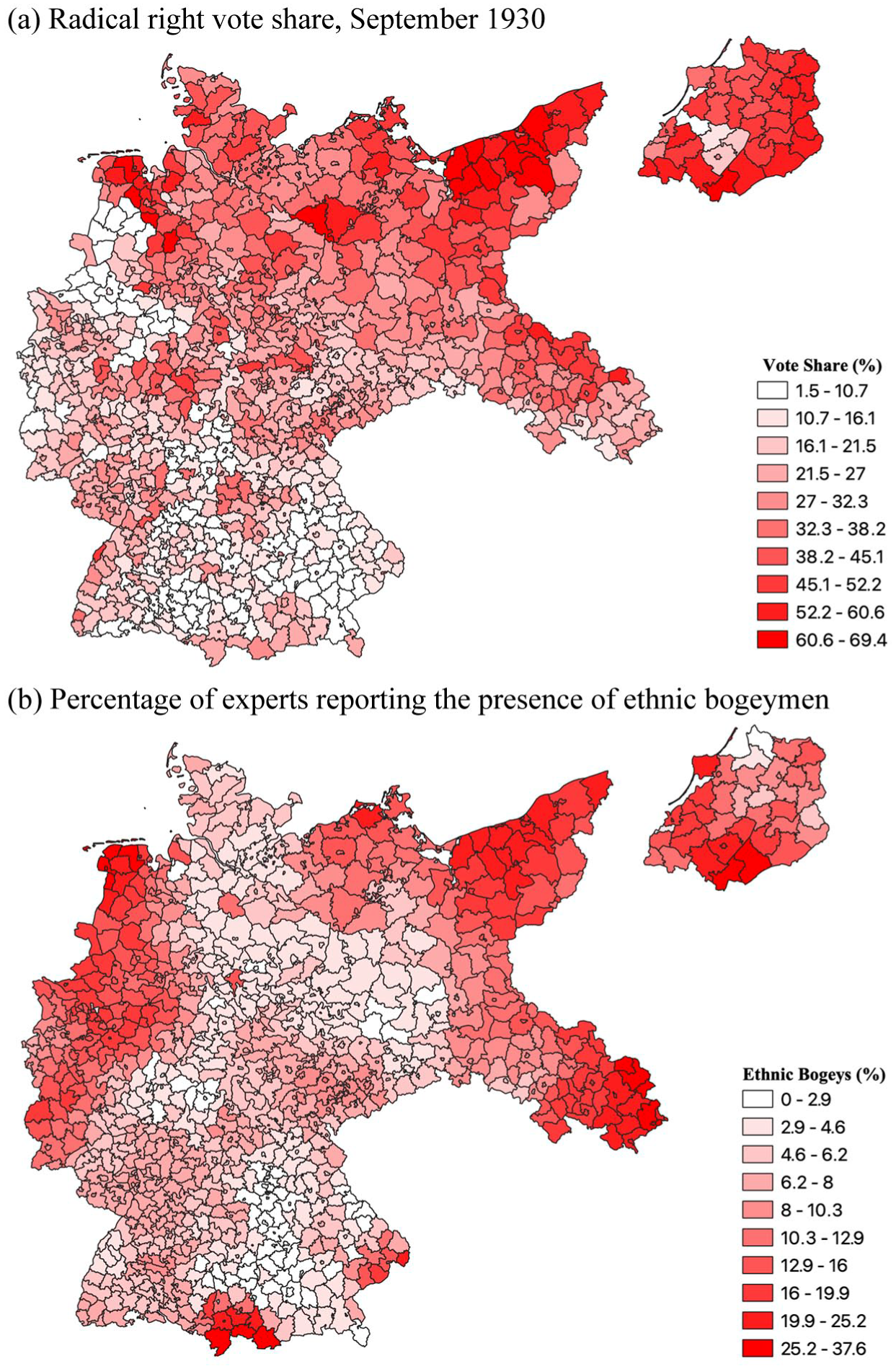
Map of Radical Right (DNVP + NSDAP) Vote Share (%) in September 1930 and Percentage of Experts Reporting the Presence of Ethnic Bogeymen
Folklore And Feeling Rules
We believe that supply- and demand-side explanations of far-right mobilization are individually incomplete. Whereas the former struggles to explain why economic, political, and demographic threats get linked to ethnic outsiders, the latter fails to account for the fact that the supply of far-right parties mobilizes some communities but not others. Prior work argues that a deeper understanding of cultural processes and meaning-making can resolve some of these theoretical and empirical challenges, as they provide a powerful way to think about how the two are linked (Bonikowski 2017). This requires one to conceptualize the radical right’s cultural resonance, that is, the extent to which radical right ideology corresponds to the cultural models prevalent among voters at a local level (Gamson 1992). Seen in this light, whether supply and demand factors meet depends on the local cultural and psychological dispositions that make radical right ideology attractive, empirically credible, and experientially commensurable (McCammon 2013).
Koopmans and Statham (1999) developed the idea of discursive opportunity structures (DOS) to identify how legitimate ideas and cultural scripts in the broader culture make environments more receptive to radical right mobilization. Movements that adhere to (at times implicit) cultural scripts succeed, and those that do not fall by the wayside. Often, the approach emphasizes cognition, in that movement actors and potential followers use media or legal discourse to learn the right or appropriate form of behavior. In its original formulation, a DOS approach was only used to capture national cultures. However, later studies have used it to capture subnational variation in cultural context (Koopmans and Olzak 2004). Here, we extend the local DOS approach in two important ways.
First, cultural resonance is as much about feelings as it is about cognition and norms of appropriate behavior (Ferree et al. 2002; Steinberg 1998). Emotions and their regulation enter political mobilization at every stage (Jasper 1998). However, the DOS approach separates cognition, norms, and scripts from the affective underbelly of culture (Bröer and Duyvendak 2009) and therefore misses the role that feelings play in the production of electoral mobilization in general (Flam and King 2007; Goodwin and Jasper 2004) and nationalist mobilization in particular (Feinstein 2024).
Following Wetherell (2012), we conceptualize the local cultural environment as an affective-discursive cannon: sets of emotional meanings and practices that become authoritative, widely shared, and institutionally reproduced, shaping what one can feel and say. This canon combines cultural scripts of appropriate behavior and the affective underbelly of discourse. To further conceptualize the interplay between cultural scripts and emotions, we draw on Hochschild’s notion of emotion management, which explicitly theorizes the intersection of cultural norms and affect. Culture, according to Hochschild, consists of feeling rules: cultural scripts that specify (1) the appropriate feelings in certain situations (Hochschild 1983) and (2) the appropriate objects of these feelings (Simon et al. 1992). In The Managed Heart, Hochschild (1983) meticulously unearthed the taken-for-granted yet demanding rules that specify which feeling is appropriate in a given social situation. For example, whereas flight attendants are expected to have inviting smiles, debt collectors need to look stern when doing their rounds. Hochschild frequently deployed feeling rules to demonstrate how people need to engage in often strenuous emotional labor to align misfitting feelings with societal norms, but she also considered feeling rules an important tool to investigate how group norms mold the ways members feel because they are forced to internalize affective guidelines.
Although this point is perhaps made less explicitly by Hochschild herself, feeling rules often specify appropriate emotions toward certain objects. Flight attendants are expected to have inviting smiles for customers on a plane, and debt collectors try to look stern and act frustrated toward debtors. This “aboutness” of feeling rules is probably best developed in the literature on love, in which scholars have shown there are rules in place that specify the appropriate objects and forms of affection (Cancian and Gordon 1988; Simon et al. 1992).
Feeling rules are often implicit and hard to observe without looking at micro-level interactions (Hochschild 1983), but this is not always the case. Scholars have used etiquette books (Elias 1939), magazines, advice manuals (Cancian and Gordon 1988), and stories (Tatar 2019) to systematically trace the evolution of affective norms. This brings us to our second extension of the DOS approach. We shift the domain in which we study culture from elite institutions to popular culture. Much work has located cultural processes in the mass media (Ferree 2003; Giugni et al. 2005; Koopmans and Olzak 2004) or legal principles (McCammon et al. 2007), but we will argue that orally transmitted group knowledge, or folklore (Dundes 1971b), can shape far-right success by constituting an affective-discursive cannon of feeling rules.
We put folklore front and center for four reasons. First, folklore, to use Herder’s famous words, expresses the soul of people (Clark 2023), making it an important pillar of the cultural environment. The stories people tell each other do not only entertain, they (1) validate culture by justifying rituals, symbols, and rules to those who observe them, (2) educate group members by inculcating moral attitudes, and (3) maintain conformity by expressing disapproval of deviant behavior (Bascom 1954; Malinowski 1926). Dundes (1984:151) goes as far as to say that folk tales might be the most important vehicle for the communication of collective symbols: folktales are how a group “discovers or establishes identity.”
Second, folklore constitutes local culture. Because it relies on oral transmission, performance, and interaction, folklore is the main carrier of local traditions and establishes local likeness. As such, locals form the folk in folklore (Fine 2018). The local nature of folklore is important considering the puzzling subnational variation in far-right voting that existing theories have a hard time explaining. To the extent that folklore is about local culture, it is a prime candidate to explain fine-grained subnational voting patterns.
Third, folklore captures the affective underbelly of culture. Some folklorists suggest the manipulation of emotions produces folk communities. On the one hand, folktales evoke positive emotions such as love, joy, and gratitude in relation to objects, symbols, and persons that strengthen the group. Conversely, and more importantly for this study, folktales attach unpleasant emotions such as fear, anger, and disgust to things that are forbidden, unattainable, threaten the community, or undermine its norms (Fischer 1963). The emotional nature of folklore is important because it provides a direct link with “affective-discursive canons” (Wetherell et al. 2015). In addition, the negative emotions, such as anger, fear, and disgust, that folklore inculcates can be manipulated by politicians to mobilize voters for their cause, turning them into dominant vectors of the political process (Illouz 2023).
Fourth, folklore educates the youth. Orally transmitted stories are incredibly important for socialization in the prewritten stage when children are not exposed to education and mass media. This stage is characterized by rapid cognitive development and is crucial for learning authority and order (Fine 1980). It is also the stage when children acquire the basic affective dispositions that dovetail with political symbols later in life (Sears et al. 1980). These long-term predispositions shape political attitudes by determining whether the political symbols associated with political policies resonate or not.
Because folktales rely on oral transmission, they often have straightforward structures that enable memorization. In analyzing the structure of folk tales, scholars have identified the main characters and themes (Propp 1968) that are easily recast as vehicles of emotions (Tatar 2019). Courageous, competitive, and independent heroes seek to restore order by rescuing sought-after victims, such as princesses who activate love and desire, while receiving support from helpers who embody empathy, trust, generosity, and hope. These heroes are opposed by outside villains or bogeys who threaten to undermine social order and trigger fear, anxiety, and hatred.
This emotional grammar of folklore can potentially be linked to the success of a wide range of political movements. Prior work has suggested that the hope and trust espoused by helpers dovetail with sharing and perhaps social democratic values (Smith, Mabulla, and Apicella 2023), yet others have hinted at the fact that competitive and courageous heroes can increase support for neo-liberal parties that promote capitalism (Michalopoulos and Xue 2021).
We explore the relationship between folklore and the far-right by zeroing in on how folktales transmit xenophobia in the form of ethnic bogeymen. To establish local identities, folktales create differences between insiders and outsiders through the activation of fear (Lévi-Strauss 1955). In folklore around the world, ethnic outsiders are the most common embodiment of these productive fears (Bottigheimer 2014; Tatar 2019).
Ethnic fears embodied by bogeymen can be linked to far-right voting in several straightforward ways. First, inspired by Adorno and colleagues’ (1950) Authoritarian Personality, political psychologists have emphasized that exposure to ethnic fear during childhood produces personality types that make people more likely to embrace the core tenets of radical right ideology later in life. In particular, this work shows that childrearing practices anchored in ethnic fear impel people to lower trust in out-group members (Hetherington and Weiler 2009) who become associated with chaos and disorder (Duckitt 2001). These practices augment the salience of the idea that one has to destroy the other group to prevent them from destroying oneself (Adorno et al. 1950) and increases the desire to restore order at the expense of diversity and pluralism, even if this involves authoritarian solutions (Altemeyer 1983; Feldman and Stenner 1997). Right-wing autocracy, to use Fromm’s ([1941] 2013) famous phrase, allows those who fear diversity to “escape from freedom.” This urge to escape from freedom and diversity dovetails with nativism and authoritarianism in that it legitimizes a state that defends the interest of the dominant in-group against non-natives, even at the expense of democratic institutions.
It is important to highlight that as part of our study we embrace the view that there is a link between frightful childrearing practices and support for the radical right, while also recognizing the shortcomings of the psychological approach in general. The main problem of psychological explanations of the radical right is that they often fail to explain the variation in authoritarian dispositions across time and space. Joining the nascent discipline of historical psychology that aims to connect psychology to historical data, we overcome this problem by locating social psychological variation in local folklore (Muthukrishna, Henrich, and Slingerland 2021).
Second, and relatedly, fear is an ally of the right because its spokespeople have become experts in deploying it for their own good. Radical right leaders from Israel (Illouz 2023) to the United States (Bonikowski, Feinstein, and Bock 2021) engage in fearmongering to legitimize strong leadership at the expense of democracy, delegitimize democratic processes, and dehumanize outsiders.
Third and more generally, cultural sociologists have shown that ethnic fear not only aligns people with the substantive pillars of radical right ideology (i.e., nativism and autocracy) but also plays a role in creating cultural resonance independently. Ethnic fear makes it more likely people will look for solutions that justify their feelings and focus attention on peripheral claims (McDonnell, Bail, and Tavory 2017). For instance, in his study of the anti-Islam movement in the United States, Bail (2012) demonstrates how the cultural amplification of fear allowed fringe actors with extreme anti-Islamic views to take over, polarize, and forever change mainstream culture.
In summary, folktales that instill feeling rules that certify ethnic fear make communities more likely to accept nativist and authoritarian solutions put forward by radical right parties. This leads us to predict the following:
Hypothesis 1: Localities in which traditional folklore features ethnic bogeys are more likely to vote for the radical right.
Hypothesis 1 focuses on how feeling rules instilled by folklore increase the resonance of authoritarian and nativist messaging. We also believe that threats condition the relationship between folklore and support for the far-right. We believe that objective supply-side threats increase the extent to which far-right ideas align with folklore. Early scholars who developed the link between fear, childrearing, and authoritarian dispositions all made explicit the importance of political, economic, and demographic transformations. In his classic study, Fromm ([1941] 2013) suggests that fear of diversity produced support for the Nazis because it was accompanied by a negative outgrowth of capitalism, modern population trends, and frustration with the power position of the political left. Along those lines, Reich (1970) argued that deeper fears led to the rise of the NSDAP because of a broad upsurge in nationalist discontent and economic frustrations. Adorno and colleagues (1950) also made clear that authoritarian dispositions would not have developed in the absence of economic and political anxieties. In later work, Adorno (1967) explicitly argued that status loss, symbols, and emotions together propel voters to support radical right-wing parties that provide fake solutions to real problems. More modern micro-level evidence backs up this idea well. Experiments show that people are more likely to reach back to ethnic fears they learned in the past if they are facing economic, political, and cultural threats (Hetherington and Weiler 2009). Survey research also reveals how narratives of fear interact with material threats to produce radical right success (Feinstein and Bonikowski 2021). This interplay between fear, narrative, and threat leads to the following hypothesis:
Hypothesis 2: The relationship between folklore and radical right voting should be particularly strong in localities that face economic, political, and cultural threats.
Data And Empirical Strategy
Outcome Variable: Radical Right Voting
Our outcome variable is the combined vote share for the NSDAP and the DNVP—the two most influential radical right nationalist parties (Debus 2016; Jones 2020) during all federal Reichstag elections that were held in the Weimar Republic. We excluded the 1919 election to the constitutional assembly because of missing data. We present a pooled analysis for all elections, and a separate analysis for each election round. We use Gemeinde-level (roughly comparable to a U.S. municipality) and Kreis-level (roughly comparable to a U.S. county) datasets to analyze voting. Both levels of analysis have different strengths and weaknesses. The former is more fine-grained and allows for more detailed comparisons of local folklore traditions, but it lacks information on the two 1932 elections, the last free elections before the Nazis seized power. The latter is less fine-grained but allows us to include the two 1932 elections. These data come from Falter and Hänisch (1990). In addition to the combined vote shares, we also run an analysis that looks at the individual parties (NSDAP and DNVP) separately.
Explanatory Variable
To capture local variation in xenophobic folklore, we focus on the genre of folk tales known as Kinderschreck (or children’s fright). Kinderschreck was an oral tradition of storytelling widespread in Central Europe during the nineteenth and twentieth centuries. Parents used these stories to discipline children through the inducement of fear. The set-up of Kinderschreck stories is brief and basic, involving only two components: a spatial location and a bogeyman (Beitl 1933). Examples from our sample include “do not go to the cornfield or the werewolf will take you” or “do not go to the forest or Baba Yaga will eat you.”
We focus on Kinderschreck for three important reasons. First, focusing on this oral tradition allows us to directly tap into the important role of childhood socialization emphasized by the political psychology of voting (Sears et al. 1980). Second, Kinderschreck was a widespread oral tradition that touched on all segments of society. Survey research from the 1930s suggests that 66 percent of the German population was exposed to Kinderschreck during their childhood (Beitl 1933). Third, folklore archives provide a unique opportunity to study this oral tradition systematically across localities.
Kinderschreck tales often feature rather innocent depictions of fantasy figures or animals that act as bogeymen. In some villages, however, the bogeymen involved ethnic stereotypes (Beitl 1933; Mannhardt 1884). These ethnic stereotypes took two prominent forms: the Gypsy 1 and the Jew. Other ethnic bogeymen, such as Turks and Poles, appeared but were extremely rare, occurring in less than 0.1 percent of all cases. Although this might seem surprising given the salience of resentment toward Slavic people in the Weimar Republic (Weitz 2018), it becomes more understandable if one considers that folklore is anchored in storytelling traditions that far predate the 1920s, and Jews and Gypsies were outsiders even before the establishment of the German nation-state (Panayi 2014). We therefore focus on Gypsies and Jews as ethnic bogeys to analyze the relationship between folklore, fear, and voting.
We build on data collection efforts by folklorists to map where these two types of ethnic bogeymen circulated in Germany. Wilhelm Mannhardt (1884) is particularly noteworthy, as he was probably the first folklorist to collect folklore through systematic expert surveys in a large number of European villages. Mannhardt’s approach became the basis of the Atlas der Deutsche Volkskunde (ADV) (Schmoll 2009). The Atlas drew on expert surveys in almost 20,000 German villages, towns, and neighborhoods between 1930 and 1935. The ADV sent questionnaires to local experts. Questions on Kinderschreck stories in the region were asked in the 1930, 1931, and 1932 surveys (Zender et al. 1958). We use the following question from the survey to measure the presence of ethnic bogeys: “Are there any sayings in your region that people tell their little children to prevent them from hanging out in places where they should not hang out (e.g., vineyards, cornfields, near the water)?”
The original surveys are located at the Abteilung Kulturanthropologie of the Rheinische Friedrich-Wilhelms Universität in Bonn, Germany. During the summers of 2017 and 2018, one of the authors hand-coded the answers to the questions on Kinderschreck stories. Bogeymen were reported by 50,356 experts across Germany. Of these experts, 9 percent reported the existence of ethnic bogeymen. Individual judgment is prone to systematic biases, so reliability is a major concern when using expert-based measures (Maestas 2018). A discussion of the reliability of this measure can be found in Part B of the online supplement.
Next, we matched the information of these 50,356 experts to our municipality- and county-level voting datasets using spatial matching procedures. The experts are matched to counties in 1930 Germany based on the borders presented in shapefiles acquired from the Census Mosaic Project (IPUMS 2023). We have reports from 925 counties with 54 expert responses, on average, on oral traditions per county.
Unfortunately, no areal unit information is available for historic German municipalities. Following Selb and Munzert (2018), we create spatial data by georeferencing center coordinates. We then match expert reports to municipalities if they fall within a certain radius of the municipality center. Our main analysis is based on a 25-kilometer radius. In Part C of the online supplement, we ran the analysis with a wide range of radii, varying from 10 to 50 kilometers, and results are comparable across buffers. When we use a 25-kilometer buffer, we acquire information on 5,212 municipalities with 28 expert reports per municipality, on average.
Specifically, our ethnic bogey variable takes the percentage of reported stories that feature Jewish or Gypsy bogeymen in a specific county or municipality:

Estimation
To assess the relationship between ethnic bogeymen in the Kinderschreck stories and radical right votes, we estimate a series of spatial autoregressive models. Conventional statistical models assume independence of units of observations. However, previous research suggests elections in the Weimar Republic were driven by regional characteristics, creating spatial autocorrelation and introducing bias into the coefficients and standard errors (O’Loughlin 2002). We deploy variogram modeling to investigate the presence of spatial autocorrelation in our dependent variable (Cressie 2015). Sample variograms suggested autocorrelation was present between observations that were 100 kilometers apart. We model this spatial autocorrelation by including an autocovariate tapping average voting of all geographic units within a 100-kilometer radius for each election round (Ward and Gleditsch 2018). Our full model has the following parameters:

The variable vote share is our primary outcome variable and represents the combined vote share percentage for the NSDAP and DNVP in a specific geographic unit U located in region L during election round E. In additional analyses, we look at the separate vote shares for each of these parties in each election from 1920 to 1933. Our explanatory variable is ethnic bogeys, which is measured as the percentage of Kinderschreck stories with either a Jewish or Gypsy bogeyman in a particular locality (U). All models include fixed effects for election round (γE) and each of 24 states (βL). By including state fixed effects, we only leverage variation within each state to avoid making comparisons across distant regions that have different cultures, socioeconomic structures, and religions. We use the election round dummies to model away temporal trends in the data. For each observation k,

k ≠ l, γl = voteshare of observation l and
Controls and Interaction Terms
Regions with xenophobic folklore might have distinct histories of tolerance, as well as conflict, and undergo distinct demographic, economic, and political transformations that the existing scholarship links to radical right voting. We therefore statistically analyze the relationship between bogeyman and radical right voting while keeping constant (1) demographic factors such as population size and religion, (2) legacies of hate and tolerance in the form of medieval pogroms, (3) class structures, including the percentage of people working in different economic sectors, (4) distinct ethnic, political, and economic threats, and (5) distance to World War I enemy borders. For a detailed discussion of the control variables and the respective data sources, see Part D of the online supplement. In Part E of the supplement, we also explore the effect of ethnic nationalism on voting.
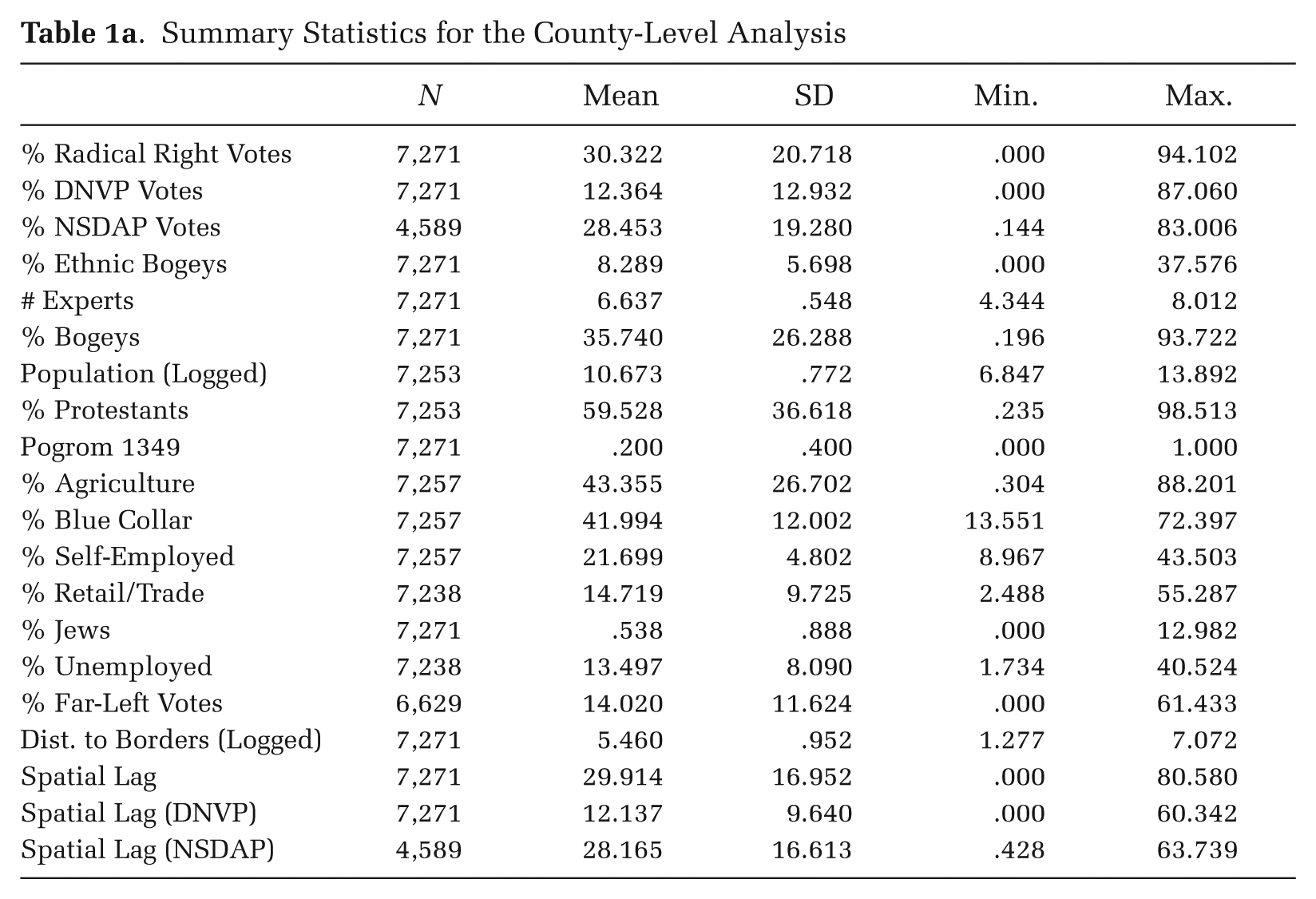
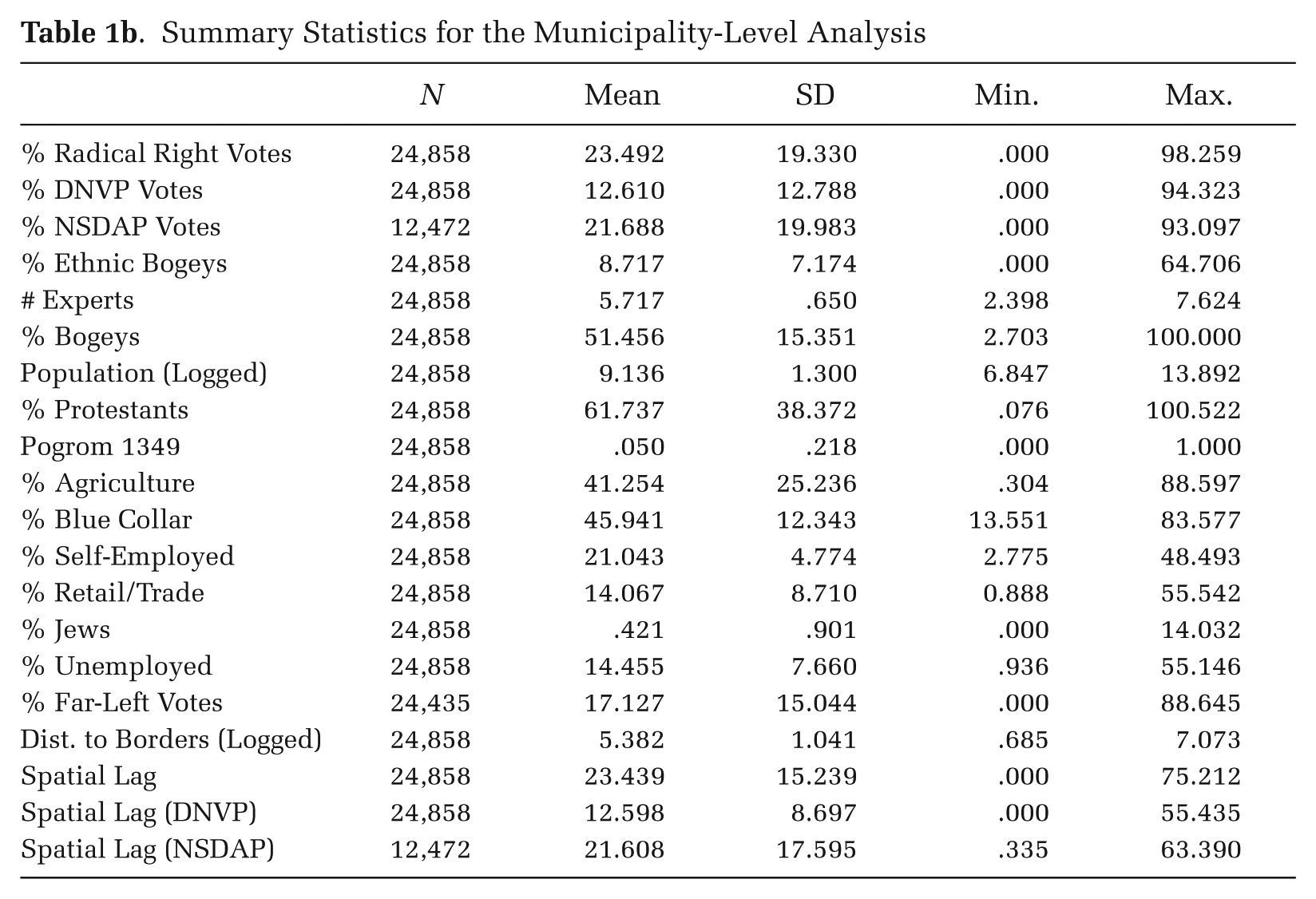
To test Hypothesis 2, which states that the effect of folklore should be stronger in threatened localities, we interact our ethnic bogey measure with the percentage of Jews living in a county (to capture ethnic threat), the unemployment rate (to tap economic threat), and the percentage of votes for far-left parties during the previous election (to measure political threats). These are common measures used to investigate the effects of distinct threats during the interwar period (Brustein and King 2004). We present descriptive statistics for the outcome, explanatory, control, and moderator variables in Tables 1a (county level) and 1b (municipality level).
Summary Statistics for the County-Level Analysis
Summary Statistics for the Municipality-Level Analysis
Results
Main Models
As a first cut at the data, an inspection of geographic distributions is insightful. Figures 1a and 1b map radical right voting and ethnic bogeymen in 1930. We see considerable overlap in the two distributions, with bogeys and votes for the radical right clustering in the East, North-East, North-West, and South-West of Germany. However, we also find noticeable differences. In particular, far-right voting was high and ethnic bogeys were rare in Brandenburg, Hannover, and the North-East of Saxony and Holstein, whereas the opposite was true in areas around Dusseldorf and Westfalen. The differential electoral success of the far-right in these regions is often attributed to religion, rurality, and fear of the radical left (Kauders 1996; Lapp 1997; Loomis and Beegle 1946). In our analysis, we therefore look at the effect of bogeymen and these factors simultaneously to assess their relative importance.
Table 2 reports the results of estimating the effect of stories on radical right voting while controlling for these and other potential omitted variables. Model 1 presents the results of a regression of the combined radical right vote shares at the county level on the percentage of ethnic bogeys in folktales, while adding all controls, state fixed effects, and election-round fixed effects to our models. A one-standard-deviation increase in the percentage of stories with ethnic bogeys is associated with a 1.8 percent increase in the radical right vote share in the Weimar Republic’s elections. This means that increasing the percentage of xenophobic folklore by one standard deviation (6 percent, see Table 1a) increases radical right voting by approximately 2 percent. Effects become stronger in the IV-specification, discussed in the next section. In the remaining five models, the effects presented above hold when we look at parties separately at the municipality and county levels. Across all six models, we find a positive, statistically significant relationship, providing considerable support for our first hypothesis.
Votes for Far-Right Parties as a Function of Folklore: Pooled Analysis
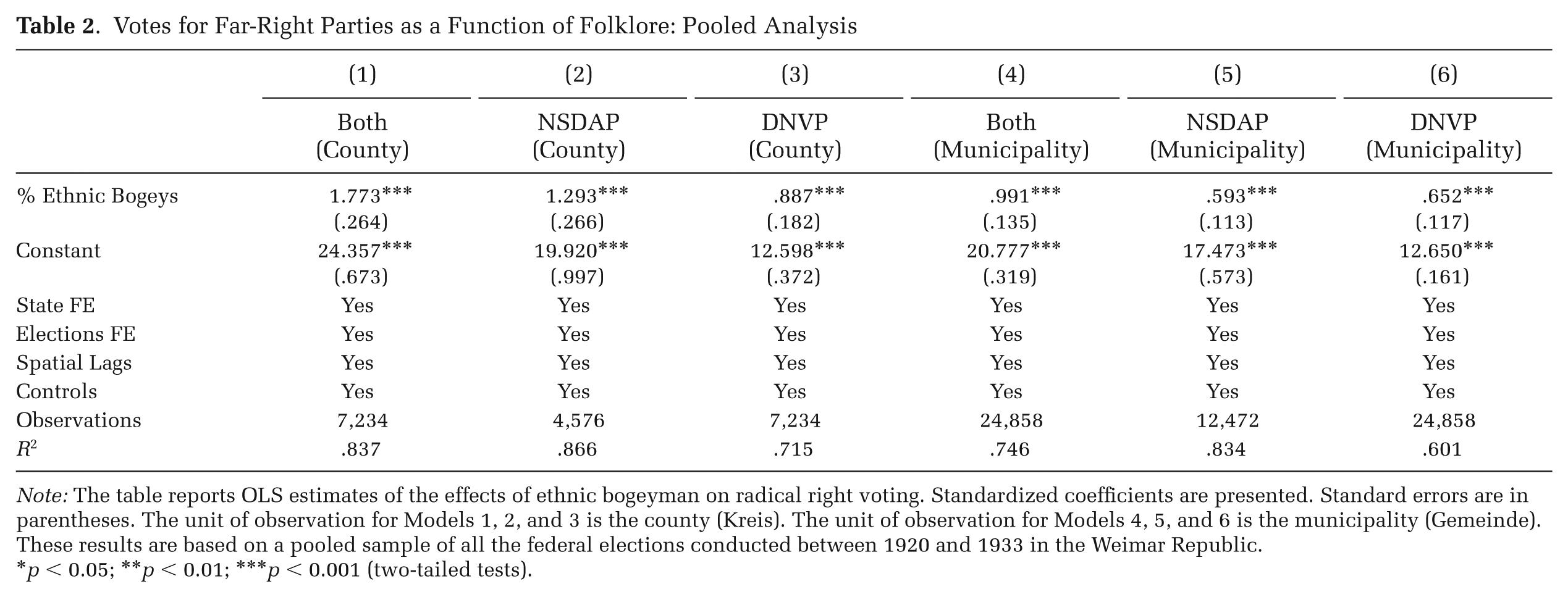
Note: The table reports OLS estimates of the effects of ethnic bogeyman on radical right voting. Standardized coefficients are presented. Standard errors are in parentheses. The unit of observation for Models 1, 2, and 3 is the county (Kreis). The unit of observation for Models 4, 5, and 6 is the municipality (Gemeinde). These results are based on a pooled sample of all the federal elections conducted between 1920 and 1933 in the Weimar Republic.
p < 0.05; **p < 0.01; ***p < 0.001 (two-tailed tests).
Figures 2 and 3 disaggregate the effects by election round at the municipality and county levels. The figures also show the effect for combined vote share, the NSDAP vote share, and the DNVP vote share. These figures show that the effect of xenophobic folklore on radical right voting is stable over time. This makes sense, as both the NSDAP and the DNVP appealed to people’s ethnic fears over the entire period (see the Existing Explanations section). Comparing the two figures, we see a slightly weakened effect for the DNVP, NSDAP, and shared vote share for the 1933 election. The effect on voting for the DNVP becomes insignificant when we look at the municipality-level analysis. This might be due to the fact that the 1933 election was only partially free, as it took place shortly after the Nazi seizure of power. After the rise of the NSDAP and Hitler’s appointment as Chancellor, there was an increase in violent repression of left-wing voters, Nazi propaganda, and irregularities in vote counts (Bracher 2013).
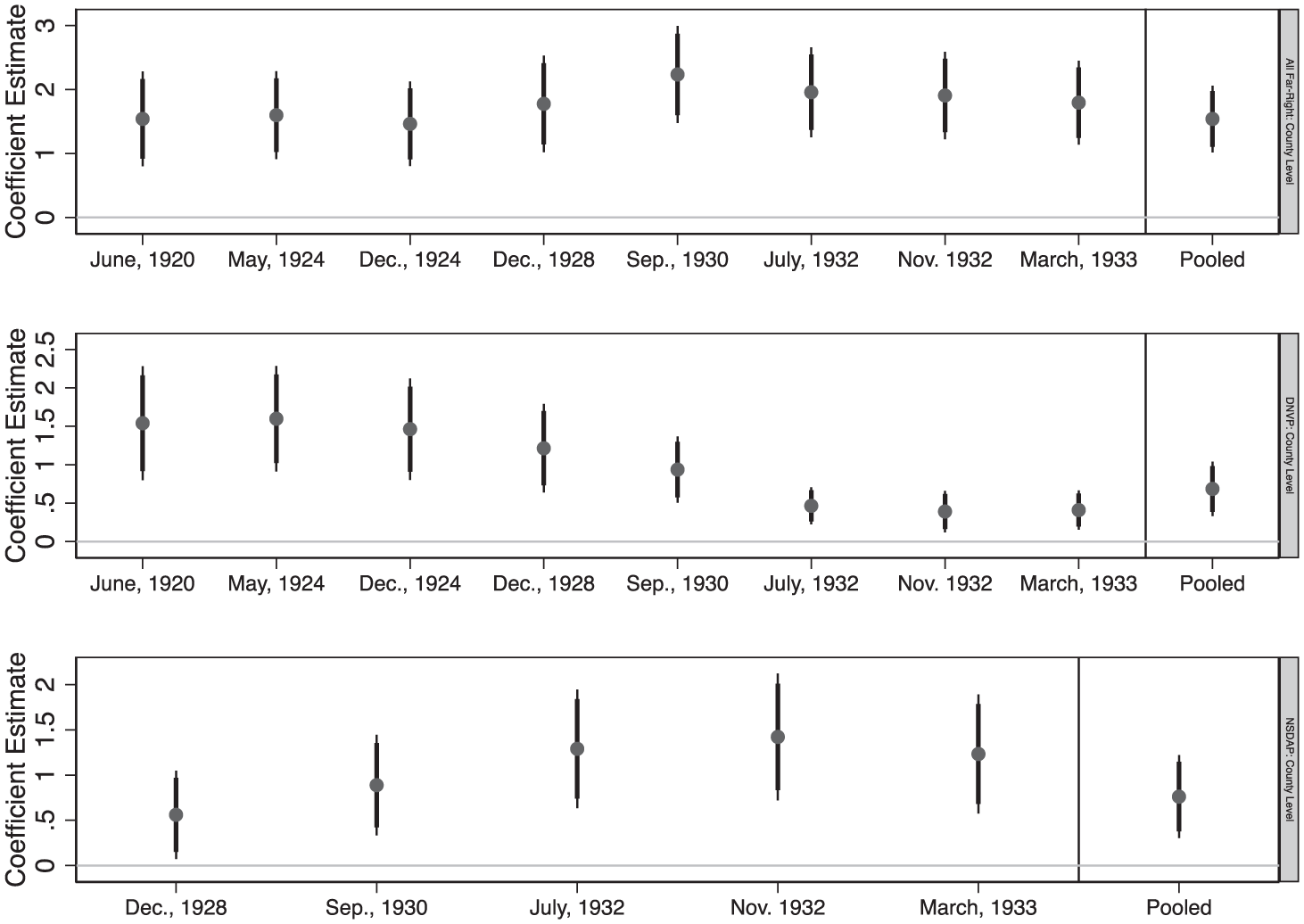
Effect of Ethnic Bogeys on Radical Right Vote Share (%) Across Time at the County Level
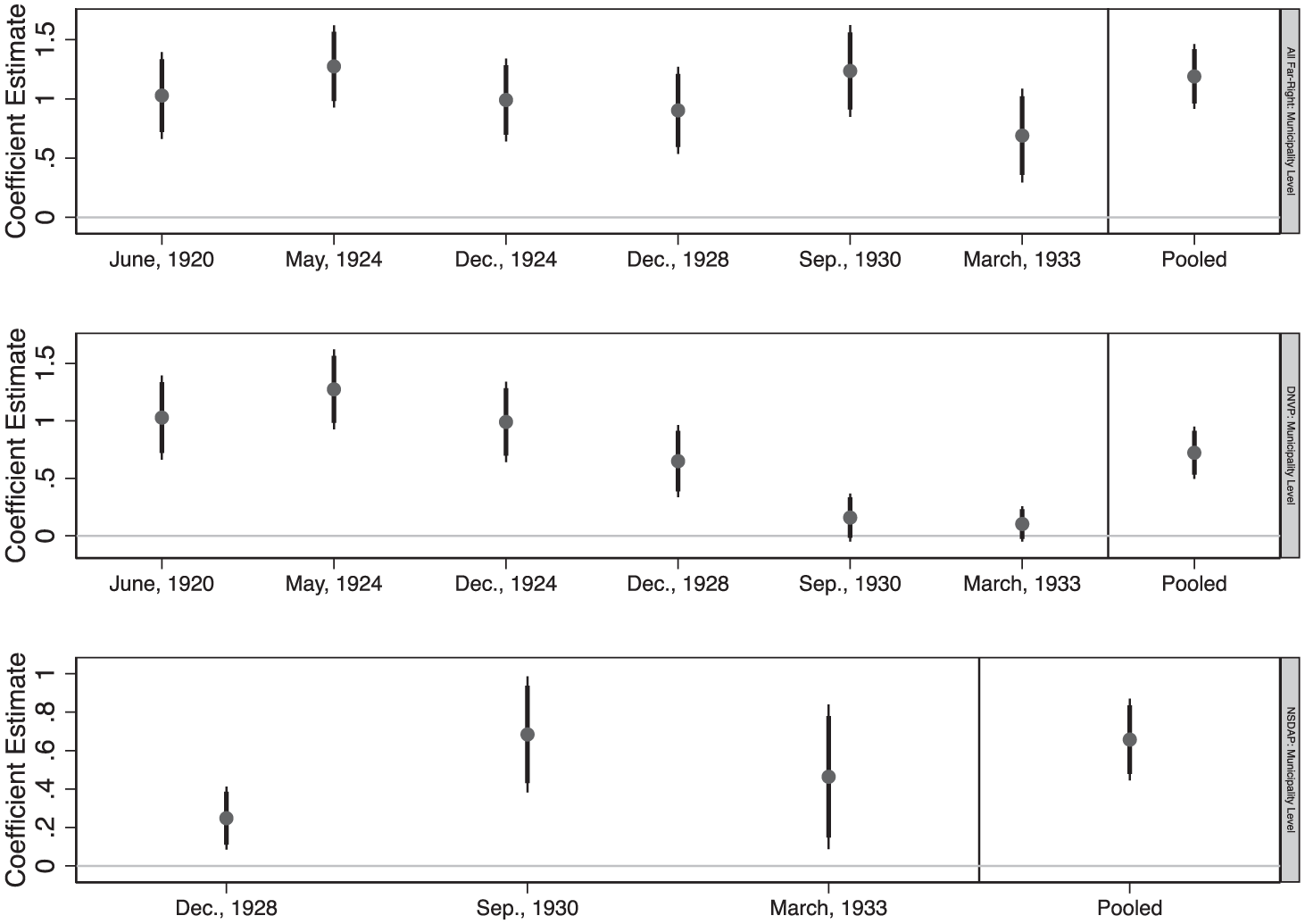
Effect of Ethnic Bogeys on Radical Right Vote Share (%) Across Time at the Municipality Level
The middle panels in Figures 2 and 3 show slightly weaker effects when looking at DNVP votes after 1924. These effects become insignificant when we look at the municipality-level analysis. This could perhaps be explained by the fact that traditionally strong nativist parties adopted a slightly more moderate strategy in the mid-1920s to attract a broader base (Ziblatt 2017) and decided to join two pro-republican coalition governments (Jones 2020). This might have weakened the appeal for voters motivated by ethno-nationalist and anti-republican sentiments. Equally important, the temporal development of effects for both parties reveal an inverse development for the NSDAP and the DNVP. This pattern is in line with the idea that the DNVP was able to mobilize ethnic resentments in early elections, but the NSDAP was able to establish itself as the primary advocate of nativism, crowding out the DNVP during later elections (De Juan et al. 2024). Given the stability of our estimates across time, unit of analysis, and party, we will use pooled municipality-level data of radical right support for both parties for the remainder of our models.
Instrumental Variable
Folklorists are interested in oral traditions that have their origins far back in time. As such, the stories they collect tend to predate contemporary political developments. Some Kinderschreck tales are thought to be between 2,500 and 6,000 years old (Da Silva and Tehrani 2016). However, Braun (2022) finds a strong correlation between contemporary political dynamics and the emergence of specific xenophobic folklore in the 1930s. This raises an important concern about endogeneity. Perhaps ethnic bogeys in tales did not shape radical right voting, but instead both were shaped by local political dynamics (e.g., World War I exposure) that produced resentment toward Jews and Gypsies. Alternatively, folklore might have been shaped by radical right propaganda campaigns that appealed to ethnic fears. Places where the radical right was successful might also have been places where propaganda creeped into local folklore traditions.
In addition, there appears to be a mismatch between the temporal nature of our argument and our measurement strategy. We argue that oral childrearing that took place at least one generation ago shapes voting in the present. However, we measure the presence of children’s stories around the same time that elections took place in the 1930s.
We use an instrumental variable approach that circumvents both issues. Our IV-strategy is based on the origins of ethnic bogeys that predate the rise of the German nation-state. As such, it allows us to capture variation in ethnic bogeys that is due to older storytelling patterns carried by older generations and that is not influenced by contemporary political dynamics. To capture older storytelling, we turn to the work of Wilhelm Mannhardt (1884). In 1865, Mannhardt conducted surveys on Kinderschreck in more than 1,600 communities all over Germany. For each community, he marked the type of bogeymen that appeared in the stories. We transformed his database into a county-level dataset. Based on this dataset, we are able to calculate whether local oral traditions featuring ethnic bogeys existed for all counties in 1865. If we use 1930 territorial units as a baseline, Mannhardt’s reports provide information on 990 counties.
Given that Mannhardt’s data relied on less expert surveys, it is not possible to calculate percentages (as this measure would be very skewed). We therefore collapsed the measure into a dummy variable that marks whether or not counties had oral traditions featuring ethnic bogeymen in 1865. Ethnic bogeymen appeared in 5 percent of all counties for which we have reports.
For this measure to be a valid instrument, we need to make two assumptions. First, presence of ethnic bogeys in 1865 needs to be a strong predictor of ethnic bogeys in the 1930s. This is commonly referred to as the relevance assumption. We test this assumption in the first-stage regression, which uses an OLS model to predict the percentage of 1930s ethnic bogeys as a function of ethnic bogeys in 1865 (see Table 3). As one can see from the large F-statistics, the spatial distribution of ethnic bogeys in 1865 is strongly correlated with the spatial distribution of ethnic bogeys in the 1930s, regardless of whether or not we include control variables and fixed effects (Models 7 and 8).
The Validity of 1865s Folklore as an Instrument

Note: Model 9 entries are logistic regression coefficients. Unit of observation is the municipality. Municipality clustered standard errors are in parentheses. Standardized coefficients are presented.
p < 0.05; **p < 0.01; ***p < 0.001 (two-tailed tests).
Second, we need to assume that 1865 bogeys only influence voting via 1930s bogeys and are not correlated with contemporary political dynamics that independently shape voting. This is often referred to as the exclusion restriction. For instance, radical right parties may have campaigned more intensively in places they knew had oral traditions rooted in ethnic fears. To assess this possibility, we regress the presence of local ethnic bogeys in 1865 on whether the NSDAP organized major campaign events. Data on campaigns come from Selb and Munzert (2018). Results of this regression using standardized coefficients are presented on the right side of Table 3 (Model 9). NSDAP campaign events and ethnic bogeys are negatively correlated. This indicates that the radical right was less likely to campaign in areas where xenophobic folklore existed before the emergence of the German nation-state.
The reduced form analysis, presented in Table 4, Models 10 and 11, shows a positive relationship between the presence of xenophobic folklore in 1865 and radical right voting. Models 12 and 13 present the second stages of two-stage OLS models. This second stage uses 1865 bogeys to determine whether municipalities with more ethnic bogeys in the 1930s were more likely to support the radical right.
The Effect of Folklore on Voting: Results Based on 1865s Folklore
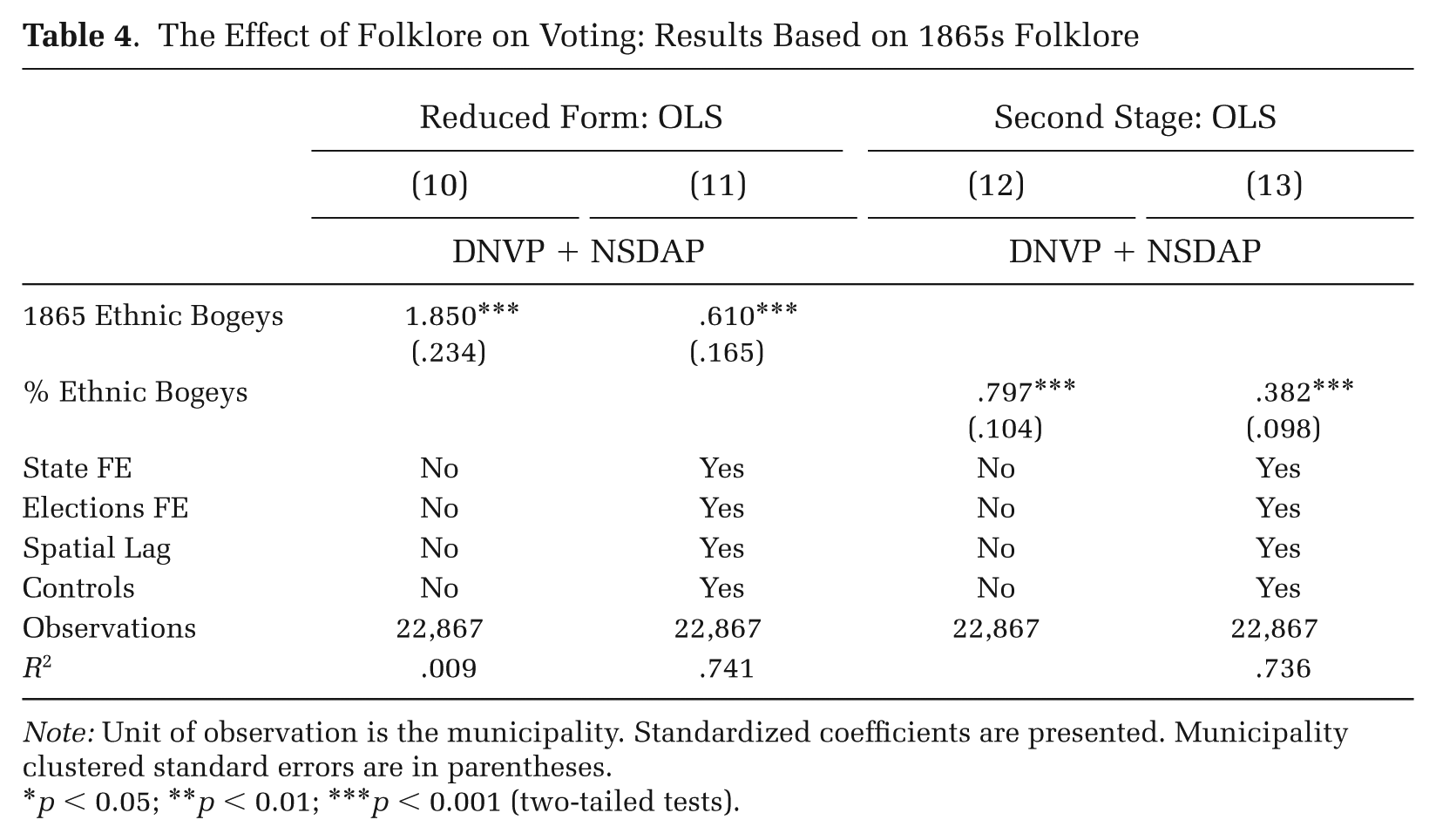
Note: Unit of observation is the municipality. Standardized coefficients are presented. Municipality clustered standard errors are in parentheses.
p < 0.05; **p < 0.01; ***p < 0.001 (two-tailed tests).
The effect of xenophobic folklore is robust in the IV-specification. Increasing the folklore variable by one standard deviation increases the percentage of votes for the far-right by almost 3.7 percent. In Part E of the online supplement, we explore whether this effect could be shaped by the presence of ethnic nationalism before 1865. Results are almost identical to the results presented in the main text.
Comparing Support Rates for the Far-Right
Now that we have established that the main findings hold in our instrumental variable estimation, we use the estimates from this model to compare support for far-right parties in localities with high and low prevalence of ethnic bogeys in folktales, while keeping all other variables constant. Figure 4 presents the results of this comparative analysis. On average, far-right parties received 26 percent of the vote in municipalities that were not exposed to folktales with ethnic bogeys. The contrast with municipalities that had maximum exposure to ethnic bogeys in folktales is stark. In the latter counties, 45 percent of voters chose the far-right party. This difference is considerable given that the median winning margin between the top two parties in municipalities was 15 percent.
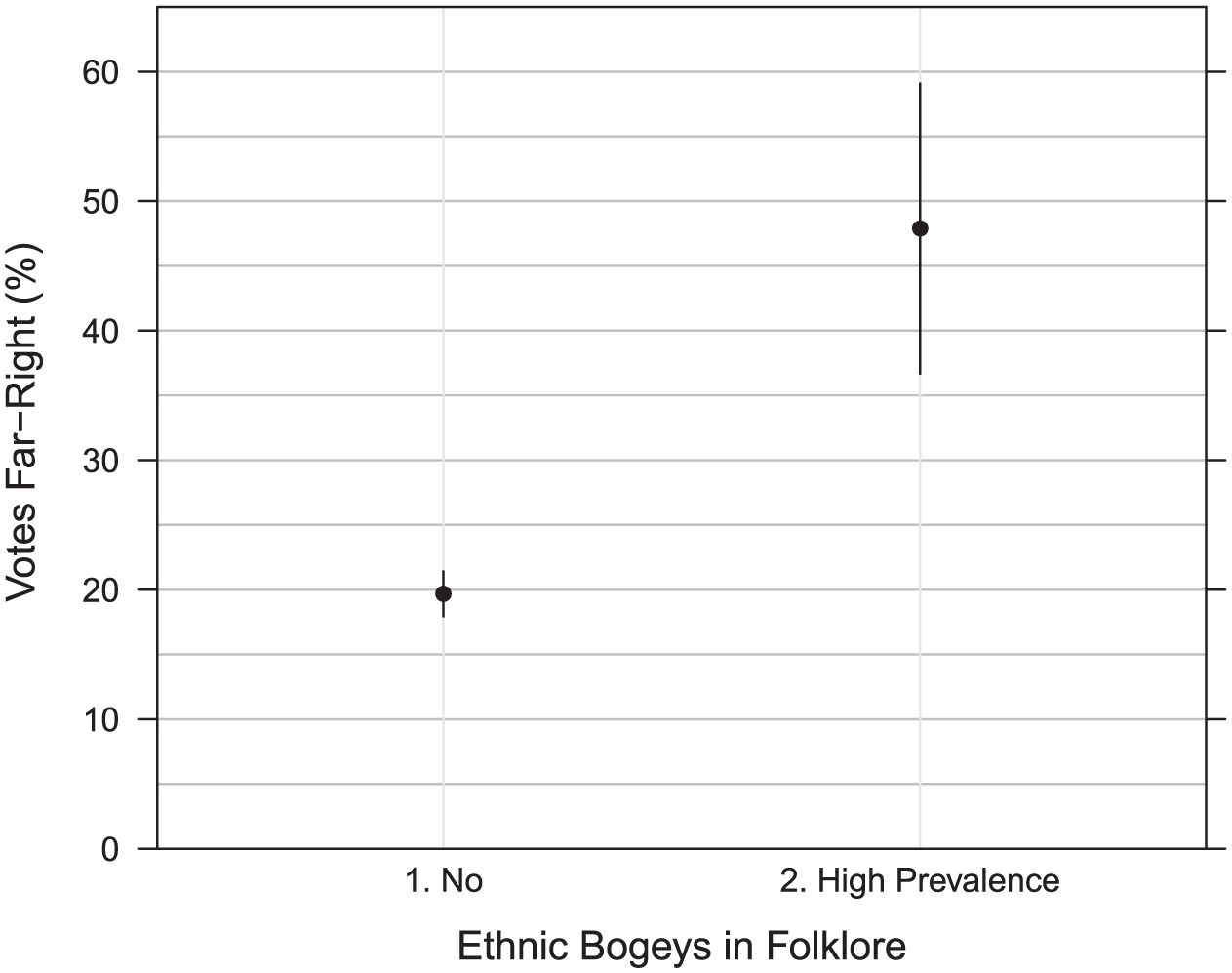
Voters for Far-Right Parties (%) in Municipalities with No and High Exposure to Ethnic Bogeymen in Folklore
A Note on Effect Size
The effects described in the previous sections are considerable and important. To put things in perspective, a one-standard-deviation increase in other robust predictors of radical right voting, such as party propaganda (Adena et al. 2015), social capital (Satyanath, Voigtländer, and Voth 2017), the influx of radicalized World War I veterans (Koenig 2023), war casualties (De Juan et al. 2024), and antisemitic legacies (Voigtländer and Voth 2012), produce increases in radical right vote share between 1 and 1.5 percent. This is well below the effect of folklore, which increased voting by 3.7 percent in the IV-specification.
Part A of the online supplement presents the standardized coefficients for the full models. Across specifications, the percentage of ethnic bogeys is the strongest and most consistent predictor of radical right voting after Protestantism, which has been considered the most important predictor for right-wing voting (King et al. 2008; Spenkuch and Tillmann 2018). The folklore effect is approximately a third of the religion effect.
It is also possible to relate our effect size to omitted variable bias using a coefficient stability approach (Oster 2019). This approach determines how strong omitted variables would need to be relative to all measured control variables, for it to reduce the effect of folklore to zero. Oster demonstrates that if the strength of observables is as strong as omitted variables bias, a bias adjusted estimate of the coefficient τ* equals:

where τ controls is the estimated coefficient in the full model with all controls and Rcontrols is the R2 from this regression; τ no controls is the estimated coefficient from a model without controls and Rno controls the R2 from this regression; and Rmax is the percentage of all variation that can be explained. We set Rmax = 1 and assume that all remaining variance in the model can be explained by omitted variables. If we follow this approach, omitted variables would need to be 5.8 times (for the county-level analysis) and 5.2 times (for the municipality-level analysis) stronger than all measured control variables combined to reduce the effect for folklore to zero. Given the extensive number of powerful controls (religion but also time and state fixed effects) and the high R-squared of our models, it seems unlikely that such a variable exists.
In conclusion, our folklore variable is (1) the second strongest predictor across our models, (2) a stronger predictor than those presented in other recent papers, (3) able to explain winning margins between parties, and (4) plausibly stronger than any omitted variables. In the next section, we will show that effects are even stronger when we consider the interplay between threats and folklore.
Threats and Folklore
We now turn to Hypothesis 2, which holds that xenophobic folklore is more likely to produce radical right voting in localities that were facing ethnic, political, and economic threats. To establish whether these threats indeed increased the effect of xenophobic folktales on voting, we re-estimated the main municipality models while including interaction terms between our main variable and our three threat proxies (i.e., percentage of Jews, strength of the far-left, and unemployment rates). These models reveal that unemployment rates and strength of the far-left do increase the effect of ethnic bogeys, and the size of the Jewish community does not. This suggests political and economic threat, but not ethnic group size, strengthen the impact of folklore. For readers’ convenience, we present kernel interaction plots for the two significant interaction effects in our main text. 2 Full models can be found in Part A of the online supplement.
Figure 5 presents the two plots for unemployment rates and strength of the far-left as moderators. Ethnic bogeymen do not increase radical right voting in localities where the far-left is weak or nonexistent (right panel of Figure 5). However, the effect starts appearing in counties where the far-left was able to acquire more than 5 percent of votes. In places where the far-left obtained 40 percent of votes, increasing the percentage of ethnic bogeys in local stories by 1 percent increased votes for the radical right by more than 0.7 percent, a more than considerable effect.

Effect of Increasing Percentage Ethnic Bogeys by One Standard Deviation on the Percentage of Combined Radical Right Vote Share Conditional on (a) Unemployment Percentage, and (b) Percentage of Far-Left Voting in the Previous Election (Kernel Density Interactions)
A similar pattern emerges when we look at the interaction between unemployment rate and ethnic bogeys (left panel of Figure 5). In municipalities with almost full employment, ethnic bogeys do no increase radical right voting. Once unemployment rates reach the 3 percent mark, however, ethnic bogeys start to have a significant influence on support for the radical right. In municipalities where a third of the population is unemployed, a 1 percent increase in ethnic bogeys in local storytelling produces a 0.6 percent shift in support for the radical right, again a more than considerable effect.
These graphs and models provide partial support for our second hypothesis. While the influence of ethnic bogeys in folktales interacts with economic and political threats, this does not seem to be the case for the size of the outsider group. The latter can perhaps be explained by the fact that anti-Semitism often emerges in the absence of Jews (Braun 2022). Nonetheless, we find that whether economic and political threats shape radical right mobilization is conditional on local folklore. If these traditional symbols activate ethnic fears, people become more likely to translate threats into political mobilization.
Conclusions
The rise of the radical right in Weimar Germany was facilitated by a unique configuration of macro-level factors, including the fall of the conservative party, backlash against modernization, and the radicalization of nationalist discourse. However, its growth manifested differently across space. Folklore had a considerable influence on where radical right ideology resonated. Citizens living in localities where folktales instilled feeling rules certifying ethnic fears were more likely to support the far-right. This was especially the case when localities were also facing economic and political threats. This suggests folklore played a substantial role in linking the supply and demand for radical right mobilization by creating an affective-discursive canon of feeling rules that facilitated the embrace of authoritarian and nativist solutions to economic and political threats. Somewhat surprisingly, the effect of folklore was not moderated by the size of the Jewish population. Perhaps folklore is less connected to xenophobia when people are directly exposed to outgroups (Allport 1954). Alternatively, this could be due to the fact that anti-Semitic feelings often emerge in the absence of Jews (Braun 2022). This may not apply to other groups, such as racial minorities in the United States (Enos 2017), where research on the relationship between local group threat and outgroup size is still largely inconclusive (Oliver 2010).
Regardless, our focus on local-level folklore enables us to refine theories of far-right mobilization by highlighting meso-level processes in general (Della Posta 2013; Golder 2016) and subnational affective-discursive canons in particular (Wetherell 2012). Supply, demand, and psychological dispositions in and of themselves do not produce radical right voting, but the three, tied together by folklore, do. An interactive multilevel perspective anchored in folklore helps us overcome the shortcomings that each approach separately faces. First, this approach helps us explain why macro-level supply produces far-right mobilization in some regions but not others by revealing how this mobilization depends on local folklore and threats. Second, this perspective helps us explain why threats sometimes activate far-right support, but not always. Whether citizens perceive a link between their problems and radical right ideology is conditional on folklore priming locals to cling to their ingroups or embrace authoritarian solutions. Absent such tales, radical right politicians might have a harder time exploiting times of realignment and crises.
Third, our approach helps us link political psychological explanations to real-life variation by pointing out how differences in local folktales create radical right dispositions in some places but not others. As such, this article breathes new life into scholarship on the authoritarian personality (Adorno et al. 1950; Altemeyer 1983). Research in this tradition explains support for radical right movements as a function of a psychological linkage between movement ideology and individual personality type. This line of scholarship has made considerable progress identifying individual vulnerability to radical right appeals. However, scholarship in this vein struggles to explain where variation in authoritarian dispositions comes from.
As our personalities are shaped by our society, understanding present-day cognition and mentalities requires an investigation of how past processes led to that psychology (Muthukrishna et al. 2021). This article makes an important step in that direction. We explain actual levels of support for the radical right during one of the most important episodes of Western European history by considering how different folktales might have produced different personalities. By doing this, we join the nascent field of historical psychology that aims to locate variation in psychological dispositions in historical contexts and sources (Muthukrishna et al. 2021).
The oral communication of morals and emotions is universal (Dundes 1984), so it seems plausible our conclusions can be extended beyond this article’s specific confines. Currently, very few studies examine folklore and voting in the United States, but it seems to be a plausible case to further develop this link. First, historically, U.S. folklore has been rife with xenophobic stereotypes (Dundes 1971a). Second, considerable evidence shows that children’s tales have recently become an even more important vehicle for transmitting political values. Since the culture wars of the 1980s, American tales have been infused with ideas about patriotism, gender, race, and morality that align with conservative values (Abate 2010). In response to this, critical authors have been working on a form of storytelling that undermines some of these values (Abate 2010). Third, prior work suggests that affective socialization of children shapes radicalization in the United States. For instance, Hetherington and Weiler (2009) find that in U.S. regions where people say it is acceptable to use fear and repression in childrearing, individuals are more likely to support hawkish and authoritarian candidates. Fourth, ethnographic research on right-wing supporters shows how important deeply internalized feeling rules regarding race and ethnicity are for authoritarian mobilization in the United States (Hochschild 2016). Perhaps feeling rules transmitted from one generation to the next through folklore can account for the striking persistence of racial inequalities and racist mobilization in the United States. Indeed, folklore could potentially provide the missing cultural link between racist institutions of the past and present-day outcomes (Baker 2022).
Considering this potential, we hope to have provided a first step in better integrating political sociology and folklore studies. Over the past century, sociology and folklore studies have largely evolved in isolation (Redfield 1947; Thompson 1980). However, this article shows how a sociological use of folklore archives and theory can provide a unique perspective on how oral culture shapes political outcomes. We believe our model can be extended in several fruitful ways.
First and most obviously, one could consider how folklore produces affective-discursive resonance for other political movements. We looked at bogeys that signified ethnic fears and linked them to far-right success. But what about other fears? It seems plausible that pluralist movements might be strengthened by bogeys that embody autocracy and inequality. Here one could think of an analysis of tales that feature despotic kings or wealthy businesspeople. Alternatively, we can return to the other core characters of folktales (Propp 1968). Research might confirm whether brave and entrepreneurial heroes indeed have the capacity to shape support for neo-liberal parties (Michalopoulos and Xue 2021), or whether generous and empathetic characters might increase trust in social democratic parties (Smith et al. 2023).
Second, one could think about how core characters operate as vehicles for (non-affective) morals that resonate with party ideology (Lakoff 2010). Here a stronger connection with work on character-building in political storytelling could be useful (Polletta 2015). This line of work focuses on how electoral success depends on the ways politicians translate their political messages into stories with clearcut characters. Generally, conservatives paint a picture of how strong leaders or strict parents, helped by traditional institutions such as the army or church, rescue pure people from chaos caused by outsiders (Lakoff 2010). Parties on the left, in contrast, emphasize how collectives come together to rescue those who are exploited from those who have financial and political power (Polletta 2015). Measuring the overlap between the spectacles politicians draw out and the oral tales circulating in society at a local level could be an important next step in investigating the relationship between folklore and mobilization.
Third, one could look at whether exposure to traditional folktales in general benefits the right over the left. Given the fact that folklore is anchored in the production of order and collective identity, conservatives may have an easier time coming up with compelling heroes and villains, as they have more traditional storylines to draw from (Polletta 2008). This might also explain why conservative metaphors tend to be more powerful than those of progressives (Lakoff 2010). Along these lines, exposure to folklore might play a role in the rise of compelling, unifying, but fake news. The main function of folktales is not truth-telling but the creation of social identity. Exposure to folktales might make one more likely to accept political and media stories that bring people together but are inherently false (Polletta and Callahan 2019).
Fourth, scholars can move beyond a pure focus on characters and forge a connection with scholarship on plot, that is, the sequence of events that turns isolated incidents into stories (Somers 1992). Plots often justify what is just and unjust by implying narrative resolution. Traditional folklore is organized around characters restoring social order (Propp 1968). The morals anchoring restored order should perhaps be linked to political mobilization. While the restoration of hierarchy, discipline, and tradition would likely benefit the right, the restoration of equality, mutual responsibility, and care could potentially dovetail with progressive messaging.
Fifth, thinking about folklore in this way forces us to think about whether we can improve our political world by changing the stories we tell. For instance, there is suggestive evidence that folktales featuring peaceful and collaborative characters reduce the appetite for conflict, something that might help us fight hyper polarization and other forms of political strife (Ahmed and Kousar 2023).
Sixth, while we focused on folktales with a fixed set of characters and themes, it is important to establish whether other forms of folklore induce far-right mobilization. This would enable us to say something about whether oral traditions per se, or only those rooted in childrearing, influence the acquisition of dispositions that matter for political processes (Sears et al. 1980). One could also study how important embodiment is for the transmission of emotions. For instance, one might look at how racist proverbs (Mieder 1997) or the presence of xenophobic symbols during Easter celebrations (Rentz 2025) influence the success of the far-right.
Finally, our model also asks for methodological extensions. Integrating folklore and sociology urges sociologists to become more sensitive to specific variables and mechanisms. Future interview research on voters could, for instance, pay more explicit attention to parents’ childrearing and informal storytelling when looking for causes of different forms of political mobilization.
Supplemental Material
sj-pdf-1-asr-10.1177_00031224251409746 – Supplemental material for Pedagogy of Fear: Folklore and the Far-Right in Weimar Germany
Supplemental material, sj-pdf-1-asr-10.1177_00031224251409746 for Pedagogy of Fear: Folklore and the Far-Right in Weimar Germany by Elena Amaya and Robert Braun in American Sociological Review
Footnotes
Acknowledgements
We would like to thank the editors and four anonymous reviewers for comments on earlier versions of this paper. A first draft of this paper was presented at the annual meeting of the American Sociological Association (ASA) and the 2023 War and Society Mini-Conference held by the ASA’s Peace, War, and Social Conflict Section. Participants at both conferences provided valuable comments. We also benefitted immensely from conversations with Ekedi Mpondo-Dika.
Funding
Amaya was supported by the National Science Foundation Graduate Research Fellowship Program under Grant No. DGE 2146752. Any opinions, findings, and conclusions or recommendations expressed in this material are those of the author(s) and do not necessarily reflect the views of the National Science Foundation.

Data Note
Data are available upon request. After the publication of Braun’s book, the data will be posted on his Dataverse.
Notes
References
Supplementary Material
Please find the following supplemental material available below.
For Open Access articles published under a Creative Commons License, all supplemental material carries the same license as the article it is associated with.
For non-Open Access articles published, all supplemental material carries a non-exclusive license, and permission requests for re-use of supplemental material or any part of supplemental material shall be sent directly to the copyright owner as specified in the copyright notice associated with the article.
