



Abstract

Many violinists spend their entire careers avoiding intricate strokes such as the 3+1 ricochet, which consists of three bounces on a down-bow followed by one on an up-bow in a repeating loop. Much like the up-bow and down-bow staccato or even the left-hand pizzicato, it appears only in a limited number of virtuosic pieces. This stroke is very impressive for the audience—in a way, it appears magical—and indeed, it can seem intricate and evasive. Nevertheless, the 3+1 ricochet absolutely can be learned. Exploring the action of the bow and discovering new kinesthetic feelings will help make this stroke seem almost effortless. The bow springs independently and the player simply needs to stay out of the way. When everything is working successfully, the fancy 3+1 ricochet becomes a paradox in that the performer receives all the credit for the fancy work of the bow.
“The 3+1 ricochet absolutely can be learned. Exploring the action of the bow and discovering new kinesthetic feelings will help make this stroke seem almost effortless.”
One evening during the early summer of 2019, I stumbled upon Ruggiero Ricci’s violin transcription “Recuerdos de la Alhambra,” one of Spanish composer and guitarist Francisco Tarrega’s (2010) most popular works (Figure 1). While the guitar original includes tremolo and the use of left-hand pizzicati to bring out the melodic line, the violin arrangement is instead made up of the 3+1 ricochet. This sparked my interest, and the next morning, I downloaded the sheet music and set out to learn the piece! I had not explored this bow stroke in a while, so I had to re-teach myself. After realizing there are limited resources available describing the pedagogy of the technique, I decided to share the process and exploration that helped me learn this breathtaking stroke and perform this difficult showpiece.
The French Larousse Dictionary defines “ricochet” as “Rebond que fait une pierre lancée obliquement sur la surface de l’eau, un projectile qui frappe un corps dur, etc.” This translates to a stone skipping—the rebound made by a stone obliquely thrown in the water. Achieving this phenomenon requires spending time choosing the right stone, waiting for the right conditions, and refining the angle and the motion until the stone keeps skipping across the water. Similarly with the bow stroke, the rebound is a consequence, an indirect effect. Many violinists use the terms “ricochet” and “jeté” (from the French for “thrown”) interchangeably, yet some violinists consider the jeté bow stroke to have more of a controlled bouncing than that of the ricochet. The term “saltato” is also used interchangeably with “ricochet.”
Fischer and Galamian recommend letting the bow bounce on the string like a ball in order to observe and feel its inherent elasticity (Fischer 2013, 74) (Galamian 2013, 82). The importance of the natural bouncing of the bow stick can also be gleaned from the following exercise: drop the bow and try to keep the bow bouncing in tiny motions. It should sound like extended teeth chattering. Try doing this with only the index finger, ring finger, and thumb on the stick; keep the contact point constant on the string. After the initial jumps, keep pulling the bow super slowly and the stick will keep bouncing in micro-steps for a long while. This exercise serves as a reminder that, in the end, the bow is going to do the work. Only think of keeping the bow on the string in order for it to bounce. Simply guide it and allow the bow stroke to happen.
In the practice room, I find it very helpful to keep an exploratory state of mind and a playful feeling while keeping in mind the sound I am trying to achieve. Many times, the body “finds its way” without the need to try hard or to over-intellectualize the motions. Through various exercises that challenge the reader to investigate different variables in their use of the bow, this article helps players discover the feeling that allows ricochet bow strokes to happen—or better said, that allows the bow to do its job.
As with all other bow strokes, it is essential to avoid unnecessary tension. Look for freedom and ease of movement and a balanced posture (make sure the thumb is flexible, feel the string with the fingers, enjoy the vibration of the string, loosen the joints in the shoulder and elbow, etc.). Since this is easier said than done, more information and concrete exercises can be found in the following articles: “Concepts of the Alexander Technique and Practical Ideas for Musicians” (Cotik 2019) and “Natural Playing on Violin and Viola, Inspired by the Alexander Technique” (Cotik 2017). These articles deal with improving the use of the body—avoiding unnecessary tensions and counterproductive habits—and serve as a basis to achieve ease in complex techniques. At the same time, my hope is that the work done in the experimentation suggested in this article will also teach readers about the use of the body and the action of the bow itself. This will in turn lead to an increased general awareness, which is helpful when going back to practicing seemingly simpler bow strokes such as spiccato.
To begin, I recommend tackling the technical difficulties as separate right- and left-hand skills. Start by working on the left hand and deciding on the fingering using separate bows and slurred (3 down + 1 up) on the string. Playing the passage slurred is often the best teacher, as it is the closest feeling to the actual bow stroke. Practice the left hand in double stops, grouping the left-hand fingers into one mental gesture. Keep the left hand, particularly the thumb, free of unnecessary tension. Loosen and let go of any tension behind the shoulder blade, especially as certain notes or gestures are subconsciously perceived as “difficult.” One helpful strategy is to practice without the left thumb touching the instrument to ensure there is no excessive pressure being applied on the neck. As with all other bow strokes, it is necessary to rely on a stable left hand. Any uncertainty in the left hand will translate into tension for the right hand, which will affect the stroke.

Violin transcription of “Recuerdos de la Alhambra” (Tarrega).
Next, play the passage with a legato bow to create an eight-note syncopated rhythm (Figure 2). I recommend spending significant time with this practice technique in the early stages of learning. In addition, it is a helpful exercise when reviewing, refining, and maintaining the stroke. It helps to slightly lengthen the bass note of each group and to feel the quick upward motion of the wrist in the last 32nd note up-bow note of each group.

Playing the passage slurred is often the best teacher.
The next step involves practicing the same motion but with a dotted rhythm, turning last note of each figure into a 64th note (Figure 3). This serves as preparation for faster tempi and allows time for a release during the middle of the stroke before a very quick up-bow at the end. The final motion should feel like a small catapult since the wrist is quite heavy. Discover the importance of timing during the string change in controlling the rhythm and the bouncing of the bow.
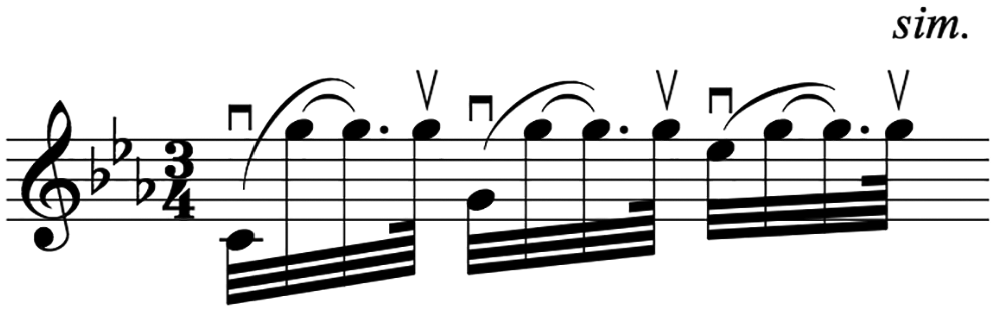
Practice with a dotted rhythm by turning last note of each figure into a 64th note.
I recommend first experimenting on open strings. This is helpful both on one string and in all possible combinations. Try the passage on open strings as they appear in the piece (Figure 4). Make note of the springing bow tip action when going toward a higher or lower string. The tip of the bow should be perpendicular to the string. Look for a clear, simple path free of excessive or unnecessary motion. In addition, monitor the arm and elbow in each case. Smooth, tension-free, and economic motions are key.

Try the passage on open strings as they appear in the piece.
The three down-bow notes are played with a subtle falling motion of the hand, while the single up-bow note employs a quick whip-like hand rise. Keep the wrist free and flexible with the downward motion driven fundamentally by gravity. I like the image of bouncing a small, imaginary ball with the hand. One helpful exercise is to let the hand hang without the bow and, with a single impulse, bring it up and let it fall back down by its own weight (Figures 5–7).
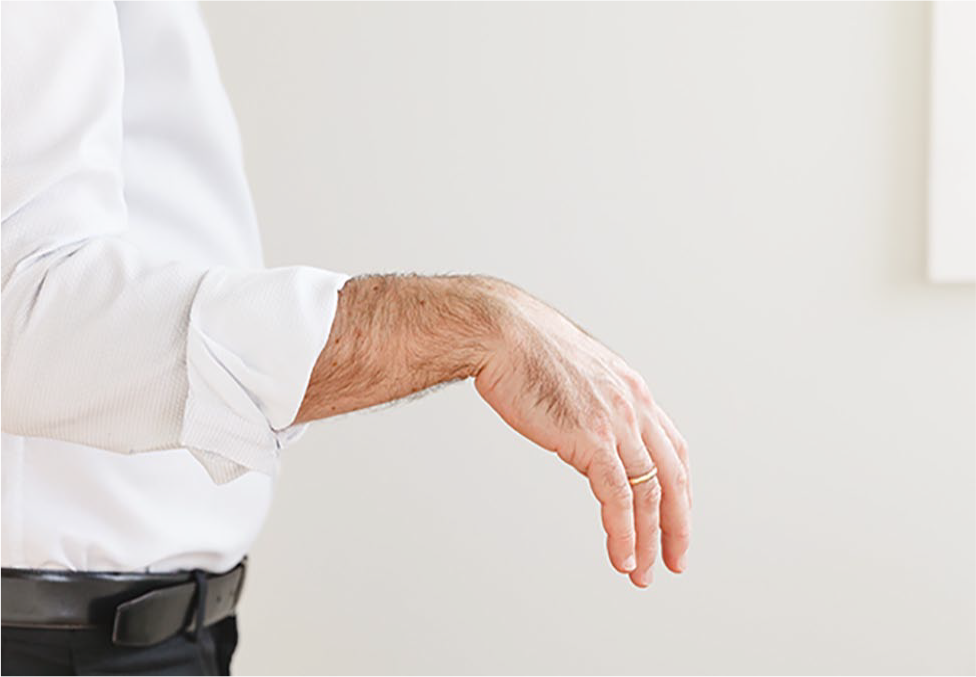
Wrist exercise step 1: Start with a relaxed hand.
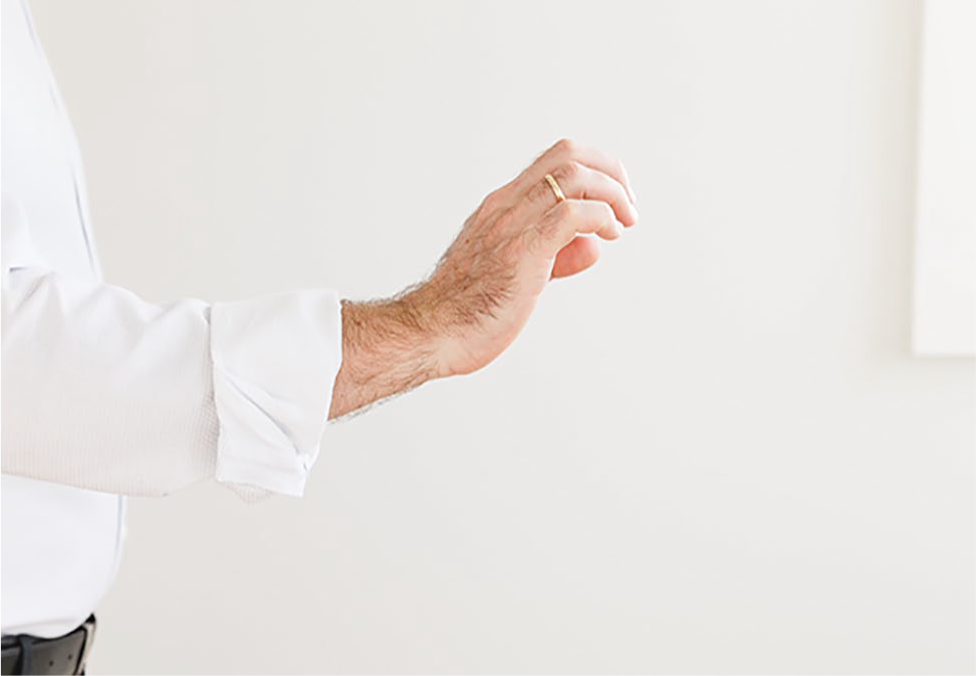
Wrist exercise step 2: Raise the hand up.
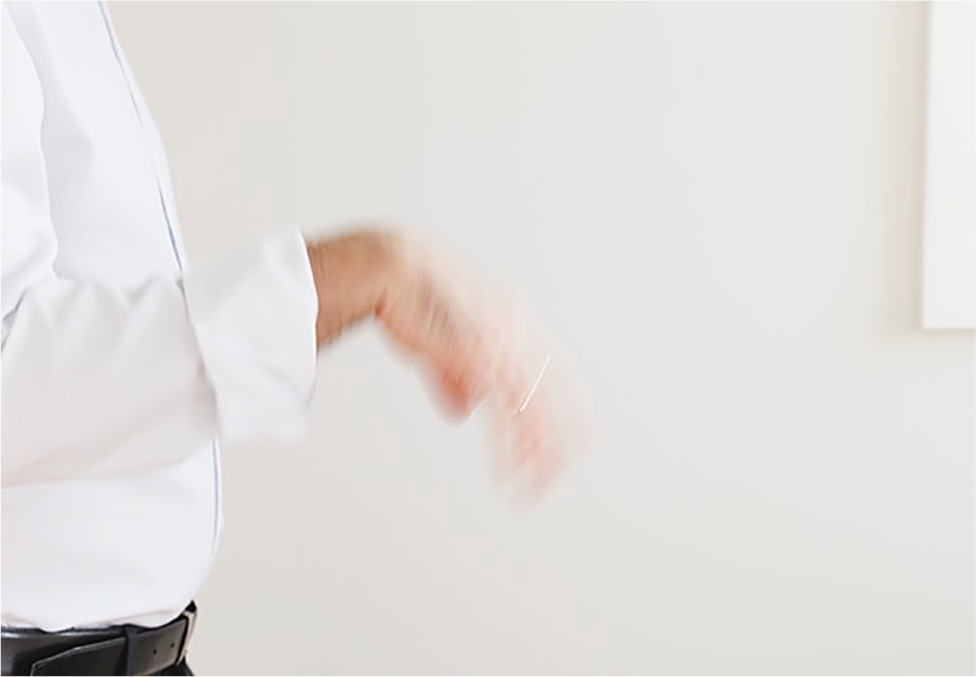
Wrist exercise step 3: Allow the hand to fall back down by gravity alone.
When practicing the written bow stroke, keep the bow low and close to the string at all times. While following the contour of the bridge, counteract the instinct to want to make the bow jump. I think of this as “earth low” in contrast to “becoming airborne.” It is important not to get too excited and start making the bow jump. After a lot of practicing, the right deltoid muscle (the muscle on the upper arm) might feel strained, as it is active when playing the lower strings. Even more so, this is the muscle that keeps the arm floating so that the wrist and fingers are in an optimal position to do the actual job. I find myself keeping the bow arm and elbow in a similar position for each string, as if I were playing détaché. Similarly, when I am between strings, the elbow is where it would be positioned for double stops. A very little amount of bow is necessary for this bow stroke.
While adjacent string crossings may feel smooth and connected, string crossings that skip strings prove challenging. To practice, I find it helpful to play the first four 32nd notes of every bar on separate bows, providing clarity when skipping strings. I also find it helpful and musical to use more bow weight and length on the bass notes. Practice creating accents by lengthening the first down-bow of each group of four notes. Then place the accent on the down-bow of each group of eight notes. Later, try only one accent on the downbeat of each bar, and finally, one accent every two bars. Experiment with creative uses of different types of accents and combinations. I find that keeping the attention to the quality of the sound in the bass makes both musical sense and keeps the bow stroke organized and coordinated with the left hand. For a change, turn it upside down. Think of the gesture as an up-bow (4th note) followed by three down-bow notes (Figure 8). I find this particularly helpful in Paganini’s Caprice No. 5.
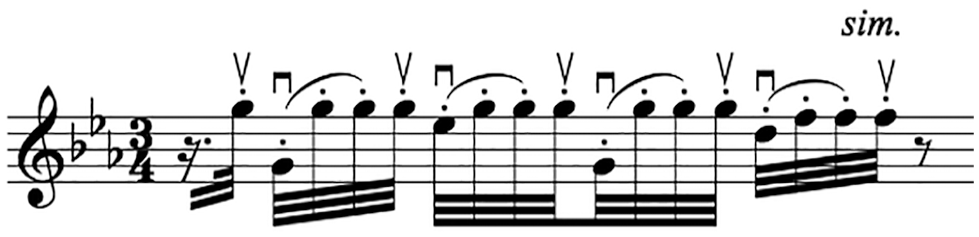
Think of the gesture as an up-bow followed by three down-bow notes.
Monitor the following variables in the use of the bow, which can significantly change its response. With this temperamental stroke, even small details such as a well-rosined bow can affect its success. Try different parts of the bow. I prefer lower in the bow for slower speeds and higher as I increase the speed, staying even closer to the string (Figures 9–11).

Straight bow, parallel to the bridge, flat hair, tip traveling straight. Avoid raising the right shoulder.

The pinkie can be on or off—keep the thumb curved and flexible.
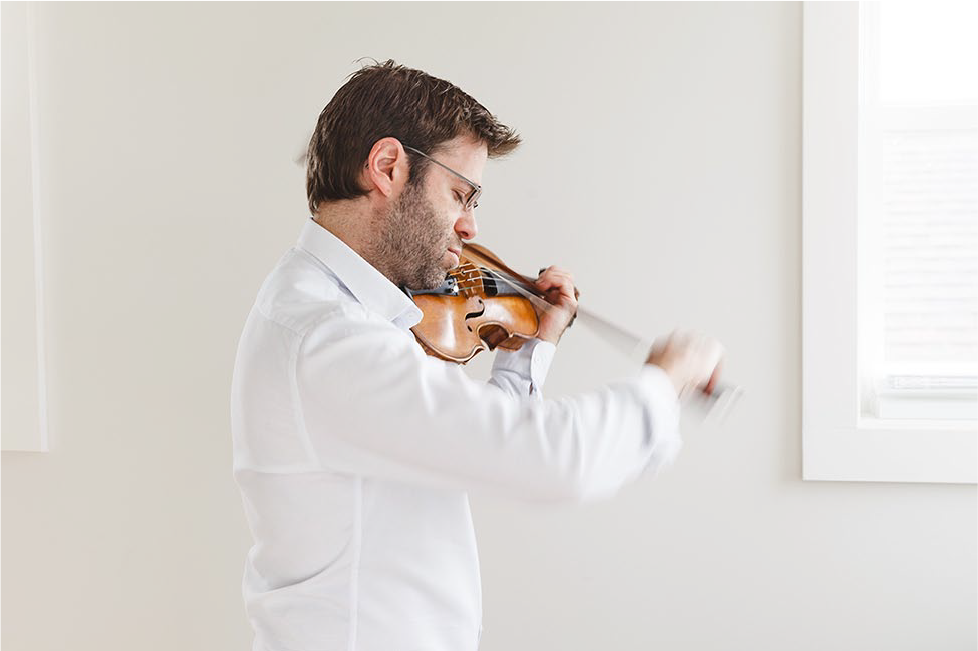
The 3+1 in action—the bow is always close to the string, following the contour of the bridge. Avoid raising the right shoulder or hand while keeping the elbow slightly elevated.
I find flat hair to start produces the crispest sound. As I play faster, I sometimes tilt the bow slightly toward the fingerboard to get a smoother stroke. Sounding point is another variable that can make a significant difference in the success of the 3+1 ricochet. Experiment with varying points of contact, trying closer and further away from the bridge. Let the ear decide what is best and consider if the sounding point changes at different speeds. For me, the challenge is to keep the bow closer to the bridge to get a clearer sound. Also try different angles to the bridge. I find the stroke most successful with the bow parallel to the bridge. Finally, the tension of the hair will play a role as well, so be sure to try different options.
In short, it is important to explore and find the best part of the bow, tilt, sounding point, angle to the bridge, and tension for each particular violin and bow combination, remembering that they might change with increased speed. When it is time to speed things up, watch out for rushing. It is common to rush when nerves or insecurities come into play. Keep a calm mind. To a listener, it is more exciting when passages are kept clear and controlled. Aim for a singing sound on the first note of each bar (try vibrato and a bit of length) to maintain or return to the intended tempo. Prepare the arrival at the beginning of each bar to avoid snowballing. Practice the bow stroke at different speeds. A final tempo could be somewhere between 144 and 174 bpm per quarter note.
Think of the bow grip like holding a paper cup filled with water (Figure 10). There must be enough contact so that it does not fall, however, too much pressure will squeeze the water out. Try doing the bow stroke with and without the pinkie on the stick. I find that without the pinkie, it is easier to get to all the strings and to have a more flexible motion. With the pinkie however, I can achieve enhanced clarity and articulation. Be able to do the stroke both ways and find out what works best. I do this by recording myself, since my perception of how I sound is more subjective while I am playing. Periodically recording practice sessions is the best way to keep assessments objective. Also, consider that the optimal way might be a combination. For fun, try holding the bow with only three fingers (thumb, index, and middle or thumb, index, and ring finger). A lot is to be learned from these experiments, especially how to give up controlling by holding tightly, as this takes away the natural springing quality of the bow.
Sing the upcoming measure. Besides helping with phrasing, this organizes the motion in gestures and helps prepare the mind and body for what comes ahead, which leads to an increased economy of motion and organic movements. I remember a story of a student who had just played a terribly difficult and fast motto perpetuo for Nathan Milstein, to which Milstein responded something along the lines of: “You should be a whole note.” When the bow stroke and left hand are working quite well, the player can eventually focus on the landscape or the desired musical shape. While emphasizing the first note of every bar helps the bow stroke and counteracts rushing, I prefer more continuity. Use the dynamic markings of the original guitar version of “Recuerdos de la Alhambra”: decrescendo in the first bar, crescendo in the second, decrescendo in the third bar, and so on, to create two-bar groups. Hold the first note of the odd-numbered bars a bit longer than the first note of the even-numbered bars.
The 3+1 ricochet stroke offers a unique opportunity in the process of discovering the intricate balance between player and bow. The exercises described above are ones I found immensely helpful in refining this fancy stroke through playful exploration. At the end of the day, I found the best ricochet teacher to be the sound. With this in mind, my body and bow found ways to collaborate, making a seemingly impossible stroke feel achievable, replicable, and most importantly, musical.
Footnotes

Tomas Cotik (