




Abstract

Shopping for a string instrument can be a daunting task for students and their parents. Without advanced playing skills, listening experience, or a string-playing vocabulary, many will not feel confident in evaluating a selection of instruments. Parents want to know how a $1,500 violin is different from a $5,000 violin. After all, they look the same to the inexperienced eye. The layperson’s ear will often confuse the quantity or volume of an instrument with the quality or character of its sound. If it sounds loud, it must be good—right? Is a loud violin better than one with more tonal complexity and wider dynamic range? With the guidance of teachers and trusted string instrument specialists, less-experienced students, parents, and even professional players can sharpen their playing and listening skills—learning to see, hear, and feel various characteristics and qualities of string instruments. The ideas presented here are for violin, but they can easily be adapted to viola, cello, and bass. Focusing on choosing the instrument first, a discussion of the selection of a bow follows.
Price Range?
How much a parent spends on a violin and bow for a student is determined by a number of factors. The student’s age, playing level, style of playing (classical, alternative styles), and commitment to music should be considered. Moreover, the price of the instrument, bow, and case should be within the family’s means. Full-size beginner student violin outfits start at several hundred dollars and can often be rented from a school or string shop. Fractional instruments are often priced proportionately lower. As the student grows and matures musically, they may be able to move up to an intermediate instrument in the $3,000 to $6,000 range. Many advancing high school players who are competing in youth symphonies, all state orchestras, and concerto competitions and are headed toward careers in music may be fortunate enough to play professional-level violins in the $10,000 to $20,000 range. Such a violin may take the student well into a music degree at a university or conservatory. The professional taking orchestra auditions or embarking on a solo career will likely need to step up even more to perform at the highest levels.
Where Should the Instrument Be Purchased?
Parents are well advised to avoid online specials. If it sounds like a fantastic deal, it is usually junk that ends up being used as wall art. The string student has the best chance to succeed with a quality instrument that is the correct size and set up properly with excellent parts, good strings, working pegs and fine tuners, a straight bow with horsehair, and a sturdy case. Purchasing from an established, reputable dealer that specializes in bowed, acoustic string instruments (not plucked or electric) is always the best route to take. These dealers are experts in violin family instruments; they will measure the student for the appropriate size, assist with adjustments, strings, and accessories, warranty their instruments, and offer full or partial trade-in when the student is ready to move up in size and/or quality. Most string instrument shops offer rental/purchase plans to provide students with quality instruments from the beginning. They will also send home or ship a selection of instruments and bows on approval before the purchase. Buying from an online site based on a picture and description, a pawn shop, an individual, or an auction might result in a good instrument, even if it needs some work to put it into playing condition. Such an instrument, however, carries no service after the sale, warranty, or trade-in value. What about Grandpa’s dusty attic violin? This instrument may be of great sentimental value and can often be restored to make music again.
Who Decides on the Instrument?
The student will play the instrument for many hours each week and for a number of years. The student has to like the sound under their ear as well as the instrument’s appearance. Playability is a big factor—it has to feel right and they need to be happy with it.
The parent is paying for the violin. Buying an instrument that gives the student room to grow will serve them better in the long run than one that they quickly outplay. The parent, who is making a significant investment, decides on the price range.
The private teacher and string class teacher/orchestra director play important advisory roles in the choice of the instrument and bow; their recommendations and preferences should certainly be considered. The teacher is working with the student for a few hours or less each week over a limited number of years, however, and should never force an instrument on a student or push the budget beyond the parents’ comfort zone. Any commission the teacher receives from the shop should be disclosed to the buyer up front. Once a fairly common practice, this conflict of interest between teacher and student can make it difficult for the teacher to be objective in helping the student choose an instrument if the teacher expects to receive a kickback—a percentage of the sale—from a certain shop. The student’s orchestra director and other professional players’ input can be invaluable, but students and parents may become bewildered with a number of differing opinions and should not expect that all of these string players will arrive at the same conclusion.
Factory versus Workshop versus Hand-Carved Instruments?
The bodies of factory instruments (Figure 1) are mass-produced, usually in large workshops, assembly-line style—one worker carves the top, another the f-holes, the ribs, back, applies the varnish, and so on. Although the level of violin-making in China was quite inferior years ago, in today’s market a high percentage of the best factory instruments come from China.
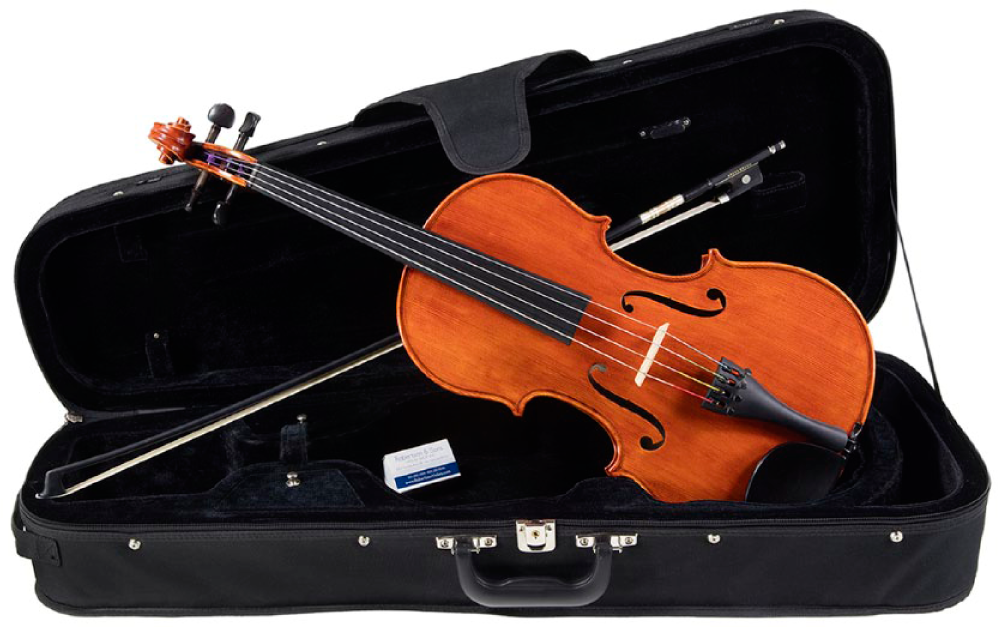
Factory 16″ viola, Howard Core Model 200 outfit with carbon fiber bow, Arcos Brasil, $775.
Workshop instruments (Figure 2) are manufactured on a much smaller scale; they are available at various levels and are excellent values. The bodies of these instruments are made of higher quality tonewoods, often originate in countries such as Germany, Bulgaria, or China, and then are shipped to the United States “in the white” where each is individually varnished and set up by an experienced American luthier. On higher quality workshop models, the luthier spends more time re-graduating the top, installing the bass bar, soundpost, and pegs, antiquing, varnishing, and setting up the violin. Highly figured tonewoods are used in these instruments and the varnish will have more transparency. Many string shops feature their own workshop lines and labels.

Workshop violin, Christian Pedersen Deluxe, Albuquerque 2020, $6,000; T. Chagas bow, Arcos Brasil, $1,100.
A hand-carved instrument (Figures 3 and 4) is a one-of-a-kind creation meticulously crafted from start to finish by hand by one master luthier. The wood is carefully chosen from a stock of expensive, aged tonewoods, and the maker spends 100 to 200 hours over a period of weeks or months crafting a violin or viola, with much more time spent on a cello or bass. In some cases, two luthiers collaborate—one makes the body and the other does the varnish and setup. Although many violins are made by semi-professional makers, the best are made by highly trained luthiers who spend their careers perfecting their art. These instruments are always of higher quality in terms of tonal depth, projection, playability, workmanship, and overall beauty of wood grain, antiquing, and varnish.

Hand-carved cello, Christopher Savino, Albuquerque 2019, $45,000; Pierre-Yves Fuchs bow, Switzerland, $6,500.
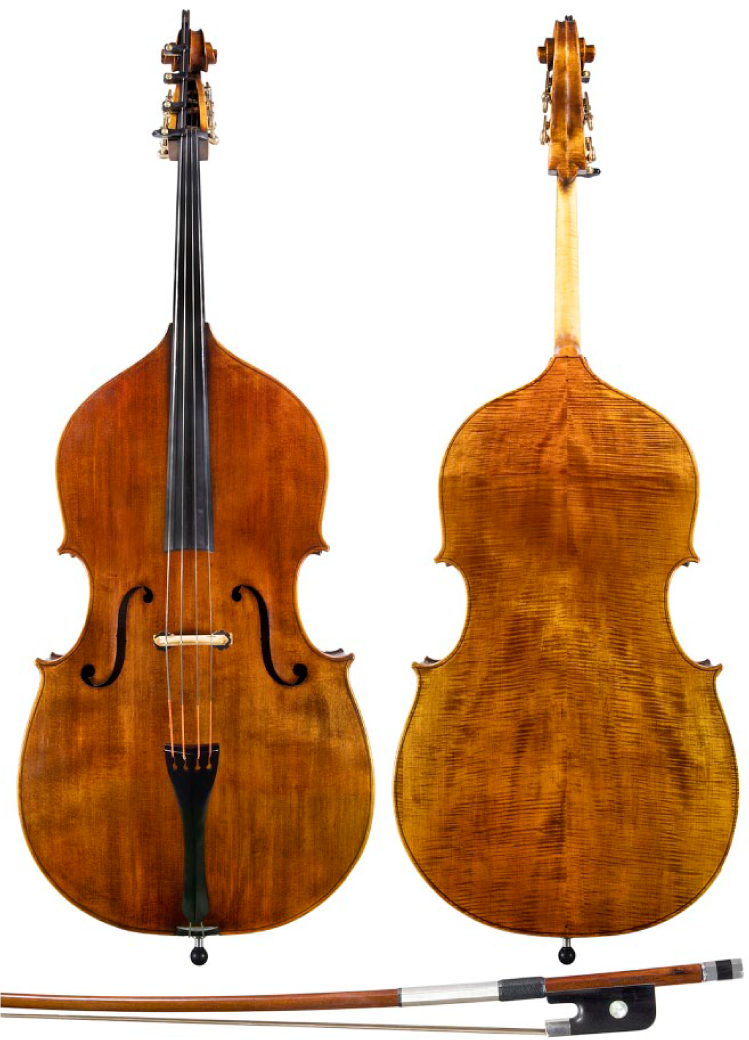
Hand-carved bass, Trevor Davis, Austin 2019 (Montagnana Model), $47,500; Rodney D. Mohr bow, Ashland, Ohio, $7,000.
Hand-carved violins by professional makers start around $7,000, violas at $8,000, cellos at $18,000, and basses at $20,000.
Old versus New?
Some parents want a brand-new violin for their child, believing that a “used” one should be discounted accordingly. They are often astonished to learn that some of the most expensive instruments in the shop are hundreds of years old and that most retain their original body, scroll, and varnish. If kept in good condition, few consumer purchases hold their value the way string instruments do. The models that have been played the most are usually the ones that sound the best because the wood has been resonating. Many believe that a new violin needs to be “played in.” A new instrument can sound amazing, however, and only needs a player to bring it to life, to make it sing; its voice will mature the more it is played.
Other students and parents like the idea of owning a vintage violin with some history and a well-seasoned sound. Some older production violins are still around under names like Roth, Meinel, Roman-Teller, JTL, Collin-Mezin, and Heberlein. In good condition, these are highly sought-after good-quality older violins. Checking the condition of an older instrument is especially important. The best plan is to try everything in the given price range with an open mind.
How Do You Try Out an Instrument?
When handed the first instrument to try, younger students are unsure of what to play and will usually start with their current piece. Since most beginning repertoire uses the upper strings, they will not hear the instrument’s full range. Better to start with open strings, then a scale, using a broad, weighty bow stroke on each note. A young student can play a one octave A major scale ascending and descending, then transpose to D, then G to hear all the strings. The intermediate student can play a two-octave G major scale with the advanced student extending it to three octaves. Using full bows, open strings only (no fourth fingers), and lots of vibrato gives us an idea of the resonance in all parts of the violin’s range. After this initial test, the player can play his or her current piece or choose from the repertoire on the next page. Many of these early pieces are from the Suzuki Violin School, but any repertoire that explores all four strings may be used.
The idea is to hear the entire range of the violin, playing in a variety of tempos, dynamics, bow strokes, and styles. For advanced players, include high-position passages on each string, checking for any wolf tones. Some violins may have a wolf tone around the high B or C on the G string; violas and cellos between E flat and F sharp on the G string. By making adjustments in bow speed, weight, contact point, and vibrato as well as experimenting with wolf eliminators, most wolf tones can be tamed. The experienced luthier can also make adjustments in the soundpost, bridge, and string tension.
Using a systematic approach, tune and line up four or five instruments with a shoulder rest on each. Play the same scale or excerpt on each for one to two minutes, and then quickly move on to the next. Test the instrument, don’t practice! (This is one of the only times the student will hear this piece of advice!) Keep a few favorites from the first group, then add more. The player will begin to develop some tonal preferences and feel the differences from one instrument to the next. Play in small spaces and larger venues. Listening to a teacher, friend, or shop salesperson play each instrument is important since what you hear under your ear may be different than from afar.
Suggested Repertoire for Evaluating Violins
Open strings, scales, arpeggios with full bows
Pieces on two strings such as Twinkle, Song of the Wind, Perpetual Motion, Long, Long Ago first in A, then in D and G
Dvorak Humoresque D minor section in first position with open strings
Vivaldi Concerto in A Minor First and Third Movements, especially G and D and string crossing passages
Seitz Concerti Nos. 3, 4, and 5
Ungar Ashokan Farewell
Haydn Concerto No. 2 in G First Movement
Accolay Concerto in A Minor
Fiocco Allegro opening, then measure 29 on G and D strings
Massenet Meditation from Thais
Bach Concerto No. 1 in A Minor First Movement opening, then measure 126 on G and D strings
Kreisler Praeludium and Allegro
Bach Solo Sonatas and Partitas
Concerti of Mozart, Bruch, Mendelssohn, Lalo, Saint-Saëns, Wieniawski, Barber, Tchaikovsky, Beethoven, Brahms, Sibelius, Paganini, and so on.
How Do We Listen?
Violin characteristics fall into the five categories below. Students and parents may find the matrix in Figure 5 helpful in keeping track of each instrument’s criteria.

How to choose a string instrument.
Tonal Characteristics, Quality, Color, Overtones
Dark, bright, even across strings, core sound, stable, focused, refined, polished, finesse, breadth, density of sound, clarity, sonority, vibrant, malleable, personality
Beautiful, thick, rich, deep, full, fat, brilliant, bold, mellow, golden, burnished, chocolaty, buttery, smooth, silky, sweet, brilliant, depth, complex, round vowel sound, edgy, lively, sparkling, luminous, effervescent, sheen, earthy, rustic, versatile, husky (viola)
Thin, tinny, metallic, strident, flat, shallow, edgy, steely, hollow, nasal, rough, coarse, gritty, shrill E, raw, tubby, thick, cardboardy, thuddy, buzzes
Many layers and wide spectrum of tone and color, multidimensional, texture, complexity, malleable
One-dimensional, dull, colorless, flat, lifeless, unfocused, no personality, generic
Projection, Resonance, Quantity, Volume
Loud, open, powerful, booming, ringing across all four strings, packs a punch
Weak, thin, small, intimate, closed, muffled, choked, tight, pinched
A wide range and layers of dynamics
Flat, generic, one-dimensional, player has to coerce or drive the sound
Strings—Thomastik Dominant, Vision Orchestral, Solo, Solo Titanium, Peter Infeld; Pirastro Evah Pirazzi, Evah Pirazzi Gold (to mention a few)
Articulation, Responsiveness, Playability, Size, Comfort
Quick response/articulation, clean, clear, clarity, stable
Easy to play, comfortable, even, smooth, effortless, ping, lively, zingy, fun, pop, sizzle
A struggle to play, tiring, clumsy, uneven across the strings, strings don’t speak, strings are false or buzz, inaccurate string spacing or height, imperfect fifths, wolf tones, dead zones
Sluggish, fuzzy, muddy, stale, clumsy, thick, dumpy, grumpy
Feel of the neck—size, texture
String length in relation to the size of the hand
Length and width of body, lower bout, middle bout, and upper shoulders (especially important for violists, cellists, and bassists)
Appearance
One- or two-piece back (has no effect on the quality or value)
Beauty, depth, and texture of wood grain
Varnish—color, texture, depth, transparency, multidimensional, luster, patina, iridescent or sprayed on, thin, shiny, flat, dull, thick, grainy, pasty
Antiquing—none, artistically done, authentic looking or too much, rough, rustic, overdone
Fittings—matching end button, chin rest, tailpiece, and pegs made of ebony, boxwood, rosewood, pernambuco
Workmanship, Setup, Condition
Quality of craftsmanship—refined, professional looking, aesthetically pleasing or rough, clumsy, rustic, amateurish
Quality of wood—spruce top; maple sides, back, neck, scroll; ebony fingerboard
Quality of varnish—translucent highlighting the beauty of the wood grain, hard, even or thick, damaged, blistered, flaky, splotched, crackled, uneven
Quality of purfling—expertly inlaid, refined corners, or painted
Quality of bridge—fitted specifically to the violin with correct curvature, string grooves, string spacing, and string height
Quality of pegs—fitted to the peg holes, ease of turning, stability, tapered for changes in humidity or constant slipping or sticking
Quality of fingerboard and its camber, nut, end button, strings, chin rest, tailpiece
Condition of instrument and quality of past repairs
Label, provenance, authenticity, attribution, condition report, dendrochronology report (tree ring dating), certificates—all important for investment-quality instruments
Even after spending time trying various instruments, some parents still will have a difficult time discerning the lower quality violins from the higher ones. Every parent, however, can understand the difference between an inexpensive car and a luxury one. Just like string instruments, the differences are in design, engineering, materials, and workmanship. A high-end vehicle is beautiful inside and out, is made with quality materials and workmanship, and handles like a dream. This kind of car gives the driver a feeling of power and control on the road. You feel awesome driving it, just as a violinist feels playing a high-end instrument.
What About the Bow?
It is best to focus on choosing the instrument first and then try a variety of bows, each with fresh hair and rosin, to match it. Parents sometimes think that the old bow should work just fine, not realizing that it should be upgraded with the violin. The bow needs to complement the violin and be appropriate to the student’s playing level. Turning again to the analogy of the automobile, the bow is like the tires on the car; it is the player’s contact with the road; it pulls the sound from the violin. You wouldn’t put worn, low-quality tires on an expensive car. Beginners often start with an inexpensive fiberglass bow. For a bow under $500, carbon fiber is an excellent choice. Pernambuco from Brazil is the only suitable wood for quality bows which start around $400 to $500. Bows made of ipe, Brazilwood, bandera, or other substitutes sometimes warp easily. The stick’s shape, either round or octagonal, is determined by the bow maker and quality of the wood; higher quality bows are usually round.
The bow should feel like a natural extension of the player’s bow arm, give the player a feeling of control, and handle well in all parts and with all bow strokes. A good bow will pull the instrument’s core sound; the better the bow, the easier the player’s job, especially in bouncing strokes. The bow should match both the instrument and the player. A general price range for the primary bow is around 20 percent of the value of the instrument.
As the student becomes more advanced and is performing in more diverse settings, they also need a backup bow in the case, just like the spare tire in the trunk of the car. If the student is moving into a higher quality pernambuco bow, an inexpensive carbon fiber bow is just fine as a backup bow. It will come in handy for crowded rehearsals, gigs, and teaching where bows can be accidentally broken, and for use when the primary bow goes in to be re-haired.
“With advance preparation from the teacher and guidance from the sales staff of a trusted string shop, parents and students can make intelligent decisions when purchasing a string instrument and bow.”
The differences in bows are not as obvious to the younger student and the parent as are the differences in violins. The subtle variables in tonal quality, weight, balance, and control are sometimes perceived only by a more experienced player. The teacher and shop salesperson can guide the student in the choice of an appropriate bow.
As with the instrument, try a selection of bows with a variety of bow strokes. For each type of stroke, listen to the tonal focus, color, and articulation and feel the control on the string and the comfort of the bow in the hand.
Suggested Repertoire for Evaluating Bows
Open strings, 1, 2, or 3 octave scales and arpeggios with full, legato bows, two string pieces in A, D, G
Staccato strokes in middle—Twinkle Variation B, Suzuki’s Perpetual Motion singles in A, D, G, Kreutzer #6
Detaché strokes in middle—Suzuki’s Perpetual Motion doubles in A, D, G
Detaché and staccato strokes combined—Bach Double
Collé and piqué in lower half—Becker Gavotte, Seitz Concerto No. 5 Third Movement, Veracini Gigue, Bach Concerto No. 1 in A Minor Third Movement, Bach Giga movements
Spiccato in middle—Mozart/Kreisler Rondo, Mozart Concerti, Kreisler Praeludium and Allegro
Sautillé in middle—Perpetual Motion pieces by Suzuki, Jenkinson, Bohm, Ries, Novacek, Sinding, Paganini
Up-bow staccato—Weber Country Dance, Kreutzer #4, virtuosi pieces by Wieniawski, Sarasate, Paganini
Ricochet in middle—Dancla Air Varie Op. 89, No. 5, de Beriot Scene de Ballet, Kreisler Danse Espagnole
Saltando—de Beriot Scene de Ballet, Mendelssohn Concerto First Movement cadenza, Sibelius Concerto First Movement coda
Bow Characteristics
Weight, balance, balance point, camber, strength, straightness, density of the wood
Quality of sound—clear, full, core, focused, dark, light, smooth, lively or thin, coarse, grainy, surfacy, dull
Playability—quick response in all parts of bow, smooth bow changes, agility, elasticity, control, precision, soft, stiff, strong, nimble or clumsy, club-like, heavy, spongy, mushy, sluggish
How much energy must the player expend? What kind of control does the bow give the player?
Materials—fiberglass, Brazilwood, ipe, bandera, carbon fiber, pernambuco
Quality of stick, finish, frog, adjuster, tip, hair, re-hair job, past repairs
With advance preparation from the teacher and guidance from the sales staff of a trusted string shop, parents and students can make intelligent decisions when purchasing a string instrument and bow. They will learn how to listen to the inner beauty of the sound, observe the ease of playability, appreciate the quality of the materials, and value the skill of the maker. They will recognize the violin as a work of art that is also a musical tool. Knowing what to play, how to listen, and having an open mind about sound, response, appearance, origin, and age of the instrument will put the right instrument and bow into the student’s hands.
Footnotes
Violinist and violist Barbara Barber(