



Abstract

The Romantic era boasts a profusion of violin concertos by composers familiar to any classical performer or teacher, each offering unique technical and interpretive possibilities. It is surprising that the 1882 concerto of Richard Strauss (1864–1949) has remained so obscure given the composer’s overall celebrity and the piece’s rewarding qualities. Advanced students will find an intriguing hybrid of rhetorical rigor and bravura. One almost always gets the sense practicing it that Strauss understands exactly what he is asking the violinist to do, daunting or not.
Strauss’s concerto carries a valuable pedagogical recommendation: the skills required all receive ample use. The topography of difficulties is remarkably consistent within each section of music, giving students an opportunity to psychologically acclimate to each one on arrival and build confidence by making unexpected performance accidents less likely. This juxtaposes the concerto with Henryk Wieniawski’s Concerto No. 2 in D minor, Op. 22, a resourceful piece from the same era that is often assigned to students at this level, but which does not share the strong formal architecture of Strauss. The Wieniawski has more of an “obstacle course” quality in which specialized techniques arise to be used only for a bar or two.
In another contrast, for all the lovability of Max Bruch’s Concerto No. 1 in G minor, Op. 26, it does not present as well with piano as Strauss, which doesn’t compel the pianist to reproduce complex or thundering orchestral timbres. Without disparaging either the Bruch or Wieniawski, this underplayed concerto may be an excellent addition or substitute. It is drawing increasing attention through recordings since 2018 by Arabella Steinbacher, James Ehnes, and Tasmin Little.
Setting the Stage
Strauss’s virtuosic symphonic and operatic works include memorable solo passages for many instruments, but he only infrequently took up concertos, a subject that interested him during short periods bookending his career. The violin concerto belongs to his first burst of enthusiasm. Like some other early major works by Strauss, it owes a scarcity of performances not to serious musical deficiencies but to comparisons with bolder later efforts like the same composer’s Violin Sonata in E♭ major of 1887 and the iconic series of tone poems for orchestra.
Strauss’s main instrument was the piano, but he studied the violin by age eight with Benno Walter, concertmaster of the Munich Hofkapelle. The principal hornist in that orchestra was Strauss’s father Franz, Walter’s cousin. While clearly not his strength, violin lessons gave Richard crucial insight into the instrument (Holden 2011, 4–6). During his teen years, the precocious composer incorporated the violin in original chamber music and short pieces for orchestra, culminating in the Symphony No. 1 in D minor of 1880. The violin concerto shares its key, maximizing the resonance of the two middle open strings.
“Strauss’s concerto carries a valuable pedagogical recommendation: the skills required all receive ample use.”
Throughout his life Strauss revered Mozart as a model, superficial differences between their styles notwithstanding (Holden 2011, 10–11). The form of Strauss’s violin concerto would have been eminently familiar to the earlier master despite the gap of a century. Like his forebear, Strauss drew on the deep tradition of virtuosic Italian string solos as filtered through a Germanic sensibility. He made his acquaintance with the history of violin writing clear in this concerto by carefully emulating models of the past for the portions designed for brilliant display.
The ideas for Strauss’s concerto were already percolating in 1878 (Potter 2014, 5) before Johannes Brahms’s Violin Concerto in D major, Op. 77, had its first hearing the following year and proved the orchestra could be a full partner in the musical discourse of a violin concerto. Hence, Strauss looked to earlier examples for the pattern of interaction between soloist and what here could correctly be termed accompaniment. The harmonic palette likewise remains rooted in the early nineteenth century, a far cry from the polytonal experiments Strauss later undertook.
First Movement: Homage to Spohr
The initial Allegro carries a reasonable quarter note marking of 112 beats per minute and immediately introduces an octave motive that recurs throughout the movement. The opening tutti is monothematic and as such points to Louis Spohr’s Concerto No. 8 in A minor, Op. 47, of 1816 as a specific inspiration, one that looms large in this movement. Spohr (1784–1859) was a touring German violin soloist who authored at least fifteen concertos, No. 8 best known among them. Also a conductor and prolific composer in other genres, he was acclaimed among the century’s musical titans even decades after his death (Campbell 1981, 28). The Concerto No. 8 was recorded by Jascha Heifetz and others before being championed by Hilary Hahn more recently. Strauss himself considered it “magnificent” (Kennedy 1999, 15).
Strauss’s shortened tutti is neither the simple tonal establishment of Felix Mendelssohn’s Concerto in E minor, Op. 64, nor a full Beethovenian exposition. The former hardly gives students time to get comfortable on stage and the latter often results in a harsh and dismaying cut in the piano reduction. The solo entrance is one of the most inventive passages in the concerto (Figure 1). Figure 2 illustrates a build-up practice progression in three stages applied to the opening solo bars of Figure 1.

Richard Strauss—Concerto, Op. 8: I, opening.

Practice progression for Figure 1.
Arching thematic material leads to some filigree passagework which notably avoids the trills and other ornaments typical of virtuoso-authored concertos up to that point, especially those of the Franco-Belgian school like Rode or de Bériot. The aesthetic of such pieces chiefly prized elegance in contrast to the weightier Strauss.
It is the F major second theme (m. 97-116) where Strauss’s fingerprints become recognizable. The majestically noble melody soars to the high violin register. He felicitously places a fragmentary but sweet phrase before passagework that must have particularly impressed him from Spohr and that violinist’s idol G.B. Viotti (1755–1824), ancestor of twentieth-century playing traditions (Campbell 1981, 22). The style of Viotti’s Concerto No. 22 in A minor of c.1792, admired by Brahms and others, appears in a double-stop configuration (Lister 2009, 367). Figures 3 to 5 detail the relationship between these passages.

Louis Spohr—Concerto No. 8, Op. 47: I, m. 264-265.

Strauss—Concerto: I, m. 126-127 and 144-145.

G.B. Viotti—Concerto No. 22: I, m. 139-142.
Strauss demonstrates his allegiance to Spohr by keeping his four-string arpeggios slurred as opposed to the ricochet stylings of the Paganini school (Campbell 1981, 34). The sonorities contain rapid voicing changes and nonharmonic tones, exhibiting the composer’s grasp of violin technique and innovation beyond overused formulas.
While the return in m. 195-196 and m. 206-207 of Figure 1’s improvisatory-sounding material might be construed as a structural design weakness, practicing in those keys (G major and minor, respectively) foreign to the original passage strengthens the technical command of all three.
Skills highlighted in the first movement include the following:
Extended passages in mixed double stops, usually on the pattern of Figure 1 or 4.
Many consecutive slurred broken octaves by steps or thirds; these can all be performed with a 1–4 fingering, or 1–3 in high registers.
Three- and four-string arpeggios slurred both on and off the beat.
Rapid slurred diatonic and chromatic scales up to three octaves.
Cantabile melodies in simple rhythms throughout all positions.
Consecutive sixths with a trill on the top voice.
Occasional large leaps.
Second Movement: Reflection on Tchaikovsky
Piotr Ilyich Tchaikovsky’s Violin Concerto in D major, Op. 35, was premiered in Vienna in December 1881 when Strauss was working on this concerto, and the younger composer reveals his awareness of that event. Like the slow movement of Tchaikovsky, Strauss’s is in a triple meter G minor with an E♭ major central section making a straightforward ternary form. Strauss begins the main theme on the same low D upbeat and continues the melody in the same range as Tchaikovsky. The spirit is song-like, devoid of double stops or Italianate operatic decoration. No one could be better suited than Strauss to writing such themes: he was a song composer the duration of his long life, preferring the female voice. By the time of this concerto, he had already tried his hand at dozens of lieder in his native German (Kennedy 1999, 18).
Throughout the concerto the published slurring is usually playable. However, a metronome marking error in this Lento ma non troppo confuses matters. A conductor acquaintance of Strauss and expert on his music confirms the dotted quarter note marking of 69 beats per minute should refer to the eighth note instead (Del Mar 1962, 19). That correction entails major bow control in the slurs of two bars to a stroke (Figure 6). Some recordings adopt a slightly faster tempo; a degree of rubato is appropriate anyhow.

Strauss–Concerto: II, opening (corrected).
This is not a long movement, taking around seven minutes, yet it is remarkable there is not a single moment of rest for the soloist after entering! Thankfully the music is not technically strenuous. While Tchaikovsky heads straight into a finale, Strauss writes a full ending to this movement and indeed was known to program it independently (Holden 2011, 124).
Skills highlighted in the second movement include the following:
Long note values for distinguishing shades of vibrato, thus elucidating phrasing and harmonic underpinnings.
Bow control in long slurs using a wide dynamic range.
Expressive shifts under an octave up to B♭6, inviting choices of fingering for different types of portamenti.
An extended trill.
Finale: Hints of the Future
Overall, the last movement is most characteristic in its entirety of Strauss. The main theme and many other passages use a quick spiccato bowing requiring an even stroke to equalize beats that start on down, versus up-bows (Figure 7).

Strauss—Concerto: III, opening.
Occasionally, it is beneficial to start upbeats on a down-bow to facilitate string crossings in a clockwise direction, as in the Viotti-like figuration in Figure 8.

Strauss—Concerto: III, m. 237-243 (author’s edits).
The primary published edition originally by Joseph Aibl is the source of most reprints. Its lack of fingerings becomes especially regrettable in this movement. Some students would need them prescribed by the teacher; there are more passages that necessitate thoughtful solutions in this movement than the earlier two, mostly related to clean shifting in the fleeting triplets. The half note marking of 96 beats per minute—more than fulfilling the Prestissimo designation—is aggressive and the movement would still be effective a few beats slower.
The form is an ABACABA sonata rondo adopting as the B theme a diffident, Schumannesque tune marked cantabile (m. 75-90). Significant intonation challenges are presented by the bridge passages, slurring triplets over the bar in a nimble ascent to arpeggiated chords in duples. A proposed practice strategy is in Figure 9. The passage is to be played at first in all equal note values, including the small added notes which are not Strauss’s. Those guide notes can then be removed one at a time from left to right before playing the passage slowly as composed.

Strauss—Concerto, III: m. 590-596 (author’s edits).
The duples in major or minor triads as shown in Figure 10 require sufficient differences between half and whole-step finger spacing on the changes, in contrast to the diminished sevenths above.

Strauss—Concerto, III: m. 629-631.
The lengthy orchestral tutti before the second B section would probably need trimming in a recital performance. Alternately if the concerto’s full duration of thirty minutes is too long, the soloist could start the last triplet of m. 649 at the end of m. 437 to make a still-classical ABACA rondo with no loss of thematic material.
The C theme in Figure 11 appears only briefly at the center of this rondo sandwich. An ascent in G major thirds seems designed to make students glad they practiced such scales. It also includes at its peak the only incidence of tenths in the concerto, used in a sparing way that is typical of the classical tradition, not Paganini or Wieniawski. Strauss here shows an admirable understanding of the nature of tenths and especially sixths as double stops on the violin, used as chromatic neighbors played by the same pair of fingers without shifting.

Strauss—Concerto: III, m. 395-402 (author’s edits).
This hints melodically at Strauss’s own Burleske for piano and orchestra from just four years later.
Generally speaking, there are many chromatic passing tones, a melodic habit Strauss shared with Mozart even into maturity. Although distant modulations are uncommon in the concerto, Figure 12 resembles the ubiquitous orchestral audition excerpt from Strauss’s future tone poem Don Juan in Figure 13. A student who has mastered this finale will be well prepared to approach the later, more varied score.
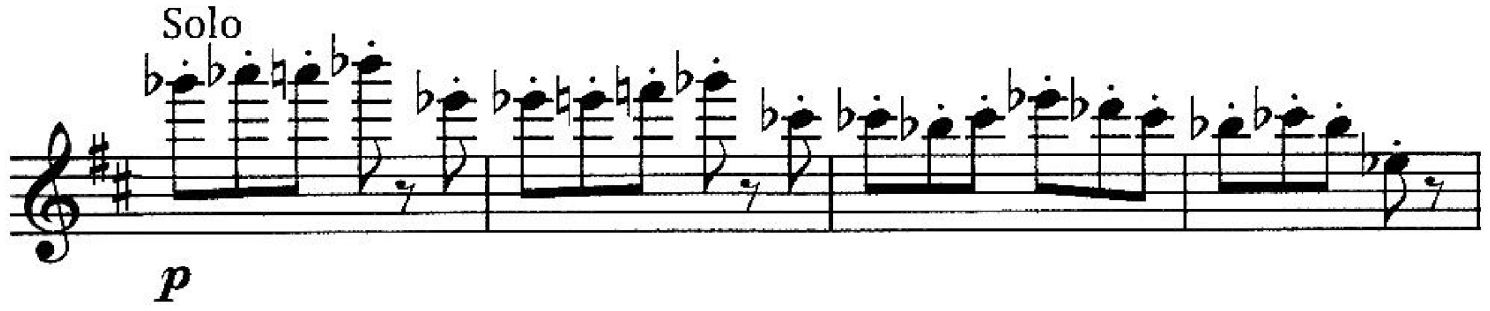
Strauss—Concerto: III, m. 461-464.

Strauss—Don Juan, Op. 20: m. 52-54.
Just four lines from the end Strauss halts the running triplet scales for a reprise of the second theme from the concerto’s first movement (m. 701). Many Romantic multi-movement works employ thematic return and it can sometimes seem unmotivated on the composer’s part. Here it makes a wonderfully warm, genuine gesture because Strauss has so thoroughly mined the potential of the intervening movements and creates such a change of mood. There is an ad libitum lead-in to this passage but no full cadenza, something Strauss saved for the concertmaster in his Ein Heldenleben (A Hero’s Life) later. A resumption of prestissimo finishes the concerto with perhaps the only bars that might benefit from a simplification as seen in Figure 14; an open A would increase resonance for the ending and avoid some glissandi.
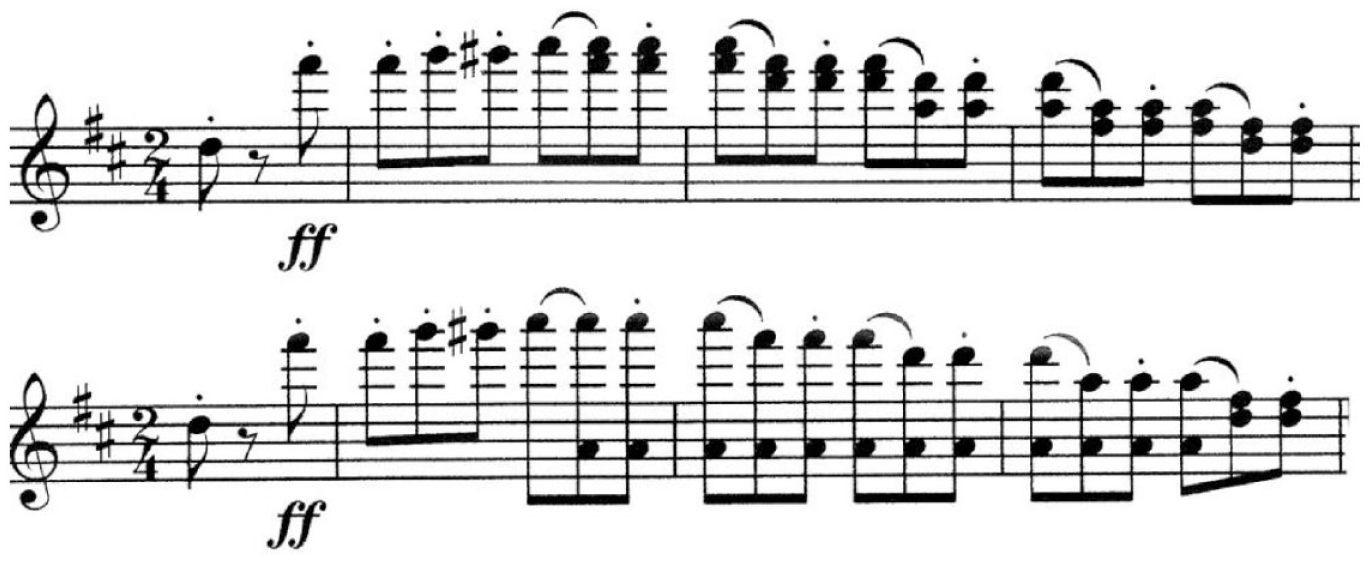
Strauss—Concerto: III, m. 718-721 original (top) and author’s proposal (bottom).
Skills highlighted in the third movement include the following:
Extended passages of rapid spiccato of varying dynamics in mostly stepwise passagework.
Chromatic fingering in combination with string crossings.
Many two- or three-octave scale/arpeggio hybrids in the style of Figure 9 on major/minor harmonies.
Multiple iterations of three-string major, minor, and diminished chords in the style of Figures 9 and 10 in all positions.
An F major arpeggio in double stops descending from seventh position.
A rapid mix of double stops including tenths as quoted in Figure 11.
Inviting a Curtain Call
Between family musicianship and wealth, the young Strauss enjoyed advantageous connections to promote his music. He himself played the violin concerto premiere at the keyboard in the Bösendorfer-Saal in Vienna, December 5, 1882. His teacher Benno Walter was soloist. The composer was eighteen and had finished his piece the prior spring; this concert marked his public debut as a performer in a professional context. “The hall was reasonably full thanks to the complimentary tickets,” he reported, “and my concerto was very well received: applause after the first F major trill, applause after each movement . . . and at least I didn’t make a mess of the accompaniment.” Even the feared critic Eduard Hanslick approved, something that would not happen often later in Strauss’s career (Potter 2014, 6). The concerto was published only later in 1897 as Opus 8, which belies the notion that Strauss disavowed the work as his style changed. It gives students a chance to reach a major composer they almost never encounter before college—sometimes not even then—while practicing a well-crafted solo line and gaining a miniature lesson in the history of the violin.
Most students perform their concertos with piano. Possibly because Strauss conceived it at the keyboard, in which version it was heard for several years before ever being played with orchestra, the concerto has a strangely protean adaptability not shared by almost any other Romantic violin showcase. In peer works either the piano reduction distracts via glaring textural seams between itself and the solo part, or the violin’s role may resemble a dramatic character who has wandered onto the set of the wrong play. All this is regardless of the pianist’s aplomb. When given with orchestra, the concerto’s breadth of thematic material ably withstands a bigger spotlight and there are fine moments for the beloved horn of Strauss’s father.
The solo line never suffers from cramming more notes than necessary to make an effect and the three movements are all completely detachable, though a listener would need to hear the first movement to catch its souvenir quote later. The violinist’s difficulties respond gradually yet quite quickly to well-organized practice, and the future opera composer Strauss, always mindful of theatrical impact, lets the soloist shine.
Footnotes

Michael Keelan (