




Abstract

Let’s be honest, music lessons are cheaper than traditional psychotherapy.
When taking on a new adult student, teachers are presented with the challenge of using an approach that differs from that used with more traditional learners. The teacher will be joining the student on a journey that has been in process for many years. This requires teachers to adjust their perspectives, expectations, and overall approach to working with these unique individuals. Rather than leading the student and making assumptions about their needs, teachers spend a lot more time listening. Teaching the adult learner is more of a side-by-side approach rather than leading an individual down a preset path. All of this having been said, it is extremely important to understand why students choose to pursue the study of an instrument in their adult years.
Prior to writing about this topic, we felt it was important to gather data from adult learners in the form of a survey. Surveys were sent to adult learners through email and social media and included seventy-three participants from across the world including the United States, the United Kingdom, Austria, Canada, Japan, the Philippines, and South America. The survey provided us with insight into what motivates adults to play instruments. The charts in Figure 1 show some of the results we found.
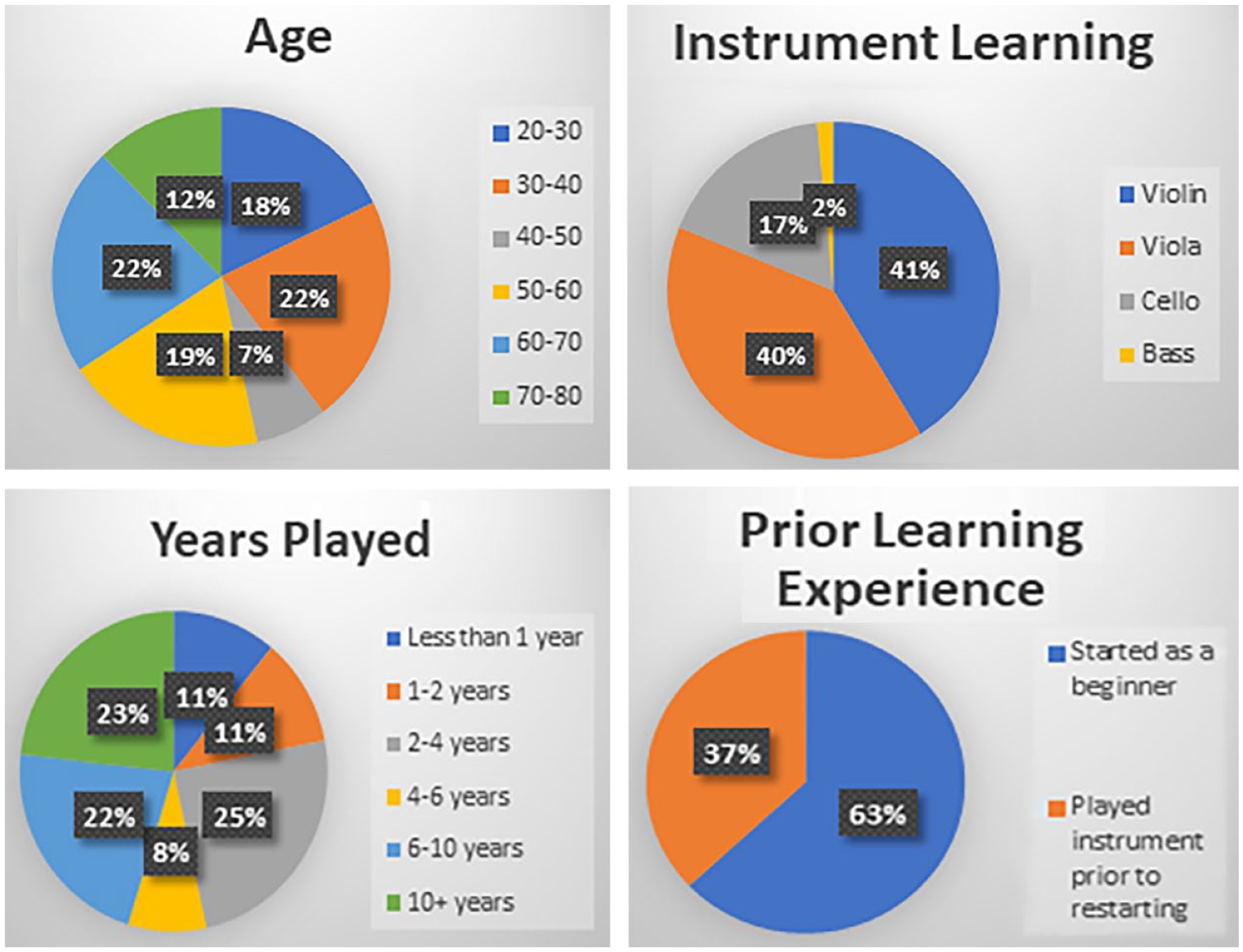
Survey Results.
After reviewing our survey responses, we came across several recurring themes. Adult learners tend to come to their instrument through some sort of experience. In many instances, the memory of learning an instrument as a child is what brought them back. Others returned to the instrument because their previous involvement was less than positive such as being discouraged as a child by a teacher, peers, or even parents. Returning to the instrument was a way to heal that broken experience. Another very powerful encounter that draws the adult learner to the instrument is hearing a particular sound in a performance and wanting to reproduce and create that sound firsthand. Some other interesting responses were the following:
A means of maintaining and treating a mental health condition;
Playing an instrument as part of a recovery from a traumatic brain injury;
A form of self-care;
Stress relief;
Staying active and sharp in retirement.
Another motivation for learning an instrument that was found in our survey was the desire to play an instrument with other musicians. Many adult learners are looking for some sort of enjoyment through learning an instrument, but that motivation does not stop at just learning to play alone. Many respondents expressed wanting to play in an orchestra or a chamber music group, while some have a desire to collaborate with others in their own family who play instruments. Parents also expressed an interest in being able to learn alongside their children. This need to connect is what keeps the adult engaged in learning, exploring, and making progress.
Practical Considerations
Now that we have established why learners choose to pursue the study of an instrument in their adult years, let us address the practical considerations for teaching adults.
Scheduling
Scheduling lessons with adults is often much easier than it is with younger students. Although many adults have a typical “9 to 5” job, some have a more flexible schedule. For many private teachers, this flexible scheduling can allow for morning and afternoon lessons, leaving the “prime time” for lessons after school and weekends open for younger students.
Flexibility is very important. This is a topic some teachers would argue is not okay to provide in a private studio, but it is necessary on an occasional basis. It is important to remember they are adults with jobs, families, and responsibilities. This by no means implies that you can’t schedule a regular time with your students and have them stick with it. Just be aware there may be some rescheduled lessons from time to time and last-minute cancellations that are unavoidable.
Many adults request lessons to occur bi-weekly. This can be for multiple reasons—they cannot afford weekly lessons, their schedule does not allow for weekly lessons, or they know that practicing will be difficult and want to give themselves more time. Many private teachers depend on their lessons to make a living and view bi-weekly lessons as lost income. It is important to think of the big picture. If a student is requesting bi-weekly lessons, put them in a time slot that isn’t highly requested—during the morning or after your regularly scheduled lessons—or fill it with another student who is also on a bi-weekly schedule.
Practice Expectations
Ultimately, this is up to the student. Remember that this is their journey, and the majority of adult learners want to learn the instrument for enjoyment. While you can still have practice expectations for your studio, expecting them to practice four to seven days a week for thirty minutes or more might be unrealistic. Yes, there will be students who can practice most days, but many will be lucky if they can practice two to three days per week.
Coaching your students on how to efficiently practice is crucial. How can they accomplish a quality practice session in fifteen minutes? This skill requires coaching from the beginning. Help plan out their practice sessions by suggesting how many minutes to practice for each concept and what goals to achieve. Showing them how they can practice four measures with a clear goal versus playing the entire piece with no goal will help their confidence in practicing as well as their ultimate success. Here are a few tips to help your students be successful during the week:
Record your lessons. Many students have success in rewatching lessons to hear what they worked on and why they worked on it.
Record videos of you playing their pieces so that they can play along. Many adults feel more confident playing along with you during lessons, so having the option to do that at home is important.
Provide “couch practice” options for those tiresome days all adults have. These can include bow exercises, finger tapping/strengthening exercises, finger pattern taps, and so on. Show them in lessons and provide videos for them to reference.
“Coaching your students on how to efficiently practice is crucial. How can they accomplish a quality practice session in fifteen minutes?”
They know it is up to them to practice and improve. On weeks when practicing has not happened as much, or at all, just tell them you will review what you went over last week and build upon it.
Progress Expectations
As previously stated, this is their journey, not ours. We are there to guide them through the learning process and provide them with the skills they need to accomplish their goals. With kids we can plan our lessons based on what we feel are the most important skills, but, with an adult, those etudes we love so much might not be a motivating factor and that’s okay!
At the first lesson, ask your new student what their goals are and make a plan with them. If they just want to learn the instrument with no specific goal in mind, then share with them your teaching methods and plan from there. If, however, they want to learn a specific genre, piece, or song, or to play in a certain group, you need to keep that at the forefront of your teaching.
Check in with your student every few months to find out if their goals have changed and adjust your lessons accordingly. At each lesson ask, “how would you like to use your time today?” This allows them the opportunity to use their time with you to work toward a specific goal. These goals can change each week—they may find their bow hold feels off, they may want to work on shifting more, they may have shoulder rest problems, etc.
Be open with your students. Talk to them about the goals they have chosen and help them establish a practice routine to reach those goals. Have them create short-term goals so they have multiple accomplishments along the way.
Repertoire
In regard to the repertoire you choose for your adult students, there is no need to change what you already do, especially at the beginning stages. It is important for them to develop a solid foundation just like any other student. Continue to use those method and technique books and yes, it’s okay to have them learn “Twinkle, Twinkle.” In fact, most adult students view “Twinkle, Twinkle” as a rite of passage.
In addition to some of the more traditional repertoire used for younger students, here are some examples of repertoire resources that work well for the adult learner:
Solo Pieces for the Beginning Violinist by Craig Duncan;
Easy Solos for Beginning Cello by Craig Duncan*;
I Used to Play Viola by Doris Gazda and Larry Clark*;
Mittell’s Violin Classics Volumes 1–5 by Philipp Mittell;
Music by Black Composers Violin Volume 1 Arranged by Rachel Barton Pine;
Any duets—adults love playing duets because it fulfills the need to collaborate while making music;
Fiddle or folk tunes are also great because the difficulty level can be adjusted.
*These books are available for violin, viola, and cello.
Be sure to keep their goals in mind. If a student is eager to play a movie theme or pop song, find a way to get them to that point, even if it means rewriting the part so it is more approachable to their level of playing. Once they have the basics, let them learn what they want to learn!
Recitals and Playing Opportunities
Adults need playing opportunities just as much as younger students do. However, adults don’t necessarily want to play in the same recital as an eight-year-old playing the same piece as themselves. If you have enough adults within your studio, do a separate recital for them. Turn it into a fun happy hour experience so it is less intimidating but still gives them that performance opportunity. If your studio does not have enough adults, team up with another teacher or two for a combined recital.
It can be very beneficial for your adult students to mingle with other like-minded learners. Help connect them with players with similar playing abilities and suggest playing in duets, trios, or quartets. While many of your students may say they have no interest in playing in a more social setting, once they are presented with the opportunity they usually say yes, and they almost always have fun.
Physiological Considerations
As we are all aware, playing a stringed instrument can take its toll on our bodies. Holding the instrument can be very unnatural for someone who hasn’t played for years or for a student who has never played an instrument. For this reason, physiological issues are extremely important to consider when addressing the adult learner. Proper posture is, of course, the beginning of successful string playing. It is always helpful to address a proper body balance. Always check for the following:
Feet are only shoulder-width apart.
Balls of the feet line up with the knees.
Knees align with the hips.
Hips line up with the shoulders.
Knees should never be locked.
For seated posture, the shoulders should line up with the hips and the student should sit on the edge of the chair with the feet directly under the knees. The upper leg and lower leg should make a 45-degree angle. The feet should never be positioned behind the knees or under the chair. This is true for violin, viola, and cello students.
After these basics are addressed, there are always special considerations that need to be addressed for adult learners. As our bodies age, muscles become much less flexible and malleable to new positions. Therefore, stretches before and after playing are very helpful. The following types of stretches can be helpful for the adult learner as well as for those of us who have been playing for many years. These include upper body, pectoral muscle, back, hand, and wrist stretches. The stretches in Figures 2 and 3 are taken from Janet Horvath’s book Playing (Less) Hurt (Horvath 2003).
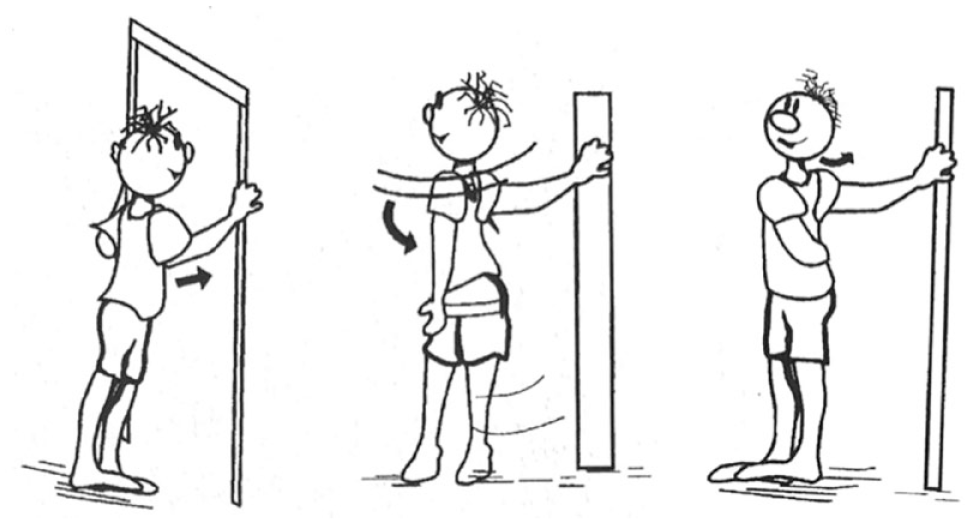
Pectoral stretches—doorway stretch and shoulder twists (Horvath 2003).
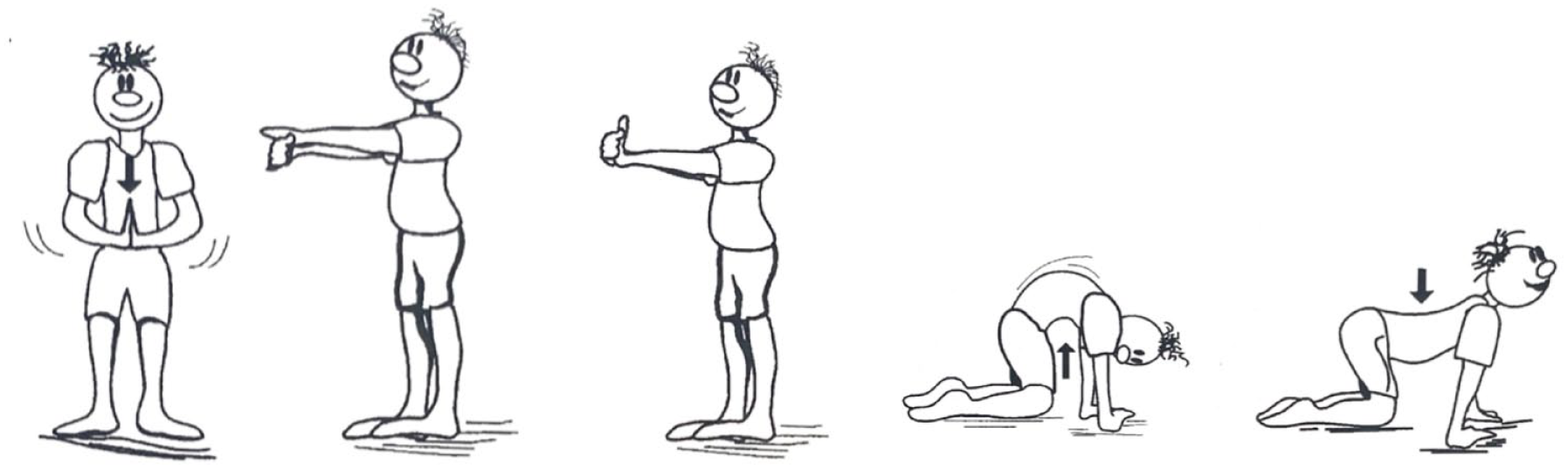
Wrist stretches—forward and backward and lower back stretch—cat cow (Horvath 2003).
It is important to reinforce patience through this process for the adult learner. As seasoned professionals, we have all been using certain muscles and postures for most of our lives to play our instruments successfully. The physical aspect of playing for the adult learner will be very new and will not come quickly in many cases. Emphasis on small successes and paced practicing will be very helpful when muscles are adjusting to these new requirements.
Music as Therapy
Looking back on our survey results, many commented that learning an instrument was a form of therapy and self-care. For this reason, we decided it would be helpful to discuss this topic with a music therapist. We were able to interview Dr. Deforia Lane, a seasoned music therapist and trailblazer in her field. The following quote from Dr. Lane describes a powerful reason as to why learners are drawn to music as both a listener and a participant: The music, especially pleasurable for the person, triggers the body’s natural opioids. As a result, your encapsulants, endorphins, dopamine, and serotonin are being released because you are listening to pleasurable music, or let alone, making pleasurable music. There is a reduction of pain that transpires. (Dr. Deforia Lane in Genadek and Hinkie 2021)
There are certain music therapy techniques we can use when working with our adult learners. The following are specific examples endorsed and encouraged by Dr. Lane:
The Adaptive Approach
Designing a student/teacher duet in which the student plays a simple musical line while the teacher embellishes above that line. This allows the student to have a meaningful musical experience without feeling overwhelmed by technical difficulties.
Visualization
Playing music while visualizing different images and emotions: seasons, scenes, joyful, angry, sad.
Creating lyrics to a melody or song.
Taking out the visual aspect of reading music—have the student close their eyes and just experience the music and connect with their body.
The following guided relaxation exercises can be used as a means of dispersing and alleviating stress either at the beginning of a lesson or throughout the lesson according to each student’s individual needs. Talk your student through these techniques in a calm, quiet voice while their eyes are closed.
Guided Relaxation Exercises
Lemon Imagery Technique
Sit comfortably and breathe slowly for a few minutes. When you are ready, imagine you are standing in your kitchen, or a kitchen you are very familiar with.
On top of the counter is a cutting board with a bright yellow lemon on top. Notice its color, size, and shape. You reach out and pick up the lemon, noticing how it feels to your touch.
Next to the cutting board is a sharp knife. Pick up the knife, hold the lemon steady and cut the lemon in half. Feel the knife slicing through the fruit. It opens to reveal fresh pulp and some seeds inside. Take one half of the lemon and cut it again, making a quarter-size slice.
Put the knife down and bring the lemon quarter up to your nose. You are aware of the sharp, fresh citrus scent. Touch the lemon to your lips, noticing the sensations. Now, open your mouth and bite into the lemon. Slowly open your eyes and discuss what sensations you felt (Gordon 2012).
54321 Technique
5: Acknowledge five things you see around you.
4: Acknowledge four things you can touch around you.
3: Acknowledge three things you hear.
2: Acknowledge two things you can smell.
1: Acknowledge one thing you can taste right now (Smith 2018).
Biofeedback
Have the student take their pulse at the beginning of the lesson. After doing some guided relaxation and playing music during the lesson, have the student take their pulse again to see if there is a reduction in their pulse rate.
Before and after recordings: Much like the previously stated exercise, make a recording of the student playing a scale or simple melody at the beginning of the lesson and at the end to see if they notice a difference in their approach to the instrument.
Our adult students are a very valuable part of our teaching studios. They bring with them a set of unique experiences that require a unique approach. Our experience surveying and studying the findings of adult learners lead us to realize that we need to use a variety of techniques we would not normally use with our younger students. We have found that some of these techniques are useful for students of all ages and ability levels. Changing our perspectives and broadening our skills as teachers allows us to have a greater impact on our entire student population. It is our hope that this article will not only serve as a guide for working with adult learners but also enhance any experienced teacher’s approach to working with all learners.
Footnotes

William Hinkie (
Lindsay Genadek (