



Abstract
In seeking an improved reputation when compared with the “core” academic subjects like math, reading, and science, music educators found a need for common standards. The result was the creation of the first set of National Association for Music Education (1994), which was later updated in the National Association for Music Education (2014). By aligning the goals of all music educators from school to school, the standards function to embed music as an irrevocable discipline which stands alongside its counterparts as a fixture of public education, during times when skeptics of the arts see an opportunity to balance budgets through program cuts (Benedict 2006). Until the creation of standards, music education had often been justified almost entirely by its contributions to cognitive development, core curricular subjects, and to the college-bound trajectory, as though its major value is that it can help boost test scores. Although there is a substantial body of evidence to support these cognitive outcomes, the truth is that no music educator wakes up each morning excited to have an opportunity to help a student do better on their math test as a result of learning to play their horn instrument.
Music as a medium of human communication predates modern science, modern and ancient mathematics, and modern and ancient written language. Studies in human evolution dates the ability to create musically inclined vocalizations to over a million years ago, and instrumental music has ancient roots, with bone pipes dated to over 40,000 years ago, a conch trumpet over 20,000 years old, and string instruments and drums originating over 10,000 years ago (Killin 2018; Montagu 2017). Music’s presence and influence continues today. Car rides, funerals, religion, sports games, videogames, and most other aspects of living incorporate some type of music. Given its cogeneration with human development, the justification of music ought to be self-evident, but following is one approach to a standards-based music education that explicitly deploys the human elements from which music emerges.
Soft Skills in Music Education
In recent decades, many in the field of education have recognized an urgency for the promotion of soft skills through explicit instruction. Employers and college professors are bereaved by the death of these important skills; skills which really are the make-or-break ingredients in college and career readiness. For instance, the job service agency ZipRecruiter® conducts research and has found that the of the three top traits valued by employers, two are soft skills: work ethic and enthusiasm. The same report found that employers feel that interview candidates are most lacking in time management, professionalism, and critical thinking—two of which are soft skills (Pollak 2023). However, it does not take a report on hiring based on soft skills to know that there are critical gaps in young peoples’ social-emotional soft skills; many K–12 educators will corroborate these findings.
Traditionally a parent and community responsibility, educators are now expected to teach kids both academic and social-emotional skills. Perhaps because music is a quasi-biological appendage of humanity, music readily lends itself to teaching soft skills. Many organizations provide support for the new social-emotional goals of public education. One such organization, the Josephson Institute, has produced a comprehensive framework for understanding a variety of soft skills and how they might be organized into larger domain areas or broken down into more narrow skills. According to the Josephson Institute (2023), there are four domains: (1) Academic, (2) Social-Emotional, (3) Character, and (4) School Culture. Within these, there are many specific soft skill areas with definitions.
Soft Skills as Curricular Standards in Music
Although it may be impossible for one classroom or teacher to dedicate instruction to all of the soft skills in the Josephson Institute’s framework, it is possible to identify which soft skills are best supported in each classroom. One team of elementary orchestra educators selected five soft-skill areas from the comprehensive framework (see Figure 1), adopted them as “anchor standards” from which eleven orchestra-specific standards were developed (see Figure 2).
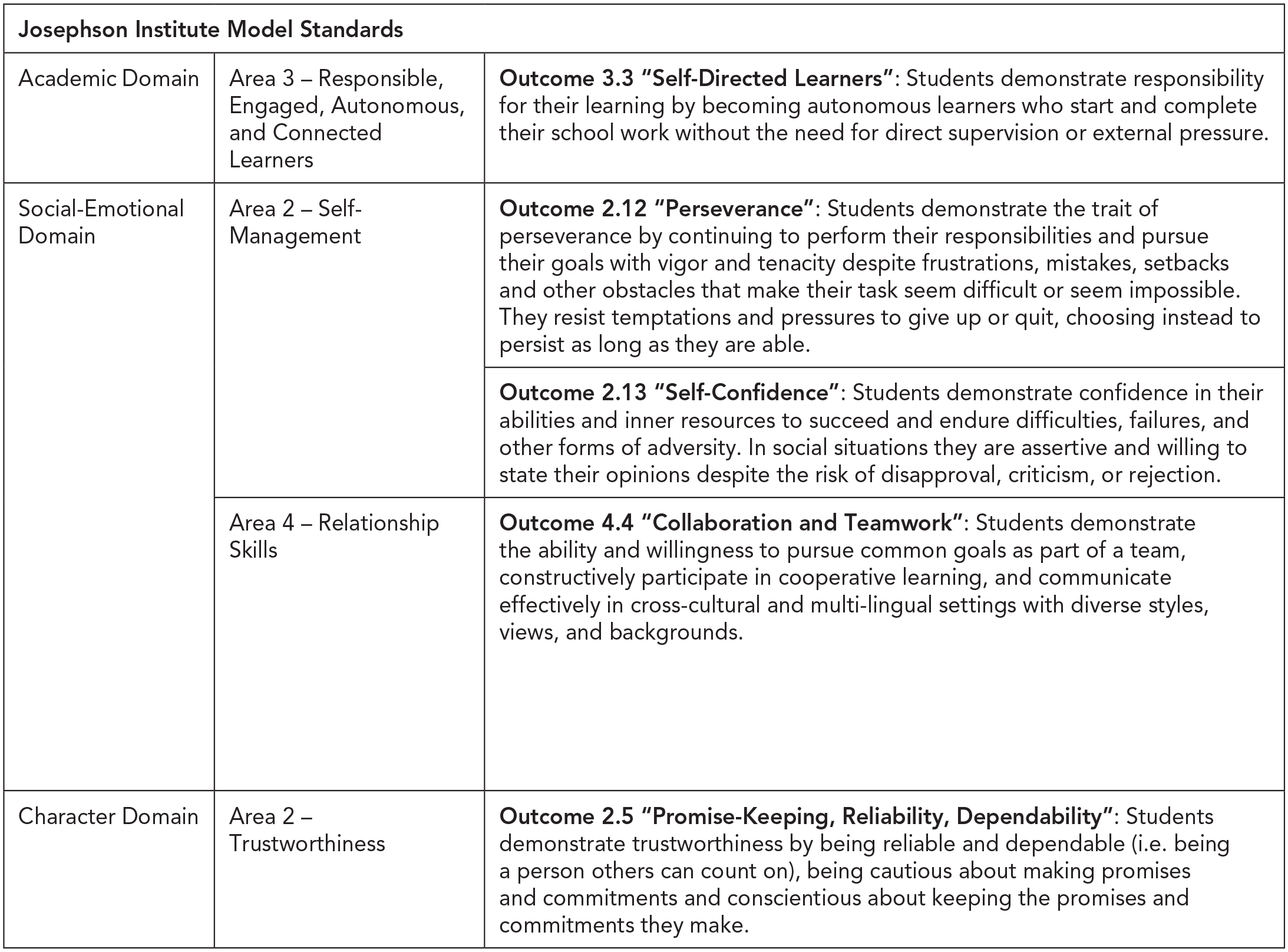
Josephson Institute Model Standards.

Bismarck Public Schools Elementary Orchestra Standards.
This standard set allows three things for the elementary orchestra teachers. First, it gives them freedom to adjust day-to-day learning objectives to fit a target standard. A teacher who sees orchestra students for one day a week can still address these standards directly the same way a teacher, who sees orchestra students five days a week, can. In other words, the standards are specific to parts of instrumental music education at beginner levels, but lesson nonspecific.
Second, the structure of these standards, broad in musical concepts, but specific in socioemotional concepts, allows for differentiation for diverse learners. More than other subject areas, music contends with late joiners to the program, students who enroll in music lessons and accelerate beyond their peers, and everything in between. The learning and expectations of each standard applies to a musician wherever they are in the continuum of their learning, whether “Twinkle Twinkle Little Star” or Dvorak’s “Symphony no. 9: movement IV” is the challenge facing them.
. . . the structure of these standards, broad in musical concepts, but specific in socio-emotional concepts, allows for differentiation for diverse learners.
Third, and maybe more importantly, the standards offer an opportunity to advocate for the meaning larger than the lesson being taught. They help to make the connection to human development and well-being. For example, if a student forgets an instrument, the conversation with the student can start with the importance of being dependable and reliable, as character traits that are essential for all humans. This shifts the focus away from the triviality of not having practiced a D-major scale as a result of lacking an instrument and puts weight on exactly what character gap a forgotten instrument reveals in a child that might need to be addressed. After all, dependability is valued by the orchestra teacher, the hockey coach, the parent, and later, the employer.
Soft Skills as Connection to Other Disciplines
Character-based standardization in music opens the door also for more substantive conversations with general education teachers. Concerns over student learning or behavior can be identified as the need for targeted interventions on a specific soft skill. The student who has issues working in small groups in an orchestra classroom (SE4.4-2) probably has similar social issues in a general classroom working on a science project. The collaboration can focus on improvements in both learning environments, and the results of the intervention are reflected in the gradebook. By proxy, improvement in social skills for working in small groups will increase the student’s proficiency in music-making as well as provide explicit focus on career and community readiness, where working in small groups is a reocurring practice.
Most crucial for music to stand out amidst other options that compete more and more efficiently and effectively for the attention of young people is seeking an answer to the question, “Why music?” Constructing standards that tie into music as a uniquely human endeavor is a powerful opportunity to advocate for music and suggest music as a valuable counter position to screens, tablets, phones, videogames, movie streaming, and so on. Musical education and its benefits to soft-skill development can influence the rising generation in a positive way.
Footnotes

Ross Baumgardner currently serves the Bismarck Public School District as an elementary and middle school orchestra teacher and instructs over 300 students each week at the beginner and intermediate level, nearly tripling student enrollment. A sought-after studio teacher for piano and violin, his students have regularly secured regional and state recognitions. He performs in the Bismarck-Mandan Symphony Orchestra, Minot Symphony Orchestra, and chamber music engagements. Baumgardner graduated from Concordia College with a Bachelor of Music in Music Education with a minor in religion (summa cum laude) and Minnesota State University at Moorhead with a Master of Science in Education.